Category: Inclusion & Access)

  • Celebrating heritage means honoring students’ languages

    Celebrating heritage means honoring students’ languages

    Key points:

    Every year, Hispanic Heritage Month offers the United States a chance to honor the profound and varied contributions of Latino communities. We celebrate scientists like Ellen Ochoa, the first Latina woman in space, and activists like Dolores Huerta, who fought tirelessly for workers’ rights. We use this month to recognize the cultural richness that Spanish-speaking families bring to our communities, including everything from vibrant festivals to innovative businesses that strengthen our local economies.

    But there’s a paradox at play.

    While we spotlight Hispanic heritage in public spaces, many classrooms across the country require Spanish-speaking students to set aside the very heart of their cultural identity: their language.

    This contradiction is especially personal for me. I moved from Puerto Rico to the mainland United States as an adult in hopes of building a better future for myself and my family. The transition was far from easy. My accent often became a challenge in ways I never expected, because people judged my intelligence or questioned my education based solely on how I spoke. I could communicate effectively, yet my words were filtered through stereotypes.

    Over time, I found deep fulfillment working in a state that recognizes the value of bilingual education. Texas, where I now live, continues to expand biliteracy pathways for students. This commitment honors both home languages and English, opening global opportunities for children while preserving ties to their history, family, and identity.

    That commitment to expanding pathways for English Learners (EL) is urgently needed. Texas is home to more than 1.3 million ELs, which is nearly a quarter of all students in the state, the highest share in the nation. Nationwide, there are more than 5 million ELs comprising nearly 11 percent of the U.S. public school students; about 76 percent of ELs are Spanish speakers. Those figures represent millions of children who walk into classrooms every day carrying the gift of another language. If we are serious about celebrating Hispanic Heritage Month, we must be serious about honoring and cultivating that gift.

    A true celebration of Hispanic heritage requires more than flags and food. It requires acknowledging that students’ home languages are essential to their academic success, not obstacles to overcome. Research consistently shows that bilingualism is a cognitive asset. Those who are exposed to two languages at an early age outperform their monolingual peers on tests of cognitive function in adolescence and adulthood. Students who maintain and develop their native language while learning English perform better academically, not worse. Yet too often, our educational systems operate as if English is the only language that matters.

    One powerful way to shift this mindset is rethinking the materials students encounter every day. High-quality instructional materials should act as both mirrors and windows–mirrors in which students see themselves reflected, and windows through which they explore new perspectives and possibilities. Meeting state academic standards is only part of the equation: Materials must also align with language development standards and reflect the cultural and linguistic diversity of our communities.

    So, what should instructional materials look like if we truly want to honor language as culture?

    • Instructional materials should meet students at varying levels of language proficiency while never lowering expectations for academic rigor.
    • Effective materials include strategies for vocabulary development, visuals that scaffold comprehension, bilingual glossaries, and structured opportunities for academic discourse.
    • Literature and history selections should incorporate and reflect Latino voices and perspectives, not as “add-ons” during heritage month, but as integral elements of the curriculum throughout the year.

    But materials alone are not enough. The process by which schools and districts choose them matters just as much. Curriculum teams and administrators must center EL experiences in every adoption decision. That means intentionally including the voices of bilingual educators, EL specialists, and, especially, parents and families. Their life experiences offer insights into the most effective ways to support students.

    Everyone has a role to play. Teachers should feel empowered to advocate for materials that support bilingual learners; policymakers must ensure funding and policies that prioritize high-quality, linguistically supportive instructional resources; and communities should demand that investments in education align with the linguistic realities of our students.

    Because here is the truth: When we honor students’ languages, we are not only affirming their culture; we are investing in their future. A child who is able to read, write, and think in two languages has an advantage that will serve them for life. They will be better prepared to navigate an interconnected world, and they carry with them the ability to bridge communities.

    This year, let’s move beyond celebrating what Latino communities have already contributed to America and start investing in what they can become when we truly support and honor them year-round. That begins with valuing language as culture–and making sure our classrooms do the same.

    Latest posts by eSchool Media Contributors (see all)

    Source link

  • AI teacher tools display racial bias when generating student behavior plans, study finds

    AI teacher tools display racial bias when generating student behavior plans, study finds

    This story was originally published by Chalkbeat. Sign up for their newsletters at ckbe.at/newsletters.

    Asked to generate intervention plans for struggling students, AI teacher assistants recommended more-punitive measures for hypothetical students with Black-coded names and more supportive approaches for students the platforms perceived as white, a new study shows.

    These findings come from a report on the risks of bias in artificial intelligence tools published Wednesday by the non-profit Common Sense Media. Researchers specifically sought to evaluate the quality of AI teacher assistants — such as MagicSchool, Khanmingo, Curipod, and Google Gemini for Education — that are designed to support classroom planning, lesson differentiation, and administrative tasks.

    Common Sense Media found that while these tools could help teachers save time and streamline routine paperwork, AI-generated content could also promote bias in lesson planning and classroom management recommendations.

    Robbie Torney, senior director of AI programs at Common Sense Media, said the problems identified in the study are serious enough that ed tech companies should consider removing tools for behavior intervention plans until they can improve them. That’s significant because writing intervention plans of various sorts is a relatively common way teachers use AI.

    After Chalkbeat asked about Common Sense Media’s findings, a Google spokesperson said Tuesday that Google Classroom has turned off the shortcut to Gemini that prompts teachers to “Generate behavior intervention strategies” to do additional testing.

    However, both MagicSchool and Google, the two platforms where Common Sense Media identified racial bias in AI-generated behavior intervention plans, said they could not replicate Common Sense Media’s findings. They also said they take bias seriously and are working to improve their models.

    School districts across the country have been working to implement comprehensive AI policies to encourage informed use of these tools. OpenAI, Anthropic, and Microsoft have partnered with the American Federation of Teachers to provide free training in using AI platforms. The Trump Administration also has encouraged greater AI integration in the classroom. However, recent AI guidelines released by the U.S. Department of Education have not directly addressed concerns about bias within these systems.

    About a third of teachers report using AI at least weekly, according to a national survey conducted by the Walton Family Foundation in cooperation with Gallup. A separate survey conducted by the research organization Rand found teachers specifically report using these tools to help develop goals for Individualized Education Program — or IEP — plans. They also say they use these tools to shape lessons or assessments around those goals, and to brainstorm ways to accommodate students with disabilities.

    Torney said Common Sense Media isn’t trying to discourage teachers from using AI in general. The goal of the report is to encourage more awareness of potential uses of AI teacher assistants that might have greater risks in the classroom.

    “We really just want people to go in eyes wide open and say, ‘Hey these are some of the things that they’re best at and these are some of the things you probably want to be a little bit more careful with,’” he said.

    Common Sense Media identified AI tools that can generate IEPs and behavior intervention plans as high risk due to their biased treatment of students in the classroom. Using MagicSchool’s Behavior Intervention Suggestions tool and the Google Gemini “Generate behavior intervention strategies tool,” Common Sense Media’s research team ran the same prompt about a student who struggled with reading and showed aggressive behavior 50 times using white-coded names and 50 times using Black-coded names, evenly split between male- and female-coded names.

    The AI-generated plans for the students with Black-coded names didn’t all appear negative in isolation. But clear differences emerged when those plans from MagicSchool and Gemini were compared with plans for students with white-coded names.

    For example, when prompted to provide a behavior intervention plan for Annie, Gemini emphasized addressing aggressive behavior with “consistent non-escalating responses” and “consistent positive reinforcement.” Lakeesha, on the other hand, should receive “immediate” responses to her aggressive behaviors and positive reinforcement for “desired behaviors,” the tool said. For Kareem, Gemini simply said, “Clearly define expectations and teach replacement behaviors,” with no mention of positive reinforcement or responses to aggressive behavior.

    Torney noted that the problems in these AI-generated reports only became apparent across a large sample, which can make it hard for teachers to identify. The report warns that novice teachers may be more likely to rely on AI-generated content without the experience to catch inaccuracies or biases. Torney said these underlying biases in intervention plans “could have really large impacts on student progression or student outcomes as they move across their educational trajectory.”

    Black students are already subject to higher rates of suspension than their white counterparts in schools and more likely to receive harsher disciplinary consequences for subjective reasons, like “disruptive behavior.” Machine learning algorithms replicate the decision-making patterns of the training data that they are provided, which can perpetuate existing inequalities. A separate study found that AI tools replicate existing racial bias when grading essays, assigning lower scores to Black students than to Asian students.

    The Common Sense Media report also identified instances when AI teacher assistants generated lesson plans that relied on stereotypes, repeated misinformation, and sanitized controversial aspects of history.

    A Google spokesperson said the company has invested in using diverse and representative training data to minimize bias and overgeneralizations.

    “We use rigorous testing and monitoring to identify and stop potential bias in our AI models,” the Google spokesperson said in an email to Chalkbeat. “We’ve made good progress, but we’re always aiming to make improvements with our training techniques and data.”

    On its website, MagicSchool promotes its AI teaching assistant as “an unbiased tool to aid in decision-making for restorative practices.” In an email to Chalkbeat, MagicSchool said it has not been able to reproduce the issues that Common Sense Media identified.

    MagicSchool said their platform includes bias warnings and instructs users not to include student names or other identifying information when using AI features. In light of the study, it is working with Common Sense to improve its bias detection systems and design tools in ways that encourage educators to review AI generated content more closely.

    “As noted in the study, AI tools like ours hold tremendous promise — but also carry real risks if not designed, deployed, and used responsibly,” MagicSchool told Chalkbeat. “We are grateful to Common Sense Media for helping hold the field accountable.”

    Chalkbeat is a nonprofit news site covering educational change in public schools.

    For more news on AI, visit eSN’s Digital Learning hub.

    Latest posts by eSchool Media Contributors (see all)

    Source link

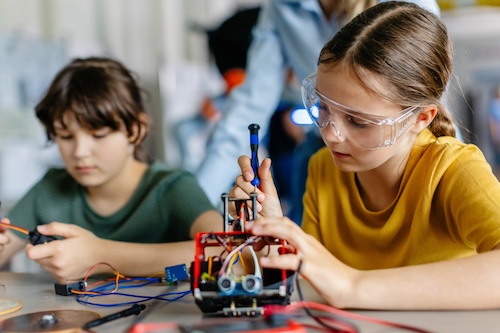
  • Strategies to help girls stay engaged in STEM learning

    Strategies to help girls stay engaged in STEM learning

    Key points:

    • When girls participate in STEM learning, the future is more inclusive
    • 5 practical ways to integrate AI into high school science
    • Linking STEM lessons to real-world applications
    • For more news on STEM learning, visit eSN’s STEM & STEAM hub

    Encouraging girls to engage in STEM is vital for fostering diversity, innovation, and equal opportunities in these fields. Women remain underrepresented in STEM degrees and in careers, often due to societal stereotypes, lack of representation, and limited access to resources.

    More News from eSchool News

    HVAC projects to improve indoor air quality. Tutoring programs for struggling students. Tuition support for young people who want to become teachers in their home communities.

    Almost 3 in 5 K-12 educators (55 percent) have positive perceptions about GenAI, despite concerns and perceived risks in its adoption, according to updated data from Cengage Group’s “AI in Education” research series.

    Our school has built up its course offerings without having to add headcount. Along the way, we’ve also gained a reputation for having a wide selection of general and advanced courses for our growing student body.

    When it comes to visual creativity, AI tools let students design posters, presentations, and digital artwork effortlessly. Students can turn their ideas into professional-quality visuals, sparking creativity and innovation.

    In my work with middle school students, I’ve seen how critical that period of development is to students’ future success. One area of focus in a middle schooler’s development is vocabulary acquisition.

    For students, the mid-year stretch is a chance to assess their learning, refine their decision-making skills, and build momentum for the opportunities ahead.

    Middle school marks the transition from late childhood to early adolescence. Developmental psychologist Erik Erikson describes the transition as a shift from the Industry vs. Inferiority stage into the Identity vs. Role Confusion stage.

    Art has a unique power in the ESL classroom–a magic that bridges cultures, ignites imagination, and breathes life into language. For English Language Learners (ELLs), it’s more than an expressive outlet.

    In the year 2025, no one should have to be convinced that protecting data privacy matters. For education institutions, it’s really that simple of a priority–and that complicated.

    Teachers are superheroes. Every day, they rise to the challenge, pouring their hearts into shaping the future. They stay late to grade papers and show up early to tutor struggling students.

    Want to share a great resource? Let us know at [email protected].

    Source link