Category: Indiana

  • 3,000 Children Repeating Third Grade Under New Indiana Literacy Requirement – The 74

    3,000 Children Repeating Third Grade Under New Indiana Literacy Requirement – The 74


    Get stories like this delivered straight to your inbox. Sign up for The 74 Newsletter

    About 3,000 Indiana students are repeating third grade this school year for not meeting the state’s reading proficiency standards.

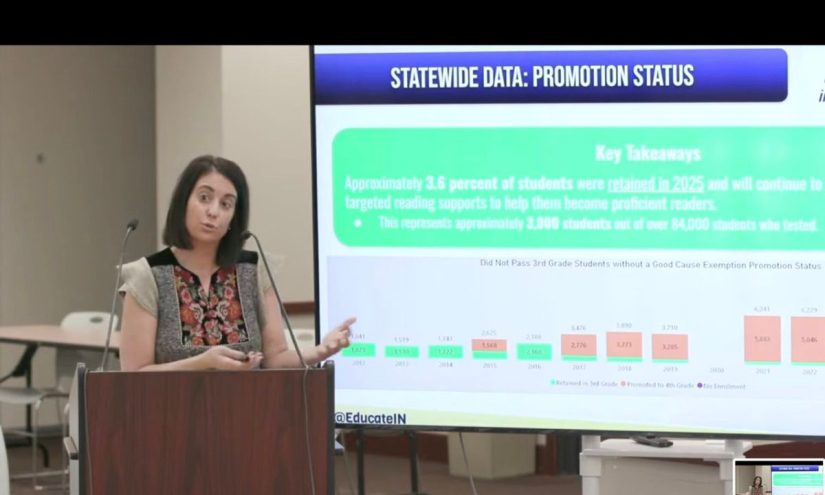
    Data released Wednesday by the Indiana Department of Education showed 3.6% of the 84,000 children who took the statewide IREAD exam were retained in third grade under the first enforcement of a requirement approved by the Legislature in 2024.

    Those 3,040 retained students are more than seven times the 412 children held back in third grade two years ago.

    Education Secretary Katie Jenner credited improved performance by students in the IREAD exam given last school year with the retention figure being lower than anticipated when the literacy requirement was being debated.

    “The numbers that were being thrown out is that it would be 7,000 to 10,000 that this law would trigger retention,” Jenner told State Board of Education members. “But, in fact, a huge shout out to our teachers and our people, we have thousands of kids who are now readers.”

    Education officials announced in August that 87.3% of third graders — about 73,500 out of more than 84,000 students statewide — demonstrated proficient reading skills in 2024-25. They hailed the nearly five percentage point improvement from the previous school year as the largest year-to-year jump since the state began IREAD testing in 2013.

    That left about 10,600 children who didn’t meet the standard, with almost 7,000 being given “good cause exemptions” to avoid retention. Nearly 75% of those given exemptions were special education students and about 24% are English learners with less than two years of specific literacy services.

    Anna Shults, the Department of Education’s chief academic officer, said the new retention requirement was having its intended effect.

    “We are now ensuring that students that are promoted on to grade four are doing so with an ability to read and show mastery of key foundational reading skills,” Shults told the State Board of Education.

    The Department of Education will have an online dashboard providing breakdowns of the Indiana Reading Evaluation and Determination assessment, or IREAD, by school district and individual schools, including charter schools and nonpublic schools.

    Officials noted about 670 children who didn’t meet the literacy standards were not enrolled in Indiana schools this year, saying they likely moved out of state or were being homeschooled.

    Jenner said a determination would need to be made about those students if they returned to Indiana schools.

    “That’s a question that we’ll need to sort through, because some may move back into Indiana, or if they left for homeschool may come back in,” Jenner said. “Because we’re looking at every unique student, I think we’ll try to figure out exactly where they are.”

    According to 2023 data, 13,840 third-graders did not pass I-READ-3. Of those, 5,503 received an exemption and 8,337 did not. Of those without an exemption, 95% moved onto 4th grade while only 412 were retained.

    Indiana Capital Chronicle is part of States Newsroom, a nonprofit news network supported by grants and a coalition of donors as a 501c(3) public charity. Indiana Capital Chronicle maintains editorial independence. Contact Editor Niki Kelly for questions: [email protected].


    Did you use this article in your work?

    We’d love to hear how The 74’s reporting is helping educators, researchers, and policymakers. Tell us how

    Source link

  • Indianapolis Public Schools to Transfer Two Closed School Buildings to Settle Legal Battle – The 74

    Indianapolis Public Schools to Transfer Two Closed School Buildings to Settle Legal Battle – The 74


    Get stories like this delivered straight to your inbox. Sign up for The 74 Newsletter

    Indianapolis Public Schools will put one closed school building up for lease or sale to charter schools for $1 and will sell another to a local nonprofit, the district announced Friday.

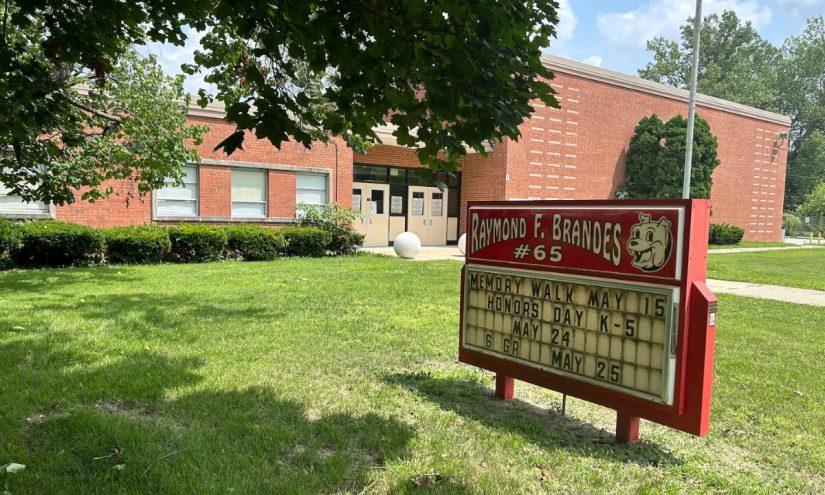
    The transfer of the buildings that used to house Raymond Brandes School 65 and Francis Bellamy School 102 stems from an Indiana Court of Appeals ruling in a lengthy battle over the state’s so-called $1 law, which requires districts to transfer unused school buildings to charter schools for the sale or lease price of $1. The court ruled in May that IPS must sell School 65.

    The announcement also comes as the Indianapolis Local Education Alliance ponders how to solve facility challenges for both IPS, which continues to lose students in its traditional schools every year, and charters, which frequently struggle to acquire school buildings.

    The district said in a statement that Damar Charter Academy, a school for students with developmental and behavioral challenges in Decatur Township, had reached out to IPS to express interest in School 65 — which is located on the southeast side of IPS. The district does not have the power to pick which charter school it will sell a building to — if more than one charter school is interested, state law requires a committee to decide.

    On Monday, Damar confirmed to Chalkbeat that it is interested in School 65.

    In the statement, the district said it would prefer to “move forward with disposition” of School 65 through a collaborative community process.

    “But, we respect the court’s decision and will proceed in full compliance with that order,” IPS Superintendent Aleesia Johnson said. “If the building is claimed by a charter school, we think Damar has a strong record of serving some of the most vulnerable and underserved students in our city and I have confidence that acquiring Raymond Brandes will allow them to expand their operations to serve even more students.”

    Meanwhile, the district will sell School 102 to Voices, a nonprofit that works with youth, for $550,000. The district had already leased the school on the Far Eastside to Voices, which also shares the space with two other youth programs.

    “Indianapolis Public Schools is committed to continuing to engage with our community on thoughtful re-use of our facilities and to being good stewards of our public assets,” Johnson said in a statement. “We are excited to move forward with our planned sale of the Francis Bellamy 102 building to VOICES and to see their impact in serving our community continue for many years into the future.”

    This story was originally published on Chalkbeat. Chalkbeat is a nonprofit news site covering educational change in public schools.


    Get stories like these delivered straight to your inbox. Sign up for The 74 Newsletter

    Source link

  • Shortage of Rural Private Schools Complicates Indiana’s Voucher Expansion – The 74

    Shortage of Rural Private Schools Complicates Indiana’s Voucher Expansion – The 74


    Get stories like this delivered straight to your inbox. Sign up for The 74 Newsletter

    Sitting on the Kentucky border, the Christian Academy of Indiana draws students from 56 different ZIP codes in southern Indiana. Some come from as far as 30 miles away and live in counties without private schools.

    Families in those distant communities make the drive every day — sometimes carpooling — because they’re drawn to the school’s environment and extracurriculars, and especially its Christian teaching, said Lorrie Baechtel, director of admissions for the school, which is part of a three-school network in Indiana and Kentucky.

    “There are lots of good public school options in Indiana. Families come to our Indiana campus more for that mission,” Baechtel said.

    The school’s enrollment has boomed in the last four years, driven in part by the expansion of the Choice Scholarship, Indiana’s signature voucher program. That’s made tuition more affordable, Baechtel said. More than 1,200 students attended in 2024-2025, up from around 700 in 2021-22.

    That reflects a statewide trend: Voucher use has surged in recent years as Indiana lawmakers loosened eligibility requirements. In 2026, the program will open to all families, regardless of income.

    But the Christian Academy’s ability to attract students from far away tells another story too. Even as vouchers have become more accessible, Indiana’s rural students aren’t using them at the same rate as their urban and suburban peers. That’s in part because one-third of counties don’t have a private school that accepts vouchers within their borders, and distance is a factor in parents’ decisions on school choice.

    The result is that students who live closer to an urban center — which typically have one or more voucher-accepting private schools — may use vouchers at rates up to 30 percentage points higher than those for students who live in a neighboring district.

    That also means rural families may be at a significant disadvantage when the state opens the Choice Scholarship to all, and when private school scholarships funded by new federal tax credits also begin to roll out in 2027.

    “If there are no schools there for you to attend it’s unlikely it’s going to be all that useful for you,” said Jon Valant, director of the Brown Center on Education Policy at the Brookings Institution.

    More than that, public education advocates say splitting state school funding with vouchers leaves less for the rural public schools these students do attend.

    “We’re making the policy choice to fund a lot more choices than we used to,” said Chris Lagoni, executive director of the Indiana Small and Rural Schools Association, which represents public schools. “We’re inviting more and more folks to Sunday dinner. It’s a little bit of a bigger meal, but a lot more guests.”

    But the state’s Republican lawmakers have dismissed the fears of a hit to public rural schools as a result of vouchers, saying that rural voters support choice and parents want educational options — whether that’s private, charter, or traditional public schools.

    Meanwhile, school choice advocates say the latest expansion of the Choice Scholarship, along with a growing preference for smaller learning environments and the rise of voucher-accepting online schools, could mean more private school access for rural areas in the near future.

    “I think we’re best when we have a robust ecosystem of private and public options,” said Eric Oglesbee of the Drexel Fund, a nonprofit venture philanthropy organization that funds new private schools in Indiana and throughout the U.S.

    Location matters in accessing a private school

    Across the state, around 76,000 students received vouchers for the 2024-25 school year — an increase of about 6,000 students from the year before. The program cost the state $497 million last year, and the average voucher recipient came from a household with just over $100,000 in income.

    But around one-third of Indiana counties don’t have voucher-accepting private schools within their borders, according to a Chalkbeat analysis of state data, which also shows that voucher use is lower in rural areas than urban ones.

    Voucher use can shift dramatically even between nearby areas. For example, around 16% of students who reside in the Madison school district in southern Indiana use vouchers, but that rate drops to as low as 1% in nearby districts that are more rural. Similar trends hold in other areas of the state, like Indianapolis, Evansville, Fort Wayne, and South Bend.

    Location matters because driving distance has been shown to be a factor in how parents choose a school.

    In a 2024 survey of parent preferences by EdChoice, an Indianapolis-based group that supports vouchers, around half of parents said they would drive a max of 15 minutes for their children “to attend a better school.” Just over a quarter said they would drive no more than 20 minutes, and the final quarter said 30 minutes would be their max.

    Concerns about this issue have persisted in the state for years. Alli Aldis of the advocacy group EdChoice pointed to a 2018 report from her organization that called areas of rural Indiana as “schooling deserts.” It estimated that in the 2017-18 school year, around 3% of Indiana students, many in rural counties, lived more than 30 minutes from a charter, magnet, or voucher-accepting private school.

    Starting a new school anywhere, but particularly in a rural area, comes with challenges like finding a building, said Oglesbee of the Drexel Fund.

    A 2023 Drexel Fund report found that facilities in the state are “inadequate to meet the needs of new entrants to the market.” Though the report notes that real estate is both affordable and available, there are no public sources of facilities funding, and surplus facilities are not available to private schools.

    But new laws in Indiana have the potential to change that. House Enrolled Act 1515 established voluntary school facility pilot programs open to both public and private schools to “allow for additional flexibility and creativity in terms of what is considered a school facility,” like colocating with schools, government entities, and community organizations.

    Oglesbee said the organization is fielding an explosion of interest from potential new private schools in Indiana, possibly as a latent result of the 2023 expansion to voucher eligibility, which made the program nearly universal.

    School succeeds ‘if the community asks for it’

    Other challenges to opening a private school include hiring staff and recruiting students, which can be a particular issue in rural areas with both fewer children and licensed teachers, advocates said.

    Opening a school also requires a team of people with both education and business experience, Oglesbee said. And they’re more likely to succeed if they have roots in the community they hope to serve.

    “I see less of the ‘if you build it, they will come’ idea,” Oglesbee said. “A school is successful if the community asks for it.”

    At a recent conservative policy conference, Indiana House Speaker Todd Huston said rural Indiana communities were “super excited” for school choice, and noted that no Republican lawmaker had been beaten in a primary for supporting the policy.

    But Indiana voters haven’t voted on school vouchers, and don’t have a legal avenue to overturn the policy, said Chris Lubienski of the Center for Evaluation and Education Policy at Indiana University. Last year, voters in Kentucky and Colorado rejected ballot measures in favor of school choice, while Nebraska voters partially repealed a state-funded scholarship program.

    “There’s resistance: ‘Why do I want to have my taxes fund a program I can’t use?’” Lubienski said.

    In rural areas, support for school choice may actually mean support for transfers between public school districts, said Lagoni.

    Ultimately, the Rural Schools Association believes any school receiving state dollars should be subject to the same expectations of transparency and accountability, Lagoni said.

    Asked about concerns that rural students often have difficulty using vouchers, Huston said he expects voucher usage to continue to grow once the program becomes universal in 2026-27.

    “We want to make sure our policies align with what works best for families,” Huston said.

    Vouchers add to financial stress for rural schools

    With more school options in Indiana, downward pressure on local tax revenue, and declining population, rural public schools feel pressure to compete. Sometimes that means closing and consolidating schools.

    Vigo County schools recently announced plans to close two rural elementary schools as part of a plan to renovate facilities and offer more programming. The school corporation’s enrollment has declined slightly, due in part to an overall decline in the county’s total population, said spokesperson Katie Shane.

    More students who reside in the district are using vouchers, although they’re not the biggest reason for the district’s falling enrollment. While 429 students used vouchers to attend private schools last school year, an increase from 252 the year before, around 870 Vigo students transferred to another public school district in the fall of the 2024-25 school year. That reflects a statewide trend.

    Without their nearest public elementary schools, students may have to travel by bus for half an hour or more to the nearest school, according to community members who have started a petition to save one of the two schools marked for closure, Hoosier Prairie Elementary School.

    “Hoosier Prairie isn’t just about going to school,” said Shyann Koziatek, an educational assistant at the school who also signed the petition to stop its closure. “Kids love to learn and love the routine we have.”

    Rural schools also often function as large area employers and drivers of the economy.

    “Schools are often the center and identity of the community, how people view who they are,” Lubienski said. “You go and cheer on your football team, it’s where you put on your school play.”

    But private schools can serve the same role, choice advocates say.

    “If people have stronger educational options, more choices, that only strengthens the community,” said Aldis of EdChoice.

    Chalkbeat is a nonprofit news site covering educational change in public schools. This story was originally published by Chalkbeat. Sign up for their newsletters at ckbe.at/newsletters.


    Get stories like these delivered straight to your inbox. Sign up for The 74 Newsletter

    Source link

  • Flat Federal Funding Stymies Head Start as State Child Care Resources Diminish – The 74

    Flat Federal Funding Stymies Head Start as State Child Care Resources Diminish – The 74


    Get stories like this delivered straight to your inbox. Sign up for The 74 Newsletter

    Despite having some of the most resources and economic support, a recent national study ranked Indiana’s early education system 42nd in the country — and second-to-last when it came to accessibility.

    The WalletHub story, shared earlier this week, is simply the latest confirmation for Hoosier parents that Indiana’s child care market is struggling. Experts, business leaders and politicians agree that Indiana needs more child care, but can’t seem to agree on the best way to meet the moment.

    Facing budgetary pressures and depressed revenue forecasts, state leaders opted to trim funding and narrow eligibility for early learning and child care resources earlier this year. Seats for state-funded preschool, known as On My Way Pre-K, have been halved while vouchers for subsidized child care have more 21,000 children on a waitlist.

    One federal program, Head Start Indiana, hopes to help close the gap left by vanishing state funding, but faces its own challenges with flat federal funding.

    “We are the quietest, most successful 60-year old program in the federal government’s history,” boasted Rhett Cecil, the organization’s executive director. “… (our programs) are going to support their families and children. They’re allowing families to work or get job training or further education. And our services — that child care and early education — are free for those families.”

    Just under 13,000 families in all 92 counties utilize the program, which receives roughly $181 million in federal funding annually. That budget line was briefly threatened by the Trump administration, which walked back proposed cuts in favor of flat funding — which does mean services will be lost as inflation and other costs eat into the bottom line.

    The second-term president also eliminated the federal Head Start office covering Indiana back in April — though the federal Administration for Children and Families announced it would dedicate one-time funding to Head Start locations earlier this week explicitly for nutrition, but not for other programming costs.

    Additional federal support could allow it to expand to meet the need following state cuts, leaders hope, and continue employing almost 4,000 Hoosiers.

    “Let’s say, hypothetically, we get $100 million more dollars. How many more teachers and classrooms could be opened?” Cecil mused. “How many kids could we serve off that waitlist?”

    Importance of child care

    Participating in and access to child care resources reaps benefits for young Hoosiers, such as better school readiness skills. Some national research has found that early education may also decrease future crime and could generate $7.30 for every one dollar invested.

    In Indiana, the shortage of child care options costs the state an estimated $4.2 billion annually, over a quarter of which is linked to annual tax revenue lost.

    The 2024 study from the Indiana Chamber of Commerce emphasized the need to free up parents, mostly women, who’ve left the workforce “as a direct result of childcare-related issues.”

    “There’s some data out there that one in four Hoosier parents leave their job over child care gaps, and it really impacts talent and workforce,” said David Ober, the chamber’s vice president of taxation and public finance. “It’s hindering economic momentum in the state and so it is a huge deal for us.”

    For the last few years, tackling the state’s child care crisis has been a top legislative priority for the organization, which represents the interests of thousands of Hoosier employers. Ober said the chamber is working to plan a child care summit later this year to identify potential solutions.

    According to Brighter Futures Indiana, average full-time weekly care costs families $181 per week — with even higher prices for infants and toddlers. That doesn’t factor in type of care or quality, and prices vary by community.

    Families can spend more on their young children’s care than on a college education — if it’s even available in their communities. Rather than pay the price, many Hoosier parents simply drop out of the workforce at the same time that employers are scrambling to hire talent.

    Ober highlighted recent legislative efforts to expand child care, including one that expanded a tax credit for employers directly providing their employees with child care resources. Other bills have tweaked staffing ratios and created a pilot program for so-called microcenters.

    But workforce remains a challenge, even for Head Start centers, earning its own legislative study carveout. Over 20% of Indiana’s child care workers left the field during the pandemic — a shock that “has not really fully healed,” Ober said.

    “If you ask any provider in the state, workforce is the hardest problem,” Ober said. “… How do you get educators and keep them? There’s so much more work to be done there and it’s challenging.”

    Traditional market forces struggle to balance affordability for parents against costs for child care, a gap sometimes covered by government subsidies.

    But Ober insisted that “child care is infrastructure,” especially for the businesses reliant upon employees who are parents. Changing funding is “going to just exacerbate underlying problems,” he added.

    “Those numbers are pretty stark,” Ober said. “And then when you add in changes at the state and the federal level, it creates new problems that we all have to come together and work on,” he concluded.

    Indiana Capital Chronicle is part of States Newsroom, a nonprofit news network supported by grants and a coalition of donors as a 501c(3) public charity. Indiana Capital Chronicle maintains editorial independence. Contact Editor Niki Kelly for questions: [email protected].


    Get stories like these delivered straight to your inbox. Sign up for The 74 Newsletter

    Source link

  • Indiana Middle Schoolers’ English Scores Have Fallen. These Schools are Bucking the Trend. – The 74

    Indiana Middle Schoolers’ English Scores Have Fallen. These Schools are Bucking the Trend. – The 74


    Get stories like this delivered straight to your inbox. Sign up for The 74 Newsletter

    Like their peers nationwide, students at Crawford County Middle School in southern Indiana struggled academically in the pandemic’s wake. Principal Tarra Carothers knew her students needed help to get back on track.

    So two years ago, she decided to double instructional time for math and English. Students now spend two periods per day in these critical subjects. Carothers believes the change has been a success, and a key trend backs her up: Crawford’s ILEARN scores in English language arts increased by over 8 percentage points from 2024 to 2025.

    But overall, Indiana middle schools are heading in the opposite direction when it comes to English. In fact, despite gains in math, middle schoolers are struggling more than students in other grade levels in English, state test scores show. Since 2021, ILEARN English proficiency rates in seventh and eighth grades have fallen, with the dip particularly pronounced for seventh graders. And while their scores are up slightly compared with four years ago, sixth graders’ performance fell over the past year.

    Indiana has made significant and much-publicized investments in early literacy, relying heavily on the science of reading, as many states have in the last few years. But that instructional transformation has come too late for current middle schoolers. Meanwhile, ILEARN English scores for third and fourth graders have risen by relatively small levels since the pandemic, although this improvement has been uneven.

    The Board of Education expressed specific concerns about middle schoolers’ performance at a July 16 meeting. “We’ve gotta pick it up and make sure all of our middle school kids are reading, provide those additional supports,” said Secretary of Education Katie Jenner.

    Some middle school leaders say strategies they’ve used can turn things around. In addition to increasing instructional time for key subjects, they point to participation in a pilot that allows students to take ILEARN at several points over the school year, instead of just once in the spring. Educators say relying on these checkpoints can provide data-driven reflection and remediation for students that shows up in better test scores.

    Middle school an ‘optimum time’ for students’ recovery

    Katie Powell, director for middle level programs at the Association for Middle Level Education, said she often asks teachers if middle schoolers seem different since the pandemic and “heads nod,” she said. These post-pandemic middle schoolers are harder to motivate and engage, self-report more stress, and are less likely to take risks academically, Powell said.

    When the pandemic hit, “they were young, at the age of school where they’re developing basic reading fluency and math fact fluency,” she said. Current eighth graders, for example, were in second grade when the pandemic shut down schools and many learned online for much of their third grade year. Third grade is when students are supposed to stop learning to read and start “reading to learn,” Powell said.

    Powell noted that middle schoolers are in the stage of rapid development with the most changes for the brain and body outside of infancy.

    “This is actually an optimum time to step in and step up for them,” she said. “It is not too late. But it’s critical that we pay attention to them now.”

    Crawford County Middle School has nine periods every day, and students spend two periods each in both math and English. While many schools have some version of block scheduling, many have a model in which students only go to each class every other day. But at Crawford, students attend every class every day. Their version of block scheduling results in double the amount of instructional time in math and English.

    To make this switch, sacrifices had to be made. Periods were shortened, resulting in less time for other subjects. Carothers worried that student scores in subjects like science and social studies would decrease. But the opposite occurred, she said. Sixth grade science scores increased, for example, even though students were spending less time in the science classroom, according to Carothers.

    “If they have better math skills and better reading skills, then they’re gonna perform better in social studies and science,” she said.

    Meanwhile, at Cannelton Jr. Sr. High School, on the state line with Kentucky, the first three periods of the day are 90 minutes, rather than the typical 45. Every student has English or math during these first three periods, allowing for double the normal class time.

    Cannelton’s sixth through eighth grade English language arts ILEARN scores increased by nearly nine percentage points last year.

    Schools use more data to track student performance

    Cannelton Principal Brian Garrett believes his school’s reliance on data, and its new approach to getting it, is also part of their secret.

    Students take benchmark assessments early, in the first two or three weeks of school, so that teachers can track their progress and find gaps in knowledge.

    This year, the state is adopting that strategy for schools statewide. Rather than taking ILEARN once near the end of the year, students will take versions of the test three separate times, with a shortened final assessment in the spring. The state ran a pilot for ILEARN checkpoints last school year, with over 70% of Indiana schools taking part.

    The Indiana Department of Education hopes checkpoints will make the data from the test more actionable and help families and teachers ensure a student is on track throughout the year.

    Kim Davis, principal of Indian Creek Middle School in rural Trafalgar, said she believes ILEARN checkpoints, paired with reflection and targeted remediation efforts by teachers, “helped us inform instruction throughout the year instead of waiting until the end of the year to see did they actually master it according to the state test.”

    The checkpoints identified what standards students were struggling with, allowing Indian Creek teachers to tailor their instruction. Students also benefitted from an added familiarity with the test; they could see how questions would be presented when it was time for the final assessment in the spring.

    “It felt very pressure-free, but very informative for the teachers,” Davis said.

    The type of data gathered matters too. In the past, Washington Township middle schools used an assessment called NWEA, taken multiple times throughout the year, to measure student learning, said Eastwood Middle School Principal James Tutin. While NWEA was a good metric for measuring growth, it didn’t align with Indiana state standards, so the scores didn’t necessarily match how a student would ultimately score on a test like ILEARN.

    Last year, the district adopted ILEARN checkpoints instead, and used a service called Otis to collect weekly data.

    It took approximately six minutes for students to answer a few questions during a class period with information that educators could then put into Otis. That data allowed teachers to target instruction during gaps between ILEARN checkpoints.

    “Not only were they getting the practice through the checkpoints, but they were getting really targeted feedback at the daily and weekly level, to make sure that we’re not waiting until the checkpoint to know how our students are likely going to do,” Tutin said.

    Both Davis and Tutin stressed that simply having students take the checkpoint ILEARN tests was not enough; it had to be paired with reflection and collaboration between teachers, pushing each other to ask the tough questions and evaluate their own teaching.

    “We still have a fire in us to grow further, we’re not content with where we are,” Davis said. “But we’re headed in the right direction and that’s very exciting.”

    This story was originally published by Chalkbeat. Chalkbeat is a nonprofit news site covering educational change in public schools. Sign up for their newsletters at ckbe.at/newsletters


    Get stories like these delivered straight to your inbox. Sign up for The 74 Newsletter

    Source link

  • Indiana’s College-Going Rate Drops Again, Dipping to 51.7% – The 74

    Indiana’s College-Going Rate Drops Again, Dipping to 51.7% – The 74


    Get stories like this delivered straight to your inbox. Sign up for The 74 Newsletter

    Fewer than 52% of Indiana high school graduates from the Class of 2023 went directly to college, according to the latest data quietly released by the Indiana Commission for Higher Education.

    That’s the state’s lowest rate in recent history and a continued decline from its previous plateau.

    Just 51.7% of 2023 graduates, about 39,000 students, enrolled in college within a year of finishing high school, data showed. That’s down from a steady 53% between 2020 and 2022, and far below the state’s peak of 65% a decade ago.

    Around 36% of all graduating seniors enrolled in one of Indiana’s public four-year institutions, followed by 8% who chose a private college or university.

    Another 7.6% went to a school outside of Indiana, according to the data.

    The figures, posted to the agency’s website earlier this month, reflect concerns state leaders have long expressed about Indiana’s declining college-going culture, especially as the state shifts focus toward career credentials and work-based learning.

    “The startling drop in our college-going rate yet again can be credited to the lack of two things: money and morale,” said Rep. Ed DeLaney, D-Indianapolis, in a statement released Wednesday.

    “While our governor has been taking a victory lap for getting our state universities to freeze tuition, he has failed to guarantee that his move will not decrease financial aid and scholarship opportunities,” DeLaney continued. “Any lack of opportunity for tuition support will lead to more Hoosiers not being able to afford college and being forced to choose a different path.”

    The 2023 numbers come just six months after the higher education commission approved sweeping changes to Indiana’s high school diploma, set to take effect statewide in 2029, that emphasize work-based learning and career readiness over traditional college preparation.

    High schoolers will be required to earn at least one “diploma seal” to graduate, including options for employment or postsecondary readiness. While some seal options are specifically geared toward college-bound students, graduates will no longer be required to complete all the coursework or meet other criteria typically expected for college admission.

    Rep. Ed DeLaney, D-Indianapolis, sits in the House Education Committee on Wednesday, Feb. 12. (Casey Smith/Indiana Capital Chronicle)

    DeLaney maintained that Republican leaders “have been devaluing the opportunities that our colleges and universities can offer students.”

    “At the same time, the supermajority has made attacking colleges and universities the centerpiece of their culture war agenda — from policing what can be taught in the classroom, to forcing institutions to eliminate hundreds of degree options, to creating an entirely new high school diploma that emphasizes the path directly into the workforce,” the lawmaker said.

    “Trying to bury this report in a website and not send a press release is a telling sign that the Commission on Higher Education knows this does not look good, and does not act to fix it,” DeLaney added. “It simply isn’t important enough to them. They are busy eliminating college courses and creating new tests. This is what the legislature has asked them to do.”

    CHE has not issued a press release on the latest data and did not immediately respond to a request for comment Wednesday.

    Indiana’s college-going rate has dropped more than any other state tracked by the National Center for Education Statistics over the past 15 years.

    Previously, Indiana reached a college-going rate of 65%.

    “We set a goal to get it back when it slumped,” DeLaney recalled. “Now, it doesn’t seem like we care to address the issue. That is a shame for our students, a shame for our economy, and a shame for our state.”

    Earlier this year, Republican lawmakers passed additional legislation requiring public colleges to eliminate low-enrollment degree programs. So far, Indiana’s public colleges and universities have collectively cut or consolidated more than 400 academic degree programs.

    “The supermajority has been in power for 20 years and this is their achievement,” DeLaney said. “At some point we have to ask ourselves: is a declining college-going rate not the result they want?”

    By the numbers

    According to the numbers published on CHE’s online college-going dashboard, the vast majority of 2023 grads who continued their education earned some form of college credit while still in high school: 85.6% of college-goers took and passed an Advanced Placement exam; 64.6% earned dual credit; 90.7% earned the Indiana College Core diploma, which comes with a block of 30 general education credits that can be transferred to and accepted at colleges across the state; 86.3% earned as associate’s degree; and 63.6% earned another type of credential.

    A quarter of postsecondary enrollees, 25%, are seeking STEM-related degrees, while:

    • 17.8% enrolled in business and communications programs
    • 16% enrolled in health programs
    • 11% enrolled in social and behavioral sciences and human services programs
    • 9.9% enrolled in arts and humanities programs
    • 7.4% enrolled in trades programs
    • 5.8% enrolled in education programs
    • 7% were undecided

    College-going among male students dropped to 45%, compared to 59% for female students — widening an existing gender gap.

    Among racial groups, Asian and white students had the highest college-going rates, at 70.7% and 54%, respectively. The college-going rates among other racial groups lagged, though, at 45.5% for Black students, and 41.7% for Hispanic students.

    The rate for students from low-income backgrounds — as measured by eligibility for free or reduced lunch — was 38.7%, compared to about 60% for their higher-income peers.

    More than 78% of college-bound graduates from the 2023 cohort were part of Indiana’s 21st Century Scholars program, according the the new data. The scholarship fund covers full tuition and fees at Indiana colleges and universities for low-income students, who enroll in the 8th grade.

    Also previewed in the data was an update on the Class of 2022.

    The CHE dashboard showed 53% of the 2022 cohort that enrolled in a postsecondary program within a year after high school graduation met all three early college success benchmarks: ​​they did not need remediation; they completed all courses they attempted during their first year of enrollment; and they persisted to their second year of schooling.

    According to the latest numbers, 77.5% of the 2022 cohort that enrolled in a postsecondary program persisted to the second year.

    Indiana Capital Chronicle is part of States Newsroom, a nonprofit news network supported by grants and a coalition of donors as a 501c(3) public charity. Indiana Capital Chronicle maintains editorial independence. Contact Editor Niki Kelly for questions: [email protected].


    Get stories like these delivered straight to your inbox. Sign up for The 74 Newsletter

    Source link

  • Policy and funding in the USA

    Policy and funding in the USA

    by Rob Cuthbert

    Abolishing the Education Department may be illegal

    It seems that many Education Department functions are codified in federal law, so may need Congressional approval or new legislation before they can be abolished, as Jessica Blake reported for insidehighered.com on 31 March 2025.

    The ignorance of Linda McMahon

    Shaun Harper reported for insidehighered.com on 9 June 2025 on the way US Education Secretary Linda McMahon had been unprepared and unbriefed on so many questions in a US Senate subcommittee hearing in the previous week, probably because of the massive staff cuts she had made in her department.

    Trump promised ‘gold standard science’; Make America Healthy Again uses fake citations

    Shaun Harper (Southern California) blogged for insidehighered.com on 2 June 2025 in disgust and despair about the US Department of Health and Human Services Make America Healthy Again (MAHA) report. And then they did it again with a report on chronic diseases in child health, as Kathryn Palmer reported for insidehighered.com on 2 June 2025. This was the climate change-denying, anti-DEI Executive Order, 23 May 2025.

    Will Columbia get its $400million back?

    Columbia University folded under Trump’s objections to its alleged anti-semitism, and acceded to multiple demands in the face of cuts to $400million of public funding. Discussions started about how to restore the cuts, but in internal discussions interim President Katrina Armstrong seemed to deny that some of the demands would ever be implemented. Now Armstrong has stepped down, replaced by a new interim President, Claire Shipman, the co-chair of Columbia’s board of trustees. Johanna Alonso reported for insidehighered.com on 29 March 2025.

    Steven Mintz (Texas at Austin), a former Columbia academic, blogged for insidehighered.com on 31 March 2025 arguing that the roots of current campus disputes go right to the heart of the university’s mission and purpose:The Gaza-Israel conflict became a flashpoint not simply because of its geopolitics, but because it sits at the crossroads of the deepest fissures in campus life: between liberalism and radicalism, identity and ideology, tradition and transformation.” The story of Columbia University in New York and its alleged failure to resist then depredations of the Trump administration was told by Andrew Gumbel for The Observer on 28 April 2025 in his article “Destroying higher education with the veneer of going after antisemitism”. Max Matza reported for the BBC on 4 June 2025 that: “The Trump administration is looking to strip Columbia University of its accreditation over claims it violated the rights of its Jewish students.” A letter from Linda McMahon, US Education Secretary, told accreditor the Middle States Commission on Higher Education that “Columbia “no longer appears to meet the Commission’s accreditation standards” by its alleged violation of anti-discrimination laws.

    The appeasement strategy didn’t work, then.

    Trump goes after Harvard

    Brock Read reported for The Chronicle of Higher Education on 31 March 2025 that the Trump administration would review $255million of current federal contracts and $8.7billion of multi-year contracts as part of its moveto reprove colleges it portrays as hotbeds of antisemitism.” A Trump official said the 18 April letter making extensive demands of Harvard about hiring, admissions and curriculum had been sent by mistake, according to Michael S Schmidt and Michael C Bender in their report for the New York Times on 18 April 2025. Jessica Blake reported for insidehighered.com on 18 April 2025 that “… Trump has made it clear that he’ll use billions of dollars in federal grants and contracts, primarily for research, as a lever to force colleges and universities to bow to his agenda and increase the representation of conservative ideology on their campuses.”

    US Education Secretary Linda McMahon sent a badly-written Trump-style threatening letter to Harvard, purporting to freeze all future federal grants, as Gram Slattery and Jarrett Renshaw reported for Reuters on 6 May 2025. Nathan M Greenfield wrote for University World News on 9 May 2025: “In a robust statement in response, Harvard University accused the United States government of making “new threats to illegally withhold funding for lifesaving research and innovation in retaliation against Harvard for filing its lawsuit on April 21”.”

    The next round of bullying of Harvard in an effort to make it do what Donald Trump decrees came in the move by the Department of Homeland Security under the notorious Kristi Noem to revoke Harvard’s ability to enrol international students, as Karin Fischer reported for the Chronicle of Higher Education on 22 May 2025.

    Then Trump interfered in Fulbright scholar selection, by vetoing about 20% of Fulbright nominations for 2025-2026 on “clearly political” grounds, ruling out applicants with proposals on diversity or climate change, as Liam Knox reported for insidehighered.com on 29 May 2025. Liam Knox reported for insidehighered.com on 11 June 2025 that 11 of 12 members of the Fulbright Scholarship Board resigned on 11 June 2025 “… in protest of the Trump administration’s intervention in the selection process, which they say was politically motivated and illegal.”

    The Harvard experience: could it happen here? by GR Evans

    On 1 May 2025 The Guardian headline read: ‘Trump administration exploits landmark civil rights act to fight universities’ diversity initiatives‘. What prevents a British King or Prime Minister from attempting to impose sanctions on universities?

    US higher education is exposed both to presidential and to state interference. Government powers to intervene in US HE reside in presidential control of federal funding, which may come with conditions. Trump cannot simply shut down the Department of Education by executive order but it seems he can direct that the Department’s grant- and loan-giving functions are taken on by another government department. … read the full blog here.

    Politicians rule in Florida

    Two weeks after the Florida Board of Governors rejected Santa Ono they approved three new presidents, none having led a university before. On 18 June 2025 they confirmed Jeanette Nuñez as president of Florida International University, Marva Johnson at Florida A&M University, and Manny Diaz Jr at the University of West Florida. Nuñez had been interim President after leaving her job as state lieutenant governor; Diaz is currently Florida commissioner of education; Johnson is a lobbyist whom State Governor Ron DeSantis appointed to the Florida State Board of Education. Josh Moody reported for insidehighered.com on 23 June 2025.

    Indiana wants to take over HE

    JD Vance said in 2021 that “universities are the enemy” and Iris Sentner for Politico said that in March 2025 ” “… the White House declared war against them”. Ryan Quinn reported for insidehighered.com on 30 April 2025 that Indiana’s state budget bill would “… require faculty at public colleges and universities to post their syllabi online and undergo “productivity” reviews … prohibit faculty emeriti from voting in faculty governance organizations, place low-enrolled degree programs at risk of elimination by the Indiana Commission for Higher Education and end alumni elections for three Indiana University Board of Trustees seats by filling them with gubernatorial appointees. In addition, it has a provision that would let [State Governor] Braun remove the currently elected board members before their terms expire. “I think overreach doesn’t begin to describe the actions of the Legislature,” said Russ Skiba, a professor emeritus of education at IU Bloomington. “This is really a sweeping takeover of higher education in Indiana.”

    Why aren’t students protesting against Trump’s university attacks?

    Patrick Jack posed the question for Times Higher Education on 1 May 2025. Why indeed?

    Endowment tax will penalise rich US universities

    A bill which passed the House of Representatives in late May proposes to increase the tax on endowments from 1.4% to 21% for private colleges with an endowment of $2 million or more per student, as Patrick Jack reported for Times Higher Education on 2 June 2025. It would affect only the 35 or so richest institutions in the USA.

    Is college worth it?

    Yes, according to the Federal Reserve Bank of New York (the NY Fed), as reported by Phil Hill of OnEdTech on 3 June 2025.

    A graph showing the return to college remains significant

AI-generated content may be incorrect.

    But not for everyone: Jaison R Abel and Richard Deitz blogged for the NY Fed’s Liberty Street Economics on 16 April 2025: “In our last post, we showed that the economic benefits of a college degree still far outweigh the costs for the typical graduate, with a healthy and consistent return of 12 to 13 percent over the past few decades. But there are many circumstances under which college graduates do not earn such a high return. Some colleges are much more expensive than average, and financial aid is not guaranteed no matter which college a student attends. In addition, the potentially high cost of living on campus was not factored into our estimates. Some students also may take five or six years to finish their degrees, which can significantly increase costs. Further, our calculations were based on median wages over a working life, but half of college graduates earn less than the median. Indeed, even when paying average costs, we find that a college degree does not appear to have paid off for at least a quarter of college graduates in recent decades.”

    Santa Ono not for Florida

    After the embarrassment of Ben Sasse, the not-very-well-known Republican politician with little HE experience but with a large spending habit, the University of Florida seemed to be playing safe by naming Santa Ono as the only preferred candidate to replace Sasse. Ono was President at Michigan and previously headed the universities of British Columbia and Cincinnatti. He might have become the highest paid university leader in the US, as Chris Havergal reported for Times Higher Education on 6 May 2025. One of his current colleagues, Silke-Maria Weineck, thought after his controversial Michigan tenure he might be better suited to red-state (Republican) politics, in her opinion piece on 5 May 2025 for the Chronicle of Higher Education. Ono’s salary would have been $3million a year: he was unanimously approved by the University of Florida Board, but on 3 June 2025 in an anti-DEI move the State University System of Florida Board of Governors voted not to approve his appointment, as David Jesse reported for the Chronicle of Higher Education. There was more detail from Josh Moody of insidehighered.com on 3 June 2025: “That process included a no vote from Paul Renner, a former Republican lawmaker in the state who had previously angled for the UF presidency …”. Patrick Jack reported for Times Higher Education on 9 June 2025 that after the Santa Ono brouhaha many commentators had said the only people willing to lead Florida institutions would be right wing ideologues.

    Rob Cuthbert is editor of SRHE News and the SRHE Blog, Emeritus Professor of Higher Education Management, University of the West of England and Joint Managing Partner, Practical Academics. Email [email protected]. Twitter/X @RobCuthbert. Bluesky @robcuthbert22.bsky.social.

    Author: SRHE News Blog

    An international learned society, concerned with supporting research and researchers into Higher Education

    Source link

  • How an Indiana Teacher Prepares Students for College Success – The 74

    How an Indiana Teacher Prepares Students for College Success – The 74


    Get stories like this delivered straight to your inbox. Sign up for The 74 Newsletter

    As new graduation requirements go into effect in Indiana, more students will likely take college and career courses to prepare for life after high school. But making sure students can access these classes — and succeed in them — takes some patience and creativity.

    When Sheridan High School teacher Jill Cali noticed her students struggling with the longer deadlines and open-ended questions typical of college assignments, she began to teach them how to break tasks into more manageable steps. Soon, her students were reaping the benefits.

    Other roadblocks to students’ success in college courses, especially in rural communities like Sheridan, a town of 3,000 people in northwest Hamilton County, include accessing these credits and paying for them.

    Cali said being part of the Rural Early College Network, sponsored by the Center of Excellence in Leadership of Learning at the University of Indianapolis, allows her students to earn college credits for free. The network also serves as a source of support, allowing her to exchange ideas with teachers at other schools.

    “The struggles that students typically have in early college courses are some of the same things that prevent many students from being confident that they will find success in college,” Cali told Chalkbeat. “When students believe they don’t have the ability to be successful in completing college-level work, their first instinct is to shy away from it.”

    Read on to learn more about how Cali approaches her early college classes.

    This interview has been lightly edited for length.

    How and when did you decide to become a teacher?

    I decided to become a teacher during my sophomore year of college when I realized that I was not meant to be an accountant! I had always loved working with kids and had a natural talent in Spanish, so becoming a [Spanish] teacher seemed like a good fit. The longer I teach, the more sure I am that this was the right path for me. I was made to be a teacher.

    What was the process like to become a dual-credit instructor?

    Our superintendent suggested I pursue a Master of Science in Curriculum and Instruction so I would be able to teach the dual-credit Education Professions courses. During our conversation, he convinced me that the degree program would be flexible enough to work with my busy single parenting and teaching schedule and that I would see the return on my investment very quickly. He was right.

    The following week, at the age of 42, I enrolled in a program to complete my master’s degree online, working at my own pace. I finished in six months, after working tirelessly to make sure that I only had to pay for one term.

    In order to be approved as a dual-credit instructor, I had to coordinate with my high school’s higher education partner, Ivy Tech Community College. This involved submitting my [college and grad school] transcripts, along with a proposed syllabus for each of the courses I planned to teach. The process was honestly pretty quick and painless.

    What’s your favorite lesson to teach and why?

    In my Principles of Teaching class, the introduction to teaching course, I teach about differentiation and making accommodations for students with special needs. My very favorite lesson to teach is the one in which I give students various tasks, but each has a different limitation. Their reactions, creative thinking, and “aha moments” are the reason it is my favorite lesson. During that lesson, my students realize that some of the most basic tasks can be entirely impossible with just one small limitation. Their internalization of how frustrating learning can be for some of our students really helps us to move forward with the unit of study in a productive manner.

    Tell us about your own experience with school and how it affects your work today.

    Throughout my childhood and into adulthood, I was a student who strived for excellence in every subject. Realizing that I finally understood a concept I had been trying to grasp or persevering through a tough problem to find an answer always gave me immense satisfaction. I loved the “light bulb moments” as a student, but I enjoy them even more now that I am the teacher. A natural lifelong learner myself, it has always been my goal to inspire my students to be inquisitive and curious investigators of anything that interests them.

    How is your early college classroom different from a standard high school classroom?

    At a glance, my classroom looks a bit more like a college classroom than many high school classrooms. I was fortunate enough to be able to use grant money to furnish the room with flexible seating options. What you can’t see is that my early college students work with elementary students, getting experience in the field. The flexible seating allows them to move seamlessly between working independently and cooperating and creating with their peers.

    How do you help students adjust to those expectations?

    Students in early college learn that when something feels overwhelming or difficult, they have the tools to tackle it on their own. This doesn’t mean that they can’t ask for help or guidance. It means that before asking for help, students should make sure they have exhausted all options for figuring it out on their own.

    I send a letter to each student and one home to their caregivers prior to the start of school in the fall, explaining what dual-credit means and what the expectations will look like in my early college class. This ensures that there is no confusion about what will be expected of early college students and also opens the lines of communication with students and families.

    Having taught these courses for a few years, I’ve found that students struggle with a course that has larger assignments and more time between deadlines. The first thing I do to support them in addressing this is to show them how they can break larger assignments and projects into smaller tasks on their own. Many students are used to having teachers do this for them. I show them how they can establish their own, smaller deadlines based on what they know about their personal schedule, how fast they tend to work, and the support they think they might need.

    Students also find it challenging to write nearly everything for their dual-credit courses using a formal tone with proper grammar and spelling. In addition, students tend to have trouble answering multi-part questions … particularly when they are higher-level thinking questions. I spend a full class period — more, if needed — showing them and having them practice how to appropriately respond to the types of writing prompts and questions they will typically see in their early college courses.

    Another area where students tend to struggle is with attendance and deadlines. During the COVID-19 pandemic, many schools insisted that students be shown grace in both of those areas. Unfortunately, this instilled in them the idea that as long as they completed all graded assignments, it didn’t matter whether they participated in class or how late assignments were submitted. Though their learning is always my primary focus, much of what my students learn builds on itself. In addition, much of the learning takes place through class discussions.

    What are some barriers your students face to postsecondary opportunities, and how does the Rural Early College Network help you help them overcome those?

    The greatest barrier to postsecondary opportunities for students in my school is the financial barrier. The dual-credit courses we offer are all free to our students, so when they successfully complete those courses, the number of semesters that will be required for them to complete their degree can be reduced. This translates to money saved for the student and makes their postsecondary options more affordable and attainable.

    Rural Early College Network schools meet throughout the school year to share ideas and support each other in building programs that provide our students with the tools they need to be successful in our classrooms, in college, and beyond.

    What’s the best advice you’ve ever received, and how have you put it into practice?

    The best advice I have ever received with regard to teaching is, “Student behavior and choices are almost never personal attacks against the teacher.” It was the great reminder that my teenage students’ brains are not fully developed. When they make poor choices or when they act out, it nearly never has anything to do with how they feel about me or anything even relating to me. Letting that go and remembering to see their behaviors as something completely separate from me has really made it much easier to create consequences when appropriate, support my students when needed, and establish a welcoming environment in which every student starts fresh every day.

    This story was originally published by Chalkbeat. Chalkbeat is a nonprofit news site covering educational change in public schools. Sign up for their newsletters at ckbe.at/newsletters.


    Get stories like these delivered straight to your inbox. Sign up for The 74 Newsletter

    Source link

  • Indiana First Lady to Raise Money for Dolly Parton’s Library Program – The 74

    Indiana First Lady to Raise Money for Dolly Parton’s Library Program – The 74


    Get stories like this delivered straight to your inbox. Sign up for The 74 Newsletter
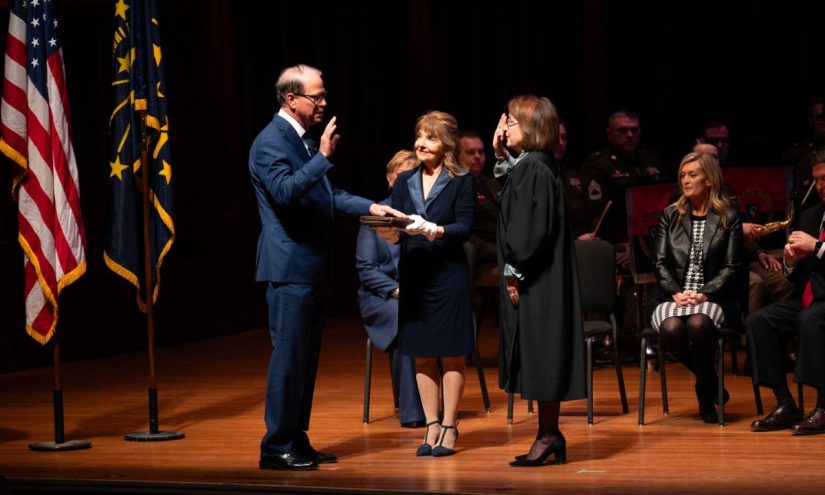
    After slashing a popular reading program from the budget, Gov. Mike Braun said Friday he asked First Lady Maureen Braun to spearhead an initiative to keep Dolly Parton’s Imagination Library in Indiana.

    “She has agreed and she will work with philanthropic partners and in consultation with state leadership to identify funding opportunities for the book distribution program,” the governor said in a news release.

    The program gifts free, high quality, age-appropriate books to children from birth to age five on a monthly basis, regardless of family income.

    Former Gov. Eric Holcomb included a statewide expansion of the program in his 2023 legislative agenda. The General Assembly earmarked $6 million for the program in the state’s last biennial budget — $2 million in the first year and $4 million in the second — to ensure that all Hoosier kids qualify to receive free books.

    But when Gov. Braun prepared his budget proposal in January he discontinued the funding as part of an overall effort to rein in state spending.

    “I am honored to lead this work to help ensure our youngest Hoosiers have as much exposure as possible to books and learning,” said First Lady Maureen Braun. “Indiana has many strong community partners and I am confident we will collaborate on a solution that grows children’s love of reading.”

    Jeff Conyers, president of The Dollywood Foundation, said he appreciates Braun’s commitment to early childhood literacy.

    “The Imagination Library brings the joy of reading to over 125,000 Hoosier children each month in all 92 counties across the state, and we are encouraged by Governor and First Lady Braun’s support to ensure its future in Indiana. We look forward to working with the Governor and First Lady, state leaders, and Local Program Partners to keep books in the hands of Indiana’s youngest learners and strengthen this foundation for a lifetime of success,” he said.

    Indiana Capital Chronicle is part of States Newsroom, a nonprofit news network supported by grants and a coalition of donors as a 501c(3) public charity. Indiana Capital Chronicle maintains editorial independence. Contact Editor Niki Kelly for questions: [email protected].


    Get stories like these delivered straight to your inbox. Sign up for The 74 Newsletter
    Source link