Category: Industrial strategy

  • Creative higher education isn’t a skills pipeline, it’s a cultural force

    Creative higher education isn’t a skills pipeline, it’s a cultural force

    Creative education is not a conveyor belt. It’s a crucible.

    In the UK’s industrial strategy, the creative industries are rightly recognised as a pillar of national growth. But this recognition comes with a familiar risk: that education will be seen merely as a supplier of skills, a passive pipeline feeding talent into pre-existing systems.

    This is a pervasive attitude, which so strongly influences the possibilities for students, they can be anxious about being “industry ready” before they’ve had the chance to explore or define fully what kind of practitioners they want to become. This is a reductive view and one we must resist. Creative higher education is not a service department for industry. It is a cultural force, a site of disruption, a collaborator and a generator of futures not yet imagined.

    Partners not pipelines

    Creative education does not simply serve industry – it co-shapes it. Our job is not just to deliver talent into predefined roles, but to challenge the boundaries of those roles altogether. We cultivate new forms of knowledge, artistic practice, and cultural leadership. As Michael Salmon has noted, HE’s relationship with the industrial strategy needs rethinking – we think especially in fields where “skills” are not easily reduced to training targets or labour force projections. Education is not just about plugging gaps; it’s about opening space for new kinds of thinking.

    Christa van Raalte and Richard Wallis have called for “a better quality of conversation” about the skills agenda in screen and creative sectors. Their point that simplistic, linear approaches to “skills gaps” are not fit for purpose should land hard within our own walls too. We need a better quality of conversation around the creative skills agenda. Narrow, supply-side thinking is not only reductive, it risks cutting off the very dynamism on which the industry depends.

    Our graduates don’t only “enter” the creative industries. They redefine them. They found new companies, invent new formats, challenge power structures, and expand what stories get told and who gets to tell them. To conceive of specialist creative HE as mainly a workforce provider is to misunderstand its essence. Our institutions are where risk-taking is possible, where experimentation is protected, and where the creative freedoms that industry often cannot afford are made viable.

    Resistance from within

    The danger isn’t just external. It’s internal too. Even within our own institutions, we sometimes absorb the language and logic of the pipeline. We begin to measure our worth by the requirement to report on short-term employability statistics. We are encouraged by the landscape to shape curricula around perceived “gaps” rather more than emerging possibilities. The pressure of metrics, league table and reputation help us to believe that our highest purpose is to serve, rather than to shape.

    This internalisation is subtle and corrosive. It narrows our vision. It makes us reactive instead of generative. And it risks turning spaces of radical creativity into echo chambers of industry demand. It is a recipe for sameness and status quo, a situation many call to change.

    We must be vigilant. We must ask ourselves: are we designing education for the world as it is, or for the world as it could be? Are we opening access, nurturing the disruptors, the visionaries, the cultural architects — or only the job-ready?

    When creative institutions start to measure their value predominantly through short-term employability metrics, or shape curriculum mainly around perceived industry gaps, we lose the distinctiveness that makes us valuable in the first place.

    We risk:

    • Designing education around current norms, not future needs
    • Prioritising technical proficiency over critical inquiry
    • Favouring students most likely to succeed within existing structures, rather than supporting those most likely to change them

    If we define our purpose only in terms of industry demand, we abandon much responsibility.

    From pipeline to ecosystem

    What we need is a new compact: not “education as service provider,” but “education as ecosystem partner.” A pipeline feeds. An ecosystem nurtures, nourishes and grows.

    This approach:

    • Recognises specialist creative HE as a site of research, innovation and values-driven practice
    • Treats industry as a collaborator, not a master – collaboration is especially present in research activity and creative projects led by industry professionals
    • Encourages co-creation of skills agendas, not top-down imposition
    • Embraces long-term thinking about sector health, sustainability, and inclusion – not just short-term workforce readiness

    The creative economy cannot thrive without imagination, critical thinking, inclusion, and cultural complexity; all things specialist institutions are powerfully placed to nurture. But this can only happen if we reject limiting narratives about our role. The industrial strategy may frame education as an economic lever to support the growth in the creative industries, but we must resist being reduced to a lever alone. Meeting the opportunities in the strategy is both an invitation to engage with sector needs, help shape the future and a challenge to the cultures of training, pedagogy and research whose long roots exercise power in specialist HE.

    If we want to protect and evolve the value of creative higher education, we must speak with greater clarity and confidence to government, to industry, and to ourselves. This is not about resisting relevance or rejecting partnership. It’s about ensuring that our contribution is understood in full: not only as a supply chain, but as a strategic and cultural force.

    Importantly, we must acknowledge that our graduates are not just contributors to the UK’s creative economy – they are cultural ambassadors on a global stage. From Emmy, Oscar and BAFTA winning actors to internationally celebrated designers, technical artists, writers and directors (and so much more) UK-trained creatives shape discourse, aesthetics, and industries across the world. To frame their education in purely national economic terms is to limit its scope and power.

    Because the purpose of creative education isn’t just to help students find their place in the industry. It’s to empower them – and us – to shape what that industry becomes.

    Source link

  • The LLE finally gets a Labour overhaul

    The LLE finally gets a Labour overhaul

    If you still imagined that the Lifelong Learning Entitlement (LLE) would mean that a student studying any module from any course would be eligible for 30 credits of funding, it’s long past time to disabuse yourself of that notion.

    Under the latest plans, eligibility only extends to short courses dealing with those subjects identified as national priorities – via a somewhat tenuous link to the industrial strategy – along with HTQ modules. Everything else in higher education will be funded by year of study, as is currently the case.

    If you were thinking that this latest round of changes – taking us even further away from the initial dreams of Boris Johnson (or even Philip Augar) – completes the long gestation of the LLE in full detail you will be disappointed. For instance, the credit transfer nettle has yet to be grasped – with a consultation due in early 2026, not far in advance of the September 2026 soft launch. And there are, as we shall see, a number of other issues still dangling.

    It’s a continuation of DfE’s gradual retreat from a universal system of funding that was supposed to transform the higher education landscape. No variable intensity, a vast reduction in modular availability – it just allows some of the short courses that universities and colleges already offer to be funded via the loan system (a measure, lest we forget, of dubious attractiveness to learners).

    A bridge to nowhere

    The Lifelong Learning Entitlement (originally known as the Lifelong Loan Entitlement) was announced by Prime Minister Boris Johnson on 29 September 2020, as a part of the government’s lifetime skills guarantee:

    we’ll expand and transform the funding system so it’s as easy to get a loan for a higher technical course as for a university degree, and we’ll enable FE colleges to access funding on the same terms as our most famous universities; and we’ll give everyone a flexible lifelong loan entitlement to four years of post-18 education – so adults will be able to retrain with high level technical courses, instead of being trapped in unemployment.

    Like most of Boris’ wheezes it was originally somebody else’s idea – in this case Philip Augar. He had a few more specifics:

    The government should introduce a single lifelong learning loan allowance for tuition loans at Levels 4, 5 and 6, available for adults aged 18 or over, without a publicly funded degree. This should be set, as it is now, as a financial amount equivalent to four years’ fulltime undergraduate degree funding. Learners should be able to access student finance for tuition fee and maintenance support for modules of credit-based Level 4, 5 and 6 qualifications. ELQ rules should be scrapped for those taking out loans for Levels 4, 5 and 6.

    But it makes more sense to think of the idea as being 100 per cent Boris in that it was a massive infrastructure initiative that he had no clue how to actually deliver (in all honesty, not much of Augar was deliverable either – perhaps that was the attraction). As has proved to be the case.

    As you were

    Let’s start by looking at what’s unchanged, following the latest revisions. The timeline for getting started remains as was: applications from September 2026 for courses and modules starting in January 2027. This still feels extremely optimistic. Plus – as has been the case for a while – a staggered rollout of standalone modules is planned, rather than an enormous platter of bitesize options spread out to pick from come next September.

    The use of the current plan 5 student loan model, with its 40-year term and nine per cent repayment rate above what is currently around minimum wage, is still there – with all the peculiarities this will inevitably engender. If anyone was expecting a large scale shake-up of the student finance system any time soon, this should serve as an enormous hint that no radically new model is arriving in the short to medium term.

    Also retained from DfE’s planning under the Conservatives is the system of “residual eligibility”, meaning how much loan is available to those who have already, for example, studied one undergraduate degree. You still get the equivalent of four years overall, though with lots of wrinkles.

    The aspiration for each member of the public to have an LLE personal account continues – this will still include, in theory, information on one’s loan balances, an application tracker, and advice and guidance on career planning.

    And in broad strokes the government’s rationale for the LLE persists: more flexible routes through tertiary education, support for upskilling and retraining throughout one’s career, and the promise of more learner mobility between institutions.

    Picking winners

    The LLE is replacing England’s entire student funding system, and so funding for full years of study at levels 4 to 6 – such as degrees or higher technical qualifications – will flow through it. In many cases, though, this is just a shift on paper.

    What’s always been the more significant change is how it will bring the funding of individual modules into scope, along with the resulting interplay between single modular courses and larger programmes of study in a learner’s lifelong journey.

    Modular provision that would be eligible had previously been defined as “modules of technical courses of clear value to employers” – this is now rejigged to:

    modules of higher technical qualifications, and level 4, 5 and 6 modules from full level 6 qualifications, in subject groups that address priority skills gaps and align with the government’s industrial strategy.

    We flagged this link between the LLE and the industrial strategy priority areas when the latter was published last month – and the updated LLE policy paper does say that DfE has worked with Skills England to assess skills priorities, though there is no detail on this.

    What we very much don’t get is a mapping between LLE subjects and the industrial strategy sectors (the IS-8), or the priority sub-sectors and their corresponding links to certain regions or clusters which is, y’know, what the industrial strategy is all about. Arguably the main bone thrown to the industrial strategy is the concept of the government “picking winners” – but note there is no stumping up of public funds to support this.

    So we get a list of which subject groups will be in scope for modular study:

    • computing
    • engineering
    • architecture, building and planning, excluding the landscape gardening subgroup
    • physics and astronomy
    • mathematical sciences
    • nursing and midwifery
    • allied health
    • chemistry
    • economics
    • health and social care.

    Common Academic Hierarchy (CAH) fans will be delighted to spot that this appears to have been done (with the curious landscape gardening exception) at the very top level. These are very broad subject groups, which will contain multiple subjects with questionable relevance to the industrial strategy.

    While on the face of it there is some ambiguity about whether this subject list refers to only level 6 qualifications, or to these and higher technical qualifications (HTQs), the accompanying provider preparation guide makes clear that the subject groups here are for level 6 qualifications only – and provision via HTQ modules covers many other subject areas, which in some cases overlap. This currently includes subjects such as business and administration, education and early years, legal and accounting, and many others – but these will need to go through the HTQ approval route.

    The provider preparation guide suggests that institutions should be looking at their current degree provision, working out where it aligns to the priority skills gaps areas that DfE has identified, and then proceeding from there in thinking about what could be modularised. All modular study, remember, needs to form part of an existing designated full course which the provider delivers – we’re a long way from some of the previous visions of universities coming up with new stand-alone bitesize offers.

    All the other funding eligibility rules for modular provision remain – they must have a single qualification level at level 4, 5 or 6, they must be at least 30 credits (though bundling up modules to meet that minimum is allowed), and a standardised transcript of some form to be determined must be delivered upon completion, to facilitate credit transfer.

    But there is one change to eligibility rules – modular provision must not be delivered through franchised arrangements. This had always sounded like a recipe for disaster. The government has been gradually setting its face against a lot of existing franchising activity, given concerns about quality and reports of fraud.

    Getting approved

    The previous plan for approving modules (outside of HTQs) for LLE eligibility was what was being labelled a “qualifications gateway”, which the Institute for Apprenticeships and Technical Education consulted on last January. This terminology has been scrubbed entirely out of the policy paper now, with just a note that “we will set out details on how level 4 to 6 Ofqual regulated qualifications could enter the market and access LLE funding.”

    But there’s a new approval process in town – providers who are interested in delivering modular provision from January 2027 will need to submit an expression of interest, from this month.

    This process will involve an “assurance check” – seemingly run centrally by DfE, rather than Skills England as might have previously been expected. There’s a wonderful flowchart in the provider guide, which you may or may not be able to read depending on how enormous your screen is:

    That’s right – TEF! Providers with gold or silver will have access to a “simpler and quicker approval process” for modular provision. Those who do not will be asked to provide additional information around “readiness, capability and successful delivery of the parent course.”

    Hang on, you cry, doesn’t the fact a provider is registered with the Office for Students demonstrate that it has “readiness” and “capability” to deliver courses of any type? Well, yes, it does. It is possible that DfE simply doesn’t trust OfS to make this kind of judgement – which would point to a rather larger issue with higher education regulation – or it could be that this is a last gasp attempt to give TEF awards some regulatory relevance.

    This is also the case for those rated “good” or “outstanding” for Ofsted provision – and if Ofsted inspects your skills provision and you have a TEF award, they both need to make the grade. Now headline Ofsted assessments were supposed to disappear from September 2025, which makes this all a bit confusing.

    If you don’t deliver HTQs or appropriate level 6 qualifications, it’s noted that modular provision is anticipated to “gradually expand when appropriate to do so” and so you may, one day, come in line for eligibility.

    Regulatory issues

    One of the areas the previous version of the policy paper promised was further information on the regulation of modular funding. This, rather oddly, is no longer listed under “next steps”, given that the update we do get is relatively slim.

    What we might have expected was a follow-up to the Office for Students’ call for evidence on positive outcomes for students studying on a modular basis – a call for evidence which closed in November 2023, and we’ve heard little of since. As DK set out at the time, the quasi-consultation asked how things like the B3 conditions could apply to individual modules, and the regulator’s initial thinking seemed to be that completion would still be a valuable metric for regulation, as would progression – though exactly how progression was assessed would need to be refined.

    There’s still no news on this complicated issue. The new section of regulation focuses more on registration categories, while noting that DfE “will refine the existing regulatory framework to ensure it is proportionate, is targeted [and] supports a high quality, flexible system.” If you were thinking that a whole new approach to learning would need a new oversight framework, the direction of travel suggests not.

    The bigger regulatory news is that, likely to the surprise of few, the idea of having a third registration category for smaller providers offering level 4 and 5 qualifications has been scrapped. Instead the government will extend the current system of advanced learner loan funding for levels 4 to 6 until the end of summer 2030. This will give unregistered providers more time to apply for OfS registration in one of the two existing categories, though OfS is scheduled to consult in autumn 2025 on proposals to disapply some conditions of registration for providers in the further education statutory sector (which already has a regulator looking after most of this stuff).

    Maintenance chunks

    As expected, student maintenance support will be available on a pro-rata basis (depending on course, location, and personal circumstances) in an equivalent way to the existing undergraduate offer. Because this support is intended to deal with “living costs”, DfE has decided to continue to restrict availability to students attending in person – there’s nothing for online or distance learning.

    Additional targeted grants (most likely this just refers to existing disabled students’ allowance and such like) will still be available – but there’s more to come on this later this year, alongside more guidance on maintenance generally. We can perhaps hope that a forthcoming announcement modifying the decades-old system (or even just the parental income thresholds) is playing a part in this delay.

    That feeling of entitlements

    Another area where things have mostly stayed the same is the personal entitlement for tuition fee funding equivalent to four full-time years (480 credits, currently £38,140) of traditional study – with the welcome clarification that where a provider charges less than the maximum the cash value rather than the credit value will be deducted from the total. Maximum borrowing is for 180 credits a year (which would just about cover a year of an accelerated degree). And for existing graduates (with the frankly wild caveats as before) there will be an entitlement to funding equivalent to unused residual credits.

    But what happens when your balance reaches £0? No more learning for you? Not quite – a “priority additional entitlement” may be available (fees plus maintenance) in order to complete a full course in a small number of subjects (medicine, dentistry, nursing and midwifery, allied health professions, initial teacher training, social work).

    For those who follow career paths that require five years or more of study (veterinary surgery, architecture part 2, an integrated masters in Scotland) there will be a “special additional entitlement” of up to two years, again covering fees and maintenance. There’s also additional entitlements for those who take foundation years, placement years, or study abroad years. It’s by-and-large a smoothing-out of some of the unintended consequences with existing provision where representations had been made.

    Plus, importantly, the government will now play a part in mitigating circumstances – if you are resitting a year because of “compelling personal reasons” (illness, bereavement) you will have the costs of your study covered. And resits on longer courses will be covered anyway.

    The credit transfer question

    “The LLE and modular provision will provide a pathway to strengthen opportunities for credit transfer and learner mobility,” the new version of the paper states. While no-one would deny that the LLE could be a “pathway to strengthen opportunities,” especially given how tepid the phrasing is, there has still been essentially no progress on the thorny question of credit transfer.

    The largely new section on “recognition of prior learning, credit transfer, and record of learning” sets out aspirational areas where the government thinks it can work collaboratively with the sector – to promote pathways between providers, to improve guidance for both incoming and outgoing learners, and to generally square the recognition of prior learning circle despite all the intractable problems therein.

    Interestingly, DfE also wants institutions to embed all this into “broader strategies for widening access”. It’s not immediately clear how this will come off – but we get the note that this year will bring an update on “proposed changes that will start to embed this flexibility and greater learner mobility across LLE funded provision.” This might be a reference to the post-16 education and skills white paper.

    To facilitate all this flexibility, DfE had previously said it would be introducing a “standardised transcript template.” Tellingly, this has now been revised down to “a standardised transcript as part of modular funding designation.” So it appears the plan is now to look at enforcing this standardisation for the (potentially scant) modular provision that the LLE will generate, while sidestepping the much bigger question of how portability between modules and larger qualifications including degrees will work. This is a substantial scaling down in ambition – and yet it’s still a complicated thing to get agreed implemented in little over a year.

    What’s next

    As is probably coming across, there is still an awful lot yet to be confirmed. Secondary legislation to implement the LLE fee limits and funding system still needs to be laid. Fee loan limits for non-fee capped provision are pending confirmation. The Student Loans Company needs to get its systems ready.

    There will be another consultation too, in addition to OfS’ further education one. While it’s not mentioned in the updated policy paper, the accompanying provider preparation guide reveals that the Department for Education will consult on “learner mobility across LLE-funded provision in early 2026” (maybe this will be the moment when credit transfer finally gets sorted out once and for all). Opening a consultation in early 2026 when big chunks of the whole shebang are supposed to be ready to go that September does not necessarily inspire confidence.

    And the drip-by-drip announcements about the policy plumbing of the LLE mean that it’s a long time since the government has really restated its belief that there is demand out there for modular provision, or committed to working to drum some up. Really it’s baffling why this week’s announcements haven’t been packaged up with the skills white paper, as surely they must form part of a wider vision. Some clarity within this about overlaps and interplay with the apprenticeship levy would have been welcome too.

    The provider preparation guide entreats institutions to start thinking about how they will market modular provision, which is a tricky question given the absence of demand that pilots have demonstrated. But one of the examples given is particularly problematic:

    if you seek to target mature students, do you need to start building relationships with local employers and/or recruitment agents, rather than only relying on existing recruitment channels?

    This isn’t a new addition to the guidance – but since the last update, Bridget Phillipson has told Parliament that the government will “take immediate action on the use of agents to recruit students,” adding that “the government can see no legitimate role for domestic agents in the recruitment of UK students,” following the Sunday Times franchising investigation fallout. So DfE is at the same time banning the use of domestic agents – or at least it said it would – while acknowledging that recruitment to modular provision might be tricky without them.

    It’s of a piece with much of the preparation guide – the responsibility to iron out the holes in the LLE’s business case is being passed onto providers. Supposedly over the rest of the year universities and colleges should be reviewing everything from accommodation to wrap-around support, while building up relationships with employers and potentially rewriting their academic regulations. All while plenty remains unclear at the sector level. It would be unsurprising to see providers reluctant to leap into the approvals process right away, and instead assess how others fare.

    Given all this, it’s perhaps unsurprising that the ambition of the LLE has diminished a little bit each time the policies around it have been updated. We’re a long way from where we started.

    Probably the most damning assessment you could make is that, were Labour to have opted to cancel the whole LLE and just allow students to take out loans for a handful of higher education short courses tenuously linked to industrial strategy priorities, the sector would be in a very similar situation to the one it is in now. And – given clear indications of lack of student demand, and common sense assessments of the general public’s appetite for more tuition fee debt wrapped up in confusing bitesize-but-lifelong repayment obligations – few would think it was a good idea.

    Source link

  • Higher education leadership is at an inflection point – we must transform, or be transformed

    Higher education leadership is at an inflection point – we must transform, or be transformed

    At a recent “fireside chat” at a sector event, after I had outlined to those present some details of the transformational journey the University of East London (UEL) has been on in the past six years, one of those attending said to me: “Until UEL has produced Nobel Prize winners, you can’t say it has transformed.”

    While I chose not to address the comment immediately – the sharp intake of breath and rebuttals that followed from other colleagues present seemed enough at the time – it has played on my mind since.

    It wasn’t so much the comment’s narrow mindedness that shocked, but the confidence with which it was delivered. Yet, looking at the ways in which we often celebrate and highlight sector success – through league tables, mission groups, or otherwise – it is little wonder my interlocutor felt so assured in his worldview.

    Value judgement

    This experience leads me to offer this provocation: as a sector, many of our metrics are failing us, and we must embrace the task of redefining value in 21st century higher education with increased seriousness.

    If you disagree, and feel that traditional proxies such as the number of Nobel Prizes awarded to an institution should continue to count as the bellwethers for quality, you may wish to pause and consider a few uncomfortable truths.

    Yes, the UK is a global leader in scientific excellence. But we are also among the worst in the OECD for translating that science into commercial or productivity gains. The UK is a leading global research hub, producing 57 per cent more academic publications than the US in per capita terms. Yet compared to the US, the UK lags significantly behind in development and scale-up metrics like business-funded R&D, patents, venture capital and unicorns.

    Universities have been strongly incentivised to increase research volume in recent years, but as the outgoing chief executive of UKRI Ottoline Leyser recently posited to the Commons Science, Innovation and Technology committee do we need to address this relatively unstrategic expansion of research activity across a range of topics, detached from economic growth and national priorities? Our global rankings – built on proxies like Nobel Prizes – are celebrated, while our real-world economic outcomes stagnate. We excel in research, yet struggle in relevance. That disconnect comes at a cost.

    I recently contributed to a collection of essays on entrepreneurial university leadership, edited by Ceri Nursaw and published by HEPI – a collection that received a somewhat critical response in the pages of Research Professional, with the reviewer dismissing the notion of bold transformation on the basis that: “The avoidance of risk-taking is why universities have endured since the Middle Ages.”

    Yes. And the same mindset that preserved medieval institutions also kept them closed to women, divorced from industry, and indifferent to poverty for centuries. Longevity is not the same as leadership – and it’s time we stopped confusing the two. While we should all be rightfully proud of the great heritage of our sector, we’re at real risk of that pride choking progress at a critical inflection point.

    Lead or be led

    Universities UK chief executive Vivienne Stern’s recent keynote at the HEPI Annual Conference reminded us that higher education has evolved through tectonic shifts such as the industrial revolution’s technical institutes, the social revolution that admitted women, the 1960s “white heat” of technological change, and the rise of mass higher education.

    Now we are on the edge of the next seismic evolution. The question is: will the sector lead it, or be shaped by it? At the University of East London, we’ve chosen to lead by pressing ahead with a bold transformation built on a central premise that a careers-first approach can drive success in every part of the university – not on precedents that leave us scrambling for relevance in a changing world.

    Under this steam, we’ve achieved the UK’s fastest, most diversified, debt-free revenue growth. We’ve become an engine of inclusive enterprise, moving from 90th to 2nd in the UK for annual student start-ups in six years, with a more than 1,000 per cent increase in the survival of student-backed businesses. We’ve overseen a 25-point increase in positive graduate outcomes – the largest, fastest rise in graduate success – as well as ranking first in England for graduating students’ overall positivity. We use money like we use ideas: to close gaps, not widen them. To combat inequality, not entrench it.

    So, let me return to the Nobel Prize comment. The metrics that matter most to our economy and society, the achievements that tangibly improve lives, are not displayed in glass cabinets – rather those that matter most are felt every day by every member of our society. Recent polling shows what the public wants from growth: improved health and wellbeing, better education and skills, reduced trade barriers. Our government’s policy frameworks – from the industrial strategy to the AI strategy – depend on us as a sector to deliver those outcomes.

    Yet how well do our reputational rankings align with these national imperatives? How well does our regulatory framework reward the institutions that deliver on them? Are we optimising for prestige – or for purpose? We are living at a pivot point in history. The institutions that thrive through it will not be those that retreat into tradition. They will be those that rethink leadership, rewire purpose, and reinvent practice.

    Too much of higher education innovation is incremental; transformational innovation is rare. But it is happening – if we choose to see it, support it, and scale it. I urge others to join me in making the case for such a choice, because the next chapter of higher education will be written by those who act boldly now – or rewritten for those who don’t.

    Source link

  • Civic engagement offers a firm foundation for universities contributing to regional economic growth agendas

    Civic engagement offers a firm foundation for universities contributing to regional economic growth agendas

    When searching for friendly support or warm words from politicians, the media, and the public, UK universities are increasingly being left empty-handed.

    Last year’s modest increase in tuition fees allowed universities a temporary reprieve after years of tightening financial constraints but came with a firm warning that standards must improve and was quickly wiped out by rises in National Insurance. Meanwhile, culture wars and negative perceptions on quality and graduate outcomes continue to dominate discourse around the sector, fuelling criticism of universities from all directions.

    Richard Jones, vice president for regional innovation and civic engagement at the University of Manchester posited last week that university leaders may be tempted to look for easy savings in their civic impact work – initiatives that engage with and benefit their local community but ultimately fall outside of a university’s traditional mission of teaching and research. But as he argues, this would be a profound mistake.

    The outlook in recent years for universities may have been challenging, but hope lies in Labour’s focus on place-based policy. Place has driven flagship funding decisions and policies including the Spending Review and the Industrial Strategy, with more money being devolved from Whitehall to the regions in pursuit of growth. New Mayoral Strategic Authorities have been empowered to take the reins on transport, investment, spatial planning and skills, with the promise of further autonomy as they mature. A new Green Book – government’s methodology for assessing public investments – is being updated and will broaden the criteria to look more favourably at investments outside London and the South East.

    Universities are perfectly placed to be the drivers of Labour’s regional growth ambitions. The priority sectors in last week’s Industrial Strategy – including advanced manufacturing, life sciences, and clean energy industries – are some of UK universities’ best strengths. Moreover, as anchor institutions located in the heart of communities, universities are physically well-placed to address causes of economic decline.

    Civic engagement for economic growth

    The civic university movement, which champions collaboration between universities and their localities, has an established framework for institutions looking to ramp up civic impact initiatives with their civic university agreements. More than 70 civic university agreements are already in place between universities and their local authorities, with universities in Manchester, Nottingham, Sheffield, Exeter, Derby and London, among others, providing a range of examples for institutions to learn from.

    A UPP Foundation series of roundtables held in four regions across England recently has also highlighted that the civic university movement remains active, with a wealth of civic activity taking place across the country. Universities are finding creative ways to engage with their local communities, with examples including offering to host events in university spaces, or running a café that demystifies the benefits of nuclear energy while providing employment and training for local people. For institutions nervous about signing up to lengthy and potentially costly partnerships, participants at the roundtables instead stressed that smaller gestures can be just as meaningful. Rather than draining resources, civic activity can in fact alleviate funding pressures when universities work together to learn from one another.

    Irrespective of geography, participants were united in their contention that universities should collaborate with their local partners to develop civic initiatives, working collaboratively to address the real day-to-day problems communities want help with, such as helping local businesses transition to net zero.

    Labour’s devolution agenda also offers an opportunity for universities to become visible bridges working across regions and political geographies. While mayoral devolution has been lauded in cohesive urban centres like Manchester and Birmingham, there are concerns the model will work less well in rural areas where proposed Mayoral Combined Authorities will intersect with traditional county borders. For such regions, universities can both serve as bolsters to wider regional identity and can benefit from the flexibility of their own geography that may span mayoral regions.

    The opportunities are there for universities to re-embed civic activity into their core work under Labour’s agenda – but it needs brave leadership to embrace them. In the face of tough financial decisions, university leaders must champion the benefits of civic activity. The late Bob Kerslake, chair of the UPP Foundation’s Civic University Commission 2018–19, deeply understood the potential and necessity for universities to be rooted in their local communities. For a higher education sector that has spent recent years on uncertain footing, tapping into Kerslake’s vision could provide a more certain path forward.

    The UPP Foundation’s full report UPP Foundation Spring 2025 Roundtables: The Role of Universities in Regional Placemaking explores the key themes of the roundtable discussions. You can download the report here.

    Source link

  • It’s up to universities to make the industrial strategy a success

    It’s up to universities to make the industrial strategy a success

    The industrial strategy is not only an economic document it is also a roadmap for how the country will be governed.

    At its heart is a simple premise. Places know what is best for people locally and power should be devolved to them. Not all powers, because some things like defence have to be coordinated at a national level, and certainly not lots of fiscal policy like taxation, but powers over things like spatial planning (where the government allows it), investment, and some parts of the R&D ecosystem.

    The ideal body for distributing these powers is the Mayoral Combined Authority (MCA). These are the collection of councils in one area, usually a city, that work together to achieve more than they could alone. The Liverpool City Region Combined Authority and the West Midlands Combined Authority are just two examples

    Process not an event

    In 1997 then Secretary of State for Wales Rob Davies called devolution “a process not an event”, and he was right. Powers are not spread evenly through the UK, London has quite a lot and a local town council has very few. And the propensity for government to operate through pots of money that local government bid for to do stuff is unusual by international comparisons. This level of financial control limits many places to being the delivery arm of government more so than independent decision makers in their own right.

    This patchwork approach also means higher education providers have a mixed relationship with the devolution story.

    Solely through an academic lens research intensive universities have done well out of (even if they do not like it) how centralised the UK is. The REF just isn’t interested in geography. It follows quality, impact, and environments wherever they may be. Previous research pots like the Regional Innovation Fund which apply a funding multiplier to places underserved by research funding are the exception not the norm.

    The industrial strategy is different in that it at least attempts some kinds of rebalancing in acknowledging that if the government funds the same things in the same places the same kinds of research outputs will be produced. The fact there is some money behind it is even better. As DK noted in his review of research in the industrial strategy:

    The £500m Local Innovation Partnerships Fund is intended to generate a further £1bn of additional investment and £700m of value to local economies, and there are wider plans to get academia and industry working together: a massive expansion in supercomputer resources (the AI research resource, inevitably) and a new Missions Accelerator programme supported by £500m of funding. And there’s the Sovereign AI Unit within government (that’s another £500m of industry investments) in “frontier AI”. On direct university allocation we get the welcome news that the Higher Education Innovation Fund (HEIF) is here to stay.

    The places that are located outside of major cities without large research portfolios have more reason to be sceptical about devolution. Deputy prime minister Angela Rayner has called for local leaders to “fill in the map” of devolution but this is easier said than done. Places have distinct histories, geographies, and can’t as easily be accommodated into MCAs as places like Greater Manchester.

    While there has been interest in towns from time to time, the Towns Fund provided some funding to some places on some research projects, they risk being left behind within a devolution system that prioritises larger conurbations.

    The universities problem

    Let’s take the government’s proposals at face value and assume it is going to implement the full version of the devolution agenda it is proposing. This would mean local government has more funding to buy land, freeports and investment zones will be streamlined to provide even more business incentives, the British Business Bank (among other funders) will release and coordinate capital aligned to regions and the eight industrial strategy priorities, a further £200m will be spent on further education in England, and a series of growth funds will run directly through mayors.There are more announcements to come on skills, local economic regulation and infrastructure.

    Universities are not losers in any of these measures but nor are they inevitably complementary to everything the governments wants to do. Former universities minister David Willetts, who had some reservations about the draft strategy, has softened his tone writing:

    Most of the key industries set out in that visual [the one explaining the industrial strategy priorities] are heavy users of higher education. Universities will play a crucial role in the strategy. One of the biggest risks to delivering it is the financial fragility of these core institutions. It is good to see them getting a vivid illustration as well – on page 73. But the Government has not yet taken the decisions needed to ensure they can thrive and continue to be such a national asset.

    This is the core problem. It is possible to imagine how industries may rely on universities but it is more difficult work out how universities, specifically, can deploy their capacity in the most effective ways. Universities cannot expect government money for everything they do but it is also true that if they fall over the industrial strategy will fall with them.

    Philosophically, the industrial strategy neither supports enormous state intervention nor is it a hands off document of supply-side reform. It sees the state as an enabling force which can reduce risks to business, catalyse investment, and reconfigure the public sector. The industrial strategy does not tell universities what to do, or even what they might do in great detail, because that is not what it is designed to do. It gives an approach and it is for universities to choose whether and how they follow it.

    Adapt or perish

    This suggests a significant period of adaptation for universities. If more investment and political attention is flowing through their places then being involved in their places becomes significantly more important. Fundamentally, the industrial strategy is not an instruction manual but it is a guide to the things that the government will and will not fund.

    There are lots of devolved things that universities would generally find unpalatable like top-slicing QR funds to MCAs. There are lots of things that universities could do and are doing to set an example which might one day be backed up by legislation. Organising regional bodies to coordinate the provision of education to meet local labour market needs. Forming joint research programmes and investment vehicles to form one front door for research in their area. Using their own research capacity to interrogate the best forms of devolution and devolved structures. And, perhaps most importantly, being embedded in the important but unglamorous business of transport and spatial planning.

    The bigger mental shift is that the industrial strategy has two core centres of control. Its eight priority industries and regions and clusters within them. The challenge for universities, if they want to see sustained government support for their work, is to answer how what they do supports those two agendas. This is not a PR exercise but a careful interrogation of the limits and approaches of universities in their places and within those core industries.

    In some places this might mean tweaking existing work, in others it might mean new partners or new projects, and in some it might mean a more fundamental reimagining of the shape of the education sector in a region. Given the perilous state of university finances it is the institutions that look like they have solutions that will do well in the era of uncertainty.

    The industrial strategy does not leave universities behind, but it might. The opportunity is for universities to shape the settlement they want through being proactive in shaping their regions. This is not about another civic strategy but about creating the governance apparatus to support economic growth. Anything short of this risks an economic agenda which is done to universities rather than with them.

    Source link

  • LEO has a role to play in picking winners

    LEO has a role to play in picking winners

    Perhaps we have LEO all wrong?

    In the week of the industrial strategy, which brought confirmation as to how central higher level skills will be to our plans for national growth, the annual release of longitudinal education outcomes (LEO) data) hits a bit different.

    In the past, ministers and higher education obsessives, have seen the release as a chance to rank universities and subjects – and perhaps even a chance to spot the infamous “low quality courses” – based on median graduate earnings. As we’ve been through time and time again on Wonkhe, this doesn’t really work.

    But quietly, and at the instigation of the former Unit for Future Skills which now forms a part of Skills England, earnings have taken something of a back seat to more detailed information about subject areas, place, and industrial sectors. If you wanted to understand the way in which investment in particular subjects might translate to benefits to particular industries (to support changes to the allocation of the Office for Students Strategic Priorities Grant, for example), LEO is where you would look.

    Factory model

    And you can illustrate this with today’s release of LEO data on graduate outcomes and provider level data. (There’s even a new DfE dashboard.)

    Let’s take a worked example. Advanced manufacturing is one of the eight sectors named in the industrial strategy as a national priority. As a sector it is going to be receiving £4.3bn over the next five years, including £2.8bn in research and development, from the state. Of the “frontier industries” within the manufacturing sector battery technology and advanced materials feel like clear priorities – and exactly the kind of things that might need the higher level skills that a university education might bring – although manufacturing as a whole will be in a similar position.

    How do you develop these skill sets?

    First up, we can see what graduates that work in manufacturing industries have studied. Engineering is the main route (and the route to the kind of high earnings that suggest senior roles) – just over 1,900 people with a first degree in engineering are working in the sector.

    [Full screen]

    But it is clear that manufacturing also needs business expertise (there are 1,350 business graduates in the field) and design capability (890 creative arts and design graduates). Both these groups earn rather less than the engineers – the low level of pay for creative arts graduates suggests that these workers may have recently moved into the sector or are in non-graduate roles, or (whisper it) we might need to pay them better. This latter interpretation is backed up by the fact that similar proportions of graduates are in this sector a year after graduation, and designers are consistently paid less.

    There is a regional component to this too (using the purple filters at the bottom of the chart, note that you can only use one of these at once) as we can see that when we look at London we can see that salary differentials shrink between our top three.

    In terms of specific manufacturing specialisms giving design graduates good jobs ten years on, another plot of the same data suggests automotive, and aircraft/space craft, manufacturing are particularly positive destinations. That said, they are not the primary destinations for creative arts and design graduates ten years out: as with many subject areas teaching is well represented, as are retail and advertising.

    [Full screen]

    The regional dimension

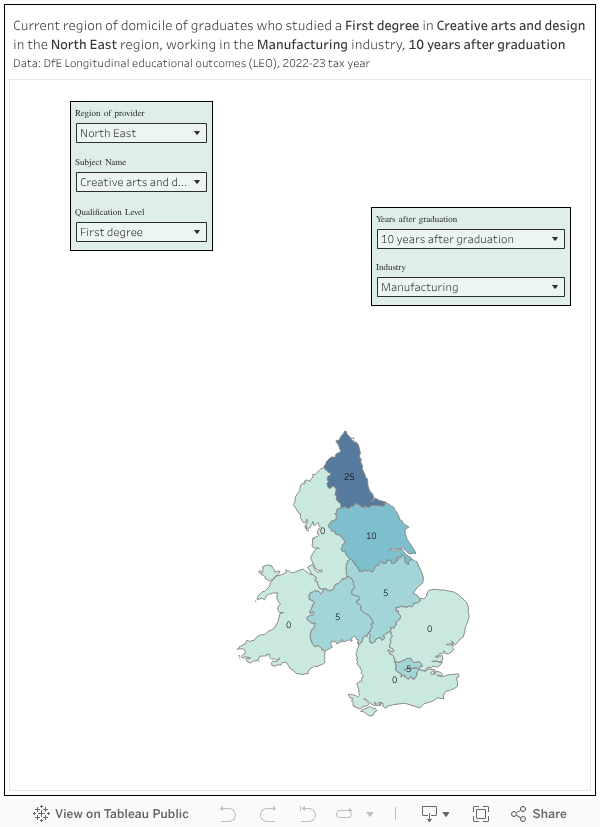
    Let’s say that we also want to use state investment in skills for manufacturing to have a regional benefit – and we wanted to focus on manufacturing in the north east. Would we need to specifically grow design provision in the north east of England in order to provide design graduates for firms there?

    Based on the data, the answer is yes. Most design graduates who studied in the north east working in manufacturing, are working in the north east ten years on. Though the numbers are small, the same appears to be true at other career points.

    [Full screen]

    Do we know if design students (rather than creative arts students) are the ones working in manufacturing? We don’t for certain but we can be reasonably sure. There are more design students than any other subjects in the creative arts and design area – and they tend to earn more ten years on than their peers in the arts. The median salaries also seem to match up – designers aren’t big earners, but they do earn more than some more traditional “skills priority” areas like ecology and mineral technology.

    [Full screen]

    Picking winners

    Seasoned LEO-watchers will be aware that there are issues when you look at specific sub-groups within the data. One of the drawbacks here is that we can’t track design specifically by provider – it would be helpful, if we decide we need more product designers in the north east, we knew which existing provider was landing them that well paid senior roles later in their careers. Best we can tell (and only five years out) it might be Newcastle and Northumbria – but we also need to factor in more granular effects (is Newcastle more likely to offer higher-paid design jobs than Sunderland or Middlesborough – I’d expect so, but we don’t get that data).

    [Full screen]

    It’s also likely that Teesside and Sunderland will be recruiting students with less traditional backgrounds, and we know that will have an impact on careers and salaries – but interestingly it appears to be Northumbria that are getting the best results for students from a domicile in a POLAR4 quintile one area.

    So there we have it: if we want to invest in advanced manufacturing in the north east of England in a way that gets the best results for local people, we need to support the design courses at Northumbria University. Which is something of a shame as we cut state support for design provision a couple of years ago.

    Source link

  • Higher education and the industrial strategy priority areas

    Higher education and the industrial strategy priority areas

    There have been industrial strategies before, but the extent to which they have shaped the provision of higher education is questionable.

    Past exercises of selecting scientific or technological priorities have undoubtedly had effects on the national research ecosystem, though constant chopping and changing of policy over the last decade and more has hindered this from reaching its fullest extent. But in terms of influencing what educational provision exists, and what qualifications are achieved – and where – it would not be unduly controversial to say that industrial strategy and the longer-term graduate pipeline have never really meshed.

    Could this time be different? This government has certainly wanted to present its different policy agendas – on industrial strategy and skills, but also on migration, and devolution – as complementary and cohesive. And there are plenty of reasons to think that the industrial strategy will be Labour’s key reforming principle for higher education and its position within the wider tertiary sphere.

    How HE shows up

    Let’s begin with what has already emerged. Government guidance to the Office for Students has set out the fact that high cost subject funding in England (via the Strategic Priorities Grant, or SPG) will be refocused towards the industrial strategy from 2026–27 – a review is underway behind the scenes.

    And even in the current year, the (rather meagre) £84m in SPG capital funding available in England includes £72.75m in a bidding process, where one of the two criteria to assess bids will be the extent to which the project supports Skills England’s priorities, or local economic needs. Skills England’s priority areas are the eight industrial strategy “growth-driving sectors” (which we are now expected to refer to as the IS-8) plus health and social care as well as construction.

    Whether these two pots of money remain significant enough to really drive changes to HE provision – as opposed to rhetorical game-playing where the words “industrial” and “strategy” get appended to everything that institutions were already planning to do – remains an open question. The size of both recurrent and capital SPG in future years remains to be seen, but you wouldn’t bet on substantial increases.

    If this were the end of it, you might think the industrial strategy’s impact on higher education would remain restricted to research and innovation – with lip service to government priorities in how the (shrinking) state contribution to teaching gets doled out. But with today’s publication of the industrial strategy in full, various other agendas begin to come into focus.

    First up, the Lifelong Learning Entitlement. A more substantive announcement on the policy and legislative details is still pending, but there’s a rather significant detail in today’s strategy:

    From January 2027 we will launch the Lifelong Learning Entitlement which will enable individuals to learn, upskill and retrain across their working lives. The first modular courses for approval will support progression into the IS-8.

    It’s been on the cards for a while – since being re-written under Labour, the current LLE policy paper has anticipated that Skills England and the government’s skills priorities would form an important part of the LLE’s development – but here we get confirmation that the module approval process will be guided by the industrial strategy priority areas. The professional services sector plan also references a role for the LLE in helping learners take up courses relevant to that specific sector.

    And it’s a similar story for the LLE’s awkward doppelganger, the growth and skills levy, which will allow employers to spend levy contributions on short courses rather than apprenticeships.

    These levy reforms, which were a key pillar of Labour’s approach to skills while it was in opposition, have gone a bit quiet since, with changes at lower and foundation levels prioritised. The fact that the spending review gave the defunding of most level 7 apprenticeships as an example of DfE savings and efficiencies, rather than a way of freeing up cash for short courses, was a little ominous.

    But the industrial strategy policy paper makes a link with the IS-8 sectors, giving examples of short courses in digital, AI, and engineering. April 2026 is floated as the date for rollout, though there is more to be done in development:

    We will work with Skills England to determine the courses which will be prioritised in the first wave of rollout and subsequent waves, and how those sit alongside apprenticeships and other training routes. We will work with Skills England to introduce these short courses and consider how to prioritise investment across the programme.

    Universities with expertise in professional and executive education – and those who are rethinking apprenticeship provision in light of changes to level 7 – will be keeping a careful eye on how this comes together.

    Finally, the forthcoming post-16 education and skills strategy, including its plans for reforming the higher education sector, is described within one of the sector plans as setting out a framework “for how the skills system will support growth-driving sectors” – that is, the IS-8.

    So, while all the details may not have come into focus yet, there’s a strong case to be made for the industrial strategy playing a key role in all kinds of areas crucial to higher education: the LLE, levy-funded short courses, high-cost subject funding in HE – plus such capital funding as still exists – and potentially the post-16 strategy as whole. It’s therefore worth the sector looking in detail at what the government, and Skills England, have said so far about the eight specific industrial strategy areas, in terms of skills needs, priority industries, and place.

    New frontiers

    The industrial strategy green paper in the autumn identified eight high-level sectors:

    • Advanced manufacturing
    • Clean energy industries
    • Creative industries
    • Defence
    • Digital and technologies
    • Financial services
    • Life sciences
    • Professional and business services.

    These were the areas where the government saw the greatest potential for growth – the “picking of winners” that has characterised industrial strategies over the years. The eight that were chosen were less STEM-heavy than previous iterations of the strategy.

    Over the consultation period that followed, the government sought input on what subsectors should feature in the finalised plan, and in what places – “all economic activity occurs somewhere,” as the technical annex puts it. These subsectors have now been rebranded as “frontier industries” within each sector – “those parts of each sector that best met the Industrial Strategy’s goal of long-term, sustainable, regionally balanced, and resilient growth.”

    There’s much more in the annex on what respondents said, and how the frontier industries were identified – but at the end of the day, it’s more picking of winners, and plenty of areas will feel they have been unfairly overlooked. The results of the process can be seen on page 22 – for example, for the creative industries, the chosen “frontier” areas are advertising and marketing, film and TV, music, performing and visual arts, and video games.

    Data definition fans will also be keen to see that this has all been mapped to Standard Industrial Classification (SIC) codes, to the extent that it is possible to do so. The technical annex highlights further revisions and improvements to occupational classifications in the future.

    What’s the plan?

    For each of the IS-8, there is a sector plan going deeper into what’s being proposed. We get five of them today – the financial services one is due on 15 July, the defence sector plan (also badged as the defence industrial strategy) is forthcoming, as is the life sciences plan.

    Each of the published sector plans has a helpful map, usually towards the end, which tracks the specific frontier industries onto the city regions and clusters which the government has identified. For example, advanced manufacturing has ten areas selected – see page 55 on. So in the northeast England region, the focus is on automotive, batteries, and space, whereas in Wrexham and Flintshire, it’s concentrated on aerospace, automotive, advanced materials, and agri-tech. Each identified geographical area has its own specific strengths – or areas for potential growth – picked for it by the government.

    Six city regions are identified for professional and business services (page 55). For the creative industries (pages 61 to 62), Dundee is spotlighted for video games and design, while for Greater Manchester it’s film and TV, music, advertising, and market research. And so on.

    Each sector plan also has some more specifics on workforce and skills planning. These largely draw together things we already knew were in train – so for the creative industries for example, this encompasses everything from the ongoing curriculum and assessment review to a refreshed creative careers service.

    Earlier this month, Skills England published sector skills needs assessments for each of the IS-8, along with construction and health. The new skills quango was clear – perhaps concerningly so – that at the time of writing it wasn’t privy to what exactly the industrial strategy would stipulate in each area. But the data analysis and accounts of employer engagement for each sector give us an indication of what kind of interventions might be welcomed in each.

    For one thing, in many of the sectors it’s clear that there are higher-level skills needs. Clean energy industries, the quango found, will need more civil, mechanical, electrical, chemical, and environmental engineers – roles which require qualifications at level 6 and above – as well as managerial roles from levels 3 to 8. The creative industries stakeholder engagement saw a demand for more mid-career training, with the current training system “felt to overemphasise entry-level positions.” Life sciences is another “highly qualified sector.” For professional and business services, we get a direct rejection of DfE’s focus on foundation-level apprenticeships, which “do not align with the roles employers want to recruit or develop.”

    In more or less all of the Skills England assessments, employers are said to want more flexible and modular training – a reiteration of the oft-expressed desire for more freedom to spend the levy on shorter courses rather than apprenticeships. The needs of the current workforce, as opposed to the pipeline, are prominent.

    The upshot

    It’s clear that higher education provision is vital to the success of many if not most of the industrial strategy frontier industries – but the immediate interventions and funding announcements packaged up within the industrial strategy are largely focused at lower levels. It’s well rehearsed by this point that the higher education sector’s ongoing financial turmoil is risking the loss of expertise and capacity in subject areas which the government surely wants to prioritise.

    The strategy makes specific calls about what industries should be supported and in which places – but it doesn’t appear that this mapping has extended to thinking about what provision is available currently in each, and what is at risk. This might be a job for the sector in making its case.

    We can see indications in the policy document, and in the background work that Skills England has been conducting, that the government will press ahead with its plans for short courses for upskilling and reskilling, whether through the levy or the LLE. Unpicking that tangle – the question of which courses are funded by which means, and why, and how to make employer or learner demand actually crystallise – is another area for universities and colleges to be coming up with concrete proposals for. Having specific industries linked to specific places should be an enormously helpful starting point.

    The specificity on offer in the finalised plan ought to be a clear indication that, for higher education institutions, demonstrating a link to the industrial strategy in one’s provision will not just be a case of talking up the volume of one’s life sciences provision, for example, and its international renown. There’s a need for – and now scope to provide – much more granular detail.

    The ambitions of the strategy, were they to be realised, include a recipe for a more differentiated sector, with concrete choices made around engagement with key local industries and contribution to their associated workforce pipelines. A read-across can be made to UKRI chief executive Ottoline Leyser’s comments last week about the future shape of the research landscape, with the need for “consolidation” and playing to one’s local strengths – you could make the same argument for educational provision.

    There’s a question about how much such change in the landscape of provision would be either desirable or practical, given the sector’s closely guarded autonomy, the fact that graduates are mobile and may change plans, the transferability of many if not most higher level skills, and the extremely short lifespan that previous industrial strategies have had. Another issue is how those institutions which do not find themselves in, near, or otherwise connected to the anointed clusters and growth regions should respond.

    But it remains a crucial agenda for higher education, even if a large-scale reorganisation of provision is problematic to pull off at a time of great financial strain. Some tweaks to how the Strategic Priorities Grant works in England are unlikely to make much headway by themselves, and it remains to be seen to what extent the devolved nations are up for steering their university sectors to better align with Westminster’s chosen priorities. For higher education, the question remains whether the government actually has the levers in place to incentivise this shift to happen – to say nothing of the political appetite to invest time and resources – or whether the subject choices of UK 17 year olds and international postgrads will continue to be the main determinant of the sector’s size and shape.

    Source link

  • The centrality of university research to the industrial strategy cannot be underestimated

    The centrality of university research to the industrial strategy cannot be underestimated

    Blue-sky research is the basis for the successful development of future technologies. The evidence that UK universities are global leaders in this is clear – the Australian Strategic Policy Institute (ASPI) ranks the UK university system as third in the world on this basis.

    Yet it has often been said the UK has not capitalised enough on its world-leading research to drive economic growth. Now though, the UK has, at last, a coherent and comprehensive industrial strategy that can realise the huge potential of this global advantage.

    Previous industrial strategies identified some of the right industries, but the new strategy has a far more comprehensive approach. It recognises the breadth of sectors that are likely to be at the forefront of global technology-led growth, not just the fashionable few like AI or pharmaceuticals. Crucially, place has now taken a central role. A myriad of global growth “hot spots” show us that this is key to understanding the detailed collaborations that will deliver growth in different UK regions, cities and innovation districts.

    In that sense this industrial strategy is the welcome and long needed economic policy that the UK economy has been lacking. Universities and their research are an essential core component, but all stakeholders across higher education, industry and government need to engage in a step-change in joined-up working if the UK is to translate the real advantage its research system has into a new level of growth and prosperity. There will need to be effective partnerships and collective momentum between universities, industry and government at both national and local levels.

    Yet risks remain in successfully translating this strategy into the growth the government wants – particularly in the persistence of certain myths about university research.

    Busting myths

    A key myth is that blue sky research only equates to growth in the long term, when the government wants growth sooner. In fact, it does not work like that. Blue sky research delivers growth both now and later. Long term gains may be greater overall, but even in the short term research brings in highly skilled global scientists, attracts leading global firms, and is a draw to medium-sized firms who want to be at the forefront of the next innovation wave.

    Research also builds place-based specialised skills that are essential for other industries and sectors, as can be seen in the Oxbridge Arc, Imperial’s White City innovation district, Manchester’s Sister district or Glasgow City Innovation District. Fostering research excellence across the UK’s places is an effective short and long-term growth strategy.

    A second myth is about the breadth of impact of university research on growth. It is natural for policymakers to focus on university spin-outs and commercialisation, but in many ways these are a small, if important, part of the story. The lesson from successful university-based growth ecosystems around the world is that the role of large global firms and their relationship with university research and innovation is much more important.

    There is understandable and laudable excitement at the prospect of nurturing UK-born unicorns, but in a globally competitive economy around future technologies it is large global firms that very often have substantial research and innovation capability. They employ global leading talent, have great market reach and also can absorb some of the risk necessary for success in future technology-based growth. They also have the interest in, and capacity and capability to partner with universities around research – as we see with Microsoft in Cambridge, Novartis in Imperial’s White City campus, Cranfield’s industry research with Airbus, AstraZeneca in Glasgow or Legal & General’s partnerships with Edinburgh and Newcastle.

    In my own university, Brunel, we have long standing research relationships with Jaguar Land Rover and Constellium, one of Europe’s largest aluminium alloy firms. Yet there needs to be much more focus on increasing the number and deepening these relationships. These are near and long term relationships that will lock in longer term growth.

    Third, is the misconception that university research exists in any freestanding way in just a small number of universities. It is certainly true that the UK’s leading research universities are absolutely key, but the research system operates in a much more complex, distributed and symbiotic way. Different types of universities play different but equally important roles, and they can and will contribute to the industrial strategy. Whether that is applied research, skills development in the workforce or building entrepreneurial capacity in a region, the university research and innovation system as a whole is key to making sure the benefits of cutting edge technology research are realised for the UK.

    The government must not underestimate the centrality of university research and its contribution to future technology-led growth to any industrial strategy worldwide, let alone the UK’s. The industrial strategy is bold and ambitious, and UK universities are well positioned to propel its implementation. However, global competition in the development of future technologies is fierce. The UK cannot afford to underplay or misapply one of its core strategic assets. The opportunity with this strategy is greater than at any time for decades, but it is not going to succeed without harnessing the power of university research.

    Source link