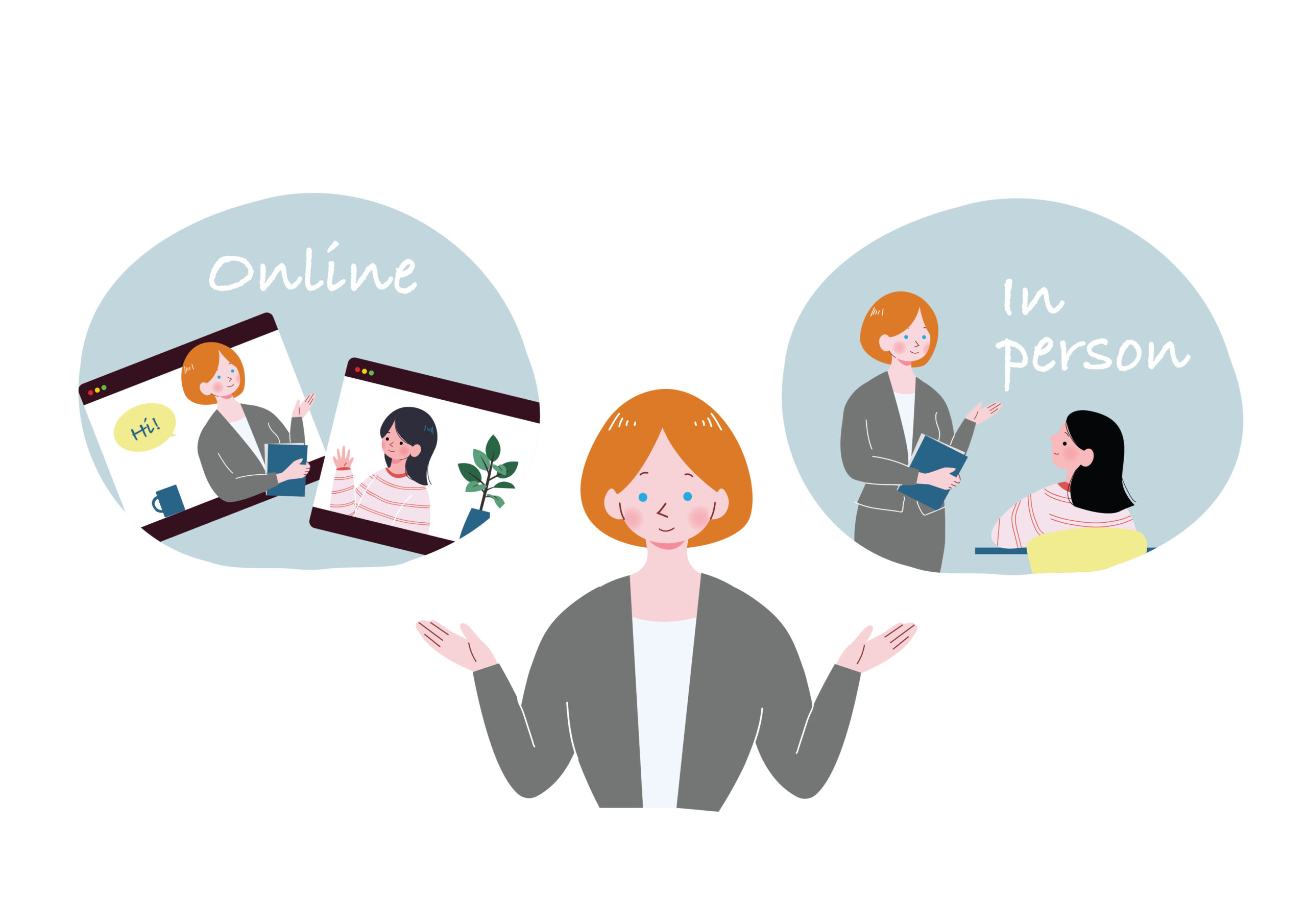
In today’s higher education landscape, many of us are navigating dual identities, teaching both online and in-person, often in the same term. While these environments may feel vastly different, great teaching is rooted in a core set of pedagogical values that transcend modality.
This article explores the shared foundations of quality instruction and offers practical strategies to help you confidently shift between digital and physical classrooms without compromising academic quality or student engagement.
What Makes Good Teaching, Good?
Whether we’re standing in a lecture hall or posting an announcement in an LMS, effective teaching starts with:
- Clear objectives
- Active learning
- Strong communication and presence
- Inclusive design
- Meaningful assessment
These fundamentals remain the same. What changes is how we deliver them.
Modality shouldn’t distract us from sound pedagogy. Whether synchronous or asynchronous, face-to-face or online, our work is grounded in backward design, student-centered approaches, and ongoing assessment. Re-centering our focus on these pillars helps us adapt thoughtfully, not reactively.
Example: Learning Objectives in Action
Anderson and Krathwohl (2001) emphasize the importance of well-defined learning objectives. In-person, this could look like writing objectives on the board or incorporating them into your lecture. Online, it might involve embedding objectives into weekly modules and pairing them with a short video or visual explanation.
Take the objective: “Apply ethical decision-making models to patient care scenarios.”
- In the classroom, this might involve a role-play simulation followed by a guided discussion.
- Online, it could become a case study analysis shared on a discussion board, followed by peer responses using a structured framework.
Same goal—different path.
Active Learning: Across Formats, It Works
Bonwell and Eison (1991) first advocated for active learning to deepen student engagement, and later research (Freeman et al., 2014) confirmed its positive impact, especially in STEM fields. The modality doesn’t limit engagement; it simply shapes the format.
- In-person, this may involve group work, real-time debates, or problem-solving tasks.
- Online, use breakout rooms, Google Docs, Padlet, Mentimeter, or discussion forums to simulate those same dynamics.
Students learn best when they are participants, not passive consumers, in the learning process.
Communication, Presence, and Feedback
Instructor presence is a key predictor of student success (Richardson et al., 2017). On campus, presence may happen organically through body language, hallway conversations, or impromptu check-ins.
But online, presence requires intention.
A few simple strategies that make a big impact:
- Weekly video or audio announcements
- Personalized feedback
- Emojis and voice comments in discussion boards
- Prompt, encouraging messages
These touchpoints help students feel supported, seen, and guided, regardless of where or when they log in.
Design and Structure Matter
A well-organized course reduces cognitive load and promotes confidence. Online, this might mean consistent modules, clear navigation, and due dates embedded in calendars. In-person, it could look like daily agendas, visual timelines, or scaffolded activities.
Anderson and Krathwohl (2001) remind us: start with the end in mind. Objectives drive assessments, which in turn shape content delivery. No matter the format, clarity and alignment help students thrive.
Assessment and Feedback
Assessment shouldn’t just evaluate learning; it should shape it. Hattie and Timperley (2007) stress the importance of feedback in closing the learning loop.
- In-person, use exit slips, real-time polling, or think-pair-share.
- Online, leverage auto-graded quizzes with explanations, journals, or reflective prompts with peer feedback.
Equity, Engagement, and Flexibility
CAST’s Universal Design for Learning (2018) reminds us to offer multiple means of representation, expression, and engagement. Think transcripts with videos, flexible deadlines, and tech check-ins early in the term.
Online learners often juggle jobs, caregiving, or time zone differences. In-person students may rely on structure but still disengage without varied methods. Both benefit from thoughtfully designed engagement strategies.
Time and energy differ by modality:
- Online requires more front-end design and structure.
- In-person demands real-time adaptability and energy.
Both require flexibility and empathy.
From Performer to Designer
In-person, instructors often act as facilitators and performers, using presence and spontaneity to engage. Online, the role shifts toward that of designer and communicator.
Darby and Lang (2019) champion “small teaching” strategies, such as short videos, weekly check-ins, and structured prompts as powerful tools to maintain momentum and connection online.
Regardless of the environment, our purpose remains unchanged: to guide, support, and respond to our students’ learning journeys.
Final Thoughts: Teaching is Teaching
To sum it up:
- Great teaching is rooted in strong pedagogy—not platform.
- Build presence, design with clarity, and prioritize equity.
- Embrace the tools of the modality but let pedagogy lead.
You don’t have to choose between being tech-savvy and student-centered. You can (and should) be both.
By making these mindful shifts, we ensure that students, wherever they are, receive the same level of support, engagement, and academic challenge.
Michele Poulos has dedicated more than twenty-five years to education, with experience spanning elementary, secondary, and post-secondary settings. She holds a Bachelor’s degree in Elementary Education, a Master’s degree in Psychology, and is currently pursuing her doctoral degree in Human and Learning Science. Throughout her career, she has taught and learned in both traditional classrooms and fully online environments, giving her a unique perspective on how students thrive across modalities. Michele currently serves as the Director of Online Education at Pima Medical Institute, where she oversees online programs, faculty development, and strategic initiatives designed to enhance student learning and success. Her professional accomplishments have been recognized nationally, as she was inducted into Marquis Who’s Who in America for four consecutive years (2022–2025). Her passion for education is matched by her commitment to family life. She resides in Naples, Florida, with her husband and their two children—ten-year-old Trenton and eight-year-old Eliana—who continually inspire her dedication to both teaching and lifelong learning.
References
Anderson, L. W., & Krathwohl, D. R. (Eds.). (2001). A taxonomy for learning, teaching, and assessing: A revision of Bloom’s taxonomy of educational objectives. Longman.
Bonwell, C. C., & Eison, J. A. (1991). Active learning: Creating excitement in the classroom. ASHE-ERIC Higher Education Report No. 1. George Washington University.
CAST. (2018). Universal Design for Learning guidelines version 2.2. http://udlguidelines.cast.org
Darby, F., & Lang, J. M. (2019). Small teaching online: Applying learning science in online classes. Jossey-Bass.
Freeman, S., Eddy, S. L., McDonough, M., Smith, M. K., Okoroafor, N., Jordt, H., & Wenderoth, M. P. (2014). Active learning increases student performance in science, engineering, and mathematics. Proceedings of the National Academy of Sciences, 111(23), 8410–8415. https://doi.org/10.1073/pnas.1319030111
Hattie, J., & Timperley, H. (2007). The power of feedback. Review of Educational Research, 77(1), 81–112. https://doi.org/10.3102/003465430298487
Richardson, J. C., Maeda, Y., & Swan, K. (2017). Predicting student achievement and satisfaction in online courses with a structural equation model. Online Learning, 21(3), 1–25. https://doi.org/10.24059/olj.v21i3.1180