Category: International Students

  • Canada: 47k int’l students flagged for potential visa non-compliance

    Canada: 47k int’l students flagged for potential visa non-compliance

    Aiesha Zafar, assistant deputy minister for migration integrity at IRCC, told the House of Commons Standing Committee on Citizenship and Immigration that 8% of international students reviewed were potentially “non-compliant”, meaning they were not attending classes as required by the terms of their study visa.

    “In terms of the total number of students we asked for compliance information from, that results in potentially 47,175. We have not yet determined whether they are fully non-compliant, these are initial results provided to us by institutions,” stated Zafar, who was questioned by Conservative MP Michelle Rempel Garner about where these students are currently, if they are not complying with their visa terms.

    Determining full non-compliance of the international students, however, is not straightforward, as institutions report data at varying intervals, and students may change schools, graduate, or take authorized leaves.

    Zafar noted that IRCC shares all the data it continually collects with the Canada Border Services Agency (CBSA), which is responsible for locating and removing non-compliant visa holders.

    “Any foreign national in Canada would be under the purview of the CBSA, so they have an inland investigation team,” Zafar told the committee when Garner questioned how the IRCC is able to track and remove students who are in violation of their visas.

    The 47,000 non-compliance cases are a backlog, evidence that fraud detection is strengthening, not weakening, Canadian standards
    Maria Mathai, M.M Advisory Services

    According to Maria Mathai, founder of M.M Advisory Services, which supports Canadian universities in the South Asian market, the figure of over 47,000 students who could be non-compliant being portrayed as a “crisis” misses the real story — that Canada’s immigration system is actively adapting.

    “Front-end Provincial Attestation Letter (PAL) screening now blocks thousands who would have entered before, and ongoing oversight is catching legacy issues. The 47,000 non-compliance cases are a backlog, evidence that fraud detection is strengthening, not weakening, Canadian standards,” Mathai told The PIE News.

    Mathai acknowledged that past PAL allocations contributed to compliance challenges, with regions like Ontario, which hosts the largest share of international students, directing most of its PALs to colleges with higher default rates.

    However, the situation is expected to change with IRCC now imposing strict provincial caps on the number of study permits each province can issue.

    “By surfacing these imbalances now, the new framework is encouraging provinces and institutions to adapt entry practices based on evidence and learning,” stated Mathai.

    Canada’s international student compliance regime, in effect since 2014, was established to identify potentially non-genuine students.

    It includes twice-yearly compliance reporting conducted in partnership with Designated Learning Institutions (DLIs), Canadian colleges, institutes, and universities authorised to host international students.

    While IRCC’s 2024 report noted no recourse against non-reporting DLIs, new rules now allow such institutions to be suspended for up to a year.

    Moreover, Canada’s struggle with international students not showing up for classes is not new, with reports earlier this year indicating nearly 50,000 instances of “no-shows”, international students who failed to enrol at their institutions, in the spring of 2024.

    While the “no-show” cohort included 4,279 Chinese students, 3,902 Nigerian students, and 2,712 Ghanaian students, Indian students accounted for the largest share at 19,582. It highlights a broader issue of immigration fraud originating from India, which Zafar identified as one of the top countries for such cases during her September 23 committee testimony.

    Over a quarter of international students seeking asylum in Canada also came from India and Nigeria.

    According to Pranav Rathi, associate director of international recruitment at Fanshawe College, which hosts one of the largest numbers of Indian students in Ontario, a “rigorous approach” has led to about 20% of Indian applications being declined to ensure only qualified candidates proceed.

    “Each application is carefully reviewed, and checked for aggregate scores, backlogs, and authenticity of mark sheets. We keep ourselves updated with the recognised institution list published by UGC,” stated Rathi.

    “It is mandatory for a student to provide English language tests approved by IRCC and we also verify English proficiency through IELTS or equivalent test reports to confirm readiness for study in Canada.”

    Rathi suggested that one reason Indian students often appear among potentially non-compliant or “no-show” cases is a systemic issue that previously allowed them to change institutions after receiving a study permit.

    He added that schools now need to take a more active role, particularly when students apply through education agents.

    “Institutions should ensure that their representatives are transparent, well-trained, and follow ethical recruitment practices that align with institutional and regulatory standards,” stated Rathi.

    “Ongoing collaboration between institutions and government bodies to monitor market trends and share insights can help build a more transparent and sustainable international education system.”

    Many Canadian institutions are now facing headwinds, with course offerings and research funding being cut as Canada’s study permit refusal rate has climbed to its highest level in over a decade.

    Canadian politicians have also intensified scrutiny of institutions across the country.

    Just days after the IRCC testimony on non-compliant students, a federal committee hearing led by MP Garner saw Conestoga College president John Tibbits questioned on issues ranging from his $600,000 salary to allegations of “juicing foreign student permits” amid growing concerns that healthcare, housing, and jobs that “don’t have capacity” in Ontario.

    “Colleges, including Conestoga, have been subject to scrutiny about the role international [students] play in housing, affordability and community pressures. I welcome the opportunity to reaffirm that Conestoga’s approach has always been about service. Our mission has always been to ensure the communities we serve have access to the skilled labour force they need to survive,” stated Tibbits, while addressing the committee on Thursday.

    “Looking ahead, we believe this is the time to stabilize the system to build an international student program that is sustainable, fair, globally competitive and focused on Canada’s economic priorities,” he added, as reported by CTV News.

    Source link

  • Three Notable StatsCan Papers | HESA

    Three Notable StatsCan Papers | HESA

    Over the summer, Statistics Canda put out a few papers on higher education and immigration which got zero press but nevertheless are interesting enough that I thought you might all want to hear about them. Below are my précis: 

    The first paper, Recent trends in immigration from Canada to the United States by Feng Hou, Milly Yang and Yao Lu, is a very general look at outbound migration to the United States, looking  specifically at the characteristics of Canadian citizens who applying for labour certification in the United States in 2015 and in 2024. I found the three top-line results all somewhat surprising.

    • The number of US certification applicants declined by just over 25% between 2015 and 2024.
    • Outbound migration to the US by Canadians is predominantly a “new” Canadian thing. In 2015, Canadian citizens born outside Canada made up 54% of those seeking certification, and by 2024 that proportion had increased to nearly 60%.
    • Among Canadians seeking US certification in 2015, 41% had a master’s or doctoral degree.  In 2024, that proportion had fallen to 31%.

    In other words, brain drain to the US changed significantly over the space of a decade: fewer Canadians headed south, and among those who did, declining proportions were Canadian-born or held advance degrees. All somewhat surprising.

    The second paper, Fields of study and occupations of immigrants who were international students in Canada before immigration by Youjin Choi and Li Xu, divides out two recent cohorts (2011-15 and 2016-21) of immigrants and starts to tease out various aspects of their current status in Canada.  Here the key findings were:

    • In the 2011-15 period, 13% of all immigrants were former international students. By the 2016-21 period, that number had risen to 23%.
    • About a third of immigrants who were students in Canada say their highest degree was taken outside Canada. It’s a bit difficult to parse this. It may mean, for instance, that they obtained a bachelor’s degree in Canada, went to another country for their master’s degree and came back; it may also mean that they took a master’s degree abroad and took some kind of short post-graduate certificate here.
    • A little over a third of all immigrants who studied in Canada have a STEM degree, a proportion that increased a tiny bit over time. This is higher than for the Canadian-born population, but not hugely different from that of immigrants who did not study here.
    • A little under half of all former international STEM students in the immigrant pool were working in a STEM field, but this is strongly correlated with the level of education. Among sub-Bachelor’s graduates this proportion was a little over 20%, while among those with a Master’s degree or higher it was over 50%. This is significantly higher than it is for Canadian-born post-secondary graduates. In non-STEM fields, the relationship is reversed (i.e. Canadian-born graduates are more likely to be working in an aligned field).

    In other words, former international students are a rising proportion of all immigrants, a high proportion are STEM graduates, and a high proportion of them go on to work in STEM fields. All signs that policy is pushing results in the intended direction.

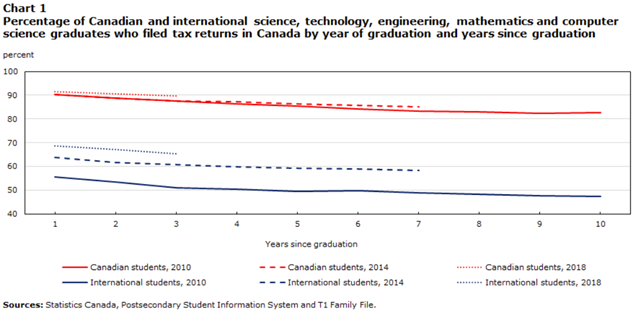
    The final paper, Retention of science, technology, engineering, mathematics and computer science graduates in Canada by Youjin Choi and Feng Hou, follows three cohorts of both domestic and international student graduates to see whether they stayed in the country (technically, it measures the proportion of graduates who file tax returns in Canada, which is a pretty good proxy for residency). The results are summed up in one incredibly ugly chart (seriously, why is StatsCan dataviz so awful?), which I reproduce below:

    So, in the chart the Y-axis is the percentage of STEM graduates who stay in Canada (measured by the proxy of tax filing) and the X-axis is years since graduation. Since they are following three different cohorts of graduates, the lines don’t all extend to the same length (the earliest cohort could be followed for ten years, the middle for seven and the most recent for just three).  The red set of lines represents outcomes for Canadian-born students and the blue set of lines does the same for international students.

    So, the trivial things this graph shows are that: i) both Canadian and international students leave Canada but ii) international students do so more frequently and iii) leaving the country is something that happens gradually over time. The interesting thing it shows, though, is that the most recent cohort (class of 2018) of STEM graduates are more likely to stay than earlier ones, and that this is especially true for international students: the retention rate of international graduates from the class of 2018 was almost fifteen percentage points higher than for the class of 2015.

    Was it a more welcoming economy? Maybe. But you’d have to think that our system of offering international students a path to citizenship had something to do with it too.

    Two other nuggets in the paper:

    • Canadian-born STEM graduates are slightly more likely to leave than non-STEM graduates (it’s not a huge difference, just a percentage point or two) while among international student graduates, those from STEM programs are substantially less likely to leave than those from non-STEM fields (a fifteen-point gap or more).
    • Regardless of where they are from, and regardless of what they studied, graduates from “highly-ranked” universities (no definition given, unfortunately) were more likely to leave Canada, presumably because degree prestige confers a certain degree of mobility.

    You are now fully up to date on the latest data on domestic and international graduates and their immigration pathways. Enjoy your day.

    Source link

  • Australia eases risk ratings amid calls to scrap system

    Australia eases risk ratings amid calls to scrap system

    According to reports, a brief note issued by the Department of Home Affairs through the Provider Registration and International Student Management System (PRISMS), which oversees international student data, confirms that evidence levels have been updated.

    “The September 2025 evidence level update for countries and education providers (based on student visa outcome data from 1 July 2024 to 30 June 2025) has taken place, effective for applications lodged on or after 30 September 2025,” read a statement by the DHA on the PRISMS website.

    Consultants and universities in Australia are able to work out these levels through the government’s document checklist tool, which reveals a provider’s risk standing based on the requirements triggered when paired with a student’s country of origin.

    Reports suggest that level 1 (lowest risk) includes Bangladesh and Sri Lanka; level 2 (moderate risk) includes India, Bhutan, Vietnam, China, and Nepal; and level 3 (highest risk) includes Fiji, the Philippines, Pakistan, and Colombia.

    Although India and Vietnam, both prominent source markets for Australia, improved from level 3 to level 2 on the back of stronger grant rates, China slipped from level 1 to level 2, possibly due to a surge in asylum applications from Chinese nationals, particularly students, as some reports suggest.

    While education providers in Australia registered under CRICOS (Commonwealth Register of Institutions and Courses for Overseas Students) are assigned an evidence level, each country is also given one based on its past performance with student visas, particularly visa refusals, asylum applications, and breaches of conditions.

    Are there not more Indians applying for protection visas? Hasn’t Nepal followed Sri Lanka and Bangladesh in political turmoil, where the economy has suffered? This has raised concerns around students meeting GS requirements
    Ravi Lochan Singh, Global Reach

    The combination of provider and country levels determines the documents required for an international student’s visa application.

    Stakeholders have highlighted the lack of transparency in assessing country risk levels, particularly as students from countries with reduced risk ratings may still arrive in Australia under precarious conditions.

    “Are there not more Indians applying for protection visas? Hasn’t Nepal followed Sri Lanka and Bangladesh in political turmoil, where the economy has suffered? This has raised concerns around students meeting GS requirements. There are also whispers that certain operators may encourage students to apply for protection visas,” stated Ravi Lochan Singh, managing director, Global Reach.

    Visa prioritisation is already tied to intended caps, with applications processed on a first-in, first-out basis until a provider reaches 80% of its allocation, explained Singh.

    With almost all universities now streamlined for visas and the majority promoted from level 2 to level 1, lowest risk, and almost none remaining in level 3, the evidence-level system appears unnecessary to some.

    “The concept of ‘streamlining’ (and then the development later of the SSVF) took place at a time where there was a whole-of-government focus on growing international student numbers and increasing the value, while maintaining integrity, of the highly important international education sector,” shared Mike Ferguson, pro vice-chancellor of Charles Sturt University.

    According to Ferguson, a former DHA official, “English and financial requirements were streamlined as part of the visa process, based on a risk assessment, given the other safeguards in place – obligations enforced by TEQSA and ASQA in terms of providers ensuring students have sufficient English proficiency and the use of the GTE requirement to consider a student’s holistic economic circumstances.”

    However, with international student numbers rising since the early 2010s, “times have changed” and the focus has shifted to managing enrolments and ensuring sustainable growth, explained Ferguson.

    “My view is that all students should provide evidence of funds and English with the visa process. That would align with community expectations, support enhanced integrity and potentially help to some degree with some of the course hopping behaviour we are seeing (though the latter requires a range of measures),” he contineud.

    “DHA could still determine the degree to which they scrutinise the funds submitted but that would be based on a more holistic and granular risk assessment – not just based on country and provider.”

    Evidence levels of select Australian institutions, showing whether they have remained steady, been upgraded, or downgraded, as shared by Ravi Lochan Singh. Correction: Deakin University was previously categorized under risk level 2 (not 1) and has since been upgraded to 1.

    Singh further stated that concerns around visa hopping and attrition could be exacerbated, as international students may now enter Australia through universities and then transition to higher-risk, non-university sectors without needing new visa applications, especially since Australia has yet to mandate linking study visas to the institution of initial enrolment, unlike neighbouring New Zealand.

    Moreover, Singh pointed out that when students arrive without adequate financial backing, it can increase visa misuse, which may lead authorities to tighten risk classifications again.

    “The document checklist tool provides a clear framework for assessing the risk level of a university. However, it raises concerns about the recent trend of promoting the application of visas without financial funds, as suggested by the document checklist tools. While these visas may be approved, this approach could potentially lead to the return of the country to risk level 3 in the future,” stated Singh.

    “For instance, if a country’s risk level is 3 (such as Pakistan), and Home Affairs requires financial and English requirements to be attached to the visa application, the university’s risk level is inferred to be 2. If the Home Affairs tool waives this requirement, the risk level is reduced to 1.”

    The PIE has requested comment from the DHA and is awaiting a response.

    Australia’s reported changes to country evidence levels come just a month after the government announced an additional 25,000 international student places for next year, raising the cap to 295,000.

    Source link

  • A quarter of students still drop out – Campus Review

    A quarter of students still drop out – Campus Review

    Some equity student retention rates are trending upwards even though one in four students still drop out of university, new Department of Education data has revealed.

    Please login below to view content or subscribe now.

    Membership Login

    Source link

  • Framework to shape international education – Campus Review

    Framework to shape international education – Campus Review

    An international education framework will shape the “next phase of maturity” of the Albanese government’s vision of a quality-first, managed-growth tertiary education sector.

    Please login below to view content or subscribe now.

    Membership Login

    Source link

  • US takes the lead on student satisfaction, survey finds

    US takes the lead on student satisfaction, survey finds

    Global student satisfaction has remained steady in 2025, but pressures on inclusivity, affordability and the quality of student life are beginning to show, according to the Global Student Satisfaction Awards: Summary Report 2025.

    Studyportals’ 2025 Student Satisfaction survey tracked responses from over 102,000 students around the world, with the US, Belgium and Austria leading the charge in overall satisfaction, ranked at 4.32, 4.29 and 4.28 stars out of five respectively.

    The biannual survey looked at reviews from students of 180 nationalities studying at institutions in 124 countries, recording an average satisfaction score of 4.18 out of 5. While stable compared to 2023 (when the last survey was published), this represents a slight dip of 0.71%.

    Meanwhile Pakistan, France, Ireland and Türkiye saw some of the steepest declines in satisfaction. The UK and India bucked the trend with improved scores, both climbing above the global average.

    Pakistan recorded the most significant drop since 2023’s survey (-11.3%), moving significantly further below the global benchmark. France also fell by -3.2%, Ireland by -2.4%, and Türkiye by -1.2%.

    By contrast, Finland (+3.3%) and the Netherlands (+0.2%) registered modest improvements, though both remain below the global average. The report warns that unless these downward trends are addressed, strong challengers like India and the UK could capture greater student interest.

    Students are more confident about career prospects, but increasingly concerned about diversity and their quality of life
    Edwin van Rest, Studyportals

    The report also tracked other factors such as admissions processes, career development, student diversity and student life.

    Winners were honoured across seven categories at an awards ceremony hosted by Studyportals in collaboration with Uni-Life and IELTS at a fringe event during last week’s European Association for International Education (EAIE) conference in Gothenburg.

    Key indicators revealed a mixed picture. Student diversity (-5.03%) and student life (-4.39%) suffered the largest declines, reflecting growing concerns around integration, housing shortages and rising costs in popular destinations. Admissions processes also weakened (-3.85%), with students calling for clearer communication, smoother transitions and more user-friendly digital systems.

    On the positive side, career development (+1.23%) recorded notable gains, with the US, India and Switzerland leading thanks to stronger links with employers, internships and industry engagement. Online classroom experience, long the weakest category, also improved modestly (+1.30%), particularly in the US, India and South Africa.

    Studyportals said the findings underline shifting student priorities. Employability outcomes and structured cross-cultural experiences are increasingly valued, while inclusivity and transparency remain pressing challenges.

    “These results show where universities are winning student trust, and where they risk losing it,” noted Edwin van Rest, CEO & co-founder of Studyportals. “Students are more confident about career prospects, but increasingly concerned about diversity and their quality of life.”

    Source link

  • Student caps could help shoddy operators – Campus Review

    Student caps could help shoddy operators – Campus Review

    Commentary

    Scams and rorts are relentless and adaptive, resurfacing even after operations are shut down

    Caps on international student places, set at 270,000 for 2025 and rising to 295,000 in 2026, are intended to manage growth and safeguard integrity in the sector.

    Please login below to view content or subscribe now.

    Membership Login

    Source link

  • UK still top choice for pathway students despite policy changes

    UK still top choice for pathway students despite policy changes

    International students are placing getting a quality education over policy developments – with the UK keeping its spot as the preferred desitnation for 80% of nearly 1,000 pathway students surveyed by NCUK.

    A new report covering the survey’s findings analyses data from 921 students across 88 countries studying an international foundation year or Master’s preparatino programs, looking at their motivations for studying in top destinations, as well as other preferences.

    It found that Australia was the second most popular choice, with 4% of students surveyed marking it as their preference, followed by Canada, the US, New Zealand and Ireland at 3%. Meanwhile, the most coveted programs are business and computer science, as the preferred subjects for just under a third (31%) of respondents.

    Students’ continued preference for the UK comes in spite of a slew of policy changes affecting international students. In May, the government unveiled its long-awaited immigration white paper, setting out the way Keir Starmer’s Labour party intends to tackle migration over the coming years.

    It included plans to reduce the Graduate Route by six months to a total of 18 months, as well as new compliance metrics that higher education institutions must in order to continue recrutiing international students. Tougher Basic Compliance Assessment (BCA) requirements are set to take effect this month, meaning that universities will face penalties if more than 5% of their students’ visas are rejected, down from 10%.

    And last September, the UK increased international student maintenance requirements for the first time since 2020. Under the new rules, students coming to London must show evidence of having £1,483 per month, while studying outside of London need proof that they have at least £1,136 per month.  

    But NCUK’s chief marketing officer Andy Howells pointed out that students are looking beyond arbitrary political decision when choosing their preferred study destination, thinking instead about their long-term prospects.

    “This research demonstrates that international students are sophisticated decision-makers who look beyond political headlines to focus on educational quality and career outcomes,” he said. “While policy changes generate significant discussion in our sector, students are primarily motivated by the academic excellence and opportunities that institutions can provide.”

    The survey found that, of a sample size of 646 students, just 12% who said they were considering studying in the UK said that financial requiremwnr increases would stop them from applying to UK instiutuons.

    However, the popularity of other major study destinations were ore impacted by political headwinds, the survey found.

    Over a third (36%) interested in applying the Australian institutions said that proposed international enrolment caps would affect their decision, while 26% of those looking to study in Canada said they would no longer apply to Canadian institutions over policy changes – particularly changes to the country’s postgraduate work permit scheme.

    And almost four in 10 (38%) considering the US said Donald Trump’s second presidency would negatively impact their choice to study in America.

    For the majority of students surveyed (69.9%), education quality is the primary driver leading them to seek study abroad opportunities, closely followed by enhanced career development opportunities (56.4%) and gaining new knowledge (55.2%).

    The survey also shone a light on students’ post-graduation plans. Half of respondents said they wanted to stay in their study destination, with 31% planning to work and 19% looking at further studies.

    This research demonstrates that international students are sophisticated decision-makers who look beyond political headlines to focus on educational quality and career outcomes
    Andy Howells, NCUK

    But a growing number of students plan to return to their hoe country immediately after graduating, with 23% saying they want to do this – up from 18% in last year’s survey.

    Immigration has continued to be a hot topic in the UK as the anti-immigration Reform party grows in popularity.

    Just earlier this week, Home Secretary Yvette Cooper drew ire from the international education sector after announcing that the government will be tougher on overseas students who make asylum claims that “lack merit” as a means to stay in the country after their visa expires.

    Some 10,000 students have already been texted and emailed warning them that they will not be allowed to stay in the UK if they have no legal right to remain and explicitly warning them against making bogus asylum claims.

    Source link

  • the realities of foreign language anxiety

    the realities of foreign language anxiety

    Picture this: you’ve crossed oceans, packed your suitcase, a dictionary (or maybe just Google Translate), your dreams, and a relentless drive to succeed in a US higher education setting. You’ve landed in the United States, ready for college life. But before you can even start worrying about your academic experience or how to navigate campus life and groceries you’re hit with a more personal challenge: “Will I sound awkward if I say this out loud?”

    For many non-native English speakers, this is not just a fleeting thought. It’s a daily reality known as foreign language anxiety – “the feeling of tension and apprehension specifically associated with second language contexts, including speaking, listening, and learning.” It can limit and negatively impact a student’s ability to communicate, threaten self-confidence, and, over time, affect academic performance.

    Why it matters more than we think

    Foreign language anxiety is more than a minor inconvenience. International students must maintain full-time enrolment to keep their visa status. If foreign language anxiety leads to missed classes, delayed assignments, or low grades, the consequences can be severe — including losing that status and returning home without a degree.

    Even though incoming students meet minimum language proficiency requirements, many have had little practice using English in real-life spontaneous situations. Passing a standardised test is one thing; responding to a professor’s question in front of a class of native speakers is another. This gap can lead to self-consciousness, fear, and avoidance behaviours that hinder academic and social success.

    The three faces of language anxiety

    Research shows that foreign language anxiety often takes three forms:

    1. Fear of negative evaluation – Worrying about being judged for language mistakes, whether by professors or peers. Some students are comfortable in class but avoid informal conversations. Others avoid eye contact entirely to escape being called on.
    2. Communication apprehension – Feeling uneasy about speaking in a foreign language, even for students who were confident communicators in their home country. Concerns about sounding less capable than native speakers can lead to silence in classroom discussions.
    3. Test anxiety – Stress about organising and expressing ideas under time pressure in a second language. This is not just about knowing the material; it’s about performing under linguistic and cognitive strain.

    These anxieties can actively block learning. When students focus on how they sound rather than what is being said, their ability to process information suffers.

    The role of faculty and administrators

    Faculty and administrators may underestimate how much their approach affects international students’ confidence. Being corrected for grammar in front of others is one of the most anxiety-provoking experiences students report. In contrast, giving students time to answer, offering feedback privately, and creating an environment where mistakes are treated as part of learning can significantly reduce foreign language anxiety.

    When capable, motivated students are held back by the effects of foreign language anxiety, institutions risk losing both talent and the global perspectives these students offer

    University administrators can also make a difference through peer mentoring programs, conversation workshops, and targeted support services. However, these resources are only effective if students are aware of them and feel comfortable using them.

    Why this isn’t just a student problem

    It’s easy to think of foreign language anxiety as a personal obstacle each student must overcome, but it has larger implications. International students bring global perspectives, enrich classroom discussions, and contribute to campus culture.

    Their success is both a moral responsibility and an investment in the overall quality and strength of higher education. When capable, motivated students are held back by the effects of foreign language anxiety, institutions risk losing both talent and the global perspectives these students offer. Taking steps to reduce its impact benefits the entire academic community.

    Moving forward

    Addressing foreign language anxiety is not about lowering academic standards. It’s about giving students a fair chance to meet them by reducing unnecessary barriers. For students, this means practicing conversation in low anxiety provoking settings, seeking clarification when needed, and accepting that mistakes are a natural part of language learning. For faculty and staff, it means being intentional about communication, offering encouragement, and ensuring that resources are accessible and culturally responsive.

    Foreign language anxiety is a shared challenge that can undermine even the most motivated and capable students. Often, the greatest hurdle of studying abroad is not mastering complex coursework, adjusting to life far from home, or navigating cultural differences – it is the moment a student must raise their hand, speak in a language that is not their own, and hope that their words are understood as intended.

    Beyond academics, foreign language anxiety can affect the kinds of social and academic engagement that are essential for building leadership skills. Group work, class discussions, and participation in student organisations often require students to communicate ideas clearly, respond to feedback, and collaborate across cultures – the same skills needed to lead effectively in professional environments.

    However, literature on foreign language anxiety suggests that students may hesitate to take on visible roles or avoid speaking in group settings altogether, limiting their ability to practice these skills. When students withdraw from such opportunities, they lose more than a chance to participate – they miss experiences that can shape confidence, decision-making, and the ability to work with diverse teams.

    Understanding and addressing the impact of foreign language anxiety, therefore, is not only relevant for academic success but also for preparing graduates to step into leadership roles in a global context.

    Source link

  • What does the K visa mean for China’s search for global talent?

    What does the K visa mean for China’s search for global talent?

    Earlier this month, China’s State Council amended the Regulations on the Administration of the Entry and Exit of Foreigners, highlighting the growing importance of its global talent strategy.

    Effective from October 1, the visa, which will be subject to approval by the authorities of the People’s Republic of China, will be open to international youths who have earned undergraduate or STEM degrees from leading domestic and global research institutions. 

    The visa will also be open to young international professionals engaged in education and research in STEM fields.

    As per reports, compared with ordinary visa categories in China, the K visa is designed to provide greater convenience for holders through multiple entries, longer validity, and extended stay durations.

    We see it as a powerful signal that China is not only open for business but is actively and competitively seeking to attract the world’s best and brightest minds
    Charles Sun, China Education International

    It will also create opportunities for exchanges and collaboration across education, science, technology, culture, business, and entrepreneurship with applications no longer needing sponsorship from a local enterprise, relying instead on the applicant’s age, educational background, and work experience.

    “We see it as a powerful signal that China is not only open for business but is actively and competitively seeking to attract the world’s best and brightest minds,” Charles Sun, founder and managing director of China Education International, told The PIE News.

    “A key attractive feature is the inclusion of provisions for spouses and children. Making it easier for families to relocate together is perhaps one of the most important factors in convincing top-tier talent to make a long-term commitment to a new country.”

    According to data from Studyportals, this move comes at a time when interest in pursuing Artificial Intelligence degrees in the US is declining, while interest in studying the same in China is on the rise.

    “When comparing January to July 2025 to the same period in 2024, relative demand for artificial intelligence degrees (on-campus Bachelor’s and Master’s and PhDs) in the US on Studyportals dropped 25% year-over-year, while interest in AI degrees in China rose 88%,” read a report shared by Studyportals.

    “Both Beijing and Washington are racing to secure technological leadership in the  ‘Race on AI’. According to Harvey Nash “Digital Leadership Report 2025” artificial intelligence has created the world’s biggest and fastest-developing tech skills shortage in over 15 years. This shortage has created a race for talent, with companies like Meta reportedly handing out $100m sign-on bonuses to win top talent.”

    While interest in pursuing such degrees in China is growing amid its global talent push, the US remains a powerhouse in the field.

    International students account for 70% of all full-time graduate enrolments in AI-related programs and make up more than half of all international students in the country enrolled in STEM disciplines.

    “Nations that succeed in drawing the brightest minds and in creating an environment for innovative business to thrive, will not just advance their economies, they will command the future of technology, security, and influence,” stated Edwin Rest, CEO of Studyportals.

    “International students do not only bring revenue to local economies and soft power, they also fuel innovation, startups, and job creation.”  

    Source link