Category: Islam

  • Can the world’s largest democracy accept all faiths?

    Can the world’s largest democracy accept all faiths?

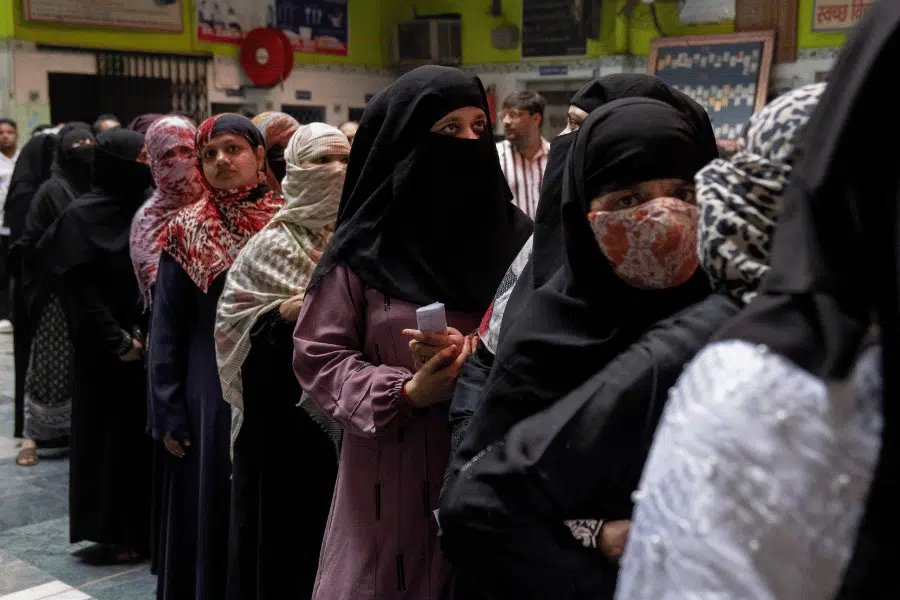
    Sidra Khan is a young Muslim woman in India who aspires to be a lawyer. Since early childhood, she has valued and respected Islam, the religion she was born into. But her headscarf now meets eagle eyes when she travels on public transport or tries to make a point during college lectures. 

    She feels that anti-Muslim rhetoric in India is causing her peers to judge her on the basis of religion and not merit. This, many Muslim students like Khan feel, is a casualty of having the government of Prime Minister Narendra Modi rule India.

    Over the last decade, the government of this secular country long considered the world’s largest democracy has introduced religious-based laws and politicians have incited anger and hatred against those who aren’t Hindu through rhetoric in speeches and AI campaigns. In northeast India’s Assam state, Wajid Alam, a college history student, watched a new election video from the ruling Bharatiya Janata Party with unease.

    An AI generated video shared by BJP’s official social media handles suggested that if the BJP loses power, Assam would be overrun by Muslims. It used AI-generated imagery to depict Muslims in hijabs and skull caps allegedly taking over airports, stadiums, tea gardens and other public spaces.

    It concluded with a message claiming Muslims could grow to 90% of Assam’s population, provoking other religious groups to choose the BJP to get rid of Muslims.

    The politics of religion

    For Alam and millions of Muslims in Assam, the video felt like an attack. And it is not the first time the BJP has been accused of demonizing religious minorities. Under Prime Minister Narendra Modi, India — a country founded on principles of secularism and religious freedom — has seen growing hostility toward Muslims and Christians.

    Some 200 million people in India practice the Muslim faith, making it the world’s third largest population of Muslims.

    Modi became India’s 14th prime minister in May 2014. Not long after, reports of attacks on religious minorities began to climb. In June 2014, Mohsin Shaikh, a young Muslim IT worker in Pune, was beaten to death by Hindu extremists — the first of several lynchings that followed. 

    A year later, in 2015, a Hindu mob in Dadri, Uttar Pradesh, killed Mohammad Akhlaq on suspicion of eating beef — considered a serious offense in the Hindu religion. That made global headlines and signalled the rise of cow-protection vigilantism. 

    By 2016–17, assaults on Muslims accused of trading or transporting cattle spread across northern India, with cases like the lynching of dairy farmer Pehlu Khan in Rajasthan. Christians, too, came under pressure during this period: nationalist groups staged forced reconversion campaigns, disrupted prayer meetings, vandalized churches and invoked new anti-conversion laws to arrest pastors and worshippers.

    Muslims under Modi’s rule

    Together, these incidents marked the early years of the Modi era as a turning point, when both Muslims and Christians began to face growing hostility in daily life.

    At the same time, hostile rhetoric against minorities became increasingly common in election campaigns. BJP leaders and affiliated Hindu nationalist groups framed Muslims as “outsiders” or “invaders,” with speeches warning of demographic “takeovers” or linking entire communities to terrorism and cow slaughter.

    Christians were accused of running covert “conversion factories,” with pastors painted as threats to India’s cultural identity. These narratives — echoed at rallies, on television debates and, more recently, through AI-generated propaganda — blurred the line between campaign messaging and hate speech. For many analysts, this marked a shift: politics was no longer just influenced by religion, but actively weaponizing it to polarize voters.

    These speeches were not isolated slips but part of a larger pattern. Muslims were painted as “infiltrators,” “termites” or participants in a supposed “love jihad” plot to convert Hindu women, while Christians were accused of running “conversion factories” and threatening India’s culture.

    Senior BJP figures, including party president Amit Shah and Uttar Pradesh Chief Minister Yogi Adityanath, used such language at rallies to mobilize support. Over time, this messaging blurred into mainstream political discourse, normalizing suspicion and hostility toward entire communities.

    Political divisions

    India’s experience is part of a wider global pattern. Around the world, political movements are blending nationalism and religion to define who “belongs.” A recent Pew Research Center study found that while the United States ranks lower than many countries on overall religious nationalism, it stands out among wealthy democracies for how many adults say the Bible should influence national laws or that being Christian is essential to being truly American.

    In the United States, debates over Christian nationalism have become a powerful current within the Republican Party and Donald Trump’s political rhetoric.

    Trump and allied evangelical leaders increasingly frame America as a “Christian nation,” a message that blurs the line between faith and state power. Commentators warn that this effort to link patriotism with religion mirrors broader global trends — from India to Israel to Turkey — where religious identity is being harnessed for political gain.

    Both the U.S. and Indian constitutions enshrine secularism, which is the idea that the state would keep equal distance from all religions. In India’s case, that principle mattered in a country where Hindus form the majority but millions of Muslims, Christians, Sikhs and Buddhists also call the nation home. 

    A history of strife

    Even before Modi, religion and politics were sometimes entwined: the Congress Party drew on Hindu symbolism, the 1984 anti-Sikh riots scarred the country and the destruction of the Babri mosque in 1992 shook faith in secularism. Still, the political consensus was that India was not to be defined by one faith.

    “But a lot has changed under Modi and the BJP,” said Sneha Lal, a Hindu student studying to become a primary school teacher. “We did not grow up in this India.”

    Lal is bothered by some of the BJP’s tactics that have promoted anti-conversion laws in several states, laws often used against Christians and Muslims accused of proselytizing. 

    In 2019, the Citizenship Amendment Act introduced fast-track citizenship for non-Muslim refugees, a move widely criticized as discriminatory toward Muslims. That same year, Delhi revoked the autonomy of Jammu and Kashmir, India’s only Muslim-majority state. Alongside these legal changes, election campaigns have increasingly featured polarizing rhetoric, and propaganda — including AI-generated videos — has circulated warning of demographic “takeovers.” 

    Critics say these policies and messages together mark a break from India’s founding secular vision, pushing the country toward a Hindu-first identity.

    Can there be a unified national identity?

    Seema Chishti, a senior journalist who has witnessed India’s journey from secular to right-wing, said that mixing religion with politics and diluting India’s unified national identity across religious and ethnic groups is a stated core principle of the ruling party, based on its militant roots. 

    “The Indian Constitution recognises no barriers to being Indian, i.e. nationality is not contingent on faith, caste, region, creed, gender or political views,” Chishti said. “BJP has loudly proclaimed ‘Hindu-India’ and instilled ‘Hindu’ nationalism in politics, education, the armed forces and every other facet of Indian life.”

    An example of Modi’s attempt to link Indian-ness with Hinduism is the Citizenship Amendment Act of 2019 which fast-tracks Indian citizenship for non-Muslims from three neighbours: Pakistan, Bangladesh and Afghanistan. “This action echoes ideas of India being a Hindu homeland,” Chishti said.

    On 15 August 2025, on India’s 79th Independence Day, Modi addressed crowds gathered at Delhi’s historical Red Fort, as he did the last 11 years that he has been in power. 

    On a day which commemorates India’s long struggle for self-rule that culminated in self-governance and independence from the British empire, Modi referred to the right-wing paramilitary organization Rashtriya Swayamsevak Sangh or RSS as a philanthropic organization. RSS has espoused an India for Hindus only. 

    Intolerance and violence

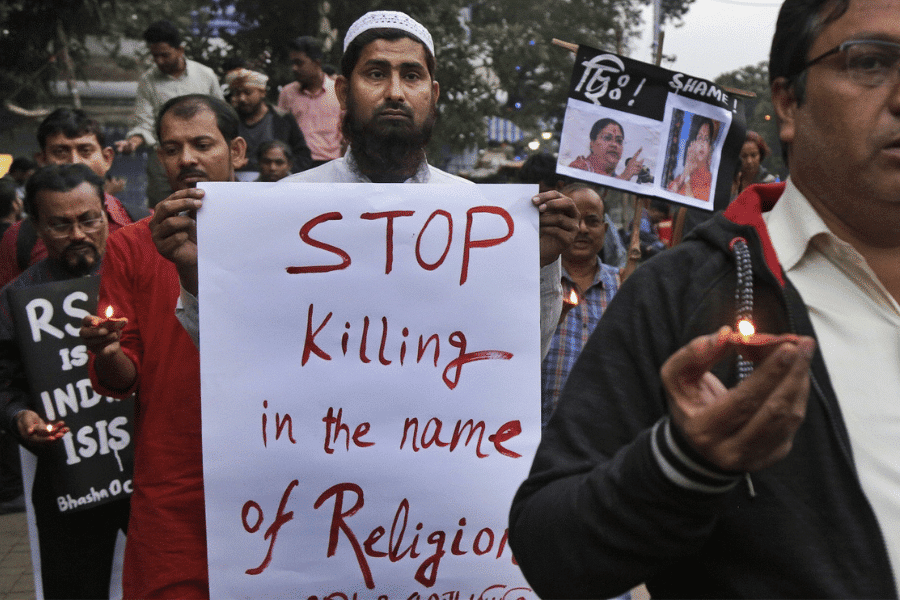
    All this has had tragic consequences. On 25 September, a seven-year-old Muslim boy was abducted from his neighborhood and brutally murdered in northern India’s Azamgarh. 

    But religious hate crimes haven’t only targeted Muslims. On 11 June, a mob allegedly linked to Hindu extremist groups attacked guests at a Christian wedding and set fire to a utility vehicle. And on 25 July, two Catholic nuns were arrested in central India’s Chhattisgarh state following a complaint by a member of an extremist Hindu group.

    India’s United Christian Forum reported that in 2024, Christians across the country witnessed 834 such incidents, up 100 incidents from 734 in 2023 — that comes out to more than two Christians being targeted every day in India simply for practising their faith. 

    These incidents of attacks and even public hate speeches against Christians are not limited to vandalism, they extend to physical assaults, disruption of prayer gatherings, financial boycotts and even motivated arrests. 

    This anti-Christian sentiment has been fanned by Hindu extremist groups in the country, which are indirectly and sometimes directly backed by the ruling BJP and other Hindu nationalist groups. These groups are increasingly using anti-conversion laws created in the Modi era to harass Christians. 

    Christians in India

    Arun Pannalal, president of the Chhattisgarh Christian Forum, said that two things are happening: Lawlessness of mobs who target Christians is ignored by police, while Christians often find themselves subject to seemingly random arrests. 

    “On random calls by Bajrang Dal goons the Police arrested the nuns, without evidence of anything,” Pannalal said. “But when the nuns wanted to complain against the goons, it was not lodged.

    Chishti said that more than politicising religion, by inserting religion into politics, the BJP is trying to portray itself as the only ‘Hindu’ party and the others consequently as not. She maintains that the BJP has fought elections on issues that polarise Indians, divide them and not on its performance or electoral record. Its electoral dominance has also meant that other parties in the fray, the opposition too find themselves playing on the BJP’s turf. 

    “The BJP has done its best to make the political discourse about faith, symbols of religion — Hindu and Muslim — and portraying themselves as saviours of the Hindu faith and righting so-called historical wrongs,” Chishti said.

    As a result, the media focuses on the religious conflicts, instead of other pressing issues, such as the economic well-being of people, the public health or education systems, joblessness and inflation, Chishti said.

    As India heads toward future elections, the blending of religion and politics raises questions not just for its own democracy but for others around the world. For young people in India, the stakes are immediate: whether their country remains true to its founding promise of secularism and equal rights.

    But for readers everywhere, India’s story is part of a larger global trend from the United States to Turkey to Israel, where religion and nationalism intertwine to shape politics. Understanding how these forces play out in the world’s largest democracy can help us make sense of how faith and power continue to influence politics across the globe.

    India’s struggle shows that when religion becomes a political weapon, democracy itself can become the battleground.


    Questions to consider:

    1. How is freedom of religion protected in India?

    2. In what ways are Muslims being treated differently by the Modi administration?

    3. In what ways to you feel comfortable or uncomfortable in your community expressing your faith?


    Source link

  • Can your religion put your nationality at risk?

    Can your religion put your nationality at risk?

    Standing on the charred remains of his hut in a village near Assam’s Morigaon district in South India, Shafik Ahmed clutched a worn folder of papers: land deeds, ration cards and a laminated voter ID, all declaring the 68-year-old bicycle repairman an Indian citizen.

    None of it mattered when bulldozers rolled into his neighbourhood in June 2025, demolishing 17 homes, all belonging to Bengali-speaking Muslims.

    “I was born here, voted here, paid taxes here,” Ahmed said. “Still, they told me I am a foreigner. They dumped us near the border like we are cattle.”

    Ahmed is among the hundreds of Muslims who say they were pushed across India’s eastern border into Bangladesh in recent months, as part of what human rights lawyers say is a rapidly intensifying campaign of ethnic targeting in Assam, a region famous across the world for the quality of tea it produces. 

    The drive has escalated in the run-up to the 2026 state elections, with Chief Minister Himanta Biswa Sarma branding undocumented Muslims as “infiltrators” and vowing to “protect the culture of Assam.”

    Islamophobia is a global concern.

    The expulsions, many executed without due legal process, have sparked concern far beyond India’s borders. As the United Nations warns of a global surge in anti-Muslim bigotry, activists say Assam’s campaign fits a broader pattern of Islamophobia playing out across continents.

    “They call it pushback,” Ahmed said. “We call it expulsion.”

    Across Assam, particularly in Muslim-majority districts like Dhubri, Barpeta and Goalpara, families wake up to midnight police knocks, arbitrary detentions and the looming threat of forced deportation.

    Rubina Khatun, 53, said she was taken without explanation from her home In May 2025, driven 200km to the Matia detention centre and later left in the no-man’s land near the India-Bangladesh border along with other women and children.

    “The soldiers shouted at us: ‘You’re not Indian anymore. Go to your country’,” she said. “But I have never been to Bangladesh. We spent hours in the swamp. No food, no water. It felt like we were being erased.”

    Applying old laws to new intolerance

    Human rights lawyer Hameed Laskar, who represents several families appealing the orders by the Foreigners Tribunals, says the government is misusing a 1950 law meant for undocumented immigrants.

    “These people have lived in Assam for generations,” Laskar said. “Some even appear on the National Register of Citizens. But a misspelled name or a missing land receipt from 1970 is enough to be declared a foreigner. It’s not legal enforcement. It’s engineered exclusion.”

    The targeting of Muslims in Assam is not new. But since the conservative Bharatiya Janata Party came to power in India in 2014, the rhetoric has hardened and the policies have sharpened.

    In 2019, the national registry process excluded nearly 2 million people, most of them Muslims. That has left families in limbo. While Hindus excluded from the list can claim citizenship under India’s 2019 Citizenship Amendment Act, there is no such provision for Muslims.

    The wife of Parvez Alam, a schoolteacher in the city of Barpeta, Aswas recently declared a foreigner despite having a birth certificate and electoral record.

    “Muslims now need 20 documents to prove their Indian-ness. Hindus only need to declare it,” Alam said. 

    Ping-ponging people across borders

    According to a June statement from Chief Minister Sarma in the state assembly, more than 300 “illegal Bangladeshis” have been expelled since May. Local media and community groups put the number closer to 500, including at least 120 women.

    But the Bangladeshi government has rejected many of these returnees, saying they have no proof of origin. Several have been stranded in border areas, caught in a bureaucratic tug-of-war.

    In one incident that drew widespread attention, 60-year-old Salim Uddin, a retired truck driver from Golaghat, was found wandering along the India-Bangladesh border after his family saw a viral video showing him being handed over to Bangladesh’s border guards.

    His son, Rashid, later confirmed that Uddin had served in the Assam Police for nearly three decades.

    “How can the son of a state police officer be declared Bangladeshi?” Rashid asked. “Had my grandfather been alive, it would have broken his heart.”

    A pattern of prejudice

    The Assam government has denied that the crackdown is communal, insisting it targets only “illegal foreigners.” But the pattern tells a different story. A recent report by a coalition of civil society groups found that over 95% of those detained or expelled this year were Bengali-speaking Muslims.

    The fear gripping Assam’s Muslims mirrors rising Islamophobia globally. From bans on hijabs in French schools to mosque attacks in the United Kingdom, Muslims across continents are facing what the United Nations calls a “widening wave of intolerance.”

    On March 15, UN Secretary-General António Guterres marked the International Day to Combat Islamophobia by warning of a disturbing rise in anti-Muslim bigotry. “This is part of a wider scourge of extremist ideologies and attacks on religious groups,” Guterres said in a video address. “Governments must foster social cohesion and protect religious freedom.”

    He called on online platforms to curb hate speech, and on leaders to avoid rhetoric that demonizes communities. Muslim civil rights groups in Europe and North America have echoed those concerns.

    A spread of intolerance across the globe

    A recent report by the Council on American-Islamic Relations documented a record 8,658 anti-Muslim incidents in 2024 alone.

    In the UK, advocacy group Tell MAMA has reported a 30% increase in Islamophobic hate crimes since October 2023, including attacks on mosques, verbal abuse and discrimination in housing and employment.

    Dr. Arshiya Khan, a political sociologist based in London, said these patterns are not isolated. “They’re interlinked,” Khan said. “What starts as state policy in one country often emboldens vigilante behaviour in others.”

    In Assam’s tea belt, the fear is palpable. In several villages, Muslim residents say they have stopped going to police stations or even hospitals, afraid they might be detained. In one case, a 27-year-old man who went to register a land dispute at a local police station was declared a foreigner after a routine ID check.

    “We don’t know who is next,” said Shahina Begum, a mother of three. “They say we don’t belong here. But where do we go?”

    Fighting back

    At least four petitions have been filed in the Assam High Court since June by families who say their relatives disappeared after being taken by police. Most had no ongoing legal cases against them.

    “They’re being disappeared without a trace,” said Laskar. “This is not law enforcement, it’s ethnic cleansing in slow motion.”

    Back in Morigaon, Shafik Ahmed said he has no plans to leave, even as bulldozers return to neighbouring villages.

    “This land is all I know. If they push me out again, I’ll come back again,” he said, eyes fixed on the debris of his former home.

    But for those like Rubina Khatun the trauma is lasting. “We’re citizens,” she said. “We have documents. We were born here. But in their eyes, we will never be Indian enough.”

    As global attention briefly turns to Assam, with international bodies urging India to uphold human rights, residents say they don’t expect justice, only survival.

    “Every day we live feels like another test to prove we exist,” Ahmed said.


    Questions to consider

    1. Why do Muslim citizens of Assam India believe that their government treats them differently than non-Muslims? 

    2. Should religion be a factor in determining whether someone should get national citizenship?

    3. Should a government be concerned about the religions of its citizens? 


    Source link

  • When the government tells you that you cannot pray

    When the government tells you that you cannot pray

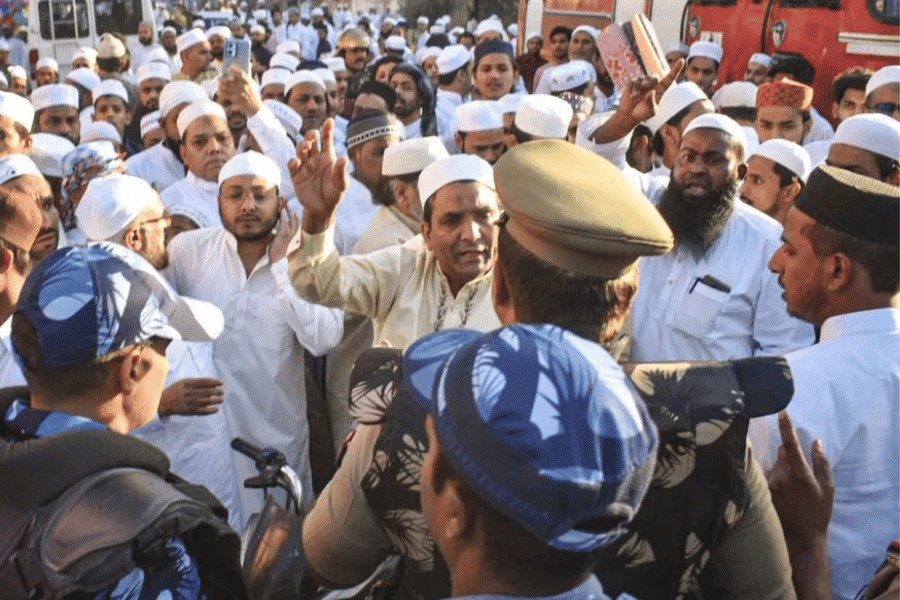
    When Abdul Kadeer returned from Saudi Arabia in last month to celebrate the Muslim festival of Eid-ul-Fitr with his family in Meerut, a city northeast of New Delhi in the Indian state of Uttar Pradesh, the 32-year-old found himself gripped by fear. The local administration had announced tough restrictions on Eid-ul-Fitr prayers for Muslims. 

    Eid-ul-Fitr is one of two major holidays celebrated by Muslims and commemorates the end of the holy month of Ramadan, in which Muslims fast daily from before dawn until sunset.

    Because mosques and designated grounds for prayers, known as Eidgahs, have insufficient space to accommodate the large number of worshippers during these holidays people often stop on roadsides to offer prayers. 

    But just days before the festival, Meerut police announced that offering prayers on roads and other public places could lead to passport cancellations. 

    “I came home to celebrate with my family, but now we are living in fear,” Kadeer says. “Why is it that when we pray, it becomes a problem, but during other festivals, roads are blocked and nothing happens?”

    Jamia Masjid Srinagar closed for Eid prayers in Kashmir. (Photo by Sajad Hameed)

    A minority religion

    For Kadeer, losing his passport would cost him his job.

    “I work in Saudi Arabia to support my family here,” he said. “Why are we being targeted for a prayer that lasts barely 20 minutes?”

    The state of Uttar Pradesh has a predominantly Hindu population, with Hindus comprising around 80% of the total population, while Muslims make up approximately 19%.

    Across Meerut, sentiments like Kadeer’s resonate deeply. Many Muslims in the city ask why they face restrictions when Hindu festivals frequently involve processions on public roads without similar consequences.

    “Why is it that only during Eid, roads become a law-and-order issue?” questions a shopkeeper in the city’s old quarter. “During Holi or Diwali, no one is threatened with legal action.”

    Holi and Diwali are major Hindu festivals celebrated with their own distinct rituals rooted in mythology, seasonal change and spiritual themes. Holi celebrates spring with colors, water fights and sweets, symbolizing good over evil. Diwali, the festival of lights, involves lamps, fireworks and sharing food, marking prosperity and the return of the Hindu god Rama.

    When the Indian government restricts public prayer during Muslim festivals like Eid-ul-Fitr it says it does so to maintain public order and prevent communal tensions. Authorities may cite concerns about large gatherings in public spaces causing traffic disruptions, noise pollution or potential clashes, especially in areas with a history of religious friction. 

    Tensions peaked on 31 March, for example, when violence erupted after the Eid prayer in Siwalkhas, a town northeast of New Delhi. According to police, members of two groups clashed, with reports of gunfire. Security forces quickly intervened, dispersing the crowds, but not before more than six Muslims were injured.

    A double standard?

    The restrictions on prayer have sparked national debate. Popular comedian Munawar Faruqui criticised the decision on social media, questioning why a short prayer was being singled out. But Uttar Pradesh Chief Minister Yogi Adityanath defended the measure, citing the Maha Kumbh in Prayagraj as an example of religious discipline. 

    “[Six hundred and sixty million] people attended the Maha Kumbh without any incidents of violence, harassment or disorder. Roads are meant for walking,” he said, suggesting that Muslims should learn from Hindu festival gatherings. 

    Nasir Qureshi, 47, of Bijnor, said that even before Eid, they were warned not to gather in large numbers for prayers. “But when Hindus celebrate their festivals, there are no such restrictions,” he said “Why is there one rule for us and another for them?”

    The directive has drawn criticism not only from opposition parties but also from within the allies of the ruling Bharatiya Janata Party or BJP.

    Iqra Hasan, a member of parliament for the socialist Samajwadi Party, questioned the intent behind the restrictions while Chirag Paswan, a BJP ally, called for a focus on broader issues rather than communal divisions. And Union Minister Chaudhary Jayant Singh compared the crackdown to authoritarian measures described in George Orwell’s book “1984”.

    Opponents to restrictions argue that the Hajj in Mecca, with 2–3 million Muslims praying peacefully, shows that large Muslim gatherings can be managed safely, like the Maha Kumbh’s 400 million Hindus. With proper planning, India could allow Eid prayers fairly, avoiding bias.

    Police and worshippers

    In Meerut, protests took shape in subtle ways. Some worshippers displayed posters stating, “It’s not just Muslims who pray on roads.” The banners listed instances of Hindus and others conducting religious activities on public streets.

    Authorities forcibly removed the posters, leading to further tensions. Among the congregation, expressions of solidarity with Palestine were visible, with worshippers seen holding “Free Palestine” placards and some donning traditional Palestinian attire.

    Mohammed Saeed, 29, a resident of Meerut, said that the police didn’t let them complete their prayers. “They stormed in, shouting at us to leave, and when people protested, they started hitting us,” Saeed said. “Even elderly men were pushed around.”

    Police have registered cases against those raising Palestine-related issues in previous instances, making this a sensitive act of defiance. Beyond Meerut, other decisions have added to the sense of alienation. In Haryana, the state government removed Eid from its list of gazetted holidays, relegating it to a restricted holiday status. This means government offices will remain open on Eid and employees —Hindus or Muslims — must request leave if they wish to observe it.

    Asaduddin Owaisi, an member of parliament from Hyderabad and chief of the right-wing political party All India Majlis-e-Ittehadul Muslimeen, said that these kind of decisions are a direct attack on Muslim minorities in the country. 

    He also said that earlier last year the central government ordered a survey of the Jamia Masjid in Uttar Pradesh, a 500-year-old mosque that is part of a UNESCO World Heritage site. It turned into violence with five people killed and 30 injured. 

    “Hundreds were detained only to deny the survey,” Owaisis said. “These decisions will increase the hate in the communities nothing else.”

    Religious clashes elsewhere

    While India sees frequent communal flashpoints between Hindus and Muslims, other South Asian nations have also witnessed religious tensions manifesting in different ways.

    In Pakistan, religious minorities, particularly Hindus and Christians, have often faced restrictions on their religious practices, though state-imposed bans on mass religious gatherings have been rare.

    In Bangladesh, political conflicts sometimes intertwine with religious identity, leading to incidents of violence during Hindu Durga Puja celebrations. Sri Lanka has seen its own set of religious tensions, with growing restrictions on Muslim practices such as a ban on the niqab — a face veil worn by women — following the 2019 Easter bombings when 269 people were killed in six suicide bombings in churches and hotels. 

    In Kashmir, meanwhile, the state’s approach to religious gatherings has taken a different but equally restrictive form. On 31 March, as Muslims worldwide prepared for Eid-ul-Fitr, authorities in Srinagar locked down the historic Jamia Masjid, preventing worshippers from offering prayers there.

    The region’s chief cleric, Mirwaiz Umar Farooq, was placed under house arrest, a move he strongly condemned.

    “When huge claims of ‘normalcy’ are made every day by the authorities, why are Muslims in Kashmir being kept away from their religious places and practices?” Mirwaiz said in a statement. “What is the agenda? Is the collective identity of Kashmiri Muslims a threat to the rulers?”

    The Jamia Masjid closure follows a pattern seen in recent years, where authorities have restricted access to religious sites on key Islamic occasions, citing security concerns.

    Earlier in March, the mosque was locked for Shab-e-Qadr and Jummat-ul-Vida prayers, triggering strong reactions from opposition parties in Kashmir.

    Darakhshan Andrabi, who is a senior BJP leader and chairs the Jammu and Kashmir Wakf Board, a body that controls the use of religious and charitable properties, justified the decision, stating that Eid prayers could not be held at Eidgah grounds due to ongoing construction work. However, many local residents and religious leaders see such restrictions as politically motivated and part of broader efforts to control religious expression in the region.


    Questions to consider: 

    1. What is Eid-ul-Fitr?

    2. What is a rationale the Indian government has to restrict public prayer during Muslim festivals?

    3. Do you think that the government should be able to regulate religion? Why?


    Source link