The tent donated by the Mani Tese association swayed every 10 minutes. In May 2012, aftershocks from the Emilia earthquakes in Northern Italy shook the ground. But inside that precarious structure, dozens of people played music together as if nothing could stop them.
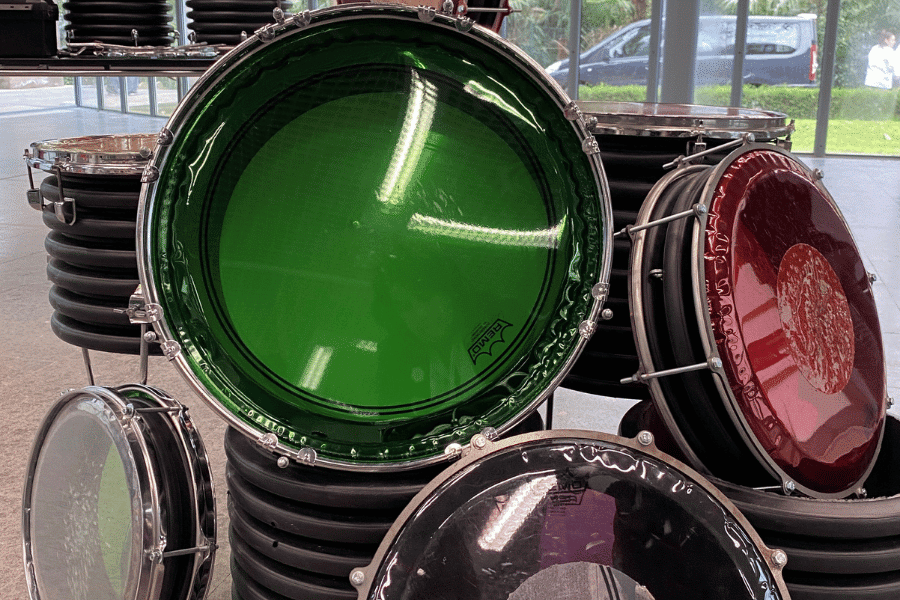
Oil buckets transformed into drums, pots hung from metal nets, plastic bins resonated like timpani. What might have seemed like an improvised concert was actually the birth of something revolutionary.
“That was truly an unforgettable moment for all of us,” said Federico Alberghini, the head and founder of Banda Rulli Frulli. “We realized we had something huge in our hands, a project with such vision and energy that telling it now still moves me.”
Founded in 2010, Banda Rulli Frulli is an inclusive and accessible music project that brings together young people of all abilities to build instruments from recycled materials and create music as a collective. Born as an educational experiment, it has grown into a community movement combining creativity, craftsmanship and social inclusion.
In that tent, among young people who had lost their homes and families uprooted from their lives, an experiment was being born that today counts 2,400 participants in 12 bands spread across Italy, with the first international expansion planned for New York in autumn 2025.
Hearing the beat of a different drum
The story of Rulli Frulli begins long before the earthquake. Alberghini was just 11 years old when, accompanying his father to a vintage car show in the Modena area in the early 1990s, he noticed a door with the inscription, “Quale percussione?” or, “Which percussion?” Beyond that threshold awaited Luciano Bosi, a collector of percussion instruments and pioneer of construction workshops using recycled materials.
“He was sitting on the floor,” Alberghini said. “He performed a solo for me with two sticks using four volumes of the [telephone book], without even greeting me first. When I saw all this I told myself that this was what I wanted to do when I grew up.”
Bosi is now part of the Rulli Frulli staff and has donated his entire instrument collection to the project. His philosophy is simple: any object, even the most mundane, can be a musical instrument. In the 1970s he had been the first to bring workshops for building instruments from recycled materials to Italian schools.
That encounter planted a seed that germinated years later. Alberghini, after pursuing a career as a drummer in various bands, became a music teacher at the Fondazione Scuola di Musica Carlo e Guglielmo Andreoli. It was then that he began experimenting in his grandmother’s garage with a small group of young people from the area.
“In 2009 I had to climb over the fence of the Finale Emilia dump because I couldn’t find anyone to give me a bucket to play,” Alberghini said. “Today we receive containers of buckets and bins to supply the more than 2,400 girls and boys who are part of the Rulli Frulli bands scattered across Italy.”
Among these bands is the one from Finale Emilia municipality. Rulli Frulli now has dozens of concerts to its name and has released six albums in collaboration with some of the biggest names from the Italian independent music scene.
A generative method of inclusion
What makes the Rulli Frulli project unique is not only the use of recycled materials, but its natural approach to inclusion for people with disabilities. “Any potential disabilities are never ‘announced,’” Alberghini said.
The result has attracted the attention of the Catholic University of Milan, which in 2022 conducted and published a scientific study on the so-called “generative method” of the band. The research revealed, among other things, how the group’s sound environment — dozens of people playing self-built percussion instruments at very high volume — can have unexpected therapeutic effects.
A child with autism who cries at the noise of a vacuum at home can, in the context of the band, find comfort in equally loud, deafening sounds that might otherwise be overwhelming — sounds that become less disturbing when created in a group.
“When you watch the Banda Rulli Frulli on stage today, you see 80 people engaged in a performance so solid, so impactful that it doesn’t even cross your mind to look for disability,” Alberghini said. “You don’t notice it because you’re overwhelmed by the impact of those who are playing.”
From tent to national spotlight
The turning point came in 2016, when the band was selected to participate in a May Day Concert in Rome. The scene that presented itself to the event’s historic sound engineer has become legendary: from a double-decker bus that arrived in Piazza San Giovanni, dozens of people poured out, all dressed in blue-and-white striped shirts, and invaded every space in the backstage area.
“The sound engineer arrives, looks at me, consults a folder and says: ‘So, you are guitar, bass and drums, right?’” Alberghini said, reconstructing those moments. “‘No,’ I replied, ‘we are those over there,’ pointing to the sea of people in striped uniforms.”
After that concert social media exploded, the band became known throughout Italy and received an invitation to appear on the prime-time national television program of pop star Mika. “When I watched the episode again, I saw 60 people moving as if there were 10: perfect, organized, like true professionals,” Alberghini said.
Since 2018 the project has spread throughout Italy according to a structured three-year process: in the first year the educators from Finale Emilia go to the headquarters of the band that is being formed once a week; in the second year they go every two weeks; in the third once a month. From the fourth year, the new band is autonomous, but remains connected to the network through a collaboration contract that establishes common practices, including ethical policies on sponsorships.
“We receive requests from individuals, from associations, from local institutions, from cooperatives,” Alberghini said. Among the most significant projects is “Marinai,” [Sailors] a band composed of 25 boys from the Ivory Coast seeking asylum in Reggio Emilia. “I remember the first rehearsal with them: we went there, we unloaded buckets, sticks, bins, etc. I turned around for a moment and, without me doing anything, a beautiful samba started.”
From ruins to rebirth
In May 2022, Italian President Sergio Mattarella inaugurated the Stazione Rulli Frulli, a multifunctional hub created from the former bus station of Finale Emilia. The renovation cost more than €1 million. Today the structure houses a rehearsal room, a radio station, a completely soundproofed construction laboratory, the Astronave Lab (a social carpentry workshop for young people with disabilities) and a restaurant open every day.
“Every week our spaces are frequented by 700-800 young people and employ 25 people,” Alberghini said. “Our goal is not to do activities only with young people with disabilities, but to mix everything together: the Station must be a beautiful and welcoming place for anyone.”
The success is tangible: reservations at the restaurant, where young people with disabilities also serve at tables, are so numerous that there is no space for months. “A parent kept telling me to forget about it, because he was afraid that our idea would scare the rest of the community,” Alberghini said. “Well, he was wrong.”
What was born in a small town in Emilia after an immense catastrophe is transforming into a global model. Rulli Frulli will soon become a foundation, and there are plans for the first band on foreign territory at La Scuola d’Italia Guglielmo Marconi in New York City.
“The goal is to export the Rulli Frulli model outside Italy as much as possible,” Alberghini said. “Because this is a big and new project, which we want to expand as much as possible in Europe and in the world.”
The message coming from Finale Emilia is as simple as it is powerful: when a community faces difficulties together, transforming waste into opportunities and differences into wealth, it can build something that goes far beyond the sum of its parts. In an increasingly divided world, the sound of plastic buckets and pots could be exactly the symphony we need.
Questions to consider
1. How can a collective tragedy transform into an opportunity to create more inclusive and resilient communities?
2. How does Rulli Frulli’s “natural” approach to inclusion differ from traditional methods of social integration?
3. What kind of music could you make from things you find in your home?