Category: Journalism

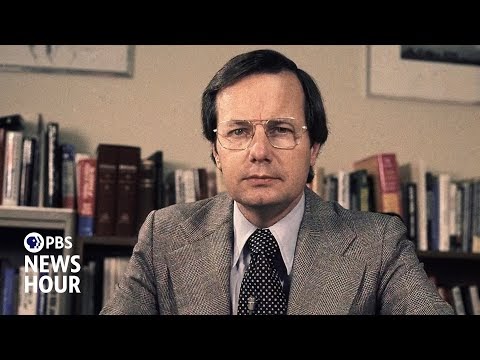
  • Higher Education Inquirer : Remembering Bill Moyers (1934-2025)

    Higher Education Inquirer : Remembering Bill Moyers (1934-2025)

    In a media landscape often dominated by soundbites, spin, and sensationalism, Bill Moyers was a rare voice of clarity, compassion, and conscience. With his passing, America has lost not only a gifted journalist and public intellectual but also one of its most courageous truth-tellers.

    For more than half a century, Moyers stood at the intersection of journalism, politics, and public education—unyielding in his pursuit of justice and understanding. From his early days as White House Press Secretary under President Lyndon Johnson to his groundbreaking work with PBS, Moyers embodied the spirit of democratic inquiry: probing deeply, listening intently, and speaking boldly. He held the powerful to account, but always with the dignity and decency that defined his Texan roots and Baptist upbringing.

    Bill Moyers never saw journalism as a career; he saw it as a calling. His programs—Now with Bill Moyers, Bill Moyers Journal, and Moyers & Company—were sanctuaries for critical thought and inconvenient truths. He gave voice to the voiceless: whistleblowers, teachers, laborers, poets, and prophets. In a time when the corporate capture of media narrowed the spectrum of acceptable opinion, Moyers stretched it wide—amplifying progressive theologians, investigative reporters, civil rights leaders, and scholars ignored by commercial networks.

    His love of learning, and his belief in public education as a democratic cornerstone, made him a champion of educators and lifelong learners. He understood that education is not merely about credentials or career preparation, but about cultivating the moral imagination. That insight animated his long relationship with public broadcasting, where he insisted that television could—and should—educate, illuminate, and elevate.

    Bill Moyers also saw through the fog of power. He knew how elite institutions—government, media, universities, and corporations—could align to manufacture consent and mystify the public. And yet he maintained hope. Not a naive optimism, but a deep belief in people’s capacity to awaken, organize, and transform society. As he once said, “Democracy is not a lie, it is a leap of faith. But you need to keep leaping.”

    In a moment when American higher education faces crises of affordability, access, and meaning—when trust in journalism is frayed, and when truth itself feels embattled—Bill Moyers’ legacy reminds us that integrity matters. So does context, complexity, and compassion.

    His loss is personal for those of us at the Higher Education Inquirer. Many of us were shaped by his work, inspired by his commitment to investigative rigor and human dignity. His interviews with thinkers like Howard Zinn, Cornel West, Barbara Ehrenreich, and Joseph Campbell helped expand the public’s moral and intellectual horizons—precisely what higher education should strive to do.

    In remembering Bill Moyers, we are called to do more than mourn. We are called to follow his example: to ask harder questions, to listen more deeply, to speak more clearly, and to stand, always, with the people who are too often ignored or maligned.

    Rest in power, Bill Moyers. Your words lit candles in the darkness. May we carry that light forward.

    Source link

  • Top Tips: To err is human

    Top Tips: To err is human

    Everyone makes mistakes. To be credible you have to fess up when you get things wrong. Doing so doesn’t make you look bad. It shows you care about the truth.

    Source link

  • To write about what’s new, look to the past

    To write about what’s new, look to the past

    To help explain what’s happening out there now, it helps to delve into the past. 

    That’s because, for one thing, something similar probably happened before and how that ended might help you anticipate what will happen next.

    News story after news story about U.S. President Donald Trump, for instance, talks about things being unprecedented. But did you know that in the 1850s in the United States there was a political party called the Know Nothing party. It was xenophobic and a spreader of conspiracy theories. According to the writer Lorraine Boissoneault, it was anti-immigration and called for mandatory Bible readings in schools. 

    “At its height in the 1850s, the Know Nothing party, originally called the American Party, included more than 100 elected congressmen, eight governors, a controlling share of half-a-dozen state legislatures from Massachusetts to California and thousands of local politicians,” Boissoneault wrote. 

    It is important to delve into history when doing a news story because things don’t just happen. Stuff led up to what is happening now. There are causes, and causes of causes. There might be a whole link of events that led up to the calamity that is now, or the explosion that happened or the political turmoil you find yourself in. 

    Put events into context.

    A little history in a story brings depth and context. It makes the whole story more interesting and helps people better understand what is happening now. News Decoder correspondent Gene Gibbons helped us understand the constitutional crisis the United States finds itself under Trump by looking back at a previous crisis in the 1970s under President Richard Nixon. 

    Correspondent Bernd Debusmann knew he couldn’t really explain the significance of the antipathy Trump now has for the European Union without explaining why the EU was formed in the first place. That meant going back to the aftermath of World War Two. 

    Correspondent Barry Moody helped us appreciate the triumphant win in a rugby game in South Africa by delving into the long history of apartheid and showing how rugby fit into that. 

    But how do you add some history? Well, you find yourself a historian. Every town has one, whether that person carries a title or not. A historian is simply someone who keeps track of past events and often documents them by collecting news stories or photographs, or by keeping journals. They might be the caretaker of archives of one kind or another. 

    You can also seek out professional historians. They can be found in university history departments, libraries and historical societies. Some are super specialized. I once saw a great documentary about a portrait of a woman believed to be painted by Leonardo de Vinci, and to prove it, the owner found a hair historian who found that the hairstyle of the woman was specific to a short time in history in a very small geographical area of Italy. 

    If you were doing a story about technology and wanted to include a bit of history you could contact the Society for the History of Technology. There are historians of politics, war, fashion, movies, food and architecture. 

    You can also just ask about the history of a place or event when you interview experts on what is happening now. You can’t really call yourself an expert on any topic if you don’t know its history. 

    So when you ask about what just happened, ask about what happened a decade or two ago, or more. Ask how things came to be the way they are. Maybe if we all understood the history of our times, history wouldn’t have to repeat itself. 


    Questions to consider:

    1. How can history add context to a news story?

    2. Where might you find a historian?

    3. If you were doing a story about your town, where would you find someone knowledgeable about its history?


    Source link

  • Top Tips: Be naive

    Top Tips: Be naive

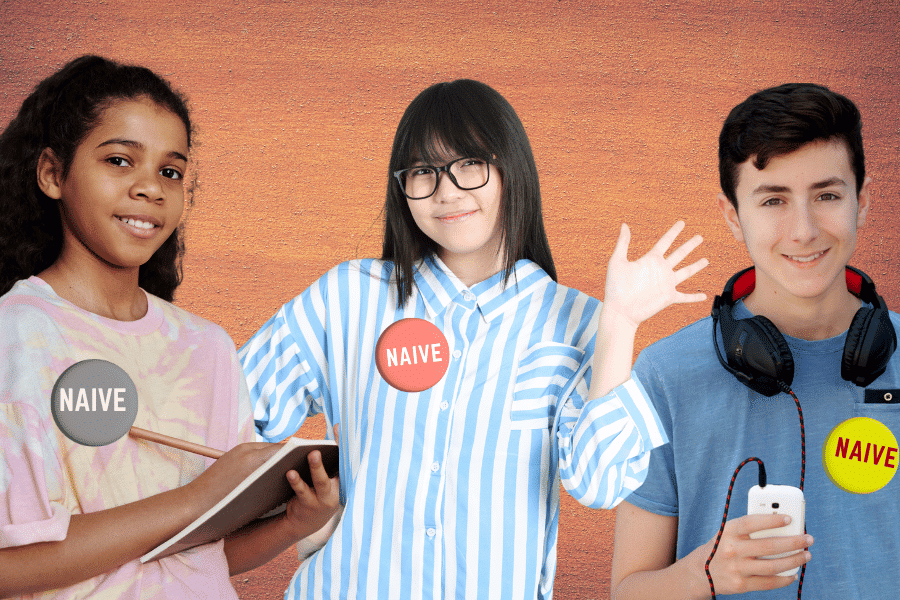
    Young people are often accused of naivety. But in journalism, naivety can be powerful.

    Being naive means sounding innocent or unsophisticated about something. You often get accused of naivety when you question why things are the way they are. Many people hate being accused of that, so they accept generally accepted standards — a fancy term I like is “prevailing paradigms.” 

    Often these are notions that some problems are so rooted that they can’t be fixed so you just have to accept them: polluted rivers or entrenched corruption or homelessness or discriminatory policies. 

    When you question these notions you might be accused of being naive. I say wear that like a badge. Why? Because if we accept problems without seeking solutions we won’t ever improve a community or society or nation. And that means that you must reject the idea that some problems can’t be solved. 

    It means we have to go back to the idea that everyone deserves clean air and water, healthy food, a basic education, shelter and safety. Nowadays you might add internet access, heat and electricity to that list and maybe a decent transportation system. The more I add, the more naive I sound. 

    Question prevailing paradigms.

    Good journalism comes from asking why people don’t have these things, not from accepting that they don’t have them. 

    So I suggest this: Draw an imaginary line. It represents a perfect world. In a perfect world everyone would have those things I listed: clean air and water, healthy food, etc. Then draw a line next to it that represents the current situation, and make the space between them wider the more off we are from that perfect world. Therein lies your story. 

    How far off is your community from having clean water or clean air? How bad are diets or how bad is the food shortage? 

    Then ask why. Why are people drinking or fishing out of contaminated water streams? Why are people going hungry? Why are people homeless? These are basic questions that come from the naive perspective that these problems shouldn’t exist in a perfect world. 

    Only when you ask these questions can you get to the heart of causes. Here is the hard part. The accusation of naivety comes not because these problems can’t be solved. It comes because the solutions are complicated. Sometimes they are really complicated. So the naivety comes in the idea that no one — including you or me — is willing to take the time and effort and brain power to unravel all those complications to get to solutions. 

    Prove them wrong.

    This all gets to the two traits that make someone a great journalist: Persistence and patience. It is the persistence to not just walk away when someone tells you that you are being naive or that a problem is too complicated, and the patience to work through the complicated elements. 

    All the complications people will throw at you are like protective layers around a problem. They are like the levels you need to surmount in a video game. 

    Once you peel them away, you get to causes that are pretty basic: Not enough money because people with money aren’t willing to spend it; a lack of power because people with power aren’t willing to cede it; and basic human failings like racism, homophobia, sexism or greed.

    If you can call out people or communities or government representatives on their racism or homophobia or sexism or greed, maybe you can get them to work on solutions. Only by finding solutions to problems can we get a little closer to that perfect world.

    Isn’t a perfect world the one you want to work towards? Or am I being naive?


    Questions to consider:

    1. What does the author mean by “prevailing paradigms”?

    2. Why can naivety be powerful in journalism?

    3. What are some problems in your community that people seem to accept without question?


    Source link

  • And the winners are…

    And the winners are…

    The judges in the 17th News Decoder Storytelling Competition chose as winners articles by students from The Hewitt School and The Tatnall School in the United States and Realgymnasium Rämibühl Zürich in Switzerland. 

    The entries tackled serious issues such as grade inflation, the local impacts of an international conference, demographic changes at universities, cell phones in classes, nepotism and the loss of languages to climate change.

    First Prize went to Stella Petersen of The Tatnall School in the U.S. state of Delaware for “Eliminating grade inflation isn’t as easy as ABC”, an article that considers whether letter or numerical grades on assignments are the best measure of student achievement. 

    One judge noted that the story was different from the others in the contest and well sourced. Another judge wrote: “This topic of grade inflation is an up-and-coming relevant conversation even across colleges around the country, and so many implications were considered here. The nuance in this article is marvellously impressive.”

    And for second place…

    Tying for Second Prize were Sophie De Lavendeyra of The Hewitt School in New York City and the team of Lennox Huisman and Maximilian Wunderli from Realgymnasium Rämibühl Zürich. 

    De Lavendeyra’s article, “Universities struggle with the speed of demographic change“, tackled the struggle of a university to meet the needs of a rapidly-changing student body. 

    In “When world leaders descend on your town”, Huisman and Wunderli looked at how the town and inhabitants of Davos, Switzerland are affected each year by the hordes of people who arrive for the World Economic Forum. Of the story, one judge wrote: “This was BY FAR my personal favorite in this storytelling contest. It grabbed at what really matters in journalism: How real-world, normal people are affected by big players attending the World Economic Forum.”

    The caliber of the entries as a whole was impressive. That can be seen in the fact that the judges had a particularly difficult time with the Third Prize winner — they ended with a four-way tie: Yi Le Low of Realgymasium Rämibühl won for “As fans flock to women’s football, pay stays out of play”; and from Tatnall, the third-place winners were Charles Norris for “Are smartphones at school all bad?”; Chloe Abel for “Should getting ahead depend on who you know?” and Simone Bessong for “Silencing voices by banning books“.

    The winners were selected by a three-person jury that included John West, a News Decoder correspondent based in Paris; ​Chloé Pété, a project officer for the international nonprofit organization Media & Learning Association; and ​Kaja Andrić, ​a former​ News Decoder intern and a journalism student at New York University.

    Judging student stories by professional standards

    The judges used the following criteria to rank the stories: whether the topic was fresh, different or timely; whether the student interviewed anyone for the story; whether the student reported the story without bias; whether the student considered different perspectives and finally the judge’s own subjective assessment. 

    Besides the winning entries, student Arya Sharma from VIBGYOR High NIBM in Pune, India won honorable mention for a story about how climate change can result in the extinction of human languages because of forced migration. One judge wrote: “This is my favourite story. I loved the topic, the style.”

    News Decoder Educational News Director Marcy Burstiner was particularly impressed by the challenging topics students took on. “There was such a great diversity of story topics,” she said. “It shows how curious students are about all kinds of things. They are questioning what they see around them and what they read.”

    It can’t be overstated how difficult a challenge the students were given, Burstiner said. Not only did they have to come up with an original topic to investigate, they need to find credible sources for their information and, at least for all the prize winners, they found experts to interview, and incorporated quotes from these people into their interviews.

    “Imagine, here you have a high school student asking a professional to set aside time to answer their questions for a story that will be published,” Burstiner said. “That is a difficult thing for professional journalists to do.”

    How the contest works

    The contest is held two times a year in honor of the late Arch Roberts Jr., who served with the International Atomic Energy Agency in Vienna after more than 12 years as a staff member with the U.S. House Foreign Affairs Committee. With the backing of an anonymous donor, News Decoder was able to award a total of $850 in cash prizes to this year’s winners.

    The entries came from students across News Decoder’s network of school partners. 

    To be considered for the contest, an entry must have been written by one or more students enrolled in a News Decoder partner institution. Students from nine schools in seven countries submitted articles to this iteration of the Storytelling Contest. Learn more about News Decoder’s school partnership program.

    Read the contest winners here:

    First Prize

    Eliminating grade inflation isn’t as easy as ABC

    Second Prize

    Universities struggle with the speed of demographic change

    When world leaders descend on your town

    Third Prize

    Are smartphones at schools all bad?

    Silencing voices by banning books

    Should getting ahead depend on who you know?

    As fans flock to women’s football, pay stays out of play

    Source link

  • The silencing of America’s voice leaves journalists abandoned

    The silencing of America’s voice leaves journalists abandoned

    On 28 March, several journalists in South Asia opened their inboxes and found messages that changed their lives. Reporting assignments were cancelled. Email access revoked. For many, it marked the end of years of work with Voice of America — without explanation, without notice.

    Nazir Ahmad is a journalist. For 11 years, Ahmad worked for Voice of America as a multimedia journalist. He documented protests, crackdowns and mass detentions. That morning, his email account was suspended. His press card was no longer valid.

    “It ended without warning,” he said. “No notice, no call. Just a message that my services were no longer needed. I had been filing reports even a week before this.”

    Nazir Ahmad is not his real name. We changed it for this article to protect his identity. And we offered anonymity to all the journalists we interviewed for this story because their reporting for Voice of America has put them in danger. 

    Ahmad is one of several South Asian journalists who lost their jobs after the Trump administration signed an executive order to downsize multiple U.S. government agencies, including the U.S. Agency for Global Media, which oversees Voice of America.

    On 22 April, a federal district judge in Washington, D.C. ruled that the administration illegally required Voice of America to cease operations and ordered it be temporarily restored until the lawsuits challenging the closure have run their course. How this will affect Ahmad and the other reporters who were dismissed remains to be seen. 

    Shutting down a news network

    The Trump Administration’s decision to end Voice of America affected journalists across Asia who have been covering sensitive political developments for years.

    “I covered the Delhi riots, Punjab farmers’ protests, and the elections,” said another Voice of America journalist. “These were not easy stories. I often worked without backup and sometimes without formal protection. Now, I’m being told to stop working.”

    Trump’s executive order resulted in mass administrative leave across Voice of America’s global network. Michael Abramowitz, Voice of America’s director, confirmed that nearly all 1,300 journalists and staff were placed on leave.

    The White House said the order was intended to reduce government spending and eliminate what it called “radical propaganda.” It accused outlets like Voice of America of political bias, despite decades of bipartisan support for the agency.

    For many South Asian journalists, the move came at a personal and professional cost. Several freelancers and stringers in India, Pakistan, Nepal, Bangladesh and Sri Lanka had worked with Voice of America for over a decade. 

    Telling important stories to the world

    Besides reporting on protests, these reporters covered elections, environmental disasters and rights violations in hard-to-reach areas.

    “I reported from Punjab’s border villages during the height of the farmers’ protests,” said yet another journalist who worked with Voice of America since 2014. “I was there when the police fired tear gas. I was there when elderly protesters braved the winter cold. And now I’m unemployed.”

    These journalists say they received no formal termination letters, only a message from editors citing administrative leave and funding suspensions. They have not been told when or if their jobs will resume.

    “There was a clear line in the message: stop all reporting,” said a Voice of America contributor from New Delhi. “I depend on this income to support my family. I’ve been sending stories every week for eight years.”

    Voice of America was established in 1942 during World War II to counter Nazi propaganda. It has since expanded to reach 360 million people weekly in nearly 50 languages. In South Asia, it provided a platform for independent voices, especially in regions where domestic media faced political pressure or censorship.

    Press coverage where the press is muzzled

    Experts say the funding freeze, if ultimately allowed by the courts, could silence important coverage from conflict zones. In regions like Kashmir, where local journalists already face surveillance and restrictions, international media partnerships like Voice of America provided both visibility and a layer of protection.

    “Working with VOA allowed us to tell local stories without fear of censorship,” says a journalist based in Srinagar. “Now that channel is gone.”

    The impact also extends beyond journalists. Translators, video editors and fixers who worked with Voice of America in the region say their contracts have been halted.

    “I’ve been working as a video editor for their South Asia bureau for six years,” said a technician based in Lahore, Pakistan. “We’ve stopped getting assignments. I haven’t been paid for last month’s work.”

    Some journalists say they are now exploring alternate work, but few opportunities exist for those with years of specialized international reporting experience.

    “I’m being told to apply to local newspapers, but they don’t have the budget or the editorial independence,” said a journalist from Kathmandu. “It feels like I’m starting over after 12 years.”

    Stories the domestic press hesitates to cover

    The Executive Order also affected coverage of religious freedom, caste violence and press crackdowns in India. Journalists who regularly filed in-depth features say important stories are now going untold.

    “I was working on a long story about attacks on Christian communities,” said a reporter based in Tamil Nadu. “It’s not something mainstream outlets want to cover. Voice of America gave me space to explore that. Now it’s shelved.”

    The global press watchdog Reporters Without Borders has described the shutdown as a serious setback for journalism, warning that it could encourage political interference in media operations across the world.

    Stephen Capus, head of Radio Free Europe/Radio Liberty, which also lost funding, said the move would leave millions without access to independent reporting.

    In South Asia, journalists say this is about more than losing a paycheck. For them, it’s the breakdown of a reporting network that allowed them to cover sensitive stories in challenging environments.

    “We weren’t just sending news reports,” says a journalist who covered the Indian government’s 2019 decision to revoke Kashmir’s autonomy. “We were capturing what was happening when few others could. And now someone in Washington has pulled the plug.”

    With no clarity on whether the shutdown is permanent, most contributors are in limbo. Some are looking for freelance work. Others are applying for short-term grants. But many say the abrupt stop has left them disoriented.

    “I always thought if I stopped reporting, it would be because of risks here,” one journalist said. “I didn’t expect to be cut off by a government halfway across the world.”


    Questions to consider:

    • What is the Voice of America?

    • Why has the U.S. government long funded foreign journalists outside the United States?

    • Do you think governments should pay journalists to cover events and other stories? Why?


    Source link

  • Can young people help save local newsrooms?

    Can young people help save local newsrooms?

    Can youth doing journalism help save local news media? 

    Unfortunately, this isn’t a rhetorical question. The crisis around the world for local news outlets is so dire, people who understand the importance of unbiased news at the local level are looking for any and all solutions to save the industry. 

    This is a worldwide phenomenon. Data collected by researcher Amy Watson in August 2023, for example, found that more news outlets in the UK closed than were launched. Between 2008 and 1 April 2025, a total of 566 local news outlets closed in 372 communities across Canada, according to the Local News Map crowd-sourcing data initiative. And a report from the Brookings Institution found that in the United States in 2023, some 2.5 local news outlets folded every week.  

    That’s why Global Youth & News Media, a French nonprofit affiliated with News Decoder, is offering an award for youth collaborations that support struggling local news outlets by providing content produced in their schools and helping to expand the outlet’s audience. Entry deadline is 16 June and details are here.

    “We and the partners in this award around the world want to find and spread the word about the lessons from the best cases of success as well as cautions about inevitable problems and challenges,” said Aralynn McMane, executive director of Global Youth & News Media.

    “At the very minimum, ‘success‘ means a discernible audience for the work that youth reporters — up through university age — produce in news media that serve a wider local community than their classmates,” McMane said “It’s even better if their efforts can be linked to financial sustainability.” 

    Supporting local news efforts

    The main goal of the award is to highlight successful collaborations between youth and local outlets so that other organizations around the world can adopt those strategies. McMane said that she has seen this happen many times — smart news media innovators will come up with a solution to a problem, and those solutions can help news producers even very far away adapt that idea to solve a similar issue. 

    Award partners that support local news efforts internationally as well as from Africa, North America, Europe and Asia have stepped up to help make sure the search for such cases is as wide as possible and to distribute the intelligence gained from this search to as many news organizations in as many places as possible. 

    First to sign up to help was the University of Southern California’s Communication Center on Leadership and Policy (CCLP), located within the USC Annenberg School for Journalism and Communication.

    In 2024, CCLP launched the Local News and Student Journalism Initiative to study the role of student journalists across America and issued this first report on their work.

    “We are delighted to partner with Global Youth & News Media to celebrate impactful local news stories produced by young journalists around the world, as well as to share and amplify their efforts with the goal of inspiring more young people to cover the news of their communities who are already providing first-rate local news coverage,” said Geoffry Cowan, center director. 

    Inspiring young people to tell important stories

    Another national academic partner, the Medill School at Northwestern University, released a report earlier this month about collaborations between local news outlets and student journalists in the United States as part of its Local News Initiative.

    The report found a trend for such collaborations in the United States. “Instead of news organizations giving boosts to students, students are supporting often-short-staffed outlets by providing coverage as part of their curricula,” the report said. 

    Senior Associate Dean Tim Franklin, the project’s director, said Medill started the initiative seven years ago to see how they could leverage the school’s resources to help local news outlets, journalism organizations, scholars and scholastic media at a time of crisis in the industry.

    “Our research provides insights about trends and issues in local news in this fast-changing landscape,” Franklin said. “And through our programs, we’re helping news organizations with things like business strategy and product development at a time when many can’t do R&D themselves. We’re also creating opportunities to inspire young people to pursue careers in journalism.”

    The quest to help local news is global. The Austria-based International Press Institute, for example, has run two editions of an “accelerator” program to support digital innovation in local journalism’s editorial and business models around the world. It also runs a related network.

    Other partners include the International Center for Journalists and the Media Diversity Institute, both of which have extensive local news programs, Youth Community Journalism Institute founded by the Strong Mind Strong Body Foundation, a U.S. nonprofit, Europe Youth Press, a consortium of outlets in 34 countries, Africa Media Perspectives, The Media Lab in Jordan, Asia division of the Asian-American Journalists Association, the Panhellenic Federation of Journalists’ Unions of Greece and Toronto Metropolitan University’s Local News Research Project

    Empowering youth through journalism

    Stefano Zamparo, an executive board member for Europe Youth Press said that the award aligns with the group’s work empowering youth voices through journalism, ensuring their stories resonate within their local communities and beyond. 

    “Celebrating successful collaborations between young journalists and local media helps foster greater press freedom and media literacy across Europe,” Zamparo said. 

    Ivor Price, founder of Africa Media Perspectives, sees young people as the driving force behind a rebirth of local news. “For local news to survive and thrive, it must become a true reflection of the communities it serves, which means opening our newsrooms and our storytelling platforms to new voices,” Price said. 

    Since 2018, the Global Youth & News Media Prize has honored the important work that sees news media meaningfully engage the young with notable results that benefit both parties. 

    Its first award recognized a cooperation between the United States digital edition of the The Guardian news organization and reporters from the Eagle Eye, a student news operation at Marjory Stoneman Douglas High School in Parkland, Florida, which was the site of a 2018 school shooting in which 17 people were killed. Through the journalism collaboration, the Parkland students contributed live digital coverage of an anti-gun violence demonstration in Washington, D.C. 

    News Decoder has been a partner in these competitions from the start.

    “This particular award theme resonates particularly strongly with us,” said News Decoder managing director Maria Krasinski. “All around the globe, student journalists are telling important stories, but often those stories aren’t heard outside their schools. This competition will rightfully recognize the important work youth are doing to help inform local communities.”

    Source link

  • News Decoder helps launch digital student journalism tool

    News Decoder helps launch digital student journalism tool

    Gathering and assessing the quality of information is one of the most effective ways to develop media literacy, critical thinking and effective communication skills. But without guidance, too many young people fail to question the reliability of visual images and overly rely on the first results they find on Google.

    That’s why News Decoder has been working with the Swedish nonprofit, Voice4You, on a project called ProMS to create a self-guided digital tool that guides students in writing news stories.

    The tool, called Mobile Stories, is now available across Europe. It takes students step-by-step through the journalistic process. Along the way, they gain critical thinking skills and a deeper understanding about the information they find, consume and share.

    It empowers students to develop multimedia stories that incorporate original reporting for school, community or global audiences, with minimal input from educators. It comes with open-access learning resources developed by News Decoder.

    After a decade of success in Sweden, Voice4You partnered with News Decoder to help make the tool available across Europe and the globe. Throughout the ProMS project, new English language content suitable for high schoolers was developed and piloted in 21 schools in Romania, Ireland and Finland. The Mobile Stories platform has demonstrated remarkable potential in building student confidence and media and information literacy by providing a platform and an opportunity to produce quality journalism.

    From story pitch to publication

    Using the new international version of Mobile Stories, students have already published 136 articles on mobilestories.com, with another 700 currently in production. Their topics range from book reviews and reporting from local cultural events to in-depth feature articles on the decline in young people’s mental health and child labor in the fast fashion industry.

    “The tool looks like a blogging platform and on every step along the way of creating an article, students can access learning materials including video tutorials by professional journalists from around the world, articles and worksheets,” said News Decoder’s ProMS Project Manager Sabīne Bērziņa.

    Some of these resources, such as videos and worksheets are open access, available to all.

    Source link

  • Why you need to triple check your facts

    Why you need to triple check your facts

    There it was. A seemingly well-sourced, carefully crafted and copy-edited article about a new brand of young, vibrant, national leader, with astonishing levels of commitment, courage, creativity and compassion. All ready to be self-published online.

    The only trouble was that my draft article was based on wrong information and it needed to be spiked. That’s a journalism term for sending it to the trash.

    Now, I could moan and blame social media and disinformation for this near mistake. Or I could reflect on how close I came to disseminating gross misinformation and share the concrete learnings that I am taking from this quasi-failure.

    Be open to new story ideas.

    I recently read a WhatsApp post from a trusted Southeast Asian colleague of mine in the United States. He shared an opinion piece from his home country about a relatively new leader in another country in the Global South.

    The opinion writer said that this leader recently told public officials: “I don’t want my photographs in your offices because I am not a god or an icon, but a servant of the nation.” He urged them to hang pictures of their children instead.

    The writer added that this leader then delivered a ‘devastating moral punch’. “Whenever the spirit of theft visits you,” he said, “take a good look at your family’s picture and ask yourself if they deserve to be the family of a thief who has destroyed the nation.”

    It seemed like a great story and when I researched this new leader online, I found posts and articles that corroborated this particularly striking example of a new leader’s bold move against corruption.

    And I found other praiseworthy stories about his economic pragmatism and post-colonial idealism.

    Trust your gut and triple-check the facts.

    As a conscientious former reporter for the Reuters international news service, something troubled me. I thought about something my dearly departed father would say: “If something seems too good to be true, it probably is.”

    So right before publication, I decided to verify some of the facts one last time with two in-country sources I knew in Kigali, Rwanda.

    In no uncertain terms, one of them challenged most of the core aspects of my article and firmly declared that the particularly praiseworthy, anti-corruption initiative that was the centerpiece of my article was actually not true at all.

    She was right. On further investigation, the other stories of this leader’s supposed initiative and success all turned out to be skewed or exaggerated.

    And so the article was sadly consigned to the dustbin of fake news.

    Find the original sources and quote them directly.

    But I was not done. On further investigation, I managed to find a slightly different quotation that the opinion piece was probably based on:

    “We will build the country of other opportunities — the one where all are equal before the law and where all the rules are honest and transparent, the same for everyone. And for that, we need people in power who will serve the people. This is why I really do not want my pictures in your offices, for the president is not an icon, an idol or a portrait. Hang your kids’ photos instead and look at them each time you are making a decision.”

    And I discovered that the person who said this was none other than Ukrainian President Volodymyr Zelenskyy during his inaugural address on 20 May 2019.

    His statement does not talk about a “thief who has destroyed the nation” but it is still deeply impactful, particularly in light of his country’s devastating challenges over the last three years.

    Be willing to do things differently in future.

    I have been a journalist for a long time but here are some key reminders for me of what I need to do going forward:

    → Balance enthusiasm and engagement with integrity and plain hard work;

    → Recognize that in these difficult times, we all yearn for an inspirational story but even with the best of intentions, emotions can get in the way of good judgment;

    → Always take the extra time necessary to track down original and reliable sources;

    → Do this extra work whether you are sharing something with thousands of people on News Decoder or with only one other person in private;

    → If in doubt, cut it out or don’t share it and start again;

    → Have the courage to admit when you are wrong, apologize and make amends as appropriate and learn from that humbling experience.

    And just in case you are wondering, my father never claimed that his beloved saying was his.

    The original source is unknown but Dictionary.com points out that the term was part of the title of Thomas Lupton’s Sivquila; Too Good to be True, which dates back to the 1580s.

    The search for the original source continues as I recall the cynical words of a former official with the title “Minister for the Quality of Life” who counseled journalists to always write “lively and interesting” stories that correspond “where possible” with the truth.

    In future, I promise to always try to write truthful stories that are, where possible, lively and interesting.


    Questions to consider:

    1. Have you ever written or said something that you thought that was true but turned out to be false? If so, what did you do?

    2. If not, what would you do if this happens in future?

    3. And what will you do from now on to make sure this doesn’t happen?


    Source link

  • The one thing that unites French voters

    The one thing that unites French voters

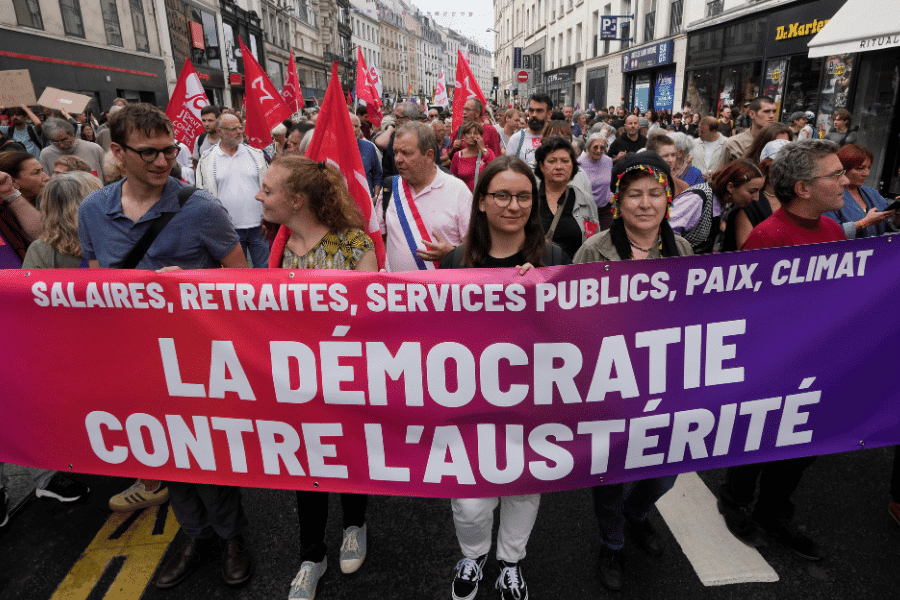
    French President Emmanuel Macron’s grip on stability, progress and voter approval seems to be slipping.

    His party lost its absolute majority in the National Assembly and, following snap elections in the summer of 2024, its relative majority as well. Now, he faces a budget crisis, voter pushback and a geopolitical crisis involving Europe, the United States and Russia.

    Macron had once hoped to bridge France’s political divides and reinvigorate its economy but is now mired in political quicksand and many French voters feel helpless. That’s what I discovered while interviewing people on the street in Rennes, France, where I’m spending a year studying abroad and trying to make sense of French politics.

    One elderly woman I spoke to described what was happening as a catastrophe. “It’s embarrassing,” she said. “All we can do is wait for the next presidential election.”

    My interviews aligned with a November 2024 IPSOS survey, which found that 74% of respondents lack confidence in the presidency, while an overwhelming 86% distrust political parties. Trust in the National Assembly has plummeted as well, with 74% of respondents expressing no faith in the institution.

    What voters say

    People are frustrated. A middle-aged man told me: “Macron has lost his authority. France is unstable, gridlocked and hostile.”

    Back in September, Macron appointed Michel Barnier as prime minister in an attempt to stabilize his government but it backfired. By December, Barnier’s government had collapsed after losing a no-confidence vote, ousting him and his ministers and triggering yet another governmental reset.

    The vote came in response to Barnier’s use of Article 49.3 of the French Constitution, which allows the executive to pass a budget without parliamentary approval.

    It wasn’t until February 2025 that lawmakers finally agreed on a budget — one met with widespread discontent over spending cuts and reallocations. Now, many French citizens are asking: What’s next for the Republic?

    A law student I spoke with who goes to the University of Rennes expressed uncertainty about the country’s future. “I’m scared because we’re walking back on progress,” he said.

    A nation disunited

    Political divisions seem to be deepening, amplified by social media.

    A political science student at Rennes 2 University noted that people seem unable to talk to each other. “It’s harder than ever to have conversations with people who disagree with us,” the student said. “We don’t just see differing opinions, we see them as attacks on who we are.”

    Another student said that at university, now, you find yourself attacked or excluded if you don’t agree.

    This polarization was evident in the most recent European elections. The far-right Rassemblement National secured 31.5% of the vote — a 40-year record for any French party in a European election. Their campaign focused on hard-line immigration policies, crime reduction and tax cuts on fossil fuels.

    Despite shared dissatisfaction, French citizens are divided on the changes they seek. One university student emphasized the need for a more equitable education system.

    “We’ve made strides in accessibility, but students are locked into career paths too early,” she said. “My younger brother, for example, always dreamed of becoming a pilot. But because his undiagnosed ADHD hurt his test scores, he was placed in a vocational high school instead of a general one. Now he’s studying to be an air steward.”

    Some want a strong government.

    A retired woman expressed concern over global instability. “Russia’s invasion of Ukraine is terrifying,” she said. “And with Trump distancing the U.S. from the EU, I worry our military isn’t strong enough. France and the EU need to invest in defense.”

    To put what I found on the streets into perspective, I spoke with Alistair Lyon, a News Decoder correspondent and former reporter with the Reuters international news service who lives in France.

    He highlighted the long-term consequences of the gridlock in French politics. “In a time when France faces huge challenges like a budget deficit and a major geopolitical crisis involving the U.S., Europe and Russia, now is not a great time to have a political stalemate,” Lyon said.

    He expects the stalemate to continue until the 2027 presidential election, given Macron’s loss of both absolute and relative majorities in the National Assembly.

    He pointed to two major sources of division: growing disillusionment with politicians and resistance to reform. Many French voters feel politically homeless, fueling a cycle where reforms are met with fierce backlash, ultimately deterring further change.

    Disinformation breeds distrust.

    Compounding the problem is the erosion of independent journalism.

    “You have to be very careful reading the news,” Lyon said. “Journalists that remain anchored to traditional values of accuracy and impartiality are becoming few and far between.”

    In France, billionaire and right-wing proponent Vincent Bolloré has bought up news and media outlets, raising concerns about bias and misinformation. In a way, Lyon said, the media is fueling the fires of divisions in new ways because now the press is controlled and owned by people with vested political interests.

    France finds itself at a crossroads. Uncertainty, frustration and political polarization are creating more gloom than ever.

    Whether stability can be restored depends on Macron, the parliament and their willingness to compromise. If cooperation remains minimal, France may continue down a path of deepening division, one with consequences far beyond its borders.


    Three questions to consider:

    1. Why has French President Emmanuel Macron lost significant support from voters?

    2. What is one thing voters are in France want from their government?

    3. As a citizen of your country, what do you expect your government to do for you?


    Source link