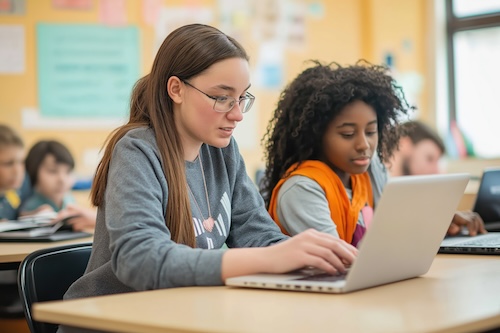
eSchool News is counting down the 10 most-read stories of 2025. Story #5 focuses on a math platform that offers AI coaching for maximum impact.
Math is a fundamental part of K-12 education, but students often face significant challenges in mastering increasingly challenging math concepts.
Many students suffer from math anxiety, which can lead to a lack of confidence and motivation. Gaps in foundational knowledge, especially in early grades and exacerbated by continued pandemic-related learning loss, can make advanced topics more difficult to grasp later on. Some students may feel disengaged if the curriculum does not connect to their interests or learning styles.
Teachers, on the other hand, face challenges in addressing diverse student needs within a single classroom. Differentiated instruction is essential, but time constraints, large class sizes, and varying skill levels make personalized learning difficult.
To overcome these challenges, schools must emphasize early intervention, interactive teaching strategies, and the use of engaging digital tools.
Edia aligns with Illustrative Mathematics’ IM Math, which New York City Public Schools adopted in 2024 as part of its “NYC Solves” initiative–a program aiming to help students develop the problem-solving, critical thinking, and math skills necessary for lifetime success. Because Edia has the same lessons and activities built into its system, learning concepts are reinforced for students.
FDR started using Edia in September of 2024, first as a teacher-facing tool until all data protection measures were in place, and now as an instructional tool for students in the classroom and at home.
The math platform’s AI coaching helps motivate students to persevere through tough-to-learn topics, particularly when they’re completing work at home.
“I was looking for something to have a back-and-forth for students, so that when they need help, they’d be able to ask for it, at any time of the day,” said Salvatore Catalano, assistant principal of math and technology at FDR.
On Edia’s platform, an AI coach reads students’ work and gives them personalized feedback based on their mistakes so they can think about their answers, try again, and master concepts.
Some FDR classes use Edia several days a week for specific math supports, while others use it for homework assignments. As students work through assignments on the platform, they must answer all questions in a given problem set correctly before proceeding.
Jeff Carney, a math teacher at FDR, primarily uses the Edia platform for homework assignments, and said it helps students with academic discovery.
“With the shift toward more constructivist modes of teaching, we can build really strong conceptual knowledge, but students need time to build out procedural fluency,” he said. “That’s hard to do in one class session, and hard to do when students are on their own. Edia supports the constructivist model of discovery, which at times can be slower, but leads to deeper conceptual understanding–it lets us have that class time, and students can build up procedural fluency at home with Edia.”
On Edia, teachers can see every question a student asks the AI coach as they try to complete a problem set.
“It’s a nice interface–I can see if a student made multiple attempts on a problem and finally got the correct answer, but I also can see all the different questions they’re asking,” Carney said. “That gives me a better understanding of what they’re thinking as they try to solve the problem. It’s hugely helpful to see how they’re processing the information piece by piece and where their misconceptions might be.”
As students ask questions, they also build independent research skills as they learn to identify where they struggle and, in turn, ask the AI coach the right questions to target areas where they need to improve.
“We can’t have 30 kids saying, ‘I don’t get it’–there has to be a self-sufficient aspect to this, and I believe students can figure out what they’re trying to do,” Carney said.
“I think having this platform as our main homework tool has allowed students to build up that self-efficacy more, which has been great–that’s been a huge help in enabling the constructivist model and building up those self-efficacy skills students need,” he added.
Because FDR has a large ELL population, the platform’s language translation feature is particularly helpful.
“We set up students with an Illustrative Math-aligned activity on Edia and let them engage with that AI coaching tool,” Carney said. “Kids who have just arrived or who are just learning their first English words can use their home languages, and that’s helpful.”
Edia’s platform also serves as a self-reflection tool of sorts for students.
“If you’re able to keep track of the questions you’re asking, you know for yourself where you need improvement. You only learn when you’re asking the good questions,” Catalano noted.
The results? Sixty-five percent of students using Edia improved their scores on the state’s Regents exam in algebra, with some demonstrating as much as a 40-point increase, Catalano said, noting that while increased scores don’t necessarily mean students earned passing grades, they do demonstrate growth.
“Of the students in a class using it regularly with fidelity, about 80 percent improved,” he said.
Laura Ascione is the Editorial Director at eSchool Media. She is a graduate of the University of Maryland’s prestigious Philip Merrill College of Journalism.
eSchool News is counting down the 10 most-read stories of 2025. Story #9 focuses on chronic absenteeism.
Key points:
The biggest problem in education is that kids aren’t showing up to school. Last year, 26 percent of students missed a month of class or more, leading to dramatic declines in academic performance. Chronic absenteeism accounted for 27 percent of the drop in math scores and 45 percent of the decline in reading scores from 2019 to 2022. Students who are chronically absent are 7x more likely to drop out before graduating, and while state and district leaders are scrambling for solutions, kids are falling further behind.
Why chronic absenteeism is hard to solve
In 2019, only 13 percent of students in the U.S. were chronically absent. Typically, these students missed school because of significant personal reasons–long-term illness, gang involvement, clinical depression, working jobs to support their families, lacking transportation, drug use, unplanned pregnancy, etc.–that aren’t easily fixed.
However, since the pandemic, the rate of chronic absenteeism has doubled from 13 percent to 26 percent.
The change is cultural. For the last hundred years, it was drilled into the American psyche that “school is important.” A great effort was made to provide bussing to any child who lived too far to walk, and the expectation was that every child should come to school every day. Cutting class was sure to land you in the principal’s office or potentially even lead to police showing up at your door.
During the Covid-19 pandemic, this narrative flipped. As parents began working from home, their kids sat beside them. With lectures recorded and assignments posted online, attending class began to feel optional. When school doors reopened, many families didn’t fully come back. Common excuses like being tired, missing the bus, or simply not feeling like going were validated and excused rather than admonished. While students who skip school were once seen as delinquent, for many families it has become culturally acceptable–almost even expected–for kids to stay home whenever they or their parents want.
Overwhelmed by the drastic rise in absenteeism, school staff are unable to revert cultural norms about attendance. And it’s not their fault.
The root of the problem
Each student’s situation is unique. Some students may struggle with reliable transportation, while others skip certain classes they don’t like, and others still are disengaged with school entirely. Without knowing why students are missing school, staff cannot make progress addressing the root cause of chronic absenteeism.
Today, nearly 75 percent of student absences are “unexplained,” meaning that no authorized parent called or emailed the school to say where their children are and why they aren’t in class. This lack of clarity makes it impossible for schools to offer personalized solutions and keep students engaged. Unexplained absences only deepen the disconnect and limit schools’ ability to tackle absenteeism effectively.
Knowing why students are missing school is critical, but also very difficult to uncover. At a high school of 2,000 students with 85 percent average daily attendance, 225 students will be absent each day without providing any explanation. In an ideal world, schools would speak with every parent to find out the reason their child wasn’t in class–but schools can’t possibly make 225 additional phone calls without 3-5 additional staff. Instead, they rely on robocalls and absence letters, and those methods don’t work nearly well enough.
Normalize attendance again: It takes a village
Improving attendance is about more than just allocating additional resources. It’s about shifting the mindset and fostering a culture that prioritizes presence. This starts with schools and communities making attendance a shared responsibility, not just a policy.
First, schools must take the initiative to understand why students are missing school. Whether through modern AI-driven attendance systems or with more traditional methods like phone calls, understanding the root causes is critical to addressing the issue.
Next, categorize and recognize patterns. Small adjustments can have big impacts. One district noticed that students who were 0.9 miles away from school were much more likely to not show up because their bussing policy was for families living 1 mile away from school or further. By changing their policy, they saw a surge in attendance. Similarly, pinpointing specific classes that students are skipping can help tailor interventions, whether through teacher engagement or offering additional support.
Lastly, schools should focus resources on students facing the most severe challenges. These students often require personalized solutions, such as home visits for unresponsive parents or help with transportation. Targeted efforts like these create a direct impact on reducing absenteeism and improving overall attendance.
When communities unite to make school attendance a priority, students receive the support they need to succeed. Tackling chronic absenteeism is not an easy task, but with focused effort and a culture of engagement, we can reverse this troubling trend and give students the foundation they deserve for future success.
Joe Philleo, Edia
Joe Philleo is the co-founder and CEO of Edia, an AI-powered platform that tackles two critical challenges in K-12 education: improving math outcomes and reducing absenteeism. Edia’s mission is to ensure every student has access to an exceptional education, grounded in the belief that school shapes the trajectory of people’s lives.
Latest posts by eSchool Media Contributors (see all)
Opinion Piece by Dean Hoke — Small College America and Senior Fellow, The Sagamore Institute
A Personal Concern About the Future of Public Education
It’s impossible to ignore the rising level of criticism directed at our nation’s public schools. On cable news, social media channels, political stages, and in school board meetings, teachers and administrators have become easy targets. Public schools are accused of being ineffective, mismanaged, outdated, or, in some corners, ideologically dangerous. Some commentators openly champion the idea of a fully privatized K–12 system, sidelining the public institutions that have educated the vast majority of Americans for generations.
For those of us who have spent our lives in and around education, this rhetoric feels deeply personal. Public schools aren’t an abstraction. They are the places where many of us began our education, where our children discovered their strengths, where immigrants found belonging, where students with disabilities received support, and where caring adults changed the trajectory of young lives.
Behind every one of those moments stood a teacher.
Amid this turbulence, there is one group of institutions still quietly doing the hard work of preparing teachers: small private nonprofit colleges.
Small Private Colleges: An Overlooked Cornerstone of Teacher Preparation
Despite the noise surrounding public education, small private colleges remain committed to the one resource every school depends on: well-prepared, community-rooted teachers.
They rarely make national headlines. They don’t enroll tens of thousands of students. But they are woven into the civic and human infrastructure of their regions—especially in the Midwest, South, and rural America.
This reality became even clearer during a recent episode of Small College America, in which I interviewed Dr. Michael Scarlett, Professor of Education at Augustana College. His insights provide an insider’s view into the challenges—and the opportunities—facing teacher preparation today. Note to hear the entire interview click here https://smallcollegeamerica.transistor.fm/28
I. The Teacher Shortage: A Structural Crisis
Much has been written about the teacher shortage, but too often the conversation focuses on symptoms rather than causes. Here are the forces shaping the crisis.
1. Young people are turning away from teaching
Data from the ACT show that only 4% of students express interest in becoming teachers—down from 11% in the late 1990s. Bachelor’s degrees in education have fallen nearly 50% since the 1970s. Surveys show that fewer than 1 in 5 adults would recommend teaching as a career.
The message is clear: Teaching is meaningful, but many no longer see it as sustainable.
As Dr. Scarlett told us: “The pipeline simply is not as wide as it needs to be.”
Recent data offers a glimmer of hope: teacher preparation enrollment grew 12% nationally between 2018 and 2022. However, this modest rebound is almost entirely driven by alternative certification programs, which increased enrollment by 20%, while traditional college-based programs grew by only 4%. This disparity underscores a critical concern: the very programs that provide comprehensive, relationship-based preparation—including those at small colleges—are not recovering at the same rate as faster, less intensive alternatives.
2. Burnout and attrition have overtaken new entrants
The pandemic accelerated an already-existing national trend: teachers are leaving faster than new ones are entering.
Reasons include:
Student behavior challenges
Standardized testing pressure
Emotional fatigue
Inequities across districts
Lack of respect
Political and social media hostility
As Scarlett notes, these realities weigh heavily on early-career teachers: “What new teachers face today goes far beyond content knowledge. They face inequities, discipline issues, emotional exhaustion… and they’re expected to do it all.”
3. Alternative certification can’t fill the gap
Alternative routes help—but they cannot replace the traditional college-based pipeline. Many alt-cert teachers receive less pedagogical training and leave sooner.
Scarlett captures the trend: “Teaching has always attracted people later in life… we’ve definitely seen an uptick.”
And while alternative routes have seen growth in recent years—increasing 20% between 2018 and 2021—this expansion has not translated into solving the shortage. As of 2025, approximately 1 in 8 teaching positions nationwide remains either unfilled or filled by teachers not fully certified for their assignments. The shortcut approach cannot substitute for comprehensive preparation.
“The national teacher shortage is real… and retention is just as big a challenge as recruitment.” — Dr. Michael Scarlett
II. The Quiet Backbone: How Small Private Colleges Sustain the Teacher Workforce
Small private colleges graduate fewer teachers than large public institutions, but their impact is disproportionately large—especially in rural and suburban America.
1. They prepare the teachers who stay
About 786 private nonprofit colleges offer undergraduate education degrees—representing roughly 20% of all teacher preparation institutions in the United States. Together, they produce approximately 25,119 graduates per year, an average of 32 per institution.
These numbers may seem modest, but these graduates disproportionately:
Student-teach locally
Earn licensure in their home state
Take jobs within 30 miles of campus
Stay in the profession longer
Public schools desperately need these ‘homegrown’ teachers who understand the communities they serve.
2. Small colleges excel at the one thing teaching requires most: mentoring
Teacher preparation is not transactional. It is relational. And this is where private colleges excel. Scarlett put it plainly: “Close relationships with our students, small classes, a lot of direct supervision… we nurture them throughout the program.” In a profession that relies heavily on modeling and mentorship, this matters enormously.
One of the most striking differences: “Full professors… working with the students in the classrooms and out in field experiences. Other institutions outsource that.”
This is not a trivial distinction. Faculty supervision affects:
Preparedness
Confidence
Classroom management
Retention
Where larger institutions rely on external supervisors, small colleges invest the time and human capital to do it right.
4. They serve the regions hit hardest by shortages
Rural districts have the highest percentage of unfilled teaching positions. Many rural counties rely almost exclusively on a nearby private college to produce elementary teachers, special education teachers, and early childhood educators.
When a small college stops offering education degrees, it often leaves entire counties without a sustainable teacher pipeline.
5. They diversify the educator workforce
Small colleges—especially faith-based, minority-serving, or mission-driven institutions—often enroll first-generation students, students of color, adult career-changers, and bilingual students. These educators disproportionately fill shortage fields.
“What we have here is special… students understand the value of a small college experience.” — Dr. Michael Scarlett
III. Should Small Colleges Keep Offering Education Degrees? The Economic Question
Let’s be direct: Teacher preparation is not a high-margin program.
Costs include:
Intensive field supervision
CAEP or state accreditation
High-touch advising
Small cohort sizes
Education majors also often have lower net tuition revenue compared to business or STEM.
So why should a small college continue offering a program that is expensive and not highly profitable?
Because the alternative is far worse—for the institution and for the region it serves.
1. Cutting teacher-prep weakens a college’s identity and mission
Many private colleges were founded to prepare teachers. Teacher education is often central to institutional mission, community trust, donor expectations, and alumni identity.
Removing education programs sends the message that the college is stepping away from public service.
2. Teacher-prep strengthens community partnerships
Education programs open doors to:
District partnerships
Dual-credit pipelines
Grow Your Own initiatives
Nonprofit and state grants
Alumni involvement
These relationships benefit the entire institution, not just the education department.
3. Education majors support other academic areas
Teacher-prep indirectly strengthens:
Psychology
English
Sciences
Social sciences
Music and arts
When teacher education disappears, these majors often shrink too.
4. The societal mission outweighs the limited revenue
There are moments when institutional decisions must be driven by mission, not margins. Producing teachers is one of them.
5. Addressing concerns about program quality and scale
Some critics question whether small programs can match the resources and diversity of perspectives available at large universities. This is a fair concern—and the answer is that small colleges offer something different, not lesser.
Graduation and licensure pass rates at small private colleges consistently match or exceed those of larger institutions. What smaller programs may lack in scale, they compensate for through personalized mentorship, faculty continuity, and deep community integration. These are not peripheral benefits—they are the very qualities that predict long-term teacher retention.
IV. Why Students Still Choose Teaching—and Why Small Colleges Are Ideal for Them
Despite all the challenges, students who pursue teaching are deeply motivated by purpose.
Scarlett described his own journey: “I wanted to do something important… something that gives back to society.”
Many education majors choose the field because:
A teacher changed their life
They want meaningful work
They value community and service
They thrive in supportive, intimate learning environments
This makes small colleges the natural home for future teachers.
V. What Small Colleges Can Do to Strengthen Their Programs
Below are the strategies that are working across the country.
1. Build Grow Your Own (GYO) teacher pipelines
Districts increasingly partner to:
Co-fund tuition
Support paraeducator-to-teacher pathways
Provide paid residencies
Guarantee interviews for graduates
2. Develop dual-credit and “teacher cadet” high school programs
Scarlett sees this as a major reason for hope: “We’re seeing renewed interest in teaching through high school programs… This gives me hope.”
3. Offer specialized certifications (ESL, special ed, early childhood, STEM)
These areas attract students and meet district needs.
4. Create 4+1 BA/M.Ed pathways
Parents and students love the value.
5. Provide flexible programs for career-changers
The rise of adult learners presents a major opportunity for private colleges. “We prepare our students for the world that exists.” — Dr. Michael Scarlett
VI. Why Small Colleges Must Stay in the Teacher-Prep Business
If small private colleges withdraw from teacher preparation, the consequences will be immediate and dramatic:
Rural and suburban schools will lose their primary source of new teachers.
Teacher diversity will shrink.
More underprepared teachers will enter classrooms.
Districts will become more dependent on high-turnover alternative routes.
Student learning will suffer.
And the profession will lose something even more important: the human-centered preparation that small colleges provide so well.
The teacher shortage will not be solved by legislation alone.
It will not be solved by fast-track certification mills.
It will not be solved by online mega-universities.
It will not be solved by market forces.
It will be solved in the classrooms, hallways, and mentoring relationships of the small colleges that still believe in the promise of teaching.
If we want public schools to remain strong, we must support the institutions that prepare the teachers who keep them alive. Small private colleges aren’t just participants in the teacher pipeline—they are its foundation.
When these colleges thrive, they produce educators who stay, who care, and who transform communities. That’s not just good for education—it’s essential for American democracy.
Dean Hokeis Managing Partner of Edu Alliance Group, a higher education consultancy firm. He formerly served as President/CEO of the American Association of University Administrators (AAUA). Dean has worked with higher education institutions worldwide. With decades of experience in higher education leadership, consulting, and institutional strategy, he brings a wealth of knowledge on colleges’ challenges and opportunities. Dean is the Executive Producer and co-host for the podcast series Small College America and a Senior Fellow at the Sagamore Institute based in Indianapolis, Indiana.
In the world of K-12 education, teachers are constantly making decisions that affect their students and families. In contrast, administrators are tasked with something even bigger: making decisions that also involve adults (parents, staff culture, etc.) and preventing conflicts from spiraling into formal complaints or legal issues. Therefore, decisions and actions often have to balance two competing values: truth and risk management.
Some individuals, such as teachers, are very truth-oriented. They document interactions, clarify misunderstandings, and push for accuracy, recognizing that a single misrepresentation can erode trust with families, damage credibility in front of students, or most importantly, remove them from the good graces of administrators they respect and admire. Truth is not an abstract concept–it is paramount to professionalism and reputation. If a student states that they are earning a low grade because “the teacher doesn’t like me,” the teacher will go through their grade-book. If a parent claims that a teacher did not address an incident in the classroom, the teacher may respond by clarifying the inaccuracy via summarizing documentation of student statements, anecdotal evidence of student conversations, reflective activities, etc.
De-escalation and appeasement
In contrast, administrators are tasked with something even bigger. They have to view scenarios from the lens of risk management. Their role requires them to deescalate and appease. Administrators must protect the school’s reputation and prevent conflicts or disagreements from spiraling into formal complaints or legal issues. Through that lens, the truth sometimes takes a back seat to ostensibly achieve a quick resolution.
When a house catches on fire, firefighters point the hose, put out the flames, and move on to their next emergency. They don’t care if the kitchen was recently remodeled; they don’t have the time or desire to figure out a plan to put out the fire by aiming at just the living room, bedrooms, and bathrooms. Administrators can be the same way–they just want the proverbial “fire” contained. They do not care about their employees’ feelings; they just care about smooth sailing and usually softly characterize matters as misunderstandings.
To a classroom teacher who has carefully documented the truth, this injustice can feel like a bow tied around a bag of garbage. Administrators usually err on the side of appeasing the irrational, volatile, and dangerous employee, which risks the calmer employee feeling like they were overlooked because they are “weaker.” In reality, their integrity, professionalism, and level-headedness lead administrators to trust the employee will do right, know better, maintain appropriate decorum, rise above, and not foolishly escalate. This notion aligns to the scripture “To whom much is given, much is required” (Luke 12:48). Those with great abilities are judged at a higher bar.
In essence, administrators do not care about feelings, because they have a job to do. The employee with higher integrity is not the easier target but is easier to redirect because they are the safer, principled, and ethical employee. This is not a weakness but a strength in the eyes of the administration and that is what they prefer (albeit the employee may be dismissed, confused, and their feelings may be hurt, but that is not the administration’s focus at all).
Finding common ground
Neither perspective (truth or risk management) is wrong. Risk management matters. Without it, schools would be replete with endless investigations and finger-pointing. Although, when risk management consistently overrides truth, the system teaches teachers that appearances matter more than accountability, which does not meet the needs of validation and can thus truly hurt on a personal level. However, in the work environment, finding common ground and moving forward is more important than finger-pointing because the priority has to be the children having an optimal learning environment.
We must balance the two. Perhaps, administrators should communicate openly, privately, and directly to educators who may not always understand the “game.” Support and transparency are beneficial. Explaining the “why” behind a decision can go a long way in building staff trust, morale, and intelligence. Further, when teachers feel supported in their honesty, they are less likely to disengage because transparency, accuracy, and an explanation of risk management can actually prevent fires from igniting in the first place. Additionally, teachers and administrators should explore conflict resolution strategies that honor truth while still mitigating risk. This can assist in modelling for students what it means to live with integrity in complex situations. Kids deserve nothing less.
Lastly, teachers need to be empathetic to the demands on their administrators. “If someone falls into sin, forgivingly restore him, saving your critical comments for yourself. You might be needing forgiveness before the day’s out. Stoop down and reach out to those who are oppressed. Share their burdens, and so complete Christ’s law. If you think you are too good for that, you are badly deceived” (Galatians 6:1-3). This scripture means that teachers should focus less on criticizing or “keeping score” (irrespective of the truth and the facts, and even if false-facts are generated to manage risk), but should work collaboratively while also remembering and recognizing that our colleagues (and even administrators) can benefit from the simple support of our grace and understanding. Newer colleagues and administrators are often in survival mode.
Dr. Yuvraj Verma, Bessemer City Middle School and William Howard Taft University
The Trump administration is elevating AI programs in K-12 education
The human edge in the AI era
Report details uneven AI use among teachers, principals
For more news on AI in education, visit eSN’s Digital Learning hub
A new executive order signed by President Trump takes aim at AI policies in K-12 education by “fostering interest and expertise in artificial intelligence (AI) technology from an early age to maintain America’s global dominance in this technological revolution for future generations.”
More News from eSchool News
A “patchwork of apps” in schools often leads to app fatigue, frustrating parents and educators who have to use multiple apps weekly, or even daily, according to new research from Cornerstone Communications, LTD. and Edsby.
Simply put, AI can do a lot–it can personalize learning, help students expand on ideas for assignments, and reduce time spent on administrative tasks, freeing up educators to spend more time on instruction.
A recent survey found that 88 percent of U.S. parents believe AI is essential to their children’s education, but most aren’t even sure whether the technology is being used in their child’s classroom.
As AI becomes more widespread in education, more than half of high school students (56 percent) polled think it can go a long way in reducing math anxiety, a new global survey shows.
Teachers often seem to have eyes in the back of their heads. They respond to a murmured question in a class full of conversation. They can tell if someone’s skipping class a floor away by reading faces in the room.
While digital literacy has become an aspirational cornerstone of modern education, the exponential growth of data-driven decision-making across industries reveals critical gaps that demand a stronger focus on data literacy.
Teaching K-12 coding without computers may seem like a daunting task, but it can be a powerful way to introduce students to the fundamental concepts of computer science and problem-solving without the distraction of technology.
The most effective way for students to learn career-ready skills in fields such as advanced manufacturing and robotics is by applying these skills in the context of authentic projects and real-world scenarios.
In the Future of Jobs 2025 report, the World Economic Forum predicts that 60 percent of jobs will require upskilling or retraining, or they’ll be threatened. The skills we have today may not keep us secure for long.
Middle and high school counselors juggle overwhelming caseloads, expanded mental health duties, and additional administrative burdens–all of which limit their ability to provide individualized support for students.