Category: K-12

  • National AI training hub for educators to open, funded by OpenAI and Microsoft

    National AI training hub for educators to open, funded by OpenAI and Microsoft

    This story was originally published by Chalkbeat. Sign up for their newsletters at ckbe.at/newsletters.

    More than 400,000 K-12 educators across the country will get free training in AI through a $23 million partnership between a major teachers union and leading tech companies that is designed to close gaps in the use of technology and provide a national model for AI-integrated curriculum.

    The new National Academy for AI Instruction will be based in the downtown Manhattan headquarters of the United Federation of Teachers, the New York City affiliate of the American Federation of Teachers, and provide workshops, online courses, and hands-on training sessions. This hub-based model of teacher training was inspired by work of unions like the United Brotherhood of Carpenters that have created similar training centers with industry partners, according to AFT President Randi Weingarten.

    “Teachers are facing huge challenges, which include navigating AI wisely, ethically and safely,” Weingarten said at a press conference Tuesday announcing the initiative. “The question was whether we would be chasing it or whether we would be trying to harness it.”

    The initiative involves the AFT, UFT, OpenAI, Microsoft, and Anthropic.

    The Trump administration has encouraged AI integration in the classroom. More than 50 companies have signed onto a White House pledge to provide grants, education materials, and technology to invest in AI education.

    In the wake of federal funding cuts to public education and the impact of Trump’s sweeping tax and policy bill on schools, Weingarten sees this partnership with private tech companies as a crucial investment in teacher preparation.

    “We are actually ensuring that kids have, that teachers have, what they need to deal with the economy of today and tomorrow,” Weingarten said.

    The academy will be based in a city where the school system initially banned the use of AI in the classroom, claiming it would interfere with the development of critical thinking skills. A few months later, then-New York City schools Chancellor David Banks did an about-face, pledging to help schools smartly incorporate the technology. He said New York City schools would embrace the potential of AI to drive individualized learning. But concrete plans have been limited.

    The AFT, meanwhile, has tried to position itself as a leader in the field. Last year, the union released its own guidelines for AI use in the classroom and funded pilot programs around the country.

    Vincent Plato, New York City Public Schools K-8 educator and UFT Teacher Center director, said the advent of AI reminds him of when teachers first started using word processors.

    “We are watching educators transform the way people use technology for work in real time, but with AI it’s on another unbelievable level because it’s just so much more powerful,” he said in a press release announcing the new partnership. “It can be a thought partner when they’re working by themselves, whether that’s late-night lesson planning, looking at student data or filing any types of reports — a tool that’s going to be transformative for teachers and students alike.”

    Teachers who frequently use AI tools report saving 5.9 hours a week, according to a national survey conducted by the Walton Family Foundation in cooperation with Gallup. These tools are most likely to be used to support instructional planning, such as creating worksheets or modifying material to meet students’ needs. Half of the teachers surveyed stated that they believe AI will reduce teacher workloads.

    “Teachers are not only gaining back valuable time, they are also reporting that AI is helping to strengthen the quality of their work,” Stephanie Marken, senior partner for U.S. research at Gallup, said in a press release. “However, a clear gap in AI adoption remains. Schools need to provide the tools, training, and support to make effective AI use possible for every teacher.”

    While nearly half of school districts surveyed by the research corporation RAND have reported training teachers in utilizing AI-powered tools by fall 2024, high-poverty districts are still lagging behind their low poverty counterparts. District leaders across the nation report a scarcity of external experts and resources to provide quality AI training to teachers.

    OpenAI, a founding partner of the National Academy for AI Instruction, will contribute $10 million over the next five years. The tech company will provide educators and course developers with technical support to integrate AI into classrooms as well as software applications to build custom, classroom-specific tools.

    Tech companies would benefit from this partnership by “co-creating” and improving their products based on feedback and insights from educators, said Gerry Petrella, Microsoft general manager, U.S. public policy, who hopes the initiative will align the needs of educators with the work of developers.

    In a sense, the teachers are training AI products just as much as they are being trained, according to Kathleen Day, a lecturer at Johns Hopkins Carey Business School. Day emphasized that through this partnership, AI companies would gain access to constant input from educators so they could continually strengthen their models and products.

    “Who’s training who?” Day said. “They’re basically saying, we’ll show you how this technology works, and you tell us how you would use it. When you tell us how you would use it, that is a wealth of information.”

    Many educators and policymakers are also concerned that introducing AI into the classroom could endanger student data and privacy. Racial bias in grading could also be reinforced by AI programs, according to research by The Learning Agency.

    Additionally, Trevor Griffey, a lecturer in labor studies at the University of California Los Angeles, warned the New York Times that tech firms could use these deals to market AI tools to students and expand their customer base.

    This initiative to expand AI access and training for educators was likened to New Deal efforts in the 1930s to expand equal access to electricity by Chris Lehane, OpenAI’s chief global affairs officer. By working with teachers and expanding AI training, Lehane hopes the initiative will “democratize” access to AI.

    “There’s no better place to do that work than in the classroom,” he said at the Tuesday press conference.

    Chalkbeat is a nonprofit news site covering educational change in public schools.

    For more news on AI training, visit eSN’s Digital Learning hub.

    Latest posts by eSchool Media Contributors (see all)

    Source link

  • Navigating back-to-school anxiety: A K-12 success guide

    Navigating back-to-school anxiety: A K-12 success guide

    Key points:

    The anticipation of a new school year brings a complex mix of emotions for both students and teachers in K-12 education. As the 2025-2026 academic year approaches, experiencing anxiety about returning to the classroom is a natural response to change that affects everyone differently.

    From elementary students facing new classroom environments to high school teachers preparing for curriculum changes, these feelings manifest uniquely across age groups. Young children often worry about making new friends or adjusting to new teachers, while older students grapple with academic performance pressures and social dynamics. Teachers face their own challenges, including meeting diverse student needs, implementing new edtech tools and digital resources, and maintaining high academic standards while supporting student well-being.

    Early identification of anxiety symptoms is crucial for both educator and student success. Young children might express anxiety through behavioral changes, such as becoming more clingy or irritable, while older students might demonstrate procrastination or avoidance of school-related topics. Parents and educators should remain vigilant for signs like changes in sleeping patterns and/or eating habits, unusual irritability, or physical complaints. Schools must establish clear protocols for identifying and addressing anxiety-related concerns, including regular check-ins with students and staff and creating established pathways for accessing additional support when needed.

    Building strong support networks within the school community significantly reduces anxiety levels. Schools should foster an environment where students feel comfortable expressing concerns to teachers, counselors, or school psychologists. Regular check-ins, mentor programs, and peer support groups help create a supportive school environment where everyone feels valued and understood. Parent-teacher partnerships are essential for providing consistent support and understanding students’ needs, facilitated through regular communication channels, family engagement events, and resources that help parents support their children’s emotional well-being at home.

    Practical preparation serves as a crucial anxiety-reduction strategy. Teachers can minimize stress by organizing classrooms early, preparing initial lesson plans, and establishing routines before students arrive. Students can ease their transition by visiting the school beforehand, meeting teachers when possible, and organizing supplies. Parents contribute by establishing consistent routines at home, including regular sleep schedules and homework times, several weeks before school starts. Schools support this preparation through orientation events, virtual tours, welcome videos, and sharing detailed information about schedules and procedures well in advance.

    The importance of physical and emotional well-being cannot be overstated in managing school-related anxiety. Schools should prioritize regular physical activity through structured PE classes, recess, or movement breaks during lessons. Teaching age-appropriate stress-management techniques, such as deep breathing exercises for younger students or mindfulness practices for older ones, provides valuable tools for managing anxiety. Schools should implement comprehensive wellness programs addressing nutrition, sleep hygiene, and emotional regulation, while ensuring ready access to counselors and mental health professionals.

    Creating a positive classroom environment proves essential for reducing anxiety levels. Teachers can establish predictable routines, clear expectations, and open communication channels with students and parents. Regular class meetings or discussion times allow students to express concerns and help build community within the classroom. The physical space should consider lighting, noise levels, and seating arrangements that promote comfort and focus. Implementing classroom management strategies that emphasize positive reinforcement and restorative practices rather than punitive measures helps create a safe space where mistakes are viewed as learning opportunities.

    Technology integration requires careful consideration to prevent additional anxiety. Schools should provide adequate training and support for new educational technologies, introducing digital tools gradually while ensuring equitable access and understanding. Regular assessment of technology needs and challenges helps schools address barriers to effective use. Training should encompass basic operational skills, digital citizenship, online safety, and responsible social media use. Clear protocols for technology use and troubleshooting ensure that both students and teachers know where to turn for support when technical issues arise.

    Professional development for teachers should focus on managing both personal and student anxiety through trauma-informed teaching practices and social-emotional learning techniques. Schools must provide regular opportunities for skill enhancement throughout the year, incorporating both formal training sessions and informal peer learning opportunities. Creating professional learning communities allows teachers to share experiences, strategies, and support, while regular supervision and mentoring provide additional support layers.

    Long-term success requires commitment from all stakeholders–including administrators, teachers, support staff, students, and families–working together to create a supportive educational environment where everyone can thrive in the upcoming 2025-2026 school year.

    Latest posts by eSchool Media Contributors (see all)

    Source link

  • How is the Trump Education Juggernaut Faring in Court? – The 74

    How is the Trump Education Juggernaut Faring in Court? – The 74


    Get stories like this delivered straight to your inbox. Sign up for The 74 Newsletter

    When a white teacher at Decatur High School used the n-word in class in 2022, students walked out and marched in protest. But Reyes Le wanted to do more.

    Until he graduated from the Atlanta-area school this year, he co-led its equity team. He organized walking tours devoted to Decatur’s history as a thriving community of freed slaves after the Civil War. Stops included a statue of civil rights leader John Lewis, which replaced a Confederate monument, and a historical marker recognizing the site where Rev. Martin Luther King, Jr. was jailed for driving with an out-of-state license.

    Reyes Le, a Decatur High graduate, sits at the base of Celebration, a sculpture in the town’s central square that honors the city’s first Black commissioner and mayor. (Linda Jacobson/The 74)

    But Le feared his efforts would collapse in the face of the Trump administration’s crackdown on diversity, equity and inclusion. An existing state law against “divisive concepts” meant students already had to get parent permission to go on the tour. Then the district threw out two non-discrimination policies April 15. 

    “I felt that the work we were doing wouldn’t be approved going into the future,” Le said.

    Decatur got snared by the U.S. Department of Education’s threat to pull millions of dollars in federal funding from states and districts that employed DEI policies. In response, several organizations sued the department, calling its guidance vague and in violation of constitutional provisions that favor local control. Within weeks, three federal judges, including one Trump appointee, blocked Education Secretary Linda McMahon from enforcing the directives, and Decatur promptly reinstated its policies.

    The reversal offers a glimpse into the courts’ role in thwarting — or at least slowing down — the Trump education juggernaut. States, districts, unions, civil rights groups and parents sued McMahon, and multiple courts agreed the department skirted the law in slashing funding and staff. But some observers say the administration is playing a long game and may view such losses as temporary setbacks.

    “The administration’s plan is to push on multiple fronts to test the boundaries of what they can get away with,” said Jeffrey Henig, a professor emeritus of political science and education at Teachers College, Columbia University. “Cut personnel, but if needed, add them back later. What’s gained? Possible intimidation of ‘deep state’ employees and a chance to hire people that will be ‘a better fit.’ ”

    A recent example of boundary testing: The administration withheld nearly $7 billion for education the president already approved in March.

    But the move is practically lifted from the pages of Project 2025, the right-wing blueprint for Trump’s second term. In that document, Russ Vought, now Trump’s director of the Office of Management and Budget, argues that presidents must “handcuff the bureaucracy” and that the Constitution never intended for the White House to spend everything Congress appropriated.  

    The administration blames Democrats for playing the courts. White House Deputy Chief of Staff Stephen Miller accused “radical rogue judges” of getting in the president’s way. 

    The end result is often administrative chaos, leaving many districts unable to make routine purchases and displaced staff unsure whether to move on with their lives. 

    While the outcome in the lower courts has been mixed, the Supreme Court — which has looked favorably on much of Trump’s agenda — is expected any day to weigh in on the president’s biggest prize: whether McMahon can permanently cut half the department’s staff. 

    In that case, 21 Democratic attorneys general and a Massachusetts school district sued to prevent the administration from taking a giant step toward eliminating the department.

    “Everything about defunding and dismantling by the administration is in judicial limbo,” said Neal McCluskey, director of the libertarian Cato Institute’s Center for Educational Freedom. As a supporter of eliminating the department, he lamented the slow pace of change. “If the Supreme Court allows mass layoffs, though, I would expect more energy to return to shrinking the department.”

    The odds of that increased last week when the court ruled that mass firings at other agencies could remain in effect as the parties argue the case in the lower courts.

    While the lawsuits over the Education Department are separate, Johnathan Smith, chief of staff and general counsel at the National Center for Youth Law, said the ruling is “clearly not a good sign.” His case, filed in May, focuses on cuts specifically to the department’s Office for Civil Rights, but the argument is essentially the same: The administration overstepped its authority when it gutted the department without congressional approval.

    Solicitor General John Sauer, in his brief to the Supreme Court, said the states had no grounds to sue and called any fears the department couldn’t make do with a smaller staff merely “speculative.”

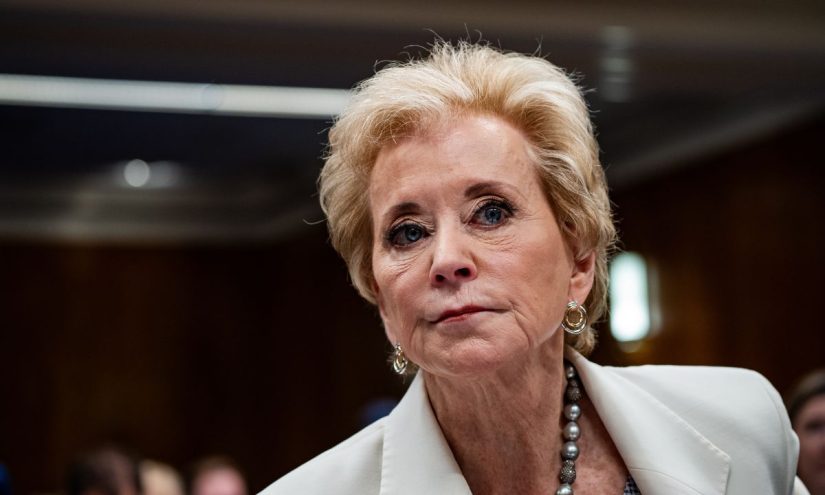
    Education Secretary Linda McMahon defended her cuts to programs and staff before a House education committee June 4. (Sha Hanting/China News Service/VCG via Getty Images)

    Even if the Supreme Court rules in McMahon’s favor, its opinion won’t affect previous rulings and other lawsuits in progress against the department.

    Here’s where some of those key legal battles stand:

    COVID relief funds

    McMahon stunned states in late March when she said they would no longer receive more than $2 billion in reimbursements for COVID-related expenses. States would have to make a fresh case for how their costs related to the pandemic, even though the department had already approved extensions for construction projects, summer learning and tutoring. 

    On June 3, a federal judge in Maryland blocked McMahon from pulling the funds.

    Despite the judicial order, not all states have been paid.

    The Maryland Department of Education still had more than $400 million to spend. Cherie Duvall-Jones, a spokeswoman, said the agency hasn’t received any reimbursements even though it provided the “necessary documentation and information” federal officials requested. 

    The cancellation forced Baltimore City schools to dip into a reserve account to avoid disrupting tutoring and summer school programs.

    Madison Biedermann, a spokeswoman for the department, declined to comment on why it had yet to pay Maryland or how much the department has distributed to other states since June.

    Mass firings

    In the administration’s push to wind down the department, McMahon admits she still needs staff to complete what she calls her “final mission.” On May 21, she told a House appropriations subcommittee that she had rehired 74 people. Biedermann wouldn’t say whether that figure has grown, and referred a reporter to the hearing video.

    “You hope that you’re just cutting fat,” McMahon testified. “Sometimes you cut a little in the muscle.” 

    The next day, a federal district court ordered her to also reinstate the more than 1,300 employees she fired in March, about half of the department’s workforce. Updating the court on progress, Chief of Staff Rachel Oglesby said in a July 8 filing that she’s still reviewing survey responses from laid off staffers and figuring out where they would work if they return.

    Student protestors participate in the “Hands Off Our Schools” rally in front of the U.S. Department of Education on April 4 in Washington, D.C. (Getty Images)

    But some call the department’s efforts to bring back employees lackluster, perhaps because it’s pinning its hopes on a victory before the Supreme Court. 

    “This is a court that’s been fairly aggressive in overturning lower court decisions,” said Smith, with the National Center for Youth Law. 

    His group’s lawsuit is one of two challenging cuts to the Office for Civil Rights, which lost nearly 250 staffers and seven regional offices. They argue the cuts have left the department unable to thoroughly investigate complaints. Of the 5,164 civil rights complaints since March, OCR has dismissed 3,625, Oglesby reported.

    In a case brought by the Victim Rights Law Center, a Massachusetts-based advocacy organization, a federal district court judge ordered McMahon to reinstate OCR employees. 

    Even if the case is not reversed on appeal, there’s another potential problem: Not all former staffers are eager to return.

    “I have applied for other jobs, but I’d prefer to have certainty about my employment with OCR before making a transition,” said Andy Artz, who was a supervising attorney in OCR’s New York City office until the layoffs. “I feel committed to the mission of the agency and I’d like to be part of maintaining it if reinstated.”

    DEI

    An aspect of that mission, nurtured under the Biden administration, was to discourage discipline policies that result in higher suspension and expulsion rates for minority students. A 2023 memo warned that discrimination in discipline could have “devastating long-term consequences on students and their future opportunities.”

    But according to the department’s Feb. 14 guidance, efforts to reduce those gaps or raise achievement among Black and Hispanic students could fall under its definition of “impermissible” DEI practices. Officials demanded that states sign a form certifying compliance with their interpretation of the law. On April 24, three federal courts ruled that for now, the department can’t pull funding from states that didn’t sign. The department also had to temporarily shut down a website designed to gather public complaints about DEI practices. 

    The cases, which McMahon has asked the courts to dismiss, will continue through the summer. In court records, the administration’s lawyers say the groups’ arguments are weak and that districts like Decatur simply overreacted. In an example cited in a complaint brought by the NAACP, the Waterloo Community School District in Iowa responded to the federal guidance by pulling out of a statewide “read-In” for Black History Month. About 3,500 first graders were expected to participate in the virtual event featuring Black authors and illustrators. 

    The department said the move reflected a misunderstanding of the guidance. “Withdrawing all its students from the read-In event appears to have been a drastic overreaction by the school district and disconnected from a plain reading of the … documents,” the department said.

    Desegregation 

    The administration’s DEI crackdown has left many schools confused about how to teach seminal issues of American history such as the Civil Rights era.

    It was the Civil Rights Act of 1964 that established “desegregation centers” across the country to help districts implement court-ordered integration. 

    In 2022, the Biden administration awarded $33 million in grants to what are now called equity assistance centers. But Trump’s department views such work as inseparable from DEI. When it cancelled funding to the centers, it described them as “woke” and “divisive.”

    Judge Paul Friedman of the U.S. District Court for the District of Columbia, a Clinton appointee, disagreed. He blocked McMahon from pulling roughly $4 million from the Southern Education Foundation, which houses Equity Assistance Center-South and helped finance Brown v. Board of Education over 70 years ago. His order referenced President Dwight Eisenhower and southern judges who took the ruling seriously.

    “They could hardly have imagined that some future presidential administration would hinder efforts by organizations like SEF — based on some misguided understanding of ‘diversity, equity, and inclusion’ — to fulfill Brown’s constitutional promise to students across the country to eradicate the practice of racial segregation.”

    He said the center is likely to win its argument that canceling the grant was “arbitrary and capricious.”

    Raymond Pierce, Southern Education Foundation president and CEO, said when he applied for the grant to run one of the centers, he emphasized its historical significance.

    “My family is from Mississippi, so I remember seeing a ‘colored’ entrance sign on the back of the building as we pulled into my mother’s hometown for the holidays,” Pierce said. 

    Trump’s Justice Department aims to dismiss many of the remaining 130 desegregation orders across the South. Harmeet Dhillon, assistant attorney general for civil rights, has said the orders force districts to spend money on monitoring and data collection and that it’s time to “let people off the hook” for past discrimination.

    But Eshé Collins, director of Equity Assistance Center-South, said the centers are vital because their services are free to districts.

    “Some of these cases haven’t had any movement,” she said. “Districts are like ‘Well, we can’t afford to do this work.’ That’s why the equity assistance center is so key.”

    Eshé Collins, director of Equity Assistance Center-South and a member of the Atlanta City Council, read to students during a visit to a local school. (Courtesy of Eshé Collins)

    Her center, for example, works with the Fayette County schools in Tennessee to recruit more Black teachers and ensure minority students get an equal chance to enroll in advanced classes. The system is still under a desegregation order from 1965, but is on track to meet the terms set by the court next year, Collins said. A week after Friedman issued the injunction in the foundation’s case, Ruth Ryder, the department’s deputy assistant secretary for policy and programs, told Collins she could once again access funds and her work resumed.

    Research

    As they entered the Department of Education in early February, one of the first moves made by staffers of the Department of Government Efficiency was to terminate nearly $900 million in research contracts awarded through the Institute for Education Sciences. Three lawsuits say the cuts seriously hinder efforts to conduct high-quality research on schools and students.

    Kevin Gee from the University of California, Davis, was among those hit. He was in the middle of producing a practice guide for the nation on chronic absenteeism, which continues to exceed pre-pandemic levels in all states. In a recent report, the American Enterprise Institute’s Nat Malkus said the pandemic “took this crisis to unprecedented levels” that “warrant urgent and sustained attention.” Last year’s rate stood at nearly 24% nationally — still well above the 15% before the pandemic.

    Gee was eager to fully grasp the impact of the pandemic on K-3 students. Even though young children didn’t experience school closures, many missed out on preschool and have shown delays in social and academic skills.

    Westat, the contractor for the project, employed 350 staffers to collect data from more than 860 schools and conduct interviews with children about their experiences. But DOGE halted the data collection midstream — after the department had already invested about $44 million of a $100 million contract.

    Kevin Gee, an education researcher at the University of California, Davis, had to stop his research work when the Trump administration cancelled grants. (Courtesy of Kevin Gee)

    “The data would’ve helped us understand, for the first time, the educational well-being of our nation’s earliest learners on a nationwide scale in the aftermath of the pandemic,” he said. 

    The department has no plans to resurrect the project, according to a June court filing. But there are other signs it is walking back some of DOGE’s original cuts. For example, it intends to reissue contracts for regional education labs, which work with districts and states on school improvement. 

    “It feels like the legal pressure has succeeded, in the sense that the Department of Education is starting up some of this stuff again,” said Cara Jackson, a past president of the Association for Education Finance and Policy, which filed one of the lawsuits. “I think … there’s somebody at the department who is going through the legislation and saying, ‘Oh, we actually do need to do this.’ ”

    Mental health grants 

    Amid the legal machinations, even some Republicans are losing patience with McMahon’s moves to freeze spending Congress already appropriated.  

    In April, she terminated $1 billion in mental health grants approved as part of a 2022 law that followed the mass school shooting in Uvalde, Texas. The department told grantees, without elaboration, that the funding no longer aligns with the administration’s policy of “prioritizing merit, fairness and excellence in education” and undermines “the students these programs are intended to help.”

    The secretary told Oregon Democratic Sen. Jeff Merkley in June that she would “rebid” the grants, but some schools don’t want to wait. Silver Consolidated Schools in New Mexico, which lost $6 million when the grant was discontinued, sued her on June 20th. Sixteen Democrat-led states filed a second suit later that month.

    The funds, according to Silver Consolidated’s complaint, allowed it to hire seven mental health professionals and contract with two outside counseling organizations. With the extra resources, the district saw bullying reports decline by 30% and suspensions drop by a third, according to the district’s complaint. Almost 500 students used a mental health app funded by the grant.

    A judge has yet to rule in either case, but Republican Rep. Brian Fitzpatrick of Pennsylvania and other members of a bipartisan task force are holding McMahon to her word that she’ll open a new competition for the funds. 

    “These funds were never intended to be a theoretical exercise — they were designed to confront an urgent crisis affecting millions of children,” Fitzpatrick said in a statement. “With youth mental health challenges at an all-time high, any disruption or diversion of resources threatens to reverse hard-won progress and leave communities without critical supports.”


    Get stories like these delivered straight to your inbox. Sign up for The 74 Newsletter

    Source link

  • Family Structure Matters to Student Achievement. What Should We Do With That? – The 74

    Family Structure Matters to Student Achievement. What Should We Do With That? – The 74


    Get stories like this delivered straight to your inbox. Sign up for The 74 Newsletter

    A version of this essay originally appeared on Robert Pondiscio’s SubStack

    A recent report from the University of Virginia—Good Fathers, Flourishing Kids — confirms what many of us know instinctively but rarely see, or avoid altogether, in education debates: The presence and engagement of a child’s father has a powerful effect on their academic and emotional well-being. It’s the kind of data that should stop us in our tracks — and redirect our attention away from educational fads and toward the foundational structures that shape student success long before a child ever sets foot in a classroom.

    The research — led by my AEI colleague Brad Wilcox and co-authored by a diverse team that includes another AEI colleague, Ian Rowe — finds that children in Virginia with actively involved fathers are more likely to earn good grades, less likely to have behavior problems in school, and dramatically less likely to suffer from depression. Specifically, children with disengaged fathers are 68% less likely to get mostly good grades and nearly four times more likely to be diagnosed with depression. These are not trivial effects. They are seismic.

    Most striking is the report’s finding that there is no meaningful difference in school grades among demographically diverse children raised in intact families. Black and white students living with their fathers get mostly As at roughly equal rates — more than 85% — and are equally unlikely to experience school behavior problems. The achievement gap, in other words, appears to be less about race and more about the structure and stability of the family.

    Figure 9 from Wilcox et al., Good Fathers, Flourishing Kids

    This may be a surprising finding to some, but not to William Jeynes, a professor of education at California State University, Long Beach, whose meta-analyses have previously demonstrated the outsized academic impact of family structure and religious faith. (The new UVA report does not study the role of church-going). 

    As I wrote in How the Other Half Learns, Jeynes’ work highlights how two-parent households and religious engagement produce measurable benefits in educational achievement. “When two parents are present, this maximizes the frequency and quality of parental involvement. There are many dedicated single parents,” Jeynes has noted. However, the reality is that when one parent must take on the roles and functions of two, it is simply more difficult than when two parents are present.” Jeynes’ most stunning finding, and his most consistent, is that if a Black or Hispanic student is raised in a religious home with two biological parents the achievement gap totally disappears—even when adjusting for socioeconomic status.

    My colleague Ian Rowe has been a tireless advocate for recognizing and responding to these patterns. He has long argued that NAEP, the Nation’s Report Card, should disaggregate student achievement data by family composition, not just by race and income. That simple step would yield a more honest accounting of the challenges schools are facing — and help avoid both unfair blame and unearned credit.

    Yet this conversation remains a third rail in education. Many teachers and administrators are understandably wary of saying too much about family structure for fear of stigmatizing children from single-parent households, particularly in settings where single-parent households are dominant. Rowe has also faced resistance to his efforts to valorize the “Success Sequence,” the empirical finding that graduating high school, getting a full-time job and marrying before having children dramatically increases one’s odds of avoiding poverty. But being cautious is not the same as being silent, and it’s not compassionate to pretend these dynamics don’t matter when the data so clearly shows that they do.

    None of this absolves educators of their duty to reach and teach every child. But it does suggest we should be clear-eyed in how we interpret data and set expectations. Teachers, particularly those in low-income communities, often shoulder the full weight of student outcomes while lacking the ability to influence some of the most powerful predictors of those outcomes. That’s frustrating — and understandably so.

    Citing compelling evidence on fatherhood and family formation is not a call for resignation or excuse-making. It’s a call for awareness and intelligent action. While schools can’t influence or re-engineer family structure, teachers can respond in ways that affirm the role of fathers and strengthen the school-home connection. They can make fathers feel welcome and expected in school life — not merely tolerated. They can design family engagement activities that include dads as co-participants, not afterthoughts. They can build classroom cultures that offer structure and mentoring, especially to students who may lack it at home. 

    And maybe — just maybe — the field can overcome its reluctance to share with students what research so clearly shows will benefit them and the children they will have in the future. Rowe takes pains to note his initiative to teach the Success Sequence is intended to help students make decisions about the families they will form, not the ones they’re from. “It’s not about telling them what to do,” he says, “it’s about giving them the data and letting them decide for themselves.”

    This leads to a final point, and for some an uncomfortable one: If we truly care about student outcomes, perhaps we should be willing to support the institutions that reliably foster them. And that includes religious schools.

    Religious schools — particularly those rooted in faith traditions that emphasize marriage, family life and moral formation — often create environments where the presence of fathers and the reinforcement of shared values are not incidental but central. A recent analysis by Patrick J. Wolf of the University of Arkansas, published in the Journal of Catholic Education, found that adults who attended religious schools are significantly more likely to marry, stay married, and avoid nonmarital births compared to public‑school peers. The effects are most pronounced among individuals from lower‑income backgrounds.

    In states with Education Savings Accounts (ESAs) and other school choice mechanisms, we have an opportunity — perhaps an obligation — to expand access to these institutions. That’s not merely a question of parental rights or religious liberty. It’s a matter of public interest. If these schools produce better education and social outcomes by encouraging family formation and reinforcing the value of fatherhood, the public benefits — even if instruction is delivered in a faith-based context. Said simply: The goal of educational policy and practice is not to save the system. It’s to help students flourish.

    So yes, let’s fund fatherhood initiatives. Let’s run PSAs about the importance of dads. But let’s also get serious about expanding access to the kinds of schools — whether secular or religious in nature — that support the kind of family culture where children are most likely to thrive. Because if we follow the evidence where it leads, we must conclude that the biggest intervention in education is not another literacy coach or SEL curriculum. It’s dad.


    Get stories like these delivered straight to your inbox. Sign up for The 74 Newsletter

    Source link

  • Wearable tech helps students overcome central vision challenges

    Wearable tech helps students overcome central vision challenges

    Central vision loss–a condition that impairs the ability to see objects directly in front of the eyes–can have profound academic and social impacts on K-12 students. Because this type of vision loss affects tasks that require detailed focus, such as reading, writing, and recognizing faces, students with central vision impairment often face unique challenges that can affect their overall school experience.

    In the classroom, students with central vision loss may struggle with reading printed text on paper or on the board, despite having otherwise healthy peripheral vision. Standard classroom materials are often inaccessible without accommodations such as large print, magnification devices, or digital tools with text-to-speech capabilities. These students might take longer to complete assignments or may miss visual cues from teachers, making it difficult to follow along with lessons. Without appropriate support, such as assistive technology, students may fall behind academically, which can affect their confidence and motivation to participate.

    As a result, they may be perceived as aloof or unfriendly, leading to social isolation or misunderstanding. Group activities, games, and unstructured time like lunch or recess can become sources of anxiety if students feel excluded or unsafe. Moreover, children with vision loss may become overly dependent on peers or adults, which can further affect their social development and sense of independence.

    While this may seem daunting, there are assistive technologies to help students navigate central vision loss and have fulfilling academic and social experiences.

    One such technology, eSight Go from Gentex Corporation’s eSight, uses an advanced high-speed, high-definition camera to capture continuous video footage of what a user is looking at. Algorithms optimize and enhance the footage and share it on two HD OLED screens, providing sharp, crystal-clear viewing. The user’s brain then synthesizes the images to fill any gaps in their vision, helping them to see more clearly, in real time.

    “The ability to have central perception brought back into your set of tools for education is critically important,” said Roland Mattern, eSight’s director of sales and marketing. “Ease of reading, ease of seeing the board, using tablets or computers–all of these things [lead to] the ability to complete an academic task with greater ease.”

    One key feature, Freeze Frame, lets the user capture a temporary photograph with the device’s camera, such as an image on an interactive whiteboard, a textbook page, or a graphic. The student can magnify the image, scan and study it, and take what they need from it.

    “This eases the ability to absorb information and move on, at a regular pace, with the rest of the class,” Mattern noted.

    Socially, central vision loss can create additional barriers. A major part of social interaction at school involves recognizing faces, interpreting facial expressions, and making eye contact–all tasks that rely heavily on central vision. Students with this impairment might have difficulty identifying peers or teachers unless they are spoken to directly. The glasses can help with these social challenges.

    “There’s a huge social aspect to education, as well–seeing expressions on teachers’ and fellow students’ faces is a major part of communication,” Mattern said.

    What’s more, the glasses also help students maintain social connections inside and outside of the classroom.

    “Think of how much peer-to-peer communication is digital now, and if you have central vision loss, you can’t see your phone or screen,” Mattern said. “The educational part is not just academic–it’s about the student experience that you want to enhance and optimize.”

    Educators, parents, and school staff play a crucial role in fostering inclusive environments–by educating classmates about visual impairments, encouraging empathy, and ensuring that students with central vision loss are supported both academically and socially. With the right accommodations and social-emotional support, these students can thrive in school and build strong connections with their peers.

    “If we can make daily living, hobbies, and education easier and facilitate participation, that’s a win for everybody,” Mattern said.

    For more spotlights on innovative edtech, visit eSN’s Profiles in Innovation hub.

    Laura Ascione
    Latest posts by Laura Ascione (see all)

    Source link

  • Students, Staff Say Farewell to Laramie Lab School – The 74

    Students, Staff Say Farewell to Laramie Lab School – The 74


    Get stories like this delivered straight to your inbox. Sign up for The 74 Newsletter

    LARAMIE—The Lab School is a family affair for Corelle Lotzer. 

    Not only did Lotzer enroll her daughter and son in the school, but she taught math here for over a decade. Her daughter, who thrived years ago as a student in the K-8 atmosphere, returned as an adult to work as a paraprofessional — just down the hall from her mom.

    Because Lotzer took a year off to take care of an aging aunt, she lost tenure. So when the closure of the 138-year-old school became official this winter, she did not receive a contract with the district to continue working at one of its other schools. 

    Lotzer, who was raised in Laramie, instead accepted a position at Cheyenne East High School. In early May, she was still trying to figure out the logistics involved with working in Cheyenne while her other, younger kids continue their education in Laramie. 

    “It’s been tough,” Lotzer said in a second-story room in the Lab School. The shrieks and laughter of children at recess drifted in from an open window. “I would have rather stayed in Albany County.”

    Lotzer is one of 11 Lab School teachers without tenure, Principal Brooke Fergon said. “That’s probably been the most difficult challenge, that our tenured teachers have been placed in other schools throughout the district, and our teachers who do not have tenure … were not initially placed in positions.”

    It’s not the only pain point involved in closing a school that predates the state of Wyoming itself. Many people fought to keep the Lab School open, and the past year has been a rollercoaster of emotions for school staff, students and their families as hopes have been raised and dashed, Fergon said. The school, which sits on the University of Wyoming campus, started as an educational learning site for college students studying to be teachers. It’s beloved for its experiential and outdoor-based approach to learning and emphasis on inclusivity. 

    Kindergarten students in Victoria Wiseman’s Lab School class raise their pencils to signify they have completed an exercise in May 2025. (Katie Klingsporn/WyoFile) 

    But the school’s future was thrown in doubt last summer as the university and Albany County School District 1 hit a stalemate over a lease agreement. School advocates pleaded to keep it open by some means and floated ideas that didn’t stick. The Lab School no longer served its former functions, university and district officials said, and issues from maintenance costs for the 75-year-old building to district-wide enrollment trends factored into closure talks. 

    The final Hail Mary came during the Wyoming Legislature. A bipartisan bill sponsored by Laramie Democrat Chris Rothfuss would have required UW and a coordinating district to operate a K-8 public lab school. The bill passed out of the Senate, but House lawmakers killed it in February, and that was pretty much that for the Lab School. 

    In the last year, Fergon said, “I think we’ve really been sitting in a place of uncertainty, just with all of the different avenues that could have kept the school going, and so that did feel kind of like a final door closing.”

    And for her staff, she said, “even though we’re not happy to say goodbye to the school, and we didn’t want to see the school close, I think that having some certainty and a path forward … feels better than just sitting in limbo.”

    With the school year ending Thursday, Lab School students will be saying goodbye to their classrooms and dispersing to other schools in the district. Some teachers will too, but others are starting new jobs or moving out of Laramie entirely. The school community spent the last couple of months bidding farewell, some with regret about how it ended. 

    Students enjoy warm weather during a May 2025 farewell celebration of the Lab School in Laramie. (Zach Agee/WyoFile) 

    “We love the school,” said Lindsey Rettler, a parent with two elementary students in Lab. Rettler was experiencing a mixture of emotions, she said in May. “Surprise, a little bit of shock, really, really sad, super disappointed and honestly, quite betrayed by those who are supposed to be leading people based on what’s best for the people.”

    End of an era 

    The school was established in 1887 as the Preparatory School to serve secondary education students from counties without access to high school. In 1913, it transitioned to the Training Preparatory School, used as a learning laboratory by UW’s College of Education. 

    In 1999, the private school partnered with the Albany County School District to become a district public school. The Lab School then operated as a “school of choice,” meaning any district family could enter a lottery to enroll their kids.

    College of Education students continued to train in its classrooms, but they also did so in classrooms across the district, state and beyond.

    Historically, UW and the school district operated with a memorandum of understanding laying out terms of tenancy. Efforts to renew that MOU, however, failed to produce an updated agreement. Instead, the university announced last summer it was pursuing an extension only for the 2024-’25 school year, meaning the school would have to find a new home if it was to continue beyond that.

    Margaret Hudson, a former principal at the Lab School, leads a school tour during a May 2025 farewell celebration of the school. (Zach Agee/WyoFile)

    Among the major sticking points: whether the district or UW should pay for things like major maintenance in the aging building. UW also cited the fact that the school “no longer serves a significant role for teacher training in UW’s College of Education,” along with security challenges regarding having a school-district-operated facility located on university grounds; the Lab School’s incongruence with the state’s public funding model and the fact that the school district “has excess capacity in its existing facilities to accommodate current Lab School students.”

    The Albany County School District Board of Trustees voted in December to close the Lab School after considering options to move it into another district building. Trustees expressed heartache but also a fiduciary obligation before making the decision

    Concerned residents bemoaned the decision, and Albany County state lawmakers took notice. Sen. Rothfuss’ bill was the product of that concern. The bill brought together strange bedfellows, with co-sponsors ranging from Freedom Caucus-aligned lawmakers like Ocean Andrew to Laramie Democrat Karlee Provenza. Both serve in the Wyoming House of Representatives.

    The issue raised questions about the state’s role in local education and what constitutes a situation so exceptional that lawmakers should meddle. Lab School supporters argued its unique role as a teaching laboratory and its century-plus of education history made it a place worth saving. 

    “This legislation is not about saving a school,” Rep. Andrew, R-Laramie, said on the House floor on Feb. 28. “It is about protecting a legacy and educating future generations of Wyoming teachers.”

    Librarian Cathy Dodgson greets a former student during a Lab School celebration in May 2025. The student remembered spending many hours reading in the library. (Zach Agee/WyoFile) 

    True local control reflects the wishes of the people in the community, he continued, “and in this case, the overwhelming support for keeping the Lab School open has been ignored. The people of Wyoming, the parents and the students have spoken, and they have been met with indifference by those in power.”

    But others said the state should not interfere in a matter of local concern.

    “This really feels like we’re being asked to micromanage a local school,” said Rep. Art Washut, R-Casper. “I don’t think this is the proper role of the state legislature.”

    The body ultimately killed the measure on a 24-32 vote. 

    Moving on 

    With that, school staff began the work of transition, making plans with its 145 students to help them figure out transfer schools and options, Fergon said.. The school counselor even brought in a “transition curriculum” to help students navigate and cope with the stress of such significant change.

    There was also a staff of roughly 20 teachers along with employees like janitors and paraprofessionals. Many say they are sad to leave a school community that felt like family. 

    Some, like Fergon, are continuing to work in the district. She will be an assistant principal at another high school.


    Get stories like these delivered straight to your inbox. Sign up for The 74 Newsletter

    Source link

  • How we designed a space where our students connect, collaborate, and flourish

    How we designed a space where our students connect, collaborate, and flourish

    Key points:

    Our charter school, Westbrook Academy, has been serving middle and high school students in the South Los Angeles area for the past six years and stands as a beacon of opportunity for our community. With a student body comprising nearly 99 percent Black and Latinx individuals hailing from historically under-resourced communities, we confront the realities of poverty and the accompanying insecurities head-on.

    Despite the odds, our 400 students consistently demonstrate remarkable resilience and a profound capacity for excellence. Our institution is supported by generous donors and funding sources. Operated and managed by the education nonprofit LA Promise Fund, which provides students with academic and enrichment opportunities that support our mission to spark passion, empower leadership, and prepare them for their chosen college and career paths.

    At one point, our high school students were learning in a church because we didn’t have a traditional classroom set-up. We also lacked the equipment that a traditional high school might have. This changed when we moved into our forever home in South Gate, where an on-campus Empowerment Center serves as a modern, welcoming “student hub.”

    Designed and outfitted by MiEN and Meteor Education, the Empowerment Center is where kids go to hang out, collaborate, and/or participate in school club activities. The hub is also set up with two wellness rooms where students can go to debrief and disconnect from a long day or just the stresses of being a student. It’s there for the students’ use.

    Here are the steps we took to create a space that consistently makes jaws drop and impresses parents who never thought their children would have access to such a warm, welcoming communal space on campus:

    • Add some flexibility into the process. Our original goal was to open the Empowerment Center’s doors in time for the 2023-24 school year, but getting it done the right way would require a bit more time. Our partners were willing to listen to us in terms of what we wanted to create, but within the realistic timelines. That was really cool.
    • Acknowledge the financial limitations. We largely relied on fundraising for this project and knew that some things just weren’t going to be realistic. To other schools in similar situations, I’d recommend staying flexible enough to hit the timelines and get all of the bases covered while keeping student needs in mind. We can have all the bells and whistles, but at the end of the day, if the car runs, the car runs. We know we can always add a new paint job later.
    • Get the right partners onboard early. As we went through the steps of designing the Empowerment Center, we learned a lot about architecture, planning, and construction. Through it all, having the right partners in its corner helped the school achieve its goals within budget and on time. It was really great to have our design and furniture partners sharing their best practices and other insights with us. We knew what we wanted to do, and a lot of the ideas came from our families and students. We just needed them to show us how we could get those ideas as close to reality as possible.
    • Make it personal. Special features we wanted in our Empowerment Center included a huge, interactive flatscreen TV that students, teachers, and guest speakers use to interact and work together. There’s also a large selection of donated books, the latest technology tools, and artwork that was personally selected by an art curation team. They were able to secure artists from the LA community to create and share visuals that our students are really familiar with. For example, some of the artwork spotlights female empowerment (i.e., with photos of authors like Octavia Butler) and the importance of acknowledging indigenous people. Everything in the hub is meant to spark curiosity. 
    • Brace yourself for some jaw-dropping moments. At our ribbon-cutting ceremony last year, our parents’ jaws were on the floor. They just never thought these resources would be available to their kids. A lot of them grew with us being in the church and a co-located space, and then we asked them to trust us to deliver on our promise, and now we’re able to show that as the reward for supporting us. We feel really proud that our parents were just over the moon about it.

    Hitting it out of the park

    Reflecting on the process we put in place to get our modern student hub designed, built, and open for business, I can say that the end result is an engaging, collaborative space that can be used for hanging out, structured learning, or a little of both. I think we really hit the ball out of the park with this innovative space.

    Student, teacher, and family feedback on the Empowerment Center has been extremely positive. Everyone loves it, and students are always excited to come and spend time in the modern, comfortable space that’s equipped with the technology and tools they need to be able to learn and engage.

    Latest posts by eSchool Media Contributors (see all)
    Source link

  • Teacher stress levels have surpassed pandemic-era highs

    Teacher stress levels have surpassed pandemic-era highs

    Key points:

    America’s K-12 educators are more stressed than ever, with many considering leaving the profession altogether, according to new survey data from Prodigy Education.

    The Teacher Stress Survey, which polled more than 800 K-12 educators across the U.S., found that nearly half of teachers (45 percent) view the 2024-25 school year as the most stressful of their careers. The surveyed educators were also three times more likely to say that the 2024-25 school year has been the hardest compared to 2020, when they had to teach during the height of the COVID-19 pandemic.

    Student behavior challenges (58 percent), low compensation (44 percent), and administrative demands (28 percent) are driving teacher burnout and turnover at alarming rates. Public school teachers were more likely to report stress from unrealistic workloads, large class sizes, school safety concerns, and student behavior issues than their private school counterparts.

    “The fact that stress levels for so many teachers have exceeded those of the pandemic era should be a wake-up call,” said Dr. Josh Prieur, director of education enablement at Prodigy Education and former assistant principal in the U.S. public school system. “Teachers need tangible, meaningful, and sustained support … every week of the year.”

    Additional key findings include:

    • The vast majority of teachers (95 percent) are experiencing some level of stress, with more than two-thirds (68 percent) reporting moderate to very high stress. K-5 teachers were the most likely to feel extremely/very stressed (33 percent). Sixty-three percent of teachers report that their current stress levels are higher than when they first started teaching. 
    • Nearly one in 10 teachers surveyed (9 percent) are planning to leave the profession this year, while nearly one in four (23 percent) are actively thinking about it. One-third of teachers do not expect to be teaching three years from now, likely because nearly half (48 percent) of teachers don’t feel appreciated for the work that they do.
    • Teachers are finding ways to prioritize their well-being, but time limits and job pressures often get in the way. Seventy-eight percent of teachers say they actively make time for self-care, but nearly half (43 percent) feel guilty for spending time on self-care and 78 percent have skipped self-care due to work demands. Implementing school-provided self-care perks and mandatory self-care breaks would appeal to teachers, with 85 percent and 76 percent taking advantage of each benefit, respectively.
    • Top solutions that would reduce teachers’ stress include a higher salary (59 percent), a four-day school week (33 percent), stronger classroom discipline policies (32 percent), and smaller class sizes (25 percent). Public school teachers were more likely to prefer a shorter week, while private school educators opted for higher pay. 

    “Teacher Appreciation Week should serve as the starting point for building systems that show we value teachers’ time, talent, and well-being,” said Dr. Prieur. “Districts can do this by investing in tools that reduce the burden on teachers, prioritizing time for self-care and implementing policies that reinforce teachers’ value as an ongoing commitment to bettering the profession.”

    This press release originally appeared online.

    Laura Ascione
    Latest posts by Laura Ascione (see all)

    Source link

  • As Enrollment Falls, Fewer Schools Close – The 74

    As Enrollment Falls, Fewer Schools Close – The 74

    The headlines are seemingly everywhere:

    Jackson Public Schools board votes to close 13 school buildings.”

    Denver Public Schools to close 7 schools, cut grades at 3 others despite heavy resistance.”

    The list is out: These are the SFUSD schools facing closure.” 

    Such reports can leave the impression that districts are rapidly closing schools in response to declining enrollment and families leaving for charters, private schools and homeschooling. 

    But the data tells a different story. 

    School closures have actually declined over the past decade, a period of financial instability that only increased in the aftermath of the pandemic, according to research from the Brookings Institution. 

    The analysis, shared exclusively with The 74, shows that in 2014-15, the closure rate — the share of schools nationwide that were open one year and closed the next — was 1.3%. In 2023-24, the rate was just .8%, up from .7% the year before.

    “I think it’s important for people to realize how rare school closures are,” said Sofoklis Goulas, a Brookings fellow and the study’s author. 

    Last fall, his research showed how schools that have lost at least 20% of their enrollment since the pandemic are more likely to be low-performing. The Clark County Public Schools, which includes Las Vegas, had the most schools on the list — 19 — but isn’t currently considering closures. In Philadelphia, with 12 schools in that category, district leaders are just beginning to discuss closures.

    When it released Goulas’s initial report, leaders of the conservative Thomas B. Fordham Institute argued that low-performing schools should be the first to close. But efforts to do so are often met with pushback from families, teachers and advocacy groups who argue that shutting down schools unfairly harms poor and minority students and contributes to neighborhood blight. Their pleas often push district leaders to retreat. Working in advocates’ favor, experts say, is the fact that many big district leaders are untested and have never had to navigate the emotionally charged waters of closing schools.

    “Closing a neighborhood school is probably one of the most difficult decisions a district’s board makes,” said Michael Fine, CEO of the Fiscal Crisis and Management Assistance Team, a California state agency that provides financial oversight to districts. “They are going to avoid that decision as long as they can and at all costs.” 

    Such examples aren’t hard to find:

    • Just weeks after announcing closures, the San Francisco district halted plans to shutter any schools this fall.
    • In September, outgoing Chicago Public Schools CEO Pedro Martinez pledged to put off school closures for another two years, even though state law allows the city to take action sooner. The district is in the process of absorbing five charter schools to keep them from closing. 
    • In October, Pittsburgh Public Schools recommended closing 14 schools; several others were set to be relocated and reconfigured. About a month later, Superintendent Wayne Walters hit pause, saying the district needed more “thoughtful planning” and community input.
    • Last May, the Seattle Public Schools announced it would shutter 20 elementary schools next school year in response to a $100 million-plus budget deficit. They later increased the number to 21. By October, the list had dwindled to four schools. Just before Thanksgiving, Superintendent Brent Jones withdrew the plan entirely. 

    “This decision allows us to clarify the process, deepen our understanding of the potential impacts, and thoughtfully determine our next steps,” Jones wrote to families. While the plan would have saved the district $5.5 million, he said, “These savings should not come at the cost of dividing our community.”

    map visualization

    Graham Hill Elementary in Seattle, which fifth grader Wren Alexander has attended since kindergarten, was initially on the list. The Title I school sits on top of a hill in a desirable area overlooking Lake Washington. But it also draws students from the lower-income, highly diverse Brighton Park neighborhood.

    Among Wren’s neighbors are students from Ethiopia, Vietnam and Guatemala. Wren, who moves on to middle school this fall, said she looks forward to visiting her former teachers and cried when she heard Graham Hill might close. She wanted her younger brother and sister to develop the same warm connection she had.

    “I don’t think I would be who I am if I didn’t go to the school,” she said.

    Wren Alexander and her little sister Nico, outside Graham Hill. (Courtesy of Tricia Alexander)

    Tricia Alexander, her mother, was among those who opposed the closures, participating in rallies outside the district’s administration building and before board meetings.

    “We were really loud,” said Alexander, who’s also part of Billion Dollar Bake Sale, an effort to advocate for more state education funding. She said there was “no real evidence” that closing schools would have solved the district’s budget woes. “In no way would kids win.”

    It’s a view shared by many school finance experts, who note that the bulk of school funding is tied up in salaries, not facility costs. Districts may save some money from closing schools, but unless coupled with staff reductions, it’s often not enough to make up for large budget shortfalls.  

    ‘So bad at this’

    If enrollment doesn’t pick up, experts say, leaders who delay closures will have to confront the same issues a year later or — perhaps even more likely — pass the problems on to their successors. 

    “If there continues to be fewer and fewer children …then that doesn’t get better,” said Brian Eschbacher, an enrollment consultant.  

    One Chicago high school, for example, had just 33 students last year. In Los Angeles, the nation’s second-largest district, 34 elementary schools have fewer than 200 students and 29 of those are using less than half of the building, according to a recent report. The share of U.S. students being educated outside of traditional schools also continues to increase, according to a forthcoming analysis Goulas conducted with researchers at Yale University. 

    “We don’t see a trajectory of enrollment recovery,” he said. “Things actually got worse in the most recently released data batch.”

    But such conditions haven’t stopped advocacy groups from campaigning against closures. One of them, the left-leaning Advancement Project, has joined with local groups in Denver and Pittsburgh to make a case against closures nationally. 

    “All children deserve to have a local, neighborhood public school in which they and their families have a say,” said Jessica Alcantara, senior attorney for the group’s Opportunity to Learn program. “It’s not just that school closures are hard on families. They harm the full education ecosystem that makes up a school — students, families, school staff and whole communities.”   

    Last May, Alcantara and other Advancement Project staff urged the U.S. Department of Education to treat school closures as a civil rights issue. Nine of the 10 schools the Denver district planned to close in 2022 had a majority Black or Hispanic student population. 

    The advocates argued that in cases of enrollment loss, run-down facilities and empty classrooms, there are alternatives to closing schools. They encourage communities to push for renovations and urge district leaders to use vacant spaces for STEM, arts or other programs that might attract families. Opponents of closures also say that districts sometimes underestimate how much of a building is used for non-classroom purposes like special education services, early-childhood programs and mental health. 

    Eschbacher’s assessment of why districts often back down from closing schools is more blunt. 

    “Districts are so bad at this,” he said. “If you just do a few things wrong, it could sink the whole effort.”

    For one, leaders often target schools with under 300 students for closure, appealing to parents that they can’t afford to staff them with arts programs, a school nurse or a librarian. 

    But those explanations sometimes fall flat.

    “Parents always say, ‘I wanted a small school. I know my teachers and they know my kid. And it’s right down the street,’” Eschbacher said. If they didn’t like their school, he added, they would have likely would have chosen a charter or some other option. 

    District officials also run into trouble if they try to spin the data. When Seattle officials talked about “right-sizing” the district, they pointed to the loss of 4,900 students since 2019-20. 

    But Albert Wong, a parent in the district and a lifelong Seattle resident, knew there was more to the story. Not only is the current enrollment higher than it was from 2000 to 2011, the pandemic-related decline seems to have leveled off. In a commentary, he argued that officials presented misleading data “to make current enrollment look exceptionally bad.”

    Graham Hill Elementary, fifth-grader Wren’s school, actually saw a slight increase in enrollment this year, including a new class for preschoolers with disabilities. And while Pittsburgh schools are projected to lose another 5,000 students over the next six years, enrollment this year held steady at about 18,400.

    To Eschbacher, the “burden of proof is always on the district” to make an airtight case for why students would be better off in larger schools. He has applauded the Denver-area Jeffco Public Schools, which has closed 21 schools since 2021, for having state demographers, not just district officials, explain population trends to families at community meetings.

    ‘It wasn’t realistic’

    Walters, Pittsburgh’s superintendent, can easily rattle off reasons why the district should rethink how it uses its buildings. Early last year, local news reports showed that almost half of the district’s schools were less than 50% full. 

    “We’ve lost about a fourth of our population, but we have not changed anything to our footprint,” he said. 

    Meanwhile, the average age of the district’s buildings is 90 years old, and many lack air-conditioning, forcing some schools to send students home in sweltering weather.

    But a consulting group’s proposal showed that Black and low-income students and those with disabilities would be disproportionately affected by the changes. Several advocacy groups drew attention to those disparities, calling  the effort “rushed.” 

    412 Justice, an advocacy group, is among the community organizations pushing for alternatives to school closures in Pittsburgh. (412 Justice)

    Walters agreed and put the plan on hold last fall, saying he lacked “robust” responses to parents’ tough questions about how schools would change for their kids.

    “It doesn’t mean that we don’t see a path forward,” he said. “But it wasn’t realistic that we would have those questions answered within the timeline that we’ve been given.”

    In March, parents pushed for another delay, causing the school board to postpone a vote on the next phase in the closure process.

    As the Jeffco district demonstrates, some school systems are following through with closures. The school board in nearby Denver unanimously voted in November to close seven schools and downsize three more. 

    But that’s after community protests pushed the district to put the brakes on a plan to close 19 schools in 2021. Advocates argued that families in low-income areas, who had been heavily impacted by the pandemic, would be most affected. Then the district only closed three in 2023, and now board members are considering a pause on closures for three years.

    School boards closing a dozen or more schools are often catching up with work their predecessors let pile up, said Goulas of Brookings. 

    “Closing a single school allows for easier placement of students and minimizes the political cost and community stress,” he said. “When a district releases a long list of schools to close, it likely indicates that they waited for conditions to improve, but this didn’t happen.”

    Angel Gober, executive director of 412 Justice — one of 16 organizations that called on the Pittsburgh district to drop its plan — acknowledged that their fight isn’t over.

    “I think we got a temporary blessing from God,” she said. But she wants the district to explore a host of alternatives, like community schools and corporate support, before it shutters and sells off buildings. “We do have very old infrastructure, and that is an equity issue. But can we try five things before we make a drastic decision to close schools for forever?”


    Get stories like these delivered straight to your inbox. Sign up for The 74 Newsletter


    Source link

  • America’s Undocumented Educators Unsure of What’s Next Under Trump – The 74

    America’s Undocumented Educators Unsure of What’s Next Under Trump – The 74


    Get stories like this delivered straight to your inbox. Sign up for The 74 Newsletter

    This story was originally reported by Nadra Nittle of The 19th.

    LOS ANGELES — Scattered among the shrubs on the southern border lie belongings migrants left behind — toothbrushes, water bottles, baseball caps. Some of the owners forged north, crossing the boundary undetected. Others were apprehended or succumbed to dehydration, drowning or one of the unimaginable dangers in the harsh desert that straddles Mexico and the United States.

    Angélica Reyes survived. At nine months old, she made the journey that could have claimed her life just as it started.

    Since 1994, approximately 10,000 migrants have died in the borderlands. That year, the North American Free Trade Agreement (NAFTA) took effect. Designed to open trade between the United States, Canada and Mexico, the now-defunct policy has faced criticism for depressing Mexican wages. Their income flatlining, Reyes said, her parents left the city of Guadalajara, in the western part of Mexico, and headed with her to Los Angeles. They did not have authorization to live in the United States.

    Reyes is now 32, though she remembers knowing she was undocumented as early as first grade.

    “My mom was very cognizant of the discrimination and the obstacles that I would face throughout my life,” she said. “She made it clear, like, ‘You can’t mess up. You need to be twice as good to get half of the respect. You need to really prove that you earned your spot.’”

    To do that, Reyes earned the good grades that set her up to become a history teacher for the Los Angeles Unified School District. She is one of about 15,000 teachers — and among the more than 835,000 undocumented people — who have received temporary permission to live, work and study in the United States through an Obama-era program known as Deferred Action for Childhood Arrivals (DACA). Women represent over half of DACA recipients, whose future in this country has been under threat by legal challenges to the program’s existence and the anti-immigration agenda of President Donald Trump.

    https://datawrapper.dwcdn.net/nA5Cv/10/

    If DACA ends, the goal of ongoing litigation,  700 education personnel, including teachers and teacher aides, would lose their jobs each month for two years as their work permits are revoked, according to FWD.us, an immigration reform organization. In California, the state with the most DACA recipients, 200 educators would lose their jobs monthly. In Texas, 100 would.

    DACA-recipient teachers relate firsthand to the estimated 620,000 undocumented K-1 2 students, who confide in them about their experiences in immigrant families. They show youth that regardless of legal status, it’s possible to attain one’s professional goals. Many of these teachers are also activists, fighting for their students, themselves and other marginalized people. They see themselves as assets to schools.

    “My immigration status inspires both my undocumented and documented students because they know all the obstacles that are faced by folks with my immigration status can be overcome,” Reyes said. “They know that if I could do it, that’s something that they could do as well.”

    Without undocumented teachers, educator shortages across states could worsen. California has spent about $1.6 billion since the 2016-17 school year to tackle its teacher shortage. Still, the state issued 11 percent fewer teaching credentials between the 2021-22 and 2022-23 school years. Last year, it enacted legislation to eliminate barriers to entry, dropping a standardized test teaching candidates had to pass to demonstrate competence in math, reading and writing. But since undocumented immigrants aren’t widely perceived to be career professionals, the fact that schoolchildren nationwide depend on them has received scant attention in the broader immigration debate.

    Maria Miranda, elementary vice president of the United Teachers Los Angeles (UTLA) labor union, said undocumented teachers “bring a different perspective to the table, a different skill set.”

    Randi Weingarten, president of the American Federation of Teachers, the nation’s second largest teacher labor union, said DACA recipients in classrooms have strengthened the United States.

    “They are role models, like all teachers, and should be treated as such, but instead, they are made to feel uncertain and fearful as their protections are challenged in court and as the Trump administration promotes mass deportations, even from sensitive locations like schools that were once considered off limits,” Weingarten said. “Immigration reform can’t be used as an excuse to rip teachers out of classrooms, where they are so desperately needed.”

    Reyes at 1 year old with her father. (Angelica Reyes)

    When Reyes was about to register for the SAT during her senior year in high school, one misinformed guidance counselor asked her why she planned to take the college entrance exam, insisting that higher education was off limits to undocumented students.

    “I was devastated. It broke my heart,” Reyes said. “I remember crying and telling my mom, ‘I worked hard, for what?’”

    Since 2001, however, California has extended access to in-state college tuition to undocumented students who have lived there long term. Unaware of this law and under the assumption that her counselor was correct, Reyes missed the deadline for the SAT and for the application to University of California schools, so she enrolled in a community college she could afford, a common path for many undocumented immigrants.

    Then, in 2011, a state law was enacted that made her cry tears of gratitude: the California DREAM Act. The policy allows undocumented immigrants who entered the United States before they were 16 to obtain financial aid if they’ve earned qualifying credits at California schools. These young people have been nicknamed Dreamers after the Development, Relief, and Education for Alien Minors (DREAM) Act, a 2001 federal bill that would have given them legal status had it succeeded.

    Reyes said that when she decided to apply to the University of California, Los Angeles (UCLA), a community college counselor took in her light brown skin and wavy black mane and without so much as seeing the 4.0 GPA in her transcript, told her to apply somewhere less competitive.

    “I’m a competitive student!” Reyes recalled balking. “She opened my chart and she was, like, ‘Oh, you actually are.’ Her tune changed so quickly. It was really infuriating because if I had believed her, like many students believe counselors, I would have not gone to UCLA.”

    In college, Reyes had to make a choice about her career path. Her research project on youth activism at Abraham Lincoln High School, where she graduated in 2010, had drawn her to education. “I realized that’s where I was needed,” she said.

    It was at Lincoln High in March 1968 that students spearheaded the protests known as the Chicano Blowouts or East Los Angeles Walkouts. With signs stating “School Not Prison” and “We Are Not Dirty Mexicans,” almost 15,000 youth from Lincoln and other schools in historically Mexican-American East L.A. walked out of classes for a week to protest their substandard education.

    Black-and-white photo of students holding protest signs outside Abraham Lincoln High School demanding equal education and language rights.
    Chicano student walkouts in front of Abraham Lincoln High School in East Los Angeles during the 1968 blowouts. (LAPL)

    Back then, students could be paddled for speaking Spanish, and with few advanced courses at Eastside schools, they were routinely steered to vocational classes like auto shop. These inequities contributed to a 60 percent dropout rate in the area. Jailed for their activism against these circumstances, the teenagers garnered community support that ushered in sweeping policy changes — bilingual instruction, ethnic studies and more Latino teachers.

    Today, the carnicerías, bungalow homes and palm trees along North Broadway Avenue, leading to 93 acres of green hills, offer no hint of the past tumult, but a mural at Lincoln commemorates the walkouts of nearly six decades ago.

    Through her research, which also explored youth activism of the 2010s, Reyes learned that contemporary Lincoln High students continued to have unmet needs, such as support applying for college financial aid or accessing legal services as members of immigrant households. So when Lincoln High teachers asked if she wanted to develop a space to serve students, Reyes threw herself into the effort. The Paula Crisostomo Dream Center — named after a lead activist of the Chicano Blowouts and the inspiration for the 2006 film “Walkout” — opened at Lincoln in 2015.

    “We established programming for immigrant students, for immigrant parents. We did immigrant and educational history,” Reyes said. “It’s still a resource for students at Lincoln, and we’ve expanded it to several other schools.”

    Working at the Dream Center for three years convinced her that teaching was the best way to reach undocumented and marginalized youth. Rather than dismiss them, as she had been dismissed by school counselors, she would inspire students to excel academically regardless of legal status. In 2012, four years before she graduated from UCLA with a bachelor’s degree in sociology and six years before she earned her master’s in education from the university, DACA enabled undocumented students like herself to become career professionals.

    In 2017, the year Reyes began teaching, the Migration Policy Institute estimated that as many as 20,000 DACA-eligible individuals were involved in education occupations. But today the number of DACA-recipient educators is 25 percent lower as litigation has frozen new applications.

    Reyes wears a cap and gown, holding flowers and standing with three smiling family members on graduation day.
    Reyes surrounded by family at her high school graduation. (Angelica Reyes)

    It’s complicated: Those two words capture Reyes’ feelings about DACA. Although the program allowed her to teach, she has long viewed it as flawed, exploitative and a “constant reminder” she isn’t “fully accepted.”

    DACA stems from the activism of undocumented college students frustrated that the DREAM Act failed and that their immigration status would limit their potential, said Jennifer R. Nájera, author of “Learning to Lead: Undocumented Students Mobilizing Education.” Fighting for immigrant rights, they found a purpose.

    Like the DREAM Act, DACA was reserved for young people who came to the United States as children and didn’t have criminal histories. “They had to graduate from high school or college or go to the military, show ‘good moral character,’” said Nájera, an associate professor in the Department of Ethnic Studies at the University of California, Riverside. Instead of citizenship, Obama’s executive order “provided temporary relief from deportation, a two-year relief specifically, that could be renewed, and a work permit, which was a big deal.”

    While DACA recipients cherished their professional opportunities, some contended that the policy cast them as second-class citizens, Nájera said.

    That includes Reyes.

    “I knew it was a Band-Aid,” she said. “In fact, when I first started teaching, my DACA expired because of an issue with the application. They had asked me if I was in a gang, and apparently I didn’t check off the X hard enough, so I wasn’t hired at the beginning of the year. I remember feeling this immense frustration.”

    Los Angeles Unified employs about 300 DACA-recipient school personnel, according to Miranda of the UTLA labor union. As Reyes’ teaching career started, DACA weathered the first of multiple legal challenges. Trump rescinded the program during his first term, a move the Supreme Court later blocked; at the time, Reyes told her students about possibly losing her job. Since then, she has endured several other threats to DACA , though she’s now pained to tell her students that the program isn’t accepting new applicants.

    DACA, she said, must be replaced with a sustainable alternative.

    In a December interview, Trump said, “We’re going to have to do something with” DACA recipients. “They were brought into this country many years ago” and “in many cases, they’ve become successful.”

    But that sympathy has been absent from his immigration policies since he resumed office. He has issued an executive order prohibiting undocumented college students from receiving in-state tuition. He has also lifted restrictions on immigration enforcement in “sensitive locations” such as churches, hospitals and schools, prompting parents nationwide to keep kids out of class.

    A young girl looks out from the arms of an adult while holding a small Mexican flag during an immigration rights protest.
    A protester waves the Mexican flag during a demonstration for immigration rights outside Los Angeles City Hall on February 5, 2025. (Qian Weizhong/Getty Images)

    “A lot of times, the children are U.S. citizens and the parents are concerned,” Reyes said. “But I’ve had students who shared that their parents are U.S. citizens, and they’re still scared because they know that U.S. citizens are also caught up in these raids. So, this isn’t about criminality. It’s about the targeting of Brown folks.”

    Immigration and Customs Enforcement (ICE) agents and other federal authorities reportedly detained or deported at least 10 U.S. citizens, including children, in the first 100 days of Trump’s second term.

    Last month, the California state superintendent presented Senate Bill 48 to limit ICE appearances at schools as absences have spiked — and schools could lose millions of dollars since their funding is tied to average daily student attendance. About half of California children belong to families that include at least one immigrant parent, while one in five live in mixed-status families with at least one undocumented parent.

    “It’s very taxing emotionally for our members and our students,” Miranda said of ICE enforcement. “We have students at the elementary level who are terrified of seeing anyone in uniform. Some of them are so young that they don’t know the difference between the police and immigration. It’s a very scary moment.”

    When Trump targeted DACA during his first term, Reyes warned in a Los Angeles Times opinion piece that disbanding the program could upend public education. But now she says her students deserve more than DACA’s “breadcrumbs.”

    “We need to fight for something new because my kids want to be chefs and doctors and lawyers, but they’re being held back by their immigration status,” she said. “It’s excruciating in two ways: One, I want my students to have the opportunities that they deserve to serve the community. And, two, I don’t know when I’m going to be taken from them because of my own uncertainty.”

    For now, she knows that her presence makes a difference at her high school. Los Angeles Unified has an immigrant student body of about 30,000 students, according to UTLA. Of those, one in four is undocumented. After Reyes shared her immigration status with students during a recent lunchtime conversation, she said a ninth grader confessed that she planned to quit school because she, too, is undocumented. Learning Reyes managed to become a teacher made the girl reconsider.

    “It was really beautiful to see that, like it reignited her hope to have a bright future,” Reyes said.

    Although the risks of revealing her status frighten her, her conscience compels her to, Reyes said. She quoted Mexican Revolution leader Emiliano Zapata: “It’s better to die on your feet than to live on your knees.”

    Staying silent as the president attacks immigrants would make it hard for Reyes to face the youth in her life — her son, especially.

    Reyes smiles in her graduation gown, holding flowers and wearing a decorated cap that reads “abolish ICE — not 1 more!”
    Reyes after receiving her master’s degree in education from UCLA. (Angelica Reyes)

    Whenever a state turned red on Election Night, Nathan Reyes felt his anxiety shoot up. Still, he held out hope Kamala Harris would win. Then the Electoral College math made it plain: Donald Trump would be president again.

    Although he’s a U.S. citizen, Nathan wondered what lay ahead for his undocumented relatives under a president promising mass deportations.

    “I feel worried for them because if they get deported, what am I going to do?” he asked. “Where am I going to stay?”

    So, he began to plan. He and his family would “have to pick our poison” — stay in a country hostile to their presence or self-deport together to Mexico regardless of citizenship status.

    That her son, with a pile of ringlets and a round cherubic face, was even considering these options stunned Reyes. Nathan is in seventh grade.

    “I was like, ‘Oh, my God, this kid is 12,’” Angélica Reyes said. “Why is he talking about this?’”

    Rummaging through a bin of childhood possessions in her mother’s bedroom last year, Reyes found a poem she wrote in fourth grade about her fear of police. Her parents were street food vendors, an occupation California criminalized until 2018, so Reyes realized growing up that one brush with the law could have seen them deported.

    Just as she did not have a childhood free of deportation fears, neither has her son.

    Nathan, now 13, is hardly the only youth pondering the possibility of a relative’s departure, according to Lisette Sanchez, a psychologist in Long Beach, California. She said children are leaving school with “Know Your Rights” cards advising them of their civil liberties during ICE encounters, but they may not understand the information.

    “They’re just feeling fear,” she said. “They’re being told something’s gonna happen. So mental health wise, you’re looking at chronic anxiety. You’re looking at hypervigilance.”

    Reyes and her teenage son Nathan stand side-by-side holding hands in front of a yellow school building, both looking directly at the camera.
    Angélica Reyes and her son Nathan Reyes in front of Abraham Lincoln High School in East Los Angeles, California, on February 9, 2025. (Zaydee Sanchez/The 19th)

    To gain some sense of control, they may overconsume social media, leading to racing thoughts, rapid heart rate and sleeping difficulties.

    “It’s this chronic nonstop anxiety because the state of uncertainty feels never-ending, and in many ways, it is not ending, right?” Sanchez said. “There’s different news every day.”

    By speaking openly with children, parents can help them better manage stress, she said. Teachers, if they’re permitted, can broach the topic of immigration. Nathan appreciated how his Spanish teacher led a class discussion after the election.

    “Sharing your feelings and emotions and finding that a lot of other people are feeling very similar can bring comfort to you,” he said.

    Reyes gave birth to her son while she was in college and briefly wed to his father. She applied for legal status as an immediate family member of a U.S. citizen, her spouse. But years passed before the federal government responded to her request, she said. By then, her marriage had ended.

    “I don’t think people understand how long the path to citizenship can be, what it looks like, how costly and time-intensive it is,” Sanchez said.

    Reyes, who has not remarried, said being undocumented seeps into every aspect of her life, including romantic relationships. She feels obligated to tell prospective partners about her status.

    “I remember to always be upfront, like, ‘Hey, I’m undocumented. I don’t want you to think I’m going to use you for papers,’” she said.

    Reyes lives in one of the country’s 4.7 million mixed-status households, which include undocumented individuals and people with legal status or U.S. citizenship. If she gets deported, she has arranged for others to care for her son.

    Her sister, two years younger, is a U.S. citizen. Asked if she resents that twist of fate, Reyes said, “I’m happy that she gets to be safe. I think that there’s a lot of pain and guilt for her.”

    Her sister realizes, Reyes said, that her entire family could be taken away.

    A younger Reyes and her son Nathan smile and throw their arms up while seated at a table with a bubbling orange bowl.
    Reyes and her son Nathan doing a science experiment when he was little. (Angelica Reyes)

    Should she be forced out of the only country she considers home, Reyes wants her son to know this: “I would never willingly leave you. I am dedicated to you. I love you, and I will always be working as hard as possible to get back to you.”

    For Nathan, it is mind-boggling that anyone would want his mother out. He doesn’t understand why politicians demonize immigrants. Trump launched his first presidential campaign calling them criminals and continues to malign them.

    “My mom has done a lot of good for her community,” Nathan said. “She has organized a finders keepers closet where people who don’t have some resources they need, like canned food or clothes, can take what they need.”

    Just as Nathan defends her honor, Reyes vouches for her parents. Her mother is now a nail technician and her father is a food vendor. Growing up, she said, she watched them visit the sick, volunteer at churches and fundraise for the poor.

    “Whenever they saw a need, they stepped up, and they didn’t wait for someone else to help,” she said.

    She’s hurt when people sympathize with Dreamers while disparaging their parents, that the immigration system paints family members as saints or sinners. The DACA recipients she’s researched feel similarly, Nájera said.

    “Many of the students that I interviewed were always talking about their parents,” Nájera said. “They did not want their stories to be divorced from their parents and their family stories. These families, they’re units.”

    But the Dream Act caused a migrant generational divide, insinuating that those who arrived in this country as children deserve citizenship, while their parents and others who arrived as adults do not, Nájera said.

    A colorful mural shows scenes from Chicano and immigrant activism, including raised fists, “HUELGA” signs, Day of the Dead skulls, and depictions of farmworkers and students.
    Angélica Reyes helped paint the red and yellow skulls on the mural across the street from Abraham Lincoln High School in East Los Angeles, where she graduated. (Zaydee Sanchez/The 19th)

    Migration often occurs out of necessity. For example, after NAFTA took effect in 1994, U.S. agricultural exports flooded Mexico, displacing workers, according to Edward Alden, a distinguished visiting professor in the College of Business and Economics at Western Washington University. Four years earlier, over 4 million Mexican migrants were in the United States, a figure that ballooned to nearly 13 million — around 9 percent of Mexico’s population — by 2008.

    Reyes said NAFTA crushed the bakery business her father’s side of the family owned because it could not compete with the U.S. companies that swooped in. Her parents migrated north to earn higher wages.

    Today, economic instability is but one of the reasons that motivate migrants.

    “A lot of the Venezuelans are leaving Venezuela because it’s a violent, dangerous place, and the government has destroyed the economy in different ways,” Alden said. “Same thing out of Central America. These are people who aren’t necessarily leaving for economic reasons. They’re doing it for personal safety reasons.”

    Reyes said she has Central American students who fled horrors. She wants them to feel safe in the United States, and the fact Los Angeles Unified has pledged not to cooperate with immigration officials voluntarily provides some comfort. Run by a formerly undocumented superintendent, the sanctuary district blocked Homeland Security agents from entering two schools in April.

    The fear of raids on campuses has traumatized her students, Reyes said. “It’s so difficult to convince my students that they are worthy of love and that they’re worthy of respect and that they deserve civil rights.”

    It is equally difficult to keep advocating for herself, she said. But as the threat of deportation looms, she has no choice but to keep fighting.

    “It’s hard to know that I can’t earn citizenship and that I can’t give my kid stability or safety,” she said. “I feel like if I could earn it, I would have three citizenships. I would have put in the work.”


    Get stories like these delivered straight to your inbox. Sign up for The 74 Newsletter

    Source link