Category: Kentucky

  • What the NAEP Proficient Score Really Means for Learning – The 74

    What the NAEP Proficient Score Really Means for Learning – The 74


    Get stories like this delivered straight to your inbox. Sign up for The 74 Newsletter

    In September, The 74 published Robert Pondiscio’s opinion piece discussing how people without strong reading skills lack what it takes “to effectively weigh competing claims” and “can’t reconcile conflicts, judge evidence or detect bias.” He adds, “They may read the words, but they can’t test the arguments.”

    To make his case, Pondiscio relies on the skill level needed to achieve a proficient score or better on National Assessment of Educational Progress, a level that only 30% of tested students reached on 2024’s Grade 8 reading exam. Only 16% of Black students and 19% of Hispanics were proficient or more.

    Yet naysayers argue that the NAEP standard is simply set too high and that NAEP’s sobering messages are inaccurate. There is no crisis, according to these naysayers.

    So, who is right?

    Well, research on testing performance of eighth graders from Kentucky indicates that it’s Pondiscio, not the naysayers, who has the right message about the NAEP proficiency score. And, Kentucky’s data show this holds true not just for NAEP reading, but for NAEP math, as well.

    Kentucky offered a unique study opportunity. Starting in 2006, the Bluegrass State began testing all students in several grades with exams developed by the ACT, Inc. These tests include the ACT college entrance exam, which was administered to all 11th grade public school students, and the EXPLORE test, which was given to all of Kentucky’s public school eighth graders.

    Both the ACT and EXPLORE featured something unusual: “Readiness Benchmark” scores which ACT, Inc. developed by comparing its test scores to actual college freshman grades years later. Students reaching the benchmark scores for reading or math had at least a 75% chance to later earn a “C” or better in related college freshman courses.

    So, how did the comparisons between Kentucky’s benchmark score performance and the NAEP work out?

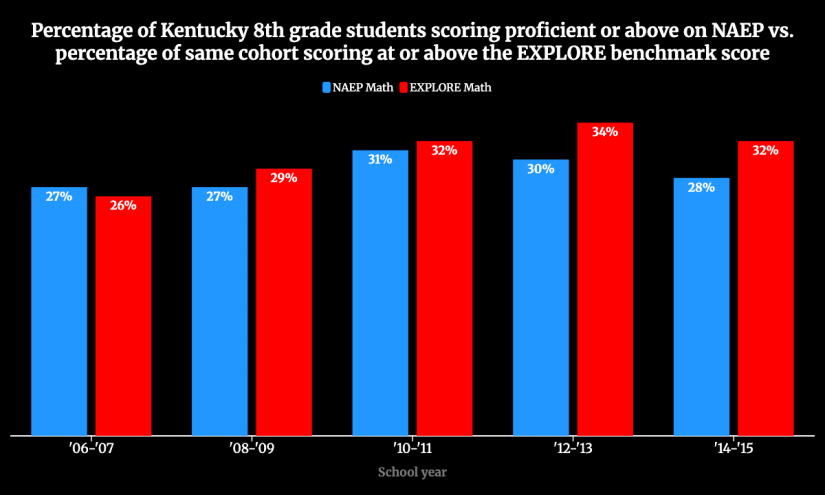
     Analysis found close agreement between the NAEP proficiency rates and the share of the same cohorts of students reaching EXPLORE’s readiness benchmarks. ​

    For example, in Grade 8 reading, EXPLORE benchmark performance and NAEP proficiency rates for the same cohorts of students never varied by more than four percentage points for testing in 2008-09, 2010-11, 2012-13 or 2014-15.

    The same, close agreement was found in the comparison of NAEP grade 8 math proficiency rates to the EXPLORE math benchmark percentages. 

    EXPLORE to NAEP results were also examined separately for white, Black and learning-disabled students. Regardless of the student group, the EXPLORE’s readiness benchmark percentages and NAEP’s proficient or above statistics agreed closely.

    Doing an analysis with Kentucky’s ACT college entrance results test was a bit more challenging because NAEP doesn’t provide state test data for high school grades. However, it is possible to compare each student cohort’s Grade 8 NAEP performance to that cohort’s ACT benchmark score results posted four years later when they graduated from high school. Data for graduating classes in 2017, 2019 and 2021 uniformly show close agreement for overall average scores, as well as for separate student group scores.

    It’s worth noting that all NAEP scores have statistical sampling errors. After those plus and minus errors are considered, the agreements between the NAEP and the EXPLORE and ACT test results look even better.

    The bottom line is: Close agreement between NAEP proficiency rates and ACT benchmark score results for Kentucky suggests that NAEP proficiency levels are highly relevant indicators of critical educational performance. ​Those claiming NAEP’s proficiency standard is set too high are incorrect.

    That leaves us with the realization that overall performance of public school students in Kentucky and nationwide is very concerning. Many students do not have the reading and math skills needed to navigate modern life. Instead of simply rejecting the troubling results of the latest round of NAEP, education leaders need to double down on building key skills among all students.


    Did you use this article in your work?

    We’d love to hear how The 74’s reporting is helping educators, researchers, and policymakers. Tell us how


    Source link

  • University of Kentucky Athlete Arrested After Infant Found Dead in Closet – Amid Kentucky’s Near-Total Abortion Ban

    University of Kentucky Athlete Arrested After Infant Found Dead in Closet – Amid Kentucky’s Near-Total Abortion Ban

    Lexington, KY (September 3, 2025) — A University of Kentucky student and athlete, 21-year-old Laken Ashlee Snelling—a senior member of the UK STUNT cheer team—has been arrested and charged in connection with the death of her newborn, authorities say.

    Allegations and Legal Proceedings

    Lexington police were called to a Park Avenue residence on August 27 after they discovered the unresponsive body of an infant hidden in a closet, wrapped in a towel inside a black trash bag. Snelling admitted to giving birth and attempting to conceal both the infant and evidence of the birth, according to arrest documents.

    Snelling faces three Class D felony charges:

    Each charge carries potential penalties of 1 to 5 years in prison and fines up to $10,000.

    At her first court appearance on September 2, Snelling pleaded not guilty and was released on a $100,000 bond, with the court ordering her to live under house arrest at her parents’ home in Tennessee. Her next hearing is scheduled for September 26.

    A preliminary autopsy by the Fayette County Coroner’s Office revealed that the infant was a boy, but the cause of death remains inconclusive. Officials confirmed that a thorough death investigation is ongoing.

    Context: Kentucky’s Near-Total Abortion Ban

    Kentucky currently enforces one of the nation’s most restrictive abortion laws. Since August 1, 2022, the state’s trigger law has rendered abortion completely illegal, except when necessary to prevent the pregnant individual’s death or permanent impairment of a major, life-sustaining bodily function. No exceptions are made for rape, incest, or fetal abnormalities.

    Attempts to challenge the ban have largely failed. A 2024 lawsuit disputing the near-total prohibition was voluntarily dismissed earlier this year, and the law remains firmly in place. Additionally, a constitutional amendment that would have explicitly declared that Kentucky’s state constitution does not protect abortion rights was rejected by voters in November 2022.

    Public Reaction and Additional Details

    Snelling, originally from White Pine, Tennessee, had built a public persona that included cheerleading and pageant appearances. Months earlier, she had posted on TikTok expressing a desire for motherhood—listing “having babies” among her life goals. Viral maternity-style photos—later removed from her social media—have intensified public scrutiny.

    A Broader National Context

    Snelling’s case arises within a wider national conversation about the legal and societal implications of criminal investigations following pregnancy outcomes. Since the repeal of federal protections for abortion rights, concerns have grown that miscarriages, stillbirths, or even self-managed abortions may now be subject to legal scrutiny—raising fears about reproductive autonomy and medical privacy.


    Sources

    • The Guardian: University of Kentucky athlete charged after dead infant found hidden in closet (Sept. 2, 2025)

    • People: Univ. of Kentucky STUNT Team Member Arrested After Allegedly Hiding Dead Newborn in Her Closet (Sept. 2, 2025)

    • TurnTo10: University of Kentucky athlete pleads not guilty to hiding newborn in closet (Sept. 2, 2025)

    • WWNYTV: College student pleads not guilty after dead infant found in closet (Sept. 3, 2025)

    • The Sun (UK): Laken Snelling cheerleader baby case (Sept. 2, 2025)

    • WKYT: Fayette County coroner releases autopsy results after infant found in closet (Sept. 3, 2025)

    • AP News: Kentucky abortion law lawsuit dismissed (2024)

    • Wikipedia: Abortion in Kentucky (updated 2025); 2022 Kentucky Amendment 2

    • New York Post: Kentucky cheerleader who hid newborn had listed “having babies” as life goal (Sept. 2, 2025)

    • Fox News: Kentucky athlete once posted about wanting babies (Sept. 2, 2025)

    • India Times: Viral maternity photos of Kentucky student after newborn death case (Sept. 2, 2025)

    • Vox: How abortion bans create confusion and surveillance risks (2025)

    Source link

  • Kentucky Libraries Step Up to Keep Kids Out of Foster Care System – The 74

    Kentucky Libraries Step Up to Keep Kids Out of Foster Care System – The 74


    Get stories like this delivered straight to your inbox. Sign up for The 74 Newsletter

    When children are unnecessarily removed from their homes, experts say the separation puts them at risk of chronic mental and physical ailments. 

    With that in mind, four Kentucky libraries are launching programs to keep families together, well resourced and educated, aided with $200,000 in grant money from the national nonprofit Youth Villages

    Libraries in Jackson, Johnson, Marshall and Spencer counties received around $45,000 each for a variety of programs to help parents meet their children’s needs. 

    Britany Binkowski, the executive director of the Youth Village initiative New Allies, said libraries are a “low stigma, high access point of contact for all communities” and make sense for grassroots outreach. 

    “They pretty consistently exist in most counties where they can be reached by lots of families, especially those in rural areas, and they’re (places) people trust to get information, to get access to resources,” she said. “They don’t carry the stigma, for example, of going to a child welfare department and asking for resources in a way that might feel very vulnerable.”  

    Among other things, the libraries are using the grant month to host trainings on growing food in an apartment setting, teaching parents how to deal with challenging behaviors and how to cook basic recipes, and connecting families to other community resources where they can get car seats and other necessities. 

    Libraries are also a more “natural” place to host visitations for parents who are working toward reunification, Binkowski said. 

    It’s “often not the case” that a child is removed from a home because the parents are outright bad, she said. Most of the time, parents lack the resources to properly feed, clothe or otherwise care for their children, she said. In fact, about 70% of all Child Protective Services allegations are related to neglect and poverty, the Lantern previously reported

    “We see substance use disorder and parents who are struggling with that as a significant driver of entries into foster care — not only in Kentucky, but across the country,” Binkowski said. 

    Other preventable issues contribute to removal, she said, like a parent not being able to buy a car seat or access safe child care. 

    “Things like that can cause safety issues that have to be resolved for a child to remain safe and stable,” Binkowski said. 

    ‘Before there’s a problem, let’s fix it.’ 

    Tammy Blackwell, an author and the director of the Marshall County Public Library, said libraries working in this space is just “logical.”

    “Libraries are already reaching families and just doing a lot of good work giving families a place to be and form bonds,” she said. 

    Tammy Blackwell is an author and the director of the Marshall County Public Library. (Photo provided)

    Marshall County’s grant supported a renovation of the Hardin branch to create a more child-friendly space and funded an eight-week program for mothers of young children called Mom’s Night Out. 

    During the Mom’s Night Out program, which will start the first week in September, mothers who are referred by Court Appointed Special Advocates will gather weekly and have a meal together. During the meal, representatives from the Marshall County Extension Office and the health department will lead discussions about stress management, home upkeep and how to cook recipes with staples handed out at food distribution centers like rice and beans. 

    Because this is grant-funded, it’s not affected by recent changes to the Supplemental Nutrition Assistance Program (SNAP) program, Blackwell said. Congress recently passed the Big Beautiful Bill Act, which cut funding for the SNAP Education program, among other things. 

    The Mom’s Night Out discussions will be in a “very non-judgmental way, and not in a lecturing kind of way, but as a conversation and getting those families very comfortable in that space, very comfortable with library staff, comfortable with community partners who they may need to call on at some point,” Blackwell explained. 

    “We’re hoping that they build a bond with each other; other people with similar lived experiences, and to really give them a sense of community and resources in order to help the mothers thrive, so that the children may thrive,” she added. “I love that it’s ‘before there’s a problem, let’s fix it.’” 

    The first round of the program will only include mothers — Blackwell hopes between 12 to 15 — who have children of preschool to early elementary school age. Should it be successful and receive funding for a repeat, she’d like to expand it to fathers as well. 

    “There’s been some coverage of how many kids in Kentucky are in either foster or kinship care situations,” Blackwell said. “It’s a lot of kids, and that really impacts their ability to be successful in life. And anything that we can do to strengthen those families and give those kids, then we need to at least try. And I think libraries are in a perfect position to really make a difference.” 

    The 2024 Kids Count report, from Kentucky Youth Advocates and the Annie E. Casey Foundation, showed there were nearly 46,000 youth in foster care in the state from 2021-2023. In that same time period, the number of children leaving foster care and reunited with their families dropped to 32%. Pre-pandemic, from 2016-2018, it was 36%. 

    Additionally, in 2024 there were around 55,000 Kentucky children being raised with a relative in a kinship care arrangement. 

    The Department for Community Based Services came up with the idea to partner with libraries, Binkowski said. Lesa Dennis, the DCBS commissioner, wasn’t available for an interview but said in a statement that “by meeting families where they are, we’re building pathways to stability, resilience and well-being so no family has to face challenges alone.” 

    Removal is ‘traumatizing’ 

    Binkowski, who previously worked as Assistant General Counsel for the Tennessee Department of Children’s Services, said that “a foster care intervention, even if necessary, is traumatizing to everyone involved.” It can damage bonds between parents and their children and upend daily routine and connections, she said. 

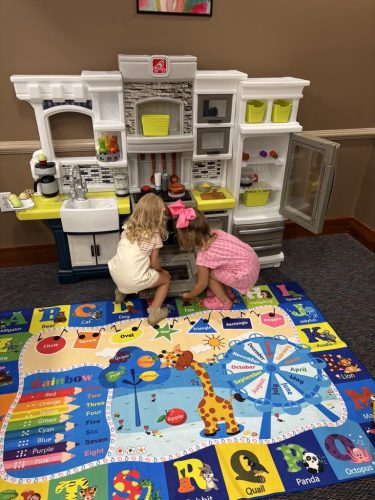
    Children play in the Marshall County library’s Hardin branch. (Photo provided)

    “We have a substantial body of evidence that tells us that children do best when they are with their families of origin — when it can be safe,” she said. “We know that connections to biological family, knowing where you came from, feeling like you belong — those are really critical emotional stabilization and safety factors that support children’s growth and development.” 

    Experiencing brokenness in the home, abuse or neglect are Adverse Childhood Experiences, which refers to traumas or stressors in a person’s life before their 18th birthday. They include, but are not limited to, parental divorce, abuse, parental incarceration, substance use issues in the home and more. The more such experiences a person has, the more likely they are to have poor health, lower education and economic hardships. Childhood trauma also cost Kentucky around $300 million a year

    “Enough stressors on a child at early ages without protective capacities to keep them from having negative outcomes can literally take years off of their lives,” Binkowski said. “So, while we don’t want children to experience abuse and neglect … we also don’t want them unnecessarily being removed from their home if the issues are not creating those kinds of negative impacts and we can stabilize a family without requiring removal.”

    Kentucky Lantern is part of States Newsroom, a nonprofit news network supported by grants and a coalition of donors as a 501c(3) public charity. Kentucky Lantern maintains editorial independence. Contact Editor Jamie Lucke for questions: [email protected].


    Get stories like these delivered straight to your inbox. Sign up for The 74 Newsletter

    Source link