
Category: language

  • The 6-7 Craze Offered A Brief Window Into the Hidden World of Children – The 74

    The 6-7 Craze Offered A Brief Window Into the Hidden World of Children – The 74

    Many adults are breathing a sigh of relief as the 6-7 meme fades away as one of the biggest kid-led global fads of 2025.

    In case you managed to miss it, 6-7 is a slang term – spoken aloud as “six seven” – accompanied by an arm gesture that mimics someone weighing something in their hands.

    It has no real meaning, but it spawned countless videos across various platforms and infiltrated schools and homes across the globe. Shouts of “6-7” disrupted classrooms and rained down at sporting events. Think pieces proliferated.

    For the most part, adults responded with mild annoyance and confusion.

    But as media scholars who study children’s culture, we didn’t view the meme with bewilderment or exasperation. Instead, we thought back to our own childhoods on three different continents – and all the secret languages we spoke.

    There was Pig Latin. The cool “S” doodled on countless worksheets and bathroom stalls. Forming an L-shape with our thumb and index finger to insult someone. Remixing the words of hand-clapping games from previous generations.

    6-7 is only the latest example of these long-standing practices – and though the gesture might not mean much to adults, it says a lot about children’s play, their social lives and their desire for power.

    The irresistible allure of 6-7

    You can see this longing for power in classic play like spying on adults and in games like “king of the hill.”

    A typical school day involves a tight schedule of adult-directed activities; kids have little time or space for agency.

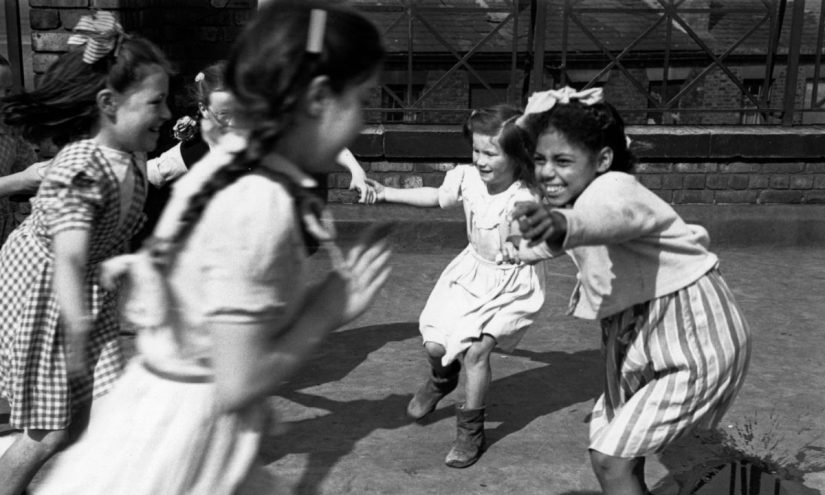
    Kids spend much of their days watched and controlled – and will jump at the chance to turn the tables. (H.Armstrong Roberts/ClassicStock via Getty Images)

    But during those in-between times when children are able to stealthily evade adult surveillance – on playgrounds, on the internet and even when stuck at home during the pandemic – children’s culture can thrive. In these spaces, they can make the rules. They set the terms. And if it confuses adults, all the better.

    As 6-7 went viral, teachers complained that random outbursts by their students were interrupting their lessons. Some started avoiding asking any kind of question that might result in an answer of 67. The trend migrated from schools to sports arenas and restaurants: In-N-Out Burger ended up banning the number 67 from their ticket ordering system.

    The meaninglessness of 6-7 made it easy to create a sense of inclusion and exclusion – and to annoy adults, who strained to decipher hidden meanings. In the U.S., siblings and friends dressed as the numbers 6-7 for Halloween. And in Australia, it was rumored that houses with 6-7 in their address were going for astronomical prices.

    Remixing games and rhymes

    Since before World War I, historians have documented children’s use of secret languages like “back slang,” which happens when words are phonetically spoken backwards. And nonsense words and phrases have long proliferated in children’s culture: Recent examples include “booyah,” “skibidi” and “talk to the hand.”

    6-7 also coincides with a long history of children revising, adapting and remixing games and rhymes.

    For example, in our three countries – the U.S., Australia and South Korea – we’ve encountered endless variations of the game of “tag.” Sometimes the chasers pretend to be the dementors from Harry Potter. Other times the chasers have pretended to be the COVID-19 virus. Or we’ll see them incorporate their immediate surroundings, like designating playground equipment as “home” or “safe.”

    Similar games can spread among children around the world. In South Korea, “Mugunghwa kkochi pieotseumnida” – which roughly translates to “The rose of Sharon has bloomed,” a reference to South Korea’s national flower – is similar to the game “Red Light, Green Light” in English-speaking countries. In the game “Hwang-ma!,” South Korean children in the early aughts shouted the word and playfully struck a peer upon seeing a rare, gold-colored car, a game similar to “Punch Buggy” and “Slug Bug” in the U.S. and Australia.
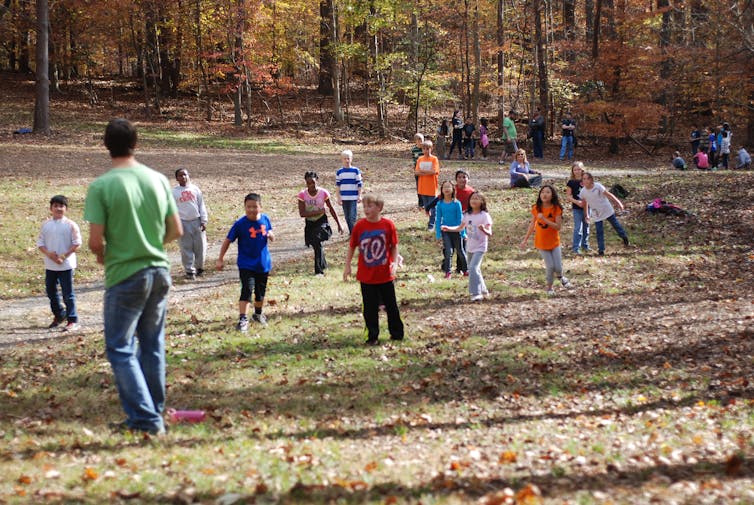
    A group of young children play a game in a field on an autumn day.
    Variations of ‘Red Light, Green Light’ exist around the world.
    Jarek Tuszyński/Wikimedia Commons, CC BY-SA

    Historically, children have reworked rhymes and clapping games to draw on popular culture of the day. “Georgie Best, Superstar,” sung to the tune of “Jesus Christ Superstar,” was a popular chant on U.K. playgrounds in the 1970s that celebrated the legendary soccer player George Best. And a variation of the clapping game “I went to a Chinese Restaurant” included the lyrics “My name is, Elvis Presley, girls are sexy, Sitting on the back seat, drinking Pepsi.”

    Making space for children’s culture

    One reason 6-7 became so popular is the low barrier to entry: Saying “6-7” and doing the accompanying hand movement is easy to pick up and translate into different cultural contexts. The simplicity of the meme allowed young Korean children to repeat the phrase in English. And deaf children have participated by signing the meme.

    Because the social worlds of children now exist across a range of online spaces, 6-7 has been able to seamlessly spread and evolve. On the gaming platform Roblox, for example, children can create avatars that resemble 6-7 and play games that feature the numbers.

    The strange words, nonsensical games and creative play of your childhood might seem ridiculous today. But there’s real value in these hidden worlds.

    With or without access to the internet, children will continue to transform language and games to suit their needs – which, yes, includes getting under the skin of adults.

    A great deal of attention is given to the omnipresence of digital technologies in children’s lives, but we think it’s worth taking a moment to appreciate the way children are using these technologies to innovate and connect in ways both creative and mundane.The Conversation

    Rebekah Willett, Professor in the Information School, University of Wisconsin-Madison; Amanda Levido, Lecturer, Southern Cross University, and Hyeon-Seon Jeong, Professor of Digital Media Education, Gyeongin National University of Education



    Source link

  • The universal language of football

    The universal language of football

    We were split into two teams scrimmaging against each other. The boys I play with are competitive so there was the usual light trash talking, jersey pulling and agile foot skills. 

    We were playing friendly rules with no corner kicks. My teammate, Gugu, was fouled in the makeshift goalie box and dramatically fell to the ground yelling for a penalty kick. 

    None of us expected the coach to listen to him, but surprisingly he gave it to our team on the condition that I take the kick. All the players lined up around the box as I prepared to shoot, choosing to aim for the bottom right corner. 

    Two things you should know: First this is in Italy and I’m an American teenager who speaks little Italian. Second, I’m the only girl on the team.

    The coach blew the whistle. I confidently ran, kicking the ball with all my strength. It went soaring over the crossbar into the fence behind. I wanted to crawl into a hole and hide. 

    A lifelong love of sports

    Sports have been a part of my life for as long as I can remember. As soon as I learned to walk, my parents introduced me to swimming (after all, 71% of earth’s surface is water). They had me learn tennis to hone my hand-eye coordination, ballet to cultivate “grace” and finally soccer to channel my boundless energy. 

    Ballet was the first to go. I was asked to leave for being too much of a distraction (it’s not my fault the class was boring and repetitive). Swimming followed when the early practices and relentless cycle of toxic comparison drained it of joy. Tennis, while never officially abandoned, became more of a casual hobby, a skill I maintained with occasional matches. 

    But soccer? Soccer was different. It endured. Not just for me, but for my siblings as well. My older brother and younger siblings all share a similar love for the sport.

    My football career began at six years old with my recreational team, Purple Thunder, where the post-game refreshments — orange slices and chocolate milk — mattered more than the outcome of the game. 

    Next came Academy, where I was paired with a “special buddy” (one of the older kids) to help me focus and follow directions. By eight, I advanced to the competitive world of travel soccer — a commitment that has defined half of my life. Over the past eight years, I’ve played on various teams, with different coaches, in several leagues and have witnessed the growing intensity of competition as more pressure is placed on each player.

    Soccer bridges divides across borders.

    Soccer has taken me across the country and around the world. I’ve played soccer in Denmark, Sweden and Germany against local girls’ teams in those countries. Soccer is now a cornerstone of my identity.

    When the external factors of my life changed as I grew and I matured, soccer remained the one constant. 

    During the pandemic, I found solace in dribbling by myself in my basement and backyard. When I moved to boarding school, leaving behind my family and home, my high school soccer team became my anchor. 

    Despite all the stress I endured through these changes, my love for the game only deepened as I experienced the unique camaraderie of a team composed of players from all over the world, united by our shared passion for soccer and desire to win. 

    I cried when my favorite coach left for another job, cried again, then confronted a different coach who left me off the roster for games. I cried when a teammate lost her brother. 

    Sports transcends the field.

    Soccer is more than a game. It’s an art, an outlet. And a team is more than just a group of players: it’s a community, a support system that celebrates your successes and lifts you up when you fall. In those eight years, I believed I had encountered every type of soccer environment imaginable — until I arrived in Italy. 

    So I could play here, the extracurricular coordinator at my study abroad school called on Gianni, a host parent who works for the local soccer club, Viterbese. 

    Equal parts nervous and excited, I met Gianni and told him about my soccer experience — travel for eight years, high school varsity for two — and what I’m looking for — consistent, high level practices to keep me in shape. 

    He suggests two teams I could play with, but both are boys’ teams, and I choose one. We decide I will go to the team’s practice on Monday and he even offers me a ride. 

    The second he leaves, my spiraling begins as my brain conjures up all the worst possible scenarios. Monday arrives and I can’t decide whether to be filled with dread or excited to finally play. 

    At the field, the boys are already huddled with the coach. Now I’ll stand out even more. I get my cleats on and join the circle, suffering through an awkward introduction with the coach, then we begin.

    It’s been four months now since that moment, and I’ve gone to every practice I could. I was nervous at first, especially after Gianni stopped coming and I was left to navigate it on my own. But during the drills on the first day, I quickly realized I’d been overthinking it. They weren’t a team of young Messis and Ronaldos, just regular teenage boys. 

    There are many ways to communicate.

    While I’d played against teams that didn’t speak English before, practicing alongside them and becoming part of their team was an entirely new experience. 

    Learning a new language is a year-long journey, and I take it one day at a time. So while I’ve built up a solid repertoire of Italian words and calcio (soccer) vocabulary, I’ve discovered other ways to communicate — through the game itself.

    Words aren’t always necessary to understand my teammates’ personalities. I can learn plenty from how they play. Whether they prefer to dribble or pass, take the shot or let someone else score, arrive early to practice, talk over the coach, yell at teammates or tug on someone’s jersey, these small choices on the field speak volumes about a person’s true character. 

    Playing soccer here has been living proof that actions truly speak louder than words and that sports have a unique ability to connect people. As a 16-year-old girl from Northern Virginia, I’ve formed a connection with 15-year-old Italian boys from a small city north of Rome. 

    It’s also a reminder that no matter how experienced or “well-versed” you think you are in a passion, there are always more opportunities to grow — if you’re willing to take the leap. I’ve embarrassed myself countless times, as I did trying to make that penalty shot after Gugu was fouled. I’ve lost the ball, missed shots, stumbled over Italian. I once even forgot my cleats. 

    But despite the awkward moments, I wouldn’t trade this experience for anything.


    Three questions to consider:

    1. How did the author manage to communicate with her teammates without knowing the language they spoke?
    2. What does the author mean by soccer being more than a sport?
    3. What sport or hobby are you passionate about and are there people who share that passion?


    Source link