Category: lausd

  • Top Los Angeles Teacher Encourages Kids To Make a Mess in Her Class – The 74

    Top Los Angeles Teacher Encourages Kids To Make a Mess in Her Class – The 74


    Get stories like this delivered straight to your inbox. Sign up for The 74 Newsletter

    By the time the morning bell rings at Rosewood STEM Magnet, Urban Planning and Urban Design, Monika Heidi Duque has already been in her classroom for hours — reviewing lesson plans, setting out materials, and greeting students by name.  

    Duque, who has taught at the award-winning, urban planning-themed LAUSD elementary school in West Hollywood for 18 years, was one of four teachers named as finalists by the state education department for the 2026 California Teachers of the Year in October. She was the only LAUSD teacher to receive the honor.

    Duque works hard to create a free-flowing vibe in her first-grade classroom to promote the creativity of her students, describing the scene as the “best kind” of messy.  

    “It’s a place where my students are able to wonder, to be curious, to take risks, to be able to make things with their hands and minds,” said Duque, who has been a teacher in Los Angeles Unified since 2000. 

    “It’s a place where you can tell learning is happening,” she said of her classroom. 

    The veteran teacher’s freewheeling approach is apparent in her classroom but there’s a method to the mayhem. Everything her students do is somehow tied back to the school’s theme of urban planning and urban design, topics Duque admits could be heady for her 6-year-old students, were it not for her approach to the subjects, which links them to kids’ everyday lives. 

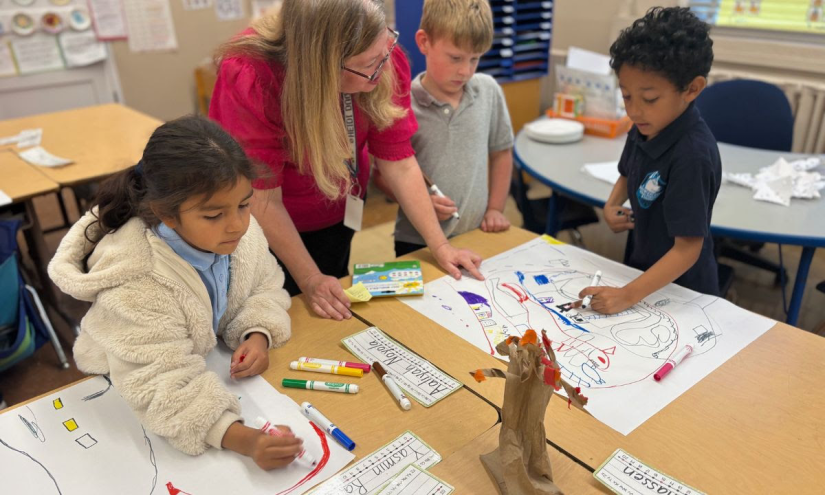
    On a recent school day, students in Duque’s class were drawing pictures of designs for a new community space in Griffith Park after she noticed a news report about the city’s struggle to repurpose the area formerly used for pony rides.   

    Students drew pictures of their ideas for the space, coloring construction paper using markers and drawing their visions for forests and lazy rivers that could be installed in L.A.’s historic park.  

    In subsequent parts of the project, Duque said, students will create three-dimensional models of their ideas for the part using recycled materials such as cardboard and paper.  

    “We’re making an arcade that’s called Fun Time, and then we put a petting zoo next to it called Pig Pig,” said Ben, a student in Duque’s class, who was working on a drawing with a few classmates. “I wonder if it will really happen.”

    Duque often pulls ideas for lessons from real-life events in L.A., finding the sprawling and diverse city offers no shortage of inspiration for classroom activities tied to urban planning. 

    “I just keep my eyes and ears to the news, and I just see what’s happening in our community, and I just get ideas from there,” she said. 

    A favorite lesson from a few years ago was based on an experience the teacher had while walking her dog in Griffith Park, when a coyote approached the two and nearly attacked Duque’s pet. 

    Feral coyotes are common in L.A. and such experiences aren’t unusual, but this event inspired Duque to create a lesson for students to create outfits for pets to repel predatory coyote attacks.

    Students created costumes for pets that featured things known to deter coyotes, such as flashing lights. One student liked the project so much she created a picture book about the lesson with her parents, a copy of which Duque keeps displayed on the wall in her class. 

    “It’s another example of how I really look at what’s in our city, what’s in the news, and what’s relevant to kids and our lives,” the teacher said. 

    Duque’s relentless curiosity and enthusiasm make her a natural leader among her colleagues at Rosewood, said the school’s principal, Linda Crowder.

    “She is a lifelong learner,” Crowder said. “She gets something and she runs with it.”


    Did you use this article in your work?

    We’d love to hear how The 74’s reporting is helping educators, researchers, and policymakers. Tell us how

    Source link

  • Layoffs, Cuts and Closures Are Coming to LAUSD Schools As District Confronts Budget Shortfalls – The 74

    Layoffs, Cuts and Closures Are Coming to LAUSD Schools As District Confronts Budget Shortfalls – The 74


    Get stories like this delivered straight to your inbox. Sign up for The 74 Newsletter

    Budget cuts, staffing reductions and school consolidations are coming to Los Angeles Unified as the cash-strapped district works to balance its shrinking budget, a top school official said. 

    LAUSD’s chief financial officer in an interview last week said declining enrollments and the end of pandemic relief funds have forced the district to take cost-cutting measures.  

    Schools have already been notified of how much they will have to cut from their budgets. The cuts will go into effect starting in August. 

    LAUSD officials in June had predicted a $1.6 billion deficit for the 2027-28 school year. But an updated version of the budget approved by the board last week eliminates the deficit by using reserve funds plus cost-cutting measures over the next two years. 

    The planned cuts to school budgets will begin in the 2026-27 school year, with school consolidations and staffing reductions planned for the following school year, said LAUSD Chief Financial Officer Saman Bravo-Karimi. 

    “We have fewer students each year, and in LAUSD that’s been the case for over two decades,” Bravo-Karimi said. “That has a profound impact on our funding levels. Also, we had the expiration of those one-time COVID relief funds that were very substantial.”  

    The district recently contracted with the consulting firm Ernst and Young to create models for closing and consolidating schools. While school officials wouldn’t say which schools or how many would be closed, the district has clearly been shrinking. 

    Enrollment last year fell to 408,083, from a peak of 746,831 in 2002. Nearly half of the district’s zoned elementary schools are half-full or less, and 56 have seen rosters fall by 70% or more. 

    Bravo-Karimi said in the current school year the district will spend about $2 billion more than it took in from state, local and federal funding. The trend of overspending is expected to continue next year and the year after that, he said.

    The district’s board in June approved a three-year budget plan that included a $18.8-billion budget for the current school year. The plan delayed layoffs until next year, and funded higher spending in part by reducing a fund for retirees’ health benefits. 

    According to the plan approved this month, the district will save:  

    • $425 million by clawing back funds that went unused by schools each year 
    • $300 million by reducing staffing and budgets at central offices 
    • $299 million by cutting special funding for schools with high-needs students
    • $120 million by cutting unfilled school staffing positions
    • $30 million by consolidating schools  
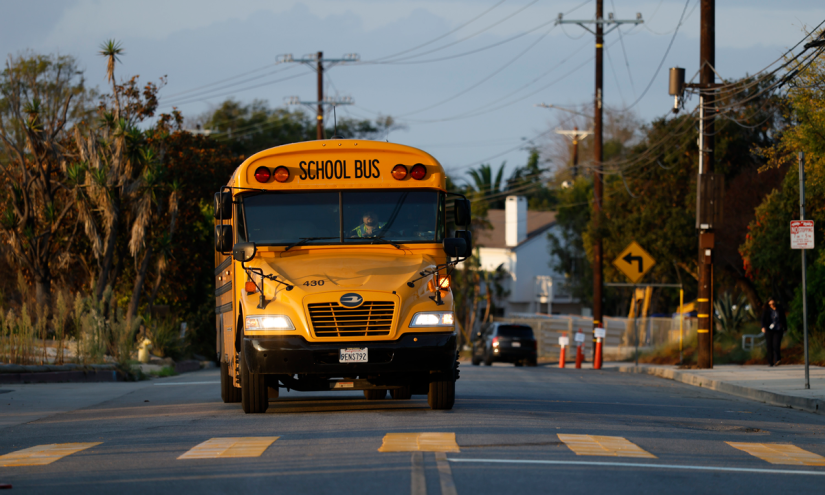
    • $16 million by cutting student transportation 

    Bravo-Karimi said the district gets virtually all of its money through per-pupil funding from the state. Since enrollment in the district has fallen steadily for decades, and then sharply since the pandemic, funding is down significantly, he said.

    Most zoned L.A. elementary schools are almost half empty, and many are operating at less than 25% capacity. Thirty-four schools have fewer than 200 students enrolled; a dozen of those schools once had enrollment over 400.     

    The drops have prompted LAUSD leaders to talk about closing or combining schools, a controversial step that other big U.S. cities are already doing or considering. 

    Bravo-Karimi said the district would assess the needs of communities and the conditions at local schools before it makes any decisions about school closings or consolidations. 

    “That process needs to play out before any decisions are made about potential consolidation of school facilities,” he said.

    Bravo-Karimi said other factors, including ongoing negotiations with labor unions, and changes to state funding, will further impact the district’s budget in the coming months. 

    Marguerite Roza, director of the Edunomics Lab and Research Professor at Georgetown University’s McCourt School of Public Policy, said the cuts planned for LAUSD are “relatively mild” compared to overall size of the district’s budget and cuts being considered at other districts around California and the rest of the country. 

    “I don’t think the people in the schools are going to notice that there’s a shrinking of the central office or that they’re using reserves,” said Roza. “Unless you’re one of the people who loses their transportation or if you’re in one of the schools that gets closed.” 

    But, Roza said, many of the cuts taken by LAUSD can only be made once, and the district still faces profound changes as enrollments continue to fall and downsizing becomes more and more necessary. 

    “This really should be a signal to families,” said Roza of the planned cuts in the district’s latest budget. “After several years of really being flush with cash, this is not the financial position that LA Unified is going to be in moving forward.” 

    LAUSD Board Member Tanya Ortiz-Franklin, who represents LAUSD’s District Seven, which includes neighborhoods such as South L.A., Watts and San Pedro, said the district will work to shield kids from the impact of budget cuts. 

    But, Ortiz-Franklin said, the district hired permanent staffers with one-time COVID funding, and now some of those staffers will have to be let go. 

    Still, LA Unified has made strong gains since the pandemic, she said, and the district must work hard to preserve its upward trajectory despite financial headwinds. 

    “We would love to share good news, especially this time of year,” said Ortiz-Franklin. “But the reality is, it is really tough.” 

    School leaders across LAUSD received preliminary budgets for the next year over the last few weeks, said Ortiz-Franklin. Some schools in her district are facing cuts of up to 15%, forcing them to make tough decisions on which staffers to keep and who to let go. 

    Several hundred additional layoffs will be announced in February, she said, when the district makes another assessment of staffing needs. 

    “We don’t know the total number yet, and we don’t know which positions yet,” said Ortiz-Franklin.


    Did you use this article in your work?

    We’d love to hear how The 74’s reporting is helping educators, researchers, and policymakers. Tell us how

    Source link

  • Parents Sued LAUSD Over Remote Learning. How the Settlement Will Benefit Students – The 74

    Parents Sued LAUSD Over Remote Learning. How the Settlement Will Benefit Students – The 74


    Get stories like this delivered straight to your inbox. Sign up for The 74 Newsletter

    This story was originally published by CalMatters. Sign up for their newsletters.

    More than 250,000 students in Los Angeles Unified will be eligible for extra tutoring, summer school and other academic help after the district settled a class-action lawsuit alleging that its remote learning practices during the pandemic were discriminatory.

    The settlement, filed in Los Angeles County Superior Court, was announced Wednesday by the law firm representing families who said their children fell disastrously behind during the Covid-related school shutdown in 2020-21.

    “After five years of tireless advocacy on behalf of LAUSD students and families, we are proud to have secured a historic settlement that ensures students receive the resources they need to thrive,” said Edward Hillenbrand, a partner at the law firm Kirkland & Ellis. “This critical support will help pave the way for lasting educational equity.”

    Los Angeles Unified had no comment on the case because the settlement has yet to be approved by the court. A hearing is set for December, although the settlement goes into effect immediately.

    During the COVID-19 pandemic, Los Angeles and nearly every other school district in California closed for in-person learning from March 2020 through fall 2021. Students attended classes virtually, and most fell behind academically. Test scores statewide plummeted after schools reopened. Chronic absenteeism soared.

    In fall 2020, a group of families whose children were languishing during remote learning sued Los Angeles Unified, saying the district wasn’t doing enough to ensure students were receiving an adequate education.

    One parent, Akela Wroten Jr., said that his second-grade daughter was behind before the pandemic and became even more lost during remote learning. She struggled with reading and never got the extra attention she needed because teachers weren’t assessing her progress.

    Another parent, Vicenta Martinez, said her daughter didn’t get any instruction in spring 2020, in part because she never received logon information for remote instruction and the school never followed up. When she finally did access remote classes, the lessons were short and teachers offered little feedback.

    “LAUSD’s remote learning plan fails to provide students with even a basic education and is not preparing them to succeed,” the lawsuit alleged.

    The suit singled out an agreement between the district and its teachers union that said teachers would only be required to work four hours a day, wouldn’t have to give tests and weren’t required to deliver live lessons — their lessons could be asynchronous, or recorded beforehand. In addition, the agreement said the district wouldn’t evaluate or monitor teachers during that time.

    United Teachers Los Angeles supports the settlement, saying it provides more assistance for students while leaving teachers’ “hard-won contractual rights” intact and avoiding “unwarranted judicial interference” in the district.

    The union also noted that student test scores have recovered significantly since the pandemic..

    The plaintiffs argued that the district’s policies discriminated against low-income, Black, Latino, disabled and English learner students, because those were the students least likely to have adequate support to succeed in remote learning. Those student groups also comprise the vast majority of students in the district, the nation’s second-largest.

    The settlement requires the district to offer a host of academic support, including summer school and after-school tutoring, to the 250,000 students who were enrolled in L.A. Unified during the pandemic and are still with the district. Among those students, 100,000 who are performing below grade level will be eligible for 45 hours of one-on-one tutoring every year through 2028.

    This article was originally published on CalMatters and was republished under the Creative Commons Attribution-NonCommercial-NoDerivatives license.


    Get stories like these delivered straight to your inbox. Sign up for The 74 Newsletter

    Source link

  • LA Wildfires Reduce Classrooms to Ashes, Uproot Students’ Lives – The 74

    LA Wildfires Reduce Classrooms to Ashes, Uproot Students’ Lives – The 74

    Republish This Article

    We want our stories to be shared as widely as possible — for free.

    Please view The 74’s republishing terms.


    Source link

  • LA Schools Reopen, But Recovery Will Be Long and Painful – The 74

    LA Schools Reopen, But Recovery Will Be Long and Painful – The 74


    Get stories like this delivered straight to your inbox. Sign up for The 74 Newsletter

    It was just after 1 am when Los Angeles charter school superintendent Ian Mcfeat started getting text messages and phone calls at a relative’s house where he was sheltering from the fires. 

    His neighbors said his house was burning down in the wildfires – along with his entire Altadena neighborhood of Los Angeles.

    Aveson School of Leaders, which McFeat runs and where his kids attended school just three blocks from his house, was also burning.

    Unable to sleep, Mcfeat drove away from his in-law’s house that he’d been evacuated to and made the drive back to Altadena.

    He drove through the fire lines and into his neighborhood to see if he could salvage anything, save anyone, or put out the fires that had raged on the east side for more than 48 hours straight, and decimated the Palisades in the west. 

    He was greeted with a scene out of a horror movie. Fueled by a violent windstorm and piles of brush left from a particularly wet winter last year, the firestorm was like a tornado shooting flames, blasting through his neighborhood.

    “It was like driving through a bomb scene,” said Mcfeat. “There were homes exploding. I probably shouldn’t have been there.” 

    Despite the devastating losses, Mcfeat can’t imagine not rebuilding his home and school right where they were in Altadena. But the road to recovery will be a long and painful one.

    “No doubt about it. We are going to rebuild,” said Mcfeat. Aveson has started a GoFundMe. At this point, a new site for the school has not been identified. The district hasn’t been able to help them yet.

    “I don’t know what we’re going to do,” said Mcfeat.

    The wildfires that burned Los Angeles this month are the costliest and most destructive in the city’s history, displacing more than 150,000 residents and killing at least 25 people. Two massive blazes fed by windstorms, the Palisades Fire and the Eaton Fire, simultaneously scorched the city from the sea to the mountains, filling the air with vast plumes of ash and smoke.

    As the wind and flames began to retreat last week, and firefighters gained control of the fires, schools began to reopen. And the kids began to return to class.

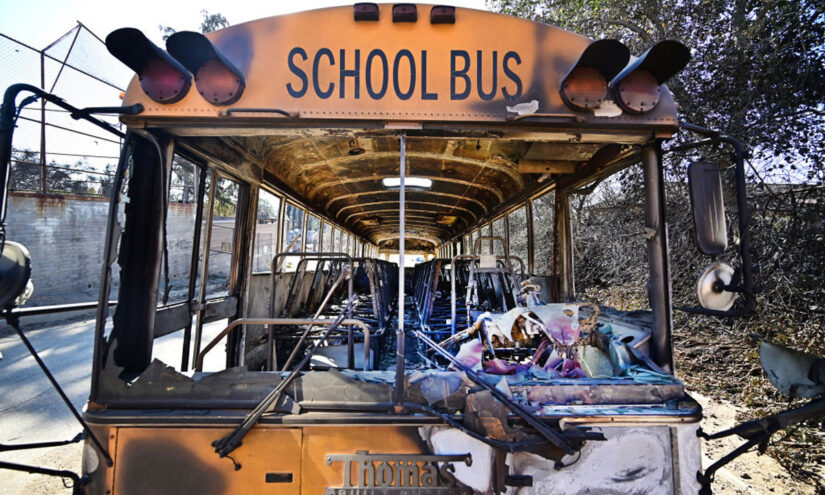
    The Los Angeles Unified School District, which is by far the largest district of about 80 in Los Angeles County, resumed instruction Monday after being totally closed since last Thursday. Seven schools remain shut because they’re located in evacuation zones. Another three won’t reopen because their buildings were badly burned or destroyed in the fires.  

    Dozens of much smaller districts in Los Angeles County also reopened this week, with the exceptions of two districts, Pasadena Unified, which encompasses Altadena, and La Cañada Unified, which neighbors Altadena to the west. 

    The Eaton fire has destroyed at least five schools but was mostly contained by Friday. 

    Kids from two of the LAUSD schools that burned in the Palisades, Marquez Charter Elementary School and Palisades Charter Elementary School, were placed, with intact school rosters, in close-ish LAUSD school buildings that already had other schools in them.

    The students who attended the burned schools were given their own entrances, classrooms and courtyards for kids to play. When parents dropped them off at class this week, there were a lot of tearful reunions.

    Families from Palisades Charter were somber, but excited to return to normalcy with their new space located inside of Brentwood Science Magnet School.  

    Joseph Koshki, a parent from the Palisades whose son attends third grade at Palisades Charter, walked holding hands with his son to their new classroom at Brentwood Science, which had been stacked with balloons.

    “When he saw his school burned on the news he was crying for days,” Koshki said of his child. “But when he heard that he was going to his new school with his old friends, he was so happy”.

    Nina Belden, a parent of a Palisades Charter student who had made an emergency evacuation from her house in the Palisades with her family, said it was important for the students at her daughter’s school to stay together and receive in-person instruction.

    “We were worried they were going to do something like remote learning,” said Beldon.

    Marquez Charter, which also burned in the Palisades fire, has a long history in the community, having opened in 1955 when the Palisades still had a frontier feel, before the neighborhood became a favorite of Hollywood stars and media execs.

    For Victoria Flores, who works as a paraeducator at Marquez, the school is part of her family. Flores went to Marquez when she was in elementary school, and her mother works in the cafeteria.

    “It was my home away from home. We are devastated by what happened,” Flores said.

    But Flores said she and the rest of the staff were glad to be relocated together at a LAUSD school called Nora Sterry, about ten miles from the burned Marquez campus.

    “We are a really close family,” said Flores. “That’s helped us a lot.”

    Upstairs at Nora Sterry, Clare Gardner’s class had about eight of twenty students show up on the first day of relocation.

    Her third-grade class was playing with clay and Mrs. Gardner, who is a twenty-seven-year veteran of Marquez, held back her tears as she helped students arrive into class.

    “We always call it the Marquez family,” Gardner said as the children greeted each other.

    One boy in Mrs. Gardner’s class said he was happy to be around his friends and teacher but sad about his classroom fish and books, which were lost in the fire.

    Later in the morning, LAUSD Superintendent Alberto Carvalho went to visit parents at Nora Sterry.

    After nearly a week off school, Carvalho says attendance is still below normal.

    “I think where that attendance is lacking is in schools that were directly affected” by the fires, Carvalho said.

    Also hurting attendance, Carvalho said, is the fact that many families are enduring temporary relocations, while others lack stable housing entirely.

    LAUSD staff attendance is back to normal, he said, while student attendance is about 88% — down from an average of about 90%, representing about 10,000 fewer students than normal.

     “As conditions of the families begin to normalize and stabilize, those [attendance] numbers will rise,” said Carvalho.

    For other schools in other areas of Los Angeles, recovery may be longer in the making. 

    Bonnie Brinecomb, principal of Odyssey Charter School – South in Altadena, which burned to the ground in the Eaton Fire, estimates that the homes of 40% of the students enrolled in the school also burned.

    Families and school staffers are scrambling to ensure displaced families have food, shelter and clothing, Brinecomb said. Some students are turning up for daycare at a nearby Boys and Girls Club that offered to take them in.  

    Brinecomb said Odyssey has partnered with McFeat’s school Aveson to search for new facilities. But the double loss of students’ homes and the schools’ campuses is a gutpunch.  

    “It’s just heartbreak. Pure shock,” she said. “You don’t even process how bad of a situation just happened.”

    Like Aveson, Odyssey has launched an online fundraiser and Brinecomb says the school will rebuild. How long that will take, though, remains an open question.  

    From the perspective of displaced children and families, the faster things return to normal, the better, said Dr. Frank Manis, professor emeritus of psychology at the University of Southern California. 

    The experience of trauma can intensify if routines are disrupted for longer periods, and the intensity of the disruption matters as well, said Manis. Kids who lost their homes to fires may have a harder time bouncing back than those who only lost their schools, he said.    

    “It’s sort of on that spectrum of wartime PTSD, but not as bad,” said Manis. “So what it could lead to is nightmares, difficulty sleeping, and emotional or behavior problems that can last for quite a while.”

    Children fighting post-traumatic stress from the fires may become withdrawn, or act out in class, said Manis. But mostly, he said, the research from past natural disasters shows that even children badly impacted by the fires may begin to feel normal within a few months. 

    “Kids are pretty resilient,” said Manis. “But trauma can disappear for a while, and then it can resurface later. When everyone’s forgotten how bad it was, it can resurface.” 


    Get stories like these delivered straight to your inbox. Sign up for The 74 Newsletter

    Source link