Category: layoffs

  • Layoffs, Cuts and Closures Are Coming to LAUSD Schools As District Confronts Budget Shortfalls – The 74

    Layoffs, Cuts and Closures Are Coming to LAUSD Schools As District Confronts Budget Shortfalls – The 74


    Get stories like this delivered straight to your inbox. Sign up for The 74 Newsletter

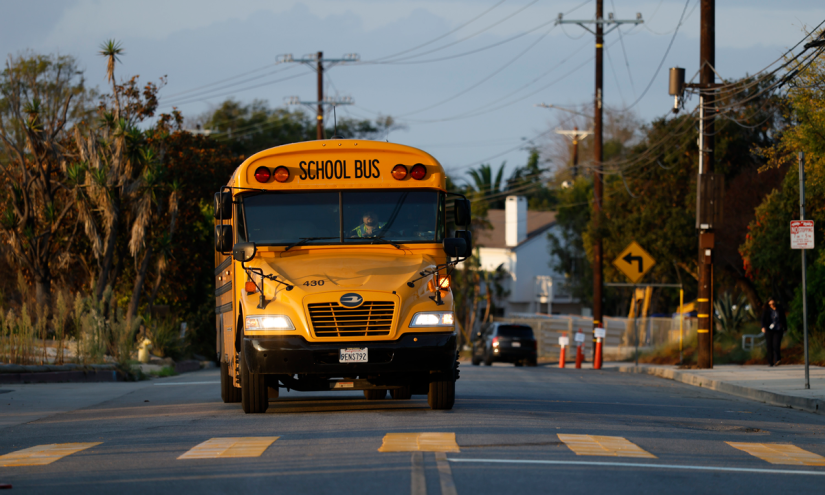
    Budget cuts, staffing reductions and school consolidations are coming to Los Angeles Unified as the cash-strapped district works to balance its shrinking budget, a top school official said. 

    LAUSD’s chief financial officer in an interview last week said declining enrollments and the end of pandemic relief funds have forced the district to take cost-cutting measures.  

    Schools have already been notified of how much they will have to cut from their budgets. The cuts will go into effect starting in August. 

    LAUSD officials in June had predicted a $1.6 billion deficit for the 2027-28 school year. But an updated version of the budget approved by the board last week eliminates the deficit by using reserve funds plus cost-cutting measures over the next two years. 

    The planned cuts to school budgets will begin in the 2026-27 school year, with school consolidations and staffing reductions planned for the following school year, said LAUSD Chief Financial Officer Saman Bravo-Karimi. 

    “We have fewer students each year, and in LAUSD that’s been the case for over two decades,” Bravo-Karimi said. “That has a profound impact on our funding levels. Also, we had the expiration of those one-time COVID relief funds that were very substantial.”  

    The district recently contracted with the consulting firm Ernst and Young to create models for closing and consolidating schools. While school officials wouldn’t say which schools or how many would be closed, the district has clearly been shrinking. 

    Enrollment last year fell to 408,083, from a peak of 746,831 in 2002. Nearly half of the district’s zoned elementary schools are half-full or less, and 56 have seen rosters fall by 70% or more. 

    Bravo-Karimi said in the current school year the district will spend about $2 billion more than it took in from state, local and federal funding. The trend of overspending is expected to continue next year and the year after that, he said.

    The district’s board in June approved a three-year budget plan that included a $18.8-billion budget for the current school year. The plan delayed layoffs until next year, and funded higher spending in part by reducing a fund for retirees’ health benefits. 

    According to the plan approved this month, the district will save:  

    • $425 million by clawing back funds that went unused by schools each year 
    • $300 million by reducing staffing and budgets at central offices 
    • $299 million by cutting special funding for schools with high-needs students
    • $120 million by cutting unfilled school staffing positions
    • $30 million by consolidating schools  
    • $16 million by cutting student transportation 

    Bravo-Karimi said the district gets virtually all of its money through per-pupil funding from the state. Since enrollment in the district has fallen steadily for decades, and then sharply since the pandemic, funding is down significantly, he said.

    Most zoned L.A. elementary schools are almost half empty, and many are operating at less than 25% capacity. Thirty-four schools have fewer than 200 students enrolled; a dozen of those schools once had enrollment over 400.     

    The drops have prompted LAUSD leaders to talk about closing or combining schools, a controversial step that other big U.S. cities are already doing or considering. 

    Bravo-Karimi said the district would assess the needs of communities and the conditions at local schools before it makes any decisions about school closings or consolidations. 

    “That process needs to play out before any decisions are made about potential consolidation of school facilities,” he said.

    Bravo-Karimi said other factors, including ongoing negotiations with labor unions, and changes to state funding, will further impact the district’s budget in the coming months. 

    Marguerite Roza, director of the Edunomics Lab and Research Professor at Georgetown University’s McCourt School of Public Policy, said the cuts planned for LAUSD are “relatively mild” compared to overall size of the district’s budget and cuts being considered at other districts around California and the rest of the country. 

    “I don’t think the people in the schools are going to notice that there’s a shrinking of the central office or that they’re using reserves,” said Roza. “Unless you’re one of the people who loses their transportation or if you’re in one of the schools that gets closed.” 

    But, Roza said, many of the cuts taken by LAUSD can only be made once, and the district still faces profound changes as enrollments continue to fall and downsizing becomes more and more necessary. 

    “This really should be a signal to families,” said Roza of the planned cuts in the district’s latest budget. “After several years of really being flush with cash, this is not the financial position that LA Unified is going to be in moving forward.” 

    LAUSD Board Member Tanya Ortiz-Franklin, who represents LAUSD’s District Seven, which includes neighborhoods such as South L.A., Watts and San Pedro, said the district will work to shield kids from the impact of budget cuts. 

    But, Ortiz-Franklin said, the district hired permanent staffers with one-time COVID funding, and now some of those staffers will have to be let go. 

    Still, LA Unified has made strong gains since the pandemic, she said, and the district must work hard to preserve its upward trajectory despite financial headwinds. 

    “We would love to share good news, especially this time of year,” said Ortiz-Franklin. “But the reality is, it is really tough.” 

    School leaders across LAUSD received preliminary budgets for the next year over the last few weeks, said Ortiz-Franklin. Some schools in her district are facing cuts of up to 15%, forcing them to make tough decisions on which staffers to keep and who to let go. 

    Several hundred additional layoffs will be announced in February, she said, when the district makes another assessment of staffing needs. 

    “We don’t know the total number yet, and we don’t know which positions yet,” said Ortiz-Franklin.


    Did you use this article in your work?

    We’d love to hear how The 74’s reporting is helping educators, researchers, and policymakers. Tell us how

    Source link

  • Trump Education Department Delays Return of Laid-Off Workers Over Logistics – The 74

    Trump Education Department Delays Return of Laid-Off Workers Over Logistics – The 74


    Get stories like this delivered straight to your inbox. Sign up for The 74 Newsletter

    Parking permits. Desk space. Access cards.

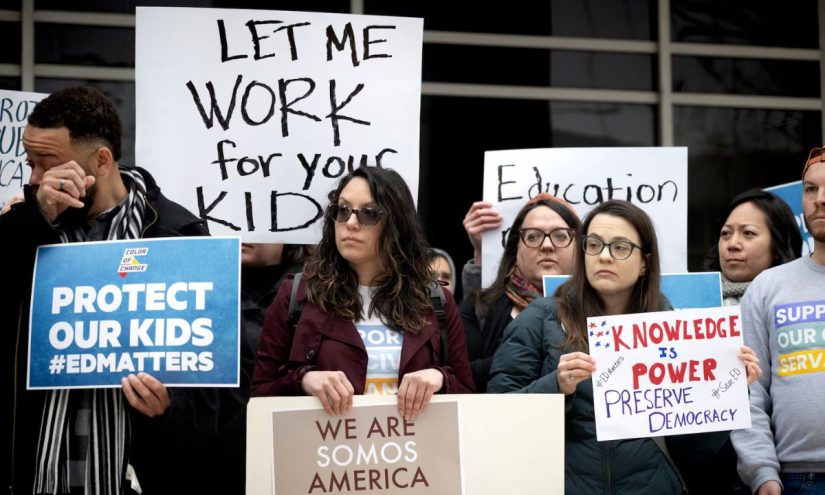
    Ordered to bring back roughly 1,300 laid-off workers, the U.S. Department of Education instead has spent weeks ostensibly working on the logistics. Meanwhile, the Trump administration wants the U.S. Supreme Court to decide they don’t have to restore those jobs after all.

    The legal argument over the job status of Education Department workers is testing the extent to which President Donald Trump and Education Secretary Linda McMahon can reshape the federal bureaucracy without congressional approval.

    The employees, meanwhile, remain in limbo, getting paid for jobs they aren’t allowed to perform.

    An analysis done by the union representing Education Department employees estimates the government is spending about $7 million a month for workers not to work. That figure does not include supervisors who are not part of the American Federation of Government Employee Local 252.

    “It is terribly inefficient,” said Brittany Coleman, chief steward for AFGE Local 252 and an attorney in the Office for Civil Rights. “The American people are not getting what they need because we can’t do our jobs.”

    McMahon announced the layoffs in March, a week after she was confirmed by the Senate, and described them as a first step toward dismantling the Education Department. A few days later, Trump signed an executive order directing McMahon to do everything in her legal authority to shut down the department.

    The Somerville and Easthampton school districts in Massachusetts, along with the American Federation of Teachers, other education groups, and 21 Democratic attorneys general sued McMahon over the cuts. They argued the layoffs were so extensive that the Education Department would not be able to perform its duties under the law.

    The layoffs hit the Office for Civil Rights, Federal Student Aid, and the Institute of Education Sciences particularly hard. These agencies are responsible for federally mandated work within the Education Department. By law, only Congress can get rid of the Education Department.

    U.S. District Court Judge Myong Joun agreed, issuing a sweeping preliminary injunction in May that ordered the Education Department to bring laid off employees back to work and blocked any further effort to dismantle or substantively restructure the department.

    The Trump administration sought a stay of that order, and the case is on the emergency docket of the Supreme Court, where a decision could come any day.

    In the administration’s request to the Supreme Court, Solicitor General John Sauer argued that the harms the various plaintiffs had described were largely hypothetical, that they had not shown the department wasn’t fulfilling its duties, and that they didn’t have standing to sue because layoffs primarily affect department employees, not states, school districts, and education organizations.

    Sauer further argued that the injunction violates the separation of powers, putting the judicial branch in charge of employment decisions that are the purview of the executive branch.

    “The injunction rests on the untenable assumption that every terminated employee is necessary to perform the Department of Education’s statutory functions,” Sauer wrote in a court filing. “That injunction effectively appoints the district court to a Cabinet role and bars the Executive Branch from terminating anyone.”

    The Supreme Court, with a conservative 6-3 majority, has been friendlier to the administration’s arguments than lower court judges. Already the court has allowed cuts to teacher training grants to go through while a lawsuit works its way through the courts. And it has halted the reinstatement of fired probationary workers.

    The Education Department did not immediately respond to a request for comment.

    Last week, Joun issued a separate order telling the Education Department that it must reinstate employees in the Office for Civil Rights. The Victims Rights Law Center and other groups had described thousands of cases left in limbo, with children suffering severe bullying or unable to safely return to school.

    Meanwhile, the Education Department continues to file weekly updates with Joun about the complexities of reinstating the laid-off employees. In these court filings, Chief of Staff Rachel Oglesby said an “ad hoc committee of senior leadership” is meeting weekly to figure out where employees might park and where they should report to work.

    Since the layoffs, the department has closed regional offices, consolidated offices in three Washington, D.C. buildings into one, reduced its contracts for parking space, and discontinued an interoffice shuttle.

    In the most recent filing, Oglesby said the department is working on a “reintegration plan.”

    Coleman said she finds these updates “laughable.”

    “If you are really willing to do what the court is telling you to do, then your working group would have figured out a way to get us our laptops,” she said.

    This story was originally published by Chalkbeat. Chalkbeat is a nonprofit news site covering educational change in public schools. Sign up for their newsletters at ckbe.at/newsletters.


    Get stories like these delivered straight to your inbox. Sign up for The 74 Newsletter

    Source link

  • Layoffs at Southern New Hampshire University

    Layoffs at Southern New Hampshire University

    Southern New Hampshire University (SNHU), long hailed as a leader in online education and a symbol of institutional reinvention, laid off approximately 60 employees on June 27, 2025. The move came without warning to staff, according to an anonymous source close to the situation.

    Employees reportedly received a generic email from Lisa Marsh Ryerson, SNHU’s newly installed president, delivering the news of their termination. There was no video call, no face-to-face meeting, and no meaningful explanation beyond the cold language of corporate HR.

    “There was no sincerity,” the source said. “No real communication. Just a robotic email. No opportunity for questions, no acknowledgment of people’s service.”

    The layoffs have sent shockwaves through the university’s workforce—many of whom had believed that SNHU’s image as a student-centered and employee-friendly institution translated into job security. That assumption, it appears, was misplaced.

    SNHU, which once garnered praise from the Obama administration for its innovative online learning model, has undergone significant changes in recent years. Under the leadership of former president Paul LeBlanc, the university expanded its online programs rapidly and became one of the largest nonprofit providers of online degrees in the United States. But as the market for online education becomes increasingly competitive and enrollment pressures mount across the country, even big players like SNHU appear to be tightening their belts.

    What’s striking about this latest round of cuts is not just the numbers—but the tone. At a university that prides itself on personalization and student engagement, employees describe the layoff process as abrupt, impersonal, and dehumanizing.

    “They preach empathy to students,” the source noted. “But when it came to their own staff, there was none.”

    It’s unclear which departments or roles were affected. SNHU has yet to issue a public statement, and no mention of the layoffs could be found on the university’s website or social media accounts at the time of publication.

    The layoffs at SNHU follow broader trends in the higher education sector, where institutions—both public and private—are increasingly resorting to staff reductions amid enrollment declines, demographic shifts, and uncertain funding landscapes. But even in this context, the lack of transparency and empathy stands out.

    The Higher Education Inquirer will continue to monitor developments at Southern New Hampshire University and invites current and former employees to share their experiences confidentially.

    Source link

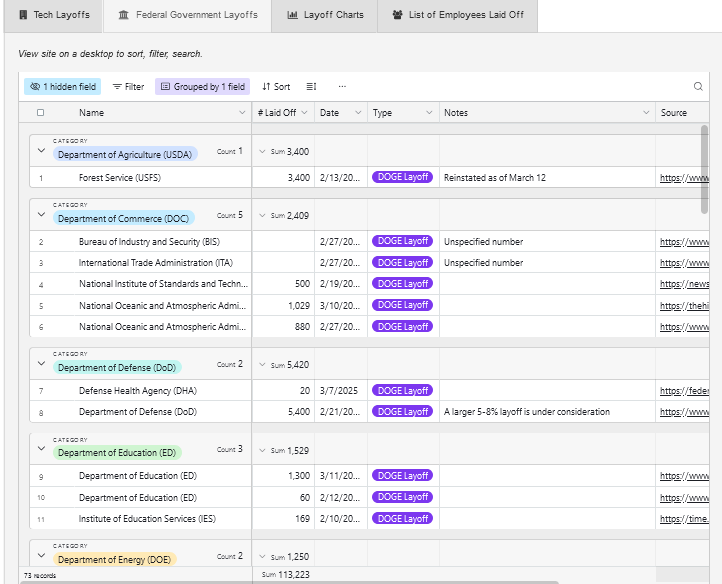
  • Watch DOGE layoffs in real-time with Layoffs.fyi

    Watch DOGE layoffs in real-time with Layoffs.fyi

    Layoffs.fyi is keeping track of US federal government layoffs. The website was originally created to track tech layoffs and has been featured in the Wall Street Journal, Bloomberg, and NY Times. 

    Source link