Category: Leadership & Policy

  • Education Department Rule Restricts Public Service Loan Forgiveness Eligibility

    Education Department Rule Restricts Public Service Loan Forgiveness Eligibility

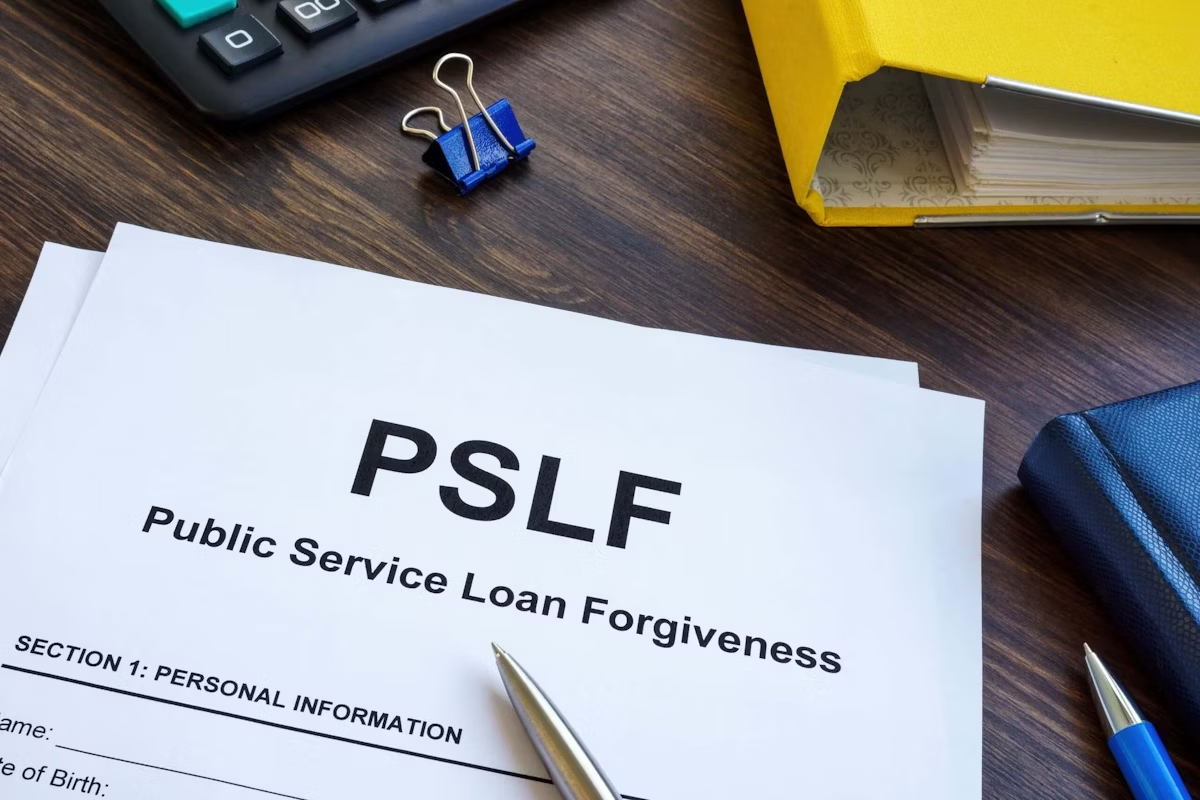
    File photoThe Department of Education announced a new rule that would allow the agency to exclude certain nonprofit and government employers from the Public Service Loan Forgiveness program, targeting organizations that “engage in specific enumerated illegal activities” or do not align with the current administration’s priorities.

    The rule, which was published Friday in the Federal Register, grants Education Secretary Linda McMahon unilateral authority to determine which organizations are ineligible for the program. It takes effect July 1, 2026.

    According to critics, the rule could disqualify employees of sanctuary jurisdictions and nonprofit organizations that provide immigrant family support, gender-affirming care, diversity and equity programs, or assistance to protesters exercising First Amendment rights.

    The Public Service Loan Forgiveness program was established by Congress in 2007 on a bipartisan basis. Under the program, federal, state, local and tribal government employees, as well as workers for 501(c)(3) nonprofit organizations, can have their remaining federal student loan debt forgiven after making 10 years of qualifying payments while working in public service. More than one million workers have received loan forgiveness through the program to date.

    Two advocacy organizations, Democracy Forward and Protect Borrowers, issued a joint statement committing to challenge the rule in federal court.

    “This is a direct and unlawful attack on nurses, teachers, first responders, and public service workers across the country,” the organizations said. “This new rule is a craven attempt to usurp the legislature’s authority in an unconstitutional power grab aimed at punishing people with political views different than the administration’s.”

    Alexander Lundrigan, Higher Education Policy and Advocacy Manager at Young Invincibles, called the changes “illegal” and “politically motivated.”

    “The administration cannot unilaterally rewrite a program that was passed into law by Congress,” Lundrigan said. “PSLF eligibility is defined by law, not political ideology.”

    Jaylon Herbin, director of federal policy at the Center for Responsible Lending, agrees, adding that the regulation “is the latest in a long list of cruel tricks imposed on workers and groups who hold views or serve people this administration doesn’t like.”

    He added that the restrictions “will consign millions of student borrowers to decades of unaffordable debt repayment and will worsen existing shortages of teachers, police and emergency services workers, and nonprofits who help local residents thrive and contribute to building vibrant, economically resilient communities.”


    Source link

  • States Must Step Up as Federal College Aid Crumbles, New Report Warns

    States Must Step Up as Federal College Aid Crumbles, New Report Warns

    File photoAs the Trump administration moves to dismantle the U.S. Department of Education and gut federal financial aid programs, a new analysis released Thursday warns that college is becoming increasingly unaffordable for low-income families — and states may be the last line of defense.

    The report from The Education Trust examines state financial aid programs in Illinois, Indiana, and Minnesota, revealing that while some states are making progress, critical gaps remain in helping students who need assistance most.

    “The role of states in ensuring postsecondary access and affordability is essential now,” the report states, citing the Trump administration’s July Supreme Court victory allowing it to proceed with layoffs that cut the Department of Education’s staff in half.

    The staffing cuts, which disproportionately targeted financial aid personnel, come as congressional Republicans passed legislation in July 2025 that restricted Pell Grant eligibility, limited parent borrowing, and made student loan repayment more expensive.

    The report documents a stark affordability crisis. For recent high school graduates in Illinois, the average cost of attending a public four-year college represents 63.2% of annual family income for Black students, compared to 25.8% for white students.

    In Indiana, the gap is similarly wide: 58.8% for Black families versus 22.1% for white families. Minnesota shows comparable disparities at 57.1% and 22.9%, respectively.

    “Despite the benefits of a college degree, most families cannot cover the costs,” according to the report, which notes that the average cost of tuition, room, and board at public four-year colleges rose from $8,984 in 1980 to $22,389 in 2023, adjusted for inflation.

    Meanwhile, the Pell Grant — the nation’s primary need-based aid — has lost purchasing power dramatically. In 1975, it covered more than 75% of college costs; today it covers only about one-third.

    The Education Trust analysis found significant problems with how states allocate financial aid:

    Illinois dedicates 98.8% of its undergraduate aid to need-based programs, primarily through its Monetary Award Program. However, the grant functions as “first dollar” aid, meaning other assistance must be applied to tuition before MAP funds, potentially leaving low-income students with little support for non-tuition costs.

    Indiana splits funding more evenly: 40% goes to its need-based Frank O’Bannon Grant, while 44% supports combination need-and-merit programs like the 21st Century Scholars Program. The O’Bannon Grant provides larger awards to students at private colleges than public institutions — a policy that researchers say “privileges students from higher-income and higher-asset families.”

    Minnesota allocates 72% of aid to its need-based State Grant program. The state recently launched the North Star Promise Scholarship, which provides tuition-free education to families earning under $80,000, though as a “last-dollar” program, it may provide minimal assistance to the lowest-income students already receiving Pell Grants.

    The report identifies numerous eligibility requirements that exclude vulnerable students:

    • Neither Indiana nor Minnesota provides aid to undocumented students, despite those residents paying state and local taxes
    • None of the three states allow currently incarcerated students to receive aid, even though Congress restored Pell Grant eligibility for this population in 2023
    • Minnesota excludes students in default on federal loans, making it harder for those experiencing financial hardship to complete degrees
    • Part-time students — often working parents or adult learners — face reduced aid or exclusion in many programs

    The Education Trust urges states to redesign financial aid systems with ten key features:

    1. Prioritize need-based aid over merit-based programs
    2. Cover costs beyond tuition, including housing, food, transportation, and childcare
    3. Serve part-time students, adult learners, and returning students
    4. Include undocumented and justice-impacted individuals
    5. Never convert grants to loans
    6. Serve students at all public colleges equally
    7. Allow access for those in loan default
    8. Consolidate programs into streamlined, need-based grants
    9. Use negative Student Aid Index numbers to direct more aid to the neediest
    10. Implement college access policies like direct admissions and FAFSA completion requirements

    “What’s more, policies that promote college attendance are crucial for reducing barriers to higher education,” the report states, highlighting that both Illinois and Indiana have FAFSA completion requirements and direct admission programs, while all three states offer dual enrollment opportunities.

    The report highlights the economic benefits of state investment in higher education. Each college graduate in Illinois increases the state’s annual GDP by approximately $155,566 and generates 6.8 jobs. The state recoups its education investment in just 4.1 years of the graduate’s working life.

    Bachelor’s degree holders earn $1.2 million more over their lifetimes than those with only high school diplomas, are 24% more likely to be employed, and are nearly five times less likely to be incarcerated.

    “State policymakers have a vested interest in ensuring that recent high school graduates pursue higher education and stay in state to complete their education,” the report concludes.

    The analysis comes as education advocates warn that the federal retreat from college affordability could reverse decades of progress in expanding access to higher education, particularly for students of color and those from low-income backgrounds.

    Source link

  • Six States Lead Nation in Anti-DEI Legislative Push, New Report Finds

    Six States Lead Nation in Anti-DEI Legislative Push, New Report Finds

    A new policy brief from the University of Southern California reveals that six states—Texas, Missouri, Tennessee, Iowa, Oklahoma, and Indiana—have emerged as national leaders in efforts to dismantle diversity, equity, and inclusion (DEI) programs in higher education, with significant consequences for students and faculty of color.

    The report, “DEI Under Fire: Policy, Politics, and the Future of Campus Diversity,” released by USC’s Black Critical Policy Collective, analyzed legislative trends across all 50 states between August 2024 and July 2025. Researchers developed a composite scoring system based on bills introduced and laws passed, identifying states with the most aggressive anti-DEI activity.

    Texas topped the rankings with a composite score of 16, having introduced 10 bills and passed three laws restricting DEI efforts. Missouri followed with 15 bills introduced, though none passed into law. Tennessee, Iowa, Oklahoma, and Indiana rounded out the top six states, all scoring between 9 and 14 on the composite scale.

    As of July 2025, 14 states have passed a total of 20 anti-DEI laws, up from 12 states with 14 laws when data collection began in December 2024. These laws typically target four main areas: elimination of DEI offices and staff, bans on mandatory diversity training, prohibitions on diversity statements in hiring, and restrictions on identity-based preferences in admissions and employment.

    “Diversity, equity, and inclusion are not peripheral ideals. They are institutional functions—woven into the operational, cultural, and legal architecture of colleges and universities,” wrote Dr. Kendrick B. Davis, series editor for the Critical Policy Collective, in the report’s introduction. “When those functions are restricted or removed, the effects are material.”

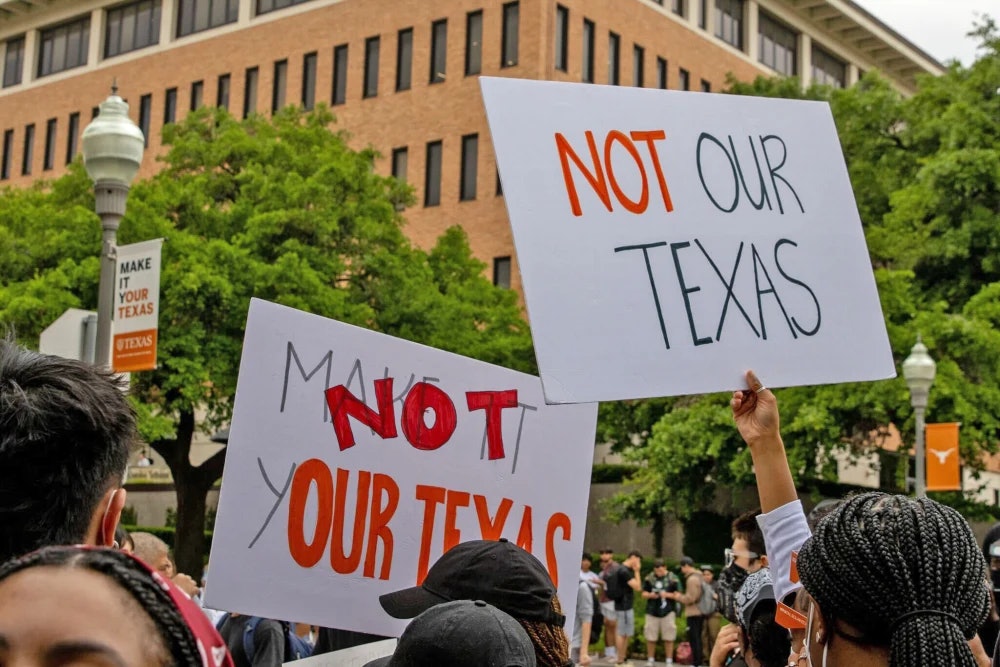
    The institutional responses have been swift and substantial. At the University of Texas System, at least 49 DEI-related employees were terminated following the passage of three bills in 2023. The system shut down its Multicultural Engagement Center and Gender & Sexuality Center at UT-Austin and eliminated funding for student identity-based organizations and scholarships for undocumented students.

    In Iowa, following Senate File 2435’s passage in May 2024, the University of Iowa eliminated its Office of Inclusive Education and Strategic Initiatives and laid off 11 DEI-related staff members. The university also removed scholarships specifically aimed at racially minoritized students, redirecting funds to support low-income students more broadly. By October 2024, Iowa’s state universities had reallocated more than $2.1 million from DEI programs.

    Indiana University announced one of the most sweeping academic restructurings in its history, planning to suspend, eliminate, or consolidate at least 43 undergraduate programs, including African American and African Diaspora Studies, Gender Studies, and multiple language programs. The changes follow passage of Senate Bills 202 and 289, which banned DEI offices and prohibited diversity statements in hiring.

    Preliminary enrollment data following the 2023 Supreme Court decision in Students for Fair Admissions v. Harvard—which effectively ended race-conscious admissions—shows declining representation of students of color at several elite institutions. At Harvard Law School, Black student enrollment in 2024 dropped to 19 first-year students, down from 43 the previous year. MIT reported a 1% decrease in the proportion of Hispanic and Black students, while UNC-Chapel Hill experienced a 5% decrease in Black, Indigenous, and people of color students overall.

    “The ongoing attacks on DEI, manifested in policy restrictions forcing institutions to comply with race-evasive policies, have significant implications for racial and ethnic diversity, student access and success, and workforce development,” the report states.

    Research shows faculty diversity benefits all students by fostering critical thinking and better preparing graduates for diverse workforces. However, DEI rollbacks make it significantly more difficult to recruit faculty of color, as institutions are now restricted from considering race in hiring decisions—a limitation reinforced by the Harvard ruling.

    The report’s authors—Mya Haynes, Glenda Palacios Quejada, Shawntae Mitchum, and Alexia Oduro—note that even private institutions like Vanderbilt University have implemented similar changes despite not being subject to state laws, “reflecting broader anxieties within the private sector about maintaining—or being seen to maintain—equity-oriented infrastructure under political scrutiny.”

    Student activism has emerged in response to the restrictions. Iowa State University students organized rallies and petitions opposing the elimination of the DEI office and restructuring of the LGBTQIA+ Center. In Alabama, university professors and students filed a lawsuit challenging the state’s DEI ban, arguing it violates First Amendment rights.

    “What is one of the things that’s sometimes difficult to see is the level of coordination between states,” Davis said in an interview. “Texas, Oklahoma, Iowa, Indiana, Tennessee, and Missouri—they’re not just a random collection. They’re a coordinated collection of states that have made some formal, some informal decisions, but what is clear through the legislation is that they share a common goal in restricting access to anything that is culturally relevant or sensitive to racially and ethnically minoritized groups in this country.” 

    Davis noted that while federal actions have dominated recent headlines, states initiated the anti-DEI movement shortly after 2020.

    “We have to remember the states started this anti-DEI, anti-critical race theory movement shortly after 2020,” he explained. “This has been a long time in the making, and I think the current federal efforts are just complementary to what states had already been doing.” The report aims to help policymakers and practitioners “get through some of the noise” and track the escalating legislative activity across multiple states, Davis said.

    The report recommends that institutions embed DEI principles within broader student success initiatives, leverage private funding where public funding is restricted, and strengthen alliances among students, faculty, staff, and community organizations to advocate for institutional accountability.

    Missouri represents a notable exception in the analysis. Despite introducing 14 bills targeting DEI—more than any state except Texas—none have passed into law. The report attributes this to intense legislative gridlock, ideological conflicts within the Republican majority, and strong opposition from educational institutions and community organizations. However, the 2025 legislative session has seen renewed efforts to advance anti-DEI policies.

    The researchers emphasize that the policy shifts carry particular consequences for Black, Latino, and Indigenous communities, who are losing access to culturally affirming resources, mentorship opportunities, and financial aid programs specifically designed to address historical inequities in higher education access.

    “If access is conditional and inclusion retractable, higher education cannot claim to serve the public,” Davis wrote.

    The report represents the third in a series examining how equity is being withdrawn across the education pipeline.

     

    Source link

  • Trump Administration Fires Nearly All Staff Overseeing Special Education Programs

    Trump Administration Fires Nearly All Staff Overseeing Special Education Programs

    The U.S. Department of Education has terminated nearly every employee in the Office of Special Education and Rehabilitative Services in a sweeping wave of layoffs that began Friday, according to the union representing agency staff—a move that advocates say will devastate services for millions of students with disabilities.

    While the agency has not provided official numbers, reports from staff and managers indicate that most employees below the leadership level in the division were eliminated, said Rachel Gittleman, president of the American Federation of Government Employees Local 252. Employees in the college access program known as TRIO, housed in a different office, were also let go.

    The union has challenged the firings in court, arguing they “double down on the harm to K-12 students and schools across the country,” Gittleman told USA TODAY.

    Education Department spokespeople did not respond to requests for comment. However, Education Secretary Linda McMahon has previously stated that safeguarding students with disabilities and ensuring their access to legally mandated educational resources is a top priority. “I would like to see even more funding go to the states for that,” she told CNN in March.

    In a Friday court filing, the Justice Department confirmed that more than 460 Education Department employees had been laid off, cutting roughly one-fifth of the agency’s workforce. The terminations, which have affected more than half a dozen federal agencies, are part of a broader Trump administration effort to pressure congressional Democrats to end the ongoing government shutdown. Nearly 90% of the Education Department remains furloughed.

    The agency eliminated nearly every employee responsible for administering funding under the Individuals with Disabilities Education Act (IDEA)—the primary federal law supporting students with disabilities. The staffer expressed uncertainty about how these programs will continue to function.

    Secretary McMahon has suggested that oversight of IDEA funding might be better positioned within the Department of Health and Human Services rather than at the Education Department, though officially moving it would require congressional action.

    The mass firings have drawn sharp criticism from education equity advocates who warn of dire consequences for vulnerable students.

    “The Trump administration’s attack on public education continued this weekend as students with disabilities are at risk of losing the services, supports, and oversight that protect their civil rights,” said Denise Forte, president and CEO of The Education Trust. 

    “The administration’s unfathomable decision to fire all employees who administer the Individuals with Disabilities Education Act (IDEA) abandons the 7.5 million students with disabilities and their families,” Forte continued. “Roughly 15% of public school students have a disability, and federal enforcement of IDEA is crucial to ensuring that these students receive a free and appropriate public education.”

    Forte said that the layoffs will have particularly significant consequences for students of color with disabilities, who already face greater barriers to accessing services and are subjected to disproportionately harsher discipline.

    “This is a direct assault on all parents of and students with disabilities and all students and families who know that an excellent education system is a diverse and inclusive one,” Forte said. “I call on the Trump administration to reverse these cuts immediately.”

    The firings come amid widespread disruption across the Education Department, which has also experienced problems with financial aid administration following earlier rounds of layoffs.

    Source link

  • Trump Administration Compact Demands Universities Align With Political Agenda

    Trump Administration Compact Demands Universities Align With Political Agenda

    The Trump administration has escalated its confrontation with higher education institutions by sending detailed policy demands to nine universities, conditioning their continued access to federal funding on compliance with the president’s political objectives.

    The unprecedented move, delivered via letters signed by Education Secretary Linda McMahon and other senior officials, presents a 10-page “compact” that outlines sweeping requirements affecting tuition pricing, international student enrollment, gender policy, and campus speech.

    The compact mandates that participating institutions freeze tuition rates for five years, place restrictions on international student enrollment, and adopt administration-approved definitions of gender. Universities must also commit to preventing any policies that the administration characterizes as punishing conservative viewpoints.

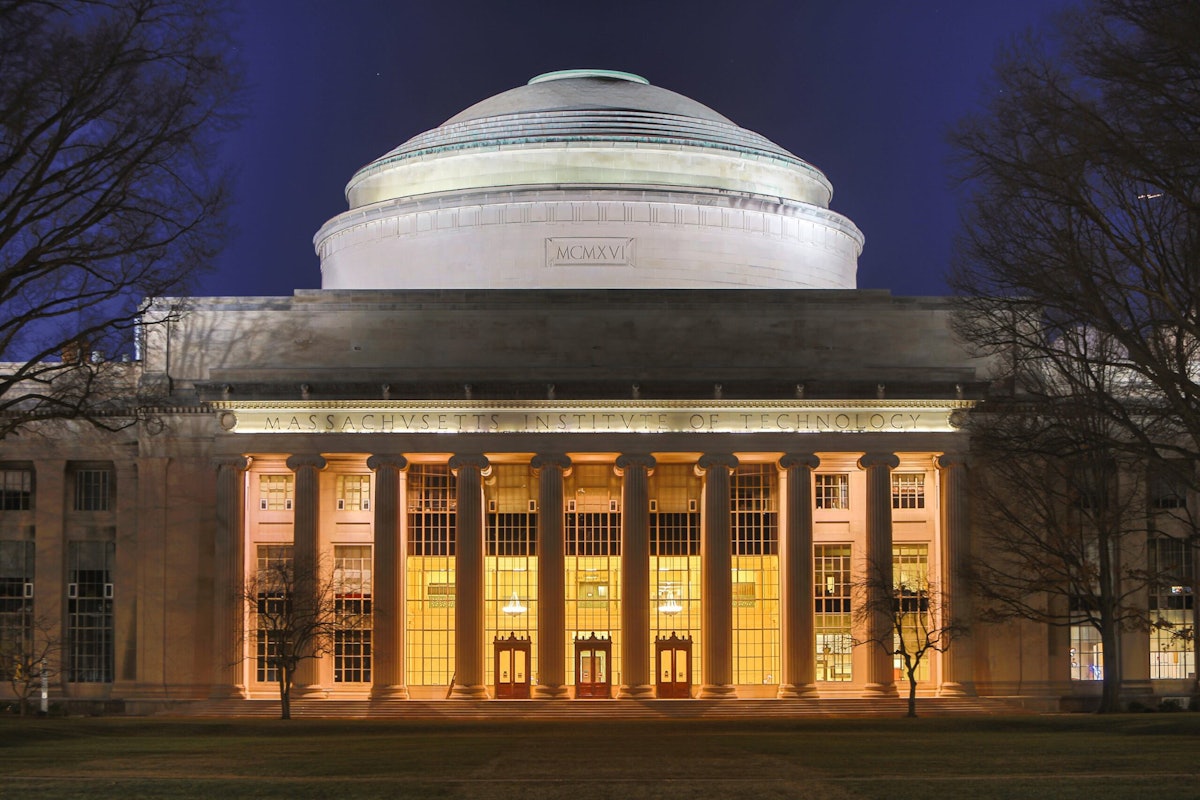
    The nine institutions that received letters on Wednesday include Dartmouth College, Brown University, Massachusetts Institute of Technology, University of Southern California, University of Arizona, University of Virginia, University of Pennsylvania, University of Texas, and Vanderbilt University.

    According to The New York Times, May Mailman, the White House’s senior adviser for special projects and a letter signatory, indicated the administration remains open to dialogue with contacted universities. “We hope all universities ultimately are able to have a conversation with us,” Mailman stated.

    The demands represent a significant threat to institutional autonomy and could have far-reaching implications for diversity, equity, and inclusion efforts on college campuses. The restrictions on international student enrollment raise particular concerns about the future of global education exchange and the presence of international scholars who contribute substantially to research and campus diversity.

    The administration’s approach effectively creates a two-tiered system where compliance brings preferential treatment in federal grant competitions. As one senior White House official told The Washington Post, universities would technically remain eligible for grants, but compliant institutions would gain a “competitive advantage.”

    This compact represents the latest escalation in the administration’s sustained campaign targeting higher education. Previous actions have included funding freezes, threats to revoke tax-exempt status, and attempts to eliminate universities’ authorization to host international students.

    The administration has particularly focused on policies related to international students, pro-Palestinian campus activism, transgender student athletes, and diversity, equity, and inclusion programming.

    Harvard University stands alone among major research universities in actively resisting the administration’s demands through litigation. In an April open letter to the Harvard community, President Alan Garber articulated the stakes for academic freedom: “No government—regardless of which party is in power—should dictate what private universities can teach, whom they can admit and hire, and which areas of study and inquiry they can pursue.”

    However, on Tuesday, President Trump claimed a deal with Harvard was nearing completion. The administration has already announced agreements with the University of Pennsylvania, Columbia University, and Brown University earlier this year.


    Source link

  • Kentucky Reaches Tentative Settlement Over In-State Tuition Policy for Undocumented Students

    Kentucky Reaches Tentative Settlement Over In-State Tuition Policy for Undocumented Students

    Kentucky Attorney General Russell ColemanThe U.S. Department of Justice and the Kentucky Council on Postsecondary Education have reached a preliminary settlement agreement that would end the state’s policy of offering in-state tuition rates to undocumented students who graduate from Kentucky high schools.

    The agreement comes after the DOJ filed a federal lawsuit in June challenging Kentucky’s practice of extending in-state residency status—and the accompanying lower tuition rates—to any student who completes high school in the state, regardless of immigration status. The Justice Department argued this policy creates unequal treatment by providing financial benefits to undocumented immigrants while denying the same rates to U.S. citizens living in other states.

    “No state can be allowed to treat Americans like second-class citizens in their own country by offering financial benefits to illegal aliens,” Attorney General Pamela Bondi said in announcing the federal lawsuit.

    The legal challenge reflects broader federal immigration enforcement priorities under the Trump administration, which has issued executive orders aimed at preventing undocumented immigrants from accessing taxpayer-funded benefits or preferential treatment in government programs.

    Kentucky’s Republican Attorney General Russell Coleman has supported the federal position, arguing that state policy conflicts with federal law prohibiting undocumented immigrants from receiving college benefits unless identical benefits are available to all U.S. citizens. In July, Coleman urged the Council on Postsecondary Education to voluntarily withdraw the regulation rather than pursue costly litigation.

    “The federal government has set its immigration policy, and the Council must regulate in accordance with it,” Coleman wrote to the CPE. “To that end, I urge the Council to withdraw its regulation rather than litigate what I believe will be, and should be, a losing fight.”

    Under the tentative settlement terms, the Kentucky Council on Postsecondary Education has acknowledged that its tuition policy violates federal law and agreed to terminate it immediately. However, the agreement remains pending approval from U.S. District Court Judge Gregory Van Tatenhove in the Eastern District of Kentucky.

    The Kentucky case mirrors a similar federal challenge resolved earlier this year, when Texas reached a settlement with the DOJ over comparable in-state tuition policies for undocumented students.

    The Mexican American Legal Defense and Educational Fund (MALDEF), a prominent Latino civil rights organization, has filed a motion seeking to intervene in the Kentucky lawsuit on behalf of affected students. The motion remains under judicial review. MALDEF was previously denied intervention rights in the parallel Texas case.

    The policy change could significantly impact college affordability for undocumented students who have spent their formative years in Kentucky’s educational system. In-state tuition rates are typically substantially lower than out-of-state rates, making higher education more accessible for students from families with limited financial resources.


    Source link

  • Trump Administration’s Higher Education Policies Drive Sharp Decline in College Graduate Support

    Trump Administration’s Higher Education Policies Drive Sharp Decline in College Graduate Support

    The Trump administration’s aggressive stance toward higher education institutions is contributing to a precipitous drop in support among college-educated voters, with new polling data revealing the president’s approval rating among graduates has fallen to historic lows.

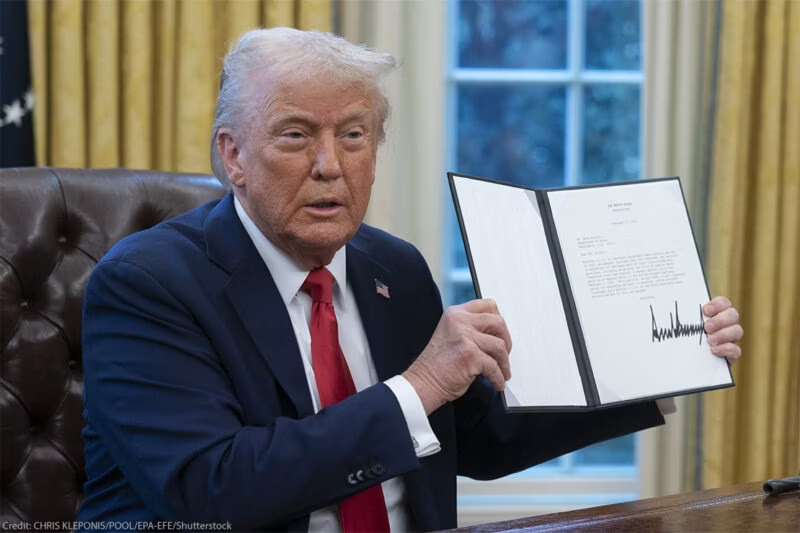
    President Donald J. TrumpAccording to Gallup polling, Trump’s approval rating among college graduates plummeted from 34% in June to just 28% by August, with disapproval climbing to 70%. This represents a concerning trend for Republicans as they look toward the 2026 midterm elections, particularly given the growing influence of college-educated voters in key suburban swing districts.

    The administration’s education policies have taken aim at what Trump characterizes as liberal bias and antisemitism on college campuses. Harvard University has faced the most severe federal intervention, with the White House canceling approximately $100 million in federal contracts and freezing $3.2 billion in research funding. The administration has also moved to block international student enrollment and threatened to revoke the institution’s tax-exempt status while demanding sweeping reforms to admissions processes and curricular oversight.

    Similar measures have been enacted against Columbia University, the University of Pennsylvania, and Cornell University over issues ranging from pro-Palestinian campus activism to policies regarding transgender athletes in women’s sports. Harvard officials have characterized these interventions as an unprecedented assault on academic freedom and institutional autonomy.

    The crackdown has generated significant campus unrest and drawn comparisons to Cold War-era loyalty investigations, raising questions about the federal government’s appropriate role in higher education governance.

    The polling data reflects broader dissatisfaction with the administration’s educational approach. Only 26% of college graduates approve of Trump’s handling of education policy, while 71% disapprove. A separate AP-NORC survey from May found that 56% of Americans nationwide disapprove of the president’s higher education agenda.

    However, the policies resonate strongly within Trump’s Republican base, with roughly 80% of Republicans approving his higher education approach—a higher approval rate than his economic policies garner. About 60% of Republicans express significant concern about perceived liberal bias on college campuses, aligning with the administration’s framing of universities as ideologically compromised institutions.

    The Republican coalition shows some internal division on enforcement mechanisms, with approximately half supporting federal funding cuts for non-compliant institutions while a quarter oppose such measures and another quarter remain undecided.

    While political controversies dominate headlines, economic concerns remain the primary driver of public opinion on higher education. Sixty percent of Americans express deep concern about college costs, a bipartisan worry that transcends ideological divisions around campus politics.

    Current data from the College Board and Bankrate show average annual costs of $29,910 for in-state public university students, $49,080 for out-of-state students, and approximately $61,990 for private nonprofit institutions when including room, board, and additional expenses. Financial aid reduces these figures to average net prices of $20,800 at public universities and $36,150 at private colleges.

    These costs reflect decades of sustained increases. EducationData.org reports that public in-state college costs have risen from $2,489 in 1963 to $89,556 in 2022-23 (adjusted for inflation). Over the past decade alone, in-state public tuition has increased by nearly 58%, while out-of-state and private tuition have risen by 30% and 27% respectively.

    The economic pressures extend beyond college costs to post-graduation employment prospects. While overall unemployment among adults with bachelor’s degrees remains low at 2.3%, recent graduates face significant challenges. Bureau of Labor Statistics data shows that only 69.6% of bachelor’s degree recipients aged 20-29 were employed in late 2024, with unemployment among 23-27-year-olds reaching nearly 6%—substantially above the 4.2% national average.

    These employment difficulties contribute to broader economic anxiety, with 39% of college graduates describing national economic conditions as “poor” and 64% reporting job search struggles.

    The confluence of political and economic pressures creates a challenging landscape for Republicans heading into the 2026 midterms. College-educated voters represent a growing and increasingly decisive demographic, particularly in suburban areas that often determine control of swing seats.


    Source link

  • ASALH Condemns White House Directive to Review Smithsonian Museums, Calls for Resistance

    ASALH Condemns White House Directive to Review Smithsonian Museums, Calls for Resistance

    Dr. Karsonya “Kaye” Wise WhiteheadThe Association for the Study of African American Life and History (ASALH) has issued a forceful condemnation of the White House’s directive calling for a comprehensive review of Smithsonian Institution museums, warning that the move represents an attempt to “erase or distort” Black history.

    The directive follows President Donald Trump’s social media post attacking the Smithsonian museums as “OUT OF CONTROL,” claiming they focus only on “how horrible our Country is, how bad Slavery was, and how unaccomplished the downtrodden have been.” The White House subsequently ordered a full review of all archival materials to determine alignment with Executive Order 14235, aimed at “Restore Truth and Sanity to American History.”

    “ASALH stands in fierce opposition to this latest directive and all efforts to erase or distort our history, to silence our voices, and to minimize our story,” said ASALH President Dr. Karsonya “Kaye” Wise Whitehead.

    The 110-year-old organization, which founded Black History Month, partnered with the African American Policy Forum to co-lead a “Hands Off Our History” rally at the Smithsonian’s National Museum of African American History & Culture in Washington, D.C.

    Whitehead characterized the museum review as part of a broader pattern of attacks on diversity and inclusion efforts. She cited the 2023 banning of over 10,000 books, many featuring people of color, and recent executive orders eliminating Diversity, Equity, and Inclusion programs in higher education, medicine, and K-12 history courses.

    “These steps are veiled attempts to rewrite and distort the narrative by removing any mention of the racist actions, words, and deeds that have shaped American history,” Whitehead added.

    The ASALH president described the current moment as part of an escalating campaign that began with what she termed the “whitelash election” of 2017, followed by increased white supremacy after George Floyd’s murder, and culminating in current efforts to “defund libraries, whitewash history curricula, zero-base the Department of Education.”

    ASALH, founded in 1915, positions itself as a bridge between scholars and the public in preserving and promoting Black history. The organization is preparing for its annual conference in Atlanta, scheduled for September 24-28, 2025, which Whitehead said will serve as an opportunity to “organize and prepare ourselves to counter his next steps.”

    The controversy highlights ongoing tensions over how American history is taught and presented in educational and cultural institutions, with particular focus on narratives involving slavery, civil rights, and systemic racism.

    Whitehead added that the organization’s resistance draws inspiration from historical figures including Dr. Carter G. Woodson, Dr. W.E.B. Du Bois, and Harriet Tubman, stating: “Our work as truth seekers obliges us to ‘speak the truth to the people’ and demands that we stay ready.”

    The Smithsonian Institution has not yet responded to requests for comment regarding the White House directive.

    Source link

  • Trump Administration Proposes Restricting Public Service Loan Forgiveness for Organizations with ‘Illegal Purpose’

    Trump Administration Proposes Restricting Public Service Loan Forgiveness for Organizations with ‘Illegal Purpose’

    The Trump administration on Friday released a proposed rule that would exclude organizations deemed to have a “substantial illegal purpose” from the Public Service Loan Forgiveness program, a move that could disqualify thousands of borrowers working for advocacy and legal aid organizations from having their student debt canceled.

    The Notice of Proposed Rulemaking, published in the Federal Register and scheduled to take effect July 1, 2026, follows President Trump’s March executive order directing the Department of Education to revise PSLF eligibility criteria. The proposed changes would give the Secretary of Education broad authority to determine which employers qualify for the program that has provided loan forgiveness to more than one million public servants.

    Under the proposed rule, organizations could lose PSLF eligibility for activities including “aiding or abetting violations of Federal immigration laws,” “engaging in a pattern of aiding and abetting illegal discrimination,” or “engaging in violence for the purpose of obstructing or influencing Federal Government policy.” The Department would use a “preponderance of evidence” standard to make determinations, and employers found ineligible would face a 10-year waiting period before they could regain qualifying status.

    The rule specifically targets several types of activities the administration considers problematic, including providing certain medical treatments to transgender minors, assisting with immigration cases, and various forms of protest activity that result in state law violations such as trespassing or disorderly conduct.

    Kristin McGuire, President and CEO of Young Invincibles, characterized the proposal as “continuing its attacks on education, deliberately targeting advocacy organizations whose work doesn’t align with its ideological agenda.”

    “By using a distorted and overly broad definition of ‘illegal activities,’ the Trump administration is exploiting the student loan system to attack political opponents,” McGuire said. “This is an illegal move by the administration; eligibility for Public Service Loan Forgiveness (PSLF) is defined by law, not political ideology.”

    The proposed rule emerged from a contentious negotiated rulemaking process that concluded in July without consensus. According to the Department’s documentation, the negotiator representing civil rights organizations dissented from the draft regulations, preventing the committee from reaching agreement.

    The Department of Education estimates the rule would result in budget savings of $1.537 billion over 10 years by reducing the number of borrowers who achieve loan forgiveness. Administrative documents suggest the changes could affect borrowers in multiple sectors, including legal services, healthcare, social work, and education.

    Organizations operating under shared federal tax identification numbers could see entire agencies lose eligibility if one component is found to engage in disqualifying activities. The rule includes provisions allowing the Secretary to separate organizations under shared identifiers, but grants ultimate authority to the Department to make such determinations.

    The proposed rule draws heavily on the Internal Revenue Service’s “illegality doctrine,” which denies tax-exempt status to organizations with substantial illegal purposes. The Department argues this approach ensures consistency across federal agencies and prevents taxpayer funds from subsidizing activities the government aims to prevent.

    Employers would be required to certify on PSLF application forms that they do not engage in activities with substantial illegal purpose. Those who fail to provide such certification would immediately lose qualifying status.

    The rule includes safeguards requiring notice and opportunity to respond before final determinations, and allows employers to maintain eligibility if they submit approved corrective action plans before losing qualification.

    According to the Department’s regulatory impact analysis, implementation would cost between $1.5 million and $3 million annually during the first two years. The analysis acknowledges that compliance costs for employers would vary significantly, with larger organizations potentially facing higher expenses for legal consultation and operational adjustments.

    The Department projects reduced confusion among borrowers due to clearer eligibility criteria, though it acknowledges potential disruptions during the transition period. The analysis notes that borrowers working for disqualified employers would need to find new positions with qualifying organizations to continue progress toward loan forgiveness.

    The proposed rule will undergo a 30-day public comment period following publication in the Federal Register on August 18. The Department must review all submitted comments before issuing a final rule.

    If implemented as proposed, the new eligibility requirements would apply only to activities occurring on or after July 1, 2026. Borrowers whose employers lose qualifying status would receive notification from the Department and would no longer earn qualifying payment credit while employed by those organizations.

    The Public Service Loan Forgiveness program, established in 2007, allows borrowers to have remaining federal student loan balances canceled after making 120 qualifying monthly payments while working full-time for eligible government agencies or qualified nonprofit organizations. The program has faced criticism and administrative challenges since its inception, with many borrowers initially denied forgiveness due to complex eligibility requirements.

    Young Invincibles and other advocacy organizations indicated they plan to submit detailed comments opposing the rule and may pursue legal challenges if the final version proceeds as proposed.

    Source link

  • Military Academies Agree to End Race-Based Admissions in Landmark Settlement

    Military Academies Agree to End Race-Based Admissions in Landmark Settlement

    United States Military Academy at West Point Students for Fair Admissions (SFFA) announced this week that it has reached a settlement agreement with the U.S. Department of Justice that will permanently end the consideration of race and ethnicity in admissions at the United States Military Academy at West Point and the United States Air Force Academy.

    The agreement, approved at the highest levels of the Department of Defense, establishes four key requirements for both academies: applying no consideration of race or ethnicity in admissions decisions, maintaining no race-based goals or quotas, shielding race and ethnicity information from admissions personnel, and training staff to adhere to merit-only standards.

    The policies will take effect immediately and apply to all future admissions cycles, according to the settlement terms.

    The settlement represents a significant policy reversal from the Biden administration’s previous position defending race-conscious admissions at military service academies. Earlier this year, under President Trump’s Executive Order 14185, the Department of Defense determined that race-based admissions at military academies are not justified by military necessity and do not advance national security, cohesion, or readiness.

    The Department formally abandoned its earlier position that a “compelling national security interest in a diverse officer corps” justified race-based policies, marking a sharp departure from decades of military diversity initiatives.

    The agreement follows SFFA’s earlier litigation against the U.S. Naval Academy, where the organization successfully challenged similar race-conscious admissions practices.

    Under the settlement terms, litigation against West Point and the Air Force Academy will be dismissed with prejudice, with each side bearing its own legal costs. The agreement preserves SFFA’s right to challenge any future changes to these policies.

    “This is an historic day for the principle of equal treatment under the law at our nation’s military academies,” said Edward Blum, president of SFFA. “Together with the Naval Academy case earlier this year, this agreement ensures that America’s critically important military service academies will admit future officers based solely on merit, not skin color or ancestry.”

    The settlement comes amid ongoing national debates over affirmative action policies following the Supreme Court’s 2023 decision in Students for Fair Admissions v. Harvard, which effectively ended race-conscious admissions at civilian colleges and universities.

    Military service academies had previously been considered potentially exempt from that ruling due to national security considerations and the unique mission of training military officers. However, the Trump administration’s policy shift has eliminated that distinction.

    The agreement affects two of the nation’s most prestigious military institutions. West Point, founded in 1802, and the Air Force Academy, established in 1954, collectively graduate approximately 2,000 new military officers annually.


    Source link