Category: Leadership & Strategy

  • Diversity and Inclusion Start With the Hiring Process: Two Institutions Getting It Right – CUPA-HR

    Diversity and Inclusion Start With the Hiring Process: Two Institutions Getting It Right – CUPA-HR

    by Jill Thompson | February 16, 2022

    For institutions to become diverse, equitable and inclusive workplaces for faculty and staff, HR must take a critical look at current hiring processes and analyze not only who’s being hired, but who’s doing the hiring. Are search committee members trained in DEI issues and prepared to conduct interviews in a way that exemplifies the institution’s commitment to DEI?

    As we wrap up the first two weeks of the 21-Day Equity Habit Building Challenge: Less Talk, More Action, we’re calling attention to inspiring higher ed hiring initiatives and resources from two institutions. HR pros will want to bookmark these resources to help them think through small adjustments or total redesigns of their institution’s hiring processes and DEI training for search committees.

    UC Davis’ Guide for Hiring Managers

    To helping hiring managers develop skills related to diversity and inclusion, UC Davis’ HR team created a guide to attracting, selecting and hiring diverse talent. The guide lists ways the institution can improve its reach for open positions and the diversity of candidates, as well as tips for incorporating inclusive language, targeting outreach, selecting recruitment panels, developing interview questions and making accommodations for applicants with accessibility issues.

    Oakland University’s Diversity Advocate Program

    Oakland University’s Diversity Advocate (DA) faculty hiring program was highlighted in-depth in the Fall 2021 issue of Higher Ed HR Magazine. The goal of the program is to mitigate bias in the hiring process. At one of the 21-Day Challenge Town Halls, OU’s team discussed the advantages of applying its DA model to the hiring process, namely ensuring equity doesn’t fall between the cracks by designating a DA to be an attentive participant in the search process.

    While Oakland University created the DA program for faculty hiring, they have gone on to create the Diversity Equity Advocate (DEA) program aimed at staff hiring. Although the DEA program is still considered a pilot program, it’s a great example of how Oakland University is shaking up search committees to achieve a more diverse workforce.

    Search committees are one of the first points of contact for job candidates. It’s imperative that these committees are prepared and trained to conduct inclusive interviews with diverse candidates and to bring issues of equity to the forefront. HR practitioners can use the resources listed here to spark ideas and action within their institutions.

    Haven’t joined in on the latest 21-day challenge yet? There are still two weeks left! 21-Day Challenges are open to CUPA-HR members only.

    Check out these articles to see how other institutions are promoting diverse, equitable and inclusive hiring practices:

    Embedding Racial Equity Into HR Practices

    The Equity Case for Competency-Based Hiring

    Breaking Down Hiring Barriers for Veterans: The Journey to Becoming a Military-Friendly Employer

    Hiring Heroes: Providing Employment Opportunities for Military Veterans

    How Two Universities Are Building Community Partnerships to Strengthen Local Hiring

    Removing Hiring Barriers for the Disability Community

    Examining Implicit Bias and Its Effect on Hiring and Inclusiveness

    e-Learning Courses:

    Building a Successful, More Inclusive Search (Individual)

    Building a Successful, More Inclusive Search (Group)


    Source link

  • Tips to Help HR Retain and Engage Talent – CUPA-HR

    Tips to Help HR Retain and Engage Talent – CUPA-HR

    by Jill Thompson | January 26, 2022

    In a recent members-only article from the winter issue of Higher Ed HR Magazine, Britni Elder, associate vice president for human resources and risk management at the University of Central Arkansas, shared tips and resources higher ed HR practitioners can tap into to get ahead of the resignation curve and not only hold onto employees, but keep them engaged and moving up within the institution.

    • Address employee discontentment at the manager level — Managers with poor people skills can lead to unhappy employees, and ultimately, more turnover within the institution. HR must ensure managers are equipped to manage their teams well and to help each team member reach their potential. This is a great opportunity for HR to partner with upper-level management to teach new managers the skills that will help them be the best leaders for their teams, not just managers.
    • Educate employees about total compensation — Oftentimes, employees leave for a bigger paycheck only to find that the base pay is better, but the benefits at the new job don’t compete with those of their previous job. When HR informs employees about total compensation (the tangible and intangible benefits offered by the employer), it enriches the employee decision-making process. They have the tools to really see when better pay is better pay, not just better base pay.
    • Prioritize well-being check-ins — Sometimes, employees are unhappy, and one way they think they can fix it is to change jobs. Unfortunately, the urge to change jobs may be only a deflection of deeper issues. HR can help in this area by keeping mental health resources and access to counseling opportunities in front of employees. Encourage managers to make time for intentional check-ins with direct reports.
    • Build a path for employees to reach their full potential — Focusing on what’s next for employees can open their eyes to the opportunities right in front of them rather than searching for something else outside the institution. HR should initiate conversations and ask employees about their career goals and construct a path to help them get there. Sometimes all it takes is a conversation to get things moving.

    Read the full members-only article: Four Areas HR Can Address to Boost Engagement and Retention.

    Resources for employee engagement and retention: 

    Employee Engagement Toolkit

    Stay Interviews Toolkit

    Compensation Programs/Plans Toolkit


    Source link

  • Read and Listen to Inspiring CUPA-HR Content From 2021 – CUPA-HR

    Read and Listen to Inspiring CUPA-HR Content From 2021 – CUPA-HR

    by CUPA-HR | January 5, 2022

    Throughout 2021, HR practitioners have proven their resilience time and again by positively impacting higher education not only in response to the ever-evolving pandemic, but also in building more flexible, diverse and inclusive workplaces. CUPA-HR captured many of these higher ed success stories, as well as leadership advice, helpful resources and workforce data trends in the following articles, podcasts and blog posts.

    As you read and listen to the inspiring work your HR colleagues are doing at colleges and universities around the country, we encourage you to jot down ideas to take into the year ahead: 

    Retention and Engagement 

    Develop to Retain: Tools and Resources for Higher Ed Professional Development (The Higher Ed Workplace Blog)

    Maintaining Culture and Connection for Remote Employees (The Higher Ed Workplace Blog)

    Stay tuned for an article in the upcoming winter issue of Higher Ed HR Magazine: “Four Areas HR Can Address Now to Boost Retention and Engagement.”

    Future of Work 

    New Report Highlights Changes to the Professional Workforce in the Wake of the Pandemic (The Higher Ed Workplace Blog)

    New Report Highlights Changes to Faculty Workforce in the Wake of the Pandemic (The Higher Ed Workplace Blog)

    Navigating Compliance With a Multi-State Workforce (The Higher Ed Workplace Blog)

    Determining Remote Work Eligibility and Talking to Leadership About Flexible Work (CUPA-HR Soundbite)

    Diversity, Equity, and Inclusion 

    5 CHROs Use CUPA-HR’s DEI Maturity Index to Energize Their DEI Efforts (The Higher Ed Workplace Blog)

    A Mission for Greater Faculty Diversity — Oakland University’s Diversity Advocate Program (Higher Ed HR Magazine)

    Can HR Investigators Be Anti-Racist? — Action Steps to Overcome Racial Bias When Conducting Workplace Investigations (Higher Ed HR Magazine)

    Juneteenth — How Will Your Institution Observe the Day? (The Higher Ed Workplace Blog)

    Supporting the LGBTQ+ Community in Higher Ed — 3 Learning Resources for HR (The Higher Ed Workplace Blog)

    Three Ways HR Can Promote Cultural Appreciation Over Appropriation (The Higher Ed Workplace Blog)

    Boost Your Pay Equity Know-How By Tapping Into These Resources (The Higher Ed Workplace Blog)

    Mental Health

    Mental Health Month Focus: Resources (The Higher Ed Workplace Blog)

    Strategies to Become More Resilient in Work and Life (The Higher Ed Workplace Blog)

    HR Care Package — Resources for Self-Care (The Higher Ed Workplace Blog)

    HR Leadership 

    CUPA-HR Conversations: Higher Ed HR Turns 75 (CUPA-HR Podcast)

    Why Psychological Safety Matters Now More Than Ever (Higher Ed HR Magazine)

    Opening Doors for Strategic Partnerships With Academic Leadership (Higher Ed HR Magazine)


    Source link

  • Develop to Retain: Tools and Resources for Higher Ed Professional Development – CUPA-HR

    Develop to Retain: Tools and Resources for Higher Ed Professional Development – CUPA-HR

    by CUPA-HR | December 7, 2021

    It’s Employee Learning Week — a great reminder for employers to showcase their commitment to talent development by highlighting development opportunities available to employees. Whether you’re an HR practitioner in search of professional development ideas for yourself and your HR peers, or you’re looking for ideas to engage and develop other employees at your institution, here are several tools, tips and resources to help you take the next step.

    Professional Development Tools for the HR Pro

    • CUPA-HR Learning Framework — A tool that assists in defining HR practitioners’ knowledge, skills and attributes and then helps create an action plan for growth and set developmental goals. Jump start your development by using the quick start guide, then build your skills further by diving deeper into the framework competencies.
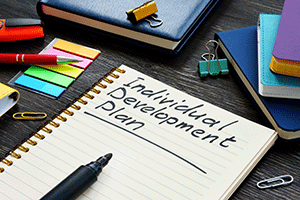
    • Creating Your Individual Development Plan — A must-have for anyone who wants to map out a strategy for career success in higher ed HR. This free CUPA-HR e-learning course provides an introduction to individual development plans (IDPs) and will guide you through the process of creating your plan, discussing your career with your leaders and implementing your strategy for success. CUPA-HR e-Learning is sponsored by PageUp.

    Ideas for the Higher Ed Community

    Apart from their own professional development, HR pros often create and help facilitate professional development opportunities for employees at their institutions. Here are some jump-start ideas from the article Optimize Your Hybrid or Remote Work Workforce — Considerations for Higher Ed HR Leaders, featured in the fall issue of Higher Ed HR Magazine.

    • Encourage managers to use an employee’s development plan to guide regular coaching calls. Gallup suggests ongoing coaching conversations — rather than annual performance reviews — can be of great benefit to both the employee and the employer. These meaningful conversations highlight the organization’s commitment to employee engagement, which can help retain employees for the long-haul. Encourage managers to use employees’ development plans during coaching calls as a guide to the conversation. Setting up the right systems and processes to help employees perform their best from any location is a great operational step, but reorienting managers to think about performance and productivity around outcomes instead is an important strategy.
    • Get creative with your learning and professional development offerings. William Paterson University’s HR team created a university-wide development program so all 600 non-faculty employees had a chance to participate. Their unique approach to talent development demonstrated institutional support for professional development, provided a platform for employees to engage and collaborate, and inspired additional ways to support employees, such as mentorship programs, goal setting and career advancement. Read more about the program in the special awards issue of Higher Ed HR Magazine to learn how the HR team adapted it to a virtual format — a great alternative for employees working in a hybrid or remote setting!


    Source link

  • 3 Takeaways From the CUPA-HR Annual Conference – CUPA-HR

    3 Takeaways From the CUPA-HR Annual Conference – CUPA-HR

    by CUPA-HR | October 7, 2021

    Thank you to all who attended the CUPA-HR Annual Conference and Expo in person and virtually this week! It was wonderful to welcome new and familiar faces, celebrate CUPA-HR’s 75th anniversary, and explore outstanding sessions with so many of you.

    For those who weren’t able to attend, here are three conference takeaways you can put to use wherever you are.

    • The Power of Kindness — Opening keynote and host of the Netflix series, “Kindness Diaries,” Leon Logothetis shared some of his experiences travelling the world fueled only by the kindness of strangers. “Kindness,” said Logothetis, “is simply a portal into human connection.” Overwhelmed by all the work to be done to support your institution’s workforce? Logothetis offered this advice: “To change the world, start by changing one life.” Who can you connect with and invest in at your institution? How can you use the power of kindness to make a difference in their life?
    • Birds and Frogs — Tuesday’s keynote speaker, David Epstein, spoke about the data supporting the value of generalists in a world increasingly focused on specialization. During his presentation, he offered an insightful message on how organizations can adapt successfully to change. Epstein used the example of birds and frogs; frogs are down on the ground, seeing all the granular details while the birds soaring above have a broader view of the big picture. Epstein asserted that we need both of these types of people to enhance our campus “ecosystems,” and should actively seek them out.
    • Ubuntu: I am because we are — Shola Richards topped off the conference with his energetic and inspiring message about the African concept of Ubuntu, which means “I am because we are.” Richards encouraged HR pros to use the spirit of Ubuntu in our various units and teams back on campus and to recognize that we will go a lot farther together than we will if we go alone no matter how small we feel (“be the mosquito, tiny but impossible to ignore”) or how difficult the situation (“be the buffalo, and run toward the storm”).

    We can’t wait to hear about the projects, initiatives, conversations and connections sparked by this year’s conference. Be sure to save the dates for our Virtual Spring Conference, April 19-21, and our 2022 Annual Conference, taking place October 22-24 in San Diego! Registration details coming soon.


    Source link