Category: leadership

  • Three Take-Home Messages From the 2022 Annual Conference – CUPA-HR

    Three Take-Home Messages From the 2022 Annual Conference – CUPA-HR

    by CUPA-HR | November 2, 2022

    Thank you to all who attended the CUPA-HR Annual Conference and Expo in person and virtually last week! It was wonderful to welcome new (300+ first-timers!) and familiar faces and to learn about successful projects and initiatives from higher ed peers at institutions across the country. 

    For those who weren’t able to attend, here’s some food for thought from our three outstanding keynote speakers:

    • Stand-Out Leadership — Opening keynote Sara Ross applied her passion for brain science to a key element of stand-out leadership: accountability. Ross explained that employees would rather have leaders who hold themselves accountable for their actions than perfect leaders. One way HR professionals can be stand-out leaders and hold themselves accountable is by using Ross’s SLOW strategy when responding to critical situations on campus. The SLOW strategy helps us respond in a way that is reflective of the positive impact we want to make in our roles as HR leaders.
      • S – Stop. Intercept your emotional reaction. Our brains are designed to process emotions first and logic second. By pausing and checking in with your emotions before responding to a situation, you prevent adding more fuel to the fire.
      •  L – Language. Check your body language. No really, look in the mirror! Pay attention to how you are presenting yourself. People are honed in on your body language, so you must make sure your body language is aligned with your message.
      • O – Oxygenate. Consciously slow your breathing to push back on your fight-or-flight instincts. Research shows that slowing down for as little as two minutes and deepening your breath can decrease the amount of cortisol in your system by up to 20 percent, which is essential when responding to an already stressful situation.
      • W – Wonder. Step outside your perspective and challenge yourself by thinking from someone else’s perspective. This simple practice helps reset our sensitivity and tap into empathy.
    • How to Citizen — Sunday’s keynote speaker, Baratunde Thurston, spoke about how racial injustices during the summer of 2020 motivated him to launch his podcast, “How To Citizen With Baratunde.” He challenged the audience to think about the word “citizen” as a verb rather than a noun. “Citizen” as a noun can carry divisive and exclusive undertones, but as a verb, it gives us something to do to improve our society. According to Thurston, there are four principles that serve as the foundation of how to “citizen.” The four principles are showing up and participating; investing in relationships with yourself and others; understanding power and what we give our power to; and to do all of these things to benefit our collective selves, not just our individual selves. What specific ways can you begin to “citizen” at your institution?
    • Reinvent HR — The take-home message from David Ulrich’s energizing talk about reinventing HR is that HR is not about HR, but about creating value for stakeholders inside and outside the organization (students, family, employers, community, alumni) so that our institutions and communities can succeed. Here are five ways HR can lead in this area: 1) Empower the next generation by making sure people feel better about themselves following their interaction with a leader, 2) Shape the future by establishing a compelling vision/mission, 3) Engage today’s talent by living the Es (empathy, emotion, energy, experience), 4) Make things happen by delivering on promises and creating a positive work environment, and 5) Invest in yourself so you can invest in others.

    Don’t Forget! Conference attendees can watch the sessions they missed or re-watch their favorites on demand. Recordings of our keynotes and livestreamed concurrent sessions are available for viewing in the desktop conference platform and the app.

    Be sure to save the dates for our Spring Conference, April 23-25 in Boston, and our 2023 Annual Conference, taking place October 1-3 in New Orleans! Registration details coming soon.


    Source link

  • Association Leaders Gathered to Learn, Laugh and Launch a New Year at the 2022 ALP! – CUPA-HR

    Association Leaders Gathered to Learn, Laugh and Launch a New Year at the 2022 ALP! – CUPA-HR

    by CUPA-HR | July 20, 2022

    CUPA-HR’s Association Leadership Program (ALP) has taken place every July for more than two decades, bringing together chapter, region, and national board members; association staff; key corporate partners; and other invited guests. After two years of meeting only virtually, these leaders were finally able to meet again in person last week.

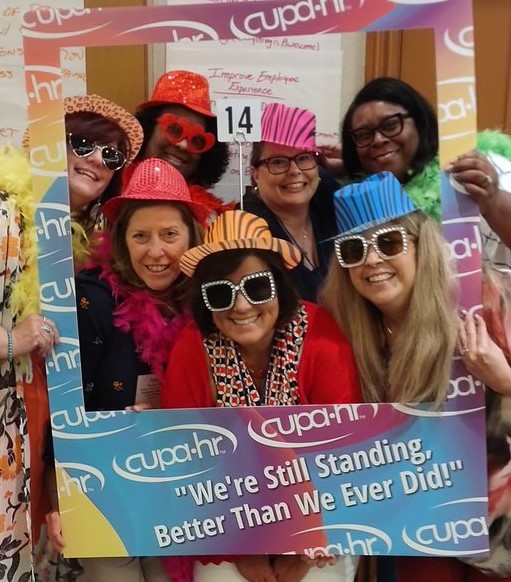
    “We’re Still Standing!”

    The HR challenges of the past two years have included leading emergency COVID-19 response, exploring a new frontier of flexible work, and addressing unprecedented talent recruitment and retention challenges. Through it all, higher ed HR professionals have been on the front lines, adapting and transforming the workplace with resourcefulness, leadership and strategic insights.

    To celebrate that strength and resilience, CUPA-HR president and CEO, Andy Brantley, and national board chair, Jay Stephens, kicked off the two-day meeting with Elton John’s “I’m Still Standing” playing in the background and issued an irresistible photo challenge for attendees. (Be sure to check out the photos posted to Twitter with the hashtag #cupahr22.)

    Building Knowledge and Connection

    The ALP’s highly interactive program included:

    • tips for managing chapters and developing a leadership pipeline
    • updates on CUPA-HR’s work on Title IX and other public policy imperatives
    • a practical overview of CUPA-HR’s DEI Maturity Index and new Research Center
    • a discussion of winning strategies for higher ed’s post-pandemic war for talent
    • a presentation on cultivating trauma-informed practice in higher education leadership

    Beyond the programming, however, what attendees valued most about the event was the opportunity to validate their campus experiences in conversations with peers, rekindle the motivation behind their work, and take away great ideas for transforming their HR teams and their institutions in ways big and small.

    Interested in Taking Your Professional Development Further?

    CUPA-HR’s volunteer leaders have committed to advancing the profession and the mission of CUPA-HR. They understand the complexities of higher ed HR, and they want to enhance the knowledge and skills they need to lead their institutions into the future.

    Are you ready to take that next step in developing your leadership skills, shaping the profession, and gaining one-of-a-kind access to successful practices and HR professionals from across the country? Then CUPA-HR leadership — in a chapter, at the region level, or even on the national board of directors — might be right for you. Learn more about how you can get involved.


    Source link

  • Attracting International Graduate Students – Edu Alliance Journal

    Attracting International Graduate Students – Edu Alliance Journal

    May 31, 2022, by Don Hossler – Setting a Context for Recruiting International Graduate Students

    There is a dearth of research on the factors that influence international graduate students to select the graduate program in which s/he will enroll. For decades, my advice to enrollment managers has been to look at the research on what influences the enrollment decisions of high ability domestic undergraduates and assume that many of the same factors will be at play. Keep in mind that for these prospective students the decision to enroll out of home country is a risky decision. It is risky because many of these students will have never lived out of their home countries. Students from more affluent families may have traveled abroad, but many  prospective students will not have done so. They are unaccustomed to the cultural norms in other countries.

    Recruiting international graduate students involve different considerations. For example, international students seeking master’s degrees in applied areas such as MBAs, and students looking at Ph.D. programs in STEM fields will have different concerns. Prospective students may have never studied in a setting where the language of the host country was the only language spoken. If a student is from some regions of Africa, Asia, or South America it is possible that the teaching style to which they have been exposed is didactic. But if the student is looking at studying in Western Europe, Canada, the United States the instructional style will be more dialectic, with give and take between students and faculty. All of these factors should be considered when universities/specific graduate programs craft recruitment strategies.

    Female students from Europe or North America, may be reluctant to consider graduate programs in the Middle East or parts of Asia because the roles of women, both inside and outside of the classroom is more constrained. Women from more religiously conservative Islamic countries may not be allowed to travel outside of home country without a male chaperone (Muharem). When graduate programs are considering the applications from students who have not grown-up in western industrialized countries consideration should be given to the fact that GRE score may not accurately reflect the abilities of prospective students. It should be clear by this point those institutions who seek to recruit graduate students from across the globe need to do their homework to be culturally sensitive.

    The Importance of Program Quality

    For graduate programs that seek to attract the best students from around the globe there are some universal truths.

    1. One of the differences between graduate and undergraduate programs is that students are likely to have courses taught by some of the leading scholars in the field. Graduate programs need to capitalize on this when attempting to recruit international students.
    2. The ranking of a graduate program is of great import. The further a graduate program is removed from being ranked among the best programs in the world, the more difficult it becomes to attract top graduate students.
    3. The reputation of individual faculty members also matters. In top ranked MBA programs, or in a STEM field for example, there may be a single professor that is regarded to be amongst the best researchers in the world in his or her field.
    4. For prospective graduate students looking only at elite programs, it is important that they have a chance to interact with faculty members by phone, video conferencing, email, and visits to campus prior to enrollment. There is always the risk that a  world-renowned professors will treat students like they are lucky to be talking to him/her – which is a mistake. Returning to a theme from my last essay on recruiting international undergraduates, graduate programs should court these top students, they will have other choices. Do not treat them like you are their only choice.
    5. Another important consideration for prospective students is the opportunity to participate in internships or to serve as research assistants (and later in post-doc fellowships). For more applied master’s degree programs, the opportunity to be part of consulting efforts can be a consideration. Finally, the longer the time period allowed for time spent in internships or in post-graduate fellowships – the better.
    6. In addition, cost matters. Prospective doctoral students in STEM fields will assume that they will get a research assistantship that will cover all, or most, costs. Most master’s degree programs do not include assistantships, thus tuition and fees, along with the availability of financial aid will influence their decisions.

    In addition to the factors above, there are other considerations for prospective students. In fields and programs, where students hope to become pre-eminent researchers there is often a preference that instruction be in English. There are practical reasons for this preference. For prospective doctoral students, the majority of the top journals in STEM fields are published in English. Often conference papers are presented in English. In the case of business, both spoken and written English is the lingua franca of international business.

    While less important, there are other considerations for prospective students. The permeability of the country culture in which the institution has been admitted can also be a consideration. Can students easily connect with other students and the wider community? Personal safety is also a factor. For example, this is often a concern about studying in the United States. In addition, any recent perceived mistreatment of international students quickly spreads across the globe. The visa process put into place by the Trump administration or China’s decision to expel all international students during the pandemic are examples of government policies that can influence the decisions of future graduate students.

    Many  international students are admitted and enroll in less prestigious graduate programs so high rankings are not always a key factor. Some students coming from Third World Countries may hope to immigrate to the country in which they choose to study. Thus, the probabilities of legal immigration can matter. Proximity to extended family and of course the probability of being admitted can be a factor.

    What Should Graduate Programs Do?

                Graduate programs that seek to enroll international students need to organize themselves to do this effectively. Unlike efforts to enroll undergraduates, where the image of an entire university plays a major role in matriculation decisions, the prestige and structure of an individual graduate program is what matters. The faculty of the program, with the support of the academic unit in which the program is housed, need to be clear eyed about the program’s strength and weaknesses. In addition, graduate programs need  to collect information on all of the students who applied, which ones were admitted, and where they enrolled. The use of data is critical especially for programs that are seeking to move higher in rankings schemes.

                Successful efforts require more organizational structure and focus than is often found at the program level. Any fellowships and scholarships need to be used in a strategic and coordinated manner. Programs need to develop communication strategies and targeted web pages –  this is necessary regardless of how highly ranked a graduate program may be. Both the communication streams and the website need to be customized to reflect the unique interests of international students. The concerns of prospective international doctoral students in Education are different from those of potential master’s students in Bioinformatics, or potential Ph.D., students in Materials Science.

                For universities and for graduate programs that seek to enroll more international graduate students there are a host of factors that influence students’ enrollment decisions. Program leaders need to be thoughtful and strategic in order to achieve their goals. Less prestigious programs may need to consider using recruiting agents, similar to undergraduate recruitment. It is likely to be necessary to assign many of these tasks to a professional staff position who has the time and expertise to create a highly integrated recruitment, admissions, and scholarship function.


    Donald Hossler a member of the Edu Alliance Group Advisory Council is an emeritus professor of educational leadership and policy studies at Indiana University Bloomington (IUB). He currently serves as a Senior Scholar at the Center for Enrollment Research, Policy and Practice in the Rossier School of Education, at the University of Southern California. Hossler has also served as vice chancellor for student enrollment services, executive associate dean of the School of Education, and the executive director of the National Student Clearinghouse Research Center.

    Hossler’s areas of specialization include college choice, student persistence, student financial aid policy, and enrollment management. Hossler has received career achievement awards for his research, scholarship, and service from the American College Personnel Association, the Association for Institutional Research, the College Board, and the National Association of Student Personnel Administrators. He recently received the Sonneborn Award for Outstanding Research and Teaching from IUB and was named a Provost Professor.


    Edu Alliance Group, Inc. (EAG) is an education consulting firm located in Abu Dhabi, the United Arab Emirates, and Bloomington, Indiana, USA. We assist higher education institutions worldwide on a variety of mission-critical projects. Our consultants have accomplished university/college leaders who share the benefit of their experience to diagnose and solve challenges.

    EAG has provided consulting and successful solutions for higher education institutions in Australia, Egypt, Georgia, India, Kazakhstan, Morocco, Nigeria, Uganda,  United Arab Emirates, and the United States.

    Edu Alliance offers higher education institutions consulting services worldwide. If you like to know more about how Edu Alliance can best serve you, please contact Dean Hoke at [email protected] 

    Source link

  • Higher Ed Without Borders Announces Its First Guest – Edu Alliance Journal

    Higher Ed Without Borders Announces Its First Guest – Edu Alliance Journal

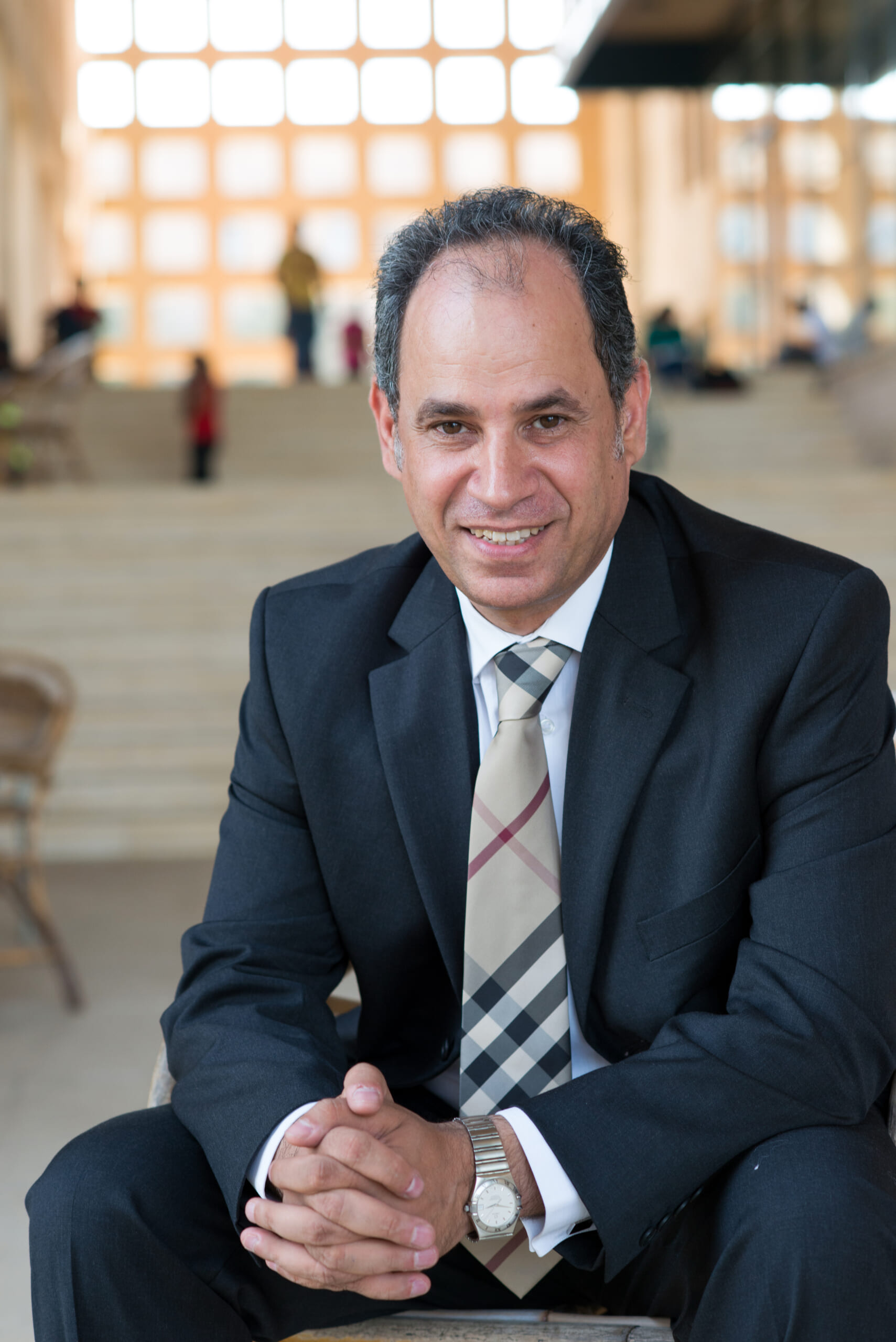
    May 29, 2022 – Higher Ed Without Borders a podcast series dedicated to education professionals worldwide announced its opening guest will be Dr. Ehab Abdel-Rahman, Provost of The American University in Cairo.  The series is hosted by co-founders of Edu Alliance Dr. Senthil Nathan in Abu Dhabi, UAE, and Dean Hoke in Bloomington, Indiana. The episode will be available on June 7th.

    Each episode is a half-an-hour-long conversation with international thought leaders that will enlighten and provide some new thoughts on critical issues facing higher education globally. You can subscribe to this free podcast series by going to Higher Ed Without Borders or searching for “Higher Ed Without Borders” on your preferred podcast app.

    Podcast Guest Dr. Ehab Abdel-Rahman

    Dr. Abdel-Rahman is the Provost of the American University in Cairo (AUC).  The university founded in 1919 has over 7,000 undergraduate and graduate students from over 60 nations. He is the Chief Academic Officer and provides administrative leadership and oversight for all academic components of the University. As Provost, he has twice led the re-accreditations of AUC by the Middle States Commission on Higher Education (MSCHE)  and the National Authority for Quality Assurance and Accreditation of Education “NAQAAE”.

    He also spearheaded the development of AUC’s Strategic Plan, and in 2020, AUC’s QS World University Rankings moved up 25 places, placing it amongst the top 1.5% of universities worldwide.

    Dr. Abdel-Rahman holds his Bachelor’s and Master’s Degrees in Physics from Helwan University in Cairo and his Ph.D. in Physics from the University of Utah.

    Future Guests Include

    • Dr. Allen Goodman, Chief Executive Officer of the Institute of International Education (IIE)
    • Dr. Frank Cooley, Chancellor Purdue University Global
    • Dr. Jim Henderson, President, and Chief Executive Officer of the University of Louisiana System
    • Dr. Gil Latz, Vice Provost of Global Strategies, and International Affairs for The Ohio State University
    • Dr. Mariët Westermann Vice Chancellor of New York University, Abu Dhabi

    Co-Host Biographies

    Dr. Senthil Nathan is Co-Founder and Managing Partner of Edu Alliance Ltd in Abu Dhabi, UAE.  Since the founding of the company in 2014, Senthil has been involved in numerous advisory & consulting projects for higher education institutions and investment firms.

    After spending a decade in the USA on research and engineering design projects, Dr. Nathan joined the Higher Colleges of Technology in 1993, the largest higher education institution in the UAE. He served in various positions and from 2006-to 2014 was Deputy Vice-Chancellor / Vice Provost for Planning & Administration. Dr. Nathan has been involved in numerous advisory and consulting roles in education/training & development engagements. In 2014 he received the Distinguished Alumni Award from the National Institute of Technology in India. He is the Chairman of the Board of Trustees for Livingston University in Uganda. Dr. Nathan is an accomplished speaker and presents at educational events worldwide.

    Dean Hoke is Managing Partner of Edu Alliance Group in the United States and Co-Founder of Edu Alliance Ltd. in the United Arab Emirates. Dean has decades of progressively responsible and visionary leadership roles in higher education, communications & online learning. He has led numerous initiatives that have created innovation & positive change in the higher education & non-profit sector. He has worked since 1974 in senior positions in higher education, broadcasting, and online learning.

    He participates in numerous advisory & consulting projects in the fields of international education, branding, business intelligence, and online learning. He is an active speaker and writer in the field of global higher education and distance learning.  Dean is a member of the Board of the American Association of University Administrators, the Franklin University School of Education Advisory Board, and is a member of the Board of Advisors for Higher Education Digest.

    Edu Alliance

    The podcast is a production of Edu Alliance an education consulting firm located in Bloomington, Indiana, and Abu Dhabi, United Arab Emirates. Founded in 2014 Edu Alliance assists higher education institutions worldwide on a variety of mission-critical projects. The consulting team is accomplished leaders who share the benefit of their experience to diagnose and solve challenges. They have provided consulting and executive search services for over 35 higher education institutions in Australia, Egypt, Georgia, India, Kazakhstan, Morocco, Nigeria, Uganda, United Arab Emirates, and the United States.

    A special thanks to:

    White Rabbit in Bloomington, Indiana is the production partner providing graphics and audio support.

    Higher Education Digest is the media partner for Higher Ed Without Borders podcast. The Digest is an independent Higher Education Portal and Magazine.

    Source link

  • Why You Should Be A Member of the American Association of University Administrators – Edu Alliance Journal

    Why You Should Be A Member of the American Association of University Administrators – Edu Alliance Journal

    April 11, 2020 by Dean Hoke – When I came back to the United States in 2017-18 I wanted to re-engage with the US university community. I joined NAFSA primarily due to my work in International Higher Education but I also wanted to be a part of a smaller organization where I could get to know the people better and attend conferences that would continue my professional development. I decided to join in 2018 The American Association of University Administrators (AAUA).

    Who is AAUA

    AAUA is a non-profit professional organization founded in 1970 for higher education leaders and administrative personnel. It is the only professional association for individuals who are interested in the entire range of higher education management (from department chair/unit director through president) in the entire diverse set of American colleges and universities (two- and four-year; public, private non-profit, private for-profit; comprehensive, research-focused, special mission).

    Membership in AAUA helps support the association’s mission. In addition, membership provides—for those members who have an interest—opportunities for professional networking and leadership. In addition to enrolling and serving a significant complement of administrators at the most senior levels, the association is also interested in assisting early-career practitioner administrators build/enhance their leadership portfolios by providing leadership opportunities through service on association committees, boards, and taskforces. Opportunities to collaborate on offering professional development services are available as well.

    Professional Development Opportunities

    Annual Leadership Seminar: In particular this is my favorite because of the networking and the presentations. The 50th Leadership Seminar of the American Association of University Administrators is scheduled for June 9-10, 2022. It will be held as a hybrid event, with in-person sessions meeting at the Marriott Stanton South Beach Hotel (Miami, Florida). In-person sessions are planned for June 9 (morning and evening) and June 10 (morning). On-line sessions will be held on the afternoon of June 9th. I will be attending in person.

    AAUA Professional Development Fellows Program : The Fellows Program is an individually designed, year-long, mentored professional development experience during which the candidate uses his/her day to-day responsibilities as the spring board for improving a set of self-identified professional skills to enhance his/her administrative competence.

    Cross-Institution Visits : Recognizing the value of learning from administrative peers at other institutions (both similar in nature and of radically different structure or purpose), AAUA facilitates short-term (one to three week) cross institution visits between like-role administrators. The association also occasionally organizes and conducts small group (6-10 people) two- and three-day visits to clusters of institutions for the purpose of learning about notable or unique programs.

    So What is the Cost of Membership?

    There are two types of memberships. One is Individual and the other is Institutional

    Individual: An active Membership (Open to any person interested in the administration of higher education) is $100. The Student (Open to any graduate student enrolled in an institution of higher education who is interested in the field of higher education administration. is $35.

    Institutional: Any college/university or any other organization/firm may sponsor the membership of individuals on the following basis:

    • 1-6 Supported Members – Total membership dues rate: $500
    • 7-15 Supported Memberships – Total membership dues rate: $1,000
    • 16-24 Supported Memberships – Total membership dues rate: $1,500
    • 25 or more Supported Memberships: $2,000

    I would encourage you to consider becoming a member of the AAUA. I have found the people you get to know are outstanding, the conferences educational and enjoyable and the cost of membership is well worth the value.

    If you have questions or wish to join feel free to contact me or better yet contact:

    Dan L. King, Ed.D., President, and Chief Executive Officer
    American Association of University Administrators
    1 Ralph Marsh Drive, Glen Mills, Pennsylvania 19342 (USA)Phone: 814-460-6498
    Email: [email protected]

    Dean Hoke is a Managing Partner of Edu Alliance Group in the United States and Co-Founder of Edu Alliance Ltd. in the United Arab Emirates. Dean has decades of progressively responsible and visionary leadership roles in higher education, communications & online learning. He has led numerous initiatives that have created innovation & positive change in the higher education & non-profit sector. 

    Dean began his career in 1975 with Bellarmine University working in various roles, including admissions and external relations. In 1983 he entered the broadcasting field, serving as a senior executive for Public Broadcasting System stations and a cable network. In 1998 he co-founded The Connected Learning Network, a full-service online learning company. In 2009 accepted an invitation to move to the United Arab Emirates serving in senior positions at Higher Colleges of Technology & Khalifa University.

    He participates in numerous advisory & consulting projects in the fields of international education, branding, business intelligence, and online learning. He is an active speaker and writer in the field of global higher education and distance learning. Dean has presented and written worldwide on leadership, higher education, and distance learning. Dean is a member of the Board of the American Association of University Administrators, the Franklin University School of Education Advisory Board, and a member of NAFSA. Mr. Hoke has a B. A from Urbana University, an M.S from the University of Louisville, and a Certificate in Executive Management from the University of Pennsylvania Wharton School.

    Source link

  • The Actual Work of an Edtech Sith Lord

    The Actual Work of an Edtech Sith Lord

    Coming to Terms With My Role as an Edtech Administrator and My Contribution to Education, Edtech, and Educators

    Recently, at the ISTE 2019 conference, I presented on building an educational technology professional development program on a budget. It was only the second time I had given this presentation and I was fortunate enough to be collaborating with my edtech sister, Kelly Martin. It was my first time presenting at what is the gold-standard conference in our field and I was feeling the incredibly trite combination of excited and nervous. Now that it is said and done, I’ve done a lot of thinking about the presentation, our message, the systems we have tried to build, and the pedagogical practice we have tried to improve. Our presentation, in many ways, speaks to a professional identity crisis I have been having since decided to cross over to the Dark Side and become an Edtech Sith Lord, an administrator.

    I came into edtech as a teacher coach. It was my job to be the expert on the tools AND to coach teachers. I would partner with them, build lesson plans and activities with them, and be in the room as support when we tested those lesson plans out with students. I loved it. If I am 100% honest with myself, after three years of being an administrator, I still miss it. In fact, I am going to commit a teaching taboo and admit: I think loved that job more than I loved my 14 years of being a classroom teacher, because the only thing I have loved more than helping middle school kids succeed by finding what they are capable of, is helping teachers succeed by finding what they AND their students are capable of.

    So when I became an administrator, when I made the conscious decision to join the Dark Side and trade my green lightsaber for a red one, I knew what it was I wanted to accomplish and why I was doing it. I wanted to build a great educational technology department in a district that was just starting out with edtech. I had had a great model at Fairfield-Suisun Unified School District, lead by Dr. Melissa Farrar. To this day, FSUSD still employs two of the best educational leadership role models I have met, Dr. Farrar and Kristen Witt. I was part of the team that first started the educational technology department in FSUSD, and naturally had some ideas on how I would do it “differently” or maybe “better.”

    I didn’t know how I was going to do it, but I had my what and my why in place. The how… well that has proved to be trickier, and more difficult than I expected. A thing I didn’t expect is how much being on The Dark Side was going to pull me farther and farther from direct contact with teachers. It has been a bit of a sacrifice, one that I am certain I would make again. Yet, it would have been easier if I had realized that going in.

    So now, after ISTE, after I have been allowed to represent myself as some sort of expert on building an educational technology department, I am reflecting even more on these questions: Am I effective? Am I an effective leader? What do I essentially do? How do I approach it? What do I believe in here?

    Teaching can be solitary work, but at least you have a whole school of other teachers, and a vast social media teacher community. One of the hardest things about my job is that to find a professional community you have to have friends outside of your district, because there’s only ever one of you. Even with that, I think what I still wrestle with most, having moved to the Dark Side, is missing teachers and classrooms.

    When I do get the chance to speak with men and women who do a similar job and we discuss how we interact with teachers and how we create professional development systems, there are common threads. What I have to say on this may not be terribly original. It could be summed up as “hire good people, and then get out of their way”, but since I have been reflecting on this, I thought I would share what the most important tasks of an Edtech Sith Lord are.

    Recruit Revolutionaries

    Every educational technology administrator I know in any public school district anywhere, who does not also have to do the IT portion of that work, is constantly messaging this to the entire organization: “We are not IT.” I like to tell people that IT works with boxes and wires, and edtech works with hearts and minds. Because we work with hearts and minds, we need the right people. Recruiting quality people is a quintessential part of building a good professional development program, educational technology or otherwise.

    One of the things you quickly find out when you’re recruiting for professional development is that even the best and most experienced teachers are not necessarily going to be the best professional developers. The skill-sets certainly overlap to a degree, the same way that there is overlap between pedagogy and andragogy, but they are not the same. Additionally, probably unsurprisingly, good teachers who are comfortable in front of a room full of second graders are not always comfortable in front of a room of their peers. So you do have to find people who are willing to do all the parts of the job. Good teachers are a must, but you cannot stop with that criteria.

    The reason I want to recruit “revolutionaries” is because an effective professional developer has to be willing to stand in front of a room full of teachers and say, “what you’re doing is good, but it could be great!” An effective professional developer is an agent of change. Being a champion of “it could be so much better” requires bravery, ardor, and perspicacity. Your people skills have to be on point. As a professional developer, you are yourself a recruiter. A recruiter to the cause of improved teaching practice, and you have to find a way to be both subtle and enthusiastic, to be a Pied Piper of teachers when you’re telling them “you can do better,” because that task is fraught with push back and hurt if you do it with a heavy hand. You must achieve a balance of gentle, yet relentless urging forward of your colleagues.

    Recruiting revolutionaries is no easy task, and they are usually in short supply. Another thing you have to be mindful of as a leader of revolutionaries, is that revolutionaries want change…and they want it now. Managing that expectation and engendering patience in them…also not easy. I wish I had better guidelines here, but I am not always patient myself, and sometimes my revolutionaries have had to teach me patience, but it is definitely a thing to think about. If you have done your recruiting right, you will find yourself being an Edtech Sith Lord who leads Edtech Jedi.

    Clear the Path

    The next thing I have learned over the last three years is that I need to clear the path for the revolution. In other words, I need to set up conditions so that my revolutionaries can get on with the work of proselytizing, being agents of change, and winning hearts and minds. What’s more, I need to ensure we don’t run out of the physical and emotional supplies they need to carry on. In short, you truly must support your revolutionaries in every conceivable way.

    Clearing the path can take many different forms. The most obvious is making sure that your team has the technology they need. You want them to be innovators and explorers so “standard issue” is often not enough. Hopefully, they will ask you, “Can we get some ____?” At first, or at least for me, my first compunction was to say, “yes.” But what you soon realize is that you are on the Dark Side, and you have peers and superiors on the Dark Side, and one of those higher Sith Lords is going to ask you why you spent $3,000 on 3D printers. You had better be ready to justify that cost using standards, superintendent goals, or board goals.

    In this case, one part of clearing the path is starting to ask your Jedi, your revolutionaries, “why,” and asking them to think about the pedagogical purpose for trying the cool new thing. Even when you yourself think it’s super cool and don’t want to ask why because you want to play with the new toys too, you have to ask that question. Another part of clearing the path is communicating and “educating” your peers and superiors behind the scenes to make connections between your experimental/innovative work and more conventional areas of education. If they already understand your department goals and vision to the point where they can guess why you’d be going to trainings or conferences, or purchasing technology they’re not themselves familiar with, then they’re less likely to question or push back.

    In fact, much of clearing the path is actually done away from your team. It might mean working with IT, principals, or union leaders. Sometimes clearing the path means finding paid professional development or peers for your Jedi and putting them in the same physical space to make connections and find support. And this last point, making sure your team has a professional community, is an example of clearing the emotional path for your team.

    I feel like, in order to do the work of professional development in education well, you have to really want to do it. If you have recruited revolutionary Jedi, and they are anxiously waiting to see change, then they might be in for some disappointment in the day-to-day. Especially in public education, changes are often incremental and slow. The word glacial comes to mind. However, if you can give your team a sense of belonging to something, remind and show them their accomplishments from time to time (hint: you will need this for yourself too as a Sith Lord) and provide opportunities for fun and bonding, then their emotional path will remain clear.

    Develop Your Developers

    This may not be as straightforward as it might sound. Obviously there is the normal goal-setting and driving people to develop their skills. In educational technology, we have the benefit of having many different certifications out there for our people to pursue. I work in a GSuiteEdu District, and I am very happy to say that we have added many Google Certified Trainers and Google Certified Innovators in our district, at all levels, and we have grown the number of Level 1 Google Certified Educators dramatically. This has been an outstanding achievement for our district, but this technical skill expertise is not enough.

    One of the things I have figured out, and it seems obvious when I read it, is to find out how people want to be developed, how they want to grow, and then find ways to grow them in those areas. This has two difficulties involved in it. The first difficulty is that sometimes you need to set aside how you want someone that you are leading to grow. Sometimes you have a need on your team, and you only have so many team members to fill it, and the team need can drive your actions in a way that isn’t always best for the person you’re trying to develop. There are, of course, certain basic team needs that must be fulfilled, but as new challenges or roles come along it’s good to be judicious and deliberate in assigning those roles and the accompanying development that goes along with them. The second difficulty comes when the team member isn’t really sure how they want to grow themselves. Allowing somebody the time and space for self-discovery and reflection can be difficult, especially if you are an impatient Sith Lord, but it will pay dividends in the long run.

    And then there’s this other thing, which seems to go opposite to the idea of developing people how they want to be developed. Sometimes you can see the potential for strengths in people; sometimes these strengths have no direct impact on the work of your team. Sometimes you can see that people are good at things even if they don’t know that they are good at those things, or, and this is a hard one, even if they don’t necessarily want to be good at those things.

    One of the members of my team is a natural diplomat, a clear-headed communicator, and has an overriding sense of fairness. It’s like he is a natural-born, level-headed leader. This is a role he shies away from. Every time he is in leadership he distinguishes himself so people keep asking him to do it. I think he would be a fabulous administrator, and it has taken me over a year to get him to a place to even consider it. For my part, I have had to be mindful and creative about how I use certain situations to help him see his strengths and the opportunities they might afford him.

    So in a way, being a Sith Lord is being a talent scout. This is pretty obvious at the recruiting phase when you’re looking for the initial attributes you want on your team. In addition, as you work with your individual team members–and you really should approach developing your team members as individuals–you need to be looking for their strengths so that you can build on them, and their areas of growth to mitigate them. The difficulty that comes as a team leader is when you know you need to push somebody up to a new position or a new challenge which will require them to leave your team. That can be hard, and downright annoying, but you develop yourself as a leader when you find new people to recruit and develop. You have to remember that teams succeed because of systems AND people. Build both, and in the long run the work will succeed, individuals will succeed, and the accomplishment will be satisfying.


    Source link

  • Inside an Expanding EdTech Company – EdTech Digest

    Inside an Expanding EdTech Company – EdTech Digest

    Why the CEO of a pioneering firm assembled a brand-new leadership team.  

    PANEL DISCUSSION | moderated by Victor Rivero

    Jamie Candee is relentless in her pursuit to put the educator first in everything that her online teaching and learning company does.

    So it follows that Jamie, recently featured as one of the Top 100 Influencers in EdTech by EdTech Digest, would expand her executive team with industry experts and educators:

    Marcus Lingenfelter, Senior VP of Strategic Initiatives and Partnerships;

    Karen Barton, Ph.D., Senior VP of Research and Design;

    Jason Scherschligt, VP of Product Strategy and Experience; and

    Christy Spivey, VP of Curriculum and Assessment Development

    …join her company, Edmentum, as it experiences strong growth and demand for partnerships with educators across the globe.

    (pictured above, from left: Marcus, Karen, Jason, Christy)   

    Built on 50 years of experience in education, the company’s solutions currently support educators and students in more than 40,000 schools nationwide.

    “I am beyond ecstatic to welcome all of our new executive team members,” says Jamie.

    “Our team has been trailblazers in education technology, and we are just getting started. As we enter a new chapter, we have assembled the right team to better serve educators worldwide,” she says.

    In this panel-in-print, we get up close with the individuals on her newly expanded team to get a better idea of the people leading the technology, and how their mindset and their approach will be key components of their future success.

    They have a lot to say.

    At a later point, we’ll follow up to see how they’ve done—and where they’re headed next.

    For now, enjoy an enlightening conversation.

    As former teachers, why do you think it’s important to have an educator’s perspective in the edtech business?

    Karen Barton: Educators, students, and their contexts vary, and sometimes vary in ways designers may not have anticipated, even in ways that may have unintentional outcomes. Understanding the contexts in which any solution is being utilized is critical to ensuring the solution best meets the needs of the educators and learners.

    Christy Spivey: The most important thing we can do is listen to educators and what they need. Any decision that is made for a new product must be made with the best interest of the teacher in mind. That’s a philosophy we embrace at Edmentum. What we need to do is extend that to having great empathy for educators and build programs that delight them and allow them to have a better connection to improving learning for their students.

    What was the biggest lesson you learned from your previous positions that will inform your current work?

    Karen Barton: 3 things: 1) The interactions we have with one another matter. They matter because when those interactions are positive, there is engagement, trust, joy, and success in our work, in the educators we serve, and in our personal lives and communities. 2) Data is only as powerful as our collection of it and should not be limited by the modeling paradigms of the past. And, 3) we should understand that even the best designs, methods, and intentions may not be aligned with the way in which educators leverage our solutions. As such, we should be sure to focus on what educators and learners really need – first – and work to meet those needs with flexibility, innovation, and usefulness.

    Marcus Lingenfelter: No significant challenges are overcome by any one individual, organization, or governmental entity – ergo, strategic partnerships are critical to mission success. Consider the partners enlisted to put American Neil Armstrong on the moon. Competing aerospace companies Boeing, Northrop Grumman, and Lockheed Martin aligned their unique capabilities to the demanding requirements to realize technological and engineering capabilities previously regarded as science fiction. Education’s challenges today are equally daunting and require a similar approach that aligns interests and capabilities of multiple organizations to ensure mission success. That mission – student success!

    Jason Scherschligt: Many times in my career I’ve been reminded of the value of observing and understanding the challenges of those who use your product. If you want to lead a product, you need to get out of your office and experience what your users experience. Educators work in complex environments with a unique set of demands and pressures. I want our product teams to obsess over the needs of educators. Getting to know educators in their natural environment is the best way to do that.

    Christy Spivey: Most of my career has been spent in Education. First as a classroom teacher and then at Edmentum. Over the years, I have worked with many educators and school districts, and all of them have one thing in common – needing more time to help students achieve their goals. With this experience, I am excited to continue to work with educators to make sure that everything we create exceeds educators’ and students’ expectations. 


    MarcusMarcus Lingenfelter, Edmentum’s newly-appointed Senior Vice President of Strategic Initiatives and Partnerships, has two decades of leadership experience in postsecondary education including campus roles at the University of Virginia and Penn State University along with cabinet-level positions at Widener University and Harrisburg University of Science and Technology. He previously served as Senior Vice President of Advancement for the National Math and Science Initiative (NMSI) – the non-profit established to dramatically improve math and science educational outcomes for the country.


    What would you say is the biggest need for educators today?

    Karen: Empowerment – the freedom to meet the needs of their learners in a variety of ways; and the training and support to ensure they are equipped to do so. 

    Christy: Educators need to feel supported and to have their voices heard. If we can provide educators with tools and data that give them the information they need to maximize their time with their students, then we are supporting teachers in a way that gives them the ability to use their talents in the classroom.

    Why should educators feel optimistic about the future of education technology?

    Marcus: Education technology, when properly deployed, has the ability to put a highly effective state-certified teacher in front of every student regardless of location or personal circumstances. Whether it is reaching students located in exceptionally rural parts of the country where teachers can’t be recruited or into the urban centers that experience high teacher turnover rates, technology has the ability to positively impact some of education’s most intractable challenges. Therefore, educators concerned about equity and access for all students should feel tremendous optimism about what the present and future hold for impacting student outcomes via education technology.

    Jason: Several trends in technology and culture are converging in ways that will help educators and students succeed. These include big data sets and powerful analytics, which will help us understand the outcomes produced by our instruction and assessment, and new interactive capabilities, like virtual and augmented reality, which will enable teachers to provide really creative and engaging learning experiences. At our company, we won’t chase technology for sizzle, but apply it on a solid base of research to genuinely help teachers teach and students learn. 

    What trends in education have you most excited?  

    Karen: I’m most excited about the shift away from a sole focus on state summative tests and a focus on supporting educators in collecting evidence through multiple and varied measures and meeting the needs of all learners.

    Christy: I’m really excited about the focus on equity and access in education today. We live in a time where the power of technology should be providing access to all kinds of instruction for all student populations. There’s no reason we shouldn’t be fighting as edtech professionals to ensure every student has access to this technology. I’m also excited about the discussions around new ways to assess student learning. If we really want to know how students learn, then we need to rethink how we assess that knowledge. 


    Karen

    Karen Barton, Ph.D. joins Edmentum as the Senior Vice President of Research and Design, bringing 20 years of experience in education to the role. She previously served as Vice President of Learning Analytics at Discovery Education and most recently as Vice President of Assessment Solutions at NWEA. In her new role, Karen will lead Edmentum’s research, academic program design, and psychometric efforts, with a focus on ensuring every Edmentum program is valid, reliable, endorsed by educators, and produces positive student outcomes.


    What is technology’s role in education?  

    Karen: To support educators in providing engaging and accessible material to all students, freeing their preparation time to focus on needs of individual students (not just prepping material for the whole class), and providing data, recommendations, and relevant content for each student – where they are in their learning journey and what they need to move forward. For students to have access to greater experiences and learning in the medium of their future, and exposure to digital opportunities (careers, access to information, working digitally, etc.). 

    Jason: I think it’s fundamentally augmentative. You can never take people out of education, because the entire enterprise of education is intended to help people become more capable and societies become stronger. So, technology in education exists to help teachers and students thrive, rather than to replace anyone. 

    What four trends in the coming years are edtech “trends to watch”, ones that will require some shaping and leadership? Name and define the trend, and describe briefly the sort of leadership that may be required to navigate it. 

    Karen:

    • Innovations in data modeling to expand our understanding of student learning, strategies, and needs.
    • Collaborative problem solving to build skills necessary for working in teams in career and even in college courses.
    • Adaptive learning, that is, not only adapting assessments but adapting recommendations of instruction. This should incorporate rich models of data and learning. It will be important for these systems to incorporate educator and student perspectives relative to learning needs.
    • Tighter integration of assessment and learning, where assessments close to the classroom become part of the larger system of assessments connected to state-level assessments and accountability. Ensuring the purposes and usefulness of classroom based assessments do not lose their value and meaning when put into an accountability context will be critical.

    Jason:

    These four really come to mind:

    • Really granular competency-based education (CBE), where every morsel of learning and assessment is closely aligned to specific standards and outcomes.
    • Adaptive learning, where we use artificial intelligence to deliver the right kind of instruction at the right time for the student.
    • Gamification, where the psychology of motivation and competition are applied to enable learning.
    • This one’s a bit of a personal interest, but technology applied to teaching the arts and humanities. Historically, edtech has emphasized math and hard sciences, where right and wrong answers might be easy to calculate, but I’m especially interested in watching how technology is applied to more nebulous and complex artifacts like poems and plays and paintings and history.

    JasonJason Scherschligt joins Edmentum as Vice President of Product Strategy and Experience. He brings more than 18 years of experience leading innovative product management and user experience approaches in organizations like the Star Tribune, Capella University, Jostens and GoKart Labs. Jason will focus on designing and managing industry changing, captivating education products that truly empower educators, engage students, and provide education leadership with the insights they need to develop and maintain education programs that create access, equity, engagement, and positive learning outcomes.


    What is the responsibility of a more established company such as yours to the edtech space? What makes you say that? 

    Marcus: As the nation’s original distance learning platform (PLATO), Edmentum most certainly has a responsibility to lead. However, such leadership is not just in the “edtech space” per se, but rather for helping all our education partners realize positive student learning outcomes for the benefit of all concerned. The challenges facing our communities – local and global – are significant and require everyone to lift their gaze to get the bigger perspective and then act responsibly, in collaboration with others, to solve the problems.

    Christy: For any edtech company, there is a big responsibility to make sure that all programs and solutions we provide really have the educator in mind. We can only do that if we work with educators directly and listen to what they need. We also have a responsibility to use technology to bring more access and equity to student learning. At our company, we want to be at the forefront of pushing for innovative and proven programs that work for all students and educators. 


    ChristyChristy Spivey assumes the role of Vice President of Curriculum and Assessment Development for Edmentum. During her tenure, Christy has served in a variety of roles shaping the company’s curriculum development strategy. Embracing her experience in the classroom, she ensures educators are involved in every step of Edmentum’s design and development to provide programs that meet the needs of educators everywhere. Christy leads a team of deeply committed curriculum and assessment designers focused on creating a new paradigm in differentiated instruction, blended learning, and active learning models.


    Anything else you might care to add or emphasize, any parting words of edtech-relevant wisdom, or commentary about the future of edtech?

    Karen: Educational technology has the potential to revolutionize our education systems – from primary through university and career training, and how we teach, train, learn and collaborate, and to bring societal balance. To do so, we need to attend to building platforms, data, content, and assessments that balance our attention across the diversities of learners and contexts, and work to address the discomfort of change that comes with progress – change that will require edtech companies to attend to legislation around the educational systems that govern educational models, as well as to be very cognizant and intentional around data privacy.

    Jason: I often think about Marc Andreesen’s aphorism that software is eating the world: almost every interaction or transaction we conduct somehow involves software, and that includes educational experiences. We can’t escape that, but we can shape it. Education remains humanity’s best hope for its future, and I’m excited that we get to shape how teachers apply software to enable student achievement.

    Christy: Today’s students should be going to school and interacting with technology in the same way they do in their social lives and time outside of school. We have a responsibility to support educators who want to make technology a seamless part of their instruction to engage students in learning. We need to have empathy for the complexity of teaching and learning and find ways to make both easier for students and educators.

    Victor Rivero is the Editor-in-Chief of EdTech Digest. Write to: [email protected]

    Source link

  • Budgets Are Declarations of Belief

    Budgets Are Declarations of Belief

    Blogger side note: Sometimes if you procrastinate on a blog post long enough, you get to write the original post and the follow up post all in one go.
    So…that’s fun.

    Why Is No One Else Excited About This?

    I seem to really like doing a part of my job that my coworkers and peers in other districts seem to dread.  I am a first year administrator, the Director of Educational Technology in Alisal Union School District; I am also originating the position.  Budgeting and budget projections have become a thing I like doing.  To me there are so many positive and intellectually engaging things here.

    It’s like a puzzle where what I want to accomplish and what I can (theoretically) accomplish come together and I have to make the pieces fit.  I like puzzles and problem-solving.  We’ve been asked to do 3 years of projections and in each year we have to cut by 10%, by the end of 2019 – 20, it will have been reduced by 30%.

    So this seemed like a critical but interesting challenge.  It was also a gut-check moment: What do I really believe my students and teachers need, and how am I am going to put resources into that when resources are diminishing?  But on an emotional level, budget projections and action planning, especially around edtech, are what one of my favorite authors, Sarah Vowell, describes as a “snowball moment.”

    Yes, budgets carry real effects and mean choices, impacts, and sacrifices. These are not always fun. But, to me, when you’re doing the projections, the harder parts have yet to happen.  The plan hasn’t met reality yet; the mistaken suppositions haven’t come to light, errors and emergencies have yet to happen.  Budgets, despite all the constraints and must-dos they are required to have, are a votive list in which we as leaders say, “this is what we believe in; this is what we are going to support; this is what we promise to do!”

    Who wouldn’t be excited by that?

    I didn’t realize I was kind of alone in this mindset this until I had a conversation like this with a fellow director before a school board meeting.

    HIM: You have a good day?
    ME: Yeah! Me and my team spent the afternoon doing our 3-year projections with those cuts we were asked to put in!
    HIM: (groans) Ugh, budgets.  You seem excited by that.
    ME: Yeah, I think we got a really good plan…(dawning realization) Wait, you don’t like doing that?
    HIM: No.  I hate budget projections.  In fact, you’re the only one I know who has ever said they liked doing this…especially during [budget] cuts.

    I am, however, undeterred.  As an administrator, I don’t have a lesson plan anymore.  I have an action plan and it’s accompanying budget.  These are a statements of what I know in my bones to be the best solutions for our students and teachers to become fluent in 21st century learning and teaching, and ultimately to become engaged citizens of the connected world.

    Being a leader, I now get to do everything in my professional power to execute, to make those solutions a reality. ¡Ándale pues!

    The Follow Up – Round 2: Is It Still Fun?

    In California right now, we’re not exactly having hard times, but we’re heading into what looks like a few years of budget reduction.  This is because STRS (State Teachers Retirement System) and PERS (Public Employees Retirement System) contribution rates are going up, and will continue to go up as far as the 19- 20 school year.  So even if our budgets are leveling off, the mandated costs of those items is going up dramatically.  For me this involved a couple of complications.

    We have a new fiscal director who pointed out that we’d been making some errors in our budgeting practices.  While we were putting in our salary costs for stipends and timesheets–“supplemental salary” (which make up a large portion of my professional development budget), we’d been leaving off the associated benefit costs. We were accounting for paying our folks their extra income, but we didn’t realize that the extra money that goes into retirement and medical for them ALSO had to come out of those budgets.
    You know, the budgets we’d spent all that time cutting by 10% year over year.

    If the first one was an interesting puzzle and a gut check this was kind of a body blow.  In real numbers, this was an additional 2% in 17 – 18, 3.5% in 18 – 19, and 5% in 19 – 20 in cuts that I had to find, while maintaining all the beliefs and hopes for efficacy I talked about above.  The absolute dollars were the same, but how much of them I was going to be able use went down each year.

    When you have to do this, it’s just you and the spreadsheet and the math.  There is no negotiating, no pleading; like Shakira’s hips, numbers don’t lie. You’re either within the limit, or you keep finding cuts.  But I wanted to be a leader, and this was a leadership moment.  And I don’t mean to be too melodramatic, but when you’re trying to build a program, there’s a lot of attachment to it.

    I admit this time I was less eager.  This time, “stuff got real.”  It’s not that I didn’t take it seriously before, I absolutely did. But it was a thing I thought I was done with for a while.  I still viewed it as an engaging puzzle, but this time was more serious, somehow. The deadline was closer, the amounts higher, but I still didn’t dread it.

    “Like” is maybe not the right word for how I felt about it, but positive definitely is.  I wouldn’t have wanted anyone else to do it.  My ardor was not reduced in any way.  I know my professional convictions; I know what I think is the right path in edtech. If anything the creative constraints got tighter and I wanted to do it more.

    This budget is my promise to my team, and the teachers and students of this district, “This is how we’ll prepare you for the future of education.” Why wouldn’t I be excited about making and keeping that promise?
    #StillExcitedAboutThis

    Source link