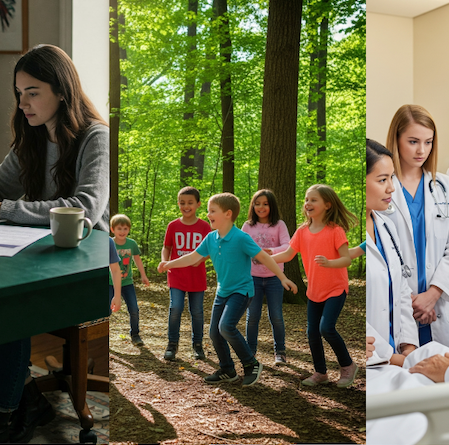
What impact is flexible learning having on learners from K-12 through to professional development?
New Zealand has remarkably high levels of digital access across the population. Why aren’t we out performing other countries in educational measurements?
This piece serves to introduce a series of six challenges faced by policy makers around flexible learning.
These six challenges are:
- Unequal Access to Technology and Connectivity
- Socioeconomic Disparities
- Digital Literacy and Skills Gaps
- Quality Assurance and Consistent Experience
- Teacher Preparedness and Support
- Policy and Funding Models
In this first piece I want to establish what I mean by ‘flexible learning’.
Like many I struggle to have a single, concise, and consistent “definition” of flexible learning. I would say that flexible learning is a model of delivery that offers learners agency and control over various aspects of their learning experience. Flexible learning is a spectrum. Formal learning courses exist on a continuum between “rigid” and “flexible” delivery. The more control and choice given to the learner, the more flexible the learning experience.
Flexible learning aims to “empower the student to choose what learning should be studied face-to-face and that which should be studied online, and how to go about engaging with that learning” (2022). This Means empowering the learner to make choices regarding:
- When: synchronous or asynchronous learning, pace-mandated or self-paced progression.
- Where: Learning in different locations (home, campus, workplace, etc.).
- How: Different modes of engagement (online, in-person, blended, hybrid, hyflex).
- What: Some degree of choice over content or learning pathways, though this is often more associated with “open learning.” Indeed in a world where students are overwhelmed with choices, there are strong arguments that having a prescriptive programme serves students well.
In my article “Definitions of the Terms Open, Distance, and Flexible in the Context of Formal and Non-Formal Learning,” (2023) I argued that flexible learning is a model of delivery, rather than a fundamental mode of learning. I posit that there are only two core modes of learning: in-person (or face-to-face) and distance learning. Flexible learning then emerges from various combinations and approaches to curriculum design that empower learners to choose amongst these two modes
As education has a habit of inventing new terms for marginally different practices it might be worth just pointing out the relationship I think exists between flexible learning and forms of Blended, Hybrid, and HyFlex learning. I perceive blended, hybrid, and HyFlex learning as specific models of delivery that fall under the umbrella of flexible learning. They all aim to give agency to the learner regarding how they engage with the material, combining elements of in-person and distance learning.
I believe that designing for flexible learning means considering the learner’s context and perspective, and creating learning experiences that are relevant, meaningful, motivating, realistic, and feasible within an agreed timeframe. This also involves careful consideration of learning outcomes and assessment in diverse delivery contexts. This means course creators need clarity about learning design principles in relation to flexible approaches, such as working with Notional Study Hours (2020a) and the importance of Learning Outcomes (2020b).
Based on my broad definition thatFlexible Learning refers to educational approaches and models of delivery that provide learners with a significant degree of choice and control over the time, place, pace, and mode of their learning, leveraging combinations of in-person and distance learning to enhance accessibility and cater to diverse learner needs, how do we face those six policy challenges?
Watch this space…
Atkinson, S. P. (2020a, April 14). Working with Notional Study Hours (NSH) or “How much is enough?” Simon Paul Atkinson. https://sijen.com/2020/04/14/working-with-notional-study-hours-nsh-or-how-much-is-enough/
Atkinson, S. P. (2020b, April 4). Designing Courses: Importance of Learning Outcomes. Simon Paul Atkinson. https://sijen.com/2020/04/04/designing-courses-importance-of-learning-outcomes/
Atkinson, S. P. (2022a, July 15). How do you define hybrid, or hyflex, learning?. Simon Paul Atkinson. Retrieved from https://sijen.com/2022/07/15/how-do-you-define-hybrid-or-hyflex-learning/
Atkinson, S. P. (2023). Definitions of the Terms Open, Distance, and Flexible in the Context of Formal and Non-Formal Learning. Journal of Open, Flexible, and Distance Learning, 26(2).3 Retrieved from https://jofdl.nz/index.php/JOFDL/article/view/521