I’m excited to share my latest publication on the open-access platform, EdTechBooks! I co-wrote a chapter with my former colleagues at the University of California, Berkeley’s Center for Teaching and Learning. It’s titled Centering Accessibility and UDL in Faculty Development of Online Instructors. It appears in the book, Advancing Accessibility: Practical Strategies for Instructional Designers & Educators. See chapter 8 for our contribution. It was such a joy to collaborate with my former colleagues on this.
Abstract
This chapter examines the conceptualization and design of an online professional development initiative at the University of California, Berkeley, aimed at equipping faculty with strategies for creating accessible and inclusive online courses. The online instructor training emphasizes integrating accessibility and Universal Design for Learning (UDL) principles into every aspect of course creation. Rather than treating accessibility as an afterthought, the training embeds these principles into the modules on course design fundamentals, content organization, assessments, instructional delivery, and community building.
The initiative employs an asynchronous training site to guide instructors through key elements of online course design, including backward mapping, establishing module-level objectives, implementing active learning techniques, and incorporating formative and summative assessments. Each module highlights specific accessibility practices. We also address reducing technical barriers and enhancing flexibility by providing multiple means of representation, expression, and engagement. By encouraging adaptable learning paths and accessible materials, the training ensured that faculty understand how pedagogical design intersects with technological access to support diverse learners. Key themes included inclusive planning, essential accessibility features for online environments, adaptable content design, and reduced access friction.
We conclude by emphasizing the importance of intentionality in creating accessible courses that empower more students to succeed. An online course accessibility and inclusion checklist for college instructors is provided. Recent campus accessibility initiatives are also discussed, including the Finding Spaces podcast and a Pop-up Proctoring Pilot Project. The chapter’s intended audience includes instructors, faculty developers, instructional designers, and other academic support staff.
Reference
Rogers, S., Allen, T., Bradley, A. M., Cohn, J. D., Gomas, C. A., & Kearns, J. J. (2025). Centering Accessibility and UDL in Faculty Development of Online Instructors. In R. M. Reese & A. Lomellini (eds), Advancing Accessibility: Practical Strategies for Instructional Designers and Educators.https://doi.org/10.59668/2204.23923
by Mehreen Ashraf, Eimear Nolan, Manual F Ramirez, Gazi Islam and Dirk Lindebaum
Walk into almost any university today, and you can be sure to encounter the topic of AI and how it affects higher education (HE). AI applications, especially large language models (LLM), have become part of everyday academic life, being used for drafting outlines, summarising readings, and even helping students to ‘think’. For some, the emergence of LLMs is a revolution that makes learning more efficient and accessible. For others, it signals something far more unsettling: a shift in how and by whom knowledge is controlled. This latter point is the focus of our new article published in Organization Studies.
At the heart of our article is a shift in what is referred to epistemic (or knowledge) governance: the way in which knowledge is created, organised, and legitimised in HE. In plain terms, epistemic governance is about who gets to decide what counts as credible, whose voices are heard, and how the rules of knowing are set. Universities have historically been central to epistemic governance through peer review, academic freedom, teaching, and the public mission of scholarship. But as AI tools become deeply embedded in teaching and research, those rules are being rewritten not by educators or policymakers, but by the companies that own the technology.
From epistemic agents to epistemic consumers
Universities, academics, and students have traditionally been epistemic agents: active producers and interpreters of knowledge. They ask questions, test ideas, and challenge assumptions. But when we rely on AI systems to generate or validate content, we risk shifting from being agents of knowledge to consumers of knowledge. Technology takes on the heavy cognitive work: it finds sources, summarises arguments, and even produces prose that sounds academic. However, this efficiency comes at the cost of profound changes in the nature of intellectual work.
Students who rely on AI to tidy up their essays, or generate references, will learn less about the process of critically evaluating sources, connecting ideas and constructing arguments, which are essential for reasoning through complex problems. Academics who let AI draft research sections, or feed decision letters and reviewer reports into AI with the request that AI produces a ‘revision strategy’, might save time but lose the slow, reflective process that leads to original thought, while undercutting their own agency in the process. And institutions that embed AI into learning systems hand part of their epistemic governance – their authority to define what knowledge is and how it is judged – to private corporations.
This is not about individual laziness; it is structural. As Shoshana Zuboff argued in The age of surveillance capitalism, digital infrastructures do not just collect information, they reorganise how we value and act upon it. When universities become dependent on tools owned by big tech, they enter an ecosystem where the incentives are commercial, not educational.
Big tech and the politics of knowing
The idea that universities might lose control of knowledge sounds abstract, but it is already visible. Jisc’s 2024 framework on AI in tertiary education warns that institutions must not ‘outsource their intellectual labour to unaccountable systems,’ yet that outsourcing is happening quietly. Many UK universities, including the University of Oxford, have signed up to corporate AI platforms to be used by staff and students alike. This, in turn, facilitates the collection of data on learning behaviours that can be fed back into proprietary models.
This data loop gives big tech enormous influence over what is known and how it is known. A company’s algorithm can shape how research is accessed, which papers surface first, or which ‘learning outcomes’ appear most efficient to achieve. That’s epistemic governance in action: the invisible scaffolding that structures knowledge behind the scenes. At the same time, it is easy to see why AI technologies appeal to universities under pressure. AI tools promise speed, standardisation, lower costs, and measurable performance, all seductive in a sector struggling with staff shortages and audit culture. But those same features risk hollowing out the human side of scholarship: interpretation, dissent, and moral reasoning. The risk is not that AI will replace academics but that it will change them, turning universities from communities of inquiry into systems of verification.
The Humboldtian ideal and why it is still relevant
The modern research university was shaped by the 19th-century thinker Wilhelm von Humboldt, who imagined higher education as a public good, a space where teaching and research were united in the pursuit of understanding. The goal was not efficiency: it was freedom. Freedom to think, to question, to fail, and to imagine differently.
That ideal has never been perfectly achieved, but it remains a vital counterweight to market-driven logics that render AI a natural way forward in HE. When HE serves as a place of critical inquiry, it nourishes democracy itself. When it becomes a service industry optimised by algorithms, it risks producing what Žižek once called ‘humans who talk like chatbots’: fluent, but shallow.
The drift toward organised immaturity
Scholars like Andreas Scherer and colleagues describe this shift as organised immaturity: a condition where sociotechnical systems prompt us to stop thinking for ourselves. While AI tools appear to liberate us from labour, what is happening is that they are actually narrowing the space for judgment and doubt.
In HE, that immaturity shows up when students skip the reading because ‘ChatGPT can summarise it’, or when lecturers rely on AI slides rather than designing lessons for their own cohort. Each act seems harmless; but collectively, they erode our epistemic agency. The more we delegate cognition to systems optimised for efficiency, the less we cultivate the messy, reflective habits that sustain democratic thinking. Immanuel Kant once defined immaturity as ‘the inability to use one’s understanding without guidance from another.’ In the age of AI, that ‘other’ may well be an algorithm trained on millions of data points, but answerable to no one.
Reclaiming epistemic agency
So how can higher education reclaim its epistemic agency? The answer lies not only in rejecting AI but also in rethinking our possible relationships with it. Universities need to treat generative tools as objects of inquiry, not an invisible infrastructure. That means embedding critical digital literacy across curricula: not simply training students to use AI responsibly, but teaching them to question how it works, whose knowledge it privileges, and whose it leaves out.
In classrooms, educators could experiment with comparative exercises: have students write an essay on their own, then analyse an AI version of the same task. What’s missing? What assumptions are built in? How were students changed when the AI wrote the essay for them and when they wrote them themselves? As the Russell Group’s 2024 AI principles note, ‘critical engagement must remain at the heart of learning.’
In research, academics too must realise that their unique perspectives, disciplinary judgement, and interpretive voices matter, perhaps now more than ever, in a system where AI’s homogenisation of knowledge looms. We need to understand that the more we subscribe to values of optimisation and efficiency as preferred ways of doing academic work, the more natural the penetration of AI into HE will unfold.
Institutionally, universities might consider building open, transparent AI systems through consortia, rather than depending entirely on proprietary tools. This isn’t just about ethics; it’s about governance and ensuring that epistemic authority remains a public, democratic responsibility.
Why this matters to you
Epistemic governance and epistemic agency may sound like abstract academic terms, but they refer to something fundamental: the ability of societies and citizens (not just ‘workers’) to think for themselves when/if universities lose control over how knowledge is created, validated and shared. When that happens, we risk not just changing education but weakening democracy. As journalist George Monbiot recently wrote, ‘you cannot speak truth to power if power controls your words.’ The same is true for HE. We cannot speak truth to power if power now writes our essays, marks our assignments, and curates our reading lists.
Mehreen Ashraf is an Assistant Professor at Cardiff Business School, Cardiff University, United Kingdom.
Eimear Nolan is an Associate Professor in International Business at Trinity Business School, Trinity College Dublin, Ireland.
Manuel F Ramirez is Lecturer in Organisation Studies at the University of Liverpool Management School, UK.
Gazi Islam is Professor of People, Organizations and Society at Grenoble Ecole de Management, France.
Dirk Lindebaum is Professor of Management and Organisation at the School of Management, University of Bath.
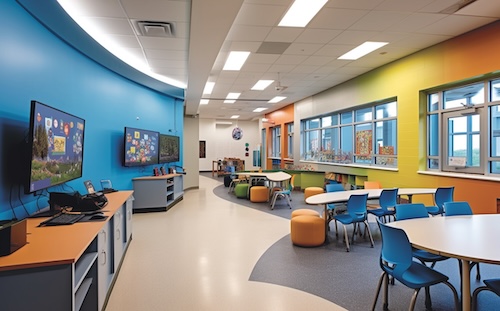
By embracing Universal Design for Learning (UDL) principles in purchasing decisions, school leaders can create learning spaces that not only accommodate students with disabilities but enhance the educational experience for all learners while delivering exceptional returns on investment (ROI).
Strangely enough, the concept of UDL all started with curb cuts. Disability activists in the 1960s were advocating for adding curb cuts at intersections so that users of wheelchairs could cross streets independently. Once curb cuts became commonplace, there was a surprising secondary effect: Curb cuts did not just benefit the lives of those in wheelchairs, they benefited parents with strollers, kids on bikes, older adults using canes, delivery workers with carts, and travelers using rolling suitcases. What had been designed for one specific group ended up accidentally benefiting many others.
UDL is founded on this idea of the “curb-cut effect.” UDL focuses on designing classrooms and schools to provide multiple ways for students to learn. While the original focus was making the curriculum accessible to multiple types of learners, UDL also informs the physical design of classrooms and schools. Procurement professionals are focusing on furniture and technology purchases that provide flexible, accessible, and supportive environments so that all learners can benefit. Today entire conferences, such as EDspaces, focus on classroom and school design to improve learning outcomes.
There is now a solid research base indicating that the design of learning spaces is a critical factor in educational success: Learning space design changes can significantly influence student engagement, well-being, and academic achievement. While we focus on obvious benefits for specific types of learners, we often find unexpected ways that all students benefit. Adjustable desks designed for wheelchair users can improve focus and reduce fatigue in many students, especially those with ADHD. Providing captions on videos, first made available for deaf students, benefit ELL and other students struggling to learn to read.
Applying UDL to school purchasing decisions
UDL represents a paradigm shift from retrofitting solutions for individual students to proactively designing inclusive environments from the ground up. Strategic purchasing focuses on choosing furniture and tech tools that provide multiple means of engagement that can motivate and support all types of learners.
Furniture that works for everyone
Modern classroom furniture has evolved far beyond the traditional one-size-fits-all model. Flexible seating options such as stability balls, wobble cushions, and standing desks can transform classroom dynamics. While these options support students with ADHD or sensory processing needs, they also provide choice and movement opportunities that enhance engagement for neurotypical students. Research consistently shows that physical comfort directly correlates with cognitive performance and attention span.
Modular furniture systems offer exceptional value by adapting to changing needs throughout the school year. Tables and desks that can be easily reconfigured support collaborative learning, individual work, and various teaching methodologies. Storage solutions with clear labeling systems and accessible heights benefit students with visual impairments and executive functioning challenges while helping all students maintain organization and independence.
Technology that opens doors for all learners
Assistive technology has evolved from specialized, expensive solutions to mainstream tools that benefit diverse learners. Screen readers like NVDA and JAWS remain essential for students with visual impairments, but their availability also supports students with dyslexia who benefit from auditory reinforcement of text. When procuring software licenses, prioritize platforms with built-in accessibility features rather than purchasing separate assistive tools.
Voice-to-text technology exemplifies the UDL principle perfectly. While crucial for students with fine motor challenges or dysgraphia, these tools also benefit students who process information verbally, ELL learners practicing pronunciation, and any student working through complex ideas more efficiently through speech than typing.
Adaptive keyboards and alternative input devices address various physical needs while offering all students options for comfortable, efficient interaction with technology. Consider keyboards with larger keys, customizable layouts, or touchscreen interfaces that can serve multiple purposes across your student population.
Interactive displays and tablets with built-in accessibility features provide multiple means of engagement and expression. Touch interfaces support students with motor difficulties while offering kinesthetic learning opportunities for all students. When evaluating these technologies, prioritize devices with robust accessibility settings including font size adjustment, color contrast options, and alternative navigation methods.
Maximizing your procurement impact
Strategic procurement for UDL requires thinking beyond individual products to consider system-wide compatibility and scalability. Prioritize vendors who demonstrate commitment to accessibility standards and provide comprehensive training on using accessibility features. The most advanced assistive technology becomes worthless without proper implementation and support.
Conduct needs assessments that go beyond compliance requirements to understand your learning community’s diverse needs. Engage with special education teams, occupational therapists, and technology specialists during the procurement process. Their insights can prevent costly mistakes and identify opportunities for solutions that serve multiple populations.
Consider total cost of ownership when evaluating options. Adjustable-height desks may cost more initially but can eliminate the need for specialized furniture for individual students. Similarly, mainstream technology with robust accessibility features often costs less than specialized assistive devices while serving broader populations.
Pilot programs prove invaluable for testing solutions before large-scale implementation. Start with small purchases to evaluate effectiveness, durability, and user satisfaction across diverse learners. Document outcomes to build compelling cases for broader adoption.
The business case for UDL
Procurement decisions guided by UDL principles deliver measurable returns on investment. Reduced need for individualized accommodations decreases administrative overhead while improving response times for student needs. Universal solutions eliminate the stigma associated with specialized equipment, promoting inclusive classroom cultures that benefit all learners.
Leslie Stebbins, Research4Ed
Leslie Stebbins is the director of Research4Ed. She has more than twenty-five years of experience in higher education and K-12 learning and design. She has an M.Ed. from the Technology Innovation & Education Program at the Harvard Graduate School of Education and a Master’s in Library and Information Science from Simmons College.
Latest posts by eSchool Media Contributors (see all)
An unexpected group of presenters–11th graders from Whitney M. Young Magnet High School in Chicago–made a splash at this year’s ACM Conference on Fairness, Accountability, and Transparency (FAccT). These students captivated seasoned researchers and professionals with their insights on how school environments shape students’ views of AI. “I wanted our project to serve as a window into the eyes of high school students,” said Autumn Moon, one of the student researchers.
What enabled these students to contribute meaningfully to a conference dominated by PhDs and industry veterans was their critical data literacy–the ability to understand, question, and evaluate the ethics of complex systems like AI using data. They developed these skills through their school’s Data is Powerprogram.
Launched last year, Data is Power is a collaboration among K-12 educators, AI ethics researchers, and the Young Data Scientists League. The program includes four pilot modules that are aligned to K-12 standards and cover underexplored but essential topics in AI ethics, including labor and environmental impacts. The goal is to teach AI ethics by focusing on community-relevant topics chosen by our educators with input from students, all while fostering critical data literacy. For example, Autumn’s class in Chicago used AI ethics as a lens to help students distinguish between evidence-based research and AI propaganda. Students in Phoenix explored how conversational AI affects different neighborhoods in their city.
Why does the Data is Power program focus on critical data literacy? In my former role leading a diverse AI team at Amazon, I saw that technical skills alone weren’t enough. We needed people who could navigate cultural nuance, question assumptions, and collaborate across disciplines. Some of the most technically proficient candidates struggled to apply their knowledge to real-world problems. In contrast, team members trained in critical data literacy–those who understood both the math and the societal context of the models–were better equipped to build responsible, practical tools. They also knew when not to build something.
As AI becomes more embedded in our lives, and many students feel anxious about AI supplanting their job prospects, critical data literacy is a skill that is not just future-proof–it is future-necessary. Students (and all of us) need the ability to grapple with and think critically about AI and data in their lives and careers, no matter what they choose to pursue. As Milton Johnson, a physics and engineering teacher at Bioscience High School in Phoenix, told me: “AI is going to be one of those things where, as a society, we have a responsibility to make sure everyone has access in multiple ways.”
Critical data literacy is as much about the humanities as it is about STEM. “AI is not just for computer scientists,” said Karren Boatner, who taught Autumn in her English literature class at Whitney M. Young Magnet High School. For Karren, who hadn’t considered herself a “math person” previously, one of the most surprising parts of the program was how much she and her students enjoyed a game-based module that used middle school math to explain how AI “learns.” Connecting math and literature to culturally relevant, real-world issues helps students see both subjects in a new light.
As AI continues to reshape our world, schools must rethink how to teach about it. Critical data literacy helps students see the relevance of what they’re learning, empowering them to ask better questions and make more informed decisions. It also helps educators connect classroom content to students’ lived experiences.
If education leaders want to prepare students for the future–not just as workers, but as informed citizens–they must invest in critical data literacy now. As Angela Nguyen, one of our undergraduate scholars from Stanford, said in her Data is Power talk: “Data is power–especially youth and data. All of us, whether qualitative or quantitative, can be great collectors of meaningful data that helps educate our own communities.”
Evan Shieh, Young Data Scientists League
Evan Shieh is the Executive Director of the Young Data Scientists League.
Latest posts by eSchool Media Contributors (see all)
I’ll admit that I use AI. I’ve asked it to help me figure out challenging Excel formulas that otherwise would have taken me 45 minutes and a few tutorials to troubleshoot. I’ve used it to help me analyze or organize massive amounts of information. I’ve even asked it to help me devise a running training program aligning with my goals and fitting within my schedule. AI is a fantastic tool–and that’s the point. It’s a tool, not a replacement for thinking.
As AI tools become more capable, more intuitive, and more integrated into our daily lives, I’ve found myself wondering: Are we growing too dependent on AI to do our thinking for us?
This question isn’t just philosophical. It has real consequences, especially for students and young learners. A recent study published in the journal Societies reports that people who used AI tools consistently showed a decline in critical thinking performance. In fact, “whether someone used AI tools was a bigger predictor of a person’s thinking skills than any other factor, including educational attainment.” That’s a staggering finding because it suggests that using AI might not just be a shortcut. It could be a cognitive detour.
The atrophy of the mind
The term “digital dementia” has been used to describe the deterioration of cognitive abilities as a result of over-reliance on digital devices. It’s a phrase originally associated with excessive screen time and memory decline, but it’s found new relevance in the era of generative AI. When we depend on a machine to generate our thoughts, answer our questions, or write our essays, what happens to the neural pathways that govern our own critical thinking? And will the upcoming era of agentic AI expedite this decline?
Cognitive function, like physical fitness, follows the rule of “use it or lose it.” Just as muscles weaken without regular use, the brain’s ability to evaluate, synthesize, and critique information can atrophy when not exercised. This is especially concerning in the context of education, where young learners are still building those critical neural pathways.
In short: Students need to learn how to think before they delegate that thinking to a machine.
Can you still think critically with AI?
Yes, but only if you’re intentional about it.
AI doesn’t relieve you of the responsibility to think–in many cases, it demands even more critical thinking. AI produces hallucinations, falsifies claims, and can be misleading. If you blindly accept AI’s output, you’re not saving time, you’re surrendering clarity.
Using AI effectively requires discernment. You need to know what you’re asking, evaluate what you’re given, and verify the accuracy of the result. In other words, you need to think before, during, and after using AI.
The “source, please” problem
One of the simplest ways to teach critical thinking is also the most annoying–just ask my teenage daughter. When she presents a fact or claim that she saw online, I respond with some version of: “What’s your source?” It drives her crazy, but it forces her to dig deeper, check assumptions, and distinguish between fact and fiction. It’s an essential habit of mind.
But here’s the thing: AI doesn’t always give you the source. And when it does, sometimes it’s wrong, or the source isn’t reputable. Sometimes it requires a deeper dive (and a few more prompts) to find answers, especially to complicated topics. AI often provides quick, confident answers that fall apart under scrutiny.
So why do we keep relying on it? Why are AI responses allowed to settle arguments, or serve as “truth” for students when the answers may be anything but?
The lure of speed and simplicity
It’s easier. It’s faster. And let’s face it: It feels like thinking. But there’s a difference between getting an answer and understanding it. AI gives us answers. It doesn’t teach us how to ask better questions or how to judge when an answer is incomplete or misleading.
This process of cognitive offloading (where we shift mental effort to a device) can be incredibly efficient. But if we offload too much, too early, we risk weakening the mental muscles needed for sustained critical thinking.
Implications for educators
So, what does this mean for the classroom?
First, educators must be discerning about how they use AI tools. These technologies aren’t going away, and banning them outright is neither realistic nor wise. But they must be introduced with guardrails. Students need explicit instruction on how to think alongside AI, not instead of it.
Second, teachers should emphasize the importance of original thought, iterative questioning, and evidence-based reasoning. Instead of asking students to simply generate answers, ask them to critique AI-generated ones. Challenge them to fact-check, source, revise, and reflect. In doing so, we keep their cognitive skills active and growing.
And finally, for young learners, we may need to draw a harder line. Students who haven’t yet formed the foundational skills of analysis, synthesis, and evaluation shouldn’t be skipping those steps. Just like you wouldn’t hand a calculator to a child who hasn’t yet learned to add, we shouldn’t hand over generative AI tools to students who haven’t learned how to write, question, or reason.
A tool, not a crutch
AI is here to stay. It’s powerful, transformative, and, when used well, can enhance our work and learning. But we must remember that it’s a tool, not a replacement for human thought. The moment we let it think for us is the moment we start to lose the capacity to think for ourselves.
If we want the next generation to be capable, curious, and critically-minded, we must protect and nurture those skills. And that means using AI thoughtfully, sparingly, and always with a healthy dose of skepticism. AI is certainly proving it has staying power, so it’s in all our best interests to learn to adapt. However, let’s adapt with intentionality, and without sacrificing our critical thinking skills or succumbing to any form of digital dementia.
Laura Hakala, Magic EdTech
Laura Hakala is the Director of Online Program Design and Efficacy for Magic EdTech. With nearly two decades of leadership and strategic innovation experience, Laura is a go-to resource for content, problem-solving, and strategic planning. Laura is passionate about DE&I and is a fierce advocate, dedicated to making meaningful changes. When it comes to content management, digital solutions, and forging strategic partnerships, Laura’s expertise shines through. She’s not just shaping the future; she’s paving the way for a more inclusive and impactful tomorrow.
Latest posts by eSchool Media Contributors (see all)
While most teachers are eager to implement the science of reading, many lack the time and tools to connect these practices to home-based support, according to a new national survey from Lexia, a Cambium Learning Group brand.
The 2025 Back-to-School Teacher Survey, with input from more than 1,500 K–12 educators nationwide, points to an opportunity for district leaders to work in concert with teachers to provide families with the science of reading-based literacy resources they need to support student reading success.
Key insights from the survey include:
60 percent of teachers are either fully trained or interested in learning more about the science of reading
Only 15 percent currently provide parents with structured, evidence-based literacy activities
79 percent of teachers cite time constraints and parents’ work schedules as top barriers to family engagement
Just 10 percent report that their schools offer comprehensive family literacy programs
Teachers overwhelmingly want in-person workshops and video tutorials to help parents support reading at home
“Teachers know that parental involvement can accelerate literacy and they’re eager for ways to strengthen those connections,” said Lexia President Nick Gaehde. “This data highlights how districts can continue to build on momentum in this new school year by offering scalable, multilingual, and flexible family engagement strategies that align with the science of reading.”
Teachers also called for:
Better technology tools for consistent school-to-home communication
Greater multilingual support to serve diverse communities
Professional learning that includes family engagement training
Gaehde concluded, “Lexia’s survey reflects the continued national emphasis on Structured Literacy and shows that equipping families is essential to driving lasting student outcomes. At Lexia we’re committed to partnering with districts and teachers to strengthen the school-to-home connection. By giving educators practical tools and data-driven insights, we help teachers and families work together–ensuring every child has the literacy support they need to thrive.”
Approximately 1 in 5 children in the United States are estimated to be neurodivergent, representing a spectrum of learning and thinking differences such as autism, ADHD, dyslexia, and more. These children experience the world in unique and valuable ways, but too often, our education systems fail to recognize or nurture their potential. In an already challenging educational landscape, where studies show a growing lack of school readiness nationwide, it is more important than ever to ensure that neurodivergent young learners receive the resources and support they need to succeed.
Early support and intervention
As President and CEO of Collaborative for Children, I have personally seen the impact that high-quality early childhood education can have on a child’s trajectory. Birth to age five is the most critical window for brain development, laying the foundation for lifelong learning, behavior, and health. However, many children are entering their academic years without the basic skills needed to flourish. For neurodivergent children, who often need tailored approaches to learning, the gap is even wider.
Research indicates that early intervention, initiated within the first three years of life, can significantly enhance outcomes for neurodivergent children. Children who receive individualized support are more likely to develop stronger language, problem-solving, and social skills. These gains not only help in the classroom but can also lead to higher self-confidence, better relationships and improved well-being into adulthood.
The Collaborative for Children difference
Collaborative for Children in Houston focuses on early childhood education and is committed to creating inclusive environments where all children can thrive. In Houston, we have established 125 Centers of Excellence within our early childhood learning network. The Centers of Excellence program helps child care providers deliver high-quality early education that prepares children for kindergarten and beyond. Unlike drop-in daycare, our certified early childhood education model focuses on long-term development, combining research-backed curriculum, business support and family engagement.
This year, we are expanding our efforts by providing enhanced training to center staff and classroom teachers, equipping them with effective strategies to support neurodivergent learners. These efforts will focus on implementing practical, evidence-based approaches that make a real difference.
Actionable strategies
As educators and leaders, we need to reimagine how learning environments are designed and delivered. Among the most effective actionable strategies are:
Creating sensory-friendly classrooms that reduce environmental stressors like noise, lighting, and clutter to help children stay calm and focused.
Offering flexible learning formats to meet a range of communication, motor, and cognitive styles, including visual aids, movement-based activities, and assistive technology.
Training teachers to recognize and respond to diverse behaviors with empathy and without stigma, so that what is often misinterpreted as “disruption” is instead seen as a signal of unmet needs.
Partnering with families to create support plans tailored to each child’s strengths and challenges to ensure continuity between home and classroom.
Incorporating play-based learning that promotes executive functioning, creativity, and social-emotional development, especially for children who struggle in more traditional formats.
Benefits of inclusive early education
Investing in inclusive, high-quality early education has meaningful benefits not only for neurodivergent children, but for other students, educators, families and the broader community. Research indicates that neurotypical students who learn alongside neurodivergent peers develop critical social-emotional skills such as patience, compassion and acceptance. Training in inclusive practices can help educators gain the confidence and tools needed to effectively support a wide range of learning styles and behaviors as well as foster a more responsive learning environment.
Prioritizing inclusive early education can also create strong bonds between families and schools. These partnerships empower caregivers to play an active role in their child’s development, helping them navigate challenges and access critical resources early on. Having this type of support can be transformative for families by reducing feelings of isolation and reinforcing that their child is seen, valued, and supported.
The benefits of inclusive early education extend far beyond the classroom. When neurodivergent children receive the support they need early in life, it lays the groundwork for increased workforce readiness. Long-term economic gains can include higher employment rates and greater earning potential for individuals.
Early childhood education must evolve to meet the needs of neurodivergent learners. We cannot afford to overlook the importance of early intervention and tailored learning environments. If we are serious about improving outcomes for all children, we must act now and commit to inclusivity as a core pillar of our approach. When we support all children early, everyone benefits.
Dr. Melanie Johnson, Collaborative for Children
Dr. Melanie Johnson serves as the President and CEO of Collaborative for Children, where she leads groundbreaking initiatives in early learning enterprise systems across Texas’s Gulf Coast region. Her work focuses on improving school-readiness outcomes for under-resourced children from birth to age five through metrics-driven outcomes and digital transformation.
Latest posts by eSchool Media Contributors (see all)
While there is wide agreement that student engagement plays a vital role in learning, educators continue to face uncertainty about what engagement looks like, how best to measure it, and how to sustain it, according to a new study from Discovery Education.
“Discovery Education conducted the EducationInsights report to gain a deeper understanding of how engagement is defined, observed, and nurtured in K-12 classrooms nationwide, and we are thankful to the participants who shared their perspectives and insights with us,” said Brian Shaw, Discovery Education’s Chief Executive Officer. “One of the most important findings of this report is that engagement is seen as essential to learning, but is inconsistently defined, observed, and supported in K-12 classrooms. I believe this highlights the need for a more standardized approach to measuring student engagement and connecting it to academic achievement. Discovery Education has embarked on an effort to address those challenges, and we look forward to sharing more as our work progresses.”
Key findings of the Education Insights 2025–2026: Fueling Learning Through Engagementreport include:
Engagement is broadly recognized as a key driver of learning and success. Ninety-three percent of educators surveyed agreed that student engagement is a critical metric for understanding overall achievement, and 99 percent of superintendents polled believe student engagement is one of the top predictors of success at school. Finally, 92 percent of students said that engaging lessons make school more enjoyable.
But educators disagree on the top indicators of engagement. Seventy-two percent of teachers rated asking thoughtful questions as the strongest indicator of student engagement. However, 54 percent of superintendents identified performing well on assessments as a top engagement indicator. This is nearly twice as high as teachers, who rank assessments among the lowest indicators of engagement.
School leaders and teachers disagree on if their schools have systems for measuring engagement. While 99 percent of superintendents and 88 percent of principals said their district has an intentional approach for measuring engagement, only 60 percent of teachers agreed. Further, nearly one-third of teachers said that a lack of clear, shared definitions of student engagement is a top challenge to measuring engagement effectively.
Educators and students differ on their perceptions of engagement levels. While 63 percent of students agreed with the statement “Students are highly engaged in school,” only 45 percent of teachers and 51 percent of principals surveyed agreed with the same statement.
Students rate their own engagement much higher than their peers. Seventy percent of elementary students perceived themselves as engaged, but only 42 percent perceived their peers as engaged. Fifty-nine percent of middle school students perceived themselves engaged in learning, but only 36 percent perceived their peers as engaged. Finally, 61 percent of high school students perceived themselves as engaged, but only 39 percent described their peers as engaged.
Proximity to learning changes impressions of AI. Two-thirds of students believe AI could help them learn faster, yet fewer than half of teachers report using AI themselves to complete tasks. Only 57 percent of teachers agreed with the statement “I frequently learn about positive ways students are using AI,” while 87 percent of principals and 98 percent of superintendents agree. Likewise, only 53 percent of teachers agreed with the statement “I am excited about the potential for AI to support teaching and learning,” while 83 percent of principals and 94 percent of superintendents agreed.
In classrooms across the country, students are mastering their ABCs, solving equations, and diving into science. But one essential life skill–behavior–is not in the lesson plan. For too long, educators have assumed that children arrive at school knowing how to regulate emotions, resolve conflict, and interact respectfully. The reality: Behavior–like math or reading–must be taught, practiced, and supported.
Today’s students face a mounting crisis. Many are still grappling with anxiety, disconnection, and emotional strain following the isolation and disruption of the COVID pandemic. And it’s growing more serious.
Further complicating matters is social media and device usage. Students and adults alike have become deeply reliant on screens. Social media and online socialization–where interactions are often anonymous and less accountable–have contributed to a breakdown in conflict resolution, empathy, and recognition of nonverbal cues. Widespread attachment to cell phones has significantly disrupted students’ ability to regulate emotions and engage in healthy, face-to-face interactions. Teachers, too, are frequently on their phones, modeling device-dependent behaviors that can shape classroom dynamics.
It’s clear: students can’t be expected to know what they haven’t been taught. And teachers can’t teach behavior without real tools and support. While districts have taken well-intentioned steps to help teachers address behavior, many initiatives rely on one-off training without cohesive, long-term strategies. Real progress demands more–a districtwide commitment to consistent, caring practices that unify educators, students, and families.
A holistic framework: School, student, family
Lasting change requires a whole-child, whole-school, whole-family approach. When everyone in the community is aligned, behavior shifts from a discipline issue to a core component of learning, transforming classrooms into safe, supportive environments where students thrive and teachers rediscover joy in their work. And when these practices are reinforced at home, the impact multiplies.
To help students learn appropriate behavior, teachers need practical tools rather than abstract theories. Professional development, tiered supports, targeted interventions, and strategies to build student confidence are critical. So is measuring impact to ensure efforts evolve and endure.
Some districts are leading the way, embracing data-driven practices, evidence-based strategies, and accessible digital resources. And the results speak for themselves. Here are two examples of successful implementations.
Evidence-based behavior training and mentorship yields 24 percent drop in infractions within weeks
With more than 19,000 racially diverse students across 24 schools east of Atlanta, Newton County Schools prioritized embedded practices and collaborative coaching over rigid compliance. Newly hired teachers received stipends to complete curated, interactive behavior training before the school year began. They then expanded on these lessons during orientation with district staff, deepening their understanding.
Once the school year started, each new teacher was partnered with a mentor who provided behavior and academic guidance, along with regular classroom feedback. District climate specialists also offered further support to all teachers to build robust professional learning communities.
The impact was almost immediate. Within the first two weeks of school, disciplinary infractions fell by 24 percent compared to the previous year–evidence that providing the right tools, complemented by layered support and practical coaching, can yield swift, sustainable results.
Pairing shoulder coaching with real-time data to strengthen teacher readiness
With more than 300,000 students in over 5,300 schools spanning urban to rural communities, Clark County School District in Las Vegas is one of the largest and most diverse in the nation.
Recognizing that many day-to-day challenges faced by new teachers aren’t fully addressed in college training, the district introduced “shoulder coaching.” This mentorship model pairs incoming teachers with seasoned colleagues for real-time guidance on implementing successful strategies from day one.
This hands-on approach incorporates videos, structured learning sessions, and continuous data collection, creating a dynamic feedback loop that helps teachers navigate classroom challenges proactively. Rather than relying solely on reactive discipline, educators are equipped with adaptable strategies that reflect lived classroom realities. The district also uses real-time data and teacher input to evolve its behavior support model, ensuring educators are not only trained, but truly prepared.
By aligning lessons with the school performance plan, Clark County School District was able to decrease suspensions by 11 percent and discretionary exclusions by 17 percent.
Starting a new chapter in the classroom
Behavior isn’t a side lesson–it’s foundational to learning. When we move beyond discipline and make behavior a part of daily instruction, the ripple effects are profound. Classrooms become more conducive to learning. Students and families develop life-long tools. And teachers are happier in their jobs, reducing the churn that has grown post-pandemic.
The evidence is clear. School districts that invest in proactive, strategic behavior supports are building the kind of environments where students flourish and educators choose to stay. The next chapter in education depends on making behavior essential. Let’s teach it with the same care and intentionality we bring to every other subject–and give every learner the chance to succeed.
Dr. Tami Dean, The Equity Hour Podcast & Kareeme Hawkins, RethinkEd and Pivot Path Strategic Solutions
Dr. Tami Dean is a veteran educator, coach, and leader with over 20 years of experience in classroom instruction, curriculum design, and educational leadership. She supports K-12 and higher education through strategic planning, professional development, and innovative program design and hosts The Equity Hour Podcast™, where she leads thought-provoking conversations on teaching, leadership and transformation in education.
Kareeme Hawkins is an education leader, executive coach, and SEL expert with over 15 years of experience in K–12 instruction, counseling, and edtech leadership. As national director of Client Success at RethinkEd and an executive coach with Pivot Path Strategic Solutions, she drives strategic initiatives, fosters partnerships, and empowers leaders to navigate change and advance equity-driven practices.
Latest posts by eSchool Media Contributors (see all)
By now, it’s no secret that phones are a problem in classrooms. A growing body of research and an even louder chorus of educators point to the same conclusion: students are distracted, they’re disengaged, and their learning is suffering. What’s less clear is how to solve this issue.
Of late, school districts across the country are drawing firmer lines. From Portland, Maine to Conroe, Texas and Springdale, Arkansas, administrators are implementing “bell-to-bell” phone bans, prohibiting access from the first bell to the last. Many are turning to physical tools like pouches and smart lockers, which lock away devices for the duration of the day, to enforce these rules. The logic is straightforward: take the phones away, and you eliminate the distraction.
In many ways, it works. Schools report fewer behavioral issues, more focused classrooms, and an overall sense of calm returning to hallways once buzzing with digital noise. But as these policies scale, the limitations are becoming more apparent.
But students, as always, find ways around the rules. They’ll bring second phones to school or slip their device in undetected–and more. Teachers, already stretched thin, are now tasked with enforcement, turning minor infractions into disciplinary incidents.
Some parents and students are also pushing back, arguing that all-day bans are too rigid, especially when phones serve as lifelines for communication, medical needs, or even digital learning. In Middletown, Connecticut, students reportedly became emotional just days after a new ban took effect, citing the abrupt change in routine and lack of trust.
The bigger question is this: Are we trying to eliminate phones, or are we trying to teach responsible use?
That distinction matters. While it’s clear that phone misuse is widespread and the intent behind bans is to restore focus and reduce anxiety, blanket prohibitions risk sending the wrong message. Instead of fostering digital maturity, they can suggest that young people are incapable of self-regulation. And in doing so, they may sidestep an important opportunity: using school as a place to practice responsible tech habits, not just prohibit them.
This is especially critical given the scope of the problem. A recent study by Fluid Focus found that students spend five to six hours a day on their phones during school hours. Two-thirds said it had a negative impact on their academic performance. According to the National Center for Education Statistics, 77 percent of school leaders believe phones hurt learning. The data is hard to ignore.
But managing distraction isn’t just about removal. It’s also about design. Schools that treat device policy as an infrastructure issue, rather than a disciplinary one, are beginning to implement more structured approaches.
Some are turning to smart locker systems that provide centralized, secure phone storage while offering greater flexibility: configurable access windows, charging capabilities, and even low admin options to help keep teachers teaching. These systems don’t “solve” the phone problem, but they do help schools move beyond the extremes of all-or-nothing.
And let’s not forget equity. Not all students come to school with the same tech, support systems, or charging access. A punitive model that assumes all students have smartphones (or can afford to lose access to them) risks deepening existing divides. Structured storage systems can help level the playing field, offering secure and consistent access to tech tools without relying on personal privilege or penalizing students for systemic gaps.
That said, infrastructure alone isn’t the answer. Any solution needs to be accompanied by clear communication, transparent expectations, and intentional alignment with school culture. Schools must engage students, parents, and teachers in conversations about what responsible phone use actually looks like and must be willing to revise policies based on feedback. Too often, well-meaning bans are rolled out with minimal explanation, creating confusion and resistance that undermine their effectiveness.
Nor should we idealize “focus” as the only metric of success. Mental health, autonomy, connection, and trust all play a role in creating school environments where students thrive. If students feel overly surveilled or infantilized, they’re unlikely to engage meaningfully with the values behind the policy. The goal should not be control for its own sake, it should be cultivating habits that carry into life beyond the classroom.
The ubiquity of smartphones is undeniable. While phones are here to stay, the classroom represents one of the few environments where young people can learn how to use them wisely, or not at all. That makes schools not just sites of instruction, but laboratories for digital maturity.
The danger isn’t that we’ll do too little. It’s that we’ll settle for solutions that are too simplistic or too focused on optics, instead of focusing not on outcomes.
We need more than bans. We need balance. That means moving past reactionary policies and toward systems that respect both the realities of modern life and the capacity of young people to grow. It means crafting strategies that support teachers without overburdening them, that protect focus without sacrificing fairness, and that reflect not just what we’re trying to prevent, but what we hope to build.
The real goal shouldn’t be to simply get phones out of kids’ hands. It should be to help them learn when to put them down on their own.
Emily Smith, HonestWaves
Emily Smith is the founder of HonestWaves, a California-based company that designs and suppliesphone charging solutions, including smart lockers and charging stations, for businesses and public spaces.
Latest posts by eSchool Media Contributors (see all)