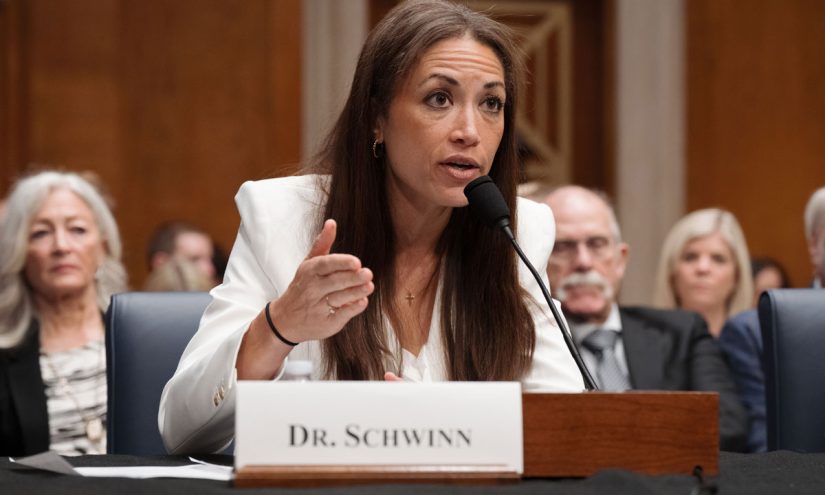
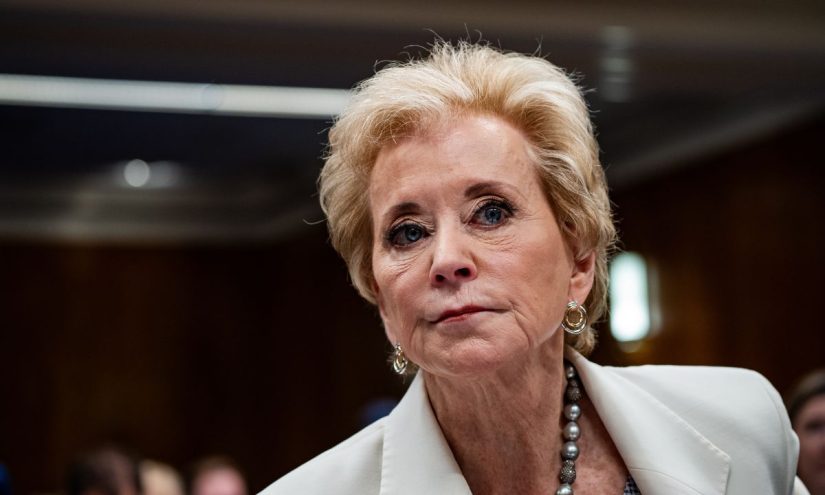
Penny Schwinn, in line to serve as second in command of the U.S. Department of Education, has withdrawn from the nomination, Education Secretary Linda McMahon announced Thursday.
Instead, the former Tennessee education commissioner will take on a different role for the department.
“I am grateful to Dr. Schwinn for her commitment to serving students, families, and educators across the nation,” McMahon said in a statement. “Penny is a brilliant education mind and I look forward to continuing working with her as my chief strategist to make education great again.”
Schwinn, in a statement, said she gave the decision “thoughtful consideration” and said she will “remain committed to protecting kids, raising achievement and expanding opportunity — my lifelong mission and north star.”
Considered a champion for improving reading outcomes and high-dosage tutoring, Schwinn was among President Donald Trump’s early picks for department posts. Many perceived her as a more bipartisan choice than others joining the administration, but among Tennessee conservatives, many who felt she was too liberal, opposition to her nomination was strong.
The timing of Schwinn’s withdrawal couldn’t be worse, according to some conservatives.
“Her decision to remove herself from consideration to become deputy secretary hurts students, educators, and the Trump administration,” said Jim Blew, co-founder of the Defense of Freedom Institute, a think tank. “Secretary McMahon has been charged by Congress and the president with huge tasks under the One Big Beautiful Bill and several urgent executive orders.”
As head of the Education Department, McMahon is striving to turn more authority over education to the states. It’s now unclear who will step into the deputy position and take the lead on the state’s requests for more flexibility over education funding. At least two states, Iowa and Oklahoma, have already submitted requests for block grants, and Indiana is currently gathering comments from the public in preparation for a similar proposal. Kirsten Baesler, North Dakota’s long-time education chief, is currently awaiting confirmation to be assistant secretary for elementary and secondary education at the department. In February, she joined 11 other GOP chiefs in asking McMahon for greater freedom to direct education funds toward state-level needs.
Controversies and questions over Schwinn’s conservative qualifications have followed her for years. Far-right groups, including Moms for Liberty, said her past support for equity initiatives, like hiring more teachers of color, was evidence that she was not a good fit for an administration determined to eliminate such programs. Others remained angry over Schwinn’s pandemic-era plan to conduct “well-being” home visits. Even though she scrapped the plan, parents and members of the legislature considered it an example of government overreach.
More recently, Steve Gill, a conservative commentator in Tennessee, reported that while she was deputy superintendent of the Texas Education Agency, Schwinn recommended individuals who advocate for comprehensive sex education, including abortion rights, to advise the state on health curriculum.
Gill told The 74 he shared his TriStar Daily article about her stance on these issues with Tennessee Sens. Marsha Blackburn and Bill Hagerty, as well as the state’s congressional delegation. Blackburn, who is expected to run for governor next year, was considered a possible no vote for Schwinn.
According to Gill, Blackburn’s office “has been working tirelessly behind the scenes with the White House, Secretary Linda McMahon and Majority Leader [John] Thune to block the confirmation.”
But Madi Biedermann, spokeswoman for the department, said the agency “strongly disagrees with that characterization.”
Republican Sen. Marsha Blackburn from Tennessee was expected to vote no on Penny Schwinn’s confirmation. (Anna Moneymaker/Getty Images)
Blew said it’s unfortunate that politics got in the way, noting that Schwinn’s experience in both blue and red states would have brought valuable expertise to the Ed Department role. In addition to her jobs in Tennessee and Texas, Schwinn founded a charter school in Sacramento and also served in the Delaware Department of Education.
“It’s sad that a handful of demagogues are standing in the way of giving Secretary McMahon the team she needs to succeed,” he said.
Others praised Schwinn’s record of prioritizing the science of reading in Tennessee schools and directing COVID relief funds toward tutoring.
“This is a setback for all who want to see Washington slashing red tape, advancing literacy and fighting for common sense values,” said Rick Hess, director of education policy studies at the conservative American Enterprise Institute.
For some critics, Schwinn’s business ventures since leaving the top spot in Tennessee two years ago raised questions as she waited to appear before the Senate education committee.
In June, a day ahead of her joint hearing with three other nominees, The 74 reported that shortly after Trump tapped her for the job, she registered a new education consulting business in Florida, New Horizon BluePrint Group, with a longtime colleague. Before Schwinn filed ethics paperwork with the federal government, her sister replaced her as a manager on the business.
When a reporter from The 74 asked questions about the new project, Donald Fennoy, her colleague and a former superintendent of the Palm Beach County School District, dissolved the business.
Ethics experts say candidates for an administration post often distance themselves from new business entanglements to avoid any appearance of a conflict, but Schwinn has faced accusations of poor judgment before.
While she was in Texas, the state agency signed a $4.4 million no-bid contract in 2017 with a software company where she had a “professional relationship” with a subcontractor, according to a state audit. And in Tennessee, the education agency made an $8 million deal in 2021 with TNTP, a teacher training organization where her husband Paul Schwinn was employed at the time. Lawmakers considered the deal a “huge conflict.”
“Ethics was a crucial concern,” said J.C. Bowman, executive director and CEO of Professional Educators of Tennessee, a non-union organization. He was among those who sent letters to the Senate, asking them to remove her from consideration. “Her personal business interests and possible conflicts could potentially influence educational decisions in ways that many found difficult to overlook.”
Clarification: An earlier version of this story mischaracterized the role Penny Schwinn will take on in lieu of serving as the deputy education secretary. Schwinn will be taking on an advisory role at the Education Department.
A freeze on federal education funding that prompted two lawsuits has been lifted, and states will be able to access the money next week, the U.S. Department of Education announced Friday.
The White House Office of Management and Budget (OMB), which argued that districts were spending the money to advance a “radical left-wing agenda,” has completed its review of five different programs totaling $5.5 billion, said Madison Beidermann, spokeswoman for the department.
The funds support education for English learners and migrant students and pay for staff training and extra instructional positions. The news came a week after the administration released over $1.3 billion for summer and afterschool programs, which was also held up for review.
The department alerted states June 30, one day before they expected to receive the money, that the review was in process, forcing programs to cut staff and end summer programs early. Congress appropriated the funds for this coming school year, and President Donald Trump signed the budget in March.
The release of the funds, announced just hours before Education Secretary Linda McMahon was scheduled to meet with the nation’s governors in Colorado Springs, Colorado, comes as superintendents nationwide were preparing to eliminate services like literacy and math coaches, according to a survey conducted by AASA, the School Superintendents Association. Half of the 628 chiefs who responded from 43 states said they would have to lay off staff who work with special education students if the funds weren’t released. American Federation of Teachers President Randi Weingarten brought the message to attendees at the union’s annual TEACH conference in Washington, D.C.
“The administration backed down and we are getting the money,” she said to a cheering audience. “Those of you who lobbied yesterday, thank you. Those of you who brought the lawsuit, thank you.”
Attorney generals from 24 blue states and the District of Columbia sued on July 14 over the freeze, arguing that the administration’s actions were harming schools. School districts, parents, unions and nonprofits filed a second challenge on July 21, saying that OMB has never stood in the way of the department’s practice of releasing the funds in two steps, first on July 1 and the rest on Oct. 1. Republican senators joined their Democratic colleagues in pressuring the administration to free up the money.
Friday’s announcement doesn’t mean the legal fight is over. In a statement, Skye Perryman, president and CEO of Democracy Forward, which is handling the second case, said the legal team would “continue to monitor the situation and work in court to ensure the administration fully complies with the law and that these resources reach the schools and students who need them most.”
Districts can now start the school year without the shortfall, but that doesn’t mean advocates’ worries are over about future disruptions to funding. The July 1 distribution date is a longstanding practice, not something written into the law.
Tara Thomas, government affairs manager for AASA, said her organization wants to “have additional conversations” with Congress or the administration to “ensure that this type of uncertainty at the last minute doesn’t happen again. Districts need to continue to rely on stable, timely, reliable federal funding.”
Another fight over education funds could also be ahead. The White House is reportedly preparing another recissions package that would target education funding. Thomas said she didn’t know what might be included, but it could be cuts that the Department of Government Efficiency made to grant programs.
On Friday, Trump signed a recissions package, pulling back $9 billion in funds from public television and foreign aid.
When a white teacher at Decatur High School used the n-word in class in 2022, students walked out and marched in protest. But Reyes Le wanted to do more.
Until he graduated from the Atlanta-area school this year, he co-led its equity team. He organized walking tours devoted to Decatur’s history as a thriving community of freed slaves after the Civil War. Stops included a statue of civil rights leader John Lewis, which replaced a Confederate monument, and a historical marker recognizing the site where Rev. Martin Luther King, Jr. was jailed for driving with an out-of-state license.
Reyes Le, a Decatur High graduate, sits at the base of Celebration, a sculpture in the town’s central square that honors the city’s first Black commissioner and mayor. (Linda Jacobson/The 74)
But Le feared his efforts would collapse in the face of the Trump administration’s crackdown on diversity, equity and inclusion. An existing state law against “divisive concepts” meant students already had to get parent permission to go on the tour. Then the district threw out two non-discrimination policies April 15.
“I felt that the work we were doing wouldn’t be approved going into the future,” Le said.
Decatur got snared by the U.S. Department of Education’s threat to pull millions of dollars in federal funding from states and districts that employed DEI policies. In response, several organizations sued the department, calling its guidance vague and in violation of constitutional provisions that favor local control. Within weeks, three federal judges, including one Trump appointee, blocked Education Secretary Linda McMahon from enforcing the directives, and Decatur promptly reinstated its policies.
The reversal offers a glimpse into the courts’ role in thwarting — or at least slowing down — the Trump education juggernaut. States, districts, unions, civil rights groups and parents sued McMahon, and multiple courts agreed the department skirted the law in slashing funding and staff. But some observers say the administration is playing a long game and may view such losses as temporary setbacks.
“The administration’s plan is to push on multiple fronts to test the boundaries of what they can get away with,” said Jeffrey Henig, a professor emeritus of political science and education at Teachers College, Columbia University. “Cut personnel, but if needed, add them back later. What’s gained? Possible intimidation of ‘deep state’ employees and a chance to hire people that will be ‘a better fit.’ ”
A recent example of boundary testing: The administration withheld nearly $7 billion for education the president already approved in March.
But the move is practically lifted from the pages of Project 2025, the right-wing blueprint for Trump’s second term. In that document, Russ Vought, now Trump’s director of the Office of Management and Budget, argues that presidents must “handcuff the bureaucracy” and that the Constitution never intended for the White House to spend everything Congress appropriated.
The administration blames Democrats for playing the courts. White House Deputy Chief of Staff Stephen Miller accused “radical rogue judges” of getting in the president’s way.
The end result is often administrative chaos, leaving many districts unable to make routine purchases and displaced staff unsure whether to move on with their lives.
While the outcome in the lower courts has been mixed, the Supreme Court — which has looked favorably on much of Trump’s agenda — is expected any day to weigh in on the president’s biggest prize: whether McMahon can permanently cut half the department’s staff.
In that case, 21 Democratic attorneys general and a Massachusetts school district sued to prevent the administration from taking a giant step toward eliminating the department.
“Everything about defunding and dismantling by the administration is in judicial limbo,” said Neal McCluskey, director of the libertarian Cato Institute’s Center for Educational Freedom. As a supporter of eliminating the department, he lamented the slow pace of change. “If the Supreme Court allows mass layoffs, though, I would expect more energy to return to shrinking the department.”
The odds of that increased last week when the court ruled that mass firings at other agencies could remain in effect as the parties argue the case in the lower courts.
While the lawsuits over the Education Department are separate, Johnathan Smith, chief of staff and general counsel at the National Center for Youth Law, said the ruling is “clearly not a good sign.” His case, filed in May, focuses on cuts specifically to the department’s Office for Civil Rights, but the argument is essentially the same: The administration overstepped its authority when it gutted the department without congressional approval.
Solicitor General John Sauer, in his brief to the Supreme Court, said the states had no grounds to sue and called any fears the department couldn’t make do with a smaller staff merely “speculative.”
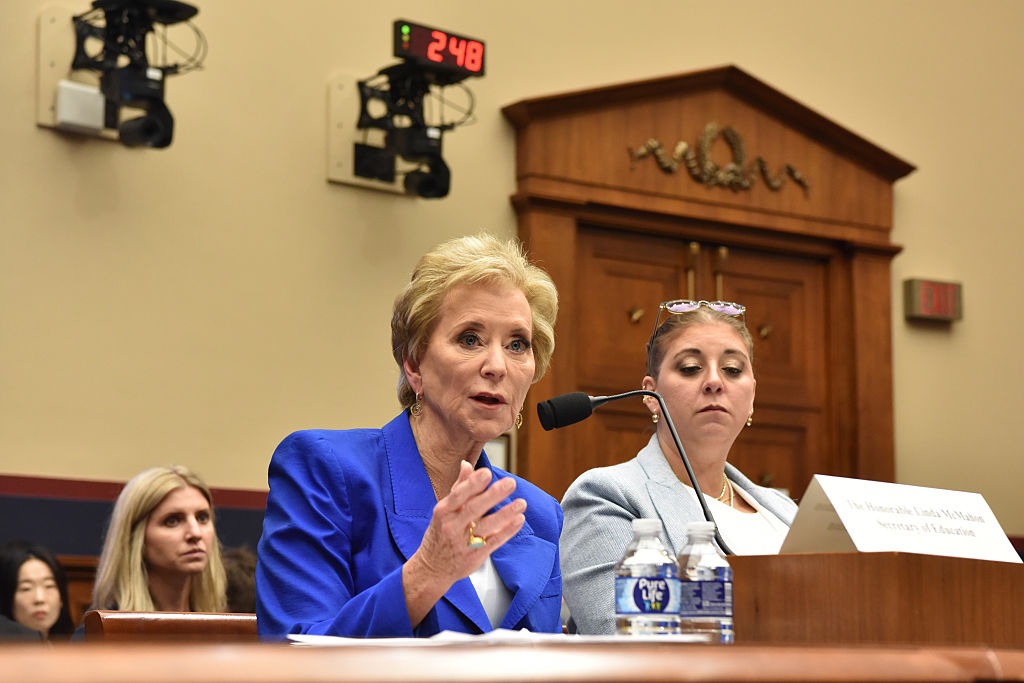
Education Secretary Linda McMahon defended her cuts to programs and staff before a House education committee June 4. (Sha Hanting/China News Service/VCG via Getty Images)
Even if the Supreme Court rules in McMahon’s favor, its opinion won’t affect previous rulings and other lawsuits in progress against the department.
Here’s where some of those key legal battles stand:
COVID relief funds
McMahon stunned states in late March when she said they would no longer receive more than $2 billion in reimbursements for COVID-related expenses. States would have to make a fresh case for how their costs related to the pandemic, even though the department had already approved extensions for construction projects, summer learning and tutoring.
On June 3, a federal judge in Maryland blocked McMahon from pulling the funds.
Despite the judicial order, not all states have been paid.
The Maryland Department of Education still had more than $400 million to spend. Cherie Duvall-Jones, a spokeswoman, said the agency hasn’t received any reimbursements even though it provided the “necessary documentation and information” federal officials requested.
The cancellation forced Baltimore City schools to dip into a reserve account to avoid disrupting tutoring and summer school programs.
Madison Biedermann, a spokeswoman for the department, declined to comment on why it had yet to pay Maryland or how much the department has distributed to other states since June.
Mass firings
In the administration’s push to wind down the department, McMahon admits she still needs staff to complete what she calls her “final mission.” On May 21, she told a House appropriations subcommittee that she had rehired 74 people. Biedermann wouldn’t say whether that figure has grown, and referred a reporter to the hearing video.
“You hope that you’re just cutting fat,” McMahon testified. “Sometimes you cut a little in the muscle.”
The next day, a federal district court ordered her to also reinstate the more than 1,300 employees she fired in March, about half of the department’s workforce. Updating the court on progress, Chief of Staff Rachel Oglesby said in a July 8 filing that she’s still reviewing survey responses from laid off staffers and figuring out where they would work if they return.
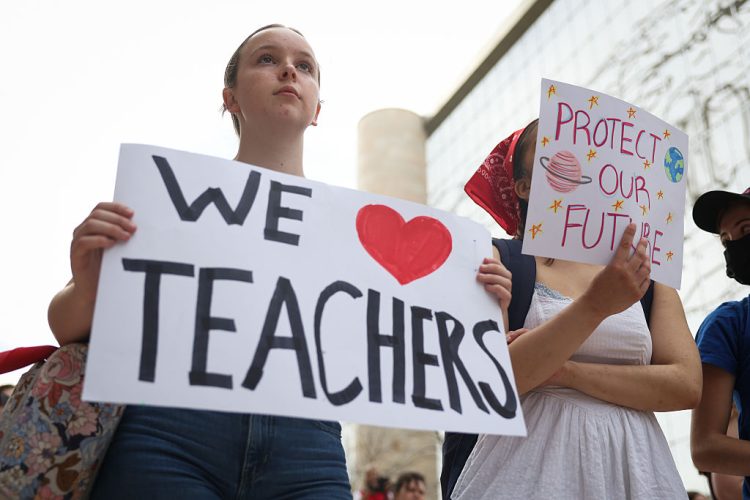
Student protestors participate in the “Hands Off Our Schools” rally in front of the U.S. Department of Education on April 4 in Washington, D.C. (Getty Images)
But some call the department’s efforts to bring back employees lackluster, perhaps because it’s pinning its hopes on a victory before the Supreme Court.
“This is a court that’s been fairly aggressive in overturning lower court decisions,” said Smith, with the National Center for Youth Law.
His group’s lawsuit is one of two challenging cuts to the Office for Civil Rights, which lost nearly 250 staffers and seven regional offices. They argue the cuts have left the department unable to thoroughly investigate complaints. Of the 5,164 civil rights complaints since March, OCR has dismissed 3,625, Oglesby reported.
In a case brought by the Victim Rights Law Center, a Massachusetts-based advocacy organization, a federal district court judge ordered McMahon to reinstate OCR employees.
Even if the case is not reversed on appeal, there’s another potential problem: Not all former staffers are eager to return.
“I have applied for other jobs, but I’d prefer to have certainty about my employment with OCR before making a transition,” said Andy Artz, who was a supervising attorney in OCR’s New York City office until the layoffs. “I feel committed to the mission of the agency and I’d like to be part of maintaining it if reinstated.”
DEI
An aspect of that mission, nurtured under the Biden administration, was to discourage discipline policies that result in higher suspension and expulsion rates for minority students. A 2023 memo warned that discrimination in discipline could have “devastating long-term consequences on students and their future opportunities.”
But according to the department’s Feb. 14 guidance, efforts to reduce those gaps or raise achievement among Black and Hispanic students could fall under its definition of “impermissible” DEI practices. Officials demanded that states sign a form certifying compliance with their interpretation of the law. On April 24, three federal courts ruled that for now, the department can’t pull funding from states that didn’t sign. The department also had to temporarily shut down a website designed to gather public complaints about DEI practices.
The cases, which McMahon has asked the courts to dismiss, will continue through the summer. In court records, the administration’s lawyers say the groups’ arguments are weak and that districts like Decatur simply overreacted. In an example cited in a complaint brought by the NAACP, the Waterloo Community School District in Iowa responded to the federal guidance by pulling out of a statewide “read-In” for Black History Month. About 3,500 first graders were expected to participate in the virtual event featuring Black authors and illustrators.
The department said the move reflected a misunderstanding of the guidance. “Withdrawing all its students from the read-In event appears to have been a drastic overreaction by the school district and disconnected from a plain reading of the … documents,” the department said.
Desegregation
The administration’s DEI crackdown has left many schools confused about how to teach seminal issues of American history such as the Civil Rights era.
It was the Civil Rights Act of 1964 that established “desegregation centers” across the country to help districts implement court-ordered integration.
In 2022, the Biden administration awarded $33 million in grants to what are now called equity assistance centers. But Trump’s department views such work as inseparable from DEI. When it cancelled funding to the centers, it described them as “woke” and “divisive.”
Judge Paul Friedman of the U.S. District Court for the District of Columbia, a Clinton appointee, disagreed. He blocked McMahon from pulling roughly $4 million from the Southern Education Foundation, which houses Equity Assistance Center-South and helped finance Brown v. Board of Education over 70 years ago. His order referenced President Dwight Eisenhower and southern judges who took the ruling seriously.
“They could hardly have imagined that some future presidential administration would hinder efforts by organizations like SEF — based on some misguided understanding of ‘diversity, equity, and inclusion’ — to fulfill Brown’s constitutional promise to students across the country to eradicate the practice of racial segregation.”
He said the center is likely to win its argument that canceling the grant was “arbitrary and capricious.”
Raymond Pierce, Southern Education Foundation president and CEO, said when he applied for the grant to run one of the centers, he emphasized its historical significance.
“My family is from Mississippi, so I remember seeing a ‘colored’ entrance sign on the back of the building as we pulled into my mother’s hometown for the holidays,” Pierce said.
Trump’s Justice Department aims to dismiss many of the remaining 130 desegregation orders across the South. Harmeet Dhillon, assistant attorney general for civil rights, has said the orders force districts to spend money on monitoring and data collection and that it’s time to “let people off the hook” for past discrimination.
But Eshé Collins, director of Equity Assistance Center-South, said the centers are vital because their services are free to districts.
“Some of these cases haven’t had any movement,” she said. “Districts are like ‘Well, we can’t afford to do this work.’ That’s why the equity assistance center is so key.”
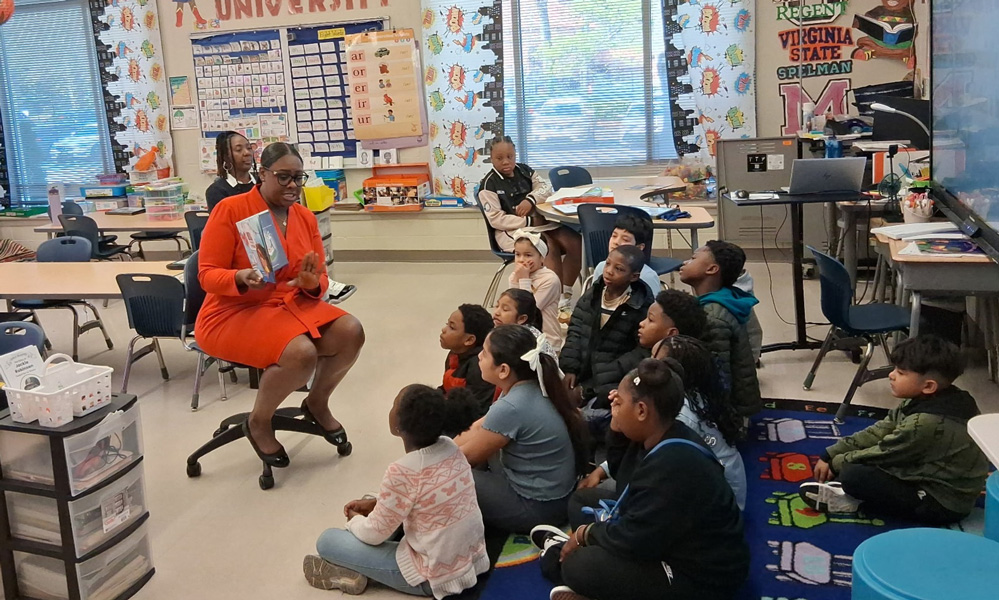
Eshé Collins, director of Equity Assistance Center-South and a member of the Atlanta City Council, read to students during a visit to a local school. (Courtesy of Eshé Collins)
Her center, for example, works with the Fayette County schools in Tennessee to recruit more Black teachers and ensure minority students get an equal chance to enroll in advanced classes. The system is still under a desegregation order from 1965, but is on track to meet the terms set by the court next year, Collins said. A week after Friedman issued the injunction in the foundation’s case, Ruth Ryder, the department’s deputy assistant secretary for policy and programs, told Collins she could once again access funds and her work resumed.
Research
As they entered the Department of Education in early February, one of the first moves made by staffers of the Department of Government Efficiency was to terminate nearly $900 million in research contracts awarded through the Institute for Education Sciences. Three lawsuits say the cuts seriously hinder efforts to conduct high-quality research on schools and students.
Kevin Gee from the University of California, Davis, was among those hit. He was in the middle of producing a practice guide for the nation on chronic absenteeism, which continues to exceed pre-pandemic levels in all states. In a recent report, the American Enterprise Institute’s Nat Malkus said the pandemic “took this crisis to unprecedented levels” that “warrant urgent and sustained attention.” Last year’s rate stood at nearly 24% nationally — still well above the 15% before the pandemic.
Gee was eager to fully grasp the impact of the pandemic on K-3 students. Even though young children didn’t experience school closures, many missed out on preschool and have shown delays in social and academic skills.
Westat, the contractor for the project, employed 350 staffers to collect data from more than 860 schools and conduct interviews with children about their experiences. But DOGE halted the data collection midstream — after the department had already invested about $44 million of a $100 million contract.
Kevin Gee, an education researcher at the University of California, Davis, had to stop his research work when the Trump administration cancelled grants. (Courtesy of Kevin Gee)
“The data would’ve helped us understand, for the first time, the educational well-being of our nation’s earliest learners on a nationwide scale in the aftermath of the pandemic,” he said.
The department has no plans to resurrect the project, according to a June court filing. But there are other signs it is walking back some of DOGE’s original cuts. For example, it intends to reissue contracts for regional education labs, which work with districts and states on school improvement.
“It feels like the legal pressure has succeeded, in the sense that the Department of Education is starting up some of this stuff again,” said Cara Jackson, a past president of the Association for Education Finance and Policy, which filed one of the lawsuits. “I think … there’s somebody at the department who is going through the legislation and saying, ‘Oh, we actually do need to do this.’ ”
Mental health grants
Amid the legal machinations, even some Republicans are losing patience with McMahon’s moves to freeze spending Congress already appropriated.
In April, she terminated $1 billion in mental health grants approved as part of a 2022 law that followed the mass school shooting in Uvalde, Texas. The department told grantees, without elaboration, that the funding no longer aligns with the administration’s policy of “prioritizing merit, fairness and excellence in education” and undermines “the students these programs are intended to help.”
The secretary told Oregon Democratic Sen. Jeff Merkley in June that she would “rebid” the grants, but some schools don’t want to wait. Silver Consolidated Schools in New Mexico, which lost $6 million when the grant was discontinued, sued her on June 20th. Sixteen Democrat-led states filed a second suit later that month.
The funds, according to Silver Consolidated’s complaint, allowed it to hire seven mental health professionals and contract with two outside counseling organizations. With the extra resources, the district saw bullying reports decline by 30% and suspensions drop by a third, according to the district’s complaint. Almost 500 students used a mental health app funded by the grant.
A judge has yet to rule in either case, but Republican Rep. Brian Fitzpatrick of Pennsylvania and other members of a bipartisan task force are holding McMahon to her word that she’ll open a new competition for the funds.
“These funds were never intended to be a theoretical exercise — they were designed to confront an urgent crisis affecting millions of children,” Fitzpatrick said in a statement. “With youth mental health challenges at an all-time high, any disruption or diversion of resources threatens to reverse hard-won progress and leave communities without critical supports.”
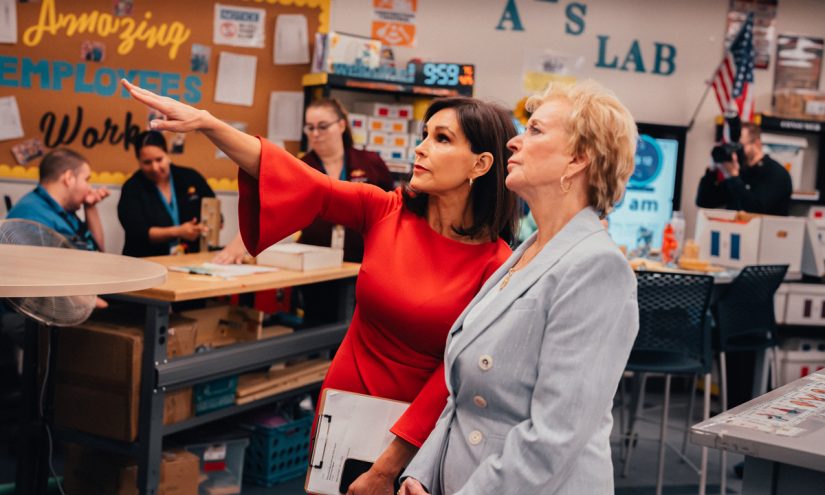
The founder and executive director of a network of Arizona charter schools serving autistic children has been named the U.S. Education Department’s deputy assistant secretary for special education and rehabilitative services. Education Secretary Linda McMahon made the announcement while touring the Arizona Autism Charter Schools’ Phoenix location.
Diana Diaz-Harrison, whose son is autistic, said that in her new job she hopes to continue her efforts to help others launch autism charter schools throughout the country. Her schools, she said in remarks captured on video by AZ Central, are a testament to what happens “when parents like me are empowered to create solutions.”
“My vision is to expand school choice for special needs families — whether through charter schools, private options, voucher programs, or other parent-empowered models,” she said in a statement to The 74. .
The five-school network uses a controversial intervention that attempts to train children to appear and behave like their neurotypical peers. Created by the researcher behind LGBTQ conversion therapy, applied behavior analysis, or ABA, is widely depicted as the gold standard despite scant independent evidence of its effectiveness and mounting research documenting its harms.
Diaz-Harrison opened the network’s first school in 2014 as a free, public alternative to private schools for autistic children, which are popular in Arizona but typically charge tens of thousands of dollars a year in tuition. Her Arizona charter schools are a 501(c)3 nonprofit financed by state and federal per-pupil funds. ABA is specifically endorsed by Arizona education officials as a strategy to use with autistic students.
In the time since those charters opened, ABA has grown to be a national, multi-billion-dollar industry, with for-profit companies tapping public and private insurance to pay for as much as 40 hours a week of one-on-one therapy. The intervention uses repeated, rapid-fire commands that bring rewards and punishments to change a child’s behavior and communication style.
A 74 investigation last year showed that most data supporting ABA’s effectiveness is drawn from research conducted by industry practitioners. Independent analyses, including a years-long U.S. Department of Defense review, found little evidence the intervention works. Former patients who underwent the therapy as children reported severe, lasting mental health effects, including PTSD.
Diaz-Harrison told The 74 the therapy is both valuable and sought-after. “For the autism community, specifically, many families seek schools that integrate positive behavioral strategies,” she says. “The evidence supporting behavioral therapy is extensive and well-established. It has been endorsed by the U.S. surgeon general and the American Academy of Pediatrics as an effective, research-backed approach for individuals with autism.”
During her visit, McMahon told students and staff she was eager to tell President Donald Trump about the schools. “He doesn’t believe any child, whether they have neuro-difficulties or any other problems, should be trapped in a school and not have the facilities that they need,” she said.
Since Trump’s second inauguration, he has issued numerous orders that have alarmed disability advocates and the autistic community. Though both edicts contradict longstanding federal laws, in March he ordered the closure of the Education Department and said responsibility for special education will be transferred to the U.S. Department of Health and Human Services.
About half of the Education Department’s staff has been fired, including most of the people responsible for investigating what had been a backlog of some 6,000 disability discrimination complaints. Though it’s unclear whether Trump and McMahon may legally disregard special education funding laws and allow states to spend federal dollars as they see fit, both have said they favor giving local officials as much decision-making power as possible.
Meanwhile, HHS Secretary Robert F. Kennedy Jr. has stoked fear in the autistic community by announcing a new effort to tie autism to vaccines or other “environmental toxins” — a hypothesis discredited by dozens of studies. The man he appointed to head the study has been cited for practicing medicine without a license and prescribing dangerous drugs to autistic children.
Last week, the new head of the National Institutes of Health announced that an unprecedented compilation of medical, pharmaceutical and insurance records would be used to create an autism “disease registry” — a kind of list historically used to sterilize, institutionalize and even “euthanize” autistic people. HHS later walked back the statement, saying the database under construction would have privacy guardrails.
Among other responsibilities, the offices Diaz-Harrison will head identify strategies for improving instruction for children with disabilities and ensure that as they grow up, they are able to be as independent as possible. The disability community has raised concerns that the administration is retreating from these goals.
Advocates have said they fear the changes pave the way for a return to the practice of separating students with disabilities in dedicated special ed classrooms rather than having them attend class with typically developing peers. The Individuals with Disabilities in Education Act guarantees special education students the right to instruction in the “least restrictive environment” possible.
Families’ preferences vary widely, with some parents of autistic children refusing any form of behavior therapy, while others want their kids in settings with children who share their needs. Many insist on grade-level instruction in general education classrooms
Diaz-Harrison has a master’s degree in education and worked as a bilingual teacher in California early in her career. From the late 1990s until she began supporting her son full time, she worked as a public relations strategist and a reporter and anchor for the Spanish-language broadcast network Univision.
In 2014, frustrated with her son’s school options, she organized a group of parents and ABA providers who applied for permission to open what was then a single K-5 school serving 90 children. The network now has about 1,000 students in all grades and features an online program.
At the end of the 2023-24 academic year, 9% of the network’s students scored proficient or highly proficient on Arizona’s annual reading exam, while 4% passed the math assessments.
In December 2022, the network won a $1 million Yass Prize, an award created by Jeff and Janine Yass. The billionaire investors have a long track record of donating to Republican political candidates and organizations that support school choice.
One of the award’s creators, Jeanne Allen, is CEO of the Center for Education Reform. The center nominated Diaz-Harrison for the federal role.
Yass award winners were featured at the 2023 meeting of the American Legislative Exchange Council, or ALEC, a conservative forum where state lawmakers are given model bills on education and other policies to introduce in their respective statehouses.
Diaz-Harrison has partnered with a Florida autism school to create a national charter school accelerator program to help people start schools like hers throughout the country. She told The 74 the effort has so far supported teams of hopeful school founders from Louisiana, Texas, Florida, Alabama and Nevada.
Parents of young autistic children and autistic adults often disagree about ABA. Told by their pediatrician or the person who diagnosed their child as autistic that they have a narrow window in which to intervene, families fight to get the therapy. Adults who have experienced it, however, report lasting trauma and have lobbied for research — much of it now at risk of being defunded by Kennedy — into more effective and humane alternatives.
On April 8, 2025, US Secretary of Education Linda McMahon will give a fireside chat at ASU+GSV, an edtech conference held in San Diego, California.
President Trump has tasked McMahon with dismantling the federal agency that oversees federally funded K-12 and higher education programs. In less than two weeks she has done just that.
Half of ED’s staff have already been fired or taken a payout, and the $1.7T student loan portfolio is likely to be transferred to the US Treasury.
There is no word yet on whether there will be demonstrators at the conference, but we expect some form of vocal nonviolent resistance. AFT President Randi Weingarten is also scheduled to appear.
Rachel
Oglesby most recently served as America First Policy Institute’s Chief
State Action Officer & Director, Center for the American Worker. In
this role, she worked to advance policies that promote worker freedom,
create opportunities outside of a four-year college degree, and provide
workers with the necessary skills to succeed in the modern economy, as
well as leading all of AFPI’s state policy development and advocacy
work. She previously worked as Chief of Policy and Deputy Chief of Staff
for Governor Kristi Noem in South Dakota, overseeing the implementation
of the Governor’s pro-freedom agenda across all policy areas and state
government agencies. Oglesby holds a master’s degree in public policy
from George Mason University and earned her bachelor’s degree in
philosophy from Wake Forest University.
Jonathan Pidluzny – Deputy Chief of Staff for Policy and Programs
Jonathan
Pidluzny most recently served as Director of the Higher Education
Reform Initiative at the America First Policy Institute. Prior to that,
he was Vice President of Academic Affairs at the American Council of
Trustees and Alumni, where his work focused on academic freedom and
general education. Jonathan began his career in higher education
teaching political science at Morehead State University, where he was an
associate professor, program coordinator, and faculty regent from
2017-2019. He received his Ph.D from Boston College and holds a
bachelor’s degree and master’s degree from the University of Alberta.
Chase Forrester – Deputy Chief of Staff for Operations
Virginia
“Chase” Forrester most recently served as the Chief Events Officer at America First Policy Institute, where she oversaw the planning and
execution of 80+ high-profile events annually for AFPI’s 22 policy
centers, featuring former Cabinet Officials and other distinguished
speakers. Chase previously served as Operations Manager on the
Trump-Pence 2020 presidential campaign, where she spearheaded all event
operations for the Vice President of the United States and the Second
Family. Chase worked for the National Republican Senatorial Committee
during the Senate run-off races in Georgia and as a fundraiser for
Members of Congress. Chase graduated from Clemson University with a
bachelor’s degree in political science and a double-minor in Spanish and
legal studies.
Steve Warzoha – White House Liaison
Steve
Warzoha joins the U.S. Department of Education after most recently
serving on the Trump-Vance Transition Team. A native of Greenwich, CT,
he is a former local legislator who served on the Education Committee
and as Vice Chairman of both the Budget Overview and Transportation
Committees. He is also an elected leader of the Greenwich Republican
Town Committee. Steve has run and served in senior positions on numerous
local, state, and federal campaigns. Steve comes from a family of
educators and public servants and is a proud product of Greenwich Public
Schools and an Eagle Scout.
Tom Wheeler – Principal Deputy General Counsel
Tom
Wheeler’s prior federal service includes as the Acting Assistant
Attorney General for Civil Rights at the U.S. Department of Justice, a
Senior Advisor to the White House Federal Commission on School Safety,
and as a Senior Advisor/Counsel to the Secretary of Education. He has
also been asked to serve on many Boards and Commissions, including as
Chair of the Hate Crimes Sub-Committee for the Federal Violent Crime
Reduction Task Force, a member of the Department of Justice’s Regulatory
Reform Task Force, and as an advisor to the White House Coronavirus
Task Force, where he worked with the CDC and HHS to develop guidelines
for the safe reopening of schools and guidelines for law enforcement and
jails/prisons. Prior to rejoining the U.S. Department of Education, Tom
was a partner at an AM-100 law firm, where he represented federal,
state, and local public entities including educational institutions and
law enforcement agencies in regulatory, administrative, trial, and
appellate matters in local, state and federal venues. He is a frequent
author and speaker in the areas of civil rights, free speech, and
Constitutional issues, improving law enforcement, and school safety.
Craig Trainor – Deputy Assistant Secretary for Policy, Office for Civil Rights
Craig
Trainor most recently served as Senior Special Counsel with the U.S.
House of Representatives Committee on the Judiciary under Chairman Jim
Jordan (R-OH), where Mr. Trainor investigated and conducted oversight of
the U.S. Department of Justice, including its Civil Rights Division,
the FBI, the Biden-Harris White House, and the Intelligence Community
for civil rights and liberties abuses. He also worked as primary counsel
on the House Judiciary’s Subcommittee on the Constitution and Limited
Government’s investigation into the suppression of free speech and
antisemitic harassment on college and university campuses, resulting in
the House passing the Antisemitism Awareness Act of 2023. Previously, he
served as Senior Litigation Counsel with the America First Policy
Institute under former Florida Attorney General Pam Bondi, Of Counsel
with the Fairness Center, and had his own civil rights and criminal
defense law practice in New York City for over a decade. Upon graduating
from the Catholic University of America, Columbus School of Law, he
clerked for Chief Judge Frederick J. Scullin, Jr., U.S. District Court
for the Northern District of New York. Mr. Trainor is admitted to
practice law in the state of New York, the U.S. District Court for the
Southern and Eastern Districts of New York, and the U.S. Supreme Court.
Madi Biedermann – Deputy Assistant Secretary, Office of Communications and Outreach
Madi
Biedermann is an experienced education policy and communications
professional with experience spanning both federal and state government
and policy advocacy organizations. She most recently worked as the Chief
Operating Officer at P2 Public Affairs. Prior to that, she served as an Assistant Secretary of Education for Governor Glenn Youngkin and worked
as a Special Assistant and Presidential Management Fellow at the Office
of Management and Budget in the first Trump Administration. Madi
received her bachelor’s degree and master of public administration from
the University of Southern California.
Candice Jackson – Deputy General Counsel
Candice
Jackson returns to the U.S. Department of Education to serve as Deputy
General Counsel. Candice served in the first Trump Administration as
Acting Assistant Secretary for Civil Rights, and Deputy General Counsel,
from 2017-2021. For the last few years, Candice has practiced law in
Washington State and California and consulted with groups and
individuals challenging the harmful effects of the concept of “gender
identity” in laws and policies in schools, employment, and public
accommodations. Candice is mom to girl-boy twins Madelyn and Zachary,
age 11.
Joshua Kleinfeld – Deputy General Counsel
Joshua
Kleinfeld is the Allison & Dorothy Rouse Professor of Law and
Director of the Boyden Gray Center for the Study of the Administrative
State at George Mason University’s Scalia School of Law. He writes and
teaches about constitutional law, criminal law, and statutory
interpretation, focusing in all fields on whether democratic ideals are
realized in governmental practice. As a scholar and public intellectual,
he has published work in the Harvard, Stanford, and University of
Chicago Law Reviews, among other venues. As a practicing lawyer, he has
clerked on the D.C. Circuit, Fourth Circuit, and Supreme Court of
Israel, represented major corporations accused of billion-dollar
wrongdoing, and, on a pro bono basis, represented children accused of
homicide. As an academic, he was a tenured full professor at
Northwestern Law School before lateraling to Scalia Law School. He holds
a J.D. in law from Yale Law School, a Ph.D. in philosophy from the
Goethe University of Frankfurt, and a B.A. in philosophy from Yale
College.
Hannah Ruth Earl – Director, Center for Faith-Based and Neighborhood Partnerships
Hannah
Ruth Earl is the former executive director of America’s Future, where
she cultivated communities of freedom-minded young professionals and
local leaders. She previously co-produced award-winning feature films as
director of talent and creative development at the Moving Picture
Institute. A native of Tennessee, she holds a master of arts in religion
from Yale Divinity School.