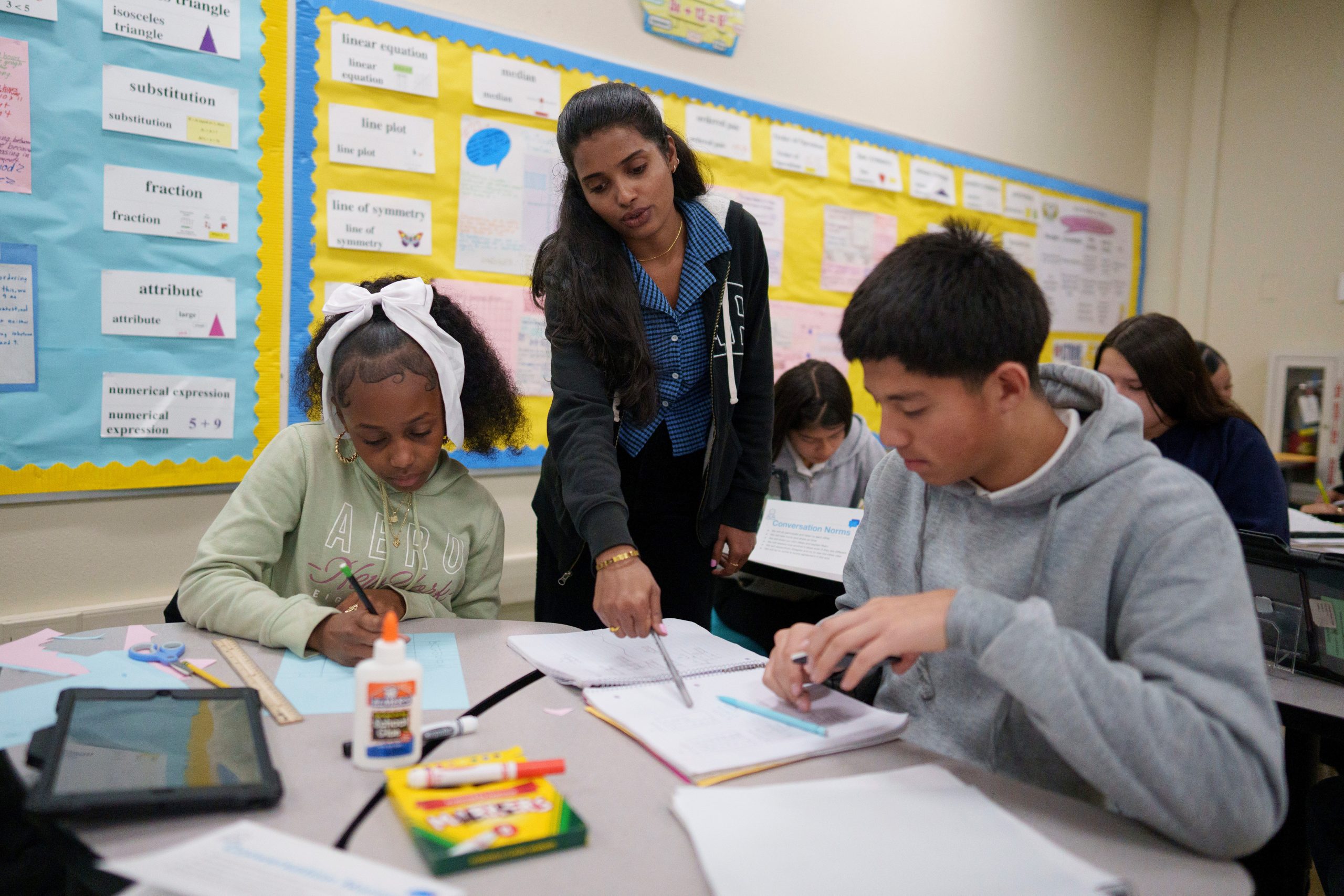
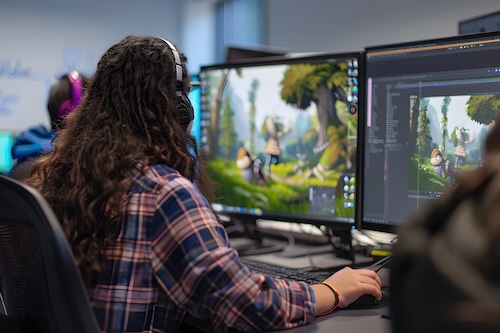
An unexpected group of presenters–11th graders from Whitney M. Young Magnet High School in Chicago–made a splash at this year’s ACM Conference on Fairness, Accountability, and Transparency (FAccT). These students captivated seasoned researchers and professionals with their insights on how school environments shape students’ views of AI. “I wanted our project to serve as a window into the eyes of high school students,” said Autumn Moon, one of the student researchers.
What enabled these students to contribute meaningfully to a conference dominated by PhDs and industry veterans was their critical data literacy–the ability to understand, question, and evaluate the ethics of complex systems like AI using data. They developed these skills through their school’s Data is Powerprogram.
Launched last year, Data is Power is a collaboration among K-12 educators, AI ethics researchers, and the Young Data Scientists League. The program includes four pilot modules that are aligned to K-12 standards and cover underexplored but essential topics in AI ethics, including labor and environmental impacts. The goal is to teach AI ethics by focusing on community-relevant topics chosen by our educators with input from students, all while fostering critical data literacy. For example, Autumn’s class in Chicago used AI ethics as a lens to help students distinguish between evidence-based research and AI propaganda. Students in Phoenix explored how conversational AI affects different neighborhoods in their city.
Why does the Data is Power program focus on critical data literacy? In my former role leading a diverse AI team at Amazon, I saw that technical skills alone weren’t enough. We needed people who could navigate cultural nuance, question assumptions, and collaborate across disciplines. Some of the most technically proficient candidates struggled to apply their knowledge to real-world problems. In contrast, team members trained in critical data literacy–those who understood both the math and the societal context of the models–were better equipped to build responsible, practical tools. They also knew when not to build something.
As AI becomes more embedded in our lives, and many students feel anxious about AI supplanting their job prospects, critical data literacy is a skill that is not just future-proof–it is future-necessary. Students (and all of us) need the ability to grapple with and think critically about AI and data in their lives and careers, no matter what they choose to pursue. As Milton Johnson, a physics and engineering teacher at Bioscience High School in Phoenix, told me: “AI is going to be one of those things where, as a society, we have a responsibility to make sure everyone has access in multiple ways.”
Critical data literacy is as much about the humanities as it is about STEM. “AI is not just for computer scientists,” said Karren Boatner, who taught Autumn in her English literature class at Whitney M. Young Magnet High School. For Karren, who hadn’t considered herself a “math person” previously, one of the most surprising parts of the program was how much she and her students enjoyed a game-based module that used middle school math to explain how AI “learns.” Connecting math and literature to culturally relevant, real-world issues helps students see both subjects in a new light.
As AI continues to reshape our world, schools must rethink how to teach about it. Critical data literacy helps students see the relevance of what they’re learning, empowering them to ask better questions and make more informed decisions. It also helps educators connect classroom content to students’ lived experiences.
If education leaders want to prepare students for the future–not just as workers, but as informed citizens–they must invest in critical data literacy now. As Angela Nguyen, one of our undergraduate scholars from Stanford, said in her Data is Power talk: “Data is power–especially youth and data. All of us, whether qualitative or quantitative, can be great collectors of meaningful data that helps educate our own communities.”
Evan Shieh, Young Data Scientists League
Evan Shieh is the Executive Director of the Young Data Scientists League.
Latest posts by eSchool Media Contributors (see all)
Literacy has always been the foundation of learning, but for middle school students, the stakes are especially high. These years mark the critical shift from learning to read to reading to learn.
When students enter sixth, seventh, or eighth grade still struggling with foundational skills, every subject becomes harder–science labs, social studies texts, even math word problems require reading proficiency. For educators, the challenge is not just addressing gaps but also building the confidence that helps adolescents believe they can succeed.
The confidence gap
By middle school, many students are keenly aware when they’re behind their peers in reading. Interventions that feel too elementary can undermine motivation. As Dr. Michelle D. Barrett, Senior Vice President of Research, Policy, and Impact at Edmentum, explained:
“If you have a student who’s in the middle grades and still has gaps in foundational reading skills, they need to be provided with age-appropriate curriculum and instruction. You can’t give them something that feels babyish–that only discourages them.”
Designing for engagement
Research shows that engagement is just as important as instruction, particularly for adolescents. “If students aren’t engaged, if they’re not showing up to school, then you have a real problem,” Barrett said. “It’s about making sure that even if students have gaps, they’re still being supported with curriculum that feels relevant and engaging.”
To meet that need, digital programs like Edmentum’s Exact Path tailor both design and content to the learner’s age. “A middle schooler doesn’t want the cartoony things our first graders get,” Barrett noted. “That kind of thing really does matter–not just for engagement, but also for their confidence and willingness to keep going.”
Measuring what works
Educators also need strong data to target interventions. “It’s all about how you’re differentiating for those students,” Barrett said. “You’ve got to have great assessments, engaging content that’s evidence-based, and a way for students to feel and understand success.”
Exact Path begins with universal screening, then builds personalized learning paths grounded in research-based reading progressions. More than 60 studies in the past two years have shown consistent results. “When students complete eight skills per semester, we see significant growth across grade levels–whether measured by NWEA MAP, STAR, or state assessments,” Barrett added.
That growth extends across diverse groups. “In one large urban district, we found the effect sizes for students receiving special education services were twice that of their peers,” Barrett said. “That tells us the program can be a really effective literacy intervention for students most at risk.”
Layering supports for greater impact
Barrett emphasized that literacy progress is strongest when multiple supports are combined. “With digital curriculum, students do better. But with a teacher on top of that digital curriculum, they do even better. Add intensive tutoring, and outcomes improve again,” she said.
Progress monitoring and recognition also help build confidence. “Students are going to persist when they can experience success,” Barrett added. “Celebrating growth, even in small increments, matters for motivation.”
A shared mission
While tools like Exact Path provide research-backed support, Barrett stressed that literacy improvement is ultimately a shared responsibility. “District leaders should be asking: How is this program serving students across different backgrounds? Is it working for multilingual learners, students with IEPs, students who are at risk?” she said.
The broader goal, she emphasized, is preparing students for lifelong learning. “Middle school is such an important time. If we can help students build literacy and confidence there, we’re not just improving test scores–we’re giving them the skills to succeed in every subject, and in life.”
Laura Ascione is the Editorial Director at eSchool Media. She is a graduate of the University of Maryland’s prestigious Philip Merrill College of Journalism.
While most teachers are eager to implement the science of reading, many lack the time and tools to connect these practices to home-based support, according to a new national survey from Lexia, a Cambium Learning Group brand.
The 2025 Back-to-School Teacher Survey, with input from more than 1,500 K–12 educators nationwide, points to an opportunity for district leaders to work in concert with teachers to provide families with the science of reading-based literacy resources they need to support student reading success.
Key insights from the survey include:
60 percent of teachers are either fully trained or interested in learning more about the science of reading
Only 15 percent currently provide parents with structured, evidence-based literacy activities
79 percent of teachers cite time constraints and parents’ work schedules as top barriers to family engagement
Just 10 percent report that their schools offer comprehensive family literacy programs
Teachers overwhelmingly want in-person workshops and video tutorials to help parents support reading at home
“Teachers know that parental involvement can accelerate literacy and they’re eager for ways to strengthen those connections,” said Lexia President Nick Gaehde. “This data highlights how districts can continue to build on momentum in this new school year by offering scalable, multilingual, and flexible family engagement strategies that align with the science of reading.”
Teachers also called for:
Better technology tools for consistent school-to-home communication
Greater multilingual support to serve diverse communities
Professional learning that includes family engagement training
Gaehde concluded, “Lexia’s survey reflects the continued national emphasis on Structured Literacy and shows that equipping families is essential to driving lasting student outcomes. At Lexia we’re committed to partnering with districts and teachers to strengthen the school-to-home connection. By giving educators practical tools and data-driven insights, we help teachers and families work together–ensuring every child has the literacy support they need to thrive.”
A new national study shows that Americans’ rates of reading for pleasure have declined radically over the first quarter of this century and that recreational reading can be linked to school achievement, career compensation and growth, civic engagement, and health. Learning how to enjoy reading – not literacy proficiency – isn’t just for hobbyists, it’s a necessary life skill.
But the conditions under which English teachers work are detrimental to the cause – and while book bans are in the news, the top-down pressure to measure up on test scores is a more pervasive, more longstanding culprit. Last year, we asked high school English teachers to describe their literature curriculum in a national questionnaire we plan to publish soon. From responses representing 48 states, we heard a lot of the following: “soul-deadening”; “only that which students will see on the test” and “too [determined] by test scores.”
These sentiments certainly aren’t new. In a similar questionnaire distributed in 1911, teachers described English class as “deadening,” focused on “memory instead of thinking,” and demanding “cramming for examination.”
Teaching to the test is as old as English itself – as a secondary school subject, that is. Teachers have questioned the premise for just as long because too many have experienced a radical disconnect between how they are asked or required to teach and the pleasure that reading brings them.
High school English was first established as a test-driven subject around the turn of the 20th Century. Even at a time when relatively few Americans attended college, English class was oriented around building students’ mastery of now-obscure literary works that they would encounter on the College Entrance Exam.
The development of the Scholastic Aptitude Test in 1926 and the growth of standardized testing since No Child Left Behind have only solidified what was always true: As much as we think of reading as a social, cultural, even “spiritual” experience, English class has been shaped by credential culture.
Throughout, many teachers felt that preparing students for college was too limited a goal; their mission was to prepare students for life. They believed that studying literature was an invaluable source of social and emotional development, preparing adolescents for adulthood and for citizenship. It provided them with “vicarious experience”: Through reading, young people saw other points of view, worked through challenging problems, and grappled with complex issues.
Indeed, a national study conducted in 1933 asked teachers to rank their “aims” in literature instruction. They listed “vicarious experience” first, “preparation for college” last.
The results might not look that different today. Ask an English teacher what brought her to the profession, and a love of reading is likely to top the list. What is different today is the unmatched pressure to prepare students for a constant cycle of state and national examinations and for college credentialing.
Increasingly, English teachers are compelled to use online curriculum packages that mimic the examinations themselves, composed largely of excerpts from literary and “informational” texts instead of the whole books that were more the norm in previous generations. “Vicarious experience” has less purchase in contemporary academic standards than ever.
Credentialing, however, does not equal preparing. Very few higher education skills map neatly onto standardized exams, especially in the humanities. As English professors, we can tell you that an enjoyment of reading – not just a toleration of it – is a key academic capacity. It produces better writers, more creative thinkers, and students less likely to need AI to express their ideas effectively.
Yet we haven’t given K-12 teachers the structure or freedom to treat reading enjoyment as a skill. The data from our national survey suggests that English teachers and their students find the system deflating.
“Our district adopted a disjointed, excerpt-heavy curriculum two years ago,” a Washington teacher shared, “and it is doing real damage to students’ interest in reading.”
From Tennessee, a teacher added: “I understand there are state guidelines and protocols, but it seems as if we are teaching the children from a script. They are willing to be more engaged and can have a better understanding when we can teach them things that are relatable to them.”
And from Oregon, another tells us that because “state testing is strictly excerpts,” the district initially discouraged “teaching whole novels.” It changed course only after students’ exam scores improved.
Withholding books from students is especially inhumane when we consider that the best tool for improved academic performance is engagement – students learn more when they become engrossed in stories. Yet by the time they graduate from high school, many students master test-taking skills but lose the window for learning to enjoy reading.
Teachers tell us that the problem is not attitudinal but structural. An education technocracy that consists of test making agencies, curriculum providers, and policy makers is squeezing out enjoyment, teacher autonomy and student agency.
To reverse this trend, we must consider what reading experiences we are providing our students. Instead of the self-defeating cycle of test-preparation and testing, we should take courage, loosen the grip on standardization, and let teachers recreate the sort of experiences with literature that once made us, and them, into readers.
Everywhere you look, someone is telling students and workers to “learn AI.”
It’s become the go-to advice for staying employable, relevant and prepared for the future. But here’s the problem: While definitions of artificial intelligence literacy are starting to emerge, we still lack a consistent, measurable framework to know whether someone is truly ready to use AI effectively and responsibly.
And that is becoming a serious issue for education and workforce systems already being reshaped by AI. Schools and colleges are redesigning their entire curriculums. Companies are rewriting job descriptions. States are launching AI-focused initiatives.
Yet we’re missing a foundational step: agreeing not only on what we mean by AI literacy, but on howweassessit in practice.
Two major recent developments underscore why this step matters, and why it is important that we find a way to take it before urging students to use AI. First, the U.S. Department of Education released its proposed priorities for advancing AI in education, guidance that will ultimately shape how federal grants will support K-12 and higher education. For the first time, we now have a proposed federal definition of AI literacy: the technical knowledge, durable skills and future-ready attitudes required to thrive in a world influenced by AI. Such literacy will enable learners to engage and create with, manage and design AI, while critically evaluating its benefits, risks and implications.
Second, we now have the White House’s American AI Action Plan, a broader national strategy aimed at strengthening the country’s leadership in artificial intelligence. Education and workforce development are central to the plan.
What both efforts share is a recognition that AI is not just a technological shift, it’s a human one. In many ways, the most important AI literacy skills are not about AI itself, but about the human capacities needed to use AI wisely.
Sadly, the consequences of shallow AI education are already visible in workplaces. Some 55 percent of managers believe their employees are AI-proficient, while only 43 percent of employees share that confidence, according to the 2025 ETS Human Progress Report.
One can say that the same perception gap exists between school administrators and teachers. The disconnect creates risks for organizations and reveals how assumptions about AI literacy can diverge sharply from reality.
But if we’re going to build AI literacy into every level of learning, we have to ask the harder question: How do we both determine when someone is truly AI literate and assess it in ways that are fair, useful and scalable?
AI literacy may be new, but we don’t have to start from scratch to measure it. We’ve tackled challenges like this before, moving beyond check-the-box tests in digital literacy to capture deeper, real-world skills. Building on those lessons will help define and measure this next evolution of 21st-century skills.
Right now, we often treat AI literacy as a binary: You either “have it” or you don’t. But real AI literacy and readiness is more nuanced. It includes understanding how AI works, being able to use it effectively in real-world settings and knowing when to trust it. It includes writing effective prompts, spotting bias, asking hard questions and applying judgment.
This isn’t just about teaching coding or issuing a certificate. It’s about making sure that students, educators and workers can collaborate in and navigate a world in which AI is increasingly involved in how we learn, hire, communicate and make decisions.
Without a way to measure AI literacy, we can’t identify who needs support. We can’t track progress. And we risk letting a new kind of unfairness take root, in which some communities build real capacity with AI and others are left with shallow exposure and no feedback.
What can education leaders do right now to address this issue? I have a few ideas.
First, we need a working definition of AI literacy that goes beyond tool usage. The Department of Education’s proposed definition is a good start, combining technical fluency, applied reasoning and ethical awareness.
Second, assessments of AI literacy should be integrated into curriculum design. Schools and colleges incorporating AI into coursework need clear definitions of proficiency. TeachAI’s AI Literacy Framework for Primary and Secondary Education is a great resource.
Third, AI proficiency must be defined and measured consistently, or we risk a mismatched state of literacy. Without consistent measurements and standards, one district may see AI literacy as just using ChatGPT, while another defines it far more broadly, leaving students unevenly ready for the next generation of jobs.
To prepare for an AI-driven future, defining and measuring AI literacy must be a priority. Every student will be graduating into a world in which AI literacy is essential. Human resources leaders confirmed in the 2025 ETS Human Progress Report that the No. 1 skill employers are demanding today is AI literacy. Without measurement, we risk building the future on assumptions, not readiness.
And that’s too shaky a foundation for the stakes ahead.
Amit Sevak is CEO of ETS, the largest private educational assessment organization in the world.
This story about AI literacy was produced by The Hechinger Report, a nonprofit, independent news organization focused on inequality and innovation in education. Sign up for Hechinger’s weekly newsletter.
The Hechinger Report provides in-depth, fact-based, unbiased reporting on education that is free to all readers. But that doesn’t mean it’s free to produce. Our work keeps educators and the public informed about pressing issues at schools and on campuses throughout the country. We tell the whole story, even when the details are inconvenient. Help us keep doing that.
This story was reported by and originally published by APM Reports in connection with its podcast Sold a Story: How Teach Kids to Read Went So Wrong.
When voters elected Donald Trump in November, most people who worked at the U.S. Department of Education weren’t scared for their jobs. They had been through a Trump presidency before, and they hadn’t seen big changes in their department then. They saw their work as essential, mandated by law, nonpartisan and, as a result, insulated from politics.
Then, in early February, the Department of Government Efficiency showed up. Led at the time by billionaire CEO Elon Musk, and known by the cheeky acronym DOGE, it gutted the Department of Education’s Institute of Education Sciences, posting on X that the effort would ferret out “waste, fraud and abuse.”
DOGE is looking for help from the general public!
Please DM insight for reducing waste, fraud, and abuse, along with any helpful insights or awesome ideas, to the relevant DOGE affiliates (found on the Affiliates tab). For example, @DOGE_USDA, @DOGE_SSA, etc. We will add…
A post from the Department of Government Efficiency.
When it was done, DOGE had cut approximately $900 million in research contracts and more than 90 percent of the institute’s workforce had been laid off. (The current value of the contracts was closer to $820 million, data compiled by APM Reports shows, and the actual savings to the government was substantially less, because in some cases large amounts of money had been spent already.)
Among staff cast aside were those who worked on the National Assessment of Educational Progress — also known as the Nation’s Report Card — which is one of the few federal education initiatives the Trump administration says it sees as valuable and wants to preserve.
The assessment is a series of tests administered nearly every year to a national sample of more than 10,000 students in grades 4, 8 and 12. The tests regularly measure what students across the country know in reading, math and other subjects. They allow the government to track how well America’s students are learning overall. Researchers can also combine the national data with the results of tests administered by states to draw comparisons between schools and districts in different states.
The assessment is “something we absolutely need to keep,” Education Secretary Linda McMahon said at an education and technology summit in San Diego earlier this year. “If we don’t, states can be a little manipulative with their own results and their own testing. I think it’s a way that we keep everybody honest.”
But researchers and former Department of Education employees say they worry that the test will become less and less reliable over time, because the deep cuts will cause its quality to slip — and some already see signs of trouble.
“The main indication is that there just aren’t the staff,” said Sean Reardon, a Stanford University professor who uses the testing data to research gaps in learning between students of different income levels.
All but one of the experts who make sure the questions in the assessment are fair and accurate — called psychometricians — have been laid off from the National Center for Education Statistics. These specialists play a key role in updating the test and making sure it accurately measures what students know.
“These are extremely sophisticated test assessments that required a team of researchers to make them as good as they are,” said Mark Seidenberg, a researcher known for his significant contributions to the science of reading. Seidenberg added that “a half-baked” assessment would undermine public confidence in the results, which he described as “essentially another way of killing” the assessment.
The Department of Education defended its management of the assessment in an email: “Every member of the team is working toward the same goal of maintaining NAEP’s gold-standard status,” it read in part.
The National Assessment Governing Board, which sets policies for the national test, said in a statement that it had temporarily assigned “five staff members who have appropriate technical expertise (in psychometrics, assessment operations, and statistics) and federal contract management experience” to work at the National Center for Education Statistics. No one from DOGE responded to a request for comment.
Harvard education professor Andrew Ho, a former member of the governing board, said the remaining staff are capable, but he’s concerned that there aren’t enough of them to prevent errors.
“In order to put a good product up, you need a certain number of person-hours, and a certain amount of continuity and experience doing exactly this kind of job, and that’s what we lost,” Ho said.
The Trump administration has already delayed the release of some testing data following the cutbacks. The Department of Education had previously planned to announce the results of the tests for 8th grade science, 12th grade math and 12th grade reading this summer; now that won’t happen until September. The board voted earlier this year to eliminate more than a dozen tests over the next seven years, including fourth grade science in 2028 and U.S. history for 12th graders in 2030. The governing board has also asked Congress to postpone the 2028 tests to 2029, citing a desire to avoid releasing test results in an election year.
“Today’s actions reflect what assessments the Governing Board believes are most valuable to stakeholders and can be best assessed by NAEP at this time, given the imperative for cost efficiencies,” board chair and former North Carolina Gov. Bev Perdue said earlier this year in a press release.
The National Assessment Governing Board canceled more than a dozen tests when it revised the schedule for the National Assessment of Educational Progress in April. This annotated version of the previous schedule, adopted in 2023, shows which tests were canceled. Topics shown in all caps were scheduled for a potential overhaul; those annotated with a red star are no longer scheduled for such a revision.
Recent estimates peg the annual cost to keep the national assessment running at about $190 million per year, a fraction of the department’s 2025 budget of approximately $195 billion.
Adam Gamoran, president of the William T. Grant Foundation, said multiple contracts with private firms — overseen by Department of Education staff with “substantial expertise” — are the backbone of the national test.
“You need a staff,” said Gamoran, who was nominated last year to lead the Institute of Education Sciences. He was never confirmed by the Senate. “The fact that NCES now only has three employees indicates that they can’t possibly implement NAEP at a high level of quality, because they lack the in-house expertise to oversee that work. So that is deeply troubling.”
The cutbacks were widespread — and far outside of what most former employees had expected under the new administration.
“I don’t think any of us imagined this in our worst nightmares,” said a former Education Department employee, who spoke on condition of anonymity for fear of retaliation by the Trump administration. “We weren’t concerned about the utter destruction of this national resource of data.”
“At what point does it break?” the former employee asked.
Every state has its own test for reading, math and other subjects. But state tests vary in difficulty and content, which makes it tricky to compare results in Minnesota to Mississippi or Montana.
“They’re totally different tests with different scales,” Reardon said. “So NAEP is the Rosetta stone that lets them all be connected.”
Reardon and his team at Stanford used statistical techniques to combine the federal assessment results with state test scores and other data sets to create the Educational Opportunity Project. The project, first released in 2016 and updated periodically in the years that followed, shows which schools and districts are getting the best results — especially for kids from poor families. Since the project’s release, Reardon said, the data has been downloaded 50,000 times and is used by researchers, teachers, parents, school boards and state education leaders to inform their decisions.
For instance, the U.S. military used the data to measure school quality when weighing base closures, and superintendents used it to find demographically similar but higher-performing districts to learn from, Reardon said.
If the quality of the data slips, those comparisons will be more difficult to make.
“My worry is we just have less-good information on which to base educational decisions at the district, state and school level,” Reardon said. “We would be in the position of trying to improve the education system with no information. Sort of like, ‘Well, let’s hope this works. We won’t know, but it sounds like a good idea.’”
Seidenberg, the reading researcher, said the national assessment “provided extraordinarily important, reliable information about how we’re doing in terms of teaching kids to read and how literacy is faring in the culture at large.”
Producing a test without keeping the quality up, Seidenberg said, “would be almost as bad as not collecting the data at all.”
The Hechinger Report provides in-depth, fact-based, unbiased reporting on education that is free to all readers. But that doesn’t mean it’s free to produce. Our work keeps educators and the public informed about pressing issues at schools and on campuses throughout the country. We tell the whole story, even when the details are inconvenient. Help us keep doing that.
In the 1980s, a public interest law group sued the state of New Jersey, saying that the way it funded education left its low-income, urban school districts at a disadvantage compared to wealthier, suburban districts.
The lawsuit, Abbott v. Burke, yielded a number of different decisions, including a requirement that the state offer free, full-day, high-quality preschool for children ages 3 and 4 in 31 school districts.
This new school year marks the 26th since the program was created. Researchers have found that children who attend the preschool program are better prepared for school later on, but enrollment has been dwindling. And with New Jersey leaders now focused on bringing preschool to all districts, supporters worry that the early learning program focused on children in low-income areas may not get the attention it needs.
Park perk for kids
Did you know every fourth grader and their family can get free admission to national parks, monuments and forests? The Sierra Club’s Outdoors for All program launched in 2015 and offers free passes each school year. Vouchers for students can be downloaded through the program’s official website.
This story about free preschool was produced by The Hechinger Report, a nonprofit, independent news organization focused on inequality and innovation in education. Sign up for the early childhood newsletter.
The Hechinger Report provides in-depth, fact-based, unbiased reporting on education that is free to all readers. But that doesn’t mean it’s free to produce. Our work keeps educators and the public informed about pressing issues at schools and on campuses throughout the country. We tell the whole story, even when the details are inconvenient. Help us keep doing that.
Rigorous research rarely shows that any teaching approach produces large and consistent benefits for students. But tutoring seemed to be a rare exception. Before the pandemic, almost 100 studies pointed to impressive math or reading gains for students who were paired with a tutor at least three times a week and used a proven curriculum or set of lesson plans.
Some students gained an extra year’s worth of learning — far greater than the benefit of smaller classes, summer school or a fantastic teacher. These were rigorous randomized controlled trials, akin to the way that drugs or vaccines are tested, comparing test scores of tutored students against those who weren’t. The expense, sometimes surpassing $4,000 a year per student, seemed worth it for what researchers called high-dosage tutoring.
On the strength of that evidence, the Biden administration urged schools to invest their pandemic recovery funds in intensive tutoring to help students catch up academically. Forty-six percent of public schools heeded that call, according to a 2024 federal survey, though it’s unclear exactly how much of the $190 billion in pandemic recovery funds have been spent on high-dosage tutoring and how many students received it.
Related: Our free weekly newsletter alerts you to what research says about schools and classrooms.
Even with ample money, schools immediately reported problems in ramping up high-quality tutoring for so many students. In 2024, researchers documented either tiny or no academic benefits from large-scale tutoring efforts in Nashville, Tennessee, and Washington, D.C.
New evidence from the 2023-24 school year reinforces those results.Researchers are rigorously studying large-scale tutoring efforts around the nation and testing whether effective tutoring can be done more cheaply. A dozen researchers studied more than 20,000 students in Miami; Chicago; Atlanta; Winston-Salem and Greensboro, North Carolina; Greenville, South Carolina; schools throughout New Mexico, and a California charter school network. This was also a randomized controlled study in which 9,000 students were randomly assigned to get tutoring and compared with 11,000 students who didn’t get that extra help.
Their preliminary results were “sobering,” according to a June report by the University of Chicago Education Lab and MDRC, a research organization.
The researchers found that tutoring during the 2023-24 school year produced only one or two months’ worth of extra learning in reading or math — a tiny fraction of what the pre-pandemic research had produced. Each minute of tutoring that students received appeared to be as effective as in the pre-pandemic research, but students weren’t getting enough minutes of tutoring altogether. “Overall we still see that the dosage students are getting falls far short of what would be needed to fully realize the promise of high-dosage tutoring,” the report said.
Monica Bhatt, a researcher at the University of Chicago Education Lab and one of the report’s authors, said schools struggled to set up large tutoring programs. “The problem is the logistics of getting it delivered,” said Bhatt. Effective high-dosage tutoring involves big changes to bell schedules and classroom space, along with the challenge of hiring and training tutors. Educators need to make it a priority for it to happen, Bhatt said.
Some of the earlier, pre-pandemic tutoring studies involved large numbers of students, too, but those tutoring programs were carefully designed and implemented, often with researchers involved. In most cases, they were ideal setups. There was much greater variability in the quality of post-pandemic programs.
“For those of us that run experiments, one of the deep sources of frustration is that what you end up with is not what you tested and wanted to see,” said Philip Oreopoulos, an economist at the University of Toronto, whose 2020 review of tutoring evidence influenced policymakers. Oreopoulos was also an author of the June report.
“After you spend lots of people’s money and lots of time and effort, things don’t always go the way you hope. There’s a lot of fires to put out at the beginning or throughout because teachers or tutors aren’t doing what you want, or the hiring isn’t going well,” Oreopoulos said.
Another reason for the lackluster results could be that schools offered a lot of extra help to everyone after the pandemic, even to students who didn’t receive tutoring. In the pre-pandemic research, students in the “business as usual” control group often received no extra help at all, making the difference between tutoring and no tutoring far more stark. After the pandemic, students — tutored and non-tutored alike — had extra math and reading periods, sometimes called “labs” for review and practice work. More than three-quarters of the 20,000 students in this June analysis had access to computer-assisted instruction in math or reading, possibly muting the effects of tutoring.
The report did find that cheaper tutoring programs appeared to be just as effective (or ineffective) as the more expensive ones, an indication that the cheaper models are worth further testing. The cheaper models averaged $1,200 per student and had tutors working with eight students at a time, similar to small group instruction, often combining online practice work with human attention. The more expensive models averaged $2,000 per student and had tutors working with three to four students at once. By contrast, many of the pre-pandemic tutoring programs involved smaller 1-to-1 or 2-to-1 student-to-tutor ratios.
Despite the disappointing results, researchers said that educators shouldn’t give up. “High-dosage tutoring is still a district or state’s best bet to improve student learning, given that the learning impact per minute of tutoring is largely robust,” the report concludes. The task now is to figure out how to improve implementation and increase the hours that students are receiving. “Our recommendation for the field is to focus on increasing dosage — and, thereby learning gains,” Bhatt said.
That doesn’t mean that schools need to invest more in tutoring and saturate schools with effective tutors. That’s not realistic with the end of federal pandemic recovery funds.
Instead of tutoring for the masses, Bhatt said researchers are turning their attention to targeting a limited amount of tutoring to the right students. “We are focused on understanding which tutoring models work for which kinds of students.”
The Hechinger Report provides in-depth, fact-based, unbiased reporting on education that is free to all readers. But that doesn’t mean it’s free to produce. Our work keeps educators and the public informed about pressing issues at schools and on campuses throughout the country. We tell the whole story, even when the details are inconvenient. Help us keep doing that.
For students with special needs, learning can often resemble a trek through dense woods along a narrow, rigid path–one that leaves little to no room for individual exploration. But the educational landscape is evolving. Picture classrooms as adventurous hunts, where every learner charts their own journey, overcomes unique challenges, and progresses at a pace that matches their strengths. This vision is becoming reality through gamification, a powerful force that is reshaping how students learn and how teachers teach in K–12 special education.
Personalized learning paths: Tailoring the adventure
Traditional classrooms often require students to adapt one method of instruction, which can be limiting–especially for neurodiverse learners. Gamified learning platforms provide an alternative by offering adaptive, personalized learning experiences that honor each student’s profile and pace.
Many of these platforms use real-time data and algorithms to adjust content based on performance. A student with reading difficulties might receive simplified text with audio support, while a math-savvy learner can engage in increasingly complex logic puzzles. This flexibility allows students to move forward without fear of being left behind, or without being bored waiting for others to catch up.
Accessibility features such as customizable avatars, voice commands, and adjustable visual settings also create space for students with ADHD, autism, or sensory sensitivities to learn comfortably. A student sensitive to bright colors can use a softer palette; another who struggles with reading can use text-to-speech features. And when students can replay challenges without stigma, repetition becomes practice, not punishment.
In these environments, progress is measured individually. The ability to choose which goals to tackle and how to approach them gives learners both agency and confidence–two things often missing in traditional special education settings.
Building social and emotional skills: The power of play
Play is a break from traditional learning and a powerful way to build essential social and emotional skills. For students with special needs who may face challenges with communication, emotional regulation, or peer interaction, gamified environments provide a structured yet flexible space to develop these abilities.
In cooperative hunts and team challenges, students practice empathy, communication, and collaboration in ways that feel engaging and low-stakes. A group mission might involve solving a puzzle together, requiring students to share ideas, encourage one another, and work toward a common goal.
Gamified platforms also provide real-time, constructive feedback, transforming setbacks into teachable moments. Instead of pointing out what a student did wrong, a game might offer a helpful hint: “Try checking the clues again!” This kind of support teaches resilience and persistence in a way that lectures or punitive grading rarely do.
As students earn badges or level up, they experience tangible success. These moments highlight the connection between effort and achievement. Over time, these small wins raise a greater willingness to engage with the material and with peers and the classroom community.
Fostering independence and motivation
Students with learning differences often carry the weight of repeated academic failure, which can chip away at their motivation. Gamification helps reverse this by reframing challenges as opportunities and effort as progress.
Badges, points, and levels make achievements visible and meaningful. A student might earn a “Problem Solver” badge after tackling a tricky math puzzle or receive “Teamwork Tokens” for helping a classmate. These systems expand the definition of success and highlight personal strengths.
The focus shifts from comparison to self-improvement. Some platforms even allow for private progress tracking, letting students set and meet personal goals without the anxiety of public rankings. Instead of competing, students build a personal narrative of growth.
Gamification also encourages self-directed learning. As student complete tasks, they develop skills like planning, time management, and self-assessment, skills that extend beyond academics and into real life. The result is a deeper sense of ownership and independence.
Teachers as learning guides
Gamification doesn’t replace teachers, but it can help teach more effectively. With access to real-time analytics, educators can see exactly where a student is excelling or struggling and adjust instruction accordingly.
Dashboards might reveal that a group of students is thriving in reading comprehension but needs help with number sense, prompting immediate, targeted intervention. This data-driven insight allows for proactive, personalized support.
Teachers in gamified classrooms also take on a new role, both of a mentor and facilitator. They curate learning experiences, encourage exploration, and create opportunities for creativity and curiosity to thrive. Instead of managing behavior or delivering lectures, they support students on individualized learning journeys.
Inclusion reimagined
Gamification is not a gimmick; it’s a framework for true inclusion. It aligns with the principles of Universal Design for Learning (UDL), offering multiple ways for students to engage, process information, and show what they know. It recognizes that every learner is different, and builds that into the design.
Of course, not every gamified tool is created equal. Thoughtful implementation, equity in access, and alignment with student goals are essential. But when used intentionally, gamification can turn classrooms into places where students with diverse needs feel seen, supported, and excited to learn.
Are we ready to level up?
Gamification is a step toward classrooms that work for everyone. For students with special needs, it means learning at their own pace, discovering their strengths, and building confidence through meaningful challenges.
For teachers, it’s a shift from directing traffic to guiding adventurers.
If we want education to be truly inclusive, we must go beyond accommodations and build systems where diversity is accepted and celebrated. And maybe, just maybe, that journey begins with a game.
Aditya Prakash, SKIDOS
Aditya Prakash is the founder and CEO of SKIDOS, a Copenhagen-based edtech leader transforming mobile gaming into learning, drawing on two decades of innovation, investment, and mentorship in technology-driven education.
Latest posts by eSchool Media Contributors (see all)
This podcast, Sold a Story, was produced by APM Reports and reprinted with permission.
There’s an idea about how children learn to read that’s held sway in schools for more than a generation – even though it was proven wrong by cognitive scientists decades ago. Teaching methods based on this idea can make it harder for children to learn how to read. In this new American Public Media podcast, host Emily Hanford investigates the influential authors who promote this idea and the company that sells their work. It’s an exposé of how educators came to believe in something that isn’t true and are now reckoning with the consequences – children harmed, money wasted, an education system upended.
Episode 14: The Cuts
Education research is at a turning point in the United States. The Trump administration is slashing government funding for science and dismantling the Department of Education. We look at what the cuts mean for the science of reading — and the effort to get that science into schools.
This podcast, Sold a Story, was produced by APM Reports and reprinted with permission.
The Hechinger Report provides in-depth, fact-based, unbiased reporting on education that is free to all readers. But that doesn’t mean it’s free to produce. Our work keeps educators and the public informed about pressing issues at schools and on campuses throughout the country. We tell the whole story, even when the details are inconvenient. Help us keep doing that.