As K-12 leaders look for ways to strengthen trust, engagement, and belonging, a growing number of districts are turning to a key partner in the work: their students.
A new national report from the National School Public Relations Association (NSPRA) and SchoolStatus reveals that districts that incorporate student voice into their communication strategies–through videos, messaging, and peer-created content–are seeing real results: stronger family engagement, increased student confidence, and more authentic school-community connection.
The report, Elevating Student Voice in School Communications: A Data-Informed Look at Emerging Practices in School PR, is based on a spring 2025 survey, which received 185 responses from K-12 communications professionals. It includes real-world examples from school districts to explore how student perspectives are being incorporated into communication strategies. It highlights the growing use of first-person student storytelling, direct-to-student messaging, and student internships as strategies to build trust, improve engagement, and strengthen school-community relationships.
“School communicators do more than share information. They help build connection, trust, and belonging in our communities,” said Barbara M. Hunter, APR, Executive Director of NSPRA. “Elevating student voice is not just a feel-good initiative. It is a powerful strategy to engage families, strengthen relationships, and improve student outcomes.”
Key findings include:
Video storytelling leads the way: 81 percent of districts using student voice strategies rely on video as their primary format.
Direct communication with students is growing, but there is room for improvement in this area: 65 percent of districts report at least some direct communication with students about matters that are also shared with families, such as academic updates, behavioral expectations or attendance
However, just 39 percent of districts copy students on email messages to families, and just 37 percent include students in family-teacher conferences, allowing them to be active participants
Internships on the rise: 30 percent of districts now involve students as interns or communication ambassadors, helping create content and amplify student perspectives
Equity efforts around student storytelling vary significantly. While some districts say they intentionally recruit students with diverse perspectives, fewer encourage multilingual storytelling or provide structured support to help students share their stories
Early results are promising: Districts report improved engagement, stronger student confidence, and more authentic communication when students are involved.
61 percent of districts that track comparisons report student-led content generates higher engagement than staff-created communications
80 percent of respondents observe that student voice positively impacts family engagement
A majority (55 percent) said direct communication with students improves academic outcomes
Building Inclusive Student Voice Strategies The report outlines a three-part approach for districts to strengthen student voice efforts:
Start with student presence by incorporating quotes, videos, and creative work into everyday communications to build trust and visibility
Develop shared ownership through internships, ambassador programs, and student participation in content creation and feedback
Build sustainable systems by aligning student voice efforts with district communications plans and regularly tracking engagement
The report also highlights inclusive practices, such as prioritizing student consent, offering mentorship and support for underrepresented students, featuring diverse stories, involving student panels in review processes and expanding multilingual and accessible communications.
“When districts invite students to take an active role in communication, it helps create stronger connections across the entire school community,” said Dr. Kara Stern, Director of Education for SchoolStatus. “This research shows the value of giving students meaningful opportunities to share their experiences in ways that build trust and engagement.”
The report also explores common challenges, including limited staff time and capacity, privacy considerations and hesitancy around addressing sensitive topics. To address these barriers and others, it offers practical strategies and scalable examples to help districts start or expand student voice initiatives, regardless of size or resources.
eSchool Media staff cover education technology in all its aspects–from legislation and litigation, to best practices, to lessons learned and new products. First published in March of 1998 as a monthly print and digital newspaper, eSchool Media provides the news and information necessary to help K-20 decision-makers successfully use technology and innovation to transform schools and colleges and achieve their educational goals.
The anticipation of a new school year brings a complex mix of emotions for both students and teachers in K-12 education. As the 2025-2026 academic year approaches, experiencing anxiety about returning to the classroom is a natural response to change that affects everyone differently.
From elementary students facing new classroom environments to high school teachers preparing for curriculum changes, these feelings manifest uniquely across age groups. Young children often worry about making new friends or adjusting to new teachers, while older students grapple with academic performance pressures and social dynamics. Teachers face their own challenges, including meeting diverse student needs, implementing new edtech tools and digital resources, and maintaining high academic standards while supporting student well-being.
Early identification of anxiety symptoms is crucial for both educator and student success. Young children might express anxiety through behavioral changes, such as becoming more clingy or irritable, while older students might demonstrate procrastination or avoidance of school-related topics. Parents and educators should remain vigilant for signs like changes in sleeping patterns and/or eating habits, unusual irritability, or physical complaints. Schools must establish clear protocols for identifying and addressing anxiety-related concerns, including regular check-ins with students and staff and creating established pathways for accessing additional support when needed.
Building strong support networks within the school community significantly reduces anxiety levels. Schools should foster an environment where students feel comfortable expressing concerns to teachers, counselors, or school psychologists. Regular check-ins, mentor programs, and peer support groups help create a supportive school environment where everyone feels valued and understood. Parent-teacher partnerships are essential for providing consistent support and understanding students’ needs, facilitated through regular communication channels, family engagement events, and resources that help parents support their children’s emotional well-being at home.
Practical preparation serves as a crucial anxiety-reduction strategy. Teachers can minimize stress by organizing classrooms early, preparing initial lesson plans, and establishing routines before students arrive. Students can ease their transition by visiting the school beforehand, meeting teachers when possible, and organizing supplies. Parents contribute by establishing consistent routines at home, including regular sleep schedules and homework times, several weeks before school starts. Schools support this preparation through orientation events, virtual tours, welcome videos, and sharing detailed information about schedules and procedures well in advance.
The importance of physical and emotional well-being cannot be overstated in managing school-related anxiety. Schools should prioritize regular physical activity through structured PE classes, recess, or movement breaks during lessons. Teaching age-appropriate stress-management techniques, such as deep breathing exercises for younger students or mindfulness practices for older ones, provides valuable tools for managing anxiety. Schools should implement comprehensive wellness programs addressing nutrition, sleep hygiene, and emotional regulation, while ensuring ready access to counselors and mental health professionals.
Creating a positive classroom environment proves essential for reducing anxiety levels. Teachers can establish predictable routines, clear expectations, and open communication channels with students and parents. Regular class meetings or discussion times allow students to express concerns and help build community within the classroom. The physical space should consider lighting, noise levels, and seating arrangements that promote comfort and focus. Implementing classroom management strategies that emphasize positive reinforcement and restorative practices rather than punitive measures helps create a safe space where mistakes are viewed as learning opportunities.
Technology integration requires careful consideration to prevent additional anxiety. Schools should provide adequate training and support for new educational technologies, introducing digital tools gradually while ensuring equitable access and understanding. Regular assessment of technology needs and challenges helps schools address barriers to effective use. Training should encompass basic operational skills, digital citizenship, online safety, and responsible social media use. Clear protocols for technology use and troubleshooting ensure that both students and teachers know where to turn for support when technical issues arise.
Professional development for teachers should focus on managing both personal and student anxiety through trauma-informed teaching practices and social-emotional learning techniques. Schools must provide regular opportunities for skill enhancement throughout the year, incorporating both formal training sessions and informal peer learning opportunities. Creating professional learning communities allows teachers to share experiences, strategies, and support, while regular supervision and mentoring provide additional support layers.
Long-term success requires commitment from all stakeholders–including administrators, teachers, support staff, students, and families–working together to create a supportive educational environment where everyone can thrive in the upcoming 2025-2026 school year.
Dr. Jason Richardson, Garden City Elementary School & the International University of the Caribbean
Dr. Jason Richardson is a Teacher Leader at the Garden City Elementary School in Savannah, Georgia and a Professor of Graduate Studies at the International University of the Caribbean (Jamaica). He holds a Diploma in Principalship from the National Leadership College of Jamaica, Bachelor of Education from the International University of the Caribbean, Master of Science in Counseling and Consulting Psychology from the International University of the Caribbean, Educational Specialist Degree and a Doctor of Education Degree in Leadership and Management from the William Howard Taft University.
Latest posts by eSchool Media Contributors (see all)
Our charter school, Westbrook Academy, has been serving middle and high school students in the South Los Angeles area for the past six years and stands as a beacon of opportunity for our community. With a student body comprising nearly 99 percent Black and Latinx individuals hailing from historically under-resourced communities, we confront the realities of poverty and the accompanying insecurities head-on.
Despite the odds, our 400 students consistently demonstrate remarkable resilience and a profound capacity for excellence. Our institution is supported by generous donors and funding sources. Operated and managed by the education nonprofit LA Promise Fund, which provides students with academic and enrichment opportunities that support our mission to spark passion, empower leadership, and prepare them for their chosen college and career paths.
At one point, our high school students were learning in a church because we didn’t have a traditional classroom set-up. We also lacked the equipment that a traditional high school might have. This changed when we moved into our forever home in South Gate, where an on-campus Empowerment Center serves as a modern, welcoming “student hub.”
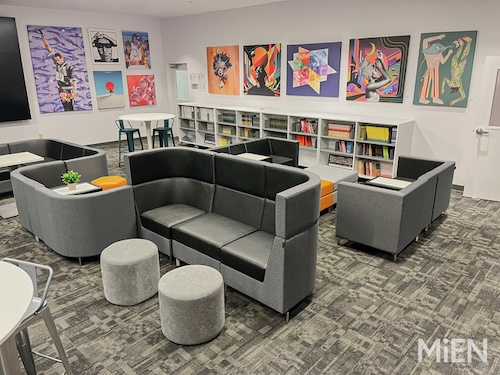
Designed and outfitted by MiEN and Meteor Education, the Empowerment Center is where kids go to hang out, collaborate, and/or participate in school club activities. The hub is also set up with two wellness rooms where students can go to debrief and disconnect from a long day or just the stresses of being a student. It’s there for the students’ use.
Here are the steps we took to create a space that consistently makes jaws drop and impresses parents who never thought their children would have access to such a warm, welcoming communal space on campus:
Add some flexibility into the process. Our original goal was to open the Empowerment Center’s doors in time for the 2023-24 school year, but getting it done the right way would require a bit more time. Our partners were willing to listen to us in terms of what we wanted to create, but within the realistic timelines. That was really cool.
Acknowledge the financial limitations. We largely relied on fundraising for this project and knew that some things just weren’t going to be realistic. To other schools in similar situations, I’d recommend staying flexible enough to hit the timelines and get all of the bases covered while keeping student needs in mind. We can have all the bells and whistles, but at the end of the day, if the car runs, the car runs. We know we can always add a new paint job later.
Get the right partners onboard early. As we went through the steps of designing the Empowerment Center, we learned a lot about architecture, planning, and construction. Through it all, having the right partners in its corner helped the school achieve its goals within budget and on time. It was really great to have our design and furniture partners sharing their best practices and other insights with us. We knew what we wanted to do, and a lot of the ideas came from our families and students. We just needed them to show us how we could get those ideas as close to reality as possible.
Make it personal. Special features we wanted in our Empowerment Center included a huge, interactive flatscreen TV that students, teachers, and guest speakers use to interact and work together. There’s also a large selection of donated books, the latest technology tools, and artwork that was personally selected by an art curation team. They were able to secure artists from the LA community to create and share visuals that our students are really familiar with. For example, some of the artwork spotlights female empowerment (i.e., with photos of authors like Octavia Butler) and the importance of acknowledging indigenous people. Everything in the hub is meant to spark curiosity.
Brace yourself for some jaw-dropping moments. At our ribbon-cutting ceremony last year, our parents’ jaws were on the floor. They just never thought these resources would be available to their kids. A lot of them grew with us being in the church and a co-located space, and then we asked them to trust us to deliver on our promise, and now we’re able to show that as the reward for supporting us. We feel really proud that our parents were just over the moon about it.
Hitting it out of the park
Reflecting on the process we put in place to get our modern student hub designed, built, and open for business, I can say that the end result is an engaging, collaborative space that can be used for hanging out, structured learning, or a little of both. I think we really hit the ball out of the park with this innovative space.
Student, teacher, and family feedback on the Empowerment Center has been extremely positive. Everyone loves it, and students are always excited to come and spend time in the modern, comfortable space that’s equipped with the technology and tools they need to be able to learn and engage.
Jade Stevens, LA Promise Fund and Westbrook Academy
Jade Stevens is the senior director of communications for the LA Promise Fund and Westbrook Academy in Los Angeles, CA.
Latest posts by eSchool Media Contributors (see all)
FREMONT, CA –Optoma, a world-leading provider of visual solutions, today announced its latest Creative Touch 3-Series Interactive Displays designed to empower educators and business professionals with new tools and features to enhance learning, make presentations more effective, and increase collaboration in classrooms, lecture halls, boardrooms, remote working and other business environments.
With Google’s Enterprise Device Licensing Agreement (EDLA) Certification and added functionality, the new 3-Series empowers professionals and educators to deliver dynamic and impactful content by providing cutting-edge tools that streamline management and elevate engagement. The advanced capabilities of the new 3-Series simplify planning and workflow through wireless collaboration, screen sharing, and innovative meeting solutions in both corporate and educational environments alike, all packed into a robust yet user-friendly platform.
The 3-Series: Purpose-Built for Corporate and Education Environments
New features and key highlights include:
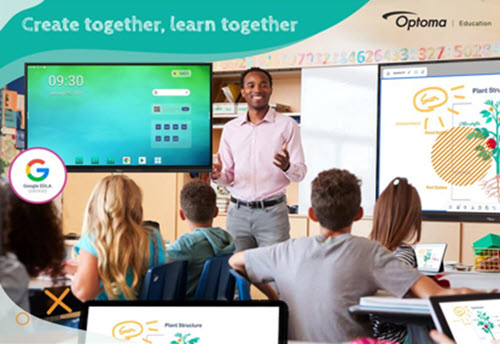
Google EDLA Certification: Ensures compatibility and optimized performance with thousands of educational applications and services available directly from the pre-installed Google Play Store allowing users to experience the full Google Suite for real-time collaboration from practically anywhere in the world. Without compatibility issues or the hassle of connecting an external PC, users can easily access the entire suite of Google-based applications they are accustomed to – including Google Drive, Google Docs, YouTube, and more!
The Optoma Solution Suite (OSS®):User-friendly software featuring Artificial Intelligence (AI) enabled tools, such as Sticky Notes* and AI Handwriting Recognition, the OSS package also includes:
Whiteboard: Unleash creativity through a digital whiteboard packed with tools that make learning and sharing ideas engaging – facilitating collaboration in real-time from anywhere.
Smart Sketch tool is ideal for drawing diagrams as it recognizes shapes and drawings and converts them into clipart images.
Floating Toolbar and Infinity Canvas allow you to seamlessly switch between tools to suit your tasks with a virtually limitless writing space.
Innovative Annotation and Highlighter Tools make underlining key points or annotating complex diagrams a breeze.
File Manager: Easily save, organize, or move files from local storage to networkable storage or to popular cloud services in seconds.
Display Share: Connect any device to wirelessly broadcast, share, or stream your content to the big screen. Bringing your own device has never been easier.
Exceptional Performance: Seamless performance with an 8-core processor, Android 14 OS, and Zero Bonding screen for that natural writing experience.
“We are excited to announce our new 3-Series and partnership with Raptor Technologies which truly embodies our commitment to supporting education through cutting-edge visual solutions, enhanced software packages and safety and security,” said Maria Repole, Head of Marketing at Optoma.
A value-added solution, Optoma Management Suite (OMS®) is available out of the box on the 3-Series Interactive Displays, with a free trial available.** OMS offers IT administrators and technicians a real time remote platform to monitor, manage, diagnose, and update multiple or entire fleets of displays simultaneously that are either on the same network or connected through the cloud. OMS makes it easy to broadcast emergency messages, alerts, or announcements across displays worldwide.
Optoma is thrilled to partner with Raptor® Technologies, the leading innovator in school safety solutions, redefining the landscape of school security with its Raptor School Safety Software Suite. By integrating Raptor’s software with Optoma’s interactive displays, school administrators and students can receive real-time alerts and emergency notifications using CAP protocols to improve the overall safety of the school.
*Some AI features may require the use of an Optoma (OSS) account.
**Free trial licenses are available for a limited time. Please register your OMS® Cloud account at https://oms.optoma.com or speak with your local representative.
OMS and OSS are registered trademarks of Optoma Corporation
DLP is a registered trademark of Texas Instruments
About Optoma Technology, Inc.
Optoma combines cutting-edge technology and innovation to deliver remarkable visual display products designed to connect audiences with engaging video experiences. From the company’s ProScene projectors to its Creative Touch interactive, Professional LCD and LED displays, Optoma’s suite of products can meet the demands of nearly any professional environment, including conference rooms and classrooms, digital signage, corporate, houses of worship, retail, simulation environments and control rooms. Optoma Technology is the U.S. headquarters for The Optoma Group, with continental headquarters also in Europe and Asia. For more information, visit optomausa.com.
eSchool Media staff cover education technology in all its aspects–from legislation and litigation, to best practices, to lessons learned and new products. First published in March of 1998 as a monthly print and digital newspaper, eSchool Media provides the news and information necessary to help K-20 decision-makers successfully use technology and innovation to transform schools and colleges and achieve their educational goals.
This blog was first published in the Oxford Magazine No 475 (Eighth Week, Hilary term, 2025) and is reproduced here with permission of the author and the editor.
Rachel Reeds’ short but comprehensive book, Surviving and Thriving in Higher Education Professional Services: a guide to success(Routledge, 2025), is both an instruction manual for the ‘professionals’ it was written for and an illuminating account of what they do for the academics and students who benefit. However, Reeds is frank about what is sometimes described as ‘trench warfare’, a ‘tension’ between academics and ‘everyone else’, including differences of ‘perceived status’ among the staff of ‘higher education providers’.
Her chapters begin with a survey of the organisation of ‘UK higher education today’. Then comes a description of ‘job or career’ in ‘professional services’ followed by a chapter on how to get such a post. Chapter 4 advises the new recruit about ‘making a visible impact’ and Chapter 5 considers ‘managing people and teams’. The widespread enthusiasm of providers for ‘change’ and ‘innovation’ prompts the discussion in Chapter 6.
Reeds defines ‘Professional Services’ as replacing and embracing ‘terms such as administrators, non-academic staff or support staff’. In some providers there are not two but three categories, with ‘professional services’ sometimes described as ‘academic-related’ and other non-academics as ‘assistant’ staff. Some academics are responsible for both teaching and research but there may also be research-only staff, usually on fixed-term externally-funded contracts, which may be classified on the sameside of the ‘trench’ as academics. The ‘umbrella carriers’ of ‘middle management’ and ‘dealing with difficult things’ provide matter for Chapter 7. In Chapter 8 and the conclusion there is encouragement to see the task in broader terms and to share ‘knowledge’ gained. Each chapter ends with suggestions for further reading under the heading ‘digging deeper’.
The scope of the needs to be met is now very wide. Government-defined ‘Levels’ of higher education include Levels 4 and 5, placing degrees at Level 6, with postgraduate Masters at 7 and doctorates at 8. The Higher Education and Research Act of 2017 therefore includes what is now a considerable range of ‘higher education providers’ in England, traditional Universities among them, but also hundreds of ‘alternative providers’. Some of these deliver higher education in partnership with other providers which have their own degree-awarding powers, relying on them to provide their students with degrees. These all need ‘professional services’ to support them in their primary tasks of teaching and, in many cases, also research.
Providers of higher education need two kinds of staff: to deliver education and research and others to provide support for them. That was noticed in the original drafting of the Further and Higher Education Act of 1992 s.65, 2 (b) which approved the use of (the then significant) ‘block grant’ public funding for:
the provision of any facilities, and the carrying on of any other activities, by higher education institutions in their area which the governing bodies of those institutions consider it necessary or desirable to provide or carry on for the purpose of or in connection with education or research.
In what sense do those offering such ‘services’ constitute a Profession? The Professional Qualifications Act of 2022, awaiting consideration of amendments and royal approval, is primarily concerned with licence to practise and the arrangements for the acceptance of international qualifications. It is designed to set out a framework ‘whereby professional statutory regulatory bodies (PSRBs) can determine the necessary knowledge and experience requirements to work in a regulated profession (for example nursing or architecture)’. It will permit ’different approaches to undertaking’ any ‘regulatory activity’ so as ‘to ensure professional standards’This is not stated to include any body recognising members of the Professional Services of higher education. Nor does the Government’s own approved list of regulated professions.
The modern Professional Services came into existence in a recognisable form only in the last few decades.The need for support for the work of the ‘scholars’ got limited recognition in the early universities. When Oxford and Cambridge formed themselves as corporations at the beginning of the thirteenth century they provided themselves with Chancellors, who had a judicial function, and Proctors (Procuratores) to ensure that the corporation stayed on the right side of the law. The office of Registrar (Oxford) and Registrary (Cambridge) was added from the fifteenth sixteenth century to keep the records of the University such as its lists and accounts.
The needs to be met expanded towards the end of the nineteenth century. Oxford’s Registrar had a staff of five in 1914. The Oxford and Cambridge Universities Commission which framed the Act of 1923 recommended that the Registrar’s role be developed. The staff of Oxford’s Registrar numbered eight in 1930 and forty in 1958. By 2016 the Registrar was manager to half the University’s staff.
The multiplication of universities from the 1890s continued with a new cluster in the 1960s, each with its own body of staff supporting the academics. A body of University Academic Administrative Staff created in 1961 became the Conference of University Administrators in 1993. The resulting Association of University Administrators (AUA) became the Association of Higher Education Professionals (AHEP) in 2023. CUA traced its history back to the Meeting of University Academic Administrative Staff, founded in 1961. Its golden jubilees was celebrated in 2011 in response to the changing UK higher education sector. It adopted the current name in 2023.
This reflects the development of categories of such support staff not all of whom are classified as ‘Professional’. A distinction is now common between ‘assistant staff’ and the ‘professionals’, often described as ’academic-related’ and enjoying a comparable status with the ‘academic’.
The question of status was sharpened by the creation of a Leadership Foundation in Higher Education (LFHE) in 2004, merged with AdvanceHE in 2018. This promises those in Professional Services ‘a vital career trajectory equal to research, teaching and supporting learning’ and, notably, to ‘empower leaders at all levels: from early-career professionals to senior executives’ That implies that executive leadership in a provider will not necessarily lie with its academics. It may also be described as managerial.
Reading University identifies ‘role profiles’ of four kinds: ‘academic and research’; ‘professional and managerial’; support roles which are ‘clerical and technical; ‘ancillary and operational support’. The ‘professional and managerial’ roles are at Grades 6-8. It invites potential recruits into its ‘Professional Services’ as offering career progression at the University. The routes are listed under Leadership and Management Development; ‘coaching and mentoring’ and ‘apprenticeships’. This may open a ‘visible career pathway for professional services staff’ and ‘also form part of succession planning within a team, department or Directorate or School where team members showing potential can be nurtured and developed’.
Traditional universities tend to adopt the terminology of ‘Professional Services’. Durham University, one of the oldest, details its ‘Professional Services’ in information for its students, telling them that they will ‘have access to an extensive, helpful support network’. It lists eleven categories, with ‘health and safety’ specifically stated to provide ‘professional’ advice. York University, one of the group of universities founded during the 1960s, also lists Professional Services. These are ‘overseen by the Chief Financial and Operating Officer’ and variously serving Technology; Estates and Facilities; Human Resources; Research and Enterprise; Planning and Risk; External Relations; student needs etc. The post-1992 Oxford Brookes University also has its Professional Services divided into a number of sections of the University’s work such as ‘academic, research and estates’. Of the alternative providers which have gained ‘university title’ Edge Hill (2006) lists seven ‘administrative staff’, two ‘part-time’, one described as administration ‘co-ordinator’, one as a ‘manager’ and one as a ‘leader’.
Reeds’ study draws on the experience of those working in a wide range of providers, but it does not include an account of the provision developed by Oxford or Cambridge. Yet the two ancient English Universities have their own centuries-long histories of creating and multiplying administrative roles. The Colleges of Oxford and Cambridge similarly distinguish their ‘academic’ from their other staff. For example St John’s College, Oxford and Sidney Sussex College, Cambridge list more than a dozen ‘departments’, each with its own body of non-academic staff.
In Oxford the distinction between academics and ‘professional’ administrators is somewhat blurred by grading administrators alongside academics at the same levels. Oxford’s Registrar now acts ‘as principal adviser on strategic policy to the Vice-Chancellor and to Council’, and to ‘ensure effective co-ordination of advice from other officers to the Vice-Chancellor, Council, and other university bodies’ (Statute IX, 30-32). Cambridge’s Registrary is ‘to act as the principal administrative officer of the University, and as the head of the University’s administrative staff’ and ‘keep a record of the proceedings of the University, and to attend for that purpose’ all ‘public proceedings of the University’, acting ‘as Secretary to the Council.’
The record-keeping responsibility continues, including ‘maintaining a register of members of the University’, and ‘keeping records of matriculations and class-lists, and of degrees, diplomas, and other qualifications’. The Registrary must also edit the Statutes and Ordinances and the Cambridge University Reporter (Statute C, VI). The multiplication of the Registrary’s tasks now requires a body offering ‘professional’ services. ‘There shall be under the direction of the Council administrative officers in categories determined by Special Ordinance’ (Statute c, VI).
Oxford and Cambridge each created a ‘UAS’ in the 1990s. Both are now engaged in ‘Reimagining Professional Services’. Oxford’s UAS (‘University Administration and Services’, also known as ‘Professional Services and University Administration’) is divided into sections, most of them headed by the Registrar. These are variously called ‘departments’, ‘directorates’, ‘divisions’, ‘services’ and ‘offices’ and may have sub-sections of their own. For example ‘People’ includes Childcare; Equality and Diversity; Occupational Health; Safety; ‘Organisational Development’; ‘Wellbeing’ and ‘international Development’, each with its own group of postholders. This means that between the academic and ‘the traditional student support-based professional services’ now fall a variety of other tasks some leading to other professional qualifications, for example from the Chartered Institute of Personnel and Development, the Chartered Management Institute or in librarianship and technology.
Cambridge’s UAS (Unified Administrative Service), headed by its Registrary and now similarly extensive and wide-ranging, had a controversial beginning. Its UAS was set up in 1996 bringing together the Financial Board, the General Board, and the Registry. Its intended status and that of its proposed members proved controversial. Although it was described as ‘professional’, the remarks made when it was proposed in a Report included the expression of concerns that this threatened the certainty that the University was ‘academic led’. This prompted a stock-taking Notice published on 20 June 2001 to provide assurance that ‘the management of the University’s activities, which is already largely in the hands of academic staff, must also continue to be academic-led’ and that the ‘role of the administration is to support, not to manage, the delivery of high-quality teaching and research’. But it was urged that the UAS needed ‘further development both in terms of resourcing and of organization’. The opportunity was taken to emphasise the ‘professionalism’ of the service.
With the expansion of Professional Services has gone a shift from an assumption that this forms a ‘Civil Service’ role to its definition as ‘administrative’ or ‘managerial’. ‘Serving’ of the academic community may now allow a degree of control. Reeds suggests that ‘management’ is a ‘role’ while ‘leadership’ is a ‘concept’, leaving for further consideration whether those in Professional Services should exercise the institutional leadership which is now offered for approval.
In Cambridge the Council has been discussing ways in which, and with whom, this might be taken forward. On 3 June 2024 its Minutes show that it ‘discussed the idea of an academic leaders’ programme to help with succession planning by building a strong pool of candidates for leadership positions within the University’. It continued the discussion at its July meeting and agreed a plan which was published in a Notice in the Reporter on 31 July:
to create up to six new paid part-time fellowships each year for emerging academic leaders at the University, sponsored by the Vice-Chancellor. Each fellow would be supported by a PVC or Head of School (as appropriate) and would be responsible for delivering agreed objectives, which could be in the form of project(s).
‘In addition to financial remuneration’, the Fellows would each receive professional coaching, including attendance on the Senior Leadership Programme Level 3. Unresolved challenge has delayed the implementation of this plan so far.
The well-documented evolution and current review of Professional Services in Oxford and Cambridge is not included, but the story of Professional Services told in this well-written and useful book is illustrated with quotations from individuals working in professional services.
SRHE member GR Evans is Emeritus Professor of Medieval Theology and Intellectual History in the University of Cambridge.