Category: Metrics

  • Higher Education Pay Increases in 2023 Exceeded Inflation for the First Time Since the Pandemic – CUPA-HR

    Higher Education Pay Increases in 2023 Exceeded Inflation for the First Time Since the Pandemic – CUPA-HR

    by CUPA-HR | March 27, 2024

    New research from CUPA-HR has found that median pay increases for most higher education employees in 2023-24 continued the upward trend seen last year (and exceeded the inflation rate for the first time since 2019-20). However, the findings also show that most higher ed employees are still being paid less than they were in 2019-20 in inflation-adjusted dollars.

    The largest gap between pre-pandemic inflation-adjusted salaries and current salaries is for tenure-track faculty (earning 9.7% less), followed by non-tenure-track teaching faculty (earning 8.2% less). The smallest gap is for staff (earning only 0.3% less).

    Other key findings from an analysis of CUPA-HR’s higher ed workforce salary survey data from 2016-17 to 2023-24 include:

    • Non-tenure-track teaching faculty received their highest raise in the past eight years.
    • Staff (generally non-exempt employees) received the highest increase in pay in comparison to other employee types. This was true last year as well.
    • Tenure-track faculty continued to receive the lowest pay increases (and were the only group of employees whose raise did not surpass inflation).

    Across higher ed, employees are still being paid less than they were in 2019-20 (pre-pandemic) in inflation-adjusted dollars. Tenure-track faculty are the group with the largest gap between median salaries in 2019-20 adjusted to 2023-24 dollars and actual median salaries in 2023-24, earning 9.7% less. This is followed by non-tenure-track teaching faculty (earning 8.2% less). The smallest gap is for staff (earning only 0.3% less).

    High inflation has only exacerbated the gaps in pay increases faculty (particularly tenure-track faculty) experience in relation to other higher ed employees. Further, even though most higher ed employee groups received raises that beat inflation in 2023-24, these raises did not reverse the erosion of higher ed employee purchasing power that has been occurring since 2019-20.

    Explore this data and more in CUPA-HR’s newest interactive graphic.

    CUPA-HR Research

    CUPA-HR is the recognized authority on compensation surveys for higher education, with its workforce surveys designed by higher ed HR professionals for higher ed HR professionals and other campus leaders.


    Source link

  • Newly Updated CUPA-HR Data Shed Light on Trends in Representation and Pay Equity in the Higher Ed Workforce – CUPA-HR

    Newly Updated CUPA-HR Data Shed Light on Trends in Representation and Pay Equity in the Higher Ed Workforce – CUPA-HR

    by Julie Burrell | January 22, 2024

    Progress in both representation and equitable pay for women and people of color remained sluggish in most roles on college and university campuses in academic year 2022-23, according to the newest data. Through several interactive graphics representing years of research, CUPA-HR highlights the progress that has been made and the disparities that persist. The data track gender and racial composition as well as pay of administrative, faculty, professional, and staff roles, collected from CUPA-HR’s signature surveys.

    While the representation of women and people of color across all roles has steadily increased, inequity remains, especially when it comes to compensation for women and people of color. However, there were some notable areas of progress when it comes to compensation. Asian women and men of color (except for Native American/Alaskan Native men) in administrative roles saw better pay equity than most other groups.

    Administrators

    The share of racial and ethnic minorities in administrative roles continued to grow over the past decade, but gaps in both representation and pay remained steady. This is especially true for women of color, who represented less than 11% of these roles and, for the most part, received lower salaries than White men.

    In 2022-23, people of color made up 18.7% of administrators, up from 12.9% in 2011-12. Although the proportion of people of color in higher ed administrator positions grew steadily over the last decade, these increases have not kept pace with the rate at which minorities are obtaining graduate degrees.

    No improvement was shown in pay disparities for most women administrators. All female administrators except for Asian women received lower salaries than White men. Conversely, men of color, except for Native American/Alaskan Native men, were paid salaries greater than those of White men.

    The Administrators in Higher Education Survey collects data on administrator positions that manage a higher ed institution or a division within it.

    See the Administrators Composition and Pay Equity by Gender and Race/Ethnicity interactive graphics, as well as data broken out by CEO, provost and chief HR officer.

    Faculty

    There are two notable findings regarding faculty composition. First, more women faculty were represented in non-tenure-track roles than in tenure-track roles in 2022-23. Second, with each increase in rank, the proportions of women faculty and faculty of color decreased for both tenure-track and non-tenure-track faculty. Taken together, this means that women were over-represented in the lowest-paying and lowest-ranking positions.

    Pay gaps within rank persist, particularly for women faculty at the professor level, regardless of tenure status. These gaps are most notable for female professors of color in non-tenure-track positions. Pay gaps for assistant and associate professors have narrowed over time, particularly for tenure-track faculty.

    The factor that most impacts faculty pay is promotion to a higher rank, which is often the only time faculty receive significant increases in salary. When there is bias in promoting women and faculty of color to successive ranks, as our data continued to show, this results in career earnings gaps that far exceed what is often detected in pay equity studies within rank for a given year.

    The Faculty in Higher Education Survey collects data on tenure-track faculty positions and non-tenure-track teaching faculty positions.

    See the Faculty Composition and Pay Equity by Gender and Race/Ethnicity interactive graphics.

    Professionals

    In academic year 2022-23, women of all races and ethnicities were paid less than their male counterparts in professional roles, while women’s representation increased from 58% to 61% across all professional positions since 2016-17. The growth is due to slight increases in the representation of women of color, from 13.1% in 2016-17 to 15.7% in 2022-23.

    Representation by gender and race/ethnicity varied widely by position. Human resources had the greatest share of women professionals, with 82% being women, including 28% women of color. Information technology had the lowest percentage of professional women (27%), and librarians and development/fundraising professionals had the lowest representation of professionals of color (14%).

    While pay was more equitable for most groups (apart from Hispanic/Latina women and men of two or more races), pay disparities persisted. Women of all races and ethnicities were paid less than their male counterparts. In addition, Hispanic/Latino men, Native Hawaiian men, and men of two or more races were paid less than White men.

    The Professionals in Higher Education Survey collects data on positions in specific functional areas in higher ed institutions, such as academic or student services, that usually require a baccalaureate degree.

    See the Professionals Composition and Pay Equity by Gender and Race/Ethnicity interactive graphics.

    Staff

    Staff roles continued to have a higher representation of people of color than any other higher ed employee group last year. Staff also continued to be the lowest-paying positions in higher ed, with women particularly hard hit by pay disparities.

    In 2022-23, women of color represented about 19% of all higher ed staff, and men of color represent about 13% of all higher ed staff — a modest increase since 2016-17. Skilled craft employees were the least racially diverse, a finding that has persisted across the past six years. Notably, skilled craft staff are among the highest-paid staff positions.

    Since 2016-17, women were paid consistently and considerably less than White men. Pay equity for American Indian/Alaska Native women, Asian women, and Native Hawaiian/Other Pacific Islander women was better in 2022-23 than in 2016-17. Pay equity was the same or worse in 2022-23 than in 2016-17 for Black women, Hispanic/Latina women, women of two or more races, and White women. Men of color fared considerably better than women of color when it came to pay equity.

    The Staff in Higher Education Survey collects data on positions that are generally non-exempt and do not require a college degree.

    See the Staff Composition and Pay Equity by Gender and Race/Ethnicity interactive graphics.

    CUPA-HR Research

    CUPA-HR is the recognized authority on compensation surveys for higher education, with its workforce surveys designed by higher ed HR professionals for higher ed HR professionals and other campus leaders.


    Source link

  • Ten Higher Ed HR Stories That Defined 2023 – CUPA-HR

    Ten Higher Ed HR Stories That Defined 2023 – CUPA-HR

    by Julie Burrell | January 17, 2024

    Last year brought major changes to the higher education landscape. Turnover reached a peak, prompting more attention than ever to retention and recruitment, while looming policy changes in overtime pay and Title IX regulations further complicated long-term planning. And, though it may feel like unprecedented change is the new normal, timeless HR topics like onboarding and compensation strategy also captured readers’ attention in 2023.

    We’ve rounded up the CUPA-HR articles, resources and research that defined 2023 and will continue to shape your 2024. These are the most-viewed stories on our website as well as some resources you may have missed.

    Top Stories

    CUPA-HR members were understandably concerned about the impact of two issues — the retention crisis and the potential shake-up to overtime pay rules — on their campuses.

    1. The Higher Ed Employee Retention Crisis — And What to Do About It

    Key Takeaway: Turnover in higher ed reached a peak last year — the highest level since we started tracking it in 2017 — so it’s no surprise that talent management and recruitment was top of mind. This article marshals a wealth of insights from our members and the CUPA-HR research team to aid HR pros, including a blueprint for employee recognition, as well as strategies for rethinking compensation and flexible work.

    1. The CUPA-HR 2023 Higher Education Employee Retention Survey

    Key Takeaway: The data provided here help explain the record-high turnover. The report also digs into the factors that most impact retention, offering a model for understanding higher ed retention. Analyzing data from 4,782 higher ed employees — administrators, professionals and non-exempt staff, with faculty excluded — from 529 institutions, the survey found that more than half (56%) of employees are at least somewhat likely to search for a new job in the coming year. (Looking for an overview of report findings? Check out our press release.)

    1. Overtime and Title IX Final Rules Targeted for Early 2024 Release in Fall Regulatory Agenda

    Key Takeaway: Last year, the Department of Labor announced that they would target April 2024 for the release of a final rule to update the Fair Labor Standards Act’s overtime pay regulations. The rule seeks to substantially increase the minimum salary threshold required for white-collar professionals to maintain exempt status. To stay abreast of any updates, don’t forget to register for our Washington Update webinars and visit our FLSA overtime resources page.

    Relationships and Well-Being

    The demands on HR pros are at an all-time high. Last year, our members sought ways to care for themselves, their team and their campuses. Two of the most popular resources of 2023 addressed mental health and resolving interpersonal conflict.

    1. Managing Stress and Self-Care: “No” Is a Complete Sentence

    Key Takeaway: In this highly rated recorded webinar, Jennifer Parker, professional development and training manager of the Colorado Community College system, gives practical tools for minimizing stress and leads participants in creating a self-care plan.

    1. Ushering in the New Wave of Conflict Resolution: Tulane University’s Restorative Approach

    Key Takeaway: Learn how Tulane University’s Office of Human Resources and Institutional Equity launched a conflict resolution program, all while successfully managing the pivot to virtual offerings during the pandemic. One of the few university programs in the country to provide a restorative approach, Tulane’s program is a roadmap for fostering and maintaining campus relationships.

    Retention and Recruitment

    Our members offered real-world case studies of talent management and attraction in these feature articles in Higher Ed HR Magazine. They provide success stories and practical tips you can tailor to fit your needs.

    1. Modernizing Workplace Culture and the Employee Experience — Strategies for HR

    Key Takeaway: Workplace culture encompasses so much that it’s tricky to pin down. Jacob Lathrop, consultant to the vice president/CHRO at Michigan State University, defines workplace culture as the feeling employees are left with when they leave work. It’s how they describe their days to family or friends. Old ways of doing things may be harmful to employees’ well-being, while modernizing workplace culture might mean retaining and attracting talent. Lathrop’s tips include embracing flexibility and autonomy, evolving your paid-leave policies, and updating career exploration programs, among others.

    1. A Tale of Two Onboarding Programs: North Carolina State University and
    2. A Tale of Two Onboarding Programs: The University Of St. Francis

    Key Takeaway: A perennially popular topic, onboarding can look very different depending on the institution. In the first article, North Carolina State University’s onboarding manager Amy Grubbs tells the story of their efforts to create consistent new-hire experiences, get supervisors involved in the onboarding process, and bring a full-service Onboarding Center to life through strategic campus partnerships. (Check out Amy’s webinar too, which provides even more information on the Onboarding Center and strategic partnerships.) With more limited resources, Carol Sheetz, formerly of the small, private University of St. Francis, shares her solo effort to build USF’s onboarding program from scratch. This article contains her top tips and resources for other HR pros in the same situation.

    1. Investing in Employees During an Economic Downturn: How We Implemented Our Living Wage Strategy

    Key Takeaway: A decade ago, the Maricopa County Community College District committed to a $30,000 livable wage for its full-time employees, but employees found it challenging to keep up with inflationary pressures and the COVID-related economic downturn. Maricopa responded by raising the livable wage by 15.5 percent, from $14.42 to $16.65. This article explains how HR managed to implement this raise, while preventing additional pay compression and reduced employee morale. (The second phase of MCCCD’s plan, focusing on progressive pay practices, internal pay equity and market alignment, is explored here.)

    1. Recalibrating Employee Recognition in Higher Education

    Key Takeaway: “Most of us continue churning out the same recognition programs — many decades old — often without questioning their value, validating their impact or reviewing for bias,” says author Sharri Margraves, the executive director of organization and professional development for Michigan State University’s human resources. She surveyed 65 higher education institutions to find out how they formally and informally recognize employees. This article not only presents these findings, but also suggests ways to redesign your own recognition program, including a self-audit tool to assess your strengths and weaknesses.


    Source link

  • Pay Equity Still Lags for Women Administrators – CUPA-HR

    Pay Equity Still Lags for Women Administrators – CUPA-HR

    by Julie Burrell | November 29, 2023

    An analysis of two decades worth of CUPA-HR data on gender and pay in higher ed administrative roles paints a troubling picture of pay equity. In 2022, women made up 51% of administrators in college and universities, but they were paid 93 cents for each dollar a man in an administrator position was paid. This represents an increase of just 3 cents from 2002, when women made 90 cents for each dollar a man was paid.

    Among chief human resources officers, the pay disparity is even wider. Though three in four (76%) of CHROs are women, their pay in 2022 was only 89 cents for each dollar male CHROs were paid. Deputy CHROs who are women were paid only 83 cents, a figure that remained unchanged from 2002 through 2022.

    The Higher Ed Administrators: Trends in Diversity and Pay Equity From 2002 to 2022 report also found that people of color — women especially — are increasingly represented in administrative positions. Drawing on 10 years of data, CUPA-HR found that between 2012 and 2022, the representation of people of color in higher ed administration increased by 41%. In 2012, people of color comprised 13% of administrators and in 2022, 18% of administrators. Women of color went from comprising 7% of higher ed administrators in 2012 to 10% of higher ed administrators in 2022.

    Despite these gains in representation, women of most races and ethnicities are still paid less than White men in the same administrator positions.

    The Report’s Major Findings Include:

    • The past 20 years saw an increase of 20% of women in administration, from 43% in 2022 to 51% in 2022, but pay equity for women has not kept pace. In 2002, women in administrator positions were paid 90 cents for each dollar men in administrator positions were paid. Two decades later, women in administrator positions were paid just 93 cents for each dollar men in administrator positions are. These wage gaps are not explained by the fact that women may have greater representation in lower-paying positions.
    • From 2012-2022, the representation of people of color in administrative roles increased by 41%. The biggest increases were among administrators of two or more races (290% increase) and Asian administrators (76%). Women of color have seen more than double the percentage increase in representation than men of color (54% increase for women versus 26% for men).
    • But people of color are still underrepresented in administrative positions. Using the percentage of people of color with U.S. graduate degrees (31%) as a comparison, we find that only 18% of higher ed administrators were people of color in 2022.
    • Women’s representation in executive roles increased, but pay inequity still exists. In 2022, women held one in three campus presidencies, an increase of 60% from 2002. In 2002, female presidents were paid 92 cents on the dollar to male presidents and saw only a 1-cent increase in the 20 years since. The worst pay equity for presidents was for Hispanic or Latina women, who were paid 82 cents per dollar paid to White men. In the same time span, the representation of women provosts increased, comprising nearly half (48%) of provosts in 2022. The gender pay gap narrowed as well: Female provosts were paid 91 cents on the dollar compared to male provosts in 2002, and in 2022, female provosts were paid 96 cents on the dollar compared to male provosts.
    • CHRO gender pay equity remains low. In 2022, three in four (76%) CHROs were women, with White women representing 60%. In 2002, female CHROs were paid 86 cents for each dollar male CHROs were paid. In 2022, female CHROs were paid only 89 cents for each dollar male CHROs were paid.

    Addressing the Administrative Pay Gap

    Addressing pay inequity and increasing the representation of people of color among higher ed administrators requires long-term solutions like conducting pay analyses. CUPA-HR’s DataOnDemand for the Administrators in Higher Education Survey features the most comprehensive data available on higher ed administrator salaries, as well as data on pay equity and representation for women and people of color for every administrative position.

    Recruiting a more diverse pool of faculty candidates and mitigating bias in faculty promotions are also important to succession planning, as one notable path to the presidency is to start off as a faculty member, ascend to dean, then to provost, and then to president.

    You also might consider what talent pipeline programs exist on your campus. For inspiration, see these models of internal talent development:


    Source link

  • Keys to Retaining Supervisors in a Time of Turnover – CUPA-HR

    Keys to Retaining Supervisors in a Time of Turnover – CUPA-HR

    by CUPA-HR | October 3, 2023

    While the ongoing turnover crisis impacts all of higher ed, supervisors are among the hardest hit. In our recent study, The CUPA-HR 2023 Higher Education Employee Retention Survey, supervisors say they’re grappling with overwork and added responsibilities (especially when their staff members take other jobs), while struggling to maintain morale.

    Supervisor retention is especially critical in a time of turnover, as these are the employees we rely on most to preserve institutional knowledge and provide continuity amid transition. But our research shows that many supervisors are not getting the kinds of institutional support they need. By empowering managers to make decisions on behalf of their staff, institutions make it less likely that their supervisors will seek employment opportunities elsewhere.

    The Supervisor’s Perspective

    Taking a closer look at the data, it’s clear that supervisors are overworked and under-resourced. Seven in ten work more hours than what is expected of full-time employees at their institution. Nearly double the percentage of supervisors versus non-supervisors agree that it is normal to work weekends and that they cannot complete their job duties working only their institution’s normal full-time hours.

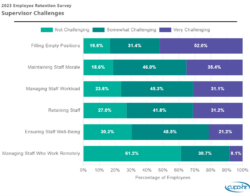
    Supervisors are also facing challenges unique to their leadership roles. Filling vacant positions and maintaining the morale of their staff are their chief worries:

    Strategies for Supervisor Retention

    Given the pressures supervisors are under, what can institutions do to ensure that their top talent won’t seek other employment? While common retention incentives like increased pay and recognition are crucial, supervisors need improved institutional support.

    Our data show that supervisors are in need of the following:

    When supervisors are empowered in these ways, they are less likely to be among the 56 percent of employees who say they’re at least somewhat likely to search for a new job in the coming year.

    Additional Resources

    Managing Stress and Self-Care: “No” Is a Complete Sentence (On-Demand Webinar, August 2023)

    Ready to Crack: Solutions for HR Managers Dealing With Burnout (Spring 2022)

    Health and Well-Being Toolkit

    Management and Supervisor Training Toolkit


    Source link

  • Hybrid, Remote and Flexible Work: The Secret Sauce for Employee Retention? – CUPA-HR

    Hybrid, Remote and Flexible Work: The Secret Sauce for Employee Retention? – CUPA-HR

    by CUPA-HR | September 19, 2023

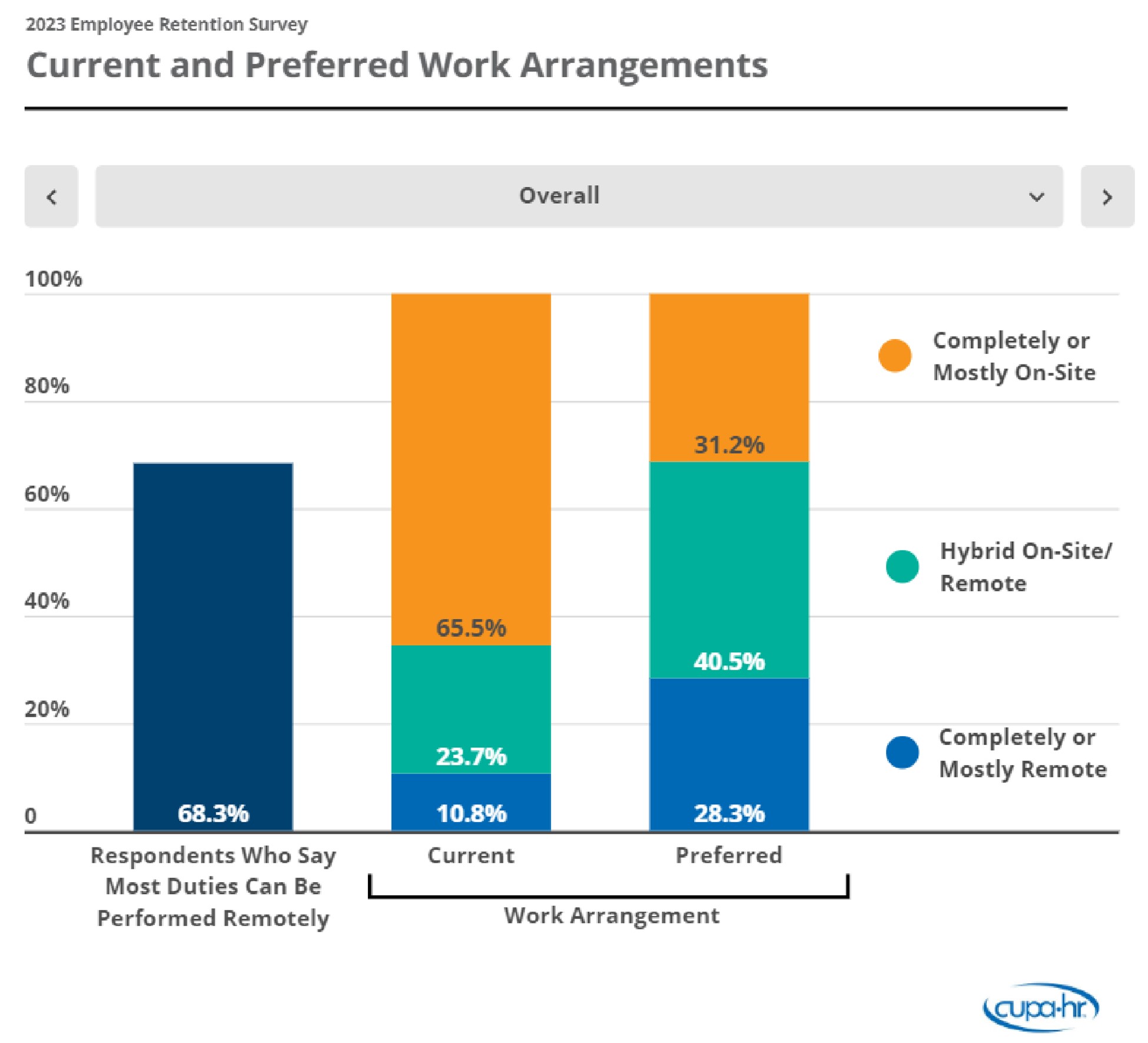
    Given the number of employees who successfully executed their work remotely at the height of the pandemic, it may come as no surprise that a substantial gap exists between the work arrangements that higher ed employees want and what institutions offer. According to the new CUPA-HR 2023 Higher Education Employee Retention Survey, although two-thirds of employees state that most of their duties could be performed remotely and two-thirds would prefer hybrid or remote work arrangements, two-thirds of employees are working completely or mostly on-site.

    Inflexibility in work arrangements could be costly to institutions and contribute to ongoing turnover in higher ed. Flexible work is a significant predictor of employee retention: Employees who have flexible work arrangements that better align with their preferences are less likely to look for other job opportunities.

    Flexible Work Benefits: A No-Brainer for Retention

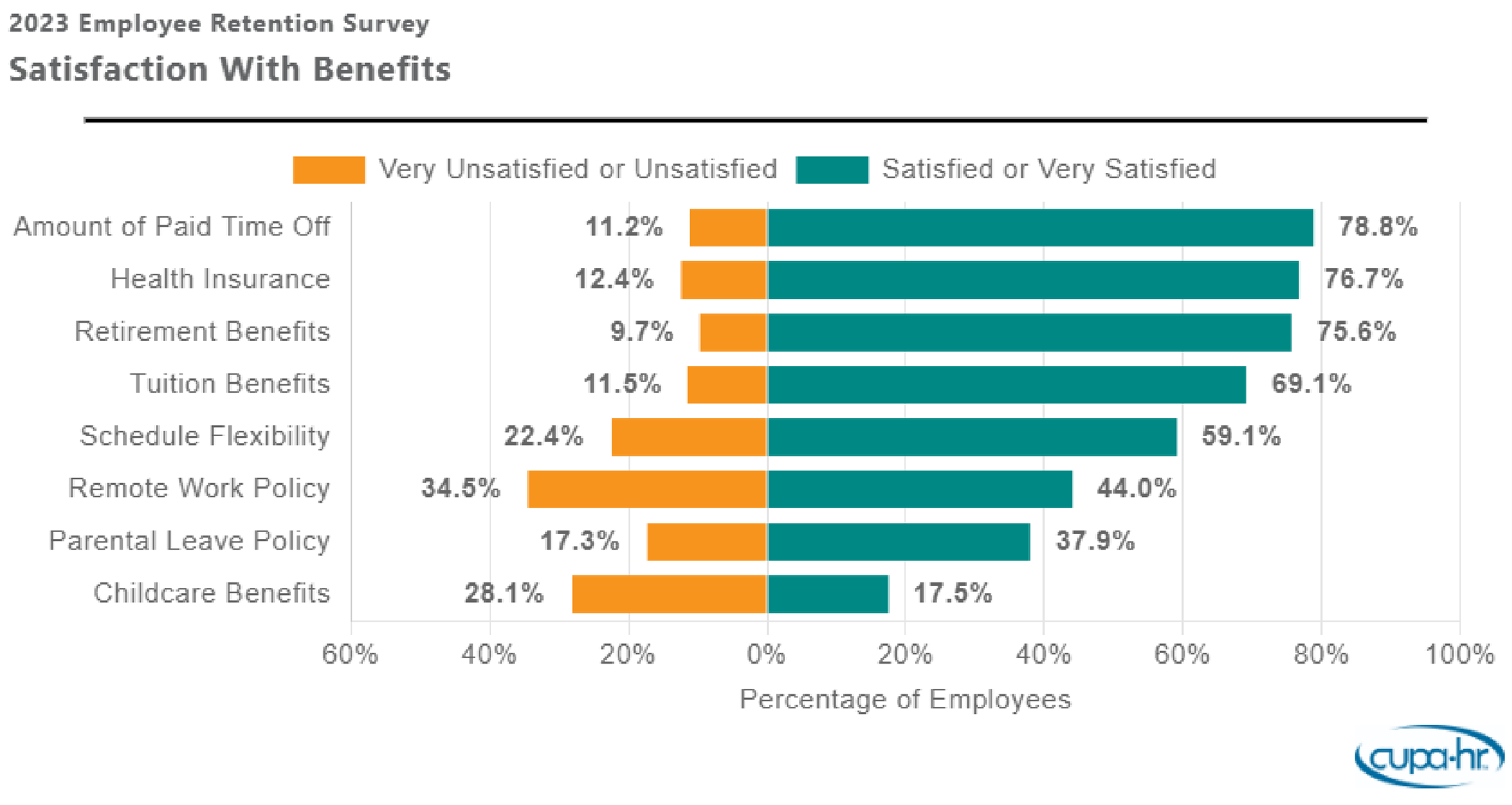
    While more than three-fourths of employees are satisfied with traditional benefits such as paid time off and health insurance, survey respondents were the most dissatisfied with the benefits that promote a healthier work-life balance. These include remote work policies and schedule flexibility, as well as childcare benefits and parental leave policies.

    Most employees are not looking for drastic changes in their work arrangements. Even small changes in remote policies and more flexible work schedules can make a difference. Allowing one day of working from home per week, implementing half-day Fridays, reducing summer hours and allowing employees some say in their schedules are all examples of flexible work arrangements that provide employees some autonomy in achieving a work-life balance that will improve productivity and retention.

    A more flexible work environment could be an effective strategy for institutions looking to retain their top talent, particularly those under the age of 45, who are significantly more likely not only to look for other employment in the coming year, but also more likely to value flexible and remote work as a benefit. Flexible work arrangements could also support efforts to recruit and retain candidates who are often underrepresented: the survey found that women and people of color are more likely to prefer remote or hybrid options.

    Three Things You Can Do

    1. Use Data to Make a Case for Change. The CUPA-HR 2023 Higher Education Employee Retention Survey provides multiple data points that support remote, hybrid and flexible work for the retention and recruitment of top talent.
    1. Explore CUPA-HR Resources. Discover best practices and policy models for navigating the challenges that come with added flexibility, including managing a multi-state workforce:
    1. Remember the Two-Thirds Rule. In reevaluating flexible and remote work policies, remember: Two-thirds of higher ed employees believe most of their duties can be performed remotely and two-thirds would prefer hybrid or remote work arrangements, yet two-thirds are compelled to work mostly or completely on-site.

    You may also be interested in:


    Source link

  • The Top Predictor of Higher Ed Employee Retention May Surprise You – CUPA-HR

    The Top Predictor of Higher Ed Employee Retention May Surprise You – CUPA-HR

    by CUPA-HR | September 12, 2023

    In 2022-23, turnover of higher ed employees was the highest in five years. A new report from CUPA-HR explores the issue of higher ed employee retention and the factors that impact retention.

    The CUPA-HR 2023 Higher Education Employee Retention Survey analyzed data from 4,782 higher ed employees — administrators, professionals and non-exempt staff, with faculty excluded — from 529 institutions. It found that 33% of higher ed employees surveyed answered they were “very likely” or “likely” to look for new employment opportunities in the next year. More than half (56%) of employees are at least somewhat likely to search for a new job in the coming year.

    Top Reasons Higher Ed Employees Are Looking for a New Job

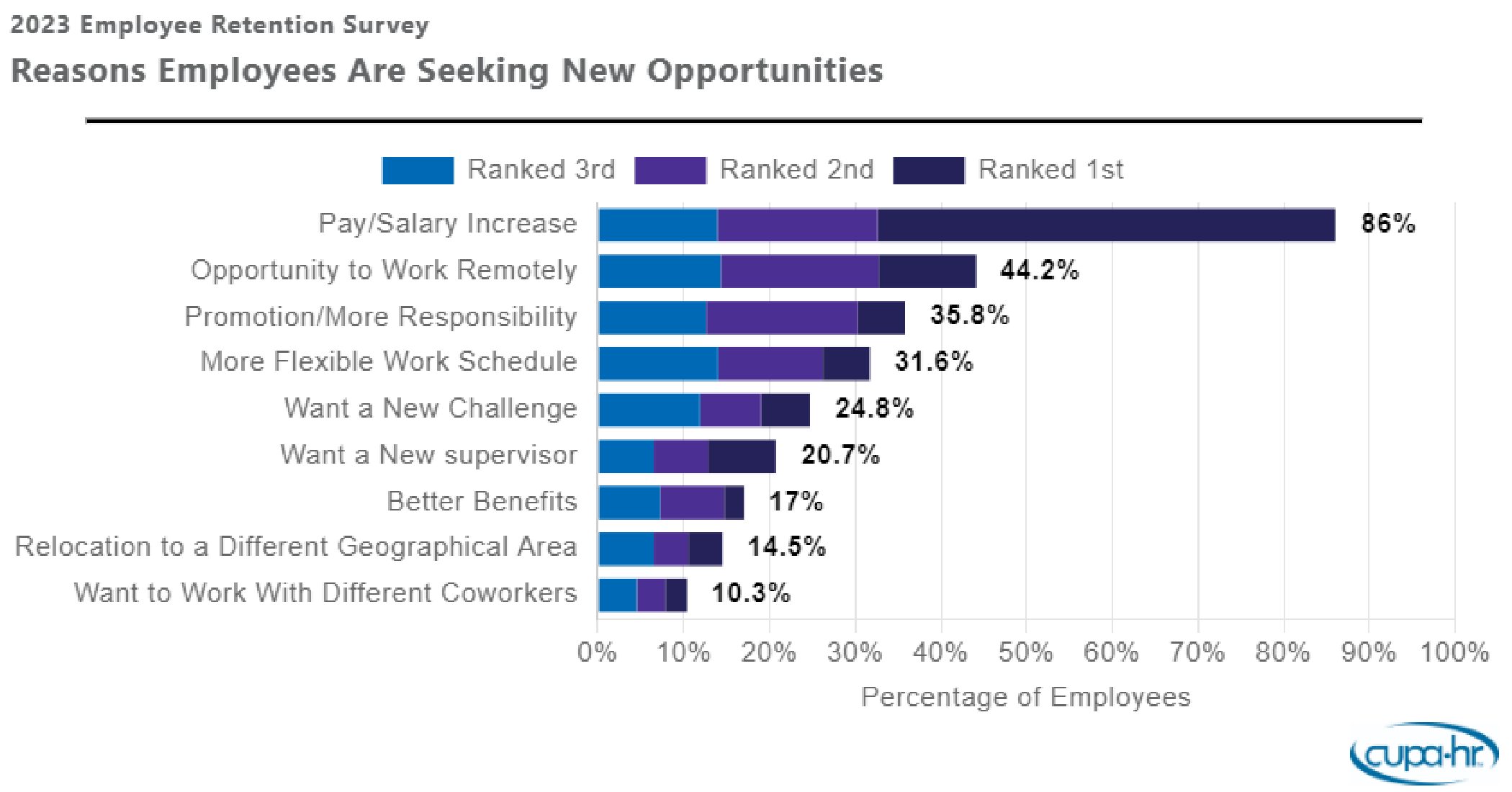
    According to the findings, respondents say that pay is the number one reason they’re looking for a new job. Other influential reasons are an opportunity to work remotely, desire for a promotion or more responsibility, and the need for a more flexible work schedule.

    But while pay is the top concern mentioned by employees, retention challenges are more complex.

    Strongest Predictors of Retention

    Digging deeper into the data, the strongest predictors of retention are factors related to job satisfaction and well-being. Only 58% of higher ed employees are generally satisfied with their jobs. Of the 16 aspects of job satisfaction and well-being the survey measured, the three that have the most impact on retention are:

    • Recognition for Contributions
    • Being Valued by Others at Work
    • Having a Sense of Belonging

    Only 59% of respondents say they receive regular verbal recognition for doing good work. The good news is that programs, training and policies that increase employee satisfaction in these areas can make a significant impact on retention without necessarily breaking the budget.

    Three Things You Can Do

    Employees are not necessarily planning to flee higher ed. Most job seekers will be looking within higher ed, and nearly half will be looking within their own institution, indicating that it’s not too late to implement retention strategies. Here are three things you can do to assess and address job satisfaction:

    1. Read the Report. The CUPA-HR 2023 Higher Education Employee Retention Survey provides not only data but also a model for understanding higher ed retention. (Looking for an overview of report findings? Check out our press release.)
    2. Explore CUPA-HR Resources. Here are several that focus on aspects of job satisfaction:
    1. Plan Next Steps. Share the report or press release with leaders on your campus. Determine areas where your institution could strengthen career development and implement training to increase job satisfaction.


    Source link

  • Managing a Multi-State Workforce: Key Findings From the CUPA-HR Survey and a Public University’s Hybrid Approach – CUPA-HR

    Managing a Multi-State Workforce: Key Findings From the CUPA-HR Survey and a Public University’s Hybrid Approach – CUPA-HR

    by CUPA-HR | April 19, 2023

    As higher ed institutions face pressure to fill open positions and offer more flexible work opportunities, many are responding by recruiting and hiring employees who live and work in a state different from where their institution’s primary campus is located. CUPA-HR’s Multi-State Workforce Survey was developed to better understand institutions’ policies, practices and challenges related to out-of-state workers.

    Notable findings:

    • 89% of responding institutions employ out-of-state workers.
    • The most common types of out-of-state workers are adjunct/part-time faculty and salaried/exempt staff.
    • On median, institutions employ out-of-state workers from 8 states.
    • Most institutions have restricted policies for both recruiting and hiring out-of-state workers.
    • Of the one third of institutions who avoid hiring from certain states, the most common states institutions avoid hiring from were California, New York, Washington and Colorado.
    • Many institutions provide salary ranges on job postings, but most do not adjust salaries based on location.

    Despite the challenges of a multi-state workforce, excluding out-of-state workers can decrease the quality of the candidate pool and may cause institutions to miss out on top talent. Institutions pursuing, or considering pursuing, out-of-state workers may want to look at Clemson University’s hybrid approach to managing a multi-state workforce.

    Charged by senior leadership to explore options for out-of-state employment, Clemson University’s HR team, led by Chief Human Resources Officer Ale Kennedy, convened a cross-campus workgroup that reached out to several schools about their out-of-state work approaches. After reviewing the data, the workgroup recommended that in-house HR manage the green or “easy” states and outsource the more challenging states in order to minimize risk. To learn more about Clemson’s approach — and the full findings from the Multi-State Workforce Survey — be sure to watch CUPA-HR’s recent webinar “The State of the Multi-State Workforce: Employment Practices and Challenges.”


    Source link

  • Pay Increases for Higher Ed Employees Sharply Improve, But Still Fall Short of Inflation Rate – CUPA-HR

    Pay Increases for Higher Ed Employees Sharply Improve, But Still Fall Short of Inflation Rate – CUPA-HR

    by CUPA-HR | April 3, 2023

    New research from CUPA-HR has found that although employees across the higher education workforce saw the most substantial pay raises in 2022-23 than in the past several years, they are still being paid less than they were in 2019-20 in inflation-adjusted dollars.

    Some of the key findings from an analysis of CUPA-HR’s higher ed workforce salary survey data from 2016 to 2023:

    • This academic year, raises for higher ed employees were the largest seen in the past seven years, and all position types (administrators, professionals, staff and faculty) received an increase of at least 1.11 percentage points compared to the previous year.
    • Tenure-track and non-tenure-track teaching faculty continue to receive the smallest pay increases of any higher ed employee category. In 2022-23, tenure-track faculty saw a median pay increase of 2.9 percent and non-tenure-track faculty saw an increase of 3.2 percent. Tenure-track faculty salary increases have not kept pace with inflation since at least 2015, and non-tenure-track salary increases last met or exceeded inflation in 2016-17, meaning full-time faculty in general continue to be paid less every year in inflation-adjusted dollars.
    • Staff, which is typically the lowest-paid category of higher ed employees, saw the biggest raises this academic year at 5.3 percent (up from 2.9 percent in 2021-22).

    Explore this data and more in CUPA-HR’s newest interactive graphic.

    CUPA-HR Research

    CUPA-HR is the recognized authority on compensation surveys for higher education, with its workforce surveys designed by higher ed HR professionals for higher ed HR professionals and other campus leaders. CUPA-HR has been collecting data on the higher ed workforce for more than 50 years, and we maintain one of the largest workforce databases in existence. CUPA-HR also publishes numerous research publications and interactive graphics highlighting trends and issues around higher ed workforce planning, pay equity, representation of women and racial/ethnic minorities and more. Learn more about CUPA-HR research.


    Source link

  • CUPA-HR Data Highlights Trends in Representation and Pay Equity in the Higher Education Workforce, and the News Is Mixed – CUPA-HR

    CUPA-HR Data Highlights Trends in Representation and Pay Equity in the Higher Education Workforce, and the News Is Mixed – CUPA-HR

    by CUPA-HR | March 1, 2023

    When it comes to representation and pay equity for women and people of color in the higher education workforce, colleges and universities have frequently struggled to make meaningful progress. Through several new interactive graphics representing years of research, CUPA-HR shines a light on the progress that has been made and the disparities that persist. These graphics represent data from CUPA-HR’s four signature higher ed workforce surveys — Administrators, Faculty, Professionals, and Staff — through 2022.

    Administrators

    While the proportion of people of color in higher ed administrator positions has grown steadily over the last 10 years, these increases have not kept pace with the rate at which minorities are obtaining graduate degrees. In 2022, people of color made up 18.2 percent of administrators, up from 12.9 percent in 2012.

    The data also show that pay gaps for women administrators of all races/ethnicities are consistent across the past 10 years and notably wide. Pay inequity is particularly egregious for women administrators of color (with the exception of Asian women). Men of color, on the other hand, have been paid salaries equitable to or greater than those of White men in recent years.

    The Administrators in Higher Education Survey collects data on administrator positions that manage a higher ed institution or a division within it.

    See the Administrators Composition and Pay Equity by Gender and Race/Ethnicity interactive graphics, as well as data broken out by CEO, provost and chief HR officer.

    Faculty

    There are two notable findings in faculty composition. First, more women are represented in non-tenure-track than in tenure-track faculty. Second, for each tenure status and with each increase in rank, the proportions of women and faculty of color decrease. This means that women are over-represented in the lowest-paying and lowest-ranking positions. This remains the case despite the fact that the proportion of women and faculty of color have increased slightly at each rank over the past five years.

    Pay gaps for women faculty, regardless of tenure status or rank, continue to persist, particularly at the rank of professor. These gaps are most notable for women of color. Pay gaps at other ranks have narrowed over time, particularly for tenure-track faculty. Importantly, the factor that most impacts faculty pay is promotion to a higher rank. Often, the only significant increases in salary happen with these promotions. These data show that the only group that has greater representation with each increase in rank is that of White male faculty, and this pattern has persisted over time.

    The Faculty in Higher Education Survey collects data on tenure-track faculty positions and non-tenure-track teaching faculty positions.

    See the Faculty Composition and Pay Equity by Gender and Race/Ethnicity interactive graphics.

    Professionals

    Women’s representation has increased across all professionals’ positions since 2017, and in 2022, women represented more than 60 percent of higher ed professionals. This change is due to slight increases in representation of women of color since 2017. In 2022, representation of people of color was 24 percent overall, with the highest percentage among human resources professionals (34 percent) and diversity and equal opportunity professionals (33 percent).

    In 2022, women were consistently paid less than White men, a pattern that has worsened since 2017. However, men of color were paid more equitably in 2022 compared to previous years.

    The Professionals in Higher Education Survey collects data on positions in specific functional areas in higher ed institutions, such as academic or student services, that usually require a baccalaureate degree.

    See the Professionals Composition and Pay Equity by Gender and Race/Ethnicity interactive graphics.

    Staff

    Staff employees have a higher representation of people of color than any other higher ed employee group. This is notable in that these are the lowest-paying positions in higher ed. In 2022, women of color represented about 19 percent of all higher ed staff, and men of color represented about 13 percent of all higher ed staff. These numbers have increased since 2017, though modestly. Skilled craft employees were the least racially diverse group, as 80 percent were White men, a finding that has persisted across the past six years. Notably, skilled craft staff are among the highest-paid staff positions.

    Since 2017, women in staff positions have been paid consistently and considerably less than White men in staff positions, a pattern that has worsened over time, particularly for women in office and clerical positions. Men of color were paid more equitably in 2022 when compared to 2017.

    The Staff in Higher Education Survey collects data on positions that are generally non-exempt and do not require a college degree.

    See the Staff Composition and Pay Equity by Gender and Race/Ethnicity interactive graphics.

    CUPA-HR Research

    CUPA-HR is the recognized authority on compensation surveys for higher education, with its workforce surveys designed by higher ed HR professionals for higher ed HR professionals and other campus leaders. CUPA-HR has been collecting data on the higher ed workforce for more than 50 years, and we maintain one of the largest workforce databases in existence. CUPA-HR also publishes numerous research publications and interactive graphics highlighting trends and issues around higher ed workforce planning, pay equity, representation of women and racial/ethnic minorities and more. Learn more about CUPA-HR research.


    Source link