Category: Metrics

  • 4 Considerations for Using Salary Data to Inform Compensation Decisions – CUPA-HR

    4 Considerations for Using Salary Data to Inform Compensation Decisions – CUPA-HR

    by Missy Kline | November 15, 2022

    Editor’s note: This blog post, originally published in April 2019, has been updated with additional resources and related content.

    Salary benchmarking is not one-size-fits-all — especially when you’re looking at groups as varied as administrators, professionals, staff and faculty on a college or university campus that is unique in its combination of Carnegie class, affiliation, regional location and mission. The question, then, is how to tailor your benchmarking efforts to take these variables into account and choose data that is appropriate to your unique needs.

    Here are four considerations to help you make the best use of salary data for compensation budget planning for your faculty and staff:

    1) Which institutions should your institution’s salaries be benchmarked against? Making the right comparisons — using position-specific data and carefully selected peers — can make all the difference when planning salaries that will make your institution competitive in the labor market. When you use CUPA-HR’s DataOnDemand, you can narrow down peer institutions by one or several institution-level criteria such as affiliation (public, private indephttp://cupahr.org/surveys/dataondemand/endent or private religious), Carnegie classification, enrollment size, geographic region, total expenses or other characteristics. Remember, balance is key: a larger comparison group gets you more robust data for comparison, but you must also make sure you are comparing to the right types of institutions that make sense for your goals.

    2) Not all faculty are the same. Tenure track faculty, non-tenure track teaching faculty, non-tenure track research faculty and adjunct faculty may each require unique compensation strategies, as do faculty members from different disciplines and ranks. Will the same salary increase help retain both tenured and non-tenured faculty? Does collective bargaining impact salary targets for some, but not all, of these faculty sub-groups? Are there unique, fast-growing, or in-demand departments/disciplines that require a separate strategy?

    3) Keep in mind that administrator salaries are broadly competitive. Like faculty, many administrative positions in higher ed are competitive at a national level. Often, institutions seek administrators with experience at other institutions of a similar size or mission, and with this experience and mobility comes an expectation of a competitive salary. As higher ed moves toward a “business model” where innovative leadership strategies are displacing more traditional shared governance models, finding administrators with the appropriate skills and expertise is becoming increasingly competitive, not only within higher education but sometimes against the broader executive employment market.

    4) Employment competition varies for staff and professionals. Many non-exempt staff are hired from within local labor markets, and therefore other institutions or companies in your state or local Metropolitan Statistical Area might be a better salary comparison than a nationwide set of peer institutions. Exempt or professional staff, however, may be more limited to competition from the higher ed sector, perhaps on a state or regional level. In addition, changes brought about by the pandemic (e.g., remote work opportunities, a desire to relocate) have made many professional positions more globally competitive. Are your institution’s salaries for these employees appropriately scoped for the market in which you need to compete?


    Additional Articles and Resources

    How One College Is Using Salary Data to Ensure Pay Equity and Market-Par Compensation

    Compensation Programs/Plans, Executive Compensation in Higher EdEqual Pay Act (CUPA-HR Toolkits)

    Working in a Fish Bowl: How One Community College System Navigated a Compensation Study in a Transparent Environment (Higher Ed HR Magazine)


    Source link

  • 2022 Data: Changes in Higher Ed Pay and Workforce Size – CUPA-HR

    2022 Data: Changes in Higher Ed Pay and Workforce Size – CUPA-HR

    by CUPA-HR | April 27, 2022

    CUPA-HR has released its data on overall higher ed pay increases, as well as changes in workforce size for 2021-22.

    Higher Ed Pay Increases Have Not Kept Pace With Inflation

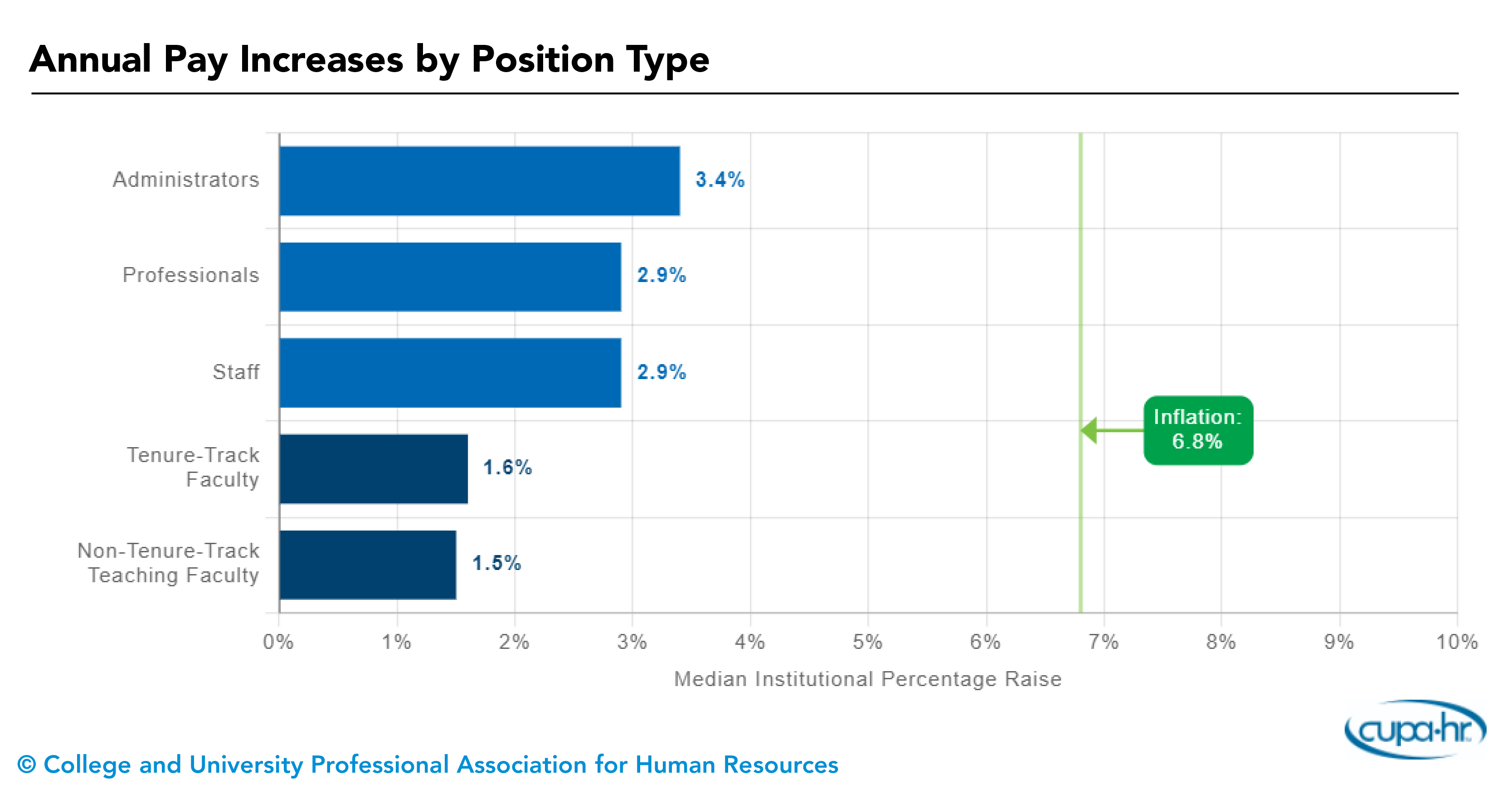
    The soaring inflation rate has far outpaced pay increases for the higher education workforce. According to findings from CUPA-HR’s annual workforce surveys for 2021-22, overall median salaries for administrators increased by 3.4%. Professionals and non-exempt staff saw increases of 2.9%, and salaries for tenure-track and non-tenure-track faculty increased by 1.6% and 1.5%, respectively. The inflation rate for 2021 was 6.8% and continues to climb.

    This is not the first year that pay increases have not kept up with inflation. Pay increases for administrators, professionals and staff last met or exceeded inflation in 2019-20.  Non-tenure-track faculty salary increases last met or exceeded inflation in 2016-17, and tenure-track faculty salary increases have not kept pace with inflation in any of the past six years.

    Explore pay-increase trends on CUPA-HR’s website.

    Overall Workforce Size Has Declined in the Wake of the Pandemic

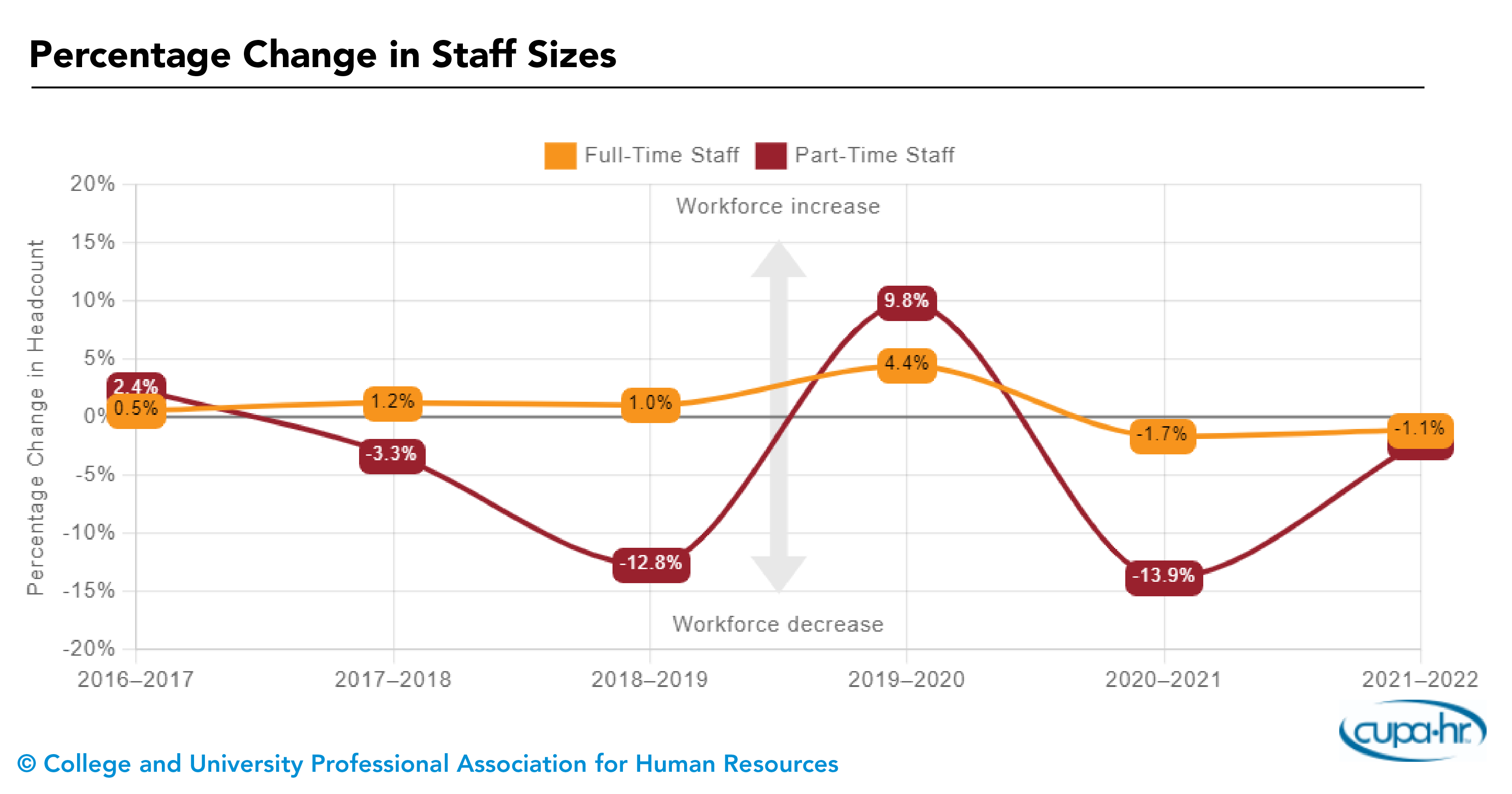
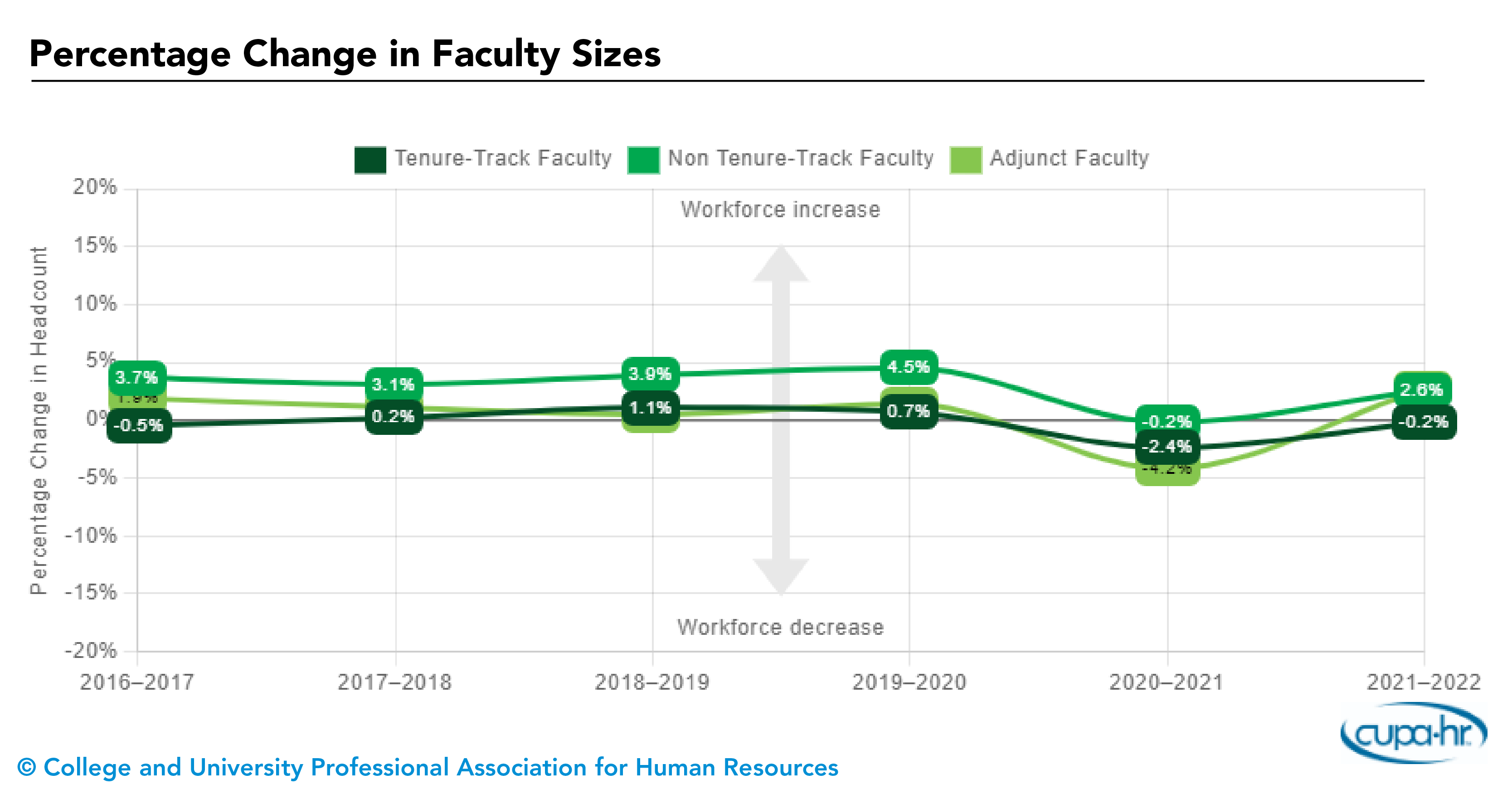
    Historically, the overall size of the higher education workforce has increased from year to year. However, colleges and universities are experiencing the same employee recruitment and retention challenges that most U.S. employers have struggled with in the past few years. In both 2020-21 and 2021-22, the size of full-time staff, part-time staff, and tenure-track faculty declined from the prior year.

    Two areas of the workforce that saw growth this year were those of non-tenure-track faculty and adjuncts. Although the number of non-tenure-track faculty and adjuncts declined between 2019-20 and 2020-21, those numbers have rebounded in 2021-22.

    Explore the trends in workforce size changes on CUPA-HR’s website.

    In-Depth Data and Custom Reports

    Higher ed institutions can use CUPA-HR’s DataOnDemand (DOD) subscription service to run comprehensive data tables and analyses.


    Source link

  • New Report on the Representation of Women and Racial/Ethnic Minorities in the Workforce of Minority-Serving Institutions – CUPA-HR

    New Report on the Representation of Women and Racial/Ethnic Minorities in the Workforce of Minority-Serving Institutions – CUPA-HR

    by CUPA-HR | February 23, 2022

    Minority-serving institutions (MSIs) play an important role in ensuring students from underrepresented races and ethnicities receive a quality education.

    While there is an abundance of research on students who attend MSIs, little research has examined the MSI workforce, specifically, how the racial/ethnic representation of faculty, administrator, professional and staff reflects the student populations being served.

    The latest CUPA-HR report, The Representation of Women and Racial/Ethnic Minorities in the Workforce of Minority-Serving Higher Education Institutions targets this gap by providing an overview of MSI representation among all U.S. higher ed institutions and showing their geographic spread across the country; providing a closer examination of racial/ethnic and gender composition of faculty, administrators, professionals and non-exempt staff; and assessing how well the racial/ethnic composition of the higher ed workforce at MSIs reflects their student populations and matches the minority-serving mission of the institutions.

    Key findings from the report:

    • MSIs have higher racial/ethnic minority representation among their workforce than non-MSIs.
    • HBCUs have the highest representation of racial/ethnic minority employees.
    • Overall, the representation of racial/ethnic minority faculty at MSIs does not match the representation in students.
    • Overall, administrators, professionals, and staff at MSIs have similar racial/ethnic minority representation when compared to students.

    For more findings on the representation of women and racial/ethnic minorities in the workforce at MSIs, read the full report.


    Source link

  • New Research Shows Women in the Leadership Pipeline in Higher Education Have Better Representation and Pay in Institutions With Female Presidents and Provosts – CUPA-HR

    New Research Shows Women in the Leadership Pipeline in Higher Education Have Better Representation and Pay in Institutions With Female Presidents and Provosts – CUPA-HR

    by CUPA-HR | January 24, 2022

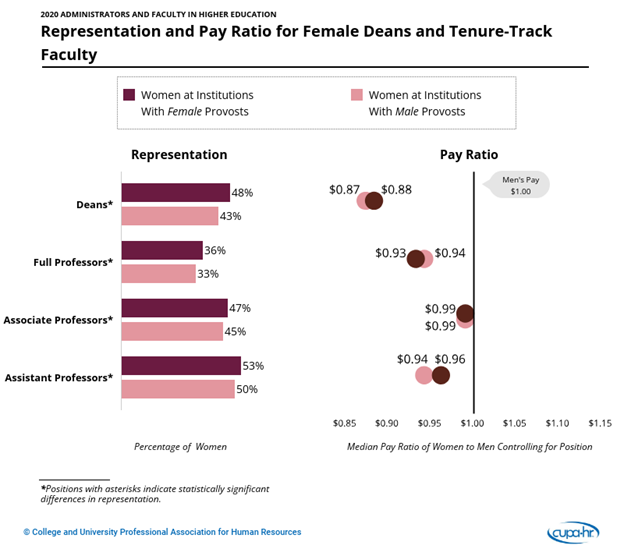
    New research by CUPA-HR has found that U.S. colleges and universities with women presidents or provosts have higher representation of women in administrative, dean and faculty positions than institutions led by men. The study also found that colleges and universities with women presidents have higher pay for women in administrative positions than institutions led by men. These positions tend to be pipelines for the senior-most executive positions in higher ed, which underscores the significance of the findings.

    Women Administrators Pay and Representation in Institutions With Female Presidents

    Findings show that institutions with female presidents have a higher percentage of women in all administrative categories — senior institutional officers, institutional administrators and heads of divisions. Although female administrators are generally paid less than male administrators in the same positions regardless of the sex of the president, female senior institutional officers, institutional administrators, and heads of divisions are paid more equitably at institutions with a female president than at institutions with a male president.

    Female Deans and Faculty Pay and Representation in Institutions With Female Provosts

    Institutions with female provosts have a significantly higher representation of women in dean positions and in all faculty ranks. Provost sex does not have a strong or consistent impact on pay equity for deans and faculty; however, it is worth noting that better representation at higher faculty ranks and in dean positions has an impact on pay, as these positions make higher salaries.

    The representation of women drops with successive faculty ranks (from assistant to associate to full professor). These promotions represent the few times in a faculty member’s career when appreciable salary increases are granted. If women are not being promoted, they are not receiving these pay raises. In addition, those in dean positions are generally promoted from senior faculty ranks. Therefore, if women are not adequately represented in senior faculty, they will not have the same likelihood as men of being considered for a higher-paying dean position.

    To sum up the findings, higher ed institutions with female executives have better representation of women throughout their institutions in positions that: a) are paid higher salaries and b) serve as key points in the executive leadership pipeline. Jackie Bichsel, CUPA-HR’s director of research and co-author of the new report, noted that, “In an era where institutions are adapting to shifting workforce expectations, adjusting to continuous decreases in budgets, contemplating changes in enrollment, addressing challenges of recruitment and retention, and rethinking their mission, more openness to change and less tolerance of risk may be just what is needed to navigate this new landscape. Providing more (and more equitable) opportunities for women to advance within higher education seems an obvious path forward in this navigation.”

    Read the full report, Women in the Leadership Pipeline in Higher Education Have Better Representation and Pay in Institutions With Female Presidents and Provosts.


    Source link

  • Read and Listen to Inspiring CUPA-HR Content From 2021 – CUPA-HR

    Read and Listen to Inspiring CUPA-HR Content From 2021 – CUPA-HR

    by CUPA-HR | January 5, 2022

    Throughout 2021, HR practitioners have proven their resilience time and again by positively impacting higher education not only in response to the ever-evolving pandemic, but also in building more flexible, diverse and inclusive workplaces. CUPA-HR captured many of these higher ed success stories, as well as leadership advice, helpful resources and workforce data trends in the following articles, podcasts and blog posts.

    As you read and listen to the inspiring work your HR colleagues are doing at colleges and universities around the country, we encourage you to jot down ideas to take into the year ahead: 

    Retention and Engagement 

    Develop to Retain: Tools and Resources for Higher Ed Professional Development (The Higher Ed Workplace Blog)

    Maintaining Culture and Connection for Remote Employees (The Higher Ed Workplace Blog)

    Stay tuned for an article in the upcoming winter issue of Higher Ed HR Magazine: “Four Areas HR Can Address Now to Boost Retention and Engagement.”

    Future of Work 

    New Report Highlights Changes to the Professional Workforce in the Wake of the Pandemic (The Higher Ed Workplace Blog)

    New Report Highlights Changes to Faculty Workforce in the Wake of the Pandemic (The Higher Ed Workplace Blog)

    Navigating Compliance With a Multi-State Workforce (The Higher Ed Workplace Blog)

    Determining Remote Work Eligibility and Talking to Leadership About Flexible Work (CUPA-HR Soundbite)

    Diversity, Equity, and Inclusion 

    5 CHROs Use CUPA-HR’s DEI Maturity Index to Energize Their DEI Efforts (The Higher Ed Workplace Blog)

    A Mission for Greater Faculty Diversity — Oakland University’s Diversity Advocate Program (Higher Ed HR Magazine)

    Can HR Investigators Be Anti-Racist? — Action Steps to Overcome Racial Bias When Conducting Workplace Investigations (Higher Ed HR Magazine)

    Juneteenth — How Will Your Institution Observe the Day? (The Higher Ed Workplace Blog)

    Supporting the LGBTQ+ Community in Higher Ed — 3 Learning Resources for HR (The Higher Ed Workplace Blog)

    Three Ways HR Can Promote Cultural Appreciation Over Appropriation (The Higher Ed Workplace Blog)

    Boost Your Pay Equity Know-How By Tapping Into These Resources (The Higher Ed Workplace Blog)

    Mental Health

    Mental Health Month Focus: Resources (The Higher Ed Workplace Blog)

    Strategies to Become More Resilient in Work and Life (The Higher Ed Workplace Blog)

    HR Care Package — Resources for Self-Care (The Higher Ed Workplace Blog)

    HR Leadership 

    CUPA-HR Conversations: Higher Ed HR Turns 75 (CUPA-HR Podcast)

    Why Psychological Safety Matters Now More Than Ever (Higher Ed HR Magazine)

    Opening Doors for Strategic Partnerships With Academic Leadership (Higher Ed HR Magazine)


    Source link