
Category: Mexico

  • A Historical Pattern of Force, Profit, and Human Cost

    A Historical Pattern of Force, Profit, and Human Cost

    From the mid‑19th century to today, U.S. interventions in Latin America and the Caribbean have consistently combined military force, political influence, and economic pressure. Across this long arc, millions of lives have been shaped—often shattered—by policies that prioritize strategic advantage over human flourishing. Today’s geopolitical tensions with Venezuela are the latest flashpoint in a historical pattern that rewards elites while exacting profound human costs.

    Note on Timing: This article is intentionally posted on Christmas Day 2025, a day traditionally associated with peace, goodwill, and reflection, to underscore the contrast between those ideals and the ongoing human toll of U.S. militarism and intervention abroad. The symbolic timing is a reminder that while many celebrate, others suffer the consequences of policies driven by power, profit, and geopolitics.


    A Critical Warning for Students and Young People

    As Higher Education Inquirer has repeatedly argued, the United States’ military footprint—its wars, recruitment programs, and entanglements with higher education—has deep consequences not just abroad but at home. ROTC programs and military enlistment are often marketed as pathways to education and economic stability, but they also funnel young people into systems with long‑term obligations, moral hazards, and psychological risk. Prospective enlistees and their families should think twice before committing to military pathways that may bind them to morally questionable conflicts and institutional control.

    Moreover, U.S. higher education has become deeply entwined with kleptocracy, militarism, and colonialism, supporting war economies and benefiting from federal research contracts with defense and intelligence partners that obscure the real human costs of empire. These warnings are especially salient in the context of Venezuela and similar interventions, where human toll and geopolitical stakes demand deeper scrutiny.


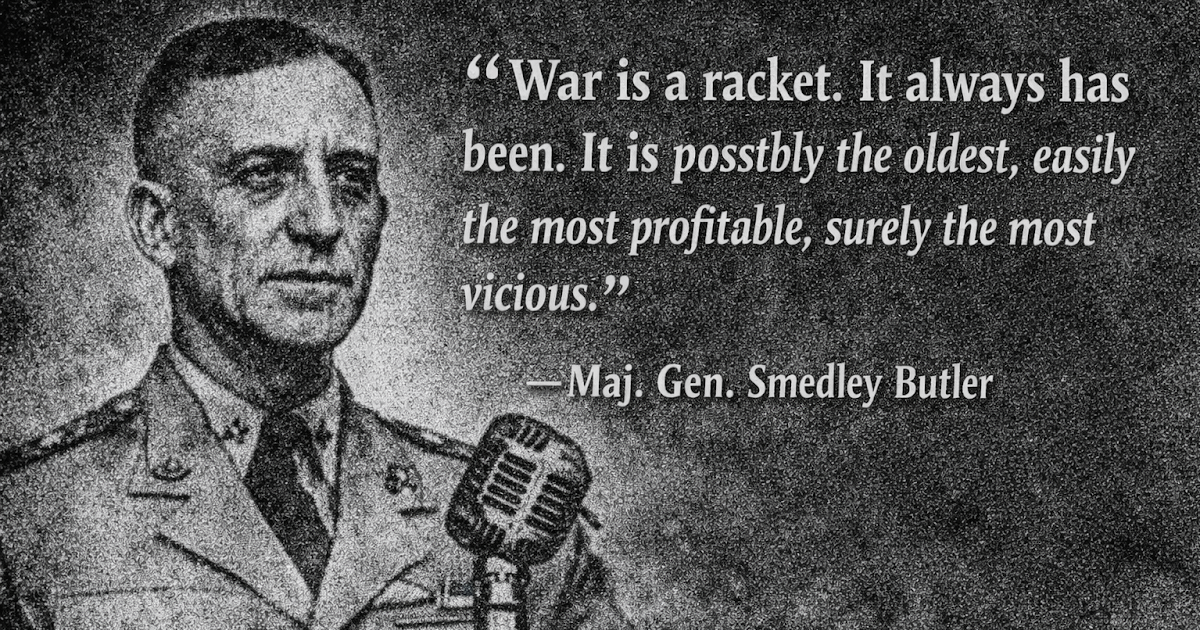
    Smedley Butler: War Is a Racket and the Business Plot

    Major General Smedley D. Butler, among the most decorated U.S. Marines, became one of the U.S. military’s most outspoken critics. In his 1935 War Is a Racket, Butler rejected romantic notions of military glory and exposed the economic motives behind many interventions:

    War is a racket. It always has been. It is possibly the oldest, easily the most profitable, surely the most vicious.

    I spent 33 years and four months in active military service… being a high‑class muscle man for Big Business, for Wall Street and for the bankers. In short, I was a racketeer for capitalism.

    Only a small inside group knows what it is about. It is conducted for the benefit of the very few at the expense of the masses.

    Butler’s warnings were not abstract. In 1933, he was approached to lead a coup against President Franklin D. Roosevelt, known as the Business Plot, which he publicly exposed. His testimony before Congress revealed how elite interests sought to use military power to overthrow democratic government, an episode that underscores his critique of war as a tool for entrenched interests at the expense of ordinary people.


    Historical Interventions and Their Toll

    Below is a timeline of major U.S. interventions in the Americas, with estimated deaths, showing the human cost of policies that often served strategic or economic interests over humanitarian ones:

    Period Location Event / Nature of Intervention Estimated Deaths
    1846–1848 Mexico Mexican-American War: Territorial conquest ~25,000 Mexicans
    1898 Cuba/P.R. Spanish-American War: U.S. seized P.R.; Cuba protectorate ~15,000–60,000 (90% disease)
    1914 Mexico Occupation of Veracruz: U.S. port seizure ~300 Mexicans
    1915–1934 Haiti Military Occupation: Suppression of rebellions ~3,000–15,000
    1916–1924 Dominican Rep. Marine Occupation: Control of customs/finance ~4,000
    1954 Guatemala Op. PBSuccess: CIA coup against Árbenz; led to civil war 150,000–250,000*
    1965 Dominican Rep. Op. Power Pack: U.S. intervention during civil war ~3,000
    1973–1990 Chile U.S.-backed Coup/Regime: Pinochet dictatorship 3,000–28,000*
    1975–1983 S. America Operation Condor: CIA-supported intelligence network ~60,000*
    1976–1983 Argentina Dirty War: U.S.-supported military junta and coup ~30,000*
    1979–1992 El Salvador Civil War: Massive military aid to govt forces 35,000–75,000*
    1981–1990 Nicaragua Iran-Contra Affair: Covert support for Contras ~30,000–50,000*
    1989 Panama Operation Just Cause: Invasion to remove Noriega 500–3,000
    2025 Venezuela Naval Blockade: Active maritime strikes and standoff 100+ (to date)

    *Estimates include civilian casualties and deaths indirectly caused by U.S.-supported interventions.


    Venezuela and the Global Politics of Intervention

    Venezuela’s 2025 crisis is the latest in a long history of U.S. pressure in the hemisphere. A naval blockade—accompanied by maritime strikes and political isolation—has already produced more than 100 confirmed deaths. Historically, interventions like this have often prioritized U.S. strategic or economic interests over local welfare.

    The situation is further complicated by global geopolitics. Former President Donald Trump, who recently pardoned key figures involved in controversial interventions, including Iran‑Contra actors, also maintains strategic ties with China and Russia, highlighting how interventions are entangled with global power plays that affect universities, recruitment pipelines, and domestic politics alike.


    A Call to Rethink Intervention and Recruitment

    Smedley Butler’s critique remains urgent: to “smash the racket,” profit must be removed from war, military force should be strictly defensive, and decisions about war must rest with those who bear its consequences. From Mexico to Venezuela—and including covert operations like Iran‑Contra—the historical record shows how interventions serve a narrow elite while imposing massive human costs.

    HEI’s warnings underscore that higher education, ROTC programs, and military recruitment pipelines are not neutral pathways but deeply embedded parts of systems that reproduce extraction, militarism, and inequality. Students, educators, and families must critically evaluate the incentives and promises of military pathways and demand institutions that serve learning, opportunity, and justice rather than empire.


    Sources

    1. Butler, Smedley D. War Is a Racket. Round Table Press, 1935.

    2. U.S. Congressional Record and Butler testimony on the Business Plot, 1934.

    3. Kinzer, Stephen. Overthrow: America’s Century of Regime Change from Hawaii to Iraq.

    4. Scott, Peter Dale. Cocaine Politics: Drugs, Armies, and the CIA in Central America.

    5. Reporting on Trump pardons, Iran‑Contra participants, and global alliances (2020–2025).

    6. Higher Education Inquirer, “Kleptocracy, Militarism, Colonialism: A Counterrecruiting Call for Students and Families,” December 7, 2025. (link)

    7. Higher Education Inquirer, “The Hidden Costs of ROTC — and the Military Path,” November 28, 2025. (link)

    8. Historical records on U.S. interventions: Mexican‑American War, Spanish‑American War, Guatemala (1954), Chile (1973), Argentina (1976–1983), El Salvador, Nicaragua, Panama, Venezuela (2025).
    Source link

  • Beyond the Rhetoric: Mexico’s Higher Education Reality with Alma Maldonado Maldonado

    Beyond the Rhetoric: Mexico’s Higher Education Reality with Alma Maldonado Maldonado

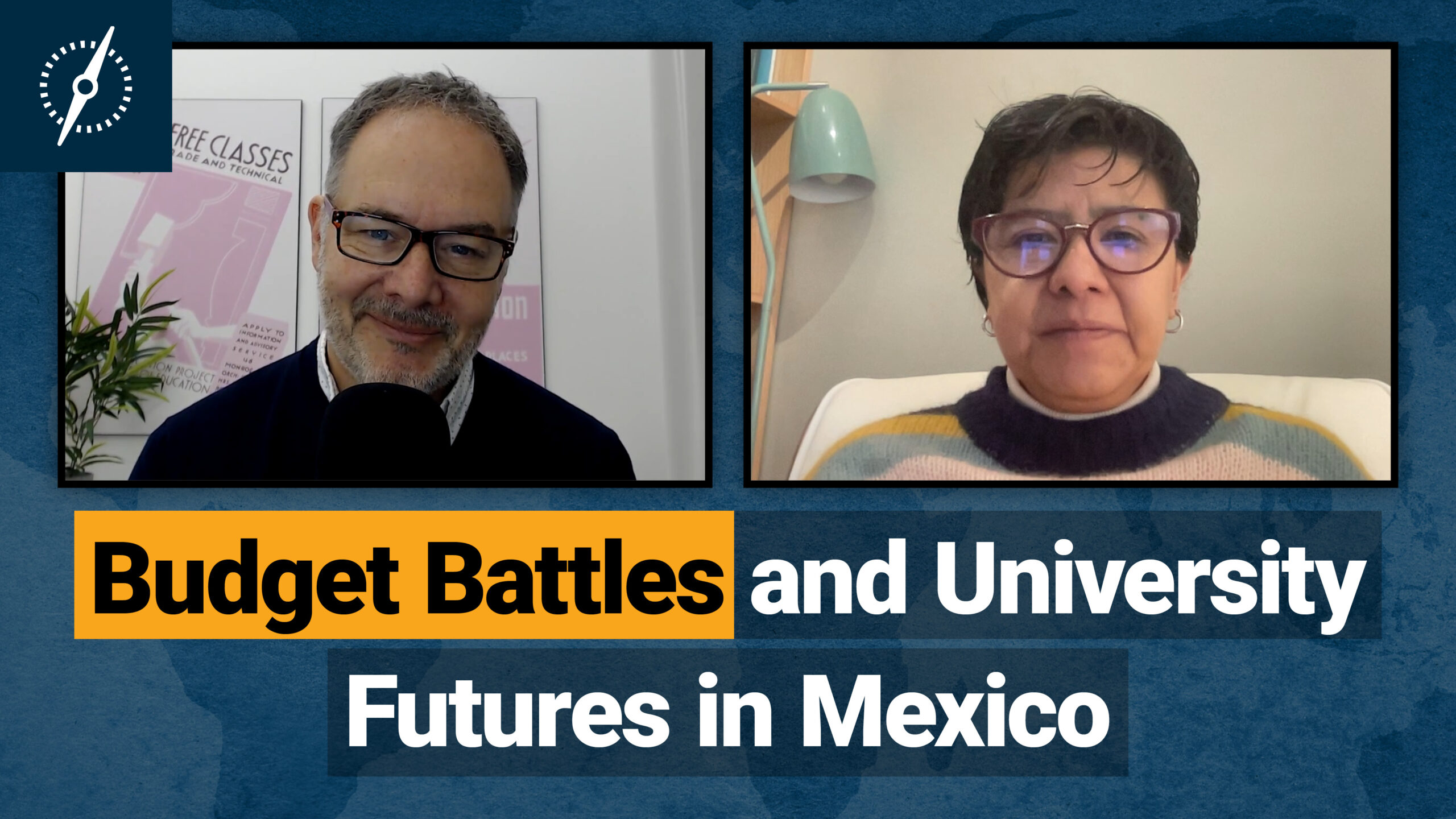
    Hi everyone. I’m Alex Usher, and this is the World of Higher Education podcast. If you’re a really faithful listener, you may remember that when the show was in beta and we were fooling around with formats and guests, we did an episode about Mexican higher education and its tribulations under the populist president Andres Manuel Lopez Obrador or AMLO for short.

    Our guest that day was my friend, Alma Maldonado Maldonado, an education researcher at Cinvestav, which is the Center for Research and Advanced Studies of the National Polytechnic Institute. That interview was so brilliant, we turned this podcast into a full-time investigation of higher education developments in various countries around the world.

    Today, Alma’s back with us again to talk about how things have and have not changed in Mexico over the past two years. The big story there is that there’s a new president in town. Last spring, Claudia Sheinbaum became the country’s first ever woman president. One who happens to have a PhD in engineering with a specialty in energy and sustainability.

    You’d think that might be an advantage to a higher education sector, but Scheinbaum comes from AMLO’s Morena party and her instincts seem to be to continue her predecessor’s tradition of attacking higher education as being a dissolute elite enterprise.

    So what does this mean for Mexican higher education? Well, in general, it’s not good. Alma takes us through the implications of Morena’s supermajority in Congress, as well as its early attempts to put fiscal pressure on universities, and its continued fascination with the experimental and kind of shambolic Benito Juarez universities.
    Spoiler alert, there are not a lot of silver linings in this story, either for public or private sector universities in Mexico. But enough from me, let’s hand things over to Alma to explain.


    The World of Higher Education Podcast
    Episode 3.16 | Beyond the Rhetoric: Mexico’s Higher Education Reality with Alma Maldonado Maldonado

    Transcript

    Alex Usher (AU): Alma, almost two years ago, then-President López Obrador had about a year and a half left in his mandate and was essentially at war with the university sector and the scientific community. How did his administration end with respect to higher education? Did anything change? Did things get better or worse in his final months? Were there any significant policy shifts we should know about?

    Alma Maldonado Maldonado (AMM): Hi Alex, thanks for inviting me. It’s a pleasure to be here. Well, I think most things didn’t change. Essentially, everything stayed the same. His rhetoric and narrative against higher education institutions, against graduates from abroad, and especially against UNAM, continued until the end of his term, unfortunately.

    There wasn’t anything that made him change that rhetoric. One reason for this is that he had political capital—he knew his base supported him fully. So, why change something that was working for him? On the contrary, the attacks on universities and the restriction of resources continued right until the end.

    AU: So, nothing was resolved. But earlier this year, there were elections for the presidency and both the Chambers of Deputies and the Senate. Did higher education play any role in that election? Were there significant policy differences between the parties?

    AMM: Not really. Education didn’t feature much in the campaign—similar to what we see in the U.S. It just wasn’t important. There were only a few mentions here and there about education, but in general, it wasn’t a key part of any campaigns.

    What we did see, unfortunately, was this sort of competition around scholarships. One candidate would say, “I’ll offer scholarships for secondary education,” and the other would respond, “Well, I’ll offer scholarships for secondary, but also primary, and even preschool!” That was the extent of the debate around education policy between the two main candidates. I’m not surprised but it was very disappointing because in a country like Mexico, where education can be a major driver of social change, it wasn’t given the attention it deserves.

    AU: The winner of the election was Claudia Sheinbaum of the Morena party, the same party as López Obrador. But she has a somewhat different image—she’s a scientist with an advanced degree from UNAM, a doctorate, I think. Does her presidency signal any kind of shift for higher education?

    AMM: It’s complicated. On paper, yes, she’s better. She has a PhD from UNAM and worked as an academic—one of the few cases where an academic has become president. Not the first, of course, but still, it’s notable.

    She has a pro-science and pro-higher education rhetoric, especially given her background in the student movement at UNAM in the 1980s. She fought alongside people like Emanuel Ordorica, Carlos Simas (her former husband), and Antonio Santos. She wasn’t a leader in that movement, though now some are rewriting history to present her as one.

    Her narrative emphasizes free higher education and the idea that education is a right, not a privilege. But since she took office a few months ago, we haven’t seen much change in terms of the most important issue—financing. It’s clear: follow the money.

    In the initial draft of the national budget, the funding for UNAM and other major universities was cut. Later, the government said, “Oh no, it was a mistake. We didn’t mean to cut the budget. Sorry, let’s fix it.” Imagine—someone who champions free higher education putting universities in that position. It’s a contradiction.

    AU: She has large majorities in both chambers of parliament, so she has significant power to implement her agenda. Why do you think she proposed cuts to education funding initially?

    AMM: Well, because she’s seen as the president of higher education and science. Reducing the budget as her first move would’ve been disastrous for her image.

    But you’re right—she has total control of Congress and the Senate. Right now, she’s focused on other reforms, particularly in the judicial system, and she’s changing a lot of laws. Education isn’t on the map because López Obrador already changed the Constitution’s third article, which governs education. There’s no immediate need for her to revisit it.

    AU: Let’s circle back to the budget cuts. Last month, the proposed budget included a cut of 10 billion pesos—about 500 million U.S. dollars—to higher education, with half of that falling directly on UNAM. There was significant outcry, and she backtracked somewhat. Do we know how this will end up? Will the universities be held whole, or are cuts still coming?

    AMM: They decided to reorganize the budget, but now they’re cutting other areas instead. Unfortunately, that includes initial education and other sectors. They also cut the Senate’s budget, which has caused disputes.

    In terms of higher education, they’ve claimed that funding will remain the same as last year, with a slight adjustment for inflation. But the adjustment is minimal—about 3%—while experts estimate inflation at around 5% but they’re just adding 3%. So, effectively, there’s still less money to spend. There’s less money for infrastructure, materials, and other essentials. Universities are in a slightly better position than they were a few weeks ago, but the situation remains difficult. The contradictions in her policies have drawn a lot of criticism.

    AU: Why was so much of the proposed cut targeted at UNAM? Was it deliberate? Is there animosity toward the university?

    AMM: There’s speculation about that. Some believe it was a punishment for UNAM’s independence, particularly regarding topics like judicial reform. UNAM has maintained a critical stance, which Morena and Claudia don’t like.

    Let’s not forget that one of the first things López Obrador did when he came to power six years ago was to modify the Constitution’s third article, removing university autonomy. When there was backlash, they said, “Oh, it was a mistake. We didn’t mean it.” But there have been many such “mistakes.”

    AU: Going back to AMLO, he also set a goal of increasing enrollment by 1.5 million students while also underfunding institutions at the same time. How did that play out? Did he reach that goal? How did the funding play into the final result?

    AMM: Currently, enrollment coverage in higher education is about 44%—very low compared to other Latin American countries. AMLO’s goal was to reach 50%, but he fell short.

    Now, Claudia Sheinbaum is aiming for 55%. I don’t think that’s realistic. The common system in Mexico is to add 5% on any policy, even if the last one isn’t achieved. To achieve that, they’d need to add about 1.2 million students, which isn’t feasible with the current system.

    The problem is that the educational spaces being created aren’t in the places where students want to go. There’s a clear contradiction between their enrollment goals and actual planning.

    AU: Part of AMLO’s strategy was the Benito Juárez Universities—small, access-oriented institutions in remote areas. You previously described them as “Potemkin institutions.” What’s the current situation? Will Sheinbaum continue with this policy?

    AMM: Yes, she’s continuing the project. But as I’ve said before, it remains very obscure. We don’t know who attends these universities, who teaches there, or what students are learning. I have a student doing their master’s dissertation on these universities, and they can’t get access for research.

    Sheinbaum recently announced plans to open 50 more. But we don’t even know what’s happening with the existing 140—or whether that number is accurate. There have been protests at these universities over issues like unreceived degrees and inadequate resources. I wouldn’t be surprised that Colombia would adopt them because they’re friends of Claudia. The idea is that these institutions could increase 40,000 new spaces. While they’re meant to provide education in remote areas with programs tailored to local communities, they’re not addressing the larger participation gaps.

    AU: We’ve been talking mainly about the public sector, but what about the private sector? Institutions like Tecnológico de Monterrey are highly regarded. How does the disarray in the public sector affect them? Does it make them stronger?

    AMM: I think they are struggling too, but we need to distinguish between the high-prestige institutions and the low-prestige ones. So, let’s start with the high-prestige institutions like Tecnológico de Monterrey or Universidad Autónoma de Guadalajara.

    They are struggling financially, particularly because some scholarships they used to receive for graduate programs have been eliminated. For example, many students in their graduate programs previously got scholarships from the National Science and Technology Council. But now, under the current rhetoric, those scholarships are only being given to students in public institutions.

    This has forced high-prestige private institutions to get more creative with their resources to maintain their programs.

    On the other hand, there are low-prestige private institutions, some of which are as bad as the Benito Juárez Universities. They lack quality, but the government lets them operate because they solve a demand problem. Parents want their kids to attend college, and these institutions offer that possibility, even if the education isn’t great. Families make sacrifices to pay for these degrees because, in their minds, a degree is still a degree.

    And then, in the middle, there are institutions that are more decent in terms of quality. But the big question is: who ensures the quality of these institutions? That’s been a longstanding issue, and it hasn’t improved under the current government.

    AU: It’s a classic trade-off we see in many countries. Alma, we’ve covered a lot of doom and gloom. Are there any bright spots you foresee for 2025?

    AMM: I wish I could say I see more positive things coming, but honestly, I don’t. A big part of my concern is tied to North America and what a Trump presidency could mean for Mexico. If he returns to power, we’re likely to face serious challenges around migration and broader U.S.-Mexico relations.

    It’s really sad that Mexico didn’t take advantage of opportunities to strengthen ties with the U.S. while Biden was in office. There could have been agreements, collaborations, and advancements, but those didn’t materialize.

    In the face of all this, creativity will be key. Maybe we’ll see new programs to support migrants with higher education degrees who end up staying in Mexico. It’s critical that we do better this time than we did during the Dreamers situation. But honestly, I’m not confident that the government is prepared to handle these challenges effectively. So, unfortunately, I don’t see much good news ahead.

    AU: Well that’s a good reminder that international affairs do intrude on higher education affairs sometimes. Alma, thanks for being with us.

    AMM: Thank you very much, Alex.

    AU: And thank you to our excellent producers, Tiffany MacLennan and Samantha Pufek. If you have comments or questions, reach out at [email protected]. Don’t forget to subscribe to our YouTube channel. Join us next week when Michael Shattock will discuss governance in European universities. Bye for now.

    *This podcast transcript was generated using an AI transcription service with limited editing. Please forgive any errors made through this service.

    Source link