Category: michigan

  • Whitmer Calls Literacy Her ‘Number One Priority’ for Final Year as Governor – The 74

    Whitmer Calls Literacy Her ‘Number One Priority’ for Final Year as Governor – The 74


    Get stories like this delivered straight to your inbox. Sign up for The 74 Newsletter

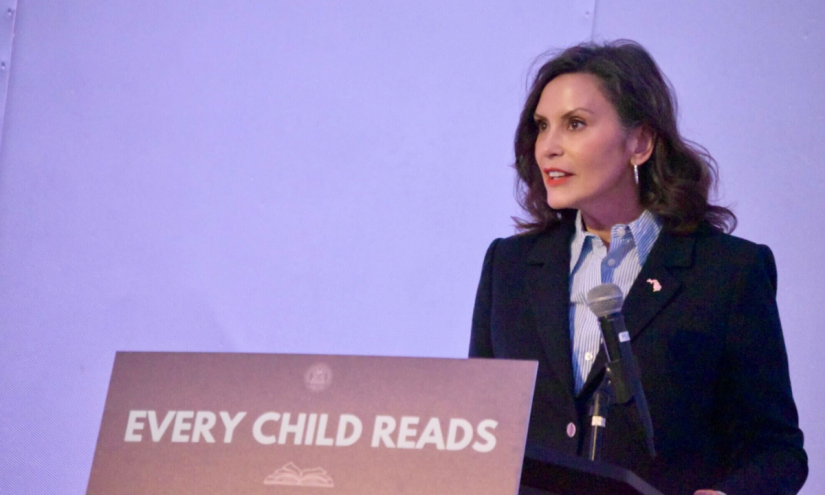
    In a keynote speech at the Michigan Literacy Summit, held Tuesday at the Michigan Science Center, Gov. Gretchen Whitmer said that improving literacy rates would remain her top priority in her final year as governor.

    “Helping every child read is tough. It’s a worthwhile goal,” she said. “It’s a long term project that will pay off in decades, not days. It’s a team effort that requires buy-in from students, parents, teachers and policy makers.”

    She referenced the increased implementation of the “science of reading” law, which she signed in October 2024, as part of this priority. That law standardized literacy teaching methods across the state and implemented regular dyslexia testing for students up to third grade. She also touted the free school breakfast and lunch program, a key piece of the state’s education budget, and funding to reduce class sizes.

    Michigan currently ranks 44th in the nation for 4th grade reading skills, Whitmer said, calling it a “crisis.”

    “The vast majority of people in our state agree this isn’t the fault of any one person or any one policy or any one political party,” she continued. “I know how hard every one of our educators works every day, but we’re all feeling the impact of our literacy crisis.”

    Gov. Gretchen Whitmer and State Superintendent Glenn Maleyko pose for a photograph before her speech at the Michigan Literacy Summit. Dec. 16, 2025. | Photo by Katherine Dailey/Michigan Advance.

    State Superintendent Dr. Glenn Maleyko, who officially took over the role leading the state’s department of education on Dec. 8, introduced Whitmer to a crowd of educators and advocates, who had gathered in Detroit for the day-long event that included panels with teachers and school leadership.

    “What stood out to me the most was the governor’s genuine commitment to partnership,” Maleyko said. “She understands that improving outcomes for students is not about politics, it’s about listening, working together and staying focused on what matters most.”

    This was Whitmer’s first public appearance since Michigan House Republicans canceled nearly $650 million in spending for departmental projects, a move heavily criticized by Democrats as “untransparent” and “cruel”. While Whitmer’s press secretary shared similar criticism from the governor’s office, Whitmer herself has yet to make a statement on the cuts, and left the summit before speaking to the press.

    Michigan Advance is part of States Newsroom, a nonprofit news network supported by grants and a coalition of donors as a 501c(3) public charity. Michigan Advance maintains editorial independence. Contact Editor Jon King for questions: [email protected].


    Did you use this article in your work?

    We’d love to hear how The 74’s reporting is helping educators, researchers, and policymakers. Tell us how

    Source link

  • Rosa Parks’ Story Didn’t End in Montgomery. These Students Are Proof of That. – The 74

    Rosa Parks’ Story Didn’t End in Montgomery. These Students Are Proof of That. – The 74


    Get stories like this delivered straight to your inbox. Sign up for The 74 Newsletter

    This story was originally reported by Ebony JJ Curry of The 19th. Meet Ebony and read more of their reporting on gender, politics and policy.

    Seventy years have passed since Rosa Parks refused to surrender her seat on a Montgomery bus, and yet the country still tries to shrink her into that single moment — a tired seamstress who’d simply had enough.

    Detroit, the city where she chose to continue her life, insists on remembering her differently. Not as an icon frozen in time, but as a Black woman whose lifelong organizing stretched from sexual violence cases in rural Alabama to open housing fights on Detroit’s west side.

    That fuller story  — truth beyond the myth — is exactly what the Rosa Parks Scholarship Foundation has fought to tell for 45 years.

    The Rosa Parks Scholarship Foundation (RPSF) has awarded more than $3 million in scholarships to more than 2,250 high school seniors since its founding by The Detroit News and the Detroit Public Schools (DPS) in 1980.

    “Most people actually don’t know the story of Rosa Parks,” said Dr. Danielle McGuire, RPSF board member, historian and author of “At the Dark End of the Street”, whose research permanently shifted how historians write about Parks and the civil rights movement. “She’s so much more interesting, so much more radical, and so much more involved in all kinds of things that we forget about. We keep her stuck on the bus in Montgomery in 1955.”

    According to Kim Trent, a  Detroit civic leader and former board president, the foundation, created through a racial discrimination lawsuit settlement involving Stroh’s Brewing Company, became one of the rare instances where federal accountability for racism produced long-term investment in Black futures.

    A judge, DPS and The Detroit News agreed the money should honor Parks — who was living in Detroit and working for Rep. John Conyers at the time — by funding scholarships for Michigan students devoted to service and social change.

    It is a statewide program, reaching students from Detroit to Grand Rapids to rural school districts where scholarship dollars often determine whether higher education is possible at all.

    That framing makes her legacy active, not ceremonial.

    “As part of her family, I feel grateful to be able to work together with my fellow board members to keep fighting for more opportunities to continue to provide scholarships,” said Erica Thedford, Parks’ great-niece and a foundation trustee. “I think Auntie Rosa would be extremely proud of what the Foundation has been able to achieve.”

    The numbers tell one story — more than 1,000 scholars, millions awarded, forty $2,500 scholarships each year — and the essays tell another. Applicants must identify a modern social issue and explain how they would confront it using principles Parks embodied: discipline, non-negotiable dignity, community before self.

    “Reading the essays of the students who apply is a great reminder that each person doing one act, no matter how small, creates a stronger network of love and kindness,” Thedford said. “Some of these students come from extreme hardship and still find the time and resources to volunteer at food banks, shelters… Some even take it upon themselves to be the organizer of ways to help the less fortunate at their schools.”

    The award is one-time, not renewable, yet its impact stretches across decades.

    “Once you become a Rosa Parks Scholarship Foundation recipient, you are a Rosa Parks Scholar for life,” Thedford said. “These students are now part of a network of people who root for each other, and that kind of support system is important.”

    Trent knows that firsthand: She was a Parks Scholar herself when she graduated from Cass Tech High School.

    “I received the scholarship in 1987,” she said. “Ironically, not only did I get it, but my best friend… also received the same scholarship. And then her son got the scholarship like 30 years later.”

    Trent said the scholarship’s origin mirrors Parks’ life — created in response to injustice and sustained through community action.

    “It’s one of those rare occasions where something beautiful grew out of an instance of racism and oppression,” Trent said.

    Over the years, some Parks Scholars attended community college. Others enrolled at flagship universities. All had to articulate how their education would serve a community beyond themselves.

    Some, like Emmy-winning actor Courtney B. Vance, who’s from Highland Park, Michigan, went on to shape national culture. Others are now attorneys, educators and nonprofit leaders across the state.

    “What gets lost in what she did is the reason she did it,” Trent added. “It wasn’t just so she could sit on a bus. It was because she was trying to open up opportunity for people who had been denied opportunity.”

    That is the heartbeat of the foundation’s lineage.

    Parks was not simply resisting segregation. She was rejecting the entire machinery that kept Black women from safety, education and economic autonomy.

    McGuire’s research highlights how Rosa Parks was investigating sexual violence cases long before #MeToo, defending Black girls like Recy Taylor, whose voices were dismissed in courtrooms and newspapers. She worked alongside the NAACP on equity cases. When she left Alabama under threat of death and moved to Detroit, she became the neighbor who knew everyone’s children, the church member who attended every meeting, the woman who collected information and names and needs.

    “She was the person in the neighborhood who knew all the kids, who worked in almost every community organization you can imagine, to make life better for her people,” McGuire said. “The scholarship foundation is an example of that — just one of many.”

    Every year, nearly 400 applicants encounter that fuller history — the Parks who fought for open housing in Detroit, who believed in Black self-determination, who, as McGuire notes, “never stopped fighting for equality and justice for people who didn’t have a voice that was being heard.”

    That is not accidental. It is by design.

    “We ask our applicants to become familiar with Rosa Parks and the tactics and strategies she used to make changes in her community and how they will do the same,” McGuire said. “I think it gives them hope. It links them to a tradition and a history of hope and change.”

    This anniversary of Parks’ arrest arrives as school boards strip Black history from K-12 classrooms and as scholarship programs for marginalized students come under attack. Thedford sees the foundation’s work as a refusal.

    “During this time, when we are hearing of funding being pulled from schools and programs that are needed to serve our youth, the Foundation is able to continue its provision of funds,” she said.

    McGuire is blunt about what that represents:

    “No matter how hard people try to cancel the past, the past is very much alive,” she said. “Rosa Parks’ history gives us so much honesty about America… and studying her is paramount to getting through any difficult time.”

    Seventy years later, the lesson remains unchanged: Rosa Parks did not fight for a place to sit, she fought for the generations who would rise. Today, those students are still applying, still studying her strategies, still refusing to yield.

    This story was originally published on The 19th.


    Did you use this article in your work?

    We’d love to hear how The 74’s reporting is helping educators, researchers, and policymakers. Tell us how

    Source link

  • Will the Detroit School District’s Enrollment Efforts Pay Off? – The 74

    Will the Detroit School District’s Enrollment Efforts Pay Off? – The 74


    Get stories like this delivered straight to your inbox. Sign up for The 74 Newsletter

    Despite the summer heat, Toyia Diab came out to the Summer on the Block at Pulaski Elementary-Middle School to learn what it had to offer the four grandchildren she had in tow.

    The family made their way to about a dozen tables snaking around the lawn on the side of the school. Diab listened to staff from the Detroit school district detail all of its resources over the pulsing base of loud music.

    Diab’s family was one of many the Detroit Public Schools Community District courted this summer as part of its efforts to retain families and boost enrollment. With the loss of more than 92,000 students in the last 20 years, district officials devote some of the summer break each year to getting word out about what the city’s schools have to offer.

    This year, the district ramped up efforts. It sent 40 people to canvas communities and held 19 events to create excitement about the start of school — nearly double that of previous years. It also started new initiatives, such as putting up billboards around the city. In all, the school system budgeted around $3.5 million for marketing this year. School starts Aug. 25.

    Though the district has “done a fairly good job” of recruiting new students in previous years, Superintendent Nikolai Vitti told school board members at a meeting earlier this month that the main challenge is keeping them.

    As a result, this year the school system also has focused on reenrollment rates. Those numbers have become a metric the district uses to “hold schools accountable,” Vitti said, though he didn’t share how many students the district typically loses during the school year.

    “We have emphasized … the need to improve customer service and parent engagement, so that parents feel more welcome,” he said. “And we fight harder to keep students at the schools that they’re at, rather than having more of an attitude of, ‘Well, if you don’t like it here, then you can find another school.’”

    Sharlonda Buckman, assistant superintendent of family and community engagement, told Chalkbeat the district has seen a lot of “good signs” for this school year because of the number of people her office reached in the summer.

    “It’s noticeable for me, and I’ve been at this for a long time,” she said. “We’ll see what that boils down to, in terms of enrollment.”

    This year, Buckman said nearly 5,000 people went to the Summer on the Block events, parties held at schools that both serve as a vehicle to sell families on sending their kids to the district and connect them with free resources.

    “As a parent, you have to bring your kids to school every day in order to get the education that they need,” Diab said at the Pulaski back-to-school event. “But then you’ll find some schools, they just don’t have enough resources to keep them interested to come to school, to stay in school.”

    All of the district’s summer efforts produced 532 leads on parents interested in enrolling their kids by mid-August. Around 80 of those students completed enrollment, according to the district.

    Though initial enrollment numbers are up, officials say, the full impact of the district’s efforts won’t be known until the end of the 2025-26 school year.

    Myriad factors have affected enrollment in DPSCD

    Boosting student numbers has been among the district’s top priorities for years.

    The numbers of students attending schools are crucial for districts in Michigan, where school funding is tied to enrollment.

    Now that COVID relief dollars are gone and the federal government has signaled it will not renew various other funding sources, districts are bracing to rely more on local money.

    A number of factors affected the district’s enrollment over the years, including population declines in the city, lower birthrates, the state’s emergency management of the district, and the pandemic. The district also faces competition from Detroit charter schools, where around half of kids in the city go to school.

    High student mobility rates, or the rate at which kids move to different homes, contribute to the district’s difficulty in keeping children enrolled. Chronic absenteeism rates also have a direct impact on enrollment.

    Enrollment in the district was more than 156,000 in the 2002-03 school year. Last year, it was 49,000.

    When DPSCD was created and the school system began being phased out of emergency management in the 2017-18 school year, enrollment shot up to more than 50,800 from 45,700 during the 2016-17 school year.

    The district has struggled to move the needle much since, especially after drops during pandemic-era school closures and the years that followed.

    At the beginning of this month, there were 50,890 students enrolled in the district, Vitti said at the board meeting.

    “We have about 1,400 more students than we did at the end of the year enrolled in DPSCD as of today, and about 500 more as compared to the first day of school,” he said, adding that “ “enrollment is trending in a positive direction.”

    Early enrollment numbers for the district are usually higher than official headcounts made in October. The number of students recorded on “Count Day” is used by the state to calculate funding for districts.

    Making the case for DPSCD face-to-face

    Three days before the Summer on the Block at Pulaski, more than 20 people squeezed into a sun-filled classroom at the Detroit School of Arts.

    The group was contracted by the district to canvas homes in areas where attendance is low compared to the number of school-aged children living there.

    This summer, the district sent canvassers to more than 78,000 homes to inform families about its schools and programs.

    The group at the School of Arts was gathered to get their assignments for the day. They waited to pick up hand-out materials, including fliers listing Summer on the Block dates and pamphlets highlighting programs at application schools.

    To get the energy up in the classroom before they headed out, the canvassers stood up to form a circle. Buckman, the assistant superintendent, asked them to share what they heard door-knocking.

    “We’re getting a good response in terms of some of those students coming back to the district,” said one woman.

    Others expressed residents’ hesitations to open their doors or to give their contact information for the district to follow up with them.

    Laura Gomez, who has been canvassing for three years, said through a translator that this summer has been different in southwest Detroit, which is home to many immigrant and newcomer families.

    People in the neighborhood say they have seen more community members detained and deported in recent months, including a student at Western International High School.

    “There are some people that are really happy we’re going out to the houses because that way they don’t have to leave their home because they don’t feel safe,” she said.

    After the canvassers broke out into teams, they drove to the areas they were assigned to for the day.

    Tanya Shelton and her son, David, arrived in the Crary St. Mary’s neighborhood in the northwest corner of the city.

    “We’ll ask them what school district are they in, and if they are interested in DPSCD, we give some information on it,” she said as she made her way down a long block adjacent to the Southfield Freeway.

    In her conversations with families, Shelton said the district’s free school lunches piqued their interest. Other canvassers said parents were interested in learning more about the academic interventionists available to students.

    Most of the doors Shelton knocked on that day, though, went unanswered. She left the district’s literature at dozens of houses.

    Families weigh programming, academics, and transportation in selecting schools

    At Pulaski’s Summer on the Block Alexa Franco-Garcia saw more students signing up to attend the school than she has in past years.

    “Right now, I have three enrollment packets in my hand, so that means they’ve completed enrollment,” she said during a break from talking with families.

    Another three parents left their contact information and said they would return the paperwork the next day.

    Considering it was about 30 minutes into the event, that was a strong number, said Franco-Garcia, who works in the Office of Family and Community Engagement.

    In her time working in the district, Franco-Garcia has learned what kinds of questions families ask: They want to know about the curriculum, extracurricular activities, and class sizes. They wonder whether their children will be supported in special education and if they will get a bus ride to school.

    Most of the sign-ups at the Pulaski event were for kindergartners who were new to the district, Franco-Garcia said.

    Enrolling early learners is one of the districts’ top growth strategies.

    There were 457 students enrolled in prekindergarten by the beginning of August, according to the district, up about 10 compared to the same time last year.

    Diab, the grandmother, brought four kids ages 5 to 12 out to learn more about the school. They heard about the district’s community health hubs, parent academy, and mental health resources.

    Teachers from the school gathered around a welcome table ready to answer questions as Principal Tyra R. Smith-Bell floated around talking with parents.

    The fresh produce boxes, ice cream truck, free books, and kids’ activities also enticed more than 350 people to come – many more than in previous years, Buckman said.

    Linn Flake was the first second-grader of the day to enroll at Pulaski, said Franco-Garcia. It would be his first experience at a neighborhood school, she added.

    His mom, Roxanne Flake, chose DPSCD over the charter school Linn went to last year.

    “I just wanted a different start,” she said.

    The charter school didn’t provide transportation, said Flake, which was an inconvenience because she doesn’t currently have a car. But the Detroit school district offered bus service for Linn to Pulaski, the mother said.

    Diab said she had more research to do before her family committed to Pulaski.

    “We’re gonna come here and we’re gonna figure everything out – ask questions, all of that stuff, and then if it’s the right fit for them, then we’re gonna put them in,” she said.

    Chalkbeat is a nonprofit news site covering educational change in public schools. This story was originally published by Chalkbeat. Sign up for their newsletters at ckbe.at/newsletters.


    Get stories like these delivered straight to your inbox. Sign up for The 74 Newsletter

    Source link

  • Fixing Michigan’s Teacher Shortage Isn’t Just About Getting More Recruits – The 74

    Fixing Michigan’s Teacher Shortage Isn’t Just About Getting More Recruits – The 74

    The number of vacancies is likely an undercount, because this number does not include substitutes or unqualified teachers who may have been hired to fill gaps.

    Local news reports and job boards suggest that at least some Michigan districts are still struggling to fill open positions for the fall of 2025.

    The teacher shortage is a nationwide problem, but it is especially acute in Michigan, where the number of teachers leaving teaching and the overall teacher shortage both exceed the national average. This shortage is particularly severe in urban and rural communities, which have the most underresourced schools, and in specialization areas such as science, mathematics and special education.

    For more than two decades, my work at Michigan State University has centered on designing and leading effective teacher preparation programs. My research focuses on ways to attract people to teaching and keep them in the profession by helping them grow into effective classroom leaders.

    Low pay and lack of support

    Teacher shortages are the result of a combination of factors, especially low salaries, heavy workloads and a lack of ongoing professional support.

    A report released last year, for example, found that Michigan teachers and teachers nationwide make about 20% less compared to those in other careers that also require a college education.

    From my experience working with teachers and district leadership across the state, I know that beginning teachers – especially those in districts which have severe shortages – are often given the most challenging teaching loads. And in some districts, teachers have been forced to work without the benefit of any kind of planning time in their daily schedule.

    The shortage was made much worse by the COVID-19 pandemic, which led many educators to leave the profession. Yet another culprit is the many teachers who, in Michigan as well as nationally, were hired during the 1960s and early ’70s, when school enrollments saw a massive increase, and who in the past decade have been retiring in large numbers.

    Creating pathways to certification

    One recent strategy to address the teacher shortage in Michigan has been to create nontraditional routes to teacher certification.

    The idea is to prepare educators more quickly and inexpensively. A variety of agencies – from the Michigan Department of Education, state-level grants programs such as the Future Proud Michigan Educator program, as well as private foundations and businesses – have helped these programs along financially.

    Even some school districts, including the Detroit Public Schools Community District, have adopted this strategy in order to certify teachers and fill vacant positions.

    Other similar programs are the product of partnerships between Michigan’s intermediate school districts, community colleges and four-year colleges and universities. One example is Grand Valley State University’s Western Michigan Teacher Collaborative, which targets interested students of college age. Another is MSU’s Community Teacher Initiative, designed to attract students into teaching while they are still in high school.

    Perhaps even more visible are national programs such as Teachers of Tomorrow and Teach for America. Candidates in such programs often work as full-time teachers while completing teacher training coursework with minimal oversight or support.

    ‘Stuffing the pipeline’ is not the solution

    But simply “stuffing the pipeline” with new recruits is not enough to solve the teacher-shortage problem in Michigan.

    The loss of teachers is significantly higher among individuals in nontraditional training programs and for teachers of color. This starts while they are preparing to be certified and continues for several years after certification.

    The primary reasons for the higher attrition rates include a lack of awareness of the complexity of schools and schooling, the lack of effective mentoring during the certification period, and the absence of instructional and other professional guidance in the early years of teaching.

    How to repair the leaky faucet

    So how can teachers be encouraged to stay in the profession?

    Here are a few of the things scholars have learned to improve outcomes in traditional and nontraditional preparation programs:

    Temper expectations. Teaching is a critically important career, but leading individuals to believe that they can repair the damage done by a complex set of socioeconomic issues – including multigenerational poverty and lack of access to healthy and affordable food, housing, drinking water and health care – puts beginning teachers on a short road to early burnout and departure.

    Give student teachers strong mentors. Working in schools helps student teachers deepen their knowledge not only of teaching but also of how schools, families and communities work together. But these experiences are useful only if they are overseen and supported by an experienced and caring educator and supported by the organization’s leadership.

    Recognize the limits of online learning. Online teacher preparation programs are convenient and have their place but don’t provide student teachers with real-world experience and opportunities for guided discussion about what they see, hear and feel when working with students.

    Respect the process of “becoming.” Professional support should not end when a new teacher is officially certified. Teachers, like other professionals such as nurses, doctors and lawyers, need time to develop skills throughout their careers.

    Providing this support sends a powerful message: that teachers are valued members of the community. Knowing that helps them stay in their jobs.

    This article is republished from The Conversation under a Creative Commons license. Read the original article.

    Source link

  • New teachers’ impact on equitable science learning

    New teachers’ impact on equitable science learning

    Key points:

    New elementary teachers who promote equity in science are proving highly effective at engaging students, no matter their background, a new University of Michigan study shows.

    U-M researchers found that new educators are pioneering paths in science education by offering opportunities for scientific conversations, innovative learning strategies and encouraging children to become active participants in scientific exploration. 

    “When teachers are equipped to foster a more equitable and just learning environment in science, it not only enhances children’s understanding of scientific concepts but also empowers them to see themselves as scientists and to use science to address real-world issues that matter in their communities,” said Elizabeth Davis, a professor at U-M’s Marsal Family School of Education.

    “Beginning teachers use a range of effective strategies to work toward more equitable science teaching. They vary in their emphasis on opportunity and access, representation and identification, expanding what counts as science and engaging children as change-makers using science to support a better world. This variation highlights the multiplicity of entry points into this challenging work and shows these teachers’ many strengths.”

    The study, published in the General Proceedings of the 5th Annual Meeting of the International Society for the Learning Sciences 2025, also identified areas for growth: These teachers were less consistently likely to work to broaden what counts as science and to link science to social justice. 

    Davis and co-authors Jessica Bautista and Victoria Pérez Nifoussi said the study helps understand how different approaches to equity in science education can work together, potentially influencing future teacher training for improved K-12 science learning. 

    They emphasized the clear need for teacher educators and curriculum developers to provide more concrete examples and resources to help future teachers navigate complex, justice-oriented approaches to science.

    “All children deserve to experience the joy and wonder of the natural world, yet science is taught far less often than language arts or math in elementary schools,” Davis said. “Furthermore, many students are marginalized in science, including girls, students of color, children with learning differences and queer or gender nonconforming children.”

    Funding challenges impact long-term research

    The study is part of the U-M ASSETS research, a four-year longitudinal project that began in September 2023. Although it was intended to run for four years, the project, funded by the National Science Foundation, was terminated in its 20th month, just shy of two years from its start.

    “The termination of these NSF projects–focused on STEM education, and in particular equity in STEM education–is going to adversely affect science education and science for generations to come,” Davis said. 

    “We are seeking additional funds for this work. Regardless, we will continue to support the teachers who participate in this project and we’ll continue to collect and analyze data to the extent we’re able to do so.”

    The team is now working on characterizing the participants’ first year of teaching to assess how their approaches to equitable and just elementary science teaching align with and differ from their approaches during teacher education.

    This news release originally appeared on U-M’s news site.

    Latest posts by eSchool Media Contributors (see all)

    Source link

  • Detroit District Offered Gift Cards For Perfect Attendance. 4,936 Kids Earned It – The 74

    Detroit District Offered Gift Cards For Perfect Attendance. 4,936 Kids Earned It – The 74


    Get stories like this delivered straight to your inbox. Sign up for The 74 Newsletter
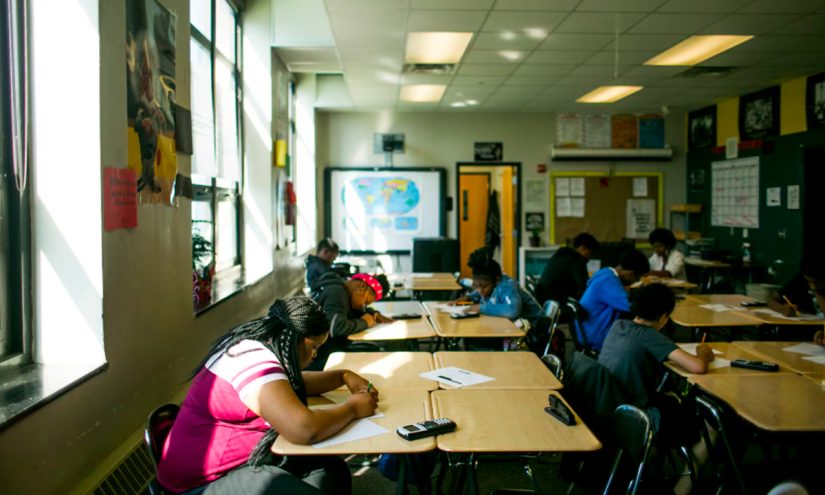
    Nearly 5,000 Detroit high school students have earned at least one $200 incentive for perfect attendance since early January.

    High school students in the Detroit Public Schools Community District can earn $200 gift cards for each two-week period in which they have perfect attendance, from Jan. 6 through March 21.

    There have been two cycles so far for which students have received the gift cards and, in addition to the 4,936 students who had perfect attendance in at least one of two-week periods, 2,028 have had perfect attendance in both cycles, according to data Superintendent Nikolai Vitti shared with Chalkbeat this week.

    The attendance incentive is aimed at improving attendance in the district, where two-thirds of nearly 49,999 students were considered chronically absent during the 2023-24 school year. The incentive is among a number of efforts the district has employed over the years to create an attendance-going culture among students. The district has invested heavily into attendance agents to improve attendance and this school year announced that students with extremely high rates of chronic absenteeism will be held back a grade at the K-8 level and required to repeat classes at the high school level.

    The number of students earning the perfect attendance incentive is a fraction of the nearly 15,000 high school students in the district, leading one school board member to question last week whether the incentive is working. But Vitti said he is encouraged that the program is getting more high school students to class and resulting in a small decrease in the chronic absenteeism rate for high school students. He said the district and board will have to evaluate the program’s success at the end of the school year.

    Chronic absenteeism has been one of the district’s biggest challenges for years. The chronic absenteeism rate has declined, from a high of nearly 80% at the height of the pandemic, when quarantining rules meant many students missed school because of COVID exposure. But last school year’s much lower chronic absenteeism rate of 66% still means it is difficult to have consistency in the classroom and improve academic achievement.

    Students in Michigan are chronically absent when they miss 10%, or 18 days in a 180-day school year. Statewide, 30% of students are considered chronically absent, compared to 23% nationally. A recent education scorecard cited the state’s rate as being a factor in students’ slow academic recovery from the pandemic.

    Here are some of the highlights of the students who’ve received the incentive so far::

    • 3,473 students had perfect attendance during the first cycle.
    • 3,492 students had perfect attendance during the second cycle.
    • About 10% already had perfect attendance.
    • About 4% were considered chronically absent at the time the incentive began.
    • About 16% had missed 10% of the school year at the time the incentive began.
    • About 25% had missed 5-10% of the school year.
    • About 44% had missed 5% or fewer days in the school year.

    At a Detroit school board meeting last week, Vitti said the statistic showing that just 10% of the students who earned the incentive already had perfect attendance is an indication that “this is not just rewarding those that have already been going to school.”

    Board member Monique Bryant questioned what school leaders are doing to promote the incentive to students who haven’t earned it.

    Bryant suggested that data Vitti shared at the meeting showing that chronic absenteeism is down by 5 percentage points for high school students since the incentive began is an illustration that most students aren’t rising to the goal of the incentive.

    Vitti responded that it depends on how you look at the data.

    “Right now, chronic absenteeism at the high school levels improved by five percentage points,” Vitti said. “That means that 700 high school students are not chronically absent where they were last year. I’d also say that at least on the 97th day, our chronic absenteeism at the high school levels is the lowest it’s been since the pandemic.”

    The question for board members to decide at the end of the school year is whether the incentive “is the right investment with other challenges that we have districtwide,” Vitti said. “But I think the data is suggesting it’s working for many students … but not all.”

    Board member Ida Simmons Short urged the district to survey students to learn more about what is preventing them from coming to school.

    The causes of chronic absenteeism are numerous and include physical and mental health reasons, lack of transportation,and lack of affordable housing. Most of them tie back to poverty. Vitti specifically cited transportation, because half of the students in the district don’t attend their neighborhood school and the district doesn’t provide school bus transportation for high school students, who must take city buses to get to school.

    “Sometimes they’re unreliable, they’re late, they’re too far away from where the child lives,” Vitti said.

    Vitti said traditional school bus transportation for high school students “was decimated” under emergency management and it could cost between $50 million and $100 million to bring that level of transportation back.

    Another factor, Vitti said, is that for some students, school isn’t relevant. Middle and high school students, in particular, “struggle to understand, ‘why am I going to school every day? How is this connected to what I’m going to I need to know for life.’”

    Mi’Kah West, a Cass Technical High School student who serves as a student representative on the board, said that when talking to other members of the District Executive Youth Council last week, many said students overall are excited about the incentive.

    One thing that stuck out, she said, was council members saying they heard students in the hallways or on social media saying they were coming to school because they want the money.

    “And, while we don’t want to just say we want to come to school for the money,” West said, “I think it’s important to see that students … may have stayed home because they don’t want to come to school, but they’re willing to come to school now.”

    Lori Higgins is the bureau chief for Chalkbeat Detroit. You can reach her at [email protected].

    Chalkbeat is a nonprofit news site covering educational change in public schools.


    Get stories like these delivered straight to your inbox. Sign up for The 74 Newsletter

    Source link