Category: Middle School

  • Indiana Middle Schoolers’ English Scores Have Fallen. These Schools are Bucking the Trend. – The 74

    Indiana Middle Schoolers’ English Scores Have Fallen. These Schools are Bucking the Trend. – The 74


    Get stories like this delivered straight to your inbox. Sign up for The 74 Newsletter

    Like their peers nationwide, students at Crawford County Middle School in southern Indiana struggled academically in the pandemic’s wake. Principal Tarra Carothers knew her students needed help to get back on track.

    So two years ago, she decided to double instructional time for math and English. Students now spend two periods per day in these critical subjects. Carothers believes the change has been a success, and a key trend backs her up: Crawford’s ILEARN scores in English language arts increased by over 8 percentage points from 2024 to 2025.

    But overall, Indiana middle schools are heading in the opposite direction when it comes to English. In fact, despite gains in math, middle schoolers are struggling more than students in other grade levels in English, state test scores show. Since 2021, ILEARN English proficiency rates in seventh and eighth grades have fallen, with the dip particularly pronounced for seventh graders. And while their scores are up slightly compared with four years ago, sixth graders’ performance fell over the past year.

    Indiana has made significant and much-publicized investments in early literacy, relying heavily on the science of reading, as many states have in the last few years. But that instructional transformation has come too late for current middle schoolers. Meanwhile, ILEARN English scores for third and fourth graders have risen by relatively small levels since the pandemic, although this improvement has been uneven.

    The Board of Education expressed specific concerns about middle schoolers’ performance at a July 16 meeting. “We’ve gotta pick it up and make sure all of our middle school kids are reading, provide those additional supports,” said Secretary of Education Katie Jenner.

    Some middle school leaders say strategies they’ve used can turn things around. In addition to increasing instructional time for key subjects, they point to participation in a pilot that allows students to take ILEARN at several points over the school year, instead of just once in the spring. Educators say relying on these checkpoints can provide data-driven reflection and remediation for students that shows up in better test scores.

    Middle school an ‘optimum time’ for students’ recovery

    Katie Powell, director for middle level programs at the Association for Middle Level Education, said she often asks teachers if middle schoolers seem different since the pandemic and “heads nod,” she said. These post-pandemic middle schoolers are harder to motivate and engage, self-report more stress, and are less likely to take risks academically, Powell said.

    When the pandemic hit, “they were young, at the age of school where they’re developing basic reading fluency and math fact fluency,” she said. Current eighth graders, for example, were in second grade when the pandemic shut down schools and many learned online for much of their third grade year. Third grade is when students are supposed to stop learning to read and start “reading to learn,” Powell said.

    Powell noted that middle schoolers are in the stage of rapid development with the most changes for the brain and body outside of infancy.

    “This is actually an optimum time to step in and step up for them,” she said. “It is not too late. But it’s critical that we pay attention to them now.”

    Crawford County Middle School has nine periods every day, and students spend two periods each in both math and English. While many schools have some version of block scheduling, many have a model in which students only go to each class every other day. But at Crawford, students attend every class every day. Their version of block scheduling results in double the amount of instructional time in math and English.

    To make this switch, sacrifices had to be made. Periods were shortened, resulting in less time for other subjects. Carothers worried that student scores in subjects like science and social studies would decrease. But the opposite occurred, she said. Sixth grade science scores increased, for example, even though students were spending less time in the science classroom, according to Carothers.

    “If they have better math skills and better reading skills, then they’re gonna perform better in social studies and science,” she said.

    Meanwhile, at Cannelton Jr. Sr. High School, on the state line with Kentucky, the first three periods of the day are 90 minutes, rather than the typical 45. Every student has English or math during these first three periods, allowing for double the normal class time.

    Cannelton’s sixth through eighth grade English language arts ILEARN scores increased by nearly nine percentage points last year.

    Schools use more data to track student performance

    Cannelton Principal Brian Garrett believes his school’s reliance on data, and its new approach to getting it, is also part of their secret.

    Students take benchmark assessments early, in the first two or three weeks of school, so that teachers can track their progress and find gaps in knowledge.

    This year, the state is adopting that strategy for schools statewide. Rather than taking ILEARN once near the end of the year, students will take versions of the test three separate times, with a shortened final assessment in the spring. The state ran a pilot for ILEARN checkpoints last school year, with over 70% of Indiana schools taking part.

    The Indiana Department of Education hopes checkpoints will make the data from the test more actionable and help families and teachers ensure a student is on track throughout the year.

    Kim Davis, principal of Indian Creek Middle School in rural Trafalgar, said she believes ILEARN checkpoints, paired with reflection and targeted remediation efforts by teachers, “helped us inform instruction throughout the year instead of waiting until the end of the year to see did they actually master it according to the state test.”

    The checkpoints identified what standards students were struggling with, allowing Indian Creek teachers to tailor their instruction. Students also benefitted from an added familiarity with the test; they could see how questions would be presented when it was time for the final assessment in the spring.

    “It felt very pressure-free, but very informative for the teachers,” Davis said.

    The type of data gathered matters too. In the past, Washington Township middle schools used an assessment called NWEA, taken multiple times throughout the year, to measure student learning, said Eastwood Middle School Principal James Tutin. While NWEA was a good metric for measuring growth, it didn’t align with Indiana state standards, so the scores didn’t necessarily match how a student would ultimately score on a test like ILEARN.

    Last year, the district adopted ILEARN checkpoints instead, and used a service called Otis to collect weekly data.

    It took approximately six minutes for students to answer a few questions during a class period with information that educators could then put into Otis. That data allowed teachers to target instruction during gaps between ILEARN checkpoints.

    “Not only were they getting the practice through the checkpoints, but they were getting really targeted feedback at the daily and weekly level, to make sure that we’re not waiting until the checkpoint to know how our students are likely going to do,” Tutin said.

    Both Davis and Tutin stressed that simply having students take the checkpoint ILEARN tests was not enough; it had to be paired with reflection and collaboration between teachers, pushing each other to ask the tough questions and evaluate their own teaching.

    “We still have a fire in us to grow further, we’re not content with where we are,” Davis said. “But we’re headed in the right direction and that’s very exciting.”

    This story was originally published by Chalkbeat. Chalkbeat is a nonprofit news site covering educational change in public schools. Sign up for their newsletters at ckbe.at/newsletters


    Get stories like these delivered straight to your inbox. Sign up for The 74 Newsletter

    Source link

  • Project POTUS 2025 Middle School Winners Announced

    Project POTUS 2025 Middle School Winners Announced

    Indianapolis, IN — Project POTUS, a national middle school history initiative from the Benjamin Harrison Presidential Site, has named winners for this year’s competition. 

    Since the founding of our nation, there have been nearly half a billion American citizens. Of those, over 12,000 of us have served in Congress. Just 115 have become Supreme Court Justices. Only 45 citizens have become President of the United States. There’s something exceptional about each POTUS — good, bad, or otherwise. Project POTUS? challenges students in middle school to research an American president and create a video, 60 seconds or less, representing the POTUS chosen in a way that is creative, supported by good history research, and fun. A Citizen Jury made up of nearly 100 people reviewed all qualifying submissions and selected this year’s winners.

    Grand Jury’s Grand Prize and Spotlight Award Selections  

    Grand Prize Winner ($500 award) 

    • 6th grader Peter Gestwicki from Muncie, Indiana won grand prize for his video about Theodore Roosevelt. Watch his winning video  here.

    Spotlight Award  Winners ($400 award winners) 

    • 8th grader Grace Whitworth from St. Richard’s Episcopal School in Indianapolis, Indiana won for her video about President Thomas Jefferson. Watch her winning video  here.
    • 8th grader Izzy Abraham from Sycamore School in Indianapolis, Indiana for her video about President Calvin Coolidge. Watch his winning video  here.
    • 8th grader Clara Haley from St. Richards Episcopal School in Indianapolis, Indiana for her video about President George W. Bush. Watch his winning video  here
    • 8th graders Delaney Guy and Nora Steinhauser from Cooperative Middle School in Stratham, New Hampshire for their video about President James Polk. Watch their winning video  here.

    37 students throughout the country each won their Presidential Category and received $100 awards. Check out all of their videos  here.

    The 2026 Project POTUS competition begins Election Day, November 4, 2025 and all submissions must be entered by Presidents Day, February 16, 2026. Learn more  here.

    Project POTUS is made possible by the generous support from Russell & Penny Fortune. 

    About the Benjamin Harrison Presidential Site

    The Benjamin Harrison Presidential Site is the former home of the 23rd U.S. President. Now celebrating its 150th anniversary, it is a stunningly restored National Historic Landmark that shares the legacy of Indiana’s only President and First Lady with tens of thousands of people annually through guided tours, educational programs, special events and cultural programs. Rated “Top 5 Stately Presidential Homes You Can Visit” by Architectural Digest, the Harrison’s 10,000 square foot Italianate residence in downtown Indianapolis houses nearly 11,000 curated artifacts spanning more than two centuries of American and presidential history. Recently expanded and restored through a $6 million campaign, the Benjamin Harrison Presidential Site is also consistently ranked a Top 5 Thing To Do in Indianapolis by TripAdvisor. Signature programs and initiatives include: Future Presidents of America; Project POTUS, Candlelight Theatre; Juneteenth Foodways Festival; Wicket World of Croquet; and Off the Record. Founded in 1966 as a private 501c(3) that receives no direct federal support, the Benjamin Harrison Presidential Site is dedicated to increasing public participation in the American system of self-government through the life stories, arts and culture of an American President. Find out more at PresidentBenjaminHarrison.org

    eSchool News Staff
    Latest posts by eSchool News Staff (see all)

    Source link

  • Why Teachers Can’t Afford to Wait on the Sidelines

    Why Teachers Can’t Afford to Wait on the Sidelines

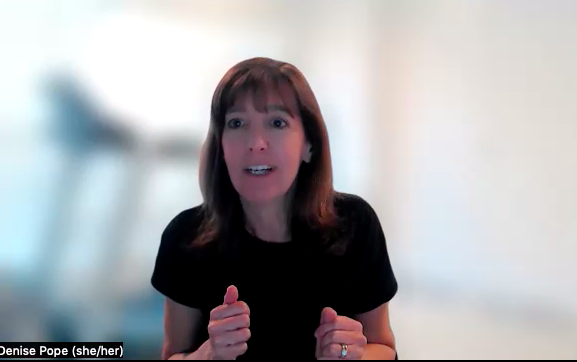
    Tired of talking about AI? That’s too bad. The technology remains the most impactful force in education. The challenge becomes avoiding all the Claptrap. Thankfully, that’s where Denise Pope, Co-Founder of Challenge Success at the Stanford Graduate School of Education, comes in.

    I had the chance to explore the current AI state-of-play from her perspective. One striking disparity I haven’t heard talked about: While AI usage among students has skyrocketed—from 25% to 60% at the middle school level and 45% to 75% at the high school level over just two school years—only 32% of teachers report using AI for academic purposes.

    This gap has created what Denise describes as an educational “La La Land,” where students are experimenting with AI tools while many schools lack clear policies or guidance. The absence of structured approaches is breeding anxiety among both educators and students, who are left wondering when and how AI should appropriately be used in academic settings.

    Click through to hear how Denise believes this issue can be addressed:

    Kevin Hogan
    Latest posts by Kevin Hogan (see all)

    Source link

  • San Jose Middle School Offers College Class to 13-Year-Olds – The 74

    San Jose Middle School Offers College Class to 13-Year-Olds – The 74


    Get stories like this delivered straight to your inbox. Sign up for The 74 Newsletter
    This story was originally published by CalMatters. Sign up for their newsletters.

    By 2:45 p.m. the regular school day at August Boeger Middle School had already ended, but one class is about to start. More than 20 eighth graders drop their backpacks and settle into desks — not for extra credit but for college credit.

    These 13- and 14-year-old students in East San Jose are taking their first college course, an entry-level class on career planning. This middle school is one of the first in the state to offer a college-level course. In the coming years, the San Jose Evergreen Community College District wants all middle school students in this school district to be able to complete three college courses before they start high school, and soon, the district plans to offer other courses, such as sociology and ethnic studies, said Beatriz Chaidez, the chancellor for the community college district.

    Middle schoolers have long been eligible to enroll in college classes in California, though only a few, high-achieving students actually do it. By offering a college class at a middle school — especially one in a high-poverty area — the community college district is looking to make that enrollment easier. The class is taught by a middle school staff member, and it’s reserved exclusively for middle school students.

    But with so few programs, there is little research about whether students are benefitting, and the local faculty union is worried middle school students might not be ready.

    Chaidez disagrees. “Navigating (college) as early as middle school is unheard of in their community,” she said. “So when they experience success, it really motivates them to continue.”

    California is increasingly pushing high schools to offer community college classes directly to students during the regular school day, a set-up known as “dual enrollment.” Unlike AP classes, which include expensive exams and are limited to certain subjects and high-performing students, these community college classes cover a range of topics and are open to all students. By 2030, California Community Colleges Chancellor Sonya Chiristian wants all high school students to graduate with at least four college courses completed.

    Chaidez wants to go further. She wants every local high school student to be able to complete about 20 college courses by the time they graduate — enough to earn an associate’s degree.

    CalMatters reached out to the college district’s faculty union, which was surprised to learn the district is offering classes at a middle school.

    “This opens up some problems,” said Jessica Breheny, an English professor and the union’s vice president. “I’m sure there are 12-year-olds that are college-ready, but there are just less of them and it’s less likely. Developmentally, they have other things going on.”

    Research shows that high schoolers who take college classes are more likely to attend college and graduate, but there’s little research on how middle school students fare, said John Fink, a senior researcher at Columbia University’s Community College Research Center. “Nationally, and in most states, this is very, very rare, and in many states this is not allowed.” Instead, he said the focus is typically on enrolling more 10th, 11th and 12th graders in college courses.

    A college-level course, with a few middle school games

    About 10% of California’s high school students took a community college class in the 2021-22 school year, according to an analysis by professors at UC Davis using the most recent data. California’s community college system doesn’t track how many middle school students take college courses.

    So far, the Mount Pleasant Elementary School District, which includes August Boeger Middle School, offers only one college course, called “Career Planning,” and it’s almost indistinguishable from any other class on its campus. The college course is taught in a regular middle school classroom, and the professor, Oscar Lamas, already works at the middle school, where he’s a counselor. Perhaps the only noticeable difference is the timing: The middle school day ends at 2:30 p.m. and Lamas’ course starts at 2:45. He’s paid separately by the community college to teach the course.

    Career Planning helps students learn about career paths, practice resume-writing and learn psychological theories related to professional success. A governing board of college district professors, known as the Academic Senate, sets the objectives for each college course, but Lamas has broad discretion in teaching it. The Academic Senate responsible for setting the parameters of Lamas’ course did not respond to multiple requests for comment.

    The dean of the community college’s counseling department, Victor Garza, refused an interview request from CalMatters but issued a written statement. Garza said the middle school class is akin to other dual enrollment courses, which maintain the college’s “academic rigor.”

    “Some adjustments might be needed to cater to the unique needs and experiences” of students, he added.

    On a Thursday before spring break, Lamas tries to make his class more fun by breaking the students into five teams to play a Jeopardy-style quiz game on the topic of the day, Maslow’s Hierarchy of Needs.

    Natalie Mendoza, 14, becomes the default spokesperson of her team, named the “Tacos R Us Club,” but she answers the first question wrong, putting her team back 300 points and prompting her classmates to burst into chatter and analyze their mistakes.

    As part of the class, she has to study a career, write a short essay about it and present it at a career fair. She picked intellectual property law. “A lot of people say I’m assertive,” she said. “I think that’s a really good trait for a lawyer, and I think it’d be fun to fight for people who have created stuff.”

    Natalie said she’d be the first in her family to attend college but she’s already planning to go and has a few schools in mind, including UC Berkeley and San Jose State. If she does attend one of those schools, her grade in this counseling class would be part of her official college transcript.

    Breheny, with the union, said she’s concerned about the quality of the classes, especially once the college district begins teaching other subjects, such as ethnic studies.

    “Faculty designed their courses for adult learners,” Breheny said. An ethnic studies class may cover topics such as sexual violence and genocide, she added — topics that may be difficult to convey to a middle schooler. “Some of the material assumes a certain knowledge about the world, about politics, which you may not have at 11, 12, 13 years old.”

    High schools offer few dual enrollment classes

    August Boeger Middle School sits at the base of the Diablo Range mountains, tucked between the ranch-style homes and strip malls that color East San Jose. Teachers and staff greet each other with mucho gusto instead of hello. All around the open-air campus, murals tell the story of the region’s multi-cultural heritage, especially its Mexican and Chicano roots.

    That celebration of culture is a direct response to a history of adversity, Lamas said. “East San Jose has always been a marginalized, disadvantaged environment.” As a result, schools in the community contend with education disparities, he said, such as a high dropout rate and a high teen pregnancy rate.

    Offering a college class to these middle school students allows them to “see a possibility for their future that doesn’t exist within these walls here” and can inspire them to reach for a higher goal, said Marisa Peña, a school advisor.

    Male students, Black and Latino students and students from rural areas are underrepresented in the community college courses offered at California’s school districts. California lawmakers have signed numerous bills in the hopes of expanding access but certain regions in the state, such as Los Angeles, enroll a higher percentage of students.

    Natalie said she hopes to continue taking college courses when she starts at Mount Pleasant High School this fall, which is just around the corner from her middle school. But her options are limited.

    Mount Pleasant High School offers just three community college courses, which serve about 10% of the school’s roughly 1,000 students, said Kyle Kleckner, the school district’s director of instructional services. All of the classes are in “multimedia” studies, he said, which teaches students how to create their own podcasts or YouTube channels, along with other digital marketing skills. 

    Although Mount Pleasant High School’s dual enrollment is about on par with the state average, it trails other districts in the region. Less than 20 miles away, at high schools in the Milpitas Unified School District, roughly 25% of students enrolled in a community college class in 2021-22, according to the UC Davis analysis.

    Finding professors to teach middle school

    Part of the dual enrollment challenge is finding qualified college professors who are willing and able to work at a high school or middle school. Existing middle and high school teachers are allowed to teach college courses but they have to meet the qualifications, which usually include a master’s degree in the area of instruction. Most of California’s high school and middle school instructors lack a master’s degree, according to a study by the Public Policy Institute of California.

    “We have graduation requirements that students have to accomplish,” Kleckner said. “The trick is finding that community college course that also fulfills those requirements and also finding a teacher who can teach it.” He said Mount Pleasant High School is committed to expanding the number of college courses but noted that it’s smaller and therefore has fewer teachers who meet the requirements to teach a college course.

    In turn, many college professors lack experience teaching children, said Breheny, who teaches at San Jose City College. “We have had some problems already with dual enrollment where faculty have gone to different (high schools) to teach and have dealt with classroom management issues that they wouldn’t have in a college course.” In one case, she said a college faculty member saw bullying in a high school classroom but didn’t feel equipped to respond.

    Lamas has a master’s degree, which is required for most school counselors. He’s gentle with the middle school students in his class, occasionally awarding points in the Jeopardy game even when the answer isn’t perfect. Lamas had two quiz games planned that day, each one covering a different topic, but the first game took up almost all of the class time.

    He ends class by taking questions about the upcoming final project. Although spring break is minutes away, the students sit still through the final minutes, except for the occasional joke and bursts of laughter. Not a single phone was in sight.

    Once class ends, however, chatter ensues, the students pull out their phones, and staff escort them to the parking lot. While they may be taking a college course, they still must wait for their parents to pick them up.

    This article was originally published on CalMatters and was republished under the Creative Commons Attribution-NonCommercial-NoDerivatives license.


    Get stories like these delivered straight to your inbox. Sign up for The 74 Newsletter
    Source link

  • Students Explore STEM with Engineers

    Students Explore STEM with Engineers

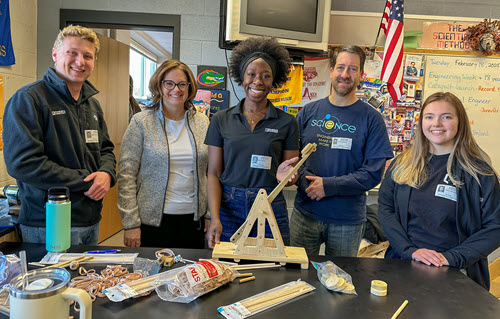
    Middletown, PA – Phoenix Contact engineers head back into the classroom this week to teach sixth-grade science class at Middletown Area Middle School in Middletown, Pa. The classes are part of Phoenix Contact’s National Engineers Week celebration.

    Phoenix Contact has worked with the school every February since 2007. The engineers lead hands-on lessons that make science fun. The goal is to inspire young people to consider careers in science, technology, engineering, and math (STEM).

    The lessons include:

    • Building catapults
    • Racing cookie tins down ramps
    • Building an electric motor
    • Learning about static electricity with the Van de Graaff generator

    “Our engineering team created this outreach program many years ago, and the partnership with Middletown Area School District has stood the test of time,” said Patty Marrero, interim vice president of human relations at Phoenix Contact. “National Engineers Week is a special time for them to share their passion for technology with students. It’s also our chance to thank our engineers for the creativity and innovations that drive our company forward.”

    About Phoenix Contact

    Phoenix Contact is a global market leader based in Germany. Since 1923, Phoenix Contact has created products to connect, distribute, and control power and data flows. Our products are found in nearly all industrial settings, but we have a strong focus on the energy, infrastructure, process, factory automation, and e-mobility markets. Sustainability and responsibility guide every action we take, and we’re proud to work with our customers to empower a smart and sustainable world for future generations. Our global network includes 22,000 employees in 100+ countries. Phoenix Contact USA has headquarters near Harrisburg, Pa., and employs more than 1,100 people across the U.S.

    For more information about Phoenix Contact or its products, visit www.phoenixcontact.com, call technical service at 800-322-3225, or email [email protected].

    eSchool News Staff
    Latest posts by eSchool News Staff (see all)

    Source link

  • A dismal report card in math and reading

    A dismal report card in math and reading

    The kids are not bouncing back. 

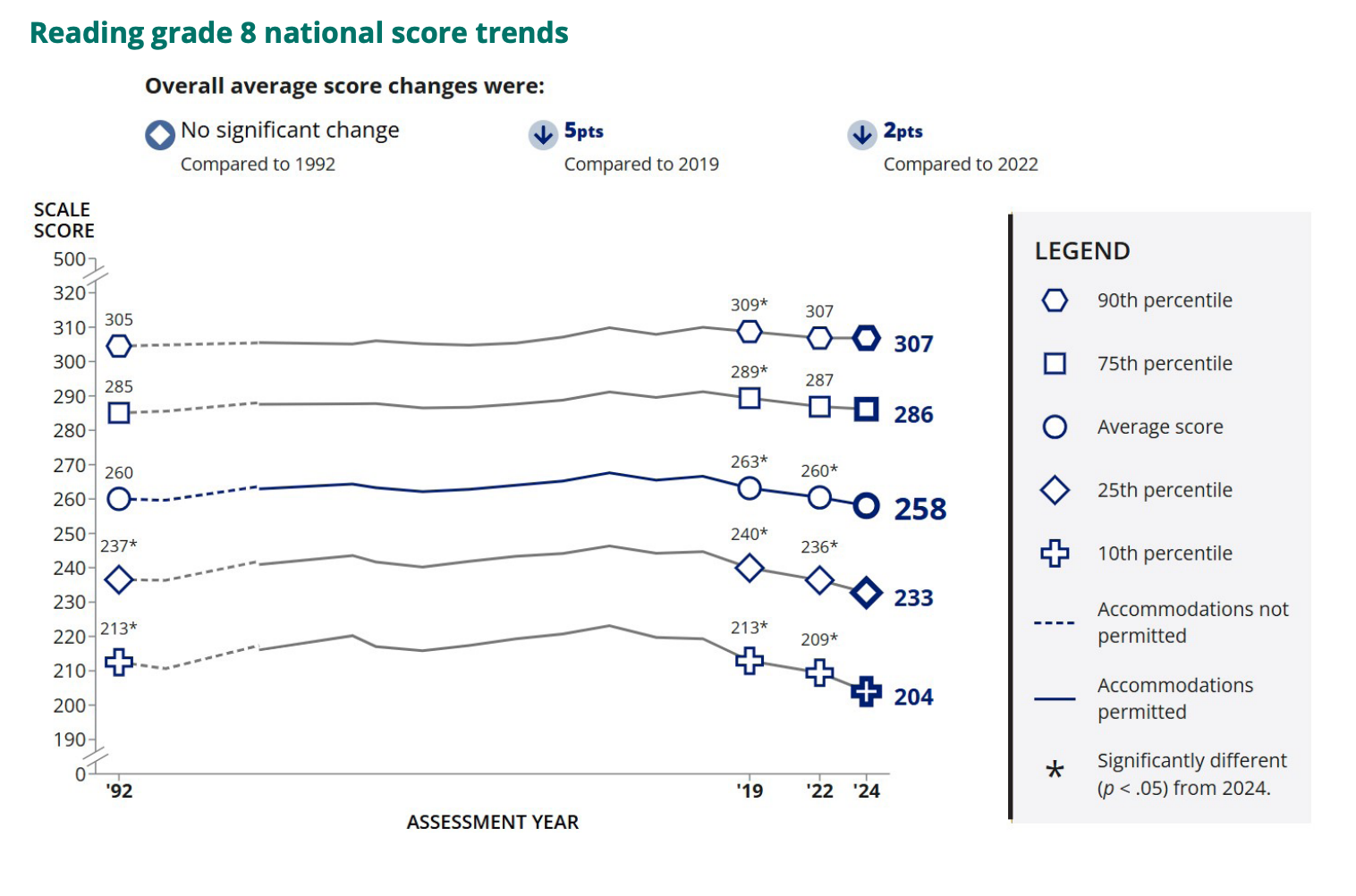
    The results of a major national test released Wednesday showed that in 2024, reading and math skills of fourth and eighth grade students were still significantly below those of students in 2019, the last administration of the test before the pandemic. In reading, students slid below the devastatingly low achievement levels of 2022, which many educators had hoped would be a nadir. 

    The test, the National Assessment of Educational Progress (NAEP), is often called the nation’s report card. Administered by the federal government, it tracks student performance in fourth and eighth grades and serves as a national yardstick of achievement. Scores for the nation’s lowest-performing students were worse in both reading and math than those of students two years ago. The only bright spot was progress by higher-achieving children in math. 

    The NAEP report offers no explanation for why students are faltering, and the results were especially disappointing after the federal government gave schools $190 billion to aid in pandemic recovery. 

    “These 2024 results clearly show that students are not where they need to be or where we want them to be,” said Peggy Carr, the commissioner of the National Center for Education Statistics, in a briefing with journalists. 

    Related: Our free weekly newsletter alerts you to what research says about schools and classrooms.

    More than 450,000 fourth and eighth graders, selected to be representative of the U.S. population, took the biennial reading and math tests between January and March of 2024. 

    Depressed student achievement was pervasive across the country, regardless of state policies or instructional mandates. Student performance in every state remained below what it was in 2019 on at least one of the four reading or math tests. In addition to state and national results, the NAEP report also lists the academic performance for 26 large cities that volunteer for extra testing.

    An ever-widening gap

    The results also highlighted the sharp divergence between higher- and lower- achieving students. The modest progress in fourth grade math was entirely driven by high-achieving students. And the deterioration in both fourth and eighth grade reading was driven by declines among low-achieving students. 

    “Certainly the most striking thing in the results is the increase in inequality,” said Martin West, a professor of education at Harvard University and vice chair of the National Assessment Governing Board, which oversees the NAEP test. “That’s a big deal. It’s something that we hadn’t paid a lot of attention to traditionally.”

    The starkest example of growing inequality is in eighth grade math, where the achievement gap grew to the largest in the history of the test.

    Source: NAEP 2024

    The chart above shows that the math scores of all eighth graders fell between 2019 and 2022. Afterward, high-achieving students in the top 10 percent and 25 percent of the nation (labeled as the 90th and 75th percentiles above) began to improve, recovering about a quarter of the setbacks for high achievers during the pandemic. That’s still far behind high-performing eighth graders in 2019, but at least it’s a positive trend. 

    The more disturbing result is the continuing deterioration of scores by low-performing students in the bottom 10 percent and 25 percent. The huge pandemic learning losses for students in the bottom 10 percent grew 70 percent larger between 2022 and 2024. Learning losses for students in the bottom 25 percent grew 25 percent larger.

    “The rich get richer and the poor are getting shafted,” said Scott Marion, who serves on the NAEP’s governing board and is the executive director of the National Center for the Improvement of Educational Assessment, a nonprofit consultancy. “It’s almost criminal.”

    More than two-thirds of students in the bottom 25 percent are economically disadvantaged. A quarter of these low performers are white and another quarter are Black. More than 40 percent are Hispanic. A third of these students have a disability and a quarter are classified as English learners. 

    By contrast, fewer than a quarter of the students in the top 25 percent are economically disadvantaged. They are disproportionately white (61 percent) and Asian American (14 percent). Only 5 percent are Black and 15 percent are Hispanic. Three percent or fewer of students at the top have a disability or are classified as English learners.  

    Related: Six puzzling questions from the disastrous [2022] NAEP results

    Although average math scores among all eighth grade students were unchanged between 2022 and 2024, that average masks the improvements at the top and the deterioration at the bottom. They offset each other. 

    The NAEP test does not track individual students. The eighth graders who took the exam in 2024 were a different group of students than the eighth graders who took the exam in 2022 and who are now older. Individual students have certainly learned new skills since 2019. When NAEP scores drop, it’s not that students have regressed and cannot do things they used to be able to do. It means that they’re learning less each year. Kids today aren’t able to read or solve math problems as well as kids their same age in the past.

    Students who were in eighth grade in early 2024, when this exam was administered, were in fourth grade when the pandemic first shuttered schools in March 2020. Their fifth grade year, when students should have learned how to add fractions and round decimals, was profoundly disrupted. School days began returning to normal during their sixth and seventh grade years. 

    Harvard’s West explained that it was incorrect to assume that children could bounce back academically. That would require students to learn more in a year than they historically have, even during the best of times.

    “There’s nothing in the science of learning and development that would lead us to expect students to learn at a faster rate after they’ve experienced disruption and setbacks,” West said. “Absent a massive effort society-wide to address the challenge, and I just haven’t seen an effort on the scale that I think would be needed, we shouldn’t expect more positive results.”

    Learning loss is like a retirement savings shortfall

    Learning isn’t like physical exercise, West said. When our conditioning deteriorates after an injury, the first workouts might be a grind but we can get back to our pre-injury fitness level relatively quickly. 

    “The better metaphor is saving for retirement,” said West. “If you miss a deposit into your account because of a short-term emergency, you have to find a way to make up that shortfall, and you have to make it up with interest.”

    What we may be seeing now are the enduring consequences of gaps in basic skills. As the gaps accumulate, it becomes harder and harder for students to keep up with grade-level content. 

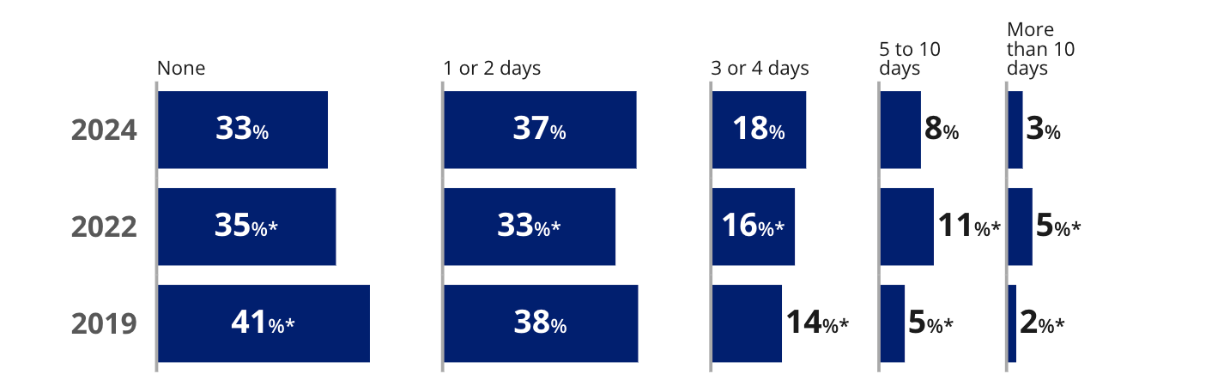
    Another factor weighing down student achievement is rampant absenteeism. In survey questions that accompany the test, students reported attending school slightly more often than they had in 2022, but still far below their 2019 attendance rates. Eleven percent of eighth graders said that they had missed five or more school days in the past month, down from 16 percent in 2022, but still far more than the 7 percent of students who missed that much school in 2019. 

    “We also see that lower-performing readers aren’t coming to school,” said NCES Commissioner Carr. “There’s a strong relationship between absenteeism and performance in these data that we’re looking at today.”

    Eighth graders by the number of days they said they were absent from school in the previous month 

    Source: NAEP 2024

    Fourth grade math results were more hopeful. Top-performing children fully recovered back to 2019 achievement levels and can do math about as well as their previous peers. However, lower-performing children in the bottom 10 percent and 25 percent did not rebound at all. Their scores were unchanged between 2022 and 2024. These students were in kindergarten when the pandemic first hit in 2020 and missed basic instruction in counting and arithmetic.

    Reading scores showed a similar divergence between high- and low- achievers.

    Source: NAEP 2024

    This chart above shows that the highest-performing eighth graders failed to catch up to what high-achieving eighth graders used to be able to do on reading comprehension tests. But it’s not a giant difference. What’s startling is the steep decline in reading scores for low-achieving students. The pandemic drops have now doubled in size. Reading comprehension is much, much worse for many middle schoolers. 

    It’s difficult to say how much of this deterioration is pandemic related. Reading comprehension scores for middle schoolers had been declining for a decade since 2013. Separate surveys show that students are reading less for pleasure, and many educators speculate that cellphone use has replaced reading time.

    Related: Why reading comprehension is deteriorating

    The biggest surprise was fourth grade reading. Over the past decade, a majority of states have passed new “science of reading” laws or implemented policies that emphasize phonics in classrooms. There have been reports of improved reading performance in Mississippi, Florida, Tennessee and elsewhere. But scores for most fourth graders, from the highest to the lowest achievers, have deteriorated since 2022. 

    One possibility, said Harvard’s West, is that it’s “premature” to see the benefits of improved instruction, which could take years.  Another possibility, according to assessment expert Marion, is that being able to read words is important, but it’s not enough to do well on the NAEP, which is a test of comprehension. More elementary school students may be better at decoding words, but they have to make sense of those words to do well on the NAEP. 

    Carr cited the example of Louisiana as proof that it is possible to turn things around. The state exceeded its 2019 achievement levels in fourth grade reading. “They did focus heavily on the science of reading but they didn’t start yesterday,” said Carr. “I wouldn’t say that hope is lost.”

    More students fall below the lowest “basic” level 

    The results show that many more children lack even the most basic skills. In math, 24 percent of fourth graders and 39 percent of eighth graders cannot reach the lowest of three achievement levels, called “basic.” (The others are “proficient” and “advanced.”) These are fourth graders who cannot locate whole numbers on a number line or eighth graders who cannot understand scientific notation. 

    The share of students reading below basic was the highest it’s ever been for eighth graders, and the highest in 20 years for fourth graders. Forty percent of fourth graders cannot put events from a story into sequential order, and one third of eighth graders cannot determine the meaning of a word in the context of a reading passage. 

    “To me, this is the most pressing challenge facing American education,” said West.

    Contact staff writer Jill Barshay at 212-678-3595 or [email protected].

    This story about the 2024 NAEP test was written by Jill Barshay and produced by The Hechinger Report, a nonprofit, independent news organization focused on inequality and innovation in education. Sign up for  Hechinger newsletters.

    The Hechinger Report provides in-depth, fact-based, unbiased reporting on education that is free to all readers. But that doesn’t mean it’s free to produce. Our work keeps educators and the public informed about pressing issues at schools and on campuses throughout the country. We tell the whole story, even when the details are inconvenient. Help us keep doing that.

    Join us today.

    Source link