Category: Mobile Stories

  • Why have someone edit your story?

    Why have someone edit your story?

    Redundancy: Did you repeat anything unnecessarily?

    Accuracy: Did you make any factual mistakes or is anything misleading and can be read in a number of different ways?

    Sourcing: Were you able to show where your information came from and did you get the information from credible sources?

    Balance: Did you recognize multiple and opposing viewpoints or is the story one-sided and preachy?

    Organization: Did you bury the most interesting or important thing way down into your story? Did you wait too long to quote someone?

    Paragraphing: Are your paragraphs way too long? Long paragraphs are daunting to read, so try breaking them up. A paragraph can be a single sentence.

    Language: Is the story full of jargon normal people wouldn’t understand or long words only highly-educated people would know?

    Complexity: Is your story bogged down by too much information that isn’t really necessary?

    Clarity: Can a normal person understand the story on a quick read or is it confusing in any way?

    The editor’s role

    Ultimately the editor’s job is to make the story clear and readable. And both those things are hard to spot when you are the writer.

    Sometimes reporter balk at the suggestions editors make or the changes they insist must be done. When you have taken a lot of time and effort to report a story and have carefully worded and reworded your article it hurts to learn that it isn’t finished or that the editor thinks there are problems with it.

    But journalism is a collaborative process. It’s your story but it is also the editors story and the publication’s story. Your name will be on it — we call that the byline — but it will affect the publication’s reputation and that of the editor. Editors can find themselves fired or suspended if they publish a story that should not have been published. That’s the negative side of it.

    On the positive side, most editors genuinely want to make the story better — clearer, more powerful, a better overall read. And isn’t that what you want too? Over the course of my career, editors have saved me time and again by spotting mistakes I had inadvertently made. They have strengthened my writing and made me a better writer.

    Now if an editor suggests or insists on a change you really think isn’t necessary or will harm your story then fight against that. But do so respectfully and professionally.

    Ultimately the process isn’t meant to be fair. The editor has the final say. But if you can make a strong case and if you can show your editors why you care so much, chances are they will yield. Often this becomes a negotiation to find a way to word the material that satisfies both of you. But pick your battles carefully. No editor wants to work with a writer who fights every change or suggestion.

    A good partnership between a journalist and editor will help you write a great story and help ensure it stands up to the scrutiny of your audience.


    QUESTIONS TO CONSIDER:

    1. What is one way an editor can improve your story?

    2. If an editor wants change a story in a way you don’t like, what should you do?

    3. What traits do you have that would make you a good editor?



    Source link

  • Top Tips: Are your sources reliable?

    Top Tips: Are your sources reliable?

    As a reporter you’re only as good as your sources. That’s why it is important, when doing a news story, to choose sources who are knowledgeable. That’s the advice from investigative journalist Matt Drange. 

    As a reporter, Drange doesn’t report his own thoughts and feelings. Instead, he reports the news based on what he can verify from multiple sources.

    Drange has written stories for ProPublica, Forbes Magazine, the Center for Investigative Reporting, the Guardian and Business Insider. 

    He said that when researching a story and looking for interviews, you should evaluate whether potential sources are reliable. This is critical in this age where so much disinformation is distributed. Just because someone says something and just because someone has a fancy title doesn’t mean they will give you good information.

    “These days the internet makes finding and accessing information easy,” Drange said. “But just because someone says something, doesn’t make it true or worthwhile for you to report in a journalistic article.”

    Source link

  • Can the information you share be trusted?

    Can the information you share be trusted?

    “If you see that a person has lied in the past you should carefully consider whether it is a good idea to trust them,” Jonas said. 

    3. Find other sources that seem to be reporting the same thing.

    “Sometimes you will find that different sources interpret the same event very differently,” Jonas said. “Think about which sources you should trust more.”

    Information in research articles, journalistic publications or academic experts and institutions are generally more reliable than blog contributors or social media posts, Jonas said. 

    Be a bit skeptical, too, she said, when a publication or podcast or post seems to mix information with emotion and see if you can separate out factual reporting with opinion.

    Incorporating this healthy skepticism and adopting a system for verifying information will help you build a reputation for credibility and reliability. This is useful not just in your reporting, Jonas said, but in your daily life, as well. 


    Questions to consider:

    1. What is meant by a system of verification?

    2. Why should you check for information about the author of an article or post you read?

    3. How can a healthy skepticism be useful in your daily life?


    Source link

  • Top Tips: Make your voice heard

    Top Tips: Make your voice heard

    Do you feel like the media doesn’t represent you? Are you aware of certain tropes that you disagree with and know from first-hand experience?

    Then use your voice. To show you how, Charis McGowan, a freelance journalist who has worked for the Guardian, the BBC and Al Jazeera and was an editor at gal-dem, a magazine for women and non-binary people of color, shares some tips that will help you effectively get your opinions across in an article. 

    McGowan offered her ideas as part of News Decoder’s partner project Mobile Stories. Mobile Stories is a publishing tool for young people. It provides guidance on how to create trustworthy news content while upholding journalist ethics. You can watch a video of McGowan explaining her ideas at the end of this article.

    McGowan said you first need to distinguish between a news story and an opinion article. “A news story is about your subjects, you don’t have to use the word ‘I’ at all, you’ll actually just keep your voice neutral,” McGowan said. “But an opinion article is totally different, you have to use your voice and your perspective.”

    You might comment on the news, but then you’ll tell readers how you relate to that particular piece of news. “This could be based on your ethnicity, your sexual orientation, where you live and your expertise, opinion,” McGowan said. 

    Articles by journalists differ from opinions you see in comments on social media. People who post comments might be spouting off the bat or using their initial gut reaction. “Opinion writers actually have to research what they’re talking about,” McGowan said. “That means looking at articles that perhaps they’ve not written and drawing on data and looking at really credible and trustworthy sources.”

    Opinions and expertise

    That’s what Alexa Taras did when she wrote an article News Decoder published in May 2025. Taras, a student at The Hewitt School in New York City, was concerned about the increasing number of schools around the country that were agreeing to pull books out of libraries and classrooms after parental complaints about the topics.

    She researched news stories to find actual incidents and interviewed a book publisher and an author. Only then did she include her own perspective:

    “As a current student and aspiring writer, I fear that in the future I will be creating books that cannot exist in the educational system,” Taras wrote. “Students deserve the right to learn about history no matter how violent or scary. How can we inspire students to be the best they can, if their education has been censored to only learn about ‘safe’ topics? Education should not be limited.”

    If you have an idea about something happening in the news that you think is worth exploring, McGowan provides some tips on writing an opinion piece that is both fact-based and persuasive.

    1. Write about what you know and what you are passionate about.

    This could be anything from pop culture to politics. McGowan wrote an opinion piece, for example, on an Ed Sheeran song. “He was using Caribbean slang in his lyrics and it made me feel a bit uneasy, so I delved into to my sense of unease.” McGowan asked: Was it okay for a white English man to be using this type of language? “My dad is from the Caribbean and my grandparents still speak with this type of language so it just made me feel a bit weird.”

    McGowan delved into matters of appropriation and the colonization of language to base the arguments on why Sheeran shouldn’t be doing that. “I had my opinion and I had previous work to draw on so that’s all I needed to start writing.”

    2. Research what’s been said on the topic already.

    After you’ve explored what other people have written about the topic, then think about your unique angle and draw on your voice.

    3. Bring in the news.

    Go back to what you read or saw or heard that got you thinking about this in the first place. “Signal your reaction to it straight away,” McGowan said.

    4. Back up your opinion.

    Use research data, facts and figures and other articles. “Make sure that you always cite trustworthy sources of information,” McGowan said.

    5. Round up your article in a clear and memorable way.

     Sometimes, McGowan said, the last sentence is the most important.

    Watch Charis McGowan’s video here:

    Learn more about the Mobile Stories project here. Co-funded by the European Union.


    Questions to consider:

    1. How does an opinion article differ from comments people make on social media?

    2. What do you need in an article to make it “persuasive”?

    3. What is a topic you are knowledgeable and passionate about?


    Source link

  • Top Tips: Take photos that stand out

    Top Tips: Take photos that stand out

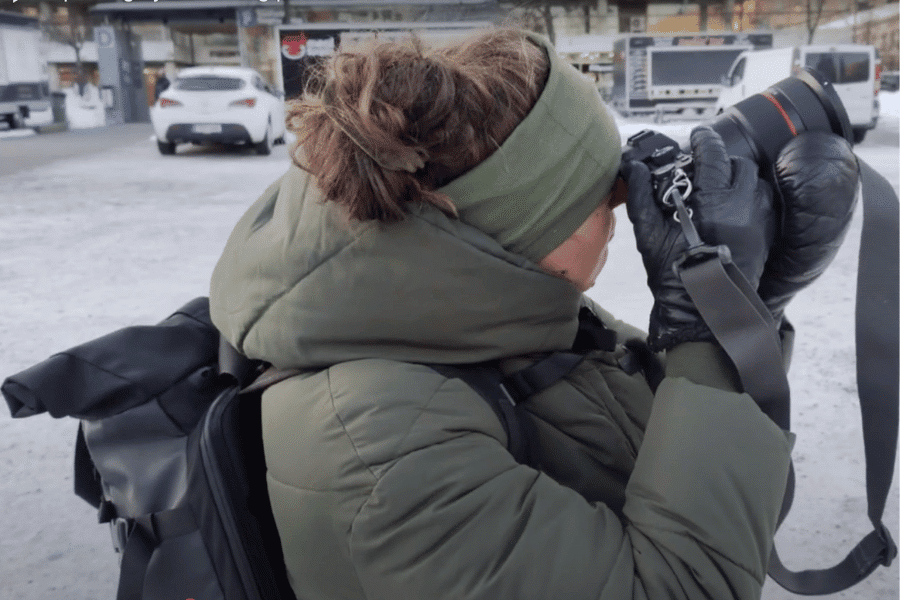
    You want to know what it’s like being a photojournalist? Do you need to take photos to illustrate an article for school publication? We asked Simone Åbacka, a photojournalist for Vasabladet in Finland, to tell us how to get inspired and make sure your photos stand out.

    “Photos nowadays are quick and easy to make, but to get a picture that really captures your audience and the viewer, that will require a bit more from you as a photographer,” Åbacka said.

    She said that photojournalists have to be out where the action is, she said.

    “So if you’re interested in a certain person, you can follow them along for a day or find a street market or a protest or something happening in your area,” Åbacka said. “So look for something that interests you and go and shoot that.”

    When you have already done a story or you are asked to provide photos for a story that has already been done, try taking a photo yourself instead of trying to find one online.

    If the story is about traffic jams, for example, go out and take a photo of the chaos and the moving cars.

    “You want your photos to get attention and be seen,” she said.

    Åbacka’s five tips for stand out photos

             1. Move around and try different kinds of angles.

    2. Look for emotion

    3. Look for good lighting

    4. Use your environment to tell viewers more about the subject

    5. Use a clean background for your subject.

    You don’t need a professional camera to take stunning photos, a phone will do. But know its limits, Åbacka said. “It can’t do everything,” she said.

    This video was produced as part of News Decoder’s partner project Mobile Stories. Mobile Stories is a publishing tool for young people. It provides guidance on how to create trustworthy news content while upholding journalist ethics.

    Watch Simone Åbacka’s video here: 

    At News Decoder, our editors, educators and correspondents guide students through the journalistic writing process to help them get a first-hand understanding of big global issues and connect across borders. From finding a story to interviewing to editing, we work closely with students to develop their skills using our Pitch-Report-Draft-Revise technique. Student stories are published on our website, social media and in our Educators’ Catalog alongside the work of professional journalists and industry experts.

    If you’re an educator looking to engage your students in media literacy programmes, a teacher in need of interesting resources or a writer looking for an outlet, find out more and get in touch at news-decoder.com


    Questions to consider:

    1. Why would a photo you take be better than one you can find online?

    2. What kind of emotion could you capture in a photograph?

    3. How can you use your environment to tell viewers more about the subject?


    Source link