Category: national

  • NAEP scores for class of 2024 show major declines, with fewer students college ready

    NAEP scores for class of 2024 show major declines, with fewer students college ready

    This story was originally published by Chalkbeat. Sign up for their newsletters at ckbe.at/newsletters.

    Students from the class of 2024 had historically low scores on a major national test administered just months before they graduated.

    Results from the National Assessment of Educational Progress, or NAEP, released September 9, show scores for 12th graders declined in math and reading for all but the highest performing students, as well as widening gaps between high and low performers in math. More than half of these students reported being accepted into a four-year college, but the test results indicate that many of them are not academically prepared for college, officials said.

    “This means these students are taking their next steps in life with fewer skills and less knowledge in core academics than their predecessors a decade ago, and this is happening at a time when rapid advancements in technology and society demand more of future workers and citizens, not less,” said Lesley Muldoon, executive director of the National Assessment Governing Board. “We have seen progress before on NAEP, including greater percentages of students meeting the NAEP proficient level. We cannot lose sight of what is possible when we use valuable data like NAEP to drive change and improve learning in U.S. schools.”

    These results reflect similar trends seen in fourth and eighth grade NAEP results released in January, as well as eighth grade science results also released Tuesday.

    In a statement, Education Secretary Linda McMahon said the results show that federal involvement has not improved education, and that states should take more control.

    “If America is going to remain globally competitive, students must be able to read proficiently, think critically, and graduate equipped to solve complex problems,” she said. “We owe it to them to do better.”

    The students who took this test were in eighth grade in March of 2020 and experienced a highly disrupted freshman year of high school because of the pandemic. Those who went to college would now be entering their sophomore year.

    Roughly 19,300 students took the math test and 24,300 students took the reading test between January and March of 2024.

    The math test measures students’ knowledge in four areas: number properties and operations; measurement and geometry; data analysis, statistics, and probability; and algebra. The average score was the lowest it has been since 2005, and 45% of students scored below the NAEP Basic level, even as fewer students scored at NAEP Proficient or above.

    NAEP Proficient typically represents a higher bar than grade-level proficiency as measured on state- and district-level standardized tests. A student scoring in the proficient range might be able to pick the correct algebraic formula for a particular scenario or solve a two-dimensional geometric problem. A student scoring at the basic level likely would be able to determine probability from a simple table or find the population of an area when given the population density.

    Only students in the 90th percentile — the highest achieving students — didn’t see a decline, and the gap between high- and low-performing students in math was higher than on all previous assessments.

    This gap between high and low performers appeared before the pandemic, but has widened in most grade levels and subject areas since. The causes are not entirely clear but might reflect changes in how schools approach teaching as well as challenges outside the classroom.

    Testing officials estimate that 33% of students from the class of 2024 were ready for college-level math, down from 37% in 2019, even as more students said they intended to go to college.

    In reading, students similarly posted lower average scores than on any previous assessment, with only the highest performing students not seeing a decline.

    The reading test measures students’ comprehension of both literary and informational texts and requires students to interpret texts and demonstrate critical thinking skills, as well as understand the plain meaning of the words.

    A student scoring at the basic level likely would understand the purpose of a persuasive essay, for example, or the reaction of a potential audience, while a students scoring at the proficient level would be able to describe why the author made certain rhetorical choices.

    Roughly 32% of students scored below NAEP Basic, 12 percentage points higher than students in 1992, while fewer students scored above NAEP Proficient. An estimated 35% of students were ready for college-level work, down from 37% in 2019.

    In a survey attached to the test, students in 2024 were more likely to report having missed three or more days of school in the previous month than their counterparts in 2019. Students who miss more school typically score lower on NAEP and other tests. Higher performing students were more likely to say they missed no days of school in the previous month.

    Students in 2024 were less likely to report taking pre-calculus, though the rates of students taking both calculus and algebra II were similar in 2019 and 2024. Students reported less confidence in their math abilities than their 2019 counterparts, though students in 2024 were actually less likely to say they didn’t enjoy math.

    Students also reported lower confidence in their reading abilities. At the same time, higher percentages of students than in 2024 reported that their teachers asked them to do more sophisticated tasks, such as identifying evidence in a piece of persuasive writing, and fewer students reported a low interest in reading.

    Chalkbeat is a nonprofit news site covering educational change in public schools.

    For more news on national assessments, visit eSN’s Innovative Teaching hub.

    Latest posts by eSchool Media Contributors (see all)

    Source link

  • Strengthening family engagement to support the science of reading

    Strengthening family engagement to support the science of reading

    Key points:

    While most teachers are eager to implement the science of reading, many lack the time and tools to connect these practices to home-based support, according to a new national survey from Lexia, a Cambium Learning Group brand.

    The 2025 Back-to-School Teacher Survey, with input from more than 1,500 K–12 educators nationwide, points to an opportunity for district leaders to work in concert with teachers to provide families with the science of reading-based literacy resources they need to support student reading success.

    Key insights from the survey include:

    • 60 percent of teachers are either fully trained or interested in learning more about the science of reading
    • Only 15 percent currently provide parents with structured, evidence-based literacy activities
    • 79 percent of teachers cite time constraints and parents’ work schedules as top barriers to family engagement
    • Just 10 percent report that their schools offer comprehensive family literacy programs
    • Teachers overwhelmingly want in-person workshops and video tutorials to help parents support reading at home

    “Teachers know that parental involvement can accelerate literacy and they’re eager for ways to strengthen those connections,” said Lexia President Nick Gaehde. “This data highlights how districts can continue to build on momentum in this new school year by offering scalable, multilingual, and flexible family engagement strategies that align with the science of reading.”

    Teachers also called for:

    • Better technology tools for consistent school-to-home communication
    • Greater multilingual support to serve diverse communities
    • Professional learning that includes family engagement training

    Gaehde concluded, “Lexia’s survey reflects the continued national emphasis on Structured Literacy and shows that equipping families is essential to driving lasting student outcomes. At Lexia we’re committed to partnering with districts and teachers to strengthen the school-to-home connection. By giving educators practical tools and data-driven insights, we help teachers and families work together–ensuring every child has the literacy support they need to thrive.”

    The complete findings are available in a new report, From Classroom to Living Room: Exploring Parental Involvement in K–12 Literacy. District leaders can also download the accompanying infographic, What District Leaders Need To Know: 5 Key Findings About Family Engagement and Literacy,” which highlights the most pressing data points and strategic opportunities for improving school-to-home literacy connections.

    Latest posts by eSchool Media Contributors (see all)

    Source link

  • Catapult Learning is Awarded Tutoring Program Design Badge from Stanford University’s National Student Support Accelerator

    Catapult Learning is Awarded Tutoring Program Design Badge from Stanford University’s National Student Support Accelerator

    Organization recognized for excellence in high-impact tutoring design and student achievement gains

    PHILADELPHIA, Aug. 25, 2025 – Catapult Learning, a division of FullBloom that provides academic intervention programs for students and professional development solutions for teachers in K-12 schools, today announced it earned the Tutoring Program Design Badge from the National Student Support Accelerator (NSSA) at Stanford University. The designation, valid for three years, recognizes tutoring providers that demonstrate high-quality, research-aligned program design.

    The recognition comes at a time when the need for high-impact tutoring (HIT) has never been greater. As schools nationwide work to close learning gaps that widened during the COVID-19 pandemic and accelerate recovery, Catapult Learning stands out for its nearly 50-year legacy of delivering effective academic support to students who need it most.

    “Catapult Learning is honored to receive this prestigious national recognition from the NSSA at Stanford University,” said Rob Klapper, president at Catapult Learning. “We are excited to be recognized for our high-impact tutoring program design and will continue to uphold the highest standards of excellence as we support learners across the country.” 

    Each year, Catapult Learning’s programs support more than 150,000+ students with nearly four million in-person tutoring sessions, in partnership with 2,100 schools and districts nationwide. Its tutors, many of whom hold four-year degrees, are highly trained professionals who are supported with ongoing coaching and professional development.

    Recent data from Catapult Learning’s HIT programs show strong academic gains across both math and reading subject areas:

    • 8 out of every 10 math students increased their pre/post score
    • 9 out of every 10 reading students increased their pre/post score

    These results come from programs that have also earned a Tier 2 evidence designation under the Every Student Succeeds Act, affirming their alignment with rigorous research standards. 

    The Badge was awarded following a rigorous, evidence-based review conducted by an independent panel of education experts. The NSSA evaluated multiple components of Catapult Learning’s program – including instructional design, tutor training and support, and the use of data to inform instruction – against its Tutoring Quality Standards.

    “This designation underscores the strength and intentionality behind our high-impact tutoring model,” said Devon Wible, vice president of teaching and learning at Catapult Learning. “This achievement reflects our deep commitment to providing high-quality, research-based tutoring that drives meaningful outcomes for learners.”

    Tutoring is available in person, virtually, or in hybrid formats, and can be scheduled before, during, or after school, including weekends. Sessions are held a minimum of three times per week, with flexible options tailored to the needs of each school or district. Catapult Learning provides all necessary materials for both students and tutors.

    To learn more about Catapult Learning’s high-impact tutoring offerings, visit: https://catapultlearning.com/high-impact-tutoring/.

    About Catapult Learning

    Catapult Learning, a division of FullBloom, provides academic intervention programs for students and professional development solutions for teachers in K-12 schools, executed by a team of experienced coaches. Our professional development services strengthen the capacity of teachers and leaders to raise and sustain student achievement. Our academic intervention programs support struggling learners with instruction tailored to the unique needs of each student. Across the country, Catapult Learning partners with 500+ school districts to produce positive outcomes that promote academic and professional growth. Catapult Learning is accredited by Cognia and has earned its 2022 System of Distinction honor.  

    Latest posts by eSchool News Contributor (see all)

    Source link

  • National AI training hub for educators to open, funded by OpenAI and Microsoft

    National AI training hub for educators to open, funded by OpenAI and Microsoft

    This story was originally published by Chalkbeat. Sign up for their newsletters at ckbe.at/newsletters.

    More than 400,000 K-12 educators across the country will get free training in AI through a $23 million partnership between a major teachers union and leading tech companies that is designed to close gaps in the use of technology and provide a national model for AI-integrated curriculum.

    The new National Academy for AI Instruction will be based in the downtown Manhattan headquarters of the United Federation of Teachers, the New York City affiliate of the American Federation of Teachers, and provide workshops, online courses, and hands-on training sessions. This hub-based model of teacher training was inspired by work of unions like the United Brotherhood of Carpenters that have created similar training centers with industry partners, according to AFT President Randi Weingarten.

    “Teachers are facing huge challenges, which include navigating AI wisely, ethically and safely,” Weingarten said at a press conference Tuesday announcing the initiative. “The question was whether we would be chasing it or whether we would be trying to harness it.”

    The initiative involves the AFT, UFT, OpenAI, Microsoft, and Anthropic.

    The Trump administration has encouraged AI integration in the classroom. More than 50 companies have signed onto a White House pledge to provide grants, education materials, and technology to invest in AI education.

    In the wake of federal funding cuts to public education and the impact of Trump’s sweeping tax and policy bill on schools, Weingarten sees this partnership with private tech companies as a crucial investment in teacher preparation.

    “We are actually ensuring that kids have, that teachers have, what they need to deal with the economy of today and tomorrow,” Weingarten said.

    The academy will be based in a city where the school system initially banned the use of AI in the classroom, claiming it would interfere with the development of critical thinking skills. A few months later, then-New York City schools Chancellor David Banks did an about-face, pledging to help schools smartly incorporate the technology. He said New York City schools would embrace the potential of AI to drive individualized learning. But concrete plans have been limited.

    The AFT, meanwhile, has tried to position itself as a leader in the field. Last year, the union released its own guidelines for AI use in the classroom and funded pilot programs around the country.

    Vincent Plato, New York City Public Schools K-8 educator and UFT Teacher Center director, said the advent of AI reminds him of when teachers first started using word processors.

    “We are watching educators transform the way people use technology for work in real time, but with AI it’s on another unbelievable level because it’s just so much more powerful,” he said in a press release announcing the new partnership. “It can be a thought partner when they’re working by themselves, whether that’s late-night lesson planning, looking at student data or filing any types of reports — a tool that’s going to be transformative for teachers and students alike.”

    Teachers who frequently use AI tools report saving 5.9 hours a week, according to a national survey conducted by the Walton Family Foundation in cooperation with Gallup. These tools are most likely to be used to support instructional planning, such as creating worksheets or modifying material to meet students’ needs. Half of the teachers surveyed stated that they believe AI will reduce teacher workloads.

    “Teachers are not only gaining back valuable time, they are also reporting that AI is helping to strengthen the quality of their work,” Stephanie Marken, senior partner for U.S. research at Gallup, said in a press release. “However, a clear gap in AI adoption remains. Schools need to provide the tools, training, and support to make effective AI use possible for every teacher.”

    While nearly half of school districts surveyed by the research corporation RAND have reported training teachers in utilizing AI-powered tools by fall 2024, high-poverty districts are still lagging behind their low poverty counterparts. District leaders across the nation report a scarcity of external experts and resources to provide quality AI training to teachers.

    OpenAI, a founding partner of the National Academy for AI Instruction, will contribute $10 million over the next five years. The tech company will provide educators and course developers with technical support to integrate AI into classrooms as well as software applications to build custom, classroom-specific tools.

    Tech companies would benefit from this partnership by “co-creating” and improving their products based on feedback and insights from educators, said Gerry Petrella, Microsoft general manager, U.S. public policy, who hopes the initiative will align the needs of educators with the work of developers.

    In a sense, the teachers are training AI products just as much as they are being trained, according to Kathleen Day, a lecturer at Johns Hopkins Carey Business School. Day emphasized that through this partnership, AI companies would gain access to constant input from educators so they could continually strengthen their models and products.

    “Who’s training who?” Day said. “They’re basically saying, we’ll show you how this technology works, and you tell us how you would use it. When you tell us how you would use it, that is a wealth of information.”

    Many educators and policymakers are also concerned that introducing AI into the classroom could endanger student data and privacy. Racial bias in grading could also be reinforced by AI programs, according to research by The Learning Agency.

    Additionally, Trevor Griffey, a lecturer in labor studies at the University of California Los Angeles, warned the New York Times that tech firms could use these deals to market AI tools to students and expand their customer base.

    This initiative to expand AI access and training for educators was likened to New Deal efforts in the 1930s to expand equal access to electricity by Chris Lehane, OpenAI’s chief global affairs officer. By working with teachers and expanding AI training, Lehane hopes the initiative will “democratize” access to AI.

    “There’s no better place to do that work than in the classroom,” he said at the Tuesday press conference.

    Chalkbeat is a nonprofit news site covering educational change in public schools.

    For more news on AI training, visit eSN’s Digital Learning hub.

    Latest posts by eSchool Media Contributors (see all)

    Source link

  • PBLWorks Announces its 2025 Award Winners

    PBLWorks Announces its 2025 Award Winners

    Novato, CA – The Buck Institute for Education (dba PBLWorks), a national provider of professional development and curriculum for high-quality Project Based Learning (PBL), has announced the recipients of its 2025 PBL Champions and John Larmer “JL” Lifelong Learning Awards.

    The recipients were honored during the organization’s 2025 PBL World conference in Napa Valley, California.

    The 2025 PBL Champions

    The PBL Champions program recognizes an individual, a school, and a school district that have demonstrated a commitment to PBL; have done quality, lasting work; and have shown evidence of impact on students. The 2025 recipients are:

    • District PBL Champion: Lynn Public Schools in Lynn, Massachusetts

    This 16,000-student district is transforming teaching and learning through its implementation of PBL. In a little over a year, the team at Lynn established high-functioning district and school leadership teams and trained a cadre of educators who have designed more than 70 projects for students. The district has implemented PBL at all seven of its secondary schools with a goal of having all students participate in two or more high-quality PBL experiences per year by the end of the 2029-30 school year.

    • School PBL Champion: University Prep Academy (UPA) High School in Detroit, Michigan

    University Prep Schools (UPrep) stands among Detroit’s earliest and longest-running charter school networks. Known for its unwavering commitment to student success, UPrep (UPA) has proudly upheld its signature “90/90 promise”—ensuring that at least 90% of students graduate from high school and 90% of those graduates go on to enroll in college. UPA teachers and leaders have leveraged PBL as a way that empowers students to be a part of the future of their city – from working on keeping their unhoused population warm in the winter through a physics project on heat transfer, to urban gardens that allowed students to provide farm-to-table food to local food pantries and shelters. PBL has opened their eyes to the challenges students face, encouraged them to see and explore those challenges through the lens of solutionists, and has brought UPA closer to the community it serves.

    • Individual PBL Champion: Kim Mishkin, Head of School at the Hudson Lab School (HLS) in Hastings, New York

    Kim Mishkin has been instrumental in embedding Project Based Learning as the foundation of the school’s curriculum. As both an educator and school leader, she has built structures, cultivated partnerships, and championed interdisciplinary, real-world learning experiences that empower students and educators alike. Through her leadership, HLS has become a model for how schools can integrate PBL at every level, ensuring that learning is not just about content, it is about empowering students to be problem-solvers, leaders, and changemakers.

    The John Larmer “JL” Lifelong Learning Award

    The John Larmer “JL” Lifelong Learning Award, named after PBLWorks’ Senior Fellow John “JL” Larmer, recognizes educators who are impacting and expanding the work of Project Based Learning. A significant advocate and thought leader in the field, JL has dedicated decades to advancing high-quality PBL and is the author of several foundational books that have shaped how educators design and facilitate high-quality PBL. This award celebrates those who carry forward that legacy with passion, purpose, and an unwavering commitment to deeper learning. The 2025 recipients are:

    • Rue Graham, Project Based Learning lead advisor and coach at the Pagosa Peak Open School, Archuleta County School District in Pagosa Springs, Colorado
    • Stephanie Tuttle, fourth grade teacher at Fairfield Elementary School, Rockbridge County Public Schools in Rockbridge, Virginia

    “Project Based Learning is an incredibly powerful way to engage students and ignite their passion for learning – and it all starts with having administrators and teachers who are committed to its success,” said PBLWorks CEO Bob Lenz. “Our awards programs recognize the incredible passion and hard work demonstrated by schools, districts, and individuals in implementing PBL. Congratulations to our 2025 award recipients!”

    About PBLWorks

    The Buck Institute for Education/ PBLWorks believes that all students, especially Black and Brown students, should have access to high-quality Project Based Learning to deepen their learning and achieve success in college, career, and life. Its focus is on building the capacity of teachers to design and facilitate high-quality Project Based Learning, and on supporting school and system leaders in creating the conditions for these teachers to succeed with all students.

    eSchool News Staff
    Latest posts by eSchool News Staff (see all)

    Source link

  • Project POTUS 2025 Middle School Winners Announced

    Project POTUS 2025 Middle School Winners Announced

    Indianapolis, IN — Project POTUS, a national middle school history initiative from the Benjamin Harrison Presidential Site, has named winners for this year’s competition. 

    Since the founding of our nation, there have been nearly half a billion American citizens. Of those, over 12,000 of us have served in Congress. Just 115 have become Supreme Court Justices. Only 45 citizens have become President of the United States. There’s something exceptional about each POTUS — good, bad, or otherwise. Project POTUS? challenges students in middle school to research an American president and create a video, 60 seconds or less, representing the POTUS chosen in a way that is creative, supported by good history research, and fun. A Citizen Jury made up of nearly 100 people reviewed all qualifying submissions and selected this year’s winners.

    Grand Jury’s Grand Prize and Spotlight Award Selections  

    Grand Prize Winner ($500 award) 

    • 6th grader Peter Gestwicki from Muncie, Indiana won grand prize for his video about Theodore Roosevelt. Watch his winning video  here.

    Spotlight Award  Winners ($400 award winners) 

    • 8th grader Grace Whitworth from St. Richard’s Episcopal School in Indianapolis, Indiana won for her video about President Thomas Jefferson. Watch her winning video  here.
    • 8th grader Izzy Abraham from Sycamore School in Indianapolis, Indiana for her video about President Calvin Coolidge. Watch his winning video  here.
    • 8th grader Clara Haley from St. Richards Episcopal School in Indianapolis, Indiana for her video about President George W. Bush. Watch his winning video  here
    • 8th graders Delaney Guy and Nora Steinhauser from Cooperative Middle School in Stratham, New Hampshire for their video about President James Polk. Watch their winning video  here.

    37 students throughout the country each won their Presidential Category and received $100 awards. Check out all of their videos  here.

    The 2026 Project POTUS competition begins Election Day, November 4, 2025 and all submissions must be entered by Presidents Day, February 16, 2026. Learn more  here.

    Project POTUS is made possible by the generous support from Russell & Penny Fortune. 

    About the Benjamin Harrison Presidential Site

    The Benjamin Harrison Presidential Site is the former home of the 23rd U.S. President. Now celebrating its 150th anniversary, it is a stunningly restored National Historic Landmark that shares the legacy of Indiana’s only President and First Lady with tens of thousands of people annually through guided tours, educational programs, special events and cultural programs. Rated “Top 5 Stately Presidential Homes You Can Visit” by Architectural Digest, the Harrison’s 10,000 square foot Italianate residence in downtown Indianapolis houses nearly 11,000 curated artifacts spanning more than two centuries of American and presidential history. Recently expanded and restored through a $6 million campaign, the Benjamin Harrison Presidential Site is also consistently ranked a Top 5 Thing To Do in Indianapolis by TripAdvisor. Signature programs and initiatives include: Future Presidents of America; Project POTUS, Candlelight Theatre; Juneteenth Foodways Festival; Wicket World of Croquet; and Off the Record. Founded in 1966 as a private 501c(3) that receives no direct federal support, the Benjamin Harrison Presidential Site is dedicated to increasing public participation in the American system of self-government through the life stories, arts and culture of an American President. Find out more at PresidentBenjaminHarrison.org

    eSchool News Staff
    Latest posts by eSchool News Staff (see all)

    Source link

  • Student-created book reviews inspire a global reading culture

    Student-created book reviews inspire a global reading culture

    Key points:

    When students become literacy influencers, reading transforms from a classroom task into a global conversation.

    When teens take the mic

    Recent studies show that reading for pleasure among teens is at an all-time low. According to the National Assessment of Educational Progress (NAEP), only 14 percent of U.S. students read for fun almost every day–down from 31 percent in 1984. In the UK, the National Literacy Trust reports that just 28 percent of children aged 8 to 18 said they enjoyed reading in their free time in 2023.

    With reading engagement in crisis, one group of teens decided to flip the narrative–by turning on their cameras. What began as a simple classroom project to encourage reading evolved into a movement that amplified student voices, built confidence, and connected learners across cultures.

    Rather than writing traditional essays or book reports, my students were invited to create short video book reviews of their favorite titles–books they genuinely loved, connected with, and wanted others to discover. The goal? To promote reading in the classroom and beyond. The result? A library of student-led recommendations that brought books–and readers–to life.

    Project overview: Reading, recording, and reaching the world

    As an ESL teacher, I’ve always looked for ways to make literacy feel meaningful and empowering, especially for students navigating a new language and culture. This video review project began with a simple idea: Let students choose a book they love, and instead of writing about it, speak about it. The assignment? Create a short, personal, and authentic video to recommend the book to classmates–and potentially, to viewers around the world.

    Students were given creative freedom to shape their presentations. Some used editing apps like Filmora9 or Canva, while others recorded in one take on a smartphone. I offered a basic outline–include the book’s title and author, explain why you loved it, and share who you’d recommend it to–but left room for personal flair.

    What surprised me most was how seriously students took the project. They weren’t just completing an assignment–they were crafting their voices, practicing communication skills, and taking pride in their ability to share something they loved in a second language.

    Student spotlights: Book reviews with heart, voice, and vision

    Each student’s video became more than a book recommendation–it was an expression of identity, creativity, and confidence. With a camera as their platform, they explored their favorite books and communicated their insights in authentic, impactful ways.

    Mariam ElZeftawy: The Fault in Our Stars by John Green
    Watch Miriam’s Video Review

    Mariam led the way with a polished and emotionally resonant video review of John Green’s The Fault in Our Stars. Using Filmora9, she edited her video to flow smoothly while keeping the focus on her heartfelt reflections. Mariam spoke with sincerity about the novel’s themes: love, illness, and the fragility of life. She communicated them in a way that was both thoughtful and relatable. Her work demonstrated not only strong literacy skills but also digital fluency and a growing sense of self-expression.

    Dana: Dear Tia by Maria Zaki
    Watch Dana’s Video Review

    In one of the most touching video reviews, Dana, a student who openly admits she’s not an avid reader, chose to spotlight “Dear Tia,” written by Maria Zaki, her best friend’s sister. The personal connection to the author didn’t just make her feel seen; it made the book feel more real, more urgent, and worth talking about. Dana’s honest reflection and warm delivery highlight how personal ties to literature can spark unexpected enthusiasm.

    Farah Badawi: Utopia by Ahmed Khaled Towfik
    Watch Farah’s Video Review

    Farah’s confident presentation introduced her classmates to Utopia, a dystopian novel by Egyptian author Ahmed Khaled Towfik. Through her review, she brought attention to Arabic literature, offering a perspective that is often underrepresented in classrooms. Farah’s choice reflected pride in her cultural identity, and her delivery was clear, persuasive, and engaging. Her video became more than a review–it was a form of cultural storytelling that invited her peers to expand their literary horizons.

    Rita Tamer: Frostblood
    Watch Rita’s Video Review

    Rita’s review of Frostblood, a fantasy novel by Elly Blake, stood out for its passionate tone and concise storytelling. She broke down the plot with clarity, highlighting the emotional journey of the protagonist while reflecting on themes like power, resilience, and identity. Rita’s straightforward approach and evident enthusiasm created a strong peer-to-peer connection, showing how even a simple, sincere review can spark curiosity and excitement about reading.

    Literacy skills in action

    Behind each of these videos lies a powerful range of literacy development. Students weren’t just reviewing books–they were analyzing themes, synthesizing ideas, making connections, and articulating their thoughts for an audience. By preparing for their recordings, students learned how to organize their ideas, revise their messages for clarity, and reflect on what made a story impactful to them personally.

    Speaking to a camera also encouraged students to practice intonation, pacing, and expression–key skills in both oral language development and public speaking. In multilingual classrooms, these skills are often overlooked in favor of silent writing tasks. But in this project, English Learners were front and center, using their voices–literally and figuratively–to take ownership of language in a way that felt authentic and empowering.

    Moreover, the integration of video tools meant students had to think critically about how they presented information visually. From editing with apps like Filmora9 to choosing appropriate backgrounds, they were not just absorbing content, they were producing and publishing it, embracing their role as creators in a digital world.

    Tips for teachers: Bringing book reviews to life

    This project was simple to implement and required little more than student creativity and access to a recording device. Here are a few tips for educators who want to try something similar:

    • Let students choose their own books: Engagement skyrockets when they care about what they’re reading.
    • Keep the structure flexible: A short outline helps, but students thrive when given room to speak naturally.
    • Offer tech tools as optional, not mandatory: Some students enjoyed using Filmora9 or Canva, while others used the camera app on their phone.
    • Focus on voice and message, not perfection: Encourage students to focus on authenticity over polish.
    • Create a classroom premiere day: Let students watch each other’s videos and celebrate their peers’ voices.

    Literacy is personal, public, and powerful

    This project proved what every educator already knows: When students are given the opportunity to express themselves in meaningful ways, they rise to the occasion. Through book reviews, my students weren’t just practicing reading comprehension, they were becoming speakers, storytellers, editors, and advocates for literacy.

    They reminded me and will continue to remind others that when young people talk about books in their own voices, with their personal stories woven into the narrative, something beautiful happens: Reading becomes contagious.

    Latest posts by eSchool Media Contributors (see all)

    Source link

  • Students Explore STEM with Engineers

    Students Explore STEM with Engineers

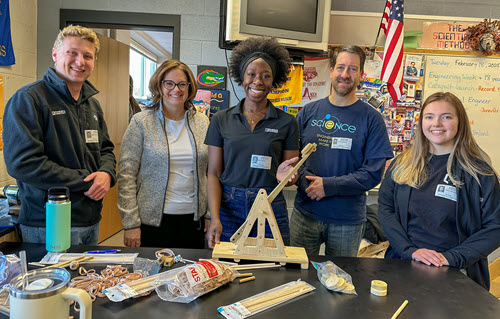
    Middletown, PA – Phoenix Contact engineers head back into the classroom this week to teach sixth-grade science class at Middletown Area Middle School in Middletown, Pa. The classes are part of Phoenix Contact’s National Engineers Week celebration.

    Phoenix Contact has worked with the school every February since 2007. The engineers lead hands-on lessons that make science fun. The goal is to inspire young people to consider careers in science, technology, engineering, and math (STEM).

    The lessons include:

    • Building catapults
    • Racing cookie tins down ramps
    • Building an electric motor
    • Learning about static electricity with the Van de Graaff generator

    “Our engineering team created this outreach program many years ago, and the partnership with Middletown Area School District has stood the test of time,” said Patty Marrero, interim vice president of human relations at Phoenix Contact. “National Engineers Week is a special time for them to share their passion for technology with students. It’s also our chance to thank our engineers for the creativity and innovations that drive our company forward.”

    About Phoenix Contact

    Phoenix Contact is a global market leader based in Germany. Since 1923, Phoenix Contact has created products to connect, distribute, and control power and data flows. Our products are found in nearly all industrial settings, but we have a strong focus on the energy, infrastructure, process, factory automation, and e-mobility markets. Sustainability and responsibility guide every action we take, and we’re proud to work with our customers to empower a smart and sustainable world for future generations. Our global network includes 22,000 employees in 100+ countries. Phoenix Contact USA has headquarters near Harrisburg, Pa., and employs more than 1,100 people across the U.S.

    For more information about Phoenix Contact or its products, visit www.phoenixcontact.com, call technical service at 800-322-3225, or email [email protected].

    eSchool News Staff
    Latest posts by eSchool News Staff (see all)

    Source link