Get stories like this delivered straight to your inbox. Sign up for The 74 Newsletter
When Cara Romero’s daughter was 11, she became interested in dolls. Romero, who is an enrolled member of the Chemehuevi Indian Tribe in Southern California, began to think about doll culture more deeply and what it can convey to the next generation.
Romero’s husband grew up collecting G.I. Joes, and her mother-in-law had her own Victorian-style porcelain doll collection. For Romero, though, her daughter’s doll phase reminded her of the Native American dolls she grew up seeing at truck stops along I-40.
The dolls were often dressed in plastic pony beads and fake buckskin that parroted the Native American Halloween costumes she knew all too well as dehumanizing stereotypes. So Romero, who is a photographer and artist, set out to create a series of photos that broke down these tropes.
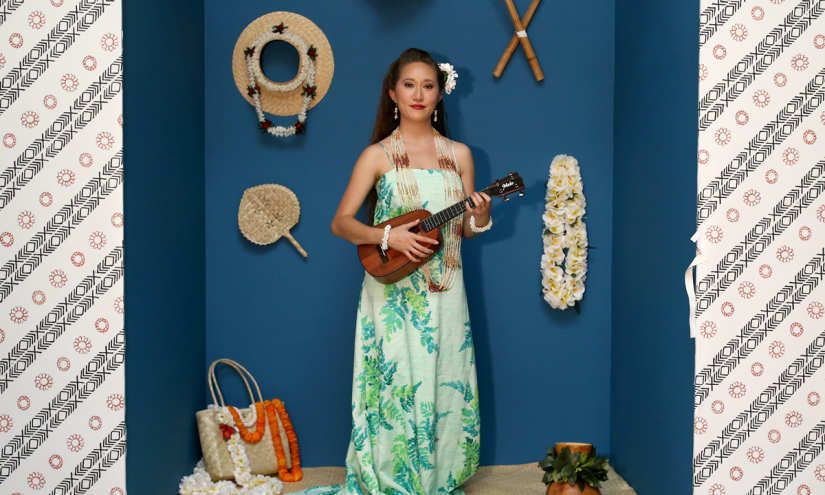
Each photograph in the “First American Doll” series features a life-sized doll box that she designed and crafted, where she poses the women with objects that represent their families, traditions and unique stories.
She wanted her daughter to be proud of her heritage. “I come from a community where women are allowed to have a voice, allowed to be really strong,” she said. “So [I was] wanting to pass down good self esteem and a strong sense of self and identity,” she said. “That’s what we aim to do as moms.”
She started the series with artist and powwow dancer Wakeah Jhane, who is of Kiowa, Comanche and Blackfeet descent. While the Plains Tribes that she is from are the models for stereotypical dolls and costumes, Romero’s photograph captures her intricate buckskin regalia, which was made by her family. Also on display are her moccasins and a fan.
“You can see the stark contrast between what she’s wearing and the Halloween costumes that people portray Plains people as,” she said. “I really wanted to kind of own it and be like, “You guys even have this wrong.’”
She has since published nine photographs for the series, the most recent featuring Fawn Douglas, an artist, activist and enrolled member of the Las Vegas Paiute Tribe, who is posed with handcrafted baskets and a gourd rattle made by her family. The box is bordered by a Las Vegas playing card motif.
The current day symbolism and high fashion lighting communicates that these women are also contemporary, Romero said. “When artwork, and specifically photography, is devoid of modern context, it does something psychologically, it perpetuates [this idea] that we’re gone and only living in history.”
Naming each of the pieces after the models was also meant to humanize Indigenous women in a way that they weren’t in historical photos. “A lot of times in the ethnographic photographs, they didn’t even say their name,” she said. “We don’t know who they were.”
Some of the photographs from the series are currently traveling the country as part of Romero’s first solo museum exhibition, titled: “Panûpünüwügai (Living Light).” They will be on display next at the Phoenix Art Museum in Arizona starting in February.
This story was originally reported by Jessica Kutz of The 19th. Meet Jessica and read more of their reporting on gender, politics and policy.
Did you use this article in your work?
We’d love to hear how The 74’s reporting is helping educators, researchers, and policymakers. Tell us how