Category: News

  • “Fix issue with Indian student visas”

    “Fix issue with Indian student visas”

    As student visa backlogs continue to plague US embassies around the world and the start of the fall semester looms, a bipartisan group of 14 lawmakers have urged the US state department to resolve issues with Indian student visas.  

    “As members of Congress who represent research universities, we are concerned by reports from our constituent universities about Indian students who have been unable to obtain visas to continue their education in the United States,” they urged Rubio. 

    Indian students, the largest group of international students in the US, contribute $9 billion annually to the US economy, added the lawmakers, led by Democratic congresswoman Deborah Ross of North Carolina.  

    In a letter sent to the State Department on July 24, the group said they had seen “first-hand” how the contributions of Indian students to science and research “keep our nation competitive”. 

    “We are dismayed at the possibility that many of these bright young individuals may be blocked… from continuing their education and research in the United States,” they continued.  

    Thirteen of the letter’s 14 signatories are member of the Democratic party, with Nebraska representative Don Bacon the only Republican to join the efforts.  

    With classes starting in just over a month, thousands of students… are at risk of missing the start of the academic year

    The letter follows a near four-week suspension of student visa appointments by the state department that began during the peak season for visa processing, causing continued backlogs that remain nearly one month on from the lifting of the freeze. 

    Though backlogs are impacting students across the globe, the congresspeople raised particular concerns about delays at Indian embassies, with the Indian mission website still carrying a warning that the scheduling of visa appointments this summer cannot be guaranteed.   

    The Indian Ministry of External Affairs (MEA) is understood to have taken the matter up with the US Embassy in New Delhi as well as the US State Department, with news of the delays being widely circulated by Indian media.  

    As previously reported by The PIE News, some Indian education consultancies are expecting 80% declines in student levels going to the US, reporting that students are “refreshing their portal everyday” in search of appointments.  

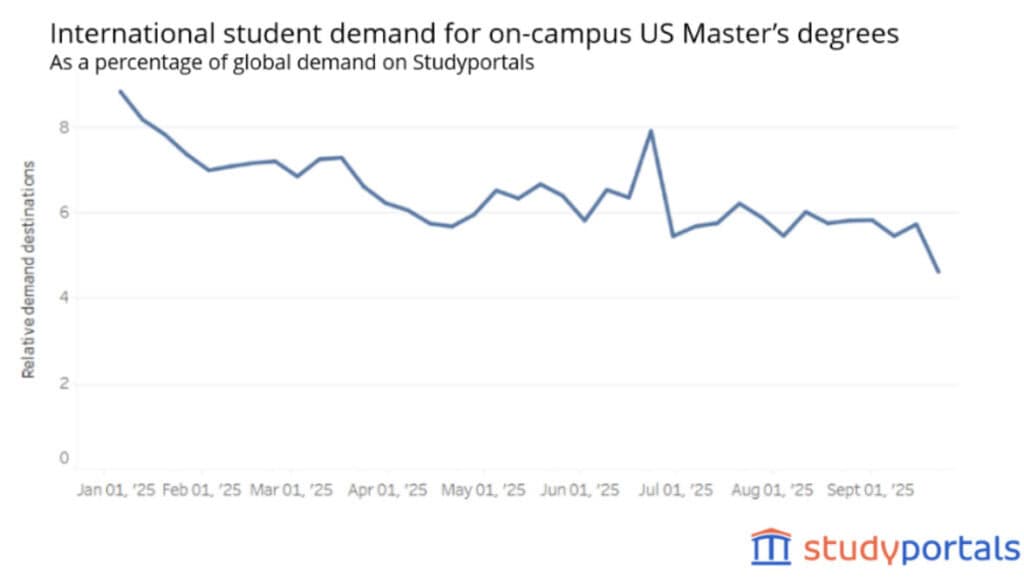
    The largest source market to the US, visa issuance to Indian students saw a notable drop this May, falling by 41% compared to the same period in 2025, with stakeholders fearing that June data will reveal a worsening picture as the full impact of the visa pause takes hold.  

    Across the board, May 2024 data showed a 22% year-on-year reduction in the number of F-1 visas issued. Exchange visitor visas were also down 13%.  

    Appealing to Rubio, the congresspeople emphasised the integral contributions of Indian students to research universities in the US, as well as the wider value of educational exchange: “vital to encouraging collaboration between our nations”.  

    Advocacy efforts are also stepping up in the sector, led by the US for Success Coalition, a national alliance of more than 50 organisations spanning business, education and innovation.  

    “This delay and the resulting backlogs couldn’t have come at a worse time,” said Jill Welch, spokesperson for the coalition. 

    “With classes starting in just over a month, thousands of students – particularly from high-demand countries like India – are at risk of missing the start of the academic year,” Welch said.  

    The coalition highlighted the widespread consequences of the visa backlogs. If students are barred from entering the US, it could jeopardise the country’s position as the leading destination for global talent, with ripple effects touching local economies and long-term implications for scientific research. 

    “When we close doors – intentionally or by bureaucratic delay – we send a clear message to the world: that the US may longer be the destination of choice for the best and brightest,” it said. “That is not just a lost opportunity; it is a strategic risk”.  

    The alliance has called on the State Department to immediately “surge” resources to process new and returning international student visas and ensure there is interview capacity in high-demand countries.  

    Referring to Rubio’s new rules around social media vetting, it called on the department to prioritise both security and efficiency, “so that screening processes do not become barriers to opportunity”. 

    “For every three international students, one US job is created or sustained,” said the coalition, citing their annual economic contribution of nearly $44bn annually.  

    What’s more, “they are ambassadors of democracy and American values creating allyship between the United States and other countries,” they said, highlighting the value of people-to-people exchanges in ensuring the country’s national security. 

    The increasingly challenging visa policy landscape is already having an impact on student interest, with young people increasingly turning to other destinations, namely the UK.  

    Sector leaders are calling for “immediate action” to prevent the worst damages while there is still time before the full extent of declines become clear in September.  

    Source link

  • Why should we care about cuts to funding for science education?

    Why should we care about cuts to funding for science education?

    Key points:

    The Trump administration is slashing the funding for new projects focused on STEM education and has terminated hundreds of grants focused on equitable STEM education. This will have enormous effects on education and science for decades to come.

    Meaningful science education is crucial for improving all of our lives, including the lives of children and youth. Who doesn’t want their child or grandchild or neighbor to experience curiosity and the joy of learning about the world around them? Who wouldn’t enjoy seeing their child making careful observations of the plants, animals, landforms, and water in their neighborhood or community? Who wouldn’t want a class of kindergartners to understand germ transmission and that washing their hands will help them keep their baby siblings and grandparents healthy? Who doesn’t want their daughters to believe that science is “for them,” just as it is for the boys in their classroom?

    Or, if those goals aren’t compelling for you, then who doesn’t want their child or grandchild or neighbor to be able to get a well-paying job in a STEM field when they grow up? Who doesn’t want science itself to advance in more creative and expansive ways?

    More equitable science teaching allows us to work toward all these goals and more.

    And yet, the Department of Government Efficiency has terminated hundreds of grants from the National Science Foundation that focused squarely on equity in STEM education. My team’s project was one of them.  

    At the same time, NSF’s funding of new projects and the budget for NSF’s Education directorate are also being slashed.

    These terminations and drastic reductions in new funding are decimating the work of science education.

    Why should you care?

    You might care because the termination of these projects wastes taxpayers’ hard-earned money. My project, for example, was 20 months into what was intended to be a 4-year project, following elementary teachers from their teacher education program into their third year of teaching in classrooms in my state of Michigan and across the country. With the termination, we barely got into the teachers’ first year–making it impossible to develop a model of what development looks like over time as teachers learn to engage in equitable science teaching.

    You might care because not funding new projects means we’ll be less able to improve education moving forward. We’re losing the evidence on which we can make sound educational decisions–what works, for whom, and under what circumstances. Earlier NSF-funded projects that I’ve been involved with have, for example, informed the design of curriculum materials and helped district leaders. Educators of future teachers like me build on findings of research to teach evidence-based approaches to facilitating science investigations and leading sense-making discussions. I help teachers learn how they can help children be change-makers who use science to work toward a more just and sustainable world.  Benefits like these will be eliminated.

    Finally, you might care because many of the terminated and unfunded projects are what’s called NSF Early Career Awards, and CAREER program funding is completely eliminated in the current proposed budget. CAREER grants provide crucial funding and mentoring for new researchers. A few of the terminated CAREER projects focus on Black girls and STEM identity, mathematics education in rural communities, and the experiences of LGBTQ+ STEM majors. Without these and other NSF CAREER grants, education within these fields–science, engineering, mathematics, data science, artificial intelligence, and more, from preschool through graduate school–will regress to what works best for white boys and men.

    To be sure, universities have some funds to support research internally. For the most part, though, those funds are minimal. And, it’s true that terminating existing projects like mine and not funding new ones will “save” the government some money. But toward what end? We’re losing crucial evidence and expertise.

    To support all children in experiencing the wonder and joy of understanding the natural world–or to help youth move into high-paying STEM jobs–we need to fight hard to reinstate federal funding for science and science education. We need to use every lever available to us–including contacting our representatives in Washington, D.C.–to make this happen. If we aren’t successful, we lose more than children’s enjoyment of and engagement with science. Ultimately we lose scientific advancement itself.

    Latest posts by eSchool Media Contributors (see all)

    Source link

  • Top Hat Acquires OpenClass IP and Welcomes Founder to Team

    Top Hat Acquires OpenClass IP and Welcomes Founder to Team

    Top Hat’s engineering team is gaining a valuable new voice with the addition of Alec Kretch, whose work and experience sits at the intersection of technical innovation and learning science. As the founder of OpenClass—an AI-powered platform that helps educators design meaningful, mastery-based assignments—Kretch is a strong advocate for using assessment as a tool for learning rather than simple measurement. The acquisition of OpenClass’s intellectual property, along with Kretch’s appointment to Top Hat’s engineering team, will support Top Hat’s continued investment in discipline-specific solutions and in expanding the company’s capabilities around authentic assessment. These efforts align with a growing institutional focus on career readiness and helping students build practical skills they can carry into life after graduation

    “Alec has shown how technology can help educators create richer, more effective learning experiences through relevant, real-world application,” said Maggie Leen CEO of Top Hat. “His work with OpenClass aligns closely with our focus on supporting instructors with tools that encourage deeper thinking and meaningful student engagement.”

    OpenClass was originally developed to help computer science instructors create authentic assignments, where students solve in-browser coding problems and receive immediate, actionable feedback. While built with programming in mind, the underlying approach is broadly applicable across disciplines. Authentic assessment encourages students to apply what they’ve learned in practical contexts, fostering critical thinking, creativity, and lasting understanding in ways traditional assignments often fall short. This kind of learning experience is especially vital as students increasingly look to higher education to build the skills they’ll need to succeed in their future careers.

    Over the past few years Top Hat has expanded innovation across many disciplines. Aktiv Chemistry, for example, which the company acquired in 2022, offers interactive tools designed to meet the unique needs of chemistry educators and learners. Offering personalized, authentic assessments that reflect the real-world scenarios students will face in their careers supports Top Hat’s mission to spark better teaching and more meaningful learning.

    “Top Hat is the gold standard for evidence-based learning platforms,” said Kretch. “We share a vision for the future of higher education—one that’s equitable, personalized, and focused on helping students develop real skills. I’m excited to help bring the best of OpenClass to more instructors and learners.”

    Source link

  • How the FY25 funding freeze impacts students across America

    How the FY25 funding freeze impacts students across America

    This press release originally appeared online.

    Key points:

    Communities across the nation began the budget process for the 2025-2026 school year after Congress passed the FY25 Continuing Resolution on March 14, 2025. Historically, states receive these funds on July 1, enabling them to allocate resources to local districts at the start of the fiscal year. 

    Even though these funds were approved by Congress, the Administration froze the distribution on June 30. Since that time, AASA, The School Superintendents Association, has advocated for their release, including organizing hundreds of superintendents to meet with offices on the Hill to share information about its impact, the week of July 7.  

    On July 16, the Office of Management and Budget (OMB) announced that Title IV-B or 21st Century funds (afterschool funds) would be released. AASA’s Executive Director issued a statement about the billions of dollars that remain frozen

    To gather more information about the real-world effects on students across America, AASA conducted a survey with its members. 

    From July 11th to July 18th, AASA received responses from 628 superintendents in 43 states.

    Eighty-five percent of respondents said they have existing contracts paid with federal funds that are currently being withheld, and now have to cover those costs with local dollars.

    Respondents shared what will be cut to cover this forced cost shift: 

    • Nearly three out of four respondents said they will have to eliminate academic services for students. The programs include targeted literacy and math coaches, before and after school programming, tutoring, credit recovery, CTE and dual enrollment opportunities.
    • Half of respondents reported they will have to lay off teachers and personnel. These personnel include those who work specifically with English-language learners and special education students, as well as staff who provide targeted reading and math interventions to struggling students.
    • Half of respondents said they will have to reduce afterschool and extracurricular offerings for students. These programs provide STEM/STEAM opportunities, performing arts and music programs, and AP coursework. 
    • Four out of five respondents indicated they will be forced to reduce or eliminate professional development offerings for educators. These funds are used to build teachers’ expertise such as training in the science of reading, teaching math, and the use of AI in the classroom. They are also used to ensure new teachers have the mentors and coaching they need to be successful.  

    As federal funding is still being withheld, 23 percent of respondents have been forced to make tough choices about how to reallocate funding, and many districts are rapidly approaching similar inflection points.  

    Notably, 29 percent of districts indicated that they must have access to these funds by August 1 to avoid cutting critical programs and services for students. Twenty-one percent of districts will have to notify parents and educators about the loss of programs and services by August 15.  

    Without timely disbursement of funding, the risk of disruption to essential educational supports for children grows significantly.

    As one superintendent who completed the survey said, “This isn’t a future problem; it’s happening now. Our budget was set with these funds in mind. Their sudden withholding has thrown us into chaos, forcing drastic measures that will negatively impact every student, classroom, and school in our district. We urgently need these funds released to prevent irreparable harm to our educational programs and ensure our students get the quality education they deserve.” 

    Latest posts by staff and wire services reports (see all)

    Source link

  • Malvern International partners with Liverpool Hope University

    Malvern International partners with Liverpool Hope University

    The deal encompasses pathway and pre-master’s programs from the upcoming Liverpool Hope University International Study Centre, which will be based at the university’s Hope Park Campus.

    Claire Ozanne, vice-chancellor and rector at Liverpool Hope University, said the new study centre will form an “exciting and important part” of the institution’s international strategy – one that would “further enhance our position as a global university and one that has an inclusive approach to education”.

    “International students and the rich diversity of ideas and experiences they bring to our campuses hugely enhance the academic experience for all of our students,” she added.

    Malvern International said that through the partnership, students attending the centre can expect to find a challenging curriculum, set to enhance their English language proficiency and the skills to help them successfully transition into university life.

    International students and the rich diversity of ideas and experiences they bring to our campuses hugely enhance the academic experience for all of our students
    Claire Ozanne, Liverpool Hope University

    Ashleigh Veres, senior director, university recruitment and partnerships at Malvern International, said that the deal marked “an important step forward and a proud moment for Malvern as we continue to grow and diversify our pathways division, scaling up our capabilities to deliver exceptional services that benefit both universities and students”.

    She added: “We are delighted to partner with Liverpool Hope University, an institution renowned for its excellent student satisfaction and commitment to academic excellence. Together, we are dedicated to providing transformative opportunities for students while expanding the University’s global reach and impact.” 

    Source link

  • Why stories still matter in a fast-moving world

    Why stories still matter in a fast-moving world

    Key points:

    Seventeen years after Suzanne Collins first introduced us to The Hunger Games, the world is still captivated by Panem. The latest installment, Sunrise on the Reaping, dives into Haymitch’s backstory and has been called a “propulsive and heart-wrenching addition” to the series by The New York Times. For many of us, books like these aren’t just stories–they’re cultural moments.

    I remember reading the original trilogy on my iPad while training for a half-marathon. Katniss’ fight against the Capitol powered me through some of my longest runs. That’s the magic of books: They meet us where we are and carry us somewhere else entirely. They become part of our personal history, woven into our memories and milestones.

    But the power of books goes far beyond personal nostalgia. When a major title drops, it’s not just a release date–it’s a shared experience. Readers rush to get their hands on it. Social media lights up with reactions. Libraries field waitlists. These moments remind us why books matter. They connect us, challenge us, and inspire us.

    This fall, we’re about to experience two more of these moments. On October 21, Diary of a Wimpy Kid: Partypooper hits shelves. Jeff Kinney’s beloved series has become a rite of passage for young readers, and this latest installment–centered around Greg Heffley’s attempt to throw himself the ultimate birthday bash–is already generating buzz. It’s funny, relatable, and perfectly timed for a generation that’s grown up with Greg’s awkward, hilarious adventures.

    Just a few weeks later, on November 11, Dog Man: Big Jim Believes arrives. Dav Pilkey’s Dog Man series has redefined what it means to be a children’s book phenomenon. With its blend of humor, heart, and comic-style storytelling, Dog Man has helped countless kids fall in love with reading. This new title promises to be no different, offering a story about belief, friendship, and finding strength within.

    These books aren’t just for kids–they’re cultural touchstones. They bring generations together. Parents read them with their children. Teachers use them to spark classroom discussions. Librarians build displays around them. And kids? They devour them and talk about them with the kind of passion usually reserved for blockbuster movies or viral games.

    And yes, there’s a business side to books. Pricing, distribution, marketing strategies–they all matter. Behind every book on a shelf is a network of people working to make that moment possible. Publishers, authors, illustrators, binders, warehouse teams, sales reps, marketers, and more. It’s easy to forget that when you’re holding a finished book, but every title is the result of countless decisions, collaborations, and passions.

    In a world dominated by screens, short-form content, and constant notifications, books offer something different. They ask us to slow down. To focus. To imagine. To empathize. And that’s more important than ever.

    Literacy isn’t just about reading words on a page–it’s about understanding the world. It’s about critical thinking, emotional intelligence, and the ability to engage with complex ideas. Books help build those skills. They give kids the tools to navigate life, not just school.

    Because in a world that’s constantly changing, books remain one of our most powerful tools for understanding it–and each other. The world needs stories. And stories need us.

    Britten Follett
    Latest posts by Britten Follett (see all)

    Source link

  • El Paso Community College Helps Design State Program for Adults Without High School Diplomas – The 74

    El Paso Community College Helps Design State Program for Adults Without High School Diplomas – The 74


    Get stories like this delivered straight to your inbox. Sign up for The 74 Newsletter

    Kurt Micklo lost interest in academics after he failed to make the basketball team as a sophomore at Chapin High School. Soon after, he fathered a son and began to work full time, which put him further behind in his studies.

    A counselor finally advised him during his junior year that he should withdraw and try to earn a GED. He dropped out and – through hard work – found professional success as a general manager of a subcontracting logistics company. However, the lack of a high school diploma haunted him. He wants one to give his family – especially his mother – another reason to be proud of him.

    A busy work and family schedule have kept him from returning to school, but the flexibility of a new state program aimed at people aged 18 and older without a high school diploma will allow him to earn a diploma and a college career and technical education, or CTE, credential for programs such as health care, welding or computer science at the same time.

    The concept of Opportunity High School Diploma was part of House Bill 8, which the state Legislature passed in 2023. The state funneled about $2 million into this program to help the approximately 4.3 million Texans as of 2023, including about 30,000 adult El Pasoans, without a diploma to earn the academic credits most of them will need to acquire higher-paying jobs. The program is scheduled to launch in spring 2026.

    “If I could juggle it, I’d be pretty interested” in the program, said 34-year-old Micklo, a father of three ages 15, 10 and 5. He is the general manager of three warehouses, two in El Paso and one in Laredo, Texas, as well as four sites near the international ports of entry with Mexico in El Paso, Tornillo and Santa Teresa, New Mexico, were commodities are offloaded.. “It would make my stepfather (a retired educator) and my mother happy if I earned my high school diploma.”

    El Paso Community College is one of five community college districts in the state selected for the design and implementation phases of this program. The other institutions in the design phase are Alamo Colleges District, Austin Community College, Dallas College and San Jacinto College near Houston.

    They work under the direction of the Texas Higher Education Coordinating Board. The board will review the instructional outcomes and performance expectations that the college collaborators created during an October meeting. Once finalized, the college faculty will begin to work with school districts to design the curriculum.

    The program is flexible for students who probably work full time and have family obligations. Courses would have suggested timelines, but students would turn in assignments as their schedule allowed through the end of the term.

    Micklo, a Northeast resident, said the promised flexibility is the only reason he might consider the program. As for his credential, he said he would need to review EPCC’s career and technical education options. The college offers more than 100 career programs such as HVAC, or heating, ventilation and air conditioning, and electrical, automotive or diesel technologies.

    Students will be co-enrolled in competency-based high school curriculum such as math, civics, sciences and communication, and a career and technical workforce program. Competency based courses are focused more on a students’ mastery of a skill or subject than the amount of time spent in a classroom.

    Isela Castañón Williams

    Isela Castañón Williams, professor and coordinator of EPCC’s teacher preparation programs, is in charge of the college’s 13-member team. She called the project a “monumental task” because of its scope and uniqueness. She said her team, and its counterparts, played a critical role in the design phase.

    “Faculty at EPCC are very innovative,” she said. “I think that my colleagues have approached this process with a great deal of enthusiasm. We’re always looking to provide better services and educational experiences to the community we serve.”

    EPCC faculty advocated for the program to be designed to accommodate English Second Language and English Language Learner populations, a THECB spokesman said in a July 1 statement. He said last year that the board selected EPCC for the project’s design phase because of its border insights, and because its CTE degrees and credentials are in line with the program.

    While the state wants to attract students aged 18 and older, EPCC officials will aim for people 25 and older so as to not compete with K-12 school districts that have their own dropout recovery programs. EPCC, which will offer the program at its five campuses, expects some of the program’s younger students to come from rural areas outside El Paso.

    Steven E. Smith

    Steven E. Smith, vice president of Instruction and Workforce Education at EPCC, said the state will provide funds to the colleges to cover tuition for initial cohorts. He expects the first groups will range from 30 to 50 students and scale up from there.

    “We think this is a big market in El Paso, and I think once the word starts to get out, that will grow tremendously,” Smith said.

    The administrator said that he would work on ways to market the program later this month with the college’s External Relations, Communication & Development Division. He said the college would work with school district partners to build lists of potential OHSD students.

    “As you might imagine, that is a pretty difficult population to identify and reach out to because they are not in the system anymore,” Smith said.

    This article first appeared on El Paso Matters and is republished here under a Creative Commons Attribution-NoDerivatives 4.0 International License.


    Get stories like these delivered straight to your inbox. Sign up for The 74 Newsletter

    Source link

  • Some States Are Seeking to Deregulate Child Care. Advocates Are Fighting Back – The 74

    Some States Are Seeking to Deregulate Child Care. Advocates Are Fighting Back – The 74


    Join our zero2eight Substack community for more discussion about the latest news in early care and education. Sign up now.

    Content warning: This story includes details of an infant’s death.

    After Democrats passed the American Rescue Plan in 2021, states were flush with federal funding to help prop the child care sector up. But that money is now all gone, and as Republicans in Congress threaten to pass spending cuts that could further shrink state budgets, lawmakers are trying to find solutions to the child care crisis that don’t cost money. 

    Many have proposed changing the mandated ratios that require a certain number of early educators to care for young kids. Nearly a dozen states have considered rolling back child care regulations, including those governing staff-to-child ratios.

    But while these deregulatory bills are common, it’s not a foregone conclusion that they will pass. Advocates in three states have been able to beat back these efforts in the legislative sessions that just wrapped up by mobilizing a wide variety of people to speak up against these proposals and deploying research-backed arguments about child safety and child care supply.

    Eliminating Ratios Entirely 

    Idaho advocates faced down the most extreme bill. In its original form, HB243 would have eliminated all requirements that limit the number of young children an early educator can care for, leaving it up to individual providers. It would have been the first state in the country to take such a step. 

    Advocates had very little time to fight back. The bill got fast tracked; there was less than 24 hours’ notice before the first public hearing on it in the House. “You can’t get child care providers and parents there in that amount of time,” said Christine Tiddens, executive director of Idaho Voices for Children, a nonprofit that advocates for child-focused policies, noting that it requires moving work schedules and getting people to cover shifts. The bill sailed through the House.

    Eventually, Tiddens said, they were able to put parents and providers in front of lawmakers to warn of the negative consequences. One of those parents was Idaho resident Kelly Emry. On June 10, 2024, she got a panicked call from the home-based child care provider where she had just started sending her 11-week-old son Logan. She dashed to the provider’s home and was told he was dead. The coroner’s report later confirmed he died from asphyxiation. According to Emry, the coroner said the provider put him down for a nap between a rolled up blanket and a pillow and left him there for hours. The provider was caring for 11 kids by herself that day, putting her out of compliance with state regulations that, at the time, required at least two staff members. 

    “It was completely preventable, and that’s what’s so hard for me to come to terms with,” Emry said in a podcast interview in January.

    Emry wasn’t the only one who spoke up. Once the bill got to the Senate, advocates packed the hearing and overflow rooms with several hundred people. Among the 40 people who signed up to testify, 38 opposed the bill. Baby Logan’s uncle spoke, as did pediatricians, fire marshals, nurses, the state police, child welfare experts, child care providers and parents. Lawmakers were flooded with thousands of calls and emails from the opposition. Tiddens made sure every senator was sent the podcast interview with Emry.

    The bill passed the Senate committee by a single vote. Advocates decided to try to stop the worst elements, knowing that the bill was likely to pass in some form. They asked a senator who opposed it to “throw a Hail Mary,” Tiddens said. When the bill came to the Senate floor, he asked for unanimous support to pull it and move it into the amending process. He got it. The original elimination of staff-to-child ratios was stripped out; instead, the bill preserved ratios, albeit higher ones than before. Under previous law, Idaho ranked at No. 41 among all states for how high its ratios were; now it has dropped even further to No. 45.

    The victory is “bittersweet,” Tiddens said. She attributes it almost solely to one thing: putting parents, not just businesses and child care providers, in front of lawmakers, which led to the moving account of Logan’s family, still in the midst of raw grief. “How could you listen and not have your heart changed?” Tiddens asked.

    Doubling Family Child Care Ratios

    Advocates in Maryland have fought back against legislation to loosen staff-to-child ratios twice now. Last year, lawmakers introduced a bill to raise the ratios in family child care settings, but it died thanks to “a lot of advocacy,” said Beth Morrow, director of public policy at the Maryland Family Network, a nonprofit focused on child care. As in Idaho, the American Academy of Pediatrics and fire marshals warned about what would happen in the case of emergencies. Children under 2 years old are “not capable of self-preservation,” Morrow pointed out; they might hide when a fire alarm goes off and can’t evacuate on their own. “If there is an emergency you have to be able to get these kids out,” she said.

    The idea returned this year in House Bill 477, this time coupled with looser ratios for center-based care. Family providers are currently allowed to care for eight children but no more than two under the age of 2; the legislation would have doubled that, allowing providers to watch as many as four children under the age of 1. That was a “nonstarter,” Morrow said. It would also have been the first time that these rules were dictated by lawmakers rather than by the Maryland State Department of Education, which would have been barred from changing them in the future. 

    So advocates marshalled research, with the help of national groups including the National Association for the Education of Young Children and Center for Law and Social Policy. They highlighted that there has been no evidence that stricter child care regulations lead to reduced supply. Lawmakers seemed moved by the argument that lower ratios support better health and safety for children.

    During the markup session, the chief sponsor amended the bill by striking the language about higher ratios; instead, the version that passed requires the Department of Education to study child care regulations with an eye toward alleviating barriers for providers.

    Ratio Increases by Another Name

    In Minnesota, lawmakers took a different approach to proposing changes to the number of staff required to care for young children this session. Their legislation avoided mentioning the term “ratios” at all. Instead, the issue was presented as an exemption for in-home child care providers caring for their own children as well. The legislation originally would have exempted as many as three of the providers’ own children from the number they are licensed to watch. “That’s a direct ratio increase, no way around that,” said Clare Sanford, vice president of government and community relations at New Horizon Academy, a child care and preschool provider. “You still have the same number of adults but you’re increasing the number of children that adult is responsible for.”

    In later drafts, the number of children who could be exempted kept being reduced. In the end the legislation didn’t get a standalone vote and the language was left out of the final state budget. The argument that Sanford thinks worked the best was that increasing ratios wouldn’t actually increase child care supply. That’s because, as a brief by NAEYC argues, they will lead to more burnout among providers, which will push them to leave and, in the end, reduce available child care spots.

    The fight is far from over. Advocates in all three states expect lawmakers to try to loosen staff-to-child ratios again next session. Tiddens fears that, although Idaho didn’t eliminate ratios, the idea could spread. “Idaho has often been a frontrunner for harmful legislation,” she said. On the whole, more of these laws have been signed than stopped, said Diane Girouard, state policy senior analyst at ChildCare Aware of America. Ratio deregulation bills pop up “in some states every single year,” she said. “This isn’t just unique to red, conservative states. It has happened in blue states, it has happened in purple states.”

    Advocates who oppose raising these ratios are formulating responses to the child care crisis that preserve safety standards without requiring state funding. In Maryland, for example, Morrow’s organization helped pass a bill that removes legal barriers to opening and operating family child care programs. The hope is that with more solutions on the table to increase child care supply, states won’t look to options that erode safety standards, such as increasing ratios. 

    Tiddens has vowed to fight back. “We’re not going away, and we’re going to show up next session with our own proposal,” she said. Her coalition plans to formulate a bill for next year that “prioritizes child safety at the same time as dealing with the child care shortage,” she said.


    Get stories like these delivered straight to your inbox. Sign up for The 74 Newsletter

    Source link

  • Homeless Student Counts in California Are Up. Some Say That’s a Good Thing – The 74

    Homeless Student Counts in California Are Up. Some Say That’s a Good Thing – The 74


    Get stories like this delivered straight to your inbox. Sign up for The 74 Newsletter

    In Kern County, the first rule in counting homeless students is not saying “homeless.”

    Instead, school staff use phrases like “struggling with stable housing” or “families in transition.” The approach seems to have worked: More families are sharing their housing status with their children’s schools, which means more students are getting services.

    “There’s a lot of stigma attached to the word ‘homeless,’” said Curt Williams, director of homeless and foster youth services for the Kern County Office of Education. “When you remove that word, it all changes.”

    Largely as a result of better identification methods, Kern County saw its homeless student population jump 10% last year, to 7,200. Those students received transportation to and from school, free school supplies, tutoring and other services intended to help them stay in school. For the purposes of this data, the definition of homelessness is broader than the state’s point in time count.

    The trend is reflected statewide. In the latest state enrollment data released last month, California had 230,443 homeless students — a 9.3% increase from the previous year. Some of the increase is due to the state’s ongoing housing shortage, but most of the increase is because of better identification, advocates and school officials said.

    Homeless students face numerous obstacles in school. They have higher rates of discipline and absenteeism, and fare worse academically. Last year, only 16% of homeless students met the state’s math standard, some of the lowest scores of any student group.

    “Schools can’t solve homelessness, but they can ensure the students are safe in the classroom and getting the education they need to get out of homelessness,” said Barbara Duffield, executive director of Schoolhouse Connection, a national homeless youth advocacy group. “That starts with identifying the child who’s homeless.”

    Challenges of counting homeless students

    Under the federal McKinney-Vento Act, schools are required to count their homeless students throughout the school year and ensure they receive services. Homeless students also have the right to stay enrolled in their original school even if they move.

    For many years, schools struggled to identify homeless students. Under state law, schools must distribute forms at the beginning of the school year asking families where they live — in their own homes, in motels, doubled-up with other families, in shelters, cars or outdoors.

    Some schools were less-than-diligent about collecting the form, or reassuring families understood the importance. Often, homeless families were reluctant to submit the form because they were afraid the school might contact a child welfare agency. Immigrant families sometimes feared the school might notify immigration authorities. And some families didn’t realize that sharing quarters with another family — by far the most common living situation among homeless families – is technically defined as homeless, at least under McKinney-Vento.

    A 2021 bill by former Assemblymember Luz Rivas, a Democrat from Arleta in the San Fernando Valley, sought to fix that problem. The bill requires schools to train everyone who works with students — from bus drivers to cafeteria workers to teachers — on how to recognize potential signs of homelessness. That could include families who move frequently or don’t reply to school correspondence.

    The bill seems to have helped. Last year, the state identified 21,000 more homeless students than it had the previous year, even as overall enrollment dropped.

    Still, that’s probably an undercount, researchers said. The actual homeless student population is probably between 5% and10% of those students who qualify for free or reduced-price lunch, according to the National Center for Homeless Education. In California, that would be a shortfall of up to 138,713 students.

    Influx of funding

    Another boost for identifying homeless students came from the American Rescue Plan, the federal COVID-19 relief package. The plan included $800 million for schools to hire counselors or train existing staff to help homeless students. Nearly all schools in California received some money.

    About 120 districts in California won grant money through the McKinney-Vento Act, which last year dispersed about $15.9 million in California to pay for things like rides to school, backpacks, staff and other services. Districts are chosen on a competitive basis; not all districts that apply receive funds.

    But those funding sources are drying up. Most of the pandemic relief money has already been spent, and President Donald Trump’s recently approved budget does not include McKinney-Vento funding for 2026-27.

    The cuts come at a time when advocates expect steep increases in the number of homeless families over the next few years, due in part to national policy changes. Republican budget proposals include cuts to Medicaid, food assistance and other programs aimed at helping low-income families, while the immigration crackdown has left thousands of families afraid to seek assistance. For families living on tight budgets, those cuts could lead to a loss of housing.

    And in California, the shortage of affordable housing continues to be a hurdle for low-income families. Even Kern County, which has traditionally been a less pricey option for families, has seen a spike in housing costs as more residents move there from Los Angeles.

    Joseph Bishop, an education professor at UCLA and co-author of a recent report on homeless students nationwide, said the loss of government funding will be devastating for homeless students.

    “California is the epicenter of the homeless student crisis, and we need targeted, dedicated support,” Bishop said. “Folks should be extremely alarmed right now. Will these kids be getting the education they need and deserve?”

    Better food, cleaner bathrooms

    In Kern County, identification has only been one part of the effort to help homeless students thrive in school. Schools also try to pair them with tutors and mentors, give them school supplies and laundry tokens, and invite them to join a program called Student Voice Ambassadors. There, students can tour local colleges, learn leadership skills and explore career options.

    As part of the program, staff ask students what would make school more enticing — and then make sure the suggestions happen. At one school, students said they’d go to class if the bathrooms were cleaner. So staff improved the bathrooms. At another school, students wanted better food. They got it.

    Williams credits the program with reducing absenteeism among homeless students. Two years ago, 45% of Kern County’s homeless students were chronically absent. Last year, the number dropped to 39% – still too high, he said, but a significant improvement.

    “Without McKinney-Vento funds, the Student Voice Ambassador program would go away,” Williams said. “How will we keep it going? I don’t know.”

    This article was originally published on CalMatters and was republished under the Creative Commons Attribution-NonCommercial-NoDerivatives license.


    Get stories like these delivered straight to your inbox. Sign up for The 74 Newsletter
    Source link

  • How a Christian Nationalist Group is Getting the Ten Commandments into Classrooms – The 74

    How a Christian Nationalist Group is Getting the Ten Commandments into Classrooms – The 74

    School (in)Security is our biweekly briefing on the latest school safety news, vetted by Mark KeierleberSubscribe here.

    As far-right political operative David Barton leads a Christian nationalist crusade, he’s traveled to state capitols across the country this year to support dozens of bills requiring Ten Commandments displays in classrooms. 

    My latest story digs into a well-coordinated and deep-pocketed campaign to inject Protestant Christianity into public schools that could carry broader implications for students’ First Amendment rights. Through a data analysis of 28 bills that have cropped up across 18 states this year, I show how Barton’s role runs far deeper than just being their primary pitchman.

    The analysis reveals how the language, structure and requirements of these bills nationwide are inherently identical. Time and again, state legislation took language verbatim from a Barton-led lobbying blitz to reshape the nation’s laws around claims — routinely debunked — about Christianity’s role in the country’s founding and its early public education system. 

    Three new state laws in Louisiana, Arkansas and Texas mandating Ten Commandments posters in public schools are designed to challenge a 1980 Supreme Court ruling against such government-required displays in classrooms. GOP state lawmakers embracing these laws have expressed support for eradicating the separation of church and state — a pursuit critics fear will coerce students and take away their own religious freedom.


    In the news

    Updates to Trump’s immigration crackdown: Immigration and Customs Enforcement has released from custody a 6-year-old boy with leukemia more than a month after he and his family were sent to a rural Texas detention center. | Slate

    • As the Department of Homeland Security conducts what it calls wellness checks on unaccompanied minors, the young people who migrated to the U.S. without their parents “are just terrified.” | Bloomberg
    • ‘It looks barbaric’: Video footage purportedly shows some two dozen children in federal immigration custody handcuffed and shackled in a Los Angeles parking garage. | Santa Cruz Sentinel
    • The Department of Homeland Security is investigating surveillance camera footage purportedly showing federal immigration officers urinating on the grounds of a Pico Rivera, California, high school in broad daylight. | CBS News
    • California sued the Trump administration after it withheld some $121 million in education funds for a program designed to help the children of migrant farmworkers catch up academically. | EdSource
    • Undocumented children will be banned from enrolling in federally funded Head Start preschools, the Trump administration announced. | The Washington Post
      • Legal pushback: Parents, Head Start providers challenge new rule barring undocumented families. | The 74
    Getty Images

    The executive director of Camp Mystic in Texas didn’t begin evacuations for more than an hour after he received a severe flood warning from the National Weather Service. The ensuing tragedy killed 27 counselors and campers. | The Washington Post

    The day after the Supreme Court allowed the Education Department’s dismantling, Secretary Linda McMahon went ahead with plans to move key programs. | The 74 

    • Now, with fewer staff, the Office for Civil Rights is pursuing a smaller caseload. During a three-month period between March and June, the agency dismissed 3,424 civil rights complaints. | Politico
    Sign-up for the School (in)Security newsletter.

    Get the most critical news and information about students’ rights, safety and well-being delivered straight to your inbox.

    Massachusetts legislation seeks to ban anyone under the age of 18 from working in the state’s seafood processing facilities after an investigation exposed the factories routinely employed migrant youth in unsafe conditions. | The Public’s Radio

    An end to a deadly trend: School shootings decreased 22% during the 2024-25 school year compared to a year earlier after reaching all-time highs for three years in a row. | K-12 Dive

    Florida is the first state to require all high school student athletes to undergo electrocardiograms in a bid to detect heart conditions. | WUSF 

    The Senate dropped rules from Trump’s “big, beautiful” tax-and-spending bill that would have prevented states from regulating artificial intelligence tools, including those used in schools. | The Verge

    • Food stamps are another matter: The federal SNAP program will be cut by about a fifth over the next decade, taking away at least some nutrition benefits from at least 800,000 low-income children. | The 74

    ICYMI @The74

    Getty Images

    Supreme Court to Address Legality of Barring Trans Athletes From School Sports

    Medicaid Cuts in Trump Tax Bill Spark Fears for Child Health, School Services

    Heinous, heartbreaking — and expensive. California schools face avalanche of sex abuse claims


    Emotional Support

    74 editor Nicole Ridgway’s dog Mika is cooler than your dog.


    Get stories like these delivered straight to your inbox. Sign up for The 74 Newsletter
    Source link