Veronica Alvarez was 4 when her family came to the U.S. from Cotija in Michoacán, Mexico, a small town famed for its cheese. Her father picked avocados amid the scorching heat in the San Fernando Valley, while her mother cleaned houses. One of nine children, she learned how to scrimp and save, how to work hard and how to dream big.
“We were so poor, I knew not to ask for much,” said Alvarez, 52, now executive director of Los Angeles-based Create CA, one of the state’s leading arts education advocacy organizations. “Looking back on those years now, I don’t know how my parents did it. I have a white-color job and two sons, and I can barely afford it.”
Her sunny disposition belies a steely resolve. She remembers well the sting of being an undocumented immigrant in the age of Gov. Pete Wilson, an era when some felt ashamed to even speak Spanish in public. She brings that fire to her arts education mission.
“I believe access to the arts is a social justice issue,” as she puts it.
“Unfortunately, students that have the most need do not get equal access and opportunities.”
Her chops as a fighter, someone who doesn’t give up on a cause, are part of what makes her special, arts advocates say.
“Veronica is an inspiring and dedicated arts education advocate and leader,” said Merryl Goldberg, a veteran music and arts professor at Cal State San Marcos, who also serves on the Create CA board. “Her commitment to equity and lifting student voices is front and center.”
Alvarez didn’t become fluent in English until about the fourth grade, but she instinctively understood that education was the key to escaping poverty.
Education was my path out of poverty. That was always my thing. I loved school.
Veronica Alvarez
The only one in her family to graduate from high school, for her, school was always a matter of sink or swim. She chose to dive deep. She paid her way through college working at Chuck E. Cheese, where she honed her chops in engaging children.
“I’ve always been pretty driven,” said Alvarez, a mother of two boys with a doctorate in education and a master’s in ancient history. “Education was my path out of poverty. That was always my thing. I loved school.”
She also loved to walk to the library. It conjured an oasis of calm amid her raucous household.
“I’d come home with bags of books and sit in a corner to read and immerse myself in the world created by the author,” she remembers. “That love of reading has lasted to this day.”
At first, she wanted to be an artist, but her fourth grade teacher said she lacked talent.
“I loved making art as a child,” said Alvarez. “But I had always been taught to respect your elders. I didn’t think it was my place to question it.”
So, she stopped trying to make art, channeling her drive into academics. Determined to graduate early, she took every AP class she could in high school and found her happy place in art history. A self-professed nerd, she always felt drawn to the world of books and ideas.
“To be able to sit and read and learn always seemed like a luxury to me,” she said.
As a child, she was first entranced by Caravaggio and Bernini, and later became beguiled by the works of Frida Kahlo and Graciela Iturbide.
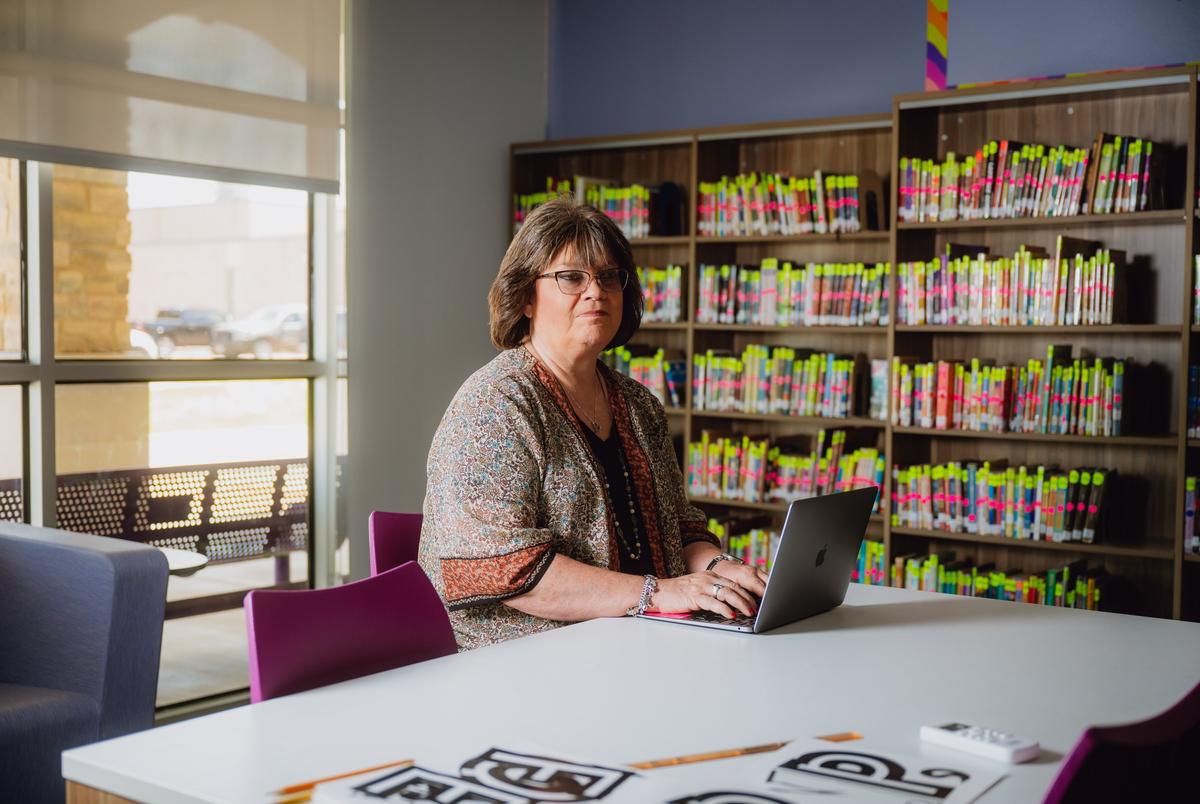
Making sure everyone can participate in the arts is what drives Veronica Alvarez, now head of Create CA. (Courtesy of Veronica Alvarez)
“I loved Bernini’s ‘David’ because of his teeth biting his lip; he looked vulnerable and intense — along with the fact that he was mid-motion as he threw the rock at Goliath,” she remembers. “The ‘Barberini Faun’ made me blush. A big piece of marble made me blush.”
She’s a full-fledged museum addict and a politics junkie with a passion for the place of women in antiquity, particularly Greek and Roman history. That expertise is what led her to the Getty Museum, where she helped launch the Getty Villa.
“My parents would’ve never dreamed of taking us to museums; that was not a place for us,” said Alvarez, who later became the director of school and teacher programs at the Los Angeles County Museum of Art. “My passion has always been about access and equity, making a place for everyone.”
While at the Getty, she worked on an English learners program with migrant workers who often start work at 4 a.m., which means language classes happened at all hours of the day and night. It was a struggle to convey the meanings of words until she landed on using the visual realm.
“When you learn a new language, you learn ‘manzana’ means apple, and then you see a picture of an apple,” she recalls. “I thought, why don’t we use Cézanne’s ‘Still Life with Apples’? And the conversations suddenly got so much more interesting. We got the students to really engage, centered around the artwork.”
That obsession with making sure everyone, not just the lucky few, can feel the transformative power of the arts is why she feels right at home at Create CA, which has been helping schools navigate the rules around Proposition 28, the state’s arts education mandate.
The organization has long fought for expanding access to arts education and helped advocate for arts educators and teaching artists in the classroom. One of the biggest challenges facing the organization now is making sure Prop. 28 funds are spent as they were intended, as well as pushing for more funding.
“With the passage of Prop. 28 and dedicated funds for arts education, people may think we have solved arts education,” she said. “However, while a billion dollars may sound like a lot of money, we have 6 million students in CA. When we parcel out what that means to individual school districts, especially in rural areas, sometimes the funds aren’t sufficient to hire one art teacher.”
Alvarez is known for her poise and her ability to keep the peace amid intense personalities.
“I’ve been struck by her powerfully calm demeanor and her openness to advocacy as a ground-up endeavor versus a top-down activity,” said Goldberg. “Being an arts leader can be challenging in so much as there are many voices in the mix and they don’t all agree.”
Alvarez has the polish to be diplomatic in a deeply divided world, partly because she puts the cause first.
“She brings a worldly and positive energy to the discussions, and she strikes me as very much always in the problem-solving and equity-centered mode,” said Letty Kraus, director of the California County Superintendents Statewide Arts Initiative. “I also have experienced her as hands-on, participatory, and collegial in her approach.”
For Alvarez, art is the tether that connects us to our shared human heritage. It’s a bridge to the past that all should be encouraged to cross.
“Human beings are unique,” she said. “Out of all the animals, we have the ability to create art, to connect across time and culture. That’s why I love the arts so much. The craftsmanship of the human hand, the human eye, is so important to me.”
As an educator, the elusive nature of cognition — why the human mind absorbs some concepts while discarding others — also fascinates her.
“To me, what you have to teach is the love of learning,” she said. “How does the mind retain information? It’s all about making connections. You learn something in history, and then you apply it in English. It’s about providing the full context; that’s how you retain information.”
If something truly moves us, she suggests, we may remember it forever. That’s why the arts can push us to transcend boundaries and grasp universal truths.
“The arts are essential to students’ creativity,” she said. “When students can’t access the traditional curriculum, the arts allow them to express themselves, their feelings, and tell their stories. The arts are essential to our well-being.”
As students returned to class earlier this month, Hawaiʻi schools reported the lowest number of teacher vacancies the state has seen in more than five years. As of last week, only 73 teacher positions were unfilled, compared to more than 1,000 in the aftermath of the Covid-19 pandemic.
But schools are employing a growing number of unlicensed teachers, also known as emergency hires, to fill those vacancies. Last August, Hawaiʻi schools started the year with 670 emergency hires, an 80% increase from four years ago.
Emergency hires can work in schools for up to three years but must make progress toward earning their licenses.
The recent increase in emergency hires partly stems from state efforts to put more teachers in classrooms, including increasing pay for unlicensed educators in 2023. But while research shows that emergency hires tend to have higher retention rates, they may also be less effective than licensed teachers, who typically have more training and classroom experience.
While the Hawaiʻi teacher licensing board tracks emergency hires in schools, it doesn’t publish regular data on how many of these teachers go on to earn their teacher licenses and continue working in public schools here.
Even so, principals and researchers say hiring unlicensed teachers is better than leaving positions vacant, which can leave schools scrambling for substitutes. The state has also explored other options to recruit and retain educators, like raising teacher pay and bringing in workers from the Philippines, but some solutions may only be temporary.
“There’s a united front to attract qualified educators that are already certified,” said Chris Sanita, principal at Hāna High and Elementary. “I think it’s a larger state issue on housing and affordability.”
A Growing Population
In 2018, Brandon Galarita began teaching at Ke’elikōlani Middle School as an emergency hire, hoping to build on his experience as a substitute teacher and use his college degree in English. While the pay was low, Galarita said, working full-time as an emergency hire allowed him to earn a living while also completing the requirements for a teacher license.
“At least it starts building a teacher if they want to go into education,” said Galarita, who earned his license from the University of Hawaiʻi Mānoa in 2020. “I would hope that the influx of emergency hires will result in more teachers that are staying in the profession.”
University of Hawaiʻi Mānoa’s College of Education offers a program that helps cover the costs of tuition and fees for residents pursuing their teacher’s license. (Kevin Fujii/Civil Beat/2024)
Osa Tui Jr., president of the state teachers’ union, said he attributes the big jump in emergency hires to the pay raise they received two years ago. Currently, emergency hires earn about $50,300 a year, compared to $38,500 previously.
“These numbers reflect exactly what we were hoping to accomplish,” Tui said.
The state has encouraged prospective educators, including emergency hires, to earn their licenses through the Grow Our Own initiative at UH Mānoa, which helps cover the costs of tuition for teacher preparation programs. Teachers who complete the program and earn their licenses must work in public schools for at least three years.
Emergency hire numbers don’t always reflect teachers’ progress toward earning their licenses, said Waiʻanae Intermediate School Principal John Wataoka. While he has around 11 emergency hires on staff this year, only one of the teachers has yet to complete a teacher preparation program.
The rest have finished their training but are waiting to take a licensing exam or haven’t received the results of their final tests yet, Wataoka said.
“Right now, it’s just a waiting game,” he said.
But a recent study of emergency hires entering Massachusetts schools during the pandemic suggests that unlicensed teachers may be less effective than other educators. Students taught by emergency hires tended to have lower math and science test scores compared to their peers, according to research from the National Center for Analysis of Longitudinal Data in Education Research.
Jonathon Medeiros, a teacher at Kauaʻi High School and vice president of the Hawaiʻi Education Association, said he understands parents’ possible concerns about emergency hires and the quality of education students are receiving. But it’s still preferable to have an emergency hire in a classroom than a substitute — or nobody at all.
In the past, Medeiros said, students were occasionally sent to the library or cafeteria for study hall when there weren’t enough educators to teach every class and the state faced a shortage of substitute teachers.
Unlike emergency hires, DOE doesn’t require substitute teachers to have a college degree.
“We all want skilled, caring, talented teachers who are from the community and committed to their schools,” Medeiros said. “How do we make sure we get those people in every single classroom is the key question.”
Expanding The Pool
While the boost in emergency hire pay has attracted more teachers to public schools, the state is still searching for other solutions to increase the hiring pool.
At Waiʻanae Intermediate, Wataoka said he’s hired seven international teachers to fill staff positions over the past two years. The J-1 visa program, which DOE has participated in since 2019, allows teachers from other countries, primarily the Philippines, to teach in the state for up to five years.
This year, the department hired around 100 new teachers through the visa program, Superintendent Keith Hayashi said in a Board of Education meeting earlier this month. International teachers’ interest in working in Hawaiʻi is comparable to past years, he said, despite concerns that participation could drop after Immigration Customs and Enforcement agents raided the shared Maui home of teachers from the Philippines last spring.
On Maui, Sanita said he’s also seeing the impact of the bonuses introduced for teachers in hard-to-fill positions five years ago. While it’s difficult to attract people to Hāna — a town with limited housing and no stop signs – the $8,000 bonus for remote schools helps retain teachers who would otherwise struggle with the high cost of living, Sanita said.
“The differentials have really helped people, our teachers in Hana, not to have five different side hustles,” Sanita said. “They can actually teach and make ends meet.”
The bonuses have also incentivized teachers to remain at Waiʻanae Intermediate even when they face long commutes from other parts of the island, Wataoka said. While the Leeward Coast has the greatest concentration of new teachers in the state, the $8,000 bonus has helped experienced teachers cover the cost of gas to West Oʻahu and remain at Waiʻanae Intermediate.
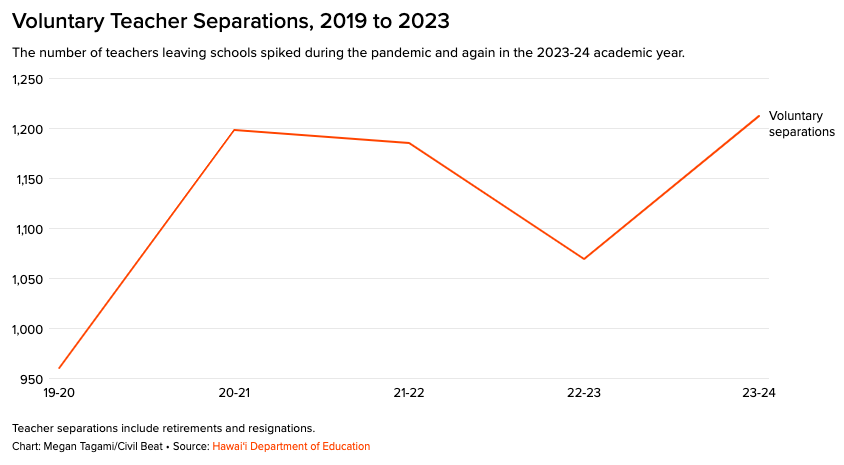
But despite more retention measures in place, the department saw a jump in the number of teachers leaving schools last year. Over 1,200 teachers voluntarily resigned or retired from DOE in the 2023-24 school year, compared to roughly 1,000 the year before.
Tui said there’s no single answer as to why the number of teachers leaving schools jumped. In some cases, teachers may have felt more comfortable changing jobs after the pandemic as they faced less uncertainty in the job market, he said.
This year, educators continuing to work in public schools will receive a 3% pay raise, with some veteran teachers receiving a larger raise of around 7%. While the pay increase will encourage teachers to stay in schools longer, Tui said, it’s possible the state will see a wave of educators retiring after three years as they qualify for higher state pensions.
For teachers hired before 2012, the state uses their three highest years of pay to determine their pensions.
“We have to make sure that we can get people into the profession that we can recruit to handle a drop off like that,” Tui said.
Civil Beat’s education reporting is supported by a grant from Chamberlin Family Philanthropy.
Join our zero2eight Substack community for more discussion about the latest news in early care and education. Sign up now.
This story was originally published by CalMatters. Sign up for their newsletters.
Break out the crayons and finger paint: Every 4-year-old in California is now eligible for transitional kindergarten.
Fifteen years after a handful of school districts opened the first TK classrooms, California now has the largest — and fastest growing — early education program in the country. At least 200,000 youngsters will attend TK this fall, enjoying low teacher-student ratios, age-appropriate curriculum and plenty of music, art and circle time.
“This really is something to celebrate,” said Carolyne Crolotte, policy director for Early Edge California, an advocacy group. “Now, there’s no question about who’s eligible and who isn’t. Everyone is eligible.”
TK is meant to be a bridge between preschool and kindergarten, preparing 4-year-olds for the routine and expectations of elementary school while honing their social skills and self-confidence. In TK, children learn how to make friends, write their names and do basic math. Mostly, they’re supposed to fall in love with learning.
Holding frogs and counting marshmallows
That was the case at Silverwood Elementary in Concord last week as a dozen bright-eyed 4-year-olds hovered around their teacher, Elizabeth Swanson, as she gingerly held out a tree frog for their inspection.
Several got a chance to hold the docile, turquoise amphibian.
“What does the frog feel like? What do you wonder about the frog?” said Swanson, who was recently named Mt. Diablo Unified’s Teacher of the Year. “How does he use his hands? How do you use your hands?”
But the tree frog — one of several critters in her classroom — was not the most popular attraction that afternoon. That honor belonged to the “home living” station, a corner of the classroom dedicated to costumes, dollhouses, a mini kitchen and everything else an imaginative youngster would need to play house.
Last year, an enterprising group of students, inspired by the opening of a Dutch Bros. near the school, used the home living station to open their own coffee shop. They ordered lattes and made coffee and collected money. Swanson turned it into a math lesson by asking them to count marshmallows and decide how many should go into each cup of hot chocolate.
“One child would be the barista and one would be the customer, so they learned how to share and take turns,” Swanson said. “They were getting so much practice with social language and communication. And everything was integrated into play.”
Importance of fun
Judy Krause, executive director of early childhood programs at Pacific Oaks College in Pasadena, said that’s exactly what a TK classroom should be like. The focus should be on experimentation and hands-on activities, based on students’ interests. TK, she said, is not a version of kindergarten; 4-year-olds have unique developmental needs. The main one, she said, is having fun.
If children are enjoying themselves, they’ll learn naturally, she said. If they feel overly pressured or bored, they’ll lose interest and miss out on valuable skills they’ll need for kindergarten and beyond.
“It’s a really big deal that we have this opportunity for all 4-year-olds,” Krause said. “But we have to make sure we’re doing it right.”
15-year rollout of TK
California introduced TK in 2010, and a decade later began expanding it to all districts. This year is the culmination of that effort, with all 4-year-olds now eligible and 91% of districts offering the program. The only districts that are exempt are those that don’t receive money through the state’s funding formula because they receive more money through their local property taxes.
Like kindergarten, TK is optional. But many districts, including Mt. Diablo Unified, have seen strong interest from families. A recent report from the Public Policy Institute of California predicted that about 70% of 4-year-olds will enroll in TK this fall, with waiting lists in some districts. Black, Latino and Native American students have been slightly underrepresented so far, although those not enrolled might be enrolled in other programs. The state doesn’t track that data.
Nearly everyone agrees TK is a good idea. Children who’ve attended TK tend to do better in reading and math, and those with disabilities can be identified early and receive services, research shows.
TK, which is free, can be a financial boon for families. Because of California’s high cost of living, child care and preschool costs are among the highest in the country, with families paying up to $20,000 annually — more than the cost of in-state tuition at the University of California.
Gov. Gavin Newsom has long championed TK, setting aside more than $2.7 billion in the years when the state had a budget surplus. The money is to help school districts pay teachers, keep class sizes small and provide other services to the new learners. Ongoing funds will come from the state’s Local Control Funding Formula.
“California is making a big commitment to making transitional kindergarten free and accessible to all 4-year-olds,” Newsom said in a 2023 video. “When we’re finished, California will have the largest free preschool program in the country, where every 4-year-old can start their schooling on the right track, setting them up for success further down the road.”
Teacher shortage and other challenges
But the TK rollout has had some hiccups. The chief one is finding enough qualified teachers. Because of the small class sizes and the extra qualifications required to teach 4-year-olds, there’s a shortfall of at least 12,000 TK teachers, according to Early Edge California. Last year the state introduced a new TK-through-third-grade credential and more districts are partnering with local colleges to recruit and train future teachers, which has eased the shortage somewhat.
Another obstacle has been finding classroom space. Like kindergarten classrooms, TK classrooms must contain bathrooms, which means that districts had to find money to remodel existing classrooms, or build new ones altogether. Last year’s $10 billion school construction bond has funding available for TK projects.
TK has also had an impact on preschools. Families in California have several early education options: state-funded preschools for low-income families, federal Head Start preschool for very low-income families, and private preschools. Now that 4-year-olds have a free option, existing preschools have seen an enrollment decline that, in some cases, has led schools to raise prices or even close. A recent report from UC Berkeley showed that TK expansion has led to “pre-K deserts” in some parts of the state.
Bruce Fuller, an education professor at UC Berkeley who’s researched TK, said it’s too early to tell who’s benefitting from the program.
“We’re seeing a shift away from preschool and toward TK, but we don’t know if TK is actually reaching new families,” Fuller said. “We might just be seeing families who would have enrolled anyway.”
Dual-language programs
A handful of districts offer dual-language TK classes, which have been popular with parents. Karina Galustians, a parent in the Tujunga neighborhood of Los Angeles, enrolled her daughter Julianna last fall in an Armenian-English TK class in Los Angeles Unified’s Pinewood Early Education Center.
Galustians’ husband speaks fluent Armenian, and the couple was eager for Julianna to be able to communicate with the extended family and learn more about the culture.
“The more languages you know, the better off you are,” said Galustians, whose first language is Spanish. “To find a school where she can get those academic skills and practice her Armenian — me and my husband were beyond grateful. We hit the jackpot.”
Julianna starts kindergarten this fall at another Los Angeles Unified school, where she’ll be part of the Armenian dual language program. “We feel like she’s very well prepared,” Galustians said.
‘Everyone feels included’
Meanwhile, at Silverwood Elementary in Concord, Swanson ended the day by having students put away the blocks and plastic bugs and Eric Carle books. Then she sat with them in a circle and praised each child’s efforts and told them how excited she was to see them again tomorrow.
“David, you were super responsible today,” Swanson told an awed 4-year-old as she handed him a personalized certificate. “Lindsay, you were a good friend. Zaire, you were so respectful.”
Then it was time for the children to go meet their parents, who were waiting at the side of the playground. Swanson chatted with nearly every parent, telling them how much she enjoys their children.
“I think TK should be the same as what we want for society generally,” Swanson said. “It should be a place where everyone feels included and valued. We want everyone to be curious and non-judgmental and happy to be here.”
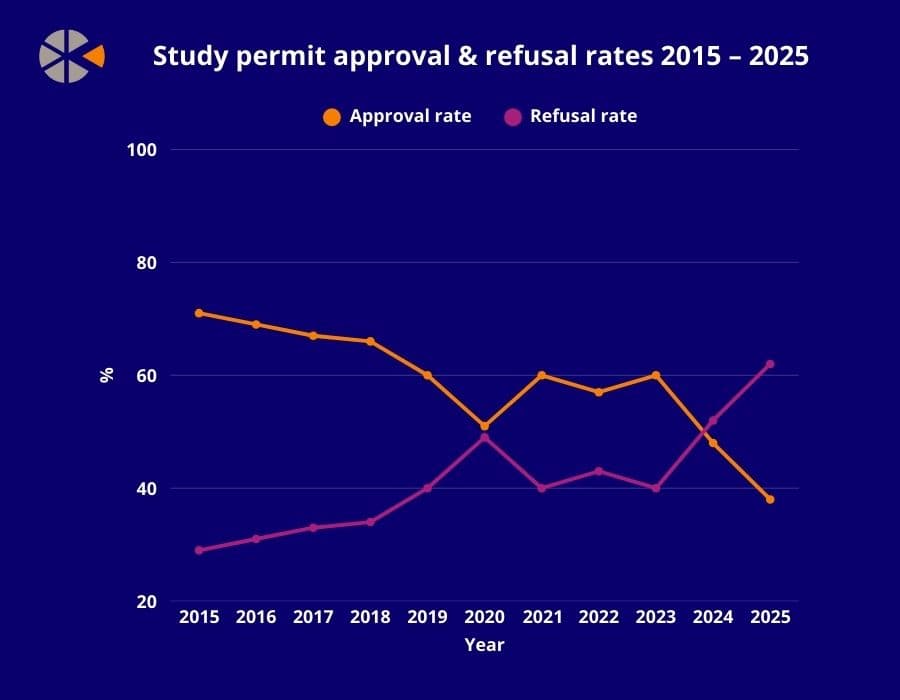
Government figures obtained by The PIE show 62% of applicants were refused a study permit from January to July this year, with record-high volumes “raising urgent questions about transparency and application readiness,” said ApplyBoard.
Despite a decade of relatively stable approval ratings hovering around 60%, rates have plummeted to 38% so far this year, down from 48% in 2024 following the implementation of Canada’s study permit caps.
“It’s clear that Immigration, Refugees and Citizenship Canada (IRCC) is applying far greater scrutiny to new applications,” Jonathan Sherman, vice president of sales & partnership at BorderPass told The PIE, pointing to a “fundamental shift” in government processing.
Data: IRCC
Indian students – who comprise 40% of Canada’s international student population – have been hardest hit by soaring refusals, with four out of five Indian students receiving rejections in Q2 2025, according to BorderPass.
Stakeholders have pointed to a glimmer of hope in overall approval ratings rising modestly this spring, though without a “dramatic shift,” Canada will only reach one fifth of the government’s international student target for the year, Sherman warned.
With institutions bracing for severe declines, ApplyBoard analysis has found the most common reason for reason for rejection in 2024 was the perception by IRCC officers that students wouldn’t leave Canada after their studies, cited in over 75% of cases.
“While reviewers at IRCC understand that some future students hope to gain work experience in Canada after graduation… the extensive use of this reason last year suggests that many are perceived as having permanent residency as their primary purpose, instead of study,” stated the report.
Financial concerns drove three of the top five refusal reasons, after Canada more than doubled its proof-of-funds requirements from $10,000 in 2023 to $20,635 in 2024.
Specifically, in 53% of cases, IRCC officers said they were unconvinced that applicants would leave Canada based on financial assets, alongside doubts about insufficient resources for tuition and living expenses.
“While new policy caps played a role, our full-year data points to recurring applicant challenges, particularly around financial readiness and immigration intent that are preventable with the right guidance and documentation,” said ApplyBoard.
The report highlighted the continuing decline of unspecified reasons for refusal, following IRCC adding officer decision notes to visa refusal letters last month, which was welcomed as a much-needed step in improving transparency.
Other reasons for refusal include the purpose of visit being inconsistent with a temporary stay and having no significant family ties outside Canada.
The data comes amid a major immigration crackdown in Canada, with temporary resident targets included in the latest Immigration Levels Plan for the first time, which aims to reduce temporary resident volumes to 5% of the population by the end of 2027 – a year later than the previous government’s target.
Many are perceived as having permanent residency as their primary purpose, instead of study
ApplyBoard
Approval rates are also below average for other temporary resident categories, but none so drastically as study permits, with just under half of all visitor visas approved so far this year, compared to a ten-year average of 64%.
After more than 18 months of federal policy turbulence, changing eligibility rules have likely contributed to the rise in study permit rejection rates.
Pressure to reduce IRCC backlogs and reach ambitious government targets could also be playing a role, according to immigration lawyers speaking to the Toronto Star.
As of July 31, over 40% of Canada’s immigration inventory was in backlog, including 56% of visitor visas, 46% of work visas and 23% of study visas, according to official data.
Following a swathe of new IRCC officer hires, Sherman said he expected to see improvements in consistency, though “processing backlogs may get worse before they get better,” he warned.
Amid the challenges, educators and advisers are doubling down on what applicants and institutions can do to ensure the best chance of success, with ApplyBoard warning that any incomplete or ineligible documentation can be grounds for refusal.
More than 600 international students studying across the UK came together at Queen Mary University of London last month for the second edition of Leverage Careers Day.
While a record 758,855 international students were enrolled in UK higher education in 2022/23, a 12% rise on the previous year, rising employer uncertainty, growing graduate anxiety, and an increase in job scams have made students more cautious in their professional choices.
The event saw students, who are now exploring opportunities in AI, data science, marketing, finance, and more, connect with top employers and industry leaders, to network, explore career pathways, and gain valuable career advice.
“We saw a remarkable breadth of interest from students across a range of disciplines, with data science and AI standing out as clear frontrunners. Many were especially drawn to AI-layered roles in marketing, creative industries, finance, and healthcare,” Akshay Chaturvedi, founder and CEO, Leverage, told The PIE News.
“At the same time, digital marketing and content strategy sparked strong interest of their own, driven by rising opportunities in the digital economy. Beyond these, students also gravitated towards specialized tracks for example in biotechnology, luxury management, automobile design, and culinary arts.”
For many international students, a successful career has long been the ultimate benchmark of achievement, and in the UK, standing out is crucial, with a sponsored job often seen as the true return on their significant investment in tuition and living costs.
Moreover, with over a quarter of UK employers unaware of the Graduate Route – which allows international students to work sponsor-free for up to two years but is set to be reduced to 18 months under the May 2025 immigration white paper and tied more closely to skill-based jobs – understanding the realities of today’s hiring market has become increasingly important.
“Employers aren’t just looking for textbook skills anymore — they’re looking for forward-thinking talent who can bring innovation to the table,” explained Lee Wildman, director, global engagement, Queen Mary University of London, who joined a fireside chat on mentorship, global exposure, and the skills needed in an ever-evolving world, alongside Chaturvedi and Rhianna Skeetes, international careers consultant at QMUL.
“What ideas do you have to take an organisation to the next level? Be prepared to sell yourself – not just in terms of what you’ve learned, but in terms of how you think.”
What excites me most is seeing students ask better, sharper questions about their careers – not just what job they’ll get, but how they’ll grow, how they’ll lead, and how they’ll stand out
Akshay Chaturvedi, Leverage
Adaptability was also highlighted as the “strongest tool in a student’s back pocket” by Jennifer Ogunleye, B2B communications lead at Google, who delivered a keynote urging students to look beyond job titles, and academic credentials, and focus on building a personal brand.
“There isn’t always a straightforward route into tech or any industry today – even those who were most in demand just a year ago are having to pivot,” noted Ogunleye.
“What matters more than ever is your personal brand: What are you passionate about beyond your job title? That’s what sets you apart from AI, from competition, from volatility.”
The event also brought together organisations such as Publicis Groupe, Reed Recruitment, Hyatt Place, Ribbon Global, and GoBritanya, which offered insights into student accommodation services across the UK and Ireland, giving students exposure to careers across creative, corporate, hospitality, and FinTech sectors.
The Westminster and Holborn Law Society also provided guidance to aspiring legal professionals on navigating local and international career pathways.
“Students today aren’t satisfied with just ‘getting a job’ anymore. They’re actively chasing careers that offer international mobility, cross-border exposure, and long-term growth,” stated Chaturvedi.
“That’s a significant shift, and quite refreshing so, given how only a few years back stability was often the top priority. Now, they want to thrive in industries that are constantly evolving every single day, with technology, globalization, and new market needs at play.”
The proposed rule, announced by the Department of Homeland Security (DHS) on August 27, would upend the longstanding “duration of status” policy and enforce additional restrictions on students changing programs and institutions.
If finalised, the new rule would limit the length of time international students, professors and other visa holders can stay in the US, which DHS claims would curb “visa abuse” and increase the department’s “ability to vet and oversee these individuals”.
Trump initially put forward the proposal during his first administration, only for it to be withdrawn under Biden. In recent weeks, a rehashed version of the plans has been moving closer towards final approval.
Yesterday’s publication of the finalised proposal in the Federal Register was met with immediate denunciation by stakeholders who say it would place an undue administrative burden on students as well as representing a “dangerous government overreach”. Now the proposal is under a 30-day public comment period.
“These changes will only serve to force aspiring students and scholars into a sea of administrative delays at best, and at worst, into unlawful presence status – leaving them vulnerable to punitive actions through no fault of their own,” said NAFSA CEO Fanta Aw.
Under the rule, students could only remain in the US on a student visa for a maximum of four years and would have to apply for a DHS extension to stay longer.
The policy document reasons that 79% of students in the US are studying undergraduate or master’s degrees which are generally two or four-year programs, thus: “a four-year period of admission would not pose an undue burden to most nonimmigrant students”.
And yet, stakeholders have previously pointed out that the average time taken to complete an undergraduate degree – for both domestic and international students – exceeds four years, meaning that the majority of students would have to file for an extension to complete their studies.
Meanwhile, this reasoning does not consider postgraduate students on longer programs or the many students that go onto Optional Practical Training (OPT), who would have to apply for a visa extension as well as the work permit itself.
If finalised, master’s students would no longer be able to change their program of study, and first year students would be unable to transfer from the institution that issued their visa documents.
Alarmingly, the rule would hand power to the government to determine academic progress, with “a student’s repeated inability or unwillingness” to complete their degree, deemed an “unacceptable” reason for program extensions.
It would also limit English-language students to a visa period of less than 24 months, and the grace period for F-1 students, post-completion, would be reduced from 60 to 30 days.
Such far reaching provisions amount to “a dangerous overreach by government into academia,” said Aw, pointing out that international students and exchange visitors are already “the most closely monitored non-immigrants in the country.”
Government interference into the academic realm in this way introduces a wholly unnecessary and new level of uncertainty to international student experience
Fanta Aw, NAFSA
“For too long, past administrations have allowed foreign students and other visa holders to remain in the US virtually indefinitely, posing safety risks, costing untold amount of taxpayer dollars, and disadvantaging US citizens,” DHS said in a statement.
Framing the issue as one of national security, the department said it had identified 2,100 F-1 visa holders who arrived between 2000 and 2010 and have remained in status, becoming what DHS called “forever” students “taking advantage of US generosity”.
Putting this in perspective, commentators have highlighted that in 2023 alone there were 1.6 million F-1 visa holders in the US.
As well as imposing significant burdens on students and intruding on academic decision-making, the proposal would also place strain on federal agencies and increase the existing immigration backlog, warned Miriam Feldblum, CEO of the Presidents’ Alliance on Higher Education and Immigration.
“International students deserve assurance that their admission period to the US will conform to the requirements of their academic programs,” said Feldblum, issuing a grave warning that the rule would further deter international students and “diminish” US competitiveness.
“At a time when the US is already facing declines in international student enrolment, we must do everything we can to keep the door open to these individuals, who are essential to our future prosperity,” she continued, alluding to recent falls in US visa issuance.
Since coming to office, a barrage of hostile policies from the Trump administration have erected unprecedented barriers for students hoping to study in the US, with a near-month long visa interview suspension earlier this summer still wreaking havoc on visa appointment availability around the world.
The latest government data revealed a 30% drop in student arrivals this July, with colleges bracing for a drastic drop in international student numbers for the upcoming year. If the decline continues, experts have warned of USD $7bn in damages to the US economy.
According to Aw, the proposed rule would “certainly” deter international students further, “without any evidence that the changes would solve any of the real problems that exist in our outdated immigration system”.
Appealing to Trump’s recent remarks pushing for a more-than doubling of the Chinese student population in the US, Aw urged the government to engage with the sector to ensure the US remained the “premier destination” for global talent while keeping the country “safe and prosperous”.
At ISTE this summer, I lost count of how many times I heard “AI” as the answer to every educational challenge imaginable. Student engagement? AI-powered personalization! Teacher burnout? AI lesson planning! Parent communication? AI-generated newsletters! Chronic absenteeism? AI predictive models! But after moderating a panel on improving the high school experience, which focused squarely on human-centered approaches, one district administrator approached us with gratitude: “Thank you for NOT saying AI is the solution.”
That moment crystallized something important that’s getting lost in our rush toward technological fixes: While we’re automating attendance tracking and building predictive models, we’re missing the fundamental truth that showing up to school is a human decision driven by authentic relationships.
The real problem: Students going through the motions
The scope of student disengagement is staggering. Challenge Success, affiliated with Stanford’s Graduate School of Education, analyzed data from over 270,000 high school students across 13 years and found that only 13 percent are fully engaged in their learning. Meanwhile, 45 percent are what researchers call “doing school,” going through the motions behaviorally but finding little joy or meaning in their education.
This isn’t a post-pandemic problem–it’s been consistent for over a decade. And it directly connects to attendance issues. The California Safe and Supportive Schools initiative has identified school connectedness as fundamental to attendance. When high schoolers have even one strong connection with a teacher or staff member who understands their life beyond academics, attendance improves dramatically.
The districts that are addressing this are using data to enable more meaningful adult connections, not just adding more tech. One California district saw 32 percent of at-risk students improve attendance after implementing targeted, relationship-based outreach. The key isn’t automated messages, but using data to help educators identify disengaged students early and reach out with genuine support.
This isn’t to discount the impact of technology. AI tools can make project-based learning incredibly meaningful and exciting, exactly the kind of authentic engagement that might tempt chronically absent high schoolers to return. But AI works best when it amplifies personal bonds, not seeks to replace them.
Mapping student connections
Instead of starting with AI, start with relationship mapping. Harvard’s Making Caring Common project emphasizes that “there may be nothing more important in a child’s life than a positive and trusting relationship with a caring adult.” Rather than leave these connections to chance, relationship mapping helps districts systematically identify which students lack that crucial adult bond at school.
The process is straightforward: Staff identify students who don’t have positive relationships with any school adults, then volunteers commit to building stronger connections with those students throughout the year. This combines the best of both worlds: Technology provides the insights about who needs support, and authentic relationships provide the motivation to show up.
True school-family partnerships to combat chronic absenteeism need structures that prioritize student consent and agency, provide scaffolding for underrepresented students, and feature a wide range of experiences. It requires seeing students as whole people with complex lives, not just data points in an attendance algorithm.
The choice ahead
As we head into another school year, we face a choice. We can continue chasing the shiny startups, building ever more sophisticated systems to track and predict student disengagement. Or we can remember that attendance is ultimately about whether a young person feels connected to something meaningful at school.
The most effective districts aren’t choosing between high-tech and high-touch–they’re using technology to enable more meaningful personal connections. They’re using AI to identify students who need support, then deploying caring adults to provide it. They’re automating the logistics so teachers can focus on relationships.
That ISTE administrator was right to be grateful for a non-AI solution. Because while artificial intelligence can optimize many things, it can’t replace the fundamental human need to belong, to feel seen, and to believe that showing up matters.
The solution to chronic absenteeism is in our relationships, not our servers. It’s time we started measuring and investing in both.
Dr. Kara Stern, SchoolStatus
Dr. Kara Stern is Director of Education for SchoolStatus, a portfolio of data-driven solutions that help K-12 districts improve attendance, strengthen family communication, support teacher growth, and simplify daily operations. A former teacher, principal, and head of school, she holds a Ph.D. in Teaching & Learning from NYU.
Latest posts by eSchool Media Contributors (see all)
Rigorous research rarely shows that any teaching approach produces large and consistent benefits for students. But tutoring seemed to be a rare exception. Before the pandemic, almost 100 studies pointed to impressive math or reading gains for students who were paired with a tutor at least three times a week and used a proven curriculum or set of lesson plans.
Some students gained an extra year’s worth of learning — far greater than the benefit of smaller classes, summer school or a fantastic teacher. These were rigorous randomized controlled trials, akin to the way that drugs or vaccines are tested, comparing test scores of tutored students against those who weren’t. The expense, sometimes surpassing $4,000 a year per student, seemed worth it for what researchers called high-dosage tutoring.
On the strength of that evidence, the Biden administration urged schools to invest their pandemic recovery funds in intensive tutoring to help students catch up academically. Forty-six percent of public schools heeded that call, according to a 2024 federal survey, though it’s unclear exactly how much of the $190 billion in pandemic recovery funds have been spent on high-dosage tutoring and how many students received it.
Related: Our free weekly newsletter alerts you to what research says about schools and classrooms.
Even with ample money, schools immediately reported problems in ramping up high-quality tutoring for so many students. In 2024, researchers documented either tiny or no academic benefits from large-scale tutoring efforts in Nashville, Tennessee, and Washington, D.C.
New evidence from the 2023-24 school year reinforces those results.Researchers are rigorously studying large-scale tutoring efforts around the nation and testing whether effective tutoring can be done more cheaply. A dozen researchers studied more than 20,000 students in Miami; Chicago; Atlanta; Winston-Salem and Greensboro, North Carolina; Greenville, South Carolina; schools throughout New Mexico, and a California charter school network. This was also a randomized controlled study in which 9,000 students were randomly assigned to get tutoring and compared with 11,000 students who didn’t get that extra help.
Their preliminary results were “sobering,” according to a June report by the University of Chicago Education Lab and MDRC, a research organization.
The researchers found that tutoring during the 2023-24 school year produced only one or two months’ worth of extra learning in reading or math — a tiny fraction of what the pre-pandemic research had produced. Each minute of tutoring that students received appeared to be as effective as in the pre-pandemic research, but students weren’t getting enough minutes of tutoring altogether. “Overall we still see that the dosage students are getting falls far short of what would be needed to fully realize the promise of high-dosage tutoring,” the report said.
Monica Bhatt, a researcher at the University of Chicago Education Lab and one of the report’s authors, said schools struggled to set up large tutoring programs. “The problem is the logistics of getting it delivered,” said Bhatt. Effective high-dosage tutoring involves big changes to bell schedules and classroom space, along with the challenge of hiring and training tutors. Educators need to make it a priority for it to happen, Bhatt said.
Some of the earlier, pre-pandemic tutoring studies involved large numbers of students, too, but those tutoring programs were carefully designed and implemented, often with researchers involved. In most cases, they were ideal setups. There was much greater variability in the quality of post-pandemic programs.
“For those of us that run experiments, one of the deep sources of frustration is that what you end up with is not what you tested and wanted to see,” said Philip Oreopoulos, an economist at the University of Toronto, whose 2020 review of tutoring evidence influenced policymakers. Oreopoulos was also an author of the June report.
“After you spend lots of people’s money and lots of time and effort, things don’t always go the way you hope. There’s a lot of fires to put out at the beginning or throughout because teachers or tutors aren’t doing what you want, or the hiring isn’t going well,” Oreopoulos said.
Another reason for the lackluster results could be that schools offered a lot of extra help to everyone after the pandemic, even to students who didn’t receive tutoring. In the pre-pandemic research, students in the “business as usual” control group often received no extra help at all, making the difference between tutoring and no tutoring far more stark. After the pandemic, students — tutored and non-tutored alike — had extra math and reading periods, sometimes called “labs” for review and practice work. More than three-quarters of the 20,000 students in this June analysis had access to computer-assisted instruction in math or reading, possibly muting the effects of tutoring.
The report did find that cheaper tutoring programs appeared to be just as effective (or ineffective) as the more expensive ones, an indication that the cheaper models are worth further testing. The cheaper models averaged $1,200 per student and had tutors working with eight students at a time, similar to small group instruction, often combining online practice work with human attention. The more expensive models averaged $2,000 per student and had tutors working with three to four students at once. By contrast, many of the pre-pandemic tutoring programs involved smaller 1-to-1 or 2-to-1 student-to-tutor ratios.
Despite the disappointing results, researchers said that educators shouldn’t give up. “High-dosage tutoring is still a district or state’s best bet to improve student learning, given that the learning impact per minute of tutoring is largely robust,” the report concludes. The task now is to figure out how to improve implementation and increase the hours that students are receiving. “Our recommendation for the field is to focus on increasing dosage — and, thereby learning gains,” Bhatt said.
That doesn’t mean that schools need to invest more in tutoring and saturate schools with effective tutors. That’s not realistic with the end of federal pandemic recovery funds.
Instead of tutoring for the masses, Bhatt said researchers are turning their attention to targeting a limited amount of tutoring to the right students. “We are focused on understanding which tutoring models work for which kinds of students.”
The Hechinger Report provides in-depth, fact-based, unbiased reporting on education that is free to all readers. But that doesn’t mean it’s free to produce. Our work keeps educators and the public informed about pressing issues at schools and on campuses throughout the country. We tell the whole story, even when the details are inconvenient. Help us keep doing that.
From the start, Na’Siah Martin and H’Sanii Blankenship’s July trip to Washington, D.C., was destined to be a riveting stop on the teenagers’ passage to adulthood. There were the scheduled meetings with lawmakers, the monuments, the reflecting pool near where Martin Luther King Jr. broadcast his dream for racial equality 62 summers ago.
For years, the pair have been involved in the Boys and Girls Clubs of the Austin Area, the revered summer and after-school program that was now making it possible for the two blossoming leaders to meet with Texans in Congress and present their game plan for tackling mental health challenges among student-athletes, a struggle both were deeply familiar with.
But two weeks before their arrival on Capitol Hill, President Donald Trump’s administration threw one of many curveballs lobbed during the first months of his second term. The U.S. Department of Education notified state education officials on the last day of June that it would pause the disbursement of nearly $7 billion in funds for teacher development, support for students learning English, and before- and after-school programs predominantly serving low-income families, pending a review of how schools had put the money to use. That notice went out a day before states expected to begin receiving the money.
For Texas, it meant a potential loss of nearly $670 million. For Martin and Blankenship, it potentially meant losing the Boys and Girls Club, a space that has aided their growth as both leaders and individuals. Martin, 18, graduated from Navarro Early College High School in June and has participated in the club since elementary school. Blankenship, a 17-year-old incoming senior at the same school, has participated in the club for about as long as Martin.
The focus of their trip immediately broadened: They now wanted to convince federal lawmakers that cutting the funds would harm Texas kids.
“These programs aren’t just for fun,” Blankenship said. “They actually give us resources, help us grow into adults instead of just coming here and just goofing around and stuff like that. These programs, they help us cope with things we need to cope with.”
The education funding freeze was typical of the Trump administration. In recent months, it has also cut billions of dollars in food assistance and health care for families in poverty; frozenbillions in grants and contracts financially supporting universities; canceled billions for foreign aid and public broadcasting stations; laid off thousands of employees working in critical federal agencies; and sought to overhaul the U.S. immigration landscape through actions like attempting to end birthright citizenship.
Those cuts and changes have often been sweeping and abrupt, disrupting federally funded services and programs serving large swaths of people of color, people with disabilities, low-income families, LGBTQ+ Americans and immigrants. And they have come at the same time the administration has moved to lower taxes for some of America’s wealthiest households.
“We can’t look at just the cuts to education in isolation,” said Weadé James, senior director of K-12 education policy at the Center for American Progress. “I think what we’re witnessing is really the undoing of a lot of progress, and also actions that are really going to keep a lot of families trapped in cyclical and generational poverty.”
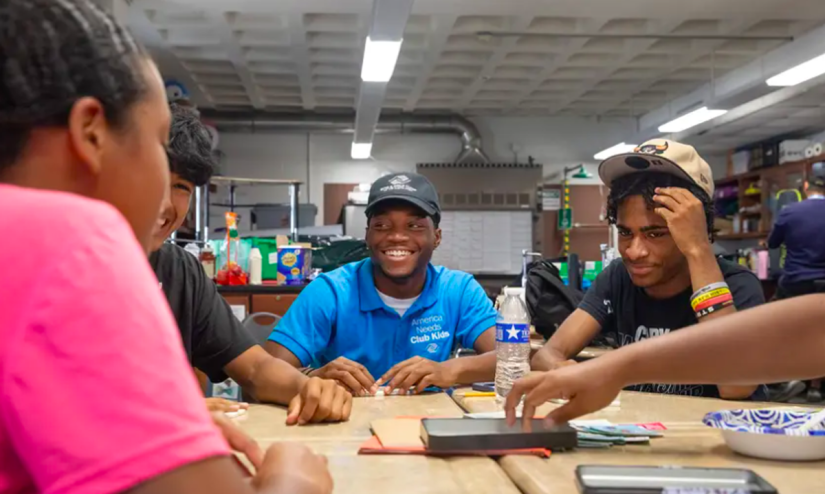
Boys and Girls Club director Jacob Hernandez watches club members play spades at Navarro Early College High School. Credit: Montinique Monroe for The Texas Tribune
Ongoing changes to the country’s educational landscape are only one part of Trump’s larger goals to eliminate what the second-term president has deemed “wasteful” spending and crack down on anything he views as diversity, equity and inclusion initiatives. A large piece of his efforts involve closing the Department of Education and sending “education back to the states,” though most decisions about education and public school funding already happen at the state and local levels.
“Teachers will be unshackled from burdensome regulations and paperwork, empowering them to get back to teaching basic subjects. Taxpayers will no longer be burdened with tens of billions of dollars of waste on progressive social experiments and obsolete programs,” Trump Secretary of Education Linda McMahon said in a statement earlier this year. “K-12 and college students will be relieved of the drudgery caused by administrative burdens—and positioned to achieve success in a future career they love.”
The disarray has resulted in profound consequences for Texas, one of the largest and most diverse states in the nation, home to more than 9,000 school campuses and 5.5 million students — the majority of whom live in low-income households and come from Hispanic and Black families. Public schools serve as a safety net for many of them. They are one of the few places where some children have consistent access to meals, where working-class parents know their kids will be taken care of.
The prospect of federal cuts to school programs triggered a wave of concern across the state. For 44-year-old Clarissa Mendez, it jeopardized the after-school program her two daughters attend while she works as a nurse in Laredo.
“I’m on shaky grounds right now because I don’t know what I’m going to do,” Mendez said last month. “I understand there has to be cuts. I understand the government needs to find out how to save money. But why does it have to affect us and our kids?”
For Gay Hibbitts, a 57-year-old trying to become a certified teacher in rural Throckmorton, the worries began months earlier.
Earlier this year, the federal government cut roughly $400 million from a program that helps teaching candidates like her pay for their education as they gain hands-on classroom experience. That left participating rural districts with one of two options: cover the costs at a time when schools are financially struggling to make ends meet, or get rid of their preparation programs during a teacher shortage.
In both scenarios, Hibbitts said, children would pay the price.
“They’re the main ones that are going to suffer,” she said.
For as long as Martin and Blankenship can remember, they have each helped raise their younger siblings, a responsibility that has been rewarding but stressful. On the one hand, Martin said, her siblings look up to her, and her academic success has motivated them to do well in school. On the other hand, Blankenship said, taking on adult responsibilities at an early age meant missing out on the type of exhilarating childhood experiences many kids desire.
Since joining the Boys and Girls Club, the program has provided them the space to be kids.
They receive tutoring and time to finish homework. They go to live sporting events, watch movies and listen to music — SZA some days, Lauryn Hill on others. They play sports, cards and board games. They can earn scholarships. They find mentorship.
“We’re the future adults, so I feel like if you help us now with programs like this, that make us happy, that give us stress relief, that let us be kids, because we can’t be kids at home, I feel like that’ll equate to happier adults,” Martin said.
Na’Siah Martin, left, and H’Sanii Blankenship traveled to Washington, D.C., in July and had a chance to discuss with lawmakers the Trump administration’s pause on roughly $7 billion in federal funding, which threatened to shutter the Boys and Girls Club. Credit: Montinique Monroe for The Texas Tribune
Neither Martin nor Blankenship enjoys public speaking. Martin actually fears it. But with the Austin Boys and Girls Club’s future in jeopardy, they decided to lean into the discomfort and use the face time with lawmakers and their staffers to make a case for the after-school program.
The pair and several other clubmates sat down with the staff of Texas Republican Sens. John Cornyn and Ted Cruz. They also met with Rep. Greg Casar, an Austin Democrat. The kids wore blue polo shirts with the words “America Needs Club Kids” etched in white. Martin, rocking a black one-button blazer, led the way.
“I gotta let these people know,” she thought.
Erica Peña is responsible for taking care of about 400 kids as she coordinates Hebbronville Elementary’s summer and after-school programs. Working with an assistant and about 25 paid volunteers, the 37-year-old often stays after hours — sometimes as late as 7 p.m. — depending on when parents can leave work to get there.
Peña breaks the after-school schedule into blocks. The first hour is for tutorials and worksheets, the later hours are usually for more fun activities like arts and crafts, kickball and cooking.
But shortly after the federal education funds were paused, the district notified Peña that it could no longer afford to keep her or the program.
“I cried, to be honest,” Peña said. “I was very upset, because I love my job, I love my students, and a lot of it is about them.”
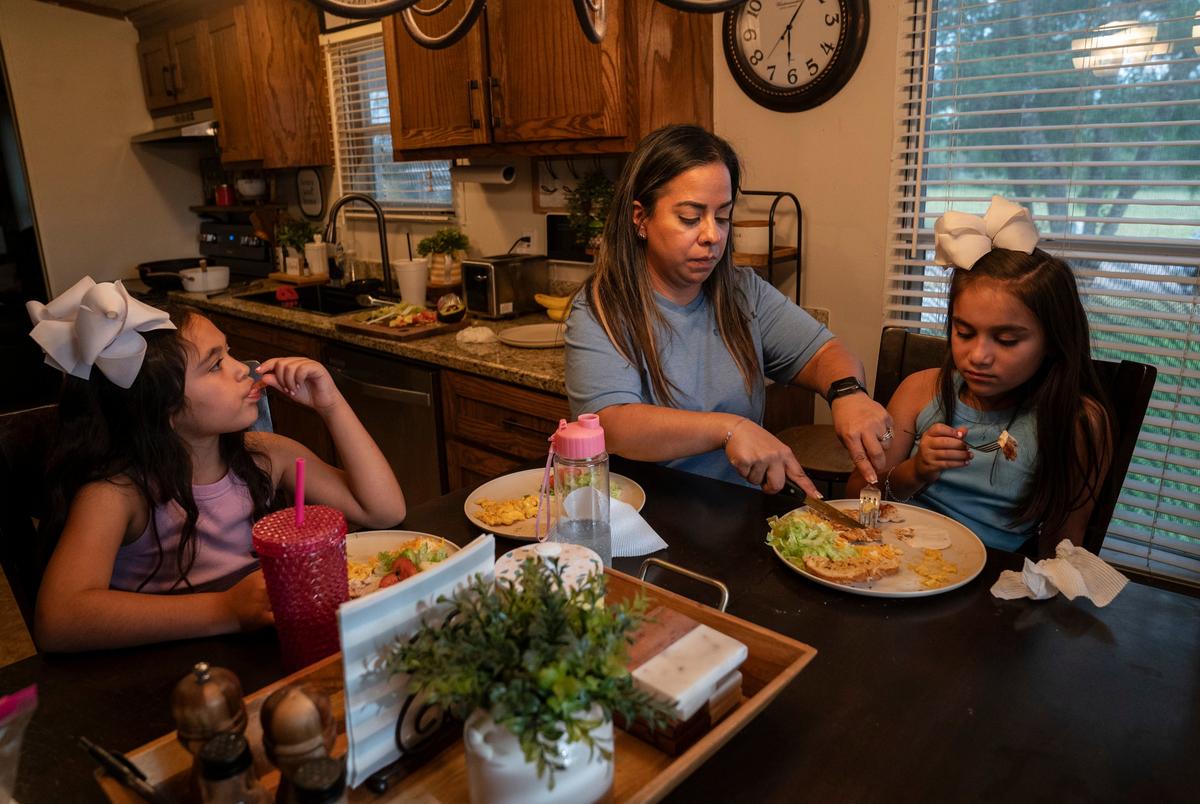
Clarissa Mendez and her daughters Catiana Ester Mendez, left, and Catalaya Avaneh Mendez pose for a photo at their home in Hebbronville on July 30, 2025. Credit: Gabriel V. Cárdenas for The Texas Tribune
Hebbronville, in far South Texas, is home to about 4,300 mostly Hispanic Texans, one-third of whom live below the poverty line. The town has no H-E-B or Walmart. The local health clinic is often busy. The town has a few day care centers, but they can get pricey.
For the average Texas family, child care is financially out of reach. The median annual cost sits at $10,706 a year — or $892 each month. That’s more than one-fourth of the average cost for in-state tuition at a four-year public college, according to the Economic Policy Institute. Access to no-cost options, like the Hebbronville after-school program, has positive effects on student attendance, behavior and learning, multiplestudies have found over the years. Such programs also keep families from having to choose between leaving their children unattended or taking time off work to stay home.
“That has a direct impact on future economic prospects for that entire family,” said Jenna Courtney, CEO of the Texas Partnership for Out of School Time, a youth advocacy organization.
Mendez, the 44-year-old Hebbronville mother with two daughters, commutes about an hour to and from Laredo every weekday to make it to her job as a nurse. She goes in at 9 a.m. and gets out at 5 p.m. Her husband operates heavy equipment and has an unpredictable work schedule.
After picking up her daughters, Mendez cooks for them and spends some time with them before she starts working from home for an additional three to four hours. The after-school program Mendez’s daughters attend allows her to save some money on daycare costs. Credit: Gabriel V. Cárdenas for The Texas Tribune
The after-school program “gives me enough time to get to town to pick them up,” she said. But with the district planning to shutter operations, Mendez needed to find care providers who could look after her children until 6-6:30 p.m., when she gets home. She pays about $1,000 a month for that service during the summer when the school program is out of session. It would likely cost her another $800 per month during the academic year.
“That’s a big chunk of our money,” Mendez said.
Without the program, she would need to find a second job.
“We’ll do what we gotta do,” she added. “But I don’t understand.”
Catalaya Avaneh Mendez plays with her sister Catiana Ester Mendez as their mother watches them at her home. The Trump administration recently froze funding that benefits after-school programs, placing financial stress on parents such as the Mendez. They would have to find and pay for daycare for their children if those programs ended. Credit: Gabriel V. Cárdenas for The Texas Tribune
Hibbitts, the 57-year-old from Throckmorton, recently joined a federally funded program that would allow her to support students in her rural hometown between Abilene and Wichita Falls. It places aspiring full-time teachers in classrooms under the supervision of more seasoned teachers and provides financial assistance for their education and living expenses.
In exchange, the district gets to retain educators familiar with the community and eager to teach.
Based on her own experience as a Throckmorton student in the 1970s, Hibbitts knows the monumental role teachers can play in a child’s life.
“They were almost like your second mother,” she said.
Texas has the largest rural population of any state in the country. Of its roughly 5.5 million students, 13% attend class on a rural campus. Those schools often have to educate their students with less: Less access to the internet and technology, less staffing, and less money to pay and retain teachers.
Educator Gay Hibbitts, left, speaks with her mentor, Amy Dick, a secondary social studies teacher, inside a classroom at Throckmorton Collegiate ISD on July 29, 2025. Hibbitts was part of a federally funded educator preparation program serving about 30 participants across 11 rural Texas districts. Credit: Desiree Rios for The Texas Tribune
Texas lawmakers have acknowledged that rural teachers often do not make as much as their urban and suburban counterparts, and that many have left the profession because of a lack of support. Public schools over time have also grown more reliant on hiring unlicensed educators, a trend playing out more profoundly in the rural parts of Texas.
In response, state officials recently passed laws aimed at raising teacher pay, particularly in rural schools, and enhancing teacher preparation programs.
During her first year in the Throckmorton program, Hibbitts learned how to incorporate state learning standards into lesson plans. She learned how to keep students engaged. She helped a child who struggled academically and acted out at the beginning of the school year become a “model student” who thrived in reading by the year’s end.
Then, one Sunday afternoon in April, her superintendent called her.
The Trump administration had abruptly cut the federal dollars that helped schools fund educator preparation initiatives like the one she was participating in. It would affect about 30 people across 11 rural districts in Texas.
Hibbitts was one of them.
Hibbitts participates in a safety training at Throckmorton Collegiate ISD. The funding for Hibbitts’ educator preparation program, which covered her two years of college and training costs, was cut on April 25 under the Trump administration, leaving her uncertain about her future. Credit: Desiree Rios for The Texas Tribune
In Hebbronville, Mendez and Peña each had to confront their own harsh realities. Mendez would have to search for child care in a community with few affordable options. Peña, the after-school program coordinator, would have to find a new job.
In Austin, Martin and Blankenship had trouble picturing life without the Boys and Girls Club.
Club leaders began preparing a memo to notify parents about the funding uncertainty and what it could mean for their kids. Nothing had come of the Republican, Democratic and legal efforts seeking the release of the frozen funds. The Texas kids who spoke with congressional lawmakers and staff at the U.S. Capitol hadn’t heard anything either. When the administration would make a decision about the funds was anyone’s guess.
When Blankenship got the news, he sprinted out of his room in excitement and told his mom. The moment was just as surreal for Martin.
“Knowing that it could have been me, my story, or any other club kids’ story,” Martin said, “it made me happy. But it was like, ‘Dang. I was a part — we were a part of that.’”
Peña, the Hebbronville Elementary program coordinator, was relieved. The mood in her group chat with people from the district’s after-school programs was “pretty ecstatic.” They all cried. Getting the funds meant they no longer had to look for new jobs, and parents like Mendez wouldn’t have to go searching for a place to take care of their kids after school.
Hibbitts is pursuing a bachelor’s degree in general studies with an emphasis in education and a minor in psychology at West Texas A&M. Credit: Desiree Rios for The Texas Tribune
Hibbitts, meanwhile, wasn’t immediately able to bask in the good news, as it did not restore the federal funds for her district’s teacher preparation program. But in early August, her supervisor notified her that the program was officially back up and running for the 2025-26 school year. The news cleared the way for the 57-year-old to graduate at the end of the year and to start teaching full time by the next.
“This has been life changing for somebody of my age, to be able to step up and to step into the world of education,” Hibbitts said. “I’m finishing my dream. And as my kids like to say, ‘Mom, you’re going to be 58 years old walking the stage.’”
Still, she recognizes that so much uncertainty around federal funding means there is no guarantee others will get the same chance.
Uncertainty is what Peña also keeps coming back to.
“It just gets me upset with the administration, because, why? What was the purpose of the freeze? Why did you do that? You’re hurting people, not just adults, but children,” Peña said. “It’s like in a divorce, you don’t want to put the children in the middle. If something were to happen between parents, you never put children in the middle. And by doing that, you put children in the middle.”
This article originally appeared in The Texas Tribune, a member-supported, nonpartisan newsroom informing and engaging Texans on state politics and policy. Learn more at texastribune.org.
Despite the summer heat, Toyia Diab came out to the Summer on the Block at Pulaski Elementary-Middle School to learn what it had to offer the four grandchildren she had in tow.
The family made their way to about a dozen tables snaking around the lawn on the side of the school. Diab listened to staff from the Detroit school district detail all of its resources over the pulsing base of loud music.
Diab’s family was one of many the Detroit Public Schools Community District courted this summer as part of its efforts to retain families and boost enrollment. With the loss of more than 92,000 students in the last 20 years, district officials devote some of the summer break each year to getting word out about what the city’s schools have to offer.
This year, the districtramped up efforts. It sent 40 people to canvas communities and held 19 events to create excitement about the start of school — nearly double that of previous years. It also started new initiatives, such as putting up billboards around the city. In all, the school system budgeted around $3.5 million for marketing this year. School starts Aug. 25.
Though the district has “done a fairly good job” of recruiting new students in previous years, Superintendent Nikolai Vitti told school board members at a meeting earlier this month that the main challenge is keeping them.
As a result, this year the school system also has focused on reenrollment rates. Those numbers have become a metric the district uses to “hold schools accountable,” Vitti said, though he didn’t share how many students the district typically loses during the school year.
“We have emphasized … the need to improve customer service and parent engagement, so that parents feel more welcome,” he said. “And we fight harder to keep students at the schools that they’re at, rather than having more of an attitude of, ‘Well, if you don’t like it here, then you can find another school.’”
Sharlonda Buckman, assistant superintendent of family and community engagement, told Chalkbeat the district has seen a lot of “good signs” for this school year because of the number of people her office reached in the summer.
“It’s noticeable for me, and I’ve been at this for a long time,” she said. “We’ll see what that boils down to, in terms of enrollment.”
This year, Buckman said nearly 5,000 people went to the Summer on the Block events, parties held at schools that both serve as a vehicle to sell families on sending their kids to the district and connect them with free resources.
“As a parent, you have to bring your kids to school every day in order to get the education that they need,” Diab said at the Pulaski back-to-school event. “But then you’ll find some schools, they just don’t have enough resources to keep them interested to come to school, to stay in school.”
All of the district’s summer efforts produced 532 leads on parents interested in enrolling their kids by mid-August. Around 80 of those students completed enrollment, according to the district.
Though initial enrollment numbers are up, officials say, the full impact of the district’s efforts won’t be known until the end of the 2025-26 school year.
Myriad factors have affected enrollment in DPSCD
Boosting student numbers has been among the district’s top priorities for years.
The numbers of students attending schools are crucial for districts in Michigan, where school funding is tied to enrollment.
High student mobility rates, or the rate at which kids move to different homes, contribute to the district’s difficulty in keeping children enrolled. Chronic absenteeism rates also have a direct impact on enrollment.
When DPSCD was created and the school system began being phased out of emergency management in the 2017-18 school year, enrollment shot up to more than 50,800 from 45,700 during the 2016-17 school year.
The district has struggled to move the needle much since, especially after drops during pandemic-era school closures and the years that followed.
At the beginning of this month, there were 50,890 students enrolled in the district, Vitti said at the board meeting.
“We have about 1,400 more students than we did at the end of the year enrolled in DPSCD as of today, and about 500 more as compared to the first day of school,” he said, adding that “ “enrollment is trending in a positive direction.”
Early enrollment numbers for the district are usually higher than official headcounts made in October. The number of students recorded on “Count Day” is used by the state to calculate funding for districts.
Making the case for DPSCD face-to-face
Three days before the Summer on the Block at Pulaski, more than 20 people squeezed into a sun-filled classroom at the Detroit School of Arts.
The group was contracted by the district to canvas homes in areas where attendance is low compared to the number of school-aged children living there.
This summer, the district sent canvassers to more than 78,000 homes to inform families about its schools and programs.
The group at the School of Arts was gathered to get their assignments for the day. They waited to pick up hand-out materials, including fliers listing Summer on the Block dates and pamphlets highlighting programs at application schools.
To get the energy up in the classroom before they headed out, the canvassers stood up to form a circle. Buckman, the assistant superintendent, asked them to share what they heard door-knocking.
“We’re getting a good response in terms of some of those students coming back to the district,” said one woman.
Others expressed residents’ hesitations to open their doors or to give their contact information for the district to follow up with them.
Laura Gomez, who has been canvassing for three years, said through a translator that this summer has been different in southwest Detroit, which is home to many immigrant and newcomer families.
“There are some people that are really happy we’re going out to the houses because that way they don’t have to leave their home because they don’t feel safe,” she said.
After the canvassers broke out into teams, they drove to the areas they were assigned to for the day.
Tanya Shelton and her son, David, arrived in the Crary St. Mary’s neighborhood in the northwest corner of the city.
“We’ll ask them what school district are they in, and if they are interested in DPSCD, we give some information on it,” she said as she made her way down a long block adjacent to the Southfield Freeway.
In her conversations with families, Shelton said the district’s free school lunches piqued their interest. Other canvassers said parents were interested in learning more about the academic interventionists available to students.
Most of the doors Shelton knocked on that day, though, went unanswered. She left the district’s literature at dozens of houses.
Families weigh programming, academics, and transportation in selecting schools
At Pulaski’s Summer on the Block Alexa Franco-Garcia saw more students signing up to attend the school than she has in past years.
“Right now, I have three enrollment packets in my hand, so that means they’ve completed enrollment,” she said during a break from talking with families.
Another three parents left their contact information and said they would return the paperwork the next day.
Considering it was about 30 minutes into the event, that was a strong number, said Franco-Garcia, who works in the Office of Family and Community Engagement.
In her time working in the district, Franco-Garcia has learned what kinds of questions families ask: They want to know about the curriculum, extracurricular activities, and class sizes. They wonder whether their children will be supported in special education and if they will get a bus ride to school.
Most of the sign-ups at the Pulaski event were for kindergartners who were new to the district, Franco-Garcia said.
There were 457 students enrolled in prekindergarten by the beginning of August, according to the district, up about 10 compared to the same time last year.
Diab, the grandmother, brought four kids ages 5 to 12 out to learn more about the school. They heard about the district’s community health hubs, parent academy, and mental health resources.
Teachers from the school gathered around a welcome table ready to answer questions as Principal Tyra R. Smith-Bell floated around talking with parents.
The fresh produce boxes, ice cream truck, free books, and kids’ activities also enticed more than 350 people to come – many more than in previous years, Buckman said.
Linn Flake was the first second-grader of the day to enroll at Pulaski, said Franco-Garcia. It would be his first experience at a neighborhood school, she added.
His mom, Roxanne Flake, chose DPSCD over the charter school Linn went to last year.
“I just wanted a different start,” she said.
The charter school didn’t provide transportation, said Flake, which was an inconvenience because she doesn’t currently have a car. But the Detroit school district offered bus service for Linn to Pulaski, the mother said.
Diab said she had more research to do before her family committed to Pulaski.
“We’re gonna come here and we’re gonna figure everything out – ask questions, all of that stuff, and then if it’s the right fit for them, then we’re gonna put them in,” she said.
Chalkbeat is a nonprofit news site covering educational change in public schools. This story was originally published by Chalkbeat. Sign up for their newsletters at ckbe.at/newsletters.