Category: News
-

‘Man versus machine’ up for debate at the International Internship Conference
Welcoming delegates with a lyric from Minnesotan, Bob Dylan, International Internship Network founder and conference organiser, Matt Byrnes, set a reflective tone: “Come in… I’ll give you shelter from the storm.”
“We’re in the midst of a storm in post-secondary education,” explained Byrnes, who believes that IIC can offer colleagues a refuge from the onsalught on recent policy decisions that are impacting international education globally.
“IIC fosters an environment of tranquillity and confidence, where attendees explore study abroad solutions and partnerships that benefit their institutions and students,” he said.
Attendees from across the globe gathered to engage in sessions that ranged from employer site visits to focused panels and social receptions. Delegates included international internship providers, faculty, government representatives, employers, and students.
Central to the program was the conference’s annual debate. This year’s square off was entitled ‘Man vs Machine’ and tackled questions surrounding AI’s role in internship design and delivery. Moderated by The PIE‘s Maureen Manning, the session featured Kate Moore, principal and co-founder of the Global Career Center (GCC), Balaji Krishnan, vice provost at the University of Memphis, Greg Holz, assistant director for global engagement at the Univerity of Central Missouri, and Rishab Malhotra, founder and CEO of AIDO.
The panellists brought diverse perspectives, from AI ethics and corporate supervision to startup innovation and campus life. They debated how technology can support rather than supplant the human experience in relation to international expeiences.
Krishnan emphasised the importance of ethical frameworks in guiding AI development, warning against unchecked reliance on algorithmic tools without human oversight. Malhotra noted that while artificial intelligence can optimise logistics and placement processes, it cannot replicate human empathy or intercultural sensitivity – qualities central to global internships. Meanwhile, Holz offered a perspective from the corporate side, suggesting that when used thoughtfully, AI can streamline operations and free up supervisors to provide more meaningful mentorships. Moore closed by framing technology as an enabler rather than a replacement; a tool, not a teacher.
These discussions reflected a core concern echoed throughout the conference: how to maintain the integrity and purpose of internships while leveraging digital tools to scale access and impact.
Byrnes commented on the relevance of the conference’s direction: “IIC’s focus on the future of internships and technology is on point. At a time when academia is pivoting to prepare students for how AI is transforming the workplace, IIC attendees return to their campuses with much more knowledge about emerging technologies and how they can evolve internship programs to meet the needs of their students.”
The event also highlighted the important role of government partnerships in advancing work-integrated learning. International Experience Canada (IEC), one of the central partners of the conference, stated: “We congratulate IIC for its role as a leading organisation in advancing dialogue and partnerships on international experiential education, work-integrated learning and internships, and as one of IEC’s newest recognised organisation partners.”
Tech knowledge alone is not enough. We must support students to think critically, navigate complexity, and adapt with agility
Maria Angeles Fernandes Lopez, Universidad de Camilo Jose CelaThroughout the three-day event, many delegates indicated to the PIE that it is not a question of whether technology will shape the future of internships, but rather how to ensure that these tools enhance, not eclipse, the human dimensions of learning: mentorship, reflection, and cross-cultural understanding.
“Tech knowledge alone is not enough. We must support students to think critically, navigate complexity, and adapt with agility,” asserted Maria Angeles Fernandes Lopez, vice rector at Universidad de Camilo Jose Cela, the host institution for the IIC in 2026. At the passing of the torch ceremony at the conclusion of the conference, Byrnes and Lopez indicated their hope to build on the momentum and dialogue sparked in Minneapolis on the intersection between technology and humanity.
-

NZ debuts growth plan as it eyes 35k more international students
- New Zealand relaxes some immigration rules – including upping the number of hours overseas students can work outside of their studies – in its bid to attract more international students
- Immigration New Zealand unveils ambitious plan to tempt 35,000 more international students to the country by 2034
- Government shines light on economic benefits of international education, but says it will keep an eye on education quality and the impact on local communities as the sector grows
The New Zealand government has launched the International Education Going for Growth plan, as part of its broader strategy to increase international student enrolments from 83,700 in 2024 to 119,000 by 2034, and double the sector’s value from NZ$3.6 billion ( £1.60 billion) to NZ$7.2 billion (£3.20 billion).
On Monday, Immigration New Zealand announced changes to immigration rules to help the country “attract more international students, maintain high education standards, and manage immigration risks”.
On November 3 this year, INZ will implement changes to increase the permitted work hours for eligible study visa holders from 20 to 25 hours per week, and extend in-study work rights to all tertiary students enrolled in approved exchange or study abroad programs, including those on one-semester courses.
As per data published by INZ, currently 40,987 study visa holders have in-study work rights with 29,790 set to expire on or before March 31 2026, with the remaining 11,197 visas expected to lapse after that date.
The new rules on work hours will apply only to students who have been granted a visa from November 3 onward, meaning those with existing visas limited to 20 hours per week will need to reapply to avail the increased allowance.
On average in 2024, an international student spent NZ$45,000 across the year. That means… ultimately more jobs being created
Erica Stanford, New Zealand education minister“This (increase in work hours) will apply to all new student visas granted from that date, even if the application was submitted earlier,” read a statement by INZ.
“If you already have a student visa with a 20-hour work limit and want to work up to 25 hours, you will need to apply for a variation of conditions or a new student visa. The relevant immigration fees will apply.”
While international students in years 12 and 13 are eligible under the new rules, they will still be required to obtain both parental and school permission to work during the academic year, even with the increased limit of 25 hours per week.
Moreover, international graduates who do not qualify for post-study work rights may soon have access to a short-duration work visa of up to six months, giving them time to seek employment in their field under the Accredited Employer Work Visa pathway.
The government is also investigating how to make it easier for students to apply for multi-year visas.
“International education is one of our largest exports, injecting NZ$3.6 billion into our economy in 2024. It also provides opportunities for research, strengthening trade and people-to-people connections, which are important to drive investment, productivity and innovation in New Zealand,” read a statement by education minister, Erica Stanford.
“On average in 2024, an international student spent NZ$45,000 across the year. That means more visits to our cafes and restaurants, more people visiting our iconic attractions and ultimately more jobs being created.”
As per data released by Education New Zealand, international enrolments are inching toward pre-Covid levels, with 2024 figures (83,425) now reaching 72% of the 2019 total of 115,705.
According to ENZ chief executive Amanda Malu, while China and India remain New Zealand’s two largest international student markets, accounting for 34% and 14% of enrolments respectively, they are followed by Japan (9%), South Korea (4%), Thailand (3%), the United States (3%), Germany (3%), the Philippines (3%), and Sri Lanka (3%)
It’s important to strike the right balance between increasing student numbers, maintaining the quality of education, and managing broader impacts on New Zealanders
Erica Stanford, New Zealand education ministerNew Zealand wants to “supercharge” this rising momentum and position New Zealand as the destination of choice for international students, according to Stanford.
This includes increasing awareness of New Zealand as a study destination from 38% in 2024 to 44% by 2034, and raising the proportion of prospective students who rank the country among their top three study choices from 18% to 22% over the same period.
“To achieve our ambitious target, we’re taking a considered and strategic approach. It’s important to strike the right balance between increasing student numbers, maintaining the quality of education, and managing broader impacts on New Zealanders. Our plan will deliver that,” stated Stanford.
-

Suddenly sacked
Peggy Carr, the former commissioner of the National Center for Education Statistics, at her Maryland home on July 1. Carr worked for the Education Department for more than 35 years before the Trump administration placed her on administrative leave on Feb. 24. Credit: Valerie Plesch for The Hechinger Report Peggy Carr’s last day on the job came so abruptly that she only had time to grab a few personal photos and her coat before a security officer escorted her out of her office and into a chilly February afternoon. She still doesn’t know why she was summarily dismissed as commissioner of the National Center for Education Statistics (NCES), where she helped build the National Assessment of Educational Progress into the influential Nation’s Report Card. NCES is the federal government’s third-largest statistical agency after the Census Bureau and the Bureau of Labor Statistics. Running it for three and a half years was the capstone of Carr’s 35-year career at the Education Department.
And suddenly, she was out in the cold with no explanation.
“I would say that what has happened is a professional tragedy, not just for me, but for all of NCES and my staff,” said Carr, 71, in a recent interview. “But for me, it really was a personal tragedy because I have spent my career helping NCES build its solid reputation as a premier statistical agency in the federal system.”
Carr doesn’t know if the decision to fire her came from the White House, Elon Musk’s Department of Government Efficiency or an outside policy advocate.
But she is clear about what was lost by the firing of the head of a nonpartisan statistical agency: an objective assessment of how American students are doing. And she finds it “ironic,” she said, that her increasingly grim reports were President Donald Trump’s public rationale for dismantling the Education Department.
Although Carr was the first woman and the first Black person to run NCES, her “firsts” go back decades. She joined NCES in 1993, after teaching statistics at Howard University and a stint as a statistician in the Education Department’s Office of Civil Rights. “I was the first person of color in NCES to ever have a managerial job, period,” said Carr. She broke a long record: The education statistical agency dates back to 1867, created in the aftermath of the Civil War as part of an effort to help the South recover during Reconstruction. She was appointed commissioner by former President Joe Biden in 2021.
Related: Our free weekly newsletter alerts you to what research says about schools and classrooms.
“It’s a kill-the-messenger strategy,” she said. “We have just been the messenger of how students in this country are faring.”
Congress established a six-year term for the commissioner so that the job would straddle administrations and insulate statistics from politics. Carr’s term was supposed to extend through 2027, but she made history with yet another first: the first NCES commissioner to be fired by a president.
Carr wasn’t thinking about her gender or her race, despite the fact that three days earlier, Trump had abruptly fired another Black senior official, Gen. Charles Q. Brown Jr., the chairman of the Joint Chiefs of Staff. “Maybe they found out I was the only Biden appointee left in the department,” Carr said. “Maybe they didn’t realize that until then.”
Carr has reason to be puzzled by her firing. She is hardly a radical. She defended standardized tests against charges that they are racist. She publicly made the case that the nation needs to pay attention to achievement gaps, even if it sometimes means putting a spotlight on the low achievement of Black and Hispanic students. “The data can reveal things about what people can do to improve it,” Carr said.
She was dismissed on Feb. 24, more than a week before Education Secretary Linda McMahon’s Senate confirmation on March 3. The department named Carr’s deputy, Chris Chapman, to act as her replacement, but subsequently fired him in a round of mass layoffs on March 11. The agency was then leaderless until July 7, when another senior department official was told to add NCES to his responsibilities.
Civil servant
In January, at the start of the second Trump administration, Carr thought her job was relatively safe. As a career civil servant, she’d worked with many Republican administrations and served as second in command under James “Lynn” Woodworth, whom Trump appointed as NCES commissioner in his first term. Both Woodworth and Carr say they had a good working relationship because they both cared about getting the numbers right. Indeed, Woodworth was so troubled and disturbed by Carr’s dismissal and the fate of the nation’s education statistics agency that he spoke out publicly, risking retaliation.
Even Carr’s fiercest critics, who contend she was an entrenched bureaucrat who failed to modernize the statistical service and allowed costs to balloon, condemned the humiliating way she was dismissed.
“She deserves the nation’s gratitude and thanks” for setting up a whole system of assessments, said Mark Schneider, who served as the director of the Institute of Education Sciences (IES), which oversees NCES, from 2018 to 2024 and as NCES commissioner from 2005 to 2008.

The official appointment of Peggy Carr as commissioner of the National Center for Education Statistics by former President Joe Biden. Credit: Valerie Plesch for The Hechinger Report A landing team
The transition seemed normal at first. A “landing team” — emissaries from the Trump transition team — arrived in mid-January and Carr briefed them three times. They asked questions about NCES’s statistical work. “They were quite pleasant, to be honest,” Carr said. “They seemed curious and interested.”
“But that was before DOGE got there,” she said.
Carr released the 2024 Nation’s Report Card on Jan. 29. More students than ever lacked the most basic reading and math skills. It was front-page news across the nation.
Days later, DOGE arrived. Still, Carr wasn’t worried. “We actually thought we were going to be OK,” Carr said. “We thought that their focus was going to be on grants, not contracts.”
Related: Tracking Trump: His actions to dismantle the Education Department, and more
The Institute of Education Sciences had awarded millions of dollars in grants to professors and private-sector researchers to study ways to improve diversity and equity in the classroom — priorities that were now out of favor with the Trump team. Carr’s agency is housed under the IES umbrella, but Carr’s work didn’t touch upon any of that.
However, NCES has an unusual structure. Unlike other statistics agencies, NCES has never had many statisticians on staff and didn’t do much in-house statistical work. Because Congress put restrictions on its staffing levels, NCES had to rely on outside contractors to do 90 percent of the data work. Only through outside contractors was the Education Department able to measure academic achievement, count students and track university tuition costs. Its small staff of 100 primarily managed and oversaw the contracts.
Keyword searches
Following DOGE instructions, Carr’s team conducted keyword searches of DEI language in her agency’s contracts. “Everyone was asked to do that,” she said. “That wasn’t so bad. The chaotic part really started when questions were being asked about reductions in the contracts themselves.”
Carr said she never had direct contact with anyone on Musk’s team, and she doesn’t even know how many of them descended upon the Education Department. Her interaction with DOGE was secondhand. Matthew Soldner, acting director of IES, summoned Carr and the rest of his executive team to his office to respond to DOGE’s demands. “We met constantly, trying to figure out what DOGE wanted,” Carr said. DOGE’s orders were primarily transmitted through Jonathan Bettis, an Education Department attorney, who was experienced with procurement and contracts. It was Bettis who talked directly with the DOGE team, Carr said.
The main DOGE representative who took an interest in NCES was “Conor.” “I don’t know his last name,” said Carr. “My staff never saw anyone else but Conor if they saw him at all.” Conor is 32-year-old Conor Fennessy, according to several media reports. His deleted LinkedIn profile said he has a background in finance. (Fennessy has also been involved in getting access to data at Health and Human Services and spearheading cuts at the National Park Service, according to media reports.) Efforts to reach Fennessy through the Education Department and through DOGE were unsuccessful.
“It was chaotic,” said Carr. “Bettis would tell us what DOGE wanted, and we ran away to get it done. And then things might change the next day. ‘You need to cut more.’ ‘I need to understand more about what this contract does or that contract does.’”
It was a lot. Carr oversaw 60 data collections, some with multiple parts. “There were so many contracts and there were hundreds of lines on our acquisition plans,” she said. “It was a very complex and time-consuming task.”
Lost in translation
The questions kept coming. “It was like playing telephone tag when you have complicated data collections and you’re trying to explain it,” Carr said. Bettis “would sometimes not understand what my managers or I were saying about what we could cut or could not cut. And so there was this translation problem,” she said. (Efforts to reach Bettis were unsuccessful.) Eventually a couple of Carr’s managers were allowed to talk to DOGE employees directly.
Carr said her staff begged DOGE not to cut a technology platform called EDPass, which is used by state education agencies to submit data to the federal Education Department on everything from student enrollment to graduation rates. For Carr, EDPass was a particular point of pride in her effort to modernize and process data more efficiently. EDPass slashed the time it took to release data from 20 months in 2016-17 to just four months in 2023-24.
Carr said DOGE did not spare EDPass. Indeed, DOGE did not spare much of NCES.
On Feb 10, only about a week after DOGE arrived, Carr learned that 89 of her contracts were terminated, which represented the vast majority of the statistical work that her agency conducts. “We were in shock,” said Carr. “What do you mean it’s all gone?”
Even its advocates concede that NCES needed reforms. The agency was slow to release data, it used some outdated collection methods and there were places where costs could be trimmed. Education Department spokesperson Madi Biedermann said that the department, “in partnership with DOGE employees,” found contracts with overhead and administrative expenses that exceeded 50 percent, “a clear example of contractors taking advantage of the American taxpayer.”
Piloting an old airplane
Carr said she was never a fan of the contracting system and wished she could have built an in-house statistical agency like those at the Census Bureau and the Bureau of Labor Statistics. But that would have required congressional authorization for the Education Department to increase its headcount. That never happened. Carr was piloting an old airplane, taped together through a complicated network of contracts, while attempting to modernize and fix it. She said she was trying to follow the 2022 recommendations of a National Academies panel, but it wasn’t easy.
The chaos continued over the next two weeks. DOGE provided guidelines for justifying the reinstatement of contracts it had just killed and Carr’s team worked long hours trying to save the data. Carr was particularly worried about preserving the interagency agreement with the Census Bureau, which was needed to calculate federal Title I allocations to high-poverty schools. Those calculations needed to be ready by June and the clock was ticking.
Her agency was also responsible for documenting geographic boundaries for school districts and classifying locales as urban, rural, suburban or town. Title I allocations relied on this data, as did a federal program for funding rural districts. “My staff was panicking,” said Carr.
The DOGE sledgehammer came just as schools were administering an important international test — the Program for International Student Assessment (PISA). The department was also in the midst of a national teachers and principals survey. “People were worried about what was going to happen with those,” said Carr.
Even though DOGE terminated the PISA contract, the contractor continued testing in schools and finished its data collection in June. But now it’s unclear who will tabulate the scores and analyze them. The Education Department disclosed in a June legal brief that it is restarting PISA. “I was told that they’re not going to do the national report, which is a little concerning to me,” Carr said. Asked for confirmation, the Education Department did not respond.
Another widely used data collection, the Early Childhood Longitudinal Survey (ECLS-K 2024), which tracks a cohort of students from kindergarten through elementary school, was supposed to collect its second year of data as the kindergarteners progressed to first grade. “We had to give up on that,” said Carr.
NAEP anxiety
Carr said that behind the scenes, her priority was to save NAEP. DOGE was demanding aggressive cuts, and she worked throughout the weekend of Feb. 22-23 with her managers and the NAEP contractors to satisfy the demands. “We thought we could cut 28 percent — I even remember the number — without cutting into critical things,” she said. “That’s what I told them I could do.”
DOGE had been demanding 50 percent cuts to NAEP’s $185 million budget, according to several former Education Department employees. Carr could not see a way to cut that deep. The whole point of the exam is to track student achievement over time, and if too many corners were cut, it could “break the trend,” she said, making it impossible to compare the next test results in 2026 with historical scores.
“I am responsible in statute and I could not cut NAEP as much as they wanted to without cutting into congressionally mandated activities,” Carr said. “I told them that.”
Related: NAEP, the Nation’s Report Card, was supposed to be safe. It’s not
While Carr and DOGE remained far apart in negotiations over cost, a security officer appeared at her office door at 3:50 p.m. on Feb. 24. Carr remembers the exact time because colleagues were waiting at her door to join her for a 4 p.m. Zoom meeting with the chair of the board that oversees NAEP.
The security officer closed the door to her office so he could tell her privately that he was there to escort her out. He said she had 15 minutes to leave. “Escort me where? What do you mean?” Carr asked. “I was in shock. I wasn’t even quite understanding what he was asking, to be honest.”
The security officer told her about an email saying she was put on administrative leave. Carr checked her inbox. It was there, sent within the previous hour.
The security officer “was very nice,” she said. “He refused to call me Peggy,” and addressed her as Dr. Carr. “He helped me collect my things, and I left.” He opened the doors for her and walked her to her car.
“I had no idea that this was going to happen, so it was shocking and unexpected,” Carr said. “I was working like I do every other day, a busy day where every minute is filled with something.”
She said she’s asked the department why she was dismissed so abruptly, but has not received a response. The Education Department said it does not comment to the public on its personnel actions.
Packing via Zoom
Two days later, Carr returned to pick up other belongings. Via Zoom, Carr’s staff had gone through her office with her — 35 years worth of papers and memorabilia — and packed up so many boxes that Carr had to bring a second car, an SUV.
When Carr and her husband arrived, she said, “there were all these people waiting in the front of the building cheering me on. The men helped me put the things in my husband’s car and my car. It was a real tearjerker. And that was before they would be dismissed. They didn’t know they would be next.”
Less than two weeks later, on March 11, most of Carr’s staff — more than 90 NCES staffers — was fired. Only three remained. “I thought maybe they just made a mistake, that it was going to be a ‘whoops moment’ like with the bird flu scientists or the people overseeing the weapons arsenal,” Carr said.
The fate of NCES remains uncertain. The Education Department says that it is restarting and reassessing some of the data collections that DOGE terminated, but the scope of the work might be much smaller. Carr says it will take years to understand the full extent of the damage. Carr was slated to issue a statement about her thoughts on NCES on July 14.
The damage
The immediate problem is that there aren’t enough personnel to do the work that Congress mandates. So far, NCES has missed an annual deadline for delivering a statistical report to Congress — a deadline NCES had “never, ever missed” in its history, Carr said — and failed to release the 2024 NAEP science test scores in June because there was no commissioner to sign off on them. But the department managed to calculate the Title I allocations to high-poverty schools “in the nick of time,” Carr said.
In addition to the collection of fresh data, Carr is concerned about the maintenance of historical datasets. When DOGE canceled the contracts, Carr counted that NCES had 550 datasets scattered in different locations. NCES doesn’t have its own data warehouse and Carr was trying to corral and store the datasets. She’s worried about protecting privacy and student confidentiality.
An Education Department official said that this data is safe and will soon be transferred to IES’s secure servers.

Peggy Carr holds artwork made by a former colleague at the National Center for Education Statistics. NAEP stands for the National Assessment of Educational Progress, which Carr helped build into the influential barometer of how American students are faring. Credit: Valerie Plesch for The Hechinger Report In the meantime, Carr says she plans to stay involved in education statistics — but from the outside. “With this administration wanting to push education down to the states, there are opportunities that I see in my next chapter,” Carr said. She said she’s been talking with states and school districts about calculating where they rank on an international yardstick.
Carr is in close touch with her former team. In May, 50 of them gathered at a church in Virginia to commiserate. A senior statistician gave Carr a homespun plaque of glued blue buttons spelling the letters NAEP with a shiny gold star above it. It was a fitting gift. NAEP is regarded as the best designed test in the country, the gold standard. Carr built that reputation, and now it has gone home with her.
Contact staff writer Jill Barshay at 212-678-3595, jillbarshay.35 on Signal, or [email protected].
This story about Peggy Carr was written by Jill Barshay and produced by The Hechinger Report, a nonprofit, independent news organization focused on inequality and innovation in education. Sign up for Proof Points and other Hechinger newsletters.
-

How is the Trump Education Juggernaut Faring in Court? – The 74
Get stories like this delivered straight to your inbox. Sign up for The 74 Newsletter
When a white teacher at Decatur High School used the n-word in class in 2022, students walked out and marched in protest. But Reyes Le wanted to do more.
Until he graduated from the Atlanta-area school this year, he co-led its equity team. He organized walking tours devoted to Decatur’s history as a thriving community of freed slaves after the Civil War. Stops included a statue of civil rights leader John Lewis, which replaced a Confederate monument, and a historical marker recognizing the site where Rev. Martin Luther King, Jr. was jailed for driving with an out-of-state license.
Reyes Le, a Decatur High graduate, sits at the base of Celebration, a sculpture in the town’s central square that honors the city’s first Black commissioner and mayor. (Linda Jacobson/The 74) But Le feared his efforts would collapse in the face of the Trump administration’s crackdown on diversity, equity and inclusion. An existing state law against “divisive concepts” meant students already had to get parent permission to go on the tour. Then the district threw out two non-discrimination policies April 15.
“I felt that the work we were doing wouldn’t be approved going into the future,” Le said.
Decatur got snared by the U.S. Department of Education’s threat to pull millions of dollars in federal funding from states and districts that employed DEI policies. In response, several organizations sued the department, calling its guidance vague and in violation of constitutional provisions that favor local control. Within weeks, three federal judges, including one Trump appointee, blocked Education Secretary Linda McMahon from enforcing the directives, and Decatur promptly reinstated its policies.
The reversal offers a glimpse into the courts’ role in thwarting — or at least slowing down — the Trump education juggernaut. States, districts, unions, civil rights groups and parents sued McMahon, and multiple courts agreed the department skirted the law in slashing funding and staff. But some observers say the administration is playing a long game and may view such losses as temporary setbacks.
“The administration’s plan is to push on multiple fronts to test the boundaries of what they can get away with,” said Jeffrey Henig, a professor emeritus of political science and education at Teachers College, Columbia University. “Cut personnel, but if needed, add them back later. What’s gained? Possible intimidation of ‘deep state’ employees and a chance to hire people that will be ‘a better fit.’ ”
A recent example of boundary testing: The administration withheld nearly $7 billion for education the president already approved in March.
But the move is practically lifted from the pages of Project 2025, the right-wing blueprint for Trump’s second term. In that document, Russ Vought, now Trump’s director of the Office of Management and Budget, argues that presidents must “handcuff the bureaucracy” and that the Constitution never intended for the White House to spend everything Congress appropriated.
The administration blames Democrats for playing the courts. White House Deputy Chief of Staff Stephen Miller accused “radical rogue judges” of getting in the president’s way.
The end result is often administrative chaos, leaving many districts unable to make routine purchases and displaced staff unsure whether to move on with their lives.
While the outcome in the lower courts has been mixed, the Supreme Court — which has looked favorably on much of Trump’s agenda — is expected any day to weigh in on the president’s biggest prize: whether McMahon can permanently cut half the department’s staff.
In that case, 21 Democratic attorneys general and a Massachusetts school district sued to prevent the administration from taking a giant step toward eliminating the department.
“Everything about defunding and dismantling by the administration is in judicial limbo,” said Neal McCluskey, director of the libertarian Cato Institute’s Center for Educational Freedom. As a supporter of eliminating the department, he lamented the slow pace of change. “If the Supreme Court allows mass layoffs, though, I would expect more energy to return to shrinking the department.”
The odds of that increased last week when the court ruled that mass firings at other agencies could remain in effect as the parties argue the case in the lower courts.
While the lawsuits over the Education Department are separate, Johnathan Smith, chief of staff and general counsel at the National Center for Youth Law, said the ruling is “clearly not a good sign.” His case, filed in May, focuses on cuts specifically to the department’s Office for Civil Rights, but the argument is essentially the same: The administration overstepped its authority when it gutted the department without congressional approval.
Solicitor General John Sauer, in his brief to the Supreme Court, said the states had no grounds to sue and called any fears the department couldn’t make do with a smaller staff merely “speculative.”
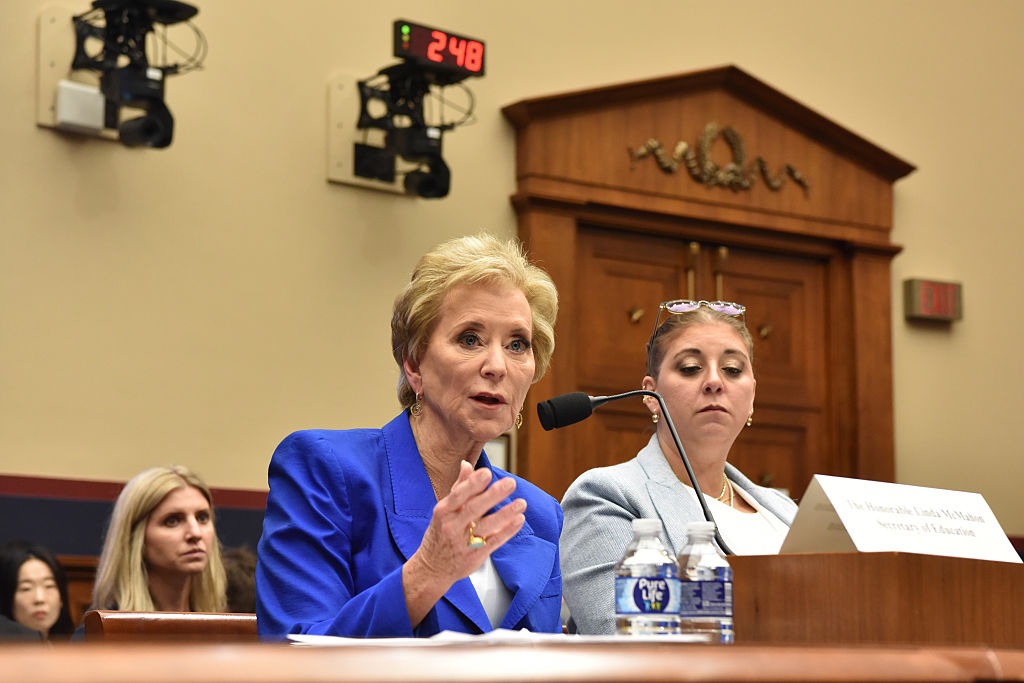
Education Secretary Linda McMahon defended her cuts to programs and staff before a House education committee June 4. (Sha Hanting/China News Service/VCG via Getty Images) Even if the Supreme Court rules in McMahon’s favor, its opinion won’t affect previous rulings and other lawsuits in progress against the department.
Here’s where some of those key legal battles stand:
COVID relief funds
McMahon stunned states in late March when she said they would no longer receive more than $2 billion in reimbursements for COVID-related expenses. States would have to make a fresh case for how their costs related to the pandemic, even though the department had already approved extensions for construction projects, summer learning and tutoring.
On June 3, a federal judge in Maryland blocked McMahon from pulling the funds.
Despite the judicial order, not all states have been paid.
The Maryland Department of Education still had more than $400 million to spend. Cherie Duvall-Jones, a spokeswoman, said the agency hasn’t received any reimbursements even though it provided the “necessary documentation and information” federal officials requested.
The cancellation forced Baltimore City schools to dip into a reserve account to avoid disrupting tutoring and summer school programs.
Madison Biedermann, a spokeswoman for the department, declined to comment on why it had yet to pay Maryland or how much the department has distributed to other states since June.
Mass firings
In the administration’s push to wind down the department, McMahon admits she still needs staff to complete what she calls her “final mission.” On May 21, she told a House appropriations subcommittee that she had rehired 74 people. Biedermann wouldn’t say whether that figure has grown, and referred a reporter to the hearing video.
“You hope that you’re just cutting fat,” McMahon testified. “Sometimes you cut a little in the muscle.”
The next day, a federal district court ordered her to also reinstate the more than 1,300 employees she fired in March, about half of the department’s workforce. Updating the court on progress, Chief of Staff Rachel Oglesby said in a July 8 filing that she’s still reviewing survey responses from laid off staffers and figuring out where they would work if they return.

Student protestors participate in the “Hands Off Our Schools” rally in front of the U.S. Department of Education on April 4 in Washington, D.C. (Getty Images) But some call the department’s efforts to bring back employees lackluster, perhaps because it’s pinning its hopes on a victory before the Supreme Court.
“This is a court that’s been fairly aggressive in overturning lower court decisions,” said Smith, with the National Center for Youth Law.
His group’s lawsuit is one of two challenging cuts to the Office for Civil Rights, which lost nearly 250 staffers and seven regional offices. They argue the cuts have left the department unable to thoroughly investigate complaints. Of the 5,164 civil rights complaints since March, OCR has dismissed 3,625, Oglesby reported.
In a case brought by the Victim Rights Law Center, a Massachusetts-based advocacy organization, a federal district court judge ordered McMahon to reinstate OCR employees.
Even if the case is not reversed on appeal, there’s another potential problem: Not all former staffers are eager to return.
“I have applied for other jobs, but I’d prefer to have certainty about my employment with OCR before making a transition,” said Andy Artz, who was a supervising attorney in OCR’s New York City office until the layoffs. “I feel committed to the mission of the agency and I’d like to be part of maintaining it if reinstated.”
DEI
An aspect of that mission, nurtured under the Biden administration, was to discourage discipline policies that result in higher suspension and expulsion rates for minority students. A 2023 memo warned that discrimination in discipline could have “devastating long-term consequences on students and their future opportunities.”
But according to the department’s Feb. 14 guidance, efforts to reduce those gaps or raise achievement among Black and Hispanic students could fall under its definition of “impermissible” DEI practices. Officials demanded that states sign a form certifying compliance with their interpretation of the law. On April 24, three federal courts ruled that for now, the department can’t pull funding from states that didn’t sign. The department also had to temporarily shut down a website designed to gather public complaints about DEI practices.
The cases, which McMahon has asked the courts to dismiss, will continue through the summer. In court records, the administration’s lawyers say the groups’ arguments are weak and that districts like Decatur simply overreacted. In an example cited in a complaint brought by the NAACP, the Waterloo Community School District in Iowa responded to the federal guidance by pulling out of a statewide “read-In” for Black History Month. About 3,500 first graders were expected to participate in the virtual event featuring Black authors and illustrators.
The department said the move reflected a misunderstanding of the guidance. “Withdrawing all its students from the read-In event appears to have been a drastic overreaction by the school district and disconnected from a plain reading of the … documents,” the department said.
Desegregation
The administration’s DEI crackdown has left many schools confused about how to teach seminal issues of American history such as the Civil Rights era.
It was the Civil Rights Act of 1964 that established “desegregation centers” across the country to help districts implement court-ordered integration.
In 2022, the Biden administration awarded $33 million in grants to what are now called equity assistance centers. But Trump’s department views such work as inseparable from DEI. When it cancelled funding to the centers, it described them as “woke” and “divisive.”
Judge Paul Friedman of the U.S. District Court for the District of Columbia, a Clinton appointee, disagreed. He blocked McMahon from pulling roughly $4 million from the Southern Education Foundation, which houses Equity Assistance Center-South and helped finance Brown v. Board of Education over 70 years ago. His order referenced President Dwight Eisenhower and southern judges who took the ruling seriously.
“They could hardly have imagined that some future presidential administration would hinder efforts by organizations like SEF — based on some misguided understanding of ‘diversity, equity, and inclusion’ — to fulfill Brown’s constitutional promise to students across the country to eradicate the practice of racial segregation.”
He said the center is likely to win its argument that canceling the grant was “arbitrary and capricious.”
Raymond Pierce, Southern Education Foundation president and CEO, said when he applied for the grant to run one of the centers, he emphasized its historical significance.
“My family is from Mississippi, so I remember seeing a ‘colored’ entrance sign on the back of the building as we pulled into my mother’s hometown for the holidays,” Pierce said.
Trump’s Justice Department aims to dismiss many of the remaining 130 desegregation orders across the South. Harmeet Dhillon, assistant attorney general for civil rights, has said the orders force districts to spend money on monitoring and data collection and that it’s time to “let people off the hook” for past discrimination.
But Eshé Collins, director of Equity Assistance Center-South, said the centers are vital because their services are free to districts.
“Some of these cases haven’t had any movement,” she said. “Districts are like ‘Well, we can’t afford to do this work.’ That’s why the equity assistance center is so key.”

Eshé Collins, director of Equity Assistance Center-South and a member of the Atlanta City Council, read to students during a visit to a local school. (Courtesy of Eshé Collins) Her center, for example, works with the Fayette County schools in Tennessee to recruit more Black teachers and ensure minority students get an equal chance to enroll in advanced classes. The system is still under a desegregation order from 1965, but is on track to meet the terms set by the court next year, Collins said. A week after Friedman issued the injunction in the foundation’s case, Ruth Ryder, the department’s deputy assistant secretary for policy and programs, told Collins she could once again access funds and her work resumed.
Research
As they entered the Department of Education in early February, one of the first moves made by staffers of the Department of Government Efficiency was to terminate nearly $900 million in research contracts awarded through the Institute for Education Sciences. Three lawsuits say the cuts seriously hinder efforts to conduct high-quality research on schools and students.
Kevin Gee from the University of California, Davis, was among those hit. He was in the middle of producing a practice guide for the nation on chronic absenteeism, which continues to exceed pre-pandemic levels in all states. In a recent report, the American Enterprise Institute’s Nat Malkus said the pandemic “took this crisis to unprecedented levels” that “warrant urgent and sustained attention.” Last year’s rate stood at nearly 24% nationally — still well above the 15% before the pandemic.
Gee was eager to fully grasp the impact of the pandemic on K-3 students. Even though young children didn’t experience school closures, many missed out on preschool and have shown delays in social and academic skills.
Westat, the contractor for the project, employed 350 staffers to collect data from more than 860 schools and conduct interviews with children about their experiences. But DOGE halted the data collection midstream — after the department had already invested about $44 million of a $100 million contract.
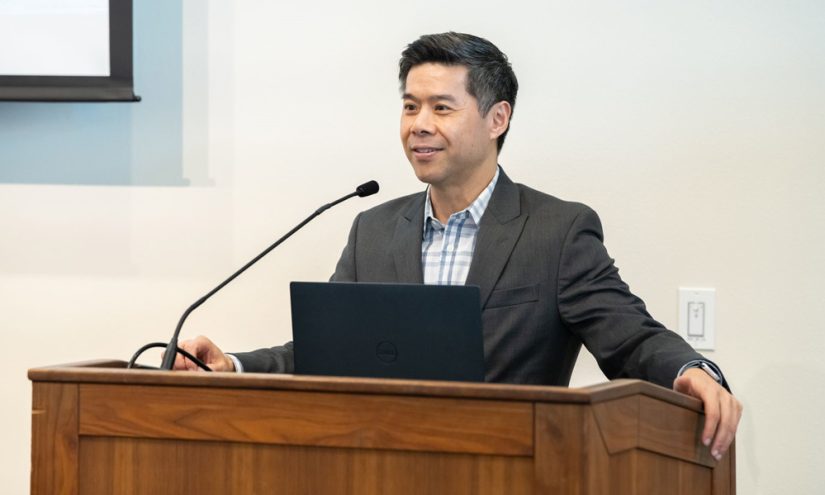
Kevin Gee, an education researcher at the University of California, Davis, had to stop his research work when the Trump administration cancelled grants. (Courtesy of Kevin Gee) “The data would’ve helped us understand, for the first time, the educational well-being of our nation’s earliest learners on a nationwide scale in the aftermath of the pandemic,” he said.
The department has no plans to resurrect the project, according to a June court filing. But there are other signs it is walking back some of DOGE’s original cuts. For example, it intends to reissue contracts for regional education labs, which work with districts and states on school improvement.
“It feels like the legal pressure has succeeded, in the sense that the Department of Education is starting up some of this stuff again,” said Cara Jackson, a past president of the Association for Education Finance and Policy, which filed one of the lawsuits. “I think … there’s somebody at the department who is going through the legislation and saying, ‘Oh, we actually do need to do this.’ ”
Mental health grants
Amid the legal machinations, even some Republicans are losing patience with McMahon’s moves to freeze spending Congress already appropriated.
In April, she terminated $1 billion in mental health grants approved as part of a 2022 law that followed the mass school shooting in Uvalde, Texas. The department told grantees, without elaboration, that the funding no longer aligns with the administration’s policy of “prioritizing merit, fairness and excellence in education” and undermines “the students these programs are intended to help.”
The secretary told Oregon Democratic Sen. Jeff Merkley in June that she would “rebid” the grants, but some schools don’t want to wait. Silver Consolidated Schools in New Mexico, which lost $6 million when the grant was discontinued, sued her on June 20th. Sixteen Democrat-led states filed a second suit later that month.
The funds, according to Silver Consolidated’s complaint, allowed it to hire seven mental health professionals and contract with two outside counseling organizations. With the extra resources, the district saw bullying reports decline by 30% and suspensions drop by a third, according to the district’s complaint. Almost 500 students used a mental health app funded by the grant.
A judge has yet to rule in either case, but Republican Rep. Brian Fitzpatrick of Pennsylvania and other members of a bipartisan task force are holding McMahon to her word that she’ll open a new competition for the funds.
“These funds were never intended to be a theoretical exercise — they were designed to confront an urgent crisis affecting millions of children,” Fitzpatrick said in a statement. “With youth mental health challenges at an all-time high, any disruption or diversion of resources threatens to reverse hard-won progress and leave communities without critical supports.”
Get stories like these delivered straight to your inbox. Sign up for The 74 Newsletter
-

Child Care Worker Detained by ICE Leaves a Community Reeling – The 74
Get stories like this delivered straight to your inbox. Sign up for The 74 Newsletter
This story was originally reported by Chabeli Carrazana of The 19th.
Two years ago, Nicolle Orozco Forero walked into an in-home day care in Seattle, Washington, looking for a job. She was barely 22, a whole five feet tall — if that. But she was calm, focused. Her presence struck the owner, Stephanie Wishon, because it’s not easy to find qualified staff who can work with children with disabilities.
Orozco Forero had experience working with kids who had autism back in Colombia, so Wishon had her come in for a trial run and hired her after the first day. The children, who needed someone who had love and care to give in abundance, gravitated toward her. She was good at the hardest stuff. She changed diapers and outfits the moment they were soiled. She was vigilant; her kids stayed pristine. And she got them to do the things they wouldn’t do for other people, like say “ah” when it was time to get their teeth brushed or sit still long enough for her to twist a braid down their back.
Some people just have that way about them.
And people like Orozco Forero are exceptionally rare. Already, the staffing shortage in child care is near crisis levels. It’s far worse for children with disabilities — about a third of those families say they face significant difficulty finding care for their kids, partly because there are too few people with the ability, expertise or desire to work with their children. Immigrant women like Orozco Forero have been helping to fill that void. They now make up 20 percent of all child care workers.
At home, Orozco Forero was also caring for her own young boys, one of whom started to show symptoms of a serious illness over the past two years that doctors have not yet been able to diagnose. She took some time off to care for him last year, before returning to the kids at Wishon’s day care.
Her work has kept an already precarious safety net together. Without women like Orozco Forero, families who have nowhere else to turn for care have to make difficult decisions about how to survive and keep their children safe. Without her, the safety net snaps.
And that’s exactly what happened on June 18, the day she was detained.
It was supposed to be a routine meeting with U.S. Immigration and Customs Enforcement (ICE). Orozco Forero and her husband had been to all their monthly meetings for the past year and change, since their asylum charge was denied in April 2024.
The family — Orozco Forero; her husband, Juan Sebastian Moreno Acosta; and their two sons, Juan David, 7, and Daniel, 5 — fled Colombia two years ago. Moreno Acosta, a street vendor, had been persecuted by gangs who target vendors for money.
After arriving in the United States, they sought the help of a lawyer with their asylum claim, but when they couldn’t pay his full fee ahead of their hearing, he pulled out. They represented themselves in court and lost the case. With no knowledge of the U.S. court system, they didn’t know they had 30 days to appeal the ruling, either. Ever since, ICE has been monitoring them, requiring they wear a wrist tracker and meet with an immigration officer once a month, sometimes more, according to a family member. (The 19th is not naming the family member to protect their identity.) It’s unclear why ICE has allowed them to stay in the country all this time, though it’s not necessarily uncommon; ICE typically prioritized immigrants with felonies for deportation.
Orozco Forero had seen the reports of illegal immigrants being rounded up at their immigration appointments. President Donald Trump’s mass deportation effort has led to the detention of about 30,000 migrants with no criminal record, like Orozco Forero, who now make up about half of those detained. Her husband does have a misdemeanor reckless driving conviction for driving under the influence of alcohol on his record, but he completed a court-mandated alcohol course for that and has no other convictions.
Still, Orozco Forero wasn’t worried when she headed to her appointment on the morning of June 18. If ICE planned to detain her, Orozco Forero thought, they would have asked her to come with the boys, right?
And she had been doing everything right: She’d gone to all her appointments, taken documentation to show she was going to school at Green River Community College taking courses in English and early childhood education. She had completed a child care internship that trained her to open her own licensed in-home day care. Her licensure approval was set to arrive any moment, likely that same week, and the day care was just about ready to go.
But that morning, her family was still wary, asking her to share her location just in case.
Shortly after 10 a.m., Orozco Forero texted her family member: “They are going to deport us”
“Nicolle what happened? Nicolle answer me,” they texted back. “What do I do?”
“I can’t speak I feel like I’m going to faint,” Orozco Forero replied. And then: “I’m sorry it wasn’t what we expected.”
Two-and-a-half hours west, on the coast of Washington in a town called Southbend, Wishon was frantic. Orozco Forero had texted her, too. ICE was asking for the boys.
In two years, Wishon had grown incredibly close to Orozco Forero, who had cared for her own kids. After her family moved to the coast, Wishon rented out her house in Seattle to Orozco Forero, whose boys were excited to have a home with a yard.
Wishon’s husband, Gabriel, hopped into his truck and headed to Seattle. Wishon, meanwhile, got on the phone with the Orozco Forero family’s ICE agent and every lawyer she could. They were going to take them into detention at a facility 2,200 miles away in Texas, a facility that was reopened earlier this year by the Trump administration to detain families. Wishon wanted to find a lawyer who could stop the deportation order, and she wanted to make sure the boys would be reunited with their parents if they took them to meet the ICE agent.
Nicolle Orozco Forero’s sons play with a child their mother takes care of. (Stephanie Wishon) And that was especially important, not just because they were young children, but because Juan David is still sick.
For the past year, he’s been seeking treatment at Seattle Children’s Hospital for an illness that is turning his urine muddy. So far, doctors have determined he’s losing red blood cells and protein through his urine, indicating a possible kidney issue, but they haven’t yet zeroed in on what is causing the problem. They likely need a kidney biopsy to be sure.
“Given the complexity of his case, it is essential that Juan remain in the United States for continued testing and treatment,” his nephrologist Jordan Symons wrote in a March letter to ICE. “We kindly request that you consider this medical necessity in your review of his immigration status and grant him the ability to stay in the United States until his treatment and evaluation are completed.”
Juan David’s care team has been monitoring him closely to ensure his red blood cell and protein levels never drop too low. His condition could become serious quickly.
“You can die from that,” said Sarah Kasnick, a physician’s assistant who is familiar with his case. Kasnick is also a foster parent, and Orozco Forero provided care for her family.
When Gabriel Wishon arrived to pick up the boys, they were confused and disoriented. Where were their parents? Why was everyone crying? They didn’t want to go to Colombia, they told him on the drive. They wanted to stay in the United States.
Around 5:30 p.m. that evening, he met with the ICE agent, who had waited past her work hours for them to arrive.
“Bye boys, you are going to see your parents right now. They are right inside,” Wishon told them. He watched them walk in carrying two stuffed animals, a Super Mario doll and Chase, the popular cartoon dog dressed as a police officer.
The families Orozco Forero cares for are now in a free fall.
Jessica Cocson, whose son has been in Orozco Forero’s care for more than a year, described her in a character letter to ICE as a “blessing to us in ways I struggle to fully express.”
Orozco Forero and her husband “support working families, provide quality childcare, and demonstrate compassion and commitment every day,” Cocson wrote. “It is heartbreaking to think that someone who gives so much and asks so little could be forced to leave.”
Tamia Riley, whose two sons with autism were also in Orozco Forero’s care, said losing her was like watching “a father walking out the door.”
“These people, these day care providers, sitters, they are a form of family members for me and my children,” Riley said.
Now, the day care she was set to open lays empty. Inside, the walls are plastered with posters listing colors and sight words. There are cushioned mats on the floor and play stations. Tables with tiny chairs. A tall pink dollhouse. High chairs and a pack and play for the babies. Outside, two play houses, a ball pit, toys to ride on and little picnic tables set across an artificial turf. But no children to enjoy any of it.
Big Dreams Day Care she was going to call it, for the dreams she wanted the kids in her care to strive for, and the ones that were finally coming to fruition for her.
Orozco Forero’s detention has rattled child care workers across the country. In Texas, workers represented by the Service Employees International Union have been rallying in her name. U.S. Rep. Joaquin Castro, a Texas Democrat, spoke in support of the family’s release at a rally on June 29 in San Antonio. And a group of union workers is attempting to deliver supplies to the family. It’s an effort Orozco Forero knows little about; she only has limited communication with those on the outside.
Tricia Schroeder, the president of the Seattle-based SEIU chapter that represents care workers, said that, for years unions like hers have been working to improve quality, access and affordability in child care, a system in such deep crisis it’s been called by the Treasury Department “a textbook example of a broken market.”
Immigrant women like Orozco Forero were part of that effort to improve access, doing jobs few Americans want to take on.
“Detaining child care providers, especially those who care for kids with special needs, just deepens the crisis in early learning,” Schroeder said.

Nicolle Orozco Forero was going to community college for early childhood education and planned to open her own daycare before she was detained by ICE. (Stephanie Wishon) Orozco Forero was also the connective tissue that kept families employed. Her loss has rippled across industries.
Kasnick, the foster parent, said one of the children in her care had been tentatively set to start at Orozco Forero’s day care as soon as it opened. Orozco Forero had been the only provider who would take the child, who has autism and is nonverbal.
Orozco Forero had cared for the girl at Wishon’s day care as if she was her own, even taking her in once when the child’s care had fallen through and no foster family in the entire county would take her in because of the complexity of her needs. The girl arrived at Orozco Forero’s house at midnight on a weekend “with no clothing, toys, medication or any of her belongings … this did not [deter] Nicolle and Sebastian instead they immediately went and purchased all the things” the child needed, a social worker wrote in a letter to ICE. Kasnick said Orozco Forero was even considering becoming a foster parent.
Without her, Kasnick is out of options: She quit her job as a physician’s assistant to care for the child after Orozco Forero was detained.
“There are now 44 patients a day who don’t have anyone to provide their health care, and I can’t go to work because Nicolle’s day care didn’t open,” Kasnick said.
In the weeks since, Kasnick has had an overwhelming feeling of helplessness, she said. How could this happen to someone who gave back so much?
“The security of knowing that you can be in your home one day and in a prison the next week, and you didn’t do anything except exist?” she said. “It makes you feel like there’s no good left in the world.”
Orozco Forero’s family has now been in ICE detention for nearly a month awaiting a bond hearing that could buy them time in the United States. Orozco Forero and the boys are together; her husband is in the same facility but separated from them.
Juan David hasn’t been eating. It took three weeks for him to receive medical care, Orozco Forero told her attorney, James Costo.
Costo has been working to get the details of why ICE allowed the family to stay in the country with monitoring after they lost their asylum case last year. There has been an order for their deportation since then, but ICE never attempted to deport them until the Trump administration ramped up efforts. The number of immigrants without criminal convictions who have been detained has doubled since May.
The process to fight an asylum claim and appeal a denial is complicated — there are court deadlines, documents that need to be submitted and translated.
“They think maybe they can do it themselves and go in and say what happened but they are not understanding the whole legal process,” Costo said. “The system isn’t made for things to be easy.”
Costo is hopeful a judge will allow them to stay in the country temporarily as Juan David seeks care. They have almost no family left in Colombia, and no way to obtain care for him there, their family said. If they can stay, then perhaps Orozco Forero could try to obtain a work visa as a domestic worker.
He has gathered letters of support from numerous people whose lives the Orozco Forero family touched, and Wishon set up a GoFundMe to cover her legal expenses.
In the letters, Juan David’s first grade teachers call him an exceptional student who went from one of the lowest reading levels in the class — 10 words a minute — to one of the highest at 70 words a minute.
“He shows the qualities of a model citizen at a young age — dependable, ethical, and hard-working,” wrote his teacher, Carla Trujillo.
They were all on their way to shaping a better future, Wishon wrote in hers. The couple “worked tirelessly to build a better life for their children and to open their own licensed child care business. In all my years of employing and mentoring caregivers, I have rarely met a couple as responsible, driven, and capable as Nicolle and Sebastian.”
“This family is not a threat,” she concluded. “They are an asset.”

Get stories like these delivered straight to your inbox. Sign up for The 74 Newsletter
-
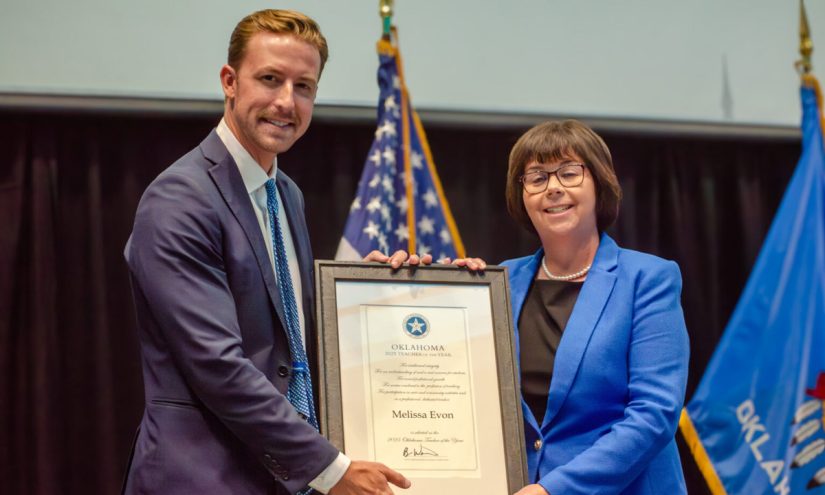
An Oklahoma Teacher Took a Leap of Faith. She Ended Up Winning State Teacher of the Year – The 74
Get stories like this delivered straight to your inbox. Sign up for The 74 Newsletter
OKLAHOMA CITY — Those who knew Melissa Evon the best “laughed really hard” at the thought of her teaching family and consumer sciences, formerly known as home economics.
By her own admission, the Elgin High School teacher is not the best cook. Her first attempt to sew ended with a broken sewing machine and her mother declaring, “You can buy your clothes from now on.”
Still, Evon’s work in family and consumer sciences won her the 2025 Oklahoma Teacher of the Year award on Friday. Yes, her students practice cooking and sewing, but they also learn how to open a bank account, file taxes, apply for scholarships, register to vote and change a tire — lessons she said “get kids ready to be adults.”
“Even though most of my career was (teaching) history, government and geography, the opportunity to teach those real life skills has just been a phenomenal experience,” Evon told Oklahoma Voice.
After graduating from Mustang High School and Southwestern Oklahoma State University, Evon started her teaching career in 1992 at Elgin Public Schools just north of Lawton. She’s now entering her 27th year in education, a career that included stints in other states while her husband served in the Air Force and a break after her son was born.
No matter the state, the grade level or the subject, “I’m convinced I teach the world’s greatest kids,” she said.
Her family later returned to Oklahoma where Evon said she received a great education in public schools and was confident her son would, too.
Over the course of her career, before and after leaving the state, she won Elgin Teacher of the Year three times, district Superintendent Nathaniel Meraz said.
So, Meraz said he was “ecstatic” but not shocked that Evon won the award at the state level.
“There would be nobody better than her,” Meraz said. “They may be as good as her. They may be up there with her. But she is in that company of the top teachers.”
Oklahoma Teacher of the Year Melissa Evon has won her district’s top teacher award three times. (Photo provided by the Oklahoma State Department of Education) Like all winners of Oklahoma Teacher of the Year, Evon will spend a year out of the classroom to travel the state as an ambassador of the teaching profession. She said her focus will be encouraging teachers to stay in education at a time when Oklahoma struggles to keep experienced educators in the classroom.
Evon herself at times questioned whether to continue teaching, she said. In those moments, she drew upon mantras that are now the core of her Teacher of the Year platform: “See the light” by looking for the good in every day and “be the light for your kids.”
She also told herself to “get out of the boat,” another way of saying “take a leap of faith.”
Two years ago, she realized she needed a change if she were to stay in education. She wanted to return to the high-school level after years of teaching seventh-grade social studies.
The only opening at the high school, though, was family and consumer sciences. Accepting the job was a “get out of the boat and take a leap of faith moment,” she said.
“I think teachers have to be willing to do that when we get stuck,” Evon said. “Get out of the boat. Sometimes that’s changing your curriculum. Sometimes it might be more like what I did, changing what you teach. Maybe it’s changing grade levels, changing subjects, changing something you’ve always done, tweaking that idea.”
Since then, she’s taught classes focused on interpersonal communication, parenting, financial literacy and career opportunities. She said her students are preparing to become adults, lead families and grow into productive citizens.
And, sure, they learn cooking and sewing along the way.
“I’m getting to teach those things, and I know that what I do matters,” Evon said. “They come back and tell me that.”
Oklahoma Voice is part of States Newsroom, a nonprofit news network supported by grants and a coalition of donors as a 501c(3) public charity. Oklahoma Voice maintains editorial independence. Contact Editor Janelle Stecklein for questions: [email protected].
Get stories like these delivered straight to your inbox. Sign up for The 74 Newsletter
-

Expanded AI Makes Active, Personalized Learning More Accessible
Top Hat’s AI-powered assistant, Ace, just got even better. Two new features—example generation and personalized practice—make it easier than ever for educators to personalize learning and give students the support they need to stay on track.
Ace was designed to take the heavy lifting out of creating assessments and provide students with help when they need it. Now, it’s enabling educators to make learning more relevant by connecting course content to student interests and career goals and by offering targeted practice based on where students are struggling most.
“Each of these features reflects our belief that great teaching and learning happens when technology helps people do what they do best,” said Maggie Leen, CEO of Top Hat. “With Ace, we’re building an experience that empowers busy educators and motivates students to connect, explore, practice, and succeed.”
Since its introduction in 2023, Ace has become a trusted partner for instructors seeking to deepen engagement and boost learning outcomes. The new enhancements make it simple for educators to implement teaching practices shown to improve learning, and enhance student success through on-demand, personalized study support.
Example Generation: Make Content More Relevant and Engaging
One of the biggest challenges in teaching is helping students see why what they’re learning actually matters. With Ace’s new example generation feature, educators can highlight any part of their course material and ask Ace to create a scenario that ties the concept to something students might encounter in their future careers—or even in everyday life. For instance, an educator teaching anatomy to nursing students might ask Ace to show how muscle function affects patient mobility. When content is connected to students’ goals or lived experiences, it becomes more relevant and meaningful.
This new capability builds on Ace’s popular question generation tool used by faculty to create formative assessments from their content with just a few clicks. With example generation, educators have another fast and flexible way to personalize course material and make learning more engaging.
Personalized Practice: Turn Mistakes Into Learning Opportunities
Many students want more chances to practice but often don’t know what to review or where to start. Ace’s new personalized practice feature gives them just that. As students work through assigned readings and questions, Ace pinpoints where they’re struggling and creates targeted practice sets based on those areas. Feedback is instant, helping students stay on track and build confidence before high-stakes tests.
More than 100,000 students have used Ace for on-demand study help—from chat-based explanations to unlimited practice questions tied directly to their course content. The new personalized practice feature builds on these tools by offering even more tailored support. It’s a smarter, more continuous way to learn, to build confidence, and deepen understanding over time.
“Ace shows what’s possible when AI is used thoughtfully to empower instructors, reflect students’ interests, and elevate the learning experience,” said Hong Bui, Chief Product Officer at Top Hat. “As Ace continues to evolve, we’ll add new capabilities to help educators teach more efficiently and create more impactful, engaging experiences for their students.”
-

Common Sense Media releases AI toolkit for school districts
Key points:
Common Sense Media has released its first AI Toolkit for School Districts, which gives districts of all sizes a structured, action-oriented guide for implementing AI safely, responsibly, and effectively.
Common Sense Media research shows that 7 in 10 teens have used AI. As kids and teens increasingly use the technology for schoolwork, teachers and school district leaders have made it clear that they need practical, easy-to-use tools that support thoughtful AI planning, decision-making, and implementation.
Common Sense Media developed the AI Toolkit, which is available to educators free of charge, in direct response to district needs.
“As more and more kids use AI for everything from math homework to essays, they’re often doing so without clear expectations, safeguards, or support from educators,” said Yvette Renteria, Chief Program Officer of Common Sense Media.
“Our research shows that schools are struggling to keep up with the rise of AI–6 in 10 kids say their schools either lack clear AI rules or are unsure what those rules are. But schools shouldn’t have to navigate the AI paradigm shift on their own. Our AI Toolkit for School Districts will make sure every district has the guidance it needs to implement AI in a way that works best for its schools.”
The toolkit emphasizes practical tools, including templates, implementation guides, and customizable resources to support districts at various stages of AI exploration and adoption. These resources are designed to be flexible to ensure that each district can develop AI strategies that align with their unique missions, visions, and priorities.
In addition, the toolkit stresses the importance of a community-driven approach, recognizing that AI exploration and decision-making require input from all of the stakeholders in a school community.
By encouraging districts to give teachers, students, parents, and more a seat at the table, Common Sense Media’s new resources ensure that schools’ AI plans meet the needs of families and educators alike.
This press release originally appeared online.
 Latest posts by eSchool News Staff (see all)
 -

Are Chinese students losing interest in the ‘big four’?
Once the world’s largest source of international students, China is no longer expected to fuel further student growth in the ‘big four’ destinations, according to predictions from Bonard Education shared in a recent webinar.
“China is no longer the easy goldmine it once was”, Bonard senior research consultant, Su Su, told attendees, highlighting the “visible trend” of Chinese students choosing alternative options closer to home.
The US has seen the most noticeable decline in Chinese enrolments, which broadly started across traditional destinations in 2020/21 and has continued in the US over the past five years, according to Bonard data.
Amid the downturn in Chinese mobility to the US, India surpassed China as America’s largest sending country in 2023 and new government data has shown this gap continue to widen.

Source: BONARD The UK, however, is bucking the trend and has witnessed continued modest growth in Chinese students since 2020, though this cohort’s visa approval rate saw a 6% year-on-year decline in 2024.
Elsewhere, Canada experienced a 21% drop in Chinese visa approvals last year as the impact of the government’s study permit caps took hold, but university enrolment nevertheless remains stable, signalling the visa decline is concentrated in non-university level students.
Meanwhile, Australia and New Zealand saw a modest rebound in Chinese enrolment in 2023/24, with Su maintaining that China was still a “pivotal” source market despite fluctuations.
The waning dominance of China as a source market can partly be attributed to the state of the economy, with financial pressure becoming the most cited factor impacting study decisions, according to Bonard’s agent network.
“Middle class families are experiencing slower financial growth, and, as a result, are more economically conscious,” explained Su, fuelling a rise in shorter term English language courses as well as impacting the post-secondary sector.
What’s more, China’s urban unemployment rate among 16-24-year-olds jumped to an all-time high of 19% last year, pushing career outcomes up the priority list for students and their families, said Su.
Given the financial context, “families are determined to make every RMB count”, said Su, with more affordable Asian destinations becoming increasingly attractive in China.
The PIE News has previously reported on the rise of intra-Asian mobility, with countries in the region increasingly seeing internationalisation as critical to sustaining economic growth, plugging workforce gaps and driving innovation.
In particular, the National Universities of Singapore and Hong Kong were highlighted as hitting the sweet spot by offering highly regarded international degrees at a lower price than traditional destinations – catering to families who still value prestige and the merits of an international education, but who are shopping “smarter”.
Elsewhere, Japan, South Korea and Malaysia are on the rise, with the Japanese government pursuing an ambitious goal of attracting 400,000 international students by 2033 and Malaysia streamlining international admissions through a new centralised system.
But it’s not just affordability that is changing the landscape: perceived policy volatility “can shape perspective just as much as the price”, said Su, highlighting the damaging impact of Donald Trump’s erratic policy announcements in the US.
“Recent headlines in the US are raising serious concerns among families, whether or not the policies are enacted,” Su warned.
By comparison, despite some restrictions in the UK: “It feels more stable… agencies are describing the UK as the safest bet due to its clear communication of policies,” attendees heard.
That being said, political environments tend to have a temporary impact on student decision-making, with agencies and institutions advised that now is the time to “adapt and rethink” rather than turning away from the Chinese market.