Category: News

  • It’s Expensive to Become a Teacher in California. This Bill Would Pay Those Who Try – The 74

    It’s Expensive to Become a Teacher in California. This Bill Would Pay Those Who Try – The 74


    Get stories like this delivered straight to your inbox. Sign up for The 74 Newsletter

    This story was originally published by CalMatters. Sign up for their newsletters.

    When Brigitta Hunter started her teaching career, she had $20,000 in student loans and zero income – even though she was working nearly full time in the classroom.

    “We lived on my husband’s pathetic little paycheck. I don’t know how we did it,” Hunter said. “And we were lucky – he had a job and my loans weren’t that bad. It can be almost impossible for some people.”

    Each year, about 28,000 people in California work for free for about a year as teachers or classroom aides while they complete the requirements for their teaching credentials. That year without pay can be a dire hardship for many aspiring teachers, even deterring them from pursuing the profession.

    A new bill by Assemblymember Al Muratsuchi, a Democrat from Torrance, would set aside money for school districts to pay would-be teachers while they do their student teaching service. The goal is to help alleviate the teacher shortage and attract lower-income candidates to the profession.

    “Nothing makes a bigger difference in improving the quality of public education than getting highly qualified teachers in the classroom,” Muratsuchi said. “This bill helps remove some of the obstacles to that.”

    Big loans, low pay

    To be a K-12 public school teacher in California, candidates need a bachelor’s degree and a teaching credential, typically earned after completing a one-year program combining coursework and 600 hours of classroom experience. During that time, candidates work with veteran teachers or lead their own classes.

    Teacher credential programs cost between $20,000 and $40,000, depending on where a student enrolls and where they live. In 2020, about 60% of teachers borrowed money to finish their degrees, according to a recent study by the Learning Policy Institute, with loans averaging about $30,000 for a four-year bachelor’s degree and a credential program.

    Entering the profession with hefty student loans can be demoralizing and stressful, the report said, adding to the challenges new teachers face. The average starting teacher salary in California is $58,000, according to the National Education Association, among the highest in the country but still hard to live on in many parts of the state. It could take a decade or more for teachers to pay off their loans.

    Muratsuchi’s bill, AB 1128, passed the Assembly on Monday and now awaits a vote in the Senate. It would create a grant program for districts to pay student teachers the same amount they pay substitute teachers, which is roughly $140 a day. The overall cost would be up to $300 million a year, according to Assembly analysts, but Gov. Gavin Newsom has set aside $100 million for the program in his revised budget.

    Muratsuchi has another bill related to teacher pay, also working its way through the Legislature. Assembly bill 477, which passed the Assembly this week, would raise teacher salaries across the board.

    Paying teachers, saving money

    Christopher Carr, executive director of Aspire Public Schools in Los Angeles, a network of 11 charter schools, called the bill a potential “game changer.”

    Teacher candidates often have to work second jobs to make ends meet, and sometimes finish with debt of $70,000 or more, he said. That can be an insurmountable barrier for people with limited resources. Paying would-be teachers would attract more people to the teaching profession, especially Black and Latino candidates, he said.

    School districts around the state have been trying to diversify their teacher workforces, based on research showing that Black and Latino students tend to do better academically when they have at least one teacher of the same race.

    Carr’s schools pay their teachers-in-training through grants and a partnership with a local college, which has led to more of them staying on to teach full time after they receive their credentials, he said. That has saved the schools money by reducing turnover.

    “This could open doors and be a step toward racial justice,” Carr said. “California has a million spending priorities, but this will lead to better outcomes for students and ultimately save the state money.”

    Tyanthony Davis, chief executive director of Inner City Education Foundation, a charter school network in Los Angeles, put it this way: “If we have well paid, qualified, happy teachers, we’ll have happier classrooms.”

    No opposition, yet

    Muratusuchi’s bill has no formal opposition. The California Taxpayers Association has not taken a position. The California Teachers Association, the state’s largest teachers union, is a supporter.

    “This legislation comes at a critical time as we continue to face an educator recruitment and retention crisis,” said David Goldberg, the union president. “Providing new grants to compensate student teachers for important on-the-job training is a strong step forward in the right direction to strengthening public education.”

    Hunter survived her student-teaching experience and went on to teach fourth grade for 34 years, retiring last year from the Mark West Union School District in Santa Rosa. The last 15 years of her career she served as a mentor to aspiring teachers. She saw first-hand the stress that would-be teachers endure as they juggle coursework, long days in the classroom and often second jobs on nights and weekends.

    But paying student-teachers, she said, should only be the beginning. Novice teachers also need  smaller class sizes, more support from administrators and more help with enrichment activities, such as extra staff to lead lessons in art and physical education.

    “We definitely need more teachers, and paying student teachers is a good start,” Hunter said. “But there’s a lot more we can do to help them.”

    This article was originally published on CalMatters and was republished under the Creative Commons Attribution-NonCommercial-NoDerivatives license.


    Get stories like these delivered straight to your inbox. Sign up for The 74 Newsletter

    Source link

  • Judge blocks Trump’s international enrolment ban

    Judge blocks Trump’s international enrolment ban

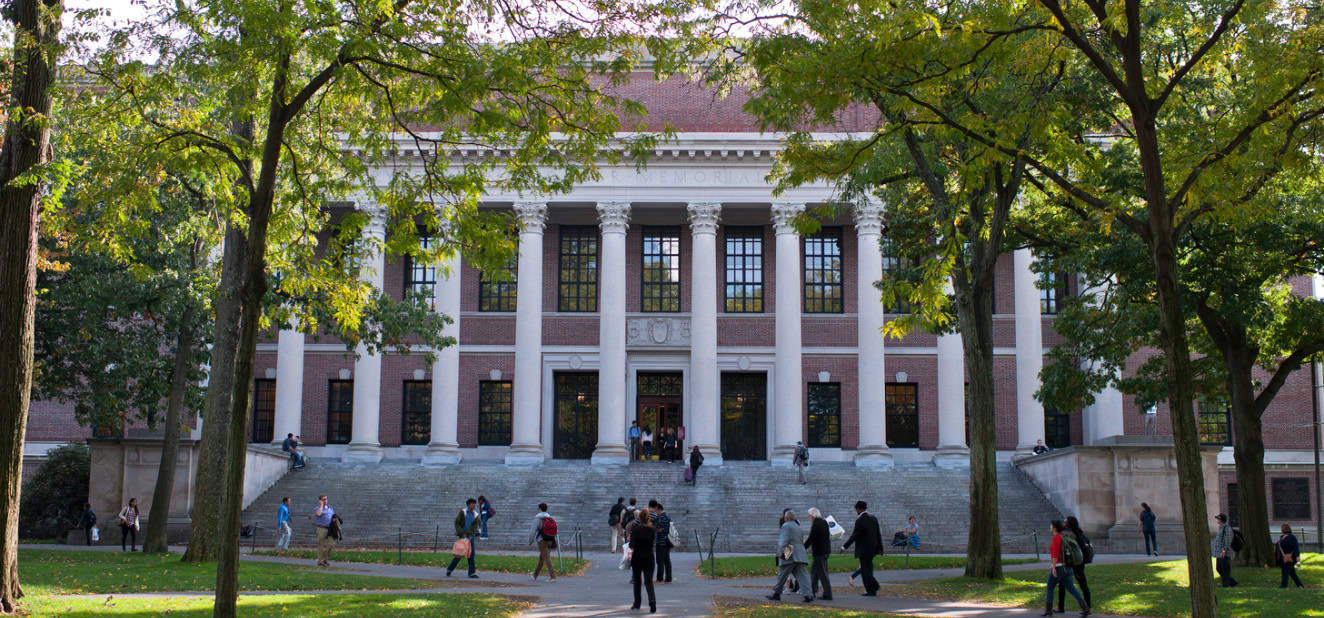
    The temporary restraining order (TRO) was issued by federal judge Allison Burroughs on June 5, just one day after President Trump’s signing of a proclamation to suspend the issuing of US visas to international students entering Harvard for an initial six months.   

    During the Massachusetts hearing, Burroughs said Trump’s directive would cause “immediate and irreparable injury” to America’s oldest institution, temporarily blocking it “until there is opportunity to hear from all parties”. 

    The judge also extended a 23 May restraining order which prevents DHS’s attempt to strip Harvard of its ability to enrol international students, until June 20 or when a preliminary injunction is issued, with a hearing set for June 16. 

    The June 4 proclamation came in addition to, and aims to circumvent, DHS secretary Kristi Noem’s revocation of Harvard’s SEVP certification, which was also blocked by the courts.  

    Wednesday’s directive – which incorrectly refers to SEVP as the “Student and Exchange Visa Program” – attempts to bar all new international students, scholars and exchange visitors from pursuing any course of study at the university, for a period of six months. 

    With the stroke of a pen, the DHS Secretary and the President have sought to erase a quarter of Harvard’s student body

    Harvard University

    This time, the government framed the ban as a matter of national security, accusing Harvard of collaborating with China. It has repeatedly criticised the institution for failing to root out antisemitism on campus and failing to hand over information on international students.  

    For its part, hours before judge Burroughs’ ruling, Harvard amended a previous lawsuit, alleging both the June 4 proclamation and the DHS revocation were “part of a concerted and escalating campaign of retaliation by the government” in clear retribution for Harvard’s exercising its First Amendment rights to free speech.  

    “With the stroke of a pen, the DHS Secretary and the President have sought to erase a quarter of Harvard’s student body,” it reads, in what the complaint calls a “government vendetta against Harvard”.  

    Last year, Harvard hosted 6,793 international students, totalling over 27% of the entire student body, though Trump has mistakenly called the figure 31%.

    Meanwhile, on June 5, Harvard’s President Garber sent a letter to the Harvard community, informing students that “contingency plans” were being drawn up to allow students to continue their studies during the summer and the upcoming academic year.

    Reaffirming the “outstanding contributions” of international students, Garber vowed to “celebrate them, support them, and defend their interests as we continue to assert our Constitutional rights”.  

    Source link

  • Education researchers lose to Trump administration in first round of court challenge

    Education researchers lose to Trump administration in first round of court challenge

    The courts have pushed back against much of President Donald Trump’s agenda, but he did win a small victory this week in a dispute with education researchers.

    On June 3, a federal judge in Washington, D.C., denied a request by four education research trade associations for a preliminary injunction, which means that the Education Department doesn’t have to temporarily reinstate fired employees and canceled contracts within its research and data arm, the Institute of Education Sciences.

    Researchers had hoped to return the research division to its pre-Trump status while the court takes time to decide the overall issue in the case, which is whether the Trump administration exceeded its executive authority in these mass firings and contract terminations. Now, the cuts in the research arm of the department will remain while the case proceeds. 

    Four education research groups (the Association for Education Finance and Policy (AEFP), the Institute for Higher Education Policy (IHEP), the National Academy of Education (NAEd) and the National Council on Measurement in Education (NCME)) are suing the Education Department because their federally funded studies, evaluations and surveys have been slashed and their access to data is slated to be curtailed. They also contend that historical data archives are at risk, along with future data quality. Their legal argument is that the cuts were arbitrary and capricious and they say that the Trump administration eliminated many activities that Congress requires by law.

    Related: Education researchers sue Trump administration, testing executive power

    U.S. District Judge Trevor McFadden acknowledged that the “upheaval” at the Institute of Education Sciences is “understandably jarring for those who rely on studies and data produced by the Institute.” However, McFadden explained in a written opinion that the law that the researchers are using to sue the executive branch, the Administrative Procedure Act, was “never meant to be a bureaucratic windbreak insulating agencies from political gales.”

    “It is not this Court’s place to breathe life back into wide swathes of the Institute’s cancelled programs and then monitor the agency’s day-to-day statutory compliance,” McFadden wrote.

    In the opinion, McFadden noted that some of the researchers’ complaints, such as losing remote access to student data for research purposes, may be “ripe for standalone challenges,” but bundling all of their grievances together is a “losing gambit.”

    The ruling not only denied researchers the short-term remedy they sought but also cast doubt on the prospects of their overall case. “We are disappointed with and disagree with the Court’s decision, and are evaluating our next steps,” said Adam Pulver, an attorney at Public Citizen, a nonprofit advocacy organization representing two of the research organizations.

    A federal judge in Maryland is still considering a similar request to temporarily restore research-related cuts at the Education Department by two other education research groups. That suit, which also accuses the Trump administration of exceeding its executive power, was brought by the American Educational Research Association (AERA) and the Society for Research on Educational Effectiveness (SREE). 

    Educators fighting the cuts have had one victory so far, in a separate case filed in federal district court in Boston. On May 22, U.S. District Judge Myong Joun ordered the Trump administration to reinstate 1,300 Education Department employees terminated in March. The Trump administration is challenging the decision, but the court said on June 4 that the Education Department couldn’t postpone rehiring everyone while the appeal works its way through the courts. This case was brought by two Massachusetts school districts, a teachers union and 21 Democratic attorneys general. 

    Contact staff writer Jill Barshay at 212-678-3595, jillbarshay.35 on Signal, or [email protected].

    This story about education researchers suing the Trump administration was written by Jill Barshay and produced by The Hechinger Report, a nonprofit, independent news organization focused on inequality and innovation in education. Sign up for Proof Points and other Hechinger newsletters.

    The Hechinger Report provides in-depth, fact-based, unbiased reporting on education that is free to all readers. But that doesn’t mean it’s free to produce. Our work keeps educators and the public informed about pressing issues at schools and on campuses throughout the country. We tell the whole story, even when the details are inconvenient. Help us keep doing that.

    Join us today.

    Source link

  • Another Casualty of Trump Research Cuts? California Students Who Want To Be Scientists – The 74

    Another Casualty of Trump Research Cuts? California Students Who Want To Be Scientists – The 74


    Get stories like this delivered straight to your inbox. Sign up for The 74 Newsletter

    This spring, the National Institutes of Health quietly began terminating programs at scores of colleges that prepared promising undergraduate and graduate students for doctoral degrees in the sciences.

    At least 24 University of California and California State University campuses lost training grants that provided their students with annual stipends of approximately $12,000 or more, as well as partial tuition waivers and travel funds to present research at science conferences. The number of affected programs is likely higher, as the NIH would not provide CalMatters a list of all the cancelled grants.

    Cal State San Marcos, a campus in north San Diego County with a high number of low-income learners, is losing four training grants worth about $1.8 million per year. One of the grants, now called U-RISE, had been awarded to San Marcos annually since 2001. San Marcos students with U-RISE stipends were often able to forgo part-time jobs, which allowed them to concentrate on research and building the skills needed for a doctoral degree.

    The cuts add to the hundreds of millions of dollars of grants the agency has cancelled since President Donald Trump took office for a second term.

    To find California campuses that lost training grants, CalMatters looked up known training grants in the NIH search tool to see if those grants were still active. If the grant’s award number leads to a broken link, that grant is dead, a notice on another NIH webpage says.

    The NIH web pages for the grants CalMatters looked up, including U-RISE, are no longer accessible. Some campuses, including San Marcos, Cal State Long Beach, Cal State Los Angeles and UC Davis, have updated their own websites to state that the NIH has ended doctoral pathway grants.

    “We’re losing an entire generation of scholars who wouldn’t have otherwise gone down these pathways without these types of programs,” said Richard Armenta, a professor of kinesiology at San Marcos and the associate director of the campus’s Center for Training, Research, and Educational Excellence that operates the training grants.

    At San Marcos, 60 students who were admitted into the center lost grants with stipends, partial tuition waivers and money to travel to scientific conferences to present their findings.

    From loving biology to wanting a doctoral degree

    Before the NIH terminations, Marisa Mendoza, a San Marcos undergraduate, received two training grants. As far back as middle school, Mendoza’s favorite subjects were biology and chemistry.

    To save money, she attended Palomar College, a nearby community college where she began to train as a nurse. She chose that major because it would allow her to focus on the science subjects she loved. But soon Mendoza realized she wanted to do research rather than treat patients.

    At Palomar, an anatomy professor introduced her to the NIH-funded Bridges to the Baccalaureate, a training grant for community college students to earn a bachelor’s and pursue advanced degrees in science and medicine.

    “I didn’t even know what grad school was at the time,” she said. Neither of her parents finished college.

    The Bridges program connected her to Cal State San Marcos, where she toured different labs to find the right fit. At the time she was in a microbiology course and found a lab focused on bacteria populations in the nearby coastal enclaves. The lab was putting into practice what she was learning in the abstract. She was hooked.

    “It just clicked, like me being able to do this, it came very easily to me, and it was just something that I came to be very passionate about as I was getting more responsibility in the lab,” Mendoza said.

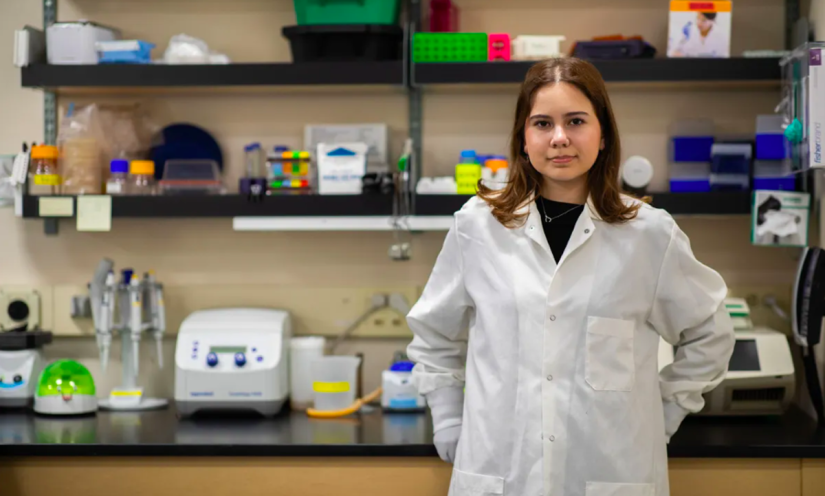
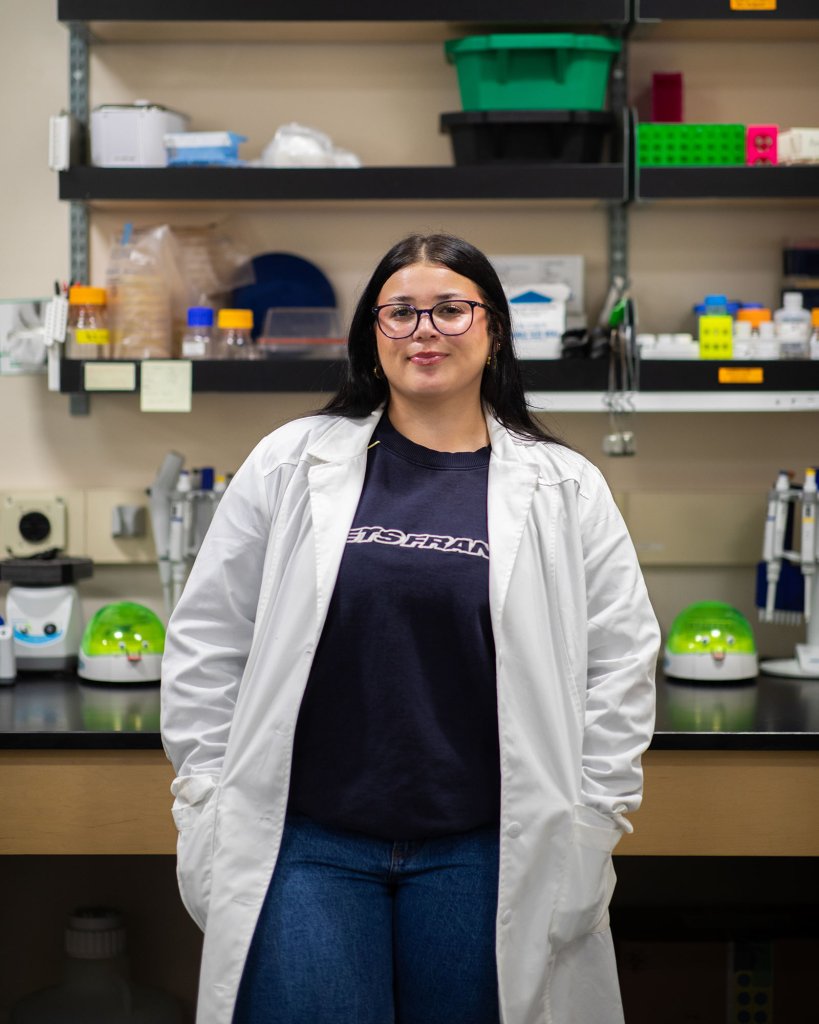
    Marisa Mendoza, right, and Camila Valderrama-Martínez, left, get ready to demonstrate how they use lab equipment for their research work at Cal State San Marcos on May 6, 2025. Photo by Adriana Heldiz, CalMatters

    From Palomar she was admitted as a transfer student to San Marcos and more selective campuses, including UCLA and UC San Diego. She chose San Marcos, partly to live at home but also because she loved her lab and wanted to continue her research.

    She enrolled at San Marcos last fall and furthered her doctoral journey by receiving the U-RISE grant. It was supposed to fund her for two years. The NIH terminated the grant March 31, stripping funds from 20 students.

    For a school like San Marcos, where more than 40% of students are low-income enough to receive federal financial aid called Pell grants, the loss of the NIH training awards is a particular blow to the aspiring scientists.

    The current climate of doctoral admissions is “definitely at a point where one needs prior research experience to be able to be competitive for Ph.D. programs,” said Elinne Becket, a professor of biological sciences at Cal State San Marcos who runs the microbial ecology lab where Mendoza and other students hone their research for about 15 hours a week.

    San Marcos doesn’t have much money to replace its lost grants, which means current and future San Marcos students will “100%” have a harder time entering a doctoral program, Becket added. “It keeps me up at night.”

    Research is ‘a missing piece’

    In a typical week in Becket’s lab, Mendoza will drive to a nearby wetland or cove to retrieve water samples — part of an ongoing experiment to investigate how microbial changes in the ecosystem are indications of increased pollution in sea life and plants. Sometimes she’ll wear a wetsuit and wade into waters a meter deep.

    The next day she’ll extract the DNA from bacteria in her samples and load those into a sequencing machine. The sequencer, which resembles a small dishwasher, packs millions or billions of pieces of DNA onto a single chip that’s then run through a supercomputer a former graduate student built.

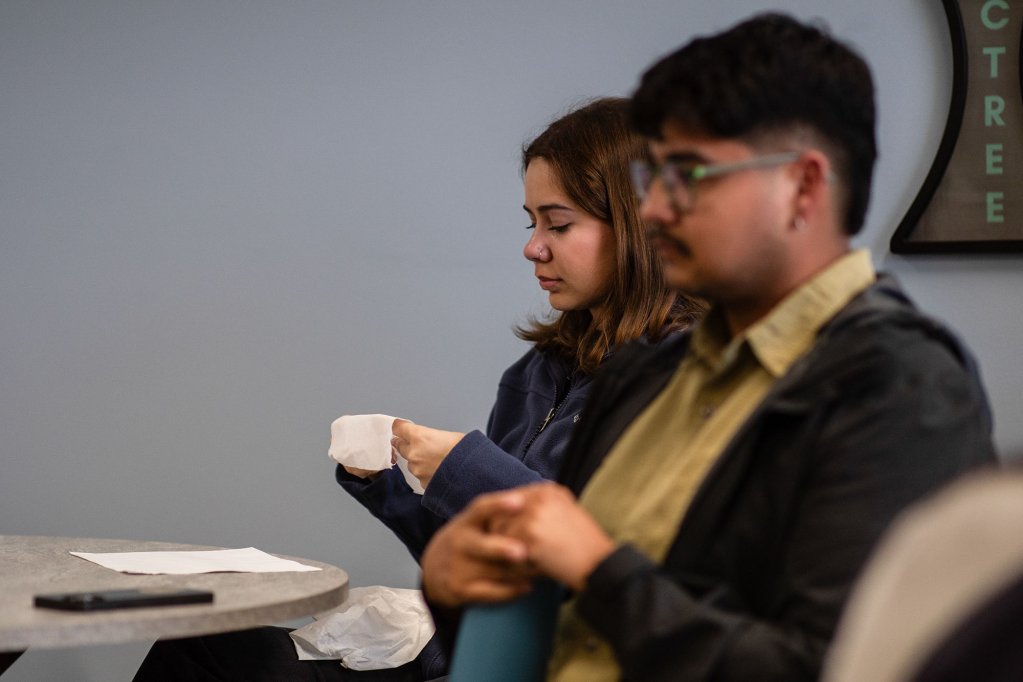
    “Once I found research, it was like a missing piece,” Mendoza, a Pell grant recipient, said through tears during an interview at Cal State Marcos. Research brought her joy and consumed her life “in the best way,” she added. “It’s really unfortunate that people who are so deserving of these opportunities don’t get to have these opportunities.”

    A side-view of a person looking down at a piece of tissue as tears stream down their face.
    Student Marisa Mendoza gets emotional while she speaks about her research at Cal State San Marcos on May 6, 2025. Photo by Adriana Heldiz, CalMatters

    The origins of the San Marcos training center date back to 2002. Through it, more than 160 students have either earned or are currently pursuing doctoral degrees at a U.S. university.

    The grant terminations have been emotionally wrenching. “There had been so many tears in my household that my husband got me a puppy,” said Denise Garcia, the director of the center and a professor of biological sciences.

    Garcia recalls that in March she was checking a digital chat group on Slack with many other directors of U-RISE grants when suddenly the message board lit up with updates that their grants were gone. At least 63 schools across the country lost their grants, NIH data show.

    In the past four years of its U-RISE grant the center has reported to the NIH that 83% of its students entered a doctoral program. That exceeds the campus’s grant goal, which was 65% entering doctoral programs.

    Mendoza is grateful: She was one of two students to win a campus scholarship that’ll defray much, but not all, of the costs of attending school after losing her NIH award. That, plus a job at a pharmacy on weekends, may provide enough money to complete her bachelor’s next year.

    Others are unsure how they’ll afford college while maintaining a focus on research in the next school year.

    Student Camila Valderrama-Martínez in a lab at Cal State San Marcos on May 6, 2025. Photo by Adriana Heldiz, CalMatters

    “You work so hard to put yourself in a position where you don’t have to worry, and then that’s taken away from you,” said Camila Valderrama-Martínez, a first-year graduate student at San Marcos who also earned her bachelor’s there and works in the same lab as Mendoza. She was in her first year of receiving the Bridges to the Doctorate grant meant for students in master’s programs who want to pursue a biomedical-focused doctoral degree. The grant came with a stipend of $26,000 annually for two years plus a tuition waiver of 60% and money to attend conferences.

    She can get a job, but that “takes away time from my research and my time in lab and focusing on my studies and my thesis.” She relies solely on federal financial aid to pay for school and a place to live. Getting loans, often anathema for students, seems like her only recourse. “It’s either that or not finish my degree,” she said.

    Terminated NIH grants in detail

    These grant cancellations are separate from other cuts at the NIH since Trump took office in January, including multi-million-dollar grants for vaccine and disease research. They’re also on top of an NIH plan to dramatically reduce how much universities receive from the agency to pay for maintaining labs, other infrastructure and labor costs that are essential for campus research. California’s attorney general has joined other states led by Democrats in suing the Trump administration to halt and reverse those cuts.

    In San Marcos’ case, the latest U-RISE grant lasted all five years, but it wasn’t renewed for funding, even though the application received a high score from an NIH grant committee.

    Armenta, the associate director at the Cal State San Marcos training center, recalled that his NIH program officer said that though nothing is certain, he and his team should be “cautiously optimistic that you would be funded again given your score.” That was in January. Weeks later, NIH discontinued the program.

    He and Garcia shared the cancellation letters they received from NIH. Most made vague references to changes in NIH’s priorities. However, one letter for a specific grant program cited a common reason why the agency has been cancelling funding: “It is the policy of NIH not to prioritize research programs related to Diversity (sic), equity, and inclusion.”

    That’s a departure from the agency’s emphasis on developing a diverse national cadre of scientists. As recently as February, the application page for that grant said “there are many benefits that flow from a diverse scientific workforce.”

    Future of doctoral programs unclear

    Josue Navarrete graduated this spring from Cal State San Marcos with a degree in computer science. Unlike the other students interviewed for this story, Navarrete, who uses they/them pronouns, was able to complete both years of their NIH training grant and worked in Becket’s lab.

    But because of the uncertain climate as the Trump administration attempts to slash funding, Vanderbilt University, which placed Navarrete on a waitlist for a doctoral program, ultimately denied them admission because the university program had to shrink its incoming class, they said. Later, Navarrete met a professor from Vanderbilt at a conference who agreed to review their application. The professor said in any other year, Navarrete would have been admitted.

    The setback was heartbreaking.

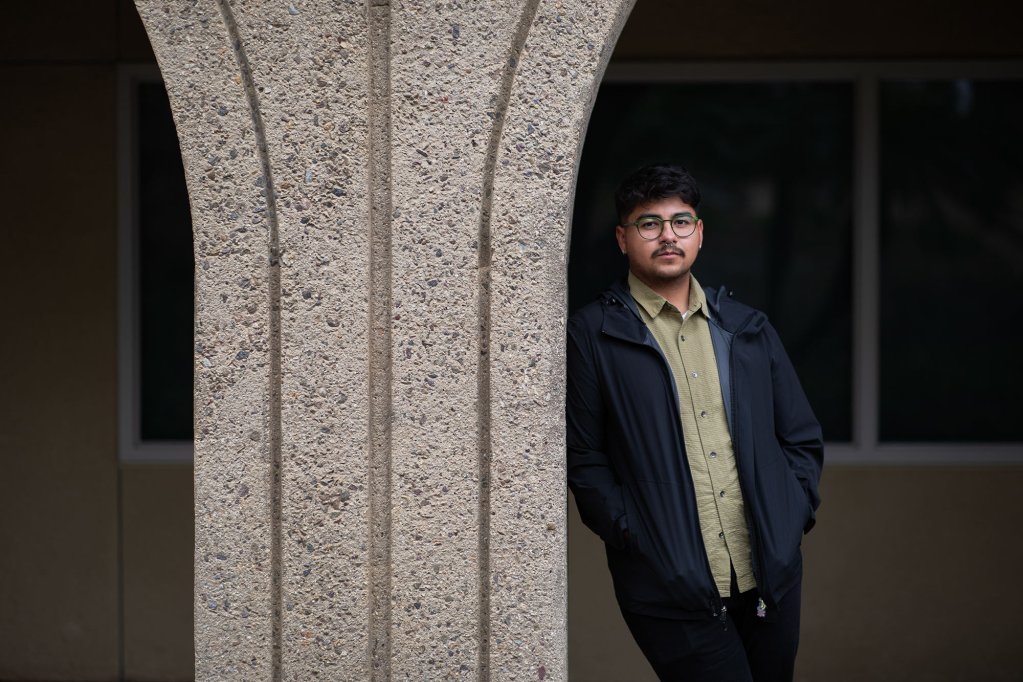
    A person -- with short black hair and wearing a black jacket and green shirt, leans against a light brown concrete column while looking straight into the camera.
    Josue Navarrete at the Cal State San Marcos campus on May 6, 2025. Photo by Adriana Heldiz, CalMatters

    “I’m gripping so hard to stay in research,” Navarrete said. With doctoral plans delayed, they received a job offer from Epic, a large medical software company, but turned it down. “They wanted me to be handling website design and mobile applications, and that’s cool. It’s not for me.”

    Valderrama-Martinez cited Navarrete’s story as she wondered whether doctoral programs at universities will have space for her next year. “I doubt in a year things are going to be better,” she said.

    She still looks forward to submitting her applications.

    So does Mendoza. She wants to study microbiology — the research bug that bit her initially and brought her to San Marcos. Eventually she hopes to land at a private biotech firm and work in drug development.

    “Of course I’m gonna get a Ph.D., because that just means I get to do research,” she said.

    This article was originally published on CalMatters and was republished under the Creative Commons Attribution-NonCommercial-NoDerivatives license.


    Get stories like these delivered straight to your inbox. Sign up for The 74 Newsletter

    Source link

  • Trump cuts could expose student data to cyber threats

    Trump cuts could expose student data to cyber threats

    When hackers hit a school district, they can expose Social Security numbers, home addresses, and even disability and disciplinary records. Now, cybersecurity advocates warn that the Trump administration’s budget and personnel cuts, along with rule changes, are stripping away key defenses that schools need.

    “Cyberattacks on schools are escalating and just when we need federal support the most, it’s being pulled away,” said Keith Krueger, chief executive officer of the Consortium for School Networking, an association of technology officials in K-12 schools. 

    Related: Our free weekly newsletter alerts you to what research says about schools and classrooms.

    The stakes are high. Schools are a top target in ransomware attacks, and cyber criminals have sometimes succeeded in shutting down whole school districts. The largest such incident occurred in December, when hackers stole personal student and teacher data from PowerSchool, a company that runs student information systems and stores report cards. The theft included data from more than 60 million students and almost 10 million teachers. PowerSchool paid an undisclosed ransom, but the criminals didn’t stop. Now, in a second round of extortion, the same cyber criminals are demanding ransoms from school districts.  

    The federal government has been stepping up efforts to help schools, particularly since a 2022 cyberattack on the Los Angeles Unified School District, the nation’s second-largest. Now this urgently needed assistance is under threat. 

    Warning service

    Of chief concern is a cybersecurity service known as MS-ISAC, which stands for Multi-State Information Sharing and Analysis Center. It warns more than 5,700 schools around the country that have signed up for the service about malware and other threats and recommends security patches. This technical service is free to schools, but is funded by an annual congressional appropriation of $27 million through the Cybersecurity and Infrastructure Security Agency (CISA), an agency within the Department of Homeland Security.

    On March 6, the Trump administration announced a $10 million funding cut as part of broader budget and staffing cuts throughout CISA. That was ultimately negotiated down to $8.3 million, but the service still lost more than half of its remaining $15.7 budget for the year. The non-profit organization that runs it, the Center for Internet Services, is digging into its reserves to keep it operating. But those funds are expected to run out in the coming weeks, and it is unclear how the service will continue operating without charging user fees to schools. 

    “Many districts don’t have the budget or resources to do this themselves, so not having access to the no cost services we offer is a big issue,” said Kelly Lynch Wyland, a spokeswoman for the Center for Internet Services.  

    Sharing threat information

    Another concern is the effective disbanding of the Government Coordinating Council, which helps schools address ransomware attacks and other threats through policy advice, including how to respond to ransom requests, whom to inform when an attack happens and good practices for preventing attacks. This coordinating council was formed only a year ago by the Department of Education and CISA. It brings together 13 nonprofit school organizations representing superintendents, state education leaders, technology officers and others. The council met frequently after the PowerSchool data breach to share information. 

    Now, amid the second round of extortions, school leaders have not been able to meet because of a change in rules governing open meetings. The group was originally exempt from meeting publicly because it was discussing critical infrastructure threats. But the Department of Homeland Security, under the Trump administration, reinstated open meeting rules for certain advisory committees, including this one. That makes it difficult to speak frankly about efforts to thwart criminal activity.

    Non-governmental organizations are working to resurrect the council, but it would be in a diminished form without government participation.

    “The FBI really comes in when there’s been an incident to find out who did it, and they have advice on whether you should pay or not pay your ransom,” said Krueger of the school network consortium. 

    A federal role

    A third concern is the elimination in March of the education Department’s Office of Educational Technology. This seven-person office dealt with education technology policies — including cybersecurity. It issued cybersecurity guidance to schools and held webinars and meetings to explain how schools could improve and shore up their defenses. It also ran a biweekly meeting to talk about K-12 cybersecurity across the Education Department, including offices that serve students with disabilities and English learners. 

    Eliminating this office has hampered efforts to decide which security controls, such as encryption or multi-factor authentication, should be in educational software and student information systems. 

    Many educators worry that without this federal coordination, student privacy is at risk. “My biggest concern is all the data that’s up in the cloud,” said Steve Smith, the founder of the Student Data Privacy Consortium and the former chief information officer for Cambridge Public Schools in Massachusetts. “Probably 80 to 90 percent of student data isn’t on school-district controlled services. It’s being shared with ed tech providers and hosted on their information systems.”

    Security controls

    “How do we ensure that those third-party providers are providing adequate security against breaches and cyber attacks?” said Smith. “The office of ed tech was trying to bring people together to move toward an agreed upon national standard. They weren’t going to mandate a data standard, but there were efforts to bring people together and start having conversations about the expected minimum controls.”

    That federal effort ended, Smith said, with the new administration. But his consortium is still working on it. 

    In an era when policymakers are seeking to decrease the federal government’s involvement in education, arguing for a centralized, federal role may not be popular. But there’s long been a federal role for student data privacy, including making sure that school employees don’t mishandle and accidentally expose students’ personal information. The Family Educational Rights and Privacy Act, commonly known as FERPA, protects student data. The Education Department continues to provide technical assistance to schools to comply with this law. Advocates for school cybersecurity say that the same assistance is needed to help schools prevent and defend against cyber crimes.

    “We don’t expect every town to stand up their own army to protect themselves against China or Russia,” said Michael Klein, senior director for preparedness and response at the Institute for Security and Technology, a nonpartisan think tank. Klein was a senior advisor for cybersecurity in the Education Department during the previous administration. “In the same way, I don’t think we should expect every school district to stand up their own cyber-defense army to protect themselves against ransomware attacks from major criminal groups.” 

    And it’s not financially practical. According to the school network consortium only a third of school districts have a full-time employee or the equivalent dedicated to cybersecurity. 

    Budget storms ahead

    Some federal programs to help schools with cybersecurity are still running. The Federal Communications Commission launched a $200 million pilot program to support cybersecurity efforts by schools and libraries. FEMA funds cybersecurity for state and local governments, which includes public schools. Through these funds, schools can obtain phishing training and malware detection. But with budget battles ahead, many educators fear these programs could also be cut. 

    Perhaps the biggest risk is the end to the entire E-Rate program that helps schools pay for the internet access. The Supreme Court is slated to decide this term on whether the funding structure is an unconstitutional tax.

    “If that money goes away, they’re going to have to pull money from somewhere,” said Smith of the Student Data Privacy Consortium. “They’re going to try to preserve teaching and learning, as they should.  Cybersecurity budgets are things that are probably more likely to get cut.

    “It’s taken a long time to get to the point where we see privacy and cybersecurity as critical pieces,” Smith said. “I would hate for us to go back a few years and not be giving them the attention they should.”

    Contact staff writer Jill Barshay at 212-678-3595, jillbarshay.35 on Signal, or [email protected].

    This story about student cybersecurity was written by Jill Barshay and produced by The Hechinger Report, a nonprofit, independent news organization focused on inequality and innovation in education. Sign up for Proof Points and other Hechinger newsletters.

    The Hechinger Report provides in-depth, fact-based, unbiased reporting on education that is free to all readers. But that doesn’t mean it’s free to produce. Our work keeps educators and the public informed about pressing issues at schools and on campuses throughout the country. We tell the whole story, even when the details are inconvenient. Help us keep doing that.

    Join us today.

    Source link

  • Many States Picked Diploma Pathways Over HS Exit Exams. Did Students Benefit? – The 74

    Many States Picked Diploma Pathways Over HS Exit Exams. Did Students Benefit? – The 74


    Get stories like this delivered straight to your inbox. Sign up for The 74 Newsletter

    This story was originally published by Chalkbeat. Sign up for their newsletters at ckbe.at/newsletters

    When 18-year-old Edgar Brito thinks about what he’ll do in the future, mechanical engineering is high on the list.

    The senior at Washington state’s Toppenish High School first considered the career after he joined a STEM group in middle school. In a ninth grade class, he researched the earning potential for a STEM degree (“so much more money”) and the demand for mechanical engineers (“exploding”).

    So Brito took some engineering classes at his high school, became president of his state’s Technology Student Association, and is starting at the University of Washington this fall on a pre-science track.

    Brito’s experience is what state education leaders hoped for when they replaced the high school exit exam with multiple pathways to graduation. When he graduates in June, Brito will have completed several diploma pathways, including ones aimed at preparing for college and building career skills.

    But his experience isn’t necessarily typical. He has friends who have no idea what pathway they’re on — or if they’re on one at all. The requirements could be clearer and advisers could spend more time talking about them with students, he said.

    “Making sure that we know exactly what our pathway is and what it means to be on a pathway would have definitely helped out a lot more students,” Brito said.

    Five years after Washington rolled out its pathways, they appear to have helped more students who aren’t college-bound to graduate, which was part of the goal. But the system has also created new issues and replicated some old ones.

    For the Class of 2023 — the most recent year with available data — around 1 in 5 seniors didn’t have a pathway. That meant they weren’t on track to graduate within four years and at risk of dropping out. Some students relied on pandemic-era waivers that don’t exist anymore. That’s similar to the share of students who didn’t graduate on time in 2019, the final year of the exit exam.

    Asian and white students are much more likely to complete one of the math and English pathways, considered the college-prep route, while Native students, English learners, and students with disabilities are more likely to have no graduation pathway.

    “The implementation of graduation pathways has reinforced that the student groups who are the furthest from educational justice are completing the requirement at lower rates,” state education officials wrote in a 2023 report.

    Across the state, students don’t have equal access to the pathways. Many schools, especially smaller and rural ones, struggle to offer more than a handful of career and technical education classes. Some career pathways train students for low-paying jobs with little opportunity for advancement. Some students get funneled to the military pathway, despite having no aspirations to serve, because the aptitude test is easier to pass. Many teens, like Brito’s friends, find the pathways confusing.

    Washington is not alone. Nearly half of states offer multiple diploma options or graduation pathways. And some, like Indiana, have already taken a second pass at their pathways. Many have struggled to address the same big questions, including what exactly high school is for, and what students should need to do to earn a diploma.

    Now the state board of education is poised to overhaul its graduation requirements again.

    Piling on more ways for students to graduate is not the answer, said Brian Jeffries, the policy director at the Partnership for Learning, an education foundation affiliated with the Washington Roundtable, which is made up of executives from across the state.

    “Let’s better prepare our students to meet the pathways, [rather] than keep creating a smorgasbord or a cafeteria of options, which too often turn into trapdoors,” said Jeffries, who sits on the state task force that’s looking at graduation requirements. Until disadvantaged kids have access to better instruction and more support, he said, “we’re going to keep spinning this wheel.”

    The path to 100 high school graduation pathways

    Back in the early 2000s, many states raised the bar to graduate from high school with the hope it would get more kids to college. As a result, by 2012, half of all states required an exit exam, including Washington state.

    But as student debt soared and some questioned the value of higher education, schools abandoned that college-for-all mentality. Critics of exit exams argued that they blocked too many disadvantaged students from graduating.

    In Washington state’s final year of the exit exam, around 1 in 10 high school seniors didn’t pass the English language arts portion, and 1 in 5 didn’t pass the math test, the Seattle Times reported. The law that nixed the exit exam had broad support from the Washington teachers union, state education officials, and parents. Lawmakers passed it unanimously.

    Just six states require an exit exam now, with New York and Massachusetts dropping their tests this school year.

    But absent an exit exam, states haven’t really reached a consensus on what students should have to do to prove they’re ready to graduate.

    Nationwide, there are now more than 100 ways to graduate from high school, according to a recent report from the Education Strategy Group, a K-12 consulting firm. The myriad options provide flexibility, but “also contribute to the lack of clarity about what it means to earn a diploma,” the report found.

    When the nation’s main K-12 education law, the Every Student Succeeds Act, passed 10 years ago, it tasked schools with getting students ready for college and career. But many states and schools are still trying to figure out how to do the career part well.

    “Part of the challenge, frankly, is that schools are going through a bit of a post-high-stakes-test-based accountability identity crisis,” said Shaun Dougherty, a professor of education and policy at Boston College.

    Michael Petrilli, the president of the Thomas B. Fordham Institute, a conservative think tank, says that’s partly because for all the talk about changing high schools, graduation policies are still fairly restrictive. One reason Washington is revisiting its policies now is because some educators worry the state’s 24-credit requirement fills up students’ schedules, leaving little time for apprenticeships and other hands-on learning.

    Many kids are still “sleepwalking through six or seven class periods a day, mostly through college-prep courses,” Petrilli said, with “maybe a few career-tech electives on the side.”

    “We haven’t really unleashed high schools to do things very differently,” Petrilli said. “If we actually think that career tech is valuable, if we think that college-for-all was a mistake, then we need to be willing to act on it.”

    Diploma pathways can bolster teens’ interest in school

    What’s happening in the Toppenish School District illustrates the potential of the pathways model.

    The district, which serves around 3,700 students in south-central Washington, is able to offer a wide range of career and technical courses, including in growing industries, like health care and agriculture. The career-oriented pathway has helped increase some students’ interest in school.

    “It is very hands-on, and so it’s definitely more engaging,” said Monica Saldivar, Toppenish’s director of career and technical education. The old one-size-fits-all approach had “a negative impact for our students with diverse learning needs, academic challenges, and also language barriers.”

    Just before the state overhauled its graduation requirements, over 81% of Toppenish students graduated within four years. Now over 89% do.

    The improvements have been especially pronounced for English learners and Native students, many of whom live on the Yakama Nation. Since the state introduced pathways, Native student graduation rates have risen from 67% to 88%.

    Since pathways launched, the district has added several career-technical education courses, including advanced welding and classes that prepare students to work as medical transcriptionists or home health care aides. That can require some careful career counseling with students, as those jobs are in high demand but don’t pay well unless students get additional training or schooling and move up the career ladder.

    Still, the expanded offerings have helped some students tailor their post-high school plans.

    Frances Tilley, a Toppenish senior who’s headed to Gonzaga University in the fall, will graduate in June after completing both college-prep and career-oriented pathways.

    The 18-year-old took two of the new sports medicine classes and liked learning about what to do if you have a concussion. (Don’t try to stay awake. “We learned that’s not true,” Tilley said.)

    She followed that up with another health care class that touched on different disciplines. She gravitated toward psychology and now plans to get a master’s in counseling and become a mental health worker.

    Pathways can also help schools expose students to career options earlier.

    Three years ago, Toppenish started offering middle schoolers two-week labs to test drive careers such as marketing, nursing, or culinary arts. By the end of eighth grade, they’ve learned about 10 different careers. Now school counselors use students’ interests to help plot their high school schedules.

    Kaylee Celestino, 16, had long considered becoming a teacher. The Toppenish sophomore often gets “education” as an answer when she takes career quizzes. But the career-exploration labs also piqued her interest in science, and now she could also envision becoming a pediatric nurse. So her course schedule reflects that with advanced biology and college-level chemistry.

    “I just want to help people out,” she said, “like my teachers have helped out me.”

    Staffing, standards, data gaps make pathways challenging

    Staffing career and technical classes is one of the biggest hurdles to doing pathways well.

    Washington makes it easier than other states for professionals to put their work experience toward a teaching license. But many schools still struggle to attract and retain teachers for attractive fields like health services and welding when the private sector beckons.

    “These are lucrative fields,” said Dougherty, who has researched career education programs in several states, including Washington. “It’s hard to convince people to give up that salary to become full-time educators.”

    That creates extra work for schools. Saldivar, for example, meets regularly with regional employers to learn about their workforce needs. That helps inform whether Toppenish should drop or add certain classes, and which teachers to recruit. Saldivar is constantly networking and following up on “so and so may know someone” tips.

    Figuring out how to hold all students to a high standard when they are meeting different criteria to graduate is a challenge, too. Some worry Washington’s pathways are too flexible.

    The state rolled out a new pathway this year that allows students to graduate by completing a project, work-related experience, or community service. Lawmakers wanted to give students a way to show what they know besides taking a class or a test. But students don’t have to work with a teacher at their school, and if they choose to work with an outside mentor, there’s no clear rules for how they should be vetted.

    “Where are they finding these people?” said Jeffries of the Partnership for Learning. “Is their opinion an expert opinion that we could trust, or is this based on vibes?”

    Experts say it’s also important for students to understand what their likely earnings and other outcomes will be depending on which career pathway they follow.

    “We should not be talking about CTE in a very generic way,” said Dan Goldhaber, a professor at the University of Washington who has researched career and technical education teacher preparation in the state. “What the concentration is matters.”

    But Washington state doesn’t yet know how students’ outcomes may vary depending on which career and technical education concentration they chose, Katie Hannig, a spokesperson for Washington’s state education agency, wrote in an email. This is a common problem nationwide.

    The state also doesn’t yet know whether the pathway, or pathways, students completed were connected to their post-high school plan, which they must create to graduate. That hasn’t assuaged concerns that students are completing pathways disconnected from their college and career goals.

    The state expects to get that data in the future, Hannig wrote. Analyzing how diploma pathways affect graduation trends and postsecondary outcomes could help schools target resources and support.

    “Any new policy is a work in progress, but the fundamental core value of this policy is preparing students for their next step after high school graduation,” Hannig wrote. “Washington is proud to be one of those states that have established and continue to refine those pathways.”

    For now, districts like Toppenish are scrambling to coordinate weekly college presentations, field trips to work sites, and military recruiter visits — “a little of everything,” Saldivar said — to hedge their bets.

    Kalyn Belsha is a senior national education reporter based in Chicago. Contact her at [email protected].

    Chalkbeat is a nonprofit news site covering educational change in public schools.


    Get stories like these delivered straight to your inbox. Sign up for The 74 Newsletter

    Source link

  • courts intensify effort to block Trump’s int’l enrolment ban

    courts intensify effort to block Trump’s int’l enrolment ban

    • District judge moves to take out an injunction on Trump administration’s Harvard international enrolment ban while the case moves through the legal system.
    • University’s international students report “emotional distress” as many cancel travel plans over fears they will not be allowed back into the US.
    • US Department of Homeland Security boss accuses Harvard of “disdain” for American people and spreading hate.

    Following on from her decision last week to temporarily block the move, district judge Allison Burroughs told a packed court that she wanted to “maintain the status quo” while Harvard’s case works its way through the legal system.

    It’s the latest twist in the university’s ongoing battle with the Trump administration, which has accused it of anti-semitism and stripped it of billions of dollars in funding. For its part, Harvard is coming out swinging against the directive, swiftly mounting a legal challenge – the latest step of which culminated in Burroughs’ judgement in a hearing yesterday.

    In court documents filed ahead of the hearing, Harvard’s director of immigration services at the institution’s international office, Maureen Martin, detailed the toll that the administration’s announcement is taking on the campus’s international students.

    She wrote that the revocation notice has caused both students and faculty to express “profound fear, concern, and confusion” – with the university “inundated” with queries from worried international students.

    “Many international students and scholars are reporting significant emotional distress that is affecting their mental health and making it difficult to focus on their studies,” said Martin, adding that some are too afraid to attend their own graduation ceremonies this week in case immigration-related action is taken against them.

    Meanwhile, others are cancelling international travel plans over concerns they will not be able to re-enter the US. “Some fear being compelled to return
    abruptly to home countries where they might not be safe due to ongoing conflicts or where they could face persecution based on their identity or background,” Martin wrote.

    Many international students and scholars are reporting significant emotional distress that is affecting their mental health and making it difficult to focus on their studies
    Maureen Martin, Harvard University

    While US stakeholders may be breathing a sigh of relief at Harvard’s temporary reprieve, Donald Trump’s government is showing no signs of backing down.

    In a letter sent to Harvard before Thursday’s hearing, US Immigration and Customs Enforcement (ICE) confirmed that it wanted to move ahead with revoking the university’s SEVP certification, which would mean it could no longer host international students. Notably, though, the letter did not repeat last week’s assertion that Harvard would have 30 days to challenge the decision and suggested the government would not look to immediately enact the directive.

    In a statement released yesterday, US secretary of the Department of Homeland Security, Kristi Noem, doubled down on accusations that Harvard has not complied with SEVP regulations, has “encouraged and allowed anti-semitic and anti-American violence to rage on its campus” and has been working with the Chinese Communist Party.

    “Harvard’s refusal to comply with SEVP oversight was the latest evidence that it disdains the American people and takes for granted US taxpayer benefits,” she said. “Following our letter to Harvard, the school attempted to claim it now wishes to comply with SEVP standards. We continue to reject Harvard’s repeated pattern of endangering its students and spreading American hate – it must change its ways in order to participate in American programs.”

    Harvard’s row with the Trump administration stems from the stand it took against a raft of government demands, including that it reform its admissions and hiring practices to combat antisemitism on campus, end DEI initiatives and hand over reports on international students.

    When the institution refused to comply with the demands, the government – seemingly in retaliation – froze $2.2 billion in the university’s funding, threatened to revoke its tax-exempt status, and demanded that international students’ records be handed over. If Harvard didn’t play ball, it was warned, it risked losing its SEVP certification. 

    Although Harvard did send over some student information on April 30, and maintained that it had provided the information it was legally bound to supply, this seems to have been insufficient for the Trump administration, which then moved to black the institution from hosting international students.

    In yet another blow to the US international education sector, the US government announced this week that it would pause all new study visa interviews at American consulates around the world – sparking dismay from stakeholders.

    And Chinese students studying in the US were plunged into uncertainty yesterday after – amid a trade war with Beijing – the government announced plans to “aggressively revoke” their visas. As yet, it remains unclear whether all Chinese students will be affected or just those with links to the Chinese Communist Party or studying in so-called key areas.

    Source link

  • Why Global Talent is Turning Away from U.S. Higher Education—and What We’re Losing – Edu Alliance Journal

    Why Global Talent is Turning Away from U.S. Higher Education—and What We’re Losing – Edu Alliance Journal

    In 2025, much of my professional focus has been on small colleges in the United States. But as many of you know, my colleague and Edu Alliance co-founder, Dr. Senthil Nathan, and I also consult extensively in the international higher education space. Senthil, based in Abu Dhabi, UAE—where Edu Alliance was founded was asked by a close friend of ours, Chet Haskell, about how the Middle East and its students are reacting to the recent moves by the Trump Administration. Dr. Nathan shared a troubling May 29th article from The National, a UAE English language paper titled, It’s not worth the risk”: Middle East students put US dreams on hold amid Trump visa crackdown.

    The article begins with this chilling line:

    “Young people in the Middle East have spoken of their fears after the US government decided to freeze overseas student interviews and plan to begin vetting their social media accounts. The directive signed by Secretary of State Marco Rubio and sent to diplomatic and consular posts halts interview appointments at US universities.”

    The UAE, home to nearly 10 million people—90% of whom are expatriates—is a global crossroads. Many of their children attend top-tier international high schools and are academically prepared to study anywhere in the world. Historically, the United States has been a top choice for both undergraduate and graduate education.

    But that is changing.

    This new wave of student hesitation, and in many cases fear, represents a broader global shift. Today, even the most qualified international students are asking whether the United States is still a safe, welcoming, or stable destination for higher education. And their concerns are justified.

    At a time when U.S. institutions are grappling with enrollment challenges—including a shrinking pool of domestic high school graduates—we are simultaneously sending signals that dissuade international students from coming. That’s not just bad policy. It’s bad economics.

    According to NAFSA: Association of International Educators, international students contributed $43.8 billion to the U.S. economy during the 2023–2024 academic year and supported 378,175 jobs across the country. These students fill key seats in STEM programs, support local economies, and enrich our campuses in ways that go far beyond tuition payments.

    And the stakes go beyond higher education.

    A 2024 study found that 101 companies in the S&P 500 are led by foreign-born CEOs. Many of these executives earned their degrees at U.S. universities, underscoring how American higher education is not just a national asset but a global talent incubator that fuels our economy and leadership.

    Here are just a few examples:

    • Jensen Huang: Born in Taiwan (NVIDIA) – B.S. from Oregon State, M.S. from Stanford
    • Elon Musk: Born in South Africa (Tesla, SpaceX) – B.A. from the University of Pennsylvania
    • Sundar Pichai: Born in India (Alphabet/Google) – M.S. from Stanford, MBA from Wharton
    • Mike Krieger: Born in Brazil (Co-founder of Instagram) B.S. and M.S. Symbolic Systems and Human-Computer Interaction, Stanford University
    • Satya Nadella: Born in India (Microsoft) – M.S. from the University of Wisconsin–Milwaukee, MBA from the University of Chicago
    • Max Levchin: Born in Ukraine (Co-founder of PayPal, Affirm), Bachelor’s in Computer Science, University of Illinois at Urbana-Champaign
    • Arvind Krishna: Born in India (IBM) – Ph.D. from the University of Illinois, Urbana-Champaign
    • Safra Catz: Born in Israel (Oracle) – Undergraduate & J.D. from University of Pennsylvania
    • Jane Fraser: Born in the United Kingdom (Citigroup) – MBA from Harvard Business School
    • Nikesh Arora: Born in India  (Palo Alto Networks) – MBA from Northeastern
    • Jan Koum: Born in Ukraine (Co-founder of WhatsApp), Studied Computer Science (did not complete degree) at San Jose State University

    These leaders represent just a fraction of the talent pipeline shaped by U.S. universities.

    According to a 2023 American Immigration Council report, 44.8% of Fortune 500 companies were founded by immigrants or their children, including iconic firms like Apple, Google, and Tesla. Together, these companies generate $8.1 trillion in annual revenue and employ over 14.8 million people globally.

    The Bottom Line

    The American higher education brand still carries immense prestige. But prestige alone won’t carry us forward. If we continue to restrict and politicize student visas, we will lose not only potential students but also future scientists, entrepreneurs, job creators, and community leaders.

    We must ask: Are our current policies serving national interests, or undermining them?

    Our classrooms, campuses, corporations, and communities are stronger when they include the world’s brightest minds. Let’s not close the door on a future we have long helped build.


    Dean Hoke is Managing Partner of Edu Alliance Group, a higher education consultancy. He formerly served as President/CEO of the American Association of University Administrators (AAUA). With decades of experience in higher education leadership, consulting, and institutional strategy, he brings a wealth of knowledge on international partnerships and market evaluations.

    Source link

  • Spirit of adventure – meet the Nepalese study abroad guides

    Spirit of adventure – meet the Nepalese study abroad guides

    Nepal has long been synonymous with the legendary ‘Sherpa’ mountain guides, skilled in helping international travellers explore the Himalayas.

    There is also however, a more recent tradition of local education guides helping their compatriots to seek out adventure and opportunity through study abroad.

    In the past, this demand favoured Australia as a study destination, but since the Albanese government introduced increased visa restrictions, that demand has increasingly turned to alternative destinations like the US, France, Japan and the UK.

    According to ONS data, more than 9,000 study visas were issued to Nepalese students studying in the UK as of March 2024 but the true number is undoubtedly higher in the year since.

    The PIE News visited Franklin International, a leading local agent, to better understand the factors supporting growth.

    Away from the chaotic streets of Kathmandu, where thousands of agent offices operate within a square mile in a district known as ‘Putalisadak’, Franklin International has chosen instead to base its national headquarters in the foothills of peaceful Pokhara.

    Here we find an operation that feels more like a family than an agency. There aren’t any cut-outs of Big Ben; instead, they favour a comfortable working atmosphere for staff and students.

    There is an office full of people diligently running document checks, taking calls, and running webinars with their prospective students across Nepal.

    I meet a team packing for a 17-day tour of the country to meet applicants face-to-face – giving them a chance to outline important next steps and reassure family members.

    There are entire rooms of people dedicated to supporting universities like the University of Roehampton and the University of East London, for whom they facilitate close operational relationships that deliver hundreds of compliant student enrolments.

    “The UK demand is still in its infancy,” company CMO and co-founder, Deepak Khadka tells me.

    “The number of students applying has grown rapidly, but the knowledge about the UK process is limited among most people,” he continues.”There are too many agents looking for short-cut commission – so we have had to build a system in partnership with British universities to focus on the compliance checks they need.”

    This is a price-sensitive market, with only 15-20 universities offering financially viable course options. This has created a unique bubble where large numbers of students are following each other to the same university in each intake. Word of mouth is a key driver of demand.

    This volume has, in turn, triggered an explosion in Nepalese agent activity as the potential for high commission levels is clear.

    At a higher education event in Kathmandu, The PIE met teams of young friends, often still in their 20s or early 30s, keen to get involved and cash-in on prospective students from their neighbourhoods.

    “We have a choice to make in Nepal,” explains Khadka. “We either compete as agents, or we try and work together to best support the students.”

    Having completed his doctorate in agent supply chains from UWS, his understanding of the Nepalese market is crucial.

    “We try to act as supportive guides for these other guys. They have so much energy and ambition – but we must make sure the professional compliance is water-tight when processing applications,” he tells The PIE. “We have the expertise to do this correctly. We call this the Official University Representative network to convey that message.”

    Khadka is keen to stress that he and his fellow agents care far more about the students they work with than pitting themselves against one another.

    “I care about Nepal’s future. We don’t want to make the same mistakes as other countries or regions,” he says.

    “We want our young people to succeed in their study abroad adventures – and I would rather work together for a better system, than get drawn into a territorial battle. We are proud that this model is being recognised by our UK partners and local officials here.”

    Overseas education agencies must have government approval to operate in Nepal, leading to conflict over online aggregator models trying to undercut this licensing.

    I care about Nepal’s future. We don’t want to make the same mistakes as other countries or regions
    Deepak Khadka, Franklin International

    Local protocol can be complicated as students need to obtain a ‘No Obligation Certificate’ from the government to study abroad, and many turn to government-backed student finance options to prepare their budgets.

    Vidhi Mistry, head of international operations for the University of Roehampton, explains her approach to the market: “In Nepal, when there are thousands of agents, it’s not about being everywhere. A university doesn’t need to work with every agent.

    “A right partnership is about aligning values, intent and quality that prioritises reputation and longevity. Agents can elevate the sector or dilute it. Exclusivity when earned and aligned isn’t a restriction, it is a strategy for sustainable growth [in a chaotic market].”

    The PIE spoke to Sajan, a Nepalese student who has an offer to study at the University of West Scotland London campus. He explained his reasoning for working with an agency.

    “I have friends already at UWS London and they love it. I didn’t need help with choosing which university or course I wanted, but I had to make sure my finances and visa are processed correctly,” he says. “My father and I have been guided to understand my required budget and each step of the process. I am very grateful.”

    With the UK government announcing future plans to tighten visa issuance for countries linked to asylum claims, and to clamp down on universities linked to poor compliance metrics – it is important the Nepal market doesn’t grow too fast, too soon.

    Strong demand will undoubtedly bring greater competition, so only time will tell if universities and agents can get regulate themselves to realise the opportunity.

    Source link

  • Solving our literacy crisis starts in the lecture hall

    Solving our literacy crisis starts in the lecture hall

    Key points:

    The recent NAEP scores have confirmed a sobering truth: Our schools remain in the grips of a literacy crisis. Across the country, too many children are struggling to read, and too many teachers are struggling to help them. But why? And how do we fix it?

    There are decades of research involving thousands of students and educators to support a structured literacy approach to teaching literacy. Teacher preparation programs and school districts across the nation have been slow to fully embrace this research base, known as the science of reading. Since 2017, consistent media attention focused on the literacy crisis has created a groundswell of support for learning about the science of reading. Despite this groundswell, too many educators are still entering classrooms without the skills and knowledge they need to teach reading.

    While there is steady progress in teacher preparation programs to move toward the science of reading-aligned practices, the National Council on Teacher Quality’s latest report on the status of teacher preparation programs for teaching reading (2023) still shows that only 28 percent of programs adequately address all five components of reading instruction. Furthermore, according to the report, up to 40 percent of programs still teach multiple practices that run counter to reading research and ultimately impede student learning, such as running records, guided reading, leveled texts, the three cueing systems, etc. This data shows that there is still much work to be done to support the education of the teacher educators responsible for training pre-service teachers.

    The disconnect between theory and practice

    When it comes to literacy instruction, this problem is especially glaring. Teachers spend years learning about teaching methods, reading theories, and child development. They’re often trained in methods that emphasize comprehension and context-based guessing. However, these methods aren’t enough to help students develop the core skills they need to become proficient readers. Phonics–teaching students how to decode words–is a critical part of reading instruction, but it’s often left out of traditional teacher prep programs.

    One primary reason this disconnect happens is that many teacher prep programs still rely on outdated methods. These approaches prioritize reading comprehension strategies that focus on meaning and context, but they don’t teach the foundational skills, like phonics, essential for developing fluent readers.

    Another reason is that teacher prep programs often lag when it comes to incorporating new research on reading. While the science of reading–a body of evidence built from decades of research and studies involving thousands of students and educators about how humans learn to read and the instructional practices that support learning to read–has been gaining deserved traction, it’s not always reflected in the teacher preparation programs many educators go through. As a result, teachers enter classrooms without the knowledge, skills, and up-to-date methods they need to teach reading effectively.

    A way forward: Structured literacy and continuous professional development

    For real progress, education systems must prioritize structured literacy, a research-backed approach to teaching reading that includes explicit, systematic instruction in phonics, decoding, fluency, and comprehension. This method is effective because it provides a clear, step-by-step process that teachers can follow consistently, ensuring that every single student gets the support they need to succeed.

    But simply teaching teachers about structured literacy is not enough. They also need the tools to implement these methods in their classrooms. The goal should be to create training programs that offer both the theoretical knowledge and the hands-on experience teachers need to make a lasting difference. Teachers should graduate from their prep programs not just with a degree but with a practical, actionable plan for teaching reading.

    And just as important, we can’t forget that teacher development doesn’t end once a teacher leaves their prep program. Just like doctors, teachers need to continue learning and growing throughout their careers. Ongoing professional development is critical to helping teachers stay current with the latest research and best practices in literacy instruction. Whether through in-person workshops, online courses, or coaching, teachers should have consistent, high-quality opportunities to grow and sharpen their skills.

    What do teacher educators need?

    In 2020, the American Federation of Teachers published an update to its seminal publication, Teaching Reading is Rocket Science. First published in 2000, this updated edition is a collaboration between the AFT and the Center on Development and Learning. Although some progress has been made over the past 20 years in teaching reading effectively, there are still too many students who have not become proficient readers.

    This report outlines in very specific ways what pre-service and in-service teachers need to know to teach reading effectively across four broad categories:

    1. Knowing the basics of reading psychology and development
    2. Understanding language structure for word recognition and language comprehension
    3. Applying best practices (based on validated research) in all components of reading
    4. Using validated, reliable, efficient assessments to inform classroom teaching

    There should be a fifth category that is directly related to each of the four areas listed above: the knowledge of how to address the specific oral language needs of multilingual learners and speakers of language varieties. Structured, spoken language practice is at the heart of addressing these needs.

    Moving forward: Reimagining teacher training

    Ultimately, fixing the literacy crisis means changing the way we think about teacher preparation and ongoing professional development. We need to create programs that not only teach the theory of reading instruction but also provide teachers with the practical skills they need to apply that knowledge effectively in the classroom. It’s not enough to just teach teachers about phonics and reading theory; they need to know how to teach it, too.

    Literacy instruction must be at the heart of every teacher’s training–whether they teach kindergarten or high school–and ongoing professional development should ensure that teachers have the support they need to continuously improve.

    It’s a big task, but with the right tools, knowledge, and support, we can bridge the gap between theory and practice and finally begin to solve a literacy crisis that has stubbornly endured for far too long.

    Latest posts by eSchool Media Contributors (see all)

    Source link