The Brazilian association for international education, FAUBAI, in its 37th year, welcomed around 650 participants from 28 countries for its 2025 conference, bringing together global stakeholders to shape a more inclusive and sustainable future.
Centred on the theme ‘Towards Equitable and Sustainable Partnerships,’ the conference highlighted Brazil’s growing commitment to inclusive, sustainable, and multilateral academic collaboration.
A major announcement came from CAPES, Brazil’s federal agency for support and evaluation of graduate education, with the launch of CAPES Global – an ambitious new program designed to build institutional cooperation networks across regions and stages of internationalisation.
It looks to strengthen Brazil’s international prominence, consolidating its position as a strategic partner in global initiatives, as well as promoting mutual cooperation, intercultural dialogue, and sustainable development.
The programs total budget sits at R$1.4 billion (approximately US$270 million) over four years and Brazilian higher education institutions are encouraged to seek international partners whose expertise aligns with the selected strategic themes that align with the SDGs or with Brazil’s national priorities.
The challenges facing Brazil reflect global concerns, Rui Oppermann, director of international relations at CAPES, explained.
“Climate change is not a Brazilian problem, it is not the problem of the Amazon – it’s a problem of everyone living in our world,” he said.
The program succeeds the CAPES PrInt program, which funded 36 universities in Brazil but left several regions like the North and parts of the Northeast underrepresented, explained Oppermann.
CAPES Global also seeks to promote opportunities for international experience, both in Brazil and abroad, for postgraduate students, researchers, faculty, and staff.
Climate change is not a Brazilian problem, it is not the problem of the Amazon, it’s a problem of everyone living in our world Rui Oppermann, CAPES
Speaking to The PIENews, José Celso Freire Junior – FAUBAI president and associate provost for international affairs at São Paulo State University (UNESP) – emphasised the importance of showcasing the strength of Brazil’s higher education system. He said FAUBAI works to highlight the country’s research excellence, world-class laboratories, and institutional capacity in order to position Brazil as a valuable international partner.
“We are looking for cooperation, we are not looking for places to send our students,” said Freire.
“Cooperation means sustainable and equitable horizontal partnership,” he asserted.
Elsewhere during the conference, Hilligje van’t Land, secretary-general of the International Association of Universities (IAU), delivered a powerful address on building equitable and sustainable partnerships, exploring how universities can form inclusive, impactful alliances that address global challenges and secure the future of higher education.
The address from van’t Land focused on the sector’s potentially transformative role in advancing the UN 2030 Agenda and the SDGs. Her speech highlighted the need for systemic change in curriculum, research culture, governance, and partnerships – with a strong call for interdisciplinary education and inclusive internationalisation strategies.
She argued that higher education institutions must embed SDG principles across operations, teaching, partnerships, and funding models, and be radical in integrating equity, diversity, and interdisciplinarity.
Elsewhere, she noted that Latin America is leading globally in how it integrates the SDGs into internationalisation strategies but warned that inclusion gaps remain and that funding structures could hinder transformative cooperation.
UPDATE: The hearing scheduled for May 9 has been postponed until May 16 at the U.S. District Court for the District of Columbia. The court will hear two similar motions at the same time and consider whether to temporarily restore the cuts to research and data collections and bring back fired federal workers at the Education Department. More details on the underlying cases in the article below.
Some of the biggest names in education research — who often oppose each other in scholarly and policy debates — are now united in their desire to fight the cuts to data and scientific studies at the U.S. Department of Education.
The roster includes both Grover J. “Russ” Whitehurst, the first head of the Institute of Education Sciences (IES) who initiated studies for private school vouchers, and Sean Reardon, a Stanford University sociologist who studies inequity in education. They are just two of the dozens of scholars who have submitted declarations to the courts against the department and Secretary Linda McMahon. They describe how their work has been harmed and argue that the cuts will devastate education research.
Professional organizations representing the scholars are asking the courts to restore terminated research and data and reverse mass firings at the Institute of Education Sciences, the division that collects data on students and schools, awards research grants, highlights effective practices and measures student achievement.
Related: Our free weekly newsletter alerts you to what research says about schools and classrooms.
Three major suits were filed last month in U.S. federal courts, each brought by two different professional organizations. The six groups are the Association for Education Finance and Policy (AEFP), Institute for Higher Education Policy (IHEP), American Educational Research Association (AERA), Society for Research on Educational Effectiveness (SREE), National Academy of Education (NAEd) and the National Council on Measurement in Education (NCME). The American Educational Research Association alone represents 25,000 researchers and there is considerable overlap in membership among the professional associations.
Prominent left-wing and progressive legal organizations spearheaded the suits and are representing the associations. They are Public Citizen, Democracy Forward and the Legal Defense Fund, which was originally founded by the National Association for the Advancement of Colored People (NAACP) but is an independent legal organization. Allison Scharfstein, an attorney for the Legal Defense Fund, said education data is critical to documenting educational disparities and improve education for Black and Hispanic students. “We know that the data is needed for educational equity,” Scharfstein said.
Officers at the research associations described the complex calculations in suing the government, mindful that many of them work at universities that are under attack by the Trump administration and that its members are worried about retaliation.
“A situation like this requires a bit of a leap of faith,” said Elizabeth Tipton, president of the Society for Research on Educational Effectiveness and a statistician at Northwestern University. “We were reminded that we are the Society for Research on Educational Effectiveness, and that this is an existential threat. If the destruction that we see continues, we won’t exist, and our members won’t exist. This kind of research won’t exist. And so the board ultimately decided that the tradeoffs were in our favor, in the sense that whether we won or we lost, that we had to stand up for this.”
The three suits are similar in that they all contend that the Trump administration exceeded its executive authority by eliminating activities Congress requires by law. Private citizens or organizations are generally barred from suing the federal government, which enjoys legal protection known as “sovereign immunity.” But under the Administrative Procedure Act of 1946, private organizations can ask the courts to intervene when executive agencies have acted arbitrarily, capriciously and not in accordance with the law. The suits point out, for example, that the Education Science Reform Act of 2002 specifically requires the Education Department to operate Regional Education Laboratories and conduct longitudinal and special data collections, activities that the Education Department eliminated in February among a mass cancelation of projects.
The suits argue that it is impossible for the Education Department to carry out its congressionally required duties, such as the awarding of grants to study and identify effective teaching practices, after the March firing of almost 90 percent of the IES staff and the suspension of panels to review grant proposals. The research organizations argue that their members and the field of education research will be irreparably harmed.
Of immediate concern are two June deadlines. Beginning June 1, researchers are scheduled to lose remote access to restricted datasets, which can include personally identifiable information about students. The suits contend that loss harms the ability of researchers to finish projects in progress and plan future studies. The researchers say they are also unable to publish or present studies that use this data because there is no one remaining inside the Education Department to review their papers for any inadvertent disclosure of student data.
The second concern is that the termination of more than 1,300 Education Department employees will become final by June 10. Technically, these employees have been on administrative leave since March, and lawyers for the education associations are concerned that it will be impossible to rehire these veteran statisticians and research experts for congressionally required tasks.
The suits describe additional worries. Outside contractors are responsible for storing historical datasets because the Education Department doesn’t have its own data warehouse, and researchers are worried about who will maintain this critical data in the months and years ahead now that the contracts have been canceled. Another concern is that the terminated contracts for research and surveys include clauses that will force researchers to delete data about their subjects. “Years of work have gone into these studies,” said Dan McGrath, an attorney at Democracy Forward, who is involved in one of the three suits. “At some point it won’t be possible to put Humpty Dumpty back together again.”
In all three of the suits, lawyers have asked the courts for a preliminary injunction to reverse the cuts and firings, temporarily restoring the studies and bringing federal employees back to the Education Department to continue their work while the judges take more time to decide whether the Trump administration exceeded its authority. A first hearing on a temporary injunction is scheduled on Friday in federal district court in Washington.*
A lot of people have been waiting for this. In February, when DOGE first started cutting non-ideological studies and data collections at the Education Department, I wondered why Congress wasn’t protesting that its laws were being ignored. And I was wondering where the research community was. It was so hard to get anyone to talk on the record. Now these suits, combined with Harvard University’s resistance to the Trump administration, show that higher education is finally finding its voice and fighting what it sees as existential threats.
The three suits:
Public Citizen suit
Plaintiffs: Association for Education Finance and Policy (AEFP) and the Institute for Higher Education Policy (IHEP)
Attorneys: Public Citizen Litigation Group
Defendants: Secretary of Education Linda McMahon and the U.S. Department of Education
Date filed: April 4
Where: U.S. District Court for the District of Columbia
A concern: Data infrastructure. “We want to do all that we can to protect essential data and research infrastructure,” said Michal Kurlaender, president of AEFP and a professor at University of California, Davis.
Status: Public Citizen filed a request for a temporary injunction on April 17 that was accompanied by declarations from researchers on how they and the field of education have been harmed. The Education Department filed a response on April 30. A hearing is scheduled for May 9.
Democracy Forward suit
Plaintiffs: American Educational Research Association (AERA) and the Society for Research on Educational Effectiveness (SREE)
Attorneys: Democracy Forward
Defendants: U.S. Department of Education, Institute of Education Sciences, Secretary of Education Linda McMahon and Acting Director of the Institute of Education Sciences Matthew Soldner
Date filed: April 14
Where: U.S. District Court for the District of Maryland, Southern Division
A concern: Future research. “IES has been critical to fostering research on what works, and what does not work, and for providing this information to schools so they can best prepare students for their future,” said Ellen Weiss, executive director of SREE. “Our graduate students are stalled in their work and upended in their progress toward a degree. Practitioners and policymakers also suffer great harm as they are left to drive decisions without the benefit of empirical data and high-quality research,” said Felice Levine, executive director of AERA.
Status: A request for a temporary injunction was filed April 29, accompanied by declarations from researchers on how their work is harmed.
Legal Defense Fund suit
Plaintiffs: National Academy of Education (NAEd) and the National Council on Measurement in Education (NCME)
Attorneys: Legal Defense Fund
Defendants: The U.S. Department of Education and Secretary of Education Linda McMahon
Date filed: April 24
Where: U.S. District Court for the District of Columbia
A concern: Data quality. “The law requires not only data access but data quality,” said Andrew Ho, a Harvard University professor of education and former president of the National Council on Measurement in Education. “For 88 years, our organization has upheld standards for valid measurements and the research that depends on these measurements. We do so again today.”
Status: A request for a temporary injunction was filed May 2.*
* Correction: This paragraph was corrected to make clear that lawyers in all three suits have asked the courts to temporarily reverse the research and data cuts and personnel firings. Also, May 9th is a Friday, not a Thursday. We regret the error.
The Hechinger Report provides in-depth, fact-based, unbiased reporting on education that is free to all readers. But that doesn’t mean it’s free to produce. Our work keeps educators and the public informed about pressing issues at schools and on campuses throughout the country. We tell the whole story, even when the details are inconvenient. Help us keep doing that.
ProPublica is a Pulitzer Prize-winning investigative newsroom. Sign up for The Big Story newsletter to receive stories like this one in your inbox.
The clear-cutting across the federal government under President Donald Trump has been dramatic, with mass terminations, the suspension of decades-old programs and the neutering of entire agencies. But this spectacle has obscured a series of moves by the administration that could profoundly harm some of the most vulnerable people in the U.S.: children.
Consider: The staff of a program that helps millions of poor families keep the electricity on, in part so that babies don’t die from extreme heat or cold, have all been fired. The federal office that oversees the enforcement of child support payments has been hollowed out. Head Start preschools, which teach toddlers their ABCs and feed them healthy meals, will likely be forced to shut down en masse, some as soon as May 1. And funding for investigating child sexual abuse and internet crimes against children; responding to reports of missing children; and preventing youth violence has been withdrawn indefinitely.
The administration has laid off thousands of workers from coast to coast who had supervised education, child care, child support and child protective services systems, and it has blocked or delayed billions of dollars in funding for things like school meals and school safety.
These stark reductions have been centered in little-known children’s services offices housed within behemoth agencies such as the Department of Health and Human Services and the Department of Justice, offices with names like the Children’s Bureau, the Office of Family Assistance and the Office of Juvenile Justice and Delinquency Prevention. In part because of their obscurity, the slashing has gone relatively overlooked.
“Everyone’s been talking about what the Trump administration and DOGE have been doing, but no one seems to be talking about how, in a lot of ways, it’s been an assault on kids,” said Bruce Lesley, president of advocacy group First Focus on Children. He added that “the one cabinet agency that they’re fully decimating is the kid one,” referring to Trump’s goal of shuttering the Department of Education. Already, some 2,000 staffers there have lost or left their jobs.
The impact of these cuts will be felt far beyond Washington, rippling out to thousands of state and local agencies serving children nationwide.
The Department of Education, for instance, has rescinded as much as $3 billionin pandemic-recovery funding for schools, which would have been used for everything from tutoring services for Maryland students who’ve fallen behind to making the air safer to breathe and the water safer to drink for students in Flint, Michigan. The Department of Agriculture, meanwhile, has canceled $660 million in promised grants to farm-to-school programs, which had been providing fresh meat and produce to school cafeterias while supporting small farmers.
At the Department of Health and Human Services, Robert F. Kennedy Jr., the agency’s secretary, has dismissed all of the staff that had distributed $1.7 billion annually in Social Services Block Grant money, which many states have long depended on to be able to run their child welfare, foster care and adoption systems, including birth family visitation, caseworker training and more. The grants also fund day care, counseling and disability services for kids. (It is unclear whether anyone remains at HHS who would know how to get all of that funding out the door or whether it will now be administered by White House appointees.)
Head Start will be especially affected in the wake of Kennedy’s mass firings of Office of Head Start regional staff and news that the president’s draft budget proposes eliminating funding for the program altogether. That would leave one million working-class parents who rely on Head Start not only for pre-K education but also for child care, particularly in rural areas, with nowhere to send their kids during the day.
Some local Head Start programs are already having to close their doors, and many program directors are encountering impediments to spending their current budgets. When they seek reimbursement after paying their teachers or purchasing school supplies, they’re being directed to a new “Defend the Spend” DOGE website asking them to “justify” each item, even though the spending has already been appropriated by Congress and audited by nonpartisan civil servants.
Next on the chopping block, it appears, is Medicaid, which serves children in greater numbers than any other age group. If Republicans in Congress go through with the cuts they’ve been discussing, and Trump signs those cuts into law, kids from lower- and middle-class families across the U.S. will lose access to health care at their schools, in foster care, for their disabilities or for cancer treatment.
The Trump administration has touted the president’s record of “protecting America’s children,” asserting in a recent post that Trump will “never stop fighting for their right to a healthy, productive upbringing.” The statement listed five examples of that commitment. Four were related to transgender issues (including making it U.S. government policy that there are only two sexes and keeping trans athletes out of women’s sports); the other was a ban on COVID-19 vaccine mandates at schools that receive federal funding.
The White House, and multiple agencies, declined to respond to most of ProPublica’s questions. Madi Biedermann, a Department of Education spokesperson, addressed the elimination of pandemic recovery funding, saying that “COVID is over”; that the Biden administration established an “irresponsible precedent” by extending the deadline to spend these funds (and exceeding their original purpose); and that the department will consider extensions if individual projects show a clear connection between COVID and student learning.
An HHS spokesperson, in response to ProPublica’s questions about cuts to children’s programs across that agency, sent a short statement saying that the department, guided by Trump, is restructuring with a focus on cutting wasteful bureaucracy. The offices serving children, the statement said, will be merged into a newly established “Administration for Healthy America.”
Programs that serve kids havehistorically fared the worst when those in power are looking for ways to cut the budget. That’s in part because kids can’t vote, and they typically don’t belong to political organizations. International aid groups, another constituency devastated by Trump’s policy agenda, also can’t say that they represent many U.S. voters.
This dynamic may be part of why cuts on the health side of the Department of Health and Human Services — layoffs of doctors, medical researchers and the like — have received more political and press attention than those on the human services side, where the Administration for Children and Families is located. That’s where you can find the Office of Child Support Services, the Office of Head Start, the Office of Child Care (which promotes minimum health and safety standards for child care programs nationally and helps states reduce the cost of child care for families), the Office of Family Assistance (which helps states administer direct aid to lower-income parents and kids), the Children’s Bureau (which oversees child protective services, foster care and adoption) and the Family and Youth Services Bureau (which aids runaway and homeless teens, among others).
All told, these programs have seen their staffs cut from roughly 2,400 employees as of January to 1,500 now, according to a shared Google document that is being regularly updated by former HHS officials. (Neither the White House nor agency leadership have released the exact numbers of cuts.)
Those losses have been most acutely felt in the agency’s regional offices, five out of 10 of which — covering over 20 states — have been closed by the Trump administration. They were dissolved this month without notice to their own employees or to the local providers they worked with. It was these outposts that had monitored Head Start programs to make sure that they had fences around their playgrounds, gates at the top of their stairs and enough staffing to keep an eye on even the most energetic little ones. It was also the regional staff who had helped state child support programs modernize their computer systems and navigate federal law. That allowed them, among other things, to be able to “pass through” more money to families instead of depositing it in state coffers to reimburse themselves for costs.
And it was the regional staff who’d had the relationships with tribal officials that allowed them to routinely work together to address child support, child care and child welfare challenges faced by Native families. Together, they had worked to overcome sometimes deep distrust of the federal government among tribal leaders, who may now have no one to ask for help with their children’s programs other than political appointees in D.C.
In the wake of the regional office cuts, local child services program directors have no idea who in the federal government to call when they have urgent concerns, many told ProPublica. “No one knows anything,” said one state child support director, asking not to be named in order to speak candidly about the administration’s actions. “We have no idea who will be auditing us.”
“We’re trying to be reassuring to our families,” the official said, “but if the national system goes down, so does ours.”
That national system includes the complex web of databases and technical support maintained and provided by the Office of Child Support Services at HHS, which helps states locate parents who owe child support in order to withhold part of their paychecks or otherwise obtain the money they owe, which is then sent to the parent who has custody of the child. Without this federal data and assistance, child support orders would have little way of being enforced across state lines.
For that reason, the Trump administration is making a risky gamble by slashing staffing at the federal child support office, said Vicki Turetsky, who headed that office under the Obama administration. She worries that the layoffs create a danger of system outages that would cause child support payments to be missed or delayed. (“That’s a family’s rent,” she said.) The instability is compounded, she said, by DOGE’s recent unexplained move to access a highly confidential national child support database.
But even if the worst doesn’t come to pass, there will still be concrete consequences for the delivery of child support to families, Turetsky said. The staff members who’ve been pushed out include those who’d helped manage complicated, outdated IT systems; without updates, these programs might over- or undershoot the amount of child support that a parent owes, misdirect the money or fail to give notice to the dad or mom about a change in the case.
When Liz Ryan departed as administrator of the Department of Justice’s juvenile division in January, its website was flush with opportunities for state and local law enforcement as well as nonprofits to apply for federal funding for a myriad of initiatives that help children. There were funds for local police task forces that investigate child exploitation on the internet; for programs where abused children are interviewed by police and mental health professionals; and for court-appointed advocates for victimized kids. Grants were also available for mentoring programs like Big Brothers Big Sisters and the Boys & Girls Clubs of America.
But the Trump administration removed those grant applications, which total over $400 million in a typical year. And Ryan said there still hasn’t been any communication, including in what used to be regular emails with grant recipients, many of whom she remains in touch with, about whether this congressionally approved money even still exists or whether some of it might eventually be made available again.
A spokesperson for the Office of Justice Programs within the DOJ said the agency is reviewing programs, policies and materials and “taking action as appropriate” in accordance with Trump’s executive orders and guidance. When that review has been completed, local agencies and programs seeking grants will be notified.
Multiple nonprofits serving exploited children declined to speak on the record to ProPublica, fearing that doing so might undermine what chance they still had of getting potential grants.
“Look at what happened to the law firms,” one official said, adding that time is running out to fund his program’s services for victims of child abuse for the upcoming fiscal year.
“I never anticipated that programs and services and opportunities for young people wouldn’t be funded at all by the federal government,” Ryan said, adding that local children’s organizations likely can’t go to states, whose budgets are already underwater, to make up the funding gap. “When you look at this alongside what they’re doing at HHS and the Department of Education and to Medicaid, it’s undercutting every single effort that we have to serve kids.”
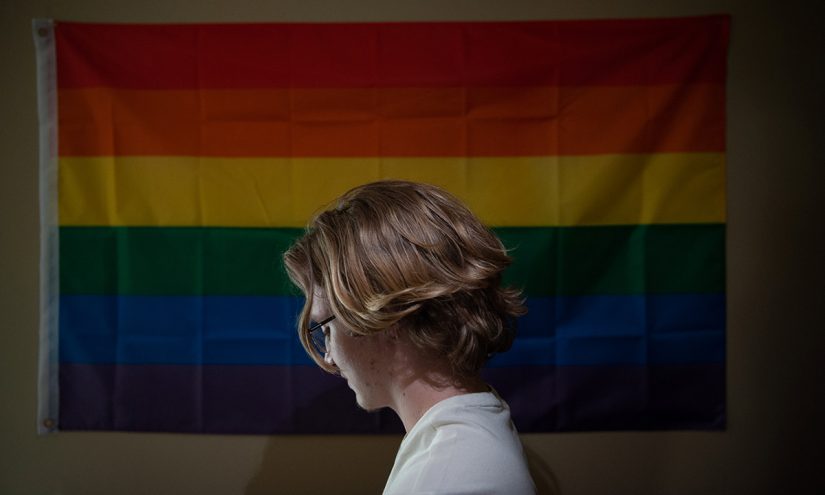
On Thursday, the Department of Health and Human Services (HHS) published a 400-page analysis of research on gender-affirming care for transgender youth, as directed by President Donald Trump. The agency used the release of the report to declare that available science does not support providing gender-affirming care to trans youth. LGBTQ+ advocacy groups worry the report will be used to further restrict gender-affirming care and to change medical guidelines in ways that harm trans youth.
The president mandated the report in an executive order condemning the medical treatment — without evidence — as a form of mutilation, amid a broader push by the administration to exclude trans people from public life. Trump’s order asked the health agency to review the “best practices for promoting the health of children who assert gender dysphoria,” while pressuring youth clinics to halt treatment or lose federal funding.
Now, the HHS has produced that report. The agency combed through research on the outcomes of puberty blockers, hormone replacement therapy, social transition, psychotherapy, and the rare cases of surgeries on adolescents and young adults diagnosed with gender dysphoria.
Gender dysphoria, the reason that most trans people undergo gender-affirming care, is a strong and persistent distress felt when one’s body is out of sync with their gender identity. Without treatment, gender dysphoria can lead to severe negative impacts in day-to-day life.
The agency states in its executive summary of the report that the document is not meant to provide clinical practice guidelines or issue legislative or policy recommendations. However, the report does imply that health care providers should refuse to offer gender-affirming care to adolescents and young adults on the basis that such care comes with the potential for risk — despite little evidence for that risk actually being found in the report.
“The evidence for benefit of pediatric medical transition is very uncertain, while the evidence for harm is less uncertain,” the executive summary states. “When medical interventions pose unnecessary, disproportionate risks of harm, healthcare providers should refuse to offer them even when they are preferred, requested, or demanded by patients.”
In its research review,the HHS determined that evidence measuring the effects of gender-affirming care on psychological outcomes, quality of life, regret and long-term health is of “very low” quality. This conclusion ignores decades of research, as well as a recent survey of more than 90,000 transgender people in the United States that found an overwhelming majority report more life satisfaction after having transitioned. Access to gender-affirming care has been linked to lower odds of suicidality and depression in trans youth, while gender-affirming surgeries have been found to lower psychological distress for adults.
Even when analyzing research that the administration deemed low-bias, the HHS found “sparse” to no evidence of harm from gender-affirming care. What’s more, the report frequently found evidence demonstrating the benefits of gender-affirming care — though it ultimately downplays those findings as not significant.
Available research on puberty blockers found high satisfaction ratings and low rates of regret. A systematic review of hormone replacement therapy described improved gender dysphoria and body satisfaction. Another found that hormone treatment leads to improved mental health. Two before-and-after studies reported reduced treatment needs or lower levels of suicidality and self-harm after hormone treatment. When measuring safety outcomes of hormone treatment, side effects did not have a major impact on treatment and complications were limited.
Despite these findings, the Department of Health and Human Services advertised the report in a Thursday news release as one that “highlights a growing body of evidence pointing to significant risks” of gender-affirming care. At the White House briefing room Thursday, deputy chief of staff for policy Stephen Miller touted the new report and attributed the idea of being transgender as part of a “cancerous communist woke culture” that is “destroying this country.”
There are side effects to many of the medications that transgender people — and cisgender people — take to receive gender-affirming care, as is the case with most medical treatments. These side effects, like the risk of decreased bone density when taking puberty blockers, are closely monitored and treated by doctors and communicated to patients.
LGBTQ+ advocacy organizations denounced the report as a political attack on transgender youth. Multiple groups said that the report’s endorsement of psychotherapy as a “noninvasive alternative” to puberty blockers and hormone treatment amounts to an endorsement of conversion therapy — a practice wherein mental health professionals try to change a youth’s sexual orientation or gender identity.
“It is already clear that this report is a willful distortion of the evidence intended to stoke fear about a field of safe and effective medicine that has existed for decades, in order to justify dangerous practices which amount to conversion therapy,” said Sinead Murano Kinney, health policy analyst at Advocates for Trans Equality.
The Human Rights Campaign, the country’s largest LGBTQ+ rights organization, accused the HHS of producing a report that is attempting to lay the groundwork to replace medical care for trans and nonbinary people with conversion therapy.
“Trans people are who we are. We’re born this way. And we deserve to live our best lives and have a fair shot and equal opportunity at living a good life,” said Jay Brown, chief of staff at the Human Rights Campaign. “This report … lays the groundwork to push parents and doctors aside and allow politicians to subject our kids to the debunked practice of conversion therapy.”
No authors or contributors are named in the report or in its executive summary. The agency says these names are being initially withheld to “maintain the integrity of this process,” and states that chapters of the document were subject to peer review.
After a five-year pause, the Trump administration is bringing back financial penalties for the many millions of borrowers who are too far behind on their student loan payments. It’s led to confusion and financial uncertainty.
At least 5 million people are in default, meaning they have failed to make payments on their loans for at least nine months — and millions more are projected to join them in the coming months.
The Hechinger Report spoke to student loan experts about what to expect and how to prepare, as well as about a separate effort in Congress to adjust how student loans work.
The Biden administration restarted loan repayments in October 2023. That came without any consequences, however, for about a year. But interest, which had also been frozen since the start of the pandemic, has been piling up for some borrowers since the fall of 2023.
All told, about 43 million federal student loan borrowers owe a total of $1.6 trillion in debt. Starting May 5, those in default face having tax refunds withheld and wages garnished if they don’t start making regular payments.
A college degree can be a path to long-term financial security, but the process of repaying loans can lead to financial hardship for many borrowers. About half of all students with a bachelor’s degree graduate with debt, which averages more than $29,000. And although average debt tends to be lower for graduates of public universities (about $20,000), close to half of people who attend those schools still leave with debt.
Related: Interested in more news about colleges and universities? Subscribe to our free biweekly higher education newsletter.
The student loan landscape is likely to change in some way over in the coming months: The Trump administration is expected to push the limits on aggressive collection practices, while Republicans in Congress are determined to adjust repayment options. Here’s what we know about what the Trump administration’s actions mean for student borrowers.
Once you’ve failed to make a loan payment in 270 days, you will probably enter into default. That means, as of May 5, the government can take your federal tax refund and apply it to your debt. Starting in June, the government can also withhold up to 15 percent of any money you receive from Social Security, including disability payments. And later this summer, officials said, they will start the process of taking a cut ofyour paycheck, although borrowers have the right to appeal. Going into default can also harm your credit score, which can make it harder to rent an apartment or borrow money for other reasons, like buying a car.
Can I go back to school to avoid repaying my loans?
Some influencers on social media have recommended enrolling in school as a way to delay making payments. It’s true that most loans are deferred while you’re in school, meaning you wouldn’t have to pay while you’re taking classes, but you may also add to what you already owe if you spend more time in college. Unless you’re confident a new certificate or degree will boost your income, delaying repayment and increasing what you owe could make paying off your loans even more difficult.
I can’t afford to repay my loan. What should I do?
There are other options. One type links your monthly payments to what you earn. These income-based repayment plans can shrink your monthly loan bill. There is also a graduated repayment plan that can lower your payments initially, after which they increase every two years. A third option is an extended repayment plan, which lowers your monthly payments but adds months or years to the time it will take to pay off your loans. The government’s Loan Simulator is one way to find options available to you.
Where can I go if I need help?
The Education Department’s Default Resolution Group can help provide advice for borrowers who are already in default. The Federal Student Aid call center is set up to answer questions. Borrowers can also reach out to their loan servicers for guidance.
What’s the difference between loan deferment, loan forbearance and default?
Loan deferment: The Education Department may grant a loan deferment for several reasons, including when a borrower is experiencing an extreme economic hardship or is unemployed. That means the borrower can temporarily stop paying off the loan without any financial penalties; in the case of subsidized undergraduate loans, interest doesn’t keep accruing during that time.
Forbearance: A loan forbearance also allows a borrower to stop payments, or make smaller ones, without any penalties. However, interest usually keeps building on all loans during that time.
Default: If a borrower is in default, it means they have failed to make payments for at least 270 days without permission. That’s when the government can begin to garnish tax refunds, Social Security benefits and wages, and a borrower’s credit score will drop.
I’ve heard income-driven repayment plans are in trouble. Is that true?
There are several types of income-driven repayment plans, which are meant to keep payments affordable. The Biden administration’s Saving for a Valuable Education (SAVE) plan is on hold because of legal challenges from Republican-led states. That plan previously offered eligible borrowers a repayment plan with lower monthly payments and a quicker path to loan forgiveness than other previously available options. But borrowers can still enroll in the Pay As You Earn (PAYE) plan and other income-based repayment options, in which payments are capped at 10 percent of a borrower’s income, or the Income-Contingent Repayment Plan, which requires payments of up to 20 percent of income and allows full repayment more quickly. Congressional Republicans hope to eliminate several of these plans in favor of just one income-based repayment plan, but it’s unclear if that bill will pass the Senate.
What’s happening with the court cases challenging the SAVE program?
Courts have effectively paused the SAVE plan. The 8 million borrowers who are enrolled don’t have to make payments, and interest will not be added while the court decides the case. With those payments paused, borrowers in this group who are intending to seek loan forgiveness for working in public service are also not making progress toward that goal. If Congress eliminates the SAVE program or the courts officially kill it, those borrowers would need to enroll in a different repayment plan.
Does Public Service Loan Forgiveness (PSLF) still exist?
Yes, the Public Service Loan Forgiveness program is still available. Borrowers should still be eligible if they are in an income-driven repayment plan and make regular payments for 10 years. They must work for the federal, state or local government — teachers and firefighters are eligible, for example — or for qualifying nonprofit organizations, such as some health care clinics or foster care agencies. The goal of PSLF is to encourage graduates to pursue careers that may pay less than jobs with private companies but which benefit their communities or the country as a whole.
The Trump administration issued an executive order in March aimed at limiting which organizations’ jobs could qualify for PSLF — for instance, a nonprofit could be excluded if the government decides it is “supporting terrorism,” engaging in civil disobedience or aiding undocumented immigrants in violation of federal law. So far, it’s unclear what the effect will be.
What other changes might be in store for student loans?
As part of the federal budget process, congressional Republicans have proposed a slew of changes to student loans that some policymakers worry will make borrowing more expensive for students — especially those in graduate programs.
The proposals include changes to:
Subsidized loans: Congressional Republicans want to get rid of subsidized loans for undergraduates, which would mean interest would accrue while a student was in college. They also want to cap total undergraduate borrowing at $50,000.
Grad Plus: They also want to end the Grad Plus program, which allows students to borrow money to cover the cost of graduate school. Student advocates worry that this would push more students into the private student loan market, which has fewer protections for borrowers.
Income-driven repayment: One proposal would simplify income-driven repayment into one option and prevent interest from causing student debt to balloon for students in income-driven repayment plans.
The proposed changes are included in the federal budget bill and may undergo many revisions as Congress figures out its spending priorities for the year.
This story about student loan repayment was produced by The Hechinger Report, a nonprofit, independent news organization focused on inequality and innovation in education. Sign up for the Hechinger newsletter.
The Hechinger Report provides in-depth, fact-based, unbiased reporting on education that is free to all readers. But that doesn’t mean it’s free to produce. Our work keeps educators and the public informed about pressing issues at schools and on campuses throughout the country. We tell the whole story, even when the details are inconvenient. Help us keep doing that.
The expansion of government powers would hand Immigration and Customs Enforcement (ICE) the authority to cancel a student’s legal status if the visa they used to enter the US is revoked.
Previously, a visa revocation would only impact a person’s ability to return to the country but would not end their permission to stay in the US as a student.
The new guidelines were outlined in an ICE document shared in a court filing on April 28, according to Associated Press.
Attorneys for international students said in court the new reasons would allow for faster deportations and would justify many of the Trump administration’s terminations of thousands of students’ legal status on the database maintained by ICE.
“This just gave them carte blanche to have the State Department revoke a visa and then deport those students, even if they’ve done nothing wrong,” said immigration attorney Brad Banias, as reported in AP.
When approached for comment, a State Department spokesperson said it “will continue to work closely with the Department of Homeland Security to enforce zero tolerance for aliens in the United States who violate US laws, threaten public safety, or in other situations where warranted”.
The PIE is yet to hear back from ICE.
This just gave them carte blanche to have the State Department revoke a visa and then deport those students, even if they’ve done nothing wrong
Brad Banias, immigration attorney
Sector leaders welcomed last week’s news that the government was restoring students’ legal status while it developed a new framework for future terminations, though the proposed vastly expanded new powers come as another blow for international students and educators.
The court heard that the new policy went against “at least 15 years of SEVP guidance”, referring to the Student and Exchange Visitor Program managed by ICE.
However, NAFSA emphasised on May 2 that “the document cannot yet be regarded as ICE’s new official policy”.
The document offers two new reasons for termination; non-compliance with the terms of nonimmigrant status and visa revocation by the state department.
In the case of the former, it is not clear whether a SEVIS record termination would also result in the termination of nonimmigrant status, though it would strip students of status benefits including applying for OPT or returning to the US after travelling abroad.
According to immigration attorneys, the new guidance could also allow for revoking student status if their names appear in a criminal database regardless of whether they were ever charged with a crime.
Traditionally, student visa revocations have not been common, but recently the US government began terminating students’ status either in addition to or instead of revoking their visas.
The Student and Exchange Visitor Information System (SEVIS) database is maintained by ICE to monitor international students’ presence in the US.
In the absence of disaggregated counts of visa revocation and SEVIS record termination, it remains unclear how many students will lose their status because of the new termination framework.
Since mid-March, sudden visa revocations by the State Department and SEVIS record terminations by ICE and DHS have caused widespread fear and uncertainty across US campuses.
“Exacerbating the stress was the rationale provided by the government, which ranged from wholly absent, to conflicting, to shifting, to downright baseless,” said NAFSA.
In March, secretary of state Marco Rubio said that his department was revoking the visas of students who took part in pro-Palestinian protests and those with criminal charges.
However, many students who saw their status terminated said they did not fall under those categories and argued that they were denied due process. Others said they were not aware their status had been revoked until logging onto the SEVIS database.
Of the more than 1,000 National Science Foundation grants killed last month by Elon Musk’s Department of Government Efficiency, some 40 percent were inside its education division. These grants to further STEM education research accounted for a little more than half of the $616 million NSF committed for projects canceled by DOGE, according to Dan Garisto, a freelance journalist reporting for Nature, a peer-reviewed scientific journal that also covers science news.
The STEM education division gives grants to researchers at universities and other organizations who study how to improve the teaching of math and science, with the goal of expanding the number of future scientists who will fuel the U.S. economy. Many of the studies are focused on boosting the participation of women or Black and Hispanic students. The division had a roughly $1.2 billion budget out of NSF’s total annual budget of $9 billion.
Related: Our free weekly newsletter alerts you to what research says about schools and classrooms.
Neither the NSF nor the Trump administration has provided a list of the canceled grants. Garisto told me that he obtained a list from an informal group of NSF employees who cobbled it together themselves. That list was subsequently posted on Grant Watch, a new project to track the Trump administration’s termination of grants at scientific research agencies. Garisto has been working with outside researchers at Grant Watch and elsewhere to document the research dollars that are affected and analyze the list for patterns.
“For NSF, we see that the STEM education directorate has been absolutely pummeled,” Noam Ross, a computational disease ecologist and one of the Grant Watch researchers, posted on Bluesky.
Terminated grants fall heavily upon STEM Education
Graphic by Dan Garisto, a freelance journalist working for Nature
Many, but not all, of the canceled research projects at NSF were also in a database of 3,400 research grants compiled by Sen. Ted Cruz, a Texas Republican. Cruz characterized them as “questionable projects that promoted Diversity, Equity, and Inclusion (DEI) or advanced neo-Marxist class warfare propaganda.”
Ross at Grant Watch analyzed the titles and abstracts or summaries of the terminated projects and discovered that “Black” was the most frequent word among them. Other common words were “climate,” “student,” “network,” “justice,” “identity,” “teacher,” and “undergraduate.”
Frequent words in the titles and summaries of terminated NSF research projects
Word cloud of the most frequent terms from the titles and abstracts of terminated grants, with word size proportional to frequency. Purple is the most frequent, followed by orange and green. Source: Noam Ross, Grant Watch
At least two of the terminated research studies focused on improving artificial intelligence education, which President Donald Trump promised to promote in an April 23 executive order,“Advancing Artificial Intelligence Education for American Youth.”
“There is something especially offensive about this EO from April 23 about the need for AI education… Given the termination of my grant on exactly this topic on April 26,” said Danaé Metaxa in a post on Bluesky that has since been deleted. Metaxa, an assistant professor of computer and information science at the University of Pennsylvania, was developing a curriculum on how to teach AI digital literacy skills by having students build and audit generative AI models.
Another canceled grant involved college students creating educational content about AI for social media to see if that content would improve AI literacy and the ability to detect misinformation. The lead researcher, Casey Fiesler, an associate professor of information science at the University of Colorado Boulder, was almost midway through her two-year grant of less than $270,000. “There is not a DEI aspect of this work,” said Fiesler. “My best guess is that the reason it was flagged was the word ‘misinformation.’”
Confusion surrounded the cuts. Bob Russell, a former NSF project officer who retired in 2024, said some NSF project officers were initially unaware that the grants they oversee had been canceled. Instead, university officials who oversee research were told, and those officials notified researchers at their institutions. Researchers then contacted their project officers. One researcher told me that the termination notice states that researchers may not appeal the decision, an administrative process that is ordinarily available to researchers who feel that NSF has made an unfair or incorrect decision.
Some of the affected researchers were attending the annual meeting of the American Educational Research Association in Denver on April 26 when more than 600 grants were cut. Some scholars found out by text that their studies had been terminated. Normally festive evening receptions were grim. “It was like a wake,” said one researcher.
The Trump administration wants to slash NSF’s budget and headcount in half, according to Russell. Many researchers expect more cuts ahead.
The Hechinger Report provides in-depth, fact-based, unbiased reporting on education that is free to all readers. But that doesn’t mean it’s free to produce. Our work keeps educators and the public informed about pressing issues at schools and on campuses throughout the country. We tell the whole story, even when the details are inconvenient. Help us keep doing that.
The founder and executive director of a network of Arizona charter schools serving autistic children has been named the U.S. Education Department’s deputy assistant secretary for special education and rehabilitative services. Education Secretary Linda McMahon made the announcement while touring the Arizona Autism Charter Schools’ Phoenix location.
Diana Diaz-Harrison, whose son is autistic, said that in her new job she hopes to continue her efforts to help others launch autism charter schools throughout the country. Her schools, she said in remarks captured on video by AZ Central, are a testament to what happens “when parents like me are empowered to create solutions.”
“My vision is to expand school choice for special needs families — whether through charter schools, private options, voucher programs, or other parent-empowered models,” she said in a statement to The 74. .
The five-school network uses a controversial intervention that attempts to train children to appear and behave like their neurotypical peers. Created by the researcher behind LGBTQ conversion therapy, applied behavior analysis, or ABA, is widely depicted as the gold standard despite scant independent evidence of its effectiveness and mounting research documenting its harms.
Diaz-Harrison opened the network’s first school in 2014 as a free, public alternative to private schools for autistic children, which are popular in Arizona but typically charge tens of thousands of dollars a year in tuition. Her Arizona charter schools are a 501(c)3 nonprofit financed by state and federal per-pupil funds. ABA is specifically endorsed by Arizona education officials as a strategy to use with autistic students.
In the time since those charters opened, ABA has grown to be a national, multi-billion-dollar industry, with for-profit companies tapping public and private insurance to pay for as much as 40 hours a week of one-on-one therapy. The intervention uses repeated, rapid-fire commands that bring rewards and punishments to change a child’s behavior and communication style.
A 74 investigation last year showed that most data supporting ABA’s effectiveness is drawn from research conducted by industry practitioners. Independent analyses, including a years-long U.S. Department of Defense review, found little evidence the intervention works. Former patients who underwent the therapy as children reported severe, lasting mental health effects, including PTSD.
Diaz-Harrison told The 74 the therapy is both valuable and sought-after. “For the autism community, specifically, many families seek schools that integrate positive behavioral strategies,” she says. “The evidence supporting behavioral therapy is extensive and well-established. It has been endorsed by the U.S. surgeon general and the American Academy of Pediatrics as an effective, research-backed approach for individuals with autism.”
During her visit, McMahon told students and staff she was eager to tell President Donald Trump about the schools. “He doesn’t believe any child, whether they have neuro-difficulties or any other problems, should be trapped in a school and not have the facilities that they need,” she said.
Since Trump’s second inauguration, he has issued numerous orders that have alarmed disability advocates and the autistic community. Though both edicts contradict longstanding federal laws, in March he ordered the closure of the Education Department and said responsibility for special education will be transferred to the U.S. Department of Health and Human Services.
About half of the Education Department’s staff has been fired, including most of the people responsible for investigating what had been a backlog of some 6,000 disability discrimination complaints. Though it’s unclear whether Trump and McMahon may legally disregard special education funding laws and allow states to spend federal dollars as they see fit, both have said they favor giving local officials as much decision-making power as possible.
Meanwhile, HHS Secretary Robert F. Kennedy Jr. has stoked fear in the autistic community by announcing a new effort to tie autism to vaccines or other “environmental toxins” — a hypothesis discredited by dozens of studies. The man he appointed to head the study has been cited for practicing medicine without a license and prescribing dangerous drugs to autistic children.
Last week, the new head of the National Institutes of Health announced that an unprecedented compilation of medical, pharmaceutical and insurance records would be used to create an autism “disease registry” — a kind of list historically used to sterilize, institutionalize and even “euthanize” autistic people. HHS later walked back the statement, saying the database under construction would have privacy guardrails.
Among other responsibilities, the offices Diaz-Harrison will head identify strategies for improving instruction for children with disabilities and ensure that as they grow up, they are able to be as independent as possible. The disability community has raised concerns that the administration is retreating from these goals.
Advocates have said they fear the changes pave the way for a return to the practice of separating students with disabilities in dedicated special ed classrooms rather than having them attend class with typically developing peers. The Individuals with Disabilities in Education Act guarantees special education students the right to instruction in the “least restrictive environment” possible.
Families’ preferences vary widely, with some parents of autistic children refusing any form of behavior therapy, while others want their kids in settings with children who share their needs. Many insist on grade-level instruction in general education classrooms
Diaz-Harrison has a master’s degree in education and worked as a bilingual teacher in California early in her career. From the late 1990s until she began supporting her son full time, she worked as a public relations strategist and a reporter and anchor for the Spanish-language broadcast network Univision.
In 2014, frustrated with her son’s school options, she organized a group of parents and ABA providers who applied for permission to open what was then a single K-5 school serving 90 children. The network now has about 1,000 students in all grades and features an online program.
At the end of the 2023-24 academic year, 9% of the network’s students scored proficient or highly proficient on Arizona’s annual reading exam, while 4% passed the math assessments.
In December 2022, the network won a $1 million Yass Prize, an award created by Jeff and Janine Yass. The billionaire investors have a long track record of donating to Republican political candidates and organizations that support school choice.
One of the award’s creators, Jeanne Allen, is CEO of the Center for Education Reform. The center nominated Diaz-Harrison for the federal role.
Yass award winners were featured at the 2023 meeting of the American Legislative Exchange Council, or ALEC, a conservative forum where state lawmakers are given model bills on education and other policies to introduce in their respective statehouses.
Diaz-Harrison has partnered with a Florida autism school to create a national charter school accelerator program to help people start schools like hers throughout the country. She told The 74 the effort has so far supported teams of hopeful school founders from Louisiana, Texas, Florida, Alabama and Nevada.
Parents of young autistic children and autistic adults often disagree about ABA. Told by their pediatrician or the person who diagnosed their child as autistic that they have a narrow window in which to intervene, families fight to get the therapy. Adults who have experienced it, however, report lasting trauma and have lobbied for research — much of it now at risk of being defunded by Kennedy — into more effective and humane alternatives.
Oklahoma wants some of its less-expensive universities to cut travel and operational costs, consolidate departments and reduce energy use — all in the name of saving money.
Already, earning a degree at one of these regional institutions is relatively inexpensive for students, costing in total as much as $15,000 less per year than bigger state universities in Oklahoma. And the schools, including Southeastern Oklahoma State University and the University of Central Oklahoma, graduate more teachers and nurses than those research institutions. Those graduates can fill critically needed roles for the state.
Still, state policymakers think there are more efficiencies to be found.
Higher education is one of the specific areas targeted by a new state-run agency with a familiar name, with the goal of “protecting our Oklahoma way of life,” Republican Gov. Kevin Stitt said in the first DOGE-OK report this spring. The Oklahoma Division of Government Efficiency, created around the same time as the federal entity with a similar title, counts among its accomplishments so far shifting to automated lawn mowers to cut grass at the state capital, changing to energy-efficient LED lighting and cutting down on state government cell phone bills. The Oklahoma governor’s office did not respond to a request for comment about this effort.
Oklahoma is one of about a dozen states that has considered an approach similar to the federal DOGE, though some state attempts were launched before the Trump administration’s. The federal Department of Government Efficiency, established the day Trump took office on Jan. 20, has commanded deep cuts to federal spending and the federal workforce, with limited justification.
As academia becomes a piñata for President Donald Trump and his supporters, Republican state lawmakers and governors are assembling in line: They want to get their whacks in too.
Related: Interested in more news about colleges and universities? Subscribe to our free biweekly higher education newsletter.
Beyond Oklahoma, Florida Gov. Ron DeSantis launched FL DOGE in February, with a promise to review state university and college operations and spending. Republicans in the Ohio statehouse formed an Ohio DOGE caucus. One of the Iowa DOGE Task Force’s three main goals is “further refining workforce and job training programs,” some of which are run through community colleges, and its members include at least two people who work at state universities.
The current political environment represents “an unprecedented attack on higher education,” said Veena Dubal, a law professor at the University of California, Irvine, and general counsel for the American Association of University Professors.
The state-level scrutiny comes atop those federal job cuts, which include layoffs of workers who interact with colleges, interdepartmental spending cuts that affect higher education and the shrinking of contracts that support research and special programs at colleges and universities. Other research grants have been canceled outright. The White House is pursuing these spending cuts at the same time as it is using colleges’ diversity efforts, their handling of antisemitism and their policies about transgender athletes to force a host of changes that go beyond cost-cutting — such as rules about how students protest and whether individual university departments require more supervision.
Florida Atlantic University students Zayla Robinson, Aadyn Hoots and Meadow Swantic (from left to right) sit together at the Boca Raton campus. Swantic objects to Florida’s efforts to dictate what subjects universities can or can’t teach: “You can’t erase history.” Credit: Michael Vasquez for The Hechinger Report
Higher education, which relies heavily on both state dollars and federal funding in the form of student loans and Pell grants, research grants and workforce training programs, faces the prospect of continued, and painful, budget cuts.
“Institutions are doing things under the threat of extinction,” Dubal said. “They’re not making measured decisions about what’s best for the institution, or best for the public good.”
For instance, the Trump administration extracted a number of pledges from Columbia University as part of its antisemitism charge, suspending $400 million in federal grants and contracts as leverage. This led campus faculty and labor unions to sue, citing an assault on academic freedom. (The Hechinger Report is in an independent unit of Teachers College.) Now Harvard faces a review of $9 billion in federal funding, also over antisemitism allegations, and the list of universities under similar scrutiny is only growing.
Budget cuts are nothing new for higher education — when a recession hits, it is one of the first places state lawmakers look to cut, in blue states or red. One reason: Public universities can sometimes make up the difference with tuition increases.
What DOGE brings, in Washington and statehouses, is something new. The DOGE approach is engaging in aggressive cost-cutting that specifically targets certain programs that some politicians don’t like, said Jeff Selingo, a special adviser to the president at Arizona State University.
“It’s definitely more political than it is fiscal or policy-oriented,” said Selingo, who is also the author of several books on higher education.
“Universities haven’t done what certain politicians wanted them to do,” he added. “This is a way to control them, in a way.”
The current pressure on Florida colleges extends far beyond budget matters. DeSantis has criticized college campuses as “intellectually repressive environments.” In 2021, Florida state lawmakers passed a law, signed by the governor, to fight this perceived ideological bent by requiring a survey of public university professors and students to assess whether there is enough intellectual diversity on campus.
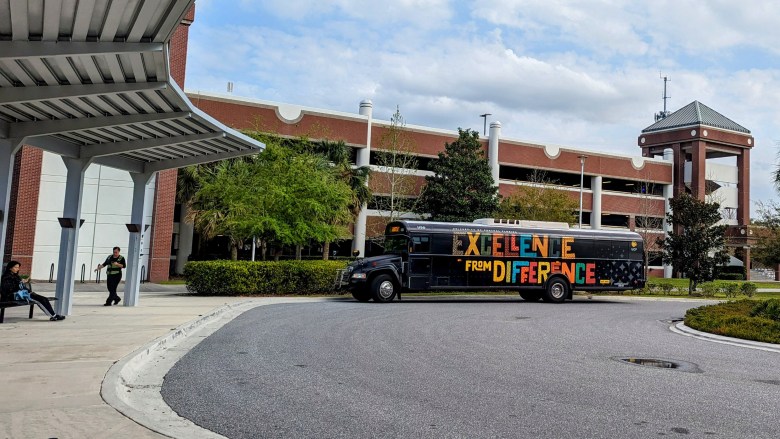
A diversity-themed bus transports students at the University of Central Florida’s Orlando campus. Credit: Michael Vasquez for The Hechinger Report
At New College in Sarasota, DeSantis led an aggressive cultural overhaul to transform the college’s atmosphere and identity into something more politically conservative. The governor has cited Hillsdale College, a conservative private Christian institution in Michigan, as a role model.
Faculty and students at New College sued. Their complaints included allegations of academic censorship and a hostile environment for LGBTQ+ students, many of whom transferred elsewhere. One lawsuit was ultimately dropped. Since the takeover, the college added athletics programs and said it has attracted a record number of new and transfer students.
Across America, Republicans control both the legislature and the governor’s mansion in 23 states, compared with 15 states fully controlled by Democrats. In those GOP-run states, creating a mini-DOGE carries the potential for increased political might, with little oversight.
In Florida, “state DOGE serves as an intimidation device,” one high-ranking public university administrator told The Hechinger Report. The administrator, who asked not to be named for fear of retribution, said “there’s also just this atmosphere of fear.”
In late March, university presidents received a letter signed by the “DOGE Team” at the governor’s office. The letter promised a thorough review by FL DOGE officials, with site visits and the expectation that each college appoint a designated liaison to handle FL DOGE’s ongoing requests.
The letter highlighted some of the items FL DOGE might request going forward, including course codes, descriptions and syllabi; full detail of all centers established on campus; and “the closure and dissolution of DEI programs and activities, as required by law.”
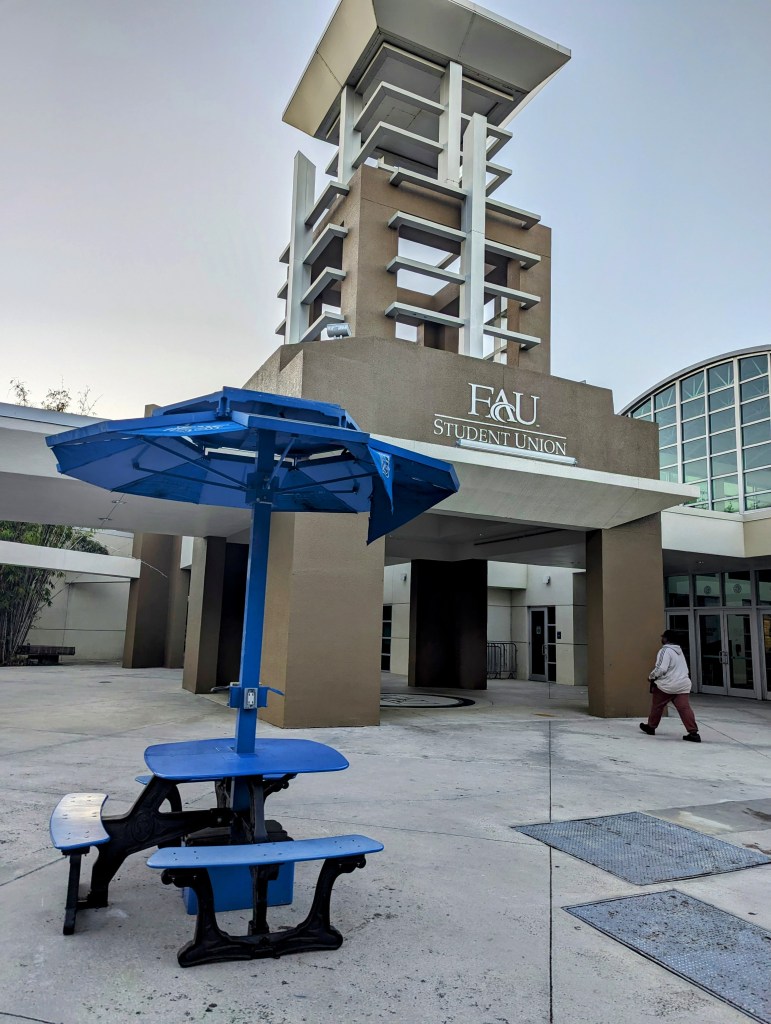
The student union at Florida Atlantic University in Boca Raton. Florida Gov. Ron DeSantis, a Republican, launched FL DOGE in February, promising to review state university and college operations and spending. Credit: Michael Vasquez for The Hechinger Report
The state did not respond to a question about whether FL DOGE is designed to attack higher education in the state. Molly Best, the deputy press secretary, noted that FL DOGE is now up and running, and cities and counties are also receiving letters requesting certain information and that the public will be updated in the future.
DOGE in Florida also follows other intervention in higher education in the state: Florida’s appointed Board of Governors, most of whom are chosen by the governor, removed dozens of courses from state universities’ core curriculum to comply with the Stop WOKE Act, a state law that took effect in 2022. The law, which DeSantis heavily promoted, discourages the teaching of concepts such as systemic racism or sexism. The courses removed from Florida’s 12 state universities were primarily sociology, anthropology and history courses.
“You can’t erase history,” said Meadow Swantic, a criminal justice major at Florida Atlantic University, a public institution, in an interview at its Boca Raton campus. “There’s certain things that are built on white supremacy, and it’s a problem.”
Fellow Florida Atlantic student Kayla Collins, however, said she has noticed some professors’ liberal bias during class discussions.
“I myself have witnessed it in my history class,” said Collins, who identifies as Republican. “It was a great history class, but I would say there were a lot of political things brought up, when it wasn’t a government class or a political science class.”
At the University of Central Florida in Orlando, political science major Liliana Hogan said she had a different experience of her professors’ political leanings.
“You hear ‘people go to university to get woke’ or whatever, but actually, as a poli-sci student, a lot of my professors are more right-wing than you would believe,” Hogan said. “I get more right-leaning perspectives from my teachers than I would have expected.” Hogan said.
Another UCF student, Johanna Abrams, objected to university budget cuts being ordered by the state government. Abrams said she understands that tax dollars are limited, but she believes college leaders should be trusted with making the budget decisions that best serve the student body.
“The government’s job should be providing the funding for education, but not determining what is worthy of being taught,” Abrams said.
Whatever their missions and attempts at mimicry, state-level DOGE entities are not necessarily identical to the federal version.
For instance, in Kansas, the Committee on Government Efficiency, while inspired by DOGE, is in search of ideas from state residents about ways to make the state bureaucracy run better rather than imposing its own changes. A Missouri Senate portal inspired by the federal DOGE works in a similar way. Yet the federal namesake isn’t taking suggestions from the masses to inform its work.
And at the federal level, then-DOGE chief Elon Musk in February emailed workers, asking them to respond “to understand what they got done last week,” he posted on X. “Failure to respond will be taken as a resignation.” Employees were asked to reply with a list of five accomplishments.
The Ohio DOGE Caucus noted explicitly it won’t be doing anything like that.
“We’re not going to be emailing any state employees asking them to give us five things they worked on throughout the week,” Ohio state Rep. Tex Fischer, a Republican, told a local radio station. “We’re really just trying to get like-minded people into a room to talk about making sure that government is spending our money wisely and focusing on its core functions that we all agree with.”
Contact editor Nirvi Shah at 212-678-3445, securely on Signal at NirviShah.14 or via email at [email protected].
The Hechinger Report provides in-depth, fact-based, unbiased reporting on education that is free to all readers. But that doesn’t mean it’s free to produce. Our work keeps educators and the public informed about pressing issues at schools and on campuses throughout the country. We tell the whole story, even when the details are inconvenient. Help us keep doing that.
Despite major policy challenges impacting the US international education sector and political tension between the North American country and its neighbours, the 2025 NAFSA conference is on track to host 8,000 attendees, the association has asserted.
The news comes despite some stakeholders choosing to skip this year’s conference due to the Trump administration’s immigration crackdown, which has seen hundreds of international students detained, arrested and fearing deportation, and controversial suggestions that Canada could become the 51st US state.
The NAFSA conference has long been a cornerstone event for the international education sector. As the largest gathering of its kind, recent years have seen approximately 9,500 attendees come together for the annual conference.
NAFSA CEO Fanta Aw told The PIE News that participants from more than 100 countries are expected to attend this year’s event in San Diego, including ministers of education and other high-level leaders and nearly 50 country consortia representing more than 1,000 academic institutions and organisations from around the world.
Jeffrey Smart, co-founder and director of the Lygon Group, based out of Australia, is among those opting out of the event, taking to LinkedIn to explain why he won’t be attending in 2025.
“NAFSA plays a crucial global role in promoting the benefits of global education – 77 years on it keeps on thriving. Sadly, this year, I won’t attend – even though it’s held in glitteringly gorgeous San Diego,” wrote Smart.
“As the new US administration seizes, arrests, and threatens to deport hundreds of international students, and makes updates to INA Section 12(f) – defining who and who can’t enter the US as ‘aliens’ – I demure.”
“The advice US schools, colleges, and universities have had to issue to their current students about what to do when crossing the border, or seized by ICE, are heartbreaking,” said Smart.
Just over three months into Donald Trump’s second term, the number of international students and recent graduates who have had their visas revoked by the administration has surpassed 1,800. However, the latest news suggests hundreds of revocations are being reversed, with immigration officials working on a new system for reviewing and terminating visas for international students.
Stakeholders speaking to The PIE shared anecdotal accounts of international colleagues forgoing NAFSA due to concerns about their experiences upon arrival in the US. One story mentioned a colleague ultimately choosing to attend the conference while considering precautionary measures, such as preparing emergency contact points.
Speaking to The PIE, Aw emphasised the event’s role as a space for colleagues to share strategies, build leadership skills, and find a “sense of community to fuel their resilience.”
“NAFSA’s annual conference and expo is an international event with global appeal, and that is absolutely true for 2025 in San Diego,” said Aw.
“The field of international education has continued to expand and where that growth has been strongest is where we’re seeing increased interest. More than 40% of our registrants so far are from outside of the United States.”
Aw recognised that some US institutions “are facing some budgetary challenges”. But the NAFSA CEO assured that “ebbs and flows are nothing new to the field of international education”.
“I think the field recognises that this is an important time for the sector to come together and our registration numbers reflect that,” she continued.
“Consider that the power of government policy to effect student mobility is playing out in the United States on a daily basis, and other major study destinations have been impacted by restrictive government policies recently as well, San Diego presents a critical time for the field to engage with the latest trends shaping the field and to share strategies for preparing and responding to the current landscape.”
San Diego presents a critical time for the field to engage with the latest trends shaping the field and to share strategies for preparing and responding to the current landscape Fanta Aw, NAFSA
Eddie West, assistant vice-president of international affairs at California State University, Fresno, told The PIE it is “encouraging” to see that the anti-DEI ‘dear colleague‘ letter that prompted alarm among the sector has been blocked.
“As one campus colleague of mine memorably put it, we should be careful not to ‘pre-comply’ regarding issues being actively litigated in the courts,” advised West.
However, West predicts budget challenges will hamper attendance at the conference this year, as many campuses are instituting hiring and travel freezes.
Christopher Connor, vice provost for enrollment management at University at Buffalo, also spoke to The PIE about this year’s conference.
“From what I’ve seen, institutions remain engaged and committed to supporting international education and the organisations that promote it, even in the face of political uncertainty,” said Connor, noting he hasn’t heard concerns that supporting NAFSA’s advocacy could jeopardise federal funding.
“For me, it’s more important than ever that international students are encouraged to pursue their dreams, rather than dwell on ‘what if’ scenarios. Sitting at home, anticipating the worst, serves no purpose and only leads to missed opportunities,” he said.
“The chance to study in the US, engage with diverse communities, and shape one’s future is still very real, and we continue to see students seizing those moments and making lasting contributions. The same goes for professionals in international education, now is not the time to retreat, but to remain engaged, connected, and focused on the broader mission we share.”
Policies will always be dynamic, not static, and it’s important for all of us, students and professionals alike, to be cognisant of that reality Christopher Connor, University at Buffalo
For Connor, the value of a US education for international students remains a “significant and compelling proposition”.
“It offers access to world-class institutions, cutting-edge research, and vast professional networks, all of which open doors globally. Despite current uncertainties, the long-term benefits far outweigh the perceived risks. In fact, the risk remains relatively low compared to the life-changing opportunities that studying in the US can provide,” he said.
“Policies will always be dynamic, not static, and it’s important for all of us, students and professionals alike, to be cognisant of that reality. Remaining adaptable and focused on the enduring value of international education is what allows us to move forward, even when the external environment shifts.”