Category: News

  • Head Start Providers Shocked as Federal Office Serving Wisconsin Shuts Without Notice – The 74

    Head Start Providers Shocked as Federal Office Serving Wisconsin Shuts Without Notice – The 74


    Get stories like this delivered straight to your inbox. Sign up for The 74 Newsletter

    Head Start child care providers in Wisconsin and five other Midwestern states were stunned Tuesday to learn that the federal agency’s Chicago regional office was closed and their administrators were placed on leave — throwing new uncertainty into the operation of the 60-year-old child care and early education program.

    “The Regional Office is a critical link to maintaining program services and safety for children and families,” said Jennie Mauer, executive director of the Wisconsin Head Start Association, in a statement distributed to news organizations Tuesday afternoon.

    The surprise shutdown of the federal agency’s Chicago office — and four others across the country — left Head Start program directors uncertain about where to turn, Mauer said.

    “We have received calls throughout the day from panicked Head Start programs worried about impacts to approving their current grants, fiscal issues, and applications to make their programs more responsive to their local communities,” Mauer said.

    The regional offices are part of the Office of Head Start in the Administration for Children and Families at the U.S. Department of Health and Human Services (HHS).

    In an interview, Mauer said there had been no official word to Head Start providers about the Chicago office closing. Some program leaders learned of the closing from private contacts with people in the office.

    “We have not seen official information come out” to local Head Start directors, who operate on the federal grants that fund the program, Mayer said. “It’s just really alarming. For an agency that is about serving families, I don’t understand how this can be.”

    The National Head Start Association issued a press release Tuesday expressing “deep concern” about the regional office closings.

    “In order to avoid disrupting services for children and families, we urge the administration to reconsider these actions until a plan has been created and shared widely,” the association stated.

    Katie Hamm, the deputy assistant secretary for early childhood development at HHS during the Biden administration, posted on LinkedIn shortly before 12 noon Tuesday that she had learned of reduction-in-force (RIF) notices to employees in the Administration for Children and Families earlier in the day.

    RIF notices appear to have gone to all employees of the Office of Head Start and the Office of Child Care in five regional offices, Hamm wrote, in Boston, New York, San Francisco and Seattle in addition to Chicago.

    “Staff are on paid leave effective immediately and no longer have access to their files,” Hamm wrote. “There does not appear to be a transition plan so that Head Start grantees, States, and Tribes are assigned to a new office. For Head Start, it is unclear who will administer grants going forward.”

    Hamm left HHS at the end of the Biden administration in January, according to her LinkedIn profile.

    Mauer said regional office employees “are our key partners and colleagues,” and their departure has left Head Start operators “incredibly saddened and deeply concerned.”

    Regional employees work with providers “to ensure the safety and quality of services and to meet the mission of providing care for the most vulnerable families in the country,” Mauer said.

    The regional offices provide grant oversight, distribute funds, monitor Head Start programs and advise centers on complying with regulations, including for child safety, she said. They also provide training and technical assistance for local Head Start programs.

    “The Regional Office is a critical link to maintaining program services and safety for children and families,” Mauer said. “These cuts will have a direct impact on programs, children, and families.”

    In addition to Wisconsin, the Chicago regional office oversees programs in Ohio, Indiana, Illinois, Michigan and Minnesota.

    Head Start supervises about 284 grants across the six states in programs that  enroll about 115,000 children, according to Mauer. There are 39 Head Start providers in Wisconsin enrolling about 16,000 children and employing about 4,000 staff.

    The federal government created Head Start in the mid-1960s to provide early education for children living in low-income households. Head Start operators report that the vast majority of the families they serve rely on the program to provide child care so they can hold jobs.

    The regional office closings came two months after a sudden halt in Head Start funding. Head Start operators get a federal reimbursement after they incur expenses, and program directors have been accustomed to being able to submit their expenses and receive reimbursement payments through an online portal.

    Over about two weeks in late January and early February, program leaders in Wisconsin and across the country reported that they were unable to log into the system or post their payment requests. The glitches persisted for some programs for several days, but were ultimately resolved by Feb. 10.

    Mauer told the Wisconsin Examiner on Tuesday that so far, there have not been new payment delays. But there has also been no communication with Head Start operators about what happens now with the unexpected regional office closings, she said.

    “No plan for who will provide support has been shared, and the still-existing regional offices are already understaffed,” Mauer said. “I’m very nervous to see what happens. With no transition plan this will be a disaster.”

    In her statement, Mauer said the regional office closing was “another example of the Federal Administration’s continuing assault on Head Start” following the earlier funding freeze and stalled reimbursements.

    She said closing regional offices was undermining the program’s ability to function.

    “We call on Congress to immediately investigate this blatant effort to hamper Head Start’s ability to provide services,” Mauer stated, “and to hold the Administration accountable for their actions.”

    Wisconsin Examiner is part of States Newsroom, a nonprofit news network supported by grants and a coalition of donors as a 501c(3) public charity. Wisconsin Examiner maintains editorial independence. Contact Editor Ruth Conniff for questions: [email protected].


    Get stories like these delivered straight to your inbox. Sign up for The 74 Newsletter
    Source link

  • Colorado School Attendance Zones Keep Racial, Socioeconomic Segregation Going – The 74

    Colorado School Attendance Zones Keep Racial, Socioeconomic Segregation Going – The 74


    Get stories like this delivered straight to your inbox. Sign up for The 74 Newsletter

    Colorado school districts should revise their school attendance zones at least every four years with a “civil rights focus.” State lawmakers should increase funding to transport students to and from school. And attorneys, advocates, and community organizations should embrace the right to sue over school assignments that increase racial segregation.

    Those are among the recommendations in a new report from the Colorado Advisory Committee to the U.S. Commission on Civil Rights. “Examining the Racial Impact of Public School Attendance Zones in Colorado” concludes that the way Colorado draws school attendance boundaries and assigns students to schools mirrors segregated housing patterns and results in low-income families having less access to high-quality schools.

    “This segregation fuels a widespread belief that schools serving predominantly white and affluent students are inherently better than those serving predominantly students of color or low-income families,” an accompanying policy brief said.

    Other reports from local and national think tanks and advocacy organizations have reached similar conclusions. While some local school officials, such as the Denver school board, have talked about possible solutions, the federal Trump administration has framed efforts to increase racial diversity in schools as discrimination that could trigger civil rights investigations.

    The Colorado Advisory Committee is a 10-person group of bipartisan appointed volunteers. Each state has an advisory committee that produces reports on civil rights issues ranging from housing discrimination to voting rights to the use of excessive force by police officers.

    In its latest report, the Colorado committee found that “thousands — perhaps tens of thousands — of Colorado students are likely to be assigned to schools in violation” of a federal law that says assigning a student to a school outside their neighborhood is unlawful “if it has segregating effects.”

    The committee’s recommended solutions attempt to balance strong support for neighborhood schools with allowing families to choose the best school for their child. School choice, or the ability for a student to apply to attend any public school, is enshrined in state law.

    The committee advocated for what it called “controlled choice,” which it said could mean that popular schools reserve seats for students who live outside the neighborhood or that schools give priority admission to non-neighborhood students who live the closest.

    To produce its report, the committee held hearings in 2023 to gather input from national experts including university professors, the author of a book on school attendance zones, and representatives from think tanks across the political spectrum.

    The committee also convened a group of 10 local experts including Brenda Dickhoner from the conservative advocacy organization Ready Colorado; Kathy Gebhardt, who was then a member of the Boulder Valley school board and now sits on the State Board of Education; former Aurora Public Schools superintendent Rico Munn; and Nicholas Martinez, a former teacher who heads the education reform organization Transform Education Now.

    The committee’s other recommendations include:

    • The civil rights divisions of the federal education and justice departments should review options for enforcing “the permissible and impermissible use of race in drawing attendance boundaries and setting school assignment policies.”
    • Colorado lawmakers should correct “the systemic racial and ethnic disparities” caused by the state’s school transportation system, which does not require school districts to provide transportation to students who use school choice.
    • State lawmakers should improve Colorado’s school choice system, including by adopting a uniform school enrollment window statewide and providing families with more information about schools’ discipline policies, class sizes, and other factors.
    • Colorado school districts should revise their school attendance zones and student assignment policies at least every four years and “consider racial and ethnic integration as part of the rezoning process.”

    “Redrawing school boundaries every few years can help prevent segregation from becoming entrenched while still allowing students to maintain a sense of stability in their educational environment,” the committee’s policy brief said.

    Chalkbeat is a nonprofit news site covering educational change in public schools.


    Get stories like these delivered straight to your inbox. Sign up for The 74 Newsletter

    Source link

  • Black Colleges Ponder Their Future As Trump Makes Cuts to Education Dollars – The 74

    Black Colleges Ponder Their Future As Trump Makes Cuts to Education Dollars – The 74


    Get stories like this delivered straight to your inbox. Sign up for The 74 Newsletter

    The nation’s historically Black colleges and universities, known as HBCUs, are wondering how to survive in an uncertain and contentious educational climate as the Trump administration downsizes the scope and purpose of the U.S. Department of Education — while cutting away at federal funding for higher education.

    In January, President Donald Trump signed an executive order pausing federal grants and loans, alarming HBCUs, where most students rely on Pell Grants or federal aid. The order was later rescinded, but ongoing cuts leave key support systems in political limbo, said Denise Smith, deputy director of higher education policy and a senior fellow at The Century Foundation, a left-leaning think tank.

    Leaders worry about Trump’s rollback of the Justice40 Initiative, a climate change program that relied on HBCUs to tackle environmental justice issues, she said. And there’s uncertainty around programs such as federal work-study and TRIO, which provides college access services to disadvantaged students.

    “People are being mum because we’re starting to see a chilling effect,” Smith said. “There’s real fear that resources could be lost at any moment — even the ones schools already know they need to survive.”

    Most students at HBCUs rely on Pell Grants or other federal aid, and a fifth of Black college graduates matriculate from HBCUs. Other minority-serving institutions, known as MSIs, that focus on Hispanic and American Indian populations also heavily depend on federal aid.

    “It’s still unclear what these cuts will mean for HBCUs and MSIs, even though they’re supposedly protected,” Smith said.

    States may be unlikely to make up any potential federal funding cuts to their public HBCUs. And the schools already have been underfunded by states compared with predominantly white schools.

    Congress created public, land-grant universities under the Morrill Act of 1862 to serve the country’s agricultural and industrial industries, providing 10 million acres taken from tribes and offering it for public universities such as Auburn and the University of Georgia. But Black students were excluded.

    The 1890 Morrill Act required states to either integrate or establish separate land-grant institutions for Black students — leading to the creation of many HBCUs. These schools have since faced chronic underfunding compared with their majority-white counterparts.

    ‘None of them are equitable’

    In 2020, the average endowment of white land-grant universities was $1.9 billion, compared with just $34 million for HBCUs, according to Forbes.

    There are other HBCUs that don’t stem from the 1890 law, including well-known private schools such as Fisk University, Howard University, Morehouse College and Spelman College. But more than three-fourths of HBCU students attend public universities, meaning state lawmakers play a significant role in their funding and oversight.

    Marybeth Gasman, an endowed chair in education and a distinguished professor at Rutgers University, isn’t impressed by what states have done for HBCUs and other minority-serving institutions so far. She said she isn’t sure there is a state model that can bridge the massive funding inequities for these institutions, even in states better known for their support.

    “I don’t think North Carolina or Maryland have done a particularly good job at the state level. Nor have any of the other states. Students at HBCUs are funded at roughly 50-60% of what students at [predominately white institutions] are funded. That’s not right,” said Gasman.

    “Most of the bipartisan support has come from the U.S. Congress and is the result of important work by HBCUs and affiliated organizations. I don’t know of a state model that works well, as none of them are equitable.”

    Under federal law, states that accept federal land-grant funding are required to match every dollar with state funds.

    But in 2023, the Biden administration sent letters to 16 governors warning them that their public Black land-grant institutions had been underfunded by more than $12 billion over three decades.

    Tennessee State University alone had a $2.1 billion gap with the University of Tennessee, Knoxville.

    At a February meeting hosted by the Tennessee Black Caucus of State Legislators, Tennessee State interim President Dwayne Tucker said the school is focused on asking lawmakers this year for money to keep the school running.

    Otherwise, Tucker said at the time, the institution could run out of cash around April or May.

    “That’s real money. That’s the money we should work on,” Tucker said, according to a video of the forum.

    In some states, lawsuits to recoup long-standing underfunding have been one course of action.

    In Maryland, a landmark $577 million legal settlement was reached in 2021 to address decades of underfunding at four public HBCUs.

    In Georgia, three HBCU students sued the state in 2023 for underfunding of three HBCUs.

    In Tennessee, a recent state report found Tennessee State University has been shortchanged roughly $150 million to $544 million over the past 100 years.

    But Tucker said he thinks filing a lawsuit doesn’t make much sense for Tennessee State.

    “There’s no account payable set up with the state of Tennessee to pay us $2.1 billion,” Tucker said at the February forum. “And if we want to make a conclusion about whether [that money] is real or not … you’re going to have to sue the state of Tennessee, and I don’t think that makes a whole lot of sense.”

    Economic anchors

    There are 102 HBCUs across 19 states, Washington, D.C., and the U.S. Virgin Islands, though a large number of HBCUs are concentrated in the South.

    Alabama has the most, with 14, and Pennsylvania has the farthest north HBCU.

    Beyond education, HBCUs contribute roughly $15 billion annually to their local economies, generate more than 134,000 jobs and create $46.8 billion in career earnings, proving themselves to be economic anchors in under-resourced regions.

    Homecoming events at HBCUs significantly bolster local economies, local studies show. North Carolina Central University’s homecoming contributes approximately $2.5 million to Durham’s economy annually.

    Similarly, Hampton University’s 2024 homecoming was projected to inject around $3 million into the City of Hampton and the coastal Virginia region, spurred by increased visitor spending and retail sales. In Tallahassee, Florida A&M University’s 2024 homecoming week in October generated about $5.1 million from Sunday to Thursday.

    Their significance is especially pronounced in Southern states — such as North Carolina, where HBCUs account for just 16% of four-year schools but serve 45% of the state’s Black undergraduate population.

    Smith has been encouraged by what she’s seen in states such as Maryland, North Carolina and Tennessee, which have a combined 20 HBCUs among them. Lawmakers have taken piecemeal steps to expand support for HBCUs through policy and funding, she noted.

    Tennessee became the first state in 2018 to appoint a full-time statewide higher education official dedicated to HBCU success for institutions such as Fisk and Tennessee State. Meanwhile, North Carolina launched a bipartisan, bicameral HBCU Caucus in 2023 to advocate for its 10 HBCUs, known as the NC10, and spotlight their $1.7 billion annual economic impact.

    “We created a bipartisan HBCU caucus because we needed people in both parties to understand these institutions’ importance. If you represent a district with an HBCU, you should be connected to it,” said North Carolina Democratic Sen. Gladys Robinson, an alum of private HBCU Bennett College and state HBCU North Carolina A&T State University.

    “It took constant education — getting folks to come and see, talk about what was going on,” she recalled. “It’s like beating the drum constantly until you finally hear the beat.”

    For Robinson, advocacy for HBCUs can be a tough task, especially when fellow lawmakers aren’t aware of the stories of these institutions. North Carolina A&T was among the 1890 land-grant universities historically undermatched in federal agricultural and extension funding.

    The NC Promise Tuition Plan, launched in 2018, reduced in-state tuition to $500 per semester and out-of-state tuition to $2,500 per semester at a handful of schools that now include HBCUs Elizabeth City State University and Fayetteville State University; Western Carolina University, a Hispanic-serving institution; and UNC at Pembroke, founded in 1887 to serve American Indians.

    Through conversations on the floor of the General Assembly, and with lawmakers on both sides of the aisle, Robinson advocated to ensure Elizabeth City State — a struggling HBCU — was included, which helped revive enrollment and public investment.

    “I’m hopeful because we’ve been here before,” Robinson said in an interview.

    “These institutions were built out of churches and land by people who had nothing, just so we could be educated,” Robinson said. “We have people in powerful positions across the country. We have to use our strength and our voices. Alumni must step up.

    “It’s tough, but not undoable.”

    Meanwhile, other states are working to recognize certain colleges that offer significant support to Black college students. California last year passed a law creating a Black-serving Institution designation, the first such title in the country. Schools must have programs focused on Black achievement, retention and graduation rates, along with a five-year plan to improve them. Sacramento State is among the first receiving the designation.

    And this session, California state Assemblymember Mike Gipson, a Democrat, introduced legislation that proposes a $75 million grant program to support Black and underserved students over five years through the Designation of California Black-Serving Institutions Grant Program. The bill was most recently referred to the Assembly’s appropriations committee.

    Stateline is part of States Newsroom, a nonprofit news network supported by grants and a coalition of donors as a 501c(3) public charity. Stateline maintains editorial independence. Contact Editor Scott S. Greenberger for questions: [email protected].


    Get stories like these delivered straight to your inbox. Sign up for The 74 Newsletter

    Source link

  • Punishing Parents for Chronic Absenteeism – The 74

    Punishing Parents for Chronic Absenteeism – The 74


    Get stories like this delivered straight to your inbox. Sign up for The 74 Newsletter

    School (in)Security is our biweekly briefing on the latest school safety news, vetted by Mark KeierleberSubscribe here.

    As educators nationwide grapple with stubbornly high levels of student absences since the pandemic drove schools into disarray five years ago, Oklahoma prosecutor Erik Johnson says he has the solution. 

    Throw parents in jail.

    This week, I offer a look at chronic absenteeism’s persistence long after COVID shuttered classrooms, plunged families into poverty and led to the deaths of more than 1 million Americans. Lawmakers nationwide have proposed dozens of bills this year designed to curtail student absences — with radically different approaches.

    While a proposal in Hawaii would reward kids’ good attendance with ice cream, new laws in Indiana, West Virginia and Iowa impose fines and jail time for parents who can’t compel their children to attend class regularly. In Oklahoma, where Johnson has ushered in a new era of truancy crackdowns, state lawmakers say parents — not principals and teachers — should be held accountable for students’ repeat absences.

    “We prosecute everything from murders to rape to financial crimes, but in my view, the ones that cause the most societal harm is when people do harm to children, either child neglect, child physical abuse, child sexual abuse, domestic violence in homes, and then you can add truancy to the list,” Johnson told me this week. 

    “It’s not as bad, in my opinion, as beating a child, but it’s on the spectrum because you’re not putting that child in a position to be successful,” continued Johnson, who has dubbed 2025 the “Year of the Child.”


    In the news

    Books are not a crime — yet: Under proposed Texas legislation, teachers could soon face jail sentences for teaching classic literary works with sexual content, including The Catcher in the Rye and (unironically?) Brave New World. | Mother Jones

    Mass layoffs at the U.S. Department of Health and Human Services this week could have devastating consequences for the health and well-being of low-income children. | The Associated Press

    Ten days or else: The Education Department demanded Thursday that states certify in writing within the next 10 days that K-12 schools are complying with its interpretation of civil rights laws, namely eliminating any diversity, equity and inclusion programs, or else risk losing their federal funding. | The New York Times

    A Texas teen was kneed in the face by a school cop: Now, with steep cuts to the Education Department’s Office for Civil Rights, her case is one of thousands that have been left to languish. | The 74

    Students’ right to privacy versus parents’ right to know: The Trump administration has opened an investigation into a California law designed to protect transgender students from being outed to their parents, alleging violations of the federal student privacy law. | The New York Times

    • A similar investigation has been opened against officials in Maine, where the feds claim district policies to protect students’ privacy come at the expense of parents’ right to information. | Maine Morning Star
    • “Parents are the most natural protectors of their children,” Education Secretary Linda McMahon said in a statement after a similar federal investigation was launched against Virginia educators. “Yet many states and school districts have enacted policies that imply students need protection from their parents.” | Virginia Mercury
    • A little context: In a recent survey, more than 92% of parents said they were supportive of their child’s transgender identity. | Human Rights Campaign
    Sign-up for the School (in)Security newsletter.

    Get the most critical news and information about students’ rights, safety and well-being delivered straight to your inbox.

    The Student Press Law Center joined a coalition of free speech and journalism organizations in denouncing the recent ICE detention of Tufts University international student Rumeysa Ozturk over opinions she expressed in an op-ed in the student newspaper. 

    • “Such a basis for her detention would represent a blatant disregard for the principles of free speech and free press within the First Amendment,” the groups wrote in their letter. | Student Press Law Center
    • The Turkish doctoral candidate is one of several students who’ve been rounded up by immigration officials in recent weeks based on pro-Palestinian comments. | The New York Times

    Florida lawmakers have a plan to fill the jobs of undocumented workers who are deported: Put kids on the overnight shift. | The Guardian

    Minority report: Following bipartisan opposition, Georgia lawmakers have given up on efforts to create a statewide student-tracking database designed to identify youth who could commit future acts of violence. | WABE

    A majority of school district programs focused on protecting student data are led by administrators with little training in privacy issues, a new report finds. | StateScoop

    Washington students’ sensitive data was exposed. The culprit? A student surveillance tool. | The Seattle Times


    ICYMI @The74


    Emotional Support

    Annie, who lives with The 74 social media guru Christian Skotte, is the cutest regular at Brooklyn’s Prospect Park. You won’t convince me otherwise. 


    Get stories like these delivered straight to your inbox. Sign up for The 74 Newsletter

    Source link

  • Adapting TNE to student needs key, say stakeholders

    Adapting TNE to student needs key, say stakeholders

    The PIE News, in partnership with Oxford International Education Group (OIEG) and Studyportals, hosted a briefing where panelists explored university strategies, government collaboration, and financial sustainability for a successful TNE model.

    As international universities compete to establish TNE partnerships in India, the University of Southampton stands out, with its Delhi branch campus set to open in August 2025.

    Kasia Cakala, director of education pathways development at OIEG, which is collaborating with Southampton on the project, noted how education providers must continuously adapt to evolving expectations of the TNE model.

    “Not only do universities have to be mindful of the models they take in this very challenging market, but private providers like us also need to pivot, change, and adapt to support universities in their urgent needs,” stated Cakala at the briefing.

    “With Southampton, the key was defining a proposition that was not only sustainable but also aligned with government priorities and the domestic student ecosystem.”

    Cakala emphasised that as students from countries like India become more savvy, knowing what they need and expecting more from institutions, universities must adopt a “sophisticated market research strategy” to define their proposition, particularly when presenting expansion plans to government bodies.

    Private providers like us need to pivot, change, and adapt to support universities in their urgent needs
    Kasia Cakala, OIEG

    In light of the changing expectations, Carlie Sage, associate director, partnerships, APAC, Studyportals, underscored the importance of understanding student behaviour and market trends in shaping international education strategies.

    “A lot of universities still make decisions without really understanding the environment they’re operating in,” stated Sage. 

     “There’s amazing data out there that can help institutions navigate shifts, understand demand, identify gaps, and see what’s happening in real time.”

    According to Aziz Boussofiane, director, Cormack Consultancy Group, while TNE models need to be financially sustainable, they also need to be beneficial for both the university and the host country in the long run. 

    “For host countries, success (in TNE) means increasing capacity with quality provision – and for universities, it must align with their mission and strategic objectives,” stated Boussofiane, while addressing the audience. 

    “There are different drivers and processes depending on the market, whether it’s India or Nigeria, [and] it’s often about increasing in-country capacity and improving the quality of local providers.”

    While TNE is widely embraced by leading universities in major study destinations, challenges persist in building scalable models due to varying international perceptions of quality and value, which impact recognition, as previously reported by The PIE. 

    According to Daniel Cragg, director of Nous, while TNE is just another challenge for institutions, which are already dealing with academic workforce stress, new pressures from AI, and evolving student needs, the appetite for partnerships has only been rising. 

    “The appetite for collaboration is growing – universities want to share risk, balance success, and be more in-market experts,” said Cragg.

    “In international education, it feels like there’s a black swan event every three to four years. But universities constantly adapt, innovate, and thrive.”

    While universities in the UK and Australia have pushed through major TNE expansions in recent years, institutions in countries like New Zealand, though interested, prioritise strengthening their reputation and research over physical expansion.

    “New Zealand is a small player in TNE, but our partnerships focus on reputation and research rather than bricks-and-mortar expansion overseas,” stated Meredith Smart, international director, Auckland University of Technology

    “There’s a strong connection between our ranking strategy and our partnership strategy – reputation matters.”

    As the New Zealand government aims to boost international recruitment from emerging markets while strengthening educational partnerships in countries like India and Vietnam, institutions like AUT see an opportunity, while also learning from the missteps of their peers.

    “We are in a strong growth focus. The government wants us to grow. They’re desperate to win the next election, and I think they feel that international education can boost the economy,” stated Smart. 

    “New Zealanders love international students, but that could change as numbers rise. We must actively demonstrate the value of internationalisation to our economy, industries, and diplomatic relations.”

    This point was further reiterated by Cragg, who highlighted how working with governments in policymaking is essential. 

    “Working with governments to shape future visa policies is essential to ensuring sustainable international student growth,” he said. 

    “The value of international education extends across different areas of government, not just within universities.”

    Source link

  • 6 ways to make math more accessible for multilingual learners

    6 ways to make math more accessible for multilingual learners

    Key points:

    Math isn’t just about numbers. It’s about language, too.

    Many math tasks involve reading, writing, speaking, and listening. These language demands can be particularly challenging for students whose primary language is not English.

    There are many ways teachers can bridge language barriers for multilingual learners (MLs) while also making math more accessible and engaging for all learners. Here are a few:

    1. Introduce and reinforce academic language

    Like many disciplines, math has its own language. It has specialized terms–such as numerator, divisor, polynomial, and coefficient–that students may not encounter outside of class. Math also includes everyday words with multiple meanings, such as product, plane, odd, even, square, degree, and mean.

    One way to help students build the vocabulary needed for each lesson is to identify and highlight key terms that might be new to them. Write the terms on a whiteboard. Post the terms on math walls. Ask students to record them in math vocabulary notebooks they can reference throughout the year. Conduct a hands-on activity that provides a context for the vocabulary students are learning. Reinforce the terms by asking students to draw pictures of them in their notebooks or use them in conversations during group work.

    Helping students learn to speak math proficiently today will pay dividends (another word with multiple meanings!) for years to come.

    2. Incorporate visual aids

    Visuals and multimedia improve MLs’ English language acquisition and engagement. Picture cards, for example, are a helpful tool for building students’ vocabulary skills in group, paired, or independent work. Many digital platforms include ready-made online cards as well as resources for creating picture cards and worksheets.

    Visual aids also help MLs comprehend and remember content. Aids such as photographs, videos, animations, drawings, diagrams, charts, and graphs help make abstract ideas concrete. They connect concepts to the everyday world and students’ experiences and prior knowledge, which helps foster understanding.

    Even physical actions such as hand gestures, modeling the use of a tool, or displaying work samples alongside verbal explanations and instructions can give students the clarity needed to tackle math tasks.

    3. Utilize digital tools

    A key benefit of digital math tools is that they make math feel approachable. Many MLs may feel more comfortable with digital math platforms because they can practice independently without worrying about taking extra time or giving the wrong answer in front of their peers.

    Digital platforms also offer embedded language supports and accessibility features for diverse learners. Features like text-to-speech, adjustable speaking rates, digital glossaries, and closed captioning improve math comprehension and strengthen literacy skills.

    4. Encourage hands-on learning

    Hands-on learning makes math come alive. Math manipulatives allow MLs to “touch” math, deepening their understanding. Both physical and digital manipulatives–such as pattern blocks, dice, spinners, base ten blocks, and algebra tiles–enable students to explore and interact with mathematical ideas and discover the wonders of math in the world around them.

    Many lesson models, inquiry-based investigations, hands-on explorations and activities, and simulations also help students connect abstract concepts and real-life scenarios.

    PhET sims, for example, create a game-like environment where students learn math through exploration and discovery. In addition to addressing math concepts and applications, these free simulations offer language translations and inclusive features such as voicing and interactive descriptions.

    Whether students do math by manipulating materials in their hands or on their devices, hands-on explorations encourage students to experiment, make predictions, and find solutions through trial and error. This not only fosters critical thinking but also helps build confidence and perseverance.

    5. Use students’ home language as a support

    Research suggests that students’ home languages can also be educational resources

    In U.S. public schools, Spanish is the most commonly reported home language of students learning English. More than 75 percent of English learners speak Spanish at home. To help schools incorporate students’ home language in the classroom, some digital platforms offer curriculum content and supports in both English and Spanish. Some even provide the option to toggle from English to Spanish with the click of a button.

    In addition, artificial intelligence and online translation tools can translate lesson materials into multiple languages.

    6. Create verbal scaffolds

    To respond to math questions, MLs have to figure out the answers and how to phrase their responses in English. Verbal scaffolds such as sentence frames and sentence stems can lighten the cognitive load by giving students a starting point for answering questions or expressing their ideas. This way, students can focus on the lesson content rather than having to spend extra mental energy figuring out how to word their answers.

    Sentence frames are often helpful for students with a beginning level of English proficiency.

    • A square has            sides.  
    • An isosceles triangle has at least             equal angles.

    Sentence stems (a.k.a. sentence starters) help students get their thoughts going so they can give an answer or participate in a discussion. 

    • The pattern I noticed was                               .               
    • My answer is                               . I figured it out by                               .

    Whether online or on paper, these fill-in-the-blank phrases and sentences help students explain their thinking orally or in writing. These scaffolds also support academic language development by showing key terms in context and providing opportunities to use new vocabulary words.

    Making math welcoming for all

    All students are math language learners. Regardless of their home language, every student should feel like their math classroom is a place to learn, participate, contribute, and grow. With the right strategies and tools, teachers can effectively support MLs while maintaining the rigor of grade-level content and making math more accessible and engaging for all.

    Source link

  • Three-quarters of global study decisions determined by cost

    Three-quarters of global study decisions determined by cost

    International students are increasingly looking for affordable destinations and alternative programs rather than give up on study abroad due to increasing costs, a new ApplyBoard survey has shown.  

    While 77% of surveyed students ranked affordable tuition fees as the most important factor shaping study decisions, only 9% said they planned to defer their studies based on these concerns, according to a recent student survey from ApplyBoard edtech firm.  

    “Students weren’t planning to wait for things to change,” said ApplyBoard senior communications manager Brooke Kelly: “They’re considering new destinations, adjusting which programs they apply to, and accepting that they have to balance work with study, but they’re still planning to study abroad,” she maintained.  

    Just over one in four students said they were considering different study destinations than originally planned, with Denmark, Finland, Nigeria and Italy the most popular emerging destinations.  

    Additionally, 55% of students said they would have to work part-time to afford their study abroad program.  

    After affordability, came employability (57%), career readiness (49%), high-quality teaching (47%), and program reputation (45%), as factors shaping student decision-making.  

    With students increasingly thinking about work opportunities, software and civil engineering topped students’ career choices, with nursing as the second most popular field. Tech fields including IT, cybersecurity, and data analysis also showed strong interest. 

    What’s more, interest in PhD programs saw a 4% rise on the previous year, while over half of students were considering master’s degrees, indicating that students are increasingly prioritising credentials and post-study work opportunities.  

    [Students are] considering new destinations, adjusting which programs they apply to, and accepting that they have to balance work with study, but they’re still planning to study abroad

    Brooke Kelly, ApplyBoard

    The study surveyed over 3,500 students from 84 countries, with the most represented countries being Nigeria, Ghana, Canada, Pakistan, Bangladesh and India.  

    Given its share of international students, it should be noted that China is absent from the top 10 most represented countries.  

    As students’ priorities shift and currencies fluctuate, “diversity will be key to mitigate against increased volatility and to ensure campuses remain vibrant with students from all around the world,” said Kelly.  

    Meanwhile, institutions should increase communication about scholarships and financial aid, offer more hybrid learning experiences and highlight programs on different timelines such as accelerated degrees, she advised.  

    While alternative markets are on the rise, 65% of respondents said they were only interested in studying in one of the six major destinations, with Canada followed by the US, UK, Australia, Germany and Ireland, in order of popularity.  

    Despite Canada’s international student caps, the largest proportion of students said they were ‘extremely’, ‘very’ or ‘moderately’ interested in the study destination, highlighting its enduring appeal among young people.  

    While stricter controls on post study work were implemented in Canada last year, in a rare easing of policies, the IRCC recently said that all college graduates would once again be eligible for post study work.  

    This change, combined with the fact that international students can still be accompanied by their dependants while studying in Canada, is likely to have contributed to it maintaining its attractiveness, according to Kelly.  

    Source link

  • Title IX Case Against Maine Schools Headed to U.S. Department of Justice – The 74

    Title IX Case Against Maine Schools Headed to U.S. Department of Justice – The 74


    Get stories like this delivered straight to your inbox. Sign up for The 74 Newsletter

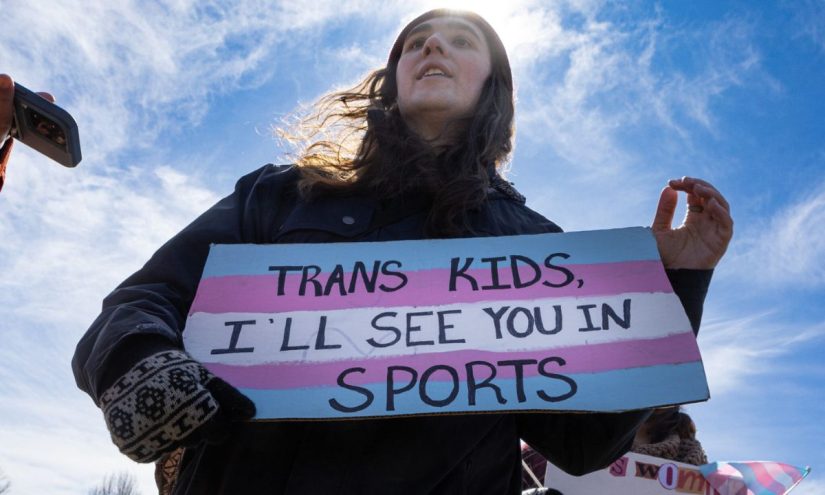
    The conflict between the state of Maine and the Trump administration over transgender student athletes reached a new pivot point on Monday. As the first of several deadlines set by the federal government has now expired, whether Maine can continue to allow trans athletes to participate in school sports appears likely to be decided by the courts.

    Two separate federal agencies determined that Maine is in violation of Title IX based on the Trump administration’s interpretation of the anti-sex discrimination protection.

    The U.S. Department of Education’s Office for Civil Rights issued a final warning Monday to the Maine Department of Education regarding its noncompliance with a federal directive for allowing trans girls to participate in girls’ sports.

    If the state does not propose an agreement that’s acceptable to the office by April 11, the case will be referred to the Department of Justice, the letter said.

    Meanwhile, a separate investigation by the U.S. Department of Health and Human Services’ civil rights office that found Maine in violation of Title IX for “continuing to unlawfully allow” trans girls to compete in girl’s sports has been referred to the U.S. Department of Justice, according to a Monday social media post from the agency.

    In a letter dated March 17, HHS had given Maine a deadline of 10 days to comply with federal guidance. Monday marked ten business days from that warning.

    Both agencies determined that Maine had violated federal law after dayslong investigations that included no interviews, while typical investigations take months and are eventually settled with resolution agreements. The probes were launched after Gov. Janet Mills and President Donald Trump had a heated exchange over the state’s trans athlete policy. Millions of dollars in federal funding might be at risk, depending on how the cases proceed.

    “We just need an answer at this point as to, ‘Does the Trump administration have the authority to do what it’s doing when it comes to fast tracking the removal of federal funds?’” said Jackie Wernz, a former OCR lawyer for the Education Department who now represents school districts nationwide in these types of cases.

    “This is just unprecedented, and we’re not following the process that we’re used to. So I think it’s going to be really helpful for courts to start weighing in on whether or not they have the authority to do this.”

    Meanwhile, Republican state lawmakers said in a news conference on Tuesday that they want the state to repeal trans students’ rights to athletics, locker rooms and bathrooms, and to roll back inclusion of gender as a protected class in the Maine Human Rights Act.

    “The problem is that the term gender identity and the Human Rights Act is being interpreted way too broadly by the left,” said Senate Minority Leader Trey Stewart (R-Aroostook). “And what it’s saying is there’s no boundary between men’s and women’s spaces.”

    Rep. Michael Soboleski (R- Phillips) said he is introducing a bill to remove consideration of gender identity from the act, and asked Democrats and Mills to support the legislation in order to avoid the risk of losing federal funding.

    Earlier this year, Iowa became the first state in the nation to remove civil rights from a state law when its Legislature voted to remove gender identity from its civil rights act.

    “This is not sustainable,” Stewart said. “We’re a poor state. We are heavily reliant on federal money. The governor needs to move on this.”

    On March 19, the Department of Education’s civil rights office notified Maine of its noncompliance and proposed a resolution agreement that would require the state to rescind its support of trans athletes, which is currently required by the Maine Human Rights Act. A Cumberland-area school district and the Maine Principals Association, which runs student athletics, that were also found in violation have already refused to sign the agreement.

    This development is part of a broader effort by the Trump administration to enforce Title IX provisions concerning gender and athletics. Earlier this year, the administration launched investigations in several other states for similar policies allowing trans athletes to compete in alignment with their gender identity.

    Title IX, the federal law banning sex-based discrimination, does not reference trans people directly, but the Trump administration has interpreted Maine’s policy as discrimination against cisgender girls.

    Rachel Perera, a fellow in the governance studies program for the Brown Center on Education Policy at national think tank The Brookings Institution, said the Trump administration’s interpretation of Title IX leaves room for questioning. If the policy goes to trial, she said federal courts may come up with a clearer interpretation.

    “It’s going to be really important to see how Maine proceeds, because they’re sort of setting the tone in terms of these other states and other localities who are going to be trying to navigate these very same dynamics,” she said.

    Maine Morning Star is part of States Newsroom, a nonprofit news network supported by grants and a coalition of donors as a 501c(3) public charity. Maine Morning Star maintains editorial independence. Contact Editor Lauren McCauley for questions: [email protected].


    Get stories like these delivered straight to your inbox. Sign up for The 74 Newsletter

    Source link

  • Education providers pivot to TNE in price-sensitive Pakistan

    Education providers pivot to TNE in price-sensitive Pakistan

    Speaking at The PIE Live Europe 2025, Stuart Smith, CEO of pathway provider NCUK, said Pakistan’s position as a growing yet price-sensitive market opens exciting opportunities for students to earn their qualifications before transitioning to a high-quality university in the UK or elsewhere. 

    “Financially, one of the biggest barriers for Pakistani students has been the cost of studying abroad. The pathway model helps address this by offering significant cost savings, allowing students to progress to high-quality universities,” Smith told delegates at the London conference.

    “One of the big advantages of our model is that students can come in on an NCUK qualification, spend one or two years at home making really important cost savings, and academically prepare for studying abroad, all in a comfortable environment.”

    According to Smith, the rise in interest in international qualifications among Pakistani students also means easier visa approvals for them. 

    Visa refusals and delays have forced many Pakistani students to miss their January intake at UK universities, with some even withdrawing their applications, as reported by The PIE News last year. 

    “For students studying in-country pathway programs, we’ve seen fewer visa refusals because they are better prepared for the visa process and qualify better for visa interviews,” Smith added. 

    Last year, Pakistan’s Higher Education Commission revised its TNE policy to provide greater clarity on requirements, operational models, and introduce guidelines for establishing offshore campuses of Pakistani higher education institutions. 

    The update also emphasised quality assurance and regulatory assessments. 

    “Instead of targeting a small number of students at a high price point, a more sustainable approach is to offer programs at a lower price to a larger student base,” stated Smith. 

    “That being said, there is a market for institutions at all price points. The key is to find the right strategy that balances accessibility with quality.”

    The HEC has previously cautioned students and parents in Pakistan about some of the violations made by Pakistani institutions in their TNE programmes. 

    Moreover, the HEC warned recognised domestic HEIs offering foreign qualifications in Pakistan to comply with the government’s TNE policy, stating that any violations would result in non-recognition of the student’s degree.

    According to Vanessa Potter, director of communications and external relations at the University of Essex, while enrolling large numbers of Pakistani students in TNE programmes remains challenging, the university has shifted its focus. It now puts more into collaborating with its Pakistani alumni, supporting research at local universities, and assisting academic staff in the country.

    “One area we’ve significantly expanded is PhD support for academic staff. We offer our partners substantial discounts on PhD programs, as we believe in supporting both the academy and our institutional collaborators,” stated Potter. 

    “Many universities we work with have one or two staff members engaged in these programs, either full-time or part-time under co-supervision arrangements with Pakistani universities.”

    Just last year, the University of Essex partnered with Beaconhouse International College to offer a variety of business, law, and technology courses to students in major Pakistani cities, including Islamabad, Faisalabad, and Lahore.

    Over the years, Pakistan’s investment in research and development has remained notably low, with expenditure dropping from 0.17% of GDP in 2019 to 0.16% in 2021. 

    This limited funding presents challenges for Pakistani universities in securing high global research rankings, keeping the country’s R & D investment well below international standards.

    Such challenges provide an opportunity for research collaboration for institutions like the University of Essex. 

    “There are pockets of excellent research in Pakistan, though they don’t always reflect in global rankings,” stated Potter. 

    “There is funding available – academic exchanges have already been supported, and the British Council in Pakistan has provided funding for specific initiatives. We are also working with them on scholarships in collaboration, while also receiving support from the British High Commission in Pakistan.”

    According to Potter, the university is also working with the HEC to support laboratory staff in universities.

    “It’s a specialised project, and while we are still looking to pay for it, we are committed to enhancing the development of lab staff in science departments in Pakistani universities.” 

    In recent years, Pakistan has emerged as a major TNE market, especially for the UK. 

    According to the revised TNE policy, HEIs with a strong reputation and ranked within the top 700 in the QS or THE world university rankings, or those classified as Fachhochschule, will be eligible to offer their degree programs in Pakistan.

    Some institutions make the mistake of treating local Pakistani-origin agents differently from international aggregators. This is a clear discrimination
    Atif Khan, University of Hertfordshire

    With the launch of its new initiative, ‘Udaan Pakistan,’ aimed at revitalising the country’s economy, Atif Khan, country director at the University of Hertfordshire, believes that Pakistan has a strategic vision for economic growth over the next five to 10 years. 

    This, in turn, could drive a rising demand for international qualifications among students, he said. 

    “Any universities keen to come to Pakistan – this is the time. Demand will not finish, it will grow,” stated Khan. 

    “Currently, Pakistan has 55 recognised TNE programs, with over 15,000 students engaged. Of these, around 12,000 are involved in UK-affiliated programs, meaning nearly 80% of TNE students in Pakistan are already planning to transition to the UK for their postgraduate studies.”

    On the recruitment front, Khan anticipates a rise in study visas from Pakistan to major international study destinations, noting that the UK issued 35,000 student visas by 2024, an increase of 13% from the previous year.

    But he highlighted how some of the practices adopted by UK universities in the country are discriminatory in nature and need to be fixed.

    “When it comes to selecting recruitment agents, universities need a sustained strategy. They must work with the right agents, ensuring strong compliance and regular training sessions. The market is evolving rapidly,” stated Khan. 

    “Some institutions make the mistake of treating local Pakistani-origin agents differently from international aggregators. This is a clear discrimination. If universities continue down this path, they risk attracting lower-quality students.”

    Furthermore, Potter emphasised that while Pakistan’s economic challenges may prevent an exponential rise in student numbers, universities that offer strong career support and employability prospects could continue to attract Pakistani students.

    “I think being able to articulate clearly how you can support students with jobs, and how having a degree from a particular type of university subject might help that career long term, does help students understand the welcoming environment,” she said.

    Source link

  • As EPA pulls back, advocates warn it’s schoolchildren who face the steepest risks

    As EPA pulls back, advocates warn it’s schoolchildren who face the steepest risks

    This story was produced by Floodlight and republished with permission. 

    President Donald Trump and his administration have called it the “Great American Comeback.” But environmental advocates say the U.S. Environmental Protection Agency’s reversing course on enforcing air and water pollution laws is more of a throwback — one that will exacerbate health risks for children who live and study in the shadows of petrochemical facilities. 

    The American Lung Association has found that children face special risks from air pollution because their airways are smaller and still developing and because they breathe more rapidly and inhale more air relative to their size than do adults.

    Environmental lawyers say Trump and EPA Administrator Lee Zeldin’s slashing of federal protections against toxic emissions could lead to increased exposure to dangerous pollutants for kids living in fenceline communities.

    Community advocates like Kaitlyn Joshua, who was born and raised in the southeast corridor of Louisiana dubbed “Cancer Alley,” say they are horrified about what EPA’s deregulation push will mean for the future generation.  

    “That is not an exaggeration; we feel like we are suffocating without the cover and the oversight of the EPA,” Joshua said. “Without that, what can we really do? How can we really save ourselves? How can we really save our communities?” 

    Kaitlyn Joshua is a native of the southeast corridor of Louisiana dubbed “Cancer Alley,” and has spent the last few years leading the fight against a hydrogen and ammonia facility being built within 2,000 feet of an elementary school in Ascension Parish. Joshua says she is ‘horrified’ about the recent deregulation measures the U.S. Environmental Protection Agency recently announced for the petrochemical industry.
    Credit: Claire Bangser/Floodlight

    Ashley Gaignard knows how hard it is to keep kids safe when pollution is all around. 

    When Gaignard’s son was in elementary school, a doctor restricted him from daily recess, saying the emissions from an ammonia facility located within 2 miles of his playground could be exacerbating a pre-existing lung condition, triggering his severe asthma attacks. 

    “I had asthma as a kid growing up, and my grandfather had asthma, so I just figured it was hereditary; he was going to suffer with asthma,” said Gaignard, who was born and raised in Louisiana’s Ascension Parish, also located within Cancer Alley. She’s now chief executive officer of the community advocacy group she created, Rural Roots Louisiana

    “I just never knew until the doctor said, ‘Okay, we have to think about what he is breathing, and what’s causing him to flare up the minute he’s outside’,” she said. 

    Gaignard said the further her son got away from that school, as he moved through the parish’s educational system, the less severe his attacks were. She said he’s now an adult living in Fresno, California — and no longer suffers from asthma.

    Related: How colleges can become ‘living labs’ for fighting climate change

    Zeldin sent shockwaves throughout the environmental justice sector on March 12 when he announced that the EPA was rolling back many of the federal regulations that were put in place under the administration of Joe Biden — many built around environmental justice and mitigating climate change. 

    Those included strengthening the Clean Air Act by implementing more stringent controls on toxic air emissions and increased air quality monitoring in communities near industrial facilities. The new standards were expected to reduce 6,000 tons of air toxins annually and reduce the emissions related to cancer risks in these communities in Texas, Louisiana, Delaware, New Jersey, the Ohio River Valley and elsewhere. 

    A new memo from the Office of Enforcement and Compliance Assurance, which serves as the law enforcement arm of the EPA — circulated the same day as Zeldin’s announcement — states that environmental justice considerations would no longer factor into the federal agency’s oversight of facilities in Black and brown communities. 

    Zeldin said the goal was “driving a dagger straight into the heart of the climate change religion.”

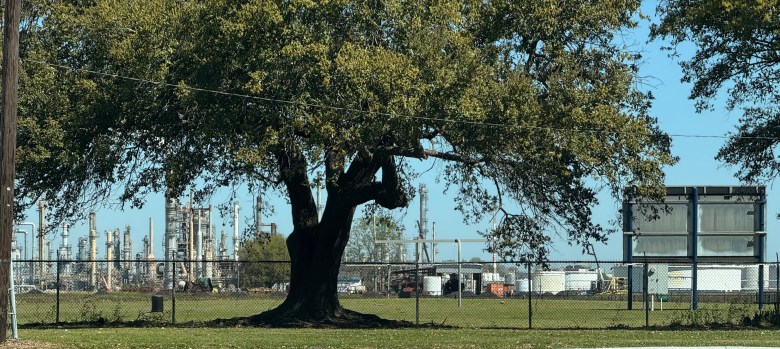
    Port Allen Middle School sits in the shadow of the Placid petrochemical refinery in West Baton Rouge Parish, La. A 2016 report found nearly one in 10 children in the U.S. attends one of the 12,000 schools located within 1 mile of a chemical facility, which for environmental advocates highlights the danger of the recently announced rollbacks of air and water pollution regulations by the U.S. Environmental Protection Agency. Credit: Terry L. Jones / Floodlight

    That means the EPA will no longer target, investigate or address noncompliance issues at facilities emitting cancer-causing chemicals such as benzene, ethylene oxide and formaldehyde in the places already overburdened with hazardous pollution. 

    “While enforcement and compliance assurance can continue to focus on areas with the highest levels of (hazardous air pollutants) affecting human health,” the memo reads, “…to ensure consistency with the President’s Executive Orders, they will no longer focus exclusively on communities selected by the regions as being ‘already highly burdened with pollution impacts.’”

    The agency also will not implement any enforcement and compliance actions that could shut down energy production or power generation “absent an imminent and substantial threat to human health.” 

    In is prepared video statement about the EPA’s deregulation measures, Zeldin said, “The agency is committed to fulfilling President Trump’s promise to unleash American energy, lower cost of living for Americans, revitalize the American auto industry, restore the rule of law, and give power back to states to make their own decisions. ”

    Related: How Trump is disrupting efforts by schools and colleges to combat climate change

    Top officials with the nonprofit environmental advocacy group Earthjustice recently said there is no way for the Trump administration to reconcile what it’s calling “the greatest day of deregulation” in EPA’s history with protecting public health. 

    Patrice Simms, vice president of litigation for healthy communities for Earthjustice, went a step further pointing out during a press briefing that the reason EPA exists is to protect the public from toxic air pollution. 

    “The law demands that EPA control these pollutants, and demands that EPA protect families and communities,” Simms said. “And these impacts on these communities most heavily land on the shoulders of children. Children are more susceptible to the harms from pollutants, and these pollutants are often happening right in the backyards of our schools, of our neighborhoods and our playgrounds.”

    A 2016 report published by the Center for Effective Government found that nearly one in 10 children in the country attends one of the 12,000 schools located within 1 mile of a chemical facility. These children are disproportionately children of color living in low-income areas, the report found. 

    For the past several years, Joshua has been leading the opposition to a hydrogen and ammonia facility being built within 2,000 feet of an elementary school in Ascension Parish. Air Products plans to start commercial operation in 2028 where an estimated 600,000 metric tons of hydrogen will be produced annually from methane gas.

    The $7 billion project has been touted as a clean energy solution because the company intends to use technology to collect its carbon dioxide emissions, and then transport them through pipelines to be stored under a recreational lake 37 miles away. 

    Carbon capture technology has been controversial, with skeptics highlighting the possibilities for earthquakes, groundwater contamination and CO2 leaking back into the atmosphere through abandoned and unplugged oil and gas wells or pipeline breaches. Pipeline ruptures in the past have also led to communities having to evacuate their homes. 

    Related: When a hurricane washes away a region’s child care system

    Joshua said these communities need more federal regulation and oversight — not less.

    “We had a community meeting … for our Ascension Parish residents, and the sentiment and the theme on that call was very much like ‘Kaitlyn, there is nothing we can do.’ Like, we just had to literally lie down and take this,” Joshua said. “We had to kind of challenge people and put them in the space, in time, of a civil rights movement. We have to get creative about how we’re going to organize around it and be our own version of EPA.”

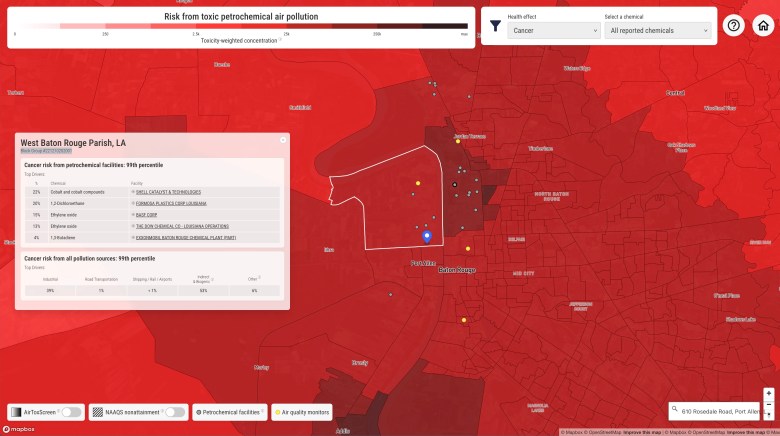
    This screenshot from CLEAR Collaborative’s Petroleum Pollution Map models health risks from hazardous air pollution from petrochemical facilities around West Baton Rouge Parish near Port Allen Middle School. The map uses U.S. Environmental Protection Agency data analyzed by the Environmental Defense Fund. Environmental advocates have sounded the alarm on the dangers of the EPA’s rollback of air and water regulations for children in fenceline communities. Credit: Provided by The Environmental Defense Fund

    Sarah Vogel, senior vice president of health communities with the Environmental Defense Fund, said the move toward deregulation comes as the U.S. Department of Justice announced on March 7 that it was dropping the federal lawsuit the Biden administration lodged against Denka’s Performance Elastomer plant in Louisiana. That plant had been accused of worsening cancer risks for the residents in the surrounding majority-Black community. 

    The DOJ said its decision was tied to Trump’s moves to dismantle all federal programs tied to diversity, equity and inclusion.

    “What they’re trying to do is just completely deregulate everything for oil and gas and petrochemical facilities, just absolutely take the lid off,” Vogel said. “We have long known that children are uniquely susceptible to air pollution and toxic chemicals. Like they’re huge, huge impacts. It’s why what they are doing is so devastating and cruel in my mind.”

    Floodlight, which produced this story, is a nonprofit newsroom that investigates the powers stalling climate action.

    The Hechinger Report provides in-depth, fact-based, unbiased reporting on education that is free to all readers. But that doesn’t mean it’s free to produce. Our work keeps educators and the public informed about pressing issues at schools and on campuses throughout the country. We tell the whole story, even when the details are inconvenient. Help us keep doing that.

    Join us today.

    Source link