A multi-pronged attack on food aid by Republican lawmakers could mean more of the nation’s children will go hungry — both at home and at school.
The U.S. Department of Agriculture recently cut two federal programs that provided roughly $1 billion in funding for the purchase of food by schools and food banks.
And the Community Eligibility Provision, which reimburses tens of thousands of schools that provide free breakfast and lunch to all students, may tighten its requirements, potentially pushing some 12 million kids out of the program.
These moves come at the same time the House Republican budget plan calls for deep cuts to the Supplemental Nutrition Assistance Program, or SNAP. The program fed more than 42 million low-income people per month nationwide in 2023. In 2022, 40% were younger than 18.
This recent shift reflects a stark reversal of earlier, nationwide efforts to keep families fed during the pandemic. Many districts, such as Baltimore, organized grab-and-go meals sites days after schools were shuttered in March 2020 with no identification or personal information required. Those initiatives led to the nation’s food insecurity rate dropping to a 20-year low when it reached 10.2% in 2021, down from a 14.9% high a decade earlier, according to the USDA.
It has since crept back up to 13.5% and now, five years after schools utilized USDA waivers to deliver meals in innovative ways, they are bracing for what could be massive cuts from the federal government.
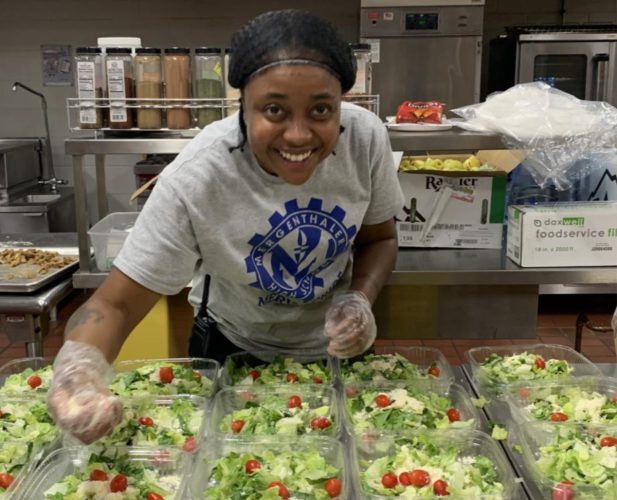
Latoya Roberson, manager at Mergenthaler Vocational-Technical High School in Baltimore (Baltimore City Public Schools)
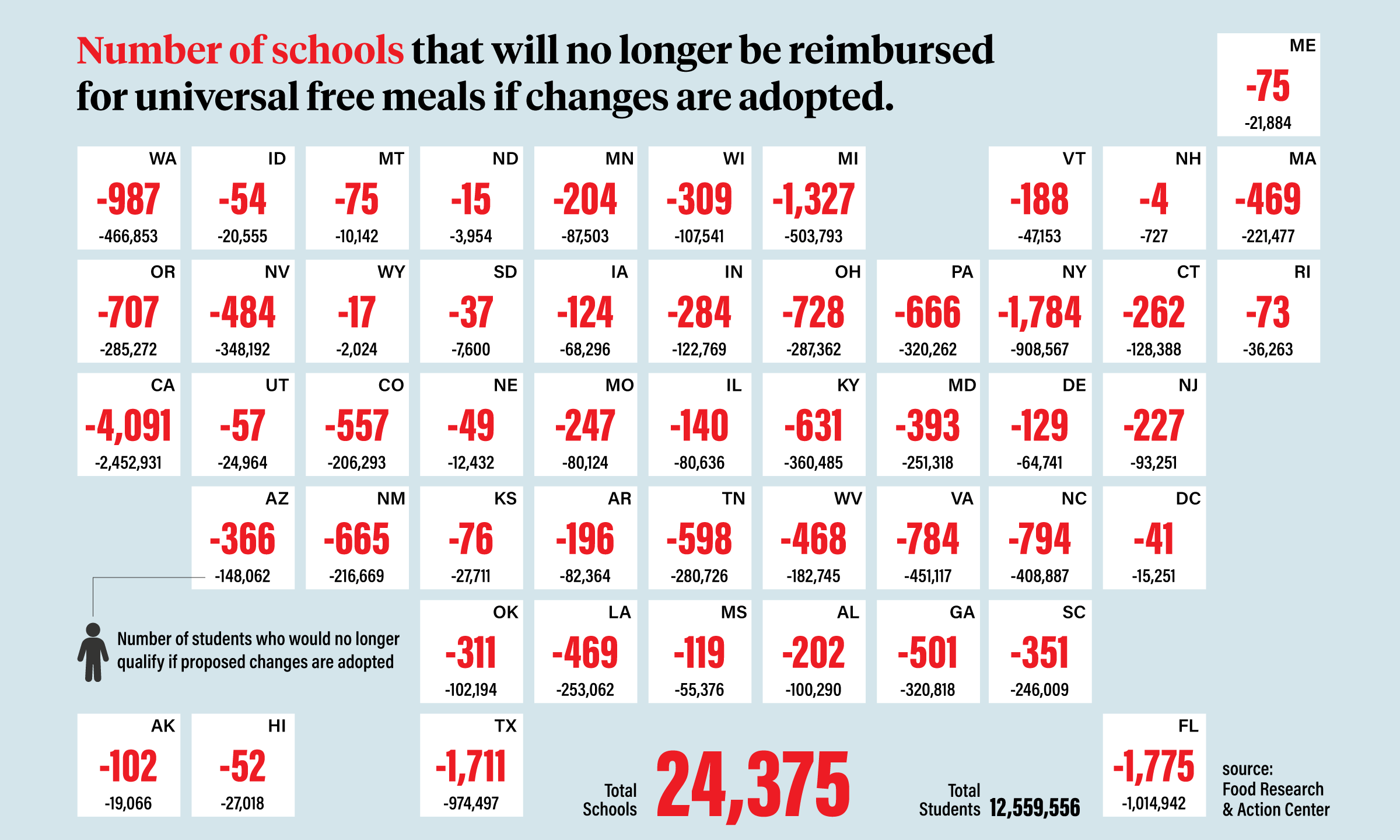
Elizabeth A. Marchetta, executive director of food and nutrition services for Baltimore City Public Schools, said 31 campuses — serving 19,000 children — would lose out on free breakfast and lunch if the Community Eligibility Provision changes go through. They are among 393 schools and 251,318 children statewide who would be shut out.
“It would be devastating,” Marchetta said. “These are critical funds. If we are not being reimbursed for all of the meals we’re serving … the money has to come from somewhere else in the school district, so that is really not great.”
Map: Eamonn Fitzmaurice/The 74, Data:Food Research & Action Cen
Nearly 48,000 schools in more than 7,700 districts benefited from the Community Eligibility Provision in the 2023-24 school year. The program reimburses schools that provide universal free meals based on the percentage of their students who automatically qualify for free and reduced-price lunch because their families receive other types of assistance, like SNAP.
In 2023, after the COVID-era policy ended where any student could receive a free school meal regardless of income, President Biden lowered the percentage of high-need students required for a school to qualify from 40% to 25%, greatly expanding participation.
House GOP Budget Committee Chairman Jodey Arrington now seeks to raise the rate to 60%. The budget proposal would also require all students applying for free and reduced-price meals to submit documentation verifying their family income.
School meal debt, a barometer of food insecurity among students, is already on the rise. It will almost certainly increase if universal school meals disappear for students whose families make too much to qualify for free and reduced-price lunch but too little to afford to buy meals at school. At the same time, kids who are eligible for free and reduced-price meals could lose that benefit if the required paperwork becomes harder.
In the fall of 2023, across 808 school districts, the median amount of school meal debt was $5,495. By the fall of 2024, that amount reached $6,900 across 766 districts, a 25% increase, according to the School Nutrition Association.
It was just $2,000 a decade earlier. A trio of Democratic senators is pushing to erase the $262 million annual debt total, with Pennsylvania Sen. John Fetterman saying in 2023, “‘School lunch debt’ is a term so absurd that it shouldn’t even exist. That’s why I’m proud to introduce this bill to cancel the nation’s student meal debt and stop humiliating kids and penalizing hunger.”
Research shows students benefit mightily from free meals: those who attend schools that adopted the Community Eligibility Provision saw lower rates of obesity compared to those who did not. Free in-school meals are also credited for boosting attendance among low-income children, improving classroom behavior and lowering suspensions.
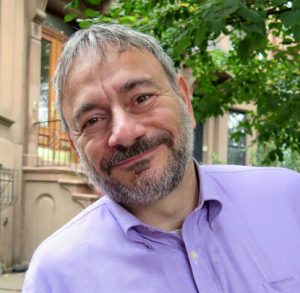
Joel Berg, CEO of Hunger Free America.
Joel Berg, the CEO of Hunger Free America, said further cuts will greatly harm the poorest students.
“Over the last few years, things have gone from bad to worse,” he said. “We were all raised seeing Frank Capra movies, where, in the end everything works out. But that’s not how the real world works. In the real world, when the economy gets a cold, poor people get cancer.”
Hunger Free America found the number of Americans who didn’t have enough to eat over two one-week periods increased by 55.2% between August-September 2021 and August-September 2024. The states with the highest rates of food insecure children were Texas at 23.8%, Oklahoma at 23.2% and Nebraska at 22.6%. Georgia and Arkansas both came in at 22.4%.
Diane Pratt-Heavner, director of media relations for the School Nutrition Association, said that as families struggle with the high cost of groceries, the government should be doing more — not less — to bolster school meals and other food aid programs.
“We’re urging Congress not only to protect the federal Community Eligibility Provision, but to expand it,” Pratt-Heavner said. “Ideally, all students should have access to free school breakfast and lunch as part of their education.”
SNAP benefits stood at $4.80 per person per day through 2020 before jumping to more than $6 per person per day after they were adjusted for rising food and other costs. Even then, the higher amount was not enough to cover the cost of a moderately priced meal in most locations.
Republicans in Congress seek to cut the program by $230 billion over the next nine years, possibly by returning to the pre-pandemic allotment of $4.80 and/or expanding work-related requirements, said Salaam Bhatti, SNAP director at the Food Research & Action Center.
Another possibility, he said, is that SNAP costs could be pushed onto states — including those that can’t afford them.
“This would be an unfunded mandate,” Bhatti said. “States would have to take away from their discretionary spending to offset the cost and if it is not a mandate, then states in rural America and in the South that don’t have the budgets just won’t do it.”
Food-related funding decreases come as the child tax credit, created to help parents offset the cost of raising children, is also facing uncertainty, said Megan Curran, the director of policy at the Center on Poverty and Social Policy at Columbia University.
The American Rescue Plan increased the amount of the child tax credit from $2,000 to $3,600 for qualifying children under age 6, and $3,000 for those under age 18. Many taxpayers received monthly advance payments in the second half of 2021, instead of waiting until tax filing season to receive the full benefits. The move cut child poverty nearly in half. The expanded child tax credit was allowed to lapse post-pandemic and now even the $2,000 credit could revert back to just $1,000.
All food-related and tax benefit cuts — plus the unknowns of Trump-era tariffs — will leave some Americans particularly vulnerable, Curran said.
“It’s shaping up to be a very precarious time for families,” she said, “especially families with children.”
More than 17,400 high school seniors last fall got the sweetest news any anxious student can get: Congratulations, because of your high school GPA, you’re automatically admitted to one of 10 California State University campuses of your choice — and they’re all relatively affordable.
Even with less than a week to go before the campuses wrap their final decisions about whom to admit, a pilot program focusing on Riverside County is already showing that more students have been admitted from the county than last year, about 10,600 so far in 2025 compared to last year’s roughly 9,800.
The pilot builds on Cal State’s efforts to enroll more students and works like this: High school seniors receive a notice in the mail that they’re automatically admitted as long as they maintain their grades, finish the 15 mandatory courses necessary for admission to a Cal State, and complete an admissions form to claim their spot at a campus. Cal State was able to mail the notices because it signed an agreement with the Riverside County Office of Education that gave the university eligible students’ addresses.
Now in the program’s first year, Cal State joins other public universities across the country in a growing national movement to automatically admit eligible students. From November through January, Cal State informed students they were accepted to the 10 campuses. To claim a spot, students needed to go online and pick at least one campus.
If past admissions and enrollment trends hold, Cal State as a system will educate hundreds of more students, all from Riverside, than they would have without the pilot. That’d be a boon for a system that prides itself on its affordability and motto that it’s the people’s university; Cal State admits a far higher percentage of students than the University of California. It also could serve as a much-needed budget boost from the extra tuition revenue those students bring, especially at campuses with sinking enrollment.
Eight campuses — Channel Islands, Chico, East Bay, Humboldt, Maritime Academy, Monterey Bay, San Francisco, and Sonoma — are so under-enrolled that Cal State is pulling some of their state revenues to send to campuses that are still growing. Cal Maritime is soon merging with another campus because of its perilous finances. The pilot also includes the two closest campuses to the county, San Bernardino and San Marcos.
The system chose Riverside County because all of its public high school students were already loaded onto a state data platform that can directly transmit student grades to Cal State — a key step in creating automatic admissions. Riverside is also “ethnically and economically representative of the diversity of California — many of the students the CSU is so proud to serve,” a spokesperson for the system, Amy Bentley Smith, wrote in an email.
At Heritage High School, a public school in Riverside County, the pilot encouraged students who previously didn’t even consider attending a public four-year university to submit the automatic admission forms to a Cal State.
Silvia Morales, a 17-year-old senior at Heritage, got an automatic admissions letter. “I was pretty set on going to community college and then transferring, because I felt like I wasn’t ready for the four-year commitment to a college,” she said.
Even with a 3.0 GPA, higher than the 2.5 GPA Cal State requires for admission, she nearly didn’t submit the forms to secure her admission until early January. That’s well past the standard Nov. 30 admissions deadline.
It wasn’t until her counselor, Chris Tinajero, pulled her into a meeting that she decided to opt into the pilot. “I went through the sales pitch like, ‘Hey, you get this guaranteed admission, you’re an amazing student,’” he recounted.
The pitch worked. Though Cal State sent a physical pamphlet and her high school also emailed her about the pilot, “I wasn’t really paying attention,” Morales said. She needed an adult she trusted at the school to persuade her that the applications were worth the effort, she said.
Morales applied to three Cal State campuses in the pilot plus two outside the program that were still accepting late applications — Chico, Humboldt, Los Angeles, Northridge and San Bernardino. She got into each one, she said.
Her parents are “proud of me because I want to go to college,” Morales said. Neither went to college, she added.
Final enrollment figures won’t be tallied until August, including how many of the students admitted through the pilot attended one of the 10 campuses. But the system’s chancellor’s office is already planning to replicate the pilot program in a Northern California county, which will be named sometime in April, Cal State officials said.
A bill by Christopher Cabaldon, a state senator and Democrat from Napa, would make automatic enrollment to Cal State for eligible students a state law. The bill hasn’t been heard in a committee yet.
A boost in application numbers
Of the 17,000 students who received an invitation to secure their automatic admissions, about 13,200 submitted the necessary forms. That’s about 3,000 more students who applied from the county than last year.
Those who otherwise wouldn’t have applied to a Cal State include students who were eyeing private colleges, said Melina Gonzalez, a counselor at Heritage who typically advises students who are already college-bound.
Nearby private colleges offer all students application fee waivers; at Cal State, typically only low-income students receive fee waivers. But the pilot provided each Cal State student one fee waiver worth $70, which was a draw to students and their parents who don’t qualify for the fee waiver but might struggle to pay.
Last year, 10 of the 100 senior students Gonzalez counseled didn’t apply to a Cal State. This application season, all her students submitted at least one Cal State application, she said.
“It was big, it was really cool, their eyes, they were so excited,” she said of the automatically admitted students. “They would come in and show me their letters.”
Parents called her asking if the pamphlet from Cal State was authentic. With guaranteed admission, some parents ultimately decided to pay for additional applications to campuses in the pilot, knowing it wasn’t in vain.
At Heritage, high school counselors reviewed Cal State’s provisional list of students eligible for the pilot to add more seniors, such as those who hadn’t yet completed the mandatory courses but were on track to do so.
Tinajero was also able to persuade some students who hadn’t completed all the required courses for Cal State entry to take those, including online classes. Still, others with qualifying grades didn’t apply because they weren’t persuaded that a four-year university was for them. Tinajero sees program growth in the coming years, assuming Cal State continues with the pilot. Younger high school students who witnessed the fanfare of automatic admissions may take more seriously the need to pass the 15 required courses to be eligible for a Cal State or University of California campus, he said.
That’s part of Cal State’s vision for this pilot, said April Grommo, the system’s assistant vice chancellor of strategic enrollment management: Begin encouraging students to take the required courses in ninth grade so that by 11th and 12th grade they’re more receptive to applying to Cal State.
Pilot leads to more applications
The automatic admissions pilot is likely what explains the jump in overall applicants, said Grommo. “If you look at the historical numbers of Riverside County students that have applied to the CSU, it’s very consistent at 10,000, so there’s no other accelerator or explanation for the significant increase in the applications,” she said.
Some campuses in the pilot are probably going to see more students from Riverside County than others. The eight under-enrolled Cal State campuses each enrolled fewer than than 100 Riverside students as freshmen, a CalMatters review of 2024 admissions data show. Two enrolled fewer than 10 Riverside students as freshmen.
Cal State isn’t solely relying on past trends to enroll more students. Grommo cited research that suggests direct admissions programs are associated with increases in student enrollment, but not among low-income students, who are less familiar with the college-going process or have additional economic and family demands, like work and child care.
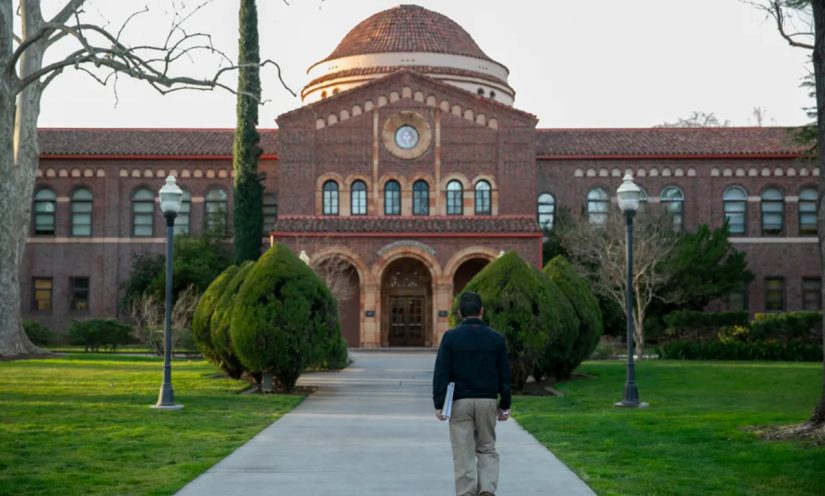
The quad at San Francisco State University in San Francisco on July 7, 2023. Photo by Semantha Norris, CalMatters
Even after students are admitted, some don’t complete key steps in the enrollment process, such as maintaining their grades in the second semester, completing registration forms to enroll, and paying deposits. Others, especially low-income students, have a change of heart over summer about attending college, which scholars call “summer melt.” Then there are the students who got into typically more selective campuses, such as at elite private schools and the University of California, and choose instead to go to those.
To prompt more students to actually enroll, Cal State officials in early March hosted two college fairs in Riverside County for students admitted through the pilot. About 2,600 students signed up to be bussed from their high schools to large venues, including the Riverside Convention Center, where they met with staff, alumni and current students from all 10 Cal State campuses participating in the program. Those were followed by receptions with students and parents.
Grommo said they maxed out capacity at both venues for the student events. While it’s common for individual campuses to host events for admitted students, it was a first for Cal State’s central office.
The event costs, physical mailers to students about their admissions guarantee, invitation to the college fairs and another flyer about the relative affordability of a Cal State cost the system’s central office around $300,000, Grommo estimates. But if the event moves the needle on students agreeing to attend a Cal State, the tuition revenue at the largely under-enrolled campuses alone would be a huge return on investment.
The effort is a far more targeted approach than another admissions outreach effort Cal State rolled out last fall to inform students who started but didn’t finish their college applications that they’re provisionally accepted, as long as they complete and send their forms. The notification went to 106,000 students and was the result of a $750,000 grant Cal State won from the Lumina Foundation, a major higher education philanthropy. The system will know by fall if this notification resulted in more students attending a Cal State.
But that was aimed at students who already applied. The Riverside pilot brings in students, like Morales, who wouldn’t have applied without the mailers and entreaties from counselors. She’s leaning toward picking Cal State San Bernardino for next fall. It’s close to home and an older cousin recently graduated who had a good experience there, she said.
Her next task? Working with her parents to complete the federal application for financial aid by April 2, the deadline for guaranteed tuition waivers for low- and middle-income students.
It’s possible that Cal State may take the direct admissions pilot statewide. All counties are required by state law to join the state-funded data system that Riverside is already a part of to electronically transmit students’ high school grades to Cal States and UCs. Doing so removes the need for schools to send campuses paper transcripts. The deadline for all counties to join the state data system is summer of 2026.
Addressing the audience at the British Council’s East Asia Education Week 2025, held in Hong Kong, Xiang Weng, visa outreach officer for South China/ West China/ Hong Kong and Macau Visa, British Consulate – General Guangzhou, described a “new concept” which would see agent advisory groups set up to enhance collaboration.
“One of our colleagues from Vietnam set up what we call our Agent Advisory Groups and tested the concept there. Now, we plan to expand it across the rest of East Asia,” said Weng.
“By having these advisory groups, UKVI can build a much stronger connection with agents, gain valuable local intelligence, and share insights with our Home Office colleagues. This will help us introduce and improve our visa services across the region.”
Though UKVI didn’t confirm plans to introduce agent advisory groups in the broader East Asian region to The PIE News, it noted that it continually works with overseas stakeholders, including the British Council, to support prospective students by addressing their questions about the UK visa system.
Over the years, Vietnam has played a pioneering role in the UK’s efforts to increase transparency among agents in East Asia.
By having these advisory groups, the UKVI can build a much stronger connection with agents, gain valuable local intelligence, and share insights with our Home Office colleagues.
Xiang Weng, British Consulate-General Guangzhou
Just last year, over 130 education advisers in Vietnam earned the prestigious “I am a UK-certified counsellor” badge, as part of the Agent Quality Framework, showcasing their expertise and deep understanding of the UK as a study destination.
According to Weng, the concept’s success in Vietnam can be emulated in the broader East Asian region.
Though visa approval remains high in East Asia, students still fall victims to common mistakes, she explained.
“Some students forget to provide a TB (tuberculosis) certificate or evidence of finances which can impact their applications,” stated Weng.
“In countries like Japan, Korea, Malaysia, Singapore, China, and Hong Kong, when applying for a student visa, you only need to submit your passport and TB certificate. That’s it. You don’t even need to apply for IELTS or provide evidence of finances.”
Though visas challenges have not proved to be a major barrier for UK universities accessing the East Asian student market, intra-regional mobility and price concerns are leading to fluctuations in demand for UK education, as reported by The PIE News.
According to Daniel Zheng, managing director, HOPE International Education, safety concerns and career prospects have also become key factors influencing student choices in East Asia, particularly in China.
To tackle these challenges, UK universities are increasingly turning to in-house employability services and other affordability options for international students.
“In terms of affordability, many UK universities, including ours, have in-house employability service teams. Their role is to enhance students’ employability and expand their career opportunities after graduation,” stated Scarlett Peng-Zang, East Asia regional head, University of Nottingham.
“So I believe that there’s something everyone is working on regarding addressing the economic uncertainty. I found lots of UK universities offer alternative payment options to improve affordability. So is the same for Nottingham University.”
As rankings of East Asian universities rise and the countries set mammoth targets for international students, agencies are also looking inward for recruitment opportunities, expanding beyond the UK.
“In the past six months, my colleagues and I have traveled to Singapore and Malaysia three times, visiting UK university campuses like Southampton and Nottingham, as well as boarding schools like Epsom College,” stated Zheng.
“This indicates that there is significant interest – not just from us, but also from our partners and institutions – in the Malaysian market, particularly from China.”
These changing trends come at a time when UK institutions are under pressure to measure the return on investment of their agents, according to Fraser Deas, director, client success, Grok Global.
“We are noticing that UK institutions are under pressure to measure the ROI of their agents. How can we work with them, along with in-country staff, to ensure that agencies provide evidence that these partnerships are going well? There’s important work to be done in that sense,” stated Deas.
“I think there is a genuinely good understanding in the sector of the difference between in-country staff and agents. The role of a third party should be to facilitate that relationship without interfering, but it remains very important.”
Agents and universities having a direct relationship has also become important for UK-East Asia relations, with organisations like BUILA demonstrating how agents can be compliant with the UK National Code of Ethical Practice as the Agent Quality Framework comes in focus.
As per Dave Few, Associate Director, Jackstudy Abroad, while education agents are already performing well, there is a concern about maintaining quality as more agencies enter the market, particularly through aggregators.
“In my unbiased perspective, I think agents are already doing a fantastic job. The key factor is the quality of information – ensuring that as the barrier for entry for new agencies lowers through aggregators, the quality remains consistent,” stated Few.
“Whether that means requiring a year of training from the very beginning or another measure, the priority should always be keeping the student at the heart of the conversation, not revenue.”
The PIE Live Europe, held between March 11-12 in central London, brought together leading figures in the international education sector. Delegates at the two-day conference heard key immigration updates, debated the future of the ELT sector and highlighted the value that international students bring to the UK.
Famed for its university rankings, QS has expanded under Quacquarelli’s leadership to employ more than 900 people from over 30 countries.
Quacqarelli said it was a “great feeling” to win the award, having been a supporter of The PIE since it was a “fledgeling business”.
On what was next for QS, he added: “We’re really committed to providing trusted data and insights to the higher education sector and we really believe in the need for universities to transform, to adopt AI – so we’ve launched a responsible AI consortium with Imperial College.
“And we really believe the need to deliver the emerging skills of the fifth industrial revolution, so we are developing huge amounts of insight on skills and occupations… to identify whatever skills are going to be demanded by employers of the future to guide curricular reform and university transformation.”
You can watch his full interview in the video below.
English/language arts and science teachers were almost twice as likely to say they use AI tools compared to math teachers or elementary teachers of all subjects, according to a February 2025 survey from the RAND Corporation that delves into uneven AI adoption in schools.
“As AI tools and products for educational purposes become more prevalent, studies should track their use among educators. Researchers could identify the particular needs AI is addressing in schools and–potentially–guide the development of AI products that better meet those needs. In addition, data on educator use of AI could help policymakers and practitioners consider disparities in that use and implications for equitable, high-quality instruction across the United States,” note authors Julia H. Kaufman, Ashley Woo, Joshua Eagan, Sabrina Lee, and Emma B. Kassan.
One-quarter of ELA, math, and science teachers used AI tools for instructional planning or teaching in the 2023–2024 school year. Nearly 60 percent of surveyed principals also reported using AI tools for their work in 2023-2024.
Among the one-quarter of teachers nationally who reported using AI tools, 64 percent said that they used them for instructional planning only, whether for their ELA, math, or science instruction; only 11 percent said that they introduced them to students but did not do instructional planning with them; and 25 percent said that they did both.
Although one-quarter of teachers overall reported using AI tools, the report’s authors observed differences in AI use by subject taught and some school characteristics. For instance, close to 40 percent of ELA or science teachers said they use AI, compared to 20 percent of general elementary education or math teachers. Teachers and principals in higher-poverty schools were less likely to report using AI tools relative to those in lower-poverty schools.
Eighteen percent of principals reported that their schools or districts provided guidance on the use of AI by staff, teachers, or students. Yet, principals in the highest-poverty schools were about half as likely as principals in the lowest-poverty schools to report that guidance was provided (13 percent and 25 percent, respectively).
Principals cited a lack of professional development for using AI tools or products (72 percent), concerns about data privacy (70 percent) and uncertainty about how AI can be used for their jobs (70 percent) as factors having a major or minor influence on their AI use.
The report also offers recommendations for education stakeholders:
1. All districts and schools should craft intentional strategies to support teachers’ AI use in ways that will most improve the quality of instruction and student learning.
2. AI developers and decision-makers should consider what useful AI applications have the greatest potential to improve teaching and learning and how to make those applications available in high-poverty contexts.
3. Researchers should work hand-in-hand with AI developers to study use cases and develop a body of evidence on effective AI applications for school leadership, teaching, and learning.
Laura Ascione is the Editorial Director at eSchool Media. She is a graduate of the University of Maryland’s prestigious Philip Merrill College of Journalism.
The Trump administration says one of its primary goals in education is to expand school choice and put power back in the hands of parents. Yet it has killed the main way to track one of the most rapidly growing options — learning at home.
The Education Department began counting the number of homeschooled children in 1999, when fewer than 2 percent of students were educated this way. Homeschooling rose by 50 percent in the first decade of the 2000s and then leveled off at around 3 percent.
The most recent survey of families took place in 2023, and it would have been the first indication of the growth of homeschooling since the pandemic. The data collection was nearly finished and ready to be released to the public, but in February, Elon Musk’s Department of Government Efficiency (DOGE) terminated the contract for this data collection, which is part of the National Household Education Survey, along with 88 other education contracts. Then in March, the federal statisticians who oversee the data collection and could review the final figureswere fired along with almost everyone else at the National Center for Education Statistics (NCES). As things stand now, this federal homeschool data is unlikely to ever be released.
Related: Our free weekly newsletter alerts you to what research says about schools and classrooms.
“Work on these data files has stopped and there are no current plans for that work to continue,” said a spokesman for the American Institutes for Research, a nonprofit research organization that had held the contract to collect and analyze the data before DOGE canceled it.
The loss of this data upset both avid supporters and watchdogs of school choice, particularly now that some states are expanding their Education Savings Account (ESA) programs to transfer public funds directly to families who homeschool their children. Angela Watson, a prominent Johns Hopkins University researcher who runs the Homeschool Research Lab, called it a “massive loss.” Robert Maranto, a professor in the department of education reform at the University of Arkansas, said that in the past, the federal statistics have helped “dispel some of the myths” that homeschooling is “overwhelmingly white,” when, in fact, a more diverse population is learning this way. Maranto also serves as the editor of the Journal of School Choice. The most recent issue was devoted to homeschooling and about half the articles in it cited NCES reports, he said.
“There is a certain irony that a pro-school choice administration would cut objective data that might help increase acceptance of homeschooling,” said Maranto.
It is unclear what will happen to the unreleased 2023 homeschooling data or if the Education Department will ever collect homeschool statistics in the future.
In response to questions about the fate of the homeschooling data, Education Department spokeswoman Madison Biedermann said that its research arm, the Institute of Education Sciences, is in possession of the data and that it is “reviewing how all its contractual activities can best be used to meet its statutory obligations.”
Last September, the Education Department released some preliminary statistics from the 2023 survey. It noted a small increase in traditional homeschooling since 2019 but a large increase in the number of students who were enrolled in an online virtual school and learning from home full time. Together, more than 5 percent of U.S. students were learning at home in one of these two ways. Fewer than 4 percent were learning at home in 2019.
Source: National Center for Education Statistics, September 2024 media briefing slide.
Researchers were keen to dig into the data to understand the different flavors of homeschooling, from online courses to microschools, which aretiny schools that often operate in private homes or places of worship. Researchers also want to understand why more parents are opting for homeschooling and which subjects they are directly teaching their children, all questions that are included in the parent survey conducted by the Education Department.
Tracking homeschooling is notoriously difficult. Families who choose this option can be distrustful of government, but this was one of the few surveys that homeschool advocates cited to document the growth in their numbers and they advised the writers of the federal survey on how to phrase questions.
Beginning in 2020, the U.S. Census Bureau also began collecting some data on homeschooling, but those statistics cannot be directly compared with the Education Department data and without a historical record, the census data is less useful, researchers said.It is also unclear if this census data will continue. Some states collect data on homeschooling, but researchers said they do it in different ways, making it impossible to compare homeschooling across states.
Patrick Wolf, a professor of education policy who studies school choice at the University of Arkansas, was also dismayed by the loss of the Education Department’s statistics.
“A federal government agency has been collecting national statistics on education since 1867,” he said. “State and local policy makers and practitioners will be severely challenged in doing their work if they don’t have good data from the feds regarding public schooling, private schooling, and homeschooling. Sending education authority to the states only will work well if the federal government continues to collect and publish comprehensive data on schooling. Otherwise, state and local officials are being asked to fly blind.”
The Hechinger Report provides in-depth, fact-based, unbiased reporting on education that is free to all readers. But that doesn’t mean it’s free to produce. Our work keeps educators and the public informed about pressing issues at schools and on campuses throughout the country. We tell the whole story, even when the details are inconvenient. Help us keep doing that.
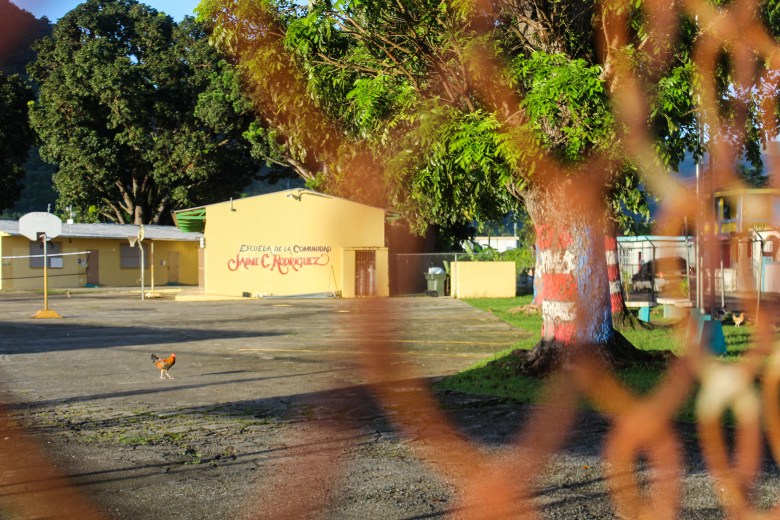
Maraida Caraballo Martinez has been an educator in Puerto Rico for 28 years and the principal of the elementary school Escuela de la Communidad Jaime C. Rodriguez for the past seven. She never knows how much money her school in Yabucoa will receive from the government each year because it isn’t based on the number of children enrolled. One year she got $36,000; another year, it was $12,000.
But for the first time as an educator, Caraballo noticed a big difference during the Biden administration. Because of an infusion of federal dollars into the island’s education system, Caraballo received a $250,000 grant, an unprecedented amount of money. She used it to buy books and computers for the library, white boards and printers for classrooms, to beef up a robotics program and build a multipurpose sports court for her students. “It meant a huge difference for the school,” Caraballo said.
Yabucoa, a small town in southeast Puerto Rico, was one of the regions hardest hit by Hurricane Maria in 2017. And this school community, like hundreds of others in Puerto Rico, has experienced near constant disruption since then. A series of natural disasters, including hurricanes, earthquakes, floods and landslides, followed by the coronavirus pandemic in 2020, has pounded the island and interrupted learning. There has also been constant churn of local education secretaries — seven in the past eight years. The Puerto Rican education system — the seventh-largest school district in the United States — has been made more vulnerable by the island’s overwhelming debt, mass emigration and a crippled power grid.
Maraida Caraballo Martinez has been an educator in Puerto Rico for 28 years and is now the principal of an elementary school. Her school has been slated for closure three times because of mass emigration from the island. Credit: Kavitha Cardoza for The Hechinger Report
Under President Joe Biden, there were tentative gains, buttressed by billions of dollars and sustained personal attention from top federal education officials, many experts and educators on the island said. Now they worry that it will all be dismantled with the change in the White House. President Donald Trump has made no secret of his disdain for the U.S. territory, having reportedly said that it was “dirty and the people were poor.” During his first term, he withheld billions of dollars in federal aid after Hurricane Maria and has suggested selling the island or swapping it for Greenland.
A recent executive order to make English the official language has worried people on the island, where only 1 in 5 people speak fluent English, and Spanish is the medium of instruction in schools. Trump is seeking to eliminate the U.S. Department of Education and has already madesweeping cuts to the agency, which will have widespread implications across the island. Even if federal funds — which last year made up more than two thirds of funding for the Puerto Rican Department of Education, or PRDE — were transferred directly to the local government, it would likely lead to worse outcomes for the most vulnerable children, say educators and policymakers. The PRDE has historically been plagued by political interference, widespread bureaucracy and a lack of transparency.
And the local education department is not as technologically advanced as other state education departments, nor as able to disseminate best practices. For example, Puerto Rico does not have a “per pupil formula,” a calculation commonly used on the mainland to determine the amount of money each student receives for their education. Robert Mujica is the executive director of the Puerto Rico Financial Oversight and Management Board, first convened under President Barack Obama in 2016 to deal with the island’s financial morass. Mujica said Puerto Rico’s current allocation of education funds is opaque. “How the funds are distributed is perceived as a political process,” he said. “There’s no transparency and there’s no clarity.”
Related: Become a lifelong learner. Subscribe to our free weekly newsletter featuring the most important stories in education.
In 2021, Miguel Cardona, Biden’s secretary of education, promised “a new day” for Puerto Rico. “For too long, Puerto Rico’s students and educators were abandoned,” he said. During his tenure, Cardona signed off on almost $6 billion in federal dollars for the island’s educational system, leading to a historic pay increase for teachers, funding for after-school tutoring programs, hiring of hundreds of school mental health professionals and the creation of a pilot program to decentralize the PRDE.
Cardona designated a senior adviser, Chris Soto, to be his point person for the island’s education system to underscore the federal commitment. During nearly four years in office, he made more than 50 trips to the island. Carlos Rodriguez Silvestre, the executive director of the Flamboyan Foundation, a nonprofit in Puerto Rico that has led children’s literacy efforts on the island, said the level of respect and sustained interest felt like a partnership, not a top-down mandate. “I’ve never seen that kind of attention to education in Puerto Rico,” he said. “Soto practically lived on the island.”
Soto also worked closely with Victor Manuel Bonilla Sánchez, the president of the teachers union, Asociación de Maestros de Puerto Rico, or AMPR, which resulted in a deal in which educators received $1,000 more a month to their base salary, a nearly 30 percent increase for the average teacher.“It was the largest salary increase in the history of teachers in Puerto Rico,” Bonilla said, though even with the increase, teachers here still make far less money than teachers on the mainland.
One of the biggest complaints Soto said he heard was how rigid and bureaucratic the Puerto Rico Department of Education was, despite a 2018 education reform law that allows for more local control. The education agency — the largest unit of government on the island, with the most employees and the biggest budget — was set up so that the central office had to sign off on everything. So Soto created and oversaw a pilot program in Ponce, a region on the island’s southern coast, focusing on decentralization.
For the first time, the local community elected an advisory board of education, and superintendent candidates had to apply rather than be appointed, Soto said. The superintendent was given the authority to sign off on budget requests directly rather than sending them through officials in San Juan, as well as the flexibility to spend money in his region based on individual schools’ needs.
In the past, that wasn’t a consideration: For example, Yadira Sanchez, a psychologist who has worked in Puerto Rican education for more than 20 years, remembers when a school got dozens of new air conditioners even though it didn’t need it. “They already had functioning air conditioners,” she said, “so that money was lost.”
The pilot project also focused on increasing efficiency. For example, children with disabilities are now evaluated at their schools rather than having to visit a special center. And Soto says he tried to remove politics and increase transparency around spending in the PRDE as well. “You can improve invoices, but if your political friends are getting the work, then you don’t have a good school system,” he said.
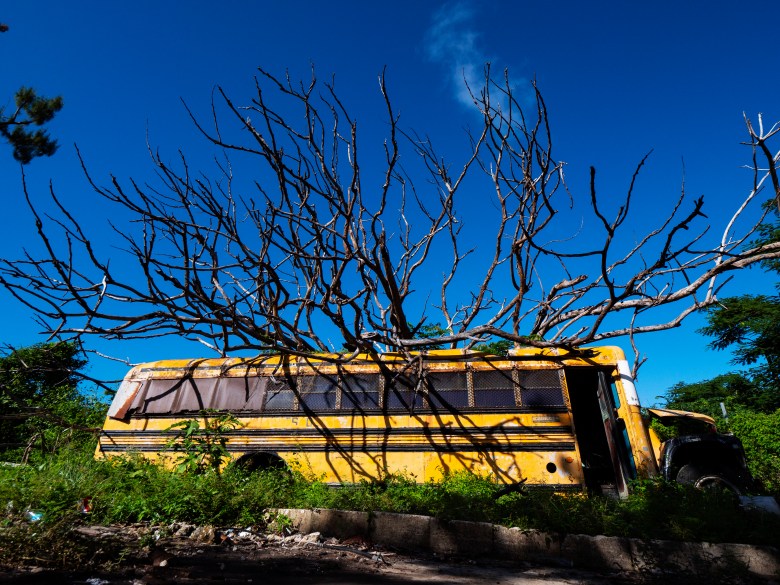
A school bus under a tree that fell during Hurricane Maria, which hit the island of Puerto Rico in September 2017. More than a year later, it had not been removed. Credit: Al Bello/Getty Images for Lumix
Under Biden, Puerto Rico also received a competitive U.S. Department of Education grant for $10.5 million for community schools, another milestone. And the federal department started including data on the territory in some education statistics collected. “Puerto Rico wasn’t even on these trackers, so we started to dig into how do we improve the data systems? Unraveling the data issue meant that Puerto Rico can properly get recognized,” Soto said.
But already there are plans to undo Cardona’s signature effort in Ponce. The island’s newly elected governor, Jenniffer González Colón, is a Republican and a Trump supporter. The popular secretary of education, Eliezer Ramos Parés, returned earlier this year to head the department after leading it from April 2021 to July 2023 when the governor unexpectedly asked him to resign — not an unusual occurrence within the island’s government, where political appointments can end suddenly and with little public debate. He told The Hechinger Report that the program won’t continue in its current form, calling it “inefficient.”
“The pilot isn’t really effective,” he said, noting that politics can influence spending decisions not only at the central level but at the regional level as well. “We want to have some controls.” He also said expanding the effort across the island would cost tens of millions of dollars. Instead, Ramos said he was looking at more limited approaches to decentralization, around some human resource and procurement functions. He said he was also exploring a per pupil funding formula for Puerto Rico and looking at lessons from other large school districts such as New York City and Hawaii.
While education has been the largest budget item on the island for years, it’s still far less than any of the 50 states spend on each student. Puerto Rico spends $9,500 per student, compared with an average of $18,600 in the states.
The U.S. Department of Education, which supplements local and state funding for students in poverty and with disabilities, has an outsized role in Puerto Rico schools. On the island, 55 percent of children live below the poverty line, compared with 17 percent in the 50 states; for students in special education, the figures are 35 percent and 15 percent, respectively. In total, during fiscal year 2024, more than 68 percent of the education budget on the island comes from federal funding, compared to 11 percent in U.S. states. The department also administers Pell Grants for low-income students — some 72 percent of Puerto Rican students apply — and supports professional development efforts and initiatives for Puerto Rican children who move back and forth between the mainland and territory.
Linda McMahon, Trump’s new education secretary, has reportedly said that the government will continue to meet its “statutory obligations” to students even as the department shuts down or transfers some operations and lays off staff. The U.S. Department of Education did not respond to requests for comment.
Some say the Biden administration’s pouring billions of dollars into a troubled education system with little accountability has created unrealistic expectations and there’s no plan for what happens after money is spent. Mujica, the executive director of the oversight board, said the infusion of funds postponed tough decisions by the Puerto Rican government. “When you have so much money, it papers over a lot of problems. You didn’t have to deal with some of the challenges that are fundamental to the system.” And he said there is little discussion of what happens when that money runs out. “How are you going to bridge that gap? Either those programs go away or we’re going to have to find the funding for them,” Mujica said.
He said efforts like the one in Ponce to bring decision making closer to where the students’ needs are is “vitally important.” Still, he said he’s not sure the money improved student outcomes. “This was a huge opportunity to make fundamental changes and investments that will yield long-term results. I’m not sure that we’ve seen the metrics to support that.”
Puerto Rico is one of the most educationally impoverished regions, with academic outcomes well below the mainland. On the math portion of the National Assessment of Educational Progress, or NAEP, a test that students across the U.S. take, just 2 percent of fourth graders in Puerto Rico were proficient, the highest score ever recorded for the island, and zero percent of eighth graders were. Puerto Rican students don’t take the NAEP for reading because they learn in Spanish, not English, though results shared by Ramos at a press conference in 2022 showed only 1 percent of third graders were reading at grade level.
There are some encouraging efforts. Flamboyan Foundation, the nonprofit in Puerto Rico, has been leading an island-wide coalition of 70 partners to improve K-3 literacy, including through professional development. Teacher training through the territory’s education department has often been spotty or optional.
The organization now works closely with the University of Puerto Rico and, as part of that effort, oversees spending of $3 million in literacy training. Approximately 1,500 or a third of Puerto Rico’s K-5 teachers have undergone the rigorous training. Educators were given $500 as an incentive for participating, along with books for their classrooms and three credit hours in continuing education. “It was a lot of quality hours. This was not the ‘spray and pray’ approach,” said Silvestre. That effort will continue, according to Ramos, who called it “very effective.”
A new reading test for first through third graders the nonprofit helped design showed that between the 2023 and 2024 school years, most children were below grade level but made growth in every grade. “But we still have a long way to go so that this data can get to teachers in a timely manner and in a way that they can actually act on it,” Silvestre said.
Kristin Ehrgood, Flamboyan Foundation’s CEO, said it’s too soon to see dramatic gains. “It’s really hard to see a ton of positive outcomes in such a short period of time with significant distrust that has been built over years,” she said. She said they weren’t sure how the Trump administration may work with or fund Puerto Rico’s education system but that the Biden administration had built a lot of goodwill. “There is a lot of opportunity that could be built on, if a new administration chooses to do that.”
Another hopeful sign is that the oversight board, which was widely protested when it was formed, has cut the island’s debt from $73 billion to $31 billion. And last year board members increased education spending by 3 percent. Mujica said the board is focused on making sure that any investment translates into improved outcomes for students: “Our view is resources have to go into the classroom.”
Betty A. Rosa, education commissioner and president of the University of the State of New York and a member of the oversight board, said leadership churn in Puerto Rico drives its educational instability. Every new leader is invested in “rebuilding, restructuring, reimagining, pick your word,” she said. “There is no consistency.” Unlike her New York state position, the Puerto Rican education secretary and other positions are political appointments. “If you have permanent governance, then even when the leadership changes, the work continues.”
Ramos, who experienced this instability when the previous governor unexpectedly asked to resign in 2023, said he met McMahon, the new U.S. secretary of education, in Washington, D.C., and that they had a “pleasant conversation.” “She knows about Puerto Rico, she’s concerned about Puerto Rico, and she demonstrated full support in the Puerto Rico mission,” he said. He said McMahon wanted PRDE to offer more bilingual classes, to expose more students to English. Whether there will be changes in funding or anything else remains to be seen. “We have to look at what happens in the next few weeks and months and how that vision and policy could affect Puerto Rico,” Ramos said.
Ramos was well-liked by educators during his first stint as education secretary. He will also have a lot of decisions to make, including whether to expand public charter schools and close down traditional public schools as the island’s public school enrollment continues to decline precipitously. In the past, both those issues led to fierce and widespread protests.
Soto says he’s realistic about the incoming administration having “different views, both ideologically and policywise,” but he’s hopeful the people of Puerto Rico won’t want to go back to the old way of doing things. “Somebody said, ‘You guys took the genie out of the bottle and it’s going to be hard to put that back’ as it relates to a student-centered school system,” Soto said.
Cardona, whose grandparents are from the island, said Puerto Rico had seen “academic flatlining” for years. “We cannot accept that the students are performing less than we know they are capable of,” he told The Hechinger Report, just before he signed off as the nation’s top education official. “We started change; it needs to continue.”
Principal Carabello’s small school of 150 students and 14 teachers has been slated for closure three times already, though each time it has been spared in part because of community support. She’s hopeful that Ramos, with whom she’s worked previously, will turn things around. “He knows the education system,” she said. “He’s a brilliant person, open to listen.”
Escuela de la Communidad Jaime C. Rodriguez is a Montessori school in Yabucoa, Puerto Rico, that did not have any sports facilities for its students. It recently began work on a multipurpose sports center, made possible by federal funds under former President Joe Biden. Credit: Kavitha Cardoza for The Hechinger Report
But the long hours of the past several years have taken a toll on her. She is routinely in school from 6:30 a.m. to 6:30 p.m. “You come in when it’s dark and you leave when it’s dark,” she said. There have been many new platforms to learn and new projects to implement. She wants to retire but can’t afford to. After decades of the local government underfunding the pension system, allowances that offset the high price of goods and services on the island were cut and pension plans were frozen.
Now instead of retiring with 75 percent of her salary, Carabello will receive only 50 percent, $2,195 a month. She is entitled to Social Security benefits, but it isn’t enough to make up for the lost pension. “Who can live with $2,000 in one month? Nobody. It’s too hard. And my house still needs 12 years more to pay.”
Carabello, who is always so strong and so optimistic around her students, teared up. But it’s rare that she allows herself time to think about herself. “I have a great community. I have great teachers and I feel happy with what I do,” she said.
The Hechinger Report provides in-depth, fact-based, unbiased reporting on education that is free to all readers. But that doesn’t mean it’s free to produce. Our work keeps educators and the public informed about pressing issues at schools and on campuses throughout the country. We tell the whole story, even when the details are inconvenient. Help us keep doing that.
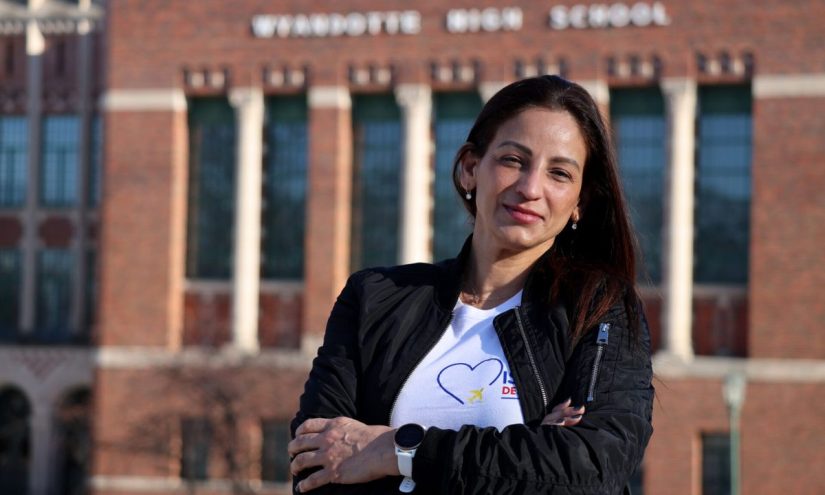
KANSAS CITY, Kan. — Marialexa Sanoja publicly quit her job as a Kansas City, Kansas, Public Schools police officer over concerns with the district’s handling of student safety needs and founded a nonprofit to help kids escape the challenges in Wyandotte County.
In the three-and-a-half months Sanoja was stationed at Wyandotte High School, the district’s largest school with 1900 students, Sanoja said she filed 140 incident reports and that in most instances the district failed to take action. The district, through its YouTube channel, disputed her figures and asserted it handled concerns responsibly.
“It didn’t take long for me to find out that the students were not in the best interest of anybody,” Sanoja said. “When the police officer becomes a safe space for students, there is something wrong with that.”
After her resignation in December 2023, Sanoja founded Missión Despegue, translated to “mission takeoff,” a nonprofit that helps parents and students document their grievances with the school district to hold the district accountable for its handling of safety issues.
Sanoja saw the district’s response to a sexual assault case and its communication as inadequate, and experts echo her concerns. Now, Sanoja works with current and former students to get their GED certificates, drivers licenses, mental health care and prevent substance abuse.
Sanoja’s concerns
Sanoja said much of the Latino community, which makes up 72% of Wyandotte High School, is afraid to complain or make a scene because many of them are new to the country. She aims to empower them, and help them achieve the “American dream.”
One reason Sanoja resigned — and a former student dropped out — was because of the district’s response to the former student’s experience of being sexually assaulted at school. Kansas Reflector doesn’t identify minors who have been sexually assaulted.
According to an incident report filed by Sanoja, the former student was a freshman and alone in the Wyandotte High School stairwell when a group of older boys groped her and made sexual remarks. She began recording the boys with her phone, which prompted them to leave, the report said.
Sanoja was off duty that day. The former student asked the on-duty officer to file a report, which Sanoja says she never saw. The day after, Sanoja and the former student said they filed an incident, criminal, and Title IX report. The former student wanted to press charges.
“After that, I just stopped going to school, because I didn’t feel safe,” the former student said in an interview with Kansas Reflector.
Sanoja said security camera footage and the former student’s video showed the boys’ faces. The former student said the district told her that because the boys never returned to school, it could not suspend them. However, the former student said she continued to see the boys on campus.
“Ultimately, the district didn’t do anything about it. We were asking, at least, for suspension. That didn’t happen,” Sanoja said.
A spokesperson from the district told Kansas Reflector it was unable to provide comment on the former student’s case, or the district’s responsibility to handle reports of sexual assault.
Sanoja publicly resigned with a letter that accused the district of failing to communicate with parents. She wrote that she was worried about instances where students brought guns to school property and all parents weren’t notified.
In a response video to Sanoja’s resignation, district superintendent Anna Stubblefield said “those incidents are not always relayed to all families. Not because we’re hiding anything, but because the impact is low and to protect the privacy of our students.”
A district spokesperson told Kansas Reflector the “administration is required to contact parents regarding student issues — such as absences, drug-related concerns, or fights — in accordance with the Student Code of Conduct.”
Expert opinions
Ken Trump, an expert in school safety communications who is not related to the president, said parental anxiety over school safety is rising nationwide.
“It’s very easy to get caught up if you’ve got a couple thousand kids in a school, dealing with incidents and other things. But you need to take a tactical pause in this, and go back to looking at the communications,” Trump said. “You can’t go back to the old-school mindset of if someone finds out about it we’ll talk. That doesn’t work anymore.”
Sanoja said that after a student overdosed at school and she contacted the parents directly, the high school principal told Sanoja to route all communication with parents through administration.
Sanoja said that she continues to receive videos of physical fights in the schools, totaling in the hundreds, since her resignation.
Michael Dorn, a school safety expert who assists schools after major acts of violence, said Sanoja’s allegations were concerning. He said he would have responded to her concerns differently than the school district did.
“I was a school district police chief for 10 years,” Dorn said. “If an officer in my department wrote that kind of resignation letter, I would request a state police investigation. I would ask for a polygraph test, and I would ask that she be polygraphed. I wouldn’t do anything like that, but if someone alleged that I did and I didn’t do it, I would request that to clear my name.”
Sanoja worked as a police officer in Lenexa before transitioning to the school district and said Wyandotte High School presented the most significant challenges she’s seen. She believes the problems are “within the culture” of the school.
“Everybody’s tired of the way the district is handling things,” Sanoja said. “They’ve been failing these kids for years.”
Fixing root causes
Through her nonprofit, Sanoja helps students who leave the district, like the former student who was sexually assaulted, earn their GED certificate.
When they’re out of the school environment, Sanoja said, they thrive.
Sanoja said most of the families she works with are immigrants, and the parents do not speak English.
“We face the daunting task of ending the stigma, shame and judgement that come with our culture,” Sanoja said.
Missión Despegue seeks to fix the root causes of the problems seen in school — like substance abuse, violence, bullying, and mental health issues. Sanoja said she sees these problems reflected in things like the graduation rate of the district. For the 2023-2024 school year it was 78.1%, which is 11.4 percentage points lower than the state average.
Through donations, Sanoja covers the cost of mental health appointments, DMV license and GED class registrations, and laptop purchases for students pursuing their GED certificate without one. In February, she began converting first-time offenders’ court fees, in hopes of reducing recidivism.
With the help of more than 100 volunteers, Sanoja has hosted events where she provides Narcan and educates parents about the dangers of substance abuse. She also guides volunteers to further training, like drug prevention and compassion fatigue workshops.
Sanoja said she doesn’t get paid for her work with Missión Despegue. She said she needs an assistant, because she has “a long list of people that need help.”
“I see something in them. I know they’re going to be successful,” Sanoja said. “I want that opportunity for every kid I have.”
Kansas Reflector is part of States Newsroom, a nonprofit news network supported by grants and a coalition of donors as a 501c(3) public charity. Kansas Reflector maintains editorial independence. Contact Editor Sherman Smith for questions: [email protected].
McCORMICK — Cows compose the greeting committee at the Governor’s School for Agriculture, flocking to the fence just past the entrance to watch visitors drive past.
Established in 1797 as a farming school for poor and orphaned children, the campus known for centuries as John de la Howe has changed missions several times. The latest turned it into the nation’s only residential public high school providing an agricultural education.
Pastures of horses, sheep and cows dot the 1,310-acre property tucked off a rural road in McCormick County inside a national forest.
The campus’ dozen residential halls are full, and for the first time since the new mission began, officials are having to turn away prospective students because of a lack of space, said Tim Keown, the school’s president.
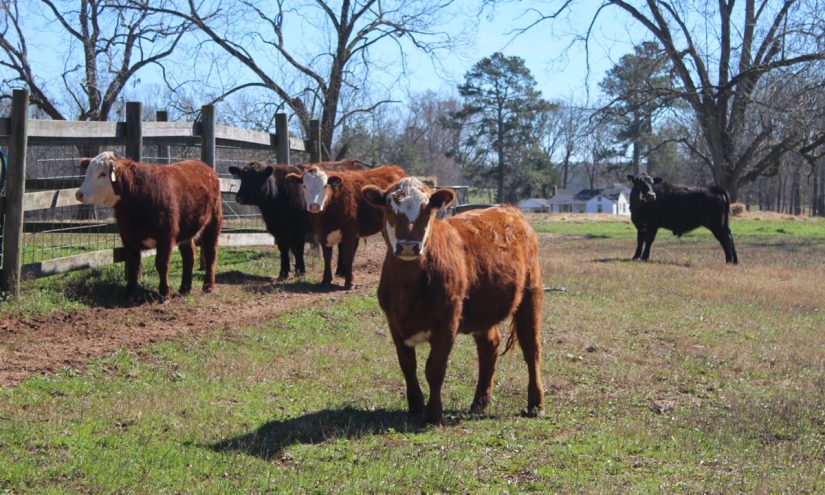
Cows graze in a pasture behind a staff house at the Governor’s School for Agriculture on Feb. 21. (Photo by Skylar Laird/SC Daily Gazette)
Two more halls sit mostly empty as they await decorations from the school’s alumni committee and, next year, a new batch of students to fill them.
After a rocky start, including findings of ethical and financial mismanagement during the school’s first year after the change, things are looking up, Keown said.
Last year, the school regained the accreditation it lost in 2016. And for the first time in 25 years, auditors last year found no problems, a rare accomplishment for a state agency, he said.
Driving through the expansive campus, where classrooms abut greenhouses and open pastures, Keown described a vision for the school’s future, including continuing to expand its capacity and offering more classes to cover the full spectrum of agriculture.
His ideas have gotten support from the House of Representatives’ budget writers.
That chamber’s state spending plan for 2025-26, passed last week, includes $2 million for continuing renovations and $4 million for a new meat processing plant.
“We don’t expect (students) to all go back and be full-time farmers,” Keown said. “But there are hundreds of thousands of jobs across South Carolina that need young people to enter those jobs.”
Becoming a school for agriculture
The mission adopted in 2020 is a return to the school’s roots.
Dr. John de la Howe, a French doctor who immigrated to Charleston in 1764, wrote in his will that he wanted the farm he had purchased to be an agricultural seminary for “12 poor boys and 12 poor girls,” giving preference to orphans, Keown said.
John de la Howe’s grave at the Governor’s School for Agriculture. (Photo by Skylar Laird/SC Daily Gazette)
For years, that was what the school was.
During World War I, John de la Howe became a state agency and a home for orphaned children, which it remained until the 1980s. Then, as orphanages waned in use, its purpose adjusted again to become a public residential school for sixth- through 10-graders with serious behavior problems.
That, too, fell out of favor over the years, as more counties established programs that kept troubled teens closer to home.
Attendance dropped, and costs per students skyrocketed.
In 2003, then-Gov. Mark Sanford recommended, without success, closing the school and sending its students to a military-like public school in West Columbia for at-risk teens. In 2014, Gov. Nikki Haley recommended putting the Department of Juvenile Justice in charge.
In March 2016, with the school’s accreditation on probation, House budget writers recommended temporarily transferring oversight to Clemson University.
Weeks later, the state Department of Education made a final decision to yank the school’s accreditation. Deficiencies cited by inspectors included classes taught by uncertified teachers, the school not meeting the needs of students with disabilities, and the lack of online access.
That forced the Legislature to make a decision.
Legislators eventually settled on creating a third residential high school offering a specific education. The agriculture school joined existing governor’s schools for the arts and for science and math.
The year the school was supposed to open its doors to its first new class of students, the COVID-19 pandemic began. Distancing restrictions meant students could no longer share rooms, so the school halved its capacity and began its first year with 33 students.
The next year, the school’s population doubled.
At the start of the 2024 school year, 81 students were enrolled, and another 81 had graduated. Once renovations in three dorms are complete, the capacity will increase to 124, plus day students, Keown said.
“It’s been like putting together a huge puzzle with many missing pieces over the last couple of years,” Keown said. “But we’re finally finding all those pieces, and it’s all making more sense.”
The new mission
Blake Arias knew he wanted to study plants. Other than that, he had little interest in agriculture when he applied for the governor’s school.
“If you looked at my application, it was very obvious that I didn’t have a background and that I didn’t know much,” Arias said.
When he first arrived at the school nearly three hours from his home in Summerton, he wasn’t particularly interested in handling animals. And he really, really didn’t want to learn to weld.
Three years later, Arias, who graduates this spring, still focuses primarily on plants.
However, he also spends hours every day after class helping a rabbit, Chunky, lose some weight before he takes her to shows. He’s working on earning a beekeeping certification. And he even learned how to weld.
A sheep looks over a fence at the Governor’s School for Agriculture on Feb. 21. (Photo by Skylar Laird/SC Daily Gazette)
“Am I the best welder? Absolutely not,” Arias said. “But I really enjoyed it, and it taught me something new because they gave me the opportunity.”
Arias is part of about half of the school’s population that comes in with little background in agriculture, Keown said. Applicants must have at least a 2.7 GPA. The goal is to take all kinds of students, whether they grew up on a farm or in a city and show them all sorts of opportunities in agriculture.
That’s not limited to farming.
The school offers four designated pathways: agricultural mechanics, horticulture, plant and animal systems, and environmental and natural resources. Students choose a focus, but they’re introduced to a sampler platter of what’s out there, Keown said.
“It really shows you all the possibilities that there are in each field,” said Emily White, a senior from McCormick.
Day to day
The days typically begin long before students report to the cafeteria at 7:45 a.m.
Like on any farm, horses, pigs and rabbits need feeding and cleaning, and plants need tending.
Students take a blend of core classes, such as English, math and social studies, and classes focused on agriculture, Keown said.
Even the core classes, which are all honors-level courses, typically use agriculture as a touch point for students, said Lyle Fulmer, a recent graduate.
Math problems, for instance, might use real-life examples of balancing a budget on a farm. For students interested in agriculture, that adds excitement to what might usually be their hum-drum classes, he said.
“Even if it was frustrating and I didn’t know how to solve the problem, I would work through it and I would know that this was something that I very well could be doing someday,” said Fulmer, who is now a freshman at Clemson University.
Once classes are over, students have the rest of the afternoon to do as they please.
The inside of a residence hall at the Governor’s School for Agriculture on Feb. 21. (Photo by Skylar Laird/SC Daily Gazette)
White said she typically goes to the pig barn to clean, feed and work with Hank the Tank, a pig she’s planning to show.
Other students might practice rodeo riding or clay shooting, two of the sports the school offers. Some gather at the saw mill to help process trees salvaged when Tropical Storm Helene swept through campus last September.
By 6:15 p.m., students are expected to return to their residence halls or other communal areas for an hour of study time. Like college students, they have the run of their residence halls under the watchful eye of a residential advisor.
Along with accumulating credits to get ahead in college courses, the freedom Fulmer had as a high school student helped prepare him for living in the dorms and all the challenges that accompany that. He already knew how to keep his space tidy and handle disagreements with roommates, which many incoming freshmen don’t, he said.
“It really did prepare me a lot for college,” Fulmer said.
What the future holds
Standing on the front lawn of the president’s mansion, glimpses of the dining hall visible across an expansive open lawn, Keown described his vision of the school’s future.
In the next couple of years, the school will start offering classes in culinary arts and hospitality management, which will help students who want to go into the growing industry of agritourism that creates attractions out of farms.
“Our ag kids learn to grow (the food), our culinary students prepare it, our tourism hospitality students manage the banquets,” Keown said of his vision.
Also in the near future is the meat processing plant, which Keown hopes to have finished in the next three years. That will give students skills to land high-paying jobs straight out of high school and fill a gap in the agricultural industry, Keown said.
Timothy Keown, president of the Governor’s School for Agriculture, stands in front of the president’s house on Feb. 21, 2025. (Photo by Skylar Laird/SC Daily Gazette)
A decade from now, Keown hopes to see 300 students roaming the grounds. He also wants them to grow about half of what they eat, compared with 20% now.
In Keown’s mind, the school presents a bright spot for the future of agriculture. While the number of farmers under the age of 35 has grown slightly in recent years, the average age of farmers is 58, according to the U.S Department of Agriculture.
Photos of recent alumni hung from flagpoles on campus. Driving under them, Keown named each graduate and where they went to school. Many go to Clemson, though some went to schools in other states.
Most are still pursuing degrees in agriculture.
“They are making us really proud,” Keown said.
SC Daily Gazette is part of States Newsroom, a nonprofit news network supported by grants and a coalition of donors as a 501c(3) public charity. SC Daily Gazette maintains editorial independence. Contact Editor Seanna Adcox for questions: [email protected].
Lawmakers want to turn the tide on the growing number of unprepared and uncertified teachers by restricting who can lead Texas classrooms. But school leaders worry those limits will leave them with fewer options to refill their teacher ranks.
Tucked inside the Texas House’s $7.6 billion school finance package is a provision that would ban uncertified teachers from instructing core classes in public schools. House Bill 2 gives districts until fall 2026 to certify their K-5 math and reading teachers and until fall 2027 to certify teachers in other academic classes.
Texas would help uncertified teachers pay for the cost of getting credentialed. Under HB 2, those who participate in an in-school training and mentoring program would receive a one-time $10,000 payment and those who go through a traditional university or alternative certification program would get $3,000. Special education and emergent bilingual teachers would get their certification fees waived. Educator training experts say itcould be the biggest financial investment Texas made in teacher preparation. Rep. Brad Buckley, the Salado Republican who authored the bill, has signaled the House Public Education Committee will vote on HB 2 on Tuesday.
District leaders, once reluctant to hire uncertified teachers, now rely on them often to respond to the state’s growing teacher shortage. And while they agree with the spirit of the legislation, some worry the bill would ask too much too soon of districts and doesn’t offer a meaningful solution to replace uncertified teachers who leave the profession.
“What’s going to happen when we’re no longer able to hire uncertified teachers? Class sizes have to go up, programs have to disappear…. We won’t have a choice,” said David Vroonland, the former superintendent of the Mesquite school district near Dallas and the Frenship school district near Lubbock. “There will be negative consequences if we don’t put in place serious recruitment efforts.”
A floodgate of uncertified teachers
Nowadays, superintendents often go to job fairs to recruit teachers and come out empty-handed. There are not as many Texans who want to be teachers as there used to be.
The salary in Texas is about $9,000 less than the national average, so people choose better-paying careers. Teachers say they are overworked, sometimes navigating unwieldy class sizes and using weekends to catch up on grading.
Heath Morrison started to see the pool of teacher applicants shrink years ago when he was at the helm of Montgomery ISD. Many teachers left the job during the COVID-19 pandemic, which accelerated the problem.
“This teacher shortage is getting more and more pronounced,” said Morrison, who is now the CEO of Teachers of Tomorrow, a popular alternative teacher certification program. “The reality of most school districts across the country is you’re not making a whole lot more money 10 years into your job than you were when you first entered … And so that becomes a deterrent.”
As the pool of certified teachers shrunk, districts found a stopgap solution: bringing on uncertified teachers. Uncertified teachers accounted for roughly 38% of newly hired instructors last year, with many concentrated in rural districts.
The Texas Legislature facilitated the flood of uncertified teachers. A 2015 law lets public schools get exemptions from requirements like teacher certification, school start dates and class sizes — the same exemptions allowed for open enrollment charter schools.
Usually, to teach in Texas classrooms, candidates must obtain a certification by earning a bachelor’s degree from an accredited college or university, completing an educator preparation program and passing teacher certification exams.
Teacher preparation experts say certifications give teachers the tools to lead a high quality classroom. To pass certification tests, teaching candidates learn how to plan for lessons and manage discipline in a classroom.
But the 2015 law allowed districts to hire uncertified teachers by presenting a so-called “district of innovation plan” to show they were struggling to meet credential requirements because of a teacher shortage. By 2018, more than 600 rural and urban districts had gotten teacher certification exemptions.
“Now, what we’ve seen is everyone can demonstrate a shortage,” said Jacob Kirksey, a researcher at Texas Tech University. “Almost every district in Texas is a district of innovation. That is what has allowed for the influx of uncertified teachers. Everybody is getting that waiver for certification requirements.”
This session, House lawmakers are steadfast on undoing the loophole they created after new research from Kirksey sounded the alarm on the impacts of unprepared teachers on student learning. Students with new uncertified teachers lost about four months of learning in reading and three months in math, his analysis found. They missed class more than students with certified teachers, a signal of disengagement.
Uncertified teachers are also less likely to stick with the job long-term, disrupting school stability.
“The state should act urgently on how to address the number of uncertified teachers in classrooms,” said Kate Greer, a policy director at Commit Partnership. The bill “rights a wrong that we’ve had in the state for a long time.”
The price of getting certified
Rep. Jeff Leach, a Plano Republican who sits on the House Public Education Committee, said his wife has worked as an uncertified art teacher at Allen ISD. She started a program to get certified this winter and had to pay $5,000 out of pocket.
That cost may be “not only a hurdle but an impediment for someone who wants to teach and is called and equipped to teach,” Leach said earlier this month during a committee hearing on HB 2.
House lawmakers are proposing to lower the financial barriers that keep Texans who want to become teachers from getting certified.
“Quality preparation takes longer, is harder and it’s more expensive. In the past, we’ve given [uncertified candidates] an opportunity just to walk into the classroom,” said Jean Streepey, the chair of the State Board for Educator Certification. “How do we help teachers at the beginning of their journey to choose something that’s longer, harder and more expensive?”
Streepey sat on the teacher vacancy task force that Gov. Greg Abbott established in 2022 to recommend fixes to retention and recruitment challenges at Texas schools. The task force’s recommendations, such as prioritizing raises and improving training, have fingerprints all over the Texas House’s school finance package.
Under HB 2, districts would see money flow in when they put uncertified teachers on the path to certification. And those financial rewards would be higher depending on the quality of the certification program.
Schools with instructors who complete yearlong teacher residencies — which include classroom training and are widely seen as the gold standard for preparing teacher candidates — would receive bigger financial rewards than those with teachers who finish traditional university or alternative certification programs.
Even with the financial help, lawmakers are making a tall order. In two years, the more than 35,000 uncertified teachers in the state would have to get their credential or be replaced with new, certified teachers.
“The shortages have grown to be so great that I think none of us have a really firm handle on the measures that it’s going to take to turn things around.” said Michael Marder, the executive director of UTeach, a UT-Austin teacher preparatory program. “There is financial support in HB 2 to try to move us back towards the previous situation. However, I just don’t know whether the amounts that are laid out there are sufficient.”
Restrictions like “handcuffs”
Only one in five uncertified teachers from 2017 to 2020 went on to get a credential within their first three years of teaching. Texas can expect a jump in uncertified teachers going through teacher preparatory programs because of the financial resources and pressure on schools through HB 2, Marder said.
But for every teacher who does not get credentialed, school leaders will have to go out and find new teachers. And they will have to look from a smaller pool.
The restrictions on uncertified teachers “handcuffs us,”said Gilbert Trevino, the superintendent at Floydada Collegiate ISD, which sits in a rural farming town in West Texas. In recent years, recruiters with his district have gone out to job fairs and hired uncertified teachers with a college degree and field experience in the subjects they want to teach in.
Rural schools across the state have acutely experienced the challenges of the teacher shortage — and have leaned on uncertified teachers more heavily than their urban peers.
“We have to recruit locally and grow our own or hire people who have connections or roots in the community,” Trevino said. “If we hire a teacher straight out of Texas Tech University, we may have them for a year. … And then they may get on at Lubbock ISD or Plainview ISD, where there’s more of a social life.”
Floydada Collegiate ISD recruits local high school students who are working toward their associate’s degree through what is known as a Grown Your Own Teacher program. But Trevino says HB 2 does not give him the time to use this program to replace uncertified teachers. From recruitment to graduation, it takes at least three years before students can lead a classroom on their own, he said.
School leaders fear if they can’t fill all their vacancies, they’ll be pushed to increase class sizes or ask their teachers to prepare lessons for multiple subjects.
“Our smaller districts are already doing that, where teachers have multiple preps,” Trevino said. “Things are already hard on our teachers. So if you add more to their plate, how likely are they to remain in the profession or remain in this district?”
At Wylie ISD in Taylor County, it’s been difficult to find teachers to keep up with student growth. Uncertified teachers in recent years have made up a large number of teacher applicants, according to Cameron Wiley, a school board trustee.
Wiley said restrictions on uncertified teachers is a “good end goal” but would compound the district’s struggles.
“It limits the pot of people that’s already small to a smaller pot. That’s just going to make it more difficult to recruit,” Wiley said. “And if we have a hard time finding people to come in, or we’re not allowed to hire certain people to take some of that pressure off, those class sizes are just going to get bigger.”
Learning suffers when class sizes get too big because students are not able to get the attention they need.
“This bill, it’s just another obstacle that we as districts are having to maneuver around and hurl over,” Wiley said. “We’re not addressing the root cause [recruitment]. We’re just putting a Band-Aid on it right now.”
The Texas Tribune is a member-supported, nonpartisan newsroom informing and engaging Texans on state politics and policy. Learn more at texastribune.org.