The series, premiering on February 5, was filmed at Bell English Schools’s Cambridge premisis in August 2025, which hosted Dong-Il Sung, Kwang-Kyu Kim, Ki-Jun Um, Hyuk Jang, and Seung-Hwan Shin for two weeks in August 2024.
The program, Shala Shala, follows the actors’ authentic experiences of learning English alongside other students, taking part in activities, and staying with host families and in Bell Cambridge’s on-campus residences.
“These are male, middle-aged actors who are famous in South Korea, but who have got to a certain point in their career and maybe they want to try more roles in English or maybe they want to travel personally with their families,” Rebecca Stead, head of marketing at Bell Educational Services told The PIE News.
“So, the premise of the show was that it’s never too late to late to learn English,” Stead added.
To make it as authentic as possible, 50 hidden cameras were set up around the school to capture the actors’ true experiences taking classes with Bell’s summer learners.
While Stead maintained that the actors were “great students”, the program’s trailer reveals a somewhat bumpy path to language learning success.
“It was a big operation and really interesting for us staff to see how a TV program is made, and the other students were really excited to have the actors around,” she added.
The premise of the show was that it’s never too late to late to learn English
Rebecca Stead, Bell English
With seven schools for adult students and young learners across the UK, Bell’s Cambridge institution is its flagship location offering year-round language courses to learners of all ages.
“We’ve got these beautiful gardens and traditional buildings, and it’s in Cambridge, which is such an attractive destination. It’s very much that quintessential image of what a lot of people from other countries imagine the UK to be like,” Stead noted.
“Not only are we showcasing Bell but we’re also showcasing the UK and what a valuable experience it is to study and travel here, so hopefully it will be a positive thing for the industry as a whole.”
The program comes at a time of slowing recovery for the UK’s ELT sector, with levels likely to be a “new normal” for the sector, according to a recent report by English UK.
The program will be airing on YouTube as well as the South Korean television network JTBC on February 5, 2025.
In two separate hearings published on December 19, the OfS granted approval for the University of Bolton to be renamed the University of Greater Manchester, and for the University of Central Lancaster (UCLan) to become the University of Lancashire.
The regulator permitted Bolton becoming the University of Greater Manchester despite objections from the University of Manchester that the change would be “very confusing and misleading”. Manchester Metropolitan University and the University of Salford also objected to the name change.
In a consultation on UCLan’s rebranding to the University of Lancashire, 90% of the 1,812 respondents said that the new name could be “confusing or misleading”, given that the existing Lancaster University carries the same official title.
During the ruling, the regulator considered the name change could be particularly confusing for international students “less familiar with contextual information” but concluded that it was “unlikely to lead to any material harm or detriment”.
The consultations in Bolton also garnered widespread opposition to the rebrand, with 64% of respondents saying the name change could cause confusion.
The OfS recognised that both instances could be confusing “for particular groups of stakeholders, including for example those for whom English is not their first language or who have difficulties in distinguishing or processing information”.
However, it concluded that “the range of contextual information that students use when applying to study” would help to prevent material harm arising from such confusion.
The name change is very good news for our students, very good news for the institution, very good news for the town and amazing news for jobs
Professor George Holmes, University of Greater Manchester
In both cases, the OfS ruled that its duties to protect the “institutional autonomy” of providers and “encourage competition” between universities weighted in favour of consenting to both new names.
In Bolton, the proposals to change the university’s name sparked backlash from local politicians and members of the public, with a motion put to Bolton Council in 2023 calling on the university to rethink the name change.
Announcing the news on December 19, vice chancellor Professor George Holmes told a group of staff members that he was “delighted” to announce the change.
“The name change is very good news for our students, very good news for the institution, very good news for the town and amazing news for jobs,” said Holmes, adding that it was “an important accolade to have the University of Greater Manchester based in Bolton”.
Professor Graham Baldwin, UCLan vice chancellor, also welcomed his institution’s new title, saying that it would “better reflect our regional economic importance and aid continuing efforts to raise brand awareness further afield.
“Locally the acronym UCLan was widely used but for many outside the region they didn’t know it was the title of a university nor where it was located,” said Baldwin.
On December 2, 2024 the OfS announced it was temporarily pausing the registration of new institutions, as well as suspending applications for an institution to change its name “where it already holds university title”. Applications already submitted would be completed, it said.
According To the New UPCEA and Collegis Report, 71% of Prospective Graduate Students Prefer Fully Online Programs
Findings highlight the need for strategic outreach to address master’s degree enrollment challenges in a competitive market
[Washington and Illinois] – December 16, 2024 – A new report released today by UPCEA, the online and professional education association, and Collegis Education, a higher education solutions tech-enabler, highlights the growing interest in online master’s degree programs that provide flexibility, transparency and streamlined communication in graduate programs. Based on a survey of over 1,000 prospective graduate students, Building a Better Pipeline: Enrollment Funnel Needs and Perspectives from Potential Post-Baccalaureate Students reveals key insights for higher education institutions aiming to improve graduate recruitment strategies.
“We are entering a period where every enrollment matters. Enrollment growth for graduate programs has been stagnant for the past 15 years, despite the number of baccalaureate degree holders growing. Future success requires colleges and universities to better align offerings with student preferences and communicating on their terms,” said Jim Fong, Chief Research Officer at UPCEA. “Listening to prospective students’ interests and addressing their needs provides a stronger roadmap for institutions to succeed in what will be a hyper-competitive landscape.”
Key findings from the report include:
Delivery Preferences: Fully online programs are the most preferred format, with 71% of respondents showing strong interest, followed by hybrid formats (53%).
Program Priorities: A specific program of study is the top consideration (54%), followed by institutional reputation (28%) and delivery method (18%).
Communication Preferences: Email remains the preferred contact method for 47% of respondents during the inquiry process, with most willing to share basic details such as their name and email address.
Engagement Challenges: Sixty-two percent of respondents said difficulty finding basic program information on an institution’s website would cause them to disengage. At the same time, financial concerns dominated the latter stages of the application process.
The report highlights a growing demand for master’s degree programs, which 65% of respondents identified as their top interest. It also points to an urgent need for institutions to address gaps in their outreach strategies to meet these demands effectively.
“As higher education faces tightening budgets, strategic investments in program delivery and candidate outreach have never been more important. These findings emphasize the need for a fully transparent graduate search experience – from program research to application – to engage and inform students so they can see the value and affordability from the start,” said Tracy Chapman, Chief Academic Officer of Collegis Education. ”Institutions that leverage data, technology, and talent can strengthen relationships with prospective students to build communication and trust.”
With graduate enrollment projected to grow by just 1.4% over the next five years, institutions must innovate to stay competitive. The report provides data-driven insights to help universities design more effective outreach and recruitment strategies, particularly in light of the 32% increase in master’s program offerings since 2017, which has led to a 15% decrease in average program size.
Actionable Insights for Institutions
With graduate enrollment projected to grow by just 1.4% over the next five years, institutions must innovate to stay competitive.The survey revealed that requiring too much personal information in online request-for-information (RFI) forms often leads to student disengagement. Institutions should streamline these forms and prioritize providing clear, accessible program details—such as tuition, course requirements, and job outcomes—on their websites. UPCEA’s analyses show that many institutions lack this essential information, which can deter potential applicants early in the inquiry process.
In light of the 32% increase in master’s program offerings since 2017, which has led to a 15% decrease in average program size, this report provides vital data-driven insights to help universities design more effective outreach and recruitment strategies.
Methodology
Conducted in August, the survey was completed by 1,005 qualified participants. Qualified respondents were between the ages of 18 and 64, held at least a bachelor’s degree, were not currently enrolled in a post-baccalaureate program, and were at least somewhat interested in pursuing further education. Nearly a quarter (24 percent) of respondents were 55 to 64 years old, 18 percent were aged 46 to 54, and 14 percent were 23 to 26 years old, showing deep interest in fully online graduate programs regardless of age.
UPCEA is the online and professional education association. Our members continuously reinvent higher education, positively impacting millions of lives. We proudly lead and support them through cutting-edge research, professional development, networking and mentorship, conferences and seminars, and stakeholder advocacy. Our collaborative, entrepreneurial community brings together decision-makers and influencers in education, industry, research, and policy interested in improving educational access and outcomes. Learn more at upcea.edu.
About Collegis Education:
As a mission-oriented, tech-enabled services provider, Collegis Education partners with higher education institutions to help align operations to drive transformative impact across the entire student lifecycle. With over 25 years as an industry pioneer, Collegis has proven how to leverage data, technology, and talent to optimize institutions’ business processes that enhance the student experience. With the strategic expertise that rivals the leading consultancies, a full suite of proven service lines, including marketing, enrollment, retention, IT, and its world-class Connected Core® data platform, Collegis helps its partners enable impact and drive revenue, growth, and innovation. Learn more at CollegisEducation.com.
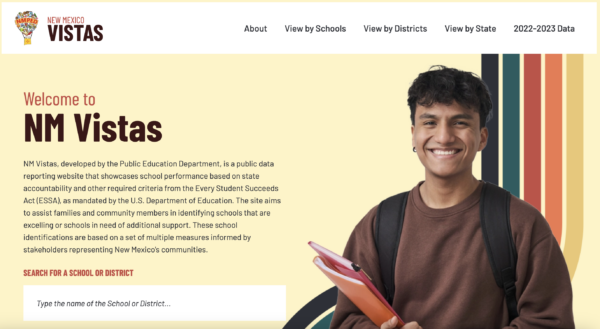
The New Mexico Public Education Department has updated its student achievement data reporting website — NM Vistas — with a renovated layout and school performance data from the 2023-2024 academic year, with expectations for additional information to be released in January 2025.
NM Vistas is crucial to informing New Mexicans about school performance and progress at the school, district and state levels through yearly report cards. The site displays student reading, math and science proficiency rates taken from state assessments, as required by the federal Every Student Succeeds Act. Districts and schools receive scores between 0 and 100 based on performance, and schools also receive designations indicating the level of support the school requires to improve.
Other information on the site includes graduation rates, attendance and student achievement growth. Data also shows rates among specific student demographics, including race, gender, disability, economic indicators and more.
PED Deputy Secretary of Teaching, Learning and Innovation, Amanda DeBell told NM Education in an interview that this year’s recreation of the NM Vistas site came from a desire to go beyond the state’s requirements for school performance data.
“We knew that New Mexico VISTAs had a ton of potential to be a tool that our communities could use,” DeBell said.
One new data point added to NM Vistas this year is early literacy rates, which measures the percentage of students in grades K-2 who are reading proficiently at their grade level. Currently, federal law only requires proficiency rates for grades 3-8 to be published, and New Mexico also publishes 11th grade SAT scores. In the 2023-2024 school year, 34.6% of students grades K-2 were proficient in reading, the data says.
DeBell said several advisory groups encouraged the PED to report early literacy data through NM Vistas.
“We were missing some key data-telling opportunities by not publishing the early literacy [rates] on our website, so we made a real effort to get those early literacy teachers the kudos that they deserve by demonstrating the scores,” DeBell said.
The PED also added data on individual schools through badges indicating specific programs and resources the school offers. For example, Ace Leadership High School in Albuquerque has two badges: one for being a community school offering wraparound services to students and families, and another for qualifying for the career and technical education-focused Innovation Zone program.
“What we are really trying to do is provide a sort of one-stop shopping for families and community members to highlight all of the work that schools are doing,” DeBell said.
The updated NM Vistas website has removed a few things as well, most notably the entire 2021-2022 NM Vistas data set. DeBell said this was because the PED changed the way it measured student growth data, which resulted in the 2021-2022 school year’s data being incomparable to the most recent two years.
“You could not say that the schools in 2021-2022 were doing the same as 2022-2023 or 2023-2024, because the mechanism for calculating their scores was different,” DeBell said.
However, this does leave NM Vistas with less data overall, only allowing viewers to compare scores from the latest data set to last year’s.
In January 2025, several new indicators are expected to be uploaded to the site, including:
Student performance levels: Reports the percentage of students who are novices, nearing proficiency, proficient and advanced in reading, math and science at each school, rather than only separating between proficient and not proficient.
Results for The Nation’s Report Card (also known as NAEP): Compares student proficiencies between US states.
Educator qualifications: DeBell said this would include information on individual schools’ numbers of newer teachers, substitute teachers covering vacancies and more.
College enrollment rates: only to be statewide numbers indicating the percentage of New Mexico students attending college after graduating, but DeBell said she later hopes the PED can narrow down by each K-12 school.
Per-pupil spending: How much money each school, district and the state spends per-student on average.
School climate: Links the viewer to results of school climate surveys asking students, parents and teachers how they feel about their school experience.
Alternate assessment participation: Percentage of students who take a different assessment in place of the NM-MSSA or SAT.
“We want VISTAs to be super, super responsive, and we want families to be able to use this and get good information,” DeBell said. “We will continue to evolve this until it’s at its 100th iteration, if it takes that much.”
This year, the PED released statewide assessment results for the 2023-2024 school year to NM Vistas on Nov. 15. Results show 39% of New Mexico students are proficient in reading, 23% are proficient in math and 38% are proficient in science. Compared to last year’s scores, reading proficiency increased by 1%, math proficiency decreased by 1% and science proficiency increased by 4%.
The admissions centre that handles university applications in NSW and the ACT has said students applying for equity scholarships has surged more than 35 per cent this year.
Please login below to view content or subscribe now.
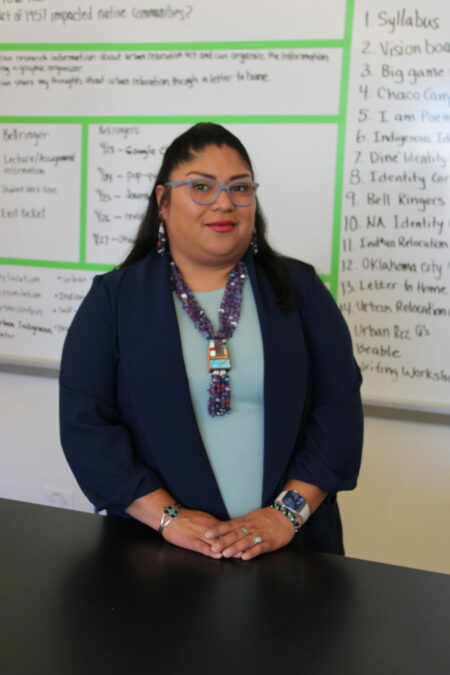
Halloween 2024 is a holiday that won’t be soon forgotten by Bernalillo High School teacher Lorilei Chavez. You see, October 31 was the day she was honored as the first Indigenous teacher named New Mexico Teacher of the Year.
Sixth period was going as usual for Lorilei and her social studies class. The group was in the middle of a lesson when BHS principal, Alyssa Sanchez-Padilla, and her secretary came to the door with an urgent request: Bring your students to the school’s black box theater to bump up attendance for a guest speaker.
“And so, you know, as a teacher, I’m like, ‘Oh no, we’re in the middle of a lesson,’” she related. “You know, I don’t want to lose valuable teaching time. But if the principal is asking you to take your students somewhere, you know, you get going.”
As she walked with her students to the theater and the seventh-period bell rang, her principal asked to detour to sign some tutoring paperwork. While walking, Chavez noticed a few extra student resource officers.
“Like I was getting kind of like an inclination that something was going on, you know?” she said, noting she was dressed in 1980s style for Halloween, with a side ponytail and an off-the-shoulder shirt.
Still thinking there was a guest speaker, Lorelei came to the theater and saw the “shimmer of cheerleading pompoms” and a huge cheer erupted as she entered the room. Assuming the cheer was for the “guest,” she got a bit spooked and started to back out of the room, she said.
“My principal was behind me and she just put her hands on my shoulders and softly nudged me forward,” she recalled. “I saw my mom and rushed over to her. Then she points up at the ceiling and there was this huge banner that says ‘Lorelei Chavez, Teacher of the Year.’”
“And that’s when it all just hit and took me over. And then it went from joy, like surprise to joy to like pure happy tears,” she said.
“It’s a life moment I’ll never forget.”
From Bernalillo and back
Lorilei describes herself as a “very proud product of Bernalillo Public Schools.” Beginning with kindergarten near home on the Kewa Pueblo (Santo Domingo Pueblo), she spent all but one year of her young life in the BPS system, beginning with Santo Domingo School and ending with graduation from Bernalillo High in 2008.
“It’s funny because I remember being in high school thinking, ‘Oh, I want to go as far as I can. Like, I want to go to school in California. I want to go to college in Washington, D.C. And I don’t want to come back to Bernalillo,’” she recalled with a chuckle. “And then six years later, I ended up (substitute teaching) while going to college. I’ve been there ever since.”
Beginning her college career at Central New Mexico Community College, Lorilei got her basics taken care of before transferring to the University of New Mexico. She graduated in 2018 with a degree in Native American Studies and a minor in History. Though she started as an education major and shifted away, her experiences as a substitute convinced her to go through CNM’s Alternative Licensure program, which she finished in 2020.
“When I started subbing as I was going to (UNM), I realized that I had a really deep ability to connect with students on a level that maybe some of my colleagues weren’t able to,” she said. “Because our district is 48% Indigenous, a lot of the students that I worked with didn’t really have Indigenous teachers or teacher aides or even substitutes that looked like them.”
Since the Bernalillo school system works with seven different tribes, Lorilei said she feels it’s important that Native students have Indigenous role models in the school setting. She used simple examples, like seeing her dressed in Native regalia or “big Native earrings” and beaded medallions to honor Native heritage.
“I think that’s what allowed me to see that I would be a good educator,” she said. “I would have an impact on students if I did a shift and got my teacher certification.
“And so that I think is my main drive even to today, is my ability to connect with students, uplift them, hear their voices, allow them to feel seen in the classroom, which I think creates the motivation to continue their goals and succeed in whatever they’re trying to accomplish.”
Serving her community
Lorilei said being named the first Indigenous teacher to win the statewide Teacher of the Year award was obviously an honor. But because “a core value of Pueblo people is the idea of service,” she said she feels that she is representing more than herself in accepting the award.
“As I serve my community, I wake up every day knowing that I’m going to serve my students, my future generations as I represent Santo Domingo Pueblo,” she said. “I wake up every day thinking, ‘What impact am I going to make on my community and what impact am I able to make today on the future generation?’ So, winning an award like this has been really hard for me to accept and value the honor. Because I feel it doesn’t just belong to me. It comes from a community of educators that has raised me and taught me.”
With her Native American Studies background, she said she strives to balance Indigenous culture and Western education in a school setting.
“The people, the past EAs, the language teachers, the teachers who’ve taught me that have poured into my education, I think is what brought me to today,” Lorilei said. “With this title and this beautiful award, I’m able to bring home not only Santo Domingo but to the Bernalillo Public Schools. I think the pressure of being the first Indigenous Teacher of the Year is making sure I’m honoring not only my school but my students and the community that I come from.”
‘Indigenizing’ the Education System
Lorilei said that as Teacher of the Year, she will emphasize “Indigenizing” education in New Mexico, as well as supporting teachers’ mental health. The desire to bring more Native experiences, stories, and perspectives into public education is something that grew from her time in the UNM Native Studies program.
“Going to (UNM’s) Native American studies program as a college student really opened my mind to this understanding of needing to know your culture, your history, the laws and the narrative that existed in Native community,” she said. “Things that weren’t necessarily told in the history books that I studied or in the papers that I wrote. Things not in the curriculum that I was offered as a public school student.”
“So graduating from UNM NAS instilled this understanding that going back into the public schools that I work at… I had no choice but an obligation to encourage our district and hold our district accountable when adopting curriculums and encouraging Native history in the core curriculum,” she concluded.
Lorilei said she and her fellow educators in the Bernalillo Public Schools “are blessed” to have a district leadership that understands the equity and value of bringing in Native languages and history as a core content.
She also said she feels very fortunate for the opportunity to work in a district that allows her the opportunity to build a curriculum that includes Indigenous history – subjects like the Pueblo Revolt, boarding schools, Native removal, sovereignty and decolonization, in a “school building that was not necessarily built for Indigenous education but built for Western education.”
“As the first Indigenous teacher of the year, I feel like that also is my obligation and duty, is to work to continue to advocate, to educate, so that we can uplift Native narrative, history, stories in curriculum,” she said. “Not just in high student of color populations, but in districts across the state.
“It is a passion of mine to Indigenize education and bring Indigenous perspective in Western curriculum. And so that’s something that I’m going to really push toward and be passionate about and continue to advocate for moving forward,” she related.
Prioritizing balance for teachers
Lorilei also said she is “super passionate” about state leadership and school districts starting a movement around prioritizing teacher mental health. She said she plans to “really pour some energy in as Teacher of the Year.” As a teacher working at the high school level, she said implementing teaching materials and testing guides, and “doing all the things that I need to do as a teacher to be the best teacher” leaves her drained at times.
“Balancing all of that with my life and my culture and everything that I am as a human being, an auntie, a sister, a cousin, is very difficult,” she said. “I really think as a state and as a nation, we really need to take a deeper look into how we are healing our teachers. How are we showing up for them in capacities that include mental wellness? And that includes body health and that includes spiritual strength in whatever capacity that they connect to.”
She concluded: “My goal and my hope is to really work with school districts, including mine, to have wellness days, wellness fairs, professional development days where teachers are paid to take time to take care of their mental health… because we’re so spread thin from the many, many things we have to do as educators.
“I’d really like to see us looking at an innovative way to address teacher wellness in ways that maybe the state and the nation haven’t before.”
The New Mexico Teacher of the Year program is sponsored by The New Mexico Oil and Gas Association. The award of $ 10,000 will go to Lorilei to help with professional development opportunities and support her travel needs.
Last year’s Albuquerque Public Schools third-graders identified in the Yazzie-Martinez decision plus African American students fell short of the reading proficiency goal set by the district in its first year of concerted progress monitoring under a new strategic plan, according to a report released earlier this month.
APS administrators pointed out during an October 2 school board meeting that these third-graders, identified in the Yazzie-Martinez decision plus African Americans, were kindergarteners during the Covid-19 pandemic, and spent much of that formative year learning online, which served them poorly.
The review is part of the district’s plan to monitor progress towards the four goals adopted by the APS Board of Education in 2023, aligned with the district’s new Emerging Stronger Strategic Plan. Each of the four goals have interim goals that serve as indicators of progress.
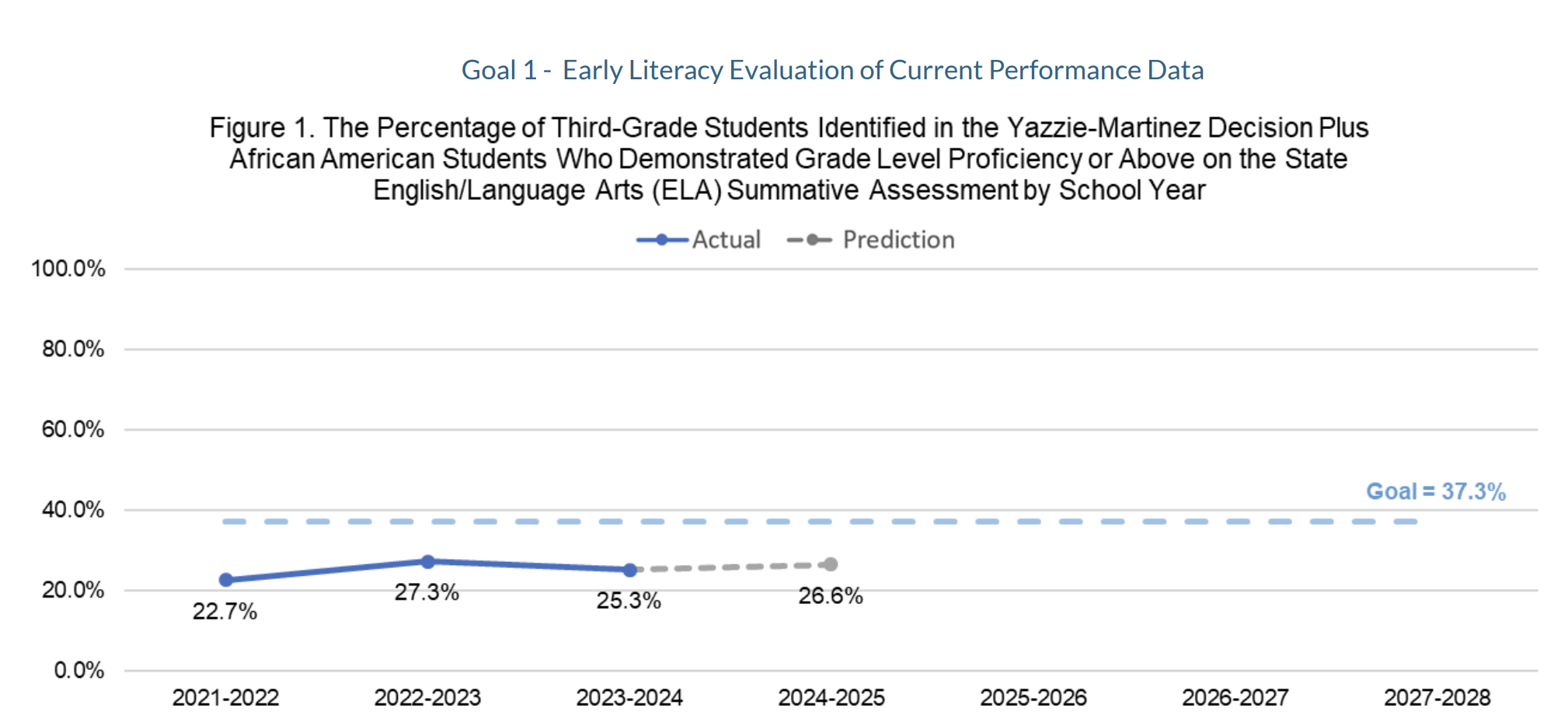
Goal One of the district’s four overarching goals calls for a 10 percentage-point increase in reading proficiency among that group of third-graders between 2023 and 2028. The interim goal for spring of 2024 was to raise the rate from 2023’s 27.3 to 28.3.
Instead, last year’s third-graders actually slipped to a proficiency rate of 25.3.
The district is still devising individualized strategies to catch kids up, officials told board members.
“Strategic measures moving forward can be summarized by the word specificity,” Antonio Gonzales, deputy superintendent of leadership and learning told the board. This means getting detailed in determining what different subgroups need, for example special education and English language learners students need, and how to provide for those needs.
“We know that we have a strategy in place, and that’s great. And I believe in the strategy that we have in place. But what this strategy calls us to action on is being specific and specific by student,” Gonzales said.
APS has not modified its five-year goal, but now predicts that the current year’s proficiency rate for identified third-graders will be 26.6 percent, rather than the 29.3 percent that would keep the district on track to meet the ultimate goal.
The board also heard reports on two sub-goals, where the news was decidedly better.
Interim Goal 1.1 focuses on the reading proficiency rates of first graders as measured by Istation formative assessments given at the beginning, middle, and end of the school year. “This interim assessment gives teachers real-time insights into each student’s reading abilities to help inform instruction and provide intervention,” said a slide presentation produced by the district.
The three-year target for Interim Goal 1.1 is to increase the proficiency rate of first graders in the targeted groups by six percentage points—from 17 percent in 2023 to 23 percent in 2026. Students significantly exceeded that goal last school year, ending the year with a 24.1 percent proficiency rate.
Interim Goal 1.2 has a three-year target of increasing the percentage of second-grade students identified in the Yazzie-Martinez decision plus African American students who demonstrate grade level proficiency or above as predicted by Istation from 18.3% in May 2023 to 24.3% in May 2026.
By the end of last school year, 26.3 percent of those students were proficient.
If these trends hold, it will suggest that the performance of last year’s third-graders was a Covid-related aberration, and that students on the grades that follow are performing significantly better.
Last month on September 19, the Public Education Department presented to the Legislative Education Study Committee slide decks showing preliminary, high-level results of the state’s spring assessments, promising that detailed data would be forthcoming soon thereafter.
A month has passed and the PED has released nothing further. No district- or school-level data files or presentations. Not even a press release. The school year is one-quarter over and the public is being kept in the dark about the state of New Mexico’s schools?
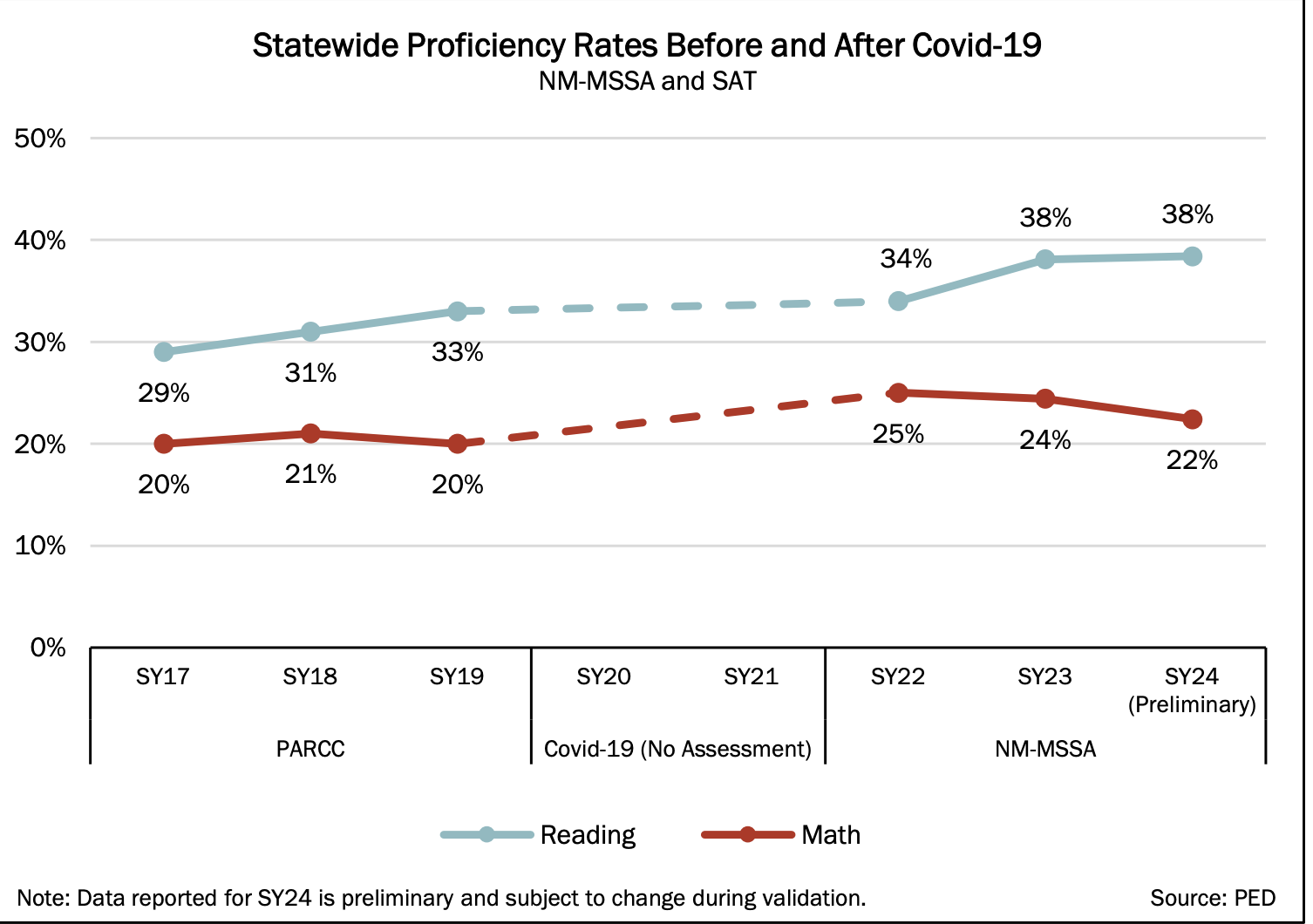
Repeated outreach by New Mexico Education to the PED has been met with silence. The one PED data slide presented showed that statewide, there was incremental improvement in reading – from 38 percent proficient in 2023 to 39 percent proficient in 2024, a decline in math (from 24 percent proficient to 23 percent), and a three percentage-point increase in science (from 34 percent to 37 percent).
A companion presentation by LESC staff contained richer data, but also showed different proficiency rates than the PED deck – reading at 38 percent proficient and math down to 22 percent proficient.
The LESC deck also contained some graphs that merit a deeper dive, which is impossible unless and until PED releases the data files. For example, the achievement gaps between economically disadvantaged and non-economically disadvantaged students in English Language Arts closed significantly statewide.
This occurred both because economically disadvantaged students’ ELA scores increased by five percentage-points (and nine percentage-points since 2022), and because more affluent students saw their ELA scores decline by five percentage-points.
Ideally, gaps should close because those on the lower end are making big gains, not because those at the higher end are dropping.
Without detailed data, it is not possible for researchers to dive in to determine why and where these changes are occurring.
National education researcher Chad Aldeman recently wrote on his Substack blog that this practice of hiding or delaying data has become a nationwide trend among state education departments.
“Here we are in pumpkin spice / decorative gourd season, and half the states still have not released their results yet,” Alderman wrote. “To put it colloquially, this is too damn slow! Summer is the key here—it’s the time when parents and educators could actually do something about the results. By the time fall rolls around, kids are already back in school and they’ve moved on to the next grade. Teachers have already written their lesson plans for the year….
…“When it comes to releasing their results, too many states are putting parents last,” Aldeman wrote. “This game of telephone is also unnecessary in today’s modern world. Most state assessments are now administered on computers and can be scored instantaneously. Private testing companies like the ACT and SAT promise to deliver results in 2-4 weeks.”
According to Aldeman’s research, last year the PED didn’t release its data until mid-November, which ranked New Mexico 45th out of the 50th states.
A new survey of more than 400 New Mexico parents of school-aged children shows widespread dissatisfaction with the state’s public schools, that communication gaps between schools and parents are a serious concern, and that many parents have misperceptions about their children’s academic achievement.
Results of the survey, “The State of Educational Opportunity in New Mexico,” were released Oct. 2 by NewMexicoKidsCAN, an education advocacy organization (and parent organization of New Mexico Education), focused on improving New Mexico’s public education system.
The state survey was part of a national report authored by 50CAN, of which NewMexicoKidsCan is an affiliate. 50CAN is “focused on building the future of American education,” according to the organization’s website. That 214-page report, “The State of Educational Opportunity in America” provides a deep, 50-state dive into parental views of public education in their home states.
Researchers surveyed more than 20,000 parents across the country, making it one of the largest education-focused surveys of parents in the past decade. This survey explores the ecosystem of educational opportunities inside and outside of school, and how they interrelate and impact a child’s success.
“With such a large sample size, we are able to dig into the findings by state and across a range of important audiences. By making the findings publicly available, this is a gift of data that can inform conversations among communities and elected officials.” said Pam Loeb, Principal at Edge Research.
The New Mexico survey provides insight into the educational opportunities available to children across New Mexico.
The New Mexico survey uncovered key findings, including:
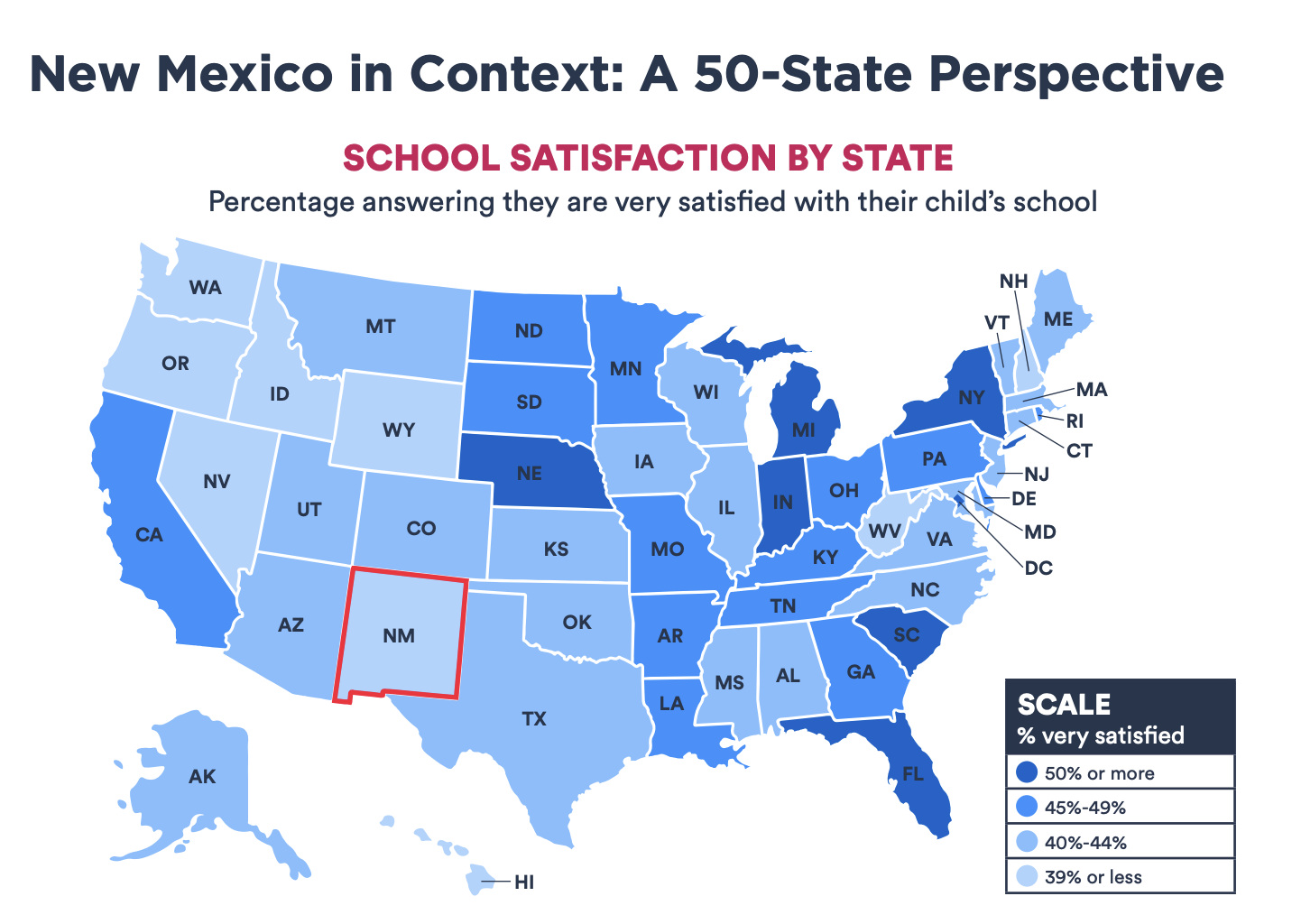
Parental dissatisfaction is widespread: Only about a third of New Mexico parents say they are “very satisfied” with their child’s school. Nationally, 45 percent of parents reported high satisfaction. New Mexico was one of the lower-ranked states in terms of parental satisfaction.
Communication Gaps Between Schools and Parents: Only 29% of New Mexico parents report feeling extremely confident in understanding their child’s academic progress ranking New Mexico second to last in the nation.
Misperceptions about Student Achievement: 41% of New Mexico parents believe their child is above grade level in reading, yet state assessments show only 39% of students are reading at grade level.
Afterschool Programs Show Promise: New Mexico ranks 22nd nationally in student participation in supervised afterschool programs, surpassing 28 other states. This success is likely attributed to increased state investments through the Extended Learning Time Program, which may have boosted overall participation rates.
“This survey amplifies the voices of New Mexico parents,” said Amanda Aragon, Executive Director of NewMexicoKidsCAN. “The results reveal significant misperceptions about student performance, serious communication gaps between schools and parents, and widespread concerns about school satisfaction.
“It’s clear that many parents are not getting the information they need about their children’s academic progress. We must do more to close this communication gap and empower parents to be true partners in their child’s education.”
“With such a large sample size, we are able to dig into the findings by state and across a range of important audiences. By making the findings publicly available, this is a gift of data that can inform conversations among communities and elected officials.” said Pam Loeb, Principal at Edge Research.
In the heart of Albuquerque’s west side, a new beacon of hope for elementary education is set to rise: Equip Academy of New Mexico.
Spearheaded by Mercy Herrera, a Yale graduate with deep New Mexico roots, the school is designed to empower Kindergarten through 5th grade students through a unique blend of high academic expectations and culturally responsive teaching. With a personal history marked by overcoming educational challenges, Herrera is bringing her passion and vision to Equip Academy, aiming to equip every child with the tools to live out their greatness.
On August 21 Equip Academy received unanimous approval to open as a charter school from the Public Education Commission.
The school is set to open on Albuquerque’s west side in August 2025, with a focus to help improve student achievement and support the academic success of all students. This comes out of experience, as Herrera’s own academic journey was anything but straightforward.
Raised in a family that moved frequently due to financial instability and personal challenges, Herrera attended multiple elementary schools, making it difficult to establish a strong academic foundation. “College seemed super out-of-reach,” she recalled, but her determination led her to Central New Mexico College (CNM), where she began to rebuild her academic confidence.
After transferring to the University of New Mexico (UNM) and excelling in a Sign Language Interpreting Program, Herrera’s educational path took her to Harvard, where she presented research on translating scriptural metaphors from English to American Sign Language (ASL). This experience eventually led her to Yale University, where she earned her master’s degree in Disability Studies and Biblical Literature.
In applying for Yale, Herrera didn’t tell a soul. She almost didn’t believe that someone like her, who struggled in school, could elevate to such a college. And yet, Herrera got in.
Despite her achievements, Herrera never forgot her New Mexico roots or the struggles she faced growing up.
Reflecting on the 2018 Yazzie-Martinez decision, which highlighted the state’s failure to provide an adequate education to many of its students, Herrera acknowledged that she would have been classified as a Yazzie-Martinez student.
“My story isn’t unique,” Herrera said, “it’s common.”
With support from mentors who believed in her, Herrera found the importance of quality education in shifting the narrative for students from backgrounds like hers. With the support, she made it to CNM, graduated UNM, attended an Ivy League, and earned a second masters in the Science of Teaching from New York City’s Pace University. It is this experience, and the belief that New Mexico’s students deserve to succeed, that drives the vision and mission of Equip Academy.
“Every child has the opportunity to live out their greatness, and our commitment is to equip them to do so,” Herrera said, quoting the school’s vision.
Equip Academy aims to provide a joyful and engaging environment with high expectations that prioritizes measurable academic learning while celebrating student curiosity and community, regardless of that student’s background.
A key aspect of Equip Academy’s approach is its commitment to culturally responsive education. Understanding the diverse cultural landscape of New Mexico, Herrera has integrated culturally respectful education efforts into the school’s curriculum. “New Mexico has so much richness and beauty, and I think it took me leaving to understand that,” she said.
To ensure the school is responsive to students across all walks of life, Herrera is working closely with the Hispanic Cultural Center, National Institute of Flamenco, Indian Pueblo Cultural Center and utilizing resources from the Native American Community Academy (NACA) to ensure that the school’s curriculum respects and reflects the cultural heritage of its students.
To support students academically, Equip Academy will implement a two-teacher model for kindergarten and first grade, allowing for more individualized attention. As part of her background, Herrera has worked as a teacher instructional coach and has made teacher support a key for the school’s success.
The school will also use cross-grade, flexible guided reading groups to ensure that students receive instruction at their individual “just right” level, helping them progress academically. Herrera emphasizes the importance of data-driven instruction and teacher excellence, which will be central to the school’s success.
Herrera’s return to New Mexico came after years of working in high-performing charter schools in New York City and driven by a desire to bring the same level of educational excellence to her home state. The experience shaped her vision for Equip Academy, prompting her to say, “I don’t know how, and I don’t know when, but I want to start a charter school in New Mexico.”
Now, that vision is becoming a reality.
Equip Academy plans to open with two kindergarten classes and one first-grade class, eventually growing to serve 450 students from kindergarten through fifth grade. The school will operate on a slow-growth model, adding one grade level each year to ensure that students receive a consistent and high-quality education throughout their elementary years.
As Herrera prepares for Equip Academy’s opening, she remains focused on the bigger picture: equipping students with the knowledge and skills they need to dream audaciously, engage deeply, and pursue lives of purpose. Her journey from a struggling student to an educational leader is proof that, with the right support and opportunities, New Mexico’s students can achieve greatness.
Herrera’s words and hope for Equip Academy’s incoming students, “Believe in yourself, know what you want to do, and pursue it with everything you’ve got. With the right support, anything is possible.”