Category: One Thought to Start Your Day

  • Re: University is on. Are you in?

    Re: University is on. Are you in?

    Hi everyone — pardon the summer interruption, but we’ve got news worth breaking the quiet for.

    You may recall that earlier this year, we announced something new: a national conference dedicated to helping Canadian universities rethink what they are and what they could be. We called it Re:University. We said it would be the conference that couldn’t have been an email. We meant it.

    Re:University will take place January 29–30, 2026, in downtown Ottawa. Two full days, bringing together hundreds of university leaders and impactful industry and government voices from across Canada, with some brave perspectives from abroad. A lot of hard questions. And, most importantly, some real answers.

    As I put it recently: Canadian universities won’t prosper unless they act with ambition (no one cuts their way to greatness), embrace experimentation (the old ways won’t get us where we want to go), and commit to dissemination (share what works, and what doesn’t).

    Re:University is our attempt to put those principles into practice. We want to give the sector a space to think new thoughts, to learn from both bold successes and instructive failures, and to build toward models that are better aligned with the challenges and possibilities of the 2020s.

    So, two things:

    First: If you’ve been involved in a reinvention story, institutional or program-level, we want to hear from you. Daring initiatives, experiments in delivery, innovative partnerships, tough decisions with real lessons. Success is not a requirement. We’re equally interested in failure because learning from what didn’t work is how we build better.

    Second: Tickets are now on sale (reuniversity.higheredstrategy.com). There are a limited number of Early Bird tickets, and space is limited (really — AI-CADEMY sold out quickly), so don’t wait.

    We already know the old playbook is running out of pages. Flat revenues, rising costs, rigid structures. People are tired. Innovation is often more slogan than substance. But some institutions are finding new ways forward, experimenting, adapting, making hard decisions and learning from them.

    This conference is about putting those lessons on the table. Moving beyond admiring the problems, and into working on the solutions. You’ll hear from institutions that have executed real turnarounds, from financial officers who stabilized budgets without gutting their mission, from private universities doing what publics often can’t (but maybe should), and from leaders building new academic models, cross-sector partnerships, and service strategies.

    You’ll also hear from our industry partners who are offering transformational approaches to experiential learning, supporting WIL, improving institutional operations, driving commercial collaboration, and advancing research and innovation.

    This isn’t a conference of passive panels and polite applause. Expect provocative plenaries, high-impact keynotes, and case spotlights. Expect to wrestle with questions like: “What would you stop doing tomorrow if you had the courage?” and “If you could build a university from scratch, where would you even begin?”

    There will also be protected space for institutions to talk to each other and to connect over what’s working, what’s not, and where we go next. If we’ve learned anything from the Recovery Project and AI-CADEMY, it’s that some of the best thinking happens not just on stage, but over coffee, in workshops, and in the shared realization that, “Oh s$!t, you’re dealing with that too?”

    We’re especially proud to be presenting Re:University with the RBC Thought Leadership Office as our Title Partner. Over the past year, we’ve worked together to convene a series of cross-Canada roundtables on the future of post-secondary education. As an engagement leader and catalyst for national postsecondary dialogue, our partnership reflects a shared commitment to turning insight into action and supporting bold, collaborative thinking about what comes next.

    If you’re also interested in partnering with us at the conference, please take a look at our Conference Partnership & Exhibitor Prospectus or reach out to explore creative and bespoke ways to get involved.

    We’ll be releasing more details on speakers and sessions throughout the fall. But for now: block your calendar. Book your flight. We’ll see you in Ottawa.

    And until then, please, resume your well-earned vacations.
    Source link

  • Summer 2025 | HESA

    Summer 2025 | HESA

    So. This is the last blog of the academic year. Service resumes Tuesday, 2 September.

    It’s been a long year. I’m pretty tired. How about you?

    This was the year it all kind of came crashing down: not just here in Canda, but everywhere else too. It’s too long to go through and my more faithful readers already know the story. It’s not just in Canada. In France, Australia, and the UK, we saw institutions having similar problems: all these fantastic higher education institutions we’ve collectively built and, quite simply, nobody wants to pay for it. Not through public funds, not through private fees. Nobody wants to pay for it.

    And then there’s American higher education would probably be going through something similar this year, only a greater catastrophe arrived first. I’ll pass over this in silence.

    Here in Canada, the sector is increasingly friendless. Parents and students seem less convinced that universities in particular represent good value. And governments are simply indifferent, not because they dislike universities necessarily, but because they dislike or distrust the knowledge economy universities are built to serve.

    Unfortunately, I think it is going to get worse. Not a single government in Canada released a budget this year which took into account the effects of US tariffs. The result? Allegedly healthy federal and provincial balance sheets are going to get pounded this year and next (and the especially unhealthy ones — BC and Quebec in particular — are going to be especially ugly). Deficits as far as they eye can see. As the saying goes, no one is coming to save us.

    I have no doubt that community colleges will find ways to get through this, because they have so far through this crisis mostly shown themselves to have the ability to do what it takes to right the ship. They might not look too good after another round or two of cuts, and it’s not impossible that a few rural colleges might disappear or shrink radically because what they get from governments and domestic tuition fees just isn’t enough to properly serve their communities, but on the whole, I think they will be ok.

    Universities, on the other hand. Well, that’s a different story.

    About a year ago, I said that the biggest change universities were going to have to undergo in this new financial age was shifting from a belief that every problem had a revenue-side solution to one in which every problem has a cost-side solution. Institutions can no longer solve their short-term problems by just recruiting another hundred international students. They actually have to change the way they do business. They have to change processes. They have to think about production functions and work processes in a way they haven’t before. And they have to do it while trying to pivot to new missions that give them more traction with government and the public.

    I am here to say that I don’t think it’s going so well.

    The message that “there is no one coming to save us” has, thankfully, penetrated fairly deeply in universities. Maybe not quite everywhere (hello, VIU!), but in most places. But what I am not sure has penetrated quite so deeply is the corollary that actual change is necessary. My (admittedly limited) vantage point on the sector is that:

    • I still see universities spending inordinate amounts of time trying to come up with new revenue-based solutions. It’s a habit they have a hard time kicking.
    • Universities are deeply resistant to doing more than the bare minimum of restructuring to meet immediate financial needs. The idea that deep structural change might be necessary remains pretty much anathema. This bare minimum approach means that when the next round of government cuts come – due to recession, or national re-armament or whatever – they are just going to have to cut again, and again, and again. There is very little sign of anyone trying to get ahead of the curve to make both big cuts and big investments in new areas that will help them survive the turmoil.
    • I still hear, distressingly often, senior people in universities utter the worst seven words in all of higher education: “we just gotta tell our story better”. Universities are reluctant to face the possibility that governments and the mass public don’t love them the way they are and that they may need to actually, you know, change.

    We need to stop acting like the research university of today – which in Canada is really only a creature of the 1970s or perhaps 1960s — is eternal. Universities can die, and have done so rather frequently across history. Universities are the product of particular configurations of social and economic forces. And now, at the moment when the western world is basically re-considering the entire post-WWII order, the idea that universities are going to be uniquely immune to change is bananas. Past performance — which I think has been pretty good — is not a guarantee of future safety.

    I am not saying here that universities shouldn’t fight for their own corner: they should! Often more vigorously than they currently do (see my piece on Bill 33, or on how they need to gear up for a fight with Bay Street over whether temporary residents will be international students or TFWs). But they can’t do it by digging in on the status quo.

    And so, I will end the academic year by repeating something I said a few months ago. To survive this coming period, universities are going to need:

    1. Ambition. Don’t waste time doing small things.
    2. Experimentation. The worst possible thing right now is an addiction to “the way we’ve always done things”
    3. Dissemination. No one institution got us into the mess. No one institution is going to get out of it alone, either. Institutions need to commit to sharing the results of their experimentation.

    I know every university in Canada can, if it chooses, commit to those three things. I have faith. And I believe that if they do, our university sector will come out as strong or stronger than any system in the world.

    But any institution that chooses not to commit to them…well, I think they are going to have some issues in the next three years. Serious ones.

    It’s up to us. Rest up this summer. Re-charge. We’re all going to need it in ‘25–’26.

    Source link

  • That Was the Quarter That Was

    That Was the Quarter That Was

    What’s been going on around the world since the end of March, you ask? 

    Well, unsurprisingly, the biggest stories have come from the United States.  There are in effect four fronts to the Trump administration’s attacks on the world of higher education.  First of all, the government’s new budget is going to reduce student eligibility for student loans and grants, meaning there will be less opportunity available to American students.  Second, the budget also proposes to radically slash the budgets of the National Science Foundation (NSF) and the National Institutes of Health (NIH) (the cuts you heard about in the early months of the Trump administration were cuts to existing and in-progress grants – the new budget is about slashing expenditures going forward).   Third, it had decided to get itself into an enormous spat with Harvard, starting with issuing a bizarre set of demands on April 11th, followed by an admission that the letter had been sent in error, followed by enraged bellicosity that Harvard wasn’t submitting to a letter the administration had not meant to send.  Things escalated: the Trump administration impounded more billions of dollars, Harvard responded by shrugging and raising a few hundred million on the bond market, and Trump escalated by, eventually, banning Harvard from accepting or hosting any international students.  And fourth, shortly after a court granted Harvard an injunction on the international students matter, the Trump administration began delaying all student visas and aggressively cancelling Chinese student visas.

    (Whew.)

    This is of course a massive own goal with dangerous implications, as commentators such as Holden Thorp and William Kirby have pointed out.  But it is not simply about Americans losing scientific/technological supremacy.  As the Economist has pointed out, the entire world has a stake in what happens to American science; its hobbling will have consequences not just for global science but for the global economy as well.

    It has been fascinating over the past few weeks watching how the American debacle had grabbed the attention of the rest of the world as well.  It has been very difficult this past month or so to be somewhere where the papers weren’t obsessing about what was happening to students at Harvard (check out a representative smattering from Ethiopia, Iceland, Vietnam, MalaysiaIndia and Kazakhstan).   At the policy level, almost every OECD government is revving up plans to poach US-based researchers even in places which genuinely don’t have the scientific infrastructure to poach anyone (Ireland?  Czechia?  C’mon).  In other words, you have basically the entire world looking at how the American debacle in a massively self-centred way.  Basically, it’s all: “Yeah, yeah, death of the American research university, how does this affect me/how can I profit?”

    But the world has yet to grapple in any kind of serious way is how to maintain growth and innovation in a world where the largest spender on research is reducing expenditures by 50%.  This has implications for absolutely everybody and at the moment there are no serious discussions about how the world gets by without it.  Obviously, other countries can’t replace what used to come out of NSF and NIH.  But they can, as Billy Beane from Moneyball might say, recreate it “in the aggregate” by working together.  Unfortunately, that’s not quite what they are doing.  That would require Australia, Canada, Japan and Korea to be working actively with the European Union; not only is that not happening, but these days the EU can’t even get it’s own act together on research.

    Meanwhile, in large parts of the world, the main higher education story we hear about is one of “cutbacks”, “austerity” and the like.  But there are, I think, some fundamentally different issues at work in different countries.  In the rich Anglosphere, which happens to be where most of the big producers of higher education are located, mature higher education systems highly reliant on market fees are being forced into big cuts as governments remove their ability to attract funds, usually by changing their student visa regimes.  (An aside here: many people ask: where will international students go if not Canada/US/Australia/wherever?  To which the answer is usually: to a great extent, they will just stay home. But a few countries do seem to be doing better on international students as of late, mostly in Asia.  TurkeyDubai and Uzbekistan in particular seem to be the big winners, though the growth in their intakes is lower than the drop in the intakes of the big anglophone countries).

    But in other countries, the fundamental financial tension is that demand for higher education is far outstripping the ability of either public or private funding to keep the system afloat (government could choose not to meet so much demand, but political needs must).   Kenya, with its widespread university financial problems comes into this category, and Nigeria, where funding new universities seems to come at the expense of funding existing ones clearly come under this category. Intermediate cases here include France (increasing demand, flat funding), Brazil (which has done a series of policy U-turns on transfers to federal universities and whose overall policy might best be described as “confused”), and perhaps Colombia (promises of money co-existing with widespread institutional precarity, even in the public sector).  What is common here is that a lot of countries seem to have built systems which are too big/expensive for what the public – collectively or individually – is willing to pay. 

    A common response to the problem of inadequate public funding is the expansion of private higher education.  Almost unbelievably, private higher education now makes up about 20% of total provision in Spain, France and Germany (in two of those countries, tuition is free, and in the third it is minimal – under 1000 euros per year in most cases).  In many cases, the expansion is in relatively cheap classroom-heavy courses (often in business) but in many cases these universities are moving into other areas such health care provision.  This explosion has led to a significant tightening of regulations on private universities in Spain and a “tri” (meaning triage”) on France’s Parcoursup system, meaning that certain types of private college will have a harder time advertising themselves to prospective students.  This phenomenon is not constrained to Europe: Tunisia is also currently pre-occupied with how to regulate private institutions.  An alternative to letting domestic private universities rip is to invite foreign institutions into the country.  India is the country most in the news for attempting this at the moment but places like Saudi Arabia, Uzbekistan and Vietnam are also eagerly heading down this route.

    Tuition fees are always an issue, and at public universities we see evidence both for and against the idea that fees are rising.  On the one hand, we have Namibia introducing free tuition (though – note – without fully announcing its operational details), and a Labor government in Australian winning on a promise to – in effect – shorten graduate repayment periods by cancelling debt.  On the other hand, Korea and Russia – both countries with abysmal youth demographics – are allowing their institutions to raise fees after years of both falling enrolments and largely frozen tuition.  Finland may be introducing fees for certain forms of continuing education.  But higher tuition isn’t the only way governments deal with crashing demographics; in Pennsylvania, the solution is outright campus closures.

    In terms of student activism, the main story so far this year is Serbia, which is now in the seventh month of student-led anti-government protests. At this point, it’s very hard to see how the students obtain their maximalist demands of regiment change.  After six months of protests, students are starting to go back to school and finish their academic year.  Recent evidence from North America suggests the movement will have trouble maintaining itself over the summer months and into next year.

    War continues to re-shape universities around the world.  Ukraine has announced changes to its system of conscription which will lower its university attendance rate (particularly for graduate studies).  Something similar has happened in Ethiopia, where new rules have been introduced requiring students to do a year of national service before graduation.  Russian universities continue to atrophy in different ways, partly due to government policy but also due to the exodus of many scholars who have fled the regime.

    Among other things from this quarter that bear watching going forward: Greece is continuing the modification of its university system at a furious pace both in terms of altering curricula and in terms of changing the post-dictatorship convention that campuses are police-free zones.  Algeria is moving its entire university system from French to English instruction, which may not have a huge effect in higher education, but certainly tells you which way global linguistic politics are going.  Hong Kong is experimenting with a new institutional type, and a billionaire in China is putting some serious coin behind a new university

    My tip for the story this summer?  Watch graduate unemployment rates around the world, particularly in India and China (where the situation is so bad the government has just announced a kind of emergency blitz on graduate hiring which sure seems like it is set up for failure).  I think the push to align higher education more with the labour market is about to go into overdrive.

    All caught up now!  See you back here in September.

    Source link

  • Book Report Summer 2025 | HESA

    Book Report Summer 2025 | HESA

    Morning everyone.  The days are getting long, so that means it’s getting close to the time when I need to wrap up this blog for the (northern hemisphere) summer.  And that, in turn, means book report time, where I round up everything I’ve read on higher education for the past six months.

    (If you’re looking for non-higher education recommendations: Terry David Martin’s The Affirmative Action Empire: Nations and Nationalism in the Soviet Union 1923-1939 will re-wire your thinking about what the early Stalinism actually looked like, and Ashoka Mody’s India is Broken will probably do the same for post-Independence India.  Can’t give you much on the fiction side because most of what I have read is pretty meh, but if you’re into the detective genre, I can recommend Inspector Imanishi Investigates by Seicho Matsumoto.  Not quite as good as his earlier Tokyo Express – which is the most brilliant novel-length thriller based on train timetables ever written – but still pretty good.)

    Let’s start with institutional histories, of which I read two: A European University: The University of Helsinki 1640-2010 and A History of Temple University Japan: An Experiment in International Education.  The first is an absolute doorstopper (over 800 pages – down from about 1500 in the original Finnish) but from a scholarly perspective it is genuinely top-notch.  Because fundamentally it is not just a history of the university, but an intellectual history of the country as a whole.  In that sense, it recalls my favourite book of last year Université de Montréal: une historie urbaine et internationale, but also to some extent Martin Friedland’s history of the University of Toronto.  The Temple Japan was also pretty interesting.  Branch campuses don’t often get their own histories, and this one is a doozy: a roller-coaster story which shows exactly how hard it is to lay down roots in a country where you don’t really speak the language, where government is mostly hostile, and your partners – even where they are legitimate (which not all of Temple’s were) – don’t always have similar goals in mind.  Great stuff.

    Searching for Utopia: Universities and Their Histories by Hanna Holborn Grey is a good short book with a misleading title.  It’s not actually about the histories of the American university, but a history of the ideas that animate them and how these ideas echo across a century or more, animated for the most part by the words of Robert Hutchins (U Chicago) and Clark Kerr (U California). 

    I was in Japan for a bit back in March, and so decided to pick up Shigeru Nakayama’s Science, Technology and Society in Postwar Japan. It’s at least 25 years out of date but it is a pretty interesting read as a kind of pre-history of the modern Japanese scientific enterprise and helpful to understand why university science is such a small part of the overall equation.  I also read Grant Black’s Education Reform Policy at a Japanese Super Global University, a book about Tsukubu U, from Routledge.  It reads like a Master’s thesis and is mostly pretty banal, but it does have just enough interesting nuggets about how top-tier institutions in Japan are re-imagining their offerings in the early twenty-first century to make it worth a skim at least.

    Two books I read focusing specifically on American university finances were Let Colleges Fail: The Power of Creative Destruction in Higher Education by Richard K. Vedder and Joshua Travis Brown’s Capitalizing on College: How Higher Education Went from Mission-Driven to Margin-Obsessed.  You can skip the Vedder book; over his career he has written a lot of useful stuff about college cost structures but now in his 80s this (apparently) farewell book contains far too much “colleges are woke so fuck ‘em” for my taste.  Capitalizing on College is a lot more interesting, containing as it does eight case studies of religious colleges and how the various financial strategies they have adopted to stave off financial decline have worked out.  The answer – mostly pretty badly except for the one who traded God for Mammon – might not sound riveting or surprising, but the routes that each institution takes towards the bottom of the canyon are varied and collectively tell a pretty interesting story, all of which come down to “nobody really wants to pay for higher education”.  Thought-provoking even if it is 50-100 pages longer than it needed to be and is too casual with use of the term “neoliberal”.

    Sticking with the theme of books with lots of institutional case studies, I also polished off two books that are heavy on case studies: Inside College Mergers: Stories From the Front Lines (Mark La Brance, editor) and Strategic Mergers in Higher Education by Ricardo Azziz, Guilbert Henschke, Lloyd Jacobs and Sonita Jacobs.  The former is seven first-person accounts of mergers, some of which worked and some of which didn’t (which is great because failure cases are always underexplored in the literature), while the latter is a more analytical look at university mergers over time.  The latter is arguably the more significant book both because of its attempts at theory-building (its typology of mergers is particularly helpful, I think) and because in many ways its checklists of how to run a merger right are actually applicable to all universities at all times!  Its inclusion of European and Canadian experiences are commendable, even if they get some of the details wrong and is awkwardly-placed in a book which is fundamentally America-focused.  Two thumbs up anyway.

    Tenure Tracks in European Universities, (free download at the link) is a collection of essays edited by Elias Pekkola and Taru Siekkinen.  Following the introduction of global rankings, there was a widespread desire to copy this North American invention partly in order to incentivize greater productivity, but also to make researcher careers more attractive to international scholars (broadly speaking, the old European systems were nicer to early career academics and much harder on mid-career academics than the North American system).    Generally speaking, tenure never replaced the old hierarchy but rather now sits uneasily beside it, but the specific manner in which reform was implemented differed from place to place, and this book is a very helpful overview.

    Two books on UK higher education to look out for.  The first was The Secret Lecturer by…well, it’s a secret (the idea is a play on a series of articles and books in the Guardian called The Secret Footballer, in which a professional talked a lot about what goes on behind the scenes on a professional soccer team…the footballer was never named but most people think it was Dave Kitson).  It was interesting in many ways, showing what day-to-day life in a UK university looks like, and it is in many ways very disappointing.  It’s a bit blighted by the lecturer’s insistence on centering his own views about the relationship between universities and the arms trade, but that’s a minor quibble: I sure would like a Canadian equivalent.  The second was Higher Imagination: A Future for Universities by British/Australian policy wonk Ant Bagshaw, which was…intriguing.  Some bits of it will probably enrage a lot of faculty – in particular the bits about being relentlessly focused on programs as “products”, but the bits stressing that one of the key outputs of universities should be “joy” are pretty original (and, IMHO, true, even if it would be madness for any institution to say stuff like this out loud).

    Education, Skills and Technical Change: Implications for Future US GDP Growth is a book I should have read when it came out a few years ago.  It’s a series of quite technical economic papers from some of the biggest names in US economics, not about higher education itself, for the most part, but mostly about returns to skills.  Of the two which are more specifically about institutional production functions, the one by Caroline Hoxby is interesting, the other one, about the rise in college costs, is garbage (as the article’s discussant in the book, Sandy Baum, ably points out).  It’s one of those books where you don’t necessarily need to buy all the results, or believe that the results hold outside the United States, but you do just sort of stand slack-jawed in wonder at how many different ways they have to analyze a problem thanks to a system of economic and institutional data collection which doesn’t suck the way Canada’s does.

    The Promise of Higher Education: Essays in Honour of 70 Years of the International Association of Universities(also availableas a free download here) is a boatload of short ideas on the idea of higher education written on the occasion of the International Association of Universities.  Most of the individual articles are forgettable – the way to best experience this book is as a kind of mood music in favour of higher education’s greatest kumbaya themes.  But a couple are superb: in particular Simon Marginson and Lili Yang’s dissection of Chinese versus Western conceptions of institutional autonomy, as well as Pedro Teixera and Manja Klemencic’s article on the Civic Role of universities (also of interest is Daniel Levy’s screed against management-led institutional activism, which might be the politest and most substantive critique of institutional DEI approaches ever written). 

    The Learning-Centered University, whose author Steven Mintz I interviewed back here, is a book that was somewhat let down by poor editing.  The subject is interesting and Mintz is well-informed on the subject, but while the material is good, it’s presented in a somewhat disorganized fashion, which undermines the point a bit.  Knowledge Towns: Colleges and Universities as Talent Magnets, by David Staley and Dominic Endicottis…almost interesting.  That is to say: it has an interesting thesis about how cities can use educational institutions to re-define themselves, especially in periods of demographic change, but it is marred by some wishful thinking about the flexibility of institutional forms and a bunch of wishful thinking about things like “micro-colleges”.  Finally, there was Polarized by Degrees: How the Diploma Divide and the Culture War Transformed American Politics by Matt Grossman and David Hopkins, which is probably of more interest to political scientists studying voting patterns than it is to educationists trying to work out how to de-polarize the sector in the current environment of wild right-wing vandalism.

    On the subject of science more generally, I read Science of Science by Alexander Krauss (open access version available here), which is an interesting approach to the subject without being anywhere near as revolutionary as the author claims.  His central insight, though – that the history of science is to a very large extent a history of methodologies and the measurement tools that permit new methodologies to sprout – is pretty interesting and I am looking forward to the companion volume coming out later this year called The Motor of Scientific Discovery.  In the history of science category, I also picked up Scientific Babel: the Language of Science from the Fall of Latin to the Rise of English  by Michael Gordin which is about how over the course of two centuries English won out over German, French, Russian and a plethora of constructed languages like Volapuk, Esperanto and Ido (many of which, to my surprise, were actually constructed with the specific intention of being languages for the transmission of sciences) to become the lingua franca of sciences.  It’s terrific and I heartily endorse it.

    I think that’s it.  Hope you get some good reading this summer and if you find anything you think I need to read, drop me a line!

    Source link

  • Last Week in Parliament: Three Takeaways

    Last Week in Parliament: Three Takeaways

    It was a busy week in Parliament last week.  The King came to Ottawa to deliver a Speech From the Throne.  His speech – almost exclusively a re-hash of Liberal promises from the April election – was deeply depressing for anyone who thinks the words “knowledge economy” have any meaning.   

    The main feature of the Speech from the Throne was that it spelled out, in excruciating detail, how the Liberals intend to double down on re-creating the Canadian economy of the 1960s.  Oh sure, the King uttered a line in there early on about how his government is committed to “building a new economy.”  But read the document: that sentiment was in no way followed up by anything resembling a commitment to any kind of new economy.  Instead, here are the major economic elements to which the government is committed:

    • Speeding up permits for major construction projects like roads and pipelines and whatnot: because natural resources have to get to the coasts somehow!
    • Building a lot of houses
    • Spending more on defense
    • Breaking down internal trade barriers
    • Er…
    • That’s it.

    Whatever you think of the merits of the various proposals here, this is not a new economy.  It is barely even a warmed-over version of the old economy.  At best, it is about finding new markets for old products, not developing any new products.  I am unsure if it is more that the Liberals have no sweet clue about how to create a new economy, or that they are uninterested in doing so.  But it’s one of those two.

    Now some might argue otherwise because look!  Evan Solomon!  Minister of Artificial Intelligence and Digital Innovation!  How New Economy is that?  All I can say is: please try not to be that person.  Solomon is a Minster without a department with a mandate which is completely undefined.  Is it an internally-facing ministry meant to diffuse digital innovation and AI throughout government?  Or an externally-facing ministry meant to diffuse these things across the economy?  Two weeks after Solomon was named Minister, we still have no clue.   And the Liberal Manifesto and the cabinet’s One Big Mandate Letter give conflicting impressions about the extent to which the Government sees its AI/digital strategy is about skill expansion/diffusion vs. handing money to techbros (the mandate letter reads like the former, the manifesto the latter). One would be forgiven for suspecting the Carney government is making things up as it goes along.

    Anyways, the point here is still: despite Carney’s globe-trotting central banker/Goldman Sachs reputation, this government seems to be staying as far away from a Davos/future industry agenda as humanly possible.  The Liberal “new economy” is all pretty much all construction and primary industries.  This is not a world which requires a lot of higher education.

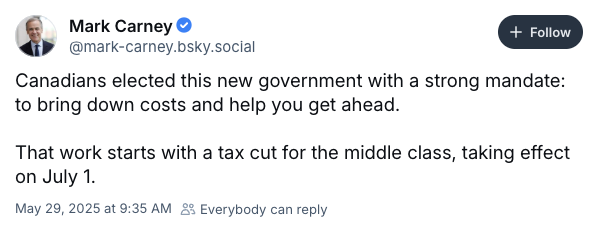
    Scared yet?  We’re just getting started.  Back on Thursday our new Prime Minister was seen to tweet:

    In other words, this government seems determined to continue in the tradition of both the former government – and the opposition parties for that matter – in framing the country’s ills as problems of costs to be solved by tax cuts and giveaways rather than problems of growth and the institutional investments required to generate it.  This way lies Peronism and perpetual stagnation. 

    And this is from our allegedly “serious” party.

    So, takeaway number one.  Universities need to throw away EVERYTHING in their playbooks for Government Relations.  Selling yourself as “the future” to a government that is desperately trying to reverse our economy into the 1960s is pointless.  This government and this Prime Minster Do. Not. Care.   Until they do, arguing for universities as “crucial” investments is a waste of time.  The real fight is over the shape of the Canadian economy.

    On to a more abstract point about budgeting.  One of the reasons we aren’t getting a budget before fall, despite the government just having been elected with a pretty detailed budget-ready manifesto and the Department of Finance being perfectly capable of putting together a set of Main Estimates for the House of Commons (as it showed on Thursday), is that Carney is trying to introduce a new set of rules with respect to public budgeting.  He spent part of this week insisting that he would balance the “operating budget” within three years, which sparked a lot of incredulity given that i) the economy is about to be in the tank and ii) the Liberals have ring-fenced most of the federal budget by saying they won’t touch transfers to provinces or transfers to institutions.  In theory, that means very significant cuts to program spending.  Like, say, research budgets.

    Except: there is currently no such thing as an “operating budget”.  What Carney wants to do is to exempt from the budget balance requirement anything that can be seen as “capital investment”, which means basically that the main game in Ottawa over the next few years is going to be how to get your favourite piece of spending classed as “capital” instead of “operating”.  And that’s a live issue because the definition the Liberals touted in the election campaign, to wit…

    …anything that builds an asset, held directly on the government’s own balance sheet, a company’s or another order of government’s.  This will include direct investments the government makes in machinery, equipment, land and buildings, as well as new incentives that support the formation of private capital (e.g. patents, plan and technology) or which meaningful raise private sector productivity.

    …is so loose you could drive a truck through it.  Will CFI spending count as capital?  Probably, but not necessarily since universities (in most provinces anyway) are neither a government nor a company.  Will tri-council spending?  Probably not, but that’s not going to stop folks claiming it supports capital formation/raises productivity, so who knows?  So, takeaway number two: get used to arguing distinctions between capital and operating because this might be the only place the sector gets traction in the next little while.

    A final point of importance is something that is not exactly new but has been given fresh salience by being in the Throne Speech, and that is the government’s commitment to limit temporary immigration – that is Temporary Foreign Workers (TFWs) plus international students – to below five percent of the population by 2027.  Or, to put it another way: every extra TFW is one international student less.  What the government has done here is set up a zero-sum game between institutions of higher education and people like the manager of the Kincardine Tim Horton’s whose business model simply cannot work if they are not allowed to employ foreign nationals at below-market rates. 

    This, my friends, is the fight post-secondary education needs to pick and needs to win.  It won’t be easy, because the captains of Canadian industry are largely clueless about competing on anything other than price, meaning low-wage labour is pretty dear to their hearts and they will fight hard for TFWs.  But it is the dilemma this country faces in a nutshell: should we use our scarce temporary immigration spots to make things cheaper in the short-term?  Or should we use them to develop a skilled workforce and build our scientific and technological talent base for the long term? 

    So, I know this won’t come easy to institutions but: screw Bay Street.  Light the torches.  Find the pitchforks.  Pick up anything you have handy and smash the windows of your local Tim Horton’s.  Fight for international students and against TFWs.  This is an existential contest: it decides whether Canada is going to be a country that gets wealthier based on investments in skills, education and science, or a country that bathes in mediocrity because we go mental if the price of a cruller goes up twenty-five cents. 

    And if the sector ducks this fight because direct confrontation with business is icky and makes some Board members uncomfortable?  Well, then the sector deserves everything it gets.  That’s the third, and most important takeaway of the last week.

    Source link

  • Provincial Budgets 2025-26 | HESA

    Provincial Budgets 2025-26 | HESA

    Ok everyone, all the provincial budgets are in and so it’s time for our annual look at what another round of irresponsible pan-partisan political leadership has wrought for our sector for the next twelve months.

    Figure 1 shows the province-by-province breakdown of this year’s budgets, showing the change in transfers to institutions in real dollars over 1 year and 5 years for each of the ten provinces. In most provinces, collecting this data is pretty easy—you just look at the Main Estimates. In Ontario it is more difficult because due to the Ministry of Finance’s crapulous incompetence, it is the one province in the country where Estimates do not appear on the day of the budget (it takes them several months to put out the detailed data; and while prior to 2018 the Ministry of Colleges and Universities was able to give out actual expenditure data on the day of the Budget, the Government no longer chooses to provide such information because shovel, manure, mushrooms, etc.). So in Ontario what you have to do is collect the previous year’s data, add the announced changes in expenditure, and then make some assumptions about the way funds are phased in (because the communications jackals who have taken over public budgeting in this province insist on phrasing spending as “$750 million over five years” to make numbers as big as possible, rather than explaining how the $750 million will be phased in on an annual basis). Which is all to say, these numbers are all pretty accurate except for Ontario, where there is a bit of a margin of error.

    Figure 1: 1-year and 5-year Changes to Budgeted Provincial Transfers to Institutions, Canada, 2025-26 Budget Year

    The one province that shows big change for 2025-26 is Prince Edward Island, which dropped a lot of money on UPEI this year in order to start a new medical school. Five other provinces (British Columbia, Alberta, Manitoba, Ontario, and Newfoundland and Labrador saw real increases (that is, increases greater than the rate of inflation) this year of between 1 and 4%. Four other provinces (Saskatchewan, Quebec, New Brunswick, and Nova Scotia) saw real declines of between 1% and 3%. Altogether, that combined nationally for real growth in provincial spending of about 0.9%.

    Over a five-year horizon, things are a bit different. The oil provinces—Alberta, Saskatchewan, and Newfoundland and Labrador—have all shown double digit declines in real expenditures (19%, 11%, and 18%, respectively), the “big two” (Quebec and Ontario) are down seven and six per cent respectively, while Nova Scotia and New Brunswick are down eight and two percent respectively. The only provinces that are up are Manitoba, where just before leaving office the Tories reversed a huge portion of their cuts of the previous eight years or so, British Columbia, which build a new med school at Simon Fraser and decided to give hefty wage increases to university and college staff (which did not, in the end, leave universities and college much better off—see Vancouver Island University for evidence), and the afore-mentioned PEI. Nationally, the drop in spending after inflation was 4%, and obviously would have been much higher without that anomalous BC result.

    So what does the overall picture look like nationally? Well, take a look at Figure 2. Basically, the picture is one of long-term stagnation.

    Figure 2: Total Budgeted Provincial Expenditures on Post-Secondary Education, 2006-07 to 2025-2025, in Billions of Constant 2025 dollars

    I suppose I should also update some charts I first made available earlier this year, looking at expenditures on post-secondary education as a percentage of total government expenditures, which I do below in Figure 3. Across the country, these percentages are down a long way over the past fifteen years, particularly in Alberta, which has gone from being by far the biggest spender in 2008 to being below the national average now.

    Figure 3: Budgeted Provincial Expenditures on Post-Secondary Education as a Percentage of Total Budgeted Provincial Expenditures, Canada and selected provinces, 2006-07 to 2025-26.

    Now, your brain might be whirring a bit trying to would out how Figures 2 and 3 can both be true. Overall spending is down only gently, but PSE expenditures as a percentage are crashing? It’s easy to explain, but not intuitive if you believe all the left-wing CBC nonsense about how governments are in austerity mode. This is nonsense: Canadian provincial governments are absolutely NOT in austerity mode. In most provinces, overall spending is wayyy up. It’s just that they are not choosing to spend any of that on postsecondary education. Since COVID, overall government expenditure is up 20% after inflation; since 2008-09, when post-secondary education peaked as a percentage of total expenditures, it’s up 59% after inflation.

    Figure 4: Real Change in Total Provincial Expenditures vs. Provincial Expenditures on Post-Secondary Education 2006-07 to 2025-26 (2006-07 = 100)

    Got it? Provinces are still spending. They just aren’t spending on postsecondary education.

    Anyways, just to finish things off, figure 5 shows changes in overall provincial spending on student assistance programs. It’s up a bit this year mainly because of Ontario. Unclear why there has been a rise, though I suspect it has something to do with the ongoing crappiness in the youth job market (something I will get back to in a blog next week) and the need for student aid to backfill.

    Figure 5: Total Budgeted Provincial Expenditures on Student Financial Assistance, Canada 2006-07 to 2025-26, in Billions of Constant 2025 Dollars

    So that’s your 2025-26 budget round up. Not as bad as some previous years but man, our sector is in a bit of a whole and just can’t get out of it. The message, as always, is: no one is coming to save us.

    Source link

  • The End of Participation Growth

    The End of Participation Growth

    One of the things that I find extremely worrying about higher education policy these days is that we’ve simply stopped talking about increasing access to the system. Oh, sure, you will hear lots of talk about affordability, that is, making the system cheaper—and hence arguments about the correct level of tuition fees—but that’s not the same. Even to the extent that these things did meaningfully affect accessibility (and it’s not at all clear that they do), no one phrases their case in terms of access anymore. We don’t care about outcomes. And I do mean no one. Not students, not governments, not institutions. They care about money, cost, all sorts of things—but actual outcomes with respect to participation rates of low-income students? At best, they are a rhetorical excuse to mask regressive spending policies which benefit the rich.

    This is a problem because it now seems as though the process of widening access, a project which began after World War II and has been proceeding for seven decades. And yet, as some recently-released Statistics Canada data shows, participation rates are now actually in decline in Canada. And it’s mainly because growth at the bottom has stalled.

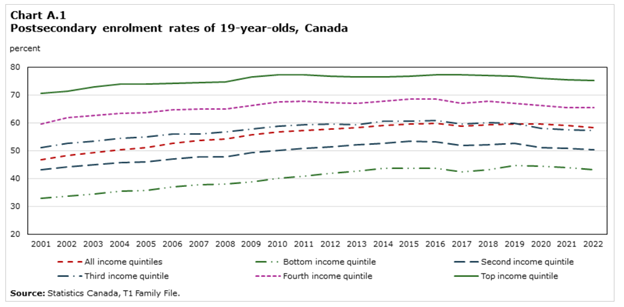
    Below is the chart StatsCan released last month. It shows the post-secondary enrolment rate for 19-year-olds, which I will henceforth refer to as the “part rate” or “participation rate,” both for the entire population (the dotted red line) and by income quintile.

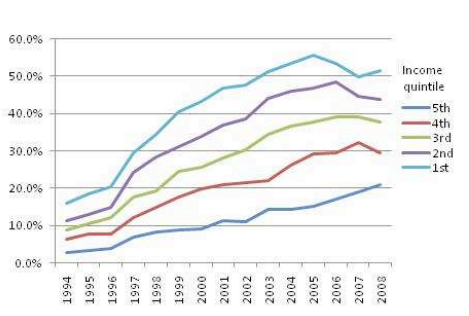
    Now, the first thing you may notice is that there are some pretty big gaps between the participation rates of youth from rich and poor families; the top quintile does not quite attend at double the rate of the lowest quintile, but it’s close. And you might be tempted to say, “Hey, I’ve taken Econ 101—That must be because of tuition fees!” Except, no. These kinds of part-rate disparities are pretty common internationally, regardless of tuition fees. Here are postsecondary enrolment rates by income quintile from the United States, which, on the whole, has higher fees than Canada:

    And here’s a similar chart from Poland, which mostly offers education tuition-free:

    And here’s one from France, where public universities are tuition-free but students are increasingly heading to the fee-paying private sector:

    I could go on, country-by-country, but I will spare you and instead point you to this rather good paper doing a cross-national analysis across over 100 countries by OISE’s Elizabeth Buckner. Trust me, it’s the same story everywhere.

    But let me point out what I think are the two important points in that chart. The first is that the red dotted line, which represents the participation rate of all 19-year-olds, basically plateaued back in about 2014, the first year it broke the 59% and is currently headed downwards. This is a huge change from the previous period, 2000-2014, when overall participation rates rose from 46% to 59%. First growth, now stagnation.

    The second is that during the growth period, the biggest strides were being made at the bottom end of the income scale. The part rate gap between top and bottom quintiles fell from 38 percentage points in the early 2000s to about 32 percentage points in 2014, even as part rates for the wealthiest quintile increased. That is to say, more of our growth came from the bottom than from the top. That’s good! But the growth stopped across all income quintiles and went gently into reverse for the top four income quintiles.

    Now, you might think that it’s not a bad thing that participation rates peaked, that maybe we were in a situation where we were overproducing postsecondary graduates, etc. Who knows, it’s possible. I don’t know of any evidence that would suggest that 57-59% of the youth population is some kind of hard maximum, but if stipulating that such a maximum exists, then it might well be in this range.

    But since it’s quite clear that this overall plateauing of participation is happening entirely by way of freezing educational inequality at substantial levels, being OK with the present situation means being OK with major inequalities, and in any democracy which wishes to remain a democracy, that’s not really OK. It is true that, as I noted earlier, disparities are the global norm, but that doesn’t mean you don’t keep up the struggle against stasis. It might be the case that there is some kind of “natural barrier” to keep the country’s PSE part rate at 57-59%, but in what world does a “natural barrier” keep those rates at 75% for rich kids and 43% for poor kids?

    Increasing access overall and narrowing rich-poor access gaps is incredibly difficult. If it were as simple as making tuition free, we’d have it licked in no time, but countries with free tuition don’t have noticeably narrower part rate gaps than those that charge fees. Achieving these gaps requires a whole suite of policies to narrow educational achievement gaps as well as financial ones, to offer young people a variety of flexible program types rather than an inflexible academic monoculture and to ensure that advice and support exist for students not lucky enough to be able to access the kinds of cultural capital available to the top quintile.

    As I say, achieving success in this area is very difficult: solutions are neither easy nor quick. But what makes the problem even more intractable is ignoring it the way we are doing right now. Are we a country that actually cares about equal opportunity? Or is that just a myth to which we genuflect when we wish to pretend to be more socially progressive than Americans? I lean towards option #2 but would be overjoyed to be proven wrong.

    Source link

  • Probably not the next Laurentian, but…..

    Probably not the next Laurentian, but…..

    As I noted yesterday, there are only two institutions in Canada which have run deficits in each of the last five years: St. Thomas University (STU) and Vancouver Island University (VIU). In both instances, these institutions have had deficits averaging between 4 and 5% of their total income over the course of those five years. By any definition, this puts them on some kind of watch list.

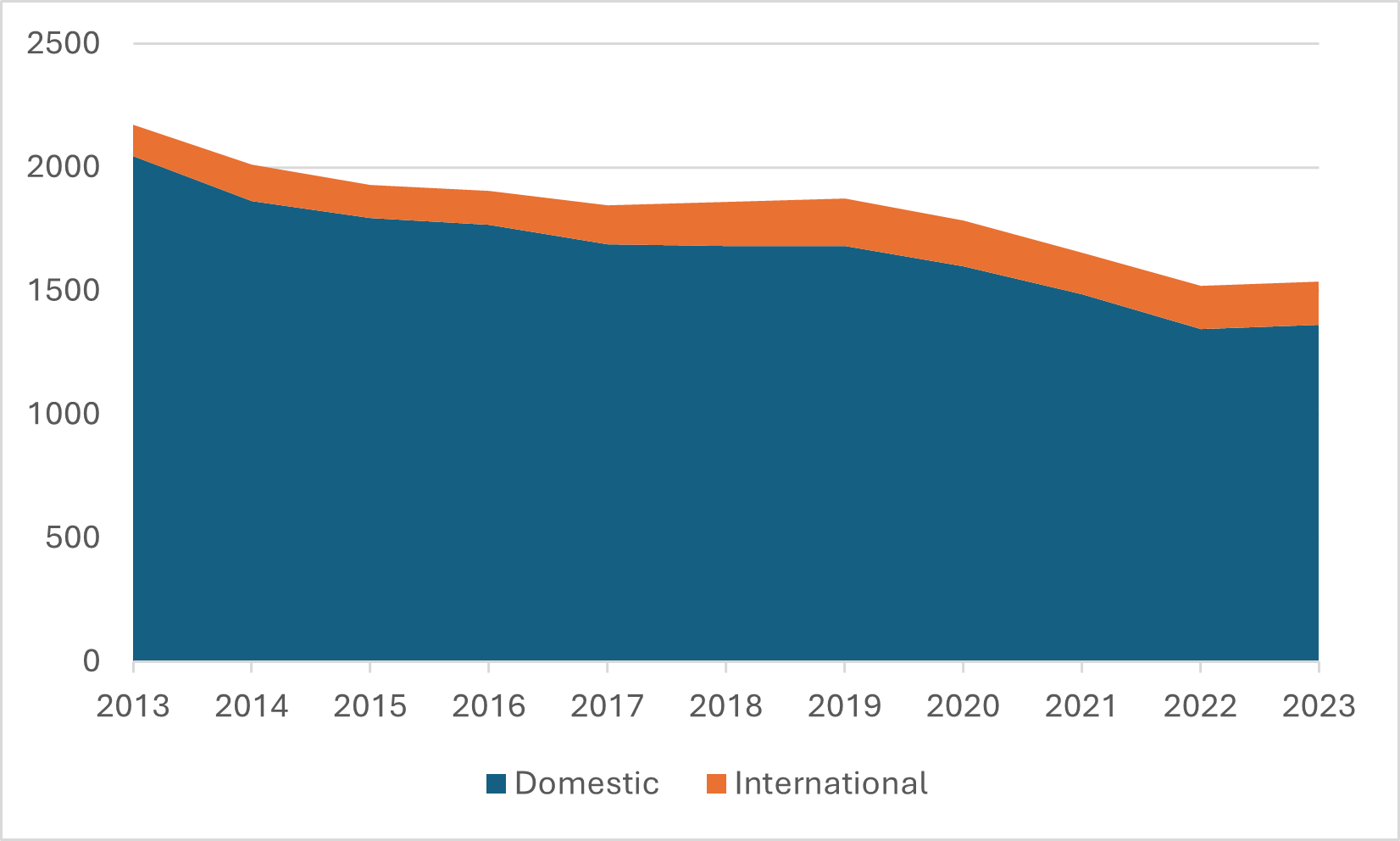
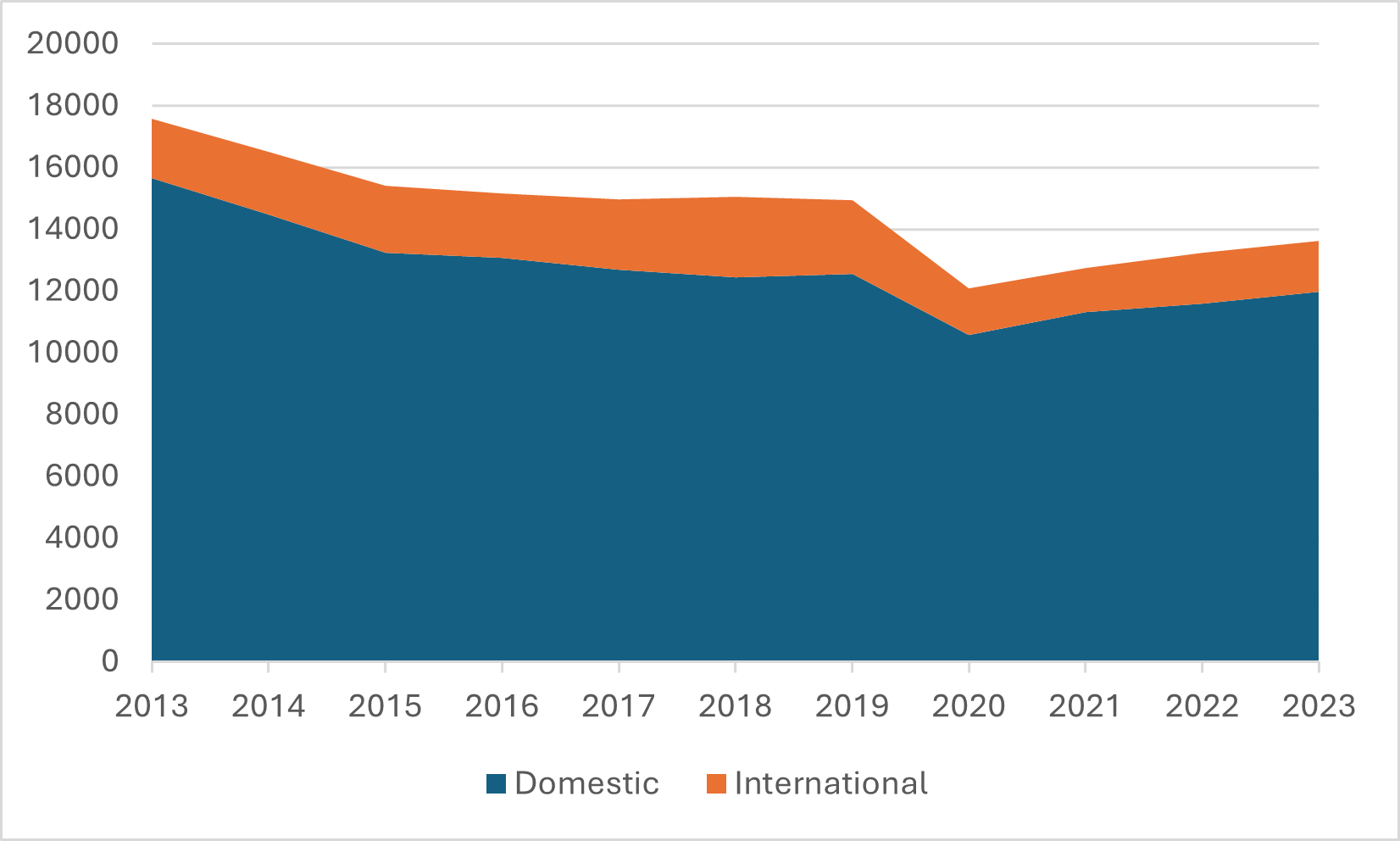
    As Figures 1 and 2 show, the root cause of both institutions’ problems is the same—namely, a big two-stage decline in enrolment. The first stage came in the early 10s, when the domestic youth population was shrinking, and the second came during Covid. The numbers are particularly bad at VIU, where the number of international students is down by over 35%. If these institutions could just get their enrolment numbers back to where they were in 2018, then STU’s tuition income would be about $3 million higher, while VIU’s would rise by roughly $20 million. In both cases, that would be enough to put the institutions well into the black. The much larger numbers at VIU are not just because it is a larger institution, but because the recent fall in student numbers is happening disproportionately on the international student side.

    Figure 1: Domestic and International Enrolment, St Thomas University, 2012-12 to 2022-23

    Figure 2: Domestic and International Enrolment, Vancouver Island University, 2012-12 to 2022-23

    At this point, folks, I am going to have to do something which some might find triggering, which is to invoke the L-word, because I am quite certain that everyone remembers the extent to which falling enrolment and a drop in tuition revenue were among the key elements in the collapse at Laurentian. I am not going to do this because I necessarily think either of these institutions is following the Laurentian path exactly. One very big dissimilarity is that neither STU nor VIU has any long-term debt, which was another of the key factors at work at Laurentian. Rather, I am doing it because I think at least some of the same dynamics are at play, particularly at VIU, which just happens to be about the same size as Laurentian in terms of enrolment and budget size, albeit without some of Laurentian’s big ambitions with respect to research. In fact, given the VIU/Laurentian similarity, I will concentrate the rest of this analysis on this west coast institution. I might come back to STU sometime, but for the moment, I will leave it aside.

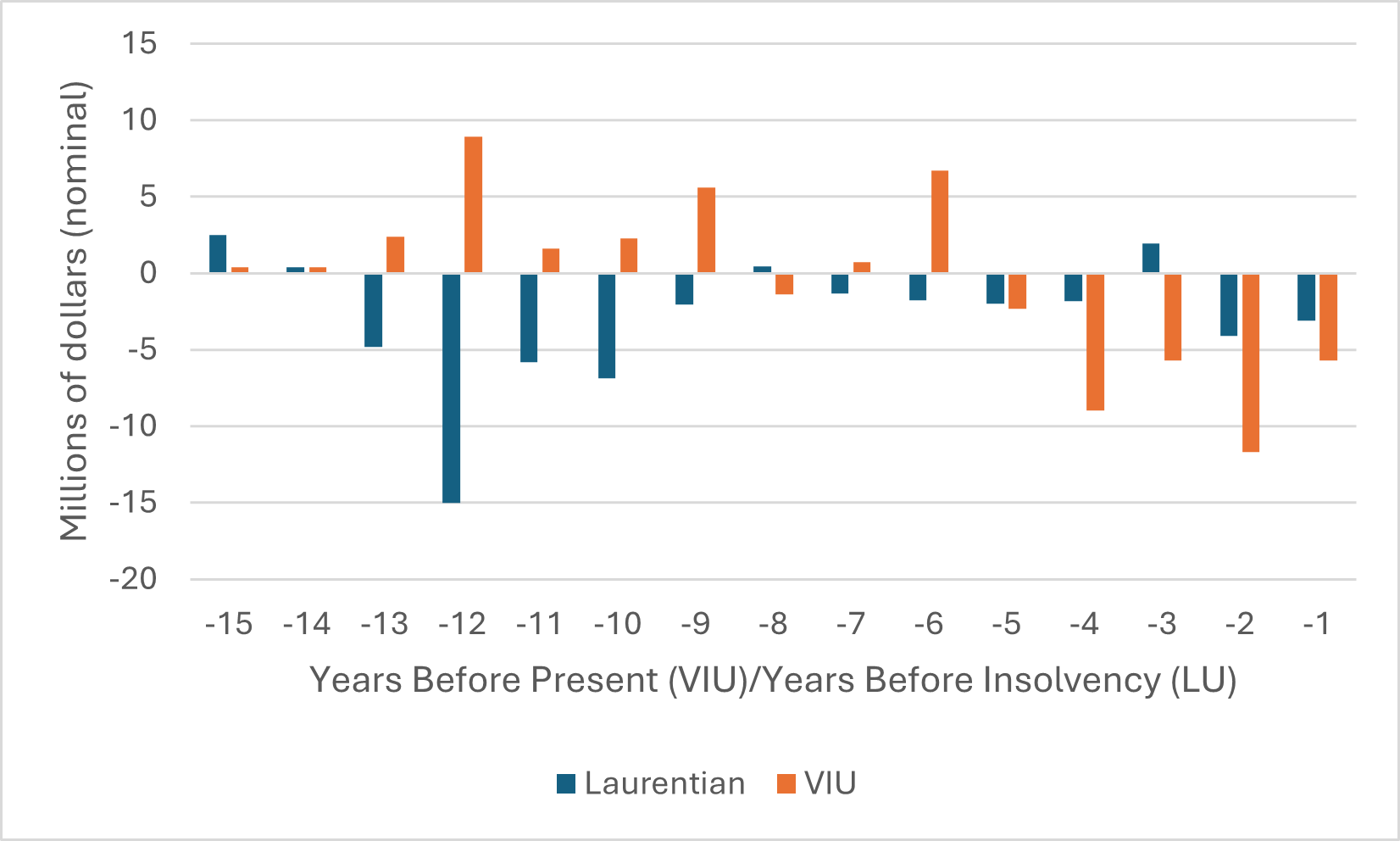
    Let’s start by looking at budget surpluses over time at VIU and Laurentian. Figure 3 shows the last fifteen years of VIU’s surpluses/deficits and compares them to the fifteen years prior to the insolvency declaration at Laurentian. Based simply on the last five years or so, there is no question that VIU is actually worse than Laurentian. The institution has spent $34 million more than it earned in the last five years; Laurentian, in contrast, was only $9 million in the red over a similar period prior to insolvency. But shift your eyes to the left of that graph for a minute, and you’ll see another difference: Laurentian ran deficits basically for most of the fifteen years prior to its events, whereas VIU was in pretty good shape. What that meant was that when the bad times started five years ago, VIU had a decent accumulated surplus to draw from. That is why the institution has been able to carry on over the past few years, but since it has now drawn down well over half of its accumulated surplus ($30.6 million in 2024, down from $78 million in 2018), that strategy doesn’t really have any more room to run.

    Figure 3: Long-term Record of Surpluses/Deficits, in Millions, Laurentian vs VIU

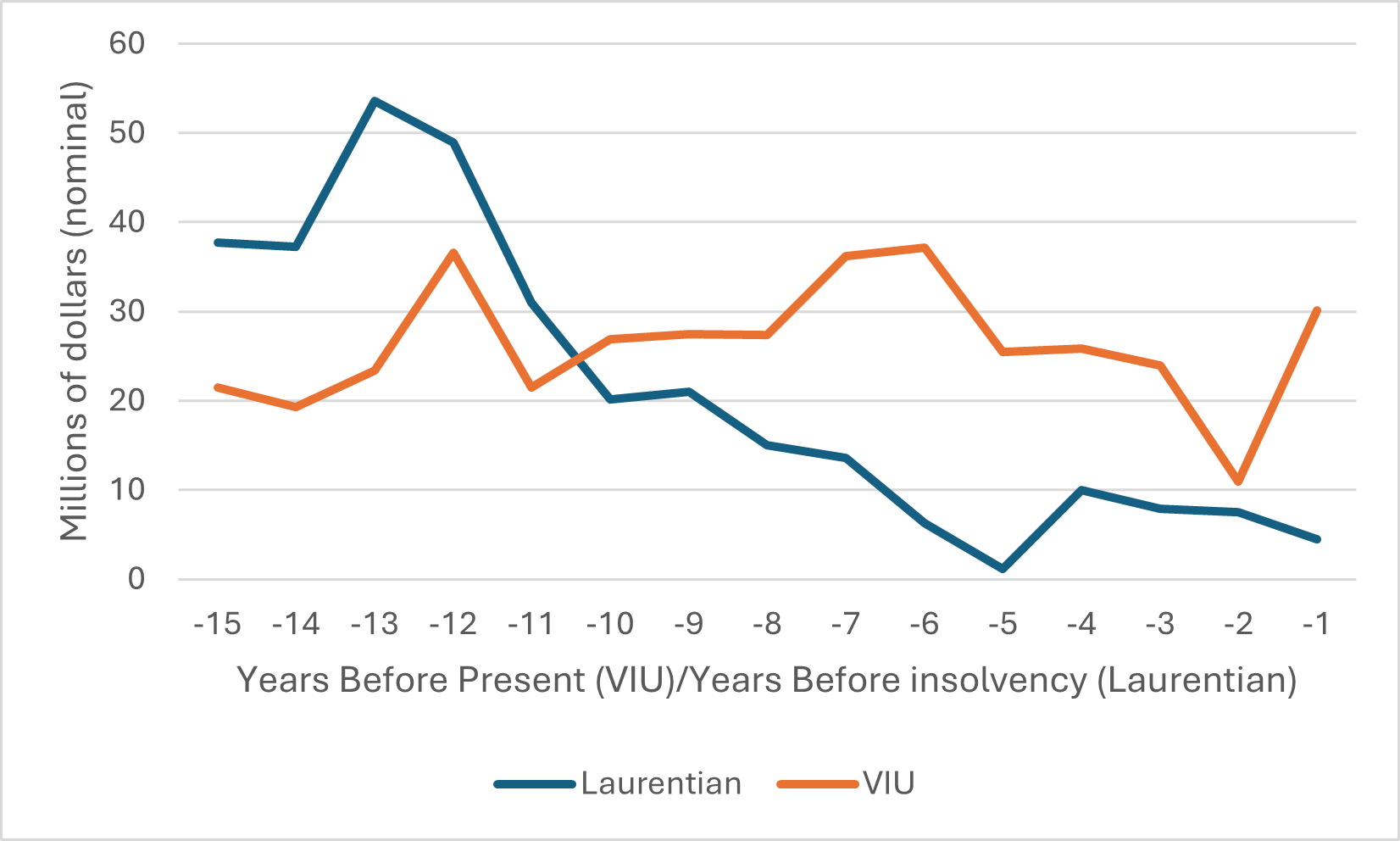
    There are also significant differences between the two institutions when you look at cash balances, as below in Figure 4. Laurentian was basically out of gas and surviving on fumes for several years prior to the collapse, with cash reserves barely enough to cover a couple of weeks of operating expenditures; VIU has never been anywhere near that point. However, note the big dip in VIU’s cash last year. It reversed itself, but only because the institution sold off a big chunk of portfolio investments precisely (I think) to boost cash reserves. There are warning signs here for sure, albeit nothing like Laurentian’s blaring klaxons.

    Figure 4: Long-term Record of Cash Position at End of Fiscal, in Millions, Laurentian vs VIU

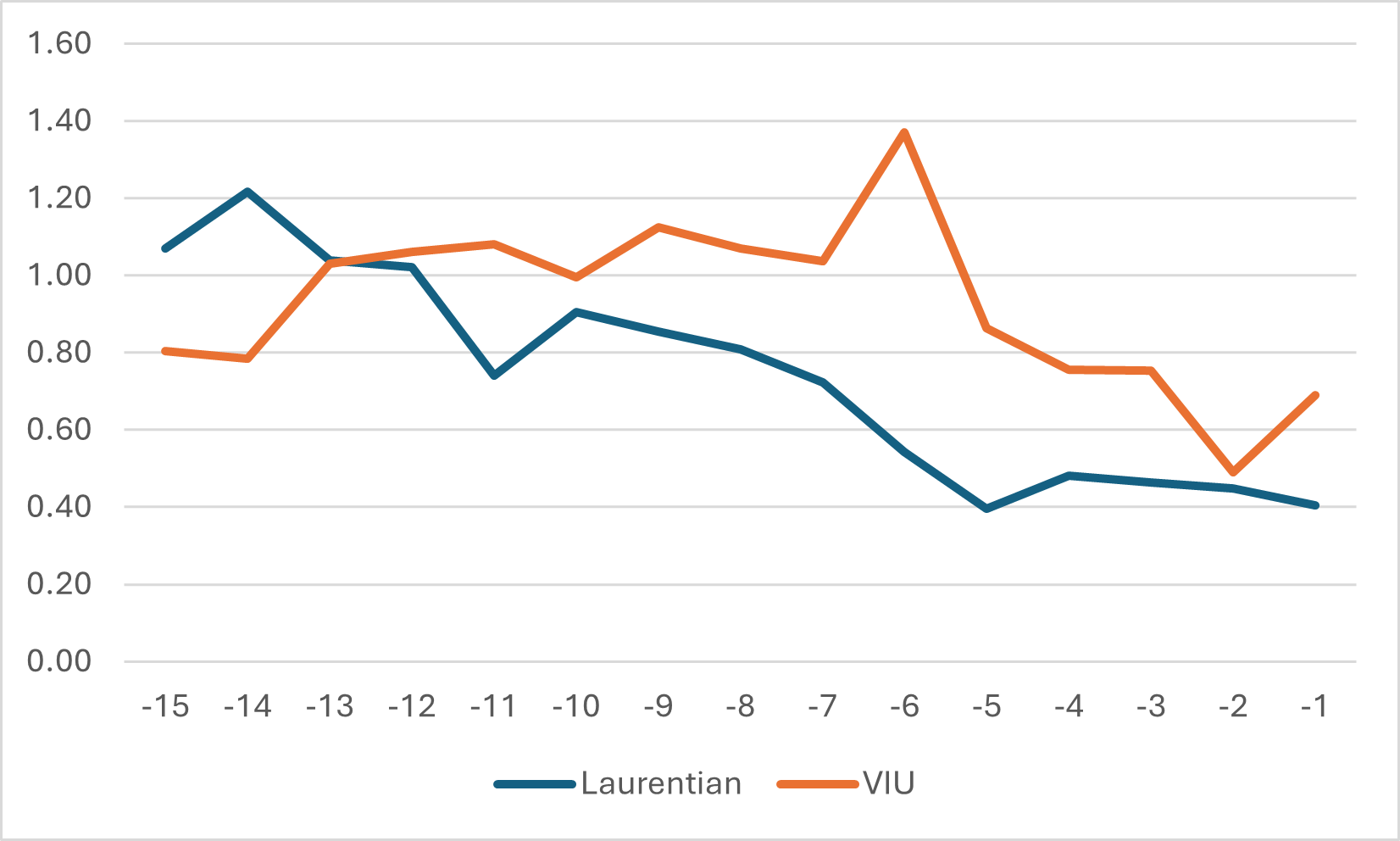
    The final comparison I want to make has to do with what is known as the “working capital ratio.” This is one of the key financial tests that the Government of Ontario uses to identify institutions in financial trouble, and it is the ratio between “current assets” (basically, cash plus accounts receivable) to current liabilities plus deferred contributions for research. Anything below a ratio of 1 puts you in the “high-risk” category.

    (Nota bene: some people think this ratio is not very useful because in a liquid market, institutions can move “long-term” investments to short-term fairly easily—as indeed VIU seems to have done last year when it sold off some of its portfolio investments in order to recharge cash reserves. However, since it’s an official government metric, it’s probably due a little respect, so I am using it here anyway.)

    One challenge in comparing VIU and Laurentian on the working capital metric is that they don’t quite calculate their liabilities identically, mainly because their respective provincial governments don’t ask them to categorize balance sheets in the same way. Specifically, VIU does not break out “current” from long-term liabilities, and also it lists substantial sums of tuition fees owed as “deferred revenue” while Laurentian does not. My read of this is therefore that to make the two sets of data on current liabilities comparable, one has to exclude from VIU’s numbers both “deferred capital contributions” and “deferred revenue”. Which is what I have done below in Figure 5.

    What Figure 5 shows is arguably similar to what Figure 3 shows: a metric in which a) neither institution looks particularly good, but b) Laurentian’s position is on the whole worse, and c) Laurentian’s deterioration is long and gradual while VIU’s is rather sharp.

    Figure 5: Long-term Record of Working Capital Ratios, Laurentian vs VIU

    To be crystal clear: I don’t think VIU is really on the verge of Laurentian-ing. It has no long-term debt. It has had a bigger cushion to fall back on. The province is on the verge of a youth boom, which should help a bit in bringing student numbers and revenues back up. It is working for a provincial government which is far more proactive than the frequently clueless one in Queen’s Park. And in fall 2023, it adopted a fairly aggressive if not especially strategic program of cost-cutting (ten percent for all units over three years), which in theory was supposed to right the ship.

    However:

    1. Even if VIU is not Laurentian, many of its key financial indicators look awfully familiar. From deficits to cash levels, to working cash ratios, it all seems very Mark Twain: history does not repeat, but it rhymes.
    2. That aggressive deficit reduction package didn’t reckon with Marc Miller, whose cuts to visas and policy of publicly crapping on the quality of Canadian institutions is likely to result in further drops in international student numbers and therefore reductions in income in the millions of dollars. There could still be problems ahead (I assume this may be what has been behind this week’s decision to consider suspending and/or cancelling roughly twenty programs at the diploma, undergraduate and graduate levels).
    3. The VIU community appears to be only dimly aware of how bad things are. When VIU President Deborah Saucier recently resigned, it was—according to CBC at least—because the VIU community would not support further cuts because they were not “supported by evidence.” Now, there may have been more to it than that (Lord knows CBC can be pretty crapulous at fact-checking post-secondary stories), but if it is anywhere near the truth, then the VIU community is clearly having some trouble facing a pretty serious reality, and that complicates any revival plan.

    Vancouver Island needs a second, flourishing undergraduate university and that can only be achieved through a strong financial base. Best wishes, therefore, to the folks at VIU as they grapple with these issues.

    Source link

  • Post-COVID University Surpluses (Deficits) | HESA

    Post-COVID University Surpluses (Deficits) | HESA

    Ok, everyone, buckle up. For I have been looking at university financial statements for 2023-24 and the previous few years, and I have Some Thoughts.

    In this exercise, I examined the financial statements from 2017-18 onwards for the 66 Canadian universities which are not federated with a larger institution and had income over $20 million. L’Université du Québec was excluded from the analysis below because it has yet to release financial statements for 2023-24.

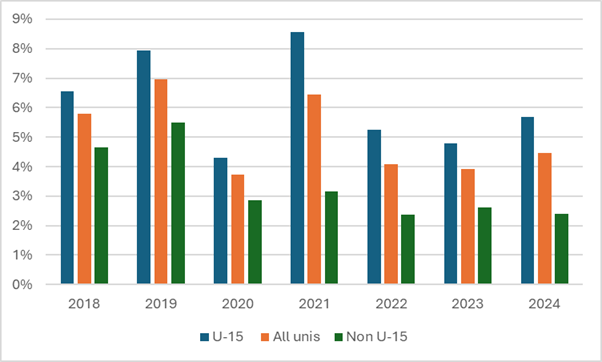
    Figure 1 shows the average net surplus (that is, total income minus total expenditures as a percentage of total income) across all institutions for the fiscal years 2017-18 to 2023-24. As is evident from the graph, fiscal years 2018 through 2021 were all pretty good, apart from 2020 (the stock market did its COVID tank right at the end of the fiscal year and radically reduced investment returns that year), and overall surpluses were in the 6% range, which is not bad. But post-COVID, things got a bit rough, and the returns dropped to about 4%. Note, though, that there is a significant gap between the “big beasts” of the Canadian university scene and everyone else. In the good years, U15 institutions, which in financial terms represent about 60% of the system, saw surpluses about two percentage points higher than non-U15 institutions. Since 2022, the gap has been about three percentage points.

    Figure 1: Average Surpluses as a Percentage of Total Income, Canadian Universities, Fiscal Years 2018 to 2024

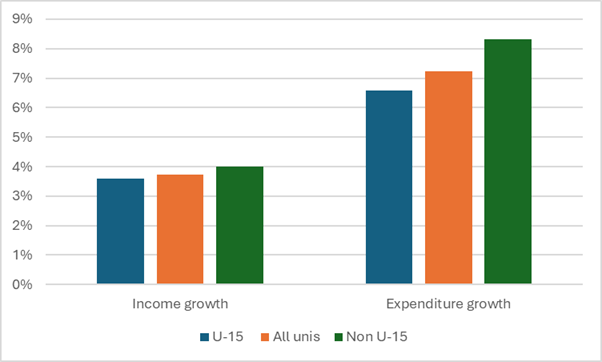
    Why have surpluses shrunk in the past few years? No surprise here: it is simply that costs have increased by about 7% in real terms for the past five years (that is about 1.4% above inflation each year), while revenues have only grown 3.7% (0.75% above inflation each year). Income growth has been pretty similar across U15 and non-U15 institutions, but expenditure growth has been significantly larger at non-U15 institutions.

    Figure 2: 5-year real change in Income and Expenditure, Canadian Universities, 2018-19 to 2023-24

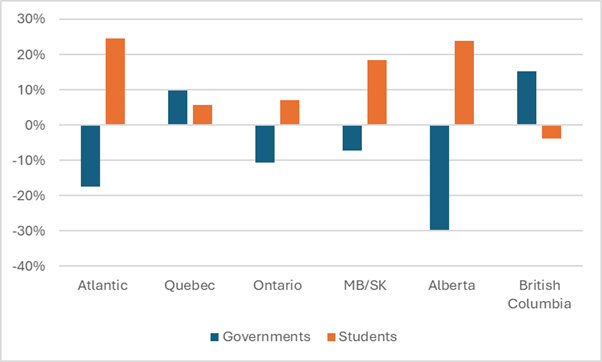
    It is worth pointing out here, though, that all of this data is from before any of the effects of the international student visa cap of 2024 come into play. In eight out of ten provinces, it has been income from students that has driven universities’ revenue growth over the past five years. Only in Quebec and British Columbia has government spending been the main driver (and yes, I know, the idea that revenue from students is declining in British Columbia was a bit shocking to me too, but I triple-checked and its true—this is the one part of the country where international student revenue was falling even before Marc Miller started swinging his axe around).

    Figure 3: 5-year real change in Income by Source and Region, Canadian Universities, 2018-19 to 2023-24

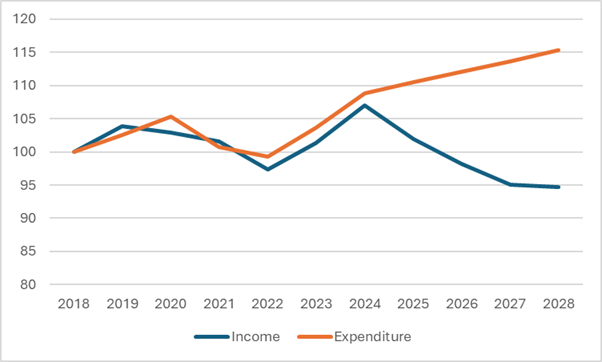
    If you assume that international student numbers overall drop by 40% over three years (which is roughly what the government says it wants to achieve), then what we are likely is a decrease of about 11% in total university revenues between now and 2027 (assuming no other changes in enrolment or tuition fees, and an annual increase in government expenditures of inflation plus 1% which is what we saw in last year’s budget cycle but I wouldn’t necessarily bet on it for the future). Meanwhile, if we keep expenditures increasing at inflation plus 1.5%, we will see an increase in expenditures of about 6% by 2028. The result is what I would call a trulyyawning financial gap over the next four years. And it is precisely this that keeps senior admins up at night.

    Figure 4: Projected changes in Income and Expenditure, Canadian Universities, 2017-18 to 2027-28, Indexed to 2017-18

    Now to be clear, I don’t expect the sector to be posting multi-billion dollar gaps implied by Figure 4 (for clarity: while Figure 4 displays changes in projected income and expenditure in index terms, if the gap that opens up between 2024 and 2028 is as depicted here, the change in net position for universities will be equal to about $7 billion in 2028, which given current surpluses of $2 billion/year implies aggregate deficits of about $5 billion/year or about 11% of total income). The income drop will probably not be quite this bad, both because I expect institutions to raise fees on international students, and because I suspect international student numbers will not fall quite this far because provinces will re-distribute spots going unused by colleges (due to the reduction in enrolments that will ensure from last fall’s changes to the post-graduate work visa program). Similarly, the increase in expenditures won’t be this high either because institutions are going to do all they can to “bend the curve” in anticipation of a fall in revenues. But bottom line: there’s a looming $5 billion income gap that has to be closed just to stay in balance, and larger if we want the system to have at least some surpluses for rainy (rainier?) days in future.

    Anyways, back to the present. We can, of course, drill down to the institutional level, too. At this point in the exercise, I have chosen to exclude two more institutions from my calculations. The first is Concordia because it has a unique (and IMHO really irritating) practice of splitting its financial reporting between the institution and its “Foundation” (don’t ask), with the result that the institution’s financial statements alone tend to show the institution as worse off than it really is. The second is Royal Roads, which uniquely took a stonking great write-down on capital investments in 2024 and so frankly looks a lot worse than I think it should.

    So with our sample now down to just 63 institutions, Table 1 shows that in fact most universities have been doing OK over the past few years. Of the institutions included in this part of the analysis, 39 have been deficit-free since 2021-22, and 28 have not shown a deficit in any of the last five years. However, there are three institutions where it might be time to start worrying: Carleton, which has posted three consecutive deficits, and St. Thomas and Vancouver Island University, which have posted deficits in each of the past five years. Carleton is a little bit less worrisome than the other two because it socked away some huge surpluses in the years prior to 2022 and so has a little bit more runway. I’ll come back to the other two in a moment.

    Years in deficit Since 2019-20 Since 2021-22
    5 2
    4 0 n/a
    3 6 3
    2 13 7
    1 16 16
    0 28 39

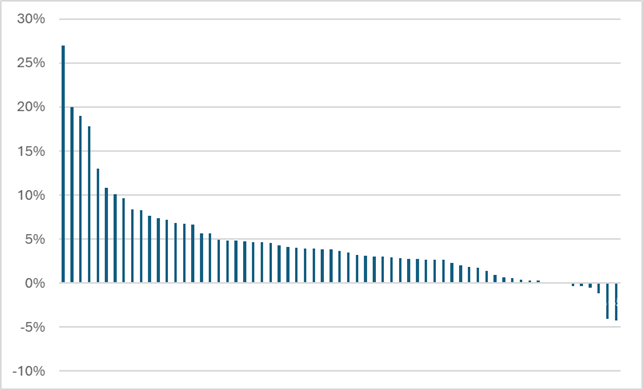
    Figure 5, below, shows combined net surplus over the past five fiscal years (2019-20 to 2023-24) as a percentage of total revenues. There are eight institutions which have net losses over the past five years, and another eight with surpluses between 0 and 2% of total revenues, which I would characterize as “precarious.” There are another 29 institutions with combined five-year surpluses, which are between 2 and 5% of total revenues, which are not great but not in the immediate danger zone either. Finally, there are 18 institutions with surpluses of 5% or more, which I would characterize as being “safe,” including two (Algoma and Cape Breton) which have five-year surplus rates of over 20% (this is what happens when your student body is 75%+ international)

    Figure 5: Distribution of 5-year aggregate net surpluses, Canadian Institutions, 2019-20 to 2020-24

    But note the right-hand side of that graph. There are two institutions that have five-year deficits equal to more than 4% of their total revenues. And those two are the same two that have posted deficits for each of the past five years: St. Thomas University in New Brunswick and Vancouver Island University in British Columbia. I’ll talk about them in a bit more depth tomorrow.

    Source link

  • Check-in on Administrative Bloat, 2025 Edition

    Check-in on Administrative Bloat, 2025 Edition

    Check-in on Administrative Bloat, 2025 Edition

    It’s been a little over five years since I took a serious dive into the question of “administrative bloat,” which apparently exists everywhere but in the statistics. Still, always good to check assumptions every once in a while, and I thought five years was long enough to make a new look at the data worthwhile. So here goes:

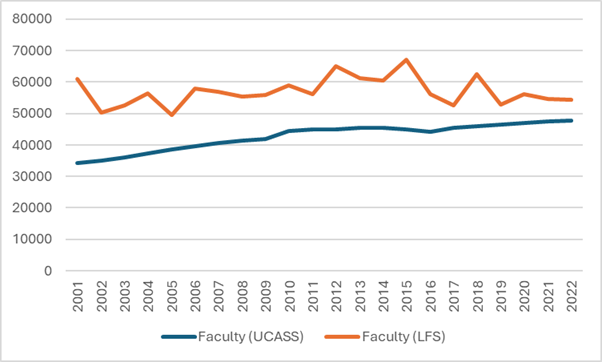
    Let’s start by reviewing what we can and cannot know about staffing at Canadian universities. StatsCan tracks the number of permanent ranked faculty pretty accurately through its University and College Academic Staff Survey (UCASS), and in a loosey-goosier fashion through the Labour Force Survey. The latter gives much higher numbers than the former, as shown below in Figure 1, which compares the number of “ranked” academics from UCASS with the number of permanent, full-time academics from the LFS.

    Figure 1 – Full-time Academic Staff Numbers According to LFS and UCASS

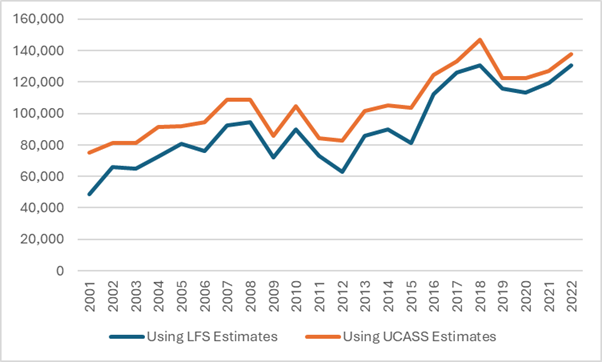
    StatsCan also tracks the total number of employees—both salaried and hourly—in the university sector using the Survey of Employment, Payroll and Hours (SEPH). However, in theory, if you subtract the number of FT academic staff from the number of total staff, you should be able to get the total number of non-academic staff, right? Well, unfortunately, this is where the discrepancy between UCASS and LFS runs into some problems. In Figure 2, I show the implied number of non-academics using both methods. The growth rates are different because of the difference in observations in the early period, but the two estimates do both converge on the observation that there are about 130,000 non-academic staff at Canadian universities, or about two and a half times the complement of academic staff.

    Figure 2 – Implied Non-Academic Staff Numbers using SEPH, LFS and UCASS

    So, that’s evidence of bloat, right? Well, maybe. Personally, what I take from Figure 2 is that either (or both) the LFS numbers and the SEPH numbers are probably flaming hot garbage. There’s simply no way that the number of non-academic staff has increased by 170% in the past twenty years, as a combination of the SEPH and LFS data suggests. For reasons that will become apparent shortly, I also have serious doubts that it’s increased by 85% either, as the combination of SPEH and UCASS suggests. Because there is a second set of data available to look at this question, one that shows expenditure on salaries, and it shows a much different picture.

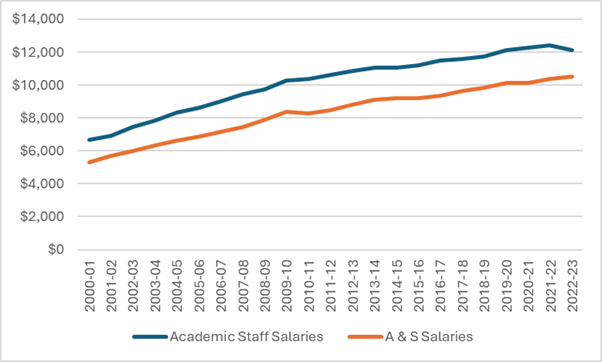
    The annual FIUC survey shows how much money is spent on wages for ranked academics as well as how much is spent on non-academics (it also shows wages for instructional staff without academic rank,” but I exclude this here for ease of analysis). Over the past three years, it is true that non-academic salary mass has risen, and academic ones have not (score for the bloat theory!), but looked at with a 25-year lens, Figure 3 shows that the rate of increase is about the same (score one against).

    Figure 3 – Total Expenditures on Salaries by Employee Group, in millions of $2023

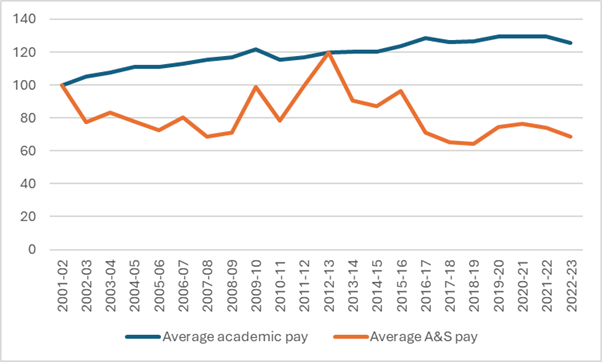
    Basically, the salary data in Figure 3 tells a completely different story than the SEPH/LFS/UCASS data in Figure 2. All you do is divide the spending data by the implied headcounts to see what I mean (which I do below). Figure 4 shows the implied change in average academic pay and average A&S pay, dividing total FIUC pay by the UCASS academic staff numbers and the A&S staff numbers implied by subtracting the UCASS numbers from the SEPH numbers, i.e., the orange line from Figure 2. To believe both sets of data, you have to believe that average academic salaries have increased substantially while average salaries for non-academics have declined substantially.

    Figure 4 – Change in Implied Average Pay, Academic Staff vs. A&S Staff, 2001-02 = 100

    In Figure 4, the blue line representing academic salaries is more or less consistent with the long-term trend in salaries we have seen by looking at salary survey data (which I last did back here): significant growth in the 00s and much slower growth thereafter. There are no staff salary surveys to use for comparison, but let’s put it this way: when people talk about “bloat” in non-academic staff positions, they normally mean it in the sense that the bloat is coming from expensive A&S staff, overpaid A&S staff, etc. For Figure 4 to be true, the growth in staff numbers would need to come almost entirely from more junior, less well-paid staff. It’s not impossible that this is true, but it’s not consistent with the general vibe about bloat, either

    So who knows, really? There’s a lot of contradictory data here, some of which argues strongly in favour of the bloat argument, but quite a bit of which points in the other direction. Better data is needed to answer this question probably isn’t forthcoming.

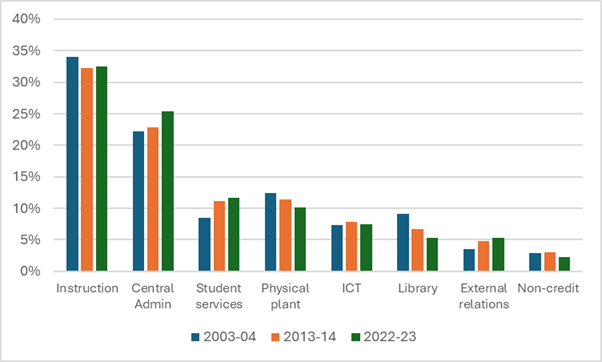
    Meanwhile, we can take one last look at A&S expenditure data. We can check to see if the pattern of A&S salary expenditures across university operating functions has changed over time. As Figure 5 shows, the answer is “a little bit.” Central Administration now takes up 25% of total A&S salary expenditures, up from 22% 20 years ago. Student services and external relations are up much more sharply in proportional terms, but since they were both starting from a low base, they don’t impact the overall numbers that much. Libraries, physical plant, and non-credit instruction are the categories losing share.

    Figure 5: Share of Total A&S Salary Mass by Function, Canadian University Operating Grants, Select Years

    And there you have it: more data than you probably needed on administrative bloat. See you back here again in 2030.

    Source link