Let’s be real — online teaching isn’t about dumping lecture notes into a learning system and calling it a day. If we want students to actually engage, grow and retain what we teach, we’ve got to meet them where they are with tools and strategies that turn passive screens into powerful learning spaces.
This is at the heart of our Spring 2025 Empowered Educator recorded webinar session, “Interactive Learning Redefined With A.I.”
During our session, we explored tools and mindsets that make all the difference, whether you’re just starting as an educator or looking to breathe new life into your virtual classroom.
Let’s talk about the “why”
We’re teaching in an era where attention spans are short, expectations are high and personalization is the norm. Students don’t just want to listen. They want to participate, problem-solve and feel seen. The combination of interactive learning andGenerative AI (GenAI) makes this not only possible, but sustainable.
Interactive learning: Real-time tools that work
Forget static slides. The key is giving students something to do, not just something to watch. Some of the most effective, real-time strategies listed in the CID Quick Tip Guide were explored during our session:
Synchronous engagement ideas:
Live polls and Q&A: Check comprehension on the fly.
Gamified quizzes (Kahoot, Mentimeter): Turn reviews into fast-paced competitions that stick.
Virtual whiteboards (like Miro or Padlet): Co-create visuals in real time.
Asynchronous options that still feel real:
Scenario-based videos and interactive PDFs help students explore at their own pace.
Gamified modules with badges or levels give students a sense of progress and motivation.
This kind of learning keeps things dynamic, allows for quick feedback and, best of all, shows students you’re in it with them.
How GenAI changes the game for personalization
Now, here’s where we level up. AI isn’t just about automation — it’s about tailoring the learning journey to meet each student where they are. In our session, we explored ways to:
Use GenAI to generate custom study guides or quizzes based on student progress, ensuring that the use of copyrighted material falls within your license or other legal parameters.
It’s like having a digital co-teacher who’s always ready to personalize.
The evidence is in
We also dove into case studies and data from real classrooms where these approaches led to:
Higher engagement and retention
More frequent participation
Better overall comprehension
Improved digital and collaborative skills
When students feel included and in control of their learning, outcomes naturally improve.
Final thoughts: Teaching that connects
In the end, this isn’t just about tools or tech. It’s about creating experiences where students feel challenged, supported and seen.
Watching this session on transforming student engagement in the online classroom will more than inspire you. You’ll learn how to:
Integrate interactive strategies with your LMS.
Engage with gamified quizzes, reflective prompts and real-time activities.
Evaluate your current engagement strategies and plan next steps.
Let’s create classrooms that aren’t just digital — but dynamic.
Written by Dr. Clevester Moten, Business Instructor at Jackson College and James Bender, Adjunct Instructor at Jackson College.
Dr. Clevester Moten is a transformative educator, scholar and thought leader whose research and work focus on equity, leadership and systemic reform. With more than 20 years of leadership spanning public, private and nonprofit sectors, he specializes in fostering collaboration and addressing societal challenges. Dr. Moten holds advanced degrees in public policy and business administration.
Watch Dr. Clevester Moten and James Bender’s recorded webinar session, “Interactive Learning Redefined with AI,” part of our Spring 2025 Empowered Educator series, to learn more about transforming student engagement in the online classroom.
As a computing professor with over 20 years of experience, I’m always searching for ways to continuously engage and motivate my students in the ever-changing educational landscape. In recent years, I’ve found that my students have a wide range of computer skill levels. I am continuously striving to ensure everyone has a positive experience. Incorporating SAM Paths in my courses has allowed me to provide both a positive and personalized learning experience for each of my students.
What is a SAM Path?
SAM Path is an adaptive learning assignment that consists of sequential combinations of exams and trainings. The three possible combinations are as follows:
Pre-Exam > Training > Post-Exam
Training > Exam
Exam > Training
Each SAM Path is customizable. An instructor can select which tasks they would like to include. There are a variety of scheduling options that allow them to tailor the SAM Path to their specific needs. These include setting time limits, randomizing questions, modifying exam scenarios and allowing multiple attempts of an exam.
How to Use SAM Path
There is no right or wrong way to use a SAM Path. You can add SAM Paths to a traditional computing course at an interval that is appropriate for your course (weekly, by unit or by module). In a non-computing course, such as data analytics, you can implement SAM Paths that meet your needs. For example, create a SAM Path with Excel tasks that students will be required to use for a data analytics exercise.
I will take this time to share how I’ve been using SAM Path. The sequential combination I prefer is Pre-Exam > Training > Post-Exam. The scheduling options I use are as follows:
A student can make one attempt on the Pre-Exam, which consists of 25 tasks.
A training is then automatically populated. This contains tasks the student answered incorrectly in the Pre-Exam. This way, they only focus on learning those specific tasks.
A Post-Exam is then automatically populated, which contains tasks the student learned how to properly complete in the training. Multiple attempts of the Post-Exam are permitted.
A student’s grade for the SAM Path is a combination of their Pre-Exam score and Post-Exam score.
SAM Path benefits for students
Students in my courses appreciate the personalized nature of SAM Paths. It allows them to work through each SAM Path at their own pace and current computer application skill-level. If a student is well-versed in a particular Office application, it allows them to complete the SAM Path quicker. It only requires them to complete training on tasks that they didn’t know how to properly complete, since they already demonstrated their knowledge in the Pre-Exam.
The Pre-Exam also provides students with a benchmark to understand what their current skill-level is with a specific Office application. Many are surprised and humbled that they’re not as well-versed in an application that they originally thought they were. This results in students becoming more engaged with the material.
Students also appreciate that they’re provided with an opportunity to learn how to complete incorrect tasks without penalty. They’re given a chance to demonstrate that they’ve achieved that skill. From an instructor perspective, I can also run a report on the Pre-Exam scores to gauge what the current skill-level of my class is, so that I can make appropriate adjustments to my lesson plan. If there was a certain task that students struggled with, I can ensure I reinforce that learning in my lesson.
SAM Path best practices
I have used SAM Paths in my courses for several years. It’s important to ensure students understand each component of the SAM path and the scheduling options that you’ve selected. An effective way that I have done this is by adding the following components to my course:
A video showing students how to access and complete each component of the SAM Path.
A SAM Path that does not count towards the students’ grade, so they can practice working through each component without penalty.
Instructions in the scheduling options window that reminds students of the number of attempts that I’ve selected for that component of the SAM Path. These instructions pop up on the screen as a friendly reminder for students.
SAM Paths have been a welcome assignment type in my educational toolkit which has resulted in motivating and engaging my students. If you are a new or experienced SAM user, I would encourage you to consider adding SAM Paths to your courses. You won’t be disappointed!
Written by Eva Turczyniak, Professor, Pilon School of Business at Sheridan College
Explore more SAM content for your computing course and check out our SAM Paths flyer for additional information on this feature.
Each year on April 22, Earth Day invites us to reflect on the beauty, complexity and fragility of our planet. It’s a time to appreciate the natural world, recognize the contributions of the environmental movement and think deeply about how we care for the planet, not just for today but for future generations.
One of the most meaningful ways we can honor that mission? Help students see and appreciate the Earth — including its landscapes, features, wonders and history — in new ways.
Virtual Field Trips in MindTap, an immersive feature for earth sciences courses, provide a unique opportunity for students to do just that.
Inspiring a deeper connection to our planet
Virtual Field Trips takes students on an unforgettable journey to some of the most iconic and geologically significant places across the United States. No travel required!
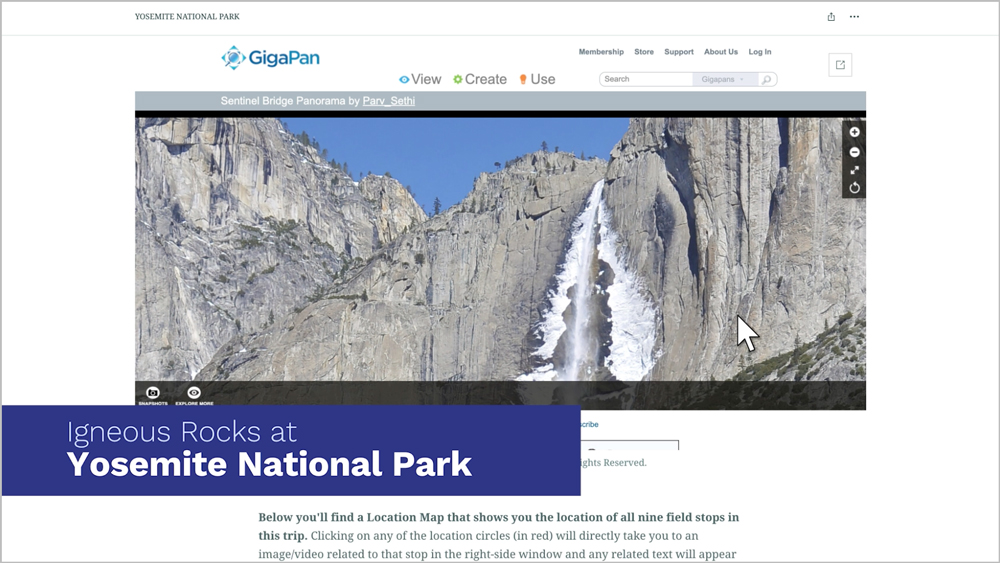
Through vivid imagery and animation, expert commentary and interactive moments of discovery, students can zoom in on rock formations in striking detail and study patterns shaped over millions of years, as if they were there in-person. Along the way, they can deepen their understanding of key earth science concepts.
Oh, the places they’ll go
From towering cliffs to ancient coral reefs, students visit awe-inspiring locations that highlight the planet’s beauty and study critical earth science topics. Field trips include:
Igneous Rocks at Yosemite National Park
Volcanoes at Hawaii Volcanoes National Park
Weathering and Erosion at Arches National Park
Sedimentary Rocks at Capitol Reef National Park
Fossilization at Petrified Forest National Park
Copper Mining at Bingham Canyon
Hydrothermal Activity at Yellowstone National Park
Deserts at Death Valley National Park
Geological Time at the Grand Canyon
Depositional Coasts on the US. East Coast
Erosional Coasts on the U.S West Coast
The Hazards of Living along an Erosional Coast
Coral Reef Communities
These locations are only the beginning, with more soon to come. And they aren’t just destinations, they’re reminders of the Earth’s complexity.
Watch this video to explore this feature for earth sciences courses:
Happy Earth Day
What started as a movement to raise awareness about environmental issues has grown into a global day of action. It’s a reminder that we’re all connected, and that taking care of our planet is something we can all do — together.
This Earth Day, let’s inspire students to explore the planet in ways that deepen their understanding and spark that sense of wonder. Thank you for teaching the next generation of explorers, scientists and stewards.
Discover how you can bring the Earth into your classroom.
Online learning in high school helps students explore career pathways
For more news on online learning, visit eSN’s Digital Learning hub
We started working with an online education high school program about 10 years ago and have been expanding our use of online courses ever since. Serving about 1,100 students in grades 6-12, our school has built up its course offerings without having to add headcount. Along the way, we’ve also gained a reputation for having a wide selection of general and advanced courses for our growing student body.
More News from eSchool News
HVAC projects to improve indoor air quality. Tutoring programs for struggling students. Tuition support for young people who want to become teachers in their home communities.
Almost 3 in 5 K-12 educators (55 percent) have positive perceptions about GenAI, despite concerns and perceived risks in its adoption, according to updated data from Cengage Group’s “AI in Education” research series.
When it comes to visual creativity, AI tools let students design posters, presentations, and digital artwork effortlessly. Students can turn their ideas into professional-quality visuals, sparking creativity and innovation.
Ensuring that girls feel supported and empowered in STEM from an early age can lead to more balanced workplaces, economic growth, and groundbreaking discoveries.
In my work with middle school students, I’ve seen how critical that period of development is to students’ future success. One area of focus in a middle schooler’s development is vocabulary acquisition.
For students, the mid-year stretch is a chance to assess their learning, refine their decision-making skills, and build momentum for the opportunities ahead.
Middle school marks the transition from late childhood to early adolescence. Developmental psychologist Erik Erikson describes the transition as a shift from the Industry vs. Inferiority stage into the Identity vs. Role Confusion stage.
Art has a unique power in the ESL classroom–a magic that bridges cultures, ignites imagination, and breathes life into language. For English Language Learners (ELLs), it’s more than an expressive outlet.
In the year 2025, no one should have to be convinced that protecting data privacy matters. For education institutions, it’s really that simple of a priority–and that complicated.
Teachers are superheroes. Every day, they rise to the challenge, pouring their hearts into shaping the future. They stay late to grade papers and show up early to tutor struggling students.
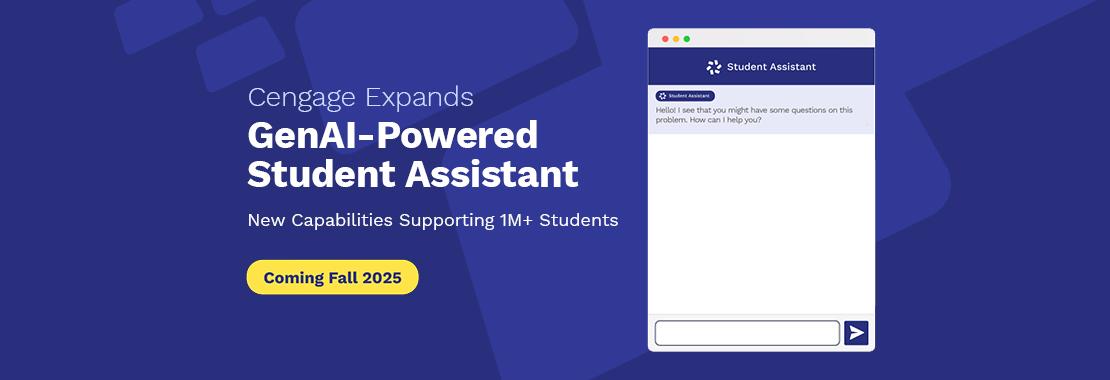
Since launching the Student Assistant in beta last year, we’ve been working with thousands of faculty and students to train it and bring a personalized learning experience to more students. So, what’s next for this GenAI-powered tool?
We’re taking it to the next level. Starting this fall 2025, the Student Assistant will become available to over 1 million students with new capabilities, including integration throughout the learning experience, course offerings across 100+ products and our new AI-powered insights dashboard.
Let’s jump in.
A quick refresher: Let us reintroduce you to the Student Assistant
Leveraging intelligent language models and Cengage-trusted content, the Student Assistant guides students through the learning process within their specific products. Currently, embedded in our online learning platform, MindTap, it provides tailored feedback to help students reach their own solutions, without giving away the answers. We want to support students to not only understand what they’re learning, but apply course concepts with confidence. That’s why this tool was purposefully trained by students and instructors, to ensure academic integrity is at the forefront.
Personalized support across learning activities
We’ve told you how the Student Assistant personalizes learning. Soon, students can experience that level of comprehensive, personalized support throughout their entire learning experience. The Student Assistant is expanding across various learning activities and can support more difficult question types. Plus, its responses will link to actual textbook chapters, images, videos and other resources. This allows students to instantly connect with their course content and understand exactly what they’re learning.
More course options equal more opportunities for students
Spanning 100+ products, the Student Assistant will be available to over 1 million students, each with their own set of unique learning needs. We’ve expanded access across our best-selling products, including “Principles of Economics” by N. Gregory Mankiw, “Anatomy & Physiology” by Dr. Liz Co, “Precalculus”by James Stewart and more. With more product offerings and platforms available, we can reach a wider range of students from a variety of key disciplines.
Allows instructors to look beyond grades with AI-powered insights dashboard
Built on real-time interactions from the Student Assistant, our new AI-powered insights dashboardis a tool instructors can utilize to support and meet students right where they’re at in the learning process. Instructors can track students’ learning patterns and increase engagement with personalized, actionable insights on everything from study habits to learning challenges and concept gaps – all before it impacts their grades.
The future of learning is looking bright
Overall, this expansion will help us create better learning experiences for more students and allow instructors like you to meet their individual needs — so you can support them in their academic journeys and create futures full of opportunity.
Want to stay posted on updates about our fall 2025 expansion and learn more about the Student Assistant for your course?
Whether today’s educators are teaching in-person, online or somewhere in between, their dedication to students has remained stronger than ever, despite rapid changes within the space. And in recent years, we’ve seen advances in technology and an increased emphasis on flexible learning environments reshape the higher ed classroom, resulting in both blended and hybrid learning models becoming more common.
Let’s explore a few common models of blended and hybrid instruction and some course materials that tailor well to this type of learning experience.
Blended and hybrid learning: a breakdown
The definitions of both terms may vary. Typically blended instructionincludes teaching with a variety of technology tools, whilehybrid instruction includes both in-person and online course sessions. These terms can apply at many levels, from specific course components (for example, a blended activity) to the broadest program or institution level, where an institution has a program with both in-person and online components.
Common models
Some of the more common models of hybrid and blended instruction include:
Flipped: Students learn new content before class and practice it in the classroom. This approach allows for multimodal content presentation online, and gives students greater control of when, where and how they access course content.
Enriched virtual: Students set the pace of their own learning and complete most of their coursework online.
Rotation: Students rotate between multiple learning modalities, one of which is online. Other modalities may include in-person instruction, group projects, individual guidance and assignments. This approach allows for students to interact with content in a variety of ways, promoting engagement.
Flex: Students direct their learning according to what works best for them among different learning modalities with an emphasis on online learning. The instructor is available for face-to-face support as needed.
A la carte/Self blend: Students choose a supplementary online course to accompany other, in-person experiences.
Depending on the model and modality, students can receive immediate feedback through computer graded activities. They can also interact with classmates in a variety of ways, such as discussion forums, online (or in-person) class sessions, group projects and multi-person online recordings, such as those available through Bongo with MindTap.
Here are a few examples of titles across disciplines like world languages, marketing, art & humanities and health care, paired with our online learning platform, MindTap, that readily translate to blended or hybrid formats.
From its inception, “Atelier: An Introductory French Program,” 2e by Kim Jansma, Margaret Ann Kassen, and Laurence Denié-Higney was designed for hybrid or flipped courses. This program includes a course manual with grammar and vocabulary presentations, readings and many interactive activities that can be assigned in class. Before coming to class, instructors can assign Learn It activities (readings and new content presentations) and Practice It activities (low-stakes, auto graded comprehension and application) in MindTap. Students and instructors then have an opportunity to discuss new content and practice applying it in open-ended and creative ways within a synchronous, in-person or virtual class.
Apply It activities (open-ended expansion) can be assigned for follow-up homework, while Got It activities close out the MindTap Learning Path sequence at the end of each chapter section, so students can verify their understanding. Alternatively, these Got It activities can be assigned as review activities at the end of the module prior to formal assessments. Evaluation can be completed during course time or virtually via online tests that accompany the program and are available through Cognero.
Blended and hybrid approaches can also work in courses that were not initially designed for hybrid instruction. For example, with “Marketing,” 21e by William M. Pride and O. C. Ferrell, students can complete the reading and subsequent Learn It comprehension activities before class. They can complete Apply It activities either before class to prepare for an upcoming discussion or after class as extension activities. Students can also use Study It materials such as flashcards and practice quizzes for review and to identify areas for improvement before a test.
In addition, this title’s MindTap contains activities that allow students to personalize their learning online, promoting self-reflection and real-world application of course concepts. For example, Why Does It Matter to Me? is a chapter-opening question that situates upcoming concepts in context and prompts students to reflect on their own knowledge and experiences. Case Activities in each chapter has students apply key concepts from the chapter to a real-world scenario, including media and reflection questions. You Make the Decision are branching-style questions where students walk through a scenario and make important, but difficult decisions. At the end of the Learning Path are comprehensive assessments of marketing analytics and Excel activities. Students review and manipulate data in Microsoft Excel to see how resulting calculations affect business decisions. The robust content in MindTap for “Marketing,” 21e facilitates a variety of blended and hybrid learning approaches by providing students with unique, personalized and authentic materials at all stages of the learning process.
With a media-rich MindTap, “Cultures and Values: A Global View of the Humanities,” 10e by Lois Fichner-Rathus provides students with the authentic primary materials they are learning about in the readings. In their eBooks, students can zoom in on images to see details such as brush strokes and lighting. They can also access authentic texts of selected literary works, listen to chapter-specific curated playlists on Spotify and watch videos through edited YouTube chapter playlists. By allowing students to view and interact with primary course content directly, hybrid and blended learning brings the materials to life while supporting flexibility and learning on the go.
While the previous examples have featured humanities and business courses, online learning is also common in workplace skills course such as medical coding and billing. Programs like “Understanding ICD-10-CM and ICD-10-PCS: A Worktext – 2025” 10eby Mary Jo Bowie provide a variety of comprehension and application-based activities, real-life case studies and review materials. Plus, it includes the Official Guidelines for Coding and Reporting for both ICD-10-CM and ICD-10-PCS. As a result, students can complete readings, study using PowerPoints and flashcards and gain vital practice with coding in preparation for the certification exam. Students appreciate the flexibility and independence that blended and hybrid learning offers, while gaining valuable preparation for certification.
The takeaways
Many forms of blended and hybrid learning – from flipped classrooms to fully-online, self-led courses – are common in higher education today. By providing a variety of robust online content, courses can offer students flexibility, authenticity and personalized learning to boost engagement and prepare them for their studies and future careers.
Check out these resources that support different types of learning models:
The rapid advancements in generative artificial intelligence (GenAI) are reshaping education, offering innovative tools for content creation, adaptive learning, and instructional strategies. GenAI models, such as ChatGPT, assist educators by generating structured lesson plans, assessments, and multimedia content, reducing workload and enhancing efficiency. These tools also support adaptive learning by personalizing content to match students’ strengths and learning gaps, increasing engagement and knowledge retention.
However, the integration of GenAI presents ethical and legal concerns, including potential biases in AI-generated content, violation of the copyrights held by content creators and data privacy risks. Responsible use, complemented by human oversight, is essential to maintaining educational integrity. Successful applications of GenAI demonstrate its potential to expedite course development and create engaging digital learning experiences. Striking a balance between innovation and ethical considerations ensures AI enhances, rather than replaces, human-led teaching.
Content creation and lesson planning
GenAI streamlines lesson planning by allowing educators to input objectives and receive lesson plans tailored to learning goals. In fact, recent Cengage research cites lesson planning as a use-case for how teaching and learning can be supported by AI. While this functionality can save instructors valuable time and ensure their subject needs are met, it’s important to ensure that the use of copyrighted material falls within your license or other legal parameters.
Additionally, AI-generated assessments support MOOCs, or Massive Open Online Courses, by facilitating adaptive and interactive course components, bridging the gap between large-scale online instruction and personalized learning. GenAI ensures lessons cater to diverse learning styles, enhancing accessibility and retention by integrating various formats, text, video and interactive activities.
Adaptive learning and personalization
AI can help assess and target students’ individual learning needs, enhancing student motivation and academic outcomes. Real-time feedback mechanisms allow learners to self-assess progress and focus on areas needing improvement, particularly beneficial in large-scale online courses. Additionally, GenAI can help personalize study materials, such as quizzes and practice tests, ensuring students learn at their own pace while maintaining engagement. When following copyright laws, these advancements help bridge gaps in traditional online learning, where standardized content may not meet diverse student needs.
The future of AI in online education
The use of AI in asynchronous learning is revolutionizing how educators develop content. With AI-driven tools, instructors can create high-quality, interactive, and accessible video lectures without the steep learning curve of traditional production methods. As technology continues to advance, AI will play an increasingly pivotal role in shaping the future of online education.
For educators looking to simplify their lecture creation process, adopting AI tools is a game-changer. Instructors can focus more on teaching and less on technical production, ultimately providing students with a more engaging and effective learning experience.
Ethical considerations and challenges
While GenAI enhances education, ethical matters must be addressed. AI systems often rely on extensive data collection, raising privacy concerns that necessitate stringent safeguards. Moreover, biases in training data can result in skewed educational content, underscoring the need for careful dataset curation.
Another challenge is the risk of over-reliance on AI-generated materials. While AI can assist in lesson planning and content development, human oversight remains critical to ensure contextual understanding and engagement. AI-based assessment tools, though efficient, may fail to interpret nuanced student responses accurately, necessitating human intervention to maintain fairness in evaluations.
Conclusion
Collaboration between educators, policymakers, and AI developers is crucial in establishing best practices that optimize AI’s benefits while mitigating risks. A balanced approach — leveraging AI’s efficiency while preserving human oversight — can foster an equitable, innovative, and effective learning environment.
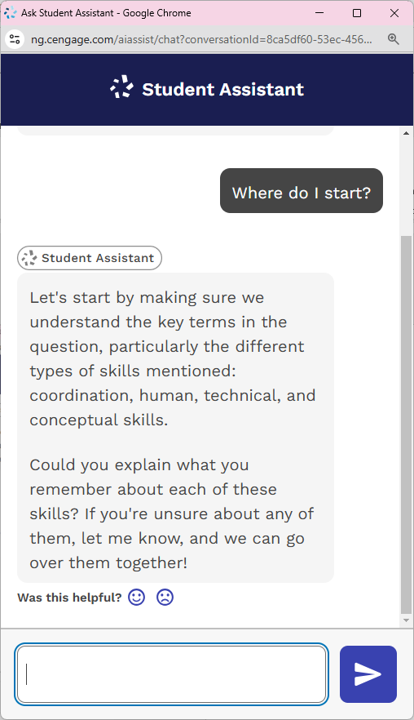
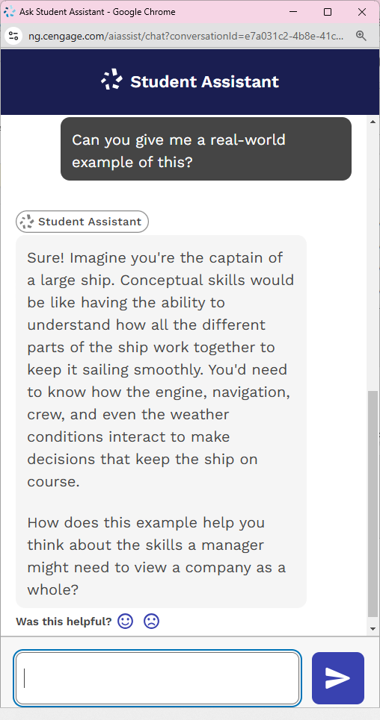
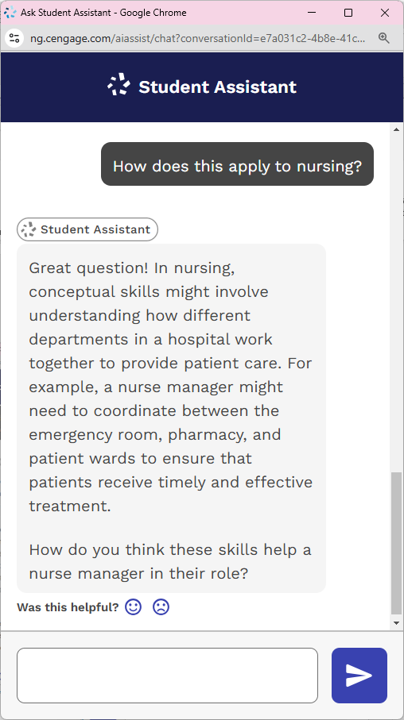
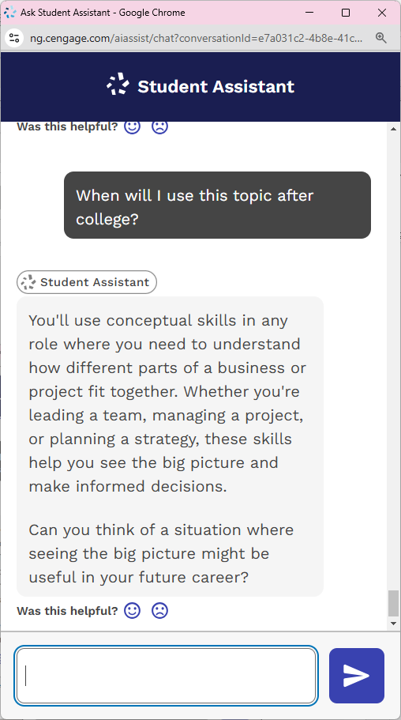
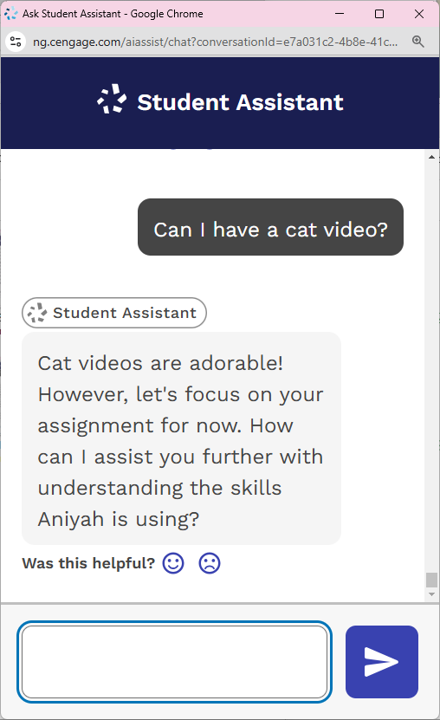
You first met our game-changingGenAI-powered Student Assistantin August 2024, and we’ve been keeping you up to date on all of the exciting developments ever since. We’ve told you how it helps personalize your students’ learning experience on a whole new level with content that’s specific to your course textbook — but now we want to show you how.
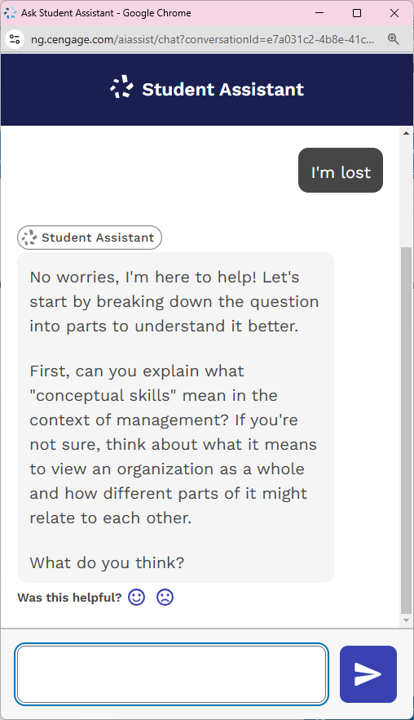
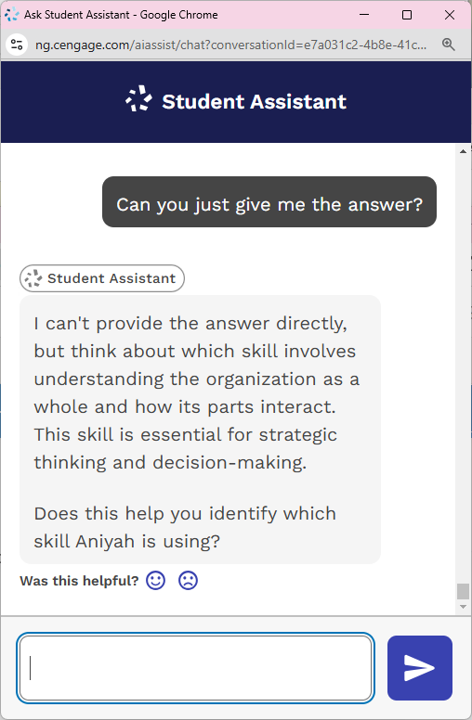
Let’s dive in and explore some visual examples of student interactions that demonstrate its full capabilities.
Points students in the right direction
Do your students ever get stuck on how to begin working on a question or topic? Using the Student Assistant, students can ask for a solid jumping-off point to get the ball rolling in the right direction. They can also ask it to clarify points of confusion, so they can successfully progress through an assignment.
Promotes critical thinking and academic integrity
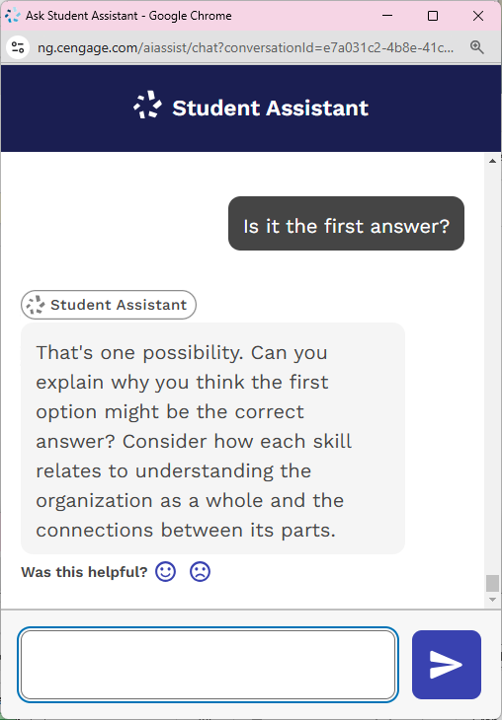
The Student Assistant guides students to help them identify the correct answer, without giving it away, promoting the development of critical thinking skills and putting emphasis on self-reliance. Students are also discouraged from simply guessing a correct answer and are asked to explain their logic behind a selection.
Simplifies complex topics
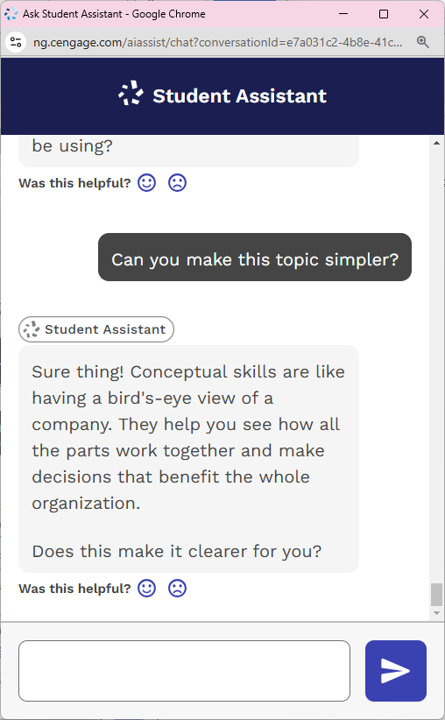
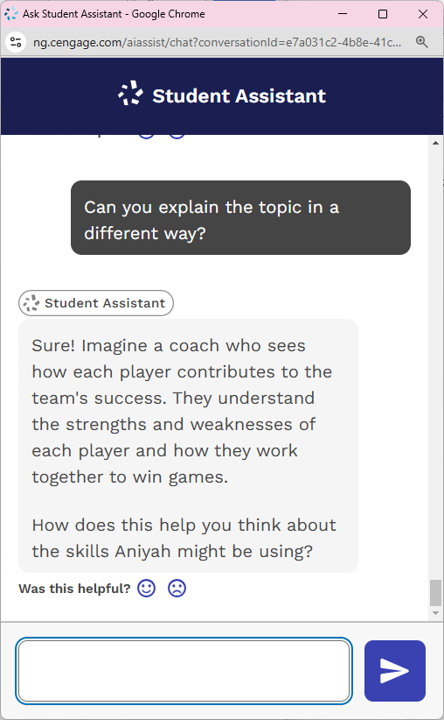
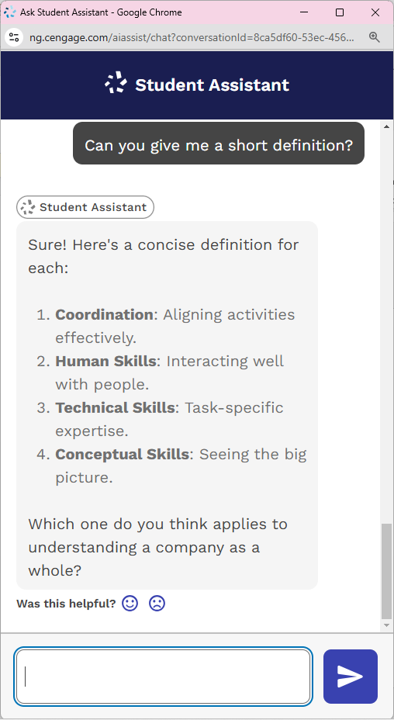
If students are struggling to comprehend what they’re learning, they can ask for topics to be elaborated on, rephrased or broken down. They can also ask for brief definitions of key terms.
Makes real-world connections
With the Student Assistant, students can ask for explanations of how topics they’re studying connect to real-world scenarios. It can generate discipline- and career-specific use-cases, helping students understand the relevancy of course content within the framework of their future careers.
Keeps students on track
Getting distracted during a task is something that can happen to the best of us, and students are no exception. If students ask to be shown external or entertaining web content, the Student Assistant will redirect and keep them focused on the assignment at hand. This tool will never provide or rely on external content.
Motivates and encourages
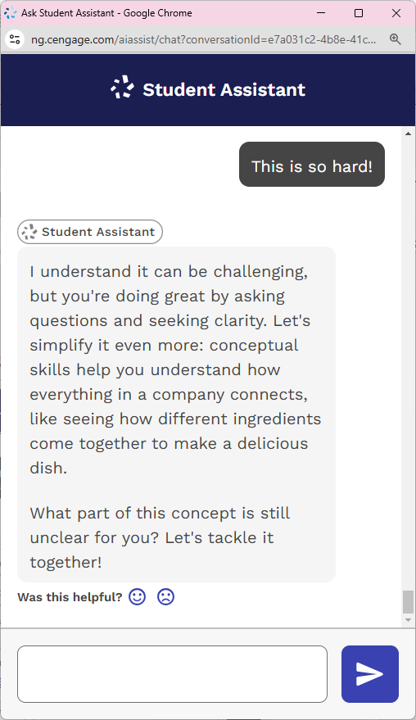
The Student Assistant lets students know that it’s okay to struggle through an assignment by encouraging them with a positive, motivational tone. With positive reassurance from the Student Assistant, students can complete assignments with confidence.
Reframes course content
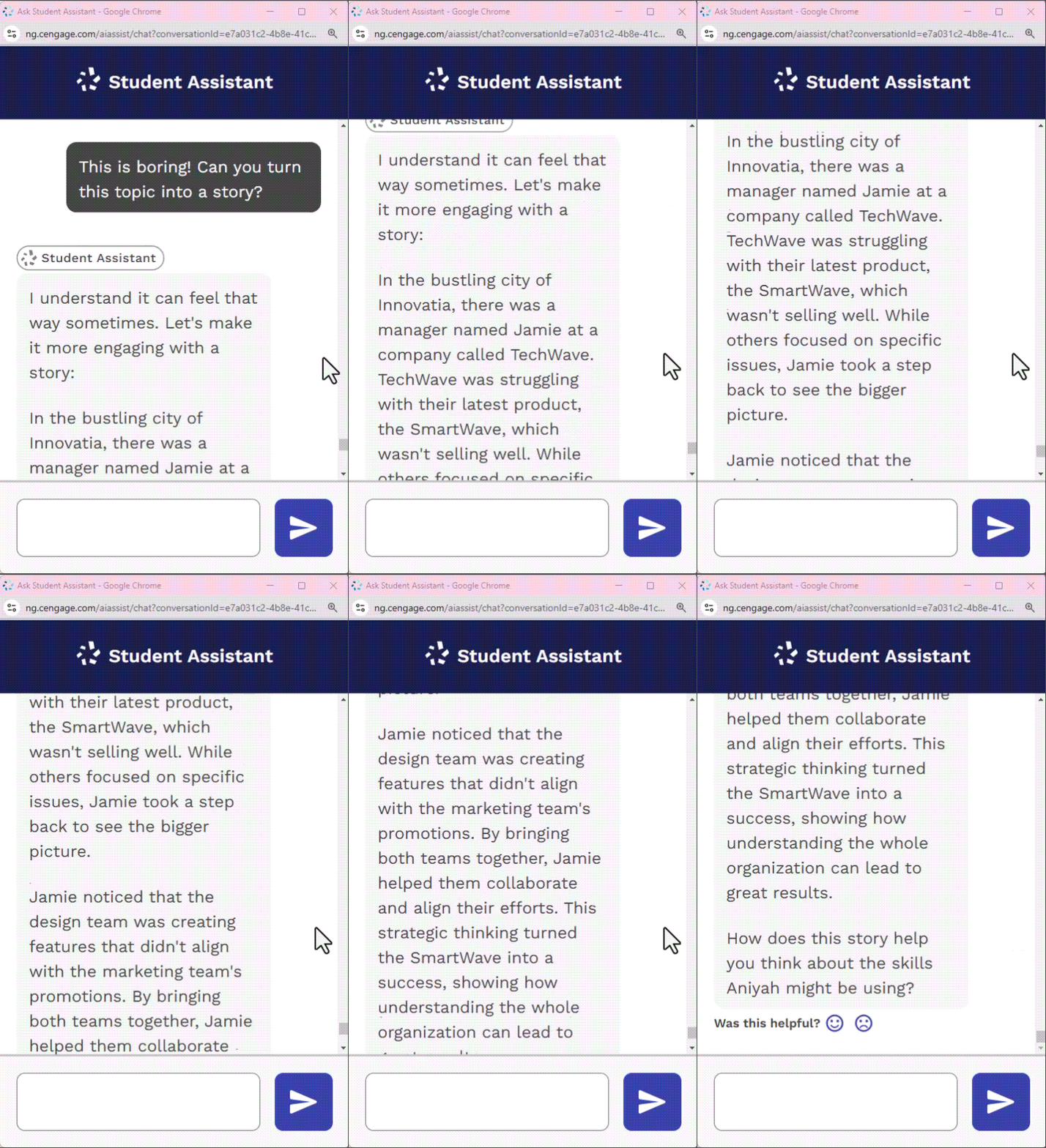
When students aren’t making personal connections with course content, it can be easy for them to lose interest in the topic altogether. Students can ask for their course topics to be turned into an engaging story, helping them key into critical themes and ideas that they may have initially overlooked.
Can’t wait to begin using the Student Assistant in your courses?
We’re gearing up for more titles to feature the Student Assistant this fall. In the meantime, you can currently explore this tool’s capabilities, its current list of titles where it’s featured and AI at Cengage.
Emma Bittner considered getting a master’s degree in public health at a nearby university, but the in-person program cost tens of thousands of dollars more than she had hoped to spend.
So she checked out master’s degrees she could pursue remotely, on her laptop, which she was sure would be much cheaper.
The price for the same degree, online, was … just as much. Or more.
“I’m, like, what makes this worth it?” said Bittner, 25, who lives in Austin, Texas. “Why does it cost that much if I don’t get meetings face-to-face with the professor or have the experience in person?”
Among the surprising answers is that colleges and universities are charging more for online education to subsidize everything else they do, online managers say. Huge sums are also going into marketing and advertising for it, documents show.
Universities and colleges “see online higher education as an opportunity to make money and use it for whatever they want to make money for,” said Kevin Carey, vice president of education and work at the left-leaning think tank New America.
Bittner’s confusion about the price is widespread. Eighty percent of Americans think online learning after high school should cost less than in-person programs, according to a 2024 survey of 1,705 adults by New America.
After all, technology has reduced prices in many other industries. And online courses don’t require classrooms or other physical facilities and can theoretically be taught to a much larger number of students, creating economies of scale.
While consumers complained about remote learning during the pandemic, online enrollment has been rising faster than was projected before Covid hit.
Yet 83 percent of online programs in higher education cost students as much as or more than the in-person versions, an annual survey of campus chief online learning officers finds. About a quarter of universities and colleges even tack on an additional “distance learning fee,” that survey found.
In addition to using the income from their online divisions to help pay for the other things they do, universities say they have had to pay more than they anticipated on advising and support for online students, who get worse results, on average, than their in-person counterparts.
Bringing down the price of a degree “was certainly a key part of the appeal” when online higher education began, said Richard Garrett, co-director of that survey of online education managers and chief research officer at Eduventures, an arm of the higher education technology consulting company Encoura.
“Online was going to be disruptive. It was supposed to widen access. And it would reduce the price,” said Garrett. “But it hasn’t played out that way.”
Related: Interested in more news about colleges and universities? Subscribe to our free biweekly higher education newsletter.
Today, online instruction for in-state students at four-year public universities costs $341 a credit, the independent Education Data Initiative finds — more than the average $325 a credit for face-to-face tuition. That adds up to about $41,000 for a degree online, compared to about $39,000 in tuition for a degree obtained in person.
Two-thirds of private four-year universities and colleges with online programs charge more for them than for their face-to-face classes, according to the survey of online managers. The average tuition for online learning at private universities and colleges comes to $516 per credit.
And community colleges, which collectively enroll the largest number of students who learn entirely online, charge them the same as or more than their in-person counterparts in 100 percent of cases, the survey of online officers found (though Garrett said that’s likely because community college tuition overall is already comparatively low).
Social media is riddled with angry comments about this. A typical post: “Can someone please explain to me why taking a course online can cost a couple $1000 more than in person?”
Online education officers respond that online programs face steep startup costs and need expensive technology specialists and infrastructure. In a separate survey of faculty by the consulting firm Ithaka S+R, 80 percent said it took them as much time, or more, to plan and develop online courses as it did in-person ones because of the need to incorporate new kinds of technology.
Online programs also need to provide faculty who are available for office hours, online advisors and other resources exclusively to support online students, who tend to be less well prepared and get worse results than their in-person counterparts. For the same reasons, many online providers have put caps on enrollment, limiting those expected economies of scale.
“You still need advisers, you still need a writing center, a tutoring center, and now you have to provide those services for students who are at a distance,” said Dylan Barth, vice president of innovation and programs at the Online Learning Consortium, which represents online education providers.
Still, 60 percent of public and more than half of private universities are taking in more money from online education than they spend on it, the online managers’ survey found. About half said they put the money back into their institutions’ general operating budgets.
Such cross subsidies have long been a part of higher education’s financial strategy, under which students in classes or fields that cost less to teach generally subsidize their counterparts in courses or disciplines that cost more. English majors subsidize their engineering classmates, for example. Big first-year lecture classes subsidize small senior seminars. Graduate students often subsidize undergrads.
“Online education is another revenue stream from a different market,” said Duha Altindag, an associate professor of economics at Auburn University who has studied online programs.
Universities “are not trying to use technology to become more efficient. They’re just layering it on top of the existing model,” said New America’s Carey, who has been a critic of some online education models.
“Public officials are not stopping them,” he said. “They’re not coming and saying, ‘Hey, we’re seeing this new opportunity to save money. These online courses could be cheaper. Make them cheaper.’ This is just a continuation of the status quo.”
Another page that online managers have borrowed from higher education’s traditional pricing playbook is that consumers often equate high prices with high quality, especially at brand-name colleges and universities.
“Market success and reputation can support higher prices,” Garrett said. It’s not what online courses cost to provide that determines the price, in other words, but how much consumers are willing to pay.
With online programs competing for customers across the country, rather than for those within commuting distance of a campus or willing to relocate to one, universities and colleges are also putting huge amounts into marketing and advertising.
An example of this kind of spending was exposed in a review by the consulting firm EY of the University of Arizona Global Campus, or UAGC, which the university created by acquiring for-profit Ashford University in 2020. Obtained through a public-records request by New America, the report found that the university was paying out $11,521 in advertising and marketing for every online student it enrolled.
The online University of Maryland Global Campus committed to spending $500 million foradvertising to out-of-state students over six years, a state audit found.
“What if you took that money and translated it into lower tuition?” asked Carey.
The online University of Maryland Global Campus is spending $500 million to market and advertise to out-of-state students over six years.
While they’re paying the same as or more than their in-person counterparts, meanwhile, online students get generally poorer success rates.
Online instruction results in lower grades than face-to-face education, according to research by Altindag and colleagues at American University and the University of Southern Mississippi — though they also found that the gap is narrowing. Students online are more likely to have to withdraw from or repeat courses and less likely to graduate on time, these researchers found, which further increases the cost.
Another study, by University of Central Florida Institute of Higher Education Director Justin Ortagus, found that taking all of their courses online reduces the odds that community college students will ever graduate.
Lower-income students fare especially poorly online, that and other research shows; scholars say this is in part because many come from low-resourced public high schools or are balancing their classes with work or family responsibilities.
Students who learn entirely online at any level are less likely to have graduated within eight years than students in general, who have a 66 percent eight-year graduation rate, data from the National Center for Education Statistics shows.
Graduation rates are particularly low at for-profit universities, which enroll a quarter of the students who learn exclusively online. In the American InterContinental University System, for example, only 11 percent of students graduated within eight years after starting, federal data shows, and at the American Public University System, 44 percent. The figures are for the period ending in 2022, the most recent for which they have been widely submitted.
Several private, nonprofit universities and colleges also have comparatively lower eight-year graduation rates for students who are online only, the data shows, including Southern New Hampshire University (37 percent) and Western Governors University (52 percent).
If they do receive degrees, online-only students earn more than their entirely in-person counterparts for the first year after college, Eduventures finds — perhaps because they tend to be older than traditional-age students, researchers speculated. But that advantage disappears within four years, when in-person graduates overtake them.
For all the growth in online higher education, employers appear to remain reluctant to hire graduates of it, according to still other research conducted at the University of Louisville. That study found that applicants for jobs who listed an online as opposed to in-person degree were about half as likely to get a callback for the job.
How strongly consumers feel that online higher education should cost less than the in-person kind was evident in lawsuits brought against universities and colleges that continued to charge full tuition even after going remote during the Covid-19 pandemic.
Yet students keep signing on. For all the complaining about remote learning at the time, its momentum seems to have beenspeeded up by the pandemic, which was followed by a 12 percent increase in online enrollment above what had been projected before it hit, according to an analysis of federal data by education technology consultant Phil Hill.
Online students save on room and board costs they would face on residential campuses, and online higher education is typically more flexible than the in-person kind.
Sixty percent of campus online officers say that online sections of classes tend to fill first, and nearly half say online student numbers are outpacing in-person enrollment.
There have been some widely cited examples of online programs with dramatically lower tuition, such as a $7,000 online master’s degree in computer science at the Georgia Institute of Technology (compared to the estimated nearly $43,000 for the two-year in-person version), which has attracted thousands of students and a few copycat programs.
There are also early signs that prices for online higher education could fall. Competition is intensifying from national nonprofit providers such as Western Governors, which charges a comparatively low average $8,300per year, and Southern New Hampshire, whose undergraduate price per credit hour is a slightly lower-than-average (for online courses) $330.
Universities have started cutting their ties with for-profit middlemen, called online program managers, who take big cuts of up to 80 percent of revenues. Nearly 150 such deals were canceled or ended and not renewed in 2023, the most recent year for which the information is available, the market research firm Validated Insights reports.
Another thing that could lower prices: As more online programs go live, they no longer require high up-front investment — just periodic updating.
“It is possible to save money on downstream costs if you offer the same course over a number of years,” Ortagus said.
A student studies on her laptop. The number of college students who learn entirely online will this year surpass the number who take all their classes in person.
While that survey of online officers found a tiny decline in the proportion of universities charging more for online than in-person classes, however, the drop was statistically insignificant. And as their enrollments continue to plummet, institutions increasingly need the revenue from online programs.
Bittner, in Texas, ended up in an online master’s program in public health that was just being started by a private, nonprofit university, and was cheaper than the others she’d found.
Her day job is at the national nonprofit Young Invincibles, which pushes for reforms in higher education, health care and economic security for young Americans. And she still doesn’t understand the online pricing model.
“I’m so confused about it. Even in the program I’m in now, you don’t get the same access to stuff as an in-person student,” she said. “What are you putting into it that costs so much?”
The Hechinger Report provides in-depth, fact-based, unbiased reporting on education that is free to all readers. But that doesn’t mean it’s free to produce. Our work keeps educators and the public informed about pressing issues at schools and on campuses throughout the country. We tell the whole story, even when the details are inconvenient. Help us keep doing that.
Let’s face it: education is changing with technology. But hasn’t it always? Imagine the calligraphy teacher’s grimace at the typewriter. Math teachers and calculators, English teachers and spellcheck, history teachers and Google — instructors quickly adopted all of these tools for their own usage. The same opportunity arises with the explosion of artificial intelligence.
Personalizing asynchronous courses
Having been an online student and now leading online courses, I empathize with both sets of stakeholders. Online courses have grown with the availability of the internet and lowered home computer costs. The flexibility asynchronous courses offer is what makes them desirable. Neither party must be in a specific classroom at a particular time. This allows both to work a more convenient schedule.
The most obvious challenge for instructors is bringing value to the students in a format that lacks the personalization of the classroom setting. Emails and discussion boards don’t communicate with the same personal touch. Recording classroom lectures for a face-to-face class certainly has some merit. The online student gets to hear and watch lectures and discussions. Yet, this might not be a foreseeable solution for instructors without in-person and online sections of the same subject. Also, recorded lectures may give the online sections less time to consume the content than their in-person peers.
Recorded lecture: the challenges
Until recently, my modus operandi was recording lectures for online students. I did this in order to replicate what they would get in the classroom, albeit passively devoid of discussion. Unless these videos are reused for different semesters and classes, it still seems inefficient and strangely impersonal. The inefficiency comes from mistakes that I would have laughed off in a live course. However, they certainly became points of frustration when watching myself stumble through a word or phrase that rolled off the tongue effortlessly during the dry run. Sometimes, I didn’t realize my mic was not toggled on. This resulted in a very uneventful silent film. Or someone would interrupt. I don’t think I’ve scratched the surface of all the things that disrupted my attempts. So, I looked for alternative sources for help.
The power of AI avatars for lecture delivery
I spent some time dabbling with AI avatars and seeing the potential to adopt the technology. The avatars cross the personalization hurdle by offering lifelike renditions with mannerisms and voice. While the technology is not quite as precise as recorded video, it’s good and getting better. The students have given it positive reviews. It is undoubtedly better than some of the textbook videos I had the unfortunate task of watching in a couple of my online courses as a student.
Avatars also clear the hurdle of efficiency and frustration. Using an avatar, I no longer have to fret over interruptions or mistakes. The editing is all done in its script. I load what I want it to say, and the avatar says it. No “ums.” No coughs or sneezes to apologize for. No triple takes on the word, “anthropomorphic.” If I’m interrupted, I can save it and return to it later. This enables me to scale my efforts.
Using Google’s NotebookLM to create AI-generated podcasts
Depending on your social media algorithm, you were probably privy to people’s Spotify top stats or other creative memes of the phenomenon in early December 2024. Spotify created personal “Wrapped AI podcasts” based on AI’s interpretation of users’ listening habits throughout the year. From a marketing perspective, this is great cobranding for both Google and Spotify, but the instructor’s perspective is why I’m writing. I learned about NotebookLM at a recent conference. The real beauty is that, currently, it’s free with a Google account.
Evaluating anecdotal evidence from my courses again, the students enjoyed the podcast version of the content. Instructors can add content that they have created and own the rights to, like lecture notes, and two AI “podcasters” will discuss it.
Because it’s only audio content, students can listen to it anywhere they are with their phones. Some comments that I noted were, “Listening to it felt less like studying” and “It was easy to listen to driving in my car.” This adds another layer of content consumption for students.
Balancing AI and instructor presence
Though I offered two technologies to deliver content to students, I do so as supplements to recorded lectures and web meetings. Indeed, in this era of AI, it is easy to become enamored with or apprehensive of this technology. Our students live very digitalized lives. Versing yourself in emerging technologies while still interacting with online students in more “traditional” formats can help you keep up with the times. You can still lean on tried-and-true education delivery. I think the key is to be willing to try a new technology and ask the students what they think of it. So many educators are worried about replacement, but at this stage in technology, we need to use AI as enhancements. So many digital platforms are using it. Why not use it in online classes responsibly?
Written by Britton Legget, Assistant Professor of Marketing at McNeese State University and Cengage Faculty Partner.
Want to learn about Professor Leggett’s unique journey into his current role?