Category: Online Student Recruitment

  • 10 Creative Ideas to Stand Out

    10 Creative Ideas to Stand Out

    Reading Time: 13 minutes

    Every year, prospective students and their families attend hundreds of open days at colleges and universities around the world. These events are more than just campus tours and presentations. They’re often the first real opportunity for students to picture themselves as part of your community. With so many options available, the challenge for institutions is clear: how do you create an open day that not only informs but also inspires?

    While the essentials, like academic info sessions, tours, and welcome talks, set the foundation, the schools that stand out go further. They design experiences that feel memorable, personal, and true to their identity. With the right mix of creativity and strategy, your open day can shift from being just another stop on a student’s list to the moment they decide your institution is the right fit.

    In this post, we’ll share 10 practical strategies to elevate your open days, whether you’re planning in-person events, virtual formats, or a blend of both. Drawing on real-world examples, including some from HEM’s own portfolio, we’ll explore how you can highlight what makes your institution unique, harness technology, and add thoughtful personal touches that resonate long after the event ends.

    Struggling with enrollment?

    Our expert digital marketing services can help you attract and enroll more students!

    What Is an Open Day?

    An open day is an event hosted by a college or university to give prospective students and their families the chance to experience the campus, meet faculty and staff, and learn more about academic programs and student life. Unlike brochures or websites, open days provide a first-hand look at the atmosphere of the institution. They typically include tours of facilities, information sessions, and opportunities to speak with current students and alumni. For many students, an open day is the key moment when they decide whether a school feels like the right fit for their academic and personal goals.

    In the same vein, what are Application Days at universities? Application days are special events hosted by universities to help prospective students complete their applications on-site. These events often provide access to admissions staff who can guide applicants through the application process, answer questions about requirements, and sometimes even waive application fees.

    In many cases, students may receive an admission decision more quickly if they apply during these events, making application days both supportive and efficient for applicants.

    1. Showcase What Makes Your School Unique

    Every institution has a defining strength, whether that’s a standout program, a strong industry network, or a vibrant campus culture. Open days work best when they put that strength front and center.

    • Build around your USP: If partnerships are key, invite industry reps to host networking booths or demos. If location is a highlight, include guided tours of nearby attractions. For research-driven schools, showcase labs or projects with real impact.
    • Spotlight distinctive opportunities: Feature sessions on co-op programs, study abroad, or unique facilities like observatories or art galleries.

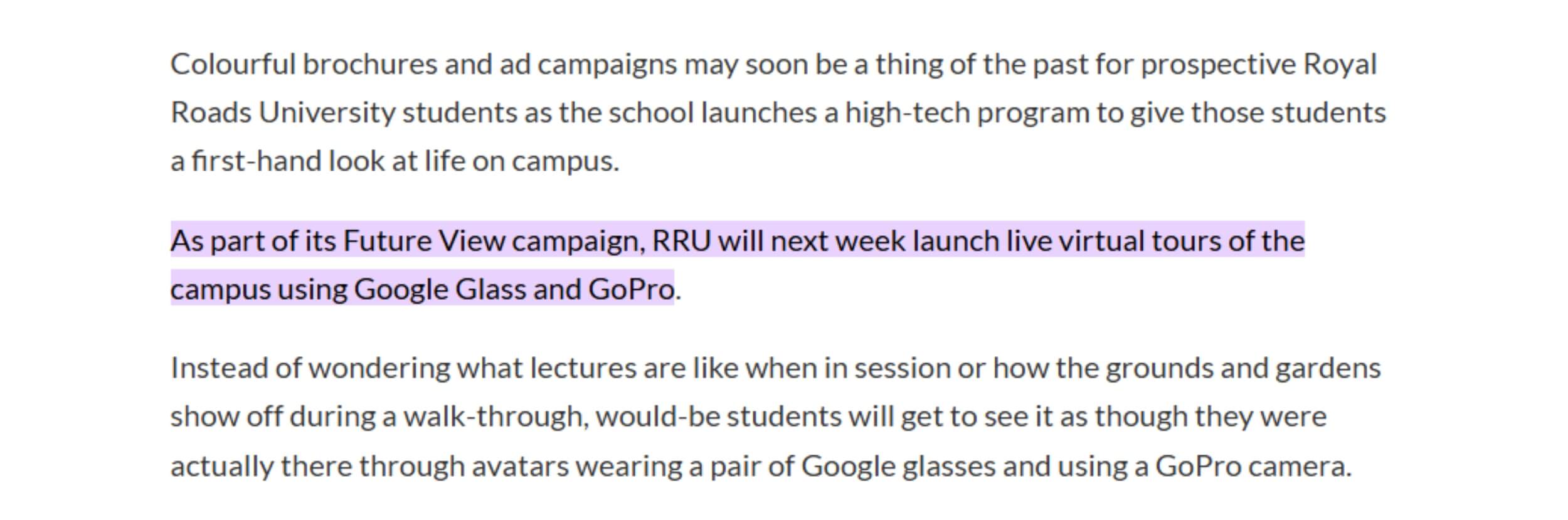
    Example: Royal Roads University: This university played to its innovative reputation with a campaign called “Future View.” Instead of relying on traditional brochures, Royal Roads launched live virtual tours of its campus and classes using GoPro cameras and Google Glass. In other words, prospects could experience campus through a student’s eyes in real time. As part of the campaign, Royal Roads representatives strapped on GoPros and Google Glass to stream lectures, walking tours, and Q&As, giving would-be students a first-hand look at life at RRU.

    HEM Image 2HEM Image 2

    Source: Times Colonist

    2. Offer Interactive and Hands-on Experiences

    Static presentations rarely capture the imagination. What sticks are experiences where prospects get to take part, experiment, and play an active role. Today’s students, especially Gen Z, respond best when an open day feels like something they can do, not just watch.

    • Classroom-style engagement: Replace long lectures with sample classes, workshops, or lab experiments where visitors actively participate, such as robotics builds or art jam sessions.
    • Campus showcase zones: Let departments display projects in interactive formats, flight simulators, artifact handling, or student performances.
    • Clubs and student life: Involve student groups with mini debates, telescope viewings, or sustainability scavenger hunts.
    • Virtual attendees: Use polls, VR tours, or guided avatars to replicate hands-on engagement online.

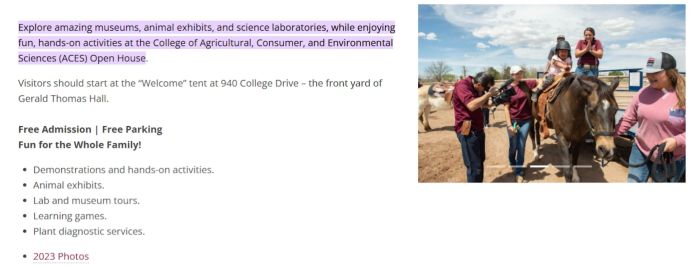
    Example: The College of ACES at NMSU turned its open house into a family-friendly interactive fair. Visitors of all ages could roam through live animal exhibits, tour science labs and museums, and try their hand at various learning games and demonstrations at each stop. From petting zoo stations with the university’s farm animals to interactive science experiments, the event engaged guests on multiple levels.

    HEM Image 3HEM Image 3

    Source: New Mexico State University

    3. Empower Your Student Ambassadors as Guides

    Your current students are among the most persuasive voices you can showcase on open day. While visitors expect polished messaging from admissions staff, what they really value are honest, relatable insights from peers who have lived the experience. Student ambassadors should therefore be central to the day, whether in person or online, acting as welcoming guides, storytellers, and role models.

    Train them with talking points, but give them freedom to share their journeys authentically, from why they chose your school to how they’ve navigated challenges. Their warmth and candor create a sense of trust that brochures and presentations can’t replicate.

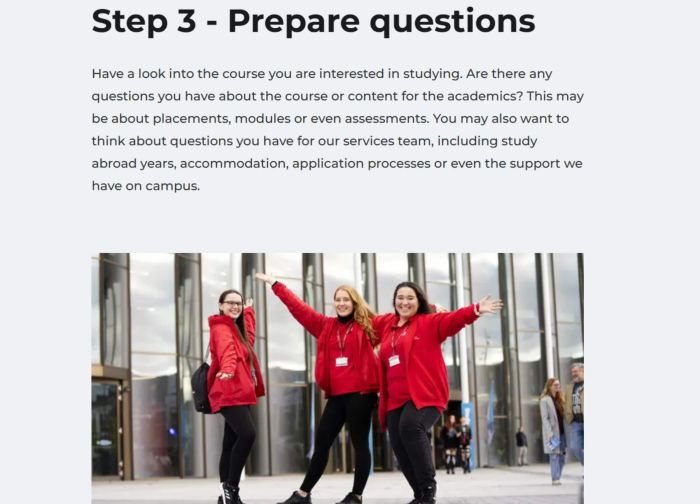
    Example: University of Central Lancashire (UK): At UCLan’s open days, current students act as official ambassadors, easily spotted in their special red UCLan hoodies. These student ambassadors are stationed at campus entrances to give a warm welcome and directions, they lead campus and accommodation tours, and they hang around after info sessions to chat. Most importantly, they share authentic insights about their courses and social life – the kind of candid student-to-student advice that visitors crave. Attendees are encouraged to approach them with any question, no matter how trivial, making the whole experience feel peer-guided and relatable.

    HEM Image 4HEM Image 4

    Source: University of Central Lancashire

    4. Involve Successful Alumni for Real-World Perspective

    Current students show the “here and now” of campus life, but alumni networks embody the long-term value of your institution. Featuring graduates in your open day event gives prospects and their parents confidence that an education with you leads to meaningful outcomes.

    Alumni panels, guest talks, or casual meet-and-greet stations can showcase diverse career paths, from industry and entrepreneurship to research and community impact. You might also pair alumni with specific program sessions. Imagine an engineering graduate now at a leading tech firm sharing how campus experiences prepared them for success. Even an “alumni corner” for informal chats helps visitors picture their own future through authentic stories.

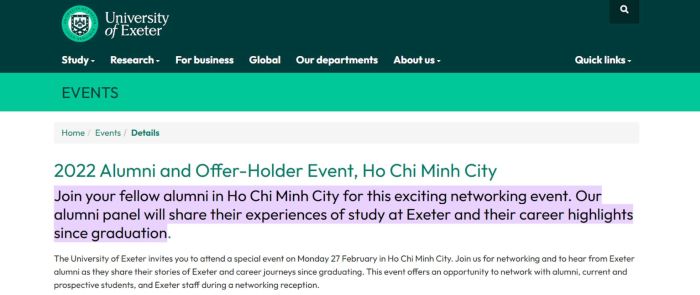
    Example: The University of Exeter organized a special alumni networking event in Ho Chi Minh City for offer-holders (admitted prospective students) and local alumni. This “Alumni and Offer-Holder” gathering (27 Feb 2023) featured an alumni panel sharing personal stories about studying at Exeter and their career achievements since graduation. Prospective students and their parents were invited to network informally with these alumni and university staff over a reception.

    HEM Image 11HEM Image 11

    Source: University of Exeter

    5. Focus On Parents’ Needs and Questions

    Parents and guardians often play a decisive role in a student’s choice, so winning them over is just as important as impressing prospects. A strong open day provides dedicated spaces and sessions tailored to their concerns.

    Consider running parent-specific info sessions while students explore elsewhere. These can cover housing, safety, tuition, financial aid, support services, and graduate outcomes, offering direct access to staff from each area. Comfortable lounges, refreshments, and a “Parent HQ” make them feel welcome and valued throughout the day. Printed or digital materials should also speak directly to their perspective, highlighting career outcomes, security measures, and student support systems.

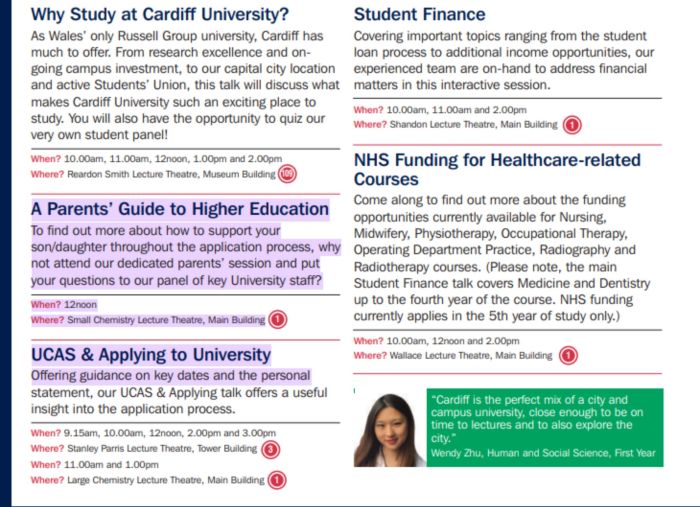
    Example: At Cardiff University’s open day, for instance, they held a dedicated session titled “A Parents’ Guide to Higher Education,” where staff walked parents through supporting their child in the application process and beyond. Parents were invited to put their questions to a panel of university experts in finance, student support, and accommodation – essentially a frank Q&A just for them. The topics ranged from tuition fees and scholarship opportunities to the quality of campus facilities. This gave parents a chance to voice any worries in a forum designed for them, separate from their teens.

    HEM Image 5HEM Image 5

    Source: Cardiff University

    6. Personalize the Open Day Experience for Visitors

    Students don’t all want the same thing from university open days, so personalization can make your event feel far more engaging. Use registration data to create tailored itineraries that reflect interests like intended major, extracurriculars, or career goals. Even simple touches, such as personalized name badges with a program of interest, help staff and ambassadors connect conversations to what matters most for each visitor.

    Flexibility is also key. Offer a “choose your own adventure” approach where attendees pick sessions that align with their priorities, whether that’s a lab tour, a faculty panel, or a sports center visit. Train ambassadors to personalize on the fly, asking about interests and adjusting tours or recommendations accordingly.

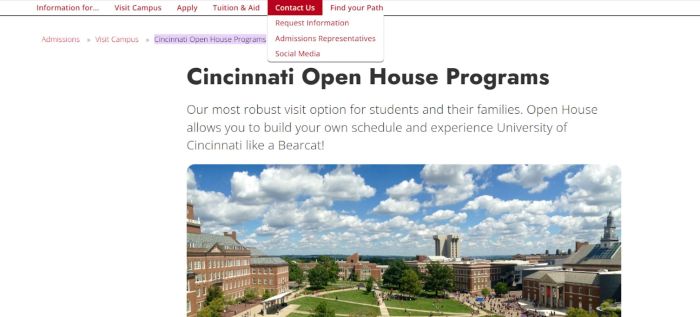
    Example: University of Cincinnati (USA): UC has embraced personalization in a big way. Their Open House events are described as “build your own schedule” experiences where each family creates a custom itinerary for the day. Upon registering for UC’s “Bearcat Open House,” students are prompted to select which academic presentations, campus tours, and special topics interest them. On the day, there isn’t a rigid tour everybody follows; instead, visitors might have a list like: 10:00 AM College of Engineering tour; 11:15 Residence hall open rooms; 1:00 PM Financial Aid Q&A; 2:00 PM Meet the Gaming Club, etc., based on what they choose.

    HEM Image 7HEM Image 7

    Source: University of Cincinnati

    7. Embrace Virtual and Hybrid Open Days to Expand Your Reach

    What is a virtual open day? A virtual open day is an online event where prospective students and their families can explore a university without visiting campus in person. Typically hosted on a digital platform, it may include live webinars with faculty, virtual campus tours, student Q&A panels, and one-on-one chats with admissions staff. The goal is to replicate the open day experience digitally, giving participants access to information, interaction, and a feel for campus life, no matter where they are in the world.

    Virtual and hybrid open days have become a staple of higher education recruitment, offering accessibility and reach that in-person events alone can’t match. A dedicated virtual event, complete with faculty webinars, student panels, and one-on-one admissions chats, can engage global audiences who might not have the time or resources to travel. Virtual campus tours, whether self-guided or live-streamed, keep your school “open” year-round and give prospects a chance to explore at their own pace.

    Hybrid formats add another layer of inclusivity. You might livestream your keynote sessions, run interactive live chats for online viewers, or capture campus highlights to share on demand afterward. Interactive elements like polls, breakout sessions, and virtual “booths” ensure remote participants remain engaged rather than passive viewers.

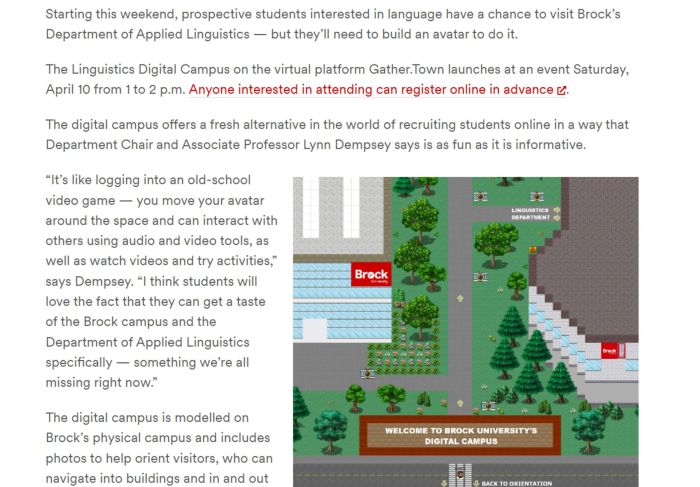
    Example: Brock University (Canada): Brock University has been an early adopter of immersive virtual open day experiences. One innovative approach they took was building an interactive online open house in a 3D virtual environment. Using a platform similar to a retro video game interface, Brock recreated key parts of its campus digitally and let prospective students log in as avatars to explore. When prospects entered this virtual campus, a simulated student guide (an avatar controlled by a Brock student or staff) would greet them and offer to lead a tour. Visitors could navigate their avatar through hallways, into classrooms and labs, and even chat when they “bumped into” other avatars representing faculty or current students.

    HEM Image 6HEM Image 6

    Source: Brock University

    8. Harness Social Media for Pre-Event Buzz and Post-Event Engagement

    A strong social media strategy can turn your open day from a single event into a shared experience that builds excitement before, during, and after. Start with a dedicated event hashtag and use it across all promotions, encouraging attendees to post their questions and experiences. 

    During the event, showcase live content: Instagram Stories, TikTok snippets, or a feed of hashtagged posts, to engage both in-person and virtual audiences. Afterward, curate user-generated content into a recap post or gallery, and follow up with a thank-you message paired with a clear call-to-action, such as “Book a chat with a student ambassador” or “Apply now.”

    Example: Lancaster University (UK): Lancaster provides a masterclass in using student-driven social media to boost recruitment events. In 2020, with in-person events off the table, Lancaster University asked its student ambassadors to create a series of fun TikTok videos as ads to generate excitement for its online open days. Instead of polished commercials, these were authentic clips following TikTok trends. Think students doing campus tours set to music, quick dorm room tours, or tongue-in-cheek “day in the life” sketches. The result? The campaign blew past expectations: over 10 million impressions and 90,000+ clicks through to Lancaster’s open day info page.

    Source TikTok

    9. Add Memorable Touches and Fun Surprises

    Sometimes it’s the little extras that transform an open day from ordinary to unforgettable. First impressions matter, so think about how your visitors are welcomed the moment they arrive. Clear signage, friendly greeters, and a thoughtful welcome pack with a campus map, schedule, and small pieces of branded swag can immediately put families at ease.

    Fun moments sprinkled throughout the day also make a difference. A student band playing in the quad, a scavenger hunt through key campus spots, or a quirky photo booth at the student life fair can lighten the mood and help prospects associate your institution with energy and creativity.

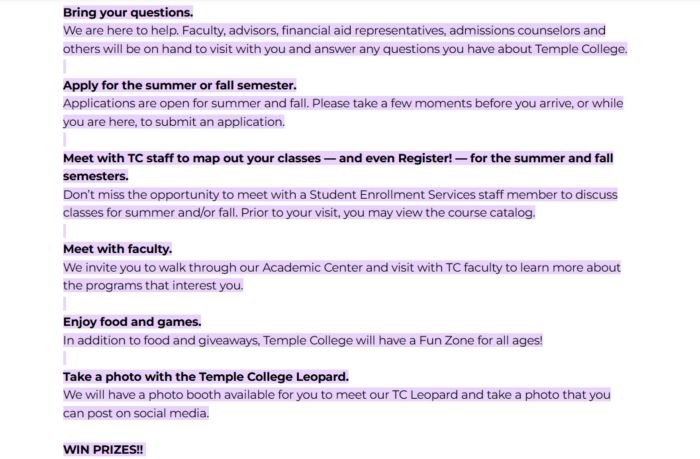
    Example: Temple College (USA): This community college in Texas put a delightful twist on their open house by setting up a photo booth with their mascot, a leopard nicknamed “TC Leopard.” Students and families could pose with the costumed mascot and snap fun pictures – a perfect keepsake to take home and share on social media. Temple College even turned it into a mini-contest where participants could win small prizes for posting their mascot photos. The result was a lot of laughter, and every family left with a tangible memory (a photo print or a digital pic) of the day.

    HEM Image 9HEM Image 9

    Source: Temple College

    These kinds of small but meaningful touches linger in memory. Long after presentations fade, visitors will remember how welcome, entertained, and cared for they felt. That emotional connection can tip the scales when it comes time for students to make their final choice.

    10. Follow Up and Continue the Conversation

    An open day doesn’t end when the last tour wraps up. In fact, some of the most important work happens afterward. A thoughtful follow-up plan not only shows prospective students and parents that you value their visit, but also keeps the momentum going as they move closer to making a decision. Too many institutions stop at a generic “thank you for coming.” By going a step further, you stand out.

    Send a prompt, personalized thank-you. Ideally, within 24-48 hours, shoot attendees an email (or even a text message, if they opted in). Make it more than just “Thanks for coming.” Use merge fields to include the student’s name and perhaps one detail from their registration or what they did. 

    For example: “Hi Alex, thank you for visiting our Open Day on Saturday! We hope you enjoyed the Biology lab tour and the sample lecture in psychology.” This level of detail shows that you noticed their presence. Then, include helpful next steps: links to apply, to book a one-on-one meeting, or to a video recap of the event.

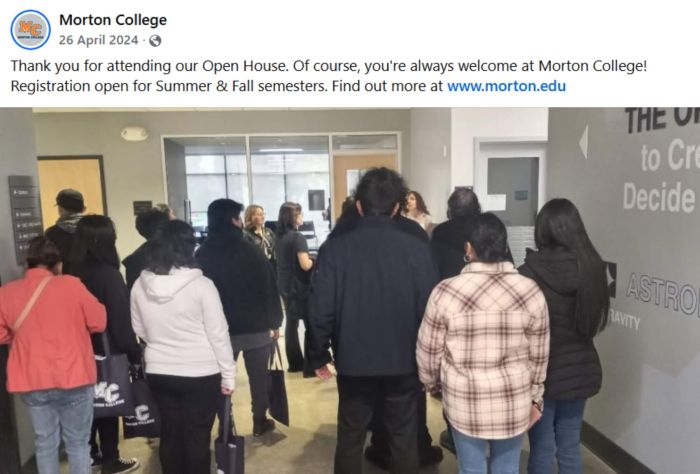
    Example: Morton College (USA): This college nailed the follow-up game. Right after their open house, Morton College rolled out a one-two punch of follow-ups. They sent out personal thank-you emails to attendees, and at the same time, they put out a public thank-you on their social media pages. Importantly, it didn’t stop at gratitude – the post also included a next step, reminding students that registration was open for the upcoming semester and providing a link to get started.

    HEM Image 10HEM Image 10

    Source: Morton College

    Strong follow-up also means nurturing interest over time. Sharing student stories, reminders about upcoming deadlines, or invitations to future events extends the relationship beyond one day. In the end, what sets your open day apart is how well you continue to guide students once they’ve left campus. 

    From Open Day to Enrollment: Your Next Step

    Open days (or open house events) are a cornerstone of student recruitment in higher education. They’re your chance to say, “Here’s who we are, here’s what makes us special, and here’s the community you could join.” By implementing these strategies, from showcasing your unique strengths, creating interactive experiences, and leveraging students/alumni, to embracing virtual formats, social media, personalization, and strong follow-up, you can elevate your open day from a routine tour into an unforgettable event that resonates with attendees long after they’ve gone home.

    Remember, the goal isn’t just to convey information, but to make prospective students feel something: excitement about an academic program, a sense of belonging on campus, confidence that your school is the right fit, or the inspiration to take the next step towards enrollment. When you make your open days stand out, you ultimately make your institution stand out in a crowded higher education market.

    Planning an exceptional open day does take effort and creativity, but the rewards are enormous. Many students cite campus visits and open days as the moment they “knew” which school was right for them. By following the approaches outlined above, you’ll increase the chances that your event is the one that wins their hearts. Good luck with your next open day event, and have fun making it one to remember!

    Struggling with enrollment?

    Our expert digital marketing services can help you attract and enroll more students!

    Frequently Asked Questions

    Question: What is an open day?

    Answer: An open day is an event hosted by a college or university to give prospective students and their families the chance to experience the campus, meet faculty and staff, and learn more about academic programs and student life.

    Question: What are Application Days at universities?

    Answer: Application days are special events hosted by universities to help prospective students complete their applications on-site.

    Question: What is a virtual open day?

    Answer: A virtual open day is an online event where prospective students and their families can explore a university without visiting campus in person. Typically hosted on a digital platform, it may include live webinars with faculty, virtual campus tours, student Q&A panels, and one-on-one chats with admissions staff.

    Source link

  • Email Marketing for Educational Institutions

    Email Marketing for Educational Institutions

    Reading Time: 13 minutes

    Email remains one of the most effective ways for colleges and universities to connect with their audiences. Unlike social platforms that limit reach through algorithms,  email marketing for educational institutions provides a direct line to prospects, parents, students, alumni, and partners, people who have already chosen to hear from you. It’s measurable from start to finish, integrates easily with CRMs and student information systems, and can be automated to deliver timely, relevant messages.

    The numbers back it up: across industries, email consistently produces one of the strongest returns on investment of any channel. In higher education, the impact is even greater when schools combine clean data with thoughtful segmentation, personalization, and creative storytelling. In practice, email often becomes the foundation of a recruitment strategy, supporting everything from initial outreach to alumni engagement.

    This guide brings together proven email marketing best practices for educational institutions. Alongside examples and trusted resources to help your team build campaigns that not only perform but also feel authentic and meaningful to the people you’re trying to reach.

    Struggling with enrollment and retention?

    Our email marketing services can help you generate more leads!

    Where Email Fits in the Student Journey

    Email plays a role at every stage of the student journey, from the first moment of discovery through to lifelong alumni engagement. What makes it so effective is its ability to deliver the right message to the right person at the right time.

    • Awareness: Introduce programs, highlight scholarships, and showcase campus life with engaging stories that spark curiosity.
    • Consideration: Share degree guides, student experiences, faculty spotlights, and invitations to virtual or in-person events.
    • Decision: Provide deadline reminders, financial aid instructions, advisor booking links, and follow-up checklists that help prospects commit with confidence.
    • Onboarding & Retention: Support new students with orientation details, academic advising reminders, wellness resources, and career services updates that strengthen their connection to your institution.
    • Alumni & Advancement: Keep graduates engaged with mentorship opportunities, continuing education offers, impact reports, and giving campaigns that showcase the value of staying involved.

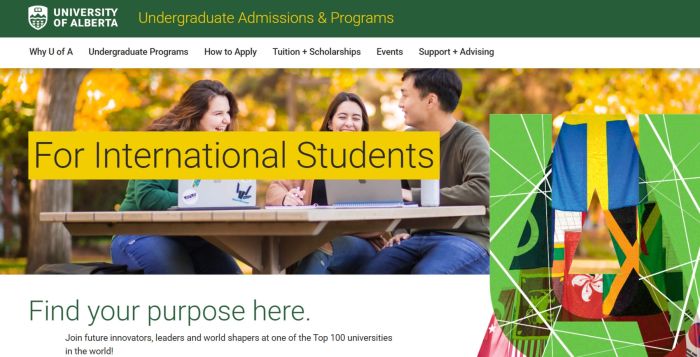
    Example in practice: The University of Alberta has built a structured email journey for international prospects, connecting them with advisors and surfacing key requirements at each stage of the process. This ensures that students receive timely, relevant information tailored to their current stage in the decision-making process.

    HEM Image 2HEM Image 2

    Source: University of Alberta

    Best Practices for Higher Education Email Marketing

    To make email marketing for educational institutions truly effective, schools need more than just frequent sends; they need strategy, structure, and respect for their audience. The best-performing campaigns are built on trust, relevance, and timing. 

    That means starting with a clean, permission-based list, segmenting by intent, and delivering value at every step of the journey. Each best practice below focuses on how colleges and universities can move beyond “batch and blast” tactics to create meaningful, high-ROI conversations with students, parents, alumni, and partners.

    1. Build a Permission-Based, High-Intent List

    The strength of your email marketing starts with the quality of your list. Buying addresses might look like a shortcut, but it usually leads to poor engagement and deliverability issues. Instead, focus on capturing leads through owned, value-driven channels. 

    Program pages with downloadable guides, open house registrations, scholarship calculators, and career snapshots are all proven ways to attract high-intent prospects. Keep sign-up forms short, just name, email, and one preference field, then use progressive profiling to enrich data over time.

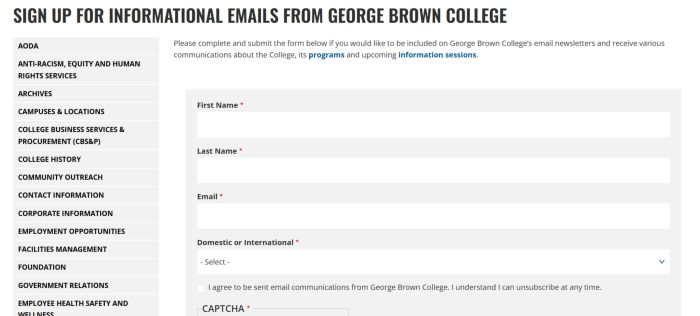
    Example: George Brown College attracts prospective students by offering downloadable program guides in exchange for email sign-ups. Because students self-select the guide they want, the college immediately knows their area of interest and can trigger tailored follow-up campaigns. This approach builds a fully permission-based list where every contact has explicitly indicated their intent, making subsequent outreach more relevant and effective.

    HEM Image 3HEM Image 3

    Source: George Brown College

    2. Segment Aggressively for Relevance

    Segmentation is the most consistent way to boost engagement and conversions in higher ed email marketing. Instead of sending broad blasts, divide your audiences by lifecycle stage, program interest, geography, or even behaviour, for example, attending a webinar or abandoning a form. This allows every recipient to receive content that feels timely and relevant. Segmentation also prevents fatigue by cutting down on irrelevant sends, which in turn protects your sender reputation and keeps unsubscribe rates low.

    How can segmentation improve the effectiveness of email marketing for higher education? Segmentation makes emails more relevant, which increases engagement. For example, international prospects segmented by country can receive updates on visas and housing, while domestic students see local funding options. Segmenting by lifecycle stage, program, and behaviour helps improve click-throughs and leads to better-qualified student interactions.

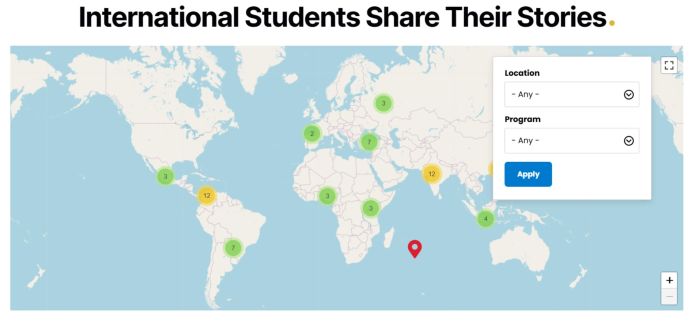
    Example: Humber College’s international portal structures content by region and need, ensuring students see information on study permits, housing options, and support services tailored to their home country. This kind of geo-segmentation can be mirrored in email journeys, for instance, sending region-specific pre-arrival checklists or visa guidance, so that communications land with stronger relevance for each subgroup of students.

    HEM Image 12HEM Image 12

    Source: Humber College

    3. Personalize Beyond the First Name

    True personalization goes deeper than inserting a first name in the subject line. In higher education, it means dynamically adjusting content blocks based on program interest, geography, or behaviour. 

    For example, prospective Nursing students should see different resources than prospective Business students. International applicants may need tuition estimates in local currency or immigration guidance. Behavioural triggers, like a reminder to finish an application, show prospects you’re paying attention to their journey.

    Why is personalization important in higher education email marketing? Personalization helps students see themselves at your institution. Tailoring emails by program, start term, or action, such as reminding them of an unfinished application, makes communication feel relevant and timely. This reduces fatigue and unsubscribes while guiding students toward conversion more effectively than generic messages.

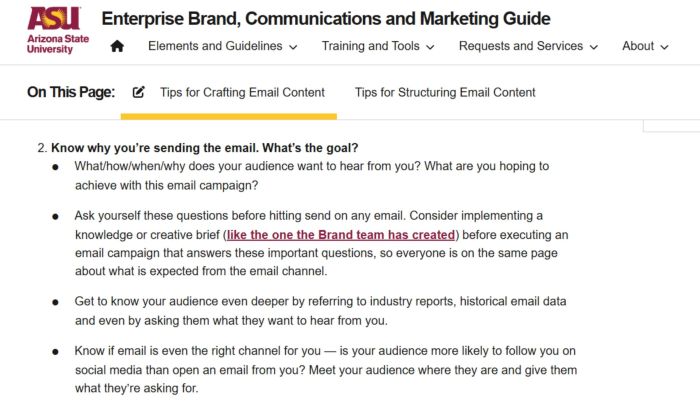
    Example: Arizona State University has invested in dynamic email content that highlights degree options, campus resources, and next-step reminders based on each student’s profile data. ASU’s own email marketing guidelines encourage the use of personalized fields and scripting for tailored messaging, ensuring that outreach feels individually relevant and helpful rather than generic.

    HEM Image 4HEM Image 4

    Source: Arizona State University

    4. Write Subject Lines and Previews That Earn the Open

    Subject lines and preview text are the most decisive factors in whether an email gets opened. In higher education, a few consistent principles stand out:

    • Clarity over cleverness: “Fall 2025 Application Deadline: Sept 30” outperforms vague teasers.
    • Specificity: call out the program or event directly (“Early Childhood Education: Virtual Info Session Tomorrow”).
    • Urgency and utility: use time-sensitive reminders, but avoid spammy tactics (“Last 48 hours for residence priority”).
    • Length: keep subject lines to 45–50 characters, and use preview text to complete the thought and front-load value.
    • Testing: run A/B tests where possible: subjects, preheaders, and sender names (e.g., “Admissions at Seneca”) are all worth experimenting with. Emoji can work sparingly for student audiences.

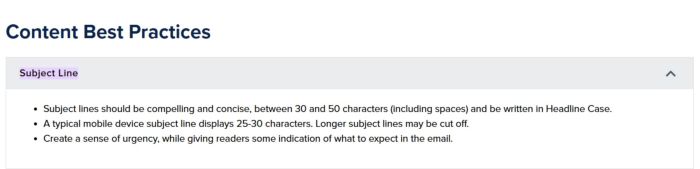
    Example: The University of Arizona’s marketing team advises keeping subject lines concise (30–50 characters) and imbued with a sense of urgency, while still indicating the email’s content. Their guidelines echo what many have found: clear, direct subject lines (often including deadlines or event details) tend to lift open rates, because recipients immediately grasp the email’s value.

    Source: The University of Arizona

    In a nutshell, what are the best practices for creating engaging subject lines in higher education email marketing? Keep subject lines clear, specific, and under 50 characters. Highlight benefits like deadlines, outcomes, or events, and use preheaders to expand the message. Test frequently with A/B experiments, and consider humanized sender names (e.g., “Admissions at [School]”) to increase open rates without relying on gimmicks.

    5. Design Mobile-First and Accessible

    Most students and parents first open emails on their phones, so mobile-first design isn’t optional. Use responsive templates, 16-pixel body text, and tappable CTAs with enough space to avoid errors. Break content into scannable blocks with headings and subheads, and avoid image-only buttons. 

    Accessibility should be built in: add alt text, maintain contrast ratios, and caption videos. Keeping one clear CTA helps prevent distraction while making the path forward obvious. Load times matter, too. Opt for system fonts, compressed images, and videos hosted externally.

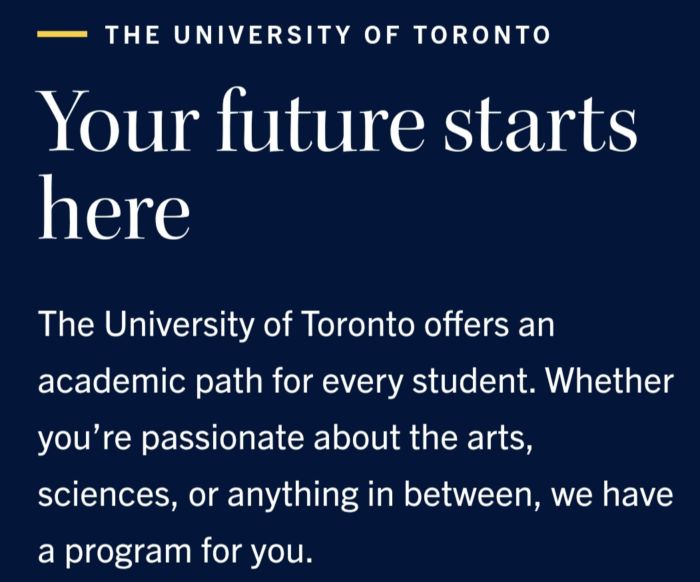
    Example: The University of Toronto’s Future Students portal provides a good model for digestible, mobile-friendly content blocks. Information is organized in concise sections and bullet points that mirror best practices for responsive email design. By structuring content for quick scanning on a small screen, U of T ensures that key messages (from program highlights to “Apply Now” links) remain prominent and actionable even on mobile devices.

    HEM Image 6HEM Image 6

    Source: University of Toronto

    6. Calibrate Timing and Frequency

    How often you email matters as much as what you send. A thoughtful cadence keeps your audience engaged without overwhelming them. Consider these practical benchmarks:

    • Prospects: 1–2 emails per week; increase frequency near application deadlines or events, then cool down.
    • Applicants/Admitted Students: Send transactional updates and personalized nudges; shield them from generic blasts.
    • Enrolled Students: A weekly digest from student affairs or the registrar is usually sufficient, plus urgent communications when needed.
    • Alumni: monthly updates with stories, impact reports, and targeted appeals tied to affinity or giving campaigns.

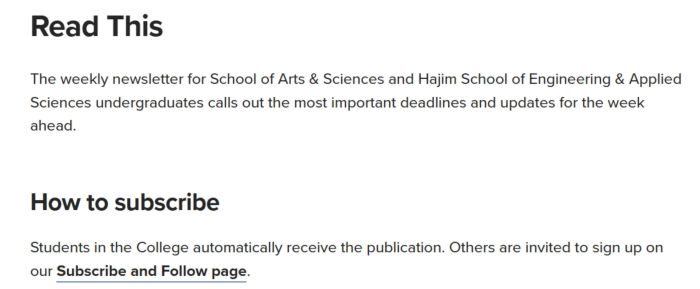
    Example: The University of Rochester balances its email frequency by audience: it sends all current students, faculty, and staff a brief daily bulletin for campus-wide announcements, but for undergraduates, it also delivers a focused weekly newsletter highlighting only the most important deadlines and updates for the coming week. This approach keeps students informed and on track (e.g., keeping current on scholarship deadlines or add/drop dates) without inundating them with multiple emails per day, illustrating how strategic timing and pacing can improve engagement.

    HEM Image 10HEM Image 10

    Source: University of Rochester

    7. Calls-To-Action That Convert

    The best emails guide students toward small, progressive steps that build confidence and commitment. Think of calls-to-action (CTAs) as a series of micro-conversions leading to the big one: enrollment.

    • Early stage: “Download the Business Degree Guide.”
    • Mid stage: “Register for the Sept 12 Virtual Info Session.”
    • Late stage: “Finish Your Application” or “Book a 1:1 with Admissions.”

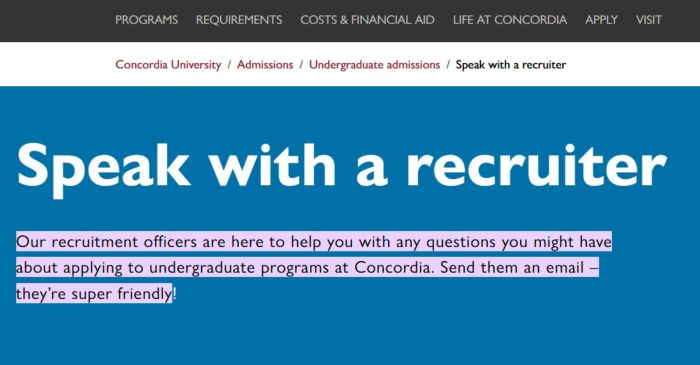
    Example: Concordia University encourages one-on-one engagement by making it easy for prospects to connect with recruitment advisors. In their outreach and on their website, Concordia invites prospective students to “Speak with a recruiter” and provides direct contact links for regional advisors. 

    By embedding advisor contact/booking links in recruitment emails, they effectively turn email into a two-way channel, and prospects can immediately take the next step of scheduling a conversation, which is often a key conversion on the path to enrollment. This kind of CTA (e.g., “Book a 1:1 Advising Appointment”) helps move students from interest to action at the decision stage.

    HEM Image 8HEM Image 8

    Source: Concordia University

    8. Automate Journeys and Triggers

    Automation ensures no student falls through the cracks. It also frees staff time by replacing one-off sends with structured flows. At a minimum, schools should build:

    • Welcome or nurture series by program cluster (3–5 emails over 10–14 days).
    • Event workflows: registration confirmation → reminder emails (24 hours and 2 hours before) → post-event follow-up with recording and next step.
    • Application rescue: reminders for incomplete applications, missing documents, or deposits.
    • Onboarding journeys: orientation checklist, LMS login, housing information, advising milestones.

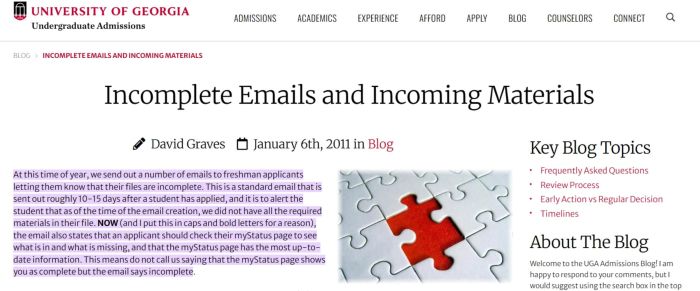
    Example: The University of Georgia’s admissions office uses automated “incomplete application” emails to prompt action from applicants. About 10–15 days after a student applies, if any required materials are still missing, UGA’s system sends a notification to alert the student. This kind of trigger-based outreach (in UGA’s case, coupled with a status portal for real-time updates) helps increase completion rates by nudging students at the right moment. Ensuring more prospects finish their applications and none are unknowingly left behind due to missing paperwork.

    HEM Image 9HEM Image 9

    Source: University of Georgia

    9. A/B Test Continuously (And Scientifically)

    Testing makes email performance predictable. Without it, you’re guessing. To get reliable insights, follow a structured method:

    • Hypothesis: define what you’re testing and why (e.g., “Clearer subject line → higher open rate”).
    • Minimal variable: test one change at a time: subject, CTA wording, or design. Not everything at once.
    • Sample & duration: send to enough recipients for statistical significance, and let the test run its course.
    • Centralize learnings: record results in a shared log and bake winners into future templates.

    This discipline helps schools turn experimentation into ongoing optimization, rather than one-off guesswork.

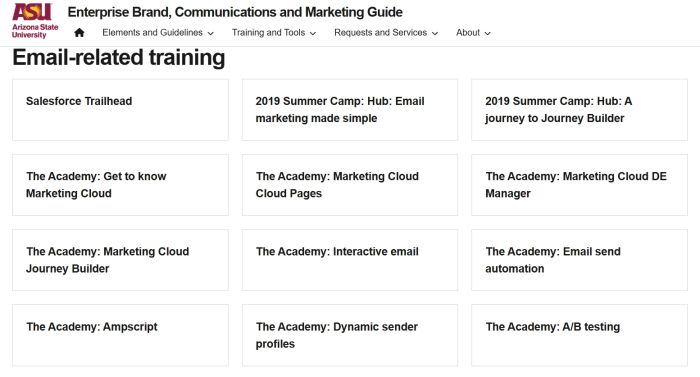
    Example: Arizona State University’s email marketing team bakes A/B testing into its processes and training. In fact, ASU’s internal Marketing Academy offers specific sessions on email A/B testing best practices. By systematically experimenting, for instance, testing whether an email from “Admissions at ASU” versus a personal advisor name yields a higher open rate, or which subject line phrasing drives more clicks, universities like ASU turn anecdotal hunches into data-backed decisions. The result is a cycle of learning where each campaign performs better than the last, based on real audience insights.

    HEM Image 13HEM Image 13

    Source: Arizona State University

    10. Measure What Matters and Close the Loop

    A great email program doesn’t just send, it learns. Schools should define KPIs at each stage of the student journey and connect systems so results tie back to outcomes that matter.

    • Top of funnel: track deliverability, open rates (adjusted for privacy changes), and click-through rates (CTR).
    • Mid-funnel: measure landing-page engagement, event registrations, and advisor bookings.
    • Bottom of funnel: monitor application starts and completions, offers accepted, and deposits paid.
    • Lifetime value: go further with retention term-to-term, alumni engagement, and giving participation.

    Tools make this possible. Google Analytics 4 allows schools to set and track conversion goals across web and email touchpoints. Marketing automation platforms like HubSpot, Mailchimp, and HEM’s Mautic provide email-level reporting, lifecycle attribution, and integration with CRMs or student information systems.

    The real power comes when those metrics are connected—so you can see not just who opened, but who enrolled. That’s how email proves its ROI in higher education.

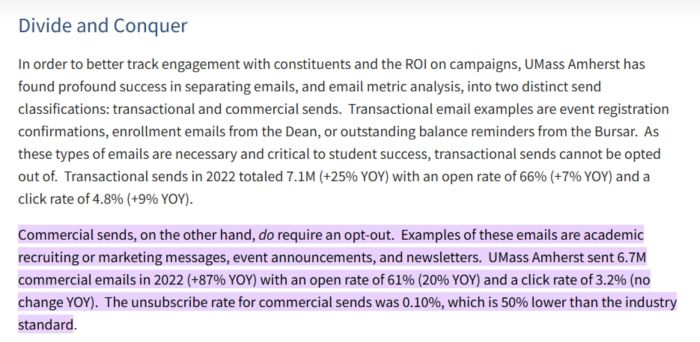
    Example: UMass Amherst provides a powerful case study in data-driven email marketing. After consolidating campus communications onto a single platform, they now rigorously track email performance and outcomes. In 2022, UMass separated its email sends into transactional vs. commercial categories to better gauge effectiveness. The university sent 6.7 million marketing (commercial) emails with a 61% open rate and only a 0.10% unsubscribe rate, about half the industry benchmark.

    HEM Image 11HEM Image 11

    Source: Cloud for Good

    These granular metrics (including year-over-year improvements in opens and clicks) are tied back to student engagement and enrollment outcomes. By monitoring and sharing such results, the UMass team can conclusively demonstrate email ROI in higher education, for instance, showing that automated, targeted campaigns directly led to more applicants completing their files and more students registering for classes

    Deliverability, Privacy, and Compliance Essentials

    Even the best-designed email is wasted if it never reaches the inbox. To protect deliverability and ensure compliance, schools need to focus on three pillars: technical health, consent, and governance.

    • Authenticate your domain with SPF, DKIM, and DMARC. Align subdomains for bulk mail so your institution sends with a verifiable identity.
    • Maintain list hygiene by removing hard bounces automatically and applying “sunset rules” for long-inactive contacts. This keeps the sender’s reputation strong.
    • Comply with Canadian Anti-Spam Law (CASL): capture express opt-in, include your institution’s physical mailing address, and provide a one-click unsubscribe.
    • Offer preference centres so subscribers can opt out of specific program streams rather than unsubscribing from all communications.
    • Monitor sender reputation and complaint rates across platforms. Coordinate centrally across departments to avoid overlap that leads to over-messaging.

    Schools that treat deliverability and compliance as core practices, not afterthoughts, protect both their brand and their audience’s trust, while ensuring every message has a fair chance of being read.

    Content Strategy: What to Send (And When)

    The most effective email marketing calendars are tied to the academic cycle. By planning content around what matters most to students at each stage, schools can stay relevant, reduce last-minute scrambles, and guide prospects and current learners smoothly from interest to enrollment, and beyond.

    • September–October: Focus on discovery. Send “Explore Programs” series, scholarship primers, and fall open house invitations to capture interest early in the cycle.
    • November–December: Support applications. Share step-by-step application checklists, portfolio preparation guides, and alumni career stories that reinforce outcomes.
    • January–February: Address financial and career considerations. Feature financial aid tutorials, co-op or internship spotlights, and “Ask an Advisor” live chats to build trust and reduce barriers.
    • March–April: Drive urgency. Countdown emails for application deadlines, residence selection reminders, and campus life reels or shorts work well here.
    • May–June: Transition from admission to enrollment. Focus on onboarding with orientation sign-ups, registrar instructions, and personalized next-step communications.
    • July–August: Provide last-mile support. Send guidance on IDs, transit, and housing, plus international arrival instructions to prepare students for day one.

    A calendar like this ensures that your emails are not just timely, but also aligned with the emotional and practical needs of your audience throughout the year.

    Turning Best Practices Into Results

    Email remains one of the most powerful tools available to higher education marketers, but only when strategy and technology work hand in hand. The best practices outlined here are: permission-based lists, segmentation, personalization, accessibility, automation, and compliance. Ensure every message is not just delivered but resonates with the right audience at the right time.

    This is where Higher Education Marketing (HEM) makes the difference. With deep sector expertise, we help schools design and execute email strategies that align with recruitment, retention, and advancement goals. 

    Central to this is our use of Mautic CRM, an open-source higher education email marketing automation platform customized for educational institutions. Mautic allows institutions to manage campaigns, segment audiences, automate journeys, and integrate seamlessly with student information systems, all while keeping data governance and compliance front and center.

    By combining best-practice strategy with the flexibility of Mautic CRM, HEM enables institutions to run smarter, more personalized campaigns that drive measurable ROI across the student lifecycle. The result is simple: stronger engagement, higher conversion rates, and a more connected experience for every student, from prospect to alumni. Do you need help crafting an effective marketing strategy for student recruitment for your institution? Contact HEM for more information.

    Struggling with enrollment and retention?

    Our email marketing services can help you generate more leads!

    Frequently Asked Questions

    Question: How can segmentation improve the effectiveness of email marketing for higher education?
    Answer: Segmentation makes emails more relevant, which increases engagement. For example, international prospects segmented by country can receive updates on visas and housing, while domestic students see local funding options. Segmenting by lifecycle stage, program, and behaviour helps improve click-throughs and leads to better-qualified student interactions.

    Question: What are the best practices for creating engaging subject lines in higher education email marketing?
    Answer: Keep subject lines clear, specific, and under 50 characters. Highlight benefits like deadlines, outcomes, or events, and use preheaders to expand the message. Test frequently with A/B experiments, and consider humanized sender names (e.g., “Admissions at [School]”) to increase open rates without relying on gimmicks.

    Question: Why is personalization important in higher education email marketing?
    Answer: Personalization helps students see themselves at your institution. Tailoring emails by program, start term, or action, such as reminding them of an unfinished application, makes communication feel relevant and timely. This reduces fatigue and unsubscribes while guiding students toward conversion more effectively than generic messages.

    Source link

  • Top Characteristics of a Student Ambassador

    Top Characteristics of a Student Ambassador

    Reading Time: 14 minutes

    Student ambassadors are more than just friendly faces on a campus tour; they’re living, breathing stories of what it’s really like to study at your institution. Whether they’re current students or recent alumni, they give prospects something no brochure or ad campaign can match: authenticity.

    Today, that authenticity is going digital. Many institutions are now recruiting digital student ambassadors who meet prospects where they already spend most of their time, on social media, in live chats, and across online communities.

    So, why does this matter? Because ambassadors humanize your school’s brand. They answer questions honestly, share glimpses of daily life, and help prospects picture themselves as part of the community. For Gen Z, especially, that peer-to-peer connection is gold. A relatable student voice can often be far more persuasive than a polished marketing message.

    As we’ll see, many of the qualities and characteristics of a student ambassador remain constant, but success in the digital realm also requires some special skills. Let’s start with the basics – what exactly does a student ambassador do, and how would we describe this role?

    Struggling to stand out in a crowded market?

    Boost enrollment with digital student ambassador strategies!

    What Is a Digital Student Ambassador?

    How would you describe a student ambassador? A student ambassador is a representative of their institution who shares authentic experiences, supports prospective students, and fosters a welcoming community. They act as a bridge between the school and its audience, answering questions, giving insights, and promoting campus culture through personal interaction, events, and digital engagement.

    On digital channels, these ambassadors take on a new kind of role: becoming micro-influencers for your school. They showcase campus moments on Instagram Stories, upload vlogs to YouTube, or join discussion threads to help someone halfway around the world decide whether your school is the right fit.

    And here’s where “digital” makes the difference. Traditional ambassadors focus on in-person tours, open houses, and campus events. Digital ambassadors bring that same personal touch into the online world. They host live Q&As, post blogs or videos, and respond to inquiries on platforms like Unibuddy, connecting with prospects who may never set foot on campus before applying. For international or out-of-town students, these online connections can be the deciding factor. The best blend is the warmth of a welcoming peer with the creativity and consistency of a skilled content creator. 

    Digital Student Ambassador Responsibilities:

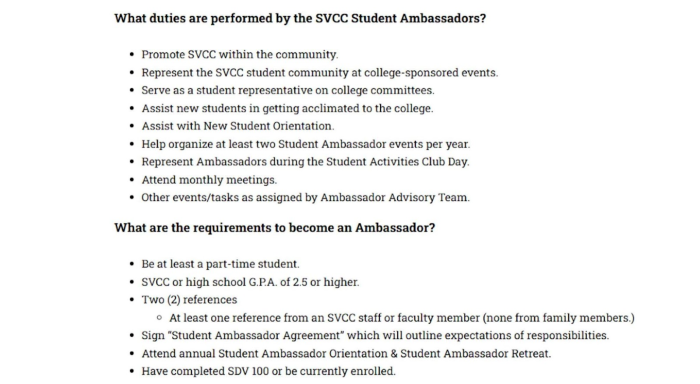
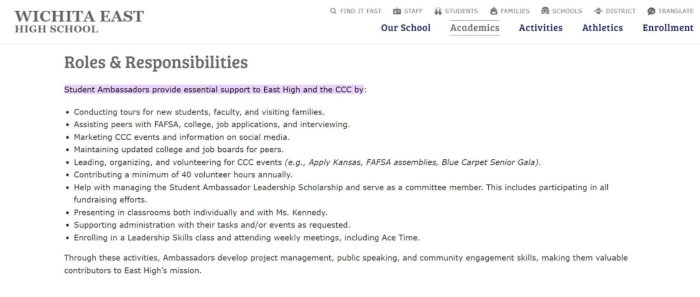
    • Welcoming and Touring Visitors: Ambassadors guide campus tours, share personal stories, and help visitors envision themselves as part of the community. They may host “shadow days,” lead Q&A panels at open houses, or ensure new students feel at ease during orientation.
    • Outreach and Communication: Many connect directly with prospects through calls, emails, and social media. They answer questions, follow up with applicants, or even make congratulatory calls to admitted students. Some take over institutional Instagram accounts or host live Q&A sessions, providing candid insights into academics, housing, and student life.
    • Event Support and Promotion: Ambassadors often help plan and run recruitment events, student panels, and webinars. They may work with faculty to coordinate workshops or invite speakers from student services, bringing a student-led energy to every event.
    • Content Creation and Storytelling: Today’s ambassador programs frequently include content production. Students might write blogs, create videos, or manage social media takeovers to highlight campus life.
    • Peer Advising and Support: Beyond recruitment, ambassadors mentor new and younger students, answer parent questions, and direct peers to campus resources. In certain settings, such as K-12 schools or community programs, they may lead workshops or classroom discussions.
    • Bridge Between Students and Administration:  Ambassadors also act as liaisons, communicating student feedback to staff and reinforcing institutional values within the student body. This two-way role supports a stronger campus culture and understanding.

    Ultimately, the role is about representing the school’s values and culture through genuine, student-to-student engagement. As one Higher Education Marketing advisor explains, “Students want to see themselves in your school’s marketing material”, and ambassadors make that possible.

    Whether volunteer or paid, ambassadors gain significant benefits: leadership and communication skills, valuable networking, and a stronger sense of belonging. Many describe the experience as a highlight of their education, one that builds confidence and allows them to give back to their community.

    The Rise of the Digital Student Ambassador

    The student ambassador role isn’t new, but the way it’s delivered has changed dramatically. Today, many of those warm, peer-to-peer conversations that once happened during campus tours now take place entirely online. That’s where the digital student ambassador comes in.

    What is a digital ambassador? A digital ambassador is a student representative who promotes their institution online through social media, live chats, and virtual events. They share authentic experiences, answer questions, and create engaging content, helping prospects connect with the school community, even if they can’t visit campus in person.

    The job is the same at its core: share genuine student experiences and help prospects imagine themselves at your school. But instead of shaking hands at an open house, digital ambassadors are hosting live virtual tours, answering questions in chat rooms and giving followers a real look at campus life through Instagram, TikTok, or YouTube. For many prospects, especially those researching from halfway around the world, this might be their very first interaction with your institution. That’s why the role is so powerful. Here are the top  characteristics of a student ambassador:

    Communication That Connects Through a Screen

    Speaking to a room is one thing. Making someone feel welcome through a camera or a line of text is another. Digital ambassadors need to master both. They know how to keep responses clear, friendly, and relatable, whether that’s through a quick message in a DM, a 30-second Instagram Story, or a thoughtful blog post. They understand tone, timing, and even how the right emoji can make an online exchange feel personal.

    Self-Motivation in a Flexible Role

    Unlike traditional ambassadors who work during scheduled tours or events, digital ambassadors often manage their own hours. They might respond to a question late in the evening, keep up with multiple conversations across platforms, or check in with an international prospect in a different time zone. That means self-motivation is of extreme importance. The best digital ambassadors don’t wait for prompts. They’re proactive about reaching out, following up, and making sure no question goes unanswered.

    Tech-Savvy and Adaptable

    A digital ambassador’s toolkit can change from one day to the next. One moment they’re editing a TikTok video, the next they’re co-hosting a Facebook Live Q&A or answering questions in a university’s custom chat app. They’re comfortable switching platforms, solving small tech issues, and adapting quickly when something unexpected happens. They also understand how to use each channel’s strengths to create the most impact, whether that’s a quick selfie video for a personal touch or a detailed written reply for complex questions.

    Bringing Energy Online

    Here’s the challenge: online, you don’t have the buzz of an in-person conversation to carry you. That means enthusiasm has to work harder. The best digital ambassadors make their passion for the school shine through in every message, video, or post. Research backs this up: positive, genuine interactions between current and prospects are one of the biggest drivers of enrollment conversions.

    To recap, what makes a good ambassador? A good ambassador is authentic, approachable, and knowledgeable, with strong communication skills. They represent their institution with enthusiasm, build trust through genuine connections, and adapt easily to different audiences and platforms, ensuring every interaction leaves a positive, lasting impression.

    In essence, a digital student ambassador is more than a student with social media skills. They’re a trusted peer, a skilled communicator, and a tech-savvy connector who can make a prospect feel seen, heard, and excited, no matter the distance. Schools that invest in them aren’t just extending their reach; they’re deepening their influence from the very first interaction.

    Key Qualities of a Great Student Ambassador

    What separates a good student ambassador from a truly exceptional one? Whether they’re greeting visitors in person or connecting with prospects online, the standouts share a set of defining qualities that make them unforgettable.

    Communication That Connects

    Great ambassadors are master communicators. They’re equally skilled at chatting one-on-one with a shy high school student or presenting to a room full of parents. They don’t just speak; they listen. They pick up on unspoken concerns, ask clarifying questions, and tailor their responses so every prospect feels understood. In a digital context, this means writing with warmth and clarity; friendly enough to spark conversation, yet concise enough to respect attention spans. They adapt effortlessly: a casual tone on Instagram, a polished one in email, and an authentic voice in video.

    Positivity That’s Contagious

    An ambassador’s outlook shapes a prospect’s first impression of the school. The best ones radiate genuine enthusiasm, never forced, never “salesy.” Their love for the institution is real, and it shows in every conversation, every smile, and every story they share. Admissions teams often spot potential ambassadors by noticing who already volunteers for events or naturally promotes their campus. Enthusiasm is magnetic: when an ambassador talks about their favorite class or a beloved campus tradition, that excitement becomes impossible to ignore.

    Initiative and Leadership in Action

    True leaders don’t wait for instructions; they step in. Exceptional ambassadors are proactive, spotting the student standing alone at an event and striking up a conversation, or jumping in to answer an unanswered question in a group chat. They embody self-discipline, integrity, and the ability to make others feel welcome. For digital ambassadors, initiative is non-negotiable. They must work independently, manage their time, and seize every opportunity to engage.

    Inclusivity and Empathy

    Great ambassadors make every prospect feel like they belong. They’re culturally aware, sensitive to differences, and skilled at connecting across backgrounds. They know what it’s like to be the newcomer, uncertain, maybe even overwhelmed, and they respond with patience and understanding. Whether reassuring an international student about campus diversity or helping a first-generation applicant navigate the admissions process, they create an atmosphere of welcome and respect.

    Professionalism You Can Count On

    While the role is peer-driven and personable, it’s also a serious responsibility. Ambassadors represent the school’s brand, and reliability is key. That means showing up on time, honoring commitments, and maintaining a respectful, professional demeanor, even in casual interactions. Digital ambassadors, in particular, must be disciplined enough to manage their role without constant oversight, delivering the same level of professionalism online as in person.

    Knowledge and Resourcefulness

    Prospects ask everything: from residence life to program details to financial aid. Ambassadors aren’t expected to have all the answers, but they must be well-informed about the institution’s key offerings and know exactly where to find information when needed. The strongest ambassadors are resourceful problem-solvers, following up quickly and connecting prospects to the right campus contacts. This builds trust and leaves prospects feeling supported.

    Digital Fluency (for Online Engagement)

    For digital student ambassadors, tech skills aren’t optional; they’re foundational. They navigate social media platforms, live chat tools, and video conferencing software with ease, staying on top of online trends and knowing how to leverage each platform’s strengths. They understand digital etiquette, moderate discussions effectively, and troubleshoot minor tech issues without losing composure. In short, they bring creativity, adaptability, and technical confidence to the role, turning digital spaces into welcoming, interactive environments.

    When you combine these student ambassador qualities: communication, positivity, initiative, inclusivity, professionalism, knowledge, and tech fluency. You get a student ambassador who doesn’t just represent the school… they embody it. They make every interaction feel personal, every prospect feel valued, and every conversation a step closer to enrollment.

    Examples of Great Student Ambassador Programs

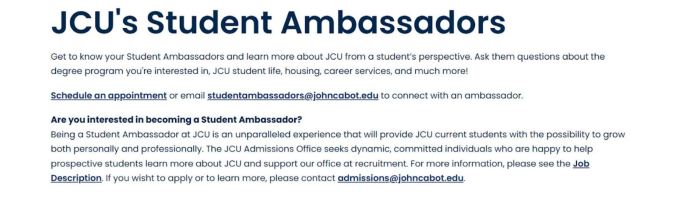
    John Cabot University 

    John Cabot University, an American university in Rome, runs a robust student ambassador program that shows how ambassadors can touch many facets of campus life. John Cabot University’s ambassadors are actively involved in the orientation process, event planning, leadership, and student support. 

    Their profiles (complete with friendly photos and contact info) are featured on the school site to invite connections. This approachable public presence signals to new and prospective students that they have peer resources ready to help. John Cabot’s example underlines the importance of choosing outgoing, involved students – their ambassadors take on leadership in organizing events and mentoring newcomers, embodying the school’s warm, inclusive culture from the start.

    HEM Image 2HEM Image 2

    Source: John Cabot University

    Academy of Applied Pharmaceutical Sciences

    Smaller career-focused colleges also leverage ambassadors. The Academy of Applied Pharmaceutical Sciences (AAPS) in Toronto uses student ambassadors in marketing-savvy ways by showcasing student and alumni success stories. AAPS regularly celebrates Student Success Stories: for example, posting when an alumnus lands a dream job in the pharmaceutical industry. These stories (often shared on AAPS’s website and social channels) let prospects “see themselves achieving their goals” at the college.

    In essence, AAPS ambassadors become living proof points of outcomes, saying “look what our students achieve; you can join them.” Ambassadors share their journeys and tips (on Facebook, YouTube, LinkedIn, etc.), adding authenticity to recruitment. The key is that AAPS selects enthusiastic storytellers proud of their field, so their posts come off as peer-to-peer endorsements of the college’s programs. This example shows that digital ambassador content doesn’t always mean live chats; even a series of student highlight posts with quotes and photos can serve as powerful testimonials.

    HEM Image 3HEM Image 3

    Source: AAPS

    Terry College of Business, University of Georgia (USA)

    Business schools often rely on ambassadors to convey the program’s culture to applicants (for MBA or undergraduate business programs). The Terry College of Business at UGA has a team of Terry Ambassadors who exemplify leadership and community-building. Their mission statement: “Leading by example, ambassadors engage with students and alumni to build community within the college, increase understanding of opportunities available, and further the Terry legacy.” 

    This highlights how ambassadors at a business school not only assist with recruiting new students but also serve as connectors among current students and alumni – bridging different parts of the community. Terry Ambassadors are selected for attributes like strong academic records, interpersonal skills, and dependability. They uphold values such as integrity, respect, and servant leadership, acting as role models. 

    In practice, they host networking events, speak with prospective business majors about career opportunities, or welcome alumni back to campus. The benefit is two-fold: prospects get insiders’ perspectives on the program, and the ambassadors themselves gain networking and leadership experience (Terry explicitly notes ambassadors “develop a strong network of peers, alumni and professionals” as a benefit of the role. This example shows a slightly different angle – ambassadors not just for admissions, but for fostering pride and connections within a college community.

    HEM Image 4HEM Image 4

    Source: Terry College of Business

    Middlebury Language Schools 

    Specialized programs like language immersion schools use ambassadors. At Middlebury’s famed Language Schools, former students act as student ambassadors to share their experience with prospective enrollees. 

    For example, the Japanese Language School has student ambassadors listed with their emails so interested students can reach out to ask about the immersion program. These ambassadors answer questions like “What surprised you about your experience?” and “How much did your Japanese improve?”, giving honest testimonials about the intensive summer program. This helps prospects, who might be nervous about the immersion pledge, hear directly from peers who succeeded.

    HEM Image 5HEM Image 5

    Source: Middlebury Language Schools

    The ambassadors in this context need to be candid and reflective, able to articulate how they overcame challenges and why the program was worth it. Their enthusiasm for language learning and personal growth becomes a selling point for others. It’s a great example of how even non-traditional educational settings leverage peer ambassadors to build trust – after all, who better to convince someone to spend a summer speaking only Japanese than a student who did it and loved it?
    Bishop O’Dowd High School 

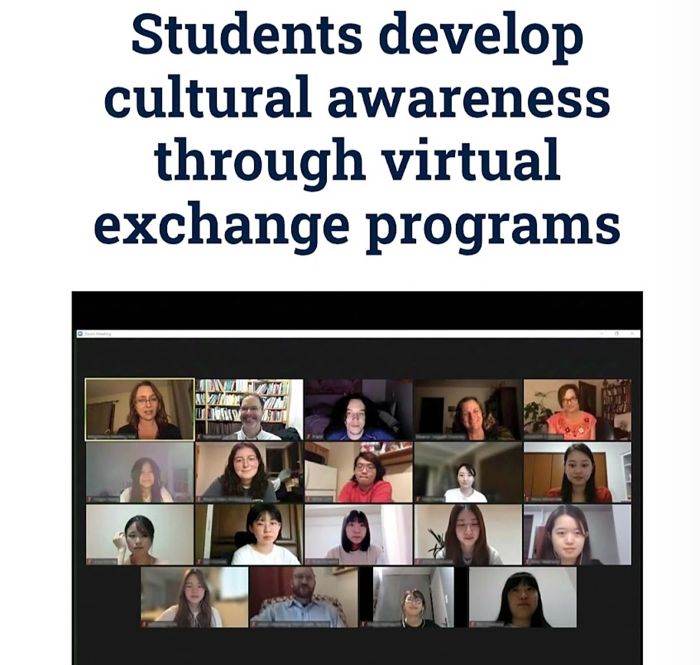
    High schools also use student ambassadors, often in admissions tours or as “student hosts.” Bishop O’Dowd, a Catholic college-preparatory high school, actually has an army of nearly 400 student volunteers in its ambassador program – affectionately nicknamed the “Dragons” (after the school mascot). According to their admissions director, this large-scale program has been “transformative for the campus culture itself”. With so many students involved, it created “a culture of positivity and a willingness in students to truly engage” on campus. 

    Ambassadors at O’Dowd not only assist with tours and open houses, but by telling their personal stories to visitors, they have also become more reflective and positive about their own school experience. This is a powerful insight: a well-run ambassador program doesn’t just benefit the admissions office; it can fundamentally boost student morale and leadership school-wide. The key qualities for these youth ambassadors include being outgoing, responsible, and service-oriented – essentially, being proud “Dragons” who want to share that pride. 

    For younger students (high schoolers), being an ambassador also instills college and career-ready skills early on, such as public speaking and collaboration. Bishop O’Dowd’s example demonstrates how scale and inclusivity (hundreds of ambassadors representing all types of students) can amplify impact: every prospective family can meet a student who resonates with their child’s interests or background.

    HEM Image 6HEM Image 6

    Source: Bishop O’Dowd High School

    Empowering Students as Digital Ambassadors

    A great digital student ambassador is more than a smiling face on a brochure. They’re a communicator, a leader, a tech-savvy problem-solver, and, most importantly, a genuine student voice. They bridge the gap between your institution and prospects, turning formal marketing into an authentic human connection. 

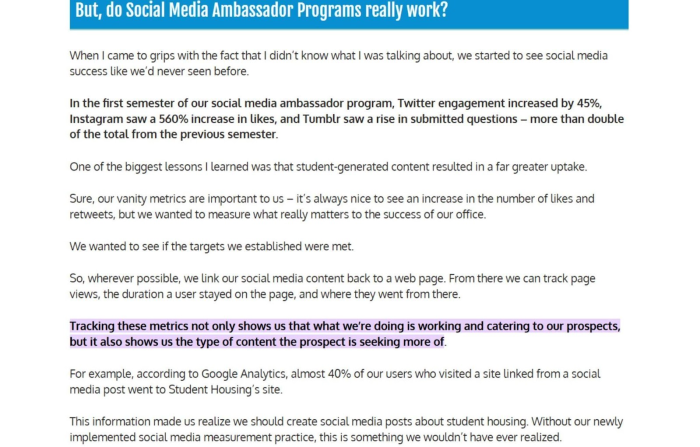
    And the proof is in the results. When the University of Guelph launched its student social media ambassador program, engagement skyrocketed: 45% more interactions on Twitter and a 560% surge in Instagram likes, all in the first semester. Why? Because prospects trust real students sharing real experiences.

    In conclusion, choose ambassadors who radiate positivity, connect easily with others, and navigate the online world with confidence. Give them the training they need, social media best practices, Q&A techniques, but don’t strip away their personality. Authenticity is their greatest asset, and when they’re free to speak in their own voice, it resonates far beyond what any scripted message can.

    For students considering the role, here’s your sign to go for it. If you naturally talk about your school with enthusiasm, becoming an ambassador is simply channeling that passion into impact. You’ll build leadership skills, expand your network, and help future students feel at home before they even arrive.

    In the end, the formula for a great digital ambassador is the same as for any ambassador: a sincere desire to help, connect, and inspire, supercharged by the reach of digital media. When schools and students partner in this way, everyone wins. Students grow as leaders, institutions gain their most credible advocates, and prospective learners get the authentic, peer-to-peer insight they crave. In an age where trust drives enrollment, investing in student ambassadors is investing in your most powerful recruitment asset: your own students.

    Struggling to stand out in a crowded market?

    Boost enrollment with digital student ambassador strategies!

    Question: How would you describe a student ambassador?
    Answer: A student ambassador is a representative of their institution who shares authentic experiences, supports prospective students, and fosters a welcoming community. They act as a bridge between the school and its audience, answering questions, giving insights, and promoting campus culture through personal interaction, events, and digital engagement.

    Question: What makes a good ambassador?

    Answer:  A good ambassador is authentic, approachable, and knowledgeable, with strong communication skills. They represent their institution with enthusiasm, build trust through genuine connections, and adapt easily to different audiences and platforms, ensuring every interaction leaves a positive, lasting impression.

    Question: What is a digital ambassador?

    Answer: A digital ambassador is a student representative who promotes their institution online through social media, live chats, and virtual events. They share authentic experiences, answer questions, and create engaging content, helping prospects connect with the school community, even if they can’t visit campus in person.

    Source link

  • Best Practices for Higher Education Websites

    Best Practices for Higher Education Websites

    Reading Time: 15 minutes

    Your website is no longer just a digital brochure. It’s the heart of your institution’s marketing, recruitment, and student engagement efforts. For most prospective students, it’s the very first touchpoint, and their decision to inquire, apply, or move on often hinges on what they find there.

    More than 90% of students visit a college or university website during their school search. That means your site must not only attract attention but deliver a seamless experience that inspires trust and action.

    What does that look like? It’s a blend of smart navigation, compelling visuals, personalized content, and performance that works flawlessly across all devices. It’s also about serving many different audiences, students, parents, alumni, and staff, without sacrificing clarity or focus.

    In this article, we break down the 7 best practices for higher education websites, with examples from institutions putting them into action. These proven strategies will help your school build a web presence that engages users and drives real results, from exploration to enrollment.

    Struggling with enrollment?

    Our expert digital marketing services can help you attract and enroll more students!

    1. Ensure a Mobile-Responsive, Mobile-First Design

    Smartphones are the default browsing tool for most prospective students and their parents. If your institution’s website doesn’t offer a seamless mobile experience, you’re not just frustrating users; you’re losing them. 

    Why is mobile responsiveness crucial for higher education websites? Most students browse on mobile devices. A mobile-responsive site ensures readability, easy navigation, and fast loading, key for user experience and search rankings. Without it, your site could rank lower on Google and lose over half of the visitors who abandon slow or poorly displayed pages.

    Mobile responsiveness means your content adjusts fluidly to any screen size, from smartphones to tablets. This isn’t a nice-to-have feature; it’s a necessity. Google now uses your site’s mobile version to determine how it ranks in search results (a process known as mobile-first indexing). If your site isn’t optimized for mobile, both your visibility and your credibility take a hit.

    But it’s not just about rankings. A mobile-first experience shapes how users perceive your brand. Nearly half of students (49%) say a positive mobile experience improves their view of a college, while a poor one can turn them away entirely.

    At a minimum, your site should:

    • Use a responsive design that automatically adjusts layouts for smaller screens
    • Collapse navigation into a clean, mobile-friendly format
    • Display readable text without requiring zoom
    • Feature buttons and links that are easy to tap

    Example: California Baptist University delivers a standout mobile experience. Its responsive design stacks content cleanly for smaller screens, while large, tappable calls-to-action make it easy for prospective students to explore programs or request information. The site balances function and aesthetics, showing that CBU understands what mobile users need and delivers it.

    HEM Image 2HEM Image 2

    Source: California Baptist University

    How can improving website speed benefit my higher education institution? Faster websites reduce bounce rates and keep users engaged longer. Prospects find what they need quickly, improving their impression of your institution. Speed also boosts SEO rankings and increases the chances of conversions like form submissions or brochure downloads.

    A smooth mobile journey doesn’t just meet expectations, it sends a clear message: your institution is accessible, student-focused, and ready to meet users where they are.

    2. Optimize Your Site’s Speed and Performance

    Speed matters. Gen Z users expect instant access, and if your pages lag, they’ll bounce, sometimes before they’ve even seen your programs.

    How fast is fast enough? According to Google, 53% of mobile visitors abandon a page if it takes more than 3 seconds to load. On the flip side, mobile sites that load in 5 seconds or less enjoy 70% longer average sessions and 35% lower bounce rates than slower counterparts.

    Beyond user frustration, slow sites impact your visibility. Google uses page speed as a ranking factor, so sluggish load times can tank your SEO and conversions.

    To keep your site performing at its best, follow these key practices:

    • Compress images and media. Use modern formats like WebP and apply compression tools to reduce file sizes without sacrificing quality.
    • Minify code and enable caching. Clean up your HTML, CSS, and JavaScript, and use browser caching to speed up page loads for returning visitors.
    • Implement a Content Delivery Network (CDN). CDNs serve content from servers closest to the user, minimizing delays caused by physical distance.
    • Limit heavy third-party scripts. Only use plugins and scripts that are essential—too many can drag your site’s performance down.
    • Test regularly. Tools like Google PageSpeed Insights, GTmetrix, or Lighthouse help you spot bottlenecks like oversized images or slow server response.

    Example: University of Arkansas at Little Rock (UA Little Rock): In March 2025, UA Little Rock rolled out a major website overhaul that improved both user experience and performance speed. A key move was transitioning to modern cloud hosting, which “ensures greater reliability, multiple backups, and improved site performance,” especially during peak or emergency periods. The web team also streamlined the site’s content (trimming 8,000+ pages down by 30%) and modernized the codebase, which reduces load times by eliminating bloat.

    HEM Image 3HEM Image 3

    Source: University of Arkansas at Little Rock

    Why this matters for higher ed: Even a one-second improvement in page load time can make a measurable difference in how long users stay and what actions they take. A fast website tells students you’re efficient, professional, and respectful of their time, a small detail that leaves a big impression.

    If your site is slow, it’s time to speed things up.

    3. Implement Strong SEO to Boost Search Visibility

    You can have the most beautifully designed website in the world, but if prospective students can’t find it, it won’t deliver results.

    That’s where search engine optimization (SEO) becomes critical. Most college students rely on search engines to explore programs, compare schools, and research next steps. If your institution doesn’t appear in those search results, you risk missing out on a massive share of qualified leads.

    Think about the intent behind queries like:

    • “Best MBA programs in Canada”
    • “Colleges in Toronto for computer science”
    • “Online diploma in healthcare administration”

    If your pages don’t show up, students won’t even know to consider you.

    Here’s how to strengthen your SEO strategy and stay visible throughout the student journey:

    Keyword Optimization

    Start with the language students use. Research long-tail keywords that reflect real queries (e.g., “online MBA in finance” or “career college digital marketing course”). Then, use those terms naturally in your:

    • Program page titles and H1 headers
    • Metadata and image alt text
    • Body content and subheadings

    This improves your rankings and helps students quickly identify whether your offerings match their needs.

    High-Quality, Student-Centric Content

    Search engines prioritize helpful content. So do students. Build rich pages and blog posts that answer common questions about admissions, tuition, career outcomes, or student life. Content that educates, informs, and reassures will keep users engaged and build trust.

    Gen Z doesn’t want to dig for answers. Make them easy to find, and you’ll win the click.

    On-Page SEO Basics

    Each page on your site should have:

    • A unique meta title and description featuring relevant keywords
    • Structured headings (H1, H2, H3…)
    • Descriptive image alt text for both accessibility and SEO

    These basic elements are easy to overlook, but they make a real difference in how Google interprets and ranks your content.

    Technical SEO and User Experience

    Your site’s infrastructure plays a big role in search visibility. Prioritize:

    • Mobile-friendliness (as covered in Section 1)
    • Fast page load times
    • Secure browsing (HTTPS)
    • Logical, crawlable URLs
    • Fixes for broken links and outdated pages

    Google rewards user-friendly experiences. So do your prospective students.

    Local and International SEO

    Have a physical campus? Make sure your Google Business Profile is claimed and accurate. Serving international audiences? Offer multilingual content or geo-targeted landing pages to attract global prospects.

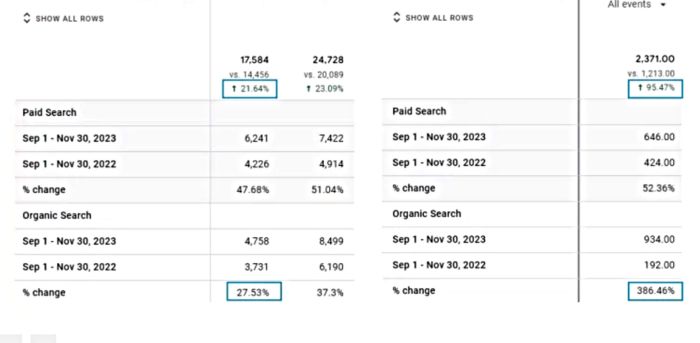
    Example: When ENSR partnered with Higher Education Marketing (HEM) in 2019, the school sought to improve its online visibility and attract more qualified leads. HEM implemented a comprehensive SEO strategy that included technical website improvements, bilingual content creation, and targeted Google Ads campaigns. These efforts significantly enhanced ENSR’s search rankings and increased high-quality inquiries from families seeking international education in Switzerland.

    HEM Image 4HEM Image 4

    Source: HEM

    Why this matters: SEO isn’t a quick win; it’s a long-term strategy. But done right, it builds sustained visibility across every stage of the student journey.

    A prospect might first find your blog post about how to choose a business school. Weeks later, they search for [Your University] campus life. Eventually, they return to your site to click Apply Now. SEO ensures you’re present at each step.

    And since over 90% of students visit your website before applying, showing up in search isn’t just a marketing boost, it’s mission-critical.

    What role does SEO play in the success of a higher education website?

    SEO helps your site appear in search results when students research programs. Strong SEO brings qualified traffic, builds credibility, and ensures your programs are seen, without relying solely on paid ads.

    SEO brings it all together. A fast, accessible, content-rich, and mobile-optimized site naturally ranks better. That means more visibility, more engagement, and more students taking the next step with you.

    4. Make Your Content Accessible and Inclusive to All Users

    Accessibility is now a fundamental expectation. Your website should serve everyone, including users with visual, auditory, motor, or cognitive disabilities.

    In the U.S., more than 61 million adults live with a disability, and in Canada are more than 27 million. Globally, the number reaches into the hundreds of millions. If your website isn’t accessible, you may be shutting out prospective students, parents, or staff who are eager to connect but simply can’t.

    Beyond ethics, it’s also the law. New ADA Title II regulations in the U.S. now require public colleges and universities to comply with WCAG 2.1 Level AA standards. Similarly, Canada’s AODA (Accessibility for Ontarians with Disabilities Act) sets a comparable benchmark for accessibility. Failure to comply with these standards can result in lawsuits, financial penalties, loss of federal funding, and significant reputational damage.

    An inclusive website is no longer optional. It’s a legal, ethical, and strategic imperative.

    Best practices for accessible higher education websites:

    • Follow WCAG 2.1 AA guidelines. This includes alt text for images, captions or transcripts for videos, strong color contrast, and keyboard-friendly navigation.
    • Use semantic HTML. Headings, lists, and ARIA landmarks help users navigate with screen readers and assistive tech. Avoid flashy layouts that confuse accessibility tools.
    • Write descriptive link text. Replace vague links like “click here” with actionable, informative phrasing: Download the admissions brochure, for example.
    • Test with real users. Use accessibility checkers and consult individuals who rely on screen readers or other assistive devices; automated tools often miss real-world issues.

    Why this benefits everyone: Captions aren’t just for deaf users; they help second-language learners, mobile viewers, and anyone watching a video in a noisy space. High-contrast design improves readability in bright light or on low-quality screens. And clean navigation benefits all users, whether or not they rely on assistive technology.

    Accessibility makes your site better for everyone and signals your commitment to equity and inclusion.

    Example: Otis College of Art and Design proves that accessible websites don’t have to be boring. Their visually bold, design-forward site includes thoughtful accessibility features, like the ability to pause animated content and high-contrast elements that enhance readability. It’s proof that inclusive design and creativity can go hand in hand.

    HEM Image 5HEM Image 5

    Source: Otis College of Art and Design

    By prioritizing accessibility from the start, your institution not only meets regulatory standards, but it also opens the door to more prospects and strengthens its reputation as a place where everyone belongs.

    5. Design Intuitive Navigation and User-Friendly Interfaces

    Higher education websites often contain a massive amount of information, program details, admissions requirements, campus services, student life, alumni resources, and more. Without clear navigation, this wealth of content can quickly become overwhelming.

    If prospective students can’t find basic information like how to apply, what programs you offer, or where to request info, they won’t stick around. They’ll simply move on to another institution that makes things easier. 

    Your goal? Make exploration effortless: Navigation should be clean, logical, and centered around user needs, not internal structures or department silos. Every menu, page layout, and search function should guide visitors toward their goals with clarity and speed.

    Tips for intuitive higher ed site navigation:

    • Use simple, student-focused labels. Stick to clear menu items like “Programs,” “Admissions,” “About Us,” and “Contact.” Avoid institutional jargon. Limit top-level menu items to avoid overload, and organize deeper pages using dropdowns or mega menus.
    • Design for user journeys, not just departments. Group content around tasks or audience needs. Instead of listing academic departments, consider categories like Plan, Start, Succeed, or even Explore Programs and Find Support.
    • Add a powerful, visible search bar. Nearly 50% of high school students use site search to navigate college websites. Make your search box easy to find on every page and power it with intelligent search tools that can handle typos and suggest relevant results as users type.
    • Create clear user paths for different audiences. Persona-based navigation (e.g., Prospective Students, Current Students, Parents, Alumni) lets visitors self-identify and jump directly to what matters to them. This reduces cognitive load and improves time-to-information.
    • Make CTAs impossible to miss. Buttons like Apply Now, Request Info, and Visit Campus should be visually distinct and consistently visible across key pages.
    • Maintain styling and structural consistency. Don’t make users relearn how to navigate with every new section. Ensure the styling, placement, and behavior of menus remain predictable and responsive for mobile users.

    Example: Eastern Iowa Community Colleges: EICC structures its top-level navigation around the student journey with three clear categories: Plan, Start, and Succeed. This not only simplifies decision-making but also shows a deep understanding of student concerns. The site also includes an “I’m most concerned about…” section: addressing common hesitations head-on, with empathy and clarity.

    HEM Image 6HEM Image 6

    Source: Eastern Iowa Community Colleges

    A user-friendly website doesn’t just look polished; it feels helpful. Smart navigation says, “We understand your needs, and we’ve made it easy to find what you’re looking for.” Higher education website design can be the difference between a visitor who bounces and one who applies.

    6. Provide Engaging Content and Clear Calls-To-Action

    Content is what transforms a higher ed website from a digital brochure into a dynamic recruitment tool. Prospective students don’t just want information; they want answers, inspiration, and a glimpse of what their future might look like at your institution.

    They’re searching for:

    • Program details
    • Admission requirements
    • Tuition costs
    • Campus life
    • Career outcomes
    • Student experiences 

    Your job is to deliver that content in a way that’s clear, engaging, and actionable.

    Best Practices for Content That Drives Enrollment:

    Showcase your academic programs clearly.
    Each program should have a dedicated page that covers curriculum highlights, faculty expertise, admissions requirements, and career prospects. Schools should prioritize program-level content because it’s the first place prospects look.

    Use rich media to bring your campus to life.
    Photos, videos, virtual tours, and infographics add emotional and visual depth that text alone can’t match. Consider a homepage hero video, a student life highlight reel, or virtual walkthroughs of your campus and classrooms.

    Incorporate authentic student voices.
    Today’s students want real stories. Feature testimonials, student spotlights, or day-in-the-life content that reflects your community’s diversity and vibrancy. Whether it’s a video diary from a nursing student or a blog from an international applicant, authenticity builds trust.

    Keep your content fresh.
    Outdated information erodes credibility. Make it a priority to update admissions deadlines, program details, and tuition info regularly. Maintain a blog or news section to show your campus is active, but don’t let fresh content bury essential evergreen pages like Programs or How to Apply.

    Guide users with clear, strategic CTAs.
    Every important page should ask: What’s the next step? Then answer it with a bold, well-placed button. Whether it’s “Apply Now,” “Download a Program Brochure,” or “Book a Virtual Tour,” your CTAs should stand out visually and match the context of the page.

    Example: OCAD University (Canada) redesigned its admissions website with a bold visual identity, simplified navigation, and CTAs tailored to the user journey, like “Get Portfolio Help” or “Start Your Application.” The results? Within weeks of launch, the site saw a 21% increase in visits and a 15% increase in applicants. The combination of user-first content and clear actions paid off.

    HEM Image 6HEM Image 6

    Source: OCAD University

    Content also reinforces every other best practice:

    • Accessible content means adding alt text and transcripts.
    • SEO-optimized content means using keywords that align with search intent.
    • Fast-loading content means using lightweight visuals and optimized media.

    When your content delivers real value and your calls-to-action guide users clearly, you don’t just inform; you inspire. And that’s what drives conversions.

    7. Integrate With a CRM for Lead Management and Personalization

    A well-designed website gets visitors. A strategically integrated website gets conversions.

    One of the most powerful ways to level up your higher ed site is by connecting it to a Customer Relationship Management (CRM) system. CRMs are central hubs for capturing, organizing, and nurturing prospective students through the enrollment journey.

    When your website and CRM are integrated, lead data flows automatically from inquiry forms, newsletter signups, and event registrations into a centralized system, no more manual data wrangling, missed follow-ups, or siloed information.

    Why CRM Integration Matters:

    1. Instant lead capture and time savings
      Every time a prospect fills out a form, to download a course brochure or RSVP to an open house, their information is logged automatically in your CRM. This eliminates the need for staff to transfer spreadsheets or copy-paste emails. The result? Less administrative busywork and fewer mistakes, giving your admissions team more time to focus on real engagement.
    2. Faster, personalized follow-up
      CRM integration lets you respond in real time. Someone requests info? They get a tailored email within minutes. And your recruiters are instantly notified with the lead’s details, so they can follow up while your institution is still top of mind. Prompt follow-up, especially within 24 hours, greatly increases contact and conversion rates. A connected CRM makes that speed possible.
    3. Personalized web experiences
      Advanced CRMs like HubSpot or Mautic allow you to show smart CTAs and dynamic content based on the visitor’s behavior. If someone has already attended a webinar, your site might offer “Schedule a One-on-One Consultation” instead of “Register for Info Session.” Personalization like this increases engagement and accelerates movement through the funnel.

    One institution used smart CTAs to tailor messaging for return visitors. New users saw English test prep offers, while returning prospects saw “Start Your Application” prompts, resulting in higher click-through and application rates.

    1. Full visibility into the student journey
      Every interaction, form fill, email open, and event attendance is tracked in the CRM. Your team gets a 360° view of each lead’s engagement, helping them tailor conversations and prioritize follow-ups. You can also track which web pages and campaigns are driving the most conversions, helping you optimize over time.

    For example, CRM data may reveal that campus tour sign-ups convert at twice the rate of general inquiries. Insights like these help you double down on what works.

    1. A seamless, consistent user experience
      From a student’s perspective, CRM integration reduces friction. They won’t have to fill in the same information twice. Communications feel timely and relevant. Even if a staff member changes, the CRM ensures continuity, so the conversation picks up where it left off.

    Behind the scenes, your team gains confidence that every lead is being handled properly, with full history and context at their fingertips.

    The tools and payoff

    Higher education institutions are increasingly using education-focused CRMs like HubSpot or HEM’s Mautic CRM. These tools enable automation at every stage, from capturing leads to triggering nurture emails to customizing website CTAs.

    Example: Griffith College, Ireland’s largest independent college, partnered with Higher Education Marketing (HEM) to implement HubSpot CRM for more efficient lead management and personalized student recruitment. Through a comprehensive strategy that included conversion funnel audits, CRM staff training, automated workflows, and segmented lead nurturing, HEM helped Griffith streamline communications and improve follow-up with prospective students. As a result, the college achieved a 20% year-over-year increase in registered learners for its Spring 2023 intake.

    HEM Image 7HEM Image 7

    Source: HEM

    CRM integration does require some technical setup and cross-department coordination. But the payoff is immense: your website becomes a two-way communication platform, collecting insights, responding to actions, and guiding visitors toward enrollment with relevance and precision.

    For institutions serious about scaling recruitment and deepening personalization, connecting your CRM to your website is no longer optional. It’s a modern best practice and a clear path to smarter, more successful digital engagement.

    Build a Website That Drives Enrollment

    Your website isn’t just a marketing asset; it’s your institution’s top recruiter. Every click, scroll, and form fill is a chance to move a prospective student closer to enrollment.

    By applying these best practices for higher education websites, from mobile-first design and fast performance to SEO, accessibility, and CRM integration, you create more than just a polished digital presence. You build a site that informs, inspires, and converts.

    In a crowded higher ed market, the schools that win are the ones that treat their website like the powerful recruitment engine it is. Make yours work harder, smarter, and more strategically, starting now.

    Struggling with enrollment?

    Our expert digital marketing services can help you attract and enroll more students!

    Frequently Asked Questions 

    Question: Why is mobile responsiveness crucial for higher education websites?
    Answer: Most students browse on mobile devices. A mobile-responsive site ensures readability, easy navigation, and fast loading, key for user experience and search rankings. Without it, your site could rank lower on Google and lose over half of the visitors who abandon slow or poorly displayed pages.

    Question: How can improving website speed benefit my higher education institution?
    Answer: Faster websites reduce bounce rates and keep users engaged longer. Prospects find what they need quickly, improving their impression of your institution. Speed also boosts SEO rankings and increases the chances of conversions like form submissions or brochure downloads.

    Question: What role does SEO play in the success of a higher education website?
    Answer: SEO helps your site appear in search results when students research programs. Strong SEO brings qualified traffic, builds credibility, and ensures your programs are seen, without relying solely on paid ads.

    Source link

  • How to Launch a School Podcast in 7 Steps

    How to Launch a School Podcast in 7 Steps

    Reading Time: 11 minutes

    As of 2023, more than 464 million people listen to podcasts regularly, and this number is growing each year. And with over 70% of parents listening with their children, podcasts are a communication channel your school can’t afford to overlook.

    Why does this matter for education marketing?

    Because parents, students, and alumni increasingly expect content that’s on demand, easy to consume, and aligned with how they already engage with other brands. A podcast offers exactly that. It provides a way to humanize your institution, give voice to your values, and build stronger relationships with your audience, all without requiring a massive budget or full production studio.

    Is a school podcast worth the effort?

    Here’s the reality: Schools that use podcasting strategically are finding new ways to connect with prospective families, boost engagement, and increase brand awareness. Whether you’re trying to showcase your faculty, highlight student achievements, or simply keep your community informed, a podcast gives you a direct line to your audience’s attention.

    First things first, what is a podcast in school? A school podcast is an audio series created by educators, students, or staff to share news, stories, or educational content. It can highlight campus life, feature interviews, or support learning, helping schools connect with their communities in an accessible, on-demand format.

    This blog post breaks down seven clear steps for launching a school podcast, from planning and production to promotion and measurement.

    Struggling with enrollment?

    Our Digital Marketing team can help you generate more leads!

    Step 1: Define Your Podcast’s Purpose

    Before you record a single second of audio, it’s important to answer one key question: Why are we starting this podcast?

    A well-defined purpose ensures your content stays focused and impactful. Are you hoping to:

    • Attract and engage prospective families?
    • Showcase student life and culture?
    • Build thought leadership through staff and faculty interviews?
    • Strengthen alumni connections?

    The most successful school podcasts have a clear audience and goal. For example, a private school may want to build trust with prospective families by featuring authentic stories from teachers and students. A language institute might use a podcast to demonstrate teaching methods or highlight student success stories. A university could aim to strengthen alumni ties through interviews and updates.

    Whatever the goal, be specific. Broad intentions like “we want to communicate better” are too vague. Instead, anchor your podcast in a focused objective, be it enhancing recruitment, increasing transparency, or offering value-added resources to your community.

    Once the purpose is clear, ensure leadership is aligned. Gaining buy-in from school administrators and relevant departments will give your project momentum, credibility, and cross-functional support.

    Example: Yale University’s admissions office launched an official podcast called Inside the Yale Admissions Office to pull back the curtain on their application process. Their goal was to demystify college admissions for prospective students by sharing firsthand insights from actual admissions officers. Because the project aligned perfectly with Yale’s outreach goals, it had strong internal buy-in. Admissions staff themselves host the show, with support from the Dean.

    HEM BP Image 2HEM BP Image 2

    Source: Yale University

    Pro tip: Avoid trying to appeal to everyone. Tailor your podcast to a specific listener group and let that clarity shape your voice, content, and messaging.

    Step 2: Choose the Right Format

    The best podcast format is the one that plays to your strengths and fits your resources. You don’t need to copy what others are doing. What matters most is that your format fits your team and speaks to your audience.

    Popular school-friendly formats include:

    • Interviews with staff, students, or alumni to spotlight personalities and accomplishments
    • Thematic episodes exploring topics like student life, curriculum innovations, or study tips.
    • Student-produced episodes that give learners ownership and boost engagement, or other types of user-generated content
    • Roundtable discussions where multiple voices weigh in on a key theme.

    Example: A great illustration of a defined concept is Stanford University’s The Future of Everything podcast, produced by its School of Engineering. The show’s premise is crystal clear – each episode explores how technology, science, and medicine are shaping our lives and future. Hosted by a Stanford bioengineering professor, it follows an interview format where experts discuss innovations in fields from AI to health care. This distinctive theme and structure leverage Stanford’s academic strengths and consistently deliver on what the title promises.

    HEM BP Image 3HEM BP Image 3

    Source: Stanford University

    Whatever you choose, aim for consistency in tone and structure. A 20-minute interview series sounds very different from a 10-minute solo voice memo, but either can be powerful if well-executed.

    Remember: A podcast is more than a recording; it’s a conversation. Make space for authenticity and spontaneity to shine through.

    Step 3: Build a Content Plan and Plan Episodes in Advance

    Now that you’ve defined your purpose and format, it’s time to think long-term. One of the biggest mistakes new podcasters make is launching without a content roadmap. Jumping into production without a plan can lead to burnout or disjointed messaging.

    Ask yourself:

    • What themes or topics will we cover across the season?
    • Which internal experts or guests should we feature?
    • Are there recurring segments that can anchor each episode?

    A solid content calendar will help you avoid scrambling for ideas and ensure your messaging supports broader marketing campaigns (like admissions deadlines, open houses, or graduation season).

    Here’s an example of a 6-episode launch plan for a K–12 school podcast:

    1. Welcome from the Head of School
    2. A Day in the Life of a Student
    3. Meet Our Parent Community
    4. Inside the Classroom: A Faculty Roundtable
    5. From Our Alumni: Life After Graduation
    6. How We Support Student Wellbeing

    Example: At Kent State University, the Division of Student Affairs took a strategic approach when launching its podcast. They deliberately planned the first season of the podcast to coincide with the university’s virtual orientation program for new students. Because orientation had moved online (due to the pandemic), the podcast team organized a series of episodes addressing topics incoming freshmen needed, essentially turning the podcast into a fun, on-demand extension of orientation. They collaborated with the orientation staff (Destination Kent State) to ensure content was relevant and even gathered feedback from that partnership to improve the show.

    HEM BP Image 4HEM BP Image 4

    Source: Kent State University

    Bonus tip: Batch-record your first few episodes in advance so you can launch with momentum and buffer time.

    Step 4: Set Up Your Equipment and Software

    Worried about needing a full recording studio? Don’t be. Getting started doesn’t require expensive equipment. Here’s a basic setup to launch your podcast with professional quality:

    Essentials:

    • Microphone: A USB mic like the Blue Yeti or Samson Q2U delivers clear, studio-like audio.
    • Headphones: Avoid audio bleed and ensure consistent sound levels during editing.
    • Recording Software: Tools like Audacity (free) or Descript (freemium) let you easily record and edit.
    • Hosting Platform: Services like Buzzsprout, Podbean, or Anchor distribute your podcast to Spotify, Apple Podcasts, and Google Podcasts.

    Tip for schools on a budget: Consider using your media or IT lab for recordings. You may already have access to podcast-friendly tools through student programs.

    Example: At UC Berkeley, staff in the communications department use a variety of clever do-it-yourself strategies to produce high-quality podcasts on a tight budget, proving that high production value is possible even without a fancy studio or expensive equipment.

    HEM BP Image 5HEM BP Image 5

    Source: UC Berkeley

    Step 5: Record and Edit With Your Audience in Mind

    Now it’s time to hit “record.” As you begin, remember that quality matters, not just in audio clarity, but in tone, pacing, and structure.

    Keep your episodes:

    • Concise. Aim for 15 to 30 minutes per episode. That’s long enough to deliver substance, but short enough to fit into a morning commute or lunchtime walk.
    • Focused. Each episode should revolve around a single topic or theme. If you have more to say, turn it into a two-part series.
    • Natural. Avoid reading from a script word-for-word. Outline your key points, then speak conversationally.

    Editing is where your podcast becomes polished. Using editing software, you can tighten up the conversation, remove umms/uhs, add intro music or segues, and generally polish the recording. Aim to balance the sound levels between speakers and cut any extraneous digressions to keep the episode flowing. The goal is an episode that sounds natural but also stays on topic and within your desired length. 

    Don’t be discouraged if the first few recordings feel rough. Podcasting has a learning curve for everyone, and you’ll get more comfortable and skilled with each episode. Incorporate feedback from early listeners and continuously improve your technique.

    Example: The team behind Bucknell University, which produces the College Admissions Insider podcast, began with two co-hosts from the admissions office and communications staff who had no prior podcasting experience. They weren’t trained radio personalities, but their deep knowledge of the admissions process and ability to communicate enabled them to create engaging episodes from the get-go. In their case, the hosts’ confidence and skill grew quickly as they recorded more sessions. After the first few episodes, they found their rhythm in interviewing guests and editing the content into a polished final product.

    HEM BP Image 6HEM BP Image 6

    Source: Bucknell University

    Pro tip: If editing feels overwhelming, explore student help or freelance editors. Podcast production is a great opportunity for cross-department collaboration.

    Step 6: Publish and Distribute Your Podcast

    With a finished episode in hand, it’s time to share it with the world. This step involves uploading your episode to your chosen podcast hosting platform and ensuring it gets distributed to all the major listening apps. The good news: once set up, this process is straightforward.

    Start by choosing a podcast hosting service (if you haven’t already). There are many options – from free platforms like Anchor (Spotify for Podcasters) to paid hosts like Libsyn, Podbean, or Buzzsprout. The host is essentially where your audio files live and where your podcast’s RSS feed is generated. When you upload a new episode, your host will update the RSS feed, which in turn notifies podcast directories (like Apple Podcasts) to pull the new content.

    Upload your MP3 file to the host and fill in the episode details: title, description, episode number, season (if applicable), etc. Use this metadata to attract listeners – write a clear, engaging description and include relevant keywords (e.g., “STEM education chat with our Science Department” or “Tips for college admissions interviews”). Also, upload your cover art if you haven’t already, as it will display on players.

    Next, distribute your podcast. Submit the RSS feed to major platforms such as Apple Podcasts, Spotify, Google Podcasts, and Amazon Music. Many hosts provide one-click distribution or guides to do this. Usually, you only need to do the submission once for each platform; after that, new episodes will appear automatically. Don’t forget any niche or regional platforms popular with your audience. Essentially, you want your school’s podcast to be available wherever listeners might look.

    Example: The University of Chicago hosts its award-winning Big Brains podcast on a platform that syndicates it widely – on the official UChicago site, the podcast page prominently offers subscribe buttons for Apple Podcasts, Spotify, and even YouTube. Once UChicago uploaded episodes and submitted their feed, their content became available across all those apps. In practice, this means a parent commuting to work can pull up Apple Podcasts and find the school’s show, while a student on Android might use Spotify to listen – the experience is seamless.

    HEM BP Image 7HEM BP Image 7

    Source: University of Chicago

    Step 7: Promote Your Podcast Across Channels

    “If you build it, they will come” doesn’t quite apply in podcasting. After creating a podcast for students and other members of your school’s community, you have to actively promote your school podcast so that your community (and beyond) know it exists. Promotion is an ongoing step, not a one-time task.

    Here’s how to promote your school podcast effectively:

    • Website: Create a dedicated podcast page with episode archives and show notes.
    • Social Media: Share episode clips, quotes, or audiograms on social media platforms like Instagram, Facebook, and LinkedIn.
    • Email Marketing: Feature new episodes in newsletters or nurture campaigns.
    • Admissions Materials: Mention your podcast in brochures or application confirmation emails.
    • Student Portals and Alumni Networks: Make your episodes discoverable for internal and extended communities.

    Example: Bucknell didn’t just publish episodes and hope people would find them. The university made the podcast an integral part of its outreach. They promoted it vigorously by including podcast links in emails to prospective students and parents, sharing episode clips on social media, and even running targeted online ads to reach more listeners.

    HEM BP Image 8HEM BP Image 8

    Source: Bucknell University

    Think beyond downloads: Use the podcast to reinforce messaging in other marketing assets like blog posts, webinars, or virtual tours.

    Bonus Tip: Track Performance and Evolve

    Like any marketing initiative, measurement is key. Use analytics tools (often provided by your podcast host) to track:

    • Number of downloads
    • Listener demographics
    • Episode drop-off points
    • Subscription growth

    But don’t stop at the numbers. Solicit feedback from listeners. What do they want to hear more of? Which episodes resonated most?

    Note: Your podcast will evolve. You might tweak your format, test new topics, or expand your production team. That’s a good thing. Podcasting, like all great content marketing, thrives on iteration.

    Partner With HEM to Create an Authentic Podcast That Stands Out

    Starting a school podcast isn’t about jumping on a trend. It’s about creating a platform to tell your school’s story in a compelling, authentic way. 

    Why are podcasts good for school? Podcasts are engaging, cost-effective, and easy to access. They help schools build trust, highlight culture, and communicate more personally with students, parents, and alumni, especially in today’s mobile-first world where audio content fits busy lifestyles.

    In today’s crowded education market, families crave meaningful connections. They want to hear directly from your community, not just what you offer, but who you are. A podcast helps you do exactly that.

    It’s a platform that humanizes your brand, showcases your values, and builds real relationships with your audience. In short, it allows your community to hear your voice, quite literally. 

    In a nutshell, the answer to the question “How do I make an academic podcast?” can be summed up in a few crucial steps. Start by defining your goal and audience. Choose a format, plan episodes, and use basic recording equipment or software. Feature faculty or students, keep episodes concise, edit for clarity, and publish on platforms like Spotify or Apple Podcasts. Promote it across your school’s channels.

    Ready to bring your school’s story to life through podcasting? Start by defining your audience and recording a pilot episode. With each step, you’ll gain clarity and momentum.

    If you’d like support planning your podcast strategy, identifying compelling topics, or aligning the content with your admissions goals, HEM is here to help.

    Would you like to learn how to create a podcast for students? 

    Contact HEM for more information.

    Struggling with enrollment?

    Our Digital Marketing team can help you generate more leads!

    Frequently Asked Questions

    Question: What is a podcast in school?
    Answer: A school podcast is an audio series created by educators, students, or staff to share news, stories, or educational content. It can highlight campus life, feature interviews, or support learning, helping schools connect with their communities in an accessible, on-demand format.

    Question: Why are podcasts good for school?
    Answer: Podcasts are engaging, cost-effective, and easy to access. They help schools build trust, highlight culture, and communicate more personally with students, parents, and alumni, especially in today’s mobile-first world where audio content fits busy lifestyles.

    Question: How do I make an academic podcast?
    Answer: Start by defining your goal and audience. Choose a format, plan episodes, and use basic recording equipment or software. Feature faculty or students, keep episodes concise, edit for clarity, and publish on platforms like Spotify or Apple Podcasts. Promote it across your school’s channels.

    Source link

  • Modern Student Portal: Transforming the Student Journey

    Modern Student Portal: Transforming the Student Journey

    Reading Time: 11 minutes

    Higher education enrollment no longer begins with a handshake on campus; it starts the moment a student finds your website. That first digital interaction sets the tone for everything that follows. If the process feels outdated, impersonal, or clunky, students move on.

    Modern applicants are tech-native. They expect fast responses, personalized support, and mobile-first tools that feel like the apps they use every day. Schools that deliver that level of experience build trust and convert more students. Those that don’t? They lose out, often silently.

    A well-built student portal is your opportunity to meet those expectations head-on. It centralizes the entire admissions process, from initial inquiry to application to enrollment, into one streamlined, student-friendly platform. It also reduces stress, automates admin work, and gives admissions teams the tools they need to focus on students instead of paperwork.

    This blog post breaks down how a modern portal transforms the student experience and what your institution needs to build one that works.

    Looking for an all-in-one student information and CRM solution tailored to the education sector?

    Try the HEM Student Portal!

    What Is a Student Portal?

    A student portal is more than an application tool. It’s a fully integrated digital experience that connects prospective students with your institution at every stage of their journey. The best portals:

    • Guide students through applying, uploading documents, paying fees, and accepting offers
    • Offer real-time updates and personalized communication
    • Integrate with back-end systems to eliminate double entry and bottlenecks

    In short, it simplifies life for students while maximizing your admissions team’s productivity.

    What is the purpose of a student portal application tool? A student portal provides a centralized, secure platform for applicants and students to access essential services, like submitting documents, tracking applications, receiving updates, and completing enrollment tasks, streamlining communication between the institution and the student.

    Why Student Portals Matter More Than Ever

    The rise of Gen Z and Gen Alpha has transformed expectations. These are digital natives. They don’t tolerate friction, and they certainly don’t want to print forms or play email tag with admissions.

    To put this into context, nearly 70% of students believe their university’s digital experience should match the quality of commercial platforms like Amazon or Facebook.

    And it’s not just about convenience. A poor online experience can actively damage your brand and lead to lost enrollments. Whether you’re a large research university or a small career college, students expect you to meet them where they already are: online, on-demand, and on mobile.

    A New Standard: Digital-First From First Click

    The student journey doesn’t begin with an application form. It starts at the moment of first contact; usually a website visit, ad click, or social media link. A well-designed student portal captures this moment and turns it into momentum.

    Replicating the admissions process online is all about providing prospective students with a valuable experience from the moment they land on your website until the day they start their courses.

    That starts with smart lead capture tools:

    • “Download a brochure.”
    • “Schedule a virtual tour.”
    • “Chat with our admissions team.”
    • “Apply now.”

    Each of these CTAs feeds into a connected CRM. That’s where the magic happens: the CRM begins tracking the prospect’s interests and behaviors and triggers follow-ups that feel personal, not automated.

    Example: London Business School attracts applicants worldwide to its MBA program, so it streamlines the process by funneling everything through its online system. In fact, the school states that its preferred format for receiving applications is via our online portal.” London Business School sends accepted candidates a series of email workflows that highlight unique aspects of the LBS experience, including video messages from faculty. These aren’t generic updates; they’re trust-building touchpoints.

    Jun 25 - HEM BP Image 2Jun 25 - HEM BP Image 2

    Source: London Business School

    From Interest to Application: Streamlining the Process

    How does a student portal improve the admissions process? A student portal automates manual tasks, improves application visibility, accelerates document collection, and enhances communication. This reduces staff workload and provides a seamless experience for students, resulting in higher conversion rates and faster admissions cycles.

    Once a student decides to apply, the expectations only grow. They want simplicity. They want speed. And they want control.

    A modern student portal delivers all three by centralizing the application process into a single, intuitive interface. Students can:

    • Create an account
    • Save progress and return later
    • Upload documents (transcripts, ID, essays)
    • Track their application status in real-time
    • Pay application fees securely

    Example: Keio Academy of New York (a boarding school with students from over 30 countries) manages its intake via a dedicated Admissions Portal. Applicants create an account and complete all steps through the portal, downloading required forms and submitting their documents online. Importantly, exam results and admission decisions are posted on Keio’s portal as well; they do not send results by postal mail.

    Jun 25 - HEM BP Image 3Jun 25 - HEM BP Image 3

    Source: Keio Academy of New York

    What students expect in a digital application portal:

    • A secure login system
    • A mobile-friendly design
    • Dynamic forms with autosave
    • Document upload support
    • Progress tracking
    • In-portal or multi-channel messaging
    • Transparent decision notifications

    Example: University of British Columbia’s Applicant Service Centre provides a 24/7 window into one’s application. Applicants can log in to see real-time status updates, upcoming deadlines, and any outstanding items or fees needed to complete their file. Once admitted, UBC uses the same portal to guide students through the next steps: from accepting the offer online to planning finances and registering for courses, each step is laid out in order.

    Jun 25 - HEM BP Image 4Jun 25 - HEM BP Image 4

    Source: University of British Columbia

    Portals also cut down administrative chaos on the backend. Admissions teams benefit from CRM and SIS integration, automated workflows, and centralized communication tools. Instead of wasting time on data entry or chasing down missing documents, staff can focus on what matters: building relationships.

    With centralized, automated workflows, institutions can save time and resources and improve tracking and reporting for better decision-making.

    Beyond the Application: Supporting Students After Acceptance

    Here’s a critical truth: admissions doesn’t end with an acceptance letter.

    There’s a critical period between “You’re in!” and “I’m enrolled.” This is where many institutions experience summer melt: when admitted students silently drift away before showing up on campus.

    A modern portal helps close that gap. Once accepted, students often get access to a new-student dashboard with a personalized checklist:

    • Confirm acceptance
    • Pay deposit
    • Submit housing preferences
    • Sign up for orientation
    • Upload immunization records
    • Apply for financial aid

    The portal handles checklists, deadlines, and reminders, so students stay on track and don’t ghost between acceptance and enrollment.

    Schools that automate this process don’t just reduce summer melt. They create a sense of structure, confidence, and connection before students even arrive.

    Each task is tracked. Each deadline is visible. And the portal nudges students forward with timely reminders via email, text, or even WhatsApp.

    And it’s not just about logistics. Portals can foster community through:

    • Access to student forums
    • Links to private social groups
    • Welcome videos from faculty or alumni

    Example: Loyola Marymount University takes engagement a step further with its “Future Lions” portal for admitted students. LMU’s portal serves as a one-stop welcome platform: new Lions are reminded to log in regularly for important enrollment information, access orientation resources, and even find roommates through a dedicated matching system. By consolidating these tools, LMU’s portal is actively building a community, connecting future classmates and helping them feel at home before they even set foot on campus.

    Jun 25 - HEM BP Image 5Jun 25 - HEM BP Image 5

    Source: Loyola Marymount University

    Choosing the Right Portal: What to Look For

    What features should I look for in a student portal? Look for CRM and SIS integration, mobile optimization, multilingual support, payment processing, real-time messaging, automated reminders, customizable dashboards, and secure document uploads.

    These are the features you can’t compromise on:

    1. Mobile-Optimized Application Forms

    Students are on their phones, and your application process better be, too. Forms should adapt to any screen size, load quickly, and allow uploads and progress saving without hassle.

    Example: Concordia University (Canada) recently replaced its old applicant site with a unified Student Hub that offers single sign-on access to all student services – from applications to course registration – in one convenient interface. This new portal features a more modern user interface and is fully mobile-responsive.

    Jun 25 - HEM BP Image 6Jun 25 - HEM BP Image 6

    Source: Concordia University

    2. CRM Integration for Lead Management

    Your portal should talk to your CRM in real time. Every form submission, download, or contact should create or update a record automatically, so no prospect slips through the cracks.

    Example: Georgia State University’s admissions portal doesn’t stop at the acceptance letter; it presents each admitted student with a personalized “Next Steps” checklist to smoothly transition them toward enrollment. Upon acceptance, students unlock an Intent to Enroll form in their status checklist, allowing them to confirm their enrollment online without delay. All subsequent requirements – from submitting final transcripts to signing up for orientation – are tracked through the same portal, so nothing falls through the cracks.

    Jun 25 - HEM BP Image 7Jun 25 - HEM BP Image 7

    Source: Georgia State University

    3. Student Information System (SIS) Sync

    From applicant to enrolled student, data should flow seamlessly. Integration with your SIS means no double entry and a smoother transition into class registration, billing, and campus life.

    Example: The University of Melbourne provides a one-stop solution through its portal. This student portal provides a single place for students to manage course administration and university life. In practice, that means a student logs into one dashboard for everything: enrolling in classes, viewing schedules, checking financials, and accessing support resources.

    Jun 25 - HEM BP Image 8Jun 25 - HEM BP Image 8

    Source: University of Melbourne

    4. Automation for Reminders and Follow-Ups

    Set up triggers for missing documents, incomplete applications, or upcoming deadlines. Automated nudges keep students moving forward and reduce the load on your staff.

    5. Multichannel Communication Tools

    Meet students where they are: email, SMS, chat, ideally all three. Your portal should support direct messaging, automatic confirmations, and personalized updates through multiple channels.

    6. Live Application Tracking

    Students hate waiting in the dark. Let them see whether their application is submitted, under review, or accepted, along with their checklist status and next steps.

    Example: The University of Toronto directs every applicant to its “Join U of T” portal, where they can track application status, upload documents, and receive admission decisions all in one place. About a week after applying, students get instructions to access the portal and are told to check it regularly for status updates, required documents, and eventual offers. In fact, U of T applicants even accept their offers of admission through the portal instead of mailing forms.

    Jun 25 - HEM BP Image 9Jun 25 - HEM BP Image 9

    Source: University of Toronto

    7. Secure File Uploads and e-Signatures

    From transcripts to ID cards and essays: make it simple and safe for students to submit everything online. Support all common file formats and include e-signing where needed.

    8. Role-Based Access for Staff

    Admissions, faculty reviewers, and financial aid each group needs the right level of access. Role-based permissions let your team collaborate efficiently without compromising security.

    9. Internationalization Support

    If you’re enrolling global students, your portal should handle different time zones, document types, phone number formats, and (ideally) multiple languages.

    Example: The International Language Academy of Canada (ILAC), which enrolls students from dozens of countries in its English programs, emphasizes a fully digital application. Prospects are invited to “start your journey” by completing ILAC’s online form and making a payment, after which they receive an electronic letter of acceptance needed for visa processing; no paper forms or international mail delays.

    Jun 25 - HEM BP Image 10Jun 25 - HEM BP Image 10

    Source: ILAC

    10. Post-acceptance Workflow Tools

    The portal shouldn’t stop working after admission. Use it for onboarding: orientation sign-ups, housing applications, deposit payments, and beyond. A one-stop platform improves both experience and yield.

    A quick rule of thumb is, the more customizable and connected your system, the more you can reduce friction and boost results.

    Example: Northwest Career College in Las Vegas is a more intimate vocational school that prides itself on personal guidance. Their admissions process blends human interaction with digital convenience: a prospective student first speaks with an admissions advisor (often by phone or in person) and only then receives an invite to the online student portal to formally apply. In doing so, Northwest ensures that every applicant gets one-on-one support in navigating requirements, while the portal handles the data capture, document uploads, and progress tracking in the background.

    Jun 25 - HEM BP Image 11Jun 25 - HEM BP Image 11

    Source: Northwest Career College

    Transforming the Student Journey With HEM-SP

    At Higher Education Marketing, we’ve built HEM-SP. A purpose-built student portal that integrates CRM for higher education, student enrollment systems, and behavioral analytics. It enables institutions to centralize data, improve the student experience, and meet digital expectations.

    HEM-SP Offers:

    • End-to-end application processing
    • Real-time behavior tracking
    • Personalized email/SMS/WhatsApp comms
    • Custom dashboards for staff and students
    • Cohort, class, and instructor management
    • Seamless SIS integration

    Request a free demo here!

    What’s Next: Why This Matters Now

    Implementing a student portal isn’t just a digital transformation; it’s a mindset shift.

    You’re not just moving forms online. You’re creating a student-centric experience that matches the speed and personalization of the rest of their digital life. That makes your school more attractive, more trustworthy, and ultimately more successful.

    In the era of digital admissions, a student portal is no longer a luxury; it’s rapidly becoming a standard. Institutions that modernize are already seeing:

    • Higher completion rates
    • Lower melt
    • Better data
    • More efficient staff workflows
    • Stronger enrollment outcomes

    Those that don’t? Risk losing applicants to schools that are simply easier to work with.

    Partner With Hem for Success

    From the first click to the first day, every moment matters. A student portal connects those moments into one seamless experience.

    It’s the digital front door. The application guide. The welcome mat. The checklist. The counselor. The map.

    When built right, it becomes more than software; it becomes part of your institutional promise: we’re here to make your education journey clear, personal, and achievable. Do you want help evaluating or implementing a student enrollment system that works for your institution? Get a free demo and see what HEM’s Student Portal can do for you today!

    Looking for an all-in-one student information and CRM solution tailored to the education sector?

    Try the HEM Student Portal!

    Frequently Asked Questions

    Question: What is the purpose of a student portal?
    Answer: A student portal provides a centralized, secure platform for applicants and students to access essential services, like submitting documents, tracking applications, receiving updates, and completing enrollment tasks, streamlining communication between the institution and the student.

    Question: How does a student portal improve the admissions process?
    Answer: A student portal automates manual tasks, improves application visibility, accelerates document collection, and enhances communication. This reduces staff workload and provides a seamless experience for students, resulting in higher conversion rates and faster admissions cycles.

    Question: What features should I look for in a student portal?
    Answer: Look for CRM and SIS integration, mobile optimization, multilingual support, payment processing, real-time messaging, automated reminders, customizable dashboards, and secure document uploads.

    Source link

  • 10 Smart Enrollment Marketing Tactics That Drive Results

    10 Smart Enrollment Marketing Tactics That Drive Results

    Reading Time: 12 minutes

    Today’s prospective students aren’t waiting for a glossy brochure to arrive in the mail. They’re researching schools on their phones between classes, watching campus tours on YouTube, and chatting with peers online to compare experiences. They’re digital-first and impatient, and expect the same seamless experience from a college as they would from Netflix or Amazon.

    To stand out in this noisy, fast-moving environment, your enrollment marketing needs to work smarter. That means shifting away from static promotions and embracing data-driven, student-centric strategies that guide each prospect from curiosity to commitment.

    Here’s how you can make that happen: 10 tactics that schools across North America (and beyond) are using to win the attention, trust, and enrollment of today’s students.

    Struggling with enrollment?

    Our expert digital marketing services can help you attract and enroll more students!

    1. Understand Your Audience (Better Than They Expect)

    The best enrollment marketing strategies begin with deep audience insight. Not the surface-level kind (like age ranges or postal codes), but real, behavior-based understanding.

    Instead of just collecting names at events or counting clicks on a landing page, take the time to analyze what your audience is doing. Are they spending five minutes reading your nursing program page but bouncing quickly from your homepage? Is there a spike in traffic after you post student testimonials on Instagram? These are the clues that shape smart decisions.

    Tools like Google Analytics, HubSpot, or Slate reveal exactly where prospects engage and where they drop off. Segmenting audiences based on their actions, rather than assumptions, lets you personalize outreach that feels meaningful. If a student explores your hospitality program at 11:00 p.m. from another time zone, your strategy should reflect that interest and context.

    Personalization builds a connection. And connection drives conversion.

    Example: Oregon State University implemented a modern CRM (Slate) to segment and personalize outreach. OSU filters prospective students by interests, major, and location to trigger automated, tailored communications (email, text, print) for each segment. With this approach, Oregon State University ensures that prospects receive information relevant to them. For example, engineering-minded students get content on OSU’s tech programs, improving engagement and application conversion.

    HEM Blog Post Image 2HEM Blog Post Image 2

    Source: Oregon State University

    2. Turn Your Website Into a Top-Performing Recruiter

    Think of your website as your lead admissions counselor. It works 24/7 and never forgets a prospect’s name, if it’s built right.

    A compelling site doesn’t just list programs. It creates an experience. Navigation should be intuitive, especially on mobile, where the majority of users browse. Application deadlines should never be more than one click away. Program benefits should be clear, outcomes measurable, and support services obvious.

    Equally important is online visibility. Students won’t land on your site if it isn’t optimized for search. That means including the phrases they’re typing into Google: “Best business diploma in Vancouver” or “Top graphic design college Canada.” A steady stream of blog content around these themes builds your authority and search rankings over time.

    Don’t underestimate local search either. Schools that claim their Google Business listing and keep it updated with reviews, photos, and FAQs tend to show up higher in local results, right when families are deciding which campuses to visit.

    Example: ENSR partnered with HEM to revamp its website for better usability and search visibility. Targeted SEO optimizations (including multilingual content and Google Ads campaigns) were implemented to attract more qualified traffic. ENSR also improved site speed and navigation. As a result, the school saw a 10% year-over-year increase in admissions, clear evidence that an optimized, easy-to-find website translates into more student enrollments.

    HEM Blog Post Image 3HEM Blog Post Image 3

    Source: HEM

    How can schools use SEO to reach more prospective students? Schools can use SEO by optimizing their website and content with keywords students search for, like program names or “colleges near me.” Creating informative blog posts, improving site speed, and using clear navigation help boost search rankings, making it easier for prospects to find and explore the school online.

    3. Meet Students Where They Scroll

    Social media is no longer just a promotional tool; it’s where brand trust is built. And guess what? Students don’t want picture-perfect posts. They want a glimpse into real student life: the awkward, the inspiring, and everything in between.

    How do social media platforms help attract prospective students? Social media platforms help attract prospective students by showcasing authentic campus life, student stories, and academic highlights where students already spend time. Targeted ads and engaging content build awareness, answer questions, and create emotional connections that encourage students to explore programs and take the next step toward applying.

    The most effective schools blend behind-the-scenes campus life, student takeovers, and authentic voices with strategic, paid campaigns. Engagement is key. Answer comments, reply to DMs, and ask questions. Your presence shouldn’t just be felt; it should be responsive.

    And when a student visits your site but doesn’t apply? A retargeting ad reminding them about a scholarship deadline can bring them back with a purpose.

    Example: Randolph-Macon Academy utilizes student-driven social media takeovers and campaigns to humanize its brand. For example, on “Takeover Tuesdays,” R-MA students run the school’s Instagram Stories, giving followers a genuine day-in-the-life look at campus life. These peer perspectives resonate with prospective students and parents. R-MA also shares posts on LinkedIn celebrating achievements (like its seniors earning $16 million+ in scholarships) to boost credibility. By strategically targeting content on platforms like Instagram, Facebook, and LinkedIn, R-MA expands its reach and builds trust with specific audiences.

    HEM Blog Post Image 4HEM Blog Post Image 4

    Source: R-MA Instagram

    4. Bring Your Campus to Their Couch

    Campus visits are powerful but not always possible. Virtual tours bridge that gap beautifully when done right. 

    Why are virtual tours important for school admissions marketing? Virtual tours are important because they let prospective students explore campus facilities, culture, and student life from anywhere. They provide a first-hand experience that builds familiarity and trust, especially for international or remote students who can’t visit in person, helping them feel more confident about applying.

    The most compelling virtual experiences go beyond slideshows or still images. They immerse visitors in 360° visuals of your labs, residences, lounges, and dining halls. Add narration, clickable maps, and interactive hotspots to create a sense of discovery.

    Want to make it even more engaging? Offer live tours hosted by current students. Answer questions in real-time. Make the conversation two-way. This kind of hybrid interaction not only informs, but it also builds comfort and connection.

    Gamifying the experience with small touches like hidden easter eggs or quizzes can boost session time, making students stay longer and remember more.

    Example: Eastern New Mexico University: In January 2025, ENMU launched an upgraded 360-degree interactive virtual tour of its campus, in partnership with a virtual tour platform. The tour lets prospective students anywhere in the world explore campus landmarks at their own pace with panoramic views and clickable info points. New interactive stops even feature current students sharing their experiences via video, and users can access photos and descriptions of traditions at each location. This immersive virtual experience makes viewers feel “like they are on campus,” even if they cannot visit in person.

    HEM Blog Post Image 5HEM Blog Post Image 5

    Source: ENMU

    5. Let Video Carry the Message

    Nothing conveys emotion, trust, and energy quite like video. That’s why it’s the top-performing format across all platforms.

    Students use video to explore, compare, and decide. A 30-second clip showing campus energy can hook them, while a three-minute video of a student explaining why they chose your school can tip the scales.

    The best videos aren’t always the most polished. Often, it’s the realness that lands, the quiet moment in a dorm room, a laugh during class, a genuine answer about overcoming a challenge. When current students tell their story on camera, it resonates far more than scripted promos ever could.

    And don’t stop with publishing. Upload to YouTube (the second largest search engine in the world), share snippets on social media, and embed videos in your emails or on your site. It keeps your message moving, even when you’re not.

    Example: The Academy of Applied Pharmaceutical Sciences regularly produces short videos featuring student success stories and hands-on training highlights. These testimonials and “day in the life” videos are shared on AAPS’s website and social channels, providing an authentic glimpse into student outcomes. AAPS also posts video content of alumni in their new careers or students in lab classes, which personalizes the school’s message.

    HEM Blog Post Image 6HEM Blog Post Image 6

    6. Be There Instantly with Smart Chatbots

    Picture this: a student is exploring your program page at 10:45 p.m. They want to know if scholarships are still open, but your office is closed.

    This is where chatbots shine. When used effectively, they answer FAQs, guide students to relevant pages, and even collect lead info for follow-up, all in real time.

    Today’s best bots go beyond text. They can speak multiple languages, schedule tours, and connect students with human counselors. They’re not a replacement for your staff. They’re the frontline, making sure no interest goes cold.

    Example: The University of Illinois Gies College of Business deployed an AI chatbot named “Alma” on its online MBA program website to handle common questions and nurture leads. The chatbot was built with a no-code AI platform and programmed to answer prospective students’ free-text questions about the program, provide key information (e.g., deadlines, curriculum), and even collect contact info for follow-up.

    HEM Blog Post Image 7HEM Blog Post Image 7

    Source: Gies College of Business

    7. Let Students Do the Talking

    Your school can say it’s great. But it means more when others say it for you.

    Prospective students read reviews before making decisions. That’s true whether they’re buying shoes or choosing a college. A few well-placed, authentic reviews from happy students or parents can tip the scale in your favor.

    Example: Rosseau Lake College actively highlights student and parent testimonials on its official site to manage its online reputation. RLC’s admissions section features a dedicated “Student Testimonials” page with quotes, stories, and even videos from current students and recent graduates.

    HEM Blog Post Image 8HEM Blog Post Image 8

    Source: RLC

    Make it easy for your community to share their voice. Follow up after tours or events with a simple request for feedback. Prompt graduating students to reflect on their journey. And most importantly, respond graciously to both praise and criticism.

    Highlight these testimonials in your marketing materials, emails, and website. Some schools even have dedicated pages that feature alumni quotes, rankings, and outcomes all in one place.

    Example: Discovery Community College leverages Google reviews and social media to boost its reputation. When the college receives a glowing review online, the marketing team amplifies it; for instance, Discovery CC shared a student’s 5-star Google review on Instagram with a thank-you message.

    HEM Blog Post Image 9HEM Blog Post Image 9

    Source: DCC Instagram

    When you let your results speak for themselves, people listen.

    8. Nurture With Purpose: Email and Text Messaging

    Email isn’t outdated. It’s just misused.

    Too often, schools blast the same generic message to every lead. But with marketing automation tools like HubSpot or Slate, you can do better. Much better.

    Send personalized messages based on actual behavior. If someone downloaded a course calendar, send a follow-up series about faculty highlights, career paths, or student testimonials from that program. If a student clicked a scholarship link but didn’t apply, follow up with a helpful guide or checklist.

    Text messages are the perfect complement: fast, direct, and effective. Use them for urgent nudges like deadline reminders or event RSVPs. But be respectful. Less is more when it comes to texting.

    9. Host Webinars That Educate and Inspire

    Done right, webinars are student recruitment gold. They let students interact with faculty, hear from alumni, and ask real questions, all from the comfort of home.

    Think beyond the program overview. What are students anxious about? Admissions essays? Career prospects? Financial aid? Offer sessions that solve these problems, not just sell solutions.

    Example: The University of North Texas runs themed Admissions Webinars for targeted audiences of students who haven’t yet applied. UNT invites high schoolers to sign up for sessions like “Why UNT? & How to Apply,” where recruiters walk through programs, campus life, and the application process via Zoom.

    HEM Blog Post Image 10HEM Blog Post Image 10

    Source: University of North Texas

    Live Q&As make these events feel dynamic. A student asking a question and getting an answer in the moment, that’s engagement. That’s trust.

    Example: Randolph-Macon Academy hosts regular live webinars for prospective families as part of its recruitment strategy. During these virtual info sessions, R-MA’s admissions counselors present an overview of the school, share up-to-date facts, and then open the floor for Q&A. They often incorporate a live virtual campus tour within the webinar. This format has been effective in converting attendees to applicants – families get to interact directly with staff and students from home, addressing any doubts in real time.

    HEM Blog Post Image 11HEM Blog Post Image 11

    Source: R-MA

    And once the event ends, the content lives on. Recordings become lead magnets. Clips fuel your social strategy. Recaps can power blog posts. Every webinar is a long-term asset when you plan it right.

    10. Showcase What Comes After: Alumni Success

    Prospective students are investing time and money. What they want to know is simple: “Will it pay off?”

    Highlighting alumni outcomes is one of the most persuasive things you can do. Share job placement rates, grad school acceptances, average salaries, whatever metrics tell the story of success.

    Even more powerful are personal stories. The alum who launched a startup. The student who landed a dream internship. The graduate who returned to school to mentor others. These aren’t just achievements, they’re proof points.
    Example: Randolph-Macon Academy publicizes its alumni and student success outcomes as a core part of marketing. R-MA’s communications showcase statistics like 100% college acceptance and millions in scholarships earned by each graduating class. In 2025, R-MA proudly shared that its 69 seniors collectively secured over $10.5 million in scholarships for college. Alumni success stories (military academy appointments, leadership roles, etc.) are featured on the school blog and newsletters.
    HEM Blog Post Image 12HEM Blog Post Image 12

    Source: R-MA

    Some schools use interactive alumni maps to show where grads are working across the globe. Others run weekly spotlight stories on social or newsletters. However you do it, make sure it’s easy for prospects to imagine their own future in the successes of those who came before.
    When you say, “Here’s where our grads go, and here’s how we help them get there,” the value of your school becomes real.

    Enrollment Marketing Is Not About Tactics. It’s About Trust.
    Each of these enrollment strategies works on its own. But when you combine them into a cohesive enrollment plan, powered by data and driven by empathy, you don’t just generate interest. You build relationships.

    From a student’s first Google search to their final enrollment decision, every interaction matters. So make them count. Use tools like CRMs to track engagement. Align marketing with admissions. And most importantly, keep the student experience at the center of it all.

    Because in today’s world, enrollment isn’t about volume. It’s about value. Give your prospects content that answers questions, support that feels personal, and stories that inspire. Do that, and the results will follow.

    Need help building your enrollment marketing plan

    HEM offers expert services tailored to higher education institutions across Canada and beyond. Contact us today to learn more.

    Struggling with enrollment?

    Our expert digital marketing services can help you attract and enroll more students!

    Frequently Asked Questions

    Question: How do social media platforms help attract prospective students?

    Answer: Social media platforms help attract prospective students by showcasing authentic campus life, student stories, and academic highlights where students already spend time. Targeted ads and engaging content build awareness, answer questions, and create emotional connections that encourage students to explore programs and take the next step toward applying.

    Question: Why are virtual tours important for school admissions marketing?

    Answer: Virtual tours are important because they let prospective students explore campus facilities, culture, and student life from anywhere. They provide a first-hand experience that builds familiarity and trust, especially for international or remote students who can’t visit in person, helping them feel more confident about applying.

    Question: How can schools use SEO to reach more prospective students?

    Answer: Schools can use SEO by optimizing their website and content with keywords students search for, like program names or “colleges near me.” Creating informative blog posts, improving site speed, and using clear navigation help boost search rankings, making it easier for prospects to find and explore the school online.


    Source link

  • 10 Tips for Hosting a Successful School Open House

    10 Tips for Hosting a Successful School Open House

    Reading Time: 12 minutes

    Planning an open house for your school?

    Good call. A well-run open house can be one of the most powerful tools in your enrollment and engagement strategy. Whether you’re welcoming new elementary parents, high school prospects, or college hopefuls, this is your chance to make an unforgettable first impression. An open house in school is important because it helps build a sense of community, foster parent involvement, and drive enrollment.

    But a memorable open house doesn’t happen by accident. It requires careful planning, creative ideas, and attention to detail. From initial promotions to day-of execution and follow-up, every step counts.

    So, how do you make it count?

    Let’s walk through ten practical (and proven) tips to take your school’s open house from good… to exceptional.

    Struggling to stand out in a crowded market?

    Boost enrollment with tailored open house strategies!

    1. Start Planning Early And Promote Like a Pro

    Here’s the truth: If no one shows up, nothing else matters.

    That’s why promotion is the first step, and it’s a big one. First, get clear on your goals. Are you looking to boost applications? Showcase new facilities? Strengthen relationships with current families? Your goals will shape everything from the schedule to who you invite.  

    How do you prepare for an open house at school? Start by setting clear goals and selecting a date that works for your audience. Plan the schedule, secure staff and student volunteers, and prepare promotional materials. Promote the event across multiple channels (website, email, social media), tidy up the campus, and organize signage, welcome tables, and printed resources to ensure a smooth, welcoming experience.

    Example: Queen’s University (Canada) demonstrated advanced planning by creating a dedicated “Fall Preview” Open House webpage months ahead. The page provided key details (date, schedule, location) and prominently featured a call-to-action for prospective students to register, ensuring maximum visibility and early sign-ups.

    HEM Image 2HEM Image 2

    Source: Queen’s University

    Then, plan your outreach. Don’t wait until the last minute. Get your date on the calendar months in advance, and begin promoting it strategically across various online channels:

    • A dedicated landing page on your school’s website (with RSVP).
    • A short email series to build awareness and excitement.
    • Countdown posts, teaser videos, and stories on social media.
    • Text reminders or personal phone calls to those most likely to attend.

    Example: Bishop’s University (Canada) boosted promotion by publishing a blog post prior to their Open House that walked readers through what to expect at the event. This preview-style post generated excitement and informed prospective students and parents about the Open House experience in detail.

    HEM Image 3HEM Image 3

    Source: Bishop’s University

    Still want more attendees? Consider offering a virtual option. Whether it’s a livestream, a digital campus tour, or a short webinar, giving families more than one way to experience your school expands your reach.

    2. Make Arrival Smooth and the Welcome Unforgettable

    Let’s face it, no one enjoys showing up somewhere and feeling lost.

    That’s why the moment guests arrive at your open house, the experience should feel seamless and friendly.

    Start with signage. Make sure every guest knows exactly where to park and where to go. Have greeters ready: staff, student leaders, or enthusiastic parent volunteers. A welcome table with a map, a friendly smile, and a short overview of what’s ahead can work wonders.

    Example: University of Oxford (UK): For its 2023 undergraduate Open Days, Oxford enlisted staff volunteers as greeters and guides. These volunteers welcomed visitors, helped with directions around campus, and served as friendly points of contact at entrances and info tables, ensuring guests felt comfortable and never lost.

    HEM Image 4HEM Image 4

    Source: University of Oxford

    Don’t stop there. Decorate with banners, student art, or a slideshow of school activities. Create a warm and exciting vibe the moment families step inside. You’re not just showing them the campus, you’re showing them the community they could be a part of.

    Example: UC Santa Cruz (USA): At its “Banana Slug Day” admitted-students open house in 2025, UC Santa Cruz set up check-in tables at key parking areas and deployed student guides (the “S.L.U.G.” ambassadors) throughout campus. Visitors were greeted at these welcome points and guided by the student ambassadors, making navigation easy and the arrival experience warm and organized.

    HEM Image 5HEM Image 5

    Source: UC Santa Cruz

    3. Spotlight the People Who Make Your School Special

    The facilities are nice. Programs are great. But what really wins hearts?

    Your people.

    That’s why teachers, support staff, coaches, and counselors need to be front and center during the open house. Make sure they’re not just present but prepared. Equip them with key talking points and FAQs so they feel confident answering questions and reinforcing your school’s values.

    What should teachers do for open house? Teachers should prepare a welcoming classroom with student work on display, provide a brief overview of their curriculum, and have handouts with contact information and expectations. During the event, they should greet families warmly, answer general questions, and encourage follow-up meetings for individual concerns.

    Example: During Nevada State’s Open House, faculty participation was a centerpiece. The event agenda included “Meet with Faculty” sessions where professors from various departments (Education, Liberal Arts & Sciences, Nursing, etc.) were on hand to chat and answer questions. This gave visitors a chance to connect face-to-face with the educators and get a feel for the academic community.

    HEM Image 6HEM Image 6

    Source: Nevada State University

    Encourage classroom displays that show what day-to-day learning looks like. And while teachers should be warm and approachable, remind them this isn’t the time for parent-teacher conferences. Keep it general, upbeat, and informative.

    Want to go the extra mile? Kick off the event with a welcome from your school leader, followed by a quick intro to the key staff attendees. Let families know who’s who, and who they can talk to about specific interests like arts, athletics, or academics.

    Example: Bucknell’s Fall Open House actively involved faculty and staff in mingling with prospects. Visitors could tour facilities and meet professors and current students to ask questions about programs and campus life, rather than only hearing formal presentations. This personal professor-student engagement at Open House helped put a human face on the university’s academics.

    HEM Image 7HEM Image 7

    Source: Bucknell University

    4. Let Students and Parents Do the Talking

    Your current students and parents are your school’s best spokespeople. Hearing about the school’s strengths from an administrator or teacher is valuable, but hearing it from a peer can be even more persuasive. In marketing terms, it’s social proof, and it carries a lot of weight. In fact, one study found that 93% of people trust recommendations from friends and family, while only 38% trust advertising.

    Applying this to an open house, a prospective student is likely to trust the words of a current student, and parents will trust the perspectives of other parents, more than any brochure or formal presentation.

    That’s why student ambassadors and parent advocates are some of your most valuable open house lead generation assets.

    Hand-pick current students who represent the best of your school; friendly, positive, and articulate. Let them lead tours, greet visitors, or share their experience during a short panel. Their enthusiasm is contagious.  As one education marketing expert put it, hearing directly from current students and parents can be one of the most powerful ways to engage prospective families.

    Example: University of Central Lancashire (UK) : At UCLan’s Open Days, current students act as official ambassadors (identifiable in special red attire). These student ambassadors welcome visitors at entrances, give campus directions, and share honest insights about student life and their courses. Attendees are encouraged to approach them with any questions, making the experience peer-guided and relatable.

    HEM Image 8HEM Image 8

    Source: University of Central Lancaster

    Similarly, invite a few involved parents to chat with prospective families. Their personal stories, why they chose the school, how their child has grown, carry a weight that even the best marketing can’t match.

    You’re not just saying, “We’re great.” You’re showing it.

    5. Make the Event Fun, Interactive, and Memorable

    Let’s be honest: No one wants to sit through a two-hour lecture.

    So here’s your mission: Turn your open house into an experience. 

    How do you make an open house at school fun? Incorporate interactive elements like hands-on activities, themed scavenger hunts, live demonstrations, or student performances. Offer refreshments, set up a photo booth, and keep presentations short and engaging. The goal is to create an energetic, memorable experience that showcases school spirit.

    Instead of a long presentation, create a rotating itinerary. Let families move through classrooms, labs, and activity spaces at their own pace. Throw in a scavenger hunt or “passport” that gets stamped at each stop. Offer a prize at the end for completing the journey.

    Example: New Mexico State (USA): The College of ACES Open House 2025 at NMSU was designed as a family-friendly, interactive event. Visitors could roam through animal exhibits, science labs and museums with hands-on demonstrations and learning games at each stop. From petting zoo stations to chemistry experiments, attendees of all ages were invited to actively engage, making the Open House both educational and fun.

    HEM Image 9HEM Image 9

    Source: New Mexico State University

    What else works? Hands-on demos. Let students try a science experiment, play with robots, sample the art room, or participate in a music warm-up. The more your visitors can do, not just see, the more they’ll remember.

    Don’t forget the snacks. Coffee, cookies, or treats from the culinary class add comfort and create natural mingling moments. Bonus points if they’re decorated with school colors or logos.

    And yes, music, performances, or even a visit from your mascot can energize the space and give families that “wow” moment.

    Example: UC Santa Cruz (USA): The Banana Slug Day Open House combined campus exploration with fun activities. Prospective students and families joined student-led tours, watched student performances, visited a resource fair, and even sat in on mock mini-lectures by faculty. These interactive elements (plus chances to snag some UC Santa Cruz swag at the bookstore) turned the day into an immersive campus experience rather than a passive info session.

    HEM Image 10HEM Image 10

    Source: UC Santa Cruz

    6. Keep Presentations Short and Sweet

    You’ve got a lot to say, but that doesn’t mean you should say it all at once.

    Keep any formal presentations concise and dynamic. Ten to fifteen minutes max is ideal. Focus on the core message: What makes your school stand out? What are the values driving your mission?

    Break up speeches with visuals; videos, photos, and student voices make everything more relatable. If you can, include a current student or alum to co-present. Their stories add authenticity and emotion.

    Whatever you do, rehearse in advance. A confident, polished delivery makes all the difference.

    Example: Bucknell keeps Open House presentations brief and purposeful. Its Fall Open House schedule is broken into short sessions: for example, a 15-minute welcome and admissions overview followed by a 15-minute “Why Liberal Arts?” talk. Instead of long lectures, Bucknell offers multiple bite-sized talks and student panels, which keep visitors engaged and allow them to sample various topics without fatigue.

    HEM Image 11HEM Image 11

    Source: Bucknell University

    7. Personalize the Experience

    Here’s where you go from good to unforgettable.

    Before the event, ask registrants about their interests: academics, sports, arts, etc. Use this intel to tailor their visit. Match them with the right teacher, program head, or club coordinator. Let them know you were expecting them.

    Even on the fly, personalization is powerful. Train ambassadors and staff to ask questions and respond accordingly: “You’re interested in robotics? You’ve got to meet Mr. Jackson. Let me introduce you.”

    Name tags, interest-specific packets, or a simple, “Hi Sarah, we’re so glad you’re here,” can go a long way in helping families feel seen.

    And yes, be mindful of accessibility needs, language support, and dietary restrictions. Every thoughtful detail adds up.

    Example: University of Cincinnati (USA): Cincinnati’s Open House model allows each guest to “build your own day.” Attendees register for the specific academic sessions and special topics that interest them most. For example, a student could choose two different college info sessions (say, Engineering and Business) and several niche interest workshops. The itinerary is flexible – with options like honors program talks, campus tours, residence hall tours, etc. – so each visitor crafts a personalized schedule aligned with their goals.

    HEM Image 12HEM Image 12

    Source: University of Cincinnati

    8. Send Families Home with Something to Remember

    You’ve done the work. Now end strong.

    Before families leave, hand them something to take home, whether that’s a branded folder with your materials, a printed photo from a photo booth, or even just a small keepsake like a sticker or magnet.

    More importantly, give them the info they need to take the next step. Include your admissions contact, an FAQ sheet, key dates, and a personalized thank-you letter from the principal.

    A friendly goodbye, a handshake, and a “We hope to see you again soon” can seal the deal emotionally. People remember how you made them feel. Make it good.

    Example: Temple College (USA): This community college makes sure guests leave with smiles (and photos). At its Open House, Temple College set up a fun photo booth with their mascot, “TC Leopard.” Students and families could snap pictures with the mascot – a keepsake to post on social media – and even win prizes. This lighthearted closing activity gave attendees a lasting memory and positive vibe to associate with the school.

    HEM Image 13HEM Image 13

    Source: Temple College

    9. Follow Up While You’re Still Top of Mind

    The event may be over, but your job isn’t.

    Send a thank-you email the next day. Personalize it if you can. Include links to the application page, upcoming deadlines, and photos from the event. Invite further questions and make it easy to get in touch.

    If a family asks about something specific, say, learning support or scholarship details, make sure someone follows up with a personalized message.

    Want to keep the momentum going? Enroll attendees in a short email series spotlighting your programs, alumni, or events. Nurturing that relationship can turn a visitor into an applicant.

    Example: Morton College (USA): After the Open House, Morton College immediately followed up with attendees and the broader community on social media. They posted a thank-you message to everyone who came, reinforcing that visitors are always welcome on campus. Importantly, the message included a next-step call-to-action, a reminder that registration was open for upcoming semesters, nudging interested students to take the next practical step toward enrollment.

    HEM Image 14HEM Image 14

    Source: Facebook

    10. Debrief, Reflect, and Get Ready to Do It Even Better Next Time

    One last tip, and it’s a game changer.

    After the event, take time to evaluate. Meet with your team and ask: What worked? What didn’t? What feedback did families share?

    Review your numbers: RSVPs, attendance, applications started. Be sure to look for patterns. Did most families come from a certain neighborhood? Were particular sessions packed while others lagged?

    Use this insight to adjust your strategy for next time. Update your checklists. Refine your flow. Keep evolving.

    Oh, and don’t forget to celebrate your wins. Share event highlights in a post or newsletter. Thank your team. Show appreciation.

    Final Thoughts

    An open house is more than just an event, it’s an invitation.It’s your chance to say, “Here’s who we are. Here’s why we care. Here’s how your family fits in.”

    When you plan with intention, create moments of connection, and follow through with heart, your open house becomes more than a tour. It becomes a story families want to be part of.

    So get planning, and get ready to make your next open house your best one yet.

    Would you like to receive tailored open house school ideas for your institution?

    Contact Higher Education Marketing for more information.

    Struggling to stand out in a crowded market?

    Boost enrollment with tailored open house strategies!

    Frequently Asked Questions

    Question: How do you prepare for an open house at school?

    Answer: Start by setting clear goals and selecting a date that works for your audience. Plan the schedule, secure staff and student volunteers, and prepare promotional materials. Promote the event across multiple channels (website, email, social media), tidy up the campus, and organize signage, welcome tables, and printed resources to ensure a smooth, welcoming experience.

    Question: What should teachers do for open house?

    Answer: Teachers should prepare a welcoming classroom with student work on display, provide a brief overview of their curriculum, and have handouts with contact information and expectations. During the event, they should greet families warmly, answer general questions, and encourage follow-up meetings for individual concerns.

    Question: How do you make an open house at school fun?

    Answer: Incorporate interactive elements like hands-on activities, themed scavenger hunts, live demonstrations, or student performances. Offer refreshments, set up a photo booth, and keep presentations short and engaging. The goal is to create an energetic, memorable experience that showcases school spirit.

    Source link

  • Top 10 Campus Recruitment Strategies You Need to Know

    Top 10 Campus Recruitment Strategies You Need to Know

    Reading Time: 11 minutes

    In today’s world, where attention spans are short and options are endless, student recruitment has become both an art and a science. Traditional methods (college fairs, brochures, high school visits) still play a role, but they can’t carry the weight alone anymore.

    Gen Z expects more. And so do their parents. They want seamless digital experiences, personalized content, and authentic connections. If your institution isn’t delivering those things, you risk losing them to one that does. So, how do you stand out?

    Whether you’re just starting to rethink your campus recruitment strategy or looking for new ways to level up, these 10 cutting-edge approaches, plus one powerful bonus, are designed to help you connect more deeply with prospective students and convert that interest into action.

    Struggling with enrollment?

    Our expert digital marketing services can help you attract and enroll more students!

    1. Hyper-Personalize the Student Experience

    Here’s the truth: blanket emails and generic web content just don’t cut it anymore.

    Students today expect you to know them; their interests, their goals, even where they’re browsing from. That’s where hyper-personalization comes in. Rather than treating your prospects as a monolithic group, modern recruitment strategies for colleges leverage data to deliver one-to-one digital experiences at scale.

    How does that look in action?

    • A high school student interested in business sees a landing page tailored with content about your BComm program, student stories, and upcoming info sessions.
    • An international applicant is greeted with region-specific admissions guidance and video testimonials from students from their home country.
    • A user who clicks on a scholarship link gets a follow-up email with a financial aid breakdown.

    In short, personalization isn’t a perk. It’s expected.

    Example: To personalize outreach at scale, the University of Idaho (U of I) introduced AI-driven personalized videos for interested applicants. Prospects received video messages addressing them by name, hometown, and academic interest.

    YouTube videoYouTube video

    Source: University of Idaho YouTube

    2. Make Mobile a Priority, Not an Afterthought

    More than 60% of student interactions with higher education websites now happen on mobile. If your site isn’t easy to navigate on a small screen, you’re likely losing leads by the dozen, especially since 53% of users will abandon a site that takes more than 3 seconds to load.

    And it’s not just about having a “responsive” website anymore.

    You also need:

    • Mobile-optimized application forms that are quick and easy to complete
    • Tap-friendly buttons and layouts that don’t frustrate the user
    • SMS alerts for key deadlines or virtual event reminders

    Even better? Google’s mobile-first indexing means this doesn’t just affect UX, it directly influences your search rankings.

    So if mobile optimization isn’t baked into your campus recruitment strategies, it’s time to fix that. Fast.

    Example: University of the District of Columbia (UDC) launched a newly redesigned, mobile-first website in 2025 to enhance recruitment.

    Image 1Image 1

    Source: UDC

    The site features a “mobile-friendly and accessible design” optimized for all devices. This responsive overhaul was part of a strategic initiative “aimed at…enhancing recruitment efforts” and making it easier for prospective students to explore academic programs. By improving navigation, search, and ensuring the site works seamlessly on phones, UDC’s digital entryway better serves today’s mobile-minded applicants.

    3. Use Video to Tell Real Stories

    Think about the last time you were captivated by a piece of content online. Chances are, it was a video. Video is more than just a nice-to-have. It’s one of the most effective ways to emotionally connect with prospective students and help them see themselves at your school.

    Today’s students have grown up on YouTube, Instagram, and TikTok,  and video content reigns supreme. Video accounts for over 80% of global internet traffic, and roughly 75% of video viewing now happens on mobile devices (aligning with Gen Z’s phone-first habits).

    A recent guide on education video marketing noted that compelling videos can communicate complex ideas in seconds and resonate emotionally, which is why Gen Z “responds favorably to videos that are authentic, visually appealing, and emotionally resonant”. 

    Additionally, social algorithms favor video content, meaning your school’s videos are more likely to surface in feeds. With 80% of prospective students reporting that campus videos (tours, student stories, etc.) influenced their perception of a school, it’s clear that storytelling through video is no longer optional; it’s essential for recruitment success.

    From quick TikToks to polished campus tours, the format you choose should match your audience and your message.

    What works well?

    • Virtual tours for international students who can’t visit in person
    • Day-in-the-life vlogs from current students
    • Candid interviews with faculty or alumni
    • Instagram Reels that highlight clubs, campus life, or student events

    Example: Queen’s University Belfast’s official student blog features a dedicated “Vlogs” section where current students share their experiences via video.

    Image 2Image 2

    Source: Queen’s University Belfast

    These student-created videos range from day-in-the-life stories to campus tours and tips for new students. By showcasing real student life through vlogs, Queen’s gives prospective students an authentic, relatable window into the university experience.

    4. Empower Student Ambassadors to Speak for You

    No offense, but students trust other students more than they trust your marketing team.

    That’s why student ambassadors are one of the most powerful (and underutilized) assets in your recruitment toolkit.

    With just a little structure and support, they can:

    • Run TikTok takeovers during orientation week
    • Host live AMAs on Instagram about life at your school
    • Create vlogs or blog posts about their journeys

    It’s authentic, it’s relatable, and it builds the kind of peer-driven trust that polished brochures never could. Best of all? Gen Z prefers real voices over institutional polish. So give them a platform and watch your reach expand.

    Example: John Cabot University (JCU) runs a robust Student Ambassador program that puts current students front and center in recruitment.

    Image 3Image 3

    Source: JCU

    These ambassadors, hailing from around the world, actively engage with prospects through social media takeovers, Q&As, and one-on-one chats. JCU’s admissions website even features profiles and contact info for each student ambassador, inviting prospects to reach out directly.

    5. Invest in SEO and Content That Answers Real Questions

    You can’t enroll students who don’t know you exist. That’s where search engine optimization (SEO) and content marketing come in. When students start Googling “best film schools in Canada” or “how to get a student visa for the U.S.,” your institution should be right there with helpful, relevant answers.

    Some essentials that build a strong foundation:

    • Blog posts that answer FAQs on tuition, housing, or programs
    • Program pages with embedded video, alumni outcomes, and clear CTAs
    • Long-tail keywords like “how to apply for nursing school in Ontario” that attract motivated searchers

    Higher Education Marketing (HEM) helps clients rank on page one of Google for high-converting keywords, turning organic traffic into an ongoing stream of qualified leads.

    And unlike paid ads, the impact of good SEO keeps compounding.

    Example: Medix College attracts prospects by publishing a steady stream of useful, SEO-optimized content related to its healthcare programs. Its official blog functions as a hub of career tips, industry trends, and program insights tailored to prospective students.

    Image 4Image 4

    Source: Medix College

    By answering common career questions and highlighting emerging fields, Medix organically improves its search visibility. This content marketing strategy attracts web traffic from interested learners and establishes Medix as an authoritative, student-centric institution, leading to more inquiries and applications driven by informative content, rather than just ads. 

    6. Use CRM and Data Tools to Nurture Leads at Scale

    Managing hundreds or thousands of prospective students without a proper system in place is a recipe for missed opportunities.

    A CRM (Customer Relationship Management system) does more than just store contact info. It helps you track where students are in the funnel, personalize your outreach, and automate time-consuming tasks like follow-up emails or event reminders.

    With the right CRM, you can:

    • Score leads based on engagement levels
    • Trigger personalized email or SMS messages based on behavior
    • Track ROI on every campaign or event

    HEM’s CRM solutions are built specifically for higher ed, so you can identify, engage, and convert prospects without the guesswork.

    Example: IH Dublin implemented a customized CRM (Mautic by HEM) to automate and personalize its student recruitment communications, using market segmentation to ensure each prospective student receives course information tailored to their specific needs. This strategic CRM implementation streamlined lead management by automatically capturing inquiries and communications, saving staff countless hours and allowing them to focus on high-quality, individualized interactions with students.

    Image 5Image 5

    Source: HEM

    By integrating web inquiry forms, social media, and email campaign data into one system, the school gained a comprehensive view of each prospect and leveraged these analytics insights to refine outreach strategies, improving the effectiveness of communications and boosting student recruitment conversions.

    7. Strengthen Relationships with High Schools and Feeder Institutions

    Want to build a pipeline that pays off year after year? Start earlier. By investing in relationships with guidance counselors, feeder schools, and partner institutions, you plant the seeds of trust long before application season.

    What helps?

    • Hosting “College Nights” or virtual info sessions
    • Offering classroom-ready materials that educators can share
    • Regular check-ins with guidance counselors to keep your school top of mind

    This long-game strategy ensures your name is the first one students hear when they start exploring their options.

    Example: Formed by the merger of Bloomsburg, Lock Haven, and Mansfield Universities, CommonwealthU has aggressively built feeder relationships in its region. In October 2022, it signed Local Scholar Agreements with 14 high school districts (expanding to 50 districts) in Pennsylvania to create a direct pipeline to its campuses. Under these agreements, any student graduating from a partner high school who meets basic criteria is guaranteed admission and up to $28,000 in scholarships to CommonwealthU.

    Image 6Image 6

    Source: CommonwealthU

    8. Gamify the Enrollment Experience

    Most application processes aren’t exactly thrilling. But what if they could be fun? That’s where gamification comes in. Adding interactive, game-like elements to your recruitment process can boost engagement and make your institution stand out. Ideas to try:

    • A quiz like “Which Degree Matches Your Personality?”
    • A digital scavenger hunt during virtual open houses
    • Points or prizes for completing milestones (like submitting an application or attending an event)

    The result? More engagement, longer site visits, and a more memorable brand experience.

    Example: To make campus visits and online events more engaging, Wentworth Institute of Technology (WIT) uses gamification elements in recruitment. For example, during a recent Open House, Wentworth organized a campus-wide scavenger hunt for visiting prospective students.

    Image 7Image 7

    Source: WIT

    Attendees were challenged to explore campus and snap photos of specific “hidden” items or locations, then show an admissions staff member to collect a prize. This fun competition had students actively interacting with the campus environment. Wentworth also partnered with the ZeeMee app (a social platform for admitted students) to host virtual scavenger hunts and trivia nights for incoming freshmen, turning the admissions process into a game.

    9. Remove Friction From the Application Process

    What are the 7 steps of the recruitment process? They are planning, strategy, development, strategies, sourcing, screening, interviewing, selecting, and onboarding. Of these seven steps, the selection process is arguably the most crucial. 

    You’ve piqued their interest. Now don’t lose them at the finish line.

    One of the biggest conversion killers? Complicated, outdated, or buggy application systems.

    Here’s how to clean it up:

    • Make sure students can save their progress and come back later
    • Allow autofill using Google or LinkedIn accounts
    • Offer live chat support for real-time help
    • Automate gentle reminders for those who haven’t finished applying

    The easier the process, the higher the completion rate. It’s that simple.

    Example: A common trend in streamlining has been colleges joining the Common App or other unified platforms. This is because a simplified, one-stop application lowers the effort for students applying to multiple schools.

    Image 8Image 8

    Source: USI

    In this example, USI joins the Common Application, enabling students to apply to USI alongside multiple schools with one form. USI’s enrollment team notes that the Common App’s mobile-friendly interface and consolidation of application tasks meet students’ expectations for simplicity. Additionally, USI uses an online status portal where applicants can see missing items and upcoming steps at a glance, reducing back-and-forth emails.

    10. Localize Your International Recruitment Strategy

    Going global isn’t just about translation; it’s about cultural connection. To truly succeed in international markets, your recruitment approach needs to feel local, not foreign. That means:

    • Translating core content into key languages
    • Showcasing alumni from the same regions
    • Using familiar platforms like WeChat or WhatsApp to communicate

    HEM specializes in multilingual campaigns that drive results across borders. Because when students see themselves represented, they’re more likely to say “yes.”

    Example: To grow its Chinese student enrollment, Iowa State University invested in a heavily localized recruitment strategy for China. The university launched a fully localized Chinese-language website to engage students and parents in China on their terms. The site was hosted on a .cn domain for fast local loading and optimized for mobile, featuring ISU’s branding but with content written in Simplified Chinese.

    Image 9Image 9

    Source: ISU

    Crucially, ISU didn’t just translate admissions info; it adapted content to address what Chinese families value (e.g., program outcomes, safety, career opportunities) and made navigation intuitive for that audience. In tandem, Iowa State ramped up its presence on Chinese social media: it ran an official WeChat account for one-to-one engagement and a verified Weibo account (China’s Twitter) for broader outreach.

    BONUS: Align Marketing and Admissions

    Too often, colleges treat marketing and admissions like separate silos. Be sure not to make this mistake.

    Your recruitment strategy is only as strong as the connection between these two teams. When marketing generates leads but admissions isn’t looped in (or vice versa), those leads slip through the cracks. Here’s how to tighten things up:

    • Use shared dashboards so both teams see the same data
    • Hold weekly check-ins to align on goals, campaigns, and challenges
    • Make sure your CRM offers visibility and collaboration tools across departments

    This alignment doesn’t just make your internal process smoother, it makes the entire student experience feel seamless.

    Common Mistakes to Avoid

    Even strong strategies can be weakened by a few missteps. Watch out for these:

    • Neglecting follow-up: Students expect timely responses. Delays kill momentum.
    • Generic messaging: One-size-fits-all language turns students off. Speak to their specific needs.
    • Skipping analytics: If you’re not tracking what works, how will you improve?

    Fix these gaps, and your recruitment strategies for colleges will be far more effective.

    HEM: Your Partner in Enrollment Success

    At Higher Education Marketing, we’ve spent over a decade helping colleges and universities level up their recruitment.

    We offer:

    • SEO and content strategy to boost visibility
    • CRM solutions to nurture leads efficiently
    • Paid ad campaigns across Google, Meta, and international platforms
    • Custom dashboards to track ROI and make data-informed decisions

    No matter your goals, whether domestic growth, international expansion, or brand visibility. HEM is here to help you meet (and exceed) them.

    Final Thoughts

    The landscape of student recruitment is shifting, and fast. But that’s not something to fear. It’s an opportunity. Which is the best method for effective recruitment? A balanced mix of digital personalization and relationship-building tends to drive the best results.

    By embracing data, technology, storytelling, and personalization, you can create a recruitment strategy that not only works but resonates. So here’s the real question: Are you ready to lead the way? Because the future belongs to the schools that adapt, connect, and engage with intention. Let’s build that future together.

    Struggling with enrollment?

    Our expert digital marketing services can help you attract and enroll more students!

    Frequently Asked Questions

    Question: What are the 7 steps of the recruitment process?

    Answer:  They are planning, strategy, development, strategies, sourcing, screening, interviewing, selecting, and onboarding. 

    Question: Which is the best method for effective recruitment?

    Answer:  A balanced mix of digital personalization and relationship-building tends to drive the best results.

    Source link