Dedicated to dialogue and peace, “Dialogue Works” is hosted by Nima Rostami Alkhorshid.
At Dialogue works, we believe there’s nothing more unstoppable than when people come together. This group’s mission is to create a global community of diverse individuals who will support, challenge, and inspire one another by providing a platform for Dialogue. We encourage you to share your knowledge, ask questions, participate in discussions, and become an integral part of this little community. Together we can become a better community and provide our members with a much better experience.
“Who are we? Where are we going? Where do we come from?” These existential questions are not luxuries in times of crisis—they are necessities. And as the storms of political, social, and environmental upheaval grow darker, they demand our full attention.
For many in the United States, especially younger generations, the future feels bleak. Student loan debt weighs down tens of millions. Meaningless, low-wage, precarious employment—what anthropologist David Graeber called “bullsh*t jobs”—dominates the landscape, even for the college educated. Higher education, once touted as the great equalizer, has increasingly functioned as a sorting mechanism that reinforces class division rather than dismantling it.
This is not accidental. It is the consequence of more than a half century of growing inequality, fueled by tax cuts for the wealthy, deregulation, union busting, and the privatization of public goods. Since the 1970s, wages for working people have stagnated, while the top one percent has consolidated unimaginable wealth and power. Higher education has both suffered from and contributed to this shift: as public funding declined, universities increasingly turned to corporate partnerships, tuition hikes, student loans, and contingent labor to survive. In doing so, they have often replicated the very inequalities they claim to challenge.
Instead of building an informed and empowered citizenry, the modern university too often churns out debt-saddled consumers, precarious workers, and disillusioned graduates. The idea of education as a public good has been replaced by the logic of the market—branding, metrics, debt financing, and labor flexibility.
Meanwhile, U.S. politics offers little solace. We are caught between the reactionary authoritarianism of Trumpism and the managerial neoliberalism of the Democratic establishment. Both forces have proven inadequate in confronting systemic inequality, environmental collapse, and imperial overreach. Instead, they compete to maintain the illusion of normalcy while conditions deteriorate.
Internationally, the collapse of moral leadership is most evident in the ongoing genocide in Palestine. Backed by billions in U.S. aid and political cover, the Israeli military has killed tens of thousands of civilians in Gaza and displaced countless more. Hospitals, schools, and entire neighborhoods have been leveled. On college campuses across the U.S., students and faculty who dare to speak out against this atrocity have faced surveillance, censorship, arrests, and administrative repression. At a moment when moral clarity should be the minimum, too many institutions of higher learning have chosen complicity.
This convergence of global injustice and domestic repression raises urgent questions for academia. What is the role of the university in a world marked by war, inequality, and ecological collapse? What values will guide us through the storm?
The answer begins with honesty. We must recognize that higher education is not separate from society’s failures—it is entangled in them. But that also means it can be part of the solution. Colleges and universities can serve as spaces of resistance, reflection, and regeneration—but only if they reject their alignment with empire, capital, and white supremacy.
Where do we come from? From resistance: from student uprisings, civil rights sit-ins, anti-apartheid divestment, labor organizing, and community building. From people who believed—and still believe—that education should serve justice, not profit.
Where are we going? That depends on whether we are willing to confront power, abandon illusions, and build institutions that are democratic, transparent, and rooted in the needs of the many rather than the few.
The future is uncertain. The storm is here. But history is not finished. A more humane and equitable society remains possible—if we have the courage to demand it.
“There will be no electricity, no food, no water, no fuel,” Gallant said. “Everything is closed. We are fighting human animals and we are acting accordingly.”
President Isaac Herzog said militants and civilians in Gaza would be treated alike. “It’s an entire nation out there that is responsible,” Herzog said. “This rhetoric about civilians not aware, not involved — it’s absolutely not true … and we will fight until we break their backbone.”
Netanyahu has been equally explicit, comparing Hamas to “Amalek”, a tribe in the Bible which the Israelites were told to eradicate. He blames Hamas for all civilian casualties.
Other ministers have urged Gaza’s total destruction — one proposed dropping a nuclear bomb — and expulsion of its people, as in the 1948 “Nakba” when several hundred thousand Palestinians were ethnically cleansed as part of Israel’s independence war.
Whether Israel’s Gaza onslaught amounts to genocide, war crimes or crimes against humanity, or very possibly all three, is for international courts to decide.
What matters now is stopping the killing in a ruined land that has lost its schools, homes, hospitals, roads, power and water plants, farms, places of worship and historical heritage. That is a moral issue for all of us, and most pertinently for Israel and its Western allies, principally the United States, which supplies most of the weapons used against Gaza.
U.S. complicity is beyond doubt. Many European and other countries, by their silence in face of the carnage, or their failure to take action, are also to blame.
Leaders in some of these nations are only now chiding Israel more strongly. Spain’s prime minister has called it a genocidal state. There is talk in European and other capitals of sanctions targeting Israeli leaders, a ban on arms shipments or trade penalties.
But no measures likely to push Netanyahu to alter course have been adopted. His eyes are fixed on the United States, the only nation that could swiftly halt the Gaza debacle — by halting or suspending the $3.8 billion it gives Israel each year in mostly military aid, along with extra arms shipments worth billions of dollars since the current war began.
Cold statistics mask the individual suffering of Gazans, but tell part of the story.
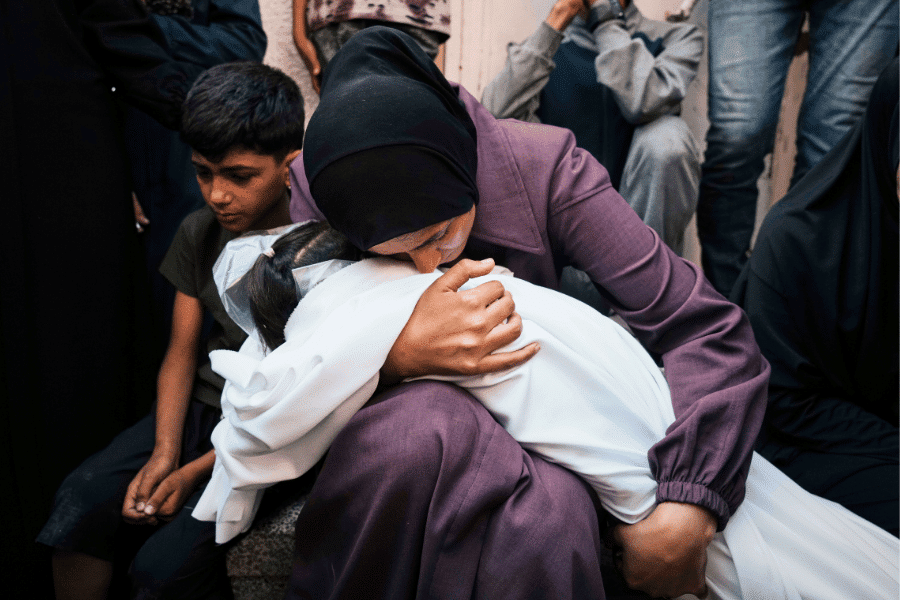
More than 54,000 people, including more than 16,000 children, have been killed since the war began, according to Gaza Health Ministry figures considered reliable by the United Nations, or 2.5% of the population — equivalent to 8.5 million Americans.
This number does not count many thousands whose bodies may still lie under the rubble, or who died weakened by hunger, preventable diseases and failing health care. It includes more than 1,400 health workers and more than 200 journalists and media workers.
United Nations officials say more than 90% of homes have been destroyed or damaged, along with 94% of Gaza’s 36 hospitals, with only some still struggling to function. Gaza has the world’s highest number of child amputees per capita.
According to Hans Laerke, spokesman for the U.N. Office for the Coordination of Humanitarian Affairs, Gaza is also the only territory in the world where “100% of the population is threatened with famine” despite Israel’s denial of any humanitarian blockade.
The horrors endured by Palestinians have been documented by local journalists (Israel has banned all international reporters from Gaza), U.N. officials, Palestinian and foreign doctors and aid workers, as well as locally shot videos and photos.
Foreign physicians with long experience of many countries ravaged by war say conditions they witnessed in Gaza are worse than anything they have ever encountered.
“I have worked in conflict zones from Afghanistan to Ukraine,” said U.S. paediatrician Seema Jilani, after an assignment in the southern city of Rafah for the International Rescue Committee. “But nothing could have prepared me for a Gaza emergency room.”
No one can plausibly claim “we did not know” what was, and is, going on.
Yet world powers have largely stood by as massacres unfold in Gaza. They have kept equally silent as Israel batters parts of Lebanon at will despite a ceasefire with Hezbollah militants agreed in November. Israel has also grabbed more land in Syria and bombed hundreds of targets there since Bashar al-Assad’s regime fell in December.
U.S. President Donald Trump, like President Joe Biden before him, has backed Israel to the hilt. Not even images of emaciated children in Gaza have prompted a change of heart.
Trump’s own contempt for international law and his plan for the removal of Gazans to allow for a fantasy reconstruction on the toxic ruins of their land has only emboldened far-right Israeli leaders with ambitions to “purify”, annex and resettle Gaza, and to do likewise in the West Bank, where half a million Israeli settlers already live.
Israel’s actions, under permissive Western eyes, are shredding a longstanding international consensus on a two-state solution to the Israeli-Palestinian conflict – an idea incompatible with an ever-expanding Israeli grip on the West Bank and Gaza.
After French President Emmanuel Macron called for recognition of a Palestinian state, Defence Minister Israel Katz responded with brutal clarity.
“They will recognise a Palestinian state on paper — and we will build the Jewish-Israeli state on the ground,” he said in the West Bank on May 29 at one of 22 new settlements just approved by the Israeli government.
Western outrage at Russia’s invasion of Ukraine has no echo when it comes to Israel which for decades has defied U.N. resolutions and violated international law.
The fate of Gaza may prove a final blow to the rules of international conduct and treatment of civilians agreed after the Second World War — a system already frayed by the Cold War and more recently the illegal U.S.-British invasion of Iraq in 2003.
Crushing the Palestinian people will not make Israel any safer in the long run. Only a true peace settlement on a basis of mutual respect and equality can do that.
If Western nations ever get around to imposing sanctions on Israel and its leaders, they should do so to promote the Jewish state’s real interests which they claim to have at heart — as a stepping stone to such a peace between human beings.
The German-born Jewish-American philosopher and political scientist Hannah Arendt foretold the consequences for a society unable to perceive others as human.
“The death of human empathy is one of the earliest and most telling signs of a culture about to fall into barbarism,” she wrote.
1. Is it justified, or wise, for a state to take revenge on its enemies?
2. Do people everywhere have the right to resist occupation?
3. How should we react when a possible genocide is taking place?
The recent HEPI report (number 185), ‘There was nothing to do but take action’: The encampments protesting for Palestine and the response to them, by Josh Freeman, provides a thoughtful, detailed account of the pro-Palestinian student protests that took place during summer 2024 on many British university campuses. “Peak camp” occurred in May 2024, when Freeman’s research shows that activity was taking place at 36 institutions, tailing-off to almost zero by mid-August – although when I last looked, a SOAS student presence remained tucked-up against the wall of the University Church on Byng Place, braving Bloomsbury winter weather, and would perhaps meet Freeman’s definition of an encampment as consisting of “some form of (temporary) structure”.
Freeman’s report focuses mainly on student motivations and on the interactions between students and the administrations of their universities, and is well worth studying to consider how any future student actions might best be handled. There is, though, a particular point for those interested in the structures of UK higher education that emerges clearly from the list Freeman provides of the institutions whose students set up pro-Palestinian encampments during 2024. Of the 36 universities involved, 21 of them were Russell Group institutions (out of a Russell Group membership of 24 – the missing ones were Glasgow, Queen’s University Belfast, and Southampton). Of the remaining 15 universities which had encampments, all except four were pre-1992 institutions (the four being University of the Arts London, Falmouth, Lincoln, and Portsmouth).
What explains the concentration of encampments at “old” universities, with a particular focus on the high-tariff Russell Group ones? Only Portsmouth represents the universities that emerged from the polytechnics. Freeman (in a recent exchange) suggests that having a politically-engaged student community was the key factor – but that of courses raises the question of why that should be found in older-established universities: institutional age itself can hardly be crucial, when many post-’92 universities can trace the histories of predecessor institutions over the last century or more. Freeman also wonders about support from the local community: he suggests that this may have been a factor in the concentration of activity in London – although it was apparently absent at Glasgow University, despite the city having Scotland’s largest concentration of Muslims.
Does a class-based analysis help here? Are students at Russell Group (or Russell-ish) universities, coming predominantly from relatively better-off families, more likely to be politically engaged than those at less-prestigious institutions, even in the same city? And not only more engaged, say in the sense of supporting a political party, but being prepared to take direct action in support of a cause? And even further, when it comes to action, having an expectation that “they” will listen and do something as a result: Freeman lists the motions passed by student bodies calling for university boycotts of Israel and disinvestment as well as wider calls for a Gaza ceasefire and “solidarity” with Palestine. Student politicians have long been attracted to wide-ranging demands for global change, of course, and the Palestinian cause is simply the most recent crisis on which to focus, but the current institutional basis of student activism is striking.
Whatever the explanation, Freeman’s work has shown up, in I think an unexpected way, the rather sharp divisions that seem to exist across UK higher education, ones not always apparent to the casual observer.
(This blog reflects discussion with Michael Shattock and Josh Freeman; I’m grateful for their thoughts.)
PS The Russell Hotel no longer exists – it is now called the Fitzroy, disappointingly not commemorating the Captain of the Beagle and the inventor of the weather forecast, but its architect.
Dr Paul Temple is Honorary Associate Professor in the Centre for Higher Education Studies, UCL Institute of Education.
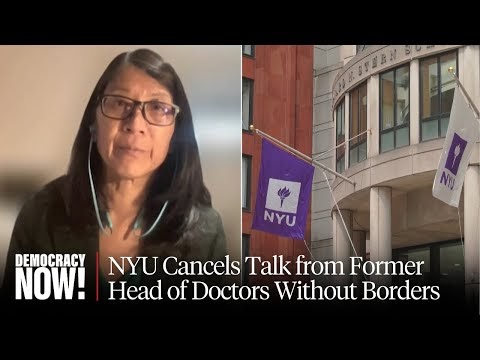
The former international head of Doctors Without Borders is speaking out after New York University canceled her presentation, saying some of her slides could be viewed as “anti-governmental” and “antisemitic” because they mentioned the Trump administration’s cuts to foreign aid and deaths of humanitarian workers in Israel’s war on Gaza. Dr. Joanne Liu, a Canadian pediatric emergency medicine physician, was scheduled to speak at NYU, her alma mater, on March 19 and had been invited almost a year ago to discuss the challenges of humanitarian crises. Censoring speech is “killing the essence of what the university is about,” says Liu. “I truly and strongly believe that universities are the temple of knowledge.”
U.S. President Donald Trump views Israel’s war on Gaza through the eyes of the real estate developer he was before he entered politics.
“We have an opportunity to do something that could be phenomenal,” he said at a joint news conference with Israeli Prime Minister Benjamin Netanyahu on 4 February. “And I don’t want to be cute. I don’t want to be a wise guy. But the Riviera of the Middle East.”
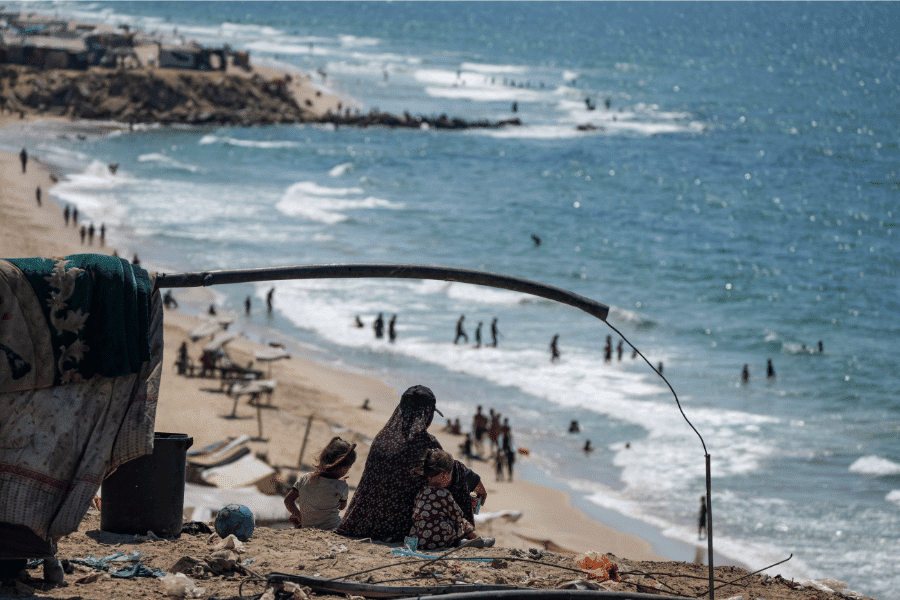
He was talking about the possibility of forcing 2.2 million Palestinians from Gaza to make place for “the Riviera of the Middle East.”
Elaborating the idea in social media posts and interviews, the U.S. president left no doubt that he saw one of the world’s most complex problems — the Israeli-Palestinian conflict — as a real estate deal.
Trump explained that the United States could take over Gaza, a place where tens of thousands of people have been killed by Israeli air strikes and ground troops over the past 16 months.
Israel has pummelled Gaza ever since 7 October 2024 when gunmen from the militant Hamas group stormed across the border, killed 1,200 Israelis and took more than 250 people hostage.
“I do see a long-term ownership position and I see it bringing great stability to that part of the Middle East and maybe the entire Middle East,” Trump said. “We’re going to take over that piece and we’re going to develop it, create thousands and thousands of jobs. And it will be something that the entire Middle East can be very proud of.”
To make that possible, the people now living in the future Riviera must leave, possibly to neighbouring Jordan or Egypt, he said.
Leaders of both countries have rejected that idea, as has the Arab League, the Secretary General of the United Nations, Antonio Guterres and a host of human rights groups.
Conspicuously absent from statements by Trump and officials of his administration was the matter of international law.
The forced deportation of civilians is prohibited by an array of provisions of the Geneva Conventions which the United States has ratified.
Forced deportation has been considered a war crime ever since the Nuremberg Trial of Nazi officials.
The International Criminal Court lists the kind of forcible population transfer visualized by Trump’s Riviera of the Middle East plan as both a war crime and a crime against humanity. (The United States is not a member of the court because it never ratified the Rome Statute on the court’s establishment).
The legal and geo-political arguments triggered by Trump’s controversial proposal often leave out the collective trauma that shapes the Palestinians’ national identity and political aspirations.
That trauma dates back to the violence preceding the establishment of the state of Israel in 1948, more than 50 years after an Austrian Jew, Theodor Herzl, published a book (Der Judenstaat) that inspired the Zionist movement.
An estimated 700,000 Palestinians fled or were expelled from what is now Israel during the war between Zionist paramilitary fighters of the Haganah, the forerunners of today’s Israeli Defence Force, and regular soldiers of six Arab countries.
Palestinians call that forced exodus the Naqba (the catastrophe). At the time, many expected to return to their homes once the fighting was over.
A resolution by the U.N. General Assembly seven months after the formal establishment of Israel provided for a right of return for those who fled. A General Assembly resolution in 1974 declared the right to return an “inalienable right.”
Like all General Assembly resolutions, the 1948 vote was not binding, but it was explicit: “Refugees wishing to return to their homes and live at peace with their neighbours should be permitted to do so at the earliest possible date and that compensation should be paid for the property of those choosing not to return…”
Neither happened but the concept that those who left had a right to return has lived on for four generations, with hopes fading gradually but not entirely. There are still families who keep as heirlooms keys to the houses they fled in the turmoil of the Naqba.
This history helps explain why today’s Palestinians in Gaza take seriously Trump’s proposal to resettle them all and their fear that any resettlement would result in permanent exile.
Trump’s “Riviera” proposal came as a surprise, apparently even to Netanyahu who stood next to him at the press conference. But it appears to have been a subject of discussion inside the Trump family for some time.
At an event at Harvard university in February 2024, Trump’s son-in-law, Jared Kushner, mused about the untapped value of the Gaza strip and its beautiful beaches. “Gaza’s waterfront property, it could be very valuable, if people would focus on building up livelihoods,” Kushner said.
He did not specify which people would do the building but his father-in-law appears to be determined that it would not be the people now living there.
Who, then? It’s one of many questions yet to be answered in the era of Trump 2.0.
• What is one problem Trump will have if he wants the United States to take over Gaza?
• Why do many Palestinians take Trump’s threat of relocation seriously?
• What makes the idea that people have the right to return to homes their ancestors were force out of complicated?

On February 10, 2025, students and activists gathered at the CUNY College Board of Trustees Public Hearing to demand divestment. Rabbi Dovid Feldman stood in solidarity with the students, supporting their call for justice and urging them not to be intimidated by false Zionist accusations.
This powerful moment highlights the growing movement for divestment and the unwavering courage of those standing up for what is right. The rallying cry was clear: “Divest! We will not stop; we will not rest!”