Category: Parents

  • PRINCIPAL VOICE: Inviting families into our classrooms slashed absenteeism and raised reading levels

    PRINCIPAL VOICE: Inviting families into our classrooms slashed absenteeism and raised reading levels

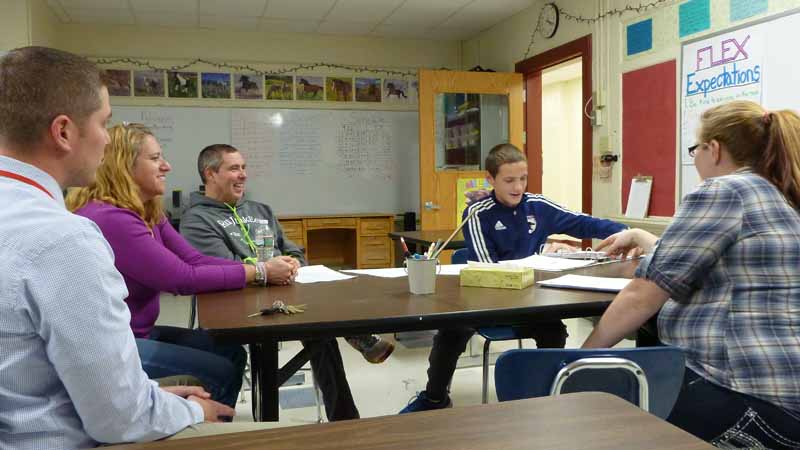
    Two years ago, I bought each of the teachers at Hamilton Elementary in San Diego’s City Heights neighborhood a blue chair. I told them to put it in the back of their classrooms, and that if a parent or caregiver wanted to visit to see how their children are learning — no matter what the reason — that this would be a dedicated space for them.

    I may have earned some exaggerated eye-rolls from educators that day. After all, I can appreciate the disruption to learning that classroom visitors can sometimes cause, especially among excitable elementary schoolers.

    But school is our home, and it is our responsibility to invite families into our home and welcome them. And this was a necessary olive branch, my way of saying to families: “From here on out, things are going to be different.”

    And they were. They also can be different at other schools, because the benefits of family engagement go well beyond student achievement.

    Related: A lot goes on in classrooms from kindergarten to high school. Keep up with our free weekly newsletter on K-12 education.

    Research has long shown that when parents and caregivers are involved and engaged with their children’s education — whether that’s by attending parent-teacher conferences or participating in school events — student achievement, motivation and social-emotional well-being increase.

    Parent involvement with reading activities has a positive impact on reading achievement, language comprehension, expressive language skills and level of attention in the classroom, according to the National Literacy Trust.

    Research also shows that educators enjoy increased job satisfaction and are more likely to keep teaching at the school, families enjoy stronger relationships with their children and feel less isolated, and even school districts themselves become better places to live and raise children.

    None of this was the case when we returned to normalcy following Covid. Just 13 percent of students were reading on grade level, and 37 percent were chronically absent. I knew right away that before we even attempted to tackle academics, we needed to engage families and make them feel deeply connected and committed to the community I envisioned building here.

    Today, 45 percent of students are reading at grade-level, and chronic absenteeism, at 12 percent on the most recent official numbers, is down to 10 percent in our own tracking, with a goal of pushing it down to 8 percent in 2025-26.

    But it wasn’t easy given the distrust that had boiled over during the pandemic, with families skeptical of our ability to effectively support their children and school staff feeling defensive and exhausted.

    It was clear to me that families weren’t excited to send their kids to school, didn’t feel informed about what was happening on our campus and, moreover, didn’t feel comfortable — let alone capable — of communicating their needs to us.

    Complicating matters further was the need to share information across many languages other than English, which can make relationship-building and communicating expectations difficult.

    Roughly half of our students are English learners, and while the majority of their families are Spanish-speakers, there are growing populations of students whose first languages are Haitian-Creole, Pashto and Vietnamese.

    Related: What the research says about the best way to engage parents

    The first thing I did was establish open communication with parents using ClassDojo, a mobile app that gives families an easy, intuitive central access point to our teachers and staff, automatically translates all messages into parents’ native languages and allows us to share stories about what is happening in school.

    It became an easy way to build trust and collaboration between families and staff.

    Creating that type of visibility was key to breaking down walls between us. And in those early days, we didn’t post about literacy, math or anything related to academics. Instead, we focused solely on attendance and getting families to come inside the school as much as possible.

    We focused on relationship-building activities and joyful learning. We hosted after-school art classes and monthly family Fridays, when families could come to school to engage in a fun activity.

    We organized a Halloween costume drive with candy and fun games for kids; we hosted a Read Across America event where we passed out Play-Doh; and we organized other low-stakes events at school, rooted in building a partnership between home and school.

    Again, our goal wasn’t learning during these meet-ups. It was all in service of building trust and creating meaningful relationships with students and their families.

    Once we had the foundation in place, we added a focus on academics — though we rooted that learning in family engagement, too. For example, our schoolwide focus last year was phonics, so we sent activities home for families to complete with their children that were tied specifically to concepts the students needed reinforced, based on their individual assessments, like long vowel patterns and sight words.

    These activities were taught by the students and their teachers to family members during conferences.

    Beyond helping students, the exercise challenged a false narrative so many families had assumed — that they either didn’t know enough about what was happening in school to help, weren’t confident enough to help or didn’t have enough time.

    Today, the atmosphere at Hamilton feels radically different than when I first walked through the doors. When we first started hosting Family Fridays, about 10 family members and their children showed up.

    Now, we have roughly 200 caregivers at every meet-up. Families run most of the community-based initiatives at the school — from a boutique where families can shop among donated clothes twice a month, to a food distribution center, to a book club, English classes and a monthly meet-up where families can socialize.

    When district leaders visit, they’re always impressed by the participation. I tell them, if you care about family engagement, it has to be so deeply embedded into the system that people don’t have a choice but to do it.

    That’s why I’m constantly thinking about how to center family engagement in staff meetings, in attendance meetings, in literacy and math plans, in behavioral and counseling plans and in meetings about school procedures and budgets.

    It’s a strategy that not only involves families but also supports academic achievement and student well-being. For me, family engagement is the ultimate strategy for academics.

    Sometimes in the K-12 world we keep outreach and academics separate, but in reality, engagement is the key that unlocks our ability to hit academic goals and create a joyful school community.

    Dr. Brittany Daley is the principal of Hamilton Elementary School in San Diego, California.

    Contact the opinion editor at [email protected].

    This story about family engagement was produced by The Hechinger Report, a nonprofit, independent news organization focused on inequality and innovation in education. Sign up for Hechinger’s weekly newsletter.

    The Hechinger Report provides in-depth, fact-based, unbiased reporting on education that is free to all readers. But that doesn’t mean it’s free to produce. Our work keeps educators and the public informed about pressing issues at schools and on campuses throughout the country. We tell the whole story, even when the details are inconvenient. Help us keep doing that.

    Join us today.

    Source link

  • Family Structure Matters to Student Achievement. What Should We Do With That? – The 74

    Family Structure Matters to Student Achievement. What Should We Do With That? – The 74


    Get stories like this delivered straight to your inbox. Sign up for The 74 Newsletter
    A version of this essay originally appeared on Robert Pondiscio’s SubStack

    A recent report from the University of Virginia—Good Fathers, Flourishing Kids — confirms what many of us know instinctively but rarely see, or avoid altogether, in education debates: The presence and engagement of a child’s father has a powerful effect on their academic and emotional well-being. It’s the kind of data that should stop us in our tracks — and redirect our attention away from educational fads and toward the foundational structures that shape student success long before a child ever sets foot in a classroom.

    The research — led by my AEI colleague Brad Wilcox and co-authored by a diverse team that includes another AEI colleague, Ian Rowe — finds that children in Virginia with actively involved fathers are more likely to earn good grades, less likely to have behavior problems in school, and dramatically less likely to suffer from depression. Specifically, children with disengaged fathers are 68% less likely to get mostly good grades and nearly four times more likely to be diagnosed with depression. These are not trivial effects. They are seismic.

    Most striking is the report’s finding that there is no meaningful difference in school grades among demographically diverse children raised in intact families. Black and white students living with their fathers get mostly As at roughly equal rates — more than 85% — and are equally unlikely to experience school behavior problems. The achievement gap, in other words, appears to be less about race and more about the structure and stability of the family.

    Figure 9 from Wilcox et al., Good Fathers, Flourishing Kids

    This may be a surprising finding to some, but not to William Jeynes, a professor of education at California State University, Long Beach, whose meta-analyses have previously demonstrated the outsized academic impact of family structure and religious faith. (The new UVA report does not study the role of church-going). 

    As I wrote in How the Other Half Learns, Jeynes’ work highlights how two-parent households and religious engagement produce measurable benefits in educational achievement. “When two parents are present, this maximizes the frequency and quality of parental involvement. There are many dedicated single parents,” Jeynes has noted. However, the reality is that when one parent must take on the roles and functions of two, it is simply more difficult than when two parents are present.” Jeynes’ most stunning finding, and his most consistent, is that if a Black or Hispanic student is raised in a religious home with two biological parents the achievement gap totally disappears—even when adjusting for socioeconomic status.

    My colleague Ian Rowe has been a tireless advocate for recognizing and responding to these patterns. He has long argued that NAEP, the Nation’s Report Card, should disaggregate student achievement data by family composition, not just by race and income. That simple step would yield a more honest accounting of the challenges schools are facing — and help avoid both unfair blame and unearned credit.

    Yet this conversation remains a third rail in education. Many teachers and administrators are understandably wary of saying too much about family structure for fear of stigmatizing children from single-parent households, particularly in settings where single-parent households are dominant. Rowe has also faced resistance to his efforts to valorize the “Success Sequence,” the empirical finding that graduating high school, getting a full-time job and marrying before having children dramatically increases one’s odds of avoiding poverty. But being cautious is not the same as being silent, and it’s not compassionate to pretend these dynamics don’t matter when the data so clearly shows that they do.

    None of this absolves educators of their duty to reach and teach every child. But it does suggest we should be clear-eyed in how we interpret data and set expectations. Teachers, particularly those in low-income communities, often shoulder the full weight of student outcomes while lacking the ability to influence some of the most powerful predictors of those outcomes. That’s frustrating — and understandably so.

    Citing compelling evidence on fatherhood and family formation is not a call for resignation or excuse-making. It’s a call for awareness and intelligent action. While schools can’t influence or re-engineer family structure, teachers can respond in ways that affirm the role of fathers and strengthen the school-home connection. They can make fathers feel welcome and expected in school life — not merely tolerated. They can design family engagement activities that include dads as co-participants, not afterthoughts. They can build classroom cultures that offer structure and mentoring, especially to students who may lack it at home. 

    And maybe — just maybe — the field can overcome its reluctance to share with students what research so clearly shows will benefit them and the children they will have in the future. Rowe takes pains to note his initiative to teach the Success Sequence is intended to help students make decisions about the families they will form, not the ones they’re from. “It’s not about telling them what to do,” he says, “it’s about giving them the data and letting them decide for themselves.”

    This leads to a final point, and for some an uncomfortable one: If we truly care about student outcomes, perhaps we should be willing to support the institutions that reliably foster them. And that includes religious schools.

    Religious schools — particularly those rooted in faith traditions that emphasize marriage, family life and moral formation — often create environments where the presence of fathers and the reinforcement of shared values are not incidental but central. A recent analysis by Patrick J. Wolf of the University of Arkansas, published in the Journal of Catholic Education, found that adults who attended religious schools are significantly more likely to marry, stay married, and avoid nonmarital births compared to public‑school peers. The effects are most pronounced among individuals from lower‑income backgrounds.

    In states with Education Savings Accounts (ESAs) and other school choice mechanisms, we have an opportunity — perhaps an obligation — to expand access to these institutions. That’s not merely a question of parental rights or religious liberty. It’s a matter of public interest. If these schools produce better education and social outcomes by encouraging family formation and reinforcing the value of fatherhood, the public benefits — even if instruction is delivered in a faith-based context. Said simply: The goal of educational policy and practice is not to save the system. It’s to help students flourish.

    So yes, let’s fund fatherhood initiatives. Let’s run PSAs about the importance of dads. But let’s also get serious about expanding access to the kinds of schools — whether secular or religious in nature — that support the kind of family culture where children are most likely to thrive. Because if we follow the evidence where it leads, we must conclude that the biggest intervention in education is not another literacy coach or SEL curriculum. It’s dad.


    Get stories like these delivered straight to your inbox. Sign up for The 74 Newsletter

    Source link

  • Maine Parents, Educators Describe Trauma from Restraint and Seclusion – The 74

    Maine Parents, Educators Describe Trauma from Restraint and Seclusion – The 74


    Get stories like this delivered straight to your inbox. Sign up for The 74 Newsletter
    Krystal Emerson never imagined her son would spend his days at school being forcibly moved against his will by school staff and shut in an empty room.

    But during the 2023-24 school year at Ellsworth Elementary-Middle School, that’s what happened — at least 18 times, according to Emerson and school district incident reports reviewed by the Maine Morning Star. Staff members put the 7-year-old boy in holds, forced him into empty rooms and did not let him out until he calmed down or his parents picked him up.

    “It broke him, and it broke me,” Emerson said.

    The trauma became so severe that her son, now a third grader, no longer attends school in person, she said.

    What happened to Emerson’s son is not an isolated case. Across Maine, schools use restraint and seclusion on students more than 10,000 times each year, according to Maine Department of Education data — with some districts resorting to the emergency tactics regularly while others have changed policies and taken other steps so that such interventions are only used as a last resort.

    ​In recent years, Maine as a whole has made an effort to reduce restraint and seclusion in schools, particularly for students with disabilities, with the U.S. Department of Education citing staff and student injuries and the resulting trauma for students as the reasons to curtail their use. The department has also condemned and discouraged these practices for years under multiple presidential administrations. Rare cases have resulted in serious injuries to students and even death.

    A 2021 state law limits restraint and seclusion to emergencies. But as Maine educators report more challenging student behavior in the years since pandemic school closures, there have been calls to allow school staff to restrain and seclude children more often. A newly proposed bill would broaden the circumstances under which school staff could restrain or seclude students, igniting debate among educators, parents and lawmakers about how to manage student behavior without inflicting harm.

    The Maine Education Association and the Maine School Management Association, representing teachers and administrators statewide, both support the proposal, citing increased reports of disruptive and violent student behavior — something educators nationwide have also reported in recent years.

    The Gardiner-area school system, Maine School Administrative District (MSAD) 11, has led the push for that proposal. Victoria Duguay, principal of River View Community School in Gardiner, and MSAD 11 Superintendent Patricia Hopkins shared stories with lawmakers of students who hit and spit at adults, scream in hallways, throw chairs and destroy other students’ schoolwork.

    Under the 2021 state law, school staff can only restrain students (immobilize them and move them against their will) or seclude them (isolate them in a room that they can’t leave) if their behavior “poses an imminent danger of serious physical injury” — requiring medical intervention beyond first aid, according to the Maine Department of Education regulations that govern restraint and seclusion.

    “Staff are being hit, they’re being bit, but it doesn’t meet the threshold of serious imminent danger, because a 5-year-old isn’t going to [cause] an injury that requires medical care,” Hopkins said during an April 23 public hearing.

    This extreme behavior, when it happens in a public place at school, traumatizes other students who witness it, Duguay said. The school sometimes has to close off access to common spaces — the gym or cafeteria — if a student acts out in a hallway through which students would need to pass.

    Under the legislation MSAD 11 is supporting, staff would be able to move students against their will to a seclusion room or another quiet space without it counting as a restraint, which districts have to record, document, and report to the state.

    But some educators who have pursued alternative training don’t agree that loosening restraint and seclusion requirements is the answer.

    “The consequences of passing this bill will only inflict more trauma on students,” said Audrey Bartholomew, associate professor and coordinator of special education programs at the University of New England, who trains special education teachers. “Additionally, the behavior will keep happening, because restraint and seclusion is not an appropriate response to challenging behavior, and it will in no way help students remediate their behavior. These should not be referred to as strategies, treatments or solutions.”

    Inside the three-hour restraint and seclusion of a 7-year-old

    In October 2023, Emerson’s son started a behavior plan to help with concentration and self-regulation. The plan, which Emerson shared with the Maine Morning Star, highlighted the mother’s concerns about her son’s anger, dysregulation, anxiety and ADHD, and noted Emerson’s finding that occupational therapy had helped her son better regulate.

    One week after the plan was put into place, the boy arrived at Ellsworth Elementary-Middle School already agitated, hit another student with a Pete the Cat stuffed animal and tried to leave the classroom, setting off a series of escalating interventions in which staff physically restrained him, relocated him against his will, and ultimately placed him in a small room where he stayed until his father arrived, according to incident reports shared with the Maine Morning Star.

    The reports, which staff or administrators are required to write, offer an inside look at the behavior leading up to the restraint, how the situation escalated as staff restrained and secluded the boy, and how it continued for three hours, ending when Seth Emerson picked his son up from a seclusion room.

    When the second grader initially tried to leave his classroom, two educators cornered the boy in a hallway nook, according to the report written by the school’s assistant principal. When he tried to push past them, they placed a mat between themselves and the child to block him from hitting them, and initiated the first of several physical holds. Each time he was released, he briefly calmed down but didn’t follow directions to sit still or stay in a designated spot, prompting a cycle: he would attempt to flee, staff would block him, the boy would resist, and staff would restrain him again, the report says.

    About an hour in, while hiding in a locker, he asked to go home. A staff member moved him to a classroom, where he hid under a desk, retrieved rocks from his backpack, and threw them at staff, the report said. While the report described the projectiles as rocks, Emerson said her son had pebbles in his backpack.

    Two hours in, staff called his parents. Even after he calmed down, they placed him in a seclusion room — referred to as a “quiet room” in the report — where they continued telling him to sit in a specific spot. When his father arrived, the boy walked out on his own, calm and cooperative.

    Incidents like that continued for several more months for reasons that Emerson said did not warrant these measures: After he pulled books off shelves, punched a door, or refused to accompany staff to a quiet room, staff would put him in a physical hold or placed him in a room alone, according to a complaint Emerson filed with the district.

    “I never condoned any of the behavior, whether he was throwing a book or whether he was yelling or running out of the classroom,” she said. “But he was not getting any education whatsoever last year. He was literally just going to school and being restrained and secluded.”

    Frequent seclusions push an educator to quit

    It’s not only students and their families who feel the trauma from restraints and seclusion. The educators who are told to put their hands on children feel it, too, several current and former teachers and education technicians told the Maine Morning Star.

    Ashley Rose took a job as an ed tech at SeDoMoCha Elementary School in Dover-Foxcroft in August while working toward a degree in special education. But after months of witnessing staff placing students in empty rooms as they screamed and cried to be let out, she changed course.

    In March, Rose switched her major, deciding she no longer wanted to become a teacher. On April 28, she resigned, writing to Superintendent Stacy Shorey that she had repeatedly raised concerns with supervisors about the school’s frequent use of seclusion, the lack of staff training on student behavior, and the absence of alternatives — without seeing meaningful change.

    SeDoMoCha Elementary School has “quiet rooms” located within special education classrooms — which Rose described as 10-by-6-foot rooms with no windows. Some have benches and one light, while others are entirely empty, she said. All the doors have windows in them so staff can monitor students.

    In her 10 years of working in special education, she has never seen such frequent use of quiet rooms, Rose said.

    In December, Rose found herself participating in her first seclusion. The student she was working with wasn’t physically aggressive, just loud, and Rose’s plan had been to escort her into the special education classroom — not the quiet room — to help her calm down.

    The student went with her voluntarily but was crying, she said. When they got to the classroom, another staff member who had worked at the school longer said it was part of that student’s behavior plan to go to the quiet room.

    “That wasn’t my plan,” Rose said. “That room scares me just looking at it as an adult.”

    As the student became more agitated, Rose said her own anxiety rose. If the student didn’t calm down, the other employee told Rose she had to shut the door. Rose complied, and then her colleague told her to hold the door shut with her foot to keep the student inside, she said.

    Inside the room, the student began having what appeared to be an anxiety attack and threatened to break the window. She calmed down after about 20 minutes, and Rose let her out. Rose said she was not directed to file an incident report, nor was she told if someone else in the district did, despite the requirement in state law that districts document every seclusion.

    Over the holiday break that followed, Rose said she had trouble sleeping. “All I can think about is the student I put in that room,” she said. “School should be their safe place, and these students were not feeling safe.”

    Shorey, the superintendent, said staff members are required to report every incident, but she did not know about the particular incident Rose described. Special Education Director Sue Terrill said it’s possible that a staff member other than Rose wrote a report, but the district was unable to locate any documentation of that event.

    The district trains employees in safety care — crisis management and prevention practices — Terrill said. It is open to other trainings, too, she said, including one that Rose brought to Terrill’s attention in February offered by the Maine nonprofit Lives in the Balance, which other districts have used to dramatically reduce their reliance on restraint and seclusion.

    Quiet rooms present a gray area

    Rose said she saw staff members keep students in seclusion rooms even when they were calm, using those same rooms for a variety of reasons beyond seclusion, which is banned or strictly regulated in at least seven states, according to the MOST Policy Initiative, a Missouri nonprofit. Maine came close to banning the rooms in 2021, but the final version of the law was amended to allow their use in emergencies.

    Rose said she saw staff place students in quiet rooms to calm down after acting out, and then not allow them to exit for 20 minutes after they calmed down. If the seclusion happened at the end of the school day, sometimes the student would be expected to return to the quiet room the next day, she said.

    Terrill recalled Rose raising this as an issue but denied keeping students in the rooms after they calmed down and no longer met the legal threshold for confinement.

    But the district does use these rooms as timeout spaces, either by student choice or by staff direction, Terrill confirmed. Often, Terrill said, staff members are positioned outside the rooms, as they would be in a seclusion incident, but the student is typically free to leave the room, which is not the case in a seclusion.

    Sometimes, the door is open, or a student can choose to shut the door with a staff member standing outside, she said.

    “It can be the same room used if the student was in seclusion,” she said. “But if they’re taking a break because of something that happened, and that’s being used as a break space, the student might continue to work in there until they’re ready to go back to the classroom.”

    Like RSU 68 in Dover-Foxcroft, districts across Maine also use seclusion rooms as quiet spaces, according to Ben Jones, a former Disability Rights Maine attorney who now works for Lives in the Balance.

    “I think it’s actually more the rare case that the school is like, ‘We’re going to build this room and we’re going to call it the seclusion room, and it’s going to be used just for seclusion,’” he said.

    If a student has voluntarily shut themselves in the seclusion room with a staff member outside and is free to go at any time, it would not count as seclusion under Maine law, he said. But if staff members ask students to stay in there to complete their work, as Rose described, whether it would count as a seclusion that districts are required to report to the state is “open to interpretation,” Jones said.

    “The overall thing is, the kid is not learning, not in the classroom, in something that could easily turn into seclusion,” he said. “It’s inappropriate at best and potentially illegal if it’s an unrecorded seclusion.”

    When are students and staff in “imminent danger”?

    Education technicians like Rose — aides who often work with students one-on-one or in small groups — are often the ones handling student outbursts or potential violence, said Greg Kavanaugh, who spent 13 years working as an ed tech and special education teacher in Biddeford, Portland, and Yarmouth.

    Ed techs are among the lowest-paid professionals in education, and often the least trained — including on behavior management techniques.

    “They’re having to make good decisions about when to restrain, when to seclude, and their judgment is going to be really hard because they’re so stressed, overwhelmed, underpaid,” Kavanaugh said. “That just leads to more mistakes, more lapses in judgment.”

    In his experience, Kavanaugh said, restraint and seclusion were consistently treated as last-resort measures — used only in extreme situations.

    Staff received training on managing student behavior, they debriefed after restraints and seclusions, and they held regular conversations with parents, he said, which disability rights advocates recommend as best practices.

    But working in a functional life skills program with students with moderate to severe disabilities, Kavanaugh said, deciding whether to restrain or seclude a child was never easy despite clear protocols in place. Even when a student threw a laptop across the room or hit him, he had to determine whether the behavior posed an imminent danger of serious injury that would require medical intervention beyond first aid — the standard in Maine law — and only intervene physically if it did. He also had to keep calm if students hit him, he said, because that still did not meet the legal standard.

    Every time he did restrain or seclude a child, it stayed with him long after. He said he often questioned whether it had been the right call, thought about how families would respond, and considered the lasting effects the practice might have on the student — and on himself.

    “Anytime there was a hold, a restraint or a seclusion, you’re taking that home, and you’re thinking about that kid when you’re at home, trying to move on with your day,” he said. “I’m a pretty strong-willed person, but there are plenty of times I would quietly be in tears, or going home and having an extra glass of wine, because I’m just not processing it well in the aftermath.”

    Other students in the classroom witnessing these incidents are also traumatized, Kavanaugh said.

    “You see the terror on their classmates’ faces, and you feel bad for the kid in a certain way because this is going to hurt their relationships,” he said.

    But talking to parents afterward would always make him feel better, Kavanaugh said, because parents of students with disabilities are often dealing with similar behavior challenges at home.

    District response to a parental complaint

    Emerson, the parent in Ellsworth, complained to the school board, Superintendent Amy Boles, and the Maine Department of Education in August 2024, alleging that staff members had not met the legal threshold for using restraint and seclusion so often on her son.

    Boles wrote back in October, saying in cases where Emerson’s son was hitting, scratching, and kicking staff, “it is my conclusion that active behavior like this toward another person does create an ‘imminent danger’ that the other person could be sufficiently injured that he or she may need more than ‘routine first aid.’”

    “The incident may not in fact have caused an injury requiring that level of care, but a reasonable and prudent person could reasonably conclude that this could occur,” Boles wrote in her letter, reviewed by Maine Morning Star.

    But the investigation the district launched in response to Emerson’s complaint found that staff had improperly restrained and secluded her son in at least five of the 18 incidents to which his mother objected. Some incident reports were also vaguely written, Boles wrote, which was the case for the three-hour incident in October 2023 — making it difficult to determine whether restraints and seclusion were warranted.

    Nonetheless, Boles concluded in her letter to Emerson that all staff need training on the proper use of restraint and seclusion, and she agreed the district should rely on the practice less often.

    Boles declined to comment on the investigation or specific incidents, but said district staff have undergone an initial training with Lives in the Balance, and followup trainings are planned.

    “Behavior is an issue across the board. I mean, it’s skyrocketing everywhere. It’s not just Ellsworth,” she said. “But we’re working really hard to try to be preventative before it gets to that extreme state, trying to teach staff day-to-day strategies to prevent the behavior before it escalates.”

    Emerson said her son is still visibly shaken every time he passes by the school, or even when someone mentions the word “school” around him.

    On April 23, she testified at a public hearing, telling Maine lawmakers restraint and seclusion in public schools must stop. The day before, her son had said he was still afraid to go to school in person.

    “His world has become so small since these events, he rarely leaves our home,” she said. “Everyone continues about their day, and yet I’m left to pick up the pieces.”

    Maine Morning Star is part of States Newsroom, a nonprofit news network supported by grants and a coalition of donors as a 501c(3) public charity. Maine Morning Star maintains editorial independence. Contact Editor Lauren McCauley for questions: [email protected].


    Get stories like these delivered straight to your inbox. Sign up for The 74 Newsletter
    Source link

  • Book bans draw libraries into damaging culture wars that undermine their purpose

    Book bans draw libraries into damaging culture wars that undermine their purpose

    For the last four years, school and public libraries have been drawn into a culture war that seeks to censor, limit and discredit diverse perspectives.

    Yet time and time again, as librarians have been encouraged or even directed to remove books that include LGBTQ+, Black, Latino and Indigenous characters or themes or history from their collections, they have said no.

    When librarians said no, policy changes were submitted and laws were proposed — all in the name of controlling the library collection.

    Some librarians lost their jobs. Some had their lives threatened. Legislators proposed bills that attempt to remove librarians’ legal protections, strive to prevent them from participating in their national professional associations, seek to limit some materials to “adults only” areas in public libraries and threaten the way library work has been done for decades.

    Here’s why this is wrong. For generations, libraries have been hubs of information and expertise in their communities. Librarians and library workers aid in workforce development, support seniors, provide resources for veterans, aid literacy efforts, buttress homeschool families —among many other community-enriching services. Your public library, the library in your school and at your college, even those in hospitals and law firms, are centers of knowledge. Restrictions such as book bans impede their efforts to provide information.

    Related: Become a lifelong learner. Subscribe to our free weekly newsletter featuring the most important stories in education. 

    Professional librarians study the First Amendment and understand what it means to protect the right to read. We provide opportunities for feedback from our users so that they have a voice in decision-making. We follow a code of ethics and guidelines to make the best selections for our communities.

    It is illegal for a library to purchase pornographic or obscene material; we follow the law established by the Supreme Court (Miller v. California, 1973). That decision has three prongs to determine if material meets the qualifications for obscenity. If the material meets all three, it is considered obscene and does not have First Amendment protection.

    But our procedures have been co-opted, abused and flagrantly ignored by a small and vocal minority attempting to control what type of information can be accessed by all citizens. Their argument, that books are not banned if they are available for purchase, is false.

    When a book or resource is removed from a collection based on a discriminatory point of view, that is a book ban.

    Librarians follow a careful process of criteria to ensure that our personal biases do not intervene in our professional work. Librarians have always been paying attention. In 1939, a group of visionary librarians crafted the Library Bill of Rights to counter “growing intolerance, suppression of free speech and censorship affecting the rights of minorities and individuals.” In 1953, librarians once again came together and created the Freedom to Read Statement, in response to McCarthyism.

    You may see a similar censorship trend today — but with the advent of the internet and social media, the speed at which censorship is occurring is unparalleled.

    Much of the battle has focused on fears that schoolchildren might discover books depicting families with two dads or two moms, or that high school level books are available at elementary schools. (Spoiler alert: they are not.)

    Related: The magic pebble and a lazy bull: The book ban movement has a long timeline

    The strategy of this censorship is similar in many localities: One person comes to the podium at a county or school board meeting and reads a passage out of context. The selection of the passage is deliberate — it is meant to sound salacious. Clips of this reading are then shared and re-shared, with comments that are meant to frighten people.

    After misinformation has been unleashed, it’s a real challenge to control its spread. Is some subject matter that is taught in schools difficult? Yes, that is why it is taught as a whole, and not in passages out of context, because context is everything in education.

    Librarians are trained professionals. Librarians have been entrusted with tax dollars and know how to be excellent stewards of them. They know what meets the criteria for obscenity and what doesn’t. They have a commitment to provide something for everyone in their collections. The old adage “a good library has something in it to offend everyone” is still true.

    Thankfully, there are people across the country using their voices to fight back against censorship. The new documentary “Banned Together,” for example, shows the real-world impact of book banning and curriculum censorship in public schools. The film follows three students and their adult allies as they fight to reinstate 97 books pulled from school libraries.

    Ultimately, an attempt to control information is an attempt to control people. It’s an attempt to control access, and for one group of people to pass a value judgment on others for simply living their lives.

    Libraries focus on the free expression of ideas and access to those ideas. All the people in our communities have a right to read, to learn something new no matter what their age.

    Lisa R. Varga is the associate executive director, public policy and advocacy, at the American Library Association.

    Contact the opinion editor at [email protected].

    This story about book bans was produced by The Hechinger Report, a nonprofit, independent news organization focused on inequality and innovation in education. Sign up for Hechinger’s weekly newsletter.

    The Hechinger Report provides in-depth, fact-based, unbiased reporting on education that is free to all readers. But that doesn’t mean it’s free to produce. Our work keeps educators and the public informed about pressing issues at schools and on campuses throughout the country. We tell the whole story, even when the details are inconvenient. Help us keep doing that.

    Join us today.

    Source link

  • The paradox of parents’ involvement in their children’s time at university

    The paradox of parents’ involvement in their children’s time at university

    Over the past few decades, there has been – as many an academic will attest – a significant shift in the extent to which parents are involved in their children’s higher education.

    Parents now often attend university open days with their children, with some institutions laying on separate talks and events for them. Moreover, despite the introduction of tuition fees and maintenance loans, many parents end up making some financial contribution to their child’s higher education.

    To date, however, we know relatively little about parents’ perspectives on their involvement, nor about the extent to which they support their children in non-financial ways once they have embarked on their higher education journey. Research that I have recently completed (with Julia Cook and Dan Woodman) on parents of Australian higher education students may be transferable to the UK, given the similarities between the two higher education systems and social structures more generally.

    Drawing on data from the longitudinal Life Patterns project, which has been following the lives of young Australians since the 1990s, we asked parents with children in higher education – or shortly to enrol – a series of questions about the support, if any, they were offering their children, as well as whether they felt parents should be supporting their children in any particular ways. Their responses were fascinating.

    Independence and intervention

    Nearly all of those we spoke to believed that higher education was a space in which young people learned how to be independent – and it was this that helped to distinguish it from school. University was typically positioned as a space where their children would “fend for themselves”, engage in “adult learning”, and be accountable for their own actions.

    However, while there was a strong rhetorical commitment to higher education as a time of achieving independence, when describing the detail of their parenting practices our participants outlined a wide range of ways in which they had been closely involved in the lives of their student children (or thought a parent should be), providing high levels of practical and emotional support.

    All of those we interviewed were either already providing financial support to their offspring at university, or they had clear plans to do so when their children enrolled. In addition, they either had already spent, or thought it was desirable to spend, considerable time with their children supporting them through any problems they encountered during their studies. This differed between participants but often included “coaching” approaches, to help the child identify the root cause of problems; strong encouragement to take advantage of the various services available on campus – sometimes with detailed advice about how best to access these; and, in a significant number of cases, direct involvement in academic matters, including paying for private tutors.

    The following excerpts from our interviews are illustrative:

    Yeah, we would help [daughter] through that and … make a timetable for her for the week on how she could help with the study. …. So she’s not thinking it’s all got to be done in a short amount of time.

    The other thing we could do is investigate some tutoring if that’s required.

    None of our interviewees remarked on the apparent paradox between the rhetorical foregrounding of “independence”, on the one hand, and the numerous examples of parental intervention, on the other. This is perhaps unsurprising. It does, however, raise the interesting question of why these parents continued to see university as a space of independence given the various forms of support they were giving their child (or thought should be given).

    Defining distances

    In answering this question, we can first point to the dominance of discourses about independence. Despite the well-documented changes to young people’s lives over recent decades and the associated later age at which the traditional markers of adulthood are on average now reached, independence as an achievement of early adulthood retains considerable discursive power. Admitting that one’s child is “semi-dependent”, or similar, while at university may thus be viewed as admitting or that an adult child is struggling and even that one has “failed” as a parent.

    Relatedly, it appears that there continues to be some social opprobrium associated with acknowledging that one intervenes in the life of one’s son or daughter once they reach the age for higher education. This is alluded to in the following comment from one of our interviewees:

    Kids get older, they’re more mature than you think. You don’t want to be seen as mothering your children, I don’t want to be that umbrella parent that’s hanging over them all the time saying ‘do go do this’ or ‘you should do that’.

    Both structural factors (such as having to pay tuition fees, and the high cost of university housing) and cultural influences (such as the expectation that parents take responsibility for monitoring their child’s educational progress) likely encourage parents to continue to intervene quite significantly in the lives of their student-children. Yet it appears that these participants were nevertheless keen to discursively distance themselves from such behaviours.

    These findings provide new insights into how parenting practices are shifting over time. They may also have broader political and policy implications. Our sample was broadly middle class and we would speculate that the interventions outlined above may not be available to all students – particularly those from families with no prior experience of higher education. Universities thus need to be aware that some students may be being supported in their academic endeavours by parents, and this may serve to exacerbate social inequalities. Can more support be offered within universities to those without such familial resources?

    With respect to more general policy debates, for those who believe that the student loan should be increased (or grants restored) to cover costs currently often picked up by parents, arguments may be harder to make if the actual degree of parental contribution is masked by the discourse of “independence”. There may therefore be some advantage to being more open about the degree of parental support, with respect to finances at least.

    Source link

  • What I learned building an AI tool for my own kids (and millions more worldwide)

    What I learned building an AI tool for my own kids (and millions more worldwide)

    Stay up-to-date with the
    INNOVATIONS
    in K-12 Education Newsletter

    Name