Category: pedagogy

  • From Lectures to Laughter: Strategies to Spark Joy in the Classroom – Faculty Focus

    From Lectures to Laughter: Strategies to Spark Joy in the Classroom – Faculty Focus

    Source link

  • From Lectures to Laughter: Strategies to Spark Joy in the Classroom – Faculty Focus

    From Lectures to Laughter: Strategies to Spark Joy in the Classroom – Faculty Focus

    Source link

  • Ford, Trump and the War on Education (Henry A. Giroux and William Paul)

    Ford, Trump and the War on Education (Henry A. Giroux and William Paul)

    Analyses of fascism too often fixate on its most spectacular expressions: staggering inequality, systemic racism, the militarization of daily life, unbridled corruption, monopolistic control of the media, and the concentration of power in financial and political elites. Fascism thrives on a culture of fear and racial cleansing and the normalization of cruelty, lies, and state violence. Yet what is often overlooked is how culture and education now function as decisive forces in legitimating these authoritarian passions and in eroding democratic commitments. As Hannah Arendt, Jason Stanley, Richard Evans, Chris Hedges, and others remind us, the protean origins of fascism are never fully buried; they return in altered and often disguised forms, seeping into everyday life and reshaping the common sense of a society.

    Under US President Donald Trump, we face a terrifying new horizon of authoritarian politics: the erosion of due process, mass abductions, vicious attacks on higher education, and the steady construction of a police state. Canada has not yet descended into such full-fledged authoritarianism, but troubling echoes are undeniable. Public spaces and public goods are under assault, book bans have appeared in Alberta, languages of hate increasingly target those deemed disposable, the mass media bends to corporate interests, labour is suppressed, and democratic values are met with disdain. These may not replicate the worst horrors of the past, but they reveal how culture and education become the terrain upon which democracy is dismantled and authoritarianism gains legitimacy. These are warning signs of a gathering darkness that must be confronted before they harden into something far more sinister.

    Culture and Pedagogy

    Fascism thrives not only on brute police power, prisons, or economic violence but also on culture and pedagogy. Culture has increasingly become a site in the service of pedagogical tyranny. It works through erasure and repression, through memory stripped of its critical force, and through dissent silenced in the name of order. Fascism is never solely a political or economic system; it is a pedagogical project, a machinery of teaching and unlearning that narrows the horizon of what can be said, imagined, or remembered.

    Today authoritarianism seeps insidiously into everyday life, embedded in seemingly obvious maneuvers that consolidate power under the guise of technical or bureaucratic necessity. Its mobilizing passions often emerge unobtrusively in maneuvers that hide in the shadows of the mundane, often at the level of everyday experience.

    This creeping logic is starkly visible in Ontario, where Doug Ford’s Progressive Conservative (PC) government has moved to seize control of local school boards. What may look like routine administrative measures should be read as a warning: authoritarianism does not arrive only with grandiose spectacles or open attacks on democracy’s foundations; it gains ground quietly, through the erosion of the ordinary, the capture of the local, and above all, through the weaponization of education as a tool to dismantle democracy itself.

    The Ford government’s seizure of the Toronto, Toronto Catholic, Ottawa-Carleton, and Dufferin-Peel Catholic district school boards is extraordinary, even for this democracy-averse regime. Education Minister Paul Calandra has even mused about eliminating trustees altogether before the 2026 local elections, declaring “Everything is on the table.” His justification that Ontario’s Ministry of Education (MOE) has allowed them to make too many decisions on their own is both unsupported and revealing. It exposes a deeper authoritarian project: the desire to centralize power and strip away democratic oversight from institutions closest to local communities. It curbs liberal instincts of trustees who see first-hand the vast diversity of lives and needs of the families who rely on their schools.

    This is precisely how authoritarian control operates: by eroding intermediary structures that connect people to power. Just as Donald Trump sought to bend national cultural institutions like the Smithsonian Museum to his will, Ford dismantles the modest democratic functions of trusteeship. Both cases illustrate how authoritarianism works through the fine print of governance as much as through grandiose pronouncements.

    Manufactured Deficits and Structural Starvation

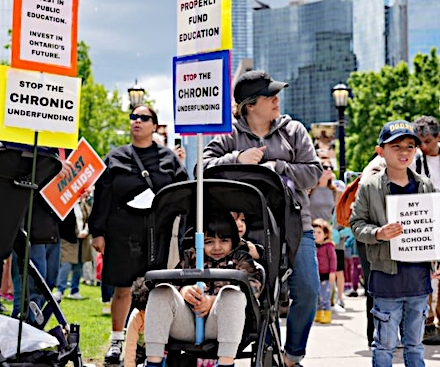
    The pretext for takeover was financial mismanagement. Yet none of the investigators found evidence of serious fiscal incompetence. The truth is that boards submitted balanced budgets year after year but only after slashing programs and services, closing outdoor education centres, selling property, cutting staff, and raising fees. What really drives their fiscal crises is a decades-old funding model – first imposed by the Mike Harris PC government in 1997 – that shifted resources from local taxes to provincial grants. This was not a move toward equitable funding; these were neoliberals of the first order who believed in central control of funding so they could squeeze school boards and education workers to contain costs.

    This model, based on enrolment rather than actual need, starved boards of resources for special education, transportation, salaries, and infrastructure. For instance, school boards don’t get funding for actual children who need special education support but rather on the basis of a predictive model MOE devised. Boards pay for the kids MOE doesn’t fund. The Ford government hasn’t funded the full increase for statutory teacher benefits for years, leaving boards short by millions. The result is a structural deficit: chronic underfunding that leaves even well-managed boards teetering on insolvency. The Ford government, while claiming to increase spending, has in fact cut funding per student by $1,500 in real terms since 2018. This is the problem faced by with 40 percent of Ontario school boards.

    It is this manufactured insolvency that led Minister Calandra to get the most out of a useful crisis and put the four school boards under supervision and maybe next eliminate all school boards in the province. Here we see neoliberal austerity converging with authoritarian ambition. Underfunding is not a policy mistake; it is a deliberate strategy to weaken public education, undermine trust in democratic institutions, and prepare the ground for privatization schemes such as vouchers and charter schools. In this instance, the policy of underfunding is a way of weakening public education and then blaming whatever problems occur on education itself. This is gangster capitalism at work, cloaked in the language of fiscal responsibility but fueled by a pedagogy of dispossession.

    Eliminating Trustees, Silencing Communities

    If board takeovers were simply about money, supervisors would have been told to just find savings. Instead, elected trustees were suspended, their offices shuttered, their tiny stipends cut off, and their ability to communicate with constituents forbidden. Calandra’s power grab has all the elements of Elon Musk’s DOGE assaults in the US: move fast, offer absurd excuses, and blame the victims. The supervisors replacing trustees – accountants, lawyers, and former politicians with no background in education – now wield greater power than the elected community representatives they displaced.

    This substitution of technocrats for democratically accountable representatives is part of fascism’s pedagogy. It teaches the public to accept disenfranchisement as efficiency, to see obedience as order. Parents who ask why a program disappeared or why their child’s special education class has grown larger are now met with silence. In this vacuum, the lesson learned is that participation is futile and resistance meaningless – precisely the kind of civic numbing oligarchic fascism requires.

    Command, Control, and the Policing of Education

    Ford’s government frames these takeovers as a “broader rethink” of governance, but the real project is clear: the imposition of command and control over education. This move sends a strong message that it’s time to duck our heads and get back to basics: teaching “reading, writing, spelling, and arithmetic and the whole shebang…” as Doug Ford complained last fall after teachers and students attended a rally in support of the Grassy Narrows First Nation and its efforts to deal with generations of mercury contamination in their area. He proclaimed, with no evidence, that the field trip was “indoctrination” by teachers because activists protesting Israeli genocide were present. Community members who supported an Indigenous curriculum, modern sexual education, or even school-name changes honoring anti-colonial figures are dismissed or painted as obstacles. The message from Ford and Calandra is blunt: stick to the basics – reading, writing, arithmetic – and leave politics at the door.

    Yet politics hangs over classrooms like a shroud. Despite his Captain Canada complaints about the Trump tariffs, Ford admires the President quick-marching America toward fascism. In an off-mic moment he commented recently: “Election day, was I happy this guy won? One hundred per cent I was.” It’s not the racism, the authoritarianism, the compulsive lying, the fraud, the sexual assaults that bothers the Premier; it’s that he got stiffed by his friend.

    Usurping trustees according to University of Ottawa professor Sachin Maharaj is just another step toward the Progressive Conservatives’ goal to “squelch the pipeline of more progressive leaders” like those gaining notice and experience attending to the needs of local schools.

    The banning of the Toronto Muslim Student Alliance’s screening of the film No Other Land, which documents Israeli settler violence, shows how censorship now masquerades as neutrality. This is the pedagogy of repression in action: narrowing what can be taught, remembered, or discussed until education is reduced to obedience training. What parades as a “broader rethink” is part of the authoritarian language of censorship and control. Like Trump’s attacks on “critical race theory” or his censorship of the Smithsonian, Ford’s moves are not about protecting students from politics but about protecting power from critique. The real issue here is constructing authoritarian policies that narrow critical thinking, teacher autonomy, essential funding, and knowledge that enable schools to both defend and facilitate democracy.

    For Ford and his adherents, the real issue is not that schools are failing but that they are public and have a vital role to play in a democracy. The real threat to Ford is that a democracy can only exist with informed citizens. Yet that is precisely the role education should assume.

    Bill 33: Codifying Authoritarianism

    The perversely named Bill 33, the Supporting Children and Students Act extends this authoritarian logic. It allows the Minister to investigate boards or trustees on the mere suspicion they might act “inappropriately” or against the “public interest” – an elastic phrase that grants unchecked power. It checks much-maligned Diversity Equity and Inclusion efforts by refusing boards the right to name schools, forcing them to abandon diversity-affirming figures in favor of colonial or sanitized names. It mandates the reintroduction of police officers into schools, despite community opposition to surveillance and “unaccountable access to youth by cops.”

    At work here is the legacy of colonialism, a legacy that is terrified of diversity, of those deemed other, being able to narrate themselves. Viewed as threat, this anti-democratic language ultimately falls back on issues of control and security. This is one instance of how authoritarianism consolidates itself, not through tanks in the streets but through legislation that transforms education into an arm of the security state. Pedagogical spaces are militarized, memory is policed, and students are taught that surveillance is normal and dissent dangerous.

    Trumpasitic Authoritarianism

    Ford’s methods echo those of his southern counterpart. Just as Trump’s politics thrive on dispossession, erasure, and the weaponization of culture, Ford borrows from the same authoritarian playbook. The takeover of school boards not only tightens political control but also grants easy access to billions of dollars in public land, enriching developers tied to his government. Here, neoliberal profiteering fuses seamlessly with authoritarian centralization, an example of the merging of gangster capitalism with the pedagogy of repression.

    What do you expect from a government that makes decisions reflecting the arrogance of power? The Ford government cut Toronto city council in half soon after took office in 2018 and threatened to use a constitutional override, the Notwithstanding Clause, Section 33 of Canada’s Charter of Rights and Freedoms, to overturn a Superior Court justice’s decision that the move was unconstitutional. Ford actually used the clause to push through a bill restricting election advertising in 2021 and again, pre-emptively, in 2022, buttressing back-to-work legislation against striking public workers, among the lowest paid in the province. He’s considering using it again after his decision to remove bike lanes from Toronto streets was overturned in court; power makes you petty.

    Democracy in the Smallest Details

    The takeover of Ontario school boards may appear less dramatic than Trump’s assaults on national institutions, but its implications are just as dire. Authoritarianism advances not only through spectacle but through the slow erosion of local democratic practices that once seemed secure.

    If fascism is a pedagogy of fear, amnesia, and conformity, then resistance must be a pedagogy of memory, solidarity, and imagination. To defend education is to defend democracy itself, for schools are not simply sites of instruction but laboratories of citizenship, places where young people learn what it means to speak, to question, to remember, and to act. When trustees are silenced, when curricula are censored, when communities are stripped of their voice, what is lost is not only oversight but the very possibility of democratic life.

    What is at stake, then, is far larger than budget shortfalls or bureaucratic reshuffling. It is whether the future will be governed by communities or dictated from above by those who mistake obedience for learning and silence for peace. Fascism thrives in these small erasures, in the details that seem technical until they harden into structures of domination.

    The lesson could not be clearer: democracy dies in increments, but it can also be rebuilt in increments – through collective memory, through civic courage, through the refusal to allow education to become a weapon of obedience. To resist the Ford government’s authoritarian incursions is not only to protect local school boards; it is to reclaim the very ground on which democratic hope stands. •

    Henry A. Giroux currently is the McMaster University Professor for Scholarship in the Public Interest and The Paulo Freire Distinguished Scholar in Critical Pedagogy. His most recent books include The Violence of Organized Forgetting (City Lights, 2014), Dangerous Thinking in the Age of the New Authoritarianism (Routledge, 2015), coauthored with Brad Evans, Disposable Futures: The Seduction of Violence in the Age of Spectacle (City Lights, 2015), and America at War with Itself (City Lights, 2016). His website is henryagiroux.com.

    William Paul is editor of School Magazine website.

    This article first appeared at the Social Project Bullet

    Source link

  • How We Think, How We Teach: Five Ways to Think About AI in Faculty Work – Faculty Focus

    How We Think, How We Teach: Five Ways to Think About AI in Faculty Work – Faculty Focus

    Source link

  • Thinking with affect theory in higher education: what can it help us to do?

    Thinking with affect theory in higher education: what can it help us to do?

    by Karen Gravett

    How does higher education feel, to work or to study in? How do affects circulate through the places, spaces, bodies and the structures and pedagogies of institutions? And why might thinking about feelings and affect be useful for educators? This blog draws on recent research that seeks to explore how affect theory can be helpful to understand and enhance our work in higher education. Attuning to affect, I suggest, has implications for both how we understand power relations in education, as well as for finding ways to foster more creative and meaningful pedagogies. 

    What is affect theory?

    Interest in affect, and ideas from affect theory/studies, are gaining momentum across the evolving field of higher education studies. Within the social sciences, the ‘affective turn’ has been influenced by work from Clough (2007), Massumi (2015), Seigworth and Pedwell (2023), Ahmed (2010), and many others. No longer confined to binary ideas of emotion/reason, body/mind, scholars have begun to think about emotion and affect as interwoven with education in complex ways. What we mean by emotions and affect can be understood differently, but for many scholars, affect specifically refers to sensory experiences (Zembylas, 2021), forces that are felt bodily. Affects circulate and evolve within and in between ordinary encounters, and in mobile ways.

    Affect in the classroom

    Thinking with affect can help us understand the classroom as a space in which learning is not divorced from the body but viscerally experienced and felt. This helps us to see learning and teaching as always situated and informed by the moment in which it occurs and as we experience it. Feelings do not simply happen within individuals and then move outward (Ahmed, 2010). This shift in thought enables us to consider ourselves in relation to others (both human and non-human), to consider how learning and teaching feels, as well as the ‘structures of feeling’ (Williams, 1961) that circulate within institutions. Thinking with affect helps us to think about the micro-incidents of co-presence, its frictions, and the ‘inconvenient’ (Berlant, 2022) work being present requires of us to engage with others. Education requires affective work of us; it requires us to change, evolve, and adapt constantly to others. This work is exposing; discomforting. In engaging with one another, and being affected and receptive to one another, we are made aware of our own interdependence.

    Affective institutions

    Thinking about affect, then, enables us to understand how institutions are permeated by, and also create, ‘affective atmospheres’ (Anderson, 2009), or ‘structures of feeling’ (Williams, 1961). In his work, Williams uses the idea of ‘structures of feeling’ to study the affective quality of life, in order that we might understand ‘the most delicate and least tangible parts of our activity’ (Williams, 1961, 48). Affective atmospheres, including competition, collegiality, anxiety, inclusion and exclusion are created through pedagogies, policies and practices. For example, the affective atmospheres of self-improvement and self-promotion may permeate neoliberal higher education institutions. Cultures of neoliberalism and precarity require academics to adopt certain affective and embodied practices, such as being competitive, self-motivated or resilient. And yet, affect may be able to disrupt these conditions: affective experiences such as humility, collegiality and joy offer opportunities for resistance and can also be found flourishing within institutional cultures and practices.

    Affective craft

    In the classroom, there may also be ways in which teachers are able to reshape affective relations. This might mean that certain relations could be given space to flourish, and other hierarchies of difference might be, at least momentarily, constrained.Different pedagogical approaches contribute to different feelings in classroom spaces and to different connections. For example, Stewart describes the changing affective atmosphere of the classroom when she employs storytelling and uses questioning approaches to enable dialogue: ‘something subtle but powerful had shifted…The room had become a scene we were in together as bodies and actors’ (Stewart, 2020: 31). For Airton, these kind of affirmative pedagogic approaches work as ‘affective craft’ and might include providing open spaces for students to lead and shape the learning encounter. In my research with Simon Lygo-Baker, we examine different ways in which teachers can experiment with affective craft. These include through teaching in spaces beyond the classroom, using art and objects for generating discussion, engaging storying and the sharing of vulnerabilities, as well as through using Play-Doh modelling to disrupt hierarchies and foster collaboration. These are just some ordinary, everyday ideas, and are ideas we also explore further in our new book: Reconceptualising Teaching in Higher Education:  Connected Practice for Changing Times, to be published in 2026 by Routledge.

    We believe that teaching is about presence, connection, an ‘encounter’, and that affect theory can be a helpful way to understand and enhance the connections we make, as well as the institutions in which we work and learn. As Dernikos and colleagues explain: ‘scholars are now theorizing what these affective swells can do. And what is surprising is that this does not call for grand movements, nor for great reforms, but depends on the subversive power of the very small’ (Dernikos et al, 2020: 16).

    Dr Karen Gravett is Associate Professor of Higher Education, and Associate Head (Research) at the University of Surrey, UK, where her research focuses on the theory-practice of higher education. She is a member of the Society for Research in Higher Education Governing Council, a member of the editorial boards for Teaching in Higher Education and Learning, Media and Technology, and Associate Editor for Sociology. She is a Principal Fellow of the Higher Education Academy. She is also an Honorary Associate Professor for the Centre for Assessment and Digital Learning at Deakin University. Karen’s latest books are: Gravett, K (2025) Critical Practice in Higher Education, and Gravett, K (2023) Relational Pedagogies: Connections and Mattering in Higher Education.

    Author: SRHE News Blog

    An international learned society, concerned with supporting research and researchers into Higher Education

    Source link

  • Rebelling together against the myth of the lone creative genius: how arts-based pedagogies enhanced community learning

    Rebelling together against the myth of the lone creative genius: how arts-based pedagogies enhanced community learning

    by Katherine Friend and Aisling Walters

    When we write about creativity, we often refer to the work of geniuses; [distancing] ordinary members of society from the act of creativity by reinforcing a perception that they could never be creative themselves (Dymoke, 2020: 80).

    Digital story by Kate Shpota

    The state of creativity

    The damage wrought by the stereotype of a creative as an isolated genius seems likely to increase within the current context of the UK school system, where an overloaded curriculum and assessment driven pedagogies dominate. The 2023 State of Creativity report notes that creativity has been ‘all but expunged from the school curriculum in England’.  Educators across schools and departments in HEIs are attempting to resist the current educational practice which promotes students as consumers and centres our students as active producers in their own learning. Yet, as education policy from primary through to higher education continues not only to cut its emphasis on the humanities and creativity,  but also eliminate arts and humanities departments altogether, higher education runs a profound risk of further alienating students from the benefits of creative thinking and artistic practice.

    Our undergraduates, being educationalists, use sociological and psychological lenses to understand the social and cultural landscape affecting both classroom learning and community education more broadly. Nevertheless, despite education being at the intersection of many academic disciplines (Sociology, English, Philosophy, History to name a few), students are often reluctant to incorporate alternative approaches into their learning and even less so into their assessments.

    Fear and discomfort

    As educators, we ask students to embrace discomfort when learning different theoretical approaches or understanding alternative viewpoints. But often, we do not ask them to embrace discomfort in operating outside of the neoliberal HE system, a ‘results driven quantification [which] directs learning’ (Kulz, 2017 p. 55). Within this context, learning focuses on the product (the assessable outcome), rather than the process (the learning journey). Thus, it is unsurprising that our undergraduates initially baulked at the idea of an assessment that incorporated a creative element, preferring essays and multiple-choice exams instead. Hunter & Frawley (2023) define arts-based pedagogy (ABP) as a process by which students can observe and reflect on an art form to link different disciplines, thus encouraging students to lean into uncomfortable subject matter and explore their place within in the wider world. To build more dynamic and critically analytical students, we had to simultaneously encourage an ABP approach so they would understand their academic and theoretical course content more fully while scaffolding their learning through a series of creative activities designed to engage students with different forms of learning and reflection. By incorporating cultural visits, mentorship, and creative assessments into the module, art enhanced subject teaching while encouraging students to think more deeply about their own practice (Fleming, 2012). Yet, incorporating practice was not enough, we were faced with the question: how do educationalists ask students to engage with their vulnerabilities around creative practice (the belief and the engrained fear that they cannot do art or are not good at art) and lead them to an understanding that vulnerability itself can be beneficial?

    Perhaps, the most basic answer came by asking ourselves, are we, as academics, scared of implementing creative pedagogies because we are scared of showing our own vulnerabilities? What if we as educators fail at a task and our students see? What would happen if we became vulnerable alongside our students? Jordan (2010) argues that when vulnerability is met with criticism, we disengage as a self-preservation tactic. For Brown, acknowledging our insecurities offers a means of understanding ourselves, developing shame resilience and acting authentically. In our session, our vulnerability as lecturers was tested when engaging with textile art, specifically a battle with crochet. Our students saw educators who were not secure or competent in a task. This resulted in a small amount of mockery, but also empathy and offers of support. By stepping out of our comfort zone and embracing a pedagogy of discomfort (Boler 1999), we encouraged our students to challenge themselves. Romney and Holland (2023) refer to this as a ‘paradox of vulnerability’: by overcoming our own reluctance to be vulnerable with our learners we create connections and a sense of trust. We should add that the session explored women’s textile art as activism and the outcome, a piece of textile art, symbolically woven together by students and staff—all female.

    Collective textile piece

    Importance of community and connection

    Once we examined theoretical and personal aspects of discomfort and vulnerability, to support and enhance our focus on creative practice, we drew on local cultural partnerships. The incorporation of cultural visits, mentorship from resident artists, and creative exercises enriched our subject teaching while simultaneously encouraging students to think more deeply about their own practice (Fleming, 2012). It also built an alliance between social scientists and colleagues in arts and humanities disciplines, capitalising on their expertise and years of honing ABP. Nottingham is a city where the legend of Robin Hood, outlaws, and rebellion intersect with vibrant cultural community. But many of our students do not engage with cultural spaces, leading to double disconnect, first from their own creative practice and second from the cultural sector altogether. Our students expressed their disconnect from the cultural heart of Nottingham was due to the spaces being ‘not for them’ or a worry that they would not ‘understand’ the art. By exploring the city centre as a group, walking from one site to another, we broke down barriers around these prohibited spaces.

    Engagement with Nottingham by Alisha Begum

    Once inside the Nottingham Contemporary, the resident artists told their own stories of fear, worries of judgement, and expressed anxieties of creative practice, thus setting our students free from the myth of the genius artist – untouchable by self-doubt. This realisation allowed our students to relax and engage worry-free into the creative tasks.

    By joining in with these activities, lecturers and students learned alongside each other, tackling our insecurities regarding our creative abilities together as a learning community. Perhaps community was the most important outcome in the project as connection was central. Exposure to the cultural sites created a feeling of connection with the cultural heart of the city. Students also, perhaps more importantly, reported that they became more connected to an understanding of themselves as creatives, becoming more autonomous and engaged in their own learning.

    Digital storytelling: Identity Crisis by Shahnaz Begum

    Perhaps it is most appropriate to end this post with the voice of one of our year-two students—the transcript from a podcast created as part of her larger portfolio. She asserts:

    Art in education is a goldmine of untouched opportunities [and can be] used to foster students’ holistic development, stimulate creative thinking and engagement with social justice. … and to my fellow Artivists, embrace creativity one canvas at a time.

    Katherine Friend is an Associate Professor of Higher Education at Nottingham Trent University. Her work focuses on three themes: the underrepresented student experience on university campuses, the importance of undergraduate engagement in the cultural sector, and reconciling international and academic identities. Threading all three themes together are discussions of one’s ‘place’ and/or ‘space’ in HE and how social and cultural hierarchies contribute to identity, representation, and belonging.

    Aisling Walters is a Senior Lecturer in Secondary Education at Nottingham Trent University whose research focuses on the development of writer identity in trainee English teachers, preservice teachers’ experiences of prescriptive schemes of learning, arts-based pedagogies, and students as writers. 

    Author: SRHE News Blog

    An international learned society, concerned with supporting research and researchers into Higher Education

    Source link

  • Perspectives on pedagogical innovation | SRHE Blog

    Perspectives on pedagogical innovation | SRHE Blog

    by Kamilya Suleymenova and Emma Thirkell

    The landscape of higher education (HE) in the UK (but also more widely, in Western countries and across the globe) has significantly changed, driven by the massification and the following marketisation of HE studies (Alves & Tomlinson, 2021; Molesworth et al, 2009). The predominance of particular governance structures and schools of thought shape the narrative further (as discussed by Marcia Devlin (2021) in her SRHE blog) and create a deceptively heterogeneous environment, where each prospective student can find their “place”, but all are conditioned to follow a similar narrative.

    New disruptions

    On this backdrop new disruptions appear, of which we want to focus on two specifically for the UK HE. First, the legacy of lockdowns, bringing more flexible working environment and an astonishing pervasiveness of digital tools together with disrupted earlier education and legacy of health, including mental health, concerns, unsettles further already brittle UK HE sector (as illustrated by SRHE blog by Steven Jones (2022). Second, the advent of Generative AI and its implications for teaching, learning, and assessment. Much has been said about these (Lee et al, 2024; O’Dea, 2024) – our learning points from this rapidly growing literature are that i) significant disruption has occurred and ii) something needs to be done to react to this change in context. In other words, while there are many tried and tested theories and methods in teaching and assessment, they need to be reviewed and very likely adapted to keep up with the changing context.

    The change did not occur only in the tools: we argue here that it is not merely a quantitative technical change (eg speed of communication), but a qualitative change, which affected or at least has the potential to affect, the mindset and the behaviour of students (and staff). Together, these factors produce more stressed, more demanding, potentially differently engaged students (sometimes perceived as less engaged), focused on the “added value” of their degrees and their “university experience”, anxious to acquire competences and skills through experiential learning to be in the best position for securing the employment of their choice.

    In this rapidly changing context, the need for pedagogical innovations (PI), or at least the desire and the ability to engage with disruptions in the education process, seems almost inevitable. But how do the staff working in the UK HE, respond to this demand? Are the challenges viewed as opportunities or rather as additional pressures, adding to an evolving workload and requirements to navigate a complex bureaucracy?

    Research focus: understanding the lived experiences of educators

    Our research explores the lived experiences of educators across 13 UK universities, investigating their engagement with PI in the aftermath of the COVID-19 pandemic. By examining how institutional dynamics, personal motivations, and perceived barriers shape decisions surrounding PI, we have developed the initial stages of a conceptual framework, presented at the SRHE International Conference, to guide policies that better support educators and foster sustained PI in teaching. Through 30 interviews with educators, senior staff, and technology-enabled learning (TEL) specialists, we reveal the complex decision-making processes that influence whether and how educators embrace or resist innovation in their teaching practices.

    What drives educators to innovate?

    Our research highlights a multifaceted landscape where educators’ motivations for engaging with PI are shaped by both intrinsic and extrinsic factors. For many, intrinsic motivations, such as a deep-rooted desire to enhance student learning and a personal commitment to pedagogical excellence, act as powerful drivers for innovation. As one educator noted, “I’m always looking for new ideas. Innovation gives me a sense of purpose and connection with my students, making teaching more fulfilling.” This indicates that where academics feel a strong personal commitment to education, and it is rewarded, they are more likely to embrace innovative practices.

    The tension between rhetoric and reality

    However, these motivations are often counterbalanced by extrinsic pressures from the institutional environment, whether perceived or real. Many educators reported feeling that institutional strategies, while rhetorically supportive of PI, were undercut by bureaucratic barriers, a lack of adequate resources, and managerial cultures focused on short-term, measurable outcomes. One academic explained, “Innovation is a buzzword here, but when it comes to implementing anything new, we’re stuck in a system that values research output over teaching innovation. There’s little incentive to invest time in something that doesn’t directly contribute to my publication record.” This highlights the tension between institutional narrative and individual motivations, with many educators perceiving a disconnect between institutional rhetoric purporting to encourage PI and the reality of its implementation.

    Autonomy and trust

    Another key finding concerns the role of autonomy and trust in fostering a culture of innovation. Educators who felt empowered within their departments – where trust was placed in their judgment – were more likely to experiment with new teaching methods. As one TEL specialist remarked, “When leadership trusts us, we feel freer to try new approaches. But when we are micromanaged, the innovation just stops. You’re constantly battling to prove that your idea is worth the time it takes.” This sense of autonomy, closely linked to professional identity, is crucial in determining whether educators feel motivated to innovate or revert to traditional methods.

    The cost of innovation

    However, these ‘empowering’ environments were not universally experienced. Many educators, particularly those in large departments or with heavy teaching loads, reported feeling that the cost of innovation – both in terms of time and energy – was too high. “It’s hard to innovate when you’re overwhelmed with marking, preparation, and administration. It feels like there’s no room to breathe, let alone experiment,” shared an academic. This sense of burnout, compounded by a perception of growing academic bureaucracy, led some to feel that the costs of engaging in PI outweighed the benefits, making it more difficult to justify the time and effort required for innovation.

    A balancing act

    Perhaps not surprisingly, some educators justified their lack of engagement with PI by citing these perceived institutional constraints. As one educator put it, “We’re told to innovate, but the structure just isn’t there to support it. It’s easier to stick with what we know works than to risk failure with something new.” This reflects the cognitive flexibility educators employ when balancing personal motivations with institutional limitations. As per Goffman’s (1959) ‘front’ and ‘back’ stage theory, educators sometimes present a compliant, innovative persona on the ‘front’ stage in order to ‘fit in’ (Nästesjö, 2023), while in the ‘back’ stage, they rationalize their lack of engagement by attributing it to costs and benefits, reconciling their professional image with their lived experiences.

    Reflections

    We are certain that some, if not all, of these quotes will resonate with many of the readers: these trends have been discussed in, for example, Lašáková et al (2017) and Findlow (2008). Our aim is not only to systematise and categorise the individual aspects shared with us by both frustrated and aspiring colleagues, but to focus on an in-depth analysis of their motivations. Based on previous literature and our data, we aim to generalise and develop a theoretical framework through the lens of an interdisciplinary management and economics analysis. The preliminary version of this theoretical framework, presented at the 2024 SRHE Conference, should provide a foundation for shaping institutional policies to develop a sustainable pipeline of innovations, in the full respect of both academic freedom and students’ interests. In other words, we hope that our work will facilitate structural changes to unlock the innovation potential and help institutions to help us to innovate.

    Kamilya Suleymenova is Associate Professor at the Department of Economics, Birmingham Business School, University of Birmingham with interests in assessment and feedback particularly for large cohorts, Generative AI in HE, as well as institutional and behavioural and experimental economics. Now twice a presenter at SRHE International Conference, Kamilya appreciates the constructive feedback of the community.

    Emma Thirkell is an Assistant Professor in Human Resource Management at Newcastle Business School, Northumbria University with interests in pedagogical innovation, experiential learning, and the integration of technology in education. A four-time teaching award winner, she is passionate about bridging academia and practice through innovative curriculum design and leadership in higher education.

    Author: SRHE News Blog

    An international learned society, concerned with supporting research and researchers into Higher Education

    Source link

  • Gaps in sustainability literacy in non-STEM higher education programmes

    Gaps in sustainability literacy in non-STEM higher education programmes

    by Erika Kalocsányiová and Rania Hassan

    Promoting sustainability literacy in higher education is crucial for deepening students’ pro-environmental behaviour and mindset (Buckler & Creech, 2014; UNESCO, 1997), while also fostering social transformation by embedding sustainability at the core of the student experience. In 2022, our group received an SRHE Scoping Award to synthesise the literature on the development, teaching, and assessment of sustainability literacy in non-STEM higher education programmes. We conducted a multilingual systematic review of post-2010 publications from the European Higher Education Area (EHEA), with the results summarised in Kalocsányiová et al (2024).

    Out of 6,161 articles that we identified as potentially relevant, 92 studies met the inclusion criteria and are reviewed in the report. These studies involved a total of 11,790 participants and assessed 9,992 university programmes and courses. Our results suggest a significant growth in research interest in sustainability in non-STEM fields since 2017, with 75 studies published compared to just 17 in the preceding seven years. Our analysis also showed that Spain, the United Kingdom, Germany, Turkey, and Austria had the highest concentration of publications, with 25 EHEA countries represented in total. The 92 reviewed studies were characterised by high methodological diversity: nearly half employed quantitative methods (47%), followed by qualitative studies (40%) and mixed methods research (13%). Curriculum assessments using quantitative content analysis of degree and course descriptors were among the most common study types, followed by surveys and intervention or pilot studies. Curriculum assessments provided a systematic way to evaluate the presence or absence of sustainability concepts within curricula at both single HE institutions and in comparative frameworks. However, they often captured only surface-level indications of sustainability integration into undergraduate and postgraduate programmes, without providing evidence on actual implementation and/or the effectiveness of different initiatives. Qualitative methods, including descriptive case studies and interviews that focused on barriers, challenges, implementation strategies, and the acceptability of new sustainability literacy initiatives, made up 40% of the current research. Mixed methods studies accounted for 13% of the reviewed articles, often applying multiple assessment tools simultaneously, including quantitative sustainability competency assessment instruments combined with open-ended interviews or learning journals.

    In terms of disciplines, Economics, Business, and Administrative Studies held the largest share of reviewed studies (26%), followed by Education (23%). Multiple disciplines accounted for 22% of the reviewed publications, reflecting the interconnected nature of sustainability. Finance and Accounting contributed only 6%, indicating a need for further research. Similarly, Language and Linguistics, Mass Communication and Documentation, and Social Sciences collectively represented only 12% of the reviewed studies. Creative Arts and Design with just 2% was also a niche area. Although caution should be exercised when drawing conclusions from these results, they highlight the need for more research within the underrepresented disciplines. This in turn can help promote awareness among non-STEM students, stimulate ethical discussions on the cultural dimensions of sustainability, and encourage creative solutions through interdisciplinary dialogue.

    Regarding factors and themes explored, the studies focused primarily on the acquisition of sustainability knowledge and competencies (27%), curriculum assessment (23%), challenges and barriers to sustainability integration (10%), implementation and evaluation research (10%), changes in students’ mindset (9%), key competences in sustainability literacy (5%), and active student participation in Education for Sustainable Development (5%). In terms of studies discussing acquisition processes, key focus areas included the teaching of Sustainable Development Goals, awareness of macro-sustainability trends, and knowledge of local sustainability issues. Studies on sustainability competencies focussed on systems thinking, critical thinking, problem-solving skills, ethical awareness, interdisciplinary knowledge, global awareness and citizenship, communication skills, and action-oriented mindset. These competencies and knowledge, which are generally considered crucial for addressing the multifaceted challenges of sustainability (Wiek et al., 2011), were often introduced to non-STEM students through stand-alone lectures, workshops, or pilot studies involving new cross-disciplinary curricula.

    Our review also highlighted a broad range of pedagogical approaches adopted for sustainability teaching and learning within non-STEM disciplines. These covered case and project-based learning, experiential learning methods, problem-based learning, collaborative learning, reflection groups, pedagogical dialogue, flipped classroom approaches, game-based learning, and service learning. While there is strong research interest in the documentation and implementation of these pedagogical approaches, few studies have so far attempted to assess learning outcomes, particularly regarding discipline-specific sustainability expertise and real-world problem-solving skills.

    Many of the reviewed studies relied on single-method approaches, meaning valuable insights into sustainability-focused teaching and learning may have been missed. For instance, studies often failed to capture the complexities surrounding sustainability integration into non-STEM programs, either by presenting positivist results that require further contextualisation or by offering rich context limited to a single course or study group, which cannot be generalised. The assessment tools currently used also seemed to lack consistency, making it difficult to compare outcomes across programmes and institutions to promote best practices. More robust evaluation designs, such as longitudinal studies, controlled intervention studies, and mixed methods approaches (Gopalan et al, 2020; Ponce & Pagán-Maldonado, 2015), are needed to explore and demonstrate the pedagogical effectiveness of various sustainability literacy initiatives in non-STEM disciplines and their impact on student outcomes and societal change.

    In summary, our review suggests good progress in integrating sustainability knowledge and competencies into some core non-STEM disciplines, while also highlighting gaps. Based on the results we have formulated some questions that may help steer future research:

    • Are there systemic barriers hindering the integration of sustainability themes, challenges and competencies into specific non-STEM fields?
    • Are certain disciplines receiving disproportionate research attention at the expense of others?
    • How do different pedagogical approaches compare in terms of effectiveness for fostering sustainability literacy in and across HE fields?
    • What new educational practices are emerging, and how can we fairly assess them and evidence their benefits for students and the environment?

    We also would like to encourage other researchers to engage with knowledge produced in a variety of languages and educational contexts. The multilingual search and screening strategy implemented in our review enabled us to identify and retrieve evidence from 25 EHEA countries and 24 non-English publications. If reviews of education research remain monolingual (English-only), important findings and insights will go unnoticed hindering knowledge exchange, creativity, and innovation in HE.

    Dr. Erika Kalocsányiová is a Senior Research Fellow with the Institute for Lifecourse Development at the University of Greenwich, with research centering on public health and sustainability communication, migration and multilingualism, refugee integration, and the implications of these areas for higher education policies.

    Rania Hassan is a PhD student and a research assistant at the University of Greenwich. Her research centres on exploring enterprise development activities within emerging economies. As a multidisciplinary and interdisciplinary researcher, Rania is passionate about advancing academia and promoting knowledge exchange in higher education.

    Author: SRHE News Blog

    An international learned society, concerned with supporting research and researchers into Higher Education

    Source link

  • How online learning can help tackle global injustices

    How online learning can help tackle global injustices

    by Sam Spiegel

    How can online learning programmes help tackle systemic global injustices with creative pedagogies? How can universities build effective educational environments and pedagogies to support critical thinking and vigorously challenge contemporary forms of racism, colonialism and inequity?

    These are some of the questions I have reflected on over the past almost 14 years of teaching at the University of Edinburgh. In 2011, I embarked with colleagues at the School of Social and Political Science to develop our school’s first fully online distance learning MSc postgraduate programmes, partnering with an interdisciplinary team spanning the three Colleges  of the University to co-create and co-teach the MSc in Global Challenges. Addressing global development, health and environmental inequalities, with case studies spanning an array of countries, this programme had students from all over the world. The insights and trajectories of our students have been deeply inspirational – many of our students have gone on to do PhDs, work with United Nations organisations, embassies, non-governmental and humanitarian organisations and work in other kinds of practitioner and research careers. In this blog I reflect on the philosophy of the teaching and learning approach we have nurtured – and associated critical conversations about pedagogy.

    We had support from a Principal’s Teaching Award (PTAS) to explore student learning experiences and reflect on our teaching practices, and in 2016 we published an article: ‘Decolonising online development studies? Emancipatory aspirations and critical reflections–a case study’. At the time, it was one of the few critical pedagogy studies to think through ‘international development’ teaching and the risks of replicating colonial logics in online learning modalities (and how to try to counter these). It proposed a critical framework for analysis that took into account barriers to social inclusivity – including the politics of language – that shaped participation dynamics in the programme. It also considered debates regarding critical development course content, rethinking possibilities for bridging counter-hegemonic development scholarship with practice-oriented approaches in a range of social contexts. Our analysis unpacked tensions in tackling intertwined institutional and pedagogic dilemmas for an agenda towards decolonising online development studies, positioning decolonisation as a necessarily unsettling and contested process that calls for greater self-reflexivity.

    Some years ago online learning initiatives were treated with suspicion as a technology craze that could not truly build effective communities of critical learners. This is no longer the case, generally speaking. Our online students have carved out sophisticated learning paths while interacting with ambitious courses – sometimes in live discussions and sometimes in asynchronous discussions that built incredible communities of practice. But there are important online learning-specific pedagogic points to keep in mind, as course instructors craft and adapt approaches to support individual and group learning.

    One is the risk of re-entrenching problematic dynamics of imperial knowledge production, even when intentions are to do exactly the opposite. There is a need to ensure that online learning platforms grapple with colonial legacies and tendencies – including biases that are easily replicable in virtual technology platforms. It is increasingly recognised that ‘decolonising’ is not simply a matter of ‘bringing in’ authors from Global South countries in reading lists. It is also a matter of ensuring that the underpinning pedagogies, assignments, and learning strategies themselves tackle systemic biases that have often shaped the field of ‘international development’ – and doing so from the outset. This may mean inviting students into at-times uncomfortable conversations about ways of understanding histories of dispossession, or ways of thinking about and governing societies; and ensuring that early course activities trouble assumptions – including about what ‘development’ is/means to different people and whose values are prioritised or overlooked. Some students might not normally read the writings of those who fought during liberation wars against colonialism, for example, but might find such readings different and transformative. There are a range of other possibilities, too, from changing the way that case studies are framed – for example, starting with stories of heavily oppressed peoples instead of starting with the technocratic logics of United Nations and government reports.

    Despite global talk of ‘decolonisation,’ there has been a tendency for globally renowned development academics from wealthy countries to dominate reading lists. We have tried in our courses to challenge this – and ensure that activity-focused coursework and online case studies challenge hegemonic assumptions in mainstream policy literature and development discourse. Some of the reflections on our pedagogy were also discussed in a wider influential review article by Shahjahan et al (2022) entitled ‘”Decolonizing” curriculum and pedagogy: A comparative review across disciplines and global higher education contexts’, which notes that ‘decolonization’ has been very differently treated by different educators. Our pedagogy work has also been part of a wider conversation in the scholarly literature on how “precautions need to be taken when incorporating non-Western knowledges into Western universities to avoid mishearing, misrepresenting, exploiting, and decontextualizing them” (Lau and Mendes, 2024; see also Spiegel et al, 2024).

    Relatedly, there is a need to be cautious of ideas about “transfer of knowledge” and instead to embrace values built on reciprocal sharing of knowledge in educational practices (see also Parmentier, 2023). Furthermore, attempts at decolonising development education requires attention to the link between learning strategy and wider institutional practices, including heeding inequities in admissions processes and language barriers in higher education. Our work in developing new online learning pedagogies is just part of the story; we have also been interacting closely with university admissions offices on strengthening approaches to make admissions more inclusive. This has included greater recognition of practitioner qualifications and also, significantly, some modifications in how English language testing requirements were addressed in some of the countries affected. This was especially important in contexts where applicants had demonstrable English language proof, from institutional and/or university experiences, but lived far from test centres and could not afford testing.

    Our article ‘Decolonising Online Development Studies?’ had a question mark in the title, alluding to the ambiguity of interpretation and the uncertainties that may play out over time. It was cited in other PTAS-awarded studies led by other staff members at UoE, supporting further analysis of specific techniques for building online learning communities (see Wood et al, 2021) How these ideas are to be taken forward is an ethically important conversation that relates to the very core of what education seeks to do, requiring ongoing attention to the interplay of values, philosophies, curricula and teaching techniques.

    Dr Sam Spiegel is the director of the Global Challenges MSc programme at the University of Edinburgh, where he serves as the Deputy Director of Research for Knowledge Exchange and Impact at the School of Social and Political Science. He is also a senior lecturer at the Centre of African Studies and has published extensively with colleagues in Zimbabwe and in other regions of the world on migration, displacement, borders, critical pedagogy and social change.

    Author: SRHE News Blog

    An international learned society, concerned with supporting research and researchers into Higher Education

    Source link

  • Asking Students to *Really* Read Each Other’s Writing | A Conversation with Timothy Oleksiak

    Asking Students to *Really* Read Each Other’s Writing | A Conversation with Timothy Oleksiak

    I spoke with Dr. Timothy Oleksiak, Assistant Professor of English at the University of Massachusetts—Boston, about two of his essays, “A Queer Praxis for Peer Review” and “Slow Peer Review in the Writing Classroom,” recently out in College Composition and Communication and Pedagogy. In these essays, they present theory and practice for a pedagogical practice they call slow peer review, a different way to approach that classical strategy of writing classes, student-to-student peer review, where students swap drafts and give each other feedback on how to improve them. Slow peer review does have students swap drafts but asks them to spend a lot more time with the drafts than usual, reading them very carefully and thinking about them deeply. Slow peer review then asks students to respond in different and more in depth ways than just giving the writer suggestions. I found the essays really compelling, opening up so many questions with relevance far beyond this specific practice and far beyond even just the teaching of writing.

    In our conversation, which you can watch below, we discuss opera, “the improvement imperative” (i.e., there are more things to do in a writing classroom than help students write better, even as that remains a key goal), and the concept of “cruel optimism” (which refers, in this case, to an unhealthy attachment to certain teaching strategies that aren’t working and won’t suddenly start working through being tweaked). We also discuss the ways in which writers and readers of drafts both participate in “worldmaking.” The idea here is that each draft someone writes envisions a world in which some are included while others are not, and peer reviewers can help writers imagine more clearly what sort of world they’ve built. We also discuss what all of this has to do with queer theory. Lastly, I asked Timothy whether this peer review pedagogy isn’t actually a reading pedagogy. While he’s not so sure, he does have students “read the drafts five different times” and directs students to consider such questions as “What does it mean to be fully human in this world?” (i.e., in the world of the draft being read). Those seem like scaffolds for deep reading to me. At any rate, whatever else this pedagogy does, it does ask students to really read each other’s writing. And that feels extraordinarily valuable to me.

    Source link