Category: Politics

  • She was a rising senior on the honor roll. ICE just upended her life

    She was a rising senior on the honor roll. ICE just upended her life

    This story was produced by The 19th and reprinted with permission. 

    On July 4, Nory Sontay Ramos stepped off a flight from San Antonio into a country she hardly recognized: Guatemala. 

    The summer wasn’t supposed to start this way. The 17-year-old had plans. In early June, she wrapped up 11th grade on a high note, having made the honor roll and represented her Los Angeles high school in the city finals for track. With track season over, she turned her attention to cross-country, showing up to campus for practice after the school year ended. 

    Everything changed when she and her mother, Estela Ramos — both undocumented — appeared at what they thought was a standard check-in visit with immigration officials on June 30. 

    “ICE took us to a room, and they ended up telling my mom, ‘Your case is over, so we have to take you guys with us,’” Sontay Ramos told The 19th. Over the objections of their attorney, federal agents led them away.

    The next day, she and her mother were shipped to Texas. And by July 4, they were on a plane to Guatemala, a country where neither of them have lived for over a decade. On Independence Day — an occasion associated with freedom, with hope — their American dream shattered. Sontay Ramos has no idea what will become of the friends, family members and school community her deportation forced her to leave behind in Los Angeles.

    A lawyer hired after she and her mother were detained said Monday that a motion to reopen the case has been filed with the Board of Immigration Appeals but provided no other information to The 19th. 

    A year shy of becoming a high school graduate in the United States, the teen’s life — and opportunities — completely changed in the span of five days.

    “I’m confused,” Sontay Ramos said, her voice breaking. “I don’t know. I’m just really sad about everything.”

    President Donald Trump campaigned for a return to office with the promise of mass deportations, characterizing undocumented immigrants as criminals and threats to women and girls. But as his administration has ramped up enforcement of his policy priority, undocumented people with no criminal backgrounds have made up the largest share of immigrants targeted. Those who are pursuing legal status through the proper channels have also become vulnerable — showing up to check-ins, like Sontay Ramos and her mother — only to be detained. These developments, recent polls reveal, have led to public disapproval of the Trump administration’s strategies. 

    Civil liberties and advocacy groups have raised concerns that undocumented immigrants are being removed so quickly they have been denied the right to due process. With Trump’s One Big Beautiful Bill Act directing $150 billion more toward mass deportations, expedited removals of undocumented immigrants will almost certainly increase — and those immigrants who arrived in the United States as children like Sontay Ramos stand to get caught in the middle. 

    Related: A lot goes on in classrooms from kindergarten to high school. Keep up with our free weekly newsletter on K-12 education.

    The Trump administration deported more than 93,800 people from January 20 to June 11, with ICE more than doubling its arrests compared with the same period in 2024, revealed an analysis by the Washington Post based on information from the Deportation Data Project. (The data does not reflect arrest and removal numbers from Customs and Border Protection.) Of those, 61 percent did not have criminal records and almost 90 percent were men, underscoring how relatively uncommon it is for a mother and daughter to be removed. 

    The Trump administration has not provided a tally of how many minors have been deported this year, but The 19th’s review of figures from the Deportation Data Project found that only about 3 percent of removals involved children. When ICE targets juveniles, the incidents often make national headlines, such as when a 9-year-old boy and his father living in Torrance, California, were detained in May and swiftly deported to Honduras. In states including Michigan, Massachusetts and New York, the detainment of teenagers, including those who are technically legal adults, have also garnered widespread media attention this year.

    But when Sontay Ramos and her mother exited their Guatemala-bound flight on Friday, they weren’t met with fanfare. None of their family members in the Central American nation knew to expect them. With the help of an internet connection, they managed to contact one of Sontay Ramos’ older sisters, with whom they’re now living. The teenager isn’t sure which part of Guatemala she’s in, though she describes the area as rural. 

    Just six when she left Guatemala, Sontay Ramos struggles to recall what life there was like. But she remembers the emotion she felt as a small child: fear.

    “I was scared because there’s gangsters here, and they tried to kill my mom,” she said. A family member involved in a gang threatened her mother, once attacking her so badly she needed to be hospitalized, she said. “My mom was scared.”

    A research study exploring the root causes of immigration from Guatemala from 2012 to 2019 found violence, poverty, climate change and corruption to be among the driving factors and that many such migrants hail from rural parts of the country.  

    “The two major reasons, especially if we look at families, have to do with violence and drought,” said David Leblang, a coauthor of that study and politics professor at the University of Virginia.  “It has been drought and then flood, hurricane and then drought that has just decreased the ability for families to put food on the table, so you see a combination of economic insecurity, but more so for families, food insecurity — because when you can’t feed your kids, that’s when families are going to pick up and they’re going to move first to more urban areas and then out of the country.”

    About 11 years ago, Sontay Ramos and her mother headed by car to the United States in search of safety and opportunity. There, other family members awaited them and they hoped to be granted asylum, she said. 

    The transition was not easy. They left behind three of Sontay Ramos’ older siblings who did not want to come to the United States, she said. Her father remained in Guatemala, too. His death from illness shortly after she moved away was devastating.

    “Unfortunately, her dad passed away at a young age, just like two weeks after her arrival to the States,” recalled Jennifer Ramos, Sontay Ramos’ 22-year-old cousin who lives in Los Angeles. “She grew up with her dad, so that also hit her at such a young age, just coming to a new country at six years old and not knowing the language here and losing her father. It was definitely hard for her.”

    Getting accustomed to life in Los Angeles also wasn’t easy. Sontay Ramos and her mother are Indigenous Guatemalans, fluent in K’iche’. Few resources in their native tongue made assimilation more challenging in a city where English and Spanish are the primary languages.

    Related: A superintendent made big gains with English learners. His success may have been his downfall

    Jennifer Ramos helped her little cousin learn to speak English. “She would come over, and I would help her with her homework. When she first came to the States, my younger sister was kind of her only friend in school because she didn’t know anybody and, again, the language barrier. She actually does struggle speaking Spanish.”

    In time, Sontay Ramos and her mother adjusted to life in California. Her mother ultimately became a garment worker, employed as a seamstress until physical setbacks — illness and surgery — sidelined her earlier this year. Her deportation has separated her from her life partner, with whom she and her daughter shared an apartment in the Westlake District of Los Angeles, the neighborhood where an ICE raid at a Home Depot close to an elementary school in June panicked families, and days of demonstrations in nearby downtown escalated after Trump deployed 4,000 National Guard troops and 700 Marines. 

    Los Angeles is a deeply blue city in a liberal state, with the nation’s highest concentration of immigrants — a place that the president has made ground zero for his immigration raids. In November, the City Council voted unanimously to make L.A. a sanctuary city, which bars it from using resources for immigration enforcement. Last week, the Trump administration filed suit, challenging the law. Meanwhile, advocacy groups including the American Civil Liberties Union of Southern California and Public Counsel are suing the Trump administration for what it describes as a pattern of federal violations during immigration raids in Greater Los Angeles.  

    Before Trump’s immigration policies roiled her neighborhood and upended her life, Sontay Ramos was indistinguishable from her peers born in the United States. She grew up on the Netflix shows “Stranger Things” and “Cobra Kai,” enjoys the music of Lana Del Rey and The Weeknd and dotes on her cat, Max, who turned one on May 15. He is black — one of her two favorite colors. In her spare time, Sontay Ramos practices taekwondo, which she’s been learning for nearly four years.  

    “I just liked it,” she said of the martial art. Knowing how to fight, she added, helps her feel protected. 

    Sontay Ramos never sensed she was in danger before the immigration check-in that would push her out of the United States.

    But her cousin Jennifer Ramos worried. The night before, Ramos’ father invited the family over to have Sunday dinner with his wife and three daughters. The evening was largely festive. Her father made shrimp ceviche and was eager for his family to enjoy the tangy, citrusy dish — especially Estela Ramos, who had just celebrated her 45th birthday. But when Estela mentioned that she and her daughter had an immigration check-in scheduled, everyone fell quiet.

    “We were kind of scared,” Jennifer Ramos said. “We were like, ‘Are you sure you should go?’”

    Estela Ramos poses for a picture with Jennifer Ramos at her quinceanera in 2017. Credit: COURTESY OF JENNIFER RAMOS

    But her aunt tried to reassure them by letting them know their lawyer said it would be fine. After all, they had shown up for previous check-ins without incident, and if they didn’t appear, immigration officials would just find them at home. 

    Now, Jennifer Ramos doesn’t know when she’ll see her aunt and cousin again.

    “It is unfair that a young student like her has been detained,” she said. “She’s the most deserving person. This should be the least of her worries.”

    Sontay Ramos couldn’t help but tear up when she described what she was looking forward to about senior year — graduation, her friends, track-and-field and cross-country.

    Although excited to reunite with family members they hadn’t seen in years, she and her mother have been weeping off and on since they arrived in Guatemala.

    “I was happy, but I was expecting to see them in another way,” she said of her relatives. “Not like this.”

    Sleeping and eating have been tough as has the constant feeling of disorientation. She doesn’t know where she is. In K’iche’, she asked her mother for the name of the town they’re in, but it didn’t register. 

    She also continues to feel blindsided about why she and her mother were deported at all. She doesn’t understand how or why their case was closed.

    Recent polls, particularly those conducted after the immigration raids in Los Angeles, reveal that the Trump’s administration’s immigration crackdowns may be unpopular with the majority of the public. A PBS News/NPR/Marist poll released July 1 found that just 43 percent of Americans support Trump’s tactics

    Sixty-four percent of registered voters support giving most undocumented immigrants in the United States a pathway to legal status, with 31 percent preferring deportation for most of them, according to a Quinnipiac University national poll released June 26. Six months ago, only 55 percent of voters supported giving unauthorized immigrants a path to legal status, while 36 percent backed deportation. 

    Leblang, the politics professor, said that ultimately the economy will sway the public to take a stand on immigration. 

    “All of those people who are being deported, they’re consuming goods that are produced by natives,” he said. “So, what the evidence suggests is that’s going to affect native workers’ wages, so across the board, this is going to have a negative effect on the economy.” 

    Related: They crossed the border for better schools. Now, some families are leaving the US

    For Manuel Guevara — a physical education teacher and coach at the Miguel Contreras Learning Complex, where Sontay Ramos is enrolled as a student — immigration isn’t an economic issue but a personal one. He came to the United States at 11 months in the mid-1980s amid El Salvador’s horrific 12-year civil war, becoming a citizen as a teenager. He fears that more deportations of youth from his school are imminent. He knows some families skipped school graduations in the area due to their concerns over raids. Some are so worried they refuse to let their children attend football practice. He’s heard that other families intend to self deport.

    “This is not normal,” Guevara said. “Our whole community is beyond vulnerable. A lot of their [students’] parents, sad to say, don’t know how to read and write. Their kids need to do that for them. If they’re presented with [immigration] paperwork, they might not even be able to read it because that’s not their primary language.”

    Before her deportation, Nory Sontay Ramos was recognized at school for her academic and athletic achievements. Credit: COURTESY OF JENNIFER RAMOS

    He can hardly believe that Sontay Ramos, whom he taught for most of her high school years, is gone. 

    “She was smiling, happy-go-lucky,” Guevara said. He’s astounded that she was detained and deported in less than a week. “Nory is going into her senior year, which is another thing that’s just killing me. She was going into her senior year with all this momentum.”

    Guevara fondly recalled the teen’s high-pitched voice that gets even higher when she’s excited. 

    “You could tell when she’s coming from down the hallway, for sure,” he said. But her trademark voice is now subdued due to her deportation ordeal. Through tears, she expressed gratitude for how her teachers, classmates and other supporters have donated nearly $7,000 to her GoFundMe campaign. 

    “I just want to thank everybody for the support and tell them to just be safe out there and be strong no matter what’s going to happen,” she said. 

    If she can’t return to the United States, she will figure out how to finish her education in Guatemala, Sontay Ramos said. 

    Guevara is certain she has the aptitude for greatness. Her academics and extracurricular activities are just hints of what she’s capable of, he said. 

    “She was about to reach cruising altitude,” he said. “Some of our students are capable of reaching the clouds up there and doing some great things. And I really believe that she was on her way.”


    The Hechinger Report provides in-depth, fact-based, unbiased reporting on education that is free to all readers. But that doesn’t mean it’s free to produce. Our work keeps educators and the public informed about pressing issues at schools and on campuses throughout the country. We tell the whole story, even when the details are inconvenient. Help us keep doing that.

    Join us today.

    Source link

  • Embed! How to save the civic agenda

    Embed! How to save the civic agenda

    The Civic University Commission was interesting, rigorous, and almost perfectly timed.

    Coming off the back of Brexit, on the heels of Covid, and foreshadowing a putative levelling up agenda, it gave shape to things universities had always done and permission to discuss more openly the things they had always wished to do.

    The civic university agreements were sometimes a fresh coat of paint on already ongoing work but undoubtedly provided new momentum to an old idea. There has been significant debate on how to define civic, the National Civic Impact Accelerator (NCIA) happens to have a very good framework, but this is less important than the interest that was generated which made the debate worth having.

    The civic movement – and whether it is a movement is also debatable – has given an intellectual hinterland to a set of disparate activities. It is the wrapper through which anything can be presented as being civic. The research project in the heritage centre, the outreach programmes with school, and employing people, are no longer just things universities do but they are part of a grander civic mission.

    It can also all feel a bit hollow. The shell of the strategies break open to reveal a kind of saccharine sweetness of advertisement and gross value added appraisals that tell the world what a university is doing, but tell us very little about what has been done differently thanks to their renewed civic approach.

    Commissioning

    The test of whether a civic approach is working can’t be whether a university is doing things that are labelled civic. Every single university that employs anyone locally, or puts students in the NHS, or does any kind of access scheme in their local area, is doing something civic. Universities have to geographically exist somewhere (mostly) and therefore they are lashed to the mast of their places.

    Recent work by NCIA talks about civic capitals. These are the deep internal resources that allow civic work to happen:

    Civic capitals are resources that exist in an organisation that enable it and the individuals who work within it to achieve their civic goals. They include day-to-day resources such as the budgets that pay for staff time and activities, and the resources such as skills and knowledge that are built up over time and that individuals and teams draw on to do their work.

    This is not the same as how these resources might be structured. As the UPP Foundation note in their recent report emerging from a series of roundtables with sector leaders:

    Participants highlighted that the civic role doesn’t fall under typical funding or strategic pillars, and has in the past been prone to being seen as a ‘nice-to-have’ extra, rather than a necessary function of the university, making it vulnerable to cuts in times of financial pressure. With the Government’s renewed attention on civic purpose, universities should embrace the chance to re-embed this ambition into their work and future-proof it for the coming decades.

    Put together, the fundamental weakness at the heart of the civic agenda is that at the point it becomes separate from other business in the university it becomes vulnerable. It becomes far too easy to cut or quietly put away.

    Incentives

    The people I speak to across the sector give a sense that programmes of work are being scaled back and posts that were once devoted to civic work are being quietly not filled. Last week’s report from the National Civic Impact Accelerator appears to agree with these conclusions.

    Aside from the roles that are distinctly labelled as civic there is definite pressure on activities that are civic in and of themselves. It is much harder for universities to be good employers, or run significant school interventions, or co-build research projects, when there is such acute financial pressure facing the sector.

    Outside of anything that universities can do to maintain their civic work there are a set of incentives that militate against their ambitions. Their primary financial incentive is to recruit students whose fees are uncapped above any consideration for the local labour market or local recruitment cold spots. Their major research incentives are about quality, their university environment, and impact – but impact does not have to be in their places. And while the access regime is tilting toward school engagement the business of raising educational standards is expensive, difficult, and often gets comparatively few students through the door.

    The secretary of state has called for universities to “to shape and deliver the economic and social change that is needed across skills, research and innovation,” but this is hard to do with a range of incentives working against them doing things in skills, research, and innovation.

    Give up?

    The fatal risk in all of this is not that universities stop doing civic work. Every university, to a lesser or greater extent, is civic. The risk is that universities try to salami slice their civic activity in the same way they might other funding pots. The widespread harm would potentially fatally damage the whole civic project.

    The work of being civic should be everyone’s business but aside from finances and national incentives there are substantive barriers.

    The main one is that civic work, done properly, is a long-term endeavour. Improving school attainment, or deploying research for local impact, or shared capital ambitions, and the litany of things which actually improve the economic fortunes of a place and the people that live in it take years, sometimes decades, not months. The things that actually move the dial on civic impact will often live well beyond the tenure of any one vice chancellor.

    The problem is that it is often the case that investing in long-term civic capacity comes at a distinct short-term cost. Universities could do more to support school improvement, there are lots of examples universities who are, but often this will come from the same funding pot used for bursaries for current students. Embedded research projects which meet a local need require deep listening, trust, and expertise that cannot easily be built over a single REF cycle.

    The irony is that being civic is usually used as a proxy for being “nice” but to do it properly means making some very hard decisions. The most crucial is whether the greatest civic impact is achieved through the cumulation of small wins within an institution or through the longer-term, less immediately rewarding, and very difficult, capacity building out in the town or city.

    Put bluntly, every pound spent on the students of today is a pound not spent on the students of tomorrow.

    Embed

    A strategy, no matter how well thought out and how popular, is not the same as doing civic work well. There is no lack of excellent ideas. There are significant and ambitious pieces of work with widespread support on getting in, getting on, and getting out of higher education. There are universities like LJMU that have thought deeply about the needs of their local businesses and places and built new partnerships and programmes off the back of their analysis.

    The impact of civicness is sometimes achieved through the big-bang initiatives but more often civic impact is mundane. For example, the University of Derby is doing a lot of excellent things – but crucially civic is one of their key organisational purposes. It is not this fluffy sense of doing good but a series of embedded work packages with targets, staff, and a shared responsibility throughout the organisation for doing civic good.

    This means not a dramatic moment of civic leadership but the slow tedious grind of looking at every single activity through a civic lens and supporting and rewarding staff members who do so. Analysing not just how many students can be recruited but how recruitment would have to change to support more local students into university. Targeting not only research income but how much research funding is redistributed to civic, business, and education partners. Engaging not only in on campus developments but considering how the university estate should be shared, expanded, or condensed, to meet the needs of a place.

    The prize

    The government has not lost sight of the civic agenda and while it might no longer be called levelling up the idea that universities should make their places better is embedded in every major education and research strategy, missive, and ministerial statement. The government may not save universities on their own terms but they may save places where universities are key to their economic success.

    The tragedy would be that just as a constellation of industrial strategies, new modes of qualifications, and new research funds become available, the sector steps away from the civic strategy. It may save some short-term income but in the long-term it would close doors to future income, harm the prospects of a place, and make everything a university does with their partners that much harder.

    Source link

  • University funding tied to antisemitism action – Campus Review

    University funding tied to antisemitism action – Campus Review

    Universities could be subject to a ’report card’ that assesses their responses to antisemitism, which could result in cut funding, according to Australia’s antisemitism envoy’s report released on Thursday.

    Please login below to view content or subscribe now.

    Membership Login

    Source link

  • Podcast: Student experience, LLE, civic

    Podcast: Student experience, LLE, civic


    By submitting you agree to our terms and conditions

    Source link

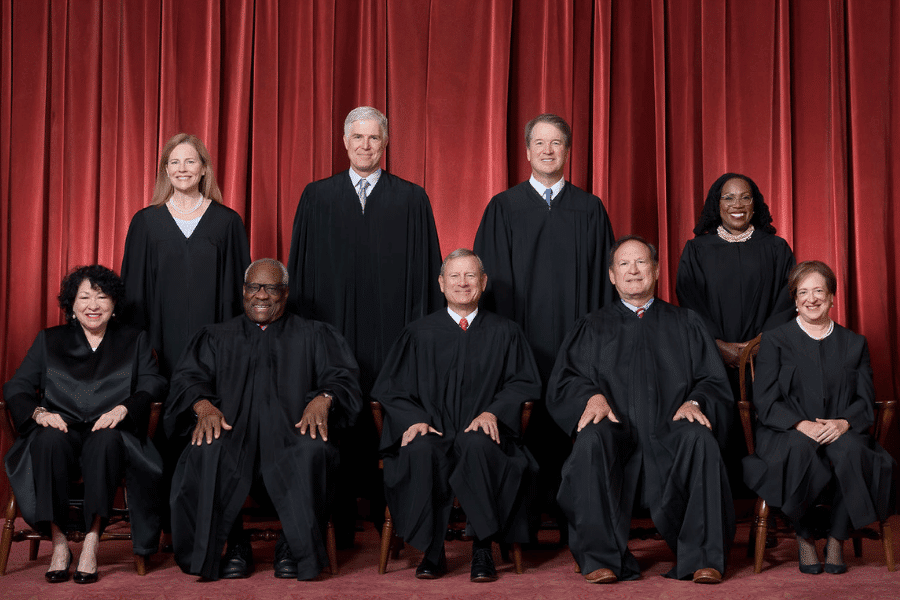
  • How important could one court be?

    How important could one court be?


    A polarized electorate

    The first Italo-American to serve on the Supreme Court, Scalia had been appointed by Ronald Reagan, a Republican president. Of the eight remaining justices, four were appointed by Republican presidents and four by Democrats.

    Both parties recognize that Scalia’s successor could tip the scales in close votes. Cases currently before the Court involve climate change, affirmative action, abortion, unions, immigrants and contraception — issues where the electorate is deeply divided.

    Although the Constitution stipulates that the president nominates Supreme Court justices, Republican candidates for the presidency have said the choice of Scalia’s successor should be left to whoever succeeds Barack Obama in the White House next January. Obama, a Democrat, has said he will send a nomination to the Senate in due course.

    That partisan split can be explained by the weight of the Court’s decisions and the polarization of the U.S. electorate.

    Whereas historically the two major parties have been able to agree, sometimes begrudgingly, on the choice of justices, the process has become far more partisan and divisive in recent decades.

    Unfavorable opinions

     The gaping ideological split in the current Congress and an increasingly vitriolic presidential campaign ensure a bitter fight in coming months.

    The political acrimony was reflected in a nationwide poll conducted last year by the Pew Research Center.

    Following recent Supreme Court rulings on Obamacare and same-sex marriage, unfavorable opinions of Court have reached a 30-year high, the survey found. And opinions about the court and its ideology have never been more politically divided.

    “Republicans’ views of the Supreme Court are now more negative than at any point in the past three decades,” it said. Little wonder that Republican presidential candidates are keen to put a conservative in the vacant seat.

    While the Supreme Court is an independent branch of government, its composition is not — and has never been — immune from politics. The nomination of justices is part of the system of checks and balances.

    But at the end of the day, the system requires the willingness of voters and their representatives to adhere to laws, executive orders and court rulings, however deep the political divide. If that faith ever crumbled, the U.S. experiment in democracy would be under threat.


    Source link

  • High school speech and debate allows students to find common ground

    High school speech and debate allows students to find common ground

    This story about high school speech and debate was produced by The Hechinger Report, a nonprofit, independent news organization focused on inequality and innovation in education. Sign up for the Hechinger newsletter.

    DES MOINES, Iowa — Macon Smith stood in front of a nearly empty classroom 1,000 miles from home. He asked his opponent and the two judges in the room if they were ready to start, then he set a six-minute timer and took a deep breath.

    “When tyranny becomes law, rebellion becomes duty,” he began. 

    In front of Macon, a 17-year-old high school junior, was a daunting task: to outline and defend the argument that violent revolution is a just response to political oppression.

    In a few hours, Macon would stand in another classroom with new judges and a different opponent. He would break apart his entire argument and undo everything he had just said.

    “An eye for an eye makes the whole world blind,” Macon started.

    It doesn’t really matter what opinion Macon holds on violence or political oppression. In this moment in front of the judges, he believes what he’s saying. His job is to get the judges to believe with him.

    Related: A lot goes on in classrooms from kindergarten to high school. Keep up with our free weekly newsletter on K-12 education.

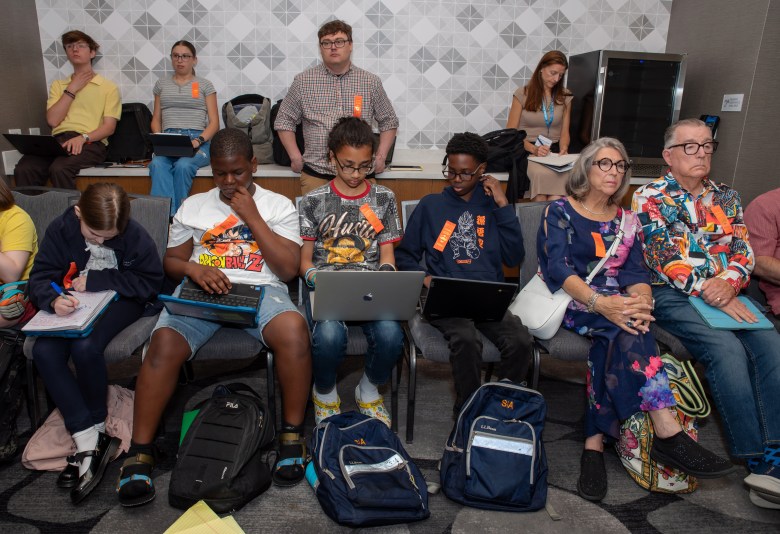
    Macon was one of more than 7,000 middle and high school students to compete in the National Speech and Debate Tournament this summer in Iowa, run by an organization that is celebrating a century in existence.

    In that time, the National Speech and Debate Association has persevered through economic and social upheaval. It is entering its next era, one in which the very notion of engaging in informed and respectful debate seems impossible. The organizers of this event see the activity as even more important in a fracturing society.

    “I don’t think there’s an activity in the world that develops empathy and listening skills like speech and debate,” said Scott Wunn, the organization’s president. “We’re continuing to create better citizens.” 

    Macon Smith, a rising senior from Bob Jones Academy in South Carolina, competes in the third round of the Lincoln-Douglas Debate at the National Speech and Debate Tournament in Iowa this summer. Credit: Meenakshi Van Zee for The Hechinger Report

    Though the tournament is held in different cities around the country, for the 100th anniversary, the organizers chose to host it in Des Moines, where the association’s headquarters is based.

    Preparing for this competition was a year in the making for Macon, who will be a senior at Bob Jones Academy, a Christian school in Greenville, South Carolina, this fall. Students here compete in more than two dozen categories, such as Original Oratory, in which they write and recite their own 10-minute speeches, or Big Questions, where they attempt to argue broad, philosophical ideas. 

    Macon’s specialty, the Lincoln-Douglas Debate, is modeled after a series of public, three-hour debates between Abraham Lincoln and Sen. Stephen Douglas in 1858. In this event, two students have just 40 minutes to set up their arguments, cross-examine each other and sway the judges.

    “Even if I don’t personally believe it, I can still look at the facts and determine, OK, this is a good fact, or it’s true, and argue for that side,” Macon said.

    Debaters often have to tackle topics that are difficult, controversial and timely: Students in 1927 debated whether there was a need for a federal Department of Education. In 1987, they argued about mandatory AIDS testing. In 2004, they debated whether the United States was losing the war on terror. This year, in the Public Forum division, students debated whether the benefits of presidential executive orders outweigh the harms. 

    Related: Teaching social studies in a polarized world

    While the speech and debate students practiced for their national event, adults running the country screamed over each other during a congressional hearing on state sanctuary policies. A senator was thrown to the floor and handcuffed during a press conference on sending the National Guard to immigration enforcement protests in Los Angeles. Most Americans feel political discourse is moving in the wrong direction — both conservatives and progressives say talking politics with someone they disagree with has become increasingly stressful and frustrating

    Speech and debate club, though, is different.

    “First of all, it gives a kid a place to speak out and have a voice,” said Gail Nicholas, who for 40 years has coached speech and debate at Bob Jones Academy alongside her husband, Chuck Nicholas, who is Macon’s coach. “But then also learn to talk to other people civilly, and I think that’s not what’s being modeled out there in the real world right now.” 

    Macon Smith, a rising senior from Bob Jones Academy in South Carolina, shows off the notes that he took during debates at the National Speech and Debate Tournament in Iowa. Credit: Meenakshi Van Zee for The Hechinger Report

    On the second day of the competition in a school cafeteria in West Des Moines, Macon was anxiously refreshing the webpage that would show the results of his rounds to learn whether he would advance to semifinals.  

    For most of the school year, Macon spent two days a week practicing after school, researching and writing out his arguments. Like many competitors, he has found that it’s easy to make snap judgments when you don’t know much about an issue. Decisively defending that view, to yourself and to others, is much harder.  

    “I tend to go in with an opinion and lose my opinion as the topic goes on,” said Daphne DiFrancesco, a rising senior from Cary Academy in Cary, North Carolina.

    Traveling for regional events throughout the school year means Macon has become friends with students who don’t always share his conservative views. He knows this because in debate, discussing politics and religion is almost unavoidable.

    “It doesn’t make me uncomfortable at all,” Macon said. “You don’t want to burn down a bridge before you make it with other people. If you stop your connection with a person right at their political beliefs, you’re already cutting off half of the country. That’s not a good way to conduct yourself.”

    Macon, and other students in the clubs, said participating has made them think more deeply about their own beliefs. Last year, Macon debated a bill that would defund Immigration and Customs Enforcement, an agency he supports. After listening to other students, he developed a more nuanced view of the organization. 

    “When you look at the principle of enforcing illegal immigration, that can still be upheld, but the agency that does so itself is flawed,” he said.

    Related: ‘I can tell you don’t agree with me’:’ Colleges teach kids how to hear differing opinions

    Henry Dieringer, a senior from L.C. Anderson High School in Austin, Texas, went into one competition thinking he would argue in favor of a bill that would provide work permits for immigrants, which he agrees with. Further research led him to oppose the idea of creating a federal database on immigrants.

    “It made me think more about the way that public policy is so much more nuanced than what we believe,” Henry said. 

    On the afternoon of the second day of the national tournament, Macon learned he didn’t advance to the next round. What’s sad, he said, is he probably won’t have to think this hard about the justness of violent revolution ever again. 

    “There’s always next year,” Macon said.

    Callista Martin, 16, a rising senior from Bainbridge High School in Washington state, also didn’t make the semifinals. Callista and Macon met online this year through speech and debate so they could scrimmage with someone they hadn’t practiced with before. It gave them the chance to debate someone with differing political views and argument styles.

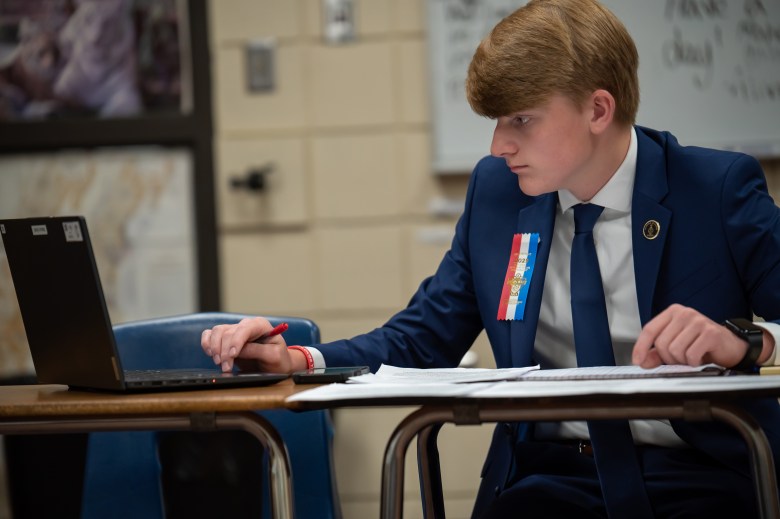
    Macon Smith, a rising senior from Bob Jones Academy in South Carolina, takes notes during a round of the Lincoln-Douglas Debate at the National Speech and Debate Tournament in Iowa. Credit: Meenakshi Van Zee for The Hechinger Report

    “In the rounds, I’m an entirely different person. I’m pretty aggressive, my voice turns kind of mean,” Callista said. “But outside of the rounds, I always make sure to say hi to them before and after and say things I liked about their case, ask them about their school.”

    Talking to her peers outside of rounds is perhaps the most important part of being in the club, Callista said. This summer, she will travel to meet with some of her closest friends, people she met at debate camps and tournaments in Washington.  

    Since Callista fell in love with speech and debate as a freshman, she has devoted herself to keeping it alive at her school. No teacher has volunteered to be a coach for the debate club, so the 16-year-old is coaching both her classmates and herself.

    A lack of coaches is a common problem. Just under 3,800 public and private high schools and middle schools were members of the National Speech and Debate Association at the end of this past school year, just a fraction of the tens of thousands of secondary schools in the country. The organization would like to double its membership in the next five years.

    That would mean recruiting more teachers to lead clubs, but neither educators nor schools are lining up to take on the responsibility, said David Yastremski, an English teacher at Ridge High School in New Jersey who has coached teams for about 30 years.

    It’s a major time commitment for teachers to dedicate their evenings and weekends to the events with little supplemental pay or recognition. Also, it may seem like a risk to some teachers at a time when states such as Virginia and Louisiana have banned teachers from talking about what some call “divisive concepts,” to oversee a school activity where engaging with controversial topics is the point.

    “I primarily teach and coach in a space where kids can still have those conversations,” Yastremski said. “I fear that in other parts of the country, that’s not the case.” 

    Related: A school district singled out by Trump says it teaches ‘whole truth history’ 

    Dennis Philbert, a coach from Central High School in Newark, New Jersey, who had two students become finalists in the tournament’s Dramatic Interpretation category, said he fears for his profession because of the scrutiny educators are under. It takes the fun out of teaching, he said, but this club can reignite that passion.

    “All of my assistant coaches are former members of my team,” Philbert said. “They love this activity [so much] that they came back to help younger students … to show that this is an activity that is needed.”

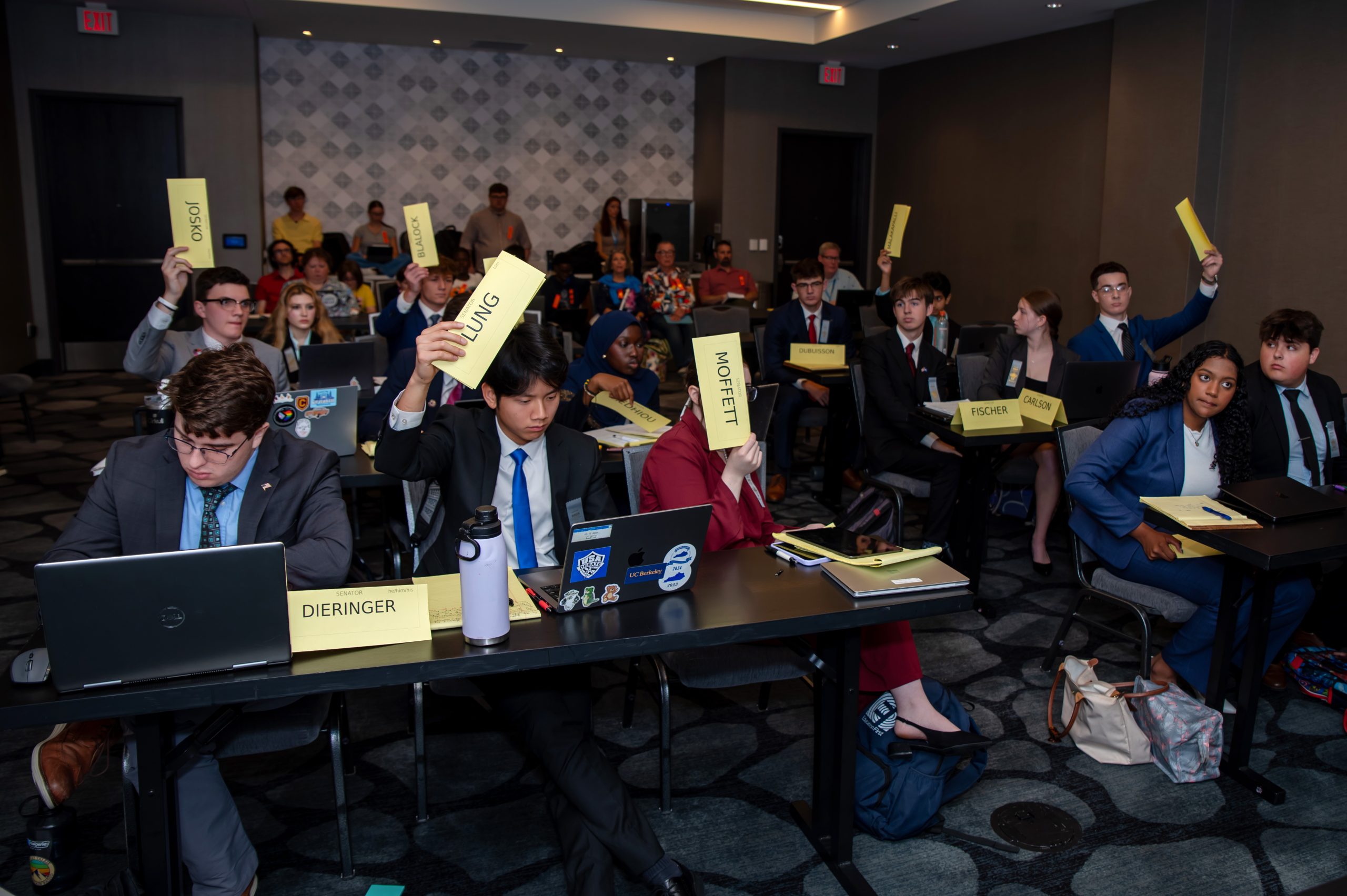
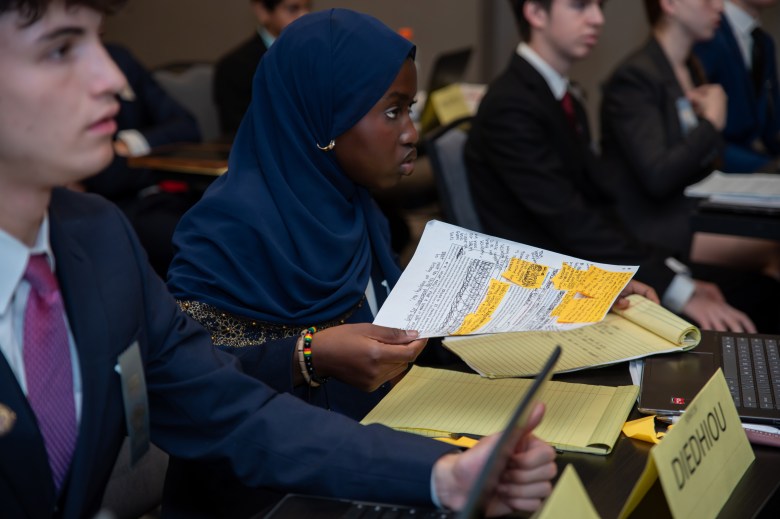
    On the other side of Des Moines, Gagnado Diedhiou was competing in the Congressional Debate, a division of the tournament that mimics Congress and requires students to argue for or against bills modeled after current events. During one round, Gagnado spoke in favor of a bill to shift the country to use more nuclear energy, for a bill that would grant Puerto Rico statehood, and against legislation requiring hospitals to publicly post prices.

    Gagnado Diedhiou, a senior from Eastside High School in South Carolina, competing in the first round of the Congressional Debate at the National Speech and Debate Tournament in Iowa in June. Credit: Meenakshi Van Zee for The Hechinger Report

    Just like in Congress, boys outnumbered girls in this classroom. Gagnado was the only Black teenager and the only student wearing a hijab. The senior, who just graduated from Eastside High School in Greenville, South Carolina, is accustomed to being in rooms where nobody looks like her — it’s part of the reason she joined Equality in Forensics, a national student-led debate organization that provides free resources to schools and students across the country.

    “It kind of makes you have to walk on eggshells a little bit. Especially because when you’re the only person in that room who looks like you, it makes you a lot more obvious to the judges,” said Gagnado, who won regional Student of the Year for speech and debate in her South Carolina district this year. “You stand out, and not always in a good way.”

    Camille Fernandez, a rising junior at West Broward High School in Florida, said the competitions she has participated in have been dominated by male students. One opponent called her a vulgar and sexist slur after their round was over. Camille is a member of a student-led group — called Outreach Debate — trying to bridge inequities in the clubs. 

    “A lot of people think that debate should stay the same way that it’s always been, where it’s kind of just — and this is my personal bias — a lot of white men winning,” Camille said. “A lot of people think that should be changed, me included.” 

    Despite the challenges, Gagnado said her time in debate club has made her realize she could have an influence in the world.

    “With my three-minute speech, I can convince a whole chamber, I can convince a judge to vote for this bill. I can advocate and make a difference with some legislation,” said Gagnado, who is bound for Yale. 

    About 10,000 people attended the National Speech and Debate Tournament in Iowa this June during the organization’s centennial anniversary. Credit: Meenakshi Van Zee for The Hechinger Report

    A day before the national tournament’s concluding ceremony, a 22-year-old attendee rushed the stage at the Iowa Event Center in Des Moines during the final round of the Humorous Interpretation speech competition, scaring everyone in the audience. After he bent down to open his backpack, 3,000 people in the auditorium fled for the exits. The man was later charged with possession of a controlled substance and disorderly conduct. For a brief moment, it seemed like the angry discourse and extreme politics from outside of the competition had become a part of it. 

    In response, the speech and debate organization shifted the time of some events, limited entrances into the building and brought in metal detectors, police officers and counselors. Some students, Gagnado among them, chose not to return to the event. 

    Still, thousands of attendees stayed until the end to celebrate the national champions. During the awards ceremony, where therapy dogs roamed the grounds, Angad Singh, a student from Bellarmine College Preparatory in California competing in Original Oratory, took the national prize for his speech on his Sikh identity and the phrase “thoughts and prayers” commonly repeated by American leaders after a tragedy, titled “Living on a Prayer.”

    “I’ve prayed for change,” Singh told the audience. “Then I joined speech and debate to use my voice and fight for it.”

    This story about high school speech and debate was produced by The Hechinger Report, a nonprofit, independent news organization focused on inequality and innovation in education. Sign up for the Hechinger newsletter.

    The Hechinger Report provides in-depth, fact-based, unbiased reporting on education that is free to all readers. But that doesn’t mean it’s free to produce. Our work keeps educators and the public informed about pressing issues at schools and on campuses throughout the country. We tell the whole story, even when the details are inconvenient. Help us keep doing that.

    Join us today.

    Source link

  • One year on from the election, Labour is losing the student vote

    One year on from the election, Labour is losing the student vote

    A year ago, Sir Keir Starmer secured the largest election victory in the UK since 1997.

    Labour won 411 seats and a 174-seat majority – and while Labour’s vote share across many constituencies dropped compared to national predictions, the UK was washed with red seats.

    Yet as we reflect on Labour’s time in government to date, it’s fair to say the journey has not been smooth.

    Starmer has already made several significant U-turns and has announced policy changes that haven’t landed well with voters – increases to national insurance contributions, reducing winter fuel payments and the “tractor tax”, to name a few.

    As public trust in the government continues to decline and disapproval rates rise, we are continuing to see a swing of support over to Reform UK – including in constituencies with large student populations.

    PLMR recently commissioned Electoral Calculus to conduct a new multi-level regression and post-stratification (MRP) poll to understand voting intentions and the current political attitudes of the public.

    Conducted in June 2025 with a sample size of 5,400 individuals, the results show a significant change in student voting patterns and beg the question – is Labour losing the student vote?

    Voting intentions

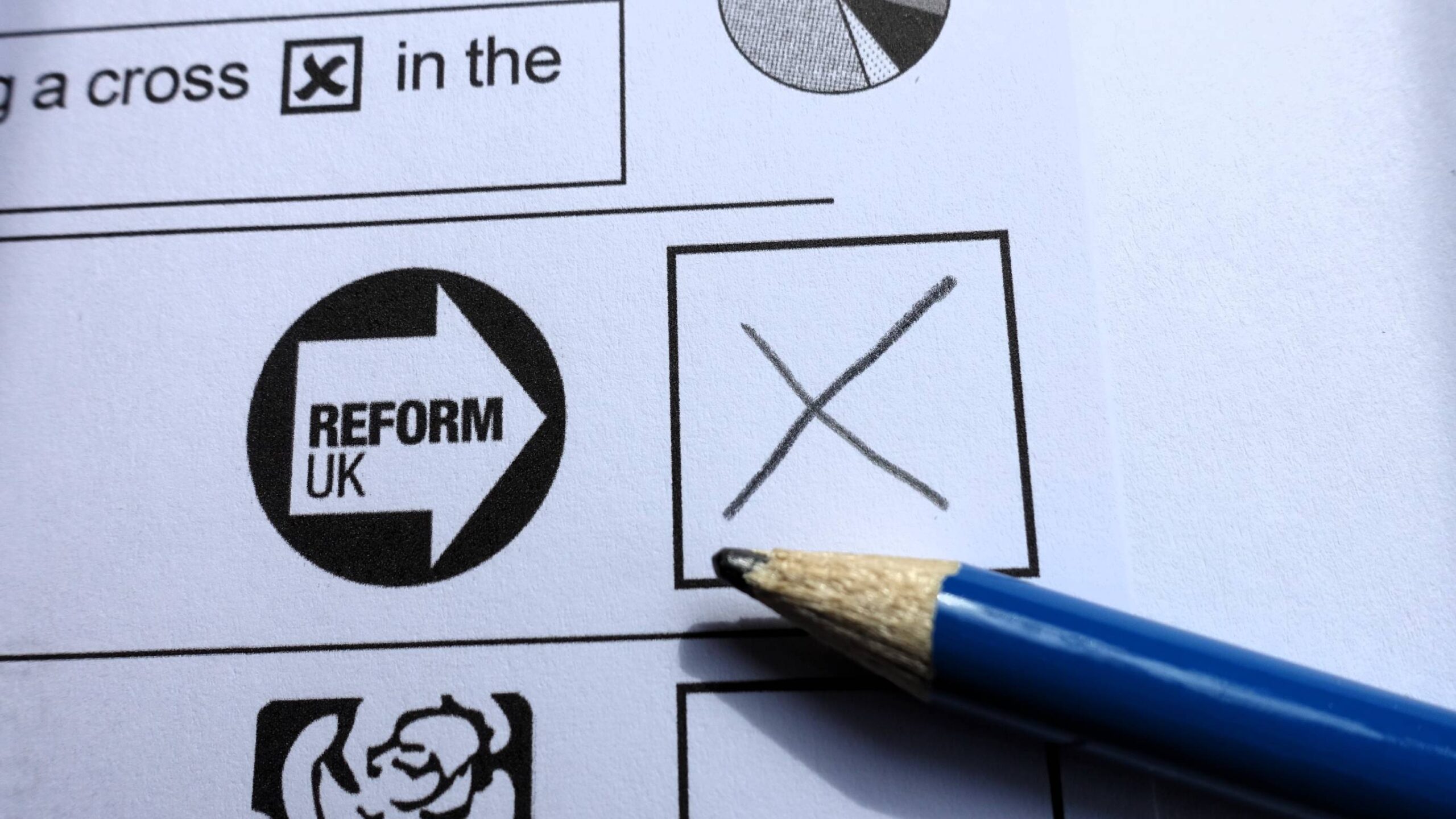
    If a General Election was called tomorrow, our data currently places Reform UK with 31 per cent of the vote share ahead of Labour with 22 per cent and the Conservatives trailing with 19 per cent. Reform UK is predicted to win an outright majority, securing 377 seats and a majority of 104.

    If a General Election was therefore called tomorrow, Nigel Farage would become the Prime Minister of the United Kingdom.

    The data also shows changes in constituency MPs, including for ministers with responsibility for higher education like the Secretary of State for Education, Bridget Phillipson MP, according to the projections.

    While the sector is not unaccustomed to experiencing regular and quick changes in political governance – with six university ministers being in post in the last five years alone – the data does point to wider challenges for HE and the student vote.

    Reform the system

    Last year, the Higher Education Policy Institute (HEPI) published a piece about whether students made a difference at the 2024 General Election – identifying the top twenty student constituencies and Labour’s vote share in these seats.

    We have analysed our polling to understand how these constituencies would fare in an election if it were called tomorrow – the results from which show the changing state of voting intentions in these areas.

    Of the twenty constituencies, over one-third (35 per cent) are predicted to move away from being Labour-held to either Reform or Green. This aligns with the national picture – voters are showing an ever-growing frustration with the current government and are therefore evolving their political affiliation.

    When we look specifically at the data for 18-24-year-olds – acknowledging the experiences of those beyond this age group who are currently studying in UK higher education – we continue to see this pattern of voting behaviour.

    For example, when asked who they would vote for if a General Election was called tomorrow, 24 per cent of 18-24-year-olds who indicated a likelihood to vote noted their intention to vote for Labour – with 23 per cent claiming they would vote for Reform UK and 21 per cent for the Green Party.

    The Conservatives followed with 13 per cent, the Liberal Democrats with 10 per cent and Scottish National Party and Plaid Cymru with 1 per cent each.

    Interestingly, when we then consider the likelihood of voting among 18-24-year-olds we see further frustration with the current political system.

    For example, under half (41 per cent) of 18-24-year-olds responded that they would “definitely” vote in a General Election if it were called tomorrow, followed by 11 per cent who would be “very likely” to vote.

    Yet 21 per cent responded that they would “definitely not” or are “unlikely” to vote, and 16 per cent were unsure. That reveals an almost even split in the likelihood of voting among 18-24-year-olds. For a traditionally politically mobile population, this raises concerns about young people’s faith and willingness to engage with an election.

    Participants were then asked about the most important issues that will influence how they vote at the next General Election, with the top three issues for 18-24-year-olds being the cost of living and the economy (57 per cent), the National Health Service (NHS) waiting times, staffing and funding (45 per cent), and immigration and border control (25 per cent).

    While these generally align with trends in all other age groups,

    18-24-year-olds express greater concern for wider issues than other age cohorts. For example, 23 per cent of individuals in this age group reported being concerned about housing affordability and home ownership, 22 per cent about trust in politicians and government integrity, and 19 per cent about climate change and the environment.

    While some in other age cohorts reported concerns in these areas, the proportion is highest among 18-24-year-olds.


    So what does all of this tell us?

    It’s clear that Labour isn’t sustaining the support it built up during the General Election campaign last year, despite securing such an historic electoral victory, and this is true especially in student-heavy constituencies – with many already indicating their interest in seeing an electoral change.

    As economic challenges continue to create barriers within HE, with many institutions closing courses, implementing redundancy programmes and depending on international fees due to limited increases to domestic fees in line with inflation, government must be proactive in its engagement with the sector to recognise how challenges to the student experience can impact voter intention.

    With a growing national swing towards Reform UK, Labour must become aware of the challenges facing student voters if it wants to change the projected course of action and secure a second term in office.

    With lots of work to do ahead of 2029 – and only a year into this Parliament – student interests need to rise up the political agenda.

    Source link

  • Podcast: International, student leaders, metascience

    Podcast: International, student leaders, metascience

    This week on the podcast we examine the latest attacks on international student recruitment as Policy Exchange calls for new restrictions and a £1,000 levy on international fees.

    Are universities really “selling immigration not education,” and what would raising English language requirements to advanced level mean for the sector?

    Plus we discuss what incoming student leaders are promising in their manifestos – from subsidised laundry to lecture materials uploaded in advance – and ask whether the new metascience unit can deliver on its promise of a more efficient and transparent research funding system.

    With Duncan Ivison, President and Vice Chancellor at the University of Manchester, Vicki Stott, Chief Executive at the Quality Assurance Agency for Higher Education, Debbie McVitty, Editor at Wonkhe and presented by Jim Dickinson, Associate Editor at Wonkhe.


    The attack lines on international students are built on shaky foundations – but won’t go away that easily

    Should students’ unions reach for the stars?

    Metascience comes of age

    Source link

  • Decoder Replay: Is truth self-evident?

    Decoder Replay: Is truth self-evident?

    Fake news is dangerous. But it’s hardly new.

    More than 3,000 years ago, the largest chariot battle ever pitted the forces of one of the most powerful pharaohs of ancient Egypt — Ramesses the Great — against the Hittite Empire in Kadesh, near the modern-day border between Lebanon and Syria.

    The battle ended in stalemate.

    But once back in Egypt, Ramesses spread lies portraying the battle as a major victory for the Egyptians. He had scenes of himself killing his enemies put up on the walls of nearly all his temples.

    It was propaganda. “It is all too clear that he was a stupid and culpably inefficient general and that he failed to gain his objectives at Kadesh,” Egyptologist John A. Wilson wrote.

    Disinformation in ancient Rome

    The Roman general Mark Antony killed himself with his sword after his defeat in the Battle of Actium upon hearing false rumors — fake news — propagated by his lover Cleopatra claiming that she had committed suicide.

    American patriots, including the esteemed U.S. statesman and inventor Benjamin Franklin, and their British enemies swapped spurious allegations during the American Revolution that murderous Native Americans were working in league with their adversaries, scalping allies.

    How about the 1938 radio drama, “The War of the Worlds”? Adopted from a novel by H.G. Wells, the radio broadcast fooled some listeners into believing that Martians had landed in America. Newspapers of the day said the broadcast sparked panic.

    But historians today say the panic was exaggerated. So it was fake news about fake news!

    There is no shortage of modern-day instances of fake news. In Myanmar in 2018, the military spearheaded a campaign of fake news, mainly on Facebook, claiming the Rohingya minority had murdered and raped members of the Buddhist majority. The Rohingya were described as dogs, maggots and rapists. The fake news helped trigger violence against the Rohingya that forced 700,000 people to flee their homes.

    The irony is that many in Myanmar had turned to Facebook for information because the military had alienated many citizens with its control of the media. But the same military took advantage of the false reports to crack down on the Muslim minority.

    Election falsehoods

    Similarly, fake news has been used in the Philippines, Indonesia, Malaysia and Sri Lanka to influence the outcome of elections, hide corruption and stir up religious animosity.

    One of the ironies of fake news is it can embolden authoritarian governments to turn the tables and use made-up news as an excuse to crack down on the media. That can enable the regime to control the media message. In other words, fake news to the rescue of autocrats.

    But we should not fool ourselves into thinking that fake news can be cured merely through technological solutions, that it’s a product of our times, that it’s mainly political and that it’s peddled only by our opponents. It’s not the property of any one political party or interest.

    Fake news takes root in the gray area between truth and fiction, an area we can be quite comfortable in. There is something very enticing about fake news, especially if it aligns with our pre-conceived notions. Yet we are apt to think that fake news is the exception, a new aberration.

    We can easily fall victim to fake news in part because we are not always disgusted by lies. We are taught at a very early age that deceit – deception, dishonesty, disinformation – is all around us. And that not all lies are as harmful as others. Our parents read us fairy tales from the earliest of ages, and many tales involve lies.

    The telling of fairy tales

    Take the ancient fable of “The Cock and the Fox,” included in the medieval collection of Middle Eastern folk tales, “One Thousand and One Nights.”

    A hungry fox tries to coax a rooster out of a tree by telling him a tall tale — that there is universal friendship now among hunters and the hunted. The cock has nothing to fear, the wily fox says. It’s a lie, of course.

    So, the equally wily cock resorts to his own lie: he tells the fox that he sees greyhounds running towards them, surely with a message from the King of Beasts. The fox, outwitted, runs away in fear. So here we have two lies in a single story. The moral? “The best liars are often caught in their own lies.”

    Children and their parents are quite comfortable surrounded by lies. Is Santa Claus a malicious or harmless lie?

    Do you know the story of the Wizard of Oz? That classic U.S. movie about a young girl lost in a fantasy world, pursued by witches, struggling to go home? The entire plot relies on a deceit – a supposedly powerful wizard who is nothing more than a bumbling, ordinary conman, who uses magic tricks to make himself seem great and powerful.

    Deceit at the service of entertainment.

    Advertisements are often innocent exaggerations, fiction if you will in the service of business and profit-making. But sometimes ads can veer into falsehoods.

    So fake news is not new. And we’re no strangers to lies. What does that mean for those of us interested in making the world a better place? Should we simply give up because the task is too great?

    Hardly. The lesson is that truth is not black and white, but grey, and it’s a moving target.

    Take, for example, colonialism. From the 15th century on, white Europeans conquered huge swathes of the Americas, Africa, the Middle East, Asia and Oceania. They subjugated millions of people, using brutal violence in many places to subdue indigenous populations. They brought diseases that wiped out millions.

    They exploited natural resources, using native labor and pocketing most of the profit from sales into a global trading network that they established. By 1914, Europeans had gained control of 84% of the globe.

    We know all of that now because colonized peoples have revolted against their colonial rulers and won independence. The wars of independence have been won, yet so many countries around the world are still grappling with the shameful effects of colonialism and racism.

    The ambiguity of truth

    But would everyone have agreed on that depiction of Europeans as rapacious colonialists before the wars of independence?

    Certainly not most of the Europeans, who believed they were exporting a superior civilization to backward natives. Missionaries who led many colonial ventures believed they were doing God’s will by converting native populations to Christianity. And not a few natives turned a blind eye to atrocities and benefited financially.

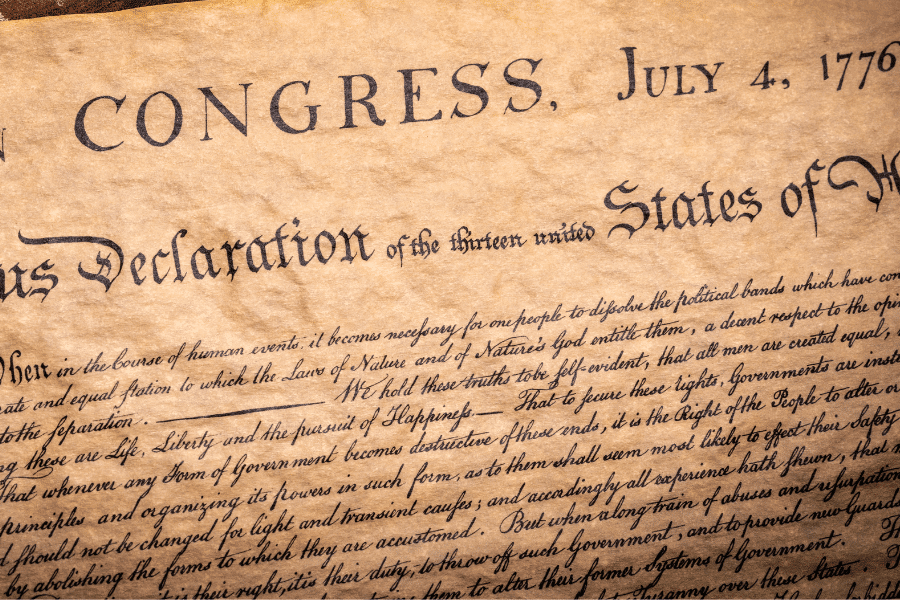
    For a glaring example of the ambiguity of truth, take the United States. Its Declaration of Independence, borrowing from the French enlightenment, states that “all men are created equal,” with “unalienable Rights” to “Life, Liberty, and the pursuit of Happiness.” It put notions of freedom and equality at the heart of the American experiment. Yet it was written by a slave owner, Thomas Jefferson, and represented 13 colonies that all, to one degree or another, allowed slavery.

    Convinced of their superiority and driven by an almost unquenchable appetite for wealth, white settlers drove Native Indians from their homes. The U.S. government authorized more than 1,500 attacks and raids on Indians. By the end of the 19th century, fewer than 238,000 indigenous people remained, down from some 5-15 million living in North America when Columbus arrived in 1492.

    What is more, settlers in the South imported slaves from Africa, forcing them to work on vast plantations and denying them the very rights to life and liberty spelled out in the Declaration of Independence.

    Rights and repercussions

    Both Native Indians and African Americans are struggling to this day to come to terms with the treatment they suffered at the hands of the white colonials.

    Would a white settler have seen himself or herself as a murderer? Hardly. In their minds, they were doing God’s work.

     Mind you, the desire to colonize is not peculiar to Europeans. Imperial Japan and imperialist China both established overseas empires. The Empire of Japan seized most of China and Manchuria. To this day, Chinese nationals and South Koreans harbor ill feelings towards the Japanese. Chinese dynasties won control over parts of Vietnam and Korea.

    There’s an expression in newsrooms around the world: “One man’s terrorist is another man’s freedom fighter.” Put another way, the same individual might seem a terrorist to some, a hero to others.

    Take Yagan, a 19th century indigenous Australian warrior from the Noongar people. He played a key role in early resistance to British colonial rule in an area that is now Perth. His execution by a young settler figures in Australian history as a symbol of the unjust treatment of indigenous peoples by colonial settlers.

    A hero to his people, he was a murderer in the eyes of the British.

    Different perspectives on history

    Or take the Incan emperor, Atahualpa, who resisted the explorer and conquistador Francisco Pizarro, to this day a Spanish hero. Pizarro forced Atahualpa to convert to Christianity before eventually killing him, hastening the end of one of the greatest imperial states in human history.

    How you view Pizarro may depend on where you are sitting and when you lived.

    There are countless modern examples of radically different perspectives on events. Such discrepancies may be inevitable. Dogged journalists can shed light on events and protagonists, and help shape history – for better or for worse.

    Joseph McCarthy was a U.S. senator who in the early years of the Cold War spearheaded a smear campaign against alleged Communist and Soviet spies. Only courageous reporting by a small group of journalists who dared question McCarthy’s tactics and risked being tarred as Communist sympathizers themselves led to McCarthy’s downfall.

    Joseph McCarthy (L) with his attorney Roy Cohn, who later mentored Donald Trump (Wikimedia Commons)

    The New York Times and Washington Post went out on a legal limb when in 1971 they published the Pentagon Papers, a U.S. government history of the Vietnam War that laid bare official lies that drove American policy for more than a decade in Southeast Asia.

    The government called the man who leaked the government documents a criminal and sought to prevent the newspapers from publishing the damning revelations.

    The newspapers won their case before the Supreme Court, and their reporting increased public pressure on the government to withdraw from Vietnam.

    Watergate upended a presidency.

    You’ve perhaps heard of Watergate? Literally speaking, it’s a hotel in Washington, DC. But it has come to stand for the dogged and courageous news reporting by two journalists with the Washington Post who exposed crimes by President Richard Nixon and helped lead to his resignation in 1974.

    Courageous investigative journalism is hardly confined to the United States. A non-profit news outfit called AmaBhungane — in Zulu, “dung beetle,” an animal that digs through shit – has reported on corrupt business deals at the highest levels of South Africa’s government.

    In the Arab world, investigative journalists in Egypt, Yemen, Tunisia, Syria, Lebanon, Jordan, Iraq, Bahrain, Palestine, Mauritania, Algeria, Kuwait and Sudan have uncovered tax evasion, money laundering, drug smuggling, torture and slavery. They have unmasked doctors who have removed the wombs of mentally disabled girls with the consent of parents.

    But it’s not all easy sailing. According to Freedom House, in 2017 there were only 175 investigative journalists in all of China, down 58% since 2011.

    What does this mean for you, a young activist who wants to help change the world?

    Truth is murky.

    The lesson is that the truth may not lie squarely on one side or the other, but rather in a murky, grey area. It can take courage to shine a light in the shadows, teeming with lies. And you may have to hear viewpoints that differ radically from your own. It pays to listen.

    Progress against racism, inequality and injustice depends on an informed public.

    The best journalists recognize their responsibility to uphold the Universal Declaration of Human Rights, which state that: all human beings are born free and equal in dignity and rights; and everyone has the right to freedom of opinion and expression; this right includes freedom to hold opinions without interference and to seek, receive and impart information and ideas through any media and regardless of frontiers.

    As the third U.S. President Thomas Jefferson said: “Were it left to me to decide whether we should have a government without newspapers or newspapers without a government, I should not hesitate a moment to prefer the latter.”

    So stick up for your rights, including the right to free expression. Be fair. And remember that one man’s terrorist may be another man’s freedom fighter. You don’t have a lock on the truth.


    Questions to consider:

    1. Why is it important to understand that fake news is nothing new?

    2. Do you think there is any way to stamp out fake news?

    3. What does it mean to say, “One man’s terrorist is another man’s freedom fighter”?


    Source link

  • ATEC starts work with reform agenda – Campus Review

    ATEC starts work with reform agenda – Campus Review

    Tertiary education’s new steward will focus on allocating university funding, harmonising tertiary education and negotiating mission-based contracts, according to its Terms of Reference released on Tuesday.

    Please login below to view content or subscribe now.

    Membership Login

    Source link