The index ranks 26 countries and territories in terms of their capacity to shape their external environment. It evaluates international power through 133 indicators across themes including military capability and defense networks, economic capability, diplomatic and cultural influence, as well as resilience and future resources.
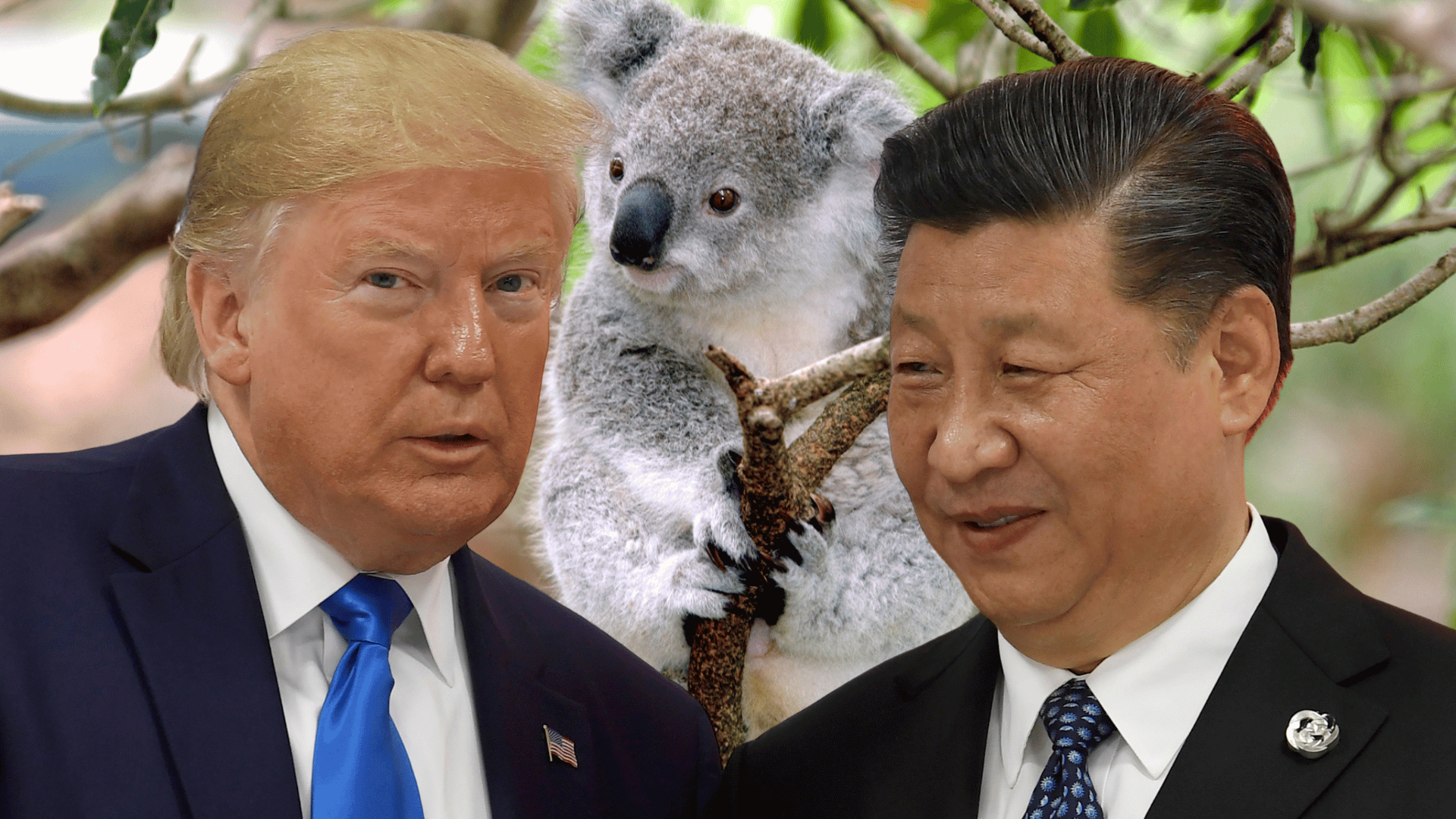
The portrait that emerges from its latest survey is that while China’s overall power still lags the United States, it is not far behind, even though the current economic slowdown is holding it back in the short term.
After the two superpowers, trailing a long way back as the next most powerful countries in the Asia-Pacific are Japan, India, Russia and then Australia.
Economic versus military power
The index confirms that China draws its power from its central place in Asia’s economic system, while that of the United States comes from its military capability and unrivaled regional defense networks.
Australia’s relationship with the two mirrors the dilemma facing the whole region.
The United States is far and away Australia’s main strategic partner and has been since the Second World War.
In a deal signed in March 2023, Australia is set to acquire a conventionally-armed, nuclear-powered submarine capability with help from the United States through the AUKUS Treaty, which also involves the United Kingdom.
This was followed by plans to station more U.S. forces in Australia, especially in air bases in northern and western Australia. There are also moves to increase cooperation between both countries in space, speed up efforts for Australia to develop its own guided missile production capability and work with the United States to deepen security relationships with other countries in the region — most notably Japan.
This comes as Australia has been working hard to get trade restrictions eased with China after it imposed tariffs on a range of Australian products in 2020 during a standoff with the previous government.
Dining with Joe and Jinping
China is still Australia’s largest two-way trading partner in goods and services, accounting for almost one third of its trade with the world. Two-way trade with China grew 6.3% in 2020-21 to A$267 billion (about US$180 billion), mostly due to the coal and iron ore sectors.
So as it stands, Australia’s security relies on the United States but its economic prosperity is heavily influenced by China.
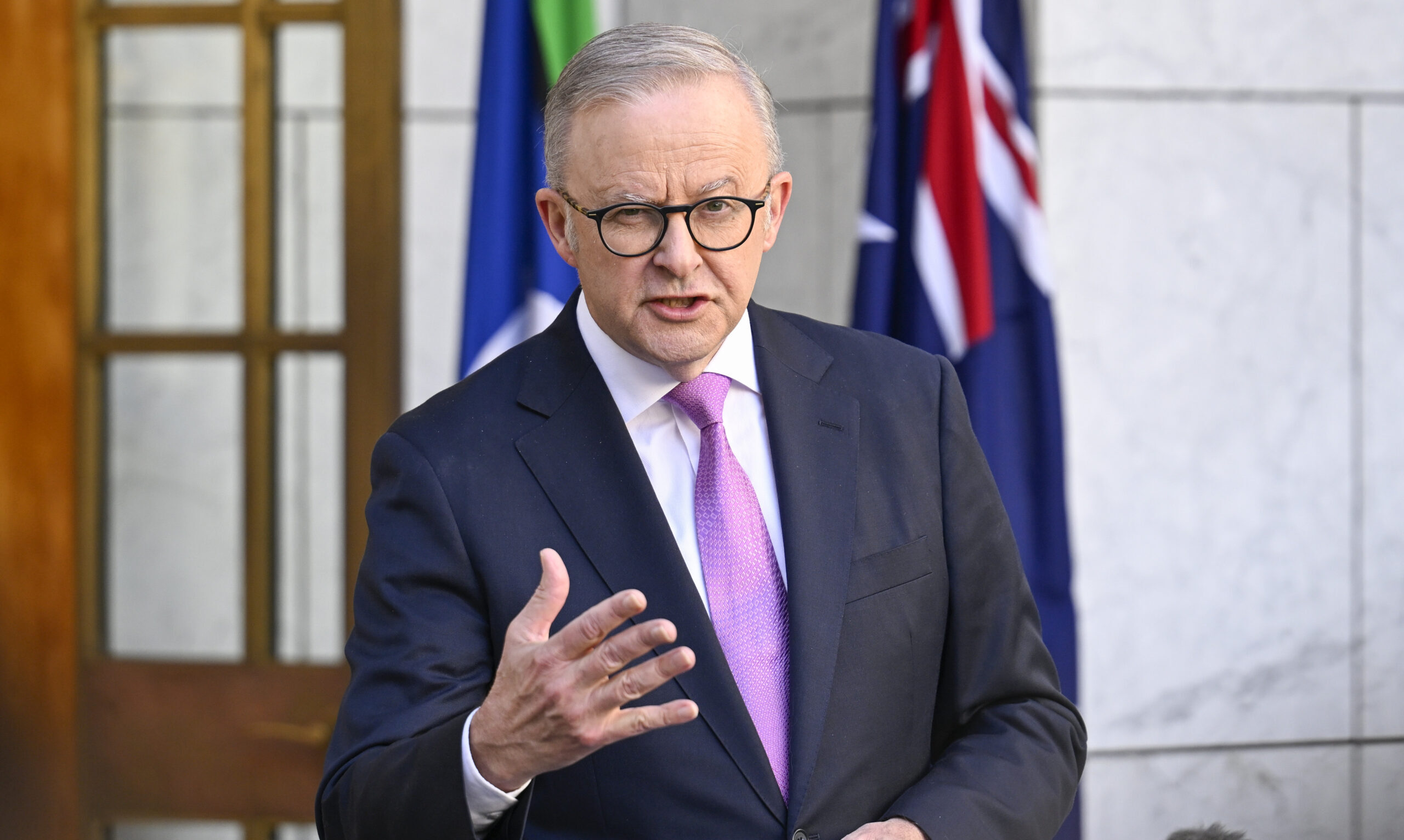
It’s no surprise then that Prime Minister Albanese had to walk a fine line in 2023 — going from a state dinner at the White House with U.S. President Biden on 26 October to meeting with Chinese president Xi Jinping 11 days later.
Colin Heseltine, a former Deputy Head of Mission at the Australian Embassy in Beijing and now senior advisor for independent think tank Asialink, said Australia is in a conundrum over China.
“Australia’s major trading partner is also perceived as our No.1 security threat,” he said.
Normalizing relations before an abnormal U.S. election
Heseltine believes there is a mood of cautious optimism about the growing relationship between Australia and China since the election of the Albanese government, but expects the future will not be completely free of headwinds.
In the end, Australia, like many other nations in the region, is pragmatically making the situation work. It has seen relations with Beijing normalize, or as some prefer to describe it, stabilize.
As for the United States, relations between Canberra and Washington remain vibrant and strong.
The next big issue for Australia in managing this twin policy of improving ties with the Asia-Pacific’s two diverse superpowers could well be the 2024 U.S. presidential election — who wins it and if China features in it.
And those things are outside its control.
Three questions to consider:
1. What is the emerging dilemma facing most democratic nations in the Asia-Pacific region? 2. Is China likely to overtake the United States as the Asia-Pacific’s major superpower anytime soon? 3. What is the biggest threat to the current status quo facing nations in the region?
Everyone has their own expertise. For academics, that expertise leads to intellectual authority. Some happily choose to use that authority in the cause of activism. Others cringe at the thought, fearing the overtly political and a loss of actual or perceived objectivity.
The debate as to whether academics can be or should be activists is alive and well. But, as universities across the UK (re)discover their civic purpose, institutional spaces for overtly activist academic work are emerging.
One such space is that offered through activist-in-residence (AiR) schemes. Typically hosted by university research centres, these programmes invite activists to work alongside academics and students on projects with a social justice focus. The activists gain access to institutional resources, collaborating with their hosts through a wealth of mutually transformative and enriching encounters that may challenge traditional academic practices. Such schemes are relatively rare in the UK but more common in North American higher education institutions.
Oppositional or diplomatic activism?
Ronald Barnett has said that academic activism can lend itself to an array of stances. He suggests that activism in universities may be situated along two sliding axes – diplomatic/oppositional and individual/collective actions. Oppositional to the state, to the status quo, versus a diplomatic willingness to engage with powerful institutions.
But let’s face it, universities often are powerful institutions perpetuating the status quo. And anyway, can you really be activist within institutional structures? For some, it’s a clear “no”. When our Queer@King’s research centre at King’s College London launched a call for activists to join a pilot AiR scheme, several rejected the invite, concerned to connect their queer activism to oppressive institutional structures.
However, for those willing to accept such an invite, there’s the potential to become a (diplomatic) institutional irritant. Here, we view the work of AiR schemes as that of “collective diplomacy”. Residencies carve out institutional spaces for academics and activists to unite around a social justice cause, practising theory-informed activism and activism-informed theory.
Those engaged in AiR schemes might act as tempered radicals, working subtly to forge change, both within and beyond institutions. Quiet acts of rebellion, compared to the vocal stridency of their oppositional cousins.
Transcending the binary
Back in 2023, we launched four new AiR schemes in the Faculty of Arts and Humanities at King’s College London. Since then, we’ve followed the journeys of the activists and academics involved as they walk the tightrope between conformity and rebellion.
The schemes, which involved four discrete research centres, have recently concluded. They spanned diverse areas – from decolonising wellness practices to challenging media narratives on race and migration, from reclaiming language justice to reframing the lived expertise of women with HIV. The communities engaged were equally diverse – French anti-racists, diaspora communities from East and Southeast Asia, movement artists, radical translators, poets, community organisers, a charity supporting women with HIV.
Despite thematic differences, what united the schemes was a commitment to co-creation, disrupting institutional norms, and centring knowledge that often remains undervalued or excluded from academia.
Activists have, quite rightly, long been wary of universities’ historical tendencies to extract knowledge without genuine reciprocity. Our AiR schemes attempt to shift this, striving for shared authorship and long-term relationship-building over transactional engagements. Academics, meanwhile, began questioning their own positionality. Several noted how the process helped them to see the activist within. Someone who takes a different approach from big marches or picket lines. Someone who instead, operates in a different sphere, with different tools from conventional protest.
A core element of the schemes involved deep conversations in which participants explored different ways of “being”, “doing”, and “knowing”, navigating creative tensions that ignited activist potential. Engagement in transformational dialogue demanded a rethinking of traditional academic hierarchies.
A striking outcome was the impact on identity. Many participants shifted from seeing themselves as strictly ‘academic’ or ‘activist’ to occupying a hybrid space—the activist-academic or the academic-activist. As one participant put it:
I’ve learned to see myself as an academic-activist, rather than assuming that activism is something distinct from what I do as a researcher.
Others reflected on how their roles had become more fluid, disrupting rigid institutional scripts about who generates knowledge, and how.
The schemes were not without tension. Bureaucratic barriers, power imbalances, and institutional inertia were recurrent frustrations. Activists were often faced with institutional red tape, while academics navigated the challenge of validating non-traditional forms of knowledge in spaces structured around rigid frameworks. Yet, the schemes demonstrated that universities could serve as incubators for new forms of activism and collaboration – if they are willing to do the hard work of structural change.
The future of AiR schemes
AiR schemes must be more than symbolic gestures. Universities must actively dismantle the barriers that limit their potential: from rethinking funding structures that exclude grassroots activists to challenging rigid research output models that fail to recognise activist knowledge production. And of course, always ensuring that sustained funding is made available.
As universities embrace their civic role, they should go beyond the activist/academic binary. The most powerful insights from AiR schemes come not from forcing these categories into opposition, but from allowing them to blur, evolve, and co-exist.
For the academic hesitant to embrace activism, AiR schemes provide a pathway for engaged scholarship. For the activist wary of academia, they offer a chance to disrupt from within. And for the university itself, they provide a critical mirror, one that reveals its complicity, its contradictions – but also, its potential as a site of radical possibility.
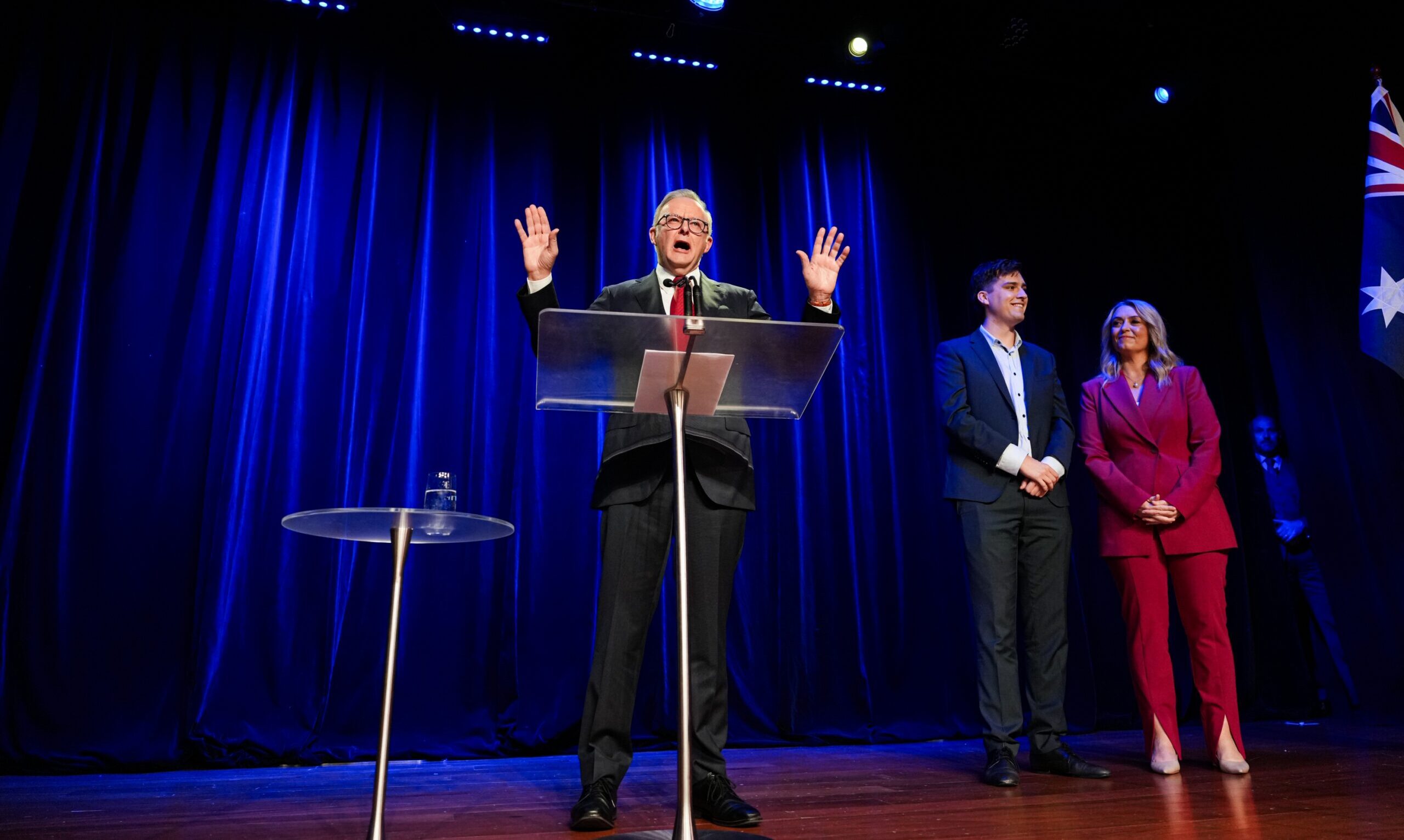
Prime Minister Anthony Albanese delivers his victory speech at the Labor Party election night event on May 3. Picture: Asanka Ratnayake
Australians have resoundingly re-elected Anthony Albanese as prime minister delivering Labor a huge majority, while Peter Dutton has lost his own seat in what was one of the most devastating results for the Coalition in living memory.
Please login below to view content or subscribe now.
This week on the podcast we discuss the financial crisis at the University of Dundee, as a revised recovery plan reduces proposed job cuts while requesting additional funding. Is this a sustainable solution for institutions facing similar challenges?
Plus we look at concerning new Wonkhe and Cibyl polling on student health, and we examine how international student policies have become political battlegrounds in global elections.
With Chris Shelley, Director of Student Experience at Queen Mary University of London, Rachel MacSween, Director of Partnerships and Stakeholder Engagement (UK and Europe) at IDP, Michael Salmon, News Editor at Wonkhe and presented by Mark Leach, Editor-in-Chief at Wonkhe.
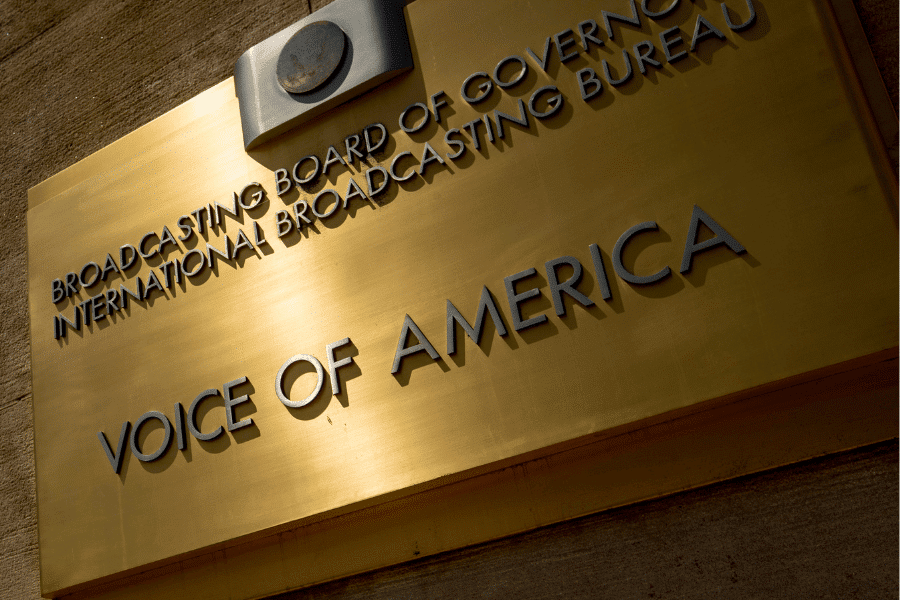
On 28 March, several journalists in South Asia opened their inboxes and found messages that changed their lives. Reporting assignments were cancelled. Email access revoked. For many, it marked the end of years of work with Voice of America — without explanation, without notice.
Nazir Ahmad is a journalist. For 11 years, Ahmad worked for Voice of America as a multimedia journalist. He documented protests, crackdowns and mass detentions. That morning, his email account was suspended. His press card was no longer valid.
“It ended without warning,” he said. “No notice, no call. Just a message that my services were no longer needed. I had been filing reports even a week before this.”
Nazir Ahmad is not his real name. We changed it for this article to protect his identity. And we offered anonymity to all the journalists we interviewed for this story because their reporting for Voice of America has put them in danger.
Ahmad is one of several South Asian journalists who lost their jobs after the Trump administration signed an executive order to downsize multiple U.S. government agencies, including the U.S. Agency for Global Media, which oversees Voice of America.
On 22 April, a federal district judge in Washington, D.C. ruled that the administration illegally required Voice of America to cease operations and ordered it be temporarily restored until the lawsuits challenging the closure have run their course. How this will affect Ahmad and the other reporters who were dismissed remains to be seen.
Shutting down a news network
The Trump Administration’s decision to end Voice of America affected journalists across Asia who have been covering sensitive political developments for years.
“I covered the Delhi riots, Punjab farmers’ protests, and the elections,” said another Voice of America journalist. “These were not easy stories. I often worked without backup and sometimes without formal protection. Now, I’m being told to stop working.”
Trump’s executive order resulted in mass administrative leave across Voice of America’s global network. Michael Abramowitz, Voice of America’s director, confirmed that nearly all 1,300 journalists and staff were placed on leave.
The White House said the order was intended to reduce government spending and eliminate what it called “radical propaganda.” It accused outlets like Voice of America of political bias, despite decades of bipartisan support for the agency.
For many South Asian journalists, the move came at a personal and professional cost. Several freelancers and stringers in India, Pakistan, Nepal, Bangladesh and Sri Lanka had worked with Voice of America for over a decade.
Telling important stories to the world
Besides reporting on protests, these reporters covered elections, environmental disasters and rights violations in hard-to-reach areas.
“I reported from Punjab’s border villages during the height of the farmers’ protests,” said yet another journalist who worked with Voice of America since 2014. “I was there when the police fired tear gas. I was there when elderly protesters braved the winter cold. And now I’m unemployed.”
These journalists say they received no formal termination letters, only a message from editors citing administrative leave and funding suspensions. They have not been told when or if their jobs will resume.
“There was a clear line in the message: stop all reporting,” said a Voice of America contributor from New Delhi. “I depend on this income to support my family. I’ve been sending stories every week for eight years.”
Voice of America was established in 1942 during World War II to counter Nazi propaganda. It has since expanded to reach 360 million people weekly in nearly 50 languages. In South Asia, it provided a platform for independent voices, especially in regions where domestic media faced political pressure or censorship.
Press coverage where the press is muzzled
Experts say the funding freeze, if ultimately allowed by the courts, could silence important coverage from conflict zones. In regions like Kashmir, where local journalists already face surveillance and restrictions, international media partnerships like Voice of America provided both visibility and a layer of protection.
“Working with VOA allowed us to tell local stories without fear of censorship,” says a journalist based in Srinagar. “Now that channel is gone.”
The impact also extends beyond journalists. Translators, video editors and fixers who worked with Voice of America in the region say their contracts have been halted.
“I’ve been working as a video editor for their South Asia bureau for six years,” said a technician based in Lahore, Pakistan. “We’ve stopped getting assignments. I haven’t been paid for last month’s work.”
Some journalists say they are now exploring alternate work, but few opportunities exist for those with years of specialized international reporting experience.
“I’m being told to apply to local newspapers, but they don’t have the budget or the editorial independence,” said a journalist from Kathmandu. “It feels like I’m starting over after 12 years.”
Stories the domestic press hesitates to cover
The Executive Order also affected coverage of religious freedom, caste violence and press crackdowns in India. Journalists who regularly filed in-depth features say important stories are now going untold.
“I was working on a long story about attacks on Christian communities,” said a reporter based in Tamil Nadu. “It’s not something mainstream outlets want to cover. Voice of America gave me space to explore that. Now it’s shelved.”
The global press watchdog Reporters Without Borders has described the shutdown as a serious setback for journalism, warning that it could encourage political interference in media operations across the world.
Stephen Capus, head of Radio Free Europe/Radio Liberty, which also lost funding, said the move would leave millions without access to independent reporting.
In South Asia, journalists say this is about more than losing a paycheck. For them, it’s the breakdown of a reporting network that allowed them to cover sensitive stories in challenging environments.
“We weren’t just sending news reports,” says a journalist who covered the Indian government’s 2019 decision to revoke Kashmir’s autonomy. “We were capturing what was happening when few others could. And now someone in Washington has pulled the plug.”
With no clarity on whether the shutdown is permanent, most contributors are in limbo. Some are looking for freelance work. Others are applying for short-term grants. But many say the abrupt stop has left them disoriented.
“I always thought if I stopped reporting, it would be because of risks here,” one journalist said. “I didn’t expect to be cut off by a government halfway across the world.”
Questions to consider:
• What is the Voice of America?
• Why has the U.S. government long funded foreign journalists outside the United States?
• Do you think governments should pay journalists to cover events and other stories? Why?
Oklahoma wants some of its less-expensive universities to cut travel and operational costs, consolidate departments and reduce energy use — all in the name of saving money.
Already, earning a degree at one of these regional institutions is relatively inexpensive for students, costing in total as much as $15,000 less per year than bigger state universities in Oklahoma. And the schools, including Southeastern Oklahoma State University and the University of Central Oklahoma, graduate more teachers and nurses than those research institutions. Those graduates can fill critically needed roles for the state.
Still, state policymakers think there are more efficiencies to be found.
Higher education is one of the specific areas targeted by a new state-run agency with a familiar name, with the goal of “protecting our Oklahoma way of life,” Republican Gov. Kevin Stitt said in the first DOGE-OK report this spring. The Oklahoma Division of Government Efficiency, created around the same time as the federal entity with a similar title, counts among its accomplishments so far shifting to automated lawn mowers to cut grass at the state capital, changing to energy-efficient LED lighting and cutting down on state government cell phone bills. The Oklahoma governor’s office did not respond to a request for comment about this effort.
Oklahoma is one of about a dozen states that has considered an approach similar to the federal DOGE, though some state attempts were launched before the Trump administration’s. The federal Department of Government Efficiency, established the day Trump took office on Jan. 20, has commanded deep cuts to federal spending and the federal workforce, with limited justification.
As academia becomes a piñata for President Donald Trump and his supporters, Republican state lawmakers and governors are assembling in line: They want to get their whacks in too.
Related: Interested in more news about colleges and universities? Subscribe to our free biweekly higher education newsletter.
Beyond Oklahoma, Florida Gov. Ron DeSantis launched FL DOGE in February, with a promise to review state university and college operations and spending. Republicans in the Ohio statehouse formed an Ohio DOGE caucus. One of the Iowa DOGE Task Force’s three main goals is “further refining workforce and job training programs,” some of which are run through community colleges, and its members include at least two people who work at state universities.
The current political environment represents “an unprecedented attack on higher education,” said Veena Dubal, a law professor at the University of California, Irvine, and general counsel for the American Association of University Professors.
The state-level scrutiny comes atop those federal job cuts, which include layoffs of workers who interact with colleges, interdepartmental spending cuts that affect higher education and the shrinking of contracts that support research and special programs at colleges and universities. Other research grants have been canceled outright. The White House is pursuing these spending cuts at the same time as it is using colleges’ diversity efforts, their handling of antisemitism and their policies about transgender athletes to force a host of changes that go beyond cost-cutting — such as rules about how students protest and whether individual university departments require more supervision.
Florida Atlantic University students Zayla Robinson, Aadyn Hoots and Meadow Swantic (from left to right) sit together at the Boca Raton campus. Swantic objects to Florida’s efforts to dictate what subjects universities can or can’t teach: “You can’t erase history.” Credit: Michael Vasquez for The Hechinger Report
Higher education, which relies heavily on both state dollars and federal funding in the form of student loans and Pell grants, research grants and workforce training programs, faces the prospect of continued, and painful, budget cuts.
“Institutions are doing things under the threat of extinction,” Dubal said. “They’re not making measured decisions about what’s best for the institution, or best for the public good.”
For instance, the Trump administration extracted a number of pledges from Columbia University as part of its antisemitism charge, suspending $400 million in federal grants and contracts as leverage. This led campus faculty and labor unions to sue, citing an assault on academic freedom. (The Hechinger Report is in an independent unit of Teachers College.) Now Harvard faces a review of $9 billion in federal funding, also over antisemitism allegations, and the list of universities under similar scrutiny is only growing.
Budget cuts are nothing new for higher education — when a recession hits, it is one of the first places state lawmakers look to cut, in blue states or red. One reason: Public universities can sometimes make up the difference with tuition increases.
What DOGE brings, in Washington and statehouses, is something new. The DOGE approach is engaging in aggressive cost-cutting that specifically targets certain programs that some politicians don’t like, said Jeff Selingo, a special adviser to the president at Arizona State University.
“It’s definitely more political than it is fiscal or policy-oriented,” said Selingo, who is also the author of several books on higher education.
“Universities haven’t done what certain politicians wanted them to do,” he added. “This is a way to control them, in a way.”
The current pressure on Florida colleges extends far beyond budget matters. DeSantis has criticized college campuses as “intellectually repressive environments.” In 2021, Florida state lawmakers passed a law, signed by the governor, to fight this perceived ideological bent by requiring a survey of public university professors and students to assess whether there is enough intellectual diversity on campus.
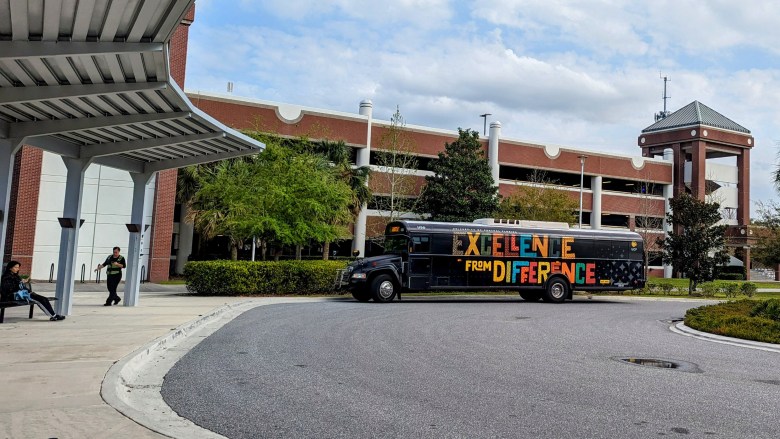
A diversity-themed bus transports students at the University of Central Florida’s Orlando campus. Credit: Michael Vasquez for The Hechinger Report
At New College in Sarasota, DeSantis led an aggressive cultural overhaul to transform the college’s atmosphere and identity into something more politically conservative. The governor has cited Hillsdale College, a conservative private Christian institution in Michigan, as a role model.
Faculty and students at New College sued. Their complaints included allegations of academic censorship and a hostile environment for LGBTQ+ students, many of whom transferred elsewhere. One lawsuit was ultimately dropped. Since the takeover, the college added athletics programs and said it has attracted a record number of new and transfer students.
Across America, Republicans control both the legislature and the governor’s mansion in 23 states, compared with 15 states fully controlled by Democrats. In those GOP-run states, creating a mini-DOGE carries the potential for increased political might, with little oversight.
In Florida, “state DOGE serves as an intimidation device,” one high-ranking public university administrator told The Hechinger Report. The administrator, who asked not to be named for fear of retribution, said “there’s also just this atmosphere of fear.”
In late March, university presidents received a letter signed by the “DOGE Team” at the governor’s office. The letter promised a thorough review by FL DOGE officials, with site visits and the expectation that each college appoint a designated liaison to handle FL DOGE’s ongoing requests.
The letter highlighted some of the items FL DOGE might request going forward, including course codes, descriptions and syllabi; full detail of all centers established on campus; and “the closure and dissolution of DEI programs and activities, as required by law.”
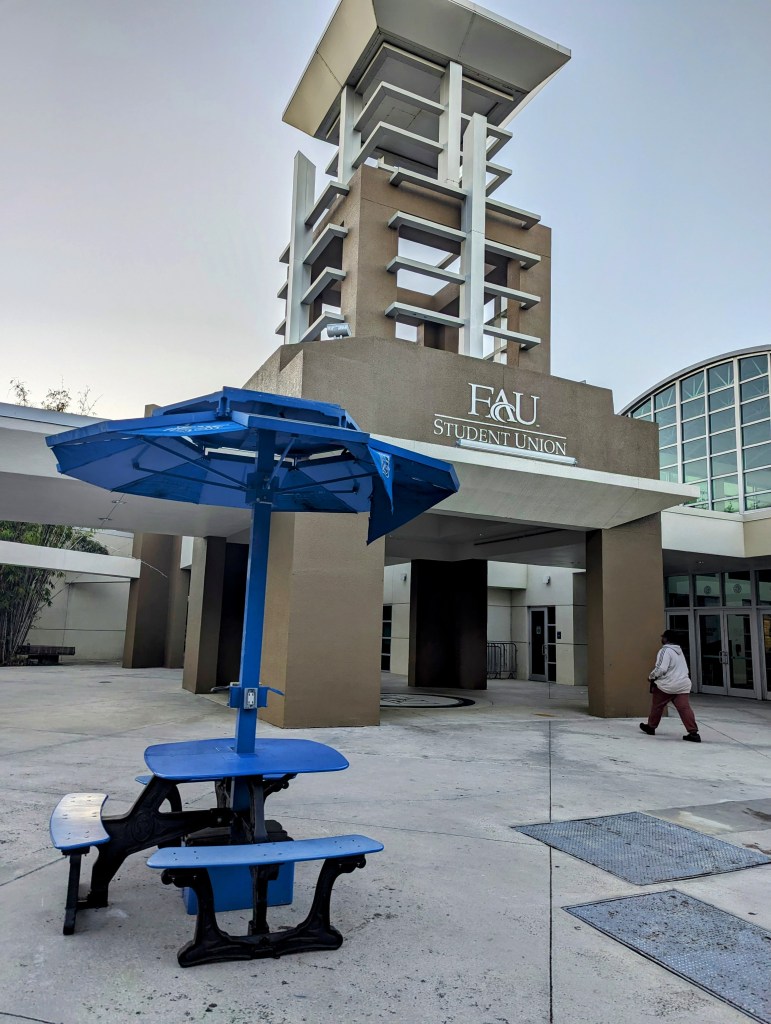
The student union at Florida Atlantic University in Boca Raton. Florida Gov. Ron DeSantis, a Republican, launched FL DOGE in February, promising to review state university and college operations and spending. Credit: Michael Vasquez for The Hechinger Report
The state did not respond to a question about whether FL DOGE is designed to attack higher education in the state. Molly Best, the deputy press secretary, noted that FL DOGE is now up and running, and cities and counties are also receiving letters requesting certain information and that the public will be updated in the future.
DOGE in Florida also follows other intervention in higher education in the state: Florida’s appointed Board of Governors, most of whom are chosen by the governor, removed dozens of courses from state universities’ core curriculum to comply with the Stop WOKE Act, a state law that took effect in 2022. The law, which DeSantis heavily promoted, discourages the teaching of concepts such as systemic racism or sexism. The courses removed from Florida’s 12 state universities were primarily sociology, anthropology and history courses.
“You can’t erase history,” said Meadow Swantic, a criminal justice major at Florida Atlantic University, a public institution, in an interview at its Boca Raton campus. “There’s certain things that are built on white supremacy, and it’s a problem.”
Fellow Florida Atlantic student Kayla Collins, however, said she has noticed some professors’ liberal bias during class discussions.
“I myself have witnessed it in my history class,” said Collins, who identifies as Republican. “It was a great history class, but I would say there were a lot of political things brought up, when it wasn’t a government class or a political science class.”
At the University of Central Florida in Orlando, political science major Liliana Hogan said she had a different experience of her professors’ political leanings.
“You hear ‘people go to university to get woke’ or whatever, but actually, as a poli-sci student, a lot of my professors are more right-wing than you would believe,” Hogan said. “I get more right-leaning perspectives from my teachers than I would have expected.” Hogan said.
Another UCF student, Johanna Abrams, objected to university budget cuts being ordered by the state government. Abrams said she understands that tax dollars are limited, but she believes college leaders should be trusted with making the budget decisions that best serve the student body.
“The government’s job should be providing the funding for education, but not determining what is worthy of being taught,” Abrams said.
Whatever their missions and attempts at mimicry, state-level DOGE entities are not necessarily identical to the federal version.
For instance, in Kansas, the Committee on Government Efficiency, while inspired by DOGE, is in search of ideas from state residents about ways to make the state bureaucracy run better rather than imposing its own changes. A Missouri Senate portal inspired by the federal DOGE works in a similar way. Yet the federal namesake isn’t taking suggestions from the masses to inform its work.
And at the federal level, then-DOGE chief Elon Musk in February emailed workers, asking them to respond “to understand what they got done last week,” he posted on X. “Failure to respond will be taken as a resignation.” Employees were asked to reply with a list of five accomplishments.
The Ohio DOGE Caucus noted explicitly it won’t be doing anything like that.
“We’re not going to be emailing any state employees asking them to give us five things they worked on throughout the week,” Ohio state Rep. Tex Fischer, a Republican, told a local radio station. “We’re really just trying to get like-minded people into a room to talk about making sure that government is spending our money wisely and focusing on its core functions that we all agree with.”
Contact editor Nirvi Shah at 212-678-3445, securely on Signal at NirviShah.14 or via email at [email protected].
The Hechinger Report provides in-depth, fact-based, unbiased reporting on education that is free to all readers. But that doesn’t mean it’s free to produce. Our work keeps educators and the public informed about pressing issues at schools and on campuses throughout the country. We tell the whole story, even when the details are inconvenient. Help us keep doing that.
Unlike kings or queens, dictators and autocrats find it helpful not to have a clear successor or rival who might soften their hold on power.
Much as that iron-fisted ruler may be loathed, their abrupt departure from the throne can bring significant risk of subsequent turmoil. They have created a system that puts them alone at the centre of power.
The White House in March was very quick to deny that President Joe Biden was pressing for regime change when he said that his Russian counterpart, Vladimir Putin, should not remain in power.
There is no shortage of countries in recent decades where fallen autocrats have left a power vacuum all too quickly filled by chancers, thugs and weird ideologues, or simply some drab toady of the old regime.
Covering tyranny
As a reporter, it was impossible for me not to get caught up in the excitement after popular unrest had driven out yet another long-serving despot in power so long that they had forgotten who was serving whom. It really is exhilarating.
During a long career as a journalist, I reported in a number of countries where autocratic, often staggeringly corrupt, leaders were forced unwillingly out of office. Sometimes, I’ve been there at the moment, more often to report on the aftermath.
The first time was just over 30 years ago in Bangladesh, whose military dictator Hussain Ershad had lost power in the face of mass protests. And in a rarity for the impoverished country, whose relatively short period of independence had been marked by violence and assassinations, the leader’s downfall had been almost bloodless.
By the time I arrived in Dhaka, crowds were cheerfully marching through the capital’s streets. The two people who would dominate Bangladeshi politics until today — the widow of one assassinated leader and the daughter of another — were happily giving interviews to visiting journalists, promising a new era for their country.
Since then, Bangladesh’s economy has indeed grown. But the country’s politics remain plagued by autocratic leadership, corruption and a drawn-out feud between those two women.
The lingering influence of despotism
In the Philippines, a reporter colleague liked to tell stories about joining a crowd streaming through the Malacanang presidential palace, vacant after President Ferdinand Marcos and his wife Imelda fled the country in the face of a People’s Power revolt in 1986 following more than 20 years of rule marked by excess and rampant graft.
This month, their son was elected president with little to offer by way of a platform beyond the promise of a return to those “halcyon days” when his parents were in charge some four decades earlier.
In neighbouring Indonesia, the family of President Suharto, who led another Southeast Asian kleptocracy into near financial ruin until he was forced to step down in 1998 after more than 32 years of iron rule, continues to try to get back into politics. Suharto’s downfall came with mass protests, violence and fears the giant archipelago would split apart. The country has largely recovered, but some of the elites established during the Suharto years remain a powerful influence.
Later, I was involved in reporting on the “colour” revolutions of former Soviet states, including Georgia and Ukraine. In both cases, infectious enthusiasm for change and the end of the old regimes did not take all that long to sour.
The leader of the 2003 Georgian revolution, Mikheil Saakashvili, eventually fled into exile. He is now back in his country where he was jailed on charges of abuse of power.
Sidelining of opposition
Ukraine struggled to find a competent leader after casting aside the old guard from the Soviet era with its Orange Revolution, which began the following year.
Paradoxically, and very unexpectedly, it has taken this year’s Russia’s invasion of Ukraine to reveal a leader of commanding stature in President Volodymyr Zelenskiy, a former comedian.
In many of these countries and others ruled by long-serving autocracies, the incentive is for leaders to crush any emerging threat to their hold on power. Rising political stars are sidelined, opponents are exiled, jailed or killed and domestic news coverage is limited to the official line.
And Russia? Rumours abound that Putin, ever tightening his control during more than 20 years in power, is seriously ill or even faces a coup. As with the likes of Suharto or Marcos, Putin took office when his country was lurching through economic crisis. He was a bit dull. Unlike his predecessor, Boris Yeltsin, Putin didn’t make a habit of rolling up drunk.
He was smart, focused on the economy, not in thrall to Russia’s plundering oligarchs and able to bring stability to the lives of ordinary Russians exhausted and disoriented by the collapse of the Soviet Union. He became hugely popular.
But there was a sense that his inner circle didn’t quite trust that popularity. By most accounts, Putin would easily have won a second term in the 2004 presidential election. But the Kremlin could not resist making sure the deck was stacked in his favour. He won 71.9% of the vote.
What would Russia be like post-Putin
Putin has run the country ever since, either as president or prime minister. Such is the state’s grip on Russian media that it is not really possible to be sure how popular Putin may be now. One recent poll suggested his star, which had started to look a bit faded, has brightened considerably since the invasion of Ukraine.
His government is clearly in no mood to put that popularity up for too much public scrutiny, throttling the remaining independent Russian media and introducing a law to hand long prison terms to those who openly oppose the war on Ukraine.
Prominent Russians who might credibly challenge Putin’s grip on the country live abroad, are in prison or dead. His most recent serious opponent, Alexei Navalny, is looking at years in a Russian prison. It isn’t all that clear, either, whether the bulk of Russians would prefer Navalny as their next leader.
If Putin is no longer in office for whatever reason, who would be in the running to replace him?
It seems very unlikely that the current political elite would readily allow a reformer to sweep them from power. Quite possibly, the average Russian — sympathetic to the view that the West has for years been treating their country with contempt — would prefer stability, a job and some international prestige.
When Russia faced revolution more than a century ago, an estimated 10 million people died after the autocrat Tsar Nicholas II was removed from power.
Perhaps that’s why Biden officials were so quick to rule out regime change. Better the devil you know than the devil you don’t.
Questions to consider:
• If you were working for local media in Moscow, how would you write about the war in Ukraine?
• Do you think your country’s mainstream media can be relied on to be factual in reporting? Why?
• If the current leader of your nation loses power, how peaceful do you think the aftermath will be?
Correction: The editor’s note at the top of the story was changed to correct the date the article was originally published.
When I was in fifth grade in northern Kentucky, I walked into my school library, excited to check out my favorite book — Drama by Raina Telgemeier — only to find it missing. My librarian told me it had been removed because someone had complained it wasn’t appropriate for our age group.
The shelves looked emptier without it and I remember the sting of frustration in my chest as I asked question after question, my voice growing unsteady. That book was my only access to a world I love and now it was gone.
At the time, I didn’t understand why it had disappeared. Now, I realize that moment was part of a much larger battle playing out across the country.
A surge in book bans across the U.S. is forcing educators and librarians into a heated debate over censorship and intellectual freedom, as restrictions on books about race, gender and LGBTQ+ topics increase.
“Books don’t hurt people. People hurt people,” said Joyce McIntosh, assistant program director for the Freedom to Read Foundation.
Bans across the nation
As book bans and censorship debates arise across the country, independent K-12 schools, like the Tatnall School in Wilmington, Delaware where I go to school, must balance open access to information with concerns over age-appropriate content — a challenge that mirrors broader societal tensions over education and free expression.
Over the past few years, book challenges have significantly increased, with reports from the American Library Association showing a record-breaking number of book bans in 2023, documenting 1,247 demands to censor library books and resources.
While these debates are heating up in the U.S., similar efforts to restrict access to information are occurring across the globe, from government crackdowns in China to classroom censorship in Brazil. McIntosh said these bans disproportionately target books focused on BIPOC and LGBTQ communities, limiting students’ access to diverse perspectives.
“Bans often target books focused on [black, indigenous and people of color] and LGBTQ communities, preventing students from seeing themselves represented,” McIntosh said.
Groups advocating for more restrictions counter that certain topics seen in school books promote inappropriate themes or political agendas. On the other hand, organizations like the Freedom to Read Foundation work to educate library workers and community members about the importance of intellectual freedom.
Local schools navigate the debate
For educators, the tension between intellectual freedom and parental concerns seems like a tightrope act. While public schools in the United States must follow government and state regulations, independent schools have more flexibility in curating their libraries and media centers. That flexibility comes with its own challenges and doesn’t provide much leeway.
Instead, it forces school administrations to set their own guidelines, often navigating difficult conversations with parents, teachers, and students to figure out what’s best for their school environment.
Ensign Simmons, the director of innovation and technology and library coordinator at the Tatnall School, emphasized the school’s approach to book selection. While the library strives to provide students with diverse perspectives in education, it also considers community concerns as well as the age-appropriateness of the content, Simmons said.
Simmons said that while Tatnall is not a public institution, the school still has a responsibility to prepare students to think critically and be open-minded when they enter the world.
Tatnall hasn’t faced formal book bans, but the school remains aware of the growing national trends. Instead of outright censorship, Simmons said that the school encourages dialogue between students, parents and educators. Maintaining this balance means that while some books may contain more mature content, the overall goal is to promote discussion among students of different perspectives rather than restrictions.
“Even if you disagree with something, that doesn’t mean we should take it off the shelves,” Simmons said. “We should keep them out there because that does spark a conversation and that conversation is what’s important at the end of the day.”
The role of parents play
While anti-ban activists argue that restricting and banning books violates an individual’s access to intellectual freedom, pro-ban supporters see it as a step taken that is necessary to protect children and youth from inappropriate and controversial material.
Moms for Liberty, a conservative advocacy group, has led efforts to remove books like The Bluest Eye by Toni Morrison from certain school districts and libraries, arguing that educators should not have the final say in what the students read.
McIntosh said that many schools already have policies allowing parents to opt their child out of specific reading materials and select an alternative that aligns with the curriculum. However, when one parent’s choice limits access for all students, it crosses into censorship, she said. Parents have the right to choose that for their child, however, it starts becoming more like censorship when they decide they don’t want anyone reading the book, making a decision for others based on their own beliefs.
Censorship is a global issue, not confined to the United States. In China, writers who challenge the government’s narrative have been imprisoned. In Tanzania, the government banned children’s books on sex education, citing violations of cultural norms, while in Brazil, attempts have been made to remove books addressing race and gender from classrooms. This is similar to the problem in the United States.
These efforts to restrict access to information emphasize the broader, international pattern of controlling stories, especially those of marginalized communities. Whether driven by political power, cultural conservatism or fear of open dialogue, these global examples underscore the dangers of erasing perspectives that are vital for understanding diverse human experiences, just as we are witnessing in the U.S.
What the future holds
As the debate over book bans intensifies, many wonder what the future for school libraries will look like. In the future, instead of banning books outright, restrictions could shift toward regulation of digital content, as our world’s use of technology grows and as more controversial material becomes accessible online.
Schools, like Tatnall, might continue to shift and shape their policies, cultivating discussions among the youth rather than enforcing strict bans and censoring intellectual content.
Years ago, I didn’t understand why my favorite book was taken away. Now, I see that removing a single book is never just about a book — it’s about whose voices get heard and whose stories remain untold.
“One of the most dangerous aspects of book bans is that they often target marginalized voices,” McIntosh said. “When we remove these stories, we’re not just censoring books. We’re erasing experiences and perspectives that are crucial for understanding the world around us.”
The ongoing debate over book bans isn’t only about stories; it’s about who gets to decide what topics are worth exploring. And that struggle isn’t limited to the United States. Across continents, governments and school systems are making similar decisions about which perspectives are allowed to exist and which are erased.
As long as books continue to disappear from shelves, that debate will continue shaping free expression and education for years to come.
Questions to consider:
• Why would some groups want to ban whole classrooms from access to particular books?
• Why are books about people of color or are about themes of gender identity often the target of bans?
• Do you think some books should be kept from children? Which ones and why?
This week on the podcast the SUs team has been on a study tour to universities in Lisbon in Portugal, and have reflections on everything from space to food, from interdisciplinarity to curriculum design and from Praxe to ribbon burning.
With Khadiza Hossein, VP Education at UWE SU, Emillia Zirker, Student Representation Officer at Lincoln SU, Gary Hughes, CEO at Durham SU, Mack Marshall, Community and Policy Officer at Wonkhe and hosted by Jim Dickinson, Associate Editor at Wonkhe.