
Category: polytechnics

  • The Society for Research into Higher Education in 1995

    The Society for Research into Higher Education in 1995

    by Rob Cuthbert

    In SRHE News and Blog a series of posts is chronicling, decade by decade, the progress of SRHE since its foundation 60 years ago in 1965. As always, our memories are supported by some music of the times.

    1995 was the year of the war in Bosnia and the Srebrenica massacre, the collapse of Barings Bank, and the Oklahoma Bombing. OJ Simpson was found not guilty of murder. US President Bill Clinton visited Ireland. President Nelson Mandela celebrated as South Africa won the Rugby World Cup, Blackburn Rovers won the English Premier League. Cliff Richard was knighted, Blur-v-Oasis fought the battle of Britpop, and Robbie Williams left Take That, causing heartache for millions. John Major was UK Prime Minister and saw off an internal party challenge to be re-elected as leader of the Conservative Party. It would be two years until D-Ream sang ‘Things can only get better’ as the theme tune for the election of New Labour in 1997. Microsoft released Windows 95, and Bill Gates became the world’s richest man. Media, news and communication had not yet been revolutionised by the internet.

    Higher education in 1995

    Higher education everywhere had been much changed in the preceding decade, not least in the UK, where the binary policy had ultimately proved vulnerable: The Polytechnic Experiment ended in 1992. Lee Harvey, the long-time editor of Quality in Higher Education, and his co-author Berit Askling (Gothenburg) argued that in retrospect:

    “The 1990s has been the decade of quality in higher education. There had been mechanisms for ensuring the quality of higher education for decades prior to the 1990s, including the external examiner system in the UK and other Commonwealth countries, the American system of accreditation, and government ministerial control in much of Europe and elsewhere in the world. The 1990s, though, saw a change in the approach to higher education quality.”

    In his own retrospective for the European Journal of Education on the previous decade of ‘interesting times’, Guy Neave (Twente) agreed there had been a ‘frenetic pace of adjustment’ but

    “Despite all that is said about the drive towards quality, enterprise, efficiency and accountability and despite the attention lavished on devising the mechanics of their operation, this revolution in institutional efficiency has been driven by the political process.”

    Europe saw institutional churn with the formation of many new university institutions – over 60 in Russia during 1985-1995 in the era of glasnost, and many others elsewhere, including Dublin City University and University of Limerick in 1989. Dublin Institute of Technology, created in 1992, would spend 24 years just waiting for the chance[1] to become a technological university. 1995 saw the establishment of Aalborg in Denmark and several new Chinese universities including Guangdong University of Technology.

    UK HE in 1995

    In the UK the HE participation rate had more than doubled between 1970 (8.4%) and 1990 (19.4%) and then it grew even faster, reaching 33% by 2000. At the end of 1994-1995 there were almost 950,000 full-time students in UK HE. Michael Shattock’s 1995 paper ‘British higher education in 2025’ fairly accurately predicted a 55% APR by 2025.

    There had been seismic changes to UK HE in the 1980s and early 1990s. Polytechnic directors had for some years been lobbying for an escape from unduly restrictive local authority bureaucratic controls, under which many institutions had, for example, not even been allowed to hold bank accounts in their own names. Even so, the National Advisory Body for Public Sector HE (NAB), adroitly steered by its chair Christopher Ball (Warden of Keble) and chief executive John Bevan, previously Director of Education for the Inner London Education Authority, had often outmanoeuvred the University Grants Committee (UGC) led by Peter Swinnerton-Dyer (Cambridge). By developing the idea of the ‘teaching unit of resource’ NAB had arguably embarrassed the UGC into an analysis which declared that universities were slightly less expensive for teaching, and the (significant) difference was the amount spent on research – hence determining the initial size of total research funding, then called QR.

    Local authorities realised too slowly that controlling large polytechnics as if they were schools was not appropriate. Their attempt to head off reforms was articulated in Management for a Purpose[2], a report on Good Management Practice (GMP) prepared under the auspices of NAB, which aimed to retain local authority strategic control of the institutions which they had, after all, created and developed. It was too little, too late. (I was joint secretary to the GMP group: I guess, now it’s time, for me to give up.) Secretary of State Kenneth Baker’s 1987 White Paper Higher Education: Meeting the Challenge was followed rapidly by the so-called ‘Great Education Reform Bill’, coming onto the statute book as the Education Reform Act 1988. The Act took the polytechnics out of local authorities, recreating them as independent higher education corporations; it dissolved the UGC and NAB and set up the Universities Funding Council (UFC) and the Polytechnics and Colleges Funding Council (PCFC). Local authorities were left high and dry and government didn’t think twice, with the inevitable progression to the Further and Higher Education Act 1992. The 1992 Act dissolved PCFC and UFC and set up Higher Education Funding Councils for England (HEFCE) and Wales (HEFCW). It also set up a new Further Education Funding Council (FEFC) for colleges reconstituted as FE corporations and dissolved the Council for National Academic Awards. The Smashing Pumpkins celebrated “the resolute urgency of now”, FE and HE had “come a long way” but Take That sensibly advised “Never forget where you’ve come here from”,

    Crucially, the Act allowed polytechnics to take university titles, subject to the approval of the Privy Council, and eventually 40 institutions did so in England, Wales and Scotland. In addition Cranfield was established by Royal Charter in 1993, and the University of Manchester Institute of Science and Technology became completely autonomous in 1994. The biggest hit in 1995 actually named an HE institution and its course, as Pulp sang: “She studied sculpture at St Martin’s College”. Not its proper name, but Central St Martin’s College of Art and Design would have been tougher for Jarvis Cocker to scan. The College later became part of the University of the Arts, London.

    The Conservative government was not finished yet, and the Education Act 1994 established the Teacher Training Agency and allowed students to opt out of students’ unions. Debbie McVitty for Wonkhe looked back on the 1990s through the lens of general election manifestos:

    “By the end of the eighties, the higher education sector as we know it today had begun to take shape. The first Research Assessment Exercise had taken place in 1986, primarily so that the University Grants Committee could draw from an evidence base in its decision about where to allocate limited research funding resources. … a new system of quality assessment had been inaugurated in 1990 under the auspices of the Committee of Vice Chancellors and Principals (CVCP) …

    Unlike Labour and the Conservatives, the Liberal Democrats have quite a lot to say about higher education in the 1992 election, pledging both to grow participation and increase flexibility”

    In 1992 the Liberal Democrats also pledged to abolish student loans … but otherwise many of their ideas “would surface in subsequent HE reforms, particularly under New Labour.” Many were optimistic: “Some might say, we will find a brighter day.”

    In UK HE, as elsewhere, quality was a prominent theme. David Watson wrote a famous paper for the Quality Assurance Agency (QAA) in 2006, Who Killed What in the Quality Wars?, about the 1990s battles involving HE institutions, QAA and HEFCE. Responding to Richard Harrison’s Wonkhe blog about those quality wars on 23 June 2025, Paul Greatrix blogged the next day about

    “… the bringing together of the established and public sector strands of UK higher education sector following the 1992 Further and Higher Education Act. Although there was, in principle, a unified HE structure after that point, it took many more years, and a great deal of argument, to establish a joined-up approach to quality assurance. But that settlement did not last and there are still major fractures in the regime …”

    It was a time, Greatrix suggested, when two became one (as the Spice Girls did not sing until 1996), but his argument was more Alanis Morrissette: “I wish nothing, but the best for you both. I’m here, to remind you of the mess you left when you went away”.

    SRHE and research into higher education in 1995

    SRHE’s chairs from 1985-1995 were Gareth Williams, Peter Knight, Susan Weil, John Sizer and Leslie Wagner. The Society’s administrator Rowland Eustace handed over in 1991 to Cynthia Iliffe; Heather Eggins then became Director in 1993. Cynthia Iliffe and Heather Eggins had both worked at CNAA, which facilitated a relocation of the SRHE office from the University of Surrey to CNAA’s base at 334-354 Gray’s Inn Road, London from 1991-1995. From the top floor at Gray’s Inn Road the Society then relocated to attic rooms in 3 Devonshire St, London, shared with the Council for Educational Technology.

    In 1993 SRHE made its first Newer Researcher Award, to Heidi Safia Mirza (then at London South Bank). For its 30th anniversary SRHE staged a debate: ‘This House Prefers Higher Education in 1995 to 1965’, proposed by Professor Graeme Davies and Baroness Pauline Perry, and opposed by Dr Peter Knight and Christopher Price. My scant notes of the occasion do not, alas, record the outcome, but say only: “Now politics is dead on the campus. Utilitarianism rules. Nationalisation produces mediocrity. Quangos quell dissent. Arid quality debate. The dull uniformity of 1995. Some students are too poor.”, which rather suggest that the opposers (both fluent and entertaining speakers) had the better of it. Whether the past or the future won, we just had to roll with it. The debate was prefaced by two short papers from Peter Scott (then at Leeds) on ‘The Shape of Higher Education to Come’, and Gareth Williams (Lancaster) on ‘ Higher Education – the Next Thirty Years’.

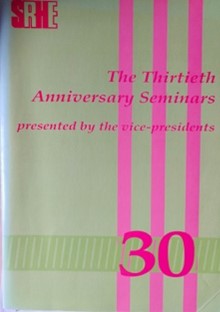
    The debate was followed by a series of seminars presented by the Society’s six (!) distinguished vice-presidents, Christopher Ball, Patrick Coldstream, Malcolm Frazer, Peter Swinnerton-Dyer, Ulrich Teichler and Martin Trow, and then a concluding conference. SRHE was by 1995 perhaps passing its peak of influence on policy and management in UK HE, but was also steadily growing its reach and impact on teaching and learning. The Society staged a summer conference on ‘Changing the Student Experience’, leading to the 1995 annual conference. In those days each Conference was accompanied by an edited book of Precedings: The Student Experience was edited by Suzanne Hazelgrove (Bristol). One of the contributors and conference organisers, Phil Pilkington (Coventry), later reflected on the prominent role of SRHE in focusing attention on the student experience.

    Research into higher education was still a small enough field for SRHE to produce a Register of Members’ Research Interests in 1996, including Ron Barnett (UCL) (just getting started after only his first three books), Tony Becher, Ernest Boyer, John Brennan, Sally Brown, Rob Cuthbert, Jurgen Enders, Dennis Farrington, Oliver Fulton, Mary Henkel, Maurice Kogan, Richard Mawditt, Ian McNay, David Palfreyman, Gareth Parry, John Pratt, Peter Scott (in Leeds at the time), Harold Silver, Maria Slowey, Bill Taylor, Paul Trowler, David Watson, Celia Whitchurch, Maggie Woodrow, and Mantz Yorke.  SRHE members and friends, “there for you”. But storm clouds were gathering for the Society as it entered the next, financially troubled, decade.

    If you’ve read this far I hope you’re enjoying the musical references, or perhaps objecting to them (Rob Gresham, Paul Greatrix, I’m looking at you). There will be two more blogs in this series – feel free to suggest musical connections with HE events in or around 2005 or 2015, just email me at [email protected]. Or if you want to write an alternative history blog, just do it.

    Rob Cuthbert is editor of SRHE News and the SRHE Blog, Emeritus Professor of Higher Education Management, University of the West of England and Joint Managing Partner, Practical Academics. Email [email protected]. Twitter/X @RobCuthbert. Bluesky @robcuthbert22.bsky.social.


    [1] I know this was from the 1970s, but a parody version revived it in 1995

    [2]National Advisory Body (1987) Management for a purpose Report of the Good Management Practice Group  London: NAB

    Author: SRHE News Blog

    An international learned society, concerned with supporting research and researchers into Higher Education

    Source link

  • Editorial: The Society for Research into Higher Education in 1985

    Editorial: The Society for Research into Higher Education in 1985

    by Rob Cuthbert

    In SRHE News and Blog a series of posts is chronicling, decade by decade, the progress of SRHE since its foundation 60 years ago in 1965. As always, our memories are supported by some music of the times (which had improved somewhat after the nadir of 1975).

    In 1985 Ronald Reagan became the US President, which seemed improbable at the time, but post-Trump now appears positively conventional – that joke isn’t funny any more. Reaganomics fuelled the present US multi-$trillion national debt; it was the era of supply-side economics. President Reagan was of course popular with UK Prime Minister Margaret Thatcher. She was by then at her peak after the 1982 Falklands War restored her own popularity, helping her in 1985 to bring an end to the miners’ strike and to ride out riots in Handsworth in Birmingham and Broadwater Farm in London.

    Vodafone enabled the first commercial mobile phone call in the UK; the BBC micro was the computer of choice for schools. Beverley Hills Cop was one of the top movies in 1985, with Eddie Murphy featured by the Pointer Sisters as they sang “I don’t wanna take it any more”, a 1980s theme song for some in universities. Globalism was in vogue; everybody wants to rule the world. International pop stars came together to sing We are the world in January and then perform at the Live Aid concert at Wembley in July with Queen’s legendary showstopping performance. Nintendo prepared to conquer the world with the launch of Super Mario, but global multinationals took a hit with one of the biggest marketing blunders ever, as Coca-Cola changed its formula, released New Coke in April, then went back to the original less than three months later.

    Higher education in 1985

    Global HE had its own marketing and governance issues after what Guy Neave (then UCL, now Twente) described as a period of consolidation from 1975 to 1985:

    “ … it was during this decade … that these systems assumed the level of dealing with mass higher education … By the late 1980s or 1990s … there are certain countries which anticipate participation rates in higher education of over 30% (Neave, 1984a). Highest amongst them are Denmark and Finland with 40% of the appropriate age group, the Federal Republic with 35% and France with 33%. … In effect, transition to mass higher education gave rise to additional bodies to control, monitor and hold accountable a sector of increasing significance in government social expenditure. Such intermediary agencies stand as a response to the advent of mass higher education, not an anticipation of it.”

    This was prescient: who’s gonna tell you things aren’t so great? Later Paul Windolf (Heidelberg) would take a very long view in his comparative analysis of Cycles of expansion in higher education 1870-1985 in Higher Education (1992:23, 3-19): “For most countries the data confirm the theory of ‘status competition’ (perverse effects): universities expand particularly fast during times of an economic recession … The human capital theory is not confirmed by this longitudinal analysis.” However human capital theory dominated policy thinking in many parts of the world, especially the UK, as Adam Matthews (Birmingham) argued in his blog for Wonkhe on 12 June 2024:

    “Despite so much adversarial and ideologically polarised politics in the 1980s domestically and internationally, we do find consensus around higher education and universities. Growth was still on the agenda. As the country found itself economically struggling, teaching and research was seen as the solution rather than the problem, particularly around research findings being applied to real world issues.”

    UK HE in 1985: a ferment of planning

    In that decade of consolidation after 1975, in the UK no new universities were created until the 1980s. By 1985 there were just two: the University of Buckingham and the University of Ulster. Expansion of UK HE in the 1980s was driven by the polytechnics, especially after the UGC’s unevenly distributed and dramatic financial cuts of 1981. The universities and UGC had tried and failed to protect the so-called ‘unit of resource’, the level of funding per full-time equivalent (FTE) undergraduate student, and the UGC’s established pattern of quinquennial funding had been reluctantly abandoned. Neave noted that:

    “Strictly speaking, university finance in the United Kingdom did not involve change to the basic unit of resource, an issue raised only under dire economic pressure in the period following the 1981 reductions in university budgets. Nor was the abandonment of quinquennial funding a response to mass higher education per se, so much as to the country’s parlous economic status.”

    The UK economy and HE were in Dire Straits: there was no money for nothing. The rapid expansion of the polytechnics, driving down costs, was the dominant influence on policy. A National Advisory Body for Local Authority Higher Education (NAB) had been set up on 1 February 1982 to advise the Secretary of State for Education and Science on matters relating to academic provision and the approval of advanced courses, reconstituted as the National Advisory Body for Public Sector Higher Education (PSHE) from 1 February 1985. In 1985 there were 503,000 students in PSHE in Great Britain, of whom 214,000 were part-time. Universities had 291,000 full-time and 114,000 part-time students. PSHE in England included 29 polytechnics, 30 major colleges, 21 voluntary colleges, and 300 others. In Wales there was one polytechnic, 7 major colleges and 16 others. The Further Education Act 1985 gave more powers to local authorities, who still governed the whole of PSHE, to supply goods and services, especially teaching and  research, through educational institutions.

    Clive Booth, principal private secretary to the Secretary of State for Education and Science since 1975, later to become Director of Oxford Polytechnic, foretold government policy in 1987, reviewing HE planning since 1965 in Higher Education Quarterly:

    “The development of a planning body for public sector higher education in England has created the potentiality for an integrated planning approach to university and non-university higher education.”

    Booth had been involved in the production of a series of significant DES papers: the 1978 Report of the Working Group on the Management of Higher Education in the Maintained Sector (the Oakes Report); in 1981 Higher Education in England outside the Universities: Policy, Funding and Management, a consultative document; and finally the 1985 Green Paper The Development of Higher Education into the 1990s. We saw the present, he saw the whole of the Moon.

    The Green Paper followed the notorious Jarratt Report of 1985, which sent shock waves through the university sector. Paul Greatrix (Nottingham), a long-serving Registrar and Secretary, wrote on his Wonderful (and Frightening) World of HE blogmuch later that:

    “Looking back from 2015, some of these observations and recommendations do seem quite tentative. But in 1985 they were dynamite. After the extraordinary and unprecedented cuts of 1981 and Keith Joseph’s unsuccessful approach to introduce fees in 1984 this seemed like another attack on universities.”

    The widespread view in UK HE at the time was, in the words of the Style Council, “You don’t have to take this crap”, but the policy walls did not come tumbling down. Greatrix cited Geoffrey Alderman’s acerbic review of Malcolm Tight’s 2009 book Higher education in the United Kingdom since 1945 for Times Higher Education:

    “… to my mind one of the most damaging inquiries into higher education over the last half-century was the Jarratt report … a mischievous and malevolent investigation (which, inter alia, popularised if it did not invent the notion that students are “customers”, which foisted on the sector the delusion that factory-floor “performance indicators” are entirely suited to a higher-education setting, and which led to the abolition of academic tenure and the concomitant triumph of managerialism in the academy) … Jarratt was self-inflicted. The inquiry was not a government creation. It was established by the Committee of Vice-Chancellors and Principals. … Jarratt was betrayal from within.”

    For Greatrix:

    “Looking back these do not look like the proposals filled with malevolence or mischief. Many of these changes were inevitable, most were long overdue, a lot would have happened in any case. … From today’s viewpoint it looks more like that what Jarratt offered were some pointers and directions in this strange new terrain.”

    With the benefit of hindsight it can be argued that in 1985 UK universities were unduly concerned, perhaps even obsessed, with what might have been lost from a supposed ‘golden age’ of autonomy. But nothing is so good it lasts eternally. The wreckage of the Titanic was finally located in 1985, another lost cause once assumed unsinkable. Universities were, like Bonnie Tyler, holding out for a hero, but Tina Turner was right, after the 1981 cuts: “Out of the ruins, out from the wreckage, can’t make the same mistake this time”.

    The Green Paper, still Green and not White, announced by Secretary of State Keith Joseph in May 1985, came as the preliminary conclusion to this ferment of planning. He said in Parliament that “… it is vital for our higher education to contribute more effectively to the improvement of the performance of the economy. This is not because the Government place a low value on the general cultural benefits of education and research or on study of the humanities.” But HE mostly heard only the first sentence, and thought we were on the road to nowhere, rather than seeing the opportunities. The Thatcher White Paper Higher Education: Meeting the Challenge would not appear until 1987, and NAB and the UGC would  survive only until 1988. REO Speedwagon captured the mood: Can’t fight this feeling any more.

    SRHE and research into higher education in 1985

    The chairs of SRHE from 1975-1985 included some great names: Lewis Elton (Surrey) 1977-78, Gareth Williams (Lancaster, later London Institute of Education) 1978-80 (and 1986-88), Donald Bligh (Exeter) 1980-82, David Warren-Piper (London Institute of Education) 1982-84, and Michael Shattock (Warwick, later London Institute of Education/UCL) 1984-86. The outstanding highlight of the decade was a major review into higher education organised by the Society. As Gareth Williams wrote:

    “With the help of a substantial grant from the Leverhulme Trust, the Society for Research into Higher Education set up a comprehensive programme of study into the future of higher education which I directed. The aim of the programme was not to undertake new research but rather to focus recent research findings and the views of informed people on the major strategic options likely to be available to higher education institutions and policy making bodies in the 1980s and 1990s.”

    The programme ran from 1980 to 1983 and led to nine themed reports, an overall review and a final report. SRHE had, in Michael Shattock’s words:

    “… established itself as an important voice in policy. It was addressed by higher education Ministers (William Waldegrave 1982, Peter Brooke 1983), at an SRHE/THES Conference on the Green Paper by Sir Keith Joseph the Secretary of State, in 1985. Most unusually it received a visit from the former Prime Minister, Edward Heath, in February 1983 who wished to seek the Society’s advice about higher education.”

    SRHE might have hoped like Madonna to be Into the Groove policywise, but the Prime Minister had a list of questions which were more about living in a material world:

    • To what extent (if any) has the balance between disciplines been inappropriate for Britain’s economic needs?
    • How far should the labour market determine the shape of higher education?
    • Are research and teaching indivisible in higher education if standards are to be maintained?
    • Is it better to have a few research institutions or many, given financial constraints?
    • Is the binary line appropriate?
    • Are the links between HE and industry poor by comparison with other major countries?
    • What are the merits of shorter courses – two years liberal arts followed by two years vocational?”

    Shattock observed:

    “The interest of these questions is both the extent to which the issues were addressed and answered in the Leverhulme Programme and the fact that their underlying assumptions formed the basis of the 1985 Green Paper. It was clear that the Society was at the sharp end of discussions about the future policy.”

    The Leverhulme findings were perhaps just too balanced for the times – can’t get there from here. Shattock as SRHE chair initiated an Enquiry on ‘Questions of Quality’ which became the theme of SRHE’s 1985 annual conference, and one of SRHE’s founders, Graeme Moodie (York), edited a 1986 bookStandards and Criteria in Higher Education. Shattock also established the influential SRHE Policy Forum, a seminar involving leading academics, civil servants and HE managers which met five times a year under the alternate chairmanship of Michael Shattock and Gareth Williams. 

    Nevertheless it was not long after 1985 that a special meeting of SRHE’s Council at the FE Staff College received a report, probably from its administrator Rowland Eustace, saying: “general knowledge and understanding of the Society remains relatively low in higher education despite attempts over recent years to give the Society a higher profile”. Perhaps still a little out of touch, hoping for glory days, still running up that hill, hoping or even believing that things can only get better.

    Rob Cuthbert is editor of SRHE News and the SRHE Blog, Emeritus Professor of Higher Education Management, University of the West of England and Joint Managing Partner, Practical Academics. Email [email protected]. Twitter/X @RobCuthbert.

    Author: SRHE News Blog

    An international learned society, concerned with supporting research and researchers into Higher Education

    Source link

  • The Society for Research into Higher Education in 1975

    The Society for Research into Higher Education in 1975

    by Rob Cuthbert

    Only yesterday

    I’ve been walking these streets so long: in the SRHE Blog a series of posts is chronicling, decade by decade, the progress of SRHE since its foundation 60 years ago in 1965. As always, our memories are supported by some music of the times, however bad it might have been[1].

    Is this the real life?

    Some parts of the world, like some parts of higher education, were drawing breath after momentous years. The oil crisis of 1973-74 sent economic shocks around the world. In 1975 the Vietnam war finally ended, and the USA also saw the conviction of President Richard Nixon’s most senior staff John MitchellBob Haldeman and John Ehrlichman, found guilty of the Watergate cover-up. Those were the days when the Washington Post nailed its colours to the mast rather than not choosing sides, and in the days when the judicial system and the fourth estate could still expose and unseat corrupt behaviour at the highest levels. Washington Post editor Katharine Graham supported her journalists Woodward and Bernstein against huge establishment pressure, as Tammy Wynette sangStand by your man. How times change.

    Higher education in the UK had seen a flurry of new universities in the 1960s: Aston, Brunel, Bath, Bradford, City, Dundee, Heriot-Watt, Loughborough, Salford, Stirling, Surrey, the New University of Ulster, and perhaps most significant of all, the Open University. All the new UK universities were created before 1970; there were no more in the period to 1975, but the late 60s and early 1970s saw the even more significant creation of the polytechnics, following the influential 1966 White Paper A Plan for Polytechnics and Other Colleges. The Times Higher Education Supplement, established in 1971 under editor Brian Macarthur, had immediately become the definitive trade paper for HE with an outstanding journalistic team including Peter (now Lord) Hennessy, David Hencke and (now Sir) Peter Scott (an SRHE Fellow), later to become the THES editor and then VC at Kingston. THES coverage of the polytechnic expansion in the 1970s was dominated by North East London Polytechnic (NELP, now the University of East London), with its management team of George Brosan and Eric Robinson. They were using a blueprint created in their tenure at Enfield College, and fully developed in Robinson’s influential book, The New Polytechnics – the People’s Universities. NELP became “a byword for innovation”, as Tyrrell Burgess’s obituary of George Brosan said, developing an astonishing 80 new undergraduate programmes validated by the Council for National Academic Awards, created like SRHE in 1965. Burgess himself had been central to NELP’s radical school for independent study and founded the journal, Higher Education Review, working with its long-time editor John Pratt (an SRHE Fellow), later the definitive chronicler of The Polytechnic Experiment. In Sheffield one of the best of the polytechnic directors, the Reverend Canon Dr George Tolley, was overseeing the expansion of Sheffield Polytechnic as it merged with two colleges of education to become Sheffield City Polytechnic.

    As in so many parts of the world the HE system was increasingly diverse and rapidly expanding. In Australia nine universities had been established between 1964 and 1975: Deakin, Flinders, Griffith, James Cook, La Trobe, Macquarie, Murdoch, Newcastle, and Wollongong. The Australian government had taken on full responsibility for HE funding as Breen (Monash) explained, and had even abolished university fees in 1974, which Mangan’s (Queensland) later review regarded as not necessarily a good thing. How times change.

    In the USA the University of California model established under president Clark Kerr in the 1960s dominated strategic thinking about HE. Berkeley’s Martin Trow had already written The British Academics with AH Halsey (Oxford) and was about to become the Director of the Centre for Studies of Higher Education at Berkeley, where his elite-mass-universal model of how HE systems developed would hold sway for decades.

    In the UK two new laws, the Sex Discrimination Act 1975 and the Equal Pay Act 1970, came into force on 29 December, aiming to end unequal pay of men and women in the workplace. In the USA the Higher Education Act 1972 with its Title IX had been a hugely influential piece of legislation which prohibited sex discrimination in educational institutions receiving federal aid. How times change. Steve Harley’s 1975 lyrics would work now with President Trump: You’ve done it all, you’ve broken every code.

    You ain’t seen nothing yet

    Some things began in 1975 which would become significant later. In HE, institutions that had mostly been around for years or even centuries but started in a new form included Buckinghamshire College of Higher Education (later Buckinghamshire New University), Nene College of Higher Education (University of Northampton), Bath Spa University College, Roehampton, and Dublin City University. Control of Glasgow College of Technology (Glasgow Caledonian University) transferred from Glasgow Corporation to the newly formed Strathclyde Regional Council. Nigeria had its own flurry of new universities in Calabar, Jos, Maiduguri and Port Harcourt.

    Everyone knew that “you’re gonna need a bigger higher education system” as the blockbuster hit Jaws was released. 1975 was the year when Ernő Rubik applied for a patent for his invention the Magic Cube, Microsoft was founded as a partnership between Bill Gates and Paul Allen, and Margaret Thatcher defeated Edward Heath to become leader of the Conservative Party. Bruce Springsteen was already ‘The Boss’ when Liz Truss was Born to run on 26 July; she would later briefly become a THES journalist and briefly Shadow Minister for Higher Education, before ultimately the job briefly as boss. 1970s terrorism saw a bomb explode in the Paris offices of Springer publishers: the March 6 Group (connected to the Red Army Faction) demanded amnesty for the Baader-Meinhof Group.

    Higher education approaching a period of consolidation

    Guy Neave, then perhaps the leading continental European academic in research into HE, later characterised 1975-1985 as a period of consolidation. In the UK the government was planning for (reduced) expansion and Labour HE minister Reg Prentice was still quoting the 1963 Robbins Report in Parliament: “The planning figure of 640,000 full-time and sandwich course students in Great Britain in 1981 which I announced in November is estimated to make courses of higher education available for all those who are qualified by ability and attainment to pursue them and who wish to do so. It allows for the number of home students under 21 entering higher education in Great Britain, expressed as a proportion of the population aged 18, to rise from 14% in 1973 to 17% in 1981. … the reductions in forecast higher education expenditure in the recent Public Expenditure White Paper are almost entirely attributable to the lower estimate of prospective student demand.” Government projections of student numbers were always wrong, as Maurice Kogan (Brunel) might have helped to explain – I thought by now you’d realise. 1975 was the year when Kogan, a former senior civil servant in the Department of Education and Science, published his hugely influential Educational Policy-making: A Study of Interest Groups and Parliament.

    In the US the Carnegie Commission on Higher Education, founded ten years earlier under Clark Kerr, was in full pomp and published Demand and Supply in United States Higher Education. Two giants of sociology, Seymour Martin Lipset and David Riesman, wrote essays on ‘Education and Politics at Harvard’. How times change.

    Research into higher education

    Academics were much in evidence in novels; 1975 saw Malcolm Bradbury’s The History Man, David Lodge’s Changing Places, and Colin Dexter‘s first Inspector Morse novel Last Bus to Woodstock, and higher education was becoming established as a field of study. Dressel and Mayhew’s 1974 US-focused book reviewed by Kellams (Virginia) in the Journal of Higher Education, and published by the then-ubiquitous HE publishers Jossey-Bass in San Francisco saw ‘the emergence of a profession’. Nevertheless much research into HE was still appearing in mainstream education rather than HE journals, even in the USA. Tinto (Columbia) reported his synthesis of research on ‘dropout’ (as it was called then) in HE in the Review of Educational Research, and DI Chambers wrote about a major debate in China about higher education policy in an article in Comparative Education.

    Michael Shattock’s history of the SRHE in its earlier years pulled no punches about the limited achievements and reach of the Society:

    “By 1973, when the university system was in crisis with the collapse of the quinquennial funding system, it was clear that the Society was significantly failing to meet the ambitious targets it had started out with: it held annual conferences but attendance at 100 to 120 ensured that any surplus was low. It had successfully launched the valuable Research into Higher Education Abstracts but its … monographs, … while influential among specialists did not command a wide readership. The Society appeared to be at a crossroads as to its future: so far it had succeeded in expanding its membership, both corporate and individual, but this could easily be reversed if it failed to generate sufficient activity to retain it. Early in 1973 the Governing Council agreed to hold a special meeting … and commissioned a paper from Leo Evans, one of its members, and Harriet Greenaway, the Society’s Administrator … The “Discussion Paper on the Objectives of  the Society” … quoted the aims set out in the Articles of Association “to promote and encourage research in higher education and related fields” and argued that the Society’s objectives needed to be broadened.  … The implied thrust of the paper was that the Society had become too narrow in its research interests and that it should be more willing to address issues related to the development of the higher education system.”

    In the end the objectives were expanded to include concern for the development of the HE sector, but the Society’s direction was not wholly settled, according to Shattock. Moreover: “Both in 1973-74 and 1974-75 there was great concern about the Society’s continued financial viability, and in 1976 the Society moved its premises out of London to the University of Surrey where it was offered favourable terms.” (Someone Saved My Life Tonight). In 1976 Lewis Elton of Surrey, one of SRHE’s founders, would become Chair of the Society when the incumbent Roy Niblett suffered ill health. It was the same year that the principal inspiration for the foundation of SRHE (as Shattock put it), Nicholas Malleson, died at only 52. SRHE’s finances were soon back on an even keel but It would be more than 25 years before they achieved long-term stability.

    Rob Cuthbert is editor of SRHE News and the SRHE Blog, Emeritus Professor of Higher Education Management, University of the West of England and Joint Managing Partner, Practical Academics. Email [email protected]. Twitter/X @RobCuthbert.


    [1] The top selling single of 1975 was Bye Bye Baby by the Bay City Rollers, and the Eurovision Song Contest was won by Ding-a-Dong. The album charts were dominated by greatest hit albums from Elton John, Tom Jones, The Stylistics, Perry Como, Engelbert Humperdinck and Jim Reeves. I rest my case. As always, there were some exceptions.

    Author: SRHE News Blog

    An international learned society, concerned with supporting research and researchers into Higher Education

    Source link

  • Editorial: 60 Years of the Society for Research into Higher Education

    Editorial: 60 Years of the Society for Research into Higher Education

    by Rob Cuthbert

    Yesterday

    Issue No 60 of SRHE News appears by happy coincidence in the 60th year since the Society for Research into Higher Education was established (“all my troubles seemed so far away”). Reminiscences can often be reinforced by the musical soundtrack of the time, as ours will be. Many readers of SRHE News and Blog weren’t born in 1965, but let’s not allow such small obstacles to deflect us, when everybody knows the tunes anyway. Here are a few reminders of how things were 60 years ago, in 1965.

    (I Can’t Get No) Satisfaction

    As the Rolling Stones sang: “I tried, and I tried, and I tried and I tried, I can’t get no satisfaction”, the message resonated with 30,000 potential HE students who could not get admitted to higher education in UK universities in 1965, with only 50,000 places available. Only about 4% of the rising cohort of 18 year olds won admission to the 25 universities in existence in 1965. Most people left school at 15; the school-leaving age was only raised to 16 in 1971.

    The Robbins Report two years earlier had punctuated, but not initiated, the accelerating expansion of demand and need for more higher education, reflected in the 1960s with the creation of the new plateglass universities, including Kent and Warwick in 1965. Robbins had proposed a new breed of scientific and technological universities but these were not established; development relied instead on the organic growth and expansion of the colleges already in existence. That growth was significantly helped and supported by the new Council for National Academic Awards (CNAA), created in 1965 to begin the validation of degree courses outside universities.

    In a Parliamentary debate in December 1965 Lord Robbins aimed to set at rest the ‘more means worse’ argument championed by Kingsley Amis:

    “On the occasion of our last debate, the two leading issues discussed were the question of numbers and the question of the machinery of government. On the first of these issues, whether the expansion proposed by the Committee on Higher Education involved a lowering of entry standards, I think it may be said that discussion is at an end. Even The Times newspaper, which is not over-given to retraction, has had to admit that its accusations in this respect rested on misapprehension; 1250 and the latest figures of qualified persons coming forward show, without a doubt, what our Committee always emphasised: that its estimates were on the low side rather than on the high.”

    Continuing rapid expansion allowed more and more 18-year-olds to join: “I’m in with the in-crowd, I go where the in-crowd goes”. This was before fees; students had grants they didn’t have to repay, with their real value still rising (they peaked in 1968): boomers could happily sing with The Who about My Generation.

     We Can Work It Out

    The non-university colleges would first become polytechnics, following the 1966 White Paper A Plan for Polytechnics and Other Colleges, written by civil servant Toby Weaver. Secretary of State for Education Tony Crosland promoted the new policy idea of the binary system (“Try to see it my way”) in his seminal Woolwich speech in April 1965, but Crosland had been mainly occupied with the comprehensivisation of secondary schools. DES Circular 10/65 was the first of a series which dealt with the issue of comprehensivisation, as Harold Wilson’s Labour government asked local education authorities to submit plans for reorganising their schools on comprehensive lines. It was the first major schools reform since Butler’s 1944 Education Act under Prime Minister Winston Churchill, who died in 1965.

    Expansion of HE was substantially driven by the colleges, still very much part of the local authority sector. The polytechnics would increasingly chafe at the bureaucratic controls of local authorities but it would be more than 20 years before the 1988 Education Reform Act ripped the polytechnics out of the local authority sector. In 1965 the replacement of the London County Council by the Greater London Council was big news for the expanding HE sector, especially because it entailed the creation of the Inner London Education Authority, responsible for no fewer than five of the 30 polytechnics, and a range of other specialist HE institutions. Nowadays that kind of restructuring would barely merit a mention in Times Higher Education, which itself was not even a glint in the eye of Brian Macarthur, the first editor of the Times Higher Education Supplement, not launched until 1971.

    I Can’t Explain

    The colleges to become polytechnics would soon be calling for ‘parity of esteem’ (“Got a feeling inside – can’t explain”). Although ‘poly’ would eventually be replaced in the vernacular by the execrable but inescapable ‘uni’, some features of the HE system proved extremely persistent. League tables had not yet made an appearance but would soon become not only persistent but pernicious. Some things, like HE hierarchies of esteem, seem to be always with us, just as Frank Herbert’s mediocre scifi novel Dune, first published in 1965, has recently seen yet another movie remake.

    A World of Our Own

    In contrast David Lodge, professor of English Literature at Birmingham University, would go from strength to strength, writing about what he knew best – “we’ll live in a world of our own”. 1965 was before his campus trilogy, rated by some as the best novels ever about university life, but in 1965 he did write about a PhD student, in The British Museum Is Falling Down. In the same year Philip Larkin, still only halfway through his twenty years’ service as Librarian at the University of Hull, was awarded the Queen’s Gold Medal for Poetry.

    It’s Not Unusual

    For those whose memory is punctuated by sporting events there was still a year to wait before England’s triumph in the football World Cup, which sadly was unusual, indeed unique. A more usual hierarchy of football esteem began in 1965 with Liverpool’s first ever win in the FA Cup, and an era ended with Stanley Matthews’ final game in the English First Division. Tom Jones began his own era of success in 1965 with his first No 1 hit, It’s Not Unusual.

    Eve of Destruction?

    US president Lyndon Johnson announced the Great Society in his State of the Union address in January 1965, but Martin Luther King marched in Selma and  Montgomery. The first American troops arrived in Vietnam, and a Students for a Democratic Society demonstration against the war drew 25,000 people in Washington. Student protests, too, are always with us (”The Eastern world, it is exploding”).

    How sweet it is

    Dorothy Hodgkin had won the Nobel Prize for Chemistry just a year earlier, and in 1965 she was made a member of the Order of Merit. The Social Science Research Council was established in 1965. It was later renamed the Economic and Social Research Council in an early skirmish in the culture wars, precipitated by Keith Joseph as Education Secretary under Prime Minister Margaret Thatcher – who had been taught by Dorothy Hodgkin at Somerville College, Oxford.

    Act naturally

    The field of research into higher education was sparsely populated in 1965, but for the founders of the Society for Research into Higher Education it was a natural development to come together. The learned society they created has, in the 60 years since then, grown into an internationally-oriented group of researchers, dedicated to every kind of research into a global HE system which could scarcely have been dreamed of, but would surely have been celebrated, by SRHE’s founders. Let’s hang on, to what we’ve got.

    The Society has planned a range of activities to celebrate its platinum anniversary, including a series of blogs reflecting on changes to higher education during those 60 years. If you would like to contribute to the series (Help! I need somebody) please contact [email protected].

    Rob Cuthbert is editor of SRHE News and the SRHE Blog, Emeritus Professor of Higher Education Management, University of the West of England and Joint Managing Partner, Practical Academics. Email [email protected]. Twitter/X @RobCuthbert.

    Author: SRHE News Blog

    An international learned society, concerned with supporting research and researchers into Higher Education

    Source link
