Category: post-16 white paper

  • Podcast: Budget, R&D, Scotland’s tertiary bill

    Podcast: Budget, R&D, Scotland’s tertiary bill

    This week on the podcast we examine how Budget 2025 reshapes the university funding model – from the international levy and modest new maintenance grants, to confirmed tuition fee uplifts and changes to pension tax arrangements that will affect institutional costs.

    We discuss what the package tells us about the government’s approach to public finances, the politics of international recruitment, and the sustainability of cross-subsidy in a tight fiscal environment for higher education.

    Plus we discuss research and innovation announcements and get across debate in Holyrood on the Tertiary Education and Training (Funding and Governance) (Scotland) Bill.

    With Ken Sloan, Vice-Chancellor and CEO at Harper Adams University, Debbie McVitty, Editor at Wonkhe, David Kernohan, Deputy Editor at Wonkhe and presented by Jim Dickinson, Associate Editor at Wonkhe.

    On the site:

    Budget 2025 for universities and students

    Universities now need to be much clearer about the total cost of a course

    Student finance changes in the budget – Director’s cut

    Reclassification ghosts and jam tomorrow at stage 2 of Scotland’s tertiary bill

    A government running out of road still sets the economic weather for higher education

    A change in approach means research may never be the same again

    You can subscribe to the podcast on Apple Podcasts, YouTube Music, Spotify, Acast, Amazon Music, Deezer, RadioPublic, Podchaser, Castbox, Player FM, Stitcher, TuneIn, Luminary or via your favourite app with the RSS feed.

    Source link

  • Labour takes steps to bring higher education and local skills closer together

    Labour takes steps to bring higher education and local skills closer together

    The post-16 white paper promised to strengthen statutory guidance on local skills improvement plans (LSIPs), including “clearer expectations on higher education providers to engage” and a move to make the plans cover skills all the way up to level 8.

    This greater roles for universities in LSIPs was gestured at in Skills England’s ministerial guidance, and even announced by Labour in opposition.

    Now, the revised guidance has been published – and the push for higher education providers to play a more central role has indeed materialised.

    This is a local shop

    LSIPs were introduced in the Skills and Post-16 Education Act under the last government as employer-owned priorities and actions around skills needs and the provision of technical education in a designated local area of England. Some 38 different plans were approved by the Secretary of State in summer 2023, with annual progress reports following – you can find them all on this page if you don’t mind navigating through some confusingly designed websites.

    That legislation also introduced mechanisms to assess how well education providers were contributing to the plans – for example, accountability agreements for further education colleges. For higher education institutions, the only mention of accountability in the old guidance was an enjoinder to make a note of activity related to LSIP priorities in strategic plans. The previous government framing around LSIPs was notably quiet on the role of higher education, as we’ve noted before – which is not to say that many HE institutions didn’t get involved, to greater or lesser extents (the progress reports linked above demonstrate this, though in a non-systematic way).

    LSIPs cover a three-year period, so a new round in summer 2026 is Labour’s big chance to reshape them in its preferred fashion. Today’s guidance is to be used for an LSIP draft submitted by the end of March, and – pending government approval – the new plans will be published in or around June next year.

    The areas covered by LSIPs, and the corresponding employer representative bodies (ERBs), have also been shifting – today we get the latest areas confirmed, now sensibly contiguous with local authority areas. An additional wrinkle that Labour announced in last year’s devolution white paper is for so-called strategic authorities (“mayoral and non-mayoral combined authorities, combined county authorities, and the Greater London Authority”) to take joint ownership of LSIPs, along with ERBs. Eventually everywhere will be in a strategic authority – one day – but today’s guidance is in many places split depending on whether the LSIP is or is not in a more devolved part of England.

    Best laid plans

    LSIPs are a complicated undertaking at the best of times – as the government puts it, they “unite employers, strategic authorities, higher education, further education and independent training providers and wider stakeholders in solving skills challenges together.” Their effectiveness in really driving change remains unproven but – in theory – they respond to calls for a skills system that is planned at a local rather than central government level (or one that is not planned at all).

    The new guidance confirms just quite how complex an endeavour putting a plan together has become. New LSIPs will need to join up with the industrial strategy and its sector plans, “as far as they relate to industries within the local area.” This will also create synergies (or cross-purposes) with the new local growth plans for mayoral authorities announced at the spending review, which focus on economic development, and the Local Get Britain Working Plans (GBWPs) which are supposed to be looking at “broader causes of economic inactivity.”

    The guidance references a need for a read-across to the clean energy jobs plan (the LSIPs legislation placed a requirement on the plans to consider the environment), but this presumably will equally apply all the other forthcoming workforce strategies – now renamed as jobs plans, keep up – that different sectors are being obliged to come up with for purposes of linking migration and skills.

    And in perhaps the most notable shift of all, the new Labour version of the LSIP is instructed to pay heed to the post-16 white paper, and specifically the new prime ministerial targets for participation in higher-level learning. This is even presented as the first bullet point in the list of what the Secretary of State will take into account in the approval process. Reading between the lines, it looks like the government will be wanting plans which are relatively bullish on the growth of provision, including – but not only – at levels 4 and 5.

    Skills England is tasked with monitoring and oversight, as well as providing copious data to inform the plans’ development.

    Get HE in

    As set out in the new guidance at least, each LSIP will function as a little microcosm of the more coherent and cooperative education and skills landscape that Labour is swinging for in its white paper vision. Whether the plans can really drive these reforms, or simply reflect their framing, is another question – but there’s similar language about asking both further and higher education providers to lean in and

    work together in support of the ambitions set out in their respective LSIP, creating a more coherent post-16 education system with better pathways and opportunities to progress from entry up to higher level skills, enabled by the Lifelong Learning Entitlement.

    As mentioned, LSIPs will now be required to run the full gamut of technical education from entry level up to level 8, having previously been limited to level 6 provision as a cut-off. Asking employers and local areas to think about postgraduate-level skills needs is a bit of a watershed moment, even if the government itself seems to have only limited appetite for much policy change, and it will be fascinating to see what comes of it.

    Perhaps it’s the paucity of much proper government support for the higher education sector in recent years which leads me to celebrate this, but the language in the guidance around higher education’s fit within local systems feels spot on, in terms of how the sector would like itself to be understood:

    Higher education providers (HEPs) are focal points for higher level technical skills, research and innovation. The differences in mission, specialisms and strategic objectives between different types of institutions mean that HEPs can add unique value to local skill systems in a variety of ways, including through industry partnerships, research-led innovation, and national and international development initiatives; as well as feeding in higher education specific intelligence, such as graduate outcomes or skills pipeline data, to complement and add to further education and employer data.

    What getting stuck in looks like

    Both HE and FE providers will be expected to play a role in LSIP governance. Core elements of the new plans will need to include details of how both types of providers have been engaged in shaping the priorities and actions, as well as identifying challenges, and set out how they will support implementation and review progress.

    The potential actions included within LSIPs are varied, but it’s anticipated that they will speak to both improving the local skills “offer” – including changes that higher and further education providers can make to better align provision with the skills needs of the area and to simplify access – and to raise awareness of existing provision, helping both employers and learners to better understand what’s available.

    On the latter, there’s a nice moment where the guidance makes a genuinely sensible suggestion:

    Where engagement between higher education providers and LSIPs has not previously taken place, ERBs (and Strategic Authorities) may find engaging with the heads of careers and employability (who tend to work on skills development and measuring skills impact) a useful starting point.

    Higher education institutions will be “expected” (more on that later) to help ERBs and local government structures help map higher technical skills needs, share information about what they currently offer, and reflect on how their provision can be more responsive. And help with evaluation, and use their subject expertise and industry links to help develop the technical skills of staff elsewhere. And employ their national and international reach to gather best practice. It’s almost as if universities are teeming hives of resource and capable people, rather than ivory towers intent on remaining aloof from their local areas.

    Plus there’s an expectation for collaboration with further education and with other higher education providers to, “where appropriate”,

    create a more strategically planned response to skills needs, leading to improved local and regional coverage and coordination.

    It all sounds very nice if it works – and it all helps to flesh out the how of the white paper’s grand but largely un-operationalised ideas.

    Who’s accountable then?

    In its promises to give universities a “seat at the table” in LSIPs, it sounded like there was the possibility of Labour introducing a degree of accountability for higher education institutions, in the same way that applies to further education colleges (both through accountability agreements with DfE, and in a growing emphasis on local skills in Ofsted inspections). Research from the Association of Colleges has previously highlighted universities’ lack of formal accountability within the LSIP system as a mild bone of contention among stakeholders.

    This hasn’t happened – as far as accountability applies to higher education institutions’ role in the plans, it will remain limited to an expectation that activity is recorded in strategic or business plans, as was previously the case. There is now also encouragement for HEIs to “publicly communicate their role in the LSIP in other ways.” What we do get much more of is an emphasis on those responsible for the plans to seek out and involve the higher education sector.

    We therefore run up against the same issues that dog Labour’s HE agenda elsewhere – there might be an attractive vision of collaboration and coherence, which all things being equal the sector would be well-disposed towards, but at a time of maximum turmoil and with incentives pointing in other directions, can it really gel? Otherwise put: is dedicating enormous resource, goodwill and strategic direction to local needs a prudent choice for institutions battling to survive, or would they be better off focusing on recruiting every single last international student they can get their hands on for the rest of the Parliament? To which we might also add that the retrenchment in higher education civic work that seems to be taking place in some areas has likely already damaged some of the required structures and led to the loss of needed expertise.

    It’s a similar story elsewhere in the system: local government structures have never been more stretched, devolution-related reforms are still in their infancy, and while employer groupings may be well-placed to say what skills they would like more of, are they really effective stewards of fiendishly complicated local projects involving multiple actors and spotty data?

    A set of 39 well thought through and carefully monitored LSIPs at the heart of a responsive ecosystem of employers, HE and FE, and local government – each with one eye on the industrial strategy, and another on an area’s own specific character – would do wonders for Labour’s education and skills agenda. But the conditions need to be in place for it to emerge, and right now it feels like quite the reach.

    Source link

  • Student protection is needed in all higher-level learning

    Student protection is needed in all higher-level learning

    With the government’s white paper having a clear policy ambition and focus on higher technical (level 4 and 5) courses, and a pledge to simplify the regulatory framework for higher-level study, gaps in regulatory oversight are still exposing an increasing number of students to risk.

    The Office of the Independent Adjudicator has today published public interest case summaries, where we have named the two providers concerned, in order to highlight the impact of differing regulatory systems leaving gaps for individual students.

    The recent closure of Applied Business Academy (ABA), as detailed in my previous Wonkhe article, shows an ongoing vulnerability where students cannot seek an independent review of their awarding organisation’s actions. This is the case if they are studying for HE qualifications awarded by an Ofqual-regulated awarding organisations as these, unlike universities, are not required to be OIA members.

    While Ofqual regulates the quality and standards of qualifications, it does not oversee student protection, welfare or institutional accountability in the same way the OfS does for registered providers, even where the provider is only validating courses.

    In our experience this regulatory fragmentation leaves students vulnerable. All HE students should be afforded the same protection and recourse as well as the ability to complain about both their delivery and awarding organisation whoever their awarding body is.

    Highlighting the consequences

    In the case of ABA, when the Department for Education instructed the Student Loans Company to suspend tuition fee payments to ABA there were over 2,000 students enrolled on the Diploma in Education and Training (DET) awarded by City and Guilds or the Organisation for Tourism and Hospitality Management.  ABA also ran courses through partnerships with two universities which were not subject to any regulatory concern.

    Since ABA was registered with the OfS, all eligible students could access public student loan funding including those on the DET course. However, when ABA collapsed their route for complaint and level of redress and support was unclear and very different. The DET students lacked the institutional safety net of an OfS-regulated validator. Despite receiving positive feedback and assurance from ABA during their studies, students were told at the time of the closure that there was insufficient evidence to meet qualification requirements, leaving them with no qualification and a debt they would have to repay.

    By contrast, those on courses validated by or franchised from the University of Buckingham or Leeds Trinity University were offered a range of protections and mitigations including, various supported transfer options to localised provision with matched timetabling, transferring to the universities or identified alternative providers. They also benefitted from reimbursements for travel costs to alternative premises or were provided with free transport. Students could also access a record of achievement to support other transfer or exit, webinars and dedicated phone lines with individualised welfare support and guidance sessions. The OIA, to date, has received no complaints from students on these courses.

    Equal funding, unequal accountability?

    We have also today published a case summary about Brit College which was OfS-registered and only ran courses which were awarded by Ofqual-regulated awarding organisations, prior to its existing higher education courses being de-designated.

    Although it has not closed, it has stated on its website that where the OIA has awarded compensation or refunds, “Brit College is currently unable to meet these awards due to financial constraints” and has yet to pay our recommended compensation to any impacted student.

    The students we have received complaints from had completed all the work that had been set, and they had not been given any indication by the college during their studies that the work was not sufficient or was not at the required standard. Nine months after completing the course the college told students that they would need to undertake substantial further work. As Brit College remains open but has refused to pay compensation, it has been formally found in non-compliance with our recommendations.

    In both cases, since the awarding organisations are not within OIA membership we are unable to review any complaints from students about their acts and/or omissions in the time prior to de-designation, as we would if their courses were awarded by universities.

    When the system fails

    The fall out is not just administrative; it is deeply personal. Students are often shocked and distressed to be denied compensation, especially when we have found in their favour. They often feel confused about the lack of protection available to them and, having chosen to study at an OfS-registered provider, feel they have been misled.

    This is compounded when they hear about students at the same provider studying for different qualifications where expectations of the validators are student focused. The qualifications studied via Ofqual-regulated awarding organisations are often gateways to teaching or a technical profession. When a provider fails and there is no one to turn to, they not only lose their tuition fees and time spent studying, but also their career trajectory, and often they cannot afford to take out further loans to start again.

    In the words of one student impacted:

    I completed the DET course as required, maintaining 100% attendance, submitting all coursework and observations on time, and consistently communicating with ABA. In addition to the course fees, I spent money on travel to attend the course, further increasing the financial burden. Despite fulfilling all my responsibilities, I’ve been left without a qualification and have been unable to get a resolution for nearly two years…

    What makes this even more distressing is that I have already started repaying the loan to Student Finance from my personal income – for a course that did not result in a qualification. This feels incredibly unfair and adds to the emotional and financial pressure I am under. I am paying for something I did not receive through no fault of my own.

    Fixing the fault lines

    This is not an isolated incident – it’s a symptom of a sector under strain. With the government’s targets directly referring to higher technical qualifications, backed by the development of the Lifelong Learning Entitlement to give “equal access to student finance for higher level study,” it should now take action to ensure equal access to student protection.

    Without this, students on higher technical and other level 4/5 courses will continue to have less access to individual remedies and redress than their counterparts studying for an award from a university.

    We note that back in 2020 the DfE expected “all awarding bodies and providers which own an approved Higher Technical Qualification to join the [OIA] scheme” – yet five years on this expectation remains unmet. We have since worked with Ofqual who have confirmed that awarding organisations being in membership of the OIA Scheme is compatible with Ofqual regulation (this was also a recommendation in our recent joint report with SUMS on managing the impact of higher education provider closure).

    Without OIA membership, students unable to complain to the OIA about their awarding organisations will not have access to independent remedies and redress, unlike those studying for university-awarded qualifications.

    Most importantly, in our experience, this is not made clear to, or understood by, students when they embark on their higher education journey.

    We reiterate that this is a student protection gap that urgently needs resolving for students who deserve that same protection. All students – regardless of their awarding organisation – should have access to the same safeguards and redress. That means all awarding organisations in receipt of public money joining the OIA scheme and making student protection, and the obligation to put things right for students, a non-negotiable part of higher education policy.

    Source link

  • Podcast: Access, governance, festival vibes

    Podcast: Access, governance, festival vibes

    This week on the podcast, live from our Festival in London, we discuss access and social mobility as the Office for Students reshuffles its leadership, and the Sutton Trust publishes a new report that paints a sobering picture.

    Plus we discuss university governance and our new paper for the Post-18 Project, and we capture the vibes from our event, from the best quotes to the big debates shaping the sector’s future.

    With Alistair Jarvis, Chief Executive at Advance HE, Janet Lord, Deputy Pro Vice Chancellor for Education at Manchester Metropolitan University, and Michael Salmon, News Editor at Wonkhe – and presented by Jim Dickinson, Associate Editor at Wonkhe.

    Sutton Trust: Degrees of Difference

    OfS: Director for Fair Access and Participation steps down from regulator

    Earning the license: How to reform university governance in the UK

    You can subscribe to the podcast on Apple Podcasts, YouTube Music, Spotify, Acast, Amazon Music, Deezer, RadioPublic, Podchaser, Castbox, Player FM, Stitcher, TuneIn, Luminary or via your favourite app with the RSS feed.

    Source link

  • What does specialisation for a university mean in a defence-led economy?

    What does specialisation for a university mean in a defence-led economy?

    Every Monday at 11.30am, a siren echoes across Plymouth.

    It’s the routine test signal to take cover in the event of a nuclear incident and a haunting sound that reminds us that Devonport dockyard – western Europe’s largest naval base, and the area’s biggest employer – dominates the edge of our city.

    It’s also a timely signal that Plymouth is entering a new era of defence-driven growth – and the University of Plymouth is right in the middle of it.

    Being special

    The words specialism and specialist appear frequently in the Government’s recent Post-16 Education and Skills White Paper. So, what moves do we make, here in Plymouth, and what does our approach suggest for the higher education sector more broadly?

    As I begin my second year as vice chancellor, I’ve seen Plymouth shift from a city with potential to one with purpose – shaped by maritime defence, marine autonomy, and national security. The city is one of five places allocated a Defence Growth Deal, alongside Scotland, Wales, Northern Ireland and South Yorkshire. The newly formed “Team Plymouth” is bidding for a share of the £250 million in funding announced alongside that, and has been also designated as the UK’s National Centre for Marine Autonomy. And all of this is within a context where £4.4 billion is being invested into Devonport over the next ten years in support of our national deterrence and assurance of our maritime infrastructure upon which our freedoms depend, with the promises of further billions in the decades to come.

    But this isn’t just about submarines. It’s about how the city’s largest university steps up – not only because investment in defence research and development is good news for us (see the politics of universities, defence, and R&D spending), but because there is a national and international imperative to protect our seas. We have a role to play – and, I would suggest, a duty – in delivering the skills, innovation, and dual-use technologies needed to do this better and faster than others.

    Our university is globally recognised for its work in all things marine and maritime – notably in sciences and engineering – but our offer also spans subject areas from the arts, humanities and a business school, through to providing national resilience of a different kind via our faculty of health (including both medicine and dentistry) which holds more than 40 per cent of our students. Civic specialisation doesn’t mean that only part of the university needs to step up. This opportunity is not just about engineers; every discipline has its role to play in ensuring we support and deliver a rich array of graduates and researchers.

    The future of defence

    Defence has changed significantly since the Russian invasion into Ukraine back in February 2022, and international conflict is the current mother of invention. The need for autonomous devices on and under the sea, and the pace of innovation, demands diverse skill sets: creatives, technologists, business leaders, psychologists, project managers and more. And, as our city grows through the “defence dividend”, there will be new jobs, higher aspirations, reduced inequality, improved health, better housing, a more vibrant culture, and stronger communities. Along with this will be a demand for artists, historians, lawyers, doctors, nurses, dentists and more.

    But there is some jeopardy, and colleagues are asking reasonable questions. Is this a distraction, just when we need to continue to be extra-focused and vigilant about being a well-run, efficient university offering students the best possible experience?

    Compared with strategic shifts universities have made in the past, this one feels like a well-founded decision. Devonport isn’t going anywhere. CASD runs until at least 2070. Defence funding is long-term and strategic – unlike some other sources we’ve all banked on that have since disappeared (remember the Global Challenges Research Fund?). Furthermore, we’re not abandoning our legacy of innovation in areas like microplastic pollution, trans-cranial ultrasound, and sustainability. If defence is the bow wave, then behind it can be a flotilla of other opportunities.

    The White Paper asks us to specialise; we’ve done it before (for example marine sciences, offshore renewable energy) and will do it again. But we also serve the South West of England. We have won three Queen’s Anniversary Prizes, and colleagues often proudly cite the 1994 award for partnering with further education providers and widening access to education in a scattered rural community. To stop doing that kind of work because we disinvested from some disciplines where there is demand would be a mistake. Specialism must be balanced with serving our communities in Devon, Cornwall and the wider region.

    Right place right time

    We’re the right university in the right city at the right time. Plymouth has been leading the way in tackling maritime cybersecurity for years. But now we’re at the centre of the UK’s marine autonomy agenda, we need to grow. And there are big questions to answer: how many graduates will be needed, in what disciplines, taught in what mode, and at what level? How do we work across HE and FE to build clearer, more exciting pathways for 16 and 17-year-olds into jobs in defence and other sectors, or retraining and upskilling adults who want to progress or change their careers? Getting the views of businesses, the Ministry of Defence and others, then sharing intelligence across the education sector will be vital to helping us make the best decisions.

    Some vice chancellors have had to navigate sensitive situations around the defence industry on campus, with links to defence businesses being scrutinised. I am sure that will happen here, and we will have the discussion – we are a university and welcome debate. But maritime defence has been in Plymouth’s DNA for generations, as a naval port of vital strategic importance. Also, the technologies we develop have more than one application – one person’s defence alert system is another’s environmental monitoring equipment.

    We need to move fast, because others outside the UK will. And we are up for it. If Cranfield is our nation’s defence aerospace university, Plymouth is poised to become its marine autonomy counterpart.

    The stakes are high – not just because of financial pressures on universities, but because this challenge is about the UK’s security, on and under the sea. And it’s about how universities like Plymouth adapt to a new kind of industrial strategy.

    Source link

  • Podcast: Banned algorithms, Schools curriculum, Wales student finance

    Podcast: Banned algorithms, Schools curriculum, Wales student finance

    This week on the podcast we examine the Office for Students’ (OfS) renewed scrutiny of degree classification algorithms and what it means for confidence in standards.

    We explore the balance between institutional autonomy, transparency for students and employers, and the evidence regulators will expect.

    Plus we discuss the government’s response to the Francis review of curriculum and assessment in England, and the Welsh government’s plan to lift the undergraduate fee cap in 2026–27 to align with England with a 2 per cent uplift to student support.

    With Alex Stanley, Vice President for Higher Education of the National Union of Students, Michelle Morgan, Dean of Students at the University of East London, David Kernohan, Deputy Editor at Wonkhe and presented by Mark Leach, Editor-in-Chief at Wonkhe.

    Algorithms aren’t the problem. It’s the classification system they support

    The Office for Students steps on to shaky ground in an attempt to regulate academic standards

    Universities in England can’t ignore the curriculum (and students) that are coming

    Diamond’s a distant memory as Wales plays inflation games with fees and maintenance

    What we still need to talk about when it comes to the LLE

    You can subscribe to the podcast on Apple Podcasts, YouTube Music, Spotify, Acast, Amazon Music, Deezer, RadioPublic, Podchaser, Castbox, Player FM, Stitcher, TuneIn, Luminary or via your favourite app with the RSS feed.

    Source link

  • Podcast: Public attitudes, housing, employability

    Podcast: Public attitudes, housing, employability

    This week on the podcast we discuss fresh polling on public attitudes to UK universities, which shows how a widening graduate/non-graduate divide and sharper political splits are fuelling worries about degree quality and whether universities are focused on the country’s interests.

    Plus we discuss the housing crunch – the new Renters’ Rights Act, warnings on missed housebuilding targets, and what a forthcoming statement of expectations on student accommodation could require of providers working with local authorities. And we explore employability insights from new research – the language gap between university “attributes” and real job adverts, and how to recognise skills students gain beyond the curriculum.

    With Ben Ward, CEO at the University of Manchester Students’ Union, Johnny Rich, Chief Executive at the Engineering Professors’ Council and Push, Livia Scott, Associate Editor at Wonkhe and presented by Jim Dickinson, Associate Editor at Wonkhe.

    Student accommodation – a tale of two cities, and 2point4 students

    The Renters’ Rights Act is out of the oven, but the student housing market is still cooked

    Shared Institutions: The public’s view on the role of universities in national and local life / More in Common and UCL Policy Lab

    AGCAS: Uncovering Skills

    Employability: degrees of value / Johnny Rich

    Research Plus

    You can subscribe to the podcast on Apple Podcasts, YouTube Music, Spotify, Acast, Amazon Music, Deezer, RadioPublic, Podchaser, Castbox, Player FM, Stitcher, TuneIn, Luminary or via your favourite app with the RSS feed.

    Source link

  • Only radical thinking will deliver the integrated tertiary system the country needs

    Only radical thinking will deliver the integrated tertiary system the country needs

    The post-16 white paper was an opportunity to radically enable an education and skills ecosystem that is built around the industrial strategy, and that has real resonance with place.

    The idea that skills exist in an entirely different space to education is just wrongheaded. The opportunity comes, however, when we can see a real connection, both in principle and in practice, between further and higher education: a tertiary system that can serve students, employers and society.

    Significant foundations are already in place with the Lifelong Learning Entitlement providing sharp focus within the higher education sector and apprenticeships, now well established, and well regarded across both HE and FE. Yet we still have the clear problem that schools, FE, teaching in HE, research and knowledge transfer are fragmented across the DfE and other associated sector bodies.

    Sum of the parts

    The policy framework needs to be supported by a major and radical rethink of how the parts fit together so we can truly unlock the combined transformational power of education and innovation to raise aspirations, opportunity, attainment, and ultimately, living standards. This could require a tertiary commission of the likes of Diamond and Hazelkorn in the Welsh system in the mid-2010’s.

    Such a commission could produce bold thinking on the scale of the academies movement in schools over the last 25 years. The encouragement to bring groups of schools together has resulted in challenge, but also significant opportunity. We have seen the creation of some excellent FE college groups following an area-based review around a decade ago. The first major coming together of HE institutions is in train with Greenwich and Kent. We have seen limited pilot FE/HE mergers. Now feels like the right time for blue sky thinking that enables the best of all of those activities in a structured and purposeful way that is primarily focused on the benefits to learning and national productivity rather than simply financial necessity.

    Creating opportunities for HE, FE and schools to come together not only in partnerships, but in structural ways will enable the innovation that will create tangible change in local and regional communities. All parts of the education ecosystem face ever-increasing financial challenge. If an FE college and a university wished to offer shared services, then there would need to be competitive tender for the purposes of best value. This sounds sensible except the cost of running such a process is high. If those institutions are part of the same group, then it can be done so much more efficiently.

    FE colleges are embedded in their place and even more connected to local communities. The ability to reach into more disadvantaged communities and to take the HE classroom from the traditional university setting, is a distinct benefit. The growth in private, for-profit HE provision is often because it has a great ability to reach into specific communities. The power of FE/HE collaboration into those same communities would bring both choice and exciting possibility.

    While in theory FE and HE can merge through a section 28 application to the Secretary of State, the reality is that any activity to this point has been marginal and driven by motivation other than enhanced skills provision. If the DfE were to enable, and indeed drive, such collaboration they could create both financial efficiencies and a much greater and more coordinated offer to employers and learners.

    The industrial strategy and the growth in devolved responsibility for skills create interesting new opportunities but we must find ways that avoid a new decade of confusion for employers and learners. The announcement of new vocational qualifications, Technical Excellence Colleges and the like are to be welcomed but must be more than headlines. Learners and employers alike need to be able to see pathways and support for their lifelong skills and learning needs.

    Path to integration

    The full integration of FE and HE could create powerful regional and place-based education and skills offers. Adding in schools and creating education trusts that straddle all levels means that employers could benefit from integrated offers, less bureaucracy and clear, accelerated pathways.

    So now is the moment to develop Integrated Skills and Education Trusts (ISET): entities that sit within broad groups and benefit from the efficiencies of scale but maintaining local provision. Taking the best of FE, understanding skills and local needs and the best of HE and actively enabling them to come together.

    Our experience at Coventry, working closely and collaboratively with several FE partners, is that the barriers thrown up within the DfE are in stark and clear contrast to the policy statements of ministers and, indeed, of the Prime Minister. The post-16 white paper will only lead to real change if the policy and the “plumbing” align. The call has to be to think with ambition and to encourage and enable action that serves learners, employers and communities with an education and skills offer that is fit for the next generation.

    Source link

  • The white paper is wrong – changing research funding won’t change teaching

    The white paper is wrong – changing research funding won’t change teaching

    The Post-16 education and skills white paper might not have a lot of specifics in it but it does mostly make sense.

    The government’s diagnosis is that the homogeneity of sector outputs is a barrier to growth. Their view, emerging from the industrial strategy, is that it is an inefficient use of public resources to have organisations doing the same things in the same places. The ideal is specialisation where universities concentrate on the things they are best at.

    There are different kinds of nudges to achieve this goal. One is the suggestion that the REF could more closely align to the government missions. The detail is not there but it is possible to see how impact could be made to be about economic growth or funding could be shifted more toward applied work. There is a suggestion that research funding should consider the potential of places (maybe that could lead to some regional multipliers who knows). And there are already announced steps around the reform on HEIF and new support for spin-outs.

    Ecosystems

    All of these things might help but they will not be enough to fundamentally change the research ecosystem. If the incentives stay broadly the same researchers and universities will continue to do broadly the same things irrespective of how much the government wants more research aimed at growing the economy.

    The potentially biggest reform has the smallest amount of detail. The paper states

    We will incentivise this specialisation and collaboration through research funding reform. By incentivising a more strategic distribution of research activity across the sector, we can ensure that funding is used effectively and that institutions are empowered to build deep expertise in areas where they can lead. This may mean a more focused volume of research, delivered with higher-quality, better cost recovery, and stronger alignment to short- and long-term national priorities. Given the close link between research and teaching, we expect these changes to support more specialised and high quality teaching provision as well.

    The implication here is that if research funding is allocated differently then providers will choose to specialise their teaching because research and teaching are linked. Before we get to whether there is a link between research funding and teaching (spoiler there is not) it is worth unpacking two other implications here.

    The first is that the “strategic distribution” element will have entirely different impacts depending on what the strategy is and what the distribution mechanism is. The paper states that there could, broadly, be three kinds of providers. Teaching only, teaching with applied research, and research institutions (who presumably also do teaching.) The strategy is to allow providers to focus on their strengths but the problem is it is entirely unclear which strengths or how they will be measured. For example, there are some researchers that are doing research which is economically impactful but perhaps not the most academically ground breaking. Presumably this is not the activity which the government would wish to deprioritise but could be if measured by current metrics. It also doesn’t explain how providers with pockets of research excellence within an overall weaker research profile could maintain their research infrastructure.

    The white paper suggests that the sector should focus on fewer but better funded research projects. This makes sense if the aim is to improve the cost recovery on individual research projects but improving the unit of resource through concentrating the overall allocation won’t necessarily improve financial sustainability of research generally. A strategic decision to align research funding more with the industrial strategy would leave some providers exposed. A strategic decision to invest in research potential not research performance would harm others. A focus on regions, or London, or excellence wherever it may be, would have a different impact. The distribution mechanism is a second order question to the overall strategy which has not yet dealt with some difficult trade offs

    On its own terms it also seems research funding is not a good indicator of teaching specialism.

    Incentives

    When the White Paper suggests that the government can “incentivise specialisation and collaboration through research funding reform”, it is worth asking what – if any – links there currently are between research funding and teaching provision.

    There’s two ways we can look at this. The first version looks at current research income from the UK government to each provider(either directly, or via UKRI) by cost centre – and compares that to the students (FTE) associated with that cost centre within a provider.


    [Full screen]

    We’re at a low resolution – this split of students isn’t filterable by level or mode of study, and finances are sometimes corrected after the initial publication (we’ve looked at 2021-22 to remove this issue). You can look at each cost centre to see if there is a relationship between the volume of government research funding and student FTE – and in all honesty there isn’t much of one in most cases.

    If you think about it, that’s kind of a surprise – surely a larger department would have more of both? – but there are some providers who are clearly known for having high quality research as opposed to large numbers of students.

    So to build quality into our thinking we turn to the REF results (we know that there is generally a good correlation between REF outcomes and research income).

    Our problem here is that REF results are presented by unit of assessment – a subject grouping that maps cleanly neither to cost centres or to the CAH hierarchy used more commonly in student data (for more on the wild world of subject classifications, DK has you covered). This is by design of course – an academic with training in biosciences may well live in the biosciences department and the biosciences cost centre, but there is nothing to stop them researching how biosciences is taught (outputs of which might be returned to the Education cost centre).

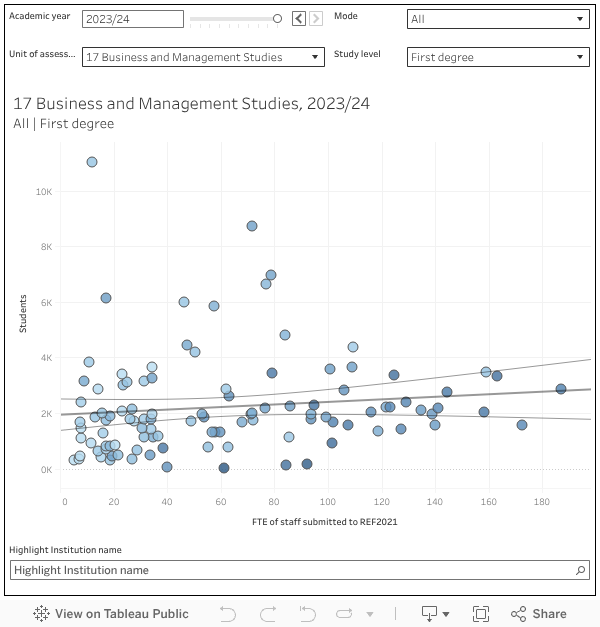
    What has been done here is a custom mapping at CAH3 level between subjects students are studying and REF2021 submissions – the axis are student headcount (you can filter by mode and level, and choose whichever academic year you fancy looking at) against the FTE of staff submitted to REF2021 – with a darker blue blob showing a greater proportion of the submission rated as 4* in the REF (there’s a filter at the bottom if you want to look at just high performing departments).

    [Full screen]

    Again, correlations are very hard to come by (if you want you can look at a chart for a single provider across all units of assessment). It’s almost as if research doesn’t bring in money that can cross-subsidise teaching, which will come as no surprise to anyone who has ever worked in higher education.

    Specialisation

    The government’s vision for higher education is clear. Universities should specialise and universities that focus on economic growth should be rewarded. The mechanisms to achieve it feel, frankly, like a mix of things that have already been announced and new measures that are divorced from the reality of the financial incentives universities work under.

    The white paper has assiduously ducked laying out some of the trade-offs and losers in the new system. Without this the government cannot set priorities and if it does not move some of the underlying incentives on student funding, regional funding distribution, greater devolution, supply-side spending like Freeports, staff reward and recognition, student number allocations, or the myriad of things that make up the basis of the university funding settlement, it has little hope of achieving its goals in specialisation or growth.

    Source link

  • The white paper on regulation

    The white paper on regulation

    The Office for Students is a creation of the 2017 Higher Education and Research Act, but this legislation was not the last word on the matter.

    It has gained new powers and new responsibilities over the years, and – looking closely at the white paper – it looks set to expand its powers, capabilities, and capacity even further.

    As the Department for Education, and as ministers and politicians more generally, make new demands of the regulator it needs to be given the power to meet these demands. And this generally needs to happen via the amendment of HERA, which almost always requires further primary legislation.

    It is clear that much of the change that ministers expect to see in the higher education sector – as set out via the white paper – needs to happen via the action of the regulator.

    Regulation, rebooted

    The 2022 Skills and Post-16 Education Act gave OfS explicit powers to assess the quality of higher education with reference to student outcomes, protection from defamation claims based on regulatory decisions, and the duty to publish details of investigations.

    The 2023 Higher Education (Freedom of Speech) Act, alongside the various measures linked directly to freedom of speech and academic freedom, attempted to grant OfS the power to monitor overseas funding – this was, in the end, not enacted.

    These decisions to give OfS new powers and new duties will have been influenced by legal embarrassment (the student outcomes and defamation issues) and perceived threats (such as on overseas funding or freedom of speech), but measures are generally finessed in conversation with the regulator and its own assessment of powers that it needs.

    It is fair to assume that OfS – famously careful around legal risk – would largely prefer to have more powers rather than less. The diversity of the sector, and the range of political and public concern about what providers actually get up to, mean that the regulator may often feel pressured to act in ways that it is not, technically, permitted to. This is not a risk limited to OfS – witness the Department for Education’s legal travails regarding Oxford Business College.

    Aspects requiring primary legislation

    The white paper offers the Office for Students a number of new powers to do things which – on the face of it – it can already do and has already done. What we need to keep an eye on here is where the amping up of these existing powers happens in a way that overrides safeguards that exist to prevent arbitrary and unfair regulatory action. It is already troubling that, unlike pretty much anyone else, the Office for Students is legally unable to defame a provider (for example by posting details of an investigation including details that are later shown to be false).

    Quality

    The Department for Education seems to labour under the misconception that OfS cannot restrict a provider’s ability to recruit on the basis of “poor quality”. It can – and has done so four times since the regulator was established. Nonetheless, the government will legislate “when parliamentary time allows” to give OfS these powers again using slightly different words – and probably modifying sections 5 and 6 of HERA to allow it to do so (currently, the Secretary of State cannot give OfS guidance that relates to the recruitment and admission of students).

    This would be part of a wider portfolio of new powers for OfS, allowing it to intervene decisively to tackle poor quality provision (including within franchise arrangements), prevent the abuse of public money at registered providers, and safeguard against provision with poor outcomes for students).

    Again – these are powers, in the broadest sense, the OfS already has. It has already intervene to tackle low quality provision (including poor quality outcomes for students) via the B3 and other B condition investigations and linked regulatory rulings. And it has already intervened on franchise arrangements (most recently opening an investigation into the arrangement between Bath Spa University and the Fairfield School of Business).

    There will be a strengthening of powers to close down provision where fraud or the misuse of public funds is identified – and here it is fair to read across to concerns about franchise provision and the work of (“unscrupulous”) UK recruitment agents. Condition E8 – which specifically addresses the wider issues of fraud and misuse of public funds, currently applies only to new registrants: it is fair to ask why extending this to currently registered providers is not under consideration as a non-legislative approach. Clearly the infamous powers of entry and search (HERA section 61) and the power to require information from unregistered providers (HERA section 62) are not cutting it.

    Linked to these, OfS will be able to build capacity to carry out more investigations and to do so at greater speed – for which in the first part we should read that OfS will get more money from DfE. It already gets roughly £10m each year, which covers things like running TEF and administering the freedom of speech complaints scheme – this is on top of around £32m in registration fees from the sector (also public money) which sounds like a lot but doesn’t even cover staff costs at OfS. We are awaiting a consultation on OfS registration fees for providers for the future, so it is possible this situation may change.

    OfS’ proposed new quality regime is centred around TEF, a “section 25” scheme in the language of HERA. Schedule 2, section 2, of HERA is clear that a section 25 scheme can be used to vary the fee cap for individual providers. Indeed, it is currently used to vary the cap – if you don’t have a TEF award (at all) you can only charge a maximum of £9,275 next year. So no fancy legislative changes would be required to make fee uplifts conditional on a “higher quality threshold” if you happened to believe that a provider’s income per student should be determined by outcomes data from a decade ago.

    Not strictly speaking “quality”, but OfS will also get stronger regulatory power to take robust action against providers that breach their duties under the Higher Education (Freedom of Speech) Act – beyond even fining providers (as it has recently done to the University of Sussex) and deregistering (or adding a condition of registration via conditions E1 and E2), a power it has had since HERA was passed. I’m not sure what would constitute more robust action than that.

    Access and participation

    The access and participation plan (APP) regime is a remnant of the work of the former Office for Fair Access (OFFA). The Higher Education Act 2004 gave this body the ability to call for and assess “access agreements”, with the approval of OFFA needed for a provider to charge higher fees. Section 29 of HERA gave the impression that handed these powers directly over to the Office for Students – but in actuality it gave a lot more direct power to the Secretary of State to specify the content of plans and the way they are assessed via regulations.

    The proposals in the white paper look for a risk-based approach to APP, but at provider level – not the more general risks associated with particular groups of students that we find in the OfS’ current approach. Providers that do well at access and participation will benefit from streamlined regulation, for those that do not the experience may involve a little more pain.

    The big change is that access and participation will now look in a lot more detail at postgraduate provision and the postgraduate student experience. And section 32(5)(b) of HERA specifically prohibits plans from addressing “education provided by means of any postgraduate course other than a course of initial teacher training”. So we could expect some kind of legislative action (it may be possible to do via regulations but if there is a bill coming then why not?) to address this issue. And besides that, there will be a load of regulations and guidance from the Secretary of State setting out what she would like John Blake or his successor to do.

    Aspects requiring changes to the regulatory framework

    Registration

    In what is fast becoming a more closely coupled tertiary sector, OfS is set to become a primary regulator for every provider of higher education. There are three sets of providers that will be affected by this move:

    • Further education colleges (FECs) delivering higher education (courses at levels 4 and above)
    • Other providers delivering provision currently funded via Advanced Learner Loans (ALL)
    • Other providers designated for student loan support, including those delivering courses via franchise and partnership arrangements.

    In each of these cases, provision that is to all intents and purposes higher education is currently delivered without the direct oversight of the higher education regulator. This may be delivered with the oversight and approval of a higher education provider (franchise and partnership provision), or with the oversight of Ofqual (there are hundreds of these).

    The regulation of this kind of provision within FECs is probably best understood – as things stand all of the fundamental regulation of these bodies (stuff like governance and financial planning) happens via the Department for Education, which took on this role from the Education and Skills Funding Agency when it was abolished on 31 March 2025. The Department then provides assurance to the Office for Students and data to HESA.

    Designation for student support nominally happens via a decision made by the Secretary of State (section 84 of HERA) – in practice this happens by default for anyone delivering higher education. As we saw in the Oxford Business College case, arrangements like this are predicated on the assumption that what we might call regulation (quality and standards, and also – I guess – fit and proper person type stuff) is pushed onto the validating organisation with varying degrees of confidence

    Advanced Learner Loan (ALL) funded provision, confusingly, is technically further education (level 3 and up) but the logic of the machinery of the Lifelong Learning Entitlement wants to bring the upper end of this provision into the ambit of OfS. There was initially supposed to be a separate category of registration for ALL provision with OfS, this plan has been scrapped.

    We’ve known informally that it was unlikely to happen for some time, but it was actually the white paper that put the nail in the coffin. OfS will be consulting, this autumn, on the disapplication of certain conditions of registration for providers in the further education sector – though this shift will be a slow process, with current ALL arrangements extending through to 2030. But this consultation is very likely to extend much wider – recall that OfS is also tasked with a more robust approach to market entry (which, again, would be done via registration).

    Likewise, OfS has been tasked with toughening up the (E) conditions on governance, and the (D) conditions on financial sustainability (which would include forming a system-wide view of sector resilience working with UKRI) – we’ve seen evidence of a rethought approach to governance in the new conditions (E7 and E9) for initial registration, and have suspected that a further consultation would apply this to more providers.

    Degree awarding powers

    The ability to award your own qualifications is an important reputational stepping stone for any provider entering the higher education sector. It has an impact on the ability to design and run new courses, and also brings a financial benefit – no need to pay capitation on fee income to your academic partners. While quality and standards play a role in OfS registration decisions, these two aspects of provision are central to assessment for degree awarding powers as expressed via:

    An emerging self-critical, cohesive academic community with a clear commitment to the assurance of standards supported by effective (in prospect) quality systems.

    The current system (as of 1 April 2023) is run by the Office for Students after the decision of the QAA to demit from the role of Designated Quality Body. There are aspects that deal with student protection, financial probity, and arrangements for progression dealt with as a precursor to a full assessment – and here OfS looks for evidence that courses have been developed and approved in accordance with sector recognised standards: currently copy-pasted from the QAA’s (2014) framework for higher education qualifications and the UKSCQA degree classification descriptions (2019).

    When this arrangement was set up back in 2022 it was somewhat controversial. There was no sign of the sector recognised standard that is the QAA Quality Code, and seemingly no mechanism to update the official list of standards recognised by the sector as they are restated elsewhere. There is a mention of sector recognised standards in HERA, but these need to be determined by “persons representing a broad range of registered higher education providers” and “command the confidence of registered higher education providers”.

    External examiners are not mentioned in the sector recognised standards (despite being a standard that is recognised by the sector), but are mentioned in DAPs criterion B3k on the quality of the academic experience, in C1g on allowing academics to be external examiners elsewhere to gain experience (which F1i clarifies should be a third of academic staff where research degrees are offered). If you are applying for full DAPs you need to send OfS a sample of external examiner reports.

    In the white paper it is suggested that government is not convinced of the value of external examination – here’s the charge sheet:

    • We will consider the extent to which recent patterns of improving grades can be explained by an erosion of standards, rather than improved teaching or assessment practices
    • We will also continue to build the evidence base on the effectiveness or otherwise of the external examining system, which we will feed into the Office for Students’ programme for reform
    • We will also seek employers’ views about whether the academic system is giving graduates the skills and knowledge they need for the workplace.

    Of course, this sails worryingly close to devolved issues, as the external examiner infrastructure extends far beyond England: it is a requirement, supported by the sector, in Wales, Scotland, and Northern Ireland. External examiners do not often have any input into awarded degree classifications (that’s degree algorithms that are set internally by providers) so are not particularly likely to be a determining factor in more people getting a first.

    Indeed, the sector came together (back in 2022) to publish a set of External Examining Principles which exist as an annex to the statement of intent on degree classifications that forms a part of the OfS’s “sector-recognised standards.” It’s a good read for anyone who does not have a full understanding of the role of external examiners, both within institutional processes and those of the many professional, statutory, and regulatory bodies (PSRBs).

    This isn’t yet at the point of a consultation, just work the Office for Students is doing to update the process – a body of work that will also establish the concept and process of granting Higher Technical Qualification awarding powers. But we should watch some of the language around the next release of the OfS’ monitoring work on grade inflation – especially as the 2022 insight brief highlighted UUK work to strengthen the external examiner system as a key tool to address the issue.

    Other new responsibilities

    White papers generally try to make changes to the provision of applicant information – we have the 2004 white paper to thank for what is now known as Discover Uni, and the 2015 white paper put forward a simple precious metals based system that we have come to love as the Teaching Excellence Framework. Thankfully this time round it is a matter of incorporating Discover Uni style data onto UCAS course pages (which, and honestly I’m sorry to keep doing this) you can already find in a “student outcomes” section operated by the Office for Students. The white paper asks for continuation data to be added to this widget – I imagine not a huge piece of work.

    It’s 2025, so every document has to mention what is popularly known as “artificial intelligence” and we more accurately describe as generative large language models. A few paragraphs tacked on to the end of the white paper ask OfS to assess the impact of such tools on assessments and qualifications – adding, almost in passing, that it expects that “all students will learn about artificial intelligence as part of their higher education experience”. In direct, but light-hearted I am sure, contravention of section 8 (a)(i) of HERA, which says that providers are free to determine the content of courses.

    Which brings us to Progress 8 – a measure used in schools policy which adds together pupils’ highest scores from eight (hence the name I suppose) GCSEs that the government thinks are important (English and maths, plus “English Baccalaureate” subjects like: sciences, history, geography, languages) and produces a cohort average used to compare schools (here it is called “Attainment 8”) and compare average performance pupils in a given school cohort with how they did in simpler subjects at primary schools as a kind of value added measure (“Progress 8”). In other words, DfE looking in the white paper to work with OfS to build Progress 8 but for higher education is another stab at learning gain measures – something we’ve been investigating since the days of HEFCE and have never been shown to work on a national scale.

    Trust and confidence

    Regulation works via the consent of the regulated. Everyone from Universities UK down has been at pains to point out that they do see the value of higher education regulation, even if it was expressed in kind of a “more in sorrow than in anger” way at the primal therapy that was the House of Lords Industry and Regulator Committee.

    But this agreement over value is determined by a perception that the actions of the regulator are fair, predictable, and proportionate. These qualities can be seen by inexperienced regulators as a block to speedy and decisive action, but the work OfS has done to reset what was initially a very fractious relationship with the sector (and associated bodies) suggests that the importance of consensual regulation is fully understood on Lime Kiln Close.

    Every time the OfS gets, or asks for, new powers it affects the calculus of value to the sector. Here it is less a matter of new powers and more an issue of strengthening and extending existing powers (despite the occasionally confused language of the white paper). Everyone involved is surely aware that a strong power is a power that is perceived as fair – and is challengeable when it appears to be unfair. The occasional lawsuits OfS (and DfE) have faced have happened when someone is keen to do the right thing but has not gone about it in the right way.

    The coming consultations – ahead of legislation and changes to the framework – need to be genuine listening exercises, even if this means adding the kind of nuance that slows things down, or reflecting on the powers OfS already has and looking for ways to improve their effective use.

    Source link