After a three-year pause prompted by the pandemic, the clock on student loan repayments suddenly started ticking again in September 2023, and forbearance ended last September. For millions of borrowers like Shauntee Russell, the resumption of payments marked a harsh return to financial reality.
Russell, a single mother of three from Chicago, had received $127,000 in student loan forgiveness through the SAVE program, and had experienced profound relief at having that $632 monthly payment lifted from her shoulders. SAVE exemplified both the transformative power of debt relief and the urgent need to continue this fight — but now SAVE has been suspended.
Such setbacks cannot be the end of our story, as I document in my forthcoming book. The resumption of loan payments, while painful, must serve as a rallying cry rather than a surrender. We stand at a critical juncture. The Supreme Court’s devastating blow to former President Biden’s initial forgiveness plan and the ongoing legal challenges to programs like SAVE have left 45 million borrowers in a state of financial limbo. The fundamental inequities of our higher education system have never been more apparent.
Black students graduate with nearly 50 percent more debt than their white counterparts, while women hold roughly two-thirds of all outstanding student debt — a staggering $1.5 trillion that continues to grow. These aren’t just statistics; they represent systemic barriers that prevent entire communities from achieving economic mobility.
Related: Interested in innovations in higher education? Subscribe to our free biweekly higher education newsletter.
The students I interviewed while reporting on this crisis reveal the human cost of inaction. They include Maria Sanchez, a nursing student in St. Louis who skips meals to save money and can only access textbooks through library loans.
Then there is Robert Carroll, who gave up his dorm room in Cleveland and now alternates between friends’ couches just to stay in school.
These students represent the millions who are working multiple jobs, sacrificing basic needs and seeing their dreams deferred under the weight of financial pressure.
Yet what strikes me most is their resilience and determination. Despite these overwhelming obstacles, these students persist, driven by the same belief that motivated civil rights leaders like Congressman Adam Clayton Powell Jr. — that education is the pathway to economic empowerment and social justice.
The current political landscape, with Donald J. Trump’s return to the presidency and a Republican-controlled Congress, presents unprecedented challenges. Plans to dismantle key borrower protections and efforts to eliminate the Department of Education signal a dark period ahead for student debt relief.
But history teaches us that progress often comes through sustained grassroots organizing and innovative policy solutions at multiple levels of government and society.
Universities must step up with institutional relief programs, as my own institution, Trinity Washington University, did when it settled $1.8 million in student balances during the pandemic.
The Black church, which has long understood the connection between education and liberation, continues to provide crucial support through scholarship programs. Organizations like the United Negro College Fund, the Thurgood Marshall College Fund and the National Association for Equal Opportunity in Higher Education remain vital pillars in making higher education accessible.
Still, individual, institutional and state efforts, while necessary, are not sufficient. We need comprehensive federal action that treats student debt as what it truly is: a civil rights issue and a moral imperative. The magnitude of the crisis — it affects Americans across every congressional district — creates unique opportunities for bipartisan coalition building.
Smart advocates are already reframing the narrative by replacing partisan talking points with economic arguments that resonate across ideological lines: workforce development, entrepreneurship and American competitiveness on the world stage.
When student debt prevents nurses from serving rural communities, teachers from working in underserved schools and young entrepreneurs from starting businesses, it becomes an economic drag that affects everyone.
The path to federal action may require creative approaches — perhaps through tax policy, regulatory changes or targeted relief for specific professions — but the political mathematics of 45 million impacted voters ultimately makes comprehensive action not just morally necessary, but politically inevitable.
Student debt relief is not about handouts — it’s about honoring the promise that education should be a ladder up, not an anchor weighing down entire generations; it’s about ensuring that Shauntee Russell’s relief becomes the norm, not the exception. The fight is far from over.
The young activists I met at the March on Washington 60th anniversary understood something profound: Their debt is not their fault, but their fight is their responsibility. They carry forward the legacy of those who came before them who believed that access to education should not depend on one’s family wealth, and that crushing debt should not be the price of pursuing knowledge.
The arc of history still bends toward justice — but in this era of political resistance, we must be prepared to bend it ourselves through sustained organizing, innovative policy solutions and an unwavering commitment to the principle that education is a right, not a privilege reserved for the wealthy.
The resumption of payments is not the end of this story. It’s the beginning of the next chapter in our fight for educational equity and economic justice. And this chapter, like those before it, will be written by the voices of the millions who refuse to let debt define their destiny.
Jamal Watson is a professor and associate dean of graduate studies at Trinity Washington University and an editor at Diverse Issues In Higher Education.
The Hechinger Report provides in-depth, fact-based, unbiased reporting on education that is free to all readers. But that doesn’t mean it’s free to produce. Our work keeps educators and the public informed about pressing issues at schools and on campuses throughout the country. We tell the whole story, even when the details are inconvenient. Help us keep doing that.
(Note: This is the second piece in a two-part series on absenteeism in schools. Read the first part, on seven insights from researchers.)
Chronic absenteeism, when students miss 10 percent or more of the school year, is 50 percent higher across the nation than before the pandemic. Researchers say it’s difficult for schools to address the problem because it is both so intense,with students missing huge chunks of the school year, and so extensive, affecting both rich and poor students and even high achievers.And the reasons vary widely, from asthma and bullying to transportation problems and the feeling that school is boring.
“It’s hard to know where and when to target resources,” said Sam Hollon, a data analyst at the American Enterprise Institute, which hosted a symposium on the problem in May. “Who do you help when every student potentially can be a candidate for help?”
Related: Our free weekly newsletter alerts you to what research says about schools and classrooms.
The Trump administration’s immigration enforcement is exacerbating the problem. A June draft paper by Stanford University professor Thomas Dee calculated that recent raids coincided with a 22 percent increase in daily student absences with particularly large increases in absenteeism among the youngest students.
Talking about the problem isn’t enough. Researchers say they want to study more schools that are making headway. It remains unclear if there are broadly applicablefixesor if each school or eveneach student needs individual solutions. Some underlying root causes for skipping school are more complex than others, requiring psychotherapy or housing assistance, which schools can’t provide alone. Here are a few examples of how very different communities are tackling the problem.
Providence: Bus stops and weekend food bags
Principal W. Jackson Reilly of Nathanael Greene Middle School in Providence, Rhode Island, said that when he arrived in April 2023, half of his 900 students in grades six to eight were chronically absent, up from 30 percent of students before the pandemic. Thirty percent of his teachers were also chronically absent. Achievement scores were in the state’s bottom 1 percent.
Reilly managed to slash his chronic absenteeism rate in half to 25 percent this past 2024-25 year. That’s still high. One in four students missed more than 18 days of school a year. But, it’s better.
He began by identifying 150 kids who were just over the threshold for chronic absenteeism, those who missed between 18 and 35 days, hoping that these kids would be easier to lure back to school than those who were more disengaged. Reilly and a group of administrators and guidance counselors each took 10 to 15 students and showed their families how much school they had missed and how low their grades were. His team asked, “What do you need in order for your kid to be coming to school?’”
The two most common replies: transportation and food.
Many students lived only a mile away, too close to school to qualify for bus service. Yet the walk deterred many, especially if it was raining or snowing. Yellow buses often passed these children’s homes as they were transporting children who lived farther out, and Reilly convinced the district to add stops for these chronically absent children.
Ninety percent of his students come from families who are poor enough to qualify for the federal free or reduced-price lunch program and 80 percent are Hispanic. Although many children were fed breakfast and lunch at school, their families admitted that their kids would get so hungry over the weekend that they didn’t want to wake up and come to school on Mondays. Reilly partnered with a food pantry and sent bags of meat and pasta home with students on Fridays.
Individual attention also helped. At the start of each school day, Reilly and his team check in with their assigned students. Kids who show up get five “green bucks” to spend on snacks and prizes. Administrators call the homes of those who didn’t come to school. “If they did not answer the phone, we’d make a home visit,” said Reilly.
The most dramatic overhaul was scheduling. Reilly scrapped individual schedules for students and assigned four teachers to every 104 students. The kids now move in pods of 26 that take all their classes together, rotating through the same four teachers throughout the day. The classrooms are right near each other, creating a smaller community within the school.
“It’s all about relationship building,” said Reilly. When students look forward to seeing their classmates and teachers, he said, they’re more motivated to come to school.
Researchers say fostering relationships is effective. Hedy Chang, executive director of Attendance Works, a nonprofit organization that advises schools on how to boost attendance rates, said it’s still a battle to persuade some school leaders (and school board members) that making school a more welcoming place is more productive than punishing kids and families for skipping school.*
Reilly said his school now posts the lowest student and teacher chronic absenteeism rates in Providence. And he said his school is the highest performing middle school in the city and among the highest statewide in reading.
New York City: Catching the butterflies
A cluster of New York City high schools are taking a more data-driven approach, guided by New Visions, a consulting organization that supports 71 city high schools.
After some experimentation, New Visions staff saw strong improvement in attendance in one subgroup of students who were on the cusp of missing 10 percent of school days, but had not yet crossed the chronic absenteeism threshold. These are students who might miss a day or two every week or every other week but were relatively engaged at school. Jonathan Green, a New Visions school improvement coach who is spearheading this effort, calls them “butterflies.” “They would flutter in and out every week,” he said.
Green suggested that someone at school meet weekly with these butterflies and show them their attendance data, set goals for the coming week and explain how their attendance was leading to better grades. The intervention took two to five minutes. “There were marked changes in attendance,” said Green.
New Visions built a website where school administrators could print out two-page documents for each student so the data, including monthly attendance and tardiness, appeared in an easy-to-digest format. The quick meetings took place for eight to 10 weeks during the final grading period for the semester. “That’s when there’s the most opportunity to turn those potentially failing grades into passing grades,” said Green. “We were finding these sweet spots within the school calendar to do this very high resource, high-energy intensive weekly check-in. It’s not something that anyone can easily scale across a school.”
Staff had to figure out the bell schedule for each child and intercept them between classes. One succeeded in holding their entire caseload of students below the chronic absenteeism threshold. Not everyone thought it was a good idea: Some school administrators questioned why so much effort should go into students who weren’t yet chronically absent rather than students in greater trouble.
The dramatic results help answer that question. Among schools in the Bronx that volunteered to participate in the butterfly intervention, chronic absenteeism rates dropped 15 percentage points from 47 percent in 2021 to 32 percent in 2025, still high. But other Bronx high schools in the New Visions network that didn’t try this butterfly intervention still had a chronic absenteeism rate of 46 percent.
Green said this solution wouldn’t work for other high schoolers. Some have trouble organizing their study time, he said, and need more intensive help from teachers. “Two- to five-minute check-ins aren’t going to help them,” said Green.
Indianapolis: Biscuits and gravy
The leader of an Indiana charter school told me he used a system of rewards and punishments that reduced the chronic absenteeism rate among his kindergarten through eighth graders from 64 percent in 2021-22 to 10 percent in 2024-25.
Jordan Habayeb, the chief operating officer of Adelante Schools, said he used federal funds for the school breakfast and lunch program to create a made-from-scratch restaurant-style cafeteria. “Fun fact: On homemade biscuit and gravy days, we saw the lowest rates of tardies,” he said.
Researchers recommend avoiding punishment because it doesn’t bring students back to school. But Habayeb said he adheres strictly to state law that requires schools to report 10 absences to the state Department of Child Services and to file a report with the county prosecutor. Habayeb told me his school accounted for a fifth of truancy referrals to the county prosecutor.
The school created an automated warning system after five absences rather than waiting for the critical 10-day loss. And Habayeb said he dispatched the safety and attendance officer in a van to have “real conversations with families rather than being buried in paperwork.” Meanwhile, students who did show up received a constant stream of rewards, from locker decorations to T-shirts.
Parent education was also important. During mandatory family orientations, the school illustrated how regular attendance matters for even young children. “We shared what a child might miss during a three-day stretch in a unit on ‘Charlotte’s Web’ — showing how easily a student could leave with a completely different understanding of the book,” said Habayeb. “This helped shift perspectives and brought urgency to the issue.”
Kansas City: Candy and notes
School leaders in Kansas City, Kansas, shared some tips that have worked for them during a webinar earlier this month hosted by Attendance Works. One elementary school reduced its chronic absenteeism from 55 percent in 2021 to 38 percent in 2024 by assigning all 300 students to an adult in the building, encouraging them to build an “authentic” relationship. Teachers were given a list of ideas but were free to do what seemed natural. One teacher left candy and notes on their assigned students’ desks. A preschoolerproudly pasted his note, which said he was a “genius,” on the front door of his house. “The smiles kids have on their faces are amazing,” said Zaneta Boles, the principal of Silver City Elementary School.
When students do miss school, Boles said educators try to take a “non-blaming approach” so that families are more likely to divulge what is going on. That helps the school refer them to other community agencies for assistance.
Albuquerque: A shining example regroups
Alamosa Elementary School in Albuquerque, New Mexico, was once a shining example of a school that persuaded more families to send their kids to class. Chronic absenteeism fell as low as 1 in 4 students in 2018, when The Hechinger Report wrote about the school.
But Alamosa has not been immune from the surge of absenteeism that has plagued schools around the nation. Chronic absenteeism spiked to 64 percent of students during the 2021-22 school year, when Covid variants were still circulating. And it remained shockingly high with 38 percent of students missing more than 10 percent of the 2024-25 school year — exactly matching the 50 percent increase in chronic absenteeism across the country since 2019.
“We were on a roll. Then life happened,” said Daphne Strader, Albuquerque Public Schools’ director of coordinated school health, who works to reduce absenteeism.
Strader said Alamosa and other Albuquerque schools have made some successful changes to how they’re tackling the problem. But the volume of absenteeism remains overwhelming. “There’s so many kids who have needs,” Strader said. “We need more staff on board.”
Strader said attendance interventions had been “too siloed” and they’re focusing more on the “whole child.” She’s encouraging schools to integrate attendance efforts with other initiatives to boost academic achievement and improve student behavior. “Students are hungry, they’re dysregulated, they don’t have grit,” said Strader, and all of these issues are contributing to absenteeism. But she also concedes that some students have more severe needs, and it’s unclear who in the system can address them.
Her biggest advice for schools is to focus on relationships. “Relationships drive everything,” said Strader. “One of the major consequences of the pandemic was the isolation. If I feel a sense of belonging, I’m more likely to come to school.”
*Clarification: This sentence was modified to make clear the Attendance Worksexecutive director did not say all school leaders oppose the idea of eliminating punishments for absenteeism.
The Hechinger Report provides in-depth, fact-based, unbiased reporting on education that is free to all readers. But that doesn’t mean it’s free to produce. Our work keeps educators and the public informed about pressing issues at schools and on campuses throughout the country. We tell the whole story, even when the details are inconvenient. Help us keep doing that.
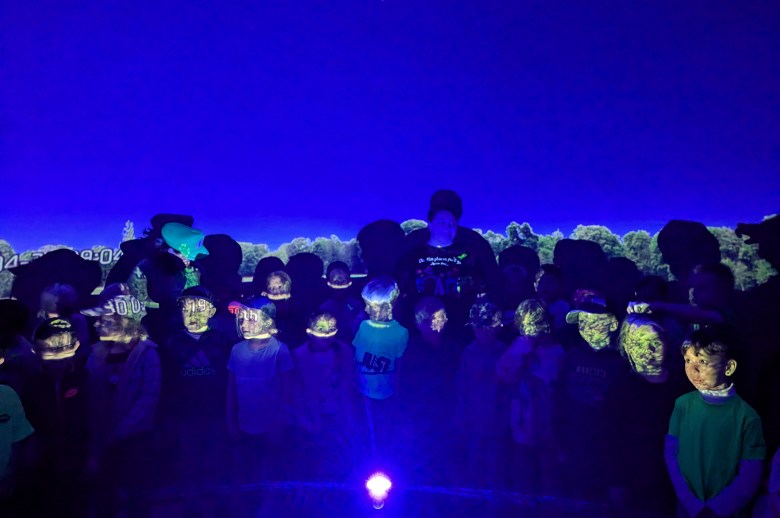
The kindergartners of South Dakota’s Hamlin County are, in fact, in space. To be specific, they are on planet Earth, near the geographic center of North America, sitting crisscross applesauce inside an 11-foot-high inflatable planetarium set up in their school gym.
The darkness is velvety. Childish whispers skitter around the dome like mice. The kids are returning from a short mission to Jupiter, piloted by Kristine Heinen, a young museum educator with a ponytail who knows how to make her voice BIG AND EXCITED and then inviting and quiet to hold little ones’ attention.
“Now we’re over China!” Heinen says.
“My friend went to China!” a girl calls out.
“The other side is nighttime and this side’s bright,” expounds a boy with a crew cut. “The sun shines here so it can’t shine over there.“
The school is in eastern South Dakota, 34 miles northeast of the settlement where Laura Ingalls Wilder grew up and attended a one-room schoolhouse. The sprawling Hamlin Education Center is a modern-day analogue, serving an entire district in one building, with just under 900 students, pre-K through 12. Notable graduates include U.S. Homeland Security Secretary Kristi Noem, the former governor of South Dakota.
The center is roughly equidistant from four tiny towns, surrounded by open fields where cornstalks shine in the sun; 95 percent of students arrive by bus, from up to 20 miles away. Over a third of them qualify for free or reduced-price lunch, said Dustin Blaha, the elementary school’s principal.
Hamlin Elementary students line up for their turn visiting a traveling planetarium sponsored by the South Dakota Discovery Center. Credit: Anya Kamenetz for The Hechinger Report
During the planetarium’s daylong visit to the small community of Hayti, S.D., an educator from the South Dakota Discovery Center wowed 500 elementary school students with a presentation about the planets and stars. Credit: Anya Kamenetz for The Hechinger Report
Many Hamlin Elementary haven’t had a chance to visit the South Dakota Discovery Center in Pierre three hours away, so the museum brings traveling exhibits like a portable planetarium to them. Credit: Anya Kamenetz for The Hechinger Report
Blaha said that most of these children have never been to the South Dakota Discovery Center, a hands-on science museum three hours west in the state capital. But thanks to a federal agency called the Institute of Museum and Library Services, a part of the museum can come to them.
The IMLS was established in 1996, combining previously separate programs. The small agency became the largest source of federal funding for museums and libraries, last year awarding $266.7 million in program grants, research and policy development across all 50 states. IMLS awarded the South Dakota Discovery Center about $45,000 in 2023 to upgrade this traveling planetarium.
But students around the state may be waiting a long time for the next upgrade.
Related: Young children have unique needs and providing the right care can be a challenge. Our free early childhood education newsletter tracks the issues.
President Donald Trump signed an executive order in mid-March calling for the agency to be “eliminated to the maximum extent consistent with applicable law.” Mass firings followed.
On May 1, the U.S. District Court in Washington, D.C., issued a temporary restraining order to block the agency’s dismantling, followed on May 6 by a second federal judge finding the dismantling of this and two other agencies unconstitutional. On May 20, the American Library Association reported that employees are returning to work and some grants have been restored.
But the administration is continuing its legal battle to all but shutter the IMLS. The latest post on the agency’s Instagram account is captioned, “The era of using your taxpayer dollars to fund DEI grants is OVER,” holding up for criticism grants that were aimed at addressing systemic racism in museums, equitable library practices, and diverse staff development. The IMLS and the Department of Government Efficiency did not respond to requests for comment.
A veteran of the agency who asked to remain anonymous because of fear of reprisal said they first saw DOGE staffers meeting with leadership on March 28. “On the 31st, we were put on administrative leave. We had about two hours to turn in your key cards, your ID, get everything off your laptop you’re ever going to need. We were locked out of our computer systems by 3:30 and told to get out of the building.” A skeleton crew was hastily rehired the next day.
The ex-staffer points out that the Institute of Museum and Library Services spends, or spent, just 7 percent of its budget on its 70 staff, passing the rest along as grants. “We are not a bloated agency.” They have two kids at home, one with special needs and are married to another federal employee whose job is also at risk; but they are almost as worried about their grantees as themselves.
“After 20 years, I didn’t even get to put an out-of-office response up. Is someone emailing me right now and getting nothing, because all of a sudden their grant just ended? I hate that,” the former IMLS employee said.
Almost all grants awarded required a one-to-one cost share out of the local institution’s budget, the staffer said. Plus, typically the grantees pay for activities first and then apply to get reimbursed. “We’re leaving these often small rural museums and libraries on the hook.”
Anne Lewis, executive director of the South Dakota Discovery Center, said that organizations like hers would be “wobbly” without federal funding and would have to scale back on ambitious programs like the planetarium upgrade.
“The new system has much better interaction and control,” said Heinen, the museum educator. An earlier version had a static point of view, but upgraded visual effects means that “now we have spaceship mode,” she said. “We can travel to destinations including planets, and go in a full 360-degree mode around galaxies.”
With a flick of the touchscreen menu, she can also display the constellations of a dozen different cultures including Lakota, a significant benefit especially when she visits tribal schools.
The South Dakota Discovery Center, based in Pierre, has used federal support from the Institute for Museum and Library Services to pay for a traveling planetarium exhibit. Credit: Anya Kamenetz for The Hechinger Report
It’s a lean operation: Heinen drove solo nearly 200 miles from Pierre to Watertown the evening before and spent the night at an Econo Lodge. From there, it was another 20-some miles to Hayti, where she arrived at 7:30 in the morning, set up the dome herself, and ran 30-minute programs all day.
The whole elementary school, about 500 kids in total, saw the planetarium, with each show customized to the children’s interest and grade level; and she also conducted a parent engagement program in the afternoon. Heinen said she never tires of being a “Santa Claus” for science. ”As soon as they see me, they know something fun is going to happen.”
During this visit, the fan favorites were Jupiter, Mars and the sun. “It was cool when we went to Mars,” said Nash Christensen, 6. “And the volcano on that one moon, and the big hurricane on Jupiter. I think Jupiter is a dangerous place to live.”
Grant recipients of the Institute of Museum and Library Services say the support from the federal government has been critical to running their programs. For example, the Boston Children’s Museum, the second-oldest children’s museum in the country, has used federal grant money to improve school readiness. One of the outcomes was a new exhibit in the museum, “Countdown to Kindergarten,” that mimics a kindergarten classroom, complete with a school bus you can sit in out front.
“It’s helpful not only for the kids, but some of our caregivers who came from other countries and may not have gone to a school like this,” said Melissa Higgins, the museum’s vice president of programs and exhibits.
At the Madison Children’s Museum in Wisconsin, federal funds paid for a multistate partnership that provides climate education for young children and their families. In Fort Lauderdale, Florida, a grant covered five “STEMobiles,” which offer hands-on science activities for children ages 3-5 in low-income parts of Broward County. The Philadelphia School District won a two-year planning grant to try to improve its pipeline of school librarians; they were down to only a handful for a district of 200,000 students.
But the greatest impact may come in rural, often deep-red areas.
“Rural communities have particularly unique challenges,” said Lewis at the South Dakota Discovery Center. “There’s 800,000 people in the state, and they’re dispersed. We don’t have a concentration of funders and donors who can help support these enrichment activities.”
She said the teachers she serves are “passionate, committed and, like every other place in the world, underfunded.” If not for institutions like hers, students would probably go without this kind of hands-on science experience, she said.
Blaha, the elementary school principal, concurred. “The planetarium brings excitement and expertise that we don’t typically have in a community like this,” he said.
For now, the excitement is coming to an end. The class has “landed” on a green lawn, under a deep blue sky. Heinen announces “It’s time to leave.” She’s met with a chorus of, “Noo!”
“You guys, we were in here for a full 30 minutes.”
“It felt like 10!”
“It felt like a second!”
Tonight, many of them will be able to look up at the dark sky over the prairie and show their parents Jupiter, Ursa Major and Mars.
Contact the editor of this story, Christina Samuels, at 212-678-3635 via Signal at cas.37 or [email protected].
The Hechinger Report provides in-depth, fact-based, unbiased reporting on education that is free to all readers. But that doesn’t mean it’s free to produce. Our work keeps educators and the public informed about pressing issues at schools and on campuses throughout the country. We tell the whole story, even when the details are inconvenient. Help us keep doing that.
Why do so many students struggle to understand what they read, even after they learn how to read?
That’s a topic of hot debate among reading researchers. One camp has been arguing that schools have been going about it all wrong. These critics say that instead of drilling students on the main idea (similar to questions students will see on annual state exams), teachers should spend more time building students’ background knowledge of the world.
The theory is that the more familiar students are with science, history, geography and even art, the easier it will be for students to grasp new ideas when reading. Many educators are embracing this theory, and knowledge building lessons have been spreading rapidly across the country, from Baltimore to Mississippi to Colorado.
Related: Our free weekly newsletter alerts you to what research says about schools and classrooms.
But the evidence for this approach is still emerging, and some reading researchers urge caution. They worry that sometimes, too much time is being spent on background knowledge rather than actually reading and discussing texts. These skeptics argue students aren’t going to magically understand what they are reading just from knowing more about the world, and they need to be explicitly taught how to identify the main idea and how to summarize.
Debates like this are common in education as new research addresses unresolved issues, such as exactly how to teach reading once students have learned phonics and how to decode the words on the page.
“Early research showed that background knowledge plays a part,” said Kausalai Wijekumar, a professor of education at Texas A&M University, who has been studying reading instruction and recently produced a study that sheds more light on the debate. “People with good background knowledge seem to be able to read faster and understand quicker.”
For some children, particularly children from affluent families, she said, background knowledge is “enough” to unlock reading comprehension, but not for all. “If we want all the children to read, we have proven that they can be taught with the right strategies,” said Wijekumar. She has a body of research to back her position.
Wijekumar agrees that drilling students on the main point or the author’s purpose isn’t helpful because a struggling reader cannot come up with a point or a purpose from thin air. (She’s also not a fan of highlighting key words or graphic organizers, both common strategies for reading comprehension in schools.) Instead, Wijekumar advocates for a step-by-step process, conceived in the 1970s by her mentor and research partner, Bonnie J.F. Meyer, a professor emeritus at Penn State.
The first step is to guide students through a series of questions as they read, such as “Is there a problem?” “What caused it?” and “Is there a solution?” Based on their answers, students can then decide which structure the passage follows: cause and effect, problem and solution, comparisons or a sequence. Next, students fill in blanks — like in a Mad Libs worksheet — to help create a main idea statement. And finally, they practice expanding on that idea with relevant details to form a summary.
Wijekumar analyzed the story of Cinderella for me, using her approach. The problem? Cinderella is bullied by her stepmother and stepsisters. We learn this because she’s forced to do extra chores and isn’t allowed to attend the ball. The cause of the problem? They’re jealous of her. That’s why they take away her pretty clothes. Finally, the solution: A fairy godmother helps Cinderella go to the ball and meet Prince Charming. Students can then put all these elements together to come up with the main idea: Cinderella is bullied by her stepmother and stepsisters because they are jealous of her, but a fairy godmother saves her.
It’s a formulaic approach and there are certainly other ways of seeing or expressing the main idea. I wouldn’t have analyzed Cinderella that way. I would have guessed it’s a story about never giving up on your dreams even if your life is wretched now. But Wijekumar says it’s a helpful start for students who struggle the most.
“It’s very structured and systematic, and that provides a strong foundation,” Wijekumar said. “This is just the starting point. You can take it and layer on more things, but 99 percent of the children are having difficulty just starting.”
Wijekumar transformed Meyer’s strategy into a computerized tutor called ITSS, which stands for Intelligent Tutoring using the Structure Strategy. About 200,000 students around the world use ITSS. Wijekumar’s nonprofit, Literacy.IO, charges schools $40 a student plus teacher training, which can run $800 per teacher, depending on school size.
The tutor allows students to practice reading comprehension at their own pace. ITSS was one of only three online learning technologies that demonstrated clear evidence for improving student achievement, according to a February 2021 report by the Institute of Education Sciences, the research and development arm of the U.S. Department of Education.
Since then, Wijekumar has continued to refine her reading program and test it with more students. Her most recent study, a large-scale replication in high poverty schools, was highly successful according to one yardstick, but not so successful, according to another measure. It was published last year in the Journal of Educational Psychology.
A team of six researchers led by Wijekumar randomly assigned 17 of 33 schools in the Northeast and along the Texas border to teach reading with ITSS, while the remaining 16 schools taught reading as usual. More than 1,200 fifth graders practiced their reading comprehension using ITSS for 45 minutes a week over six months. Their teachers received 16 hours of training in how to teach reading comprehension this way and also delivered traditional analog reading lessons to their students.
After six months, students who received this reading instruction posted significantly higher scores on a researcher-designed assessment, which measured students’ ability to write main ideas, recall key information and understand text structures. However, there was no statistically significant difference between the two groups on a standardized test, the Gray Silent Reading Test (GSRT), which measured students’ general reading comprehension. The researchers did not report state test scores.
Earlier studies with wealthier students showed improvements on the standardized reading comprehension test. It’s hard to make sense of why this study showed giant benefits using one measure, but none using another.
Substantial changes in the instruction were needed for these high-poverty students. Some were such weak readers that Wijekumar’s team had to draft easier texts so that students could practice the method. But the biggest change was 14 hours of additional teacher training and the creation of instructional guides for the teachers. Wijekumar’s strategies directly contradicted what their schools’ textbooks told them to do. At first, the students were confused with the teachers teaching them one way and ITSS another. So Wijekumar worked with the teachers to scrap their textbook instructions and teach her way.
I consulted with Marissa Filderman,a respected reading expert who has reviewed the literature on comprehension instruction for children who struggle with reading and is an assistant professor at the University of Alabama. She said despite the imperfect evidence from this study, she sees Wijekumar’s body of research as evidence that explicit strategy instruction is important along with building background knowledge and vocabulary. But it’s still an evolving science, and the research isn’t yet clear enough to guide teachers on how much time to spend on each aspect.
Improving reading comprehension is critical, and I’ll be watching for new research to help answer these questions for teachers.
The Hechinger Report provides in-depth, fact-based, unbiased reporting on education that is free to all readers. But that doesn’t mean it’s free to produce. Our work keeps educators and the public informed about pressing issues at schools and on campuses throughout the country. We tell the whole story, even when the details are inconvenient. Help us keep doing that.
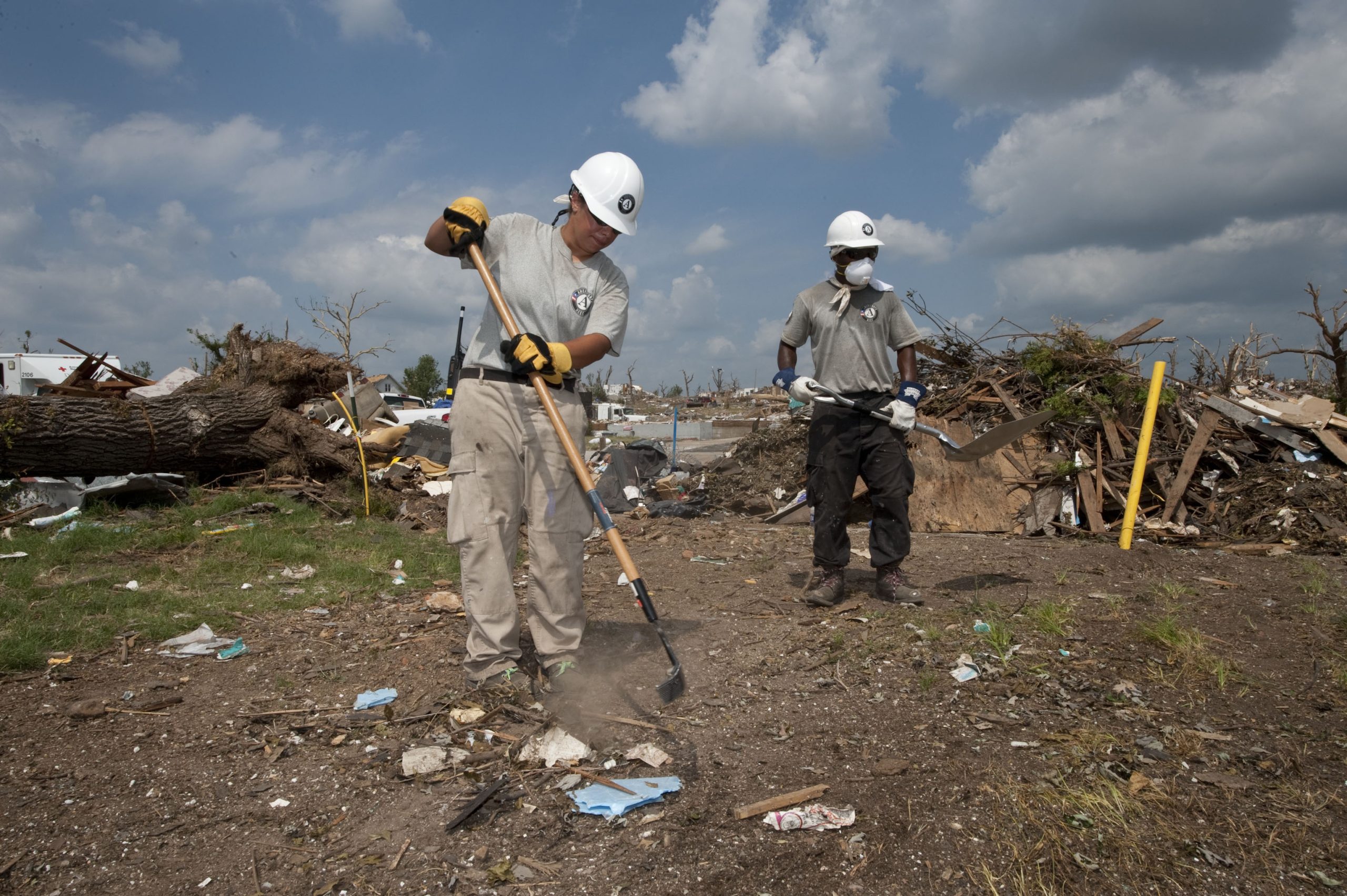
The recent decision to cancel $400 million in AmeriCorps grants is nothing short of a crisis. With over 1,000 programs affected and 32,000 AmeriCorps and Senior Corps members pulled from their posts, this move will leave communities across the country without critical services.
The cuts will dismantle disaster recovery efforts, disrupt educational support for vulnerable students and undermine a powerful workforce development strategy that provides AmeriCorps members with in-demand skills across sectors including education.
AmeriCorps provides a service-to-workforce pipeline that gives young Americans and returning veterans hands-on training in high-demand industries, such as education, public safety, disaster response and health care. Its nominal front-end investment in human capital fosters economic mobility, enabling those who engage in a national service experience to successfully transition to gainful employment.
As leaders of Teach For America and City Year, two organizations that are part of the AmeriCorps national service network and whose members receive education stipends that go toward certification costs, student loans or future education pursuits, we are alarmed by how this crisis threatens the future of the education and workforce pipelines that power our nation’s progress, and it is deeply personal. We both started our careers as corps members in the programs we now lead.
Aneesh began his journey as a Teach For America corps member teaching high school English in Minnesota. Jim’s path began with City Year, serving at a Head Start program in Boston. We know firsthand that AmeriCorps programs are transformative and empower young people to drive meaningful change — for themselves and their communities.
At Teach For America, AmeriCorps grants are essential to recruiting thousands of new teachers every year to effectively lead high-need classrooms across the country. These teachers, who have a consistent and significant positive impact on students’ learning, rely on the AmeriCorps education awards they earn through their two years of service to pay for their own education and professional development, including new teacher certification fees, costs that in some communities exceed $20,000.
Termination of these grants threatens the pipeline of an estimated 2,500 new teachers preparing to enter classrooms over the summer. At a time when rural and urban communities alike are facing critical teacher shortages, cutting AmeriCorps support risks leaving students without the educators they need and deserve.
City Year, similarly, relies on AmeriCorps to recruit more than 2,200 young adults annually to serve as student success coaches in K-12 schools across 21 states, 29 cities and 60 school districts.
These AmeriCorps members serving as City Year student success coaches provide tutoring and mentoring that support students’ academic progress and interpersonal skill development and growth; they partner closely with teachers to boost student achievement, improve attendance and help keep kids on track to graduate. Research shows that schools partnering with City Year are two times more likely to improve their scores on English assessments, and two to three times more likely to improve their scores on math assessments.
Corps members gain critical workforce skills such as leadership, problem-solving and creative thinking, which align directly with the top skills employers seek; the value of their experience has been reaffirmed through third-party research conducted with our alumni. The City Year experience prepares corps members for success in varied careers, with many going into education.
AmeriCorps-funded programs like Breakthrough Collaborative and Jumpstart further strengthen this national service-to-workforce pathway, expanding the number of trained tutors and teacher trainees while also preparing corps members for careers that make a difference in all of our lives.
Those programs’ trained educators ensure all students gain access to excellent educational opportunities that put them on the path to learn, lead and thrive in communities across the country. And the leaders of both organizations, like us, are AmeriCorps alumni, proof of the lasting effect of national service.
Collectively, our four organizations have hundreds of thousands of alumni whose work as AmeriCorps members has impacted millions of children while shaping their own lives’ work, just as it did ours. Our alumni continue to lead classrooms, schools, districts, communities and organizations in neighborhoods across the country.
The termination of AmeriCorps grants is a direct blow to educators, schools and students. And, at a time when Gen Z is seeking work that aligns with their values and desire for impact, AmeriCorps is an essential on-ramp to public service and civic leadership that benefits not just individuals but entire communities and our country at large.
For every dollar invested in AmeriCorps, $17 in economic value is generated, proving that national service is not only efficient but also a powerhouse for economic growth. Rather than draining resources, AmeriCorps drives real, measurable results that benefit individual communities and the national economy.
Moreover, two-thirds of AmeriCorps funding is distributed by governor-appointed state service commissions to community- and faith-based organizations that leverage that funding to meet local needs. By working directly with state and local partners, AmeriCorps provides a more effective solution than top-down government intervention.
On behalf of the more than 6,500 current AmeriCorps members serving with Teach For America and City Year, and the tens of thousands of alumni who have gone on to become educators, civic leaders and changemakers, we call on Congress to protect AmeriCorps and vital national service opportunities.
Investing in AmeriCorps is an investment in America’s future, empowering communities, strengthening families and revitalizing economies. Let’s preserve the fabric of our national service infrastructure and ensure that the next generation of leaders, educators and community advocates who want to serve our nation have the ability to do so.
Aneesh Sohoni is Teach For America’s new CEO. Previously, he was CEO of One Million Degrees and executive director of Teach For America Greater Chicago-Northwest Indiana. He is a proud alum of Teach For America.
Jim Balfanz, a recognized leader and innovator in the field of education and national service, is CEO and a proud alum of City Year.
The Hechinger Report provides in-depth, fact-based, unbiased reporting on education that is free to all readers. But that doesn’t mean it’s free to produce. Our work keeps educators and the public informed about pressing issues at schools and on campuses throughout the country. We tell the whole story, even when the details are inconvenient. Help us keep doing that.
In 1965, President Lyndon Johnson launched “Project Head Start,” a summer program intended to help children from low-income families prepare for school. Sixty years later, Head Start has expanded into a multi-billion program operating in all 50 states, serving preschoolers as well as infants, toddlers and pregnant women.
But the program is facing serious challenges, such as recent disruptions in federal funding, and cuts among staffers who oversee the program. In a recent feature story for The Hechinger Report, reporter Anya Kamenetz delved into Head Start’s uncertain future. I asked Anya what she learned from her reporting. Her responses have been edited for length and clarity.
Q: Head Start is celebrating its 60th anniversary this year, and has persevered through both Democratic and Republican presidential administrations. However, it seems to be uniquely vulnerable this year. What is happening that puts the program at risk?
A: A lot of the federal staff has been fired. And Project 2025, which the Trump administration has been following closely, calls for eliminating the program altogether. (Editor’s note: this week, the Department of Health and Human Services, which oversees Head Start, placed staffers at five of Head Start’s 10 regional offices on administrative leave.)
Q: Critics of Head Start say that the program is poorly run and that the money could be better spent at the local level. According to its supporters, why is Head Start still an important program?
A: The program has always been severely underfunded, serving only a fraction of eligible children. The lapses in quality that we know about have come to light in part because the program has better oversight and higher quality standards than the existing patchwork of subsidized, nonprofit and for-profit programs otherwise available across the country. Head Start has been shown to improve long-term educational outcomes. In addition, lawmakers are threatening cuts to Head Start alongside cuts to programs that support families across the board, from food stamps to Medicaid.
Q: States and local communities are stepping in to expand their early childhood offerings. Did state officials share with you if they are ready to step in should Head Start be cut or if the funding shifts?
A: Yes, a bright spot in my article was that in states like Vermont and New Mexico where they have been committed to expanding access to childcare, they are intending to keep this a priority even if federal funding shifts.
This story about Head Start was produced by The Hechinger Report, a nonprofit, independent news organization focused on inequality and innovation in education. Sign up for the Hechinger newsletter.
The Hechinger Report provides in-depth, fact-based, unbiased reporting on education that is free to all readers. But that doesn’t mean it’s free to produce. Our work keeps educators and the public informed about pressing issues at schools and on campuses throughout the country. We tell the whole story, even when the details are inconvenient. Help us keep doing that.
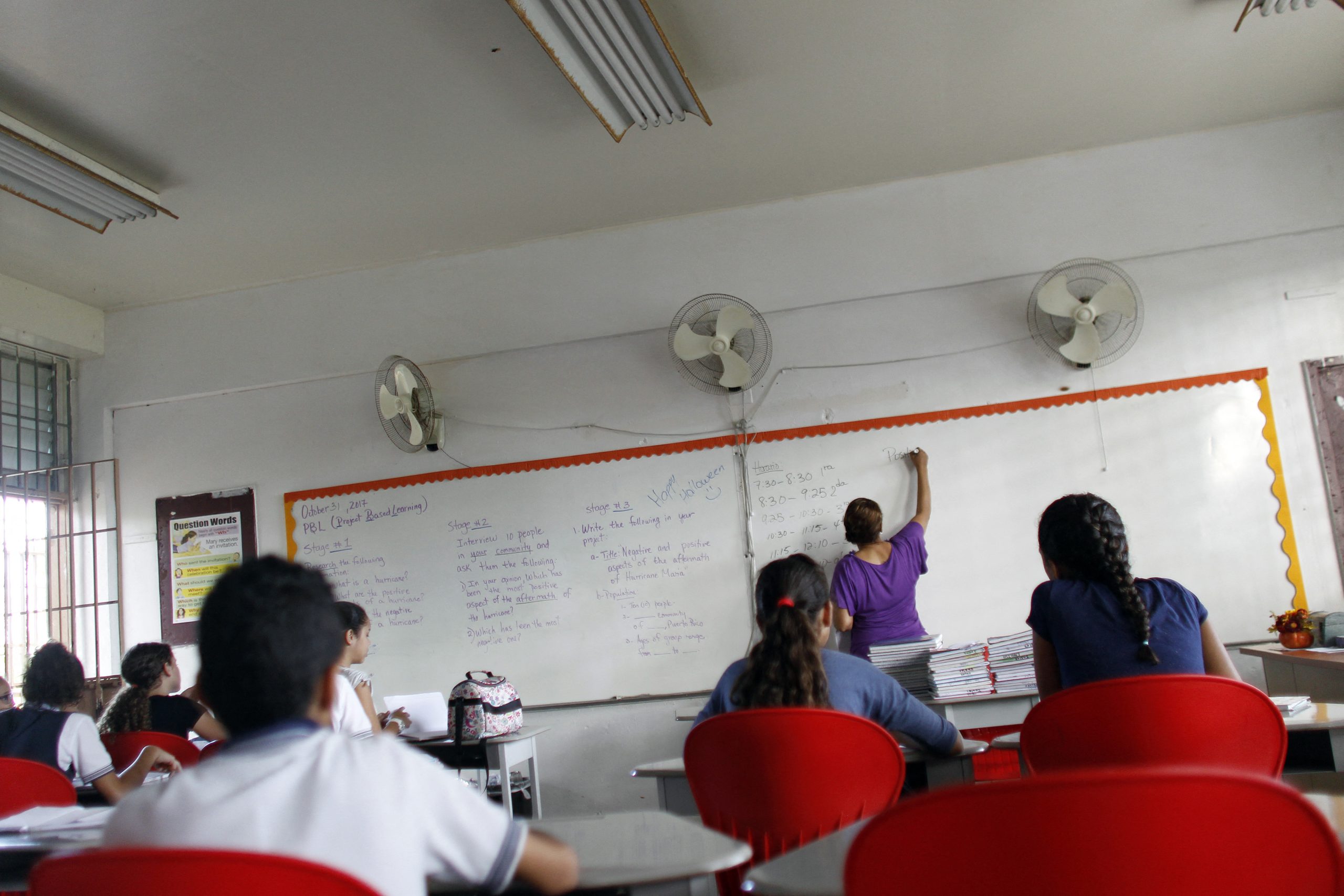
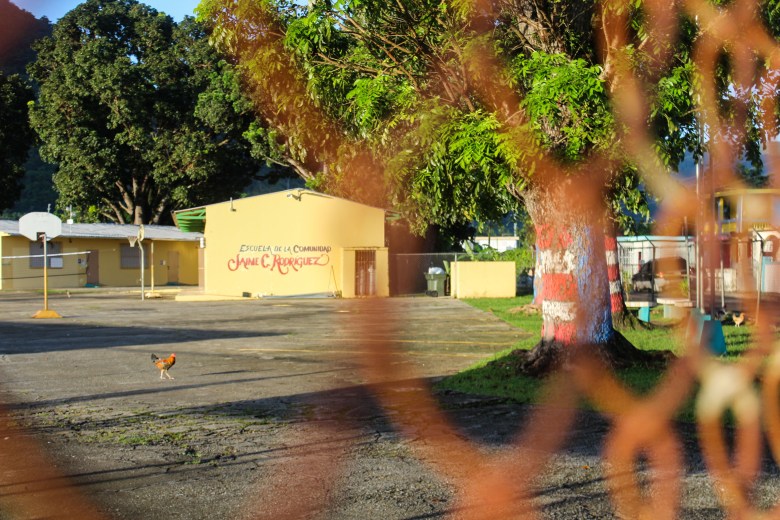
Maraida Caraballo Martínez es educadora en Puerto Rico desde hace 28 años y directora de la Escuela de la Comunidad Jaime C. Rodríguez desde hace siete. Nunca sabe cuánto dinero recibirá del gobierno cada año porque no se basa en el número de niños matriculados. Un año recibió 36.000 dólares; otro año, 12.000 dólares.
Pero por primera vez como educador, Caraballo notó una gran diferencia durante la administración Biden. Gracias a una inyección de fondos federales en el sistema educativo de la isla, Caraballo recibió una subvención de 250.000 dólares, una cantidad de dinero sin precedentes. La utilizó para comprar libros y ordenadores para la biblioteca, pizarras e impresoras para las aulas, reforzar el programa de robótica y construir una pista polideportiva para sus alumnos. “Esto significó una gran diferencia para la escuela”, dijo Caraballo.
Yabucoa, un pequeño pueblo del sureste de Puerto Rico, fue una de las regiones más afectadas por el huracán María en 2017. Y esta comunidad escolar, como cientos de otras en la isla, ha experimentado trastornos casi constantes desde entonces. Una serie de desastres naturales, como huracanes, terremotos, inundaciones y deslizamientos de tierra, seguidos de la pandemia de coronavirus en 2020, han golpeado la isla e interrumpido el aprendizaje. También ha habido una rotación constante de secretarios de educación locales: siete en los últimos ocho años. El sistema educativo puertorriqueño -el séptimo distrito escolar más grande de Estados Unidos- se ha vuelto más vulnerable debido a la abrumadora deuda de la isla, la emigración masiva y una red eléctrica paralizada.
Relacionado: En las aulas de preescolar a secundaria pasan muchas cosas. Mantente al día con nuestro boletínsemanal gratuito sobre educación.
Bajo la presidencia de Joe Biden, se produjeron tímidos avances, respaldados por miles de millones de dólares y una atención personal sostenida por parte de altos funcionarios federales de educación, dijeron muchos expertos y educadores de la isla. Ahora les preocupa que todo se desmantele con el cambio en la Casa Blanca. El presidente Donald Trump no ha ocultado su desdén por el territorio estadounidense, habiendo dicho supuestamente que estaba “sucio y que la gente era pobre.” Durante su primer mandato, retuvo miles de millones de dólares en ayuda federal tras el huracán María y ha sugerido vender la isla o cambiarla por Groenlandia.
Una reciente orden ejecutiva para hacer del inglés el idioma oficial ha preocupado a los habitantes de la isla, donde solo 1 de cada 5 personas habla inglés con fluidez, y el español es el idioma de instrucción en las escuelas. Trump está tratando de eliminar el Departamento de Educación de EE.UU. y ya ha hecho recortes radicales a la agencia, lo que tendrá implicaciones en toda la isla. Incluso si los fondos federales -que el año pasado representaron más de dos tercios del financiamiento del Departamento de Educación de Puerto Rico, o DEPR- se transfirieran directamente al gobierno local, probablemente traerían peores resultados para los niños más vulnerables, dicen los educadores y expertos en políticas públicas. Históricamente, el DEPR ha estado plagado de interferencias políticas, burocracia generalizada y falta de transparencia.
Maraida Caraballo Martínez ha sido educadora en Puerto Rico durante 28 años y ahora es directora de una escuela primaria. Su escuela ha estado a punto de cerrar tres veces debido a la emigración masiva de la isla. Credit: Kavitha Cardoza for The Hechinger Report
Y el departamento de educación local no está tan avanzado tecnológicamente como otros departamentos de educación estatales, ni es tan capaz de difundir las mejores prácticas. Por ejemplo, Puerto Rico no dispone de una “fórmula por alumno”, un cálculo utilizado habitualmente en el continente para determinar la cantidad de dinero que recibe cada estudiante para su educación. Roberto Mujica es el director ejecutivo de la Junta de Supervisión y Gestión Financiera de Puerto Rico, convocada por primera vez bajo la presidencia de Barack Obama en 2016 para hacer frente al marasmo financiero de la isla. Mujica dijo que la actual asignación de fondos educativos de Puerto Rico es opaca. “Cómo se distribuyen los fondos se percibe como un proceso político”, dijo. “No hay transparencia ni claridad”.
En 2021, Miguel Cardona, Secretario de Educación de Biden, prometió “un nuevo día” para Puerto Rico. “Durante demasiado tiempo, los estudiantes y educadores de Puerto Rico fueron abandonados”, dijo. Durante su mandato, Cardona aignó casi 6.000 millones de dólares federales para el sistema educativo de la isla, lo que se tradujo en un aumento salarial histórico para los profesores, financiamiento para programas de tutoría extraescolar, la contratación de cientos de profesionales de salud mental escolar y la creación de un programa piloto para descentralizar el DEPR.
Cardona designó a un asesor principal, Chris Soto, para que fuera su persona de contacto con el sistema educativo de la isla, subrayando el compromiso del gobierno federal con la isla. Durante casi cuatro años en el cargo, Soto realizó más de 50 viajes a la isla. Carlos Rodríguez Silvestre, director ejecutivo de la Fundación Flamboyán, una organización sin fines de lucro de Puerto Rico que ha dirigido los esfuerzos de alfabetización infantil en la isla, dijo que el nivel de respeto e interés sostenido hicieron sentir que se trataba de una asociación, no un mandato de arriba hacia abajo. “Nunca había visto ese tipo de atención a la educación en Puerto Rico”, afirmó. “Soto prácticamente vivía en la isla”.
Soto también trabajó estrechamente con Víctor Manuel Bonilla Sánchez, presidente del sindicato de maestros, la Asociación de Maestros de Puerto Rico, o AMPR, lo que dio lugar a un acuerdo por el que los educadores recibieron 1.000 dólares más al mes en su salario base, un aumento de casi el 30% para el maestro promedio. “Fue el mayor aumento salarial en la historia de los maestros de Puerto Rico”, dijo Bonilla, aunque incluso con el aumento, los maestros de aquí siguen ganando mucho menos dinero que sus colegas en el continente.
Una de las mayores quejas que Soto dijo haber escuchado fue lo rígido y burocrático que era el Departamento de Educación de Puerto Rico, a pesar de una ley de reforma educativa de 2018 que permite un mayor control local. La agencia de educación -la unidad de gobierno más grande de la isla, con la mayor cantidad de empleados y el mayor presupuesto- estaba configurada de manera que la oficina central tenía que aprobar todo. Así que Soto creó y supervisó un programa piloto en Ponce, una región en la costa sur de la isla, enfocado en la descentralización.
Por primera vez, la comunidad local eligió un consejo asesor de educación, y los candidatos a superintendente tuvieron que postularse en lugar de ser nombrados, dijo Soto. El superintendente recibió autoridad para aprobar directamente las solicitudes presupuestarias en lugar de enviarlas a través de funcionarios de San Juan, así como flexibilidad para gastar el dinero en su región en función de las necesidades de cada escuela.
En el pasado, eso no se tenía en cuenta: Por ejemplo, Yadira Sánchez, psicóloga que lleva más de 20 años trabajando en la educación puertorriqueña, recuerda cuando una escuela recibió docenas de aires acondicionados nuevos aunque no los necesitaba. “Ya tenían aires acondicionados que funcionaban”, dice, “así que ese dinero se perdió”.
El proyecto piloto también se centró en aumentar la eficiencia. Por ejemplo, ahora se evalúa a los niños discapacitados en sus colegios, en lugar de tener que acudir a un centro especial. Y Soto dice que también intentó eliminar el uso de influencias y aumentar la transparencia en torno al gasto en el PRDE. “Puedes mejorar las facturas, pero si tus amigos políticos son los que se quedancon los trabajos, entonces no tienes un buen sistema escolar”, dijo.
Bajo el mandato de Biden, Puerto Rico también recibió una subvención competitiva o grant del Departamento de Educación de EE.UU. por valor de 10,5 millones de dólares para escuelas comunitarias, otro hito. Y el departamento federal empezó a incluir datos sobre el territorio en algunas estadísticas educativas recopiladas. “Puerto Rico ni siquiera figuraba en estos indicadores, así que empezamos a preguntarnos cómo mejorar los sistemas de datos. Desentrañar el problema de los datos significó que Puerto Rico puede ser debidamente reconocido”, dijo Soto.
Pero ya hay planes para deshacer el esfuerzo de Cardona en Ponce. La recién elegida gobernadora de la isla, Jenniffer González Colón, es republicana y partidaria de Trump. El popular secretario de Educación, Eliezer Ramos Parés, regresó a principios de este año al frente del departamento tras dirigirlo desde abril de 2021 hasta julio de 2023, cuando la gobernadora le pidió inesperadamente que dimitiera, algo nada inusual en el gobierno de la isla, donde los nombramientos políticos pueden terminar de repente y con poco debate público. Ramos dijo a The Hechinger Report que el programa no continuará en su forma actual, calificándolo de “ineficiente”.
“El programa piloto no es realmente eficaz”, dijo, señalando que la política puede influir en las decisiones de gasto no sólo a nivel central, sino también a nivel regional. “Queremos tener algunos controles”. También dijo que ampliar la iniciativa a toda la isla costaría decenas de millones de dólares. En su lugar, Ramos dijo que estaba estudiando enfoques más limitados de la descentralización, en torno a algunas funciones de recursos humanos y adquisiciones. Dijo que también estaba explorando una fórmula de financiación por alumno para Puerto Rico y estudiando las lecciones de otros grandes distritos escolares como la ciudad de Nueva York y Hawai.
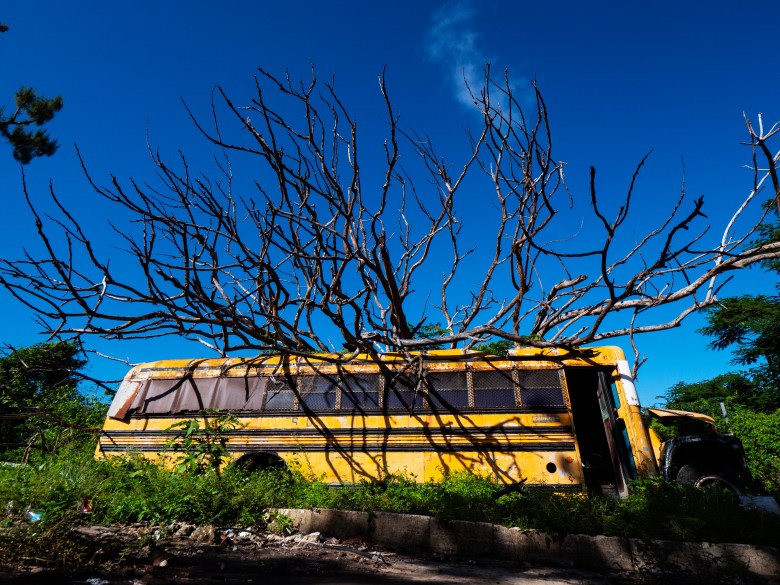
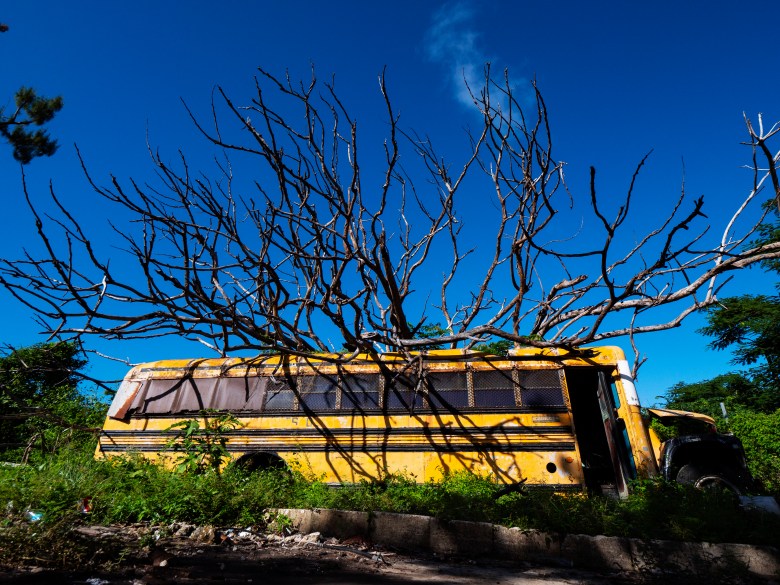
Un autobús escolar bajo un árbol que cayó durante el huracán María, que azotó la isla de Puerto Rico en septiembre de 2017. Más de un año después, no había sido retirado. Credit: Al Bello/Getty Images for Lumix
El Departamento de Educación de EE.UU., que complementa la financiación local y estatal para los estudiantes en situación de pobreza y con discapacidades, tiene un papel desproporcionado en las escuelas de Puerto Rico. En la isla, el 55% de los niños viven por debajo del umbral de la pobreza, frente al 17% en los 50 estados; en el caso de los estudiantes de educación especial, las cifras son del 35% y el 15%, respectivamente. En total, durante el año fiscal 2024, más del 68 por ciento del presupuesto de educación en la isla procede de fondos federales, frente al 11 por ciento en los estados de EE UU. El departamento también administra las becas Pell para estudiantes de bajos ingresos -alrededor del 72 por ciento de los estudiantes puertorriqueños las solicitan- y apoya los esfuerzos de desarrollo profesional y las iniciativas para los niños puertorriqueños que van y vienen entre el continente y el territorio.
Linda McMahon, la nueva secretaria de Educación de Trump, ha dicho supuestamente que el Gobierno seguirá cumpliendo sus “obligaciones legales” con los estudiantes aunque el departamento cierre o transfiera algunas operaciones y despida personal. El Departamento de Educación de Estados Unidos no respondió a las solicitudes de comentarios para esta historia.
Algunos dicen que el hecho de que la administración Biden haya vertido miles de millones de dólares en un sistema educativo en problemas con escasa rendición de cuentas ha creado expectativas poco realistas y no hay un plan para lo que ocurre después de que se gasta el dinero. Mujica, director ejecutivo de la junta de supervisión, dijo que la infusión de fondos pospuso la toma de decisiones difíciles por parte del gobierno puertorriqueño. “Cuando se tiene tanto dinero, se tapan muchos problemas. No tienes que enfrentarte a algunos de los retos que son fundamentales para el sistema”. Y afirmó que apenas se habla de lo que ocurrirá cuando se acabe ese dinero. “¿Cómo se va a llenar ese vacío? O desaparecen esos programas o tendremos que encontrar la financiación para ellos”, dijo Mujica.
Dijo que esfuerzos como el de Ponce para acercar la toma de decisiones a donde están las necesidades de los estudiantes es “de vital importancia”. Aún así, dijo que no está seguro de que el dinero haya mejorado los resultados de los estudiantes. “Esta era una gran oportunidad para hacer cambios fundamentales e inversiones que produzcan resultados a largo plazo. No estoy seguro de que hayamos visto las métricas que lo respalden”.
Puerto Rico es una de las regiones más empobrecidas desde el punto de vista educativo, con unos resultados académicos muy inferiores a los del continente. En la parte de matemáticas de la Evaluación Nacional de Progreso Educativo, o NAEP, una prueba que realizan los estudiantes de todo EE.UU., sólo el 2% de los alumnos de cuarto curso de Puerto Rico calificaron como competentes, la puntuación más alta jamás registrada en la isla, y el 0% de los alumnos de octavo curso lo fueron. Los estudiantes puertorriqueños no hacen la prueba NAEP de lectura porque aprenden en español, no en inglés, aunque los resultados compartidos por Ramos en una conferencia de prensa en 2022 mostraron que sólo el 1% de los estudiantes de tercer grado leían a nivel de grado.
Hay algunos esfuerzos alentadores. La Fundación Flamboyán ha liderado una coalición de 70 socios en toda la isla para mejorar la alfabetización de los niños de preescolar a tercer grado, entre otras cosas mediante el desarrollo profesional. La formación del profesorado a través del departamento de educación del territorio ha sido a menudo irregular u opcional.
La organización trabaja ahora en estrecha colaboración con la Universidad de Puerto Rico y, como parte de ese esfuerzo, supervisa el gasto de 3 millones de dólares en formación para la alfabetización. Aproximadamente 1.500 profesores de Puerto Rico (un tercio de los maestros de Kinder a 5º grado) han recibido esta rigurosa formación. Los educadores recibieron 500 dólares como incentivo por participar, además de libros para sus aulas y tres horas de formación continua. “Fueron muchas horas de calidad. No ha sido el método de ‘rociar (con un poco de agua) y rezar’”, dijo Silvestre. Ese esfuerzo continuará, según Ramos, que lo calificó de “muy eficaz”.
Una nueva prueba de lectura para alumnos de primero a tercer grado que la organización sin fines de lucro ayudó a diseñar mostró que entre los años escolares 2023 y 2024, la mayoría de los niños estaban por debajo del nivel del grado, pero hubo avances en los resultados en todos los grados. “Pero aún nos queda un largo camino por recorrer para que estos datos lleguen a los profesores a tiempo y de forma que puedan actuar en consecuencia”, dijo Silvestre.
Kristin Ehrgood, Directora General de la Fundación Flamboyán, afirma que es demasiado pronto para ver resultados espectaculares. “Es realmente difícil ver una tonelada de resultados positivos en un período tan corto de tiempo con la desconfianza significativa que se ha construido durante años”, dijo. Dijo que no estaban seguros de cómo la administración Trump podría trabajar o financiar el sistema educativo de Puerto Rico, pero que la administración Biden había construido una gran cantidad de buena voluntad. “Hay muchas oportunidades que podrían aprovecharse, si una nueva administración decide hacerlo”.
Otra señal esperanzadora es que la junta de supervisión, que fue muy protestada cuando se formó, ha reducido la deuda de la isla de 73.000 a 31.000 millones de dólares. Y el año pasado los miembros de la junta aumentaron el gasto en educación en un 3%. Mujica dijo que la junta se centra en asegurarse de que cualquier inversión se traduzca en mejores resultados para los estudiantes: “Nuestra opinión es que los recursos tienen que ir a las aulas”.
Betty A. Rosa, comisionada de educación y presidente de la Universidad del Estado de Nueva York y miembro de la Junta de Supervisión, afirmó que la inestabilidad educativa en Puerto Rico se debe a los cambios en el liderazgo. Cada nuevo líder se dedica a “reconstruir, reestructurar, reimaginar, elija la palabra que elija”, dijo. “No hay coherencia”. A diferencia de su cargo en el estado de Nueva York, el Secretario de Educación de Puerto Rico y otros cargos son nombramientos políticos. “Si tienes un gobierno permanente, aunque cambie el liderazgo, el trabajo continúa”.
Ramos, que vivió esta inestabilidad cuando el anterior gobernador pidió inesperadamente su dimisión en 2023, dijo que se reunió con McMahon, la nueva secretaria de Educación de EE.UU., en Washington, D.C., y que mantuvieron una “agradable conversación”. “Ella sabe de Puerto Rico, se preocupa por Puerto Rico y demostró total apoyo en la misión de Puerto Rico”, dijo. Dijo que McMahon quería que el DEPR ofreciera más clases bilingües, para exponer a más estudiantes al inglés. Queda por ver si habrá cambios en la otorgación de fondos o cualquier otra cosa. “Tenemos que ver lo que ocurre en las próximas semanas y meses y cómo esa visión y esa política podrían afectar a Puerto Rico”, dijo Ramos.
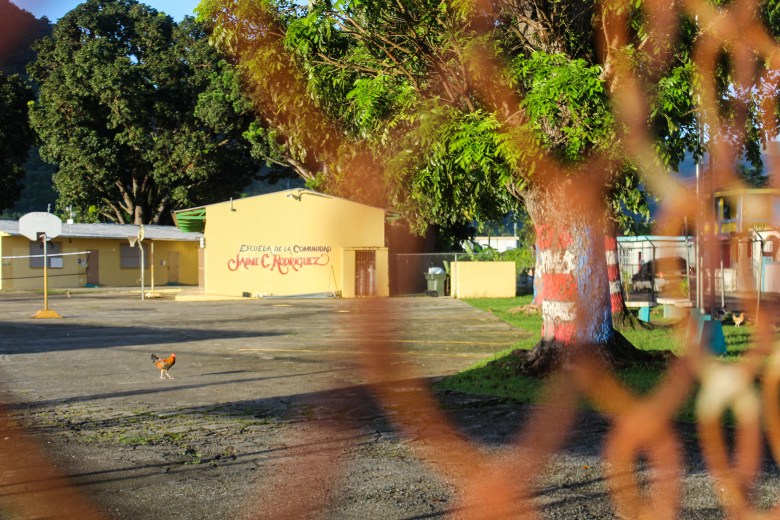
La Escuela de la Comunidad Jaime C. Rodríguez es una escuela Montessori de Yabucoa, Puerto Rico, que carecía de instalaciones deportivas para sus alumnos. Recientemente comenzó las obras de un centro deportivo polivalente gracias a los fondos federales otorgados por la administración del presidente Biden. Credit: Kavitha Cardoza for The Hechinger Report
Ramos fue muy apreciado por los educadores durante su primera etapa como Secretario de Educación. También tendrá que tomar muchas decisiones, como ampliar las escuelas charter y cerrar las escuelas públicas tradicionales, ya que la matriculación en las escuelas públicas de la isla sigue disminuyendo vertiginosamente. En el pasado, ambas cuestiones provocaron protestas feroces y generalizadas.
Soto es realista y cree que la nueva administración tendrá “puntos de vista diferentes, tanto ideológica como políticamente”, pero confía en que el pueblo de Puerto Rico no quiera volver a la antigua forma de hacer las cosas. “Alguien dijo: ‘Ustedes sacaron al genio de la botella y va a ser difícil volver a ponerlo’ en lo que se refiere a un sistema escolar centrado en el estudiante”, dijo Soto.
Cardona, cuyos abuelos son oriundos de la isla, dijo que Puerto Rico había experimentado un “estancamiento académico” durante años. “No podemos aceptar que los estudiantes rindan menos de lo que sabemos que son capaces”, dijo a The Hechinger Report, justo antes de despedirse como máximo responsable de educación del país. “Empezamos el cambio; tiene que continuar.
La pequeña escuela de la directora Carabello, con 150 alumnos y 14 profesores, ha estado a punto de cerrarse ya tres veces, aunque en todas ellas se ha salvado en parte gracias al apoyo de la comunidad. Carabello confía en que Ramos, con quien ya ha trabajado anteriormente, cambie las cosas. “Conoce el sistema educativo”, afirma. “Es una persona brillante, abierta a escuchar”.
Pero las largas jornadas de los últimos años le han pasado factura. Suele estar en la escuela de 6:30 a.m. a 6:30 p.m. “Entras cuando anochece y te vas cuando anochece”, dice. Ha habido muchas plataformas nuevas que aprender y nuevos proyectos que poner en marcha. Quiere jubilarse, pero no puede permitírselo. Tras décadas en las que el gobierno local no financió suficientemente el sistema de pensiones, se recortaron los subsidios que compensaban el alto precio de los bienes y servicios en la isla y se congelaron los planes de pensiones.
Ahora, en lugar de jubilarse con el 75% de su salario, Carabello recibirá sólo el 50%, 2.195 dólares al mes. Tiene derecho a prestaciones de la Seguridad Social, pero no son suficientes para compensar la pensión perdida. “¿Quién puede vivir con 2.000 dólares en un mes? Nadie. Es demasiado duro. Y mi casa aún necesita 12 años más para pagarse”.
A Carabello, siempre tan fuerte y optimista con sus alumnos, se le saltaron las lágrimas. Pero es raro que se permita tiempo para pensar en sí misma. “Tengo una gran comunidad. Tengo grandes profesores y me siento feliz con lo que hago”, afirma.
Está muy, muy cansada.
Comunícate con editora Caroline Preston al 212-870-8965 o [email protected].
The Hechinger Report provides in-depth, fact-based, unbiased reporting on education that is free to all readers. But that doesn’t mean it’s free to produce. Our work keeps educators and the public informed about pressing issues at schools and on campuses throughout the country. We tell the whole story, even when the details are inconvenient. Help us keep doing that.
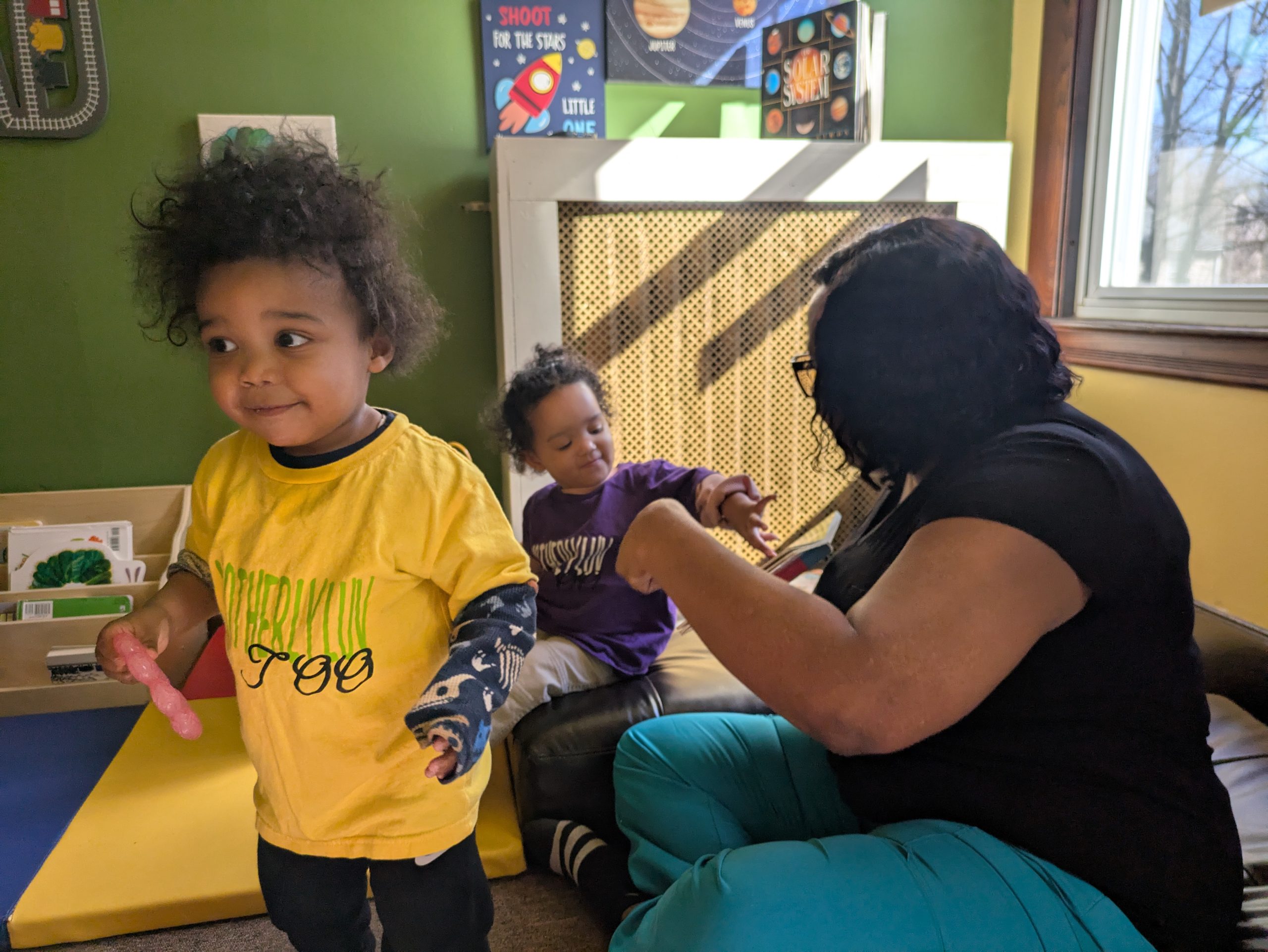
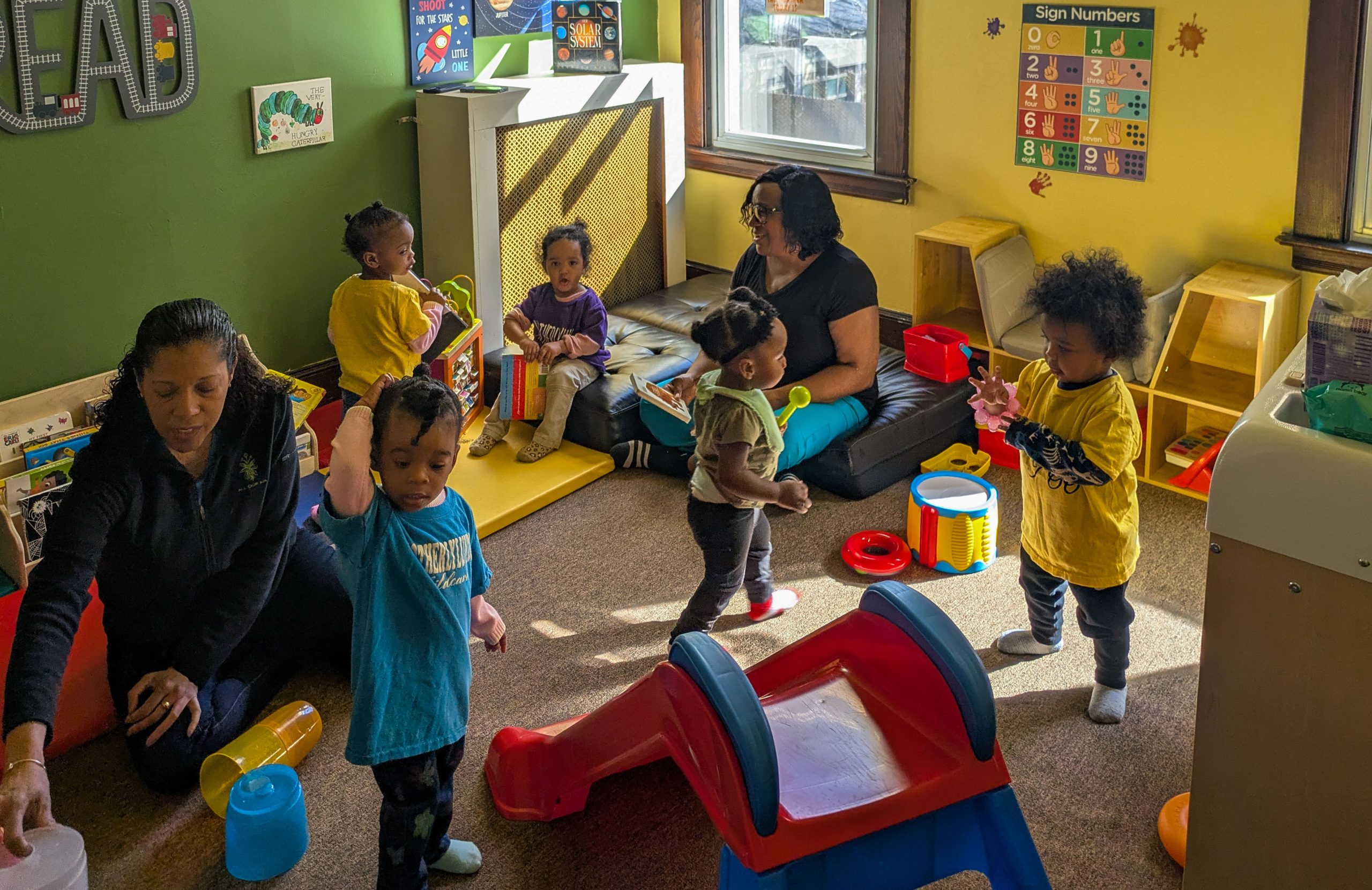
NEW HAVEN, Conn. — Bright morning sun is streaming through her home’s windows as Sandra Dill reads a picture book about penguins to a room full of busy toddlers. While listening, the kids blow kisses, plop in a visitor’s lap, then get up to slide down a small slide.
Dill has been running a family child care business from her home for 15 years, and every one of her 13 grandchildren has spent time here — currently it’s 20-month-old Nathaniel, who has a puff of curly hair and a gooey grin.
“My older ones started to call it ‘grandma school,’” she said. Another one of her granddaughters, now a teenager, is returning this summer to help out.
Four of Dill’s eight available slots are funded through Head Start. This is the federal-to-local program that funds child care and other support for the poorest families in America. (Regular Head Start serves children 3 to 5 years old; Early Head Start is for those under 3.) The program — which began right here in New Haven, Connecticut — is celebrating its 60th anniversary this year.
It’s also never been so at risk: First a federal funding freeze hit providers, then a chunk of Head Start federal support staff were fired by the Department of Government Efficiency. On March 27, the Department of Health and Human Services announced it was cutting a further 10,000 jobs, and reorganizing the Administration for Children and Families, which administers Head Start. As of April 1, Head Start employees in five of the program’s 10 regions — Boston, New York, Chicago, San Francisco and Seattle — had reportedly been laid off, according to a LinkedIn post that day from Katie Hamm, a former official with the federal Administration for Children and Families. Hamm said there does not appear to be a transition plan laying out how Head Start programs in those regions will receive funding and support. Project 2025, the conservative policy handbook organized by the Heritage Foundation, which the Trump administration has been following closely, calls for eliminating Head Start altogether.
“I think it’s terrible,” Dill said. “I just can’t imagine. It’s already not enough, and if this happens, it’s going to affect a lot of families that are already struggling.”
Ed Zigler, the “father of Head Start,” was the son of immigrants from Poland. His father was a peddler and his mother plucked chickens to make a little money, according to Walter Gilliam, executive director of the University of Nebraska’s Buffett Early Childhood Institute, who counted Zigler as his closest mentor.
When Zigler was a child, his family made its way to a settlement house in Kansas City, Missouri; these community-based charities offered a two-generation approach, caring for and educating children while also teaching English and job skills to parents and connecting families with medical care and housing help.
“That made a huge impact on his and his family’s life,” Gilliam said.
Related: Young children have unique needs and providing the right care can be a challenge. Our free early childhood education newsletter tracks the issues.
As a young psychology professor at Yale, Zigler was hired as an advisor to President Lyndon Johnson to help design family programs for the federal War on Poverty. In creating Head Start, he turned to the same two-generation model he grew up with.
To date, Head Start has served nearly 40 million children. In fiscal year 2023, the Head Start program was funded to serve 778,420 children. The program has always been underfunded: In 2020 Head Start served barely 1 in 10 eligible infants and toddlers and only half of eligible preschoolers. It’s limited to families making under the federal poverty level, which is just $31,200 for a family of four.
The sand table at Dill’s child care is an opportunity to explore shapes, colors and textures. Credit: Anya Kamenetz for The Hechinger Report
Still, for many of the families who do manage to make it through the doors, the program is life-changing.
“Head Start is in every community in America,” said Cara Sklar, director of early & elementary education policy at the D.C.-based think tank New America. “It’s the original two-generation program, with wraparound support for kids. It’s really held up as a model of quality in early learning.”
The “wraparound support” for Dill’s Early Head Start families is funded by the United Way of Greater New Haven, and comes via a network for family child care educators called All Our Kin. The network helps mothers enroll in community college and apply for housing subsidies. Dill has had mothers who lived in their cars and one who was living with her mother “six to a room,” she said. She also does regular home visits with families to talk about children’s development and support parents in goals like potty training.
Thanks to Early Head Start, a nurse, a mental health consultant and a nutritionist all help Dill keep the kids healthy and safe. And the program also provides extra funds she can use to get back up and running if, for example, the furnace needs fixing.
But Head Start is now facing funding challenges that go far beyond a broken furnace. “The past month has been harrowing for child care providers,” said Carolina Reyes, director of Arco Iris Bilingual Children’s Center, a preschool in Laurel, Maryland, that is a Head Start partner, and also a member of the nationwide advocacy group MomsRising.
The first blow to Head Start in this administration was President Donald Trump’s January 27 executive order calling for a federal funding freeze. Since Head Start is a direct federal-to-local grant program, even temporary interruptions in funding can cause programs to close their doors.
“ Programs like mine operate on razor-thin margins,” said Reyes. “I don’t have any reserves to pull from if funding is delayed or slashed.”
While funding for most programs has resumed, Joel Ryan, the executive director of the Washington State Association of Head Start, said in a recent press conference that as late as the week of Feb. 17, one in four of his programs still had trouble accessing the Head Start payment website.
That same week of the 17th, almost 70 Head Start staffers were pink-slipped in the federal government’s sweep of “probationary” employees — about one-fifth of the program’s workforce. One laid-off employee, who didn’t want to give his name because he is still fighting his dismissal and fears reprisal, said he spent five years as a contractor before switching to full time this past summer, which accounted for his probationary status. He wore many hats at Head Start, doing data analytics, working with grant recipients and serving as a liaison for state partners.
“They say we’re bloated; we could have used two more full-time people,” he said.
The cuts, he feared, will lead to further delays in programs getting the payments they rely on, not to mention the oversight that keeps kids safe.
“I come from the private sector. I will find another job,” he said. “The issue isn’t us, it’s the children and the families. We’ve got all these people in poverty who are getting screwed over by what’s happening.”
A third blow came on February 25, when the House passed a budget resolution calling for $880 billion in cuts to discretionary spending programs over the next decade, with Medicaid the prime target, along with the federal Supplemental Nutrition Assistance Program. Head Start families overwhelmingly rely on these safety net programs. The White House’s gutting of the Department of Education also threatens many services for preschoolers, especially those in special education. (This process, which maps out the next fiscal year, is separate from the recent vote to fund the government until Sept. 30.)
“This is going from the precipice of disaster to decimating the system,” Sklar said. “All the parts that help families, from Head Start to child care to food to health care, are all being destabilized at once.”
Gilliam said that threats to eliminate Head Start are nothing new. After designing the program during the Johnson administration, Zigler was appointed to run it under the presidency of Richard Nixon. “Some folks told him that his job was to destroy, essentially, the program that he had created,” Gilliam said.
Head Start advocates said the program has been able to fight off political challenges in the past because it is widely distributed geographically and has bipartisan support.
“I agree that Project 2025 is a real threat to Head Start, as well as to other programs that we all care about,” said Ryan, with the Washington State Head Start association.
“But I will say this: We have great research. We have great data. We have a great track record. We have a lot of bipartisan support in Congress. And we have parent power.”
By coincidence, the week the House passed its budget resolution, a group of 150 Head Start parents were on Capitol Hill lobbying as part of a group called Start Early, and they met with many Republican senators.
Tommy Sheridan, the deputy director of the National Head Start Association, struck an almost defiantly optimistic tone after the visit to lawmakers: “We still believe and have seen indicators that this administration is supportive of Head Start. And Congress as well.”
NaMaree Cunningham and her twin sister turned two on the day of our visit. Credit: Anya Kamenetz for The Hechinger Report
Another potential bright spot is the growth of child care support and funding on the state level. Elizabeth Groginsky is New Mexico’s first cabinet secretary for the state’s new Early Childhood Education & Care Department, and she said the pandemic woke a lot of people up to the importance of early care and education.
“People began to understand the impact that child care has on children’s development, families’ ability to work, the overall economy,” Groginsky said.
Since 2020, New Mexico has gone through a major expansion in home visits, child care and preschool. Vermont has made similar moves, and New York and Connecticut are heading in that direction as well. Even the deep-red state of Kentucky has expanded access.
What all of these state-level programs have in common is that they are much more widely available to middle-class families, rather than tightly targeted to families in poverty, as Head Start still is. Historically, with programs like Medicare and Social Security, universal access has meant durable support.
Now those states are contemplating stepping in further if the federal government drops the ball.
“Because the state has made such an impressive commitment to child care, we’re potentially in a better spot than others,” said Janet McLaughlin, deputy commissioner for Vermont’s Department of Children and Families. And Groginsky, in New Mexico, said firmly, “The governor and the legislature — I don’t think we’ll let New Mexicans go without. They’ll find a way.”
Support for this reporting was provided by the Better Life Lab at New America.
Contact editor Christina Samuels at 212-678-3635 or [email protected].
This story about Head Start was produced by The Hechinger Report, a nonprofit, independent news organization focused on inequality and innovation in education. Sign up for the Hechinger newsletter.
The Hechinger Report provides in-depth, fact-based, unbiased reporting on education that is free to all readers. But that doesn’t mean it’s free to produce. Our work keeps educators and the public informed about pressing issues at schools and on campuses throughout the country. We tell the whole story, even when the details are inconvenient. Help us keep doing that.
Maraida Caraballo Martinez has been an educator in Puerto Rico for 28 years and the principal of the elementary school Escuela de la Communidad Jaime C. Rodriguez for the past seven. She never knows how much money her school in Yabucoa will receive from the government each year because it isn’t based on the number of children enrolled. One year she got $36,000; another year, it was $12,000.
But for the first time as an educator, Caraballo noticed a big difference during the Biden administration. Because of an infusion of federal dollars into the island’s education system, Caraballo received a $250,000 grant, an unprecedented amount of money. She used it to buy books and computers for the library, white boards and printers for classrooms, to beef up a robotics program and build a multipurpose sports court for her students. “It meant a huge difference for the school,” Caraballo said.
Yabucoa, a small town in southeast Puerto Rico, was one of the regions hardest hit by Hurricane Maria in 2017. And this school community, like hundreds of others in Puerto Rico, has experienced near constant disruption since then. A series of natural disasters, including hurricanes, earthquakes, floods and landslides, followed by the coronavirus pandemic in 2020, has pounded the island and interrupted learning. There has also been constant churn of local education secretaries — seven in the past eight years. The Puerto Rican education system — the seventh-largest school district in the United States — has been made more vulnerable by the island’s overwhelming debt, mass emigration and a crippled power grid.
Maraida Caraballo Martinez has been an educator in Puerto Rico for 28 years and is now the principal of an elementary school. Her school has been slated for closure three times because of mass emigration from the island. Credit: Kavitha Cardoza for The Hechinger Report
Under President Joe Biden, there were tentative gains, buttressed by billions of dollars and sustained personal attention from top federal education officials, many experts and educators on the island said. Now they worry that it will all be dismantled with the change in the White House. President Donald Trump has made no secret of his disdain for the U.S. territory, having reportedly said that it was “dirty and the people were poor.” During his first term, he withheld billions of dollars in federal aid after Hurricane Maria and has suggested selling the island or swapping it for Greenland.
A recent executive order to make English the official language has worried people on the island, where only 1 in 5 people speak fluent English, and Spanish is the medium of instruction in schools. Trump is seeking to eliminate the U.S. Department of Education and has already madesweeping cuts to the agency, which will have widespread implications across the island. Even if federal funds — which last year made up more than two thirds of funding for the Puerto Rican Department of Education, or PRDE — were transferred directly to the local government, it would likely lead to worse outcomes for the most vulnerable children, say educators and policymakers. The PRDE has historically been plagued by political interference, widespread bureaucracy and a lack of transparency.
And the local education department is not as technologically advanced as other state education departments, nor as able to disseminate best practices. For example, Puerto Rico does not have a “per pupil formula,” a calculation commonly used on the mainland to determine the amount of money each student receives for their education. Robert Mujica is the executive director of the Puerto Rico Financial Oversight and Management Board, first convened under President Barack Obama in 2016 to deal with the island’s financial morass. Mujica said Puerto Rico’s current allocation of education funds is opaque. “How the funds are distributed is perceived as a political process,” he said. “There’s no transparency and there’s no clarity.”
Related: Become a lifelong learner. Subscribe to our free weekly newsletter featuring the most important stories in education.
In 2021, Miguel Cardona, Biden’s secretary of education, promised “a new day” for Puerto Rico. “For too long, Puerto Rico’s students and educators were abandoned,” he said. During his tenure, Cardona signed off on almost $6 billion in federal dollars for the island’s educational system, leading to a historic pay increase for teachers, funding for after-school tutoring programs, hiring of hundreds of school mental health professionals and the creation of a pilot program to decentralize the PRDE.
Cardona designated a senior adviser, Chris Soto, to be his point person for the island’s education system to underscore the federal commitment. During nearly four years in office, he made more than 50 trips to the island. Carlos Rodriguez Silvestre, the executive director of the Flamboyan Foundation, a nonprofit in Puerto Rico that has led children’s literacy efforts on the island, said the level of respect and sustained interest felt like a partnership, not a top-down mandate. “I’ve never seen that kind of attention to education in Puerto Rico,” he said. “Soto practically lived on the island.”
Soto also worked closely with Victor Manuel Bonilla Sánchez, the president of the teachers union, Asociación de Maestros de Puerto Rico, or AMPR, which resulted in a deal in which educators received $1,000 more a month to their base salary, a nearly 30 percent increase for the average teacher.“It was the largest salary increase in the history of teachers in Puerto Rico,” Bonilla said, though even with the increase, teachers here still make far less money than teachers on the mainland.
One of the biggest complaints Soto said he heard was how rigid and bureaucratic the Puerto Rico Department of Education was, despite a 2018 education reform law that allows for more local control. The education agency — the largest unit of government on the island, with the most employees and the biggest budget — was set up so that the central office had to sign off on everything. So Soto created and oversaw a pilot program in Ponce, a region on the island’s southern coast, focusing on decentralization.
For the first time, the local community elected an advisory board of education, and superintendent candidates had to apply rather than be appointed, Soto said. The superintendent was given the authority to sign off on budget requests directly rather than sending them through officials in San Juan, as well as the flexibility to spend money in his region based on individual schools’ needs.
In the past, that wasn’t a consideration: For example, Yadira Sanchez, a psychologist who has worked in Puerto Rican education for more than 20 years, remembers when a school got dozens of new air conditioners even though it didn’t need it. “They already had functioning air conditioners,” she said, “so that money was lost.”
The pilot project also focused on increasing efficiency. For example, children with disabilities are now evaluated at their schools rather than having to visit a special center. And Soto says he tried to remove politics and increase transparency around spending in the PRDE as well. “You can improve invoices, but if your political friends are getting the work, then you don’t have a good school system,” he said.
A school bus under a tree that fell during Hurricane Maria, which hit the island of Puerto Rico in September 2017. More than a year later, it had not been removed. Credit: Al Bello/Getty Images for Lumix
Under Biden, Puerto Rico also received a competitive U.S. Department of Education grant for $10.5 million for community schools, another milestone. And the federal department started including data on the territory in some education statistics collected. “Puerto Rico wasn’t even on these trackers, so we started to dig into how do we improve the data systems? Unraveling the data issue meant that Puerto Rico can properly get recognized,” Soto said.
But already there are plans to undo Cardona’s signature effort in Ponce. The island’s newly elected governor, Jenniffer González Colón, is a Republican and a Trump supporter. The popular secretary of education, Eliezer Ramos Parés, returned earlier this year to head the department after leading it from April 2021 to July 2023 when the governor unexpectedly asked him to resign — not an unusual occurrence within the island’s government, where political appointments can end suddenly and with little public debate. He told The Hechinger Report that the program won’t continue in its current form, calling it “inefficient.”
“The pilot isn’t really effective,” he said, noting that politics can influence spending decisions not only at the central level but at the regional level as well. “We want to have some controls.” He also said expanding the effort across the island would cost tens of millions of dollars. Instead, Ramos said he was looking at more limited approaches to decentralization, around some human resource and procurement functions. He said he was also exploring a per pupil funding formula for Puerto Rico and looking at lessons from other large school districts such as New York City and Hawaii.
While education has been the largest budget item on the island for years, it’s still far less than any of the 50 states spend on each student. Puerto Rico spends $9,500 per student, compared with an average of $18,600 in the states.
The U.S. Department of Education, which supplements local and state funding for students in poverty and with disabilities, has an outsized role in Puerto Rico schools. On the island, 55 percent of children live below the poverty line, compared with 17 percent in the 50 states; for students in special education, the figures are 35 percent and 15 percent, respectively. In total, during fiscal year 2024, more than 68 percent of the education budget on the island comes from federal funding, compared to 11 percent in U.S. states. The department also administers Pell Grants for low-income students — some 72 percent of Puerto Rican students apply — and supports professional development efforts and initiatives for Puerto Rican children who move back and forth between the mainland and territory.
Linda McMahon, Trump’s new education secretary, has reportedly said that the government will continue to meet its “statutory obligations” to students even as the department shuts down or transfers some operations and lays off staff. The U.S. Department of Education did not respond to requests for comment.
Some say the Biden administration’s pouring billions of dollars into a troubled education system with little accountability has created unrealistic expectations and there’s no plan for what happens after money is spent. Mujica, the executive director of the oversight board, said the infusion of funds postponed tough decisions by the Puerto Rican government. “When you have so much money, it papers over a lot of problems. You didn’t have to deal with some of the challenges that are fundamental to the system.” And he said there is little discussion of what happens when that money runs out. “How are you going to bridge that gap? Either those programs go away or we’re going to have to find the funding for them,” Mujica said.
He said efforts like the one in Ponce to bring decision making closer to where the students’ needs are is “vitally important.” Still, he said he’s not sure the money improved student outcomes. “This was a huge opportunity to make fundamental changes and investments that will yield long-term results. I’m not sure that we’ve seen the metrics to support that.”
Puerto Rico is one of the most educationally impoverished regions, with academic outcomes well below the mainland. On the math portion of the National Assessment of Educational Progress, or NAEP, a test that students across the U.S. take, just 2 percent of fourth graders in Puerto Rico were proficient, the highest score ever recorded for the island, and zero percent of eighth graders were. Puerto Rican students don’t take the NAEP for reading because they learn in Spanish, not English, though results shared by Ramos at a press conference in 2022 showed only 1 percent of third graders were reading at grade level.
There are some encouraging efforts. Flamboyan Foundation, the nonprofit in Puerto Rico, has been leading an island-wide coalition of 70 partners to improve K-3 literacy, including through professional development. Teacher training through the territory’s education department has often been spotty or optional.
The organization now works closely with the University of Puerto Rico and, as part of that effort, oversees spending of $3 million in literacy training. Approximately 1,500 or a third of Puerto Rico’s K-5 teachers have undergone the rigorous training. Educators were given $500 as an incentive for participating, along with books for their classrooms and three credit hours in continuing education. “It was a lot of quality hours. This was not the ‘spray and pray’ approach,” said Silvestre. That effort will continue, according to Ramos, who called it “very effective.”
A new reading test for first through third graders the nonprofit helped design showed that between the 2023 and 2024 school years, most children were below grade level but made growth in every grade. “But we still have a long way to go so that this data can get to teachers in a timely manner and in a way that they can actually act on it,” Silvestre said.
Kristin Ehrgood, Flamboyan Foundation’s CEO, said it’s too soon to see dramatic gains. “It’s really hard to see a ton of positive outcomes in such a short period of time with significant distrust that has been built over years,” she said. She said they weren’t sure how the Trump administration may work with or fund Puerto Rico’s education system but that the Biden administration had built a lot of goodwill. “There is a lot of opportunity that could be built on, if a new administration chooses to do that.”
Another hopeful sign is that the oversight board, which was widely protested when it was formed, has cut the island’s debt from $73 billion to $31 billion. And last year board members increased education spending by 3 percent. Mujica said the board is focused on making sure that any investment translates into improved outcomes for students: “Our view is resources have to go into the classroom.”
Betty A. Rosa, education commissioner and president of the University of the State of New York and a member of the oversight board, said leadership churn in Puerto Rico drives its educational instability. Every new leader is invested in “rebuilding, restructuring, reimagining, pick your word,” she said. “There is no consistency.” Unlike her New York state position, the Puerto Rican education secretary and other positions are political appointments. “If you have permanent governance, then even when the leadership changes, the work continues.”
Ramos, who experienced this instability when the previous governor unexpectedly asked to resign in 2023, said he met McMahon, the new U.S. secretary of education, in Washington, D.C., and that they had a “pleasant conversation.” “She knows about Puerto Rico, she’s concerned about Puerto Rico, and she demonstrated full support in the Puerto Rico mission,” he said. He said McMahon wanted PRDE to offer more bilingual classes, to expose more students to English. Whether there will be changes in funding or anything else remains to be seen. “We have to look at what happens in the next few weeks and months and how that vision and policy could affect Puerto Rico,” Ramos said.
Ramos was well-liked by educators during his first stint as education secretary. He will also have a lot of decisions to make, including whether to expand public charter schools and close down traditional public schools as the island’s public school enrollment continues to decline precipitously. In the past, both those issues led to fierce and widespread protests.
Soto says he’s realistic about the incoming administration having “different views, both ideologically and policywise,” but he’s hopeful the people of Puerto Rico won’t want to go back to the old way of doing things. “Somebody said, ‘You guys took the genie out of the bottle and it’s going to be hard to put that back’ as it relates to a student-centered school system,” Soto said.
Cardona, whose grandparents are from the island, said Puerto Rico had seen “academic flatlining” for years. “We cannot accept that the students are performing less than we know they are capable of,” he told The Hechinger Report, just before he signed off as the nation’s top education official. “We started change; it needs to continue.”
Principal Carabello’s small school of 150 students and 14 teachers has been slated for closure three times already, though each time it has been spared in part because of community support. She’s hopeful that Ramos, with whom she’s worked previously, will turn things around. “He knows the education system,” she said. “He’s a brilliant person, open to listen.”
Escuela de la Communidad Jaime C. Rodriguez is a Montessori school in Yabucoa, Puerto Rico, that did not have any sports facilities for its students. It recently began work on a multipurpose sports center, made possible by federal funds under former President Joe Biden. Credit: Kavitha Cardoza for The Hechinger Report
But the long hours of the past several years have taken a toll on her. She is routinely in school from 6:30 a.m. to 6:30 p.m. “You come in when it’s dark and you leave when it’s dark,” she said. There have been many new platforms to learn and new projects to implement. She wants to retire but can’t afford to. After decades of the local government underfunding the pension system, allowances that offset the high price of goods and services on the island were cut and pension plans were frozen.
Now instead of retiring with 75 percent of her salary, Carabello will receive only 50 percent, $2,195 a month. She is entitled to Social Security benefits, but it isn’t enough to make up for the lost pension. “Who can live with $2,000 in one month? Nobody. It’s too hard. And my house still needs 12 years more to pay.”
Carabello, who is always so strong and so optimistic around her students, teared up. But it’s rare that she allows herself time to think about herself. “I have a great community. I have great teachers and I feel happy with what I do,” she said.
The Hechinger Report provides in-depth, fact-based, unbiased reporting on education that is free to all readers. But that doesn’t mean it’s free to produce. Our work keeps educators and the public informed about pressing issues at schools and on campuses throughout the country. We tell the whole story, even when the details are inconvenient. Help us keep doing that.
The layoffs of half of the employees of the U.S. Department of Education clearly demonstrate the Trump administration’s follow-through on one of Project 2025’s mandates, which intends to eliminate the resources, protections and opportunities that millions of children and families across this nation rely on.
It is evident that the White House will not stop until it wipes out the most basic protections and supports for the American people, including the youngest children. The first step was the attempt to defund Head Start and Early Head Start, impacting 800,000 young children across the nation. This order was halted by a federal judge in Washington, thanks to the lawsuits filed by Democracy Forward and attorneys general from 23 states.
The mass layoffs will severely hamper the department’s ability to execute on its core responsibilities. This move is a direct assault on millions of students, teachers and families. It is clearly a precursor to dismantling the department without congressional consent, which would have an even more devastating impact. The department serves and protects the most vulnerable children and young adults, ensuring that they have equal access to education. This includes:
26 million students from low-income backgrounds — more than half of all K-12 students — who rely on the department for reasonable class sizes; school meals; tutoring; afterschool and summer programs; school supplies such as laptops and books; parent engagement programs; and, in some cases, transportation
9.8 million students enrolled in rural schools
7.4. million students with disabilities
5 million English learners
1.1 million students experiencing homelessness
87 million college students who receive Pell Grants and student loans
The department was created in 1980 with a single, crucial purpose: to ensure equal access to education and to promote educational excellence throughout the nation. Its creation followed decades of systemic inequities that left children in disadvantaged communities without the same learning opportunities as their more privileged peers. The department’s work has been a critical safeguard against discrimination in schools, whether on the basis of race, disability, gender or income.
Without the federal government’s intervention and oversight, the more than 13 million children who live in poverty would be even more vulnerable to systemic inequities. The department ensures that federal dollars are distributed to those students most in need, ensuring that underserved children have the same opportunities for success as their wealthier peers. Without the federal oversight and the department’s support, these students will fall even further behind, and the national achievement gap will grow wider.
The federal government is the only entity that can ensure a baseline level of educational equity across the entire nation. The department holds states accountable for ensuring that all children, regardless of where they live or what their socioeconomic status may be, receive a quality education. If this accountability is removed, the children most at risk — those in underfunded schools, children of color, children with disabilities, English learners and those experiencing homelessness — will be the first to suffer. These children would be denied the critical services and protections they need to succeed in school and in life.
Moreover, the president’s plan to turn education policy over to the states would completely dismantle the federal safety net that ensures that the most vulnerable children are not left behind. Each of the 50 states has different priorities, resources and political climates. While some might be able to provide excellent educational opportunities, others will leave children behind, particularly in rural or economically disadvantaged areas. Inequities between states could widen to an intolerable degree, and the resulting lack of uniform educational standards would only further disadvantage the children who need the most help.
To be clear, the department cannot be dissolved at the whim of a sitting president. Under the Constitution, only an act of Congress can create or dismantle a federal agency. The president does not have the unilateral power to eliminate an entire federal institution that serves the educational needs of millions of children across this country. Attempting to do so would not only undermine the law, but also inflict tremendous harm to the very foundation of America’s educational system.
The idea that dismantling the department could somehow improve that system is not only misguided, but dangerously naïve.
It’s vital that we, as a nation, recognize the long-term damage this action would cause. The attempt to dismantle the Department of Education is not just an attack on a government agency — it is an attack on the future of America’s children.
To parents across the country: This policy is not only unconstitutional — it is a grave threat to your children’s future. Whether your child is in a classroom in New York, Los Angeles or a small town in the Midwest, the U.S. Department of Education has worked to ensure that their educational opportunities are protected, funded and regulated. A president who seeks to eliminate this essential agency is jeopardizing the future of every single student in America.
This is why we must all rise up and make our voices heard. We must demand that our leaders stop this dangerous plan in its tracks, that they fix what isn’t working and that they use this opportunity to reimagine public education and invest in a more effective, equitable system that gives all children the opportunity to succeed.