Category: preschool

  • California Schools Now Offer Free Preschool for 4-Year-Olds. Here’s What They Learn – The 74

    California Schools Now Offer Free Preschool for 4-Year-Olds. Here’s What They Learn – The 74


    Join our zero2eight Substack community for more discussion about the latest news in early care and education. Sign up now.

    Every 4-year-old in California can now go to school for free in their local districts. The new grade is called transitional kindergarten — or TK — and it’s part of the state’s effort to expand universal preschool.

    In 2021, Gov. Gavin Newsom and the state legislature moved to expand transitional kindergarten in a $2.7 billion plan so that all 4-year-olds could attend by the 2025-26 school year. (Prior to this, TK was only available for kids who missed the kindergarten age cutoff by a few months). While it’s not mandatory for students to attend, districts must offer them as an alternative to private preschool.

    As a free option, it can save parents a lot of money. Parents also must weigh how sending their kids into a school-based environment compares to a preschool they might already know and like, as well as other needs like all-day care, and how much play their child does.

    One big question we’ve heard: What do kids actually do and learn in a TK classroom? Educators say it’s intended to emphasize play, but what does that mean?

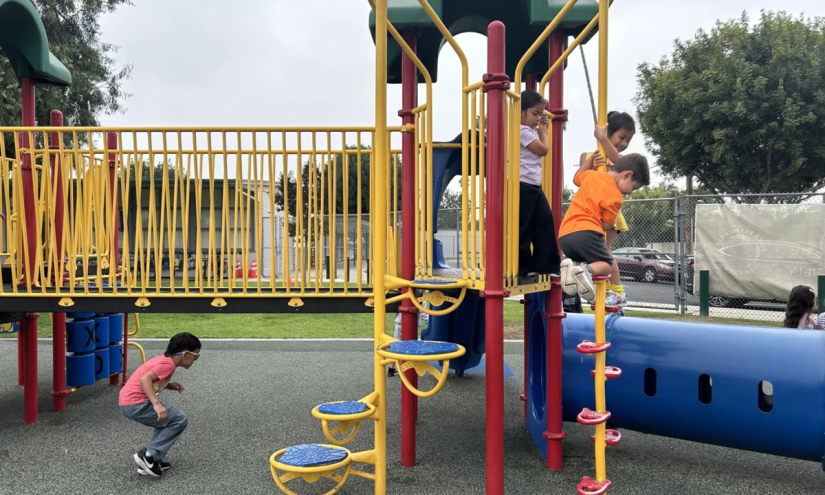
    A social skill students can learn in transitional kindergarten is how to take turns on the playground. (Mariana Dale/LAist)

    To help parents get a better sense of this new grade as they make their decisions, LAist reporters spent the day in three different classrooms across the Southland. Here are five things we saw children do.

    Get used to the structure and routines of school

    For many students, transitional kindergarten is their first introduction to a formal school preschool setting. Crystal Ramirez sent her 4-year-old to TK at Marguerita Elementary School in Alhambra, so he could get used to the rhythm and rigors of school.

    “I didn’t wanna put him straight into kindergarten when he was five, six, so he at least knows a routine, already,” she said. “Now, as soon as he sees that we’re in school, he loves it.”

    TK students, like other elementary school students, follow a schedule: morning bell, recess, lunch, second recess and dismissal. They’re also learning how to listen to instructions or stand in a line. Some are learning to go to the cafeteria for lunch.

    “ I wanna make sure that their first experience in a public school setting is one that is joyful, where they feel loved, where they feel welcomed, where they get to really transition nicely into like the rigor of the school,” said Lauren Bush, a TK teacher at Lucille Smith Elementary in Lawndale.

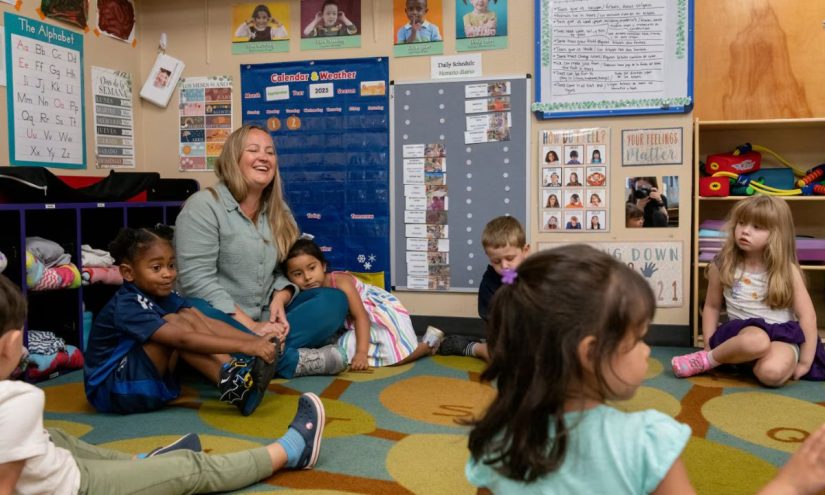
    Claudia Ralston, a TK teacher at Marguerita Elementary, said it can be hard for young kids to get up early and leave their moms and dads. But seven weeks in, many of her students have learned their routines already. She helps with the morning transitions by turning on soft instrumental music in the classroom, and allowing them free play until they regroup on the mat to discuss the day.

    “They’re four years old. I want them to feel safe at school, know that this is a special place for learning and that they play,” she said.

    Learn how to socialize and communicate

    In TK, social-emotional learning is a big part of the curriculum. That’s a fancy word, but it just means they’re learning how to be in touch with their emotions

    At Price Elementary in Downey, the teacher has her kids give an affirmation: “I am safe. I am kind. I matter. I make good choices. I can do hard things. All of my problems have solutions!” (They also have these sentences on classroom wall signs.)

    The children also learn how to interact with their peers. In some schools, there are no assigned desks so the kids can learn how to share the space.

    “ They’re able to problem solve. They’re able to use communication to get their needs, regulating their emotions. They do better than students who come in without this experience,” said Cristal Moore, principal at Lucille Smith Elementary.

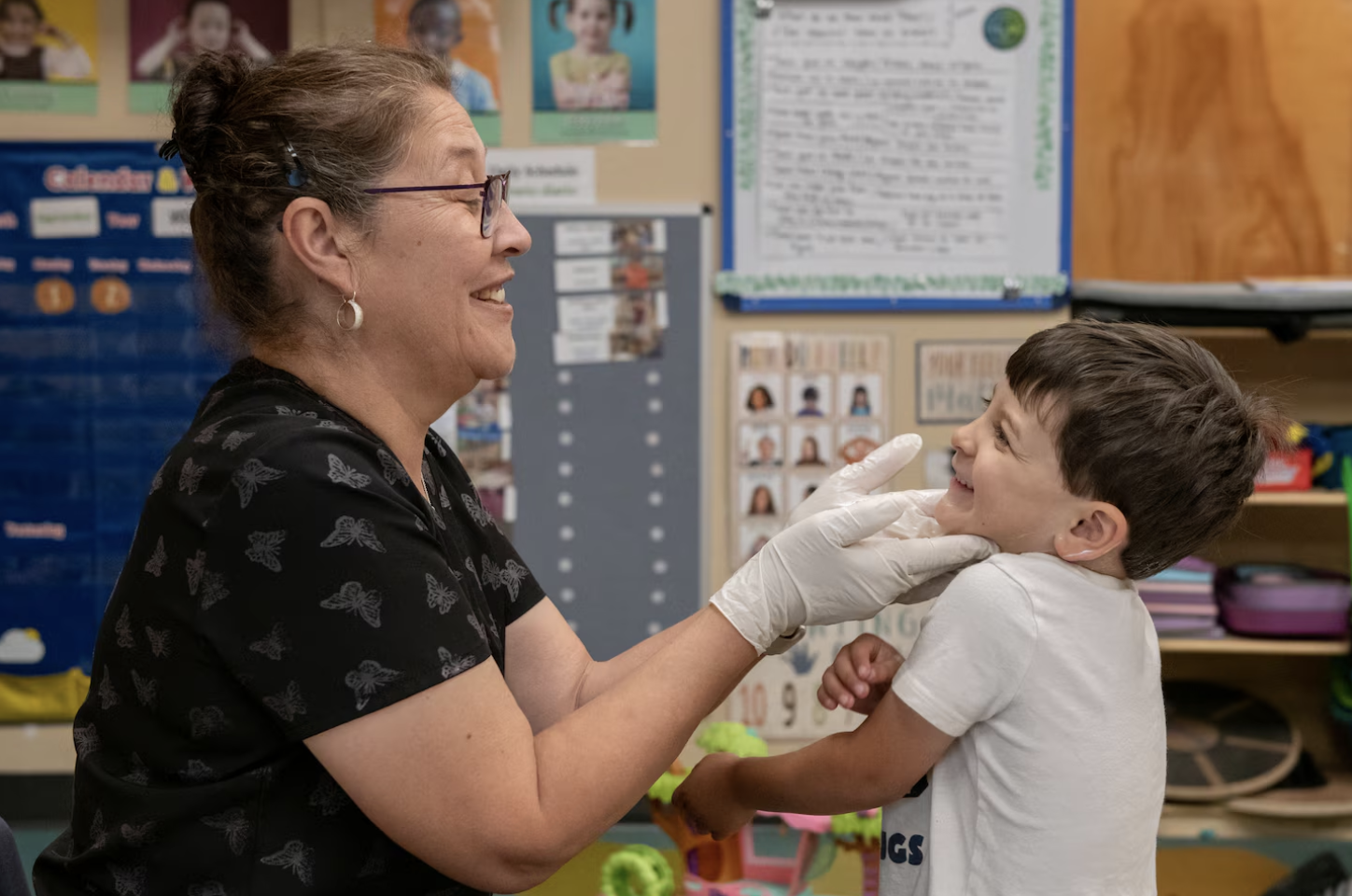
    On the playground, a student named Ava told teacher assistant Lizbeth Orozco that another student pushed her.

    “How did that make you feel?” Orozco asked.

    “Mad!”

    Orozco encouraged Ava to express her feelings to her classmate.

    “ We give them options of how to solve a problem and then they go in and solve it themselves,” Orozco said. “If they need extra help, they always come back and we can help them.”

    Arguing over toys can be a common occurrence in a TK classroom. At Price Elementary in Downey, educators help kids work through a solution. On a recent morning, one 4-year-old used two tongs to pick up paper shapes in a sensory bin, leaving another kid upset.

    “What’s the rule about sharing?” asked Alexandria Pellegrino, a teacher who gives extra support for one TK classroom.

    The boy handed over a tong to his peer. “Thank you so much for being a good friend,” Pellegrino said.

    “[It’s]  about being kind friends and making friends and using our manners. So we do build that foundation at the beginning of the year,” said Samantha Elliot, the classroom’s lead instructor.

    At the end of the day in Alvarez’s Lawndale TK class, she counts up the stars next to each student’s name earned throughout the day — earned for positive behavior like being kind, solving problems, trying something challenging, or showing effort in other ways. Ten stars earns a small prize from the treasure chest.

    “If we don’t get something today are we going to get mad?” Alvarez asked the class.

    “No!” they responded.

    “I’m not going to cry!” one boy piped up, followed by his classmate and a “Me too!” from another student.

    “That’s [a] positive attitude,” Alvarez said. “Because tomorrow you can get more stars!”

    Get exposed to numbers, shapes, letters

    In Elliot’s TK class, students use their own little lightsabers to trace letters in the air.

    “They’re learning the letter, the sound, and then a little action to go with it. They’re wiggling and moving and they’re also learning those letter sounds and they don’t really realize, so it’s incorporating instruction,” she said.

    There’s no mandated curriculum in TK, but instruction is supposed to align with the state’s Preschool/Transitional Kindergarten Learning Foundations. “Kindergarten is basically where the state standards go and kick in. There are standards in TK, but it’s a little bit different,” said Tom Kohout, principal at Marguerita Elementary.

    Students might put playdough into letter molds, or the teacher might pull out toys from a bag that all start with a letter “E.” Kids will play with little plastic toys that connect — or “manipulatives” — that can help them recognize numbers and patterns.

    “It’s play with a purpose,” Ralston said. “They’re just being introduced to the numbers, the colors, writing. But again, we’re not doing worksheets.”

    Build fine motor skills

    Molding pretend cakes with kinetic sand. Connecting small LEGO bricks. Cutting playdough. It might not seem like much, but children this age are still learning how to use their bodies.

    “Tearing paper is really hard and it’s a really amazing fine motor skill for them because the same muscles you use to tear paper are the same muscles that you use to hold a pen or a pencil,” said Lauren Bush, a TK teacher at Lucille Smith Elementary in Lawndale.

    “You see kids playing with dinosaurs. I see kids sorting by color, doing visual, you know, eye hand coordination and visual discrimination. I see them using their fine motor skills,” she said.

    At lunch, kids learn how to open up a milk carton or open a packaged muffin. At PE, they learn to balance on a block or walk in a straight line — learning spatial awareness.

    “They’re learning how to run, stop, things like that and playing because their bodies are so young,” said Principal Kohout.

    Learn independence

    For some kids, it might be the first time where mom and dad aren’t there to help carry their backpacks or help them go to the bathroom. TK is meant to help focus on their independence, though aides can help.

    TK classrooms are also usually set up with play centers, so kids can have the choice to explore on their own.

    “ I want them to be independent, to be able to solve their problems, you know, with assistance,” Ralston said.

    Samantha Elliot, the TK teacher in Downey, says she encourages kids to talk to their teammates first to figure out an activity before going to a teacher.

    “It’s just gaining the confidence and building that independence from basically the start of the school year,” she said.

    Parent Crystal Ramirez has already noticed a change in her 4-year-old this year since starting school. “ [He’s] socializing a little bit more, talking a little bit more, trying to express himself as well.”


    Did you use this article in your work?

    We’d love to hear how The 74’s reporting is helping educators, researchers, and policymakers. Tell us how
    Source link

  • How a San Diego Preschool Serves Kids After Trauma – The 74

    How a San Diego Preschool Serves Kids After Trauma – The 74


    Join our zero2eight Substack community for more discussion about the latest news in early care and education. Sign up now.

    Almost 20 years ago a San Diego nonprofit created a preschool to focus on the “little guys” — children who experience domestic violence and other serious traumatic events before kindergarten. 

    Today, Mi Escuelita is still going strong and it’s something of a model in showing other schools how to address childhood trauma.

    Mi Escuelita provides services for kids in a single location that for most other families would require intricate coordination among multiple health care providers, educators and social programs. 

    The children learn in a classroom that is always staffed with at least one therapist, they participate in one-on-one therapy, and join group therapy sessions. Their parents take part in special classes, too, where they learn ways to support their children.

    Researchers from UC San Diego have paid close attention to Mi Escuelita and followed how its graduates fared after leaving the preschool. The university also works with the school to evaluate outcomes from each cohort of students. Here are four takeaways from those reports.

    The kids leave ready for kindergarten

    Students who graduate from Mi Escuelia outperform or do at least well as their peers in kindergarten, according to a UC San Diego analysis of their scores in reading and math tests.

    It looked at kindergarten students in the Chula Vista Elementary School District from 2007 to 2013 and found a higher percentage of Mi Escuelita met math, reading and writing standards than the district’s general population.

    That’s not a given because research shows that children exposed to domestic violence have lower verbal ability than their peers, which can set them back in school. 

    And they do well for years

    The length of UC San Diego’s study allowed its team to follow Mi Escuelita graduates through fifth grade. The results suggested that their preschool experience helped the kids throughout their childhoods. 

    Their average scores on several standardized tests exceeded those of the general population at Chula Vista Elementary School District, especially in math.

    “Taken together, the Mi Escuelita program demonstrates clear benefits to children who may otherwise fall quickly and unsparingly behind with regard to school readiness,” the UC San Diego researchers wrote. 

    Better relationships at home

    Some families turn to Mi Escuelita in moments of distress, such as after experiencing domestic violence. The preschool provides counseling for parents and students alike, which may contribute to behavioral improvements at home.

    Over the past five years, 64% of the families in the program reported sensing fewer conflicts and 83% of them noticed an increase in closeness. 

    “Families reported that children’s communication, behavior, and listening skills improved both at home and at school,” a UC San Diego team wrote in an evaluation of student and parent surveys that spanned 2020 to 2024. 

    It takes a village

    Running Mi Escuelita costs about $1.3 million a year, a sum that nonprofit South Bay Community Services raises through a mix of donations and government funding. That cost — along with the challenge of hiring trained educators and therapists — makes the program difficult to replicate. 

    But, other schools and government agencies are watching Mi Escuelita to see what kind of services they can carry over to other venues. 

    “We can spend less later on intervention programs and alternative facilities,” said Hilaria Bauer, chief early learning services officer at Kidango, a Bay Area nonprofit childcare provider. “There will be less truancy, less big behaviors or expulsions or alternative programs, and all of those ‘fix’ initiatives if we really focus on the time in the life of a child that really makes a change.”


    Get stories like these delivered straight to your inbox. Sign up for The 74 Newsletter

    Source link

  • Colorado’s 3rd year of Universal Pre-K Gets Off the Ground – The 74

    Colorado’s 3rd year of Universal Pre-K Gets Off the Ground – The 74


    Join our zero2eight Substack community for more discussion about the latest news in early care and education. Sign up now.

    Sign up for Chalkbeat Colorado’s free daily newsletter to get the latest reporting from us, plus curated news from other Colorado outlets, delivered to your inbox.

    The little boy clung to his mother as she carried him through the wooden half-door of the preschool classroom on Tuesday morning. Tears streamed down his face. It was going to be a tough drop-off.

    While other children finished bananas, raisin bagels, and milk, Vraja Johnson, the lead teacher, ushered the mother and son toward a cozy corner in the back of the classroom. She spoke softly in English and Spanish to the nervous preschooler. Several minutes later, when his mother had slipped away, the boy nestled into a large blue beanbag clutching Tucker the Turtle, a stuffed animal that helps preschoolers understand that it’s OK to retreat into your shell — and to come back out when you’re ready.

    It was the first day of preschool in the Otters classroom at El Nidito, a bilingual child care program at The Family Center in Fort Collins. The little boy and his 11 classmates are among 40,000 children enrolled in Colorado’s universal preschool program this year. The $349 million program offers tuition-free preschool — typically a half day — to all children in the year before kindergarten.

    Now entering its third year, Colorado’s preschool for all program has smoothed out since its rocky rollout in 2023. At the time, application system errors, glitches in the state’s preschool matching algorithm, and last-minute reductions in preschool hours for some children caused widespread confusion and frustration.

    A national early childhood group recently ranked Colorado third in the country for the share of children served by state-funded preschool. Around 70% of the state’s 4-year-olds are enrolled in the program, which generally covers about $6,000 a year in preschool costs per child.

    But wrinkles remain. The state is still fighting two lawsuits brought by religious preschools that objected to non-discrimination rules protecting LGBTQ children, families, and employees. Both suits are pending in federal appeals court. And the national early childhood group found that Colorado meets only two of 10 benchmarks meant to ensure that preschool classrooms are high quality.

    Currently, the “universal preschool” label doesn’t indicate anything about the caliber of classroom a child will join. Rather, it simply indicates the state is paying for 10 to 30 hours of class time. Of about 2,000 preschools participating in the program, some have the state’s lowest rating and meet only basic health and safety standards.

    Others, including El Nidito, which has been around for 25 years, have the state’s highest rating.

    A morning in Johnson’s classroom makes it easy to see why. She and her co-teacher, an experienced sub named Maria Chavira, are warm, cheerful, and organized. Their young charges are curious, silly, and always in motion.

    Maria Chavira, a substitute teacher at the El Nidito child care program in Fort Collins, puts sunscreen on a preschool student before they go outside. (Rachel Woolf for Chalkbeat)

    During breakfast, two boys held bananas up to their ears like phones.

    “Ring, ring, ring. Hi, Henry,” one said as the other burst out laughing.

    Nearby at the sensory table, as one little boy poured dried pinto beans through a cardboard tube, he said, “Did you ever watch ‘Boss Baby?’ The baby is a bossssss. Babies can’t be bosses!”

    Meanwhile, the little boy who’d struggled to leave his mother was getting braver, slowly testing the waters of group play. One minute he crouched next to a little girl in front of a tree house play set. Later, he tried out bear and leopard hand puppets as the Boss Baby skeptic threw Tucker the Turtle up in the air next to him.

    Johnson, who switched from a sales and marketing career to early childhood education in 2007, seems to have a sixth sense for detecting imminent meltdowns, skirmishes, and rule-bending.

    She quickly peeled away from a conversation with a visitor when a little girl dressed in head-to-toe pink accidentally got a squiggle of red marker on her new cowboy boots.

    “Your mom can get that out. The markers are washable,” Johnson said as tears welled in the preschooler’s eyes.

    Then she averted the crisis with five words: “Do you want a hug?”

    Chalkbeat is a nonprofit news site covering educational change in public schools.


    Get stories like these delivered straight to your inbox. Sign up for The 74 Newsletter

    Source link